After Finance Minister Nirmala Sitharaman announced that RBI will launch a digital Rupee in her budget speech yesterday, Finance Secretary TV Somanathan has confirmed that India’s digital currency will be backed by the Reserve Bank of India which will be the only legal digital currency in the country. In a post-budget briefing in Delhi on Wednesday, the North Block official said that the money will be issued by the RBI but the nature will be ‘digital’. He also added that other digital currencies or cryptocurrencies will never become legal tender in the country.
Digital currency will be backed by @RBI which will never be default. Money will be of RBI but the nature will be digital. Digital rupee issued by RBI will be a legal tender. Rest all aren’t legal tender, will not, will never become legal tender: Finance Secy TV Somanathan pic.twitter.com/aZCmZ1k5aH
— Prasar Bharati News Services पी.बी.एन.एस. (@PBNS_India) February 2, 2022
“Digital rupee issued by the RBI will be a legal tender. Rest all aren’t legal tender, will not, will never become legal tender” he said in the press conference. Somanathan has advised that other cryptocurrencies like Bitcoin, Ethereum or NFT will never become legal tenders. Instead, these cryptocurrencies will be considered as assets where investments can be made. “Crypto assets are assets whose value will be determined between two people. You can buy gold, diamond, crypto, but that will have not have the value authorization by the government” he added.
Bitcoin, Ethereum or NFT will never become legal tender. Crypto assets are assets whose value will be determined between two people. You can buy gold, diamond, crypto, but that will have not have the value authorization by govt: Finance Secy TV Somanathan
— Prasar Bharati News Services पी.बी.एन.एस. (@PBNS_India) February 2, 2022
Secretary Somanathan further said, “People investing in private crypto should understand that it does not have the authorisation of the government. There is no guarantee whether your investment will be successful or not, one may suffer losses and govt is not responsible for this”. While making the government’s stance clear on the issue, the FM had announced in her budget that an RBI-issued ‘Digital Rupee’ will be introduced as a digital currency, and the government will levy a 30 per cent tax on gains made from any other private digital assets from April 1, 2021.
Taking a definite stand on the cryptocurrency issue, Central Government’s Budget 2022-23 stands out by regulating digital currencies while charging a 30% tax on income generated through it. Whilst, it has been now confirmed that other currencies will not have legal tender, the Digital rupee backed by RBI will stand as the only legal digital currency in the market.
A model who had attempted to commit suicide by jumping from a hotel in Jodhpur in Rajasthan on Sunday, January 30, was forced to honeytrap the state’s revenue minister Ramlal Jat, revealed the Rajasthan police as they arrested Akshat Sharma alias Sagar alias Chinnu and Dipali from Udaipur for blackmailing the girl.
Three arrested for blackmailing a model and allegedly trying to honey trap Rajasthan minister Ramlal Jat
Two days ago,a woman attempted suicide by jumping from the top floor of a hotel. She’s currently in hospital & undergoing treatment: Bhuvan Bhushan Yadav, Dy CP (E), Jodhpur pic.twitter.com/e7IAUuNfxF
The police said that the duo was forcing the model, who was associating the former for modelling assignment in Udaipur, to honeytrap the minister in the Ashok Gehlot government. They also coerced her to implicate Revenue Minister Ram Lal Jat in a sex scandal, said the police.
Accused duo shot an explicit video and used it to blackmail model to implicate the minister in a sex scandal, reveals the Rajasthan police
Jodhpur DCP (East) Bhuvan Bhushan Yadav said that during the preliminary interrogation, it was revealed that the accused had recorded an explicit video of the model and used it to blackmail her to implicate the minister in a sex scandal. They reportedly took her to Bhilwara on Saturday and tried to force her to sleep with the minister, but she was able to flee Bhilwara and return to Jodhpur. When she arrived in Jodhpur, she notified her family about the situation. Instead of returning home, she went to a hotel and jumped from the top floor.
Fortunately, she landed on a car below. Her father, who hurried to the hotel after getting the news of the attempted suicide, rushed her to the hospital with several fractures and in an unconscious state. On Tuesday, after she regained consciousness, she gave her statement to the police.
“Based on her statements, we arrested Akshat and Dipali. They have a record of honey trapping rich and important persons in the past,” said Yadav.
The DCP further stated that the accused duo had recorded a video of the model bathing and used it to coerce her into honey trapping the minister. The two wanted the minister to clear some files, which he had refused to do during a meeting with them in the Bhilwara Circuit House.
State renenue minister responds after the scandal cane to light
Speaking about the incident, Revenue Minister Ram Lal Jat said on Wednesday that two ladies posing as journalists had met him in connection with some work, but he had told them it couldn’t be done because the matter was unrelated to his department. The minister stated that he was unfamiliar with the women.
“When I was in Bhilwara, two women called my PA on Friday night, seeking an appointment. As it was too late, I asked the PA to call them next morning at a public hearing,” the Rajasthan minister said.
He added that a man had also called him earlier claiming to be the head of a news channel. Later, the women introduced themselves as reporters from the channel. They met him on Saturday morning, according to Jat, and showed him a paper.
“I went through it but the matter was not related to my department and I told them that clearly. I have never met them before. After I turned them down, they left,” the minister said in Jaipur.
Meanwhile, Police said that the accused Akshat Sharma, who is from Jaipur, has a criminal background and was arrested in a case of honey trap in the past also. Both the accused are being interrogated.
Reacting to the issue, Rajasthan Minister Pratap Khachariyawas said that revenue minister Ram Lal Jat has innocent. “Honey trap cases and conspiracies have been underway since the inception of dynasties,” Khachariyawas said.
“Earlier, kings were killed in this way. So these conspiracies will happen in politics. But what can the minister do? He didn’t know anything,” Khachariyawas added.
Madhya Pradesh honey-trap racket
It may be recalled that a major high profile honey-trap racket was uncovered in Madhya Pradesh in 2019 in which 13 IAS officers, a former Chief Minister and Governor was possibly honey-trapped by a gang. The wife of the state coordinator of Congress party’s IT Cell was also arrested for her involvement in the racket.
The Special Investigative Team (SIT) that was formed to investigate the high profile honey-trap racket, had confiscated nearly 4,000 files containing screenshots of sex chats, videos of officers in compromising positions, and audio clips have so far been recovered from laptops and mobile phones from the honeytrap ring.
The arrested women in the honey-trapping racket are identified as 39-year-old Shweta Vijay Jain, 48-year-old Shweta Swapnil Jain, 35-year-old Barkha Soni (wife of former Congress IT cell vice-president), 34-year-old Aarti Dayal and an 18-year-old college student. Omprakash Kori, 34, who drives Aarti Dayal’s car was also arrested.
Shweta, the kingpin, had reportedly confessed that she had trapped dozens of college girls and made them sleep with bureaucrats and politicians. Videos were made of these sexual escapades and these videos were then used by the gang to extort money.
Senior Congress leader Rahul Gandhi on Wednesday accused the Modi government of using Judiciary, Election Commission, Pegasus as instruments of destroying the voice of the Union of states.
“The Judiciary, the Election Commission, Pegasus, these are all instruments of destroying the voice of the union of states,” Rahul Gandhi said in Lok Sabha while speaking on Motion of Thanks to President’s address during Budget session 2022.
#WATCH | “The Judiciary, the Election Commission, Pegasus, these are all instruments of destroying the voice of the union of states,” says Congress MP Rahul Gandhi in Lok Sabha pic.twitter.com/BQzxXf9VM7
However, soon after the Gandhi scion raised aspersions on the judiciary, election commission and branded them as puppets of the central government, Union Law Minister Kiren Rijiju condemned his statements and asked the Wayanad MP to apologise to the nation. Taking to Twitter, Rijiju said, “Not only as India’s Law Minister but also as an ordinary citizen, I condemn what Rahul Gandhi has said about India’s judiciary and EC. These are vital institutions of our democracy. Rahul Gandhi should immediately apologise to the people, judiciary and EC.”
Not only as India’s Law Minister but also as an ordinary citizen, I condemn what Mr. Rahul Gandhi has said about India’s judiciary and EC.
These are vital institutions of our democracy.
Mr. Rahul Gandhi should immediately apologise to the people, judiciary and EC. https://t.co/FJk2EPpBq5
Besides, the former Congress president also tried to corner the Centre on the issue of China and Pakistan. Stating that the Chinese have a very clear vision of what they want to do, Gandhi accused the central government of bringing China and Pakistan together. “The single biggest strategic goal of India’s foreign policy has been to keep Pakistan and China separate. What you have done is, you have brought them together,” he proclaimed.
“Do not be under any illusion, do not underestimate the force that is standing in front of you. You have brought Pakistan and China together. This is the single biggest crime that you could commit against the people of India,” Gandhi added.
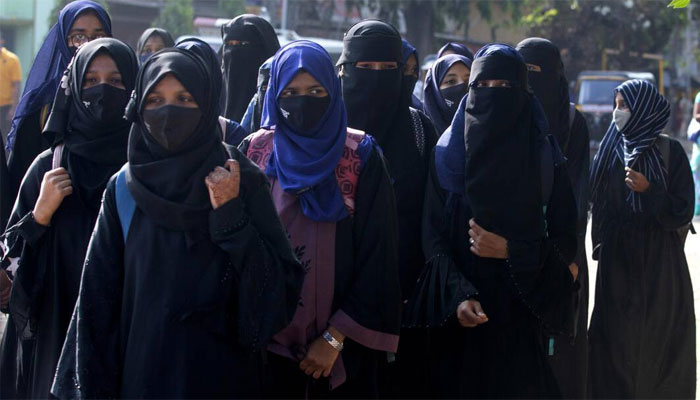
As the Hijab row in a college in Udupi in Karnataka refuses to cool down, a similar controversy has occurred in another college in the state. The latest Hijab issue from Government Junior College in Kunadapur, where Hindu boys are protesting against Muslim girls coming to the college wearing Hijab. On Wednesday, around 100 Hindu students came to the college with saffron scarves around their necks to protest against Muslim girls continuing to wear Hijab to the college.
Reportedly, 27 Muslim girls who study in the college had been coming to the campus wearing hijab, which is being protested by other students. As the girls refused to remove the Hijabs after they were asked to do so by the other students, some boys decided to come to the college with saffron scarves.
After the controversy erupted, Kundapur MLA Haladi Srinivas Shetty along with the school management held a meeting with the parents of Muslim students, but the issue could not be resolved as the parents refused to let their children come to the college without Hijab. The parents said that the Muslim girls have a right to wear hijab in the college and said that it was not fair to bring religion among the students in the educational institutions. “Our students are not wearing Burkha but are only wearing Hijab. It is not good to bring religion among the students in the educational institution,” the Muslim parents said.
“If you don’t want our students to wear Hijab in the college, let the Principal give written instructions for the same, and then we will decide whether to send our students to the college or not,” the parents further added.
In the videos from the meeting that went viral on social media, Muslim parents argued that they never discriminated against any religion and sent their children to the college during all Hindu festivals. “When it comes to Hijab it is mandatory. We have to do it. Don’t discriminate between them. They come here to study,” said a parent in the video.
A meeting was also conducted by management along with local MlA with parents of the students. A parent of the girl student can be heard saying we didn’t discriminate. We sent our students during all the #hindu festivals. Why is that you are discriminating with out students (2/2) pic.twitter.com/OSDbdravXM
Responding to the stand taken by Muslim students and their parents, Hindu students said that they will continue to wear saffron scarves until the Hijab is banned on the campus.
According to the reports, the MLA has said that he will initiate action against those wearing Hijab and Saffron scarfs to the college as the meeting ended without any conclusive decision. This is a day after students of the girl’s pre-university college in Udupi district moved to the Karnataka High Court seeking to allow the right to wear a hijab inside the classroom.
The petition stated that the student’s right to wear a hijab is a fundamental right guaranteed under Article 14 and 25 of the Constitution and is an essential practice of Islam. The petition also sought to permit students to attend classes wearing hijab without any interference from the college administration.
The controversy has been raging since early January that has forced the state to call for a committee to look into the matter and take a call on pre-university college uniforms across the state. Management under the new state guidelines has asked girl students to skip wearing hijab while in the college. Eight girl students have constantly refused to the guideline in practice of the Islamic faith.
The actions of the college administration are unconstitutional, arbitrary and exclusionary in nature, the petition claims as the college in Udupi denied entry to eight students wearing hijab. The first hearing in the case is expected to be held by the end of this week.
Since 5th August 2019 when article 370 was abrogated and the state was converted into two separate union territories, nearly 1700 Kashmiri Pandits were appointed by the Jammu and Kashmir government in various departments. This information was provided in Rajya Sabha by Nityanand Rai, the Union Minister of States for home affairs, on Wednesday. He has further said that as per the data provided by the government of Jammu and Kashmir, 44,684 Kashmiri migrant families were registered with the Office of the Relief and Rehabilitation Commissioner (Migrants), Jammu. These families comprise 1,54,712 individuals.
Nityanand Rai, while answering a written question, has said “In order to rehabilitate Kashmiri migrant families, the government of Jammu and Kashmir has appointed 1,697 such persons since August 5, 2019, and selected additional 1,140 persons in this regard.”
During the winter session of the parliament, the Union Ministry of home affairs had informed that no Kashmiri Pandits had been displaced from the Kashmir valley since 5th August 2019 when Union Home Minister Amit Shah had moved a bill to abolish article 370 and article 35a in the upper house of the Indian parliament. With President’s assent, Article 370, which granted a special status to the state of Jammu and Kashmir was scrapped from the Indian constitution, and consequently, the state was divided into two Union territories—Jammu and Kashmir and Ladakh.
Nityanand Rai also said 439 terrorists were killed after the repeal of Article 370 in Jammu and Kashmir. 98 civilians & 109 security personnel also lost their lives & 541 incidents of terror were reported during this period.
439 terrorists were killed after the repeal of Article 370 in Jammu and Kashmir. 98 civilians & 109 security personnel also lost their lives & 541 incidents of terror were reported during this period: MoS Home Nityanand Rai in Rajya Sabha
It is also notable that after the abrogation of article 370, the stone-pelting protests have also been reduced to zero and NIA has cracked down to seize terror funding trails and separatist leaders in the valley.
The illegal mosque inside the Krantiveera Sangoli Rayanna railway station on platform number five has been converted back to a porters’ restroom on 2nd February 2022. The action was taken after Hindu activists protested against the mosque and urged the South Western railways’ officials to take legal action against the unauthorized place of worship.
A report published in Indian Express said that after a protest by Hindu Janajagruti Vedike members, South-Western railways officials have restored the mosque back to the porters’ restroom as it earlier was. According to the report, an SWR officer has said “The restroom is the porter’s place and even today they are the ones who take care of it. We have never interfered in their restroom and they have never complained about their colleagues performing prayers. The issue will be solved in consultation.”
Porters’ restroom’s exterior is painted blue again. Earlier, when converted to a mosque, it was painted green.
The issue was actually raised by a social media user who had made a video of this illegally converted mosque wherein it was clearly shown that it earlier used to be a porters’ restroom and still the interiors of the room were painted and made up like that of a mosque. The South Western Railways (SWR) repainted the walls of the room on Tuesday and deployed personnel of the Railway Police Force (RPF) after locking it.
This is how a porters’ restroom was converted to a mosque at Bengaluru.
The colour code used by the railways for the original construction was white and blue. The Muslims painted it green to underline the exclusivity as non-Muslim porters were not allowed to enter the porters’ restroom as it was converted to a mosque.
The porters’ restroom is now restored.
The mosque was not only converted back to the restroom but all the paraphernalia related to the mosque were also removed. The interior and exterior of this room are again painted blue as before.
A photo frame comprising of different religious symbols is also fixed on the inner wall of the room.
A photo frame comprising of different religious symbols put together is also fixed on the wall to emphasize that this is a public place and does not belong to any particular religion.
Hindu activists protest against alleged illegal mosque at Bengaluru railway station
A controversy had erupted in Bengaluru after Hindu activists in the city protested against the illegal conversion of public property inside the Krantiveera Sangoli Rayanna railway station to a mosque.
A video had gone viral on the internet a few days ago, in which it was alleged that a mosque was unlawfully set up by converting a porters’ restroom on platform number 5 of KSR railway station in Bengaluru. A social media user had released a video on Twitter alleging that the porters’ restroom at a platform in KSR railway station in Bengaluru was converted into a mosque.
The videos stoked massive controversy in the state, leading to which the civilians in the city protested against the illegal conversion of public property into a mosque. On Monday, the members of Hindu Janajagruti Vedike also protested against the South Western Railway officials for allowing the unlawful conversion of porters’ rooms inside the railway station
The Central Government on Wednesday informed the Kerala High Court that its decision to revoke the licence of the Malayalam news channel MediaOne was based on credible national security concerns flagged by the Ministry of Home Affairs (MHA). On Monday, The Kerala based news channel went off the air after Union Information and Broadcasting Ministry suspended its licence over security concerns. After that, the channel had approached the Kerala High court challenging the order.
During a hearing in the matter at the High Court today, in a statement filed through Assistant Solicitor General S Manu, the Central government said that going by the decision of the Supreme Court for the case in a situation of national security, a party cannot insist on the strict observance of the principles of natural justice. Earlier On January 31, after the channel MediaOne went off the air, The Kerala High Court had deferred the Central Government’s order for two days until the hearing which happened today.
The Central Government while opposing any grant of reliefs to the operation of the channel has said that doing so would defeat the purpose of the guidelines that are set in place for granting security clearance. The Ministry of Home Affairs has refused to state details on the concerns raised by MHA against MediaOne as of now. The statement filed by the Central Government read, “The MHA has informed that denial of security clearance in the case on hand are based on intelligence inputs, which are sensitive and secret in nature, therefore, as a matter of policy and in the interest of national security, MHA does not disclose reasons for denial. It is submitted that the interim order passed by this Hon’ble Court if continued is defeating the purpose of the relevant guidelines and objective of obtaining the security clearance of MHA”
Further stating that while the Ministry of Home Affairs does not directly communicate with media companies, the Centre rejected the petitioner’s claim that the company had written to the ministry for security clearance but received no reply from the MHA. “In this connection, it is clarified that the applications for renewal is first examined in the Ministry of Information and Broadcasting and then Ministry sends the proposal to the MHA for security clearance,” the reply stated.
The Centre had clarified that a show-cause notice was also sent to the company in 2016 when the MHA had denied security clearances to the permission of opening additional TV channels by the Media house M/s Madhyamam Broadcasting Limited. In 2012, The Media House had sought permission from the centre to uplink and downlink “of a Non-News TV channel “Media One Life” and News TV Channel “Media One Global”.
However, In reply to the above clarification by the Centre, the media company has said that they were unaware of the denial of security clearances since they were never communicated for the same. According to the Central Government, the permission for uplinking and downlinking “Media One Life” was cancelled on September 11, 2019, while denying the security clearance.
The exponential growth of the cryptocurrency in India was just a phenomenon until it was given a considerable attention by the government. Taking a conservative stand on the taxation of digital currency, Finance Minister Nirmala Sitharaman on Tuesday announced that government would earn 30% behind every penny of profit earned by way of transfer of virtual money. Also, to minutely capture the crypto transaction details, the Union Budget 2022 introduced 1% of tax deduction at source (TDS) for every transaction beyond a threshold limit.
Giving a legal status to crypto assets, the government further said that it would come up with a new digital rupee issued by the Reserve Bank by 2022-23. The Central Bank Digital Currency (CBDC) once traded would be powered by the block chain technology and will remain permanent. Though the blockchain technology will allow to record the CBDC transaction in a transparent manner, the traders won’t be allowed to revise or change the authenticate record, the Budget read.
#WATCH | FM Nirmala Sitharaman speaks on proposed Digital Rupee & cryptocurrencies: What RBI will issue is a digital currency. Everything that prevails outside of it is assets being created by individuals & we are taxing profits made out of transactions of those assets, at 30%. pic.twitter.com/acVOktqosH
Of the key issues yet to be analysed, government charging 30% tax on income from cryptocurrency is a big proof of the shift in the centre’s outlook on the legitimacy of the digital currency. This is because though the study of the dynamic behavior of the cryptocurrency is under process, the Centre already is looming to charge a little over 1 million crypto traders with such bulky rate. Whereas, more than 15 million share traders are accountable for just 15% to 20% tax on dividend, depending on the taxable income and filing status, that remains unchanged.
While India initially had pledged to impose complete ban on dealing in crypto assets, policy direction based on Budget 2022 and statements by government officials now appears to be moving towards regulating crypto assets. Let’s look at how the financial mechanism of India is on the verge of shift and swap catering to the current 9.6% estimated growth factor-
What is cryptocurrency?
A cryptocurrency is a digital form of currency secured by cryptography that can be circulated without the need for a central monetary authority such as government or a bank. The cryptographic technique used in creation through decentralized financial network enables people to exchange them securely for any goods or services.
At the core of functionality of cryptocurrency is the block chain technology which is a set of connected blocks or an online ledger. Being highly secure tech, it demands every single node of the entire network to agree upon the computer maintained copy of the ledger.
How many number of cryptocurrencies are there?
According to the CoinMarketCap, there are more than 17,000 different cryptocurrencies that are traded publicly and continue to proliferate. The total value of all cryptocurrencies as on January 28, 2022 was about $1.7 trillion, having fallen substantially from an all time high above $2.9 trillion late in 2021.
The most popular trading cryptocurrencies by market capitalization as tracked by the report are Bitcoin ($717.5 billion), Ethereum ($303.1 billion), Tether ($78.2 billion), BNB ($63.6 billion), USD Coin ($49.6 billion), Cardano ($35.4 billion), XRP ($29.2 billion), Solana ($28.9 billion), Terra ($20.3 billion) and Dogecoin ($18.8 billion).
The launch of the Central Bank Digital Currency in India
The Reserve Bank of India has been a staunch opponent of crypto since 2013. Four years after the world’s first crypto currency, bitcoin was launched, the Reserve Bank of India had opposed to legalize its financial status in India citing the economic and security risk involved. The opposition became stronger only when it stated the need for ‘complete ban’ on crypto and ordered banks not to facilitate it. A Supreme Court ruling in 2020, however, set aside the central bank’s order.
The regulator was worried that the usage of digital currency could undermine its entities and destabilise the economy until yesterday when it approved the launch of CBDC by 2023. The move comes amid the government’s plans to introduce a Bill on cryptocurrency that seeks to prohibit all private cryptocurrency in India with certain exceptions. What makes CBDC different from decentralized virtual currencies and crypto assets is that it will probably be backed by the state and will no more lack the legal tender status. It will enable the users to conduct both domestic and cross border transactions which do not require a third party or a bank to approve.
It is important to note that India is not the only country who would launch digital currency. Last year in October, Nigeria launched eNaira along with CBDCs lofted in Bahamas and five other islands in the East Caribbean.
The need for regulation of cryptocurrency system
Virtual Currencies are not fiat currencies but basically collection of binary data stored using cryptography to secure the transaction records. They are distributed over a vast network of computers and cannot exceed a certain limit. For instance, there are only a 21 million bitcoins issued and as the demand for these increases, so does its value. It works on the principle of demand and supply, as applied in the securities.
The transaction cost while using the crypto currencies is also reduced as the third party commission like that of Visa or Master Card is totally cut down. They can be stored in a digital wallet, which can only be accessed by a private key. The most significant advantages of crypto is that they can be mined by a computer that involves a process of solving arithmetical problems or algorithms, which are used to verify transaction blocks to be added to the block chain. One can also use a computer to validate these transactions and, as a reward, receive a cryptocurrency.
While crypto already has these many advantages, the only reason why the India has proposed to regulate digital coin is privacy. The block chain technology used by crypto currencies is highly secure, therefore, the Government finds it challenging to trace the origin and keep record of a private crypto transaction. Another important concern is that crypto is not supported by any commodity and has potential risk of loss in values if the promoter of the crypto stops trading activity.
Are digital currencies also good mode of investments?
While digital currencies promise to streamline the existing financial architecture to make it faster and cheaper, there reportedly are two ways in which a user can deal in them- one is as typical currency and other as the security investment. The digital currency can either be generated or bought via a software (wallet) that contains partial or full history of transactions that have occurred in its network. But holding crypto as investment is of major risk due to the price volatility issue involved.
The recent instance of the Squid Game Crypto Scam is a big slap on face of those who see crypto as investments. Reports mention that the promoters scammed an estimated $ 3.38 million, by drawing in buyers and thereafter stopped trading, leaving the buyers with tokens which had no financial value there after.
Investors usually are seen rushing around to buy or invest in cryptos as they presumably think cryptos might become more valuable. But for those who see cryptocurrencies such as bitcoin as the currency of the future, should also think upon ‘currency needs stability’ theory.
The Cryptocurrency and Regulation of Official Digital Currency Bill, 2021
The government last year had proposed to table the bill to ban all the private cryptocurrencies in India but could not make it to the Budget this year. As the crypto trading platforms are witnessing substantial jump in volumes, the bill ideally serves to introduce a level of uniformity of understanding and providing security, also preventing misuse of the virtual currency.
However, the penalties prescribed under the bill seem to be disproportionately harsher when compared with similar economic offences. The fact of the matter remains that as with any other system, there exists an inherent risk in CBDCs too. Introducing a digital rupee might be of a benefit when single window regulation is thought through but concerns regarding price volatility need to be addressed clearly by the government.
According to a recent report, WazirX, India’s biggest Cryptocurrency exchange registered an annual trade of over $43 billion. If the government had pre-plans to charge 30% tax on earnings from crypto assets, it would have been a win-win situation for the traders and the government if no ban was incurred in first place. The Indian cryptocurrency market is expected to reach up to $241 million by 2030 in India and $2.3 billion by 2026 worldwide.
A Delhi Court today continued hearing Umar Khalid’s bail plea in connection with Delhi Riots larger conspiracy case involving charges under IPC and UAPA. Special Public Prosecutor Amit Prasad, appearing on behalf of the Delhi police Wednesday, February 2, presented more evidence before Additional Sessions Judge Amitabh Rawat, to oppose the bail plea of Anti-Hindu Delhi Riots accused Umar Khalid.
The Prosecutor began today’s argument by presenting the excerpt of a meeting that was held in Chand Bagh on 15th and 16th January 2020. He said that as accounted by one of the witnesses, “Dande, Patthar, Lall Mirch, Tezaab ikkathey kiye gaye” (Sticks, Red Chilli, Acid and stones collected). The prosecutor, here, wondered what was the purpose to collect such things in a protest that the accused like Umar Khalid had termed ‘peaceful’. He further stated that the witness had revealed that the conspirators gathered ladies and gents who were handed over lathi’s, stones, gravel etc.
“Peaceful protest me lathi (sticks), dande (batons), aur laal mirch (red chilli)!! How peaceful can that be”, questioned Amit Prasad.
To substantiate claims that a larger conspiracy to cause communal riots was hatched by Umar Khalid, SSP Amit Prasad read out a statement of a witness who had confirmed that Umar Khalid during a meeting had said: “Sarkar musalmano ke khilaaf hai, bhashan se kaam nahi chalega, khoon bahana padega,” translated as (The government is against the Muslims, only talking is not enough, we will have to shed blood).
At a meeting @UmarKhalidJNU told Gul during a meeting “Sarkar musalmano ke khilaaf hai, bhashan se kaam nahi chalega, khoon bahana padega”: Prosecutor reads a statement by witness #Delhiriotspic.twitter.com/llJXLY8MWJ
Prasad further informed the court that various WhatsApp groups, including the Jamia Coordination Committee (JCC) and the Delhi Protest Support Group (DPSG), were formed to coordinate information regarding protest places.
He went on to say that the Jamia Awareness Campaign Team was formed to raise awareness about the protest sites and mobilise individuals to participate in the plot.
Prasad further went on to share screenshots to show the messages in the Delhi Protest Support Group (DPSG) group, exchanged on 16th and 17 February by one Owais Sultan Khan. “There is no mincing of words. ‘Your proposal to incite violence’ and local people have evidences. And these local people have now come up to support a case of Prosecution”, said SSP while he read some Whatsapp messages exchanged between the conspirators of the anti-Hindu Delhi riot.
“Aag lagwane ki poori tayyari hai” (We have everything we need to ignite a fire)”, read one message shared on the Whatsapp group which Umar Khalid, Khalid Saifi and others part of DPSG were a part of.
Umar Khalid and others part of DPSG. On the group there is a message “Aag lagwane ki poori tayyari hai” (We are entirely ready to light a fire): Prosecutor #DelhiRiotspic.twitter.com/fumc5JWKWn
It may be recalled here that the Special Cell of the Delhi Police had in July 2020 unearthed a connection between hate preacher Zakir Naik and Khalid Saifi, a facilitator in the Delhi anti-Hindu riots. As per the status report filed, Saifi, a close associate of Islamists such as Tahir Hussain and Umar Khalid, had met Naik in Malaysia to raise funds for the Delhi anti-Hindu riots. In fact, the chargesheet filed by the Delhi Police in connection with the anti-Hindu riots in Delhi in January 20201 mentioned the confession made by former AAP Councilor Tahir Hussain. The confessions had revealed the sinister agenda behind the conspiracy hatched by the Islamist along with his comrades Khalid Saifi and JNU ‘scholar’ Umar Khalid.
Further opposing Umar Khalid’s bail petition, SSP Amit Prasad told the city court that the 2020 North East Delhi riots were committed as part of a ‘conspiracy of silence,’ with the goal of utterly paralysing the system.
BJP Leader Kapil Mishra’s name was used by accused to build a narrative: SSP
Presenting his argument in front of Additional Sessions Judge Amitabh Rawat, the prosecution further argued that BJP leader Kapil Mishra’s name was used by the accused to “build a narrative.”
Prasad read another message by Khalid Saifi on Whatsapp that said that there is a complaint that has been filed against BJP leader Kapil Mishra. The Prosecutor told the court that this was nothing but a way to deflect and put the blame on Mishra, whereas it was clear from chat logs that Jaffrabad violence was planned.
Prasad told the court, “There was a proposal to incite violence as on 17th February 2020 which is the time when you draw a narrative that Kapil Mishra came there…Where was Kapil Mishra then? He has not even surfaced anywhere and your proposal to incite violence has surfaced.”
Speaking of the riots in phases, the prosecution stated that the “first phase of rioting in late 2019 and January 2020 was a failure” and that the “second phase of riots in February 2020 was employed to carry out the plot.”
Further, referring to the charge sheet, the SPP argued, “People involved in both the phases were common… meetings which happened, Umar Khalid was sitting there with Sharjeel Imam. The presence of Sharjeel Imam was admitted in his own speech, Umar Khalid’s presence was there in the picture.”
Prosecutor draws parallel between 9/11 US terror attack and Delhi-riots to oppose bail plea of Umar Khalid
The prosecutor representing the Delhi Police had earlier on January 29, Friday compared the planning of the February 2020 riots to that of the 9/11 terror attacks in the US while opposing former JNU student Umar Khalid’s bail plea.
To counter Umar Khalid’s claim that he only sent five messages on a WhatsApp group and was not present at the site, Amit Prasad, appearing for the Delhi police, cited the example of the 9/11 terror attack in the USA. Prasad stated, citing the chargesheet, that Khalid and others were remotely supervising the protest sites, akin to the 9/11 conspirators who never visited the United States.
The prosecution had also told the court that organizers of anti-CAA protests allegedly built 25 protest locations near madarsas and mosques, but gave them a different name to give it a ‘secular facade’.
The anti-CAA protesters’ key conspirators were like entertainers who resorted to “damrubaazi,” organising protests across Muslim-dominated neighbourhoods and using poor people as cannon fodder, Prasad had said while strongly opposing the bail application of Umar Khalid.
The All India Kisan Sabha(AIKS), the farmer wing of the CPM, which is also a part of the Samyukt Kisan Morcha that led the demonstration against the three farm laws, slammed the Union Budget, calling it anti-poor, anti-farmer, insensitive to genuine demands of farmers. The AIKS termed the Budget as one that reflects the “government’s vengeance on farmers’ protests.”
In its press release, the AIKS stated that the total allocation was ₹4,74,750.47 crore in 2021-22 (Revised Estimates) which has plunged to ₹3,70,303 crore. The share of rural development has also fallen from 5.59 per cent to 5.23 per cent. In addition to this, there is a cut in allocations for procurement, MGNREGA, crop insurance, food and fertiliser subsidy, they added.
"FM Nirmala Sitharaman has sought to create hype that 2.37 lakh crore is set aside for procurement of paddy and wheat in 2022-23. In fact this is lesser than the allocation of 2.48 lakh crore…"https://t.co/8cYf3bGthN
“The Finance Minister Nirmala Sitharaman has sought to create hype that 2.37 lakh crore is set aside for procurement of paddy and wheat in 2022-23. In fact this is lesser than the allocation of 2.48 lakh crore made last year and the beneficiaries will also be drastically reduced from to 1.63 crores only while beneficiaries last year were 1.97 crore; an exclusion of 34 lakh farmers while we have been demanding expansion to all crops and widening of the reach,” the farmers’s wing of CPM alleged in its statement.
The AIKS cites the reduction in BE figures for FY 2022-23 in procurement of wheat and paddy to allege that the budget is against the interests of farmers and a reflection of the government’s “vengeance” against the farmers’ protests.
AIKS’ misgivings about Union Budget unwarranted and groundless: Govt sources
However, sources in the central government have called the apprehensions raised by the AIKS as unwarranted and groundless. They assert that while the food subsidy budget for FY 2021-22-BE was Rs 2.46 lakh crores, the Revised Estimate(RE) was Rs 2.92 lakh crores. For the FY 2022-23, the budget estimate is pegged at Rs 2.13 lakh crores, which is less than the last year’s BE, but that is because of the PMGKY scheme (providing 5 kg per person additional foodgrains due to COVID pandemic) is upto March, 2022, government sources said.
The total value of MSP for paddy and wheat for FY 2020-21 was Rs 2.44 lakh crores while the total procurement of paddy and wheat was 1285 lakh tonnes. More than 1.74 crore farmers benefitted from the procurement by the Centre.
However, in her budget speech, FM Sitharaman announced that the centre would procure 1208 tonnes of wheat and paddy of the kharif season alone, sources privy to details of Union Budget said. They stated that the MSP value of this procurement stands at Rs 2.37 lakh crores and close to 1.63 crore farmers would benefit from the procurement.
In addition to this, some paddy procured in Rabi season will be counted in 2021-22 season, thereby increasing the figures of quantity procured, MSP paid to farmers and the total number of farmers benefitting in the season.
The Rabi marketing season 2021-22 for paddy will commence from April 2022 and upto September 2022. In the 2020-21 Rabi marketing season, paddy procurement stood at 176 lakh tonnes, covering 26 lakh farmers and with Rs. 33228 crores of MSP paid by the Centre.