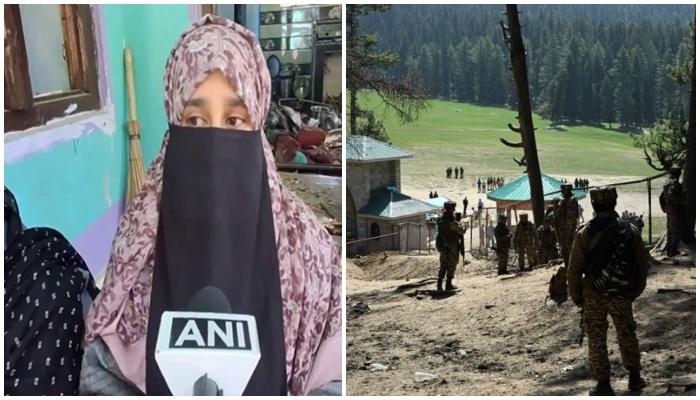
The family of one of the terrorists allegedly involved in Pahalgam attack whose house was demolished on Friday morning, has called him a “Mujahideen”
The houses of two Lashkar-e-Taliba terrorists believed to be involved in the Pahalgam terror attack, were demolished today. One house of LeT terrorist in Tral, Pulwama and the other of a terrorist Adil Guree in Anantnag were demolished.
Speaking with ANI, the sister of the terrorist whose house was demolished in Tral, said, “My one brother is in jail, the other brother is a ‘Mujahideen’, and I also have two sisters. Yesterday, when I came here from my in-laws’ place, I did not find my parents and siblings at their home. Police had taken them all away.”
The sister said that the family is innocent and doesn’t know anything about their brother’s involvement.
“While I was here, the Security Forces came and asked me to move to a neighbour’s house. I saw a man wearing a camouflage uniform placing an object like a bomb on top of the house. After that, the house was demolished…We are innocent. They have destroyed our house. We don’t know anything and have nothing to do with it. It is the government’s responsibility. We don’t know anything. We have nothing to do with it.”
Meanwhile, the second house of the terrorist Adil Guree was also demolished in Anantag today.
Adil Guree, a resident of Guree village in Bijbehara block of Anantnag district of Jammu and Kashmir, is believed to have been involved in the Pahalgam attack that killed 26 people, including a Nepalese national, mostly tourists. He has been declared the most wanted, and the Anantnag Police have offered a reward of Rs 20 lakh for any specific information leading to his arrest. Two Pakistani nationals were also declared most wanted in the case,Adil had illegally travelled to Pakistan in 2018, where he reportedly received terror training before returning to Jammu and Kashmir last year.
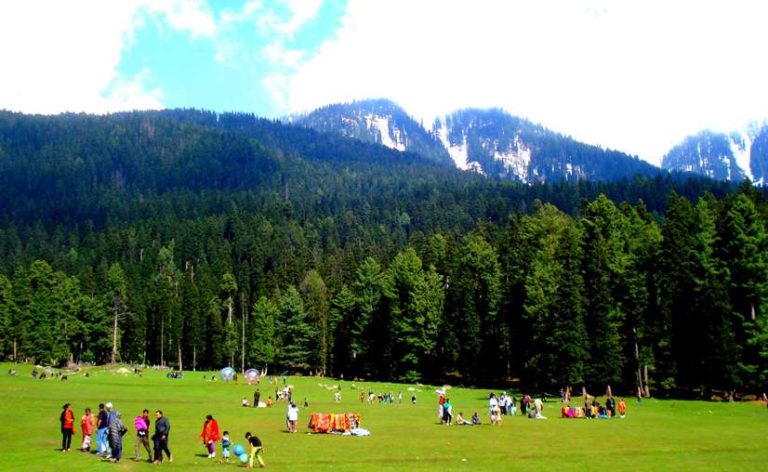
On April 22, Terrorists attacked tourists at Baisaran meadow in Pahalgam on April 22, killing 25 Indian nationals and one Nepali citizen while leaving several others injured.
(This news report is published from a syndicated feed. Except for the headline, the content has not been written or edited by OpIndia staff)
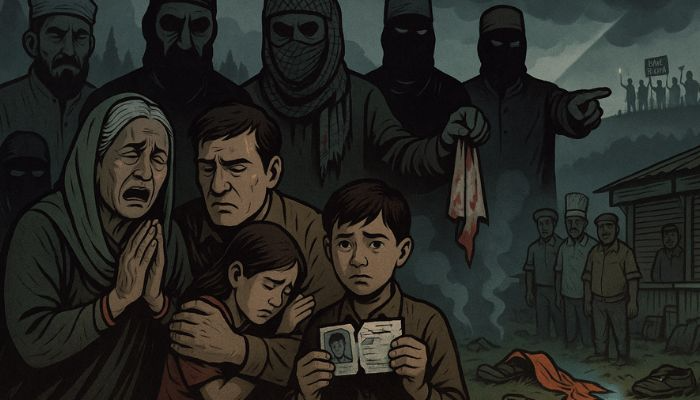
When horrid details of the Pahalgam massacre came out, most of us reeled in horror — not just at the loss of innocent lives, but also at the sheer brutality with which the terrorists singled out men, asked them to recite Kalma, forced them to strip to segregate non-Muslims and subsequently execute them in cold blood, even as their family members watched in utter horror the carnage underway.
But what unfolded a day later, on The New Indian Express in its recent opinion piece, was no less insidious—a thinly-veiled justification of terror by peddling an irresponsible and frankly absurd narrative that Pakistan’s attack on Indian civilians was somehow a “retaliation” to a train hijack by Baloch rebels in Quetta.
Source: NIE
Authored by Neena Gopal and titled “End of the Kashmiri summer: Is Pahalgam the payback for the Jaffar Express hijacking?”, the opinion column was a stunning illustration of practicing yellow journalism—facts and gravity of the matter taking a back seat as sensationalism and canards took precedence.
This isn’t journalism. It’s parroting Pakistan’s press releases.
What is even more alarming is that it was penned by an Indian author, a day after the ghastly terror attacked claimed the lives of 27 people. There seems to be no moral responsibility among the leftwing intelligentsia and their footsies to be rational and empathetic at a time when the nation was collectively mourning the loss of innocent lives. Yet, they carried on with their intellectually dishonest dissection of the tragedy—exploiting the attack to provide a cop out to Pakistan, and instead place the blame of the carnage at the feet of the Indian security apparatus, for purportedly orchestrating a train hijack in Pakistan, of course, with no evidence to support it.
Let’s call this out for what it is: a textbook case of legitimising state-sponsored terrorism against India by inventing false moral equivalencies. The article not only implicates India in a struggle that is inherently indigenous — the Baloch fight for freedom from Punjabi hegemony — but also subtly validates the Pakistani military’s long-standing, evidence-free accusations of Indian interference in its internal matters. It’s like handing your enemy ammunition and then pretending it’s an olive branch.
A fifth columnist doing Pakistan’s bidding: Deflecting attention from Pak COAS’ anti-Hindu bigotry
By weaving a causal thread between the Jaffar Express hijack in Balochistan and the massacre in Pahalgam, the writer inadvertently does what Pakistan’s Inter-Services Public Relations (ISPR) couldn’t have dreamed of achieving — provide an Indian byline to their propaganda. The suggestion that “Pahalgam was payback” is not just intellectually dishonest, it’s morally bankrupt.
Pakistan has always cried hoarse about Indian involvement in Balochistan, ever since Prime Minister Modi had the audacity to mention Balochistan in his Independence Day speech in 2016. But till date, it hasn’t presented a shred of credible evidence to the world. What it has done, however, is nurture terror factories in its backyard — from the Lashkar-e-Taiba to the Jaish-e-Mohammed — whose only export is jihad and whose only customer is terror in Kashmir.
Drawing a false equivalence between the Pahalgam massacre and the Jaffar Express hijacking not only distorts the moral clarity required in condemning terrorism, but also conveniently serves Pakistan’s agenda of deflection. By equating a brutal, targeted attack on innocent Hindu pilgrims in Kashmir—allegedly triggered by Pakistan Army Chief Gen. Asim Munir’s incendiary rhetoric—with a criminal hijacking incident, the narrative is diluted and accountability is blurred. Munir’s reference to Kashmir as Pakistan’s “jugular vein,” laced with sectarian undertones and anti-Hindu sentiment, has dangerously emboldened jihadist groups like Lashkar-e-Taiba.
Instead of confronting the consequences of state-sponsored Islamic terrorism, the opinion pieces helps Pakistan to muddy the waters, drawing baseless parallels to mask the direct ideological link between its military leadership’s provocative speeches and the bloodshed of innocent civilians.
Let’s be clear: Balochistan is not Kashmir
The comparison between Kashmir and Balochistan is laughably lazy, and dangerously misleading. Balochistan is a province under the jackboot of the Punjabi-dominated Pakistan Army. It is denied basic rights, its resources plundered, and its people “disappeared” in broad daylight. The Baloch struggle is not propped up by any foreign hand — it is a grassroots movement against a colonialist military that treats its citizens like chattel.
Kashmir, on the other hand, is a democratically governed territory, part of the Indian Union — with regular elections, courts, and constitutional protections. What it has suffered for decades is not a freedom movement, but an externally fuelled jihad that seeks to Islamise and balkanise India. There is no equivalence here — not morally, not politically, not historically.
So what if India did support the Baloch cause?
Even if, for the sake of argument, India has offered diplomatic or covert support to Baloch separatists (which New Delhi officially denies), why shouldn’t it? Pakistan has bled India for decades through proxy terror, proudly boasting of its “strategic depth” policy using non-state actors. From Kandahar to Kargil, from Parliament to Pulwama — India’s streets are red with the blood of its citizens because Rawalpindi’s generals have made it their life’s mission to “bleed India by a thousand cuts.”
Is it not within India’s strategic right to strike back, not with suicide bombers or madrassas, but with support to oppressed nationalities yearning for freedom? If the Pakistani establishment can’t bear the heat in its own backyard, maybe it should stop setting fires across the fence.
The Real danger: Undermining India’s global standing
Opinion pieces like the one in The New Indian Express may sell well to a bleeding-heart crowd eager to believe in moral symmetry, but in the international arena, they do tangible harm. They will be gleefully waved at the UN by Pakistani diplomats, used as “evidence” that India justifies terrorism and meddles in Pakistan. This is not just academic folly — it’s a strategic own goal.
At a time when India is painstakingly building global partnerships, deepening its ties with the Gulf, and tightening counter-terror coordination with the US, such pieces undermine its moral authority. They offer Rawalpindi a fig leaf to cover its crimes, and give the impression that India and Pakistan are mirror images — both sponsors of violence, both equally culpable. That’s not just wrong, it’s dangerous.
We must reject false narratives, Not reinforce them.
Terrorism, by its very nature, is never justified. But even more important is to understand what terrorism is. The Baloch rebels in Balochistan have been waging a fight against the repressive Pakistani rule for decades as part of their freedom struggle. To categorize it as “terrorism” akin to the unprovoked and wanton massacre witnessed in Pahalgam is to insult their years-long struggle and understate the tragedy that befell the victims of the Pahalgam terror attack. The notion that a targeted civilian massacre of Indian tourists was somehow provoked by a freedom struggle action against a tyrannical military personnel in another country is not just flawed — it is despicable.
What we need now is clarity, not intellectual dishonesty. Strength, not self-doubt. Strategic vision, not rhetorical vandalism.
To those trying to find balance where there is only brutality, here’s a simple reminder: the Pahalgam massacre wasn’t about Balochistan. It was about Pakistan’s desperation, its diminishing relevance, and its perennial addiction to terrorism as state policy. And it’s high time we stopped pretending otherwise.
As India went on the offensive against Pakistan by cutting all diplomatic ties with the country and suspending the Indus Water Treaty after the Pahalgam terrorist attack, Pakistan responded through a slew of measures, including a statement announcing that it would exercise its right to hold the Simla (Shimla) agreement in abeyance. The statement came after Pakistan PM Shehbaz Sharif convened a meeting of the National Security Committee (NSC) yesterday (24th April) amid the fear of facing a strong retaliation from India after the ghastly terrorist attack in Pahalgam where Jihadi terrorists killed 26 Hindu tourists.
“Pakistan shall exercise the right to hold all bilateral agreements with India, including but not limited to the Shimla Agreement, in abeyance. All cross-border transit from India through this route shall be suspended, without exception. Those who have crossed with valid endorsements may return through that route immediately, but not later than April 30,” read the statement released by Pakistan.
As the Indian authorities launched a manhunt for terrorists in Jammu and Kashmir and along the Line of Control (LoC), which has historically been used by Pakistan-sponsored terrorists from Pakistan to infiltrate into India and carry out terrorist activities, let’s understand how the LoC came into existence and how the suspension of suspend the Simla Agreement 1972 would impact the deteriorating relations between India and Pakistan.
The Simla Agreement, 1972
Pakistan faced a humiliating defeat in the 1971 Bangladesh Liberation War when about 93,000 Pakistani soldiers surrendered en masse to the Indian forces, making it the largest surrender of troops after WWII. The Simla Agreement, 1972, was signed between India and Pakistan in the aftermath of the Liberation War. It paved the way for several subsequent agreements, including those relating to the repatriation of citizens and the Prisoners of War (PoWs) between the two countries. The agreement also led to Pakistan recognising Bangladesh as an independent and sovereign nation in 1974.
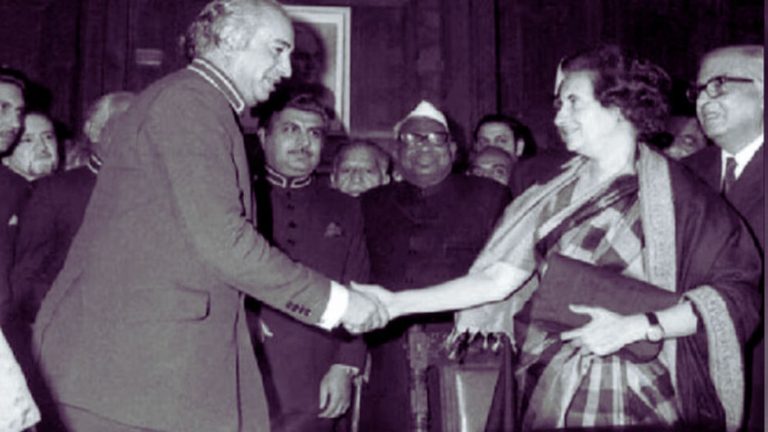
The Simla Agreement was a peace treaty signed by the Pakistan President Zulfikar Ali Bhutto, and the Indian Prime Minister Indira Gandhi in Shimla, Himachal Pradesh, on July 2, 1972. It was aimed at normalising relations between the two countries but putting an end to hostilities and laying down the principles to be followed by them in their future interactions.
“The Government of India and the Government of Pakistan are resolved that the two countries put an end to the conflict and confrontation that have hitherto marred their relations and work for the promotion of a friendly and harmonious relationship and the establishment of durable peace in the sub-continent, so that both countries may henceforth devote their resources and energies to the pressing task of advancing the welfare of their peoples,” the agreement stated.
The agreement laid down a framework of bilateral relations between the two countries. Under the agreement, both countries agree to “abjure conflict and confrontation which had marred relations in the past, and to work towards the establishment of durable peace, friendship and cooperation”. The agreement stated that the relations between the two countries would be governed by the principles and purposes of the UN Charter and obligated both countries not to indulge in acts detrimental to the maintenance of peaceful and harmonious relations between them.
They also pledged to resume communication, trade, economic cooperation and promote travel facilities for the citizens of both countries.
The Ceasefire Line of 1971 recognised as the LoC
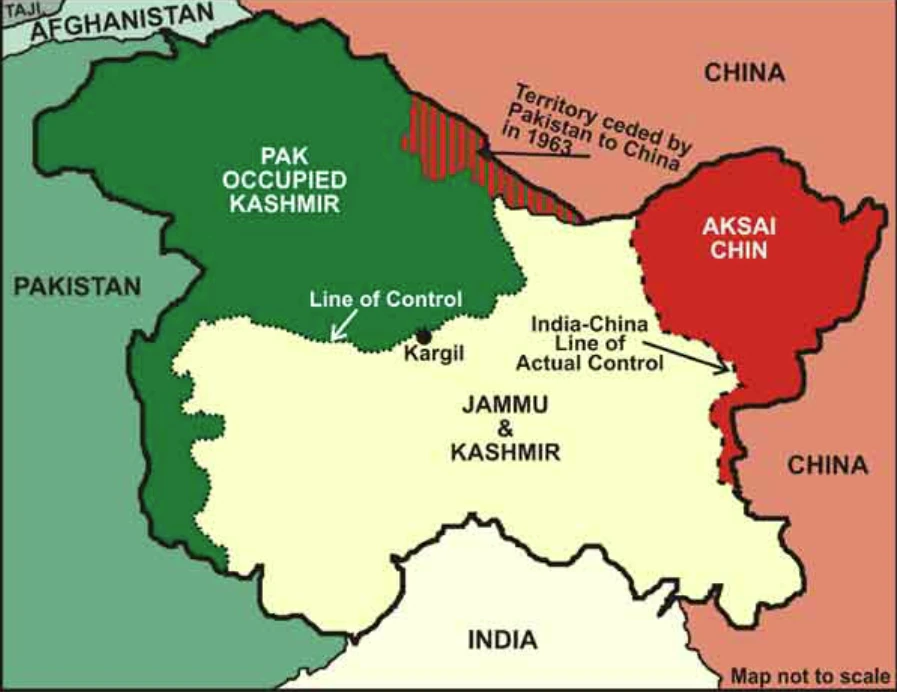
Under clause 4 of the Simla Agreement, the countries agreed to withdraw their troops to their side of the international border and recognised the Ceasefire Line as the Line of Control (LoC). The Ceasefire Line was demarcated after the Indo-Pakistan War of 1947 through the intervention of the United Nations. The military representatives of India and Pakistan signed the Karachi Agreement, 1949, under the supervision of the UN Commission for India and Pakistan, which established the Ceasefire Line. With minor modifications, the Shimla agreement recognised the Ceasefire Line as the Line of Control.
Image via India Toda
“In Jammu and Kashmir, the line of control resulting from the cease-fire of December 17, 1971, shall be respected by both sides without prejudice to the recognised position of either side. Neither side shall seek to alter it unilaterally, irrespective of mutual differences and legal interpretations. Both sides further undertake to refrain from the threat or the use of force in violation of this Line,” read the agreement.
The agreement set the period of 30 days for the withdrawal of troops by both countries to their side of the international border.
Impact of the suspension of the LoC
Pakistan has been consistently violating the Simla Agreement either through military activities or by indulging in proxy war against India by promoting and enabling cross-border terrorism against India. In 1999, Pakistan violated the agreement by sending its military into the Indian territory in Jammu and Kashmir, which resulted in the Kargil War.
Pakistan’s announcement to suspend the Simla Agreement may amount to a unilateral attempt to alter the status of the border agreed upon by India and Pakistan under the agreement. It would mean derecognising the agreed framework of bilateral relations between the two countries, thus making way for the intervention of third parties. If Pakistan proceeds to suspend the Simla Agreement, whether this would play out in its favour or would prove a self-sabotaging move remains to be seen.
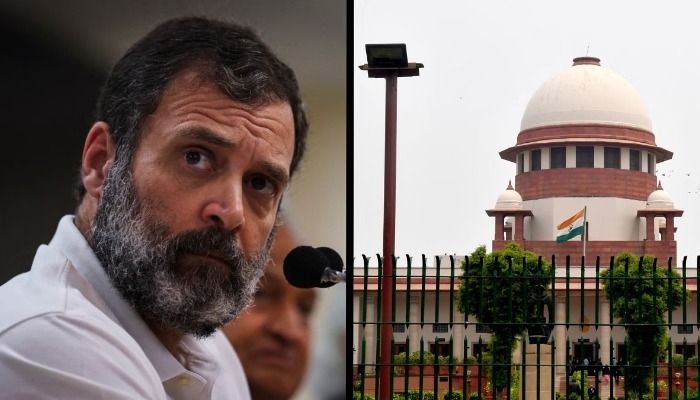
On 24th April, the Supreme Court voiced its dissatisfaction over the comments made by Rahul Gandhi, the Congress leader of the opposition in the Lok Sabha, against Veer Savarkar. Justices Manmohan and Dipankar Datta were part of the bench that heard the case.
The Court even warned to take “suo moto” action against Rahul Gandhi if he made any more remarks that were critical of freedom fighters like Veer Savarkar, even while staying the criminal defamation proceedings that were still pending against him in a Lucknow court.
Justice Datta objected to Rahul Gandhi’s claim that Savarkar was a British servant as soon as the hearing commenced. He questioned whether Mohandas Karamchand Gandhi’s use of the phrase “your faithful servant” in his correspondence with the Viceroy qualified him as a servant of the empire as well.
“Does your client know Mahatma Gandhi also used ‘your faithful servant’ while addressing the Viceroy? Does your client know that his grandmother (Indira Gandhi), when she was the Prime Minister, also sent a letter praising the gentleman (Veer Savarkar), the freedom fighter,” the Judge questioned Abhishek Manu Singhvi, Congress veteran and senior advocate representing the Gandhi family scion.
“So therefore, let him not make irresponsible statements about the freedom fighters. You have laid down a good point of law and you are entitled to stay. We know that. But this is not the way you treat our freedom fighters. When you don’t know anything of the history or geography of India,” Justice Datta further chastised Rahul Gandhi and asked, “He is a person of stature. He is a leader of a political party. Why should you foment trouble like this? You go to Akola and make this statement, in Maharashtra, where he (Savarkar) is worshiped? Don’t do this. Why do you make this statement?”
The Bench further pointed out that even the Judges of the Calcutta High Court referred to the Chief Justice as “Your Servant” during the period of British rule and added, “Someone does not become a servant like this. Next time, somebody will say Mahatma Gandhi was the servant of the British. You are encouraging these kind of statements.”
The bench did, however, state that it was inclined to halt the proceedings, provided Rahul Gandhi promised not to make any more remarks of that nature. “We will grant you stay but we will restrain you from making irresponsible statements. Let’s be clear, any further statement and we will take suo moto action and no question of sanction. We will not allow you to speak anything about our freedom fighters. They have given us freedom, and this is how we treat them,” Justice Datta stated. Congress leader and Rahul Gandhi’s lawyer Singhvi verbally committed to refraining from making such claims.
“Issue notice. The impugned order is stayed,” the court declared. The Rae Bareli Lok Sabha MP Rahul Gandhi went to the apex court after the Allahabad High Court denied him relief. The summons issued to him by a Magistrate court for his remarks concerning Vinayak Damodar Savarkar was upheld by the high court.
In December of 2024, Rahul Gandhi was called to appear in court as a defendant regarding his remarks made during a press conference, in which he stated that Veer Savarkar was an agent of the British Raj and received a pension from them. A legal complaint was submitted by Advocate Nripendra Pandey, charging that the Congress leader aimed to incite hatred in the society through his comments. Rahul Gandhi was charged with violating Sections 505 (public mischief) and 153A (promoting enmity) of the Indian Penal Code (IPC).
A Hindu woman named Priyanka Dutta, who hails from Ashoknagar Kalyangarh city of West Bengal, has narrated how she received abudction and rape threats from Muslims for voicing her anger against the Pahalgam terror attack.
In a video that has now surfaced on social media, the victim was heard saying, “I had shared a lot of things on the Kashmir incident. Some people supported my idea, others verbally abused me and those who were in my support. I will still say it was tolerable.”
“When they couldn’t fight with me using logic and arguments, they went to my DMs and repeatedly gave me rape threats,” the woman recounted as she broke down in tears.
2 Islamists claiming to be members of @BSF_India & TMC are threatening to kidnap & rap€ a Hindu girl Priyanka Dutta for posting about the #PahalgamTerroristAttack on social media in West Bengal
“They threatened to abduct me from my home, called me on Messenger repeatedly and gave rape threats,” she emphaised.
Priyanka Dutta identified one of the accused as Mj Maruf. In one of the screenshots shared by her, Maruf was seen sending voice notes and write some ‘expletives.’
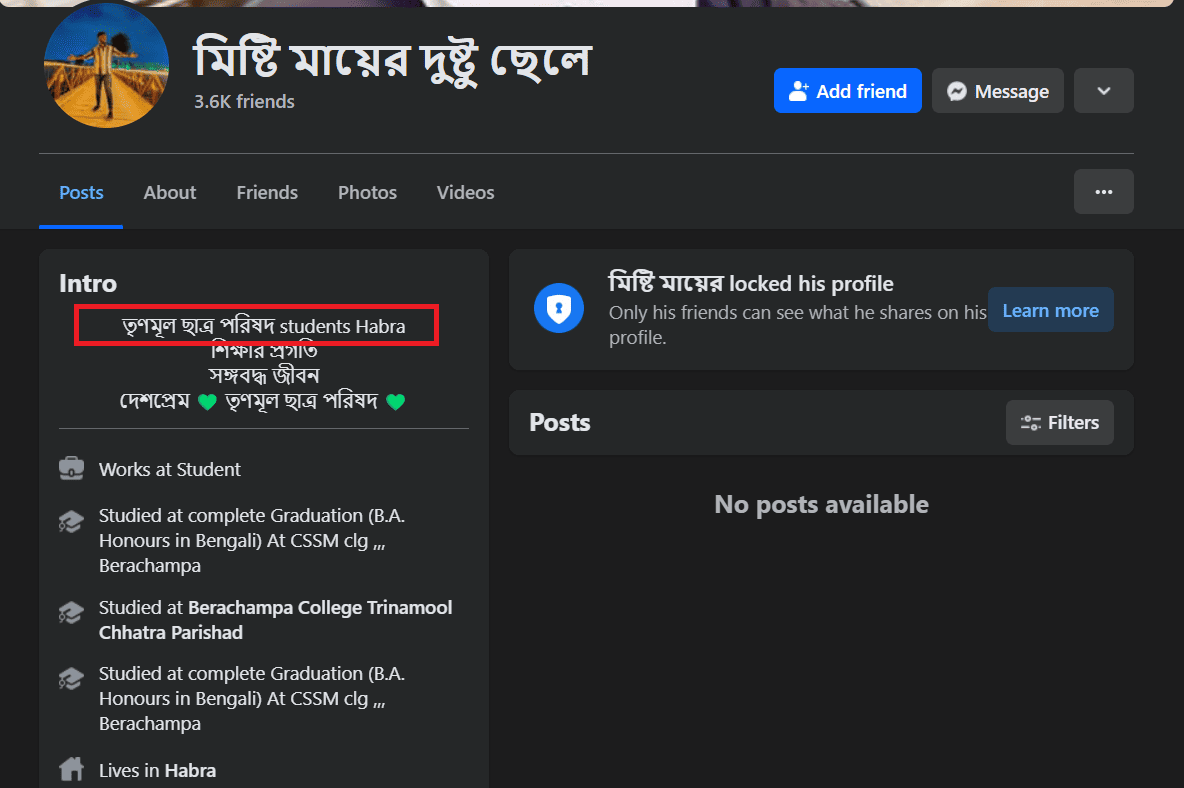
The other accused operated with a pseudo name ‘Misti Mayer Dusto Chela (translates to bad son of a sweet mother).’
According to the Facebook profile of the second accused, he is a member Trinamool Congress Chhatra Parishad.
Screengrab of the
One of the pictures shared by the victim showed the accused sporting an Islamic skull cap.
He was seen threatening the Hindu woman on Messenger to share her address. “Are you afraid,” he had inquired. The accused had then made two audio calls on messenger.
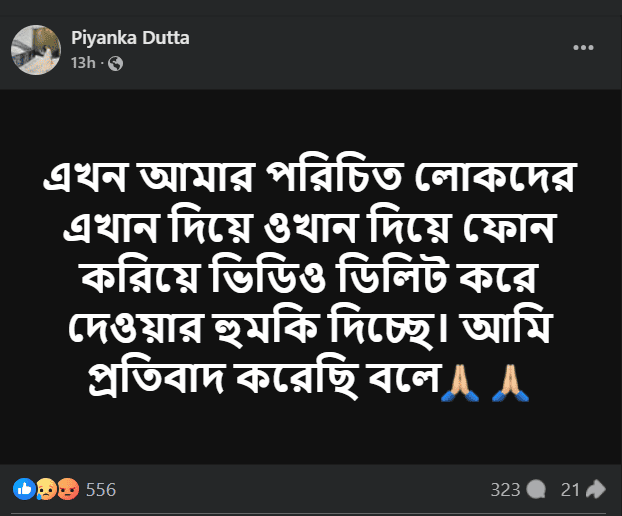
Priyanka Dutta narrated that she was being coerced into deleting the video, where she revealed that she was being threatened with abduction and rape for voicing her opinion against the Pahalgam terror attack.
Screengrab of the Facebook post of Priyanka Dutta
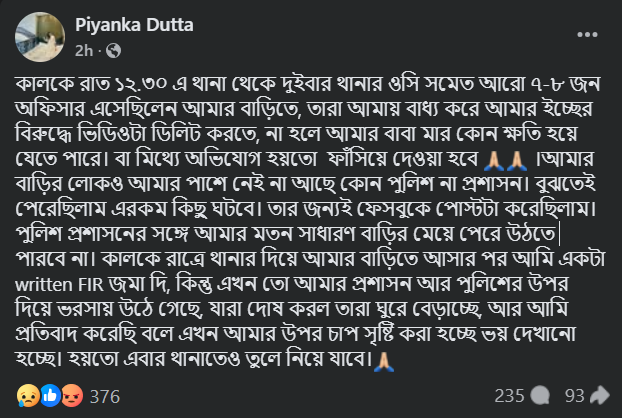
Eventually, the victim deleted the video. She had explained the reason in a Facebook post on Friday (25th April).
Priyanka Dutta informed that 7-8 police officers and 2 Officers-in-Charge landed at her hone and forced her to delete the video where she tearfully described how 2 Muslim men threatened to abduct and rape her.
The victim added that she feared that the police could do harm to her parents or implicate them on fabricated charges.
Despite this, the video is now being widely shared on Facebook and Twitter by netizens who had previously downloaded the video.
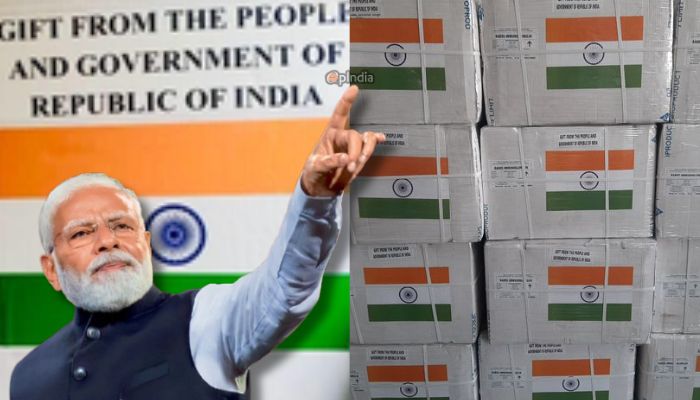
On Thursday (24th April), India sent 4.8 tons of vaccines to Afghanistan, including vaccines for rabies, tetanus, hepatitis B, and influenza, according to the XP Division, Ministry of External Affairs.
India donated 4.8 tons of vaccines to the people of Afghanistan. Vaccines sent include rabies, tetanus, hepatitis B, and influenza: XP Division, MEA pic.twitter.com/pVSFMqUhon
India has also sent medical aid worth USD 2 million to Nepal, reaffirming its Neighbourhood First policy.
Taking to X, MEA spokesperson Randhir Jaiswal said, “India sends assistance consisting of medicines and vaccines for patients with Thalassemia and Sickle Cell Disease worth $2 million, responding to a request from Nepal. The 1st tranche of 17,030 vials of Vaccines for Immunization of patients with Thalassemia was handed over to Nepal.”
?? sends assistance consisting of medicines and vaccines for patients with Thalassemia and Sickle Cell Disease worth $2 million, responding to a request from Nepal.
In a similar effort, India recently handed over a fresh relief consignment to Myanmar under Operation Brahma in April. The Indian Embassy in Myanmar stated that relief aid recently dispatched from India has been handed over to Mandalay Chief Minister Myo Aung under Operation Brahma.
The aid from India was handed over by the Indian Ambassador to Myanmar, Abhay Thakur. It contained an RO water plant, a Genset, rice, noodles, cooking oil, atta, sugar, dal, salt, MRES, blankets, and medicines.
As the first responder to the devastating earthquake on March 28, India has provided over 750 metric tons of relief material, including medical aid, food, shelters, and essential supplies.
In April, India also sent a consignment of 1,000 metric tons of rice to Cameroon on Wednesday for food grain assistance. Official Spokesperson for the Ministry of External Affairs, Randhir
Jaiswal, said the effort is in the spirit of a committed partnership with the Global South.
In a post on X, Jaiswal said, “India: A committed partner to the Global South. India sends food grain assistance to the people of Cameroon. A consignment of 1000 mt of Rice departed today from Nhava Sheva Port to Cameroon.” Official Spokesperson of the Ministry of External Affairs, Randhir Jaiswal, stated that India has sent the first tranche of assistance to Botswana in response to the floods.”
The MEA said that the tranche comprised of 10 tons of essential medicines, surgical supplies, mosquito nets, water purifiers, among other things.
In a post on X, Jaiswal said, “India sends humanitarian assistance to Botswana. In the wake of floods in Botswana, the first tranche of approx 10 tons of assistance comprising essential medicines, surgical supplies, mosquito nets, water purifiers, etc, was dispatched for Botswana.”
The terrorist assault on Hindu tourists in the Baisaran meadow of Pahalgam, which resulted in the deaths of 26 innocent people, has reverberated not only throughout the nation but also across the globe. The assailants demanded that the victims present their identification cards, recite Islamic verses and even remove their pants to confirm they were not Muslims before executing them mercilessly.
Hindus were slain in cold blood purely due to their religious beliefs. The Resistance Front (TRF), a splinter group of Lashkar-e-Taiba based in Pakistan, has claimed responsibility for the attack. It was not solely a terrorist attack but rather the continuation of Islamic terrorism sponsored by Pakistan in the region for over 75 years, and the ideology that brands non-Muslims as kafirs and justifies their murder.
The nation is justifiably outraged and is calling for severe action against the perpetrators and their Pakistani sponsors for the bloodshed they have caused within India. Similarly, a bandh was declared across the entire region following the incident. Notably, within hours of the assault, videos began to emerge from the valley of protests and candlelight marches expressing outrage over the horrific killings. The defining characteristic of the agitations was the profound apprehension concerning the repercussions on the valley’s booming tourism industry.
Local Kashmiris in #Pahalgam held a candlelight march to condemn today’s terror attack on tourists.
Gulzar Ahmad Wani, president of Pahalgam Taxi Association claimed that the area has always been peaceful and stated, “I condemn this attack. It is not just tourists, but our livelihood, our families. We don’t consider them tourists. It is as if our family members have been killed. I request the government to get to the bottom of this matter.” He highlighted that tourism is the backbone of Pahalgam.
#WATCH | Gulzar Ahmad Wani, president of Pahalgam Taxi Association, says, "I condemn this attack. It is not just tourists, but our livelihood, our families. We don't consider them tourists. It is as if our family members have been killed. I request the government to get to the… https://t.co/rTrToTW5JHpic.twitter.com/8vyTvbycCB
The president of the Travel Agents Association of Kashmir, Rauf Tramboo, described the attacks as a “huge blow,” noting that a “peaceful situation” had allowed the tourism industry to thrive in recent years. “We are already getting inquiries about cancellations from companies and customer partners,” he added. A local chef who has worked for 30 years serving tourists at a Pahalgam hotel expressed his anguish, pointing out that his entire livelihood is dependent on tourists traveling to the area.
“I have been working as a chef in Pahalgam for the last 30 years. I have never seen such a huge incident here. I am poor, and my livelihood depends entirely on the tourists. Now, I don’t know what I will do. I don’t have enough property to get by. The tourism season was going well, and all hotels were at full capacity. But now, the loss will be insurmountable,” he conveyed.
“Because of this incident, the entire town has come to a standstill. The tourism season was going well, and everything was in full swing. But now, the poor people here, many of whom have taken loans to run their businesses, are in great trouble. I pray that such an incident never happens again,” remarked another local chef with 25 years of working experience in Pahalgam.
Pahalgam Terror Attack Halts Tourism: Poor Locals Struggle With Loans and Livelihood Crisis pic.twitter.com/CXLQRaliiP
— Kashmir Student Alerts (@TheOfficialKSA) April 24, 2025
Omar Abdullah, the Chief Minister of Jammu and Kashmir, referred to the evacuation of tourists from Kashmir after the Pahalgam terror incident as “heartbreaking.” Other Kashmiri politicans echoed similar sentiments including Sajjad Gani Lone who termed the occurrence as an “assault on economic lifeline of Kashmir, which is tourism” and added that it has jeopardized Kahsmir’s “hospitality and future.”
It’s heartbreaking to see the exodus of our guests from the valley after yesterday’s tragic terror attack in Pahalgam but at the same time we totally understand why people would want to leave. While DGCA & the Ministry of Civil Aviation are working to organise extra flights,… pic.twitter.com/5O3i5U1rBh
Interestingly, Jammu & Kashmir National Conference (JKNC) leader and Srinagar Lok Sabha MP Aga Syed Ruhullah Mehdi labelled Kashmir tourism as a cultural invasion, during an interview in early January.
The concern regarding the economic decline of tourism in Kashmir is legitimate and the fears vocalised by the local population and leaders are warranted. However, it cannot be denied that the conversation also diverts attention from the 26 deceased individuals who were murdered because of their religious beliefs. It is also as a clear reminder of the victimhood industry that is determined to distract from pressing issues requiring prompt focus only to advance its own narrative, particularly in relation to Kashmir.
This is the same propaganda that humanized dreaded terrorists as the headmaster’s son (Burhan Wani) and mathematics teacher (Riyaz Naikoo), both commanders of Hizbul Mujahideen, as well as Pakistan-backed jihad in Jammu and Kashmir as a political conflict and even suggested the separation of the region from the country. The Indian forces have been portrayed as an occupational entity to provide a shield to terrorists, including Adil Ahmed Dar and Burhan Wani, among others.
Of course, a discussion regarding the impact of the incident on the local economy must take place, nevertheless, this hurried prioritisation of victimhood could have been avoided at least till the bodies of actual victims were brought back to their homes and last rites were performed by the bereaved families. The tourism sector and the economy can be revived in one season, but the lives that have been lost can never be restored as that wound is irreparable and permanent.
It is important to note that local terrorists were involved in the strike. “The Urdu that they (the foreign terrorists) spoke is from certain parts of Pakistan. At least two local militants are suspected to be accompanying them,” an officer from the security establishment informed The Indian Express.
“The two others are believed to be from Bijbehara and Thokerpora, Kulgam. They went to Pakistan in 2017 and returned to the valley last year. Information has been received that they received training in Pakistan. They were associated with the Jaish-e-Mohammed and initial investigation suggests that the Lashkar-e-Taiba and the Jaish allied to execute this attack,” revealed a source from a central agency.
The agencies have published sketches of three terrorists and declared a reward of Rs 20 lakh for any information leading to their identification. This was the largest terrorist attack in Kashmir in recent years following the Pulwama carnage.
What happened in Pulwama
The Pulwama incident took place on 14th February 2019, when a convoy transporting Indian security forces along the Jammu–Srinagar National Highway was targeted by a suicide bomber using a vehicle in Lethapora, located in the Pulwama district of Jammu and Kashmir. The assault resulted in the deaths of 44 members of the Indian Central Reserve Police Force (CRPF) along with the attacker, Adil Ahmad Dar, a local youth from the Pulwama district. The responsibility for this act was taken by the Pakistan-based terrorist organization, Jaish-e-Mohammed.
After the Pulwama attack, stone-pelters targeted injured CRPF jawans. When the IED struck, the men in the convoy immediately moved out of their vehicles and surrounded the explosion site with a protective cordon. They unveiled that it had been done to shield the wounded from the stone-throwing that started after the blast.
“He was beaten by Indian troops a few years back when he was returning from school. This led to anger in him against Indian troops. We searched for him for three months. Finally we gave up efforts to bring him back home,” Adil’s parents alleged, subtly blaming the army for their son’s act. Subsequently, Indian security forces apprehended individuals involved in facilitating this attack, detaining approximately 23 men associated with Jaish-e-Muhammad.
The authorities believed that they could have significant insights into the details surrounding the incident, where the assaliant crashed a vehicle filled with 300 kilograms of explosives into a convoy vehicle. The National Investigative Agency’s (NIA) findings indicated that four to five terrorists from Jaish-e-Mohammed, including the suicide bomber Adil Ahmad Dar and a local facilitator, played a role in orchestrating the massacre.
The RDX used in the attack was supplied by the Pakistan military and smuggled into India by associates of Jaish-e-Mohammed, transported in multiple batches due to its substantial volume. Women and children were employed to carry the lethal explosive RDX grade 5, intended for military applications, along with ammonium nitrate from a transit location in Tral, situated in the Pulwama district of southern Kashmir.
The explosive’s trigger was reportedly produced locally, utilizing ammonium nitrate as an oxidizer in the RDX explosive. The military-grade A5 RDX was sourced from Pakistan and the device was constructed approximately 10 kilometers from the location of the explosion. Explosives were transported by women and children in the valley in limited amounts over several months.
Security forces had neutralized two terrorists, suspected to be the masterminds of the Pulwama attack, approximately 15 kilometers from the location of the suicide bombing. During the encounter, four Army personnel, including a major, lost their lives. Additionally, two civilians, who were exploited by the terrorists as human shields, were also killed.
The Maruti Eeco vehicle involved in the attack was registered in Kashmir approximately eight years ago and was utilized by the group with the owner’s consent, who was missing. Seven people from Kashmir, engaged in the sale of shawls and dried fruits in Delhi, were nabbed by the Intelligence Bureau (IB) due to their suspected involvement in illicit activities. According to various agencies, they might be acting as informants for terrorist groups.
A massive crackdown against Jamaat-e-Islami leaders was also unleashed in Jammu and Kashmir. Law enforcement agencies conducted operations and apprehended numerous leaders of Jamat-e-Islami in Srinagar and its vicinity. Moreover, terrorist Mohammed Yasin Malik who is also chief of the Jammu Kashmir Liberation Front (JKLF) was taken into custody from his home. Police arrested at least 150 separatists.
India conducted the Balakot airstrike and successfully targeted terrorists, including members of Jaish-e-Mohammed’s supremo Maulana Masood Azhar’s family, such as his nephew and IED (Improvised explosive device) expert Ismail Alvi, also known as Fauji Bhai or Lambu, to avenge the deadly strike against its soldiers. “Ismail is an IED expert and helped other bombers of the Pulwama attack to fit the bomb in Maruti Eeco van,” disclosed an army official.
The airstrike was followed by the NIA’s huge crackdown on the separatist leadership in the valley. The raids were part of a search operation that was connected to the agency’s inquiry into the terror funding.
Conspiracy to unleash more bloodshed
Security forces were placed on high alert due to intelligence reports indicating that Jaish-e-Mohammad was planning another attack soon after Pulwama. Meanwhile, two terrorists from Kashmir, Shahnawaz Ahmed Teli and Aquib Ahmed Malik, affiliated with Jaish-e-Mohammed, were captured by the Anti-Terrorism Squad (ATS) of the Uttar Pradesh Police in Saharanpur. On 20th February 2019, the ATS arrested them and confiscated 30 cartridges, three pistols with magazines and two hand grenades from them.
The ATS reported that the pair is from the Pulwama district in Jammu and Kashmir. The authorities asserted that they received audio messages from the cellphone of one of the two young men, in which he discussed about a “bada kaam” (something big) and “samaan” (goods). The investigators linked the “bada kaam” to a significant operation that the two individuals were preparing, noting that the “samaan” was intended for weapons and explosives necessary for executing the attack.
“They have confessed to their links with JeM in front of me and have given specific information based on which we are hopeful of some more recoveries in the near future,” Uttar Pradesh Director General of Police OP Singh informed. The Inspector General of Police (ATS) Asim Arun, stated that Shahnawaz had maintained contact with terrorist organizations for a duration of 18 months, whereas Aqib became involved only six months prior. Last year, a special ATS/NIA court sentenced them to seven years in prison for inciting youth and enlisting them for anti-national endeavors.
Killings of Kashmiri Hindus
The engagement of Kashmiris with terrorist groups including many locals is a matter of public knowledge. This involvement was notably revealed during the 1990 exodus of Kashmiri Hindus as they were killed, threatened and were forced to leave the valley, often by their own neighbours. Countless Kashmiri Hindus were subjected to savage killings and were coerced into fleeing their homes overnight at gunpoint by terrorists associated with Pakistan, including Yasin Malik and Bitta Karate.
One of them, Girija Tickoo, was from Bandipora and was employed as a lab assistant at a higher secondary school in the valley. She got a call one day claiming that things had improved and she should come pick up her salary from the school where she was employed. She went to the school, believing the information, but didn’t realize that she was being followed on the way back. Five men abducted her from a coworker’s house and transported her to an unidentified place. Her companion and other witnesses saw her abduction, but chose to remain silent.
Her body was discovered by the side of the road in a horrible state a few days after she was kidnapped. According to the autopsy, she had suffered severe torture and gang rape. She was alive when she was chopped into two pieces with a carpenter’s saw, directly through the middle of her body for her “fault” of being Hindu.
Likewise, BK Ganjoo, a Telecommunication Department employee went home during a brief respite in Srinagar’s curfew. However, as soon as he stepped inside, his wife Vijay saw suspicious persons following him and quickly bolt to the door. He hurried to the third floor of his home and, in a desperate attempt, hid inside a big rice bin. The terrorists, meantime, searched the house, scouring every nook for their target but could not find him.
However, a Muslim neighbour who observed him concealing himself in the rice drum alerted the terrorists as they departed. It is noteworthy that Ganjoo had recently assisted this same person with food supplies just days prior. The terrorists went back to the third floor and killed Ganjoo by firing several shots into the rice bin where he was hiding.
When Vijay pleaded with the terrorists to take her life as well, the attackers replied that they were allowing her to live so she could mourn over her husband’s body. They even made her eat the rice soaked in his blood, taunting her that her family should also indulge in this tasty meal. There are countless similar accounts of bloodshed and betrayal faced by Kashmiri Hindus, who were forced to vacate their homes as the local mosques resounded with the chilling declaration of “Raliv, Galiv ya Chaliv” (convert, leave or perish).
Notably, thousands of ancestral estates belonging to Kashmiri Hindus were unlawfully seized by Muslims after the Pandits escaped to protect their lives. The locals not only took an active part in the atrocities committed against their Hindu neighbours but illegally occupied their homes and lands.
The properties were recently returned to their original owners few years back which again led to attacks on Kashmiri Hindus in the area. The administration of Jammu and Kashmir launched an online grievance redressal platform in 2021, that allowed Kashmiri Hindus to file complaints about any property they have in the region. The government received several complaints, illustrating the grim reality, and over a thousand concerns were addressed.
Glorification of terrorists
The terrorists, lauded as mujahids and perceived as freedom fighters, often participated in the grand funeral ceremonies of their counterparts, showcasing their guns and firing shots into the air while surrounded by a massive enthusiastic crowd, all locals, all hailing the violence and slaughter.
After Hizbul Mujahideen terrorist Burhan Wani was killed in 2016, the valley endured several months of turmoil, including violent incidents and assaults. Numerous police stations, security personnel and even BJP offices were targeted after thousands gathered to attend his funeral prayers in Shareef village of Tral. Predictably, stone pelting occurred at multiple places. Support for the terrorists who had been freely roaming the countryside in South Kashmir grew since then. The public’s support for terrorists was a greater issue for the security forces who often faced opposition from crowds during anti-terror operations, according to the police.
A video recording depicted terrorists performing a gun salute at the funeral of their colleague in Pulwama, in that year. A large number of individuals gathered for the funeral of Shakir Ahmad, a Hizbul Mujahideen terrorist who was killed during an encounter. The footage showed a group within the crowd brandishing firearms and discharging gunshots into the air, reminiscent of the 1990s, when militancy in the valley was at its peak.
Two funerals took place at the same time in South Kashmir for a terrorist and the cop he killed, in May 2017. Azhar Mehmood, who gave his life to stop an attack, was solely mourned by his coworkers and family while the burial of terrorist Fayaz Ahmad Aishwar of Hizbul Mujahideen drew thousands of people barely 10 kilometers away. Fayaz and three other terrorists carried out the attack in Anantnag, killing Mehmood and three civilians.
The same year, Hizbul Mujahideen commander Riyaz Naikoo was seen attending the funeral of one of the group’s members who was one of two terrorists neutralised in a gunfight with security forces in the Pulwama area of south Kashmir. The funeral of Shariq Ahmad Sheikh, a resident of Takuna in Pulwama, drew thousands of people. Shabir Ahmad Mir, a terrorist from the nearby Anantnag district was also eliminated.
“The Pakistani flag is our flag. Linking our struggle with al-Qaeda and IS is a ploy to defame it,” he announced in front of the crowd. He also shouted pro-Pakistan slogans before disappearing. The funeral procession for Zakir Musa in May 2019, who left Hizbul Mujahideen to lead Ansar Ghazwat-Ul-Hind, attracted a similar number of attendees. He had even threatened to behead separatist leaders and warned, “If they create any hurdles in the path of turning Kashmir into an Islamic state.”
Many areas of the valley, particularly south Kashmir and the capital Srinagar, had to be subject to curfew-like restrictions by the authorities. However, hundreds of young people from the area violated curfew and made it to his hometown of Noorpora in Tral. All key roads in Pulwama, the capital Srinagar and Anantnag were barricaded to control the protesters. Many sections were off-limits to vehicles. The valley’s sensitive areas were sealed off with concertina wires. All exams were postponed and educational institutions were closed for the day. As a precaution, mobile internet was also slowed down.
Stone pelting on forces
Stone pelting at Indian troops was a frequent occurrence during terrorist encounters in Kashmir. However, it was not limited to specific locations or incidents but regularly took place outside mosques and targeted the forces. Major Leetul Gogoi of Assam attracted controversy in 2017 for allegedly using a Kashmiri man as a human shield by tying him to a jeep. However, army representatives had maintained that the troops resorted to this extreme action to safeguard themselves from being pelted with stones and the governement also supported the same.
In 2018, a group of Muslims hurled large stones at military vehicles in Ganovpora village of Shopian, compelling Major Aditya Kumar to use his firearm, which subsequently led to a case against him by the police. However, the Supreme Court stayed the inquiry into the matter.
“As per the narration in the FIR (First Information Report), it is stated that Major Aditya Kumar was leading the convoy which resorted to firing on coming under heavy stone-pelting and arson by the mob. This means even if he is not shown as an accused, police can, at any point of time, rope him in as an accused. He is an Army officer. Do not treat him as an ordinary criminal,” promounced a bench of Chief Justice Dipak Misra and Justices A M Khanwilkar and D Y Chandrachud.
The frequency of stone pelting incidents declined following the abrogation of Article 370, however, in 2017 and 2018, the recorded incidents were 1,412 and 1,458, respectively. As per the data provided by the Ministry of Home Affairs up to 2021, there were 618 recorded incidents of stone pelting in the valley from January to July 2019, which decreased to 222 during the same timeframe in 2020, and further went down to only 76 in 2021.
The number of injuries sustained by security forces during these incidents decreased from 64 between January and July 2019 to only 10 in 2021. The Ministry of Home Affairs reported to the Lok Sabha that from 1st January to 15th November 2019, the police recorded 551 cases related to stone pelting and law and order, with 190 of these cases occurring after 5th August.
Nevertheless, such occurrences did not entirely cease. 2020 witnessed a group of youths throw stones and fight with security personnel close to the scene of an encounter in the Budgam area of Jammu & Kashmir. There were reports of a shootout between troops and terrorists in the Kawoosa area. According to officials, the terrorists were able to escape the area after breaking through the barrier.
A cordon-and-search operation was initiated in Kawoosa based on information about the presence of terrorists in the area. There was a gunfight after they started shooting at the search party. While soliders and terrorists were engaged in firing, some youngsters threw stones at the security personnel. They were chased away with tear smoke shells and none of them could be apprehended. The terrorists then seized the chance to break through the security perimeter.
Veil of doubt over Pahalgam
The mass slaughter in Pahalgam was meticulously planned by the perpetrators, who took into consideration the possibility that it would take the forces from the neighboring army and paramilitary camps almost an hour to make it to the scene, which would give them ample opportunity to slip into the surrounding meadow, reported Deccan Herald. The sources outlined, “Those who planned the attack knew about the geography and prepared an escape route for the attackers. It is possible that they may have done a recce for a few days to see at what time the tourist flow is the maximum.”
The troops from the nearest Rashtriya Rifles battalion would need to travel for a further 30 to 35 minutes to reach Baisaran, a popular picnic location, after taking about 40 to 45 minutes to get to the closest road head, according to sources acquainted with the region. A Central Reserve Police Force camp is located in front of the army establishment, but it would also require approximately one hour to arrive.
Lieutenant general DP Pandey (retired), former General Officer Commanding (GOC) of Indian Army’s 15 Corps in Srinagar highlighted, “There is no doubt about Pakistan’s involvement. The Resistance Force is speaking Pakistan’s language. It also has local support. They attackers knew that such a site would give them time to carry out the act after checking on their religion. This may not have been possible elsewhere.”
The concerns expressed by the officer are significant, as executing and maintaining such an attack with such precision is unfeasible without assistance from local individuals who possess extensive knowledge of the region and could also offer additional support to the terrorists. Significantly, the historical context of these attacks demonstrates that local participation is essential for their execution.
According to media reports, the area is exclusively open to visitors and pilgrims traveling to Amarnath in June, but it was opened to the public on 20th APril without warning security personnel. Local officials were unaware that visitors were being transported to Baisaran because tour operators and local hoteliers failed to notify them of theses movements. Hence, the troops were present in Pahalgam but they were not deployed. Forces are stationed per the information supplied by travel companies.
This could be a clear security breach or might potentially involve malicious intent. Additionally, the engagement of local terrorists in the terror strike ought to provoke alarm. Moreover, the rapid rise in concerns about tourism and attack on Kashmir’s economy is not only insensitive but also disrespectful to the memory of those who were killed by the terrorists. Many families have been affected and it is crucial that we stand together in support of them without making any unnecessary noise and ensure that all offenders behind the attack, whether in India or abroad, face justice.
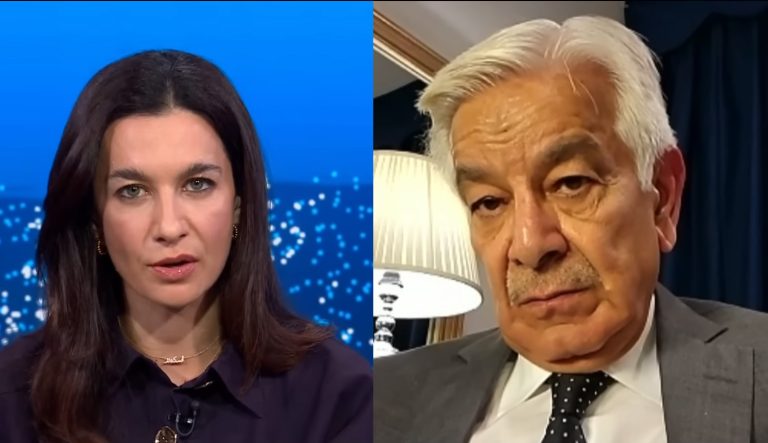
The truth about Pakistan is out of the bag, with its defence minister admitting that Pakistan has been funding and backing terrorist groups.
In a video clip that has now gone viral, Pakistan’s defence minister is in conversation with Sky News’s Yalda Hakim, when she asks him, “But you do admit, you do admit, sir, that Pakistan has had a long history of backing and supporting and training and funding these terrorist organisations?
Khwaja Asif in his reply says, “We have been doing this dirty work for the United States for about 3 decades… and the west, including Britain…That was a mistake, and we suffered for that, and that is why you are saying this to me. If we had not joined the war against the Soviet Union and later on the war after 9/11, Pakistan’s track record was unimpeachable.”
#Pakistan Defence Minister Khwaja Asif admits on live TV that they have been sponsoring terrorism against India for past three decades.
Sky News (@SkyYaldaHakim): “But you do admit, you do admit sir, that Pakistan has had a long history of backing and supporting and training… pic.twitter.com/rT7LYzhnDr
The Pakistani Defence Minister has also in the interview with Sky News presenter Yalda Hakim warned of an “all-out war” possible with India.
Asif’s statement lays bare the fact that Pakistan, for many years, has been harbouring these terror groups.
Earlier, India’s foreign secretary Vikram Misri had said that in the meeting of the Cabinet Committe on Security, the cross-border linkages of the terrorist attack were brought out. It was noted that this attack came in the wake of the successful holding of elections in the Union Territory and its steady progress towards economic growth and development.
Following the terror attack in Pahalgam that killed 26 people, the Central government announced several diplomatic measures, such as closing the Integrated Check Post (ICP) at Attari, suspending the SAARC Visa Exemption Scheme (SVES) for Pakistani nationals, giving them 40 hours to return to their country, and reducing the number of officers in the High Commissions on both sides.
India also halted the Indus Waters Treaty signed in 1960 in the wake of the Pahalgam attack.
Prime Minister Narendra Modi also assured the country that the terrorists responsible for this attack, along with those who conspired it, will face punishment beyond their imagination, The Prime Minister asserted that the time has come to eliminate the remaining strongholds of terrorism and that the willpower of 140 crore Indians will now break the backbone of the perpetrators of terror.
(This news report is published from a syndicated feed. Except for the headline, the content has not been written or edited by OpIndia staff)
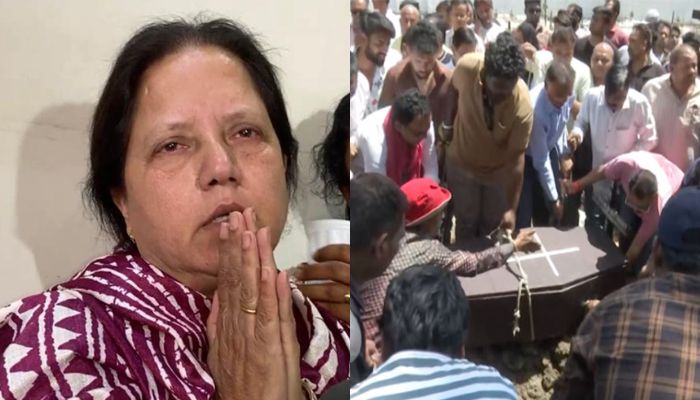
On Thursday (24th April), Jennifer Nathaniel, the wife of Sushil Nathaniel, a 55-year-old Indore resident who was killed in the recent Pahalgam terror attack, recounted how, after shooting her husband dead, the Islamic terrorists took selfies with the dead bodies of victims. She told the media her husband was shot after he told the terrorists that he was a Christian and did not know Kalma, when they asked him to recite the Islamic verse.
The Islamic terrorists belonging to Pakistani terror outfit Lashkar-e-Taiba’s offshoot, The Resistance Force (TRF), also asked if the Christian victim knew about Palestine. “Palestinia ke baare mein pata hai na (you know about Palestine, right)?” Jennifer Nathaniel recalled the TRF terrorists as saying.
Further describing the sequence of events before Sushil Nathaniel’s brutal killing, Jennifer said, “We were about to return from there when my husband told me he needed to use the washroom… When he came out of the washroom, suddenly a loud sound came and we thought it was of the ropeway breakage, but when we turned around, we saw the first man who was shot. A girl was crying and asking to be killed. Everyone started running and hiding here and there. We hid behind the washroom… All of us started trying to run but the terrorists found us… We were not able to contact each other via phone… The terrorists asked my husband to recite Kalma… “
#WATCH | Indore | Jennifer, wife of Sushil Nathaniel, says, "We were about to return from there when my husband told me he needed to use the washroom… When he came out of the washroom, suddenly a loud sound came and we thought it was of ropeway breakage but when we turned… https://t.co/4tpjGpjoXQpic.twitter.com/wzOzeD8ZbT
As it turns out, the Islamic Jihadis from Hamas had done something similar to their Israeli victims during their offensive against Israel in October 2023. They had taken photos with the bodies of their victims and shared it. They even paraded the naked dead body of a German woman Shani Louk. The Hamas terrorists spat on her and recorded videos of their horrific deeds.
Be it Pahalgam or Palestine, Islamic terrorists clicked pictures and took videos of their non-Muslim victims to mock and dehumanise them. For them, apparently, their act of religiously driven killing was an act of triumph over Kafirs.
A case of rape of Hindu girls has come to light from Bhopal, Madhya Pradesh. The victims say that the accused boys trapped them by telling them fake names and then made their obscene videos, blackmailed them for money and started forcing them for conversion.
The accused have been identified as Farhan Khan, Sahil Khan, and Ali Khan. The police registered a case in this matter on April 18, but it came to the media attention almost a week later. In the complaint, it has been mentioned that all three accused are MBA students of the same college where the victims were doing their graduation.
According to the Dainik Bhaskar report, first Farhan Khan trapped a girl student doing graduation in his college. After this, he made relations with the victim and started threatening her after recording her video. Later, Farhan himself pressurized the victim to introduce her friends to Sahil and Ali.
When the victim did this out of fear, Sahil and Ali met the other two girls at different places and made obscene videos of them in the first meeting itself. After this, the three accused were pressuring the victims to change their religion to Islam and were repeatedly asking them for marriage.
Apart from this, the accused used to demand money from the college girls every day. When this demand and blackmailing started increasing, one of the victims decided to complain to the police. She reached Baghsewania police station. She told the police that her two other friends have also been victimized in the same way.
While starting the investigation, the police also got the two girls counseled and later during interrogation, both the victims told that Ali Khan made physical relations with one girl in a hotel in Ashok Garden and Sahil Khan did it in a room in Jahangirabad.
The police sent the case to Ashok Garden and Jahangirabad police stations for further investigation, after which the police arrested Farhan Khan and Sahil Khan and sent them to police custody while the search for Ali Khan is on. After this case came to light, the police suspect that more revelations can be uncovered in the investigation. Police suspect that more victims can be discovered in the case.
In the investigation so far, the police have found pictures of many other girls from Farhan’s mobile. Police said that all three accused are not from Madhya Pradesh. Two of them are from Bengal. The case has been registered under rape, POCSO Act and Religious Freedom Act. Further, an SIT has been formed for impartial investigation.
A similar pattern of targeting young girls was seen in 1992 Ajmer case and in Beawar in February this year. In Bhopal as well, Hindu girls were targeted in a similar way by Muslim youths. The accused used to deceive the victims going to school, do obscene acts with them, and then harass them further by threatening to make the video viral.