Yesterday, on the 6th of March 2020, two Kerala based Malayalam News channels, namely Asianet News and MediaOne were awarded 48-hour token ban by the Information and Broadcasting Ministry for their shoddy ‘coverage of the Delhi riot’. Both these channels displayed a black screen since 7.30 pm on March 6 (Friday), when they were taken off-air.
The channels were supposed to resume broadcast only at 7.30 pm on March 8 (Sunday) after completion of the 48-hour ban. The order had alleged that the two Malayalam News channels have indulged in biased coverage of the Delhi riots, being critical of the RSS and Delhi police and siding with a particular community, showing those who supported Citizenship Amendment Act in poor light.
However, just after a few hours of the ban being imposed, the Information and Broadcasting Ministry and rescinded the 48-hour ban that was awarded to Asianet News and MediaOne. Reportedly, the ban against Asianet News was lifted at 1:30 AM and the ban on MediaOne was lifted at 9:30 AM.
Both channels were taken off air citing two rules under the Cable Television Networks Rules, 1994:
Rule 6(1 c)- says that no programme should be carried which contains an attack on religions or communities or visuals or words contemptuous of religious groups or which promote communal attitudes.
Rule 6(1 e)- says that no programme should be carried which is likely to encourage or incite violence or contains anything against maintenance of law and order or which promote anti-national attitudes.
The I&B ministry had imposed a similar token 24-hour ban on NDTV in 2016 their coverage of Pathankot terrorist attack. The penalty of taking the channel off-air for one full day came after the IMC noted with “grave concern” that the channel had “revealed sensitive details like the location of ammunition depot and the place where terrorists were held up, location of the school and residential areas”.
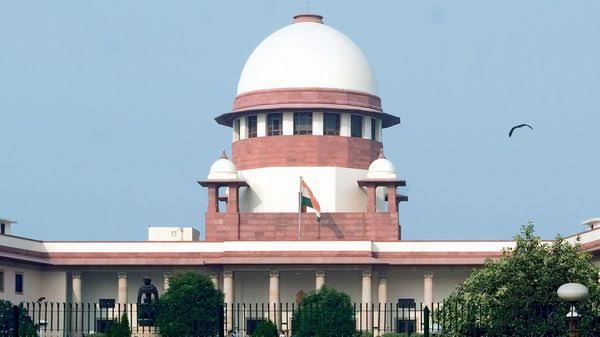
In a ruling that could open floodgates pertaining to the functioning of non-governmental organisations (NGO) in the country, the Supreme Court on Friday ruled that the Centre cannot prevent NGOs and civil society groups from receiving foreign funds if they indulge in agitations, bandhs or hartals in support of public causes, saying such action could not be termed political in nature.
On Friday, the Supreme Court ruled that the ban on receiving foreign contributions under the Foreign Contribution Regulation Rules (FCRA rules) should apply only to those organisations which take an active part in politics.
A Supreme Court bench of Justices L Nageswara Rao and Deepak Gupta stated that organisations of farmers, workers, students, which are not directly aligned to any political party but work towards the advancement of political interests of these sections, are entitled to receive foreign funds under the Foreign Contribution (Regulation) Act.
Examining various provisions of the law and the rules framed under the FCRA, the apex court said such voluntary organisations cannot be penalised under the act for getting foreign funds.
“Any organisation which habitually engages itself in or employs common methods of political action like ‘bandh’ or ‘hartal’, ‘rasta roko’, ‘rail roko’ or ‘jail bharo’ in support of public causes can also be declared as an organisation of political nature, according to the guideline prescribed in Rule 3 (vi). Support to public causes by resorting to legitimate means of dissent like bandh, hartal etc cannot deprive an organisation of its legitimate right of receiving the foreign contribution,” said Justice Rao, who wrote the judgment for the bench.
However, the court did not declare the provision under the law unconstitutional but ruled that it will be applicable only to those organisations which are involved in active politics. “We hold that it is only those organisations which have connection with active politics or take part in party politics, that are covered by Rule 3 (vi). To make it clear, such of those organisations which are not involved in active politics or party politics do not fall within the purview of Rule 3 (vi),” the judgement said.
The court also clarified that political parties can’t receive foreign fund using non-political NGOs. The court said, “we make it clear that organisations used for channelling foreign funds by political parties cannot escape the rigour of the Act provided there is concrete material”. The bench added that the “Central Government shall follow the procedure prescribed in the Act and Rules strictly before depriving such organisation the right to receive foreign contributions”.
The top court bench was hearing a plea filed by the Indian Social Action Forum (Insaf), a voluntary organisation, challenging the validity of various provisions of the act and rules.
Senior advocate Sanjay Parikh, representing the petitioners contended the act confers “unguided and uncanalised power” to the centre to specify an organisation as an outfit of political nature, though not being a political party, to prevent it from accessing foreign funds. The words “political interests” used in the rule are vague and susceptible to misuse, he said.
The court held that a balance has to be drawn between the object that is sought to be achieved by the legislation and rights of the voluntary organisations to have access to foreign funds.
“The purpose for which the statute prevents organisations of a political nature from receiving foreign funds is to ensure that the administration is not influenced by foreign funds. A prohibition from receiving foreign aid, either directly or indirectly, by those who are involved in active politics is to ensure that the values of a sovereign democratic republic are protected,” the apex court added.
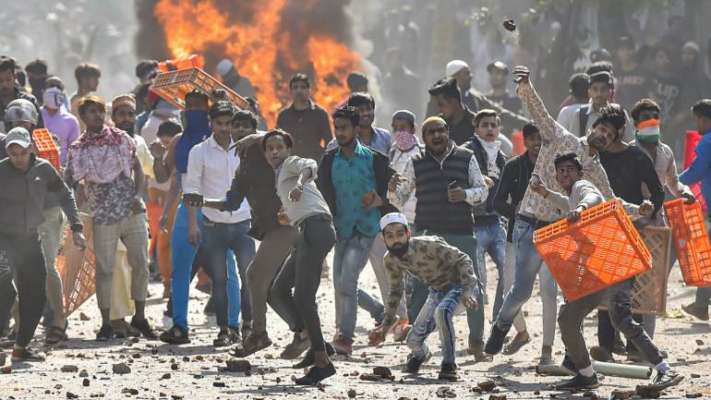
On Friday, the Delhi Police had revealed that some of the mob involved in the Delhi Anti-Hindu riots came from nearby areas of Ghaziabad and Meerut in Uttar Pradesh, reportedAsian News International (ANI).
The vital information reportedly came to light during a coordination meeting between the Delhi and the Uttar Pradesh police. The meeting was held at the DCP office in North-East Delhi and had DCP Northeast Ved Prakash Surya, Meerut IG Praveen Kumar, and SSP Ghaziabad, besides the Joint Commissioner (Delhi Police) Alok Kumar.
Kumar said, “Certain points regarding the Delhi violence was taken up during the meeting. The meeting was called to discuss the various aspects of the incident by police officials of the Eastern Range.”
In a major breakthrough, the Special Investigation Teams (SITs) investigating the North-East Delhi violence, have identified Head constable Ratan Lal’s assassin and the rioters who attacked and injured DCP Shahdara IPS Amit Sharma and Delhi police officer ACP Anuj Sharma.
More than half a dozen rioters have been identified using local surveillance, CCTV footages and information from eyewitnesses. The cops are now conducting raids at various places in Delhi to nab the perpetrators.
Earlier, the Delhi police had apprehended an accused named Shahnawaz involved in the gruesome murder of 20-year-old Dilbar Singh Negi on February 24 during the Delhi Anti-Hindu riots. His mutilated body was later discovered at Anil Sweet House in Brijpuri on February 26.
Dilbar Singh Negi was burnt alive by a Muslim mob of rioters after his limbs being cut off with a sword. The rioters, after cutting his hands and feet, threw the rest of his body into the burning fire.
The Delhi Anti-Hindu riots claimed at least 42 lives and injured 200 people. These riots were fuelled by a relentless sleuth of anti-Hindu sentiments amongst the Islamists. The violent, radical mobs were further enabled by a narrative peddled by self-declared liberals, who fueled Hinduphobia in name of ‘saving constitution’.
The Indian Army will set up quarantine facilities for 1500 people in different parts of the country such as Jaisalmer, Suratgarh, Secunderabad, Chennai and Kolkata etc. in a bid to contain the coronavirus outbreak.
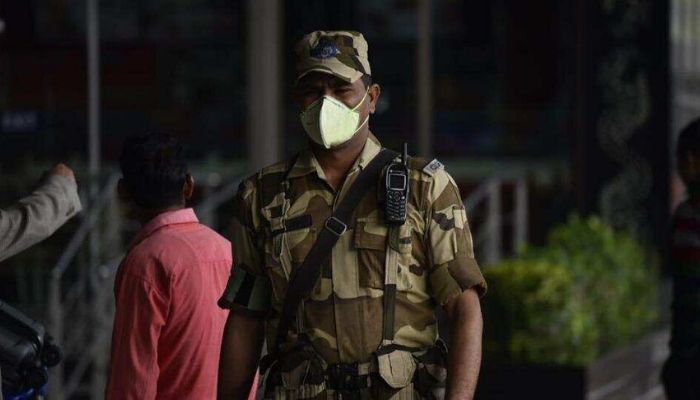
Sources said that the men in uniform had been asked to avoid crowded places and non-essential foreign travel. They had been advised to use shopping complexes within cantonments. The Army Headquarters had also released a detailed advisory with regards to tackling the coronavirus outbreak.
The advisory had asked security personnel to set up isolation wards and separate out-patient departments for the screening of “symptomatic cases”. These quarantine facilities will work in tandem with local medicos and designated laboratories of the Indian Council of Medical Research. Counselling and Health Education would also be provided at all military stations.
Similar guidelines had been issued by the Indian Air Force. The Indian navy had to defer its maritime exercise (Milan), scheduled between March 18-28 due to the coronavirus outbreak. A key security conference, scheduled between March 12 and 13 was also postponed by The Manohar Parrikar Institute for Defence Studies and Analyses.
Lieutenant General BK Chopra (retd) was quoted as saying, “From natural calamities to outbreak of communicable diseases such as the coronavirus, you can count on armed forces to deliver in an effective and systematic manner.”
Another positive case of coronavirus has been reported from Uttar Pradesh’s Ghaziabad on Thursday, taking the total number of cases in India to 30 so far. According to reports, the Ghaziabad man is a middle-aged person with a recent travel history to Iran.
In a shocking incident, an Irish national, suspected to be carrying the coronavirus, had absconded from SCB Medical College and Hospital in Odisha’s Cuttack late on Thursday. The affected person was admitted and was kept in the isolation ward as he was suspected to have been infected with COVID-19. He was later found in a private hotel in Bhubaneswar.
The anti-India protestors at Shaheen Bagh, who have been illegally squatting at the public roads from three months, seem to be losing their steam day-after-day as their media partners have abandoned them following the riots unleashed by Islamist mobs across Delhi.
On Friday, the ‘protestors’ attacked India TV reporters after the reporters pointed out that sirens are being used to assemble Muslim crowds on Fridays to intensify anti-CAA protests across the capital at a time when these mobs have run amok on the streets of Delhi.
India TV journalists Meenakshi Joshi and Diksha Pandey were on the streets of Shaheen Bagh on Friday to report on how Shaheen Bagh seems to be deserted as only a handful turned up at the site on Friday. The two reporters tried to expose the truth behind protesters leaving the protest site after the supporters of Shaheen Bagh protestors began to abandon them.
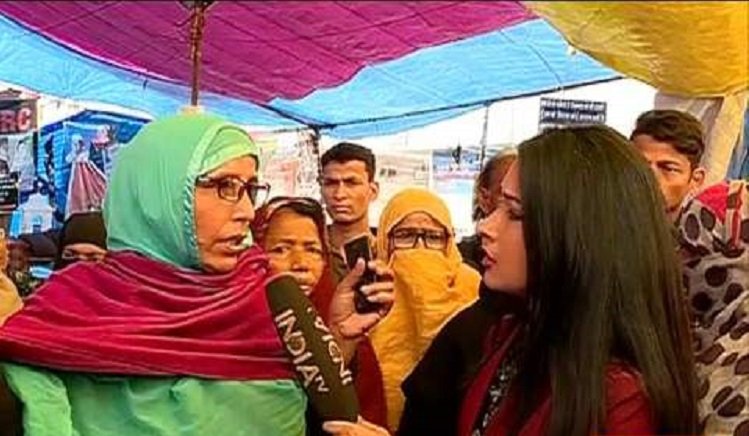
As Meenakshi Joshi showed visuals of Shaheen Bagh protest site being empty, the angry mob joined with few women protestors began to stop them from recording the visuals. Further, the angry protestors began to force her out of Shaheen Bagh.
Protesters try to stop India TV journalists from exposing empty scenes at #ShaheenBagh
Interestingly, at around 49 seconds into the video, a siren sound can be heard. The siren sound, perhaps a panic call, was made to garner enough protestors at the site as visuals of empty Shaheen Bagh was out in the public.
Shockingly, in the video, it can be seen that a protestor was forcing ladies of Shaheen Bagh to not talk to the media and forcing them to leave the place. Later, the same crowd began to hound the reporter and asked her to leave the place. Similarly, another mob outside the Shaheen Bagh was seen hounding India TV journalist Diksha Pandey to force her to stop her coverage.
In another video, it was quite evidently visible how Hijab-clad Muslim protestors at Shaheen Bagh attacked the India TV journalists and even attempted to destroy their camera for recording the visuals of Shaheen Bagh being empty.
शाहीन बाग में धरने पर बैठे लोगों ने सच दिखाने पर इंडिया टीवी की पत्रकार @IMinakshiJoshi के साथ की बदतमीजी, कैमरा तोड़ने की भी की कोशिश
देखिये शाहीन बाग पर इंडिया टीवी की EXCLUSIVE ग्राउंड जीरो से रिपोर्ट#ShaheenbaghTestOnIndiaTv
A group of women heckled journalist Meenakshi Joshi, as she asked where were the other ‘protestors’. As she questioned one of the protestors regarding the truth of using long-range sirens to assemble Muslim crowds to the protest site, an angry protestor tried to snatch and break their camera. They also forced the India TV crew out of the Shaheen Bagh tents.
This is not the first time that the protestors, backed by leftists and secular media, have unleashed violence on the journalists. Just a few days back, Consulting Editor of News Nation Deepak Chaurasia was attacked by a mob at Shaheen Bagh during their so-called ‘protest’ against the Citizenship Amendment Act.
The mob protesting at Shaheen Bagh had heckled the senior journalist and eventually, Chaurasia was manhandled as he reported from the venue. The mob, who were angry on Chaurasia for reporting the truth, tried to forcefully stop him from doing so. The video journalist accompanying Chaurasia was attacked as well and the camera was destroyed.
Since December 15, 2019, ‘protesters’ have occupied streets at Shaheen Bagh and blocked one of the arterial roads in Delhi to protest against the Citizenship Amendment Act. The protest site was accused of being an independent enclave where participation of people was regulated based on their political inclinations and past predispositions.
The anti-CAA protests which began as a peaceful protest has now crossed all the boundaries as it has not only turned violent but has now become another typical left-wing event where anti-India and Hinduphobic slogans are being openly chanted. The anti-CAA protests have also become a platform for secessionist agenda as protestors were caught openly batting for cutting North-east from rest of the country. The protest at Shaheen Bagh is fuelled by Islamic supremacy beside causing unprecedented traffic woes for daily commuters have also led to job losses.
The area which was once a witness to an enormous gathering of Islamist fundamentalists shouting anti-India, anti-government and Azaadi slogans is being visited by only a handful people, exceedingly outnumbered by the security personnel deployed there to ensure their safety. As “liberal-secular” media has lost interest in them and also with no more Biriyani supplies, the ‘protestors’ at Shaheen Bagh seems to have slowly abandoned the ‘protest’ site.
The Delhi police have apprehended an accused named Shahnawaz involved in the gruesome murder of 20-year-old Dilbar Singh Negi on February 24 during the Delhi Anti-Hindu riots. His mutilated body was later discovered at Anil Sweet House in Brijpuri on February 26.
Delhi Police: Crime Branch has arrested an accused Shahnawaz, in the murder/riot case of Gokulpuri which was registered after the body of one Dilbar Negi was found in mutilated condition in Anil Sweet House, Brijpuri on 26th February. #DelhiViolencepic.twitter.com/p07SjSUpZS
Dilbar Singh Negi was burnt alive by a Muslim mob of rioters after his limbs being cut off with a sword. The rioters, after cutting his hands and feet, threw the rest of his body into the burning fire.
The incident was first reported by Opindia, when the relatives of Dalbir, the deceased, contacted us and reported the horrific accident. He came to Delhi just 6 months ago from Pauri Garhwal in Uttarakhand. He used to work at a sweet shop located in Shiv Vihar. he Uttarakhand government has announced financial assistance of five lakh rupees to the family of the deceased.
His close aide Shyam Singh told Opindia that some rioters entered the Shahdara area on the evening of 23 February. The rioters made Negi their first target. They cut off his arms and legs. Then, they burnt his body in a nearby shop. He was accompanied by his two other companions in the building who managed to escape from there.
On February 26, when the shop owner Anil Pal reached the spot to know the condition of his shop with the police, he found the body of the deceased Negi near the stairway on the second floor. We can assume that he was trying to jump from the building after seeing the rioters.
At least 42 people were killed and more than 200 people were injured in the Delhi Anti-Hindu riots. The violence that was unleashed on the streets by radical Muslim mobs, fuelled by the contentious objective of Khilafat 2.0 have caused significant damage to personal and public property. They blew up houses, shops, vehicles, a petrol pump and opened fire on local people and police personnel.
The Delhi riots have exposed further a rather ugly underbelly of the media fraternity. Throughout the riots and even after, the media has been trying its best to try and further a false narrative of the Delhi riots being an anti-Muslim pogrom when in reality, the Delhi riots were aggression by Islamist mobs. In fact, the aggression started way back in December when Muslim mobs had run riots and gone on a rampage, supposedly, against the Citizenship Amendment Act. There are several channels, journalists and portals that have furthered the false narrative about Delhi riots, however, NDTV has led the charge rather effectively. The Media has been hell-bent on blaming BJP leader Kapil Mishra for the Delhi riots.
A few days before the riots, Kapil Mishra had said that the protestors who have been blocking roads must clear the area, or, after President Donald Trump leaves, he will have to come on to the streets as well. The media latched on to this statement and tried to blame Kapil Mishra for ‘provoking riots’. In doing so, they, of course, shielded the Islamists who had made far more provocative statements. Sharjeel Imam had spoken about grinding Delhi to a halt and breaking up the country, Umar Khalid had actually incited violence by asking people to take to the streets while President Donald Trump was here, Waris Pathan had alluded to the fact that Muslims can overpower Hindus and AAP’s Amanatullah Khan had been booked already for inciting violence.
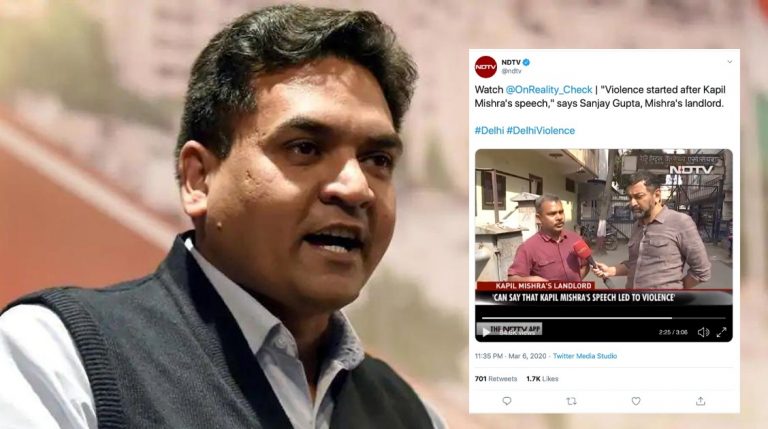
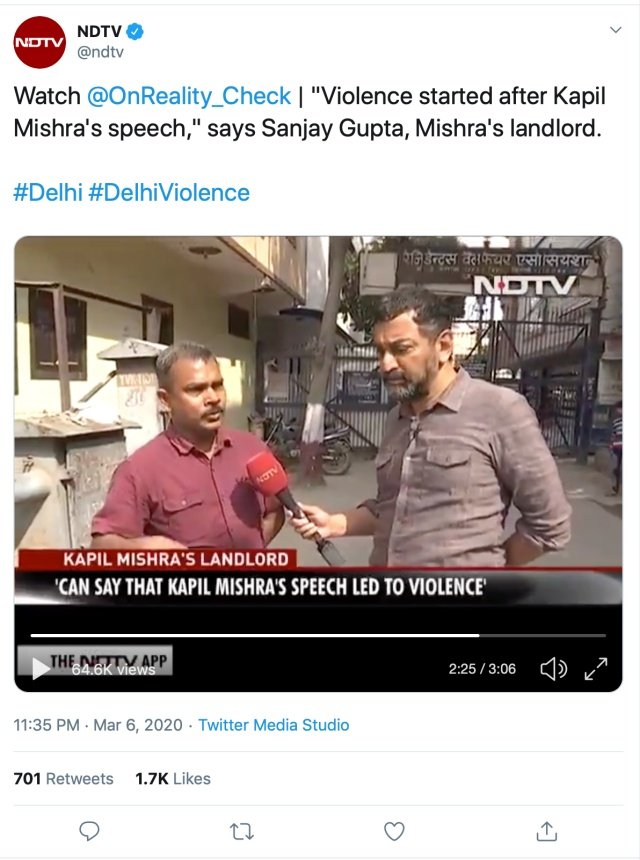
While shielding all those who incited violence, the media worked overtime to blame the riots on Kapil Mishra. Furthering that agenda, NDTV, the propagandists-in-chief, published a video on 6th March where one of their lie-peddling anchors, Srinivasan Jain, was supposedly talking to Kapil Mishra’s landlord.
In the video, the man being spoken to, one Sanjay Gupta, is identified as the landlord of Kapil Mishra by NDTV. It is not only in the narration, but even in the ticker, he is identified as such repeatedly.
NDTV snapshot
While the NDTV likes to claim that they actively managed to track down the Landlord of Kapil Mishra who in turn blamed Kapil Mishra for the riots, the truth might be something completely different.
Kapil Mishra has claimed that Sanjay Gupta is not his landlord. Speaking to OpIndia, BJP leader Kapil Mishra claimed that Sanjay Gupta was not his landlord. In fact, he said that Sanjay Gupta has never been his landlord ever.
The same statement was made by Kapil Mishra on Twitter as well.
He has claimed that NDTV picked up some random person from the streets and claimed that he was Mishra’s landlord.
In fact, during the video too, Sanjay Gupta seems to not claim that he is the ‘landlord’ of Mishra. The manner in which Gupta is speaking seems to suggest that he might have been a property broker and not a landlord.
Kapil Mishra, speaking to OpIndia also claimed that the street where Srinivasan Jain is standing with Sanjay Gupta is not even the street where Mishra lives.
NDTV has attempted actively to stoke tensions and peddled blatant lies during the Delhi riots. Earlier, OpIndia had busted how the channel had lied while reporting about two schools in the Shiv Vihar area. One school was Muslim owned while the other was Hindus owned. The Muslim owned school was used as a launchpad for attacks against Hindus. OpIndia found several sacks of bricks, petrol bombs, crude bombs etc on the terrace of the Muslim owned school. The Hindu owned school was completely ravaged and gutted by the Muslim mob. NDTV, with no evidence, claimed that it was the Muslim owned school that was attacked by Hindu mobs first. This was a complete lie concocted by NDTV to implicate Hindus falsely.
The government on Friday constituted a Delimitation Commission to redraw Lok Sabha and Assembly Constituencies of the Union Territory Jammu and Kashmir and the northeastern states of Assam, Arunachal Pradesh, Manipur and Nagaland.
According to the reports, the Delimitation Commission to be headed by former Supreme Court judge Ranjana Prakash Desai, a law ministry notification said. Election Commissioner Sushil Chandra and state election commissioners of Jammu and Kashmir and the four states will be the ex-officio members, it said.
The appointment of Justice Desai will be for a period of one year or till further orders, whichever is earlier, the notification said.
Delimitation is the process of fixing limits or boundaries of territorial constituencies in a country or a province with a legislative body. The new delimitation will enable the process of redrawing the Lok Sabha and assembly constituencies in the Union Territory of Jammu and Kashmir and the four northeastern states.
“The Commission will delimit the constituencies of Jammu and Kashmir in accordance with the provisions the Jammu and Kashmir Reorganisation Act, and of Assam, Arunachal Pradesh, Manipur and Nagaland in accordance with the provisions of the Delimitation Act, 2002, the notification said.
The last delimitation across the country was conducted in 2002, but these states were left out due to various reasons. In the four states of North East India, delimitation could not be carried out along with other Indian states due to prevailing security reasons. But now, the government thinks the situation has changed.
The delimitation in the union territory of Jammu and Kashmir comes nine months after the controversial Article 370 was scrapped and the state was divided into two union territories. The Jammu and Kashmir Reorganisation Act, 2019 which was cleared in Parliament in August 2019, mentioned new delimitation to redraw the constituencies of Jammu and Kashmir according to section 62 of the Act.
The notification of the law ministry said that “it appears that the circumstances that led to the deferring of the delimitation exercise have ceased to exist and that the delimitation of the constituencies as envisaged under the Delimitation Act, 2002 could be carried out now.”
According to section 60 of the Jammu and Kashmir Reorganisation Act, the number of seats in the Legislative Assembly of Union territory of Jammu and Kashmir shall be increased from 107 to 114. Out of these 24 seats are in Pakistan-occupied Kashmir. So effectively, the seats will go up from 83 to 90.
The Delimitation Commission in India is a high power body whose orders have the force of law and cannot be called in question before any court. In India, four such Delimitation Commissions have been constituted.
The first one was constituted in 1952 under the Delimitation Commission Act, 1952, second in 1963 under Delimitation Commission Act, 1962. Subsequently, another delimitation commission was set up in 1973 under the Delimitation Act, 1972 and in 2002 under the Delimitation Act, 2002.
The intelligence agencies have specific evidence that connects the terror-state of Pakistan to the anti-CAA protests, reports Hindustan Times. The evidence corroborates the fact that Pakistan had indeed tried to amplify the violence on the streets of Delhi and had made an all-out effort to spread false propaganda at UN Human Rights Council at Geneva by equating the Delhi riots to 2002 Gujarat riots.
According to Hindustan Times, the Indian intelligence agencies have picked up cross-country electronic communication where people believed to be Pakistani operatives are reprimanding their sources for failing to organise anti-CAA protests with enough mobs on March 3-4 despite the funding at their disposal.
In one such call, the handler attacks his sources for failing to organise an anti-CAA protest and states that he has to now explain to his higher-ups for the lack of crowds.
It is believed that despite the anti-Hindu riots in Delhi was contained at a significant cost, the Pakistani establishment supported by its sympathisers in India will try and use it as an instrument to radicalize young Muslims in north India against the Narendra Modi government through videos and speeches. A similar modus operandi was used after the 2002 riots in Gujarat, they add.
Reportedly, Islamabad’s cause is being supported by other Muslim states such as Iran and Turkey as part of their effort to pitch for leadership in the Shia and Sunni world of Islam.
The Pakistan establishment, especially the ISI, has put every effort to defame India in the UN bodies by talking about the alleged Muslim killings and persecution by the NDA government. However, the Imran Khan government has avoided blaming CAA as the law is designed only to help persecuted minorities in Pakistan among other neighbourhood countries.
Making a national statement at the UNHRC, Pakistan’s permanent representative warned the Council on “India’s drift towards fascism and rank communalism…” and asked the High Commissioner to “prevent violence and ensure the safety of Muslims in Delhi” and elsewhere in the country.
On the day of US President Donald Trump’s visit to India, the national capital had witnessed unprecedented violence. The anti-CAA riots turned communal in Delhi resulting in severe violence on the streets of Delhi.
The anti-Hindu riots were carefully planned by certain anti-India elements within the country, backed by sections of media, to intensify the so-called anti-CAA protests. However, the Muslim mobs, which were at the forefront of these protests, soon gave up the idea of ‘peaceful’ protests and resorted to their usual modus operandi of inflicting massive terror on the citizens of the national capital.
Shockingly, the left “liberal-secular” media of the country, chose to work on similar lines to amplify the riots by inciting Muslim population through blatant misinformation campaign. Just like Pakistan, which pushed the false narrative of Muslims being the victim despite being the perpetrator of violence on the streets of the Delhi, the media industry of the country also continued with false reporting to fear-monger and incite Muslims, who further descended on the streets to inflict more terror.
Ever since the Citizenship Amendment Act was passed by the Indian government, the “liberal-secular” media, both within the country and international media, has been at the forefront of spreading false propaganda. In a way, these media instigated people with false reportage resulting in the anti-Hindu riots.
Later, these left-wing media industry also tried to whitewash the crimes committed by Muslim mobs and instead are blaming Hindus for the anti-Hindu riots.
The anti-Hindu riots that engulfed the streets of Delhi have resulted in deaths of around 50 persons and more than 250 people sustained injuries in the violence that started on February 23. The injured include around 70 persons from the security forces. More than 50 FIRs had been filed and 514 suspects had also been rounded up by the police. The cops have set up 2 SITs for investigating serious cases of offence that took place during the riots.
Ever since India won its independence, there has been an organized effort to whitewash the crimes committed against in the Hindu community. Even when the crime was obvious, an assorted bunch of intellectuals, academicians, activists and ‘journalists’ engaged in complete hogwash to pretend as if nothing ever happened and Hindus did not suffer any brutality. This has been India’s reality since independence.
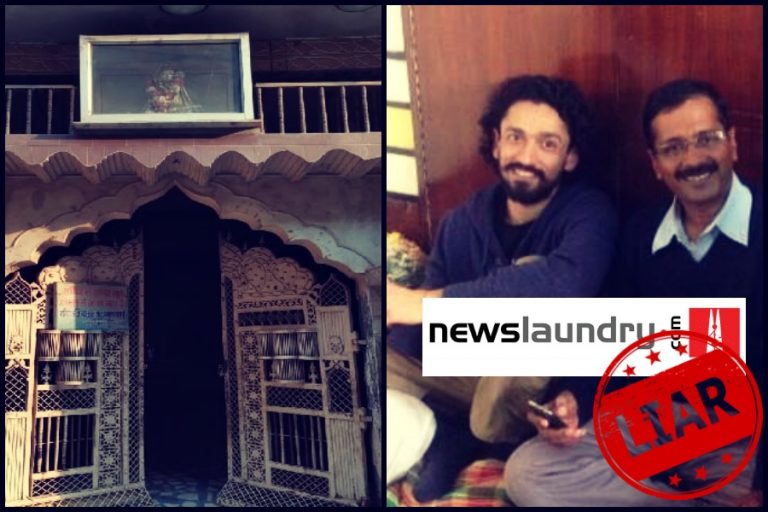
Over time, such buffoonery has become institutional and we have a generation of completely brainwashed clowns who could not recognize Hinduphobia if it danced in front of them wearing Burhan Wani’s nappies. One of the products of such indoctrination on an industrial scale is Newslaundry. The ‘news outlet’ has made it a habit of peddling politically biased narratives in the garb of neutrality, propaganda under the cloak of objectivity, righteousness over the shroud of Hindu corpses.
On the 6th of March, Newslaundry published a ‘ground report‘ on the basis of which it branded OpIndia’s ground report ‘fake news’. According to Newslaundry, OpIndia made four claims and on the basis of its ground report, it claimed to ‘rebut’ each of these. Together, we shall verify the claims made by Newslaundry one by one on each of these four issues. But first, let us see what OpIndia did say on the matter.
“Local Hindus’ speaking to OpIndia said that a crowd of Muslims, mostly youths, approached through Mustafabad in Delhi. They all gathered on the bridge of Chand Bagh. From there, they reached Aam Aadmi Party councillor Tahir Hussain’s building. They went to the terrace, from where they started throwing stones and petrol bombs.
These locals also revealed to Opindia that the Muslim crowd captured a Shiv temple by climbing on to the roof of the temple, placing ladders at the back yard of the Shiva temple. Apart from forcibly occupying the temple, the Islamist goons also captured the surrounding Hindu houses.
The mob allegedly vandalised the temple, after which they climbed the roof of the Shiv Mandir and started pelting stones on the Hindus from there. On one side there was stone pelting from the roof of Tahir Hussain’s building, and on the other side, there was stone pelting from the temple, divulged the devastated Hindus of Chand Bagh.”
Now that readers have acquainted themselves with our report, let us proceed to debunk Newslaundry’s thuggery one claim at a time. Before we begin, Newslaundry appears to have taken great issue with the fact that we reported that the Shiv Mandir was in Chand Bagh when it was actually in Moonga Nagar. Well, Moonga Nagar is only 750 meters away from Chand Bagh. Chand Bagh and Moonga Nagar are just a drain apart. Since Chand Bagh is the better-known area, Moonga Nagar is often identified with it.
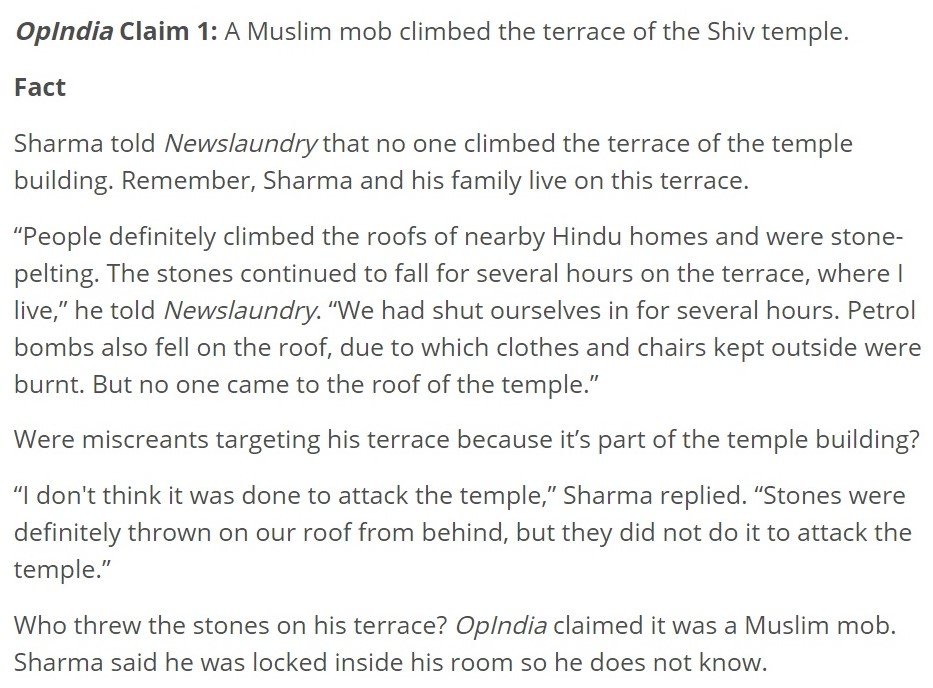
1. A Muslim mob climbed the terrace of the Shiv Temple
Newslaundry quoted Gokul Chandra Sharma, the caretaker of the Temple, to claim that a Muslim mob had not climbed the terrace of the Shiv Temple in question. Where was Sharma when the attack on the Temple occurred? He was locked inside his home because he was scared for his life. Thus, Newslaundry is taking Sharma’s words as the ultimate truth, a man who did not see anything and could not even say who threw the stones at the terrace because he was locked inside his home, scared. We are not making this up, Newslaundry has itself quoted Sharma as saying so.
Newslaundry’s conversation with Gokul Chandra Sharma
Newslaundry also had a conversation with Ram Shamra, a person who lives opposite the Temple, who admitted that Muslims used ladders to climb into the terraces of Hindu homes beside the Temple but not on the terrace of the Temple. Another anonymous source told them Muslims could not even get to the Temple because Hindus were pelting stones at them from the opposite rooftops. Now, let us get to the truth of the matter.
We were not the only ones who reported on the attack of the Temple. Know The Nation, another organization had also reported on the matter. They also talked with the people present in the attack and they gave a chilling account of the events that transpired. Know The Nation was also informed of the terrible nature of the attack, however, the two people who were witness to the attack fled the place because they realized couldn’t help in any manner and they would be risking their lives if they stayed any longer.
[youtube https://www.youtube.com/watch?v=ny6h2Vz5_N4]
The two youth also said that the ‘Mahommedan mob’ had climbed on top of the terraces but it is unclear from their statement whether the mob climbed atop Sharma’s terrace also. In any case, they were not present during the entire duration of the attack. They also informed that petrol bombs and stones were pelted at the Temple while Gokul Chandra Sharma locked himself up with his daughters in his house. He was quite worried about the safety of his daughters.
We were told by eyewitnesses that the Muslim mob had climbed on the terrace of the Temple. That is what we stated in our report. It is unclear to us how on earth Newslaundry could accuse us of spreading ‘fake news’ when we reported what the eyewitnesses said. Unless, of course, the preconceived agenda of the ground report was to engage in the denial of the crimes suffered by the Hindus.
[youtube https://www.youtube.com/watch?v=_PN988ta2mo]
2. The Muslim mob captured the Temple
Newslaundry claimed that Gokul Chandra Sharma ‘refuted’ the claim saying, “There was no attack inside the temple. Nobody came here nor did they break anything. All our idols are fine. They have not been harmed.” Nowhere in our report did we claim that the inside of the Temple was vandalized, nowhere did we claim that the idols were damaged either. It doesn’t say anything about whether Sharma refuted the claim of whether the Mandir was captured. Newslaundry appears to be putting words into Sharma’s mouth.
Furthermore, it appears that Sharma himself realized that the Newslaundry journalist was acting in bad faith and therefore, he was reserved in his words. While he told Newslaundry that he wasn’t aware of who were pelting the stones, he did tell Know The Nation that the mob pelting the stones and attacking the Temple was ‘Mahomeddan’. We were told by the eyewitness whose statement has been attached above that the Temple was captured by the mob.
Also, it is interesting the NewsLaundry says that the temple was not captured. Picture this. There is a Muslim mob that has surrounded the temple from all sides, some also say there were atop the temple terrace. The Muslim mob was also pelting stones and petrol bombs from the surrounding building. Nobody could go in, to rescue anyone, and the ones inside could not escape. In such a scenario, would the temple be considered captured or not? Or is it NewsLaundry’s contention that only if Namaz was read inside would the temple be considered captured?
And really, how many IQ points does it take to realize that the Temple was indeed captured when Sharma who had locked himself up in his home fearing for the life of his family? Sharma told Newslaundry that he was not even living in his home when he had the conversation with the ‘journalist’. But even then, Newslaundry was busy claiming that the Idols were not vandalized, a claim we had not made in the first and on the basis of it, declared that the Mandir had not been captured. It is truly some remarkable journalism we witnessed here.
3. The mob allegedly vandalised the temple
If you believed Newslaundry has hit the pits already, we assure you will be surprised. The mob pelted stones and petrol bombs at the Temple. This much is not disputed by anyone, not even the NewsLaundry report. Sharma was forced to lock himself up in a room to ensure the safety of his family, especially his two daughters. Is the terrace a separate entity than the Temple? Does the terrace in a vacuum? From the Know The Nation report, the extent of the stone-pelting is quite clear.
Petrol bombs were hurled, a huge amount of stones were pelted, things got burnt but Newslaundry reached the conclusion that the Temple was not vandalized because it occurred primarily on the terrace and the terrace, as we all know, is entirely a separate entity from the Temple which floats on the ocean of Ganga-Jamuni Tehzeeb. It seems according to Newslaundry, it doesn’t matter if petrol bombs were hurled at the Temple and the terrace was strewn with stones, we cannot call it vandalization. Why? Because it hurts Newslaundry’s agenda of whitewashing the suffering of Hindus.
The intelligence of Newslaundry is at its glorious magnificence when it asks its readers, “Yet in the video, the reporter himself said people did not allow stone-pelters to enter the temple. So, why is the story saying the exact opposite, with its claims of vandalism and a mob “forcibly occupying” the temple?” This, dear readers, is the level of intelligence of the average Newslaundry journalist. It would have been hilarious if their agenda wasn’t so sinister.
Someone should probably inform Newslaundry that if you climb on the top of a building and pelt stones and petrol bombs in the surrounding places, it is convention norm to consider that you have captured the building. The same rules apply to Temples as well. Apart from that, the eyewitnesses themselves said that the Temple was captured by the Muslim mob.
We were told by another individual that the Shiv Mandir was attacked with stones. We were also told a furniture shop close adjacent to the Temple was vandalized as well. The locks of the shop were forced open before it was set on fire. Furthermore, he clearly calls it an attack on the Shiv Mandir. The building adjacent to the Temple share a common wall and it was gutted by the fire.
[youtube https://www.youtube.com/watch?v=NFCicCtNObk]
Our precise words were, “The mob allegedly vandalised the temple, after which they climbed the roof of the Shiv Mandir and started pelting stones on the Hindus from there.” We reported what we were told and what we were told can be heard in the video.
[youtube https://www.youtube.com/watch?v=DWBaDqAcmr8]
4. The Islamist mob hurled stones at Hindus from the roof of the temple
Newslaundry says that the claim contains only a ‘quarter of the truth’. We have eyewitnesses who have said that the Islamist mob indeed pelted stones from the roof. It did happen. And Newslaundry’s efforts to whitewash the event will not alter reality.
Newslaundry further states, “The mob did not climb onto the temple terrace. Hindus were not just hapless victims of stone-pelting. They were pelting back.” The entire objective of the groud report is summarized in this single line. It was to prove that Hindus were not victims. Everything else was just a charade, Newslaundry set out from the very beginning to prove that Hindus are not victims. Because that is the foundation upon which the edifice of Ganga-Jamuni Tehzeeb is built upon. That Hindus under no circumstances can be victims.
Thus it happened that Newslaundry completely ignored the plight of Sharma who was forced to live away from his own home for the fear of his life. He is not a victim according to Newslaundry. The entire area which was attacked with stones and petrol bombs, the numerous Hindu houses which were attacked, none of them are victims. Why? Because they are Hindus.
While certain people were claiming that Tahir Hussain was acting in self-defense and went on to defend the AAP Councillor, legitimate Hindu victims are being ignored because some people pelted stones at the Muslim mob, and every piece of evidence points towards the fact that it was in retaliatory. But that is not enough to whitewash the victimization of Sharma and other hapless Hindus. This was Newslaundry’s objective from the very beginning. Ganga-Jamuni Tehzeeb commands it and thus, Newslaundry complied.
Newslaundry’s claim 1: “No attacks on temples in the area”
Newslaundry has indeed said such a thing. It has said this in the same report where Sharma said that petrol bombs and stones were being hurled at the terrace of the Temple. But sure. believe Newslaundry when it says, “No attacks on temples in the area”. Is it supposed to be some kind of a stupid joke?
Newslaundry just reported on an incident where the caretaker is forced to live away from his home on the terrace of the Temple after surviving a horrid attack. And then Newslaundry says in the same report that no Temples were attacked in the area. We have no explanation for this unbelievable crazy behaviour apart from the obvious fact that Hinduphobia has a way of making you mad. The Gods are not very forgiving, it seems.
Newslaundry’s claim 2: OpIndia propagated fake news right as Delhi burned
Someone should inform Newslaundry that facts are not fake news and they cannot be altered through manufactured propaganda. The Temple was captured, it was attacked, it was vandalized and they could try but they will not be able to alter the series of events that transpired during the Anti-Hindu Delhi Riots.
Newslaundry goes on to boldly assert, “Our conclusion? OpIndia propagated fake news right as Delhi burned. Meanwhile, people are returning to work, roads are being cleaned, destroyed property is being rebuilt. Despite a Hindu nationalist blog’s attempt to fan flames, life might limp back to normal.”
The propagandists’ ode to Ganga-Jamuni Tehzeeb really warmed our hearts because we were told by their comrades that we were living under a fascist regime where people don’t have freedom of speech and expression, our civil rights are being curbed and the Modi-Shah duo is only one step away from locking all the Indian Muslims in concentration camps. But sure, we are the ones fanning flames here. Because, obviously.
Meanwhile, ’eminent peace-loving intellectual activists’ are busy on the streets inciting Muslim mobs and undermining the institutions of the country. They are not the ones fanning flames. Oh, no. OpIndia is. How? By reporting on the atrocities that Hindus suffered in the wake of the communal riots in Delhi. Because the crimes of Hindus must never be told.
Our Conclusion?
The employees at Newslaundry are a bunch of propagandists with IQ levels that would shame baboons. They have been brainwashed to an extent that they do not recognize petrol bombs and stones being pelted at a Temple as a legitimate attack on a Temple. In fact, there was not a hint of concern or sadness over the fact that a Temple was attacked and that its caretaker is forced to live away from his home for the fear of his life and that of his family.
It’s only natural that there was not a hint of sadness or concern. Newslaundry did not go there to listen to the story that the Hindu residents had to share. They went there to whitewash the atrocities that Hindus suffered. Thus, when they could see that they had achieved their objective, it was pretty hard to hide the glee. When your heart’s rotten to the core by Ganga-Jamuni Tehzeeb, no amount of atrocities against Hindus could possibly melt your heart.
Meanwhile, Abhinandan Sekhri is a long-term aide of Aam Aadmi Party chief Arvind Kejriwal. He had co-founded the NGO ‘Public Cause Research Foundation’ which eventually evolved into ‘India Against Corruption’ movement that gave birth to AAP. He also co-founded Newslaundry, a self-declared media watchdog, which has till now deleted at least two of its own reports as they went against self-declared ‘liberal’ journalists. Unsurprisingly, Newslaundry is also busy defending Tahir Hussain, the AAP Councillor, who is a prime accused in the murder of Intelligence Bureau Constable Ankit Sharma.
Essentially, a propaganda outlet that has deep connections with the Aam Admi Party defends a murder and riot accused Tahir Hussain by saying that there is hardly any evidence against, when there is plenty, simply because he is an AAP leader and in the same breath, downplays attacks against Hindus and Hindu Temples by Islamists because to defend Hussain, the Islamist mobs would also need to be shielded. It is rather amusing that NewsLaundry, which is a failing outlet clutching on to straws, could not even produce one article that doesn’t turn them into a joke.