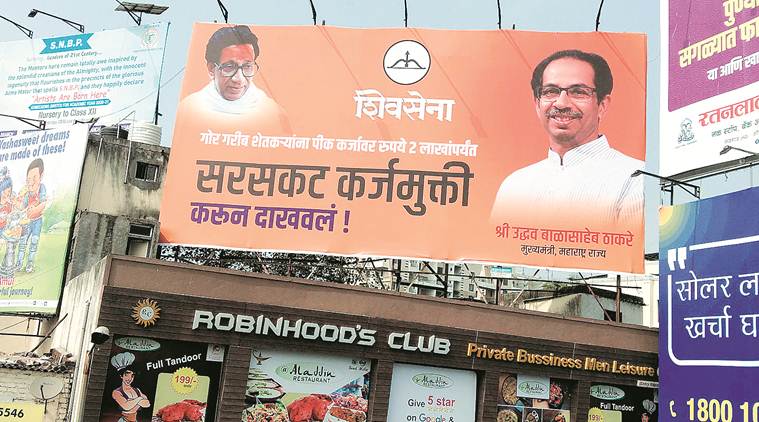
The state of Maharashtra has been in a state of confusion ever since the Assembly Election results were announced. First, Shiv Sena demanded the Chief Minister position for son Aditya Thackeray and broke their alliance with BJP over it. Then, Shiv Sena, Congress and NCP started negotiation over government formation with days of inconclusive talks. Then, one morning, everyone woke up to Devendra Fadnavis of BJP and Ajit Pawar of NCP being sworn in as the Chief Minister and Deputy CM respectively.
Post the swearing-in of Devendra Fadnavis and Ajit Pawar, the drama has reached an unprecedented level, dare we say, perhaps even more dramatic than the Karnataka fiasco. Congress, NCP (Sharad Pawar) and Shiv Sena have approached the Supreme Court to demand that a floor test be held immediately. Amidst accusations of MLAs being kidnapped, Sharad Pawar, while initially had distanced himself and the party from Ajit Pawar’s decision to ally with BJP, is yet to expel Ajit Pawar from the party rather inexplicably. He has said that this is a decision that has to be one by the party, and not his alone – non-committal at best.
A litany of leaders has met Ajit Pawar in an attempt to convince him to change his decision but to no avail. Three prominent leaders who met Ajit Pawar are Chagan Bhujbal, Jayant Patil and Dilip Walse Patil.
Sources in the know confirm Ajit Pawar categorically rejected the offers to come back to NCP and dilute his arrangement with BJP. Here is what he said:
Why not an NCP CM for 2.5 years?
Ajit Pawar told the leaders that Shiv Sena which has 56 MLAs wanted 2.5 years for the Chief Minister post when it was in alliance with BJP which has 105 seats. In the same scenario, now that Shiv Sena wants to ally with NCP, why is Uddhav Thackeray not giving NCP 2.5 years at the Chief Minister position since NCP has 54 MLAs? Ajit Pawar pointed out this discrepancy to the leaders and pointed out that NCP is kneeling to Shiv Sena, which according to numbers, is not required or desirable.
Alliance anti-democracy?
Ajit Pawar also questioned the leaders about his move being called anti-democracy by the NCP and its friendly parties. Ajit Pawar asked the leaders that if his decision to ally with BJP is anti-democracy, then how was Congress and NCP’s decision to ally with Shiv Sena democratic considering Shiv Sena fought in alliance with BJP and campaigned with worst words for Congress and NCP?
More stability
Ajit Pawar told the senior leaders that an NCP and BJP alliance would be far more stable than a three-party alliance with a party like Shiv Sena that can be a fickle friend.
Shiv Sena’s ‘questionable’ pride in Maharashtra
Ajit Pawar told the senior leaders of NCP who were trying to convince him that if Shiv Sena can remove word “Shiv” from Maha Shiv Aghadi just at the first instance of objection by Congress, how are they going to take forward pride of Maharashtra?
They couldn’t even manage BMC
Accusing Shiv Sena of being inadequate administrators, Ajit Pawar told the senior NCP leaders that Shiv Sena has not even managed to handle BMC adequately and handing them the reigns of the entire state can only be bad for Maharashtra. Besides, he also said that nobody would trust Shiv Sena to run the state adequately.
The special cell of Delhi police has stated that a terror attack plan on the National capital has been averted and the culprits have been arrested by them. DCP Pramod Kushwaha informed in a press conference that the police have arrested three persons from a suspected ISIS module in Assam.
DCP Pramod Kushwaha, Delhi Police Special Cell: The three arrested persons were from an ISIS inspired module and were planning to attack using an IED blast a local fair in Goalpara (Assam). They were planning to replicate it in Delhi. pic.twitter.com/mjRkIk8EN1
Kushwaha has stated that the arrested individuals were planning an IED blast at the ‘Rasmela’ a local fair in Assam and planning to replicate it later in Delhi.
As per reports, a considerable stash of IEDs was recovered from the trio. Police have stated that the IED recovered from them was of the same type that was used earlier in the Bhopal blast.
He added that prima facie, the group looks like a self-radicalised group. He further added that the investigation is on and further details will be revealed later.
The three arrested persons are named as Islam, Ranjeet Ali and Jamal. They were arrested from Gopalpara Assam. They were allegedly arrested with the IEDs in their possession.
As Delhi inches towards state assembly elections, Delhi Chief Minister and Aam Aadmi Party supremo Arvind Kejriwal has reached out to people for donation. As per reports, Kejriwal, while addressing a rally in the national capital said that the party has run out of funds and hence is seeking donation to fight the upcoming elections.
While addressing a rally in Delhi’s Burari, Kejriwal appealed to the people to donate to AAP. “We have done a lot of work in last five years in Delhi. We do not have money to fight the upcoming elections. I have not earned a rupee in last five years,” he said while addressing the rally. He again appealed to people to donate to AAP.
Ahead of 2019 general elections, Aam Aadmi Party was caught running donation ads in Saudi Arabia, the United Arab Emirates, Qatar and Oman other than in India.
Aam Aadmi Party has had a dubious relationship with donations in the past. In May 2017 it was alleged that AAP allegedly received crores of funding from shell companies through hawala transactions. Prior to that, anti-corruption crusader Anna Hazare had written a letter to AAP chief to come clean on the donations received by the party.
It was even alleged that before the 2014 general elections, Kejriwal had received money through dubious channels. BJP leader who was formerly an AAP MLA Kapil Mishra had alleged that one Hem Prakash Sharma, was the key to Kejriwal’s demonetisation drama. Mishra had alleged that on 5th Apil, 2014, a week before Kejriwal filed his nomination for 2014 General Elections from Varanasi, Rs 2 crore had been deposited in AAP’s account from four shell companies. Of these 4 companies, Hem Prakash Sharma is a director in 3. During an ED raid after demonetisation, carried out in GK in Delhi, Rs 13 crore worth currency was found. One of the directors of this company is also one Hem Prakash Sharma.
He further said that Hem Prakash Sharma is a fake director, who probably does not even exist. He went on to add that the only reason Kejriwal was on a back foot about contesting elections is the demonetisation, which has hurt him the most. This was bewildering for someone like Kejriwal, who hailed himself as an anti-corruption crusader and formed the political outfit on the plank of fighting corruption.
When OpIndia investigated into the mysterious Hem Prakash Sharma, we found that according to this report, the official records show that the four companies that had donated to AAP in April 2014, have no revenue to show. These companies have three common directors, Hem Prakash Sharma, Dharmender Kumar and Mukesh Kumar. The addresses listed in the registrar house a post office, a grocery store with shutters down and a small sewing factory. From the details, it would seem like these were shell companies.
Moreover, DNA was able to track down one of these directors, Mukesh Kumar, who denied donating anything to AAP, ever. He admitted to owning these companies, which exist only on paper, but denied donating to AAP. As per DNA, when they visited the address of Hem Prakash Sharma as mentioned in the official records, they found the two-storey house. There resided a lady in her 60s and a woman named Deepika Sharma, who was living with her family. She denied knowing Hem Prakash Sharma.
So who are these mysterious men? Are they fictitious? If so, who is funding these operations? Is there something the ‘anti-corruption crusader’, Arvind Kejriwal, hiding from us?
When the Aam Aadmi Party stormed into Indian political scenario, it arrived with a promise of changing the way political parties operate in India. It promised complete honesty and transparency in its operations, and most people believed in it. One the innovative thing the party did was to publish a list of donations it receives on its website, as proof of the transparent nature of its financial activities.
Towards the year 2016, the party removed the donation list for its website. During that time, the webpage for the list was still there, but it showed a message “under construction. New Version coming soon..”. But that new version never came.
It was reported that the page listed many donations above ₹ 20,000, but those were not reported to the Election Commission as per rules, and thus the party removed the list itself from the public domain.
This removal of the donation list was questioned by many people, including Yogendra Yadav and Anna Hazare. Former party member Yadav had alleged that the party was collecting cash donations which were not recorded.
They have relaunched their donation page on their website, but with a significant change. They have changed the web address for the page, it was donate.aamaadmiparty.org earlier, but now it is donations.aamaadmiparty.org. Along with standalone donations, the party now have provided the option of monthly donations also.
Meanwhile, the fact that AAP is running donation ads in the Middle Eastern countries also raises eyebrows. In November last year, as Delhi grappled with toxic pollution, Kejriwal was found taking a private trip to Dubai. It was also reported that Delhi’s health minister Satyendra Jain had also taken a week-long trip to Dubai just a week prior. Earlier too, Kejriwal has made trips to Dubai including that on a business class, drawing criticism.
It was also reported that the Indian-community based in Saudi Arabia is one of the major supporters of the Aam Aadmi Party. In February 2015 it was reported that they celebrated when AAP beat BJP in Delhi state assembly elections. In fact, a year later, they even celebrated one-year completion of AAP government in Delhi.
Every Wednesday afternoon, the corridor outside HSB 335 of IIT Madras witnessed celebration over coffee, samosa and cake ordered for all the students of the logic class. The excitement it generated was enough to last beyond the long class and the taste of the food perhaps lingered a little longer. Sudarsan Padmanabhan, the professor, enjoyed spending from his pocket and took a personal interest in getting the right supplier so as to ensure quality. He also made sure that biodegradable cups/plates are used and all food items are served fresh and/or hot.
Interestingly, the Wednesday orders had sufficient provision for some uninvited guests that included a few colleagues and staff who would routinely assemble outside the lecture hall to steal a coffee or some leftover cake. The road to logic, for Sudarshan Padmanabhan or SP as he was known, always passed through food, more so if it involved students. But that is part of the story; he was an extra-ordinary scholar combining the very best of Western and Indian intellectual traditions and balancing the textual with the worldly.
It was common to see students fiercely arguing with SP when he posed tough questions or played devil’s advocate by enticing the students to make statements and then finding contradictions in them. Never shy of responding to an innocuous query from students, nor in taking up a conceptual gauntlet, or laughing over some harmless banter or mimicry by creative and mischievous students, SP was the epitome of a textbook professor who walked in a way as if there is no destination and had all the time in the world to speak with students, colleagues and non-teaching staff. Colleagues often pulled his leg for being over caring about his students; students who did not belong to his class often regretted not being so (and also for missing out on tea/snacks). It is not surprising that the Institute and student representatives always found a willing partner in SP as and when there was a need for continuous monitoring of facilities such as upgraded canteen or drafting of various institutional frameworks involving elected student bodies.
Fathima Lateef, a rare talent of her batch, was a student of this logic class. SP treated everybody equally and Fathima, a little more equally, often ending a discussion with what Fathima said. As of now, nobody knows for sure what drove Fathima to accuse her professors when the professors named actually pampered her. Regardless of the authenticity of Fathima’s notes, or the probability of other causes, SP was declared guilty by grief-stricken friends and relatives and an over-zealous media, with able support from politicians and interest groups.
Within a matter of days, SP became the reason of not just Fathima’s death but of everything that ails the Indian education system in general and IIT Madras in particular. His is a classic case of all associations of reason gone horribly wrong and ideas such as deliberation, participation etc. sacrificed at the altar of political agenda-setting, religious polarization, ideological divide and journalistic one-upmanship. In the cacophony of finding the truth behind Fathima’s death, what is still shrouded in mystery is the very truth itself.
After the mysterious note blaming SP was released by the relatives, two more student-friendly professors (Hemchandran Karah and Milind Brahme) found their names in the list of suspects and were held responsible for pushing Fathima to take the extreme step. These two professors were equally caring, concerned and empathetic, always finding ways to reach out to those who needed help or required emotional/academic support. Both of them had the conviction of walking an extra mile in accommodating students with different social/cultural backgrounds. Two weeks after the tragic incident, students and faculty believe that the bond between the teacher and the student will never be the same again at IIT Madras. As a faculty member put it tersely, ‘this is our 9/11 moment’.
News media and the ways of delivering justice
The objective here is not to credit or discredit the parents’ version of the incident, but to create a context to understand the media discourse around truth, probability and informed debate. Given that the parents have lost their precious child, it would serve no one’s cause to be judgemental. The same with her classmates, friends and seniors who believe that her death could have been avoided.
So far as political parties and their affiliated student bodies are concerned, their demonstrations and demands can be seen as bread and butter questions; they are doing what they are trained to do, i.e. fishing in troubled waters. But what is appalling is the complete degradation of news media which absolved itself of any pretension of objectivity and disinterestedness, the general virtues associated with the profession. Not just social media trolls and the faceless rabble-rousers, even mainstream news media indulged in this evolving news story and sought to cash in on a minefield of a topic that can send their TRP soaring. Here are a few examples:
News media not only violated their own self-assigned credential of creating conditions for citizenship and democracy; they conducted themselves in a manner that produced the very opposite: mob justice, vigilantism, utter disregard for rule of law and willful abandonment of verifiability of their own claims. What we have got so far is character assassination, scandalous statements and an in-your-face unwillingness to ask very basic questions about available evidence.
What is troubling is the absence of any sense of doubt, self-reflexivity and moderation that should guide any engagement with an issue such as this. The suicide notes have been presented in an uncritical manner as if it constitutes authentic evidence. Here are some examples where the news media virtually became the spokespersons of the bereaved family by legitimating the ‘suicide notes’ left by the victim. Those who naively believe that we should not give media too much importance, not only underestimate the power of media in peddling truth for a significant length of time, but also vulgarize real suffering of the victims. The term ‘media trial’ has limited carrying capacity in the present context; perhaps ‘media justice’ has better claims.
Since that unfortunate incident, IIT Madras has issued an official statement about its sincerity in a fair probe without compromising its commitment to protecting its faculty who have been scarred by both mainstream and social media and are perhaps too numb to defend themselves. It is believed that the investigative team will do a professional job without being swayed by the media blitzkrieg. The accused professors are cooperating with the investigation, have not applied for anticipatory bail and have not made any outlandish statements, something that establishes their sincerity and trust in the system. Since the initial whispers about the possible reason for her death (such as performance in an exam), the debate has gone over to issues of harassment, casteism, elitism and Islamophobia.
If you are scratching your head as to how such divergent reasons could be reconciled, you need to understand what is known as media logic. This media logic is not peculiar to local, vernacular, regional newspapers and magazines coming out of Kerala and Tamil Nadu, but to the very philosophy of contemporary media management.
Template of predictable truths
At a time of political correctness, combined with the conventional truism of journalism as Fourth Estate, journalism as a profession has taken up the garb of activism, consciousness raising, social conditioning and even politicking (many media houses are owned by political leaders/parties), not through fair representation of facts but through predictable templates. The baseline of this template while dealing with an institution such as IIT Madras is to question it for what it is meant to be – a specialized and elite technological institution (to be distinguished from elitist). What follows is the demonization of the elite institution for not being the same like more inclusive institutions / local colleges (i.e. not perpetuating caste politics, academic mediocrity, political interference, favouritism in appointments of faculty, corruption in admission and evaluation to name a few). The very fact that IITs remain islands of meritocracy (a bad word now) is reason enough to castigate such institutes as an impediment in the path of equality, justice etc. Thus many reports linked Fathima’s death to Rohith Vemula’s; some went to the extent of comparing the case with the lynching of Md. Akhlaq in Dadri.
Once the deviance of the elite institution is established, an unfortunate death can be converted to institutional murder (or even murder), and be connected with a series of earlier suicides/deaths that can create a web of opacity, suspicion and intrigue. Points of criticism such as saffronization, Hinduization, Brahminism, Islamophobia, patriarchy, caste discrimination etc. follow this predictable pattern. As per this template (that has become normalized after decades of academic and political sanction), if a girl dies, the first suspect is patriarchy, and in case of a dalit, the needle of suspicion is directed at an individual/group blinded by Brahminism and caste hierarchy. Similar template was used after Fathima’s death as in this report.
I am reminded of a colleague’s experience when she was asked by her journalist friend about the possible cause of Fathima’s death. The colleague referred to the ongoing investigation and went on to argue about various possibilities that could have contributed to her untimely death. But the journalist friend intervened with an all-knowing aura and said, “you see my friend, I don’t want what you think. I want the cause, the real one”.
Reality is not what has happened, but what is logical, believable and can be easily digested using the template mentioned above. Since an individual suicide is not sufficiently eye catching, news media converted it to a grand plan of Brahminization and saffronization and the professors their agents. At a time when news media and journalism have become synonymous with cinema, often following the logic of capital investment and marketing, what the audience is conditioned to desire is instant gratification and instant justice delivery. The phrase that frequently appears is ‘call to action’, so that citizens can be converted into revolutionaries, the reason is replaced by mob frenzy and mass hysteria.
In such media framing (part of media logic mentioned earlier), the focus is on gaining attention by arousing emotion, often by putting the headlines in inverted comma or by placing a question mark after the headline. Some others make plain statements without any quotation mark as in the following item.
Such headlines trend not just in specific Indian circles but find fame in Pakistan as well.
The casualty in such journalistic practice is professionalism and ethics. Journalistic norms such as ‘conjecture cannot replace facts’ or ‘the balance between the right to publish and public interest’ are seen as obsolete principles. What thus matters is a catchy headline, a sensitive image ‘for representational purposes’, a quote from ‘our own sources’ or ‘someone who requested anonymity’ in order to optimize anger and the desire for retribution.
(This article has been written by Jyotirmaya Tripathy. He is a Chennai based academic and cultural critic)
The law and order situation in West Bengal shows no signs of improving. Today the Vice President of Bengal BJP and candidate for the party in the by-poll in Karimpur Assembly Constituency, Joy Prakash Majumdar was manhandled and assaulted, allegedly by Trinamool workers while voting was underway in the constituency.
#WATCH West Bengal BJP Vice President and candidate for Karimpur bypoll, Joy Prakash Majumdar manhandled and kicked allegedly by TMC workers as voting is underway in the constituency. #WestBengalpic.twitter.com/Vpb5s14M5A
Shishir Bajoria, the state executive member of the BJP, said on Twitter that a delegation led by Mukul Roy met Chief Minister Mamata Banerjee and demanded the immediate removal and arrest of the District Magistrate the Superintendent of Police of Nadia for dereliction of their duty.
In Karimpur, Majumdar is up against Trinamool candidate Bimalendu Singha Roy and CPI(M)-Congress candidate Gholam Rabbi. The by-poll was necessitated after the sitting MLA Mahua Moitra was elected to the Parliament from the Krishnanagar Lok Sabha Constituency.
BJP-Trinamool clashes have been occurring with remarkable frequency ever since the saffron party emerged as threat to Mamata Banerjee’s political power. Only yesterday, three were injured in clashes between the two parties in Khragapur. Political murders have also been occurring with a troubling frequency. Numerous workers of the BJP have been murdered, however, the state machinery appears utterly incapable of putting an end to the cycle of violence.
A huge revelation has been made in the murder case of the Hindu student in Pakistan. Earlier, the final autopsy of Dr Nimrita Kumari Chandani revealed that she was murdered after being raped in her hostel room in September 2019. Now, it is being reported that the police in Pakistan did not even send crucial evidence pertaining to the investigation in time to the forensic lab for testing.
The police have now received the DNA report of the dupatta that was wrapped around the victim’s neck at the time of death. However, forensic experts have told the Police that they were unable to retrieve any shred of skin or droplets of blood from the dupatta, as a consequence of which they could not retrieve any DNA sample from the object.
It is pertinent to mention that DNA can be retrieved in such instances only within 72 hours of the time of death. However, the Police had sent the dupatta to the lab a week after the murder.
Meanwhile, the National Database and Registration Authority have told Larkana Police that the fingerprints they had sent them were of extremely poor quality and none of them matches with the records in their database. The Police had sent the fingerprints a month after the murder.
Hindu student Nimrita Chandani, a final year BDS student in the Bibi Asifa Dental College of Larkana, Pakistan was found dead in her room in September. She was found lying on a cot with a rope tied around her neck while her room was locked from inside. The college administration tried to pass it as suicide. Following the incident, the Sindh High Court on September 25 had ordered a judicial inquiry into it as her family alleged that she may have been murdered.
The Larkana police have stated in its defence that they were alerted of the incident three hours after Nimrita’s body was found. They added that the crime scene was already contaminated and college students had admitted that they had removed the dupatta and had shifted Nimrita’s body to a different position. However, they have not stated why the police had made such a delay in sending the evidence to the DNA lab.
Referring to the national capital as ‘narak’ (hell), the Supreme Court today said that it will take suo moto cognisance on the water pollution controversy and will verify whether the drinking water is safe for drinking or not.
#JustIn | Delhi Chief Secretary admits before SC that Delhi is facing governance problem due to dual power centres and tussle between Delhi govt and Centre.
The Delhi Chief Secretary also admitted before the Supreme Court that the national capital is facing governance problem because of dual power centres and the constant tussle between the central government and the state government. Coming down heavily on the Delhi pollution, Justice Arun Mishra asked Solicitor General Tushar Mehta why are Delhiites forced to live in the ‘gas chamber’. “It’s better to get explosives in bags and kill them in one go! Why are people made go suffer like this?” he said.
Pulling up the states of Punjab and Haryana over stubble burning, the SC asked Punjab Chief Secretary about the steps taken to prevent stubble burning. “How can you treat people like this and let them die? Tell us why stubble burning increased after our order. Why are you not able to check stubble burning? Is it not a failure?” the SC rapped the Punjab Chief Secretary.
The apex court also pulled up Uttar Pradesh Chief Secretary over stubble burning. “Everybody should know we are not going to spare you,” Justice Arun Mishra warned UP CS over failure to control stubble burning. UP CS told the SC that about 1,000 FIRs have been registered on stubble burning and a fine of Rs 1 crore has been imposed.
The Sunni Waqf Board has initiated the process to remove the name of Babri Masjid from its listed properties. As per a report in Amar Ujala, the Sunni Central Waqf Board has called a meeting of all 8 board members at Lucknow on 26 November to discuss several issues.
As per reports, the Sunni Central Waqf Board’s registers have more than 1 lakh 23 thousand properties listed. The board lad listed the Babri Masjid as one of its properties 75 years ago in 1944. The now-demolished Mosque was reportedly registered as ‘Babri Masjid, Ayodhya, District Faizabad’ in the board’s documents. The board is to consider the removal of its mention as one of its properties.
Review petition
The Sunni Central Waqf Board has planned to discuss several issues in its November 26 meeting. Among these will be the discussion on whether the Board will accept the Ayodhya verdict by the Supreme Court or will consider filing review petitions. However, Board chairman Zafar Farooqui had already stated earlier that he won’t file any review petition.
The Sunni Central Waqf Board will also discuss whether to take the 5 acres land as accorded in the SC’s order or not. The chairman has spoken in the favour of taking the land the government is ordered to offer them.
What to build on those 5 acres
The board will also deliberate on what to build on those 5 acres of land if they take it. As per reports, some board members are in favour of building a hospital or an educational institution along with a Mosque on the land.
The All India Muslim Personal Law Board had earlier stated that it will not accept the SC verdict and will proceed to file a review petition against it. However, legal experts have stated that the proposed removal of Babri Masjid’s name from Sunni Waqf Board’s documents is a mere formality and even if the AIMPLB or Muslim petitioners do proceed to file review petitions, the process will not be affected if the Board removed the Masjid’s mention from its documents.
The state of Maharashtra has been in a state of confusion ever since the Assembly Election results were announced. First, Shiv Sena demanded the Chief Minister position for son Aditya Thackeray and broke their alliance with BJP over it. Then, Shiv Sena, Congress and NCP started negotiation over government formation with days of inconclusive talks. Then, one morning, everyone woke up to Devendra Fadnavis of BJP and Ajit Pawar of NCP being sworn in as the Chief Minister and Deputy CM respectively.
Post the swearing-in of Devendra Fadnavis and Ajit Pawar, the drama has reached an unprecedented level, dare we say, perhaps even more dramatic than the Karnataka fiasco. Congress, NCP (Sharad Pawar) and Shiv Sena have approached the Supreme Court to demand that a floor test be held immediately. Amidst accusations of MLAs being kidnapped, Sharad Pawar, while initially had distanced himself and the party from Ajit Pawar’s decision to ally with BJP, is yet to expel Ajit Pawar from the party rather inexplicably. He has said that this is a decision that has to be one by the party, and not his alone – non-committal at best.
While the entire country is wondering who has the numbers, especially in the NCP camp, some new details that have emerged may throw some light on what has been brewing behind the curtains.
What is brewing in the NCP camp
Sources confirmed to OpIndia that over 27 MLAs are with Ajit Pawar. When one says they are ‘with’ Ajit Pawar, one means that during the floor test, these MLAs are likely to vote in Pawar’s favour while at the moment, by virtue of their physical presence at the meeting with Sharad Pawar, one might assume that these MLAs are with the opposite camp.
In fact, a litany of leaders from NCP has been meeting Ajit Pawar supposedly to “convince him” to reverse his decision. That seems unlikely considering Ajit Pawar tweeted several times yesterday thanking everyone and promising to deliver a stable government to Maharashtra. During the meeting between Chagan Bhujbal and Ajit Pawar, sources confirmed that Bhujbal told Ajit that 30-35 MLAs are “uneasy” without the presence of Ajit in the party.
What is brewing in the Shiv Sena camp
The day before yesterday, late evening on Saturday, according to our sources, a fight broke out between Milind Narvekar and Eknath Shinde. Evidently, Narvekar, who is the Personal Assistant of Uddhav Thackeray, accused Shinde of being in the BJP camp. The fight reached messy proportions with Narvekar and Shinder getting into a verbal spat. According to sources, a chunk of Shiv Sena MLAs is also planning to vote for the alliance between BJP and Shiv Sena.
If one recalls, even earlier, Shiv Sena MLAs were disgruntled with Uddhav Thackeray sacrificing party interests for the Chief Minister’s post either for Aditya Thackeray or himself. After a verbal spat, several MLAs had left the resort they were staying in earlier.
With the fissures in NCP and Shiv Sena, Congress has been wondering if it has sailed on the wrong boat. Congress had summoned Uddhav Thackeray after news of the fight between Narvekar and Shinde. Uddhav first met Sonia Gandhi and tried to convince her that all was well in Shiv Sena and that all the MLAs were with him and the Congress.
Post the meeting with Sonia Gandhi, Uddhav Thackeray addressed a meeting of NCP MLAs and tried to convince them that everything was in control.
In fact, interestingly, it is being said that not more than 40 people attended the NCP meeting and many people from the youth wing were also present. In fact, one could see Milind Narvekar in the meeting too, essentially indicating that all MLAs were not present at the meeting as indicated by the Media reports.
What is brewing in the Congress camp
After the fights in Shiv Sena and NCP, the Congress camp has also seen massive infighting over Maharashtra. A massive fight broke up in the Congress camp over the election of CLP leader. On Saturday, when leaders met to choose a CLP leader, a fight broke out between the three top leaders of the party namely Sonia Gandhi, Rahul Gandhi and Ahmed Patel. As a result, a CLP leader could not be chosen.
According to sources, MLAs of Congress, especially from the Vidharba side are on edge with the fights in Congress. In fact, after the fissures in all three parties, many MLAs from Congress are also thinking of abstaining when the trust vote takes place.
Unconfirmed reports indicate that a section of Congress MLAs wish to abstain and claim the moral high ground. While the Rahul Gandhi faction never wanted to talk to Shiv Sena in the first place, it is the Sonia Gandhi faction led by Ahmed Patel that wanted to fight. Patel wanted to decimate the BJP government, uncaring about whether Congress itself would be able to form the government or not.
According to sources, Ahmed Patel wanted to rule over Mumbai in order to develop an election war kitty. Initially, even Sonia Gandhi was not in favour of talking to Shiv Sena, however, it was after Uddhav Thackeray agreed to give Congress a piece of the pie in corporations is when Patel could convince Sonia Gandhi to speak to Shiv Sena.
Sources say that for Congress, allying with Shiv Sena is a financial decision more than a political decision as if Maharashtra had gone for re-election, Congress and NCP would stand to gain the most. Congress and NCP would fight the elections together while BJP and Shiv Sena would be divided. And hence, Congress’ decision to ally with Shiv Sena makes no political sense per se, unless Congress got into the alliance for financial reasons.
Who has the numbers?
High placed sources have told OpIndia that BJP is confident of passing the floor test. The source has said that BJP is confident of getting over 170 votes during the floor test, indicating that MLAs from NCP (Ajit Pawar faction), dissidents of Shiv Sena, some Independent candidates and BJP together are confident of forming the government after the floor test.
After remaining absent for a full week from Lok Sabha since the winter session of parliament started, former Congress president Rahul Gandhi has said that he won’t ask a question in the house because ‘democracy has been murdered’ in Maharashtra.
The ongoing session of Parliament started on November 18, and several important bills were discussed and passed in the first week, but Rahul Gandhi was missing from the house. He attended Lok Sabha session today after missing the first five working days of the house. Addressing the house, Rahul Gandhi said, ‘speaker sir, today I had come to ask a question, but democracy has been murdered in Maharashtra, therefore there is no point in me asking a question.’ The Congress leader made the comment amid condominium in Lok Sabha over the issue of the current political situation in Maharashtra.
Rahul Gandhi was referring to the dramatic events in Maharashtra on last Saturday when suddenly BJP staked claim to form the government with the support of a faction of NCP led by Ajit Pawar. The president’s rule was removed from the state, and Devendra Fadnavis took oath as Chief Minister on the early hour on Sunday. Ajit Pawar also took oath as the deputy CM of the state.
But NCP supremo Sharad Pawar has said that his party is not supporting BJP, and reiterated the alliance with Shiv Sena and Congress. Earlier today the Sena-NCP-Congress alliance submitted a letter to the governor staking claim to the government, saying they have the requisite numbers. In may be noted that when earlier the governor had asked Shiv Sena to show the letters of support, both NCP and Congress had refused to give the letters, saying they need more time to discuss the issue.
The political drama in Maharashtra is going on for a month since the results on October 24th produced a hung assembly with BJP winning the highest 105 seats in the 288-seat house. With Shiv Sena winning 56, The BJP-Shiv Sena alliance has a clear majority, but the alliance broke over the power-sharing arrangement, and Sena has teamed up with NCP and Congress to form a government. During all these activities in the state, Rahul Gandhi was missing, as he had gone for yet another foreign trip. This time he was in Indonesia to attend a meditation camp, as per Congress leader Randeep Surjewala. Rahul Gandhi as mostly silent on Maharashtra during the past month, but suddenly he claimed today that democracy has been murdered in the state.