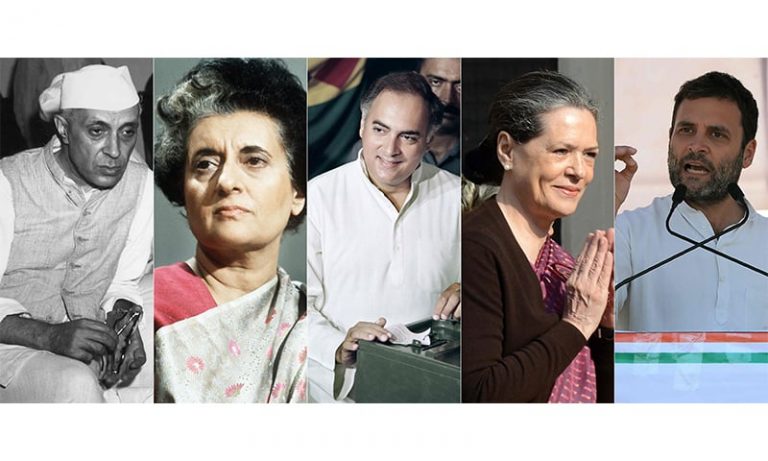
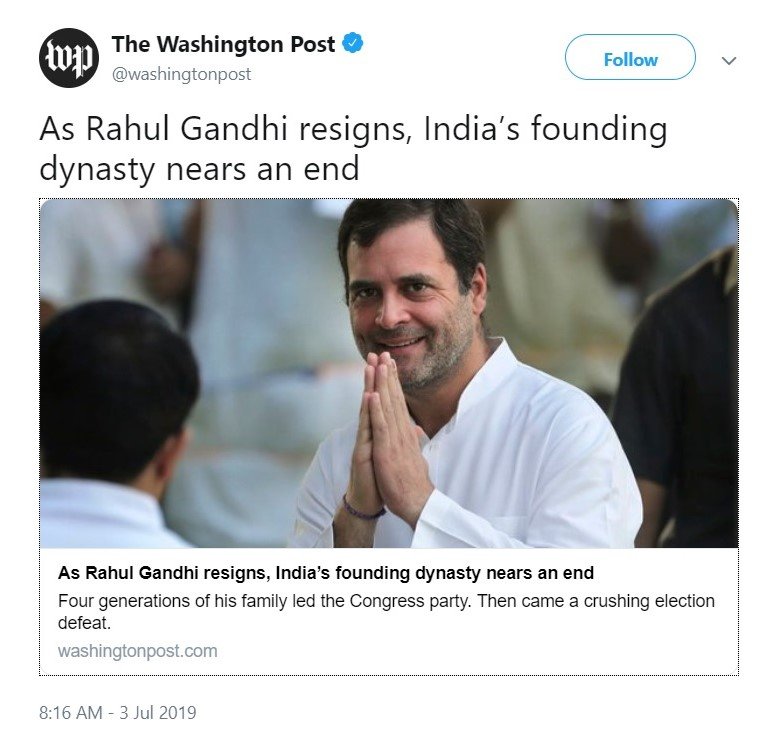
In a news report that highlights how little the Western world knows about Indian realities, Washington Post referred to the Nehru-Gandhi dynasty as India’s ‘Founding Dynasty’. The report, which highlights the vacuum in the leadership of India’s main opposition party, stated that with Rahul Gandhi’s resignation, the dynasty was nearing an end.
The headline only shows that Western Media buys into whatever delusions Indian liberals are selling due to ideological affinity. Far from being India’s ‘Founding Dynasty’, the Nehru-Gandhi Parivar’s contribution to Indian independence itself is extremely debatable. There were a plethora of great leaders who contributed to Indian independence and a lot of them did not even belong to the Congress party.
Forget being the founding dynasty of India, the Nehru-Gandhi family is not even the founding dynasty of the Congress party. The party was led by some of the greatest leaders India had seen before the independence of India, long before Jawaharlal Nehru became the defacto supremo of the party.
Thus, Jawaharlal Nehru was merely a leader of the Congress party at the time when the party was littered with stalwarts who fought for Indian independence. Moreover, the family is not biologically related to the designated father of the nation, Mohandas Karamchand Gandhi, like many people believe. The original Gandhi did favour Nehru for the Prime Ministerial post and overruled the democratic will of the Congress party but he certainly wasn’t a part of the dynasty.
Nehru wasn’t even the most popular leader within the Congress at the time, let alone India. Sardar Vallabhbhai Patel far exceeded Nehru when it came to the preference for the post of Prime Minister among senior Congress leaders. Then, there were leaders such as Netaji Subhash Chandra Bose who were sidelined by the Congress who contributed immensely to Indian independence. Therefore, to ignore the contributions of such stalwarts and label the Nehru Parivar as India’s Founding Party is sheer ignorance.
Unsurprisingly, the Washington Post is furthering the exact narrative that the Parivar and liberals in India have normalized in India over the years. Over the years, intellectuals have attributed every good thing about our country to one particular Parivar and the entire blame for all of its follies has been laid at the feet of Hindu culture. Western media, and its intellectuals, overly reliant on their Indian counterparts as they are have not bothered at all to critically evaluate such claims.
The desire to have a ‘Founding Dynasty’ for India is rooted in the Eurocentrism of the West. American intellectuals wish to see founders of nation-states in the political leaders of the time because of the fact that the USA has its own Founding Fathers. But India is completely different. As has been argued by many scholars earlier, India is more of a Civilizational state than a Nation state. Therefore, the equivalent of our country’s founding fathers lie in ancient history, not in the modern era.
However, it is easy to understand why Indian liberals would want to consider the Nehru Parivar as India’s ‘Founding Dynasty’. According to the liberal conception of the Indian state, India made a fresh beginning on the 15th of August, 1947 from a blank slate. They completely deny India’s ancient history and reject the fact that India is a natural consequence of thousands of years of Hindu Civilization.
Objectively, India is the manifestation of the Hindu conception of a nation state. As such, India is the custodian of the Hindu Civilization, the primary objective of which is to ensure the continued existence of Dharma. Hence, it is practically impossible for India to have a founding dynasty that originated in the 20th century.
Calling the Nehru Parivar India’s founding dynasty only reveals the utter lack of respect liberals have for the great and ancient history of our civilization. That it is an idea that has been accepted as Vedic Truth in the West only reflects the manner in which Indian liberals have undermined our history.
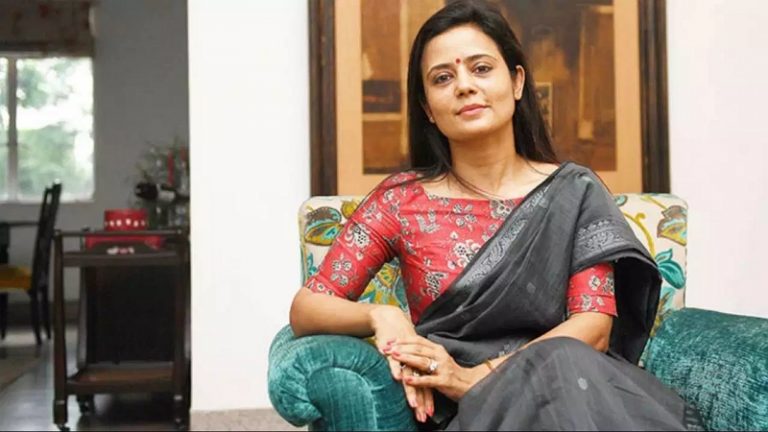
There has been a huge controversy surrounding the controversial speech by Trinamool Congress MP Mahua Moitra, the new poster woman of the Indian liberal circuit.
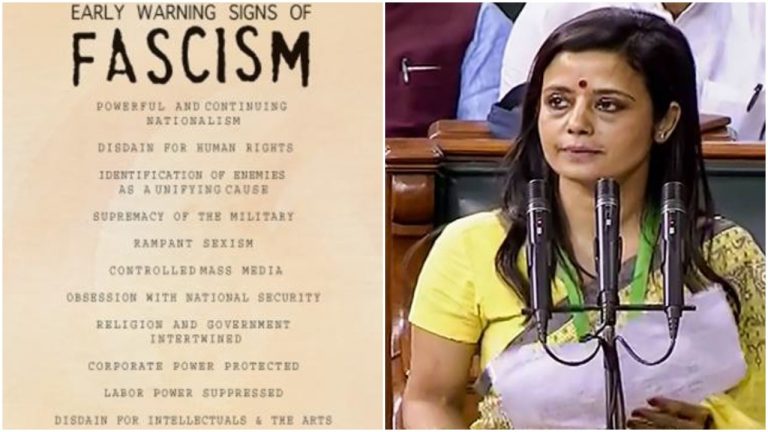
Mahua Moitra in her speech in the parliament said, “In 2017, the United States Holocaust Memorial Museum put up a poster in its main lobby and it contained a list of all the signs of early fascism…”. There are a few factually incorrect and a few misleading things about this asserive statement of hers.
A 2017 fact-check by American website Snopes had found that the poster was not on display at the museum but was available in a souvenir shop. The report claims that the poster was not an exhibit but instead was at one point available in the gift shop of the United States Holocaust Memorial Museum. As of 2019, it is unclear whether the poster is still available for sale at the gift shop.
‘The Early Warning Signs of Fascism’ poster found at a gift shop.
The poster was not put up in the ‘main lobby’ as said by Mahua.
Moreover, the list was originally created by Laurence Britt in 2003, for an article published by Free Inquiry magazine. Britt had created this list during George W. Bush’s tenure as president of the United States with highlighting “Fourteen Defining Characteristics of Fascism”.
Subsequently, the poster was designed on the basis of Britt’s article, which later inspired Martin Longman, who himself wrote a propaganda article in Washington Monthly targetting United States President Donald Trump. In fact, Longman also misleads his readers by claiming that “If you go to the U.S. Holocaust Museum, you can see a sign hanging there that tells you what to look for if you’re worried that your country may be slipping into fascism.”
Longman, too, did not specify in his article that the poster was based on Britt’s article and that it was available at the Museum’s gift shop and that it is not a ‘sign’ that is hanging at the museum.
Mahua Moitra, who seems to be inspired by this gift shop poster, lifted seven out of the fourteen listed characteristics and tried to co-opt the same narrative into India scenario.
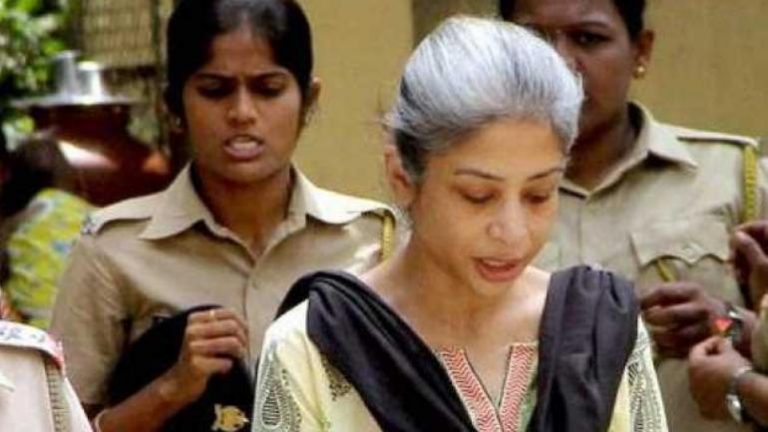
Indrani Mukerjea’s plea to turn approver in the INX Media corruption case involving former finance minister P Chidambaram and his son Karti Chidambaram was today accepted by a Delhi CBI court.
The CBI endorsed her application saying that the co-owner of INX group was privy to evidence, which could help consolidate the case.
Special judge Arun Bhardwaj pardoned Indrani Mukerjea, a co-accused in the INX media case after she submitted that she voluntarily agreed to become an approver in the case.
The court has issued a production warrant for Indrani who is currently placed in Mumbai’s Byculla Jail awaiting trial for the murder of her daughter Sheena Bora.
The next date of hearing in the matter is July 11.
Last year, Indrani Mukerjea had made a sensational revelation accusing Chidambaram of trying to use his influence to get Indrani to pay a bribe to Karti to the tune of 1 million dollars. Indrani Mukerjea has claimed that she had met P Chidambaram at North Block in Central Secretariat.
The CBI had filed an FIR on May 15, 2017, against the alleged irregularities in FIPB clearance to INX Media.
Both P Chidambaram and his son Karti Chidambaram are accused in the INX Media scam which involves charges of bribery and lobbying in granting foreign investments worth Rs 300 crores to INX Media. INX Media was later known as NewsX, it was owned by Peter and Indrani Mukerjea, who are accused in the sensational Sheena Bora murder case. ED had initiated a probe on the basis of the Central Bureau of Investigation’s FIR. Chidambaram is accused of misusing his power as the finance minister to grant INX Media an FIPB clearance.
Karti was arrested by agencies last year in February for allegedly lobbying for the Mukerjeas, in order to get FIPB clearance from Finance Ministry, which at the time was under his father. The ED had also attached properties and bank deposits of Karti Chidambaram worth around Rs.54 crores in connection with the case in October last year.
Last Month, the Central Vigilance Commission (CVC) gave permission to prosecute four former Congress era finance ministry officers, including former NITI Aayog CEO Sindhushree Khullar, former secretary of the Ministry of Micro, Small & Medium Enterprises Anup K Pujari and current principal secretary in the Himachal Pradesh government, Prabodh Saxena for their involvement in the INX media corruption case.
There is an Urdu couplet by late poet Dr Bashir Badr Sahab.
“Mujhe Ishtehaar si lagti hain, ye muhabbaton ki kahaaniyaan
Jo kahaa nahin voh sunaa karo, jo sunaa nahin vo kahaa karo.”
Which loosely translates to:
“I find the stories and claims of higher love which you make to me, slogans without feelings,
Thou must learn the subtle art of listening to the unsaid and saying what has never been said before.”
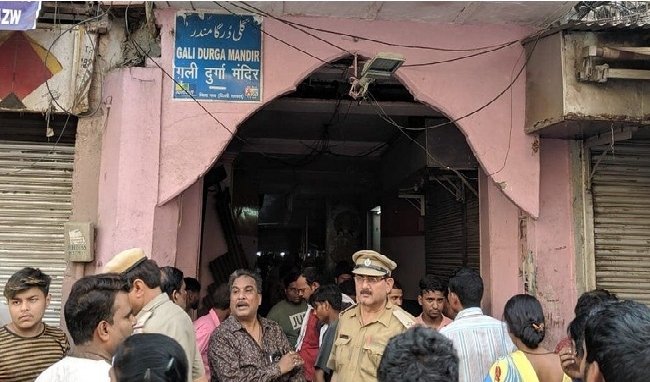
When I today sit thinking about the vandalism of the Hindu temple in the heart of Delhi’s capital, Hauz Qazi, and the outpouring of emotions of citizens, addressed to the newly re-elected Prime Minister Narendra Modi, somehow this couplet came to my mind. When we look at the shrill promises during the election campaign and the stony silence after this incident, I understand why I utter these lines in desperation today.
Democracy is all about giving a voice to the voiceless and representation to the faceless. This is what went missing in the initial period of the incident of Old Delhi where a Hindu temple was vandalized. Unlike crazy, violent men baying for the blood, threatening mayhem when religious symbols of any other religions is even slightly mocked at, what stood out was a steely Hindu resolve standing firmly behind the rule of law, albeit with a bitter taste of betrayal in its tongue.
Witnessing a broken nation in 1947 on account of religious fanaticism, Hindus have come a long way, wading through political apathy, mockery and even hatred as the ruling class aligned with the minorities in order to establish their secular credentials through appeasement; as the intellectuals class aligned with the ruling class in order to establish its loyalty; as the establishment-aligned to both of them to establish its unquestioning subservience.
As the hurt settles and slowly the intellectuals return to their routine manner of maligning Hindus, whether they are criminals or victims, we are reminded of the hope philosopher Will Durant expressed towards the Hindus when he wrote-
“Perhaps in return for conquest, arrogance, and spoliation, India will teach us the tolerance and gentleness of the mature mind, the quiet content of the unacquisitive soul, the calm of understanding spirit, and a unifying, pacifying love for all living things.” – Will Durant,
Hinduism has always been a faith of Dharma, the spirit of doing the right thing. It has never been a militaristic faith bent on building empires. The founders of Hindu faith have been the thinkers and philosophers, not Military Commanders.
But when the innocence of ideas collides with the cruelty of cults, what will prevail- that is the question haunting the Hindus today. What will remain when belligerence comes face to face with benevolence? Will Hinduism face the same fate which polytheist Paganism faced in Rome, in the face of an aggressive and intolerant monotheist fate which not only refused to accept it; it even refused to tolerate it to the extent that the faith which flourished for centuries was erased from human memory. These questions bother every Hindu mind, every time an idol is smashed or desecrated. In a democracy, in face of such act of barbarism, Media is supposed to report, Politics is supposed to offer assurance and administration is supposed to offer strict action.
In the case of Hauz Qazi, we saw failure on all three counts. Why did what happened, happened is another matter. It could be centuries of arrogance which looked at soft and accommodative Hindus with disdain and annoyance. It must have been always a shock to monotheists to come across a kind acceptance and a brotherly bonhomie from the overwhelmingly numerically superior polytheists of India. It seems to still confound them. Thus comes the mockery, thus comes the needless needling.
Unlike the monotheists where books define how the believers ought to behave, a religion of faith depends on belief in the ideas and principles. Every idol stands for an idea. When any religious idol is cracked, an arm of faith is fractured. When Islamist invaders arrived in India as absolute rulers, they had an abundance of land and plentiful resources suddenly available to the vagabond marauders. Why did they not use that and instead demolish the Hindu places of worship to appropriate them as their places of worship? It was for them a battle of religious supremacy. What Christians brought to the Muslim world in the form of Crusade, Muslims brought to India with fanatic military invaders. The more things change, the more they remain the same. What else could explain, even in the face of all the motivated intellectualism out to paint the Mughal Kings as secularists that not one Temple could be found in Delhi to have been built by Muslim Emperor during the regime of Mughals and other Muslim kings? Their secular love for their Hindu citizens had its boundaries.
What we find being fanned by the intellectuals in the name of motivated protests against the death of Tabrez Ansari is the propagation of the same thought. What else can explain that most prominent slogans representing the motivated protest, manufactured on a country-wide basis, promptly and expeditiously are not anti-crime; they are anti-Hinduism. It has been spread from Jharkhand to Malegaon, Bhopal, Meerut, Delhi and now it seems from the reports to Jaipur. It is not an innocent protest on Human cause. It ignores Mangru Pahan, killed by Muslims in the same state on the same day as the death of Tabrez Ansari with an obstinate denial. This is a blatantly and brazenly biased battle. This is not only a battle of muscles. It is equally supported by the fanatic faithful who carry a pen in place for sword and lead a cruel war from behind the curtains. They will hype your failures and belittle your injuries. Let us not be driven by this motivated campaign.
Let us be what we are- benevolent, kind, law-abiding and inclusive. But then, let us be vigilant and cautious. It is small things which lead to the collapse of a big idea. Let us not be dismissive about things. There is a definite design to the way things are unravelling post a definitive emergence of assertive Hinduism post-elections 2019.
I sometimes wonder when the temple of Athena in Palmyra in 385 AD had happened, how would the Pagans have viewed it? Was it to them the end of nonsense or the beginning of an end? The smallest motif of a non-military faith is important, critical and of historical significance, whether we realize it today or not. We must stand guard and not repeat the mistake of the Romans. I share an excerpt from “The Darkening Age- The Christian Destruction of The Classical World” brilliantly written by Catherine Nixey and my point being that this could be someone reading about Hinduism the same way, one century from now unless we are watchful.
“For years, marauding bands of bearded, black-robed zealots, armed with little more than stones, iron bars and an iron sense of righteousness had been terrorizing the east of the Roman Empire. Their attacks were primitive, thuggish and very effective…Their targets were temples and the attacks could be astonishingly swift. Great stone columns that had stood for centuries collapsed in an afternoon; statues that had stood for half a millennium had their faces mutilated in a moment; temples that had seen the rise of Roman Empire fell in a single day.”
This is not a new thing for us. We have faced and survived this for years. But zealots will keep coming back and we will not be able to even understand their motives, let alone duplicate that. We are not historically designed to be fanatics. We can only be steadfast about defending what we believe in and unapologetic and unembarrassed about it. Friends, Indians and Countrymen, let us be on the vigil and succeed where the Romans failed. This war will be fought in ideological battlefields.
When one lie loses currency, another will be manufactured. The objective will remain the same, maligning and demonizing a faith until the battle is won decisively and the destruction is complete. It will not be a temporary surrender. It could very well be complete annihilation, much like the Roman Pagans. Let us remain watchful and steadfast not to let this last bastion, this beautiful country of ours, fall to the fanatics at the door.
Newly elected Member of Parliament from Trinamool Congress, Mahua Moitra has become the new darling of the Left. After she waxed eloquence on rising fascism across the country, the Left heralded the rise of a new star. As is the case with most stars on the Left, Mahua, too, is an extremely problematic character.
Mahua Moitra has proven herself to be uncouth and ill-tempered with a remarkable propensity toward violence. She was accused of assaulting a female constable at the Silchar Airport and on another occasion, she showed Arnab Goswami the middle finger. While liberals ignored the former, they cheered enthusiastically when they discovered the latter and her credentials went up a couple of notches as a consequence.
Egregious behaviour, it appears, is the norm for Mahua Moitra. Yesterday, while trying to defend herself against allegations of plagiarism, was extremely rude to the media and quoted an American as saying “rightwing a**holes are the same everywhere”. Mahua Moitra has every right to defend herself, however, elected representatives are expected to conduct themselves in public than calling critics an a**hole.
#WATCH TMC MP Mahua Moitra responds to media on allegations that her maiden speech in Parliament was plagiarized, quotes American commentator Martin Longman’s tweet “right-wing a**holes seem to be similar in every country.” pic.twitter.com/dU8UDMBirP
The liberals will, without the shadow of a doubt, cheer for this also. After all, Liberals perpetuate a culture where indecency is the norm. And, of course, they will then pretend to be shocked when one of them turns out to be a sexual predator or a criminal. But when a culture is willing to brush every crime under the rug for political purposes, it’s not surprising then that so many of their heroes turn out to be extremely problematic characters.
However, there was something fundamentally wrong with Mahua Moitra’s defence. Anyone who is aware of politics is perfectly aware that it’s not the right-wing that is the same in every country, it’s the Left. That Mahua’s apparently favourite ideologue believes otherwise only reveals the extent to which the Left depends on projection, a psychological defence mechanism.
The Leftwing is practically indistinguishable across the world while the rightwing comes in various flavours depending on the native culture of the country in question. The rightwing can be Catholic, Protestant, Hindu, Buddhist and of other religious hue but the Left, unfailingly, is always the same.
It is only to be expected since the Left is a religion in itself. It has its sets of faith-based beliefs which have very little to do with science and are not in consonance with observable reality. It has its own ‘Satan’ and angels and demons and Gods, it is replete with a clergy of its own and dedicated devotees who engage in esoteric rituals in public.
In the world of the Left, the Gods are Multiculturalism, Diversity, Feminism and LGBT rights. Conversely, Satan is, of course, homogeneous societies with a strong traditional order. The Father is the great enemy, ‘Toxic Masculinity’ is basically the extension of the concept of Father to the rest of the society.
On the issue of LGBT rights, an overwhelming majority of people on the rightwing in non-Islamic countries are tolerant of the LGBT community. However, they do not wish to engage in the celebration of it. On the other hand, mere refusal to attend and celebrate and opposition to pride parades is seen by the Left as gross homophobia. And yet, it’s not Islam that is criticized most vehemently by the Left, it’s the dominant culture in Western countries and India.
The congruence of the Left can be further elaborated by the remarkable parallels between the Indian Left and American Left. In the United States, white men are responsible for every sin under the Sun while in India, it’s Brahmin men. The American Left even has a word for Feminism that they believe does not adequately represent the concerns of the women of colour. They call it ‘White Feminism’, the Indian counterpart for it is ‘Savarna Feminism’.
In the States, the Black community is considered to be the most oppressed in the racial hierarchy. Indian Leftists have twisted the meaning and definition of the caste system to represent a racial hierarchy, despite the obvious fact that all castes belong to the same race, and Dalits are considered to be the equivalent to Blacks. Consistent with this approach, there are groups such as ‘Dalit Panthers’ along the lines of Black Panthers.
There are no parallels between the Black community in the USA and Dalits in India, the circumstances are completely different and yet, they are clubbed together. Throughout the course of history, Dalits have overwhelmingly stood by people of other castes when Hinduism was under threat. Even in 2019, the political choices of Upper Castes and Dalits were almost indistinguishable.
Plus, it’s not a race issue at all. Caste is a far more complicated issue than mere skin colour. More significantly, the basis of Indian society is not only caste, Jaati plays a just as significant role if not more. The Jaati-Varna mechanism is how Indian society is organized. To reduce it to the vulgarity of merely skin colour is preposterous and reflects the sheer intellectual laziness of the Left.
Then, there’s the gender politics as well. The Indian Left has swallowed hook, line and sinker even the worst of the American Left. The Left in India truly believes in the non-binary theory of gender. Like their American counterparts, they believe a person should be at liberty to choose their own gender. If a man says he is a woman, then he ought to be treated as a woman. Physical characteristics, biology, science does not matter.
The Left believes men can menstruate, can become pregnant, can even breastfeed babies. These are not fringe beliefs, they are quite mainstream. A Democratic Presidential Hopeful for the 2020 elections echoed these sentiments during the Primary Debates. The Congress party manifesto for the 2019 Lok Sabha elections didn’t quite take it that far but the implications of it were pretty clear.
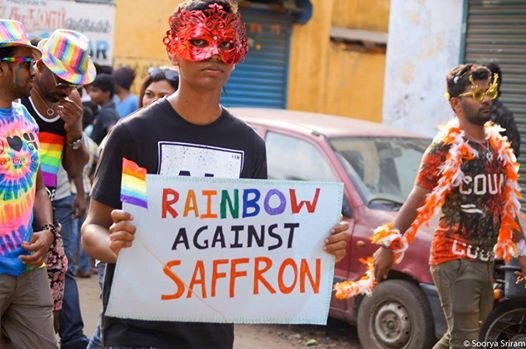
The Left-Islamist alliance is equally prevalent in India and the West. Invariably, the Left worldwide displays its commitment towards the Muslim community by cultivating and promoting the most toxic elements within their society. The LGBT community, too, allies with Islam against the dominant culture of the land. In India, ‘Rainbow against Saffron’ placards are extremely common at pride parades. In the West, too, placards to that effect can be found. Saffron is replaced by White Supremacy or something else of a similar nature.
Rainbow against saffron placard
The Left has its own version of religious festivals where Leftists gather to celebrate their shared identity. At their core, that’s what festivals are, a celebration of a collective identity. Since the Gods they worship are different, so do their festivals. Pride Parades are the Left equivalent to religious festivals. It’s replete with chanting of slogans, dancing, loud music and all the rest that accompany traditional festivals.
The Women’s March following Donald Trump’s electoral victory shared similar elements. Quite obviously, there was no imminent threat to women’s rights. That did not prevent Leftists from organizing and marching on the streets in solidarity.
The Left has its own version of doomsday prophecy as well. Traditionally, an Apocalyptic end to the world has been a core Christian theme. The Left, secularized Christianity as it is, does not rely on Divinity to envision its own version of doomsday. For the Left, Apocalypse won’t be caused by God, it will be a consequence of Global Warming or Climate Change.
Of course, the Science on Global Warming is far from settled. Consequently, the doomsday narrative that is built around it appears ill-founded. Even the Leftist claim that 97% of scientists agree that humans are the driving force behind Climate Change is demonstrably false and particularly misleading.
Moreover, Science is not settled by consensus. It is settled by observation and facts. It doesn’t matter if 97% of scientists agree on something, it only takes one Copernicus or Einstein to prove them all wrong. The core disagreement between scientists is whether humans have been causing climate change.
No one argues that climate hasn’t been changing because it has practically been changing for as long as Earth has existed. Humans did not cause the Ice Ages or the subsequent warmings. Sure, humans may be contributing to it in the current scenario, but the extent of it is not known yet. Moreover, climate alarmists have been spectacularly wrong about their predictions regularly.
One ‘Arctic Expert’ in 2012 predicted that sea ice in the Arctic region would collapse within four years. Nothing remotely close to that has happened. In 2009, the then Prime Minister of Britain predicted that we had only 50 days to save the planet. A decade has passed since then. In 2007, UN scientists predicted that “we only had as little as eight years left to avoid a dangerous global average temperature rise of 2°C or more.” Needless to say, it was another failed prediction. Such predictions did not start in the 2000s, it started as far back as 1989.
The San Jose Mercury News reported on June 30, 1989, that a senior environmental officer at the UN says that “entire nations could be wiped off the face of the earth by rising sea levels if global warming is not reversed by the year 2000.” 19 years have passed since then and yet, there haven’t been consequences to that end. The alarmist predictions have been wrong consistently and yet, that hasn’t stopped Leftists from making further predictions.
Alexandria Ocasion-Cortez, the new Leftist Queen in America, argued passionately that the world will end in 12 years if climate change is not addressed. Given the track record of other such predictions, it is likely to be proven false as well but that won’t prevent Leftists from making such predictions in the future. Because such alarmist predictions are not based on reason, the basis for them is faith. And faith, as is obvious from religiosity, is remarkably persistent.
The Leftist approach to immigration in India and the West is the same as well. Immigration, illegal and otherwise, is not treated as an economic or a security issue. It’s treated as a moral issue and somehow it is conceived that the country has a moral obligation to provide resources and citizenship to anyone who knocks on the door. The threat that an unstable demography poses is ignored entirely by them.
In fact, Demographic decline of the dominant population is celebrated. It’s not surprising considering the fact that the Left treats nation-states and borders as minor inconveniences for their grand visions of a global family. And it’s only to be expected then that their loyalty toward their own country is very questionable.
Just as the Left has its Gods, it has its clergy and preachers and crusaders as well. The clergy is, of course, the Academia, especially the Humanities fields and only of a certain political dispensation. They spend their time creating new doctrines and dogma. Intersectionality and Postmodernism, the foundation structure of the Left, are the contributions of the Academia.
The preachers, of course, are the mainstream media journalists and celebrities. They feed the masses with the teachings of the clergy and make it more accessible to them. They convey the complex doctrines and dogma of the clergy to the masses in a language they would understand. The warriors are the politicians and the tech giants who institutionalize such dogma through laws and terms and conditions of their platforms. They also regularly mainstream the Left dogma through their vocal and active support toward the dogma and doctrines.
There is scope for the punishment of heretics as well. Boycotts, public denunciation, intimidation, destruction of their careers and even violence against heretics is considered perfectly acceptable. The celebration of Antifa, a bunch of violent demented psychopaths, by the establishment in America and great support for elements such as Jignesh Mevani, Kanhaiya Kumar and Hardik Patel in India is a testament to that fact. In fact, the structure of the Left as described is exactly the same in America and India. There is absolutely no difference at all.
Antifa goons attack a man in Berkeley in 2017
The iconoclasm of the Left worldwide is quite evident as well. They treat the cultural heroes of their respective countries as reflective of a past mired in debauchery and sin. Thus, the Left conspires to remove them from their pedestal and drag them through the mud because some ideas they espoused were inconsistent with modern Leftist ideals. In that, their ideas are remarkably similar to Muslims who believe the world was an abode of sin before the arrival of Prophet Muhammad.
There is remarkable consistency in the conduct of Left leaders around the world as well. They are generally uncouth, extremely rude, use expletives quite often and frequently, they are revealed to be sexual predators or criminals. They treat their political opponents with utter disdain while continuing their verbal commitment towards civility. Their actions and their words are rarely consistent if ever.
Thus, to effectively counter the Left, we need to realize that we are dealing with an organized religion. Every religion believes that it is the sole arbiter of truth, and so does the Left. The ontological positions of the Left are at complete odds with observable reality. In fact, the ontological positions of Hinduism, Buddhism, Sikhism, Shintoism and every other polytheistic philosophy are far superior to the Left doctrine. Since the Left is a mutation of monotheism, it has all the fallacies of monotheism itself and a few more specific to its own.
The Left does not seek to win adherents through reason and debates. True to its monotheistic heritage, it seeks to capture power by any means necessary and impose its will on the masses disregarding their will. Hence, it is imperative that Hindutva approaches the Left in the same manner that it approaches other monotheistic creeds.
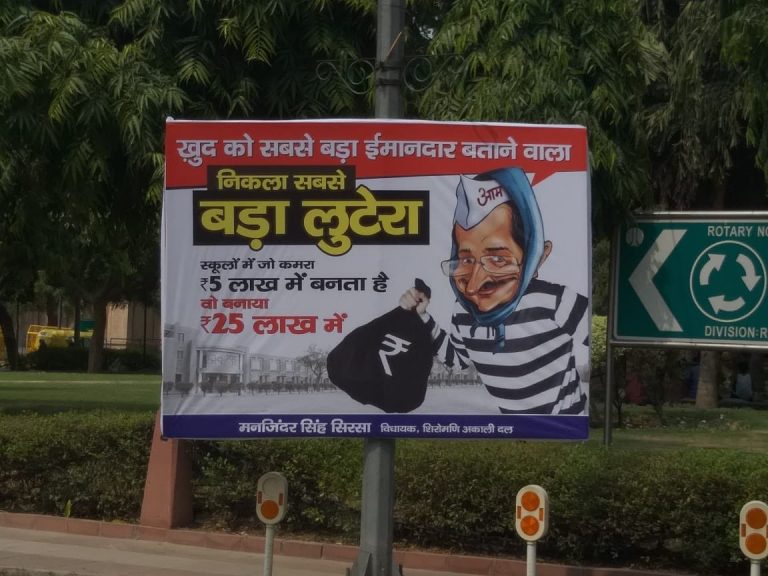
Days after the BJP accused Kejriwal government of indulging in Rs 2,000 crore scam in construction of classrooms, posters reading ‘Kejriwal Chor Hai’ and accusing the Delhi CM of being involved in it have surfaced. The posters were put up by Shiromani Akali Dal (SAD) leader and Rajouri Garden MLA Manjinder Singh Sirsa.
In one of the posters installed by Sirsa, Kejriwal can be seen wearing muffler and prisoner’s clothes, holding in his hand a black bag of money. The poster reads, “The one who claimed to be the most honest one, turned out to be the biggest thief.” It further reads, “A room in a school which usually costs Rs 5 lakhs is being made for Rs 25 lakhs.” Manjinder Singh Sirsa’s name has been mentioned at the bottom of these posters.
In another tweet, Sirsa has accused Kejriwal of graft and asserted that the scam will amount to crores of rupees.
Earlier this month, the Delhi Unit of the BJP has accused Delhi Chief Minister Arvind Kejriwal and Deputy Chief Minister Manish Sisodia of being involved in a scam relating to the construction of classrooms in the schools of Delhi.
BJP MP Manoj Tiwari had alleged that the AAP government overpaid for the construction of the classrooms and the contracts were largely given to relatives of AAP leaders. He had said that the information regarding the cost of the construction of the classrooms was revealed in an RTI filed by his party member. As per the information revealed in the RTI, 34 contractors whom the AAP government gave the project include the associates and relatives of AAP leaders, he alleged.
Tiwari claimed that the AAP government spent Rs 24.86 lakh on the construction of one 300 square foot classroom which at the market rate will cost not more than Rs 5 lakh. He added that the government has already paid an amount of Rs 77,54,21,000 for one tender and 12,478 rooms are already under construction. He said that the AAP government is spending Rs 2,892 crore on the construction of 12,782 such rooms while these classrooms, at the maximum, could be constructed at the cost of Rs 892 crore. He alleged that the AAP government committed a scam of Rs 2000 crore in the project.
AAP has been projecting its education model as one of its biggest achievements.
An Irish woman who had hurled racist abuses and spat on the crew of Air India flight she was travelling in, was found dead on June 1st just days after having served her prison sentence.
50-year-old Simone Burns was found dead at her home in East Sussex in England after having served a prison sentence for her behaviour onboard the Air India flight late last year. As per reports, she is said to have committed suicide.
In the videos that went viral in November last year, it could be seen that Burns was on a racist rant embarrassing her fellow passengers. She said “I am working for all your people, the f**king Rohingyas, the f**king people of Asia for four years as international criminal lawyer, didn’t take any money for it, by the way, but you won’t give me a f**king glass of wine. Is that correct?”
Burns, who claimed to be a human rights lawyer by profession, boarded an Air India flight from Mumbai to Heathrow. In a video that went viral, it could be seen that Burns went on rant abusing the Air India crew for refusing to serve her alcohol. Burns was already in an inebriated state after having 3 bottles of wine.
She had also threatened the crew by asserting that she was an “international criminal lawyer”. She had also spat at a male crew member. She was subsequently arrested after landing at Heathrow airport. She was sentenced to six months of prison after having pleaded guilty of assault and being drunk.
Burns was released from prison on license on May 20, after spending less than two months in jail. The police are not treating her death as supicious and it has been ruled as an apparent suicide.
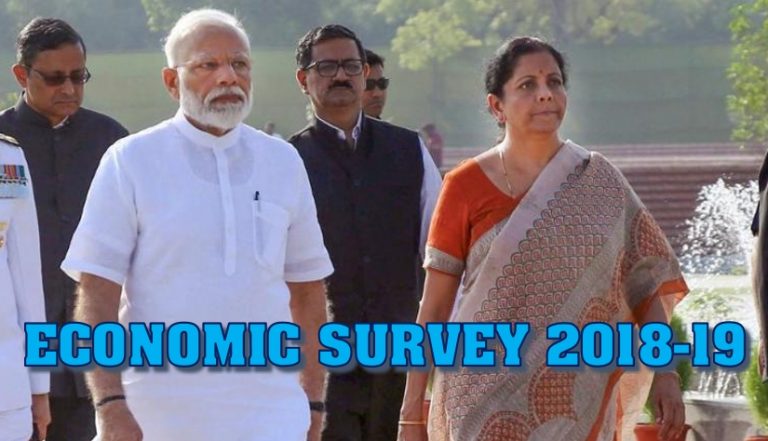
A day before the Union Budget to be presented in the Parliament, Union Finance Minister Nirmala Sitharaman on Thursday tabled the Economic Survey in both Houses of Parliament Thursday.
The Economic Survey 2018-19 has projected the GDP growth for 2019-20 at 7-7.75%, up from 6.8 per cent in the previous fiscal, reinstating India as the world’s fastest-growing major economy. The fiscal deficit estimate for 2018-19 has been retained at 3.4 per cent of the GDP, the same as projected in the interim Budget.
State of the Economy in 2018-19:
The survey projects the “State of the Economy in 2018-19” stating that India will still be the fastest growing major economy in 2018-19. The Non-Performing Assets as a percentage of Gross Advances has reduced to 10.1 per cent at end December 2018 from 11.5 per cent at end March 2018.
Investment growth has been recovering since 2017-18 with growth in fixed investment picked up from 8.3 per cent in 2016-17 to 9.3 per cent next year and further to 10.0 per cent in 2018-19. The Current account deficit (CAD) is also manageable at 2.1 per cent of GDP. The fiscal deficit of the Central Government has declined from 3.5 per cent of GDP in 2017-18 to 3.4 per cent in 2018-19.
Money Management and Financial Intermediation:
The Survey suggests that the country’s banking system has improved as NPA ratios have declined and credit growth accelerated. The major reforms initiated by Narendra Modi government like Insolvency and Bankruptcy Code led to recovery and resolution of a significant amount of distressed assets and improved business culture.
According to the survey, the Corporate Insolvency Resolution Process (CIRP) has yielded a resolution of 94 cases involving claims worth Rs. 1,73,359 crore till March 31, 2019. As on 28 Feb 2019, 6079 cases involving Rs 2,84,000 lakh crores have been withdrawn. As per RBI reports, Rs.50,000 crore received by banks from previously non-performing accounts.
Prices and Inflation:
The Headline inflation based on CPI-C continuing on its declining trend for the fifth straight financial year remained below 4.0 per cent in the last two years. The Food inflation based on Consumer Food Price Index (CFPI) also continuing on its declining trend for the fifth financial year has remained below 2.0 per cent for the last two consecutive years. The
The CPI-C based core inflation (CPI excluding the food and fuel group) has now started declining since March 2019 after incrementing during the fiscal year 2018-19 as compared to 2017-18.
External Sector:
The Survey predicts that as per WTO projection, World trade growth has slowed down to 3 per cent in 2018 from 4.6 per cent in 2017 due to four major reasons. First, the introduction of new and retaliatory tariff measures, secondly, the heightened US-China trade tensions. Thirdly, the weaker global economic growth hampering global trade and finally, the volatility in financial markets has an effect on international trade and investments.
The silver lining for India is that it has reduced the country’s external debt to US$ 521.1 billion at end-December 2018, 1.6 per cent lower than its level at end-March 2018. The total liabilities-to-GDP ratio, inclusive of both debt and non-debt components, has declined from 43 per cent in 2015 to about 38 per cent at the end of 2018.
Agriculture and Food Management:
The Economic Survey states that the agriculture sector in India typically goes through cyclical movement in terms of its growth. The Gross Value Added (GVA) in agriculture improved from a negative 0.2 per cent in 2014-15 to 6.3 per cent in 2016-17 but decelerated to 2.9 per cent in 2018-19.
The Gross Capital Formation (GCF) in agriculture as a percentage of GVA marginally declined to 15.2 per cent in 2017-18 as compared to 15.6 per cent in 2016-17. The public sector GCF in agriculture as a percentage of GVA increased to 2.7 per cent in 2016-17 from 2.1 per cent in 2013-14.
Interestingly, the Women’s participation in agriculture has increased to 13.9 per cent in 2015-16 from 11.7 per cent in 2005-06 and their concentration is highest (28 per cent) among small and marginal farmers.
Industry and Infrastructure:
The survey says that the overall Index of Eight Core Industries registered a growth rate of 4.3 per cent in 2018-19. The country has improved its Ease of Doing Business ranking by 23 to 77 position in 2018 among 190 countries assessed by the World Bank Doing Business (DB) Report, 2019.
The infrastructure sector has seen growth as road construction grew at 30 km/day in 2018-19 compared to 12 km/day in 2014-15. The rail freight and passenger traffic grew by 5.33 per cent and 0.64 per cent respectively in 2018-19 as compared to 2017-18.
Total telephone connections in India touched 118.34 crores in 2018-19. The installed capacity of electricity has increased to 3, 56,100 MW in 2019 from 3, 44,002 MW in 2018.
Services Sector:
The Services sector (excluding construction) has a share of 54.3 per cent in India’s GVA and contributed more than half of GVA growth in 2018-19. The IT-BPM industry has seen a growth of 8.4 per cent in 2017-18 to US$ 167 billion and is estimated to reach US$ 181 billion in 2018-19. However, the services sector growth declined marginally to 7.5 per cent in 2018-19 from 8.1 per cent in 2017-18.
The Services sector provided employment to 34 per cent of the total workforce in the country for the year 2017. The tourism sector has grown marginally with 10.6 million foreign tourists received in 2018-19 compared to 10.4 million in 2017-18. Forex earnings from tourism stood at US$ 27.7 billion in 2018-19 compared to US$ 28.7 billion in 2017-18.
Social Infrastructure, Employment and Human Development:
The public investments in social infrastructure like education, health, housing and connectivity are critical for inclusive development, states the Economic Survey 2018-19.
The Government expenditure (Centre plus States) as a percentage of GDP has increased in Health by 1.5 per cent in 2018-19 from 1.2 per cent in 2014-15. The spending on Education is also increased from 2.8 per cent to 3 per cent during this period.
There is substantial progress in both quantitative and qualitative indicators of education is reflected in the improvements in Gross Enrolment Ratios, Gender Parity Indices and learning outcomes at primary school levels.
The net employment generation in the formal sector was higher at 8.15 lakh in March 2019 as against 4.87 lakh in February 2018 as per EPFO.
Around 1,90,000 km of rural roads constructed under Pradhan Mantri Gram Sadak Yojana (PMGSY) since 2014. About 1.54 crore houses completed under Pradhan Mantri Awas Yojana (PMAY) as against a target of 1 crore pucca houses with basic amenities by 31 March 2019.
The first volume of the Economic Survey 2018-19 outlines the ‘strategic blueprint’ to achieve Prime Minister’s Vision for $5 trillion Economy. The Survey in its theme speaks about enabling to “shifting of gears” to achieve the objective of becoming India a $5 trillion economy by 2024-25.
The Survey recommends creating a virtuous cycle encompassing private investment, jobs, exports and demand. The Survey states that pathways for trickle-down opened up during the last five years and benefits of growth and macroeconomic stability reached the bottom of the pyramid.
The Survey also lays out an ambitious agenda for inducing behavioural change through the principles of Behavioural economics.
The Survey states that sustained real GDP growth rate of 8% is needed for a $5 trillion economy by 2024-25. The major emphasis is on “Virtuous Cycle” of savings, investment and exports catalyzed and supported by a favourable demographic phase required for sustainable growth. The survey states that Private investment is a key driver for demand, capacity, labour productivity, new technology, creative destruction and job creation.
A Delhi court on Thursday awarded 6-month jail term to AAP MLA Som Dutt in a 2015 assault case. Additional Chief Metropolitan Magistrate (ACMM) Samar Vishal also imposed a penalty of Rs 2 lakh on Dutt, who was convicted by the court last week.
A Delhi Court awards 6 months jail to AAP MLA Somdutt for voluntarily causing grievous hurt in a 2015 case.During Delhi Assembly poll campaign he&50 men went to Gulabi Bagh&continuously rang door bell of a Sanjiv Rana’s house. When he objected, he was attacked by MLA’s supporters
On July 1, the ACMM held Dutt, a legislator from Sadar Bazar constituency, guilty under Section 325 (voluntarily causing grievous hurt without provocation), 341 (wrongful restraint), 147 (rioting), and Section 149 (unlawful assembly ) of the Indian Penal Code (IPC). The maximum punishment for causing grievous injury is seven years. The court had then announced that the quantum of punishment would be pronounced on July 4.
It was alleged that during the 2015 Delhi Assembly election campaign, Som, along with 50 supporters went to Gulabi Bagh and continuously rang the doorbell of one Sanjiv Rana’s house. When he objected, he was attacked by MLA and his supporters.
“There is no doubt that on January 10, 2015, at around 8 pm, Som Dutt, along with his 50 supporters, went to flat No.13 where the complainant was present. The complainant was beaten and assaulted by the accused and his associates due to which he suffered grievous injury,” the court had said while convicting Dutt.
On the basis of a complaint received from Sanjiv Rana, the Delhi police had registered an FIR( First Information Report) against the AAP leader in 2015. Rana had alleged that during the canvassing at Gulabi Bagh in North Delhi, Dutt and his supporters hit his leg with a baseball bat. He further submitted that after an argument, Dutt dragged him out on the road and beat him, causing grievous injuries.
Rana’s allegations were denied by Dutt who in turn accused Rana of fighting with him and his supporters under intoxication while they were peacefully campaigning.
However, on May 18, 2017, Metropolitan Magistrate Ruby Neeraj Kumar had framed charges against Aam Aadmi Party MLA Som Dutt in the rioting case.
A few days ago, another AAP MLA Manoj Kumar was convicted and sentenced to three months in jail for obstructing the election process at a polling booth in Kalyan Puri area of East Delhi during 2013 Assembly elections.
Last year on October 9, the sessions court of Delhi had convicted Aam Aadmi Party MLA from Deoli, Prakash Jarwal, under IPC section 352(assault or criminal force otherwise than on grave provocation), 354(Assault or criminal force to woman with intent to outrage her modesty) and section 506(1) (criminal intimidation).
In an extremely shameful incident, Congress MLA Nitesh Narayan Rane along with his supporters threw mud on engineer Prakash Shedekar at a bridge near Mumbai-Goa Highway in Kankavali.
#WATCH: Congress MLA Nitesh Narayan Rane and his supporters throw mud on engineer Prakash Shedekar at a bridge near Mumbai-Goa highway in Kankavali, when they were inspecting the potholes-ridden highway. They later tied him to the bridge over the river. pic.twitter.com/B1XJZ6Yu6z
In the video of the incident, Rane is seen assaulting Shedekar while a man standing behind Shedekar brings a basket full of mud and throws the mud on him. Shedekar is then pushed against the wall of the bridge and Rane’s supporters are seen trying to tie him to the bridge.
Rane who is a Member of Maharashtra Legistlative Assembly from Kankavli Assembly constituency, inspecting the potholes on the highway.





![[Video] Congress MLA Nitesh Narayan Rane and his supporters caught on camera assaulting, throwing mud at an engineer](https://www.opindia.com/wp-content/uploads/2019/07/narayan-rane-assault-768x518.png "[Video] Congress MLA Nitesh Narayan Rane and his supporters caught on camera assaulting, throwing mud at an engineer")
