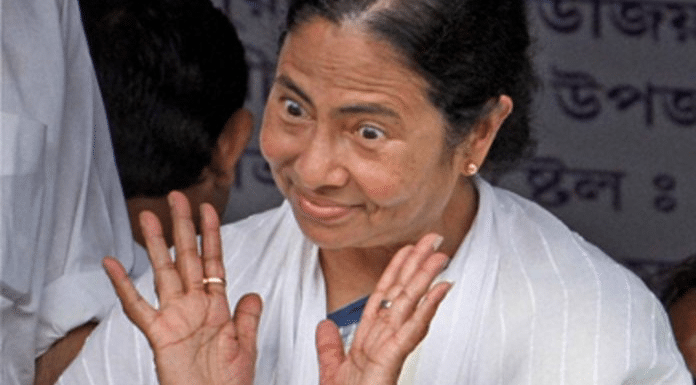
Facing flak from several quarters for confronting groups of people chanting “Jai Shri Ram”, the West Bengal chief minister has now come up with new demand, directing TMC workers across the state to greet phone calls not by “Hello” but by “Jai Bangla Jai Hind”.
‘जय श्रीराम’ से तिलमिलाई ममता ने लिया फैसला, TMC कार्यकर्ता अब फोन पर हेलो की जगह ”जय बांग्ला, जय हिंद” बोलें pic.twitter.com/0dsM0KUWmq
The TMC workers across the state have been strictly instructed to greet people on phone by “Jai Bangla, Jai hind” instead of “Hello” only after which they can continue their conversation. In a public meeting, Mamata Banerjee said, “I will say Jai Hind not once but thousand times. I have no problem in chanting Jai Hind as it was a slogan chanted by Netaji Subhash Chandra Bose. It is not related to a particular community. You all should chant Jai Hind. Bengal’s culture is not so cheap that it can be adulterated by outsiders with their belligerent slogans.”
The dictum comes at a time when 7 people were detained by the West Bengal police, allegedly on the directions of CM Mamata Banerjee for chanting slogans of “Jai Shri Ram” at her motorcade while it was passing through the Bhatpara area. A furious Mamata came out of her vehicle and confronted the sloganeers at least thrice while she was on her way to the destination. The video of which has gone viral on the Social Media in which an enraged Mamata Banerjee can be seen admonishing people who were chanting “Jai Shri Ram” and called them ‘BJP people’ who have come to the state from outside.
Threatening the people who chanted “Jai Shri Ram”, Mamata Banerjee said, “What do you think, you can come to my state, stay here and abuse me? How dare you do this? I will not put up with this kind of behaviour. all your names and details will be noted down.”
The Enforcement Directorate has summoned UPA era Civil Aviation Minister, Praful Patel, on the 6th of June in the Deepak Talwar illicit aviation deals case. He is also a prominent leader of Congress ally, NCP.
Enforcement Directorate Lawyer: ED summons Praful Patel in the Deepak Talwar illicit aviation deals case, on June 6. pic.twitter.com/l2C3oSG6x2
It was reported in February that the Enforcement Directorate (ED) had found dubious deposits alleged to be the kickbacks paid by the international airlines into several accounts of extradited Congress era lobbyist Deepak Talwar. The ED had discovered Rs 270 crores deposited in Bank of Singapore by international airlines and another Rs 88 crore received in his NGO to influence some top ministers and bureaucrats in the previous UPA regime, reported Times of India.
It was also reported that Talwar was being grilled in connection with bribing politicians and senior officials in the UPA era to tweak the rules to benefit certain foreign aircraft manufacturers and airlines.
Reportedly, Airbus has made two transfers of $10.5 million to Talwar controlled companies between August and September 2012, interestingly at the same time when civil aviation ministry under the UPA era had placed orders for the purchase of aircraft. Investigations were initiated into the matter in the US too.
Talwar is known for his proximity to politicians, journalists, bureaucrats etc, including Praful Patel. Patel was the aviation minister in UPA government and during his term, the Air India had taken the controversial decision to purchase 111 aircraft, which included 43 aircraft from Airbus. Talwar is also under investigation for meeting the CBI director Ranjit Sinha about 63 times in 2014 at Sinha’s official residence. His name had appeared in Nira Radia tapes too.
Rajiv Saxena and Deepak Talwar. two high-profile lobbyists linked to UPA era scams were extradited to India from Dubai on January 31st. Rajiv Saxena is accused in a money laundering case connected with the AgustaWestland deal. The Enforcement Directorate (ED) had named him in a supplementary charge sheet filed in the VVIP Chopper scam in September 2017.
The 2019 General Elections were seen as pivotal for the future of the country from the very beginning. It was touted as the Battle of Panipat by now Home Minister Amit Shah, the Opposition called it a battle for the soul of the country.
The results came in on the 23rd of May and it was a resounding victory for Prime Minister Narendra Modi, even surpassing the great victory margin of 2014. But there was a greater story in the details, one that had been missed thus far by most sociologists and political analysts.
The greatest realignment in the recent political history of India has been the political consolidation of all castes under the banner of Hindutva. Mandal politics worked in the 1990s, the Samajwadi Party-Bahujan Samaj Party was successful in thwarting the BJP’s rise in Uttar Pradesh post the Ram Janambhoomi movement but failed miserably in 2019. There’s a lesson right there.
The cultural revolution that various political commentators have hinted at is precisely this phenomenon. The first time it happened in 2014, many considered it a ‘Black Swan’ event, that such a feat won’t be repeated again in 2019. But they were proved wrong. Not only did it repeat itself but the Hindu Consolidation was even greater this time around.
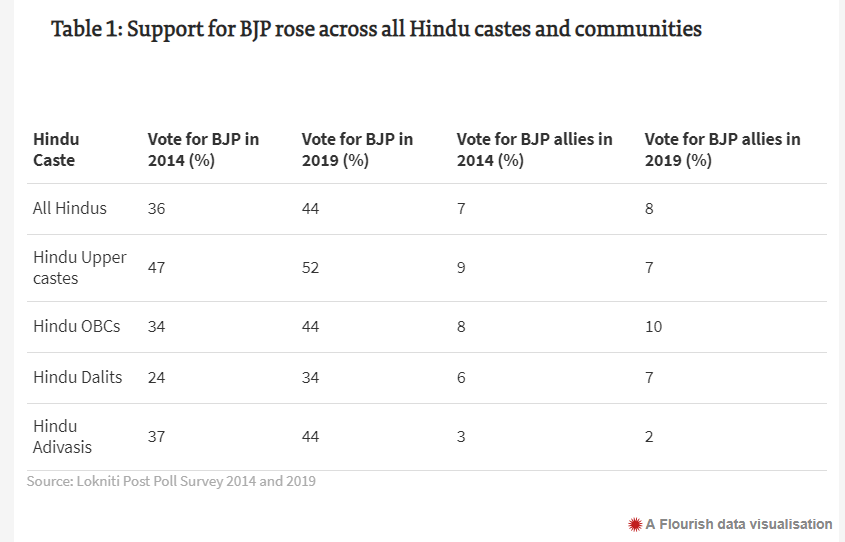
In 2019, according to a CSDS post-poll survey, 44% of Hindus voted for the BJP, an increase of 7% since 2014. There was an increase in BJP’s vote-share across all sections of Hindus. The Upper Caste vote-share went up to 52% from 47% in 2014, the vote-share among OBCs increased to 44% from 34%, the same for Dalits went up to 34% from 24%. Even among Adivasis, the BJP’s vote-share increased by a whopping 7%, from 37% to 44%.
Source: The Hindu
There’s a good reason for us to believe that the Opposition political parties and the secular-liberal establishment were aware of the tectonic shift in the Hindu mindset. The propaganda of atrocities against Dalits and Tribals does point towards that fact. That leaders like Jignesh Mevani were propped up, who represent a very rabid form of caste politics, is further evidence of the attempt to thwart the political consolidation of Hindus.
That there has been a decisive cultural shift is further evidenced by the fact that despite events such as Bhima Koregaon, where deliberate attempts were made to stir a caste conflict, Hindus of all hues came out in large numbers to vote for Narendra Modi in 2019. The BJP will be acutely aware that they are dependent on this Hindu consolidation for its stellar performance and going forward, if it is to do well, then it has to further cement it.
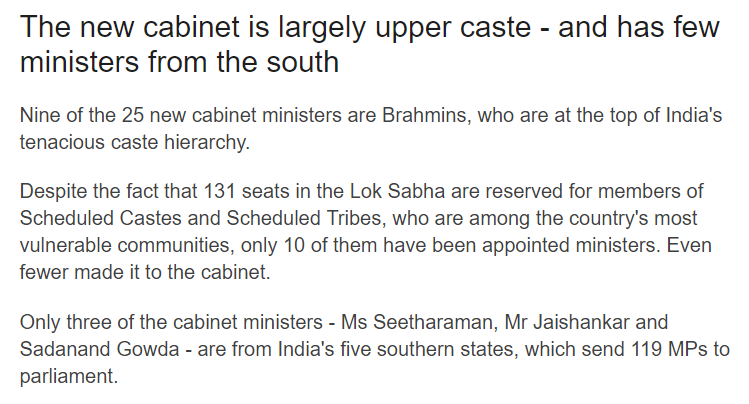
The strategy of the Opposition will be to break this political consolidation. And from the events of the past couple of days, it appears their tactics will be more atrocity literature. The analysis of the Caste Composition of the ministers in the second term of the Modi government by Times of India and the BBC certainly points towards it.
Modi Cabinet Ministers List: Upper castes get big chunk of ministerial berths | India News – Times of India https://t.co/kCpBt5ZC11
Times of India, since then, after social media backlash, appears to have changed its headline to the soberer “Union Cabinet 2019: PM tries to accommodate most castes”, however, the implication in the article is still quite clear, that Upper Castes, and especially Brahmins, are over-represented in ministerial positions with respect to their share in the Indian population.
Individual accounts on social media as well have been trying to peddle this narrative and push the Dalit-Adivasi vote-bank away from the BJP. This strategy hasn’t worked in the past 5 years, therefore, it appears unlikely that it will in the next 5. There certainly has been a cultural revolution within Hindu society, the cause can be attributed to various factors but its occurrence is quite undeniable.
Moreover, the symbolism of a Dalit President presiding over the Oath-Taking ceremony with a Prime Minister from the OBC caste heading the government with a significant chunk of ministers from the Upper-Castes will not be lost on anyone. People from expected quarters may cry foul but the Modi 2.0 Cabinet does a pretty good job of inclusion on the basis of caste and is symbolic of the political consolidation of Hindus.
In the next 5 years, we can expect more polarization as Opposition parties become even more desperate to break the consolidation of Hindus behind the BJP. Because if they fail, too many of them will be relegated to political irrelevance.
The North-South divide will be propped up as well by vested interests and attempts will be made to further create a fissure within Indian society. The Dravidian brand of politics will find resonance with various regional parties as they try to feed the electorate with a sense of regional supremacy. In Bengal, we can see it taking shape as Mamata Banerjee attempts to paint all BJP supporters as outsiders. In social media, we have certain ’eminent intellectuals’ who believe Bengalis who support the BJP are not real Bengalis.
Coincidentally, the saffron surge in West Bengal was the greatest evidence of the fact that the BJP’s rise is fueled by the political consolidation of Hindus from all castes. Hindus from every caste and creed consolidated massively in favour of the BJP, thus, increasing their tally to 18 seats from 2 in 2014. It also marked the end of the Left as Muslims consolidated behind Mamata Banerjee.
Thus, the next 5 years will be extremely crucial for the unity and integrity of India. A last gasp attempt will be made by vested interests to retain their power even at the cost of damaging the social fabric of the country permanently. The efforts are already underway. Only time will tell how much success they achieve in their attempts.
On paper, it looks like a straightforward victory for Australia against Afghanistan, but doubt Australia will be relaxing even a bit ahead of this contest. They have owned this tournament over the past 2 decades, winning 4 out of the 5 editions held since 1999 and they will be looking to make a positive start to this edition.
After stuttering to one series defeat after another for 2 years, Australia suddenly discovered their form in the middle of the Indian series when they turned around a 0-2 deficit to win the series 3-2, that was followed by a 5-0 thrashing of Pakistan in UAE and suddenly they look in great shape for the World Cup.
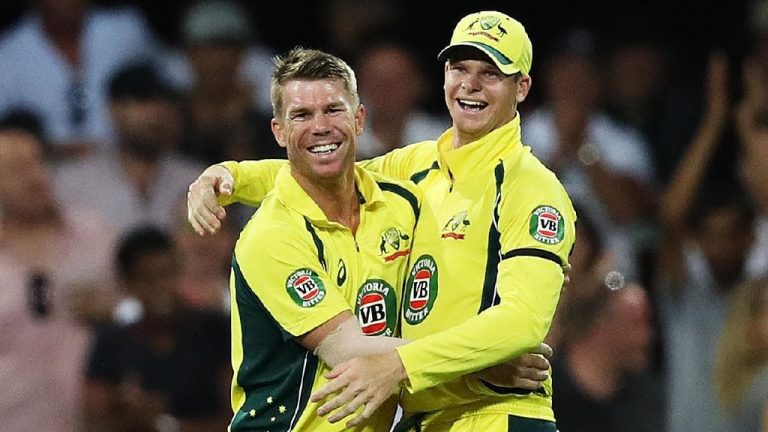
The squad that beat the 2 sub-continent giants back to back has been further bolstered by the arrival of David Warner and Steve Smith, 2 very talented batsmen with a point to prove to the cricketing world. This will be their first official match since the 12 months ban for ball tampering and both of them will be looking to make up for lost time.
Looking at their bowling attack, Afghanistan batsmen better prepare for some quick, short stuff as the battery of pace bowlers from Australia will be really eager to have a go at them. Starc and Cummins are certain to start but who partners them in attack will be interesting to watch, with skipper Finch having a number of pace options at his disposal. In spin department, Zampa is likely to get the nod ahead of Nathan Lyon, with Maxwell’s part-time off spin as back-up.
For Afghanistan, this is their second World Cup and they will be hoping to put up a better show against Australia than what they did last time. Back in 2015, Australia rode on Warner’s 178 and Smith’s 95 to score 417/5 in 50 overs against Afghanistan, who could only manage 142 in reply, crashing to 275 runs defeat. This time the Afghanistan side looks much more improved, they have greater experience of the big stage, and in Rashid Khan they have one of the best ODI bowlers.
A lot will be expected of Rashid and his fellow spinners Mujeeb and Nabi with the ball, and how Australia deals with this spin attack may well decide the game.
While their bowling has become steadily world class, Afghanistan batting has often been their weaker suit. However, the successful run chase of 263 against Pakistan must have bolstered the confidence of the Afghanistan batsmen. In Shahzad and Zazai, they have a really explosive opening pair and they will be hoping they can set the base for batsmen like Shahidi, Shinwari, Captain Gulbadin and Asghar to build a total. Nabi and Rashid can give it a good whack at the end and can be very useful in accelerating the scoring rate to set up a total or chase one down.
Key Players
Australia: David Warner – After a bit of a scare, Warner has been declared fit for the opening game. He had an outstanding IPL where he dominated pretty much every bowling attack on the way to winning the Orange Cap. After being out for an year over the ball tampering incident, and having been painted as the main villain of the piece, he will be desperate to go out there and do what he does best, smashing the bowler to all parts.
Afghanistan: Rashid Khan – Currently occupying 3rd spot in the ICC ODI bowling rankings, Rashid Khan is one of the biggest stars in World Cricket in the shorter formats. Keeping a tight leash on the scoring rate, and at the same time picking up wickets, he has become the main weapon for every T20 franchise he plays for. How Gulbadin uses his 10 overs, and how Australia handle him is going to be very interesting to watch. Look out for his big hits with the bat towards the end of the innings as well.
Australia vs Afghanistan in ODIs
Overall: Matches 2, Australia Won 2
World Cup: Matches 1, Australia Won 1
Recent Form (most recent first): Australia W W W W W. Afghanistan W L W NR L
On the day Amit Shah took the charge of Home Ministry, 5 youths of Kulgam district of Jammu and Kashmir, who were formerly associated with different terror have shunned the path of violence and returned to their families, according to a police report.
The Kulgam police said, “5 youths from different terror outfits have given up the arms and returned back to their families after persuasive efforts by the families and police”.
The police have refrained from revealing the identities of the surrendered youths for security reasons.
Scores of militants have shed the path of terrorism and surrendered since 2017 when the police had announced a new surrender proposal for the local militants to surrender even during an ongoing encounter.
The surrender and rehabilitation policy was first introduced in the valley on the Independence day in 1995. The policy was designed on the lines of the similar rehabilitation program initiated for the Naxalites.
Earlier, the surrender and rehabilitation policy was limited to those who crossed the Line of Control into Pakistan-occupied Kashmir in the early 1990s and were stuck there. But the policy didn’t provide the intended benefits. The new surrender policy is contemplating clause of “passports and jobs to any local youth who gives up the gun” and “support for his full assimilation into society”.
In January this year, some data on jobs from the Periodic Labour Force Survey (PLFS) conducted by National Sample Survey Office (NSSO) was leaked, which had created a big furore in the country. Based on the leaked incomplete data, several media houses and intellectuals had claimed that India’s unemployment rate for the year 2017-18 was at the highest level in 45 years. Opposition parties had used such analysis based on incomplete leaked data to attack the government before and during the Lok Sabha elections.
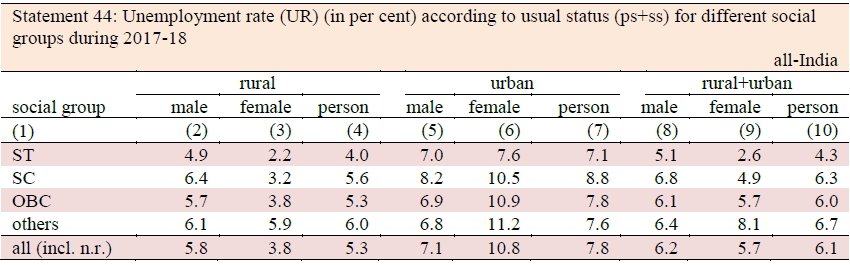
Today the Periodic Labour Force Survey report was officially released by the Ministry of Statistics and Programme Implementation. Going through the same, it can be said that there can be nothing farther away from the truth than saying that unemployment in India is at a 45 year low! The report confirms the leaked figure of 6.1% unemployment rate, but there are crucial details which make the difference. The report shows that the method to calculate jobs data has been changed, hence it can’t be compared with past data.
The unemployment rate for different social groups during 2017-2018
Past jobs data was measured using the expenditure of households as a criterion. The current jobs data uses education as a criterion instead of expenditure. This means this has become a perfect ‘apples to oranges’ comparison.
In India, the labour force surveys (Employment and Unemployment Surveys or EUS) have usually been bundled along with the household Consumer Expenditure Survey, conducted typically once in 5 years. The employment and unemployment surveys conducted by the National Sample Survey till 2011-12 used the monthly per capita expenditure of the household in the selected villages/blocks as a basis for stratification of households.
In the Periodic Labour Force Survey (PLFS) conducted for the year 2017-18, a decision was taken to use education levels as a criterion for stratification at the ultimate level.
This change in criteria from monthly per capita expenditure to education levels has direct implications on the comparability of the results of PLFS with the EUS of earlier years. In view of this, the PLFS needs to be seen as a new series for measuring employment and unemployment on an annual basis.
It is important to note that with the rise in education levels in the economy and rise in household income levels, the aspiration levels of educated youth have also risen. Thus, they may no longer be willing to join the labour force or workforce requiring low skills and low remuneration. The PLFS results give the distribution of educated and unemployed persons across the country which can be used as a basis for skilling of youth to make them more employable by industry.
There are various facets to the employment and unemployment scenario and no single data source is complete by itself. These data sets need to be supplemented by data from other sources so as to collectively give a holistic picture of the overall employment market. In this direction, the Ministry has been bringing out a compilation of new subscribers to EPFO, ESIC and NPS to give an assessment of changes in the formal market employment. The PLFS survey data complemented by administrative data and data from other sources need to be triangulated to get a complete picture.
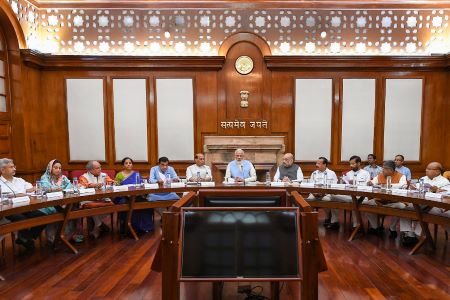
A day after swearing in, Prime Minister Modi met with the new Cabinet met on Friday and made some key decisions fulfilling the election promises that were made in the manifesto like the Jal Shakti Ministry. The Prime Minister tweeted that path-breaking decisions taken in the first Cabinet meeting would greatly benefit farmers and traders.
People first, people always.
Glad that path-breaking decisions were taken in the Cabinet, the first in this tenure. Hardworking farmers and industrious traders will benefit greatly due to these decisions.
The Cabinet has approved expanding the coverage of the PM KISAN scheme to all 14.5 crore farmers across the country. This expansion would cost Rs 87,000 crore a year.
#Cabinet approves extension of PM-Kisan yojana to all farmers. Nearly 14.5 crore farmers to benefit from the scheme. pic.twitter.com/v4zTCCEi4u
In February this year, the Prime Minister had launched the implementation of Rs. 75,000-crore Pradhan Mantri Kisan Samman Nidhi (PM-KISAN) scheme. Under this scheme under Rs.6,000 per year will be given in three instalments to 12 crore small and marginal farmers holding cultivable land up to two hectares.
Livestock Vaccination
The Food and Mouth Disease (FMD) and Brucellosis are very common diseases in livestock. The Cabinet has decided to bear the entire cost Rs 13,343 for vaccinating the livestock, aiming to control the diseases in the next 5 years and hopefully eradicate these diseases.
#Cabinet clears special scheme for Control of Foot and Mouth Disease (FMD) and Brucellosis The diseases of Foot and Mouth Disease (FMD) and Brucellosis are very common amongst the livestock – cow-bulls, buffaloes, sheep, goats, pigs etc.#CabinetDecision@PMOIndia@narendramodipic.twitter.com/VFhCfbaGUF
If a cow or buffalo gets infected by FMD, there would a milk loss of 100% for 4-6 months. In the case of Brucellosis, milk production gets affected by a loss of 30%, can cause infertility and even spread the disease to the farm workers.
Pension scheme for small and medium farmers
The Cabinet has approved the Pradhan Mantri Kisan Pension Yojana. Under this scheme, small and medium farmers aged 60 and above would be receiving a pension of Rs 3,000 per month. The scheme is voluntary and has an entry age of 18-40 years.
#Cabinet approves a path breaking scheme that will provide pension cover to crores of farmers.The Central Government would spend Rs 10774.5 crores for a period of 3 years.#CabinetDecisionpic.twitter.com/xaYfdAtuMS
In the initial phase, the plan is to cover 5 crore small and medium farmers within a span of 3 years. It would cost the exchequer Rs 10,774.5 crore per annum.
Pension scheme for traders
The Cabinet has decided that all shopkeepers, retail traders and self-employed people a minimum monthly pension of Rs 3,000. Traders with GST turnover below Rs 1.5 crore and aged between 18-40 years are eligible to enrol into the scheme.
The decision would benefit three crore, retail traders and shopkeepers. Union Minister Prakash Javadekar said that 5 crore traders are expected to join the scheme in the next 5 years.
Change in Prime Minister’s Scholarship Scheme
Yesterday Prime Minister Modi took the first decision after assuming office for the second time. A major change has been made in the Prime Minister’s Scholarship Scheme’ under the National Defence Fund (NDF), increasing the amount of scholarship and widening the ambit.
A couple of days ago, Dr Anand Ranganathan wrote an excellent article on the need for the so-called “Right-Wing” folks to come to occupy the space of critiquing the government for when it goes wrong, as the left is no longer in a position to do the same.
The article witnessed a rebuttal from none other than Rahul Roushan who argued that the left is far from being done, just yet. While I agree with both of them on most of their points, I somewhat disagree with them in one important area. Therefore, this article is trying to take this important debate forward with the intention of many more such debates in the foreseeable future.
Over the course of last 5 years, I’ve come to a conclusion that labels such as political, cultural or economic right (or the left) are too restrictive, and often, an oversimplification of the diverse set of ideas that an individual may represent. For instance, I am a big believer in free markets, and in the phrase that governments have no business, but to be in business. But, at the same time, I acknowledge the reality that markets too fail; and when they do, there is a definite need for government intervention. Similarly, it is my belief that popular understanding of “free-markets” often ignores the importance of institutions or the government in ensuring that such a market can exist and function efficiently.
Most of the people have views that put them in different such identities, and as the Nobel Laureate, Dr Amartya Sen has stressed, Indians do have multiple identities. Therefore, for the majority of us, we can’t be labelled as the Right-Wing or the Left-Wing and more importantly, our views are not static and they’re bound to change over a period of time.
There is a slight minority of select commentators who genuinely hate the present administration, and even they too tend to lean to whichever ideology that they find convenient so long as it criticizes the government- be it extreme left, extreme right or even centre. But, for all practical purposes, such rigid identities don’t exist for most of us and therefore it is not possible to have just the “right-wing” critique the policies of the government because perhaps there are very few such individuals. The left, or as a matter of fact, anyone should criticize the government when it gets something wrong, but at the same time, they should also appreciate everything that the government gets right; for the current administration in its previous tenure got many things right and only a handful of things wrong.
Moreover, I feel that the need of the hour is for genuine constructive and prescriptive criticism that is based on a rigorous understanding of the subject rather than the conventional norm of criticism just for the sake of it. Of late, many commentators who are known to have an ideological agenda against the government have written articles without substance, or any merit and some of these articles have been published in leading newspapers of the day. This is where the problem lies in the left’s criticism of the government, that it is often based on ideology rather than data, facts and rigorous academic merit. As the new government gets sworn in, perhaps these authors should reflect and introspect on the poor quality of their work.
There is a definitive need for debate, dissent and discussion on multiple issues, be it on handling of NRC, or on the RBI’s monetary policy framework and even on 35A and this discussion should not be limited to just the “right-wing”, but, the discussion must be subject to a minimum standard to ensure that the quality of such a debate is maintained. I do agree with Dr Ranganathan on the need to debate, but I disagree as this debate should not be confined to just the centre right because the left too, can offer us a lot of ideas, if only it was willing to step up its game. This is where I disagree with Mr Roushan too, as the left will never be dead, just as the right can never be dead. These labels are dynamic, rather than static and it will be difficult to differentiate between them in a rigorous academic discourse.
With the elections over, we should move towards a new discourse where academic untouchability does not exist and where we evaluate arguments on the basis of merit and hypothesis on the basis of data. Only then can we find the best of solutions that will benefit policymakers and aid them in taking the country forward. The last 5 years witnessed an unprecedented pace of transformation of India & it is about time that the left appreciates and acknowledge it. The left should also realize that the so-called right is willing to engage with their ideas as long as their arguments have merits and are backed by data, what is unacceptable to us, and to India is when their work is driven by ideology and propaganda.
We’re at the dawn of a “New India” that will require us to contribute a continuum of ideas to build it over the next couple of years. Let all such ideas be discussed, debated and developed over the course of coming months.
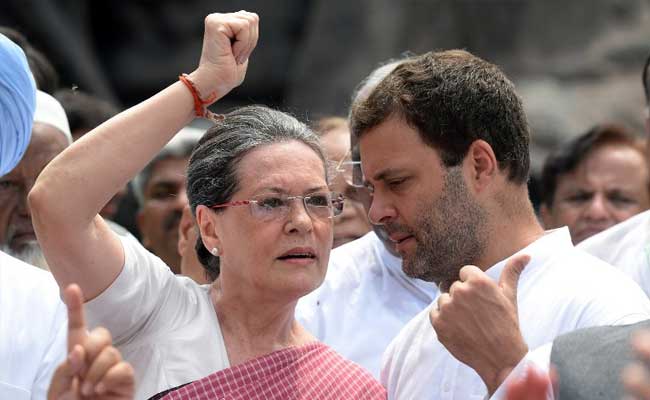
After the humiliating poll debacle of 2019 Lok Sabha Elections, the Congress is trying hard to put up a pretence of introspection and change within the party. Rahul Gandhi had earlier offered to resign as the Congress President, a resignation which was rejected by the CWC of which, Rahul Gandhi is the President. As the drama unfolded, media speculated that Rahul Gandhi might be elected to lead the Congress Parliamentary Party (CPP) but not take charge of Congress in the Lok Sabha.
The media speculations have been proven incorrect as news has now trickled in that Sonia Gandhi has been elected to continue to head the CPP
As reported by Media agencies, Rahul Gandhi mouthed off the same platitudes in the CPP meet while addressing the newly elected 52 MPs.
Rahul Gandhi told the elected representatives that that Congress has 52 lawmakers and “will fight the BJP every day”. He urged the leaders to understand what they are first and also understand that evidently, they are fighting for every single Indian. “Hatred cowardice and anger is fighting against you,” Rahul Gandhi said adding that BJP says that they want a Congress-free India so they don’t have any opposition left and this has to be fought with “love and compassion”.
Shri Rahul Gandhi thanked the voters & Congress workers.
He says, ‘every Congress member must remember that each one of you is fighting for the Constitution, for every person in India irrespective of the color of his skin or belief’. pic.twitter.com/yMtE6IWUXo
— Randeep Singh Surjewala (@rssurjewala) June 1, 2019
Reportedly, Rahul Gandhi also asked the newly elected MPs to be “more aggressive”.
Interestingly, Sonia Gandhi has reportedly thanked not just the voters but also Rahul Gandhi for “toiling hard” to fight the PM Modi led BJP government. She also said that the Congress party will oppose “divisive” measures even though they are small in numbers.
With Sonia Gandhi continuing to lead the CPP and reportedly, Rahul Gandhi refusing to lead Congress in the Parliament, Rahul’s role in the Congress party becomes even more unclear other than the platitudes of an ‘ideological battle’ that he seems to be heading.
It is also evident that the Congress party is in no mood to let Rahul Gandhi take responsibility for the poll debacle with Sonia Gandhi thanking him for “toiling hard” in the run-up to 2019 Lok Sabha elections.
The Congress panel that comprises senior party leaders Zubair Khan and KL Sharma started held assembly segment-wise consultations on Friday. They tried to ascertain why Rahul Gandhi was handed a humiliating defeat in his family bastion, Amethi. The conclusion that the panel drew was unsurprising considering it deflected all the blame to SP-BSP and shielded Rahul Gandhi from taking any part of the blame.
The panel has decided that Rahul Gandhi’s crushing defeat in Amethi at the hands of BJP MP Smriti Irani can be attributed to non-cooperation from the SP and the BSP that formed an alliance to fight the 2019 Lok Sabha elections in Uttar Pradesh.
The report says that even though SP and BSP did not field candidates from Amethi, the ground cadre did not help the Congress garner votes for Rahul Gandhi.
Khan is AICC secretary and an aide of Congress general secretary Priyanka Gandhi Vadra, while Sharma is UPA chairperson Sonia Gandhi’s representative in Rae Bareli and has worked closely in Amethi too.
The eventual blame has been placed on the local units of Akhilesh Yadav run SP and Mayawati led BSP for not helping in Rahul Gandhi’s election in Amethi.
In the run-up to the 2019 Lok Sabha elections, it was rather evident that the SP-BSP alliance leaving out Congress in Uttar Pradesh was nothing but shadow-boxing to get caste arithmetic right. While SP was wooing Muslims and Yadavs, BSP was wooing Dalits, the Congress, according to their strategy, would be free to woo the upper caste Hindus.
With their shadow-boxing failing, the claws are out and Congress seems to be going all out to protect Rahul Gandhi who has been throwing a tantrum ever since the poll debacle where BJP ended up bagging a thumping majority of 303 Lok Sabha seats.
Amethi that has been a Dynasty bastion for long was turned by fiesty Smriti Irani who ended up defeating Rahul Gandhi. The angst of Amethi against Rahul Gandhi was evident when several residents asserted that they don’t want to empower Muslims in the area by voting for the Congress party.
Interestingly, while the District Committee President of Amethi has stepped down taking responsibility, the Congress still seems to be shielding Rahul Gandhi from taking any responsibility of the poll debacle not just in Amethi but overall.