Home Blog Page 66

Gaurav Gogoi’s wife Elizabeth reported to Pakistani boss while working in India, sent confidential reports advocating low visibility strategies: Read explosive details revealed by Assam Police SIT

The Special Investigation Team (SIT) formed by the Assam government to probe the Pakistan link of Congress MP Gaurav Gogoi and his wife Elizabeth Colburn Gogoi has concluded. In a press conference today, Assam Chief Minister Himanta Biswa Sarma presented the findings of the probe, levelling serious allegations against the Deputy Leader of Opposition in Lok Sabha and his wife.

The CM said that the state government has forwarded the findings of the SIT probe to the Union Ministry of Home Affairs for further probe, as Assam Police does not have jurisdiction over many matters linked to the case. He said these links pose a significant threat to national security and require further detailed probe.

The Chief Minister described the findings as “damning and damaging,” emphasising that the involvement of a sitting MP elevates the matter to one of “extreme seriousness.” He alleged that Gogoi “attempted to legitimise Pakistan” through various actions, including leading a youth delegation to the Pakistan High Commission in New Delhi in 2015, where he met with then-High Commissioner Abdul Basit.

As per the CM, Elizabeth previously served as an aide to former US Senator Tom Udall, who is linked to anti-India billionaire George Soros, who wants to topple nationalist governments across the world, including the Modi government.

Sarma pointed to a viral photograph from this meeting, which he initially suspected was photoshopped but later confirmed as authentic after endorsements from Congress leaders.  Following the photo’s circulation, Basit reportedly visited Assam, which Sarma suggested was not coincidental.

The main allegations are regarding Elizabeth Colburn Gogoi and her links with Pakistani national Ali Tauqeer Sheikh. As per the probe, Elizabeth worked in Pakistan from March 18, 2011, to March 17, 2012, under a Pakistan-based organisation called LEAD Pakistan. During this period, she allegedly developed close ties with Ali Tauqeer Sheikh, whom CM Sarma described as a “Pakistani agent” with connections to the Pakistan Army, the Inter-Services Intelligence (ISI), and the country’s Planning Commission.

Sheikh, according to Sarma, was no mere environmentalist but a figure who promoted anti-India narratives on global platforms, particularly regarding the Indus Water Treaty and other bilateral conflicts. Sheikh visited India at least 13 times between 2010 and 2013, raising concerns about his role in anti-India activities. CM Sarma said that he was allowed to visit India by the UPA govt despite his anti-India comments being known.

Sarma revealed explosive details from the SIT report, claiming Elizabeth was transferred to India but continued to receive her salary from the Pakistani firm even after her relocation. Moreover, an appointment letter placing her in India was issued a year before her transfer. As per the SIT probe, LEAD India was brought under LEAD Pakistan so that Elizabeth’s salary could be transferred from Pakistan to India, bypassing FCRA regulations.

The CM said that LEAD Pakistan could not send the salary directly to Elizabeth, as a fund transfer under FCRA is only for Indians, and she is not an Indian citizen. Therefore, the fund was diverted to LEAD India, an Indian organisation, to pay her salary.

Elizabeth Colburn Gogoi worked under Bhawana Luthra in Lead India, who was questioned by the SIT in connection with the case. As per the financial records of Lead India checked by the investigators, LEAD India received funds from LEAD Pakistan in the name of organisational work, but actually the money was for Gogoi’s salary.

Sarma stated that Elizabeth maintained active bank accounts in Pakistan, where she received payments, but she refused disclose details of the accounts to the SIT. Another shocking fact was that her salary was much higher than that of her superior in India. While she received ₹2,50,000, Bhawana Luthra’s salary was ₹50,000.

As per the probe, Gogoi received a total of ₹82.41 lakhs from Pakistan through FCRA. LEAD India received ₹63.48 lakh from LEAD Pakistan, while in total it received ₹91.27 lakh from September 2012 to November 2014. Out of this, 90% amount was received by Gaurav Gogoi’s wife alone.

Moreover, while Gogoi was under Bhawana Luthra in LEAD India, she actually reported to Asian Regional Director Ali Tauqeer Sheikh in Islamabad. The agreement appointing Elizabeth in LEAD India said, “CDKN’s programme in India is part of the overall Asia programme managed and directed by Lead Pakistan as a core partner of the CDKN delivery alliance. As such, the personnel in this statement of work (namely Elizabeth Gogoi) are line managed, and their work overseen and approved, by the Asia Regional Director and Asia Regional Manager in Islamabad.

It further states that, “The Asit. Regional Director, together with the CDKN outcome leads and Head of Country Support in London have joint strategic and budgetary control over the programme in India. The Lead Pakistan office will administer this contract on behalf of CDKN including setting monthly work plans, approving budgets and travel expenses and all other technical, strategic and budgetary decisions.”

This makes it clear that LEAD India was completely under LEAD Pakistan, an unusual arrangement as, in general, country units of international organisations have equal rank and status, and are governed by regional/global heads. But in this case, the wife of a Lok Sabha MP worked under an organisation under direct control of Pakistan, and CM Sarma called it a very serious issue.

The agreement was collected by the SIT during the probe. As per CM Sarma, while Elizabeth transferred from Pakistan to India, she remained a ‘shadow employee’ of LEAD Pakistan working in India. He said that the SIT has confiscated documents showing the flow of money from Pakistan to India from the LEAD India office, and Bhawana Luthra has also confirmed the same.

In another explosive allegation, the CM alleged she collected sensitive information on activities surrounding India and sent reports back to Pakistan, including a 50-page confidential document to Sheikh that referenced Intelligence Bureau (IB) sources. The report was marked as confidential, and it prima facie violates Section 2 of the Official Secrets Act, 1923.

During questioning, Elizabeth agreed that she authored the report. As per the CM, the report stated, “no risk, no visibility strategy recommended”. It further advocated that the Pakistan-based actor maintain a covert operational strategy in India to avoid detection and scrutiny, as per the SIT.

Elizabeth had also recommended bypassing the central government in India and working directly with state governments and other regional agencies. She had written that the tension between the centre and states will increase under PM Modi.

When she was working in LEAD India, she visited Islamabad six times, and after she left LEAD India and joined Oxford Policy Management, she visited three more times. Each time, she used the land route through the Atari border, instead of taking flights, the CM said. As per SIT, LEAD India head Bhawana Luthra said that she does not know why Elizabeth visited Pakistan.

The SIT made the following major observations regarding Elizabeth Colburn Gogoi

  • Links to George Soros via Senator Tom Udall
  • Employment with LEAD Pakistan under Ali Tauqeer Sheikh
  • Refused to disclose Pakistani bank account details
  • Pre-determined employment contract with LEAD India (issued 18 months before joining)
  • Shadow employment arrangement to facilitate entry into India
  • Salary 500% higher than reporting manager – FCRA violation
  • Concealed funding source from Pakistan
  • Primary beneficiary of Rs. 82.41 lakhs from Pakistani FCRA funds
  • No oversight from LEAD India management-reported directly to Pakistan
  • Transmission of CONFIDENTIAL report to Pakistan (August 5, 2014)
  • Report contained reference to secret IB communication
  • Advocated “Low Risk Low Visibility” strategy for Pakistani actors
  • Recommended bypassing Central Government via State-level engagement
  • Exploited Centre-State political tensions in intelligence report
  • Joint pre-employment travel with Ali Tauqeer Sheikh (3 occasions)
  • 6 unauthorized visits to Pakistan while at LEAD India
  • 3 additional Pakistan visits after joining Oxford Policy Management

The Chief Minister also talked about Gaurav Gogoi, saying that in 2013, five months before his first Lok Sabha election win, Gogoi visited Pakistan via the land border after losing his passport during a trip to Israel. CM Sarma questioned the upgrade of Gogoi’s single-entry visa to multiple-entry upon arrival in Pakistan and his access to ISI strongholds in Pakistani cities amid ongoing border skirmishes.

As per the CM, while Gogoi’s visa was only for Lahore, after he reached Pakistan, his visa was extended to include visits to Islamabad and Karachi. This extension was granted based on a letter written by Pakistan’s interior ministry. CM Sarma said that the SIT has obtained the passport showing the endorsement for extending the visa locations.

As per the CM, Gogoi’s personality completely changed after visiting Pakistan, and raised parliamentary questions related to confidential matters, like Nuclear power plants, uranium reserves, border security, defence hardware and software, air power, domestic weapons manufacturing, espionage at the Pakistan High Commission in Delhi. He also asked questions on national water mission strategies, a matter linked to Elizabeth’s area of work.

The CM also showed a video clip from an interview, where Gaurav Gogoi had said that he visited Pakistan because his wife was working there. But the CM pointed out that his wife was transferred to LEAD India a year before his visit.

While Gaurav Gogoi’s daughter is a British citizen, as she was born in London, CM Sarma revealed that he had surrendered the Indian passport of his India-born son. He displayed the surrender certificate issued by the Regional Passport in Delhi, stating that the passport was surrendered on 12 May 2022. CM Sarma called it very regrettable that the son of former Assam CM Tarun Gogoi surrendered his son’s Indian passport.

Another serious allegation the CM made was that when son Kabir Gogoi had an Indian passport, his religion was mentioned as Hindu, but no religion is mentioned in his British passport. On the other hand, the British passport of daughter Maya Gogoi mentions her religion as Christian.

CM Sarma said that his son is being converted to Christianity, and Gaurav Gogoi is now a religious minority in his own family.

Himanta Sarma underscored the national security implications of these facts, stating, “The SIT has given proof that three persons have a direct link with Pakistan—Ali Tauqeer Sheikh, Elizabeth Gogoi, and Gaurav Gogoi. After seeing the SIT report, our cabinet ministers were shocked.”

He added that the probe, initially handled by Assam Police’s CID, revealed information requiring Interpol assistance and access to classified data out of the jurisdiction of Assam Police. The cabinet discussed the report on February 7 and authorised its partial disclosure today, excluding confidential elements. The cabinet has decided to refer the report to the Union Home Ministry for further investigation.

Chief Minister Himanta Biswa Sarma has also questioned why Elizabeth Colburn Gogoi retains her UK visa even so many years after her marriage with Gaurav Gogoi. He has also questioned why their children are also British citizens and why no application has been made for Indian citizenship.

Artist TM Krishna spews venom against Vande Mataram, calls it ‘unfit’ as national anthem, labels Anandmath anti-Muslim; Read how he reveals deep hostility towards Hindu identity

0

Carnatic music artist TM Krishna, who is notorious for holding extreme political views, recently spewed venom against the national song ‘Vande Mataram’ and the Hindus. In a recent interview with the YouTube channel The Deshbhakt, where he was promoting his book, Krishna expressed his disdain for Vande Mataram, Anandmath and also the Hindu identity.

Vande Mataram was written by the renowned Indian author and novelist Bankim Chandra Chatterjee and was introduced by him in his famous novel ‘Anandmath’. The novel is set against the backdrop of the Indian freedom struggle and the famine situation in Bengal.

The words ‘Vande Mataram’ became a popular slogan among freedom fighters, who drew motivation and strength from it at a time when the country was reeling under British rule. The song captures the passion of the Indian freedom fighters for their country, which they revere as ‘mother’, and their resolve to free it from the clutches of slavery.

Vande Mataram portrays Bharat Mata as a Hindu Goddess: Krishna

However, Krishna, completely failing to appreciate the song’s devotional undertones, describes it as “complex” and claims it was not fit to become the country’s national anthem. “There is no way Vande Mataram could have been the national anthem of India, let me very simply say. Because Vande Mataram is a complex song…” Krishna asserted. He, then, goes on to justify his critical opinion by finding fault with the structure of the song and points out how the song was not written by Chatterjee in one stretch but in phases, as if that is a disqualifier for the song to be accepted as the national anthem.

He compares the song ‘Jana Gana Mana’, the Indian national anthem written by Nobel Prize-winning Rabindranath Tagore, with Vande Mataram. While both songs celebrate India with different viewpoints, Krishna claims that Jana Gana Mana is more fit to be the national anthem than Vande Mataram, which he associates and restricts to the Hindu identity, which he clearly abhors. Furthermore, he points out a shift in the “tonality” in the last couple of stanzas of Vande Mataram and says that in these stanzas, Mother India has been portrayed as a “Hindu Goddess”, which is another grievance he carries with the song.

Anandmath is an anti-Muslim book: Krishna

He does not stop there with his Hindu hatred and goes on to peddle lies about the book ‘Anandmath’ by also making misleading claims about it. Krishna, who claims to have read two translations of Anandmath, declares the book to be not just anti-establishment (British and Muslim establishment at that time) but also anti-Muslim. “In the book, it is a song that is sung by Hindu Sanyasis, while they are attacking villages where Muslims live. It is a book that is establishing the superiority of the Hindu community and the need for their control coming back,” Krishna said.

One might say that being an ‘artist’, Krishna is entitled to his opinion regarding the ‘structure’ or the ‘tone’ of the song. From criticising the structure of the song, he shifts to making sweeping generalisations about the song and creates a cult out of people who praise and support the song, and states, “And the fascinating thing is, all those who subscribe to ‘Vande Mataram’, in general, also said ‘Uniform Civil Code,’ also said ‘one language.’ Some of them also said there should be a mention of God in the Preamble (of the Constitution), and also said ‘anti-conversion.’

TM Krishna and his Hindu hatred

As he keeps on critically talking about the song, it becomes clear that it is not the song that has deeply bothered him, but something bigger that he believes the song symbolises. “So, if you see, Vande Mataram symbolises an entire ecology of what they believe is India, which is a Hindu India, a dominant Hindu India, in which others can be accommodated if they agree to be emotionally subservient or they say (accept) that our forefathers were Hindu.”

It becomes obvious from the above-quoted statements of Krishna that Anandmath or Vande Mataram are not the actual subjects of his vitriol, but it is actually the Hindu identity that he associates with them. Krishna tries to package his Hindu hatred as a genuine concern for the “secular” ethos of the country by insinuating that Hindu identity intrinsically contrasts with an egalitarian society.

He presents his idea of India as one which accommodates people from all communities and does not discriminate against anyone based on religion or ideology. However, in saying so, Krishna exposes his hypocrisy and double standards. Years ago, in 2018, TM Krishna had openly admitted that he feels no empathy when RSS members are killed by communists or Islamists in places like Kerala. Not just that, he blatantly blamed the BJP for making him this “crass” and “inhuman”. Krishna, who lends lip service to the idea of giving space to all ideologies, has himself displayed intolerance towards the ideologies he is not pleased with, including the Hindu ideology.

‘Reconsider blanket prohibition on non-Hindus in Hindu temples’ – Kerala High Court calls for ‘harmonious’ interpretation; read why this is problematic

0

On 30th January, the Kerala High Court held that the rule imposing a blanket ban on the entry of non-Hindus into Hindu temples may require reconsideration to align with constitutional principles. The court observed that statutory provisions that govern religious spaces should not become instruments of “social discord or disharmony”.

The judgment was pronounced by a Division Bench comprising Justice Raja Vijayaraghavan V and Justice K V Jayakumar. The court dismissed a writ petition that challenged the entry of Christian priests into a temple during a Hindu festival. While dismissing the petition, the court asked the State government to examine whether Rule 3(a) of the Kerala Hindu Places of Public Worship Rules, 1965 should be retained in its present form or amended after consultation with religious stakeholders.

OpIndia accessed judgment in the matter.

Background of the dispute

The case stemmed from events on 7th September 2023 during Sreekrishna Jayanthi celebrations at the Adoor Sree Parthasarathi Temple in Pathanamthitta district. The temple authorities had invited two Christian priests, including Dr Zacharias Mar Aprem, to attend a public programme held within the temple compound as part of the celebrations.

Following the event, the priests were taken near the Sreekovil, the inner sanctum area, and were presented with gifts. As the Christian priests were in their priestly robes, Hindu devotees raised objections and contended that non-Hindus were not permitted to enter the temple precincts as per the Kerala Hindu Places of Public Worship (Authorisation of Entry) Act, 1965 and the Rules framed thereunder.

Sanil Narayanan Nampoothiri, a devotee of the temple, approached the Kerala High Court and accused the temple authorities of violating statutory provisions by permitting the entry of Christian priests. He sought disciplinary action against members of the Temple Advisory Committee, including their termination. Furthermore, he sought directions to bar all non-Hindus from entering the temple, and the performance of curative rituals to restore the sanctity of the premises.

Clear prohibition on entry of non-Hindus

The petitioner argued that Rule 3(a) of the 1965 Rules clearly prohibits the entry of non-Hindus into temples. He argued that the entry of Christian priests, especially in religious attire, amounted to a direct violation of the law. It was contended that temple authorities had no discretion to override the statutory embargo, regardless of whether permission was granted by the Thanthri.

It was further asserted that allowing such entry undermined established customs and religious practices, thereby diluting the sanctity of the temple. The petitioner maintained that the issue was not about hospitality or courtesy but about strict adherence to statutory and religious norms governing Hindu places of worship.

Stand of the Devaswom Board and temple authorities

In its counter affidavit, the Travancore Devaswom Board admitted that the Christian priest had been invited by the Temple Advisory Committee to inaugurate the Shobha Yatra connected with Sreekrishna Jayanthi celebrations. It stated that after the programme, the priests sought permission to enter the temple and such permission was granted by the Thanthri.

The Board contended that the entry was ceremonial and permissive, not as a matter of right, and did not violate temple rituals, rites, or customs. It was also stated that the maximum consequence under the Rules, even if violated, was removal of the person from the premises, and not punitive action against temple authorities.

Members of the Temple Advisory Committee echoed this position and asserted that the entry was authorised by the Thanthri. The committee further contended that no devotees objected at the time, and that the petition amounted to an abuse of the legal process.

Observations of the Court

The Kerala High Court noted that the Kerala Hindu Places of Public Worship (Authorisation of Entry) Act, 1965 was enacted to ensure the entry of all sections and classes of Hindus into temples and to eliminate caste-based exclusions.

The Bench pointed out that while Rule 3(a) of the 1965 Rules bars non-Hindus from entering temples, the parent Act itself does not contain any explicit prohibition on the entry of non-Hindus. The Court emphasised that subordinate legislation cannot introduce restrictions that are not included in the parent Act.

The Court reiterated that delegated legislation must supplement, not supplant, the Act under which it is framed.

Findings and conclusions of the Court

In its judgment, the Court drew a distinction between entry claimed as a matter of right and entry permitted by the Thanthri as a guest or invitee. The Court held that the Thanthri occupies a central and authoritative position in the spiritual hierarchy of the temple. A permissive entry authorised by him cannot be equated with a statutory violation.

The Court further observed that the object of the law is to promote social harmony. The statutes should evolve with changing societal realities, the court said. It further cautioned that rigid interpretations of subordinate rules should not result in religious disharmony.

The Court, however, refrained from striking down the rule and left it to the government to decide whether it should be amended after due consultation with Devaswom Boards, Thanthris, religious scholars, and other stakeholders.

Why this judgment is fundamentally flawed and unfair to Hindus

The judgment is being presented as a defence of constitutional harmony. However, it exposes a deeper and recurring problem in the legal landscape, that is, judicial overreach into Hindu religious spaces under the selective banner of secularism and harmony.

Across India and the world, places of worship impose faith-based restrictions without controversy. Non-Muslims are prohibited from entering the inner precincts of Mecca and Medina. The Vatican enforces strict access controls based on religious authority and protocol. Even several churches and synagogues restrict participation in core religious ceremonies to adherents alone. None of these practices are framed as unconstitutional or socially divisive.

However, when it comes to Hindu temples, they are subjected to relentless judicial scrutiny, reinterpretation, and moral policing. The Kerala High Court’s suggestion that a rule barring non-Hindus may be inconsistent with constitutional values ignores the basic principle that religious institutions have the right to preserve their spiritual character. They cannot be turned into tourist spots.

The argument that Hinduism is merely a way of life and therefore open to universal access has been repeatedly weaponised to dilute Hindu religious autonomy. This reasoning conveniently overlooks the fact that Hindu temples are not public parks or cultural halls, but consecrated ritual spaces governed by Agamas, customs, and centuries-old practices.

What is more troubling is that the Court showed readiness to question a rule framed specifically to protect Hindu temple sanctity, despite the Act itself being a product of state intervention into Hindu religious affairs. Hindu temples are already under government control through Devaswom Boards, unlike churches and mosques which retain autonomy. Asking Hindus to now surrender even the authority to decide who may enter their sacred spaces amounts to an unequal application of secularism.

Secularism does not mean that Hindus must endlessly accommodate everyone and everything for the sake of it, that too when other faiths enforce exclusivity without question. Hindus are not the sole custodians of secularism. Their temples are not laboratories for social experimentation.

Read the judgment here.

Opposition trying to provoke farmer protests by lying about India-US trade deal: Read how it is only interim framework, no tariff cut on major crops, and India already imports farm products

The United States and India on Saturday unveiled a new joint framework for an Interim Trade Agreement, a major step toward a full Bilateral Trade Agreement (BTA). The White House said that the US is dropping the punitive 25% tariff on India for purchasing Russian Oil immediately, and the reciprocal tariff of 25% will come down to 18% once the trade deal is finalised and signed.

After US President Donald Trump and Prime Minister Narendra Modi described the move as a big breakthrough that could open the door to deeper economic cooperation between the two countries, opposition leaders have started to attack the Modi government over the framework. Some of them have started to claim that PM Modi has already signed the trade deal with the United States, reducing tariffs on farm products to zero, and that it will flood the domestic market with cheap American agricultural products, leading to the ruin of local producers. However, these allegations are completely false and misleading.

In a post on X, Sanjay Singh of the Aam Aadmi Party claimed that Prime Minister Narendra Modi had “lied to the nation” and “betrayed crores of farmers” by opening India’s agricultural market to the US at zero per cent tax. He also claimed that PM Modi agreed for the deal to save Gautam Adani after he was accused of corruption by US Department of Justice. He accused the government of lying for saying that interests of farmers will be protected in the trade deal with the US.

Sanjay Singh claimed that cheap American grains and fruits would devastate Indian farmers, while the country would be forced to buy costly American oil instead of cheaper Russian supplies, imposing an additional burden of ₹80,000 crore on the public. The AAP leader claimed that while the US will impose 18% tariff on all Indian exports to the US, India will not impose any tariff on imports from the US. He claimed that Narendra Modi signed the death warrant of farmers by allowing 0% tariff on farm products.

Similarly, activist Yogendra Yadav claimed that the deal marked the first time Indian agriculture was being integrated into an international trade agreement. He added that while products will be imported at zero import duties, others like maize and soya will enter the Indian market through the “back door.” He urged farmers to mobilise against what he termed an “attack.”

Yadav claimed that the Modi govt is also ready to relax the ban on the import of genetically modified crops and dairy from animals that consume non-vegetarian feed. But there is no basis to make this claim, and even the Trump administration has not made such a claim.

These comments are completely baseless and untrue, aimed at provoking the farmers to launch yet another protest against the government. The opposition leaders are claiming that the Indian government has already signed a trade deal reducing tariffs on agricultural products to zero, which is completely false.

No Trade Deal Yet

Opposition leaders are claiming that India has already signed the trade deal with the USA, which is completely false. What we have is a joint statement saying that India and the US have reached a framework for an interim trade agreement. The actual Free Trade Agreement is yet to be finalised, let alone signed.

The framework is not a binding pact but a preliminary outline reaffirming commitment to broader US-India Bilateral Trade Agreement (BTA) talks. It will potentially take months of negotiations to finalise the draft of the deal. The final agreement will depend on these negotiations, and also on the famously unstable mood of Donald Trump.

No Major Farm Products Mentioned

Notably, the Joint statement specifies that India will “eliminate or reduce tariffs” on all US industrial goods and a “wide range” of American food and agricultural products. Notably, it does not say that India will eliminate tariffs across all items, contrary to the claims. Yogendra Yadav, Sanjay Singh and other opposition leaders have chosen to conveniently ignore the term ‘reduce’, which is a blatant misrepresentation of the text of the statement.

The agricultural products on which India will eliminate or reduce tariffs include Dried Distillers’ Grains, red sorghum for animal feed, tree nuts, fresh and processed fruit, soybean oil, wine, spirits, and select others. These are predominantly commodities that India already imports to meet domestic demand gaps. These are not major farm products produced by Indian farmers. Therefore, it does not represent any major threat to Indian farmers.

The joint statement does mention any major staple crop like rice, wheat, maize, etc., most of the products are used for industrial and non-food purposes. These reductions are targeted at industrial and supplementary goods that do not compete with the core productions of Indian farmers.

While the US was demanding that India open up its market for American corn, soybean, fuel ethanol, dairy and poultry products, none of them have been mentioned in the joint statement, and are unlikely to be included in the final agreement.

No Backdoor Entry

Yogendra Yadav claimed India is allowing backdoor import of corn and soyabean by allowing import of Dried Distillers’ Grains (DDG) and soyabean oil, which is not correct. DDG is a byproduct of ethanol manufactured from corn and other cereal grains, and it is used as animal feed. But it does not replace existing feed; it is only added to normal feed, as it is very rich in protein.

Similarly, Red Sorghum mentioned in the statement is also used as animal feed. Amul MD Jayen Mehta has assured that import of these items will not have any major impact on Indian farmers, as dairy farmers do not use more then 3%-4% of DDG in animal feed. He said that though DDG has high energy, it leads to fat separation in the cattle, and hence it is kept limited to around 3% to 4% only.

DDG is only a byproduct of corn that India has agreed to purchase; there will be no import of corn or other corn products like ethanol and corn syrup. And as DDG made from corn is cheaper compared to DDG made from other crops like rice or other sources of protein, Indian dairy farmers will actually benefit from it.

Contrary to Yadav’s claim, importing soyabean oil does not mean backdoor import of soyabean, and India already imports a large quantity of soyabean oil as domestic production is not sufficient to meet demand.

Union ministers, including Commerce Minister Piyush Goyal and Agriculture Minister Shivraj Singh Chauhab have repeatedly emphasised that farmers’ interests will be safeguarded, and the joint statement reflects that commitment by not referring to not mentioning any major Indian farm products. It only shows that tariff adjustments are limited to products where India has import dependencies.

US imposed 25% reciprocal tariff on India, claiming that India was charging a very high import duty. Therefore, it was only expected that the Indian govt will reduce some tariffs as part of the deal. In exchange, the US has committed to slashing tariffs on Indian goods from 50 per cent to 18 per cent, removing punitive duties linked to India’s prior Russian oil purchases, and easing barriers on items like generic pharmaceuticals, gems, diamonds, and aircraft parts.

Russian Oil

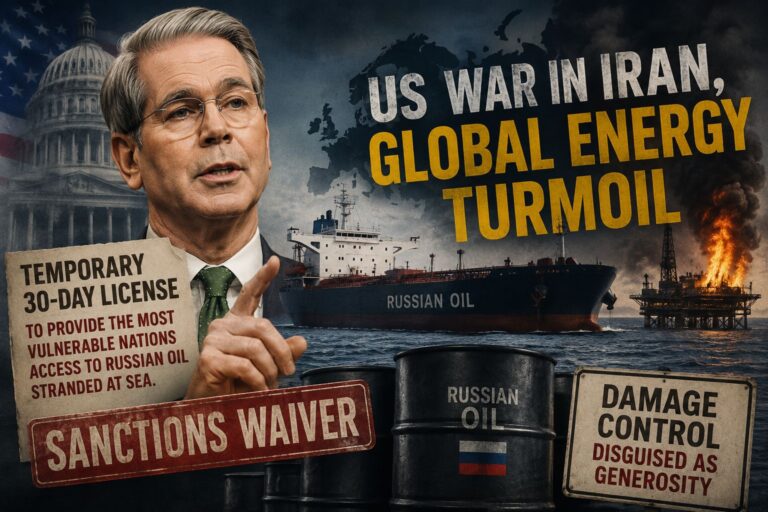
Referring to the claim that India will replace cheap Russian Oil with costly American oil, it needs to be noted that this remains only a claim by the US, and the Indian govt has not made any comment on it. The claim that India has agreed to stop buying Russian Oil is not even mentioned in the India-US joint statement. It was mentioned in a separate presidential order issued by the White House, eliminating the 25% punitive tariff on India.

The Executive Order states, “India has committed to stop directly or indirectly importing Russian Federation oil, has represented that it will purchase United States energy products from the United States, and has recently committed to a framework with the United States to expand defense cooperation over the next 10 years.”

India never imported oil only from Russia; the country imported petroleum products from various countries depending on market conditions. India started to buy Russian oil in significant quantities only after the Russia-Ukraine conflict resulted in EU imposed discount on Russian oil. Before that, India was buying oil at prevailing market rates.

Therefore, the claim that replacing discounted Russian oil with oil at market rates will destroy the economy is completely baseless and wrong. Discount on Russian oil is anyway coming down, and once the war is ended, sanctions on Russian oil and gas will also go away, as the country is a major producer and exporter of energy in the world. Once that discount is removed, India will have to buy all its imported oil at market prices only. That will not destroy the economy, but will only remove the additional benefit oil companies are enjoying.

India Already Imports Farm Products

A key misconception fuelling the claims regarding the import of agricultural products is the notion that India does not import farm products, and is now being coerced into doing so under US pressure. In reality, India has long been a major importer of agricultural commodities to meet its vast domestic demand. A country does not and can not produce all the agricultural products, and has to depend on imports.

For example, an interesting trivia is that India is simultaneously the largest producer, largest consumer and largest importer of pulses. India’s domestic demand for pulses is so high that, despite being the largest producer, it needs to import substantial quantities from various countries, including the USA and Canada.

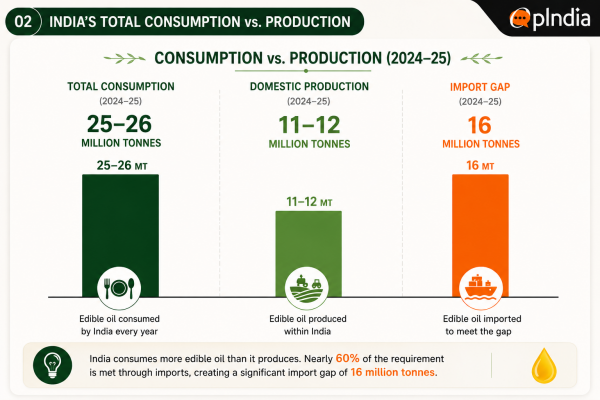
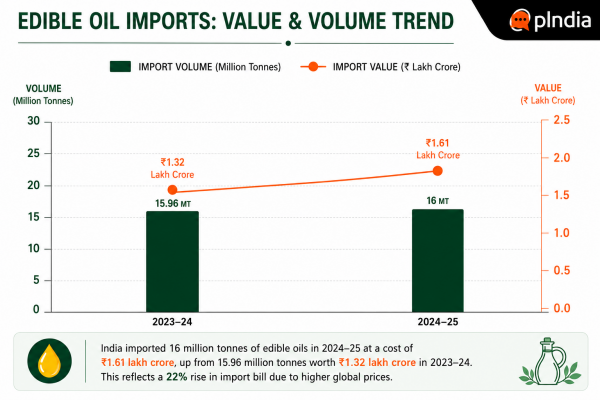
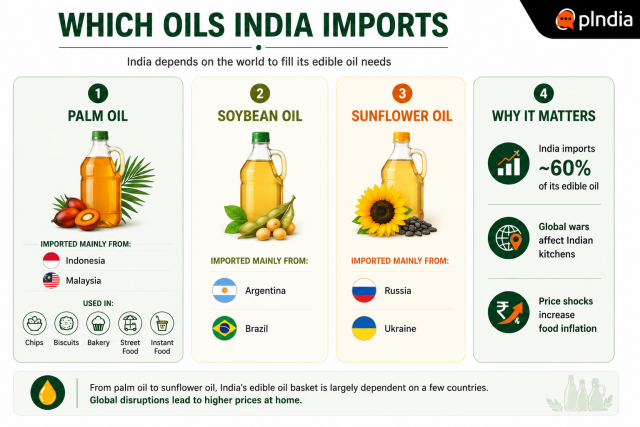
Similarly, India imports substantial quantities of vegetable oils like palm oil, soybean oil, sunflower oil, etc. India needs to import edible oils because domestic oilseed production, like mustard, groundnut, soybean, etc., doesn’t meet the high demand for cooking and industrial use.

Similarly, Indian markets already import a variety of fruits and nuts in large quantities. This includes apples, almonds, walnuts, pistachios, kiwis, pears, dates, grapes and others. Other farm products already imported by India include cotton, natural rubber, certain cereals, coffee, cocoa beans, and certain spices, which are not produced domestically in sufficient quantities, like some types of pepper and cardamom.

As per the latest data, India imported agricultural and farm produce worth approximately US $38 billion in total in the year 2024-25. Imports have been rising because domestic production of certain items, especially edible oils and pulses, falls short of domestic demand.

These imports address shortages in edible oils and protein-rich foods, supporting food security without undermining local farmers.

UP records massive drop in accidents and fatalities on National Highways: Read how CM Yogi Adityanath’s policies brought the transformation

India remains the most affected country in the world in terms of road accidents. The National Highways (NHs), though they form only about 2.3% of the total road network, account for more than 36% of all road accident deaths in the country, but 2025 marked a major turning point. For the first time in three years, the rising trend in accidents and deaths on National Highways was reversed, with both figures falling by more than 11%.

According to data placed in the Lok Sabha by the Ministry of Road Transport and Highways (MoRTH), there were 1,34,307 accidents and 57,482 deaths on National Highways in 2025. This was a sharp improvement compared to the year 2024, when 1,50,958 accidents and 64,772 deaths were reported. These numbers clearly indicate a nationwide improvement in highway safety.

Uttar Pradesh leads the national decline

Among all states, Uttar Pradesh played the biggest role in bringing down the national figures. Under the leadership of Chief Minister Yogi Adityanath, road safety has remained a top priority since 2017. Continuous work on road quality, better engineering, stricter enforcement and faster emergency response has delivered visible results.

Deaths on National Highways in Uttar Pradesh fell from 9,560 in 2024 to 6,973 in 2025. This means 2,587 lives were saved in just one year, the highest reduction achieved by any state in the country. Officials say this improvement reflects long-term planning rather than short-term action.

Five states drive the overall improvement

Provisional MoRTH data, based on inputs from states uploaded on the eDAR portal, shows that total accidents on National Highways fell by 16,651 and deaths by 7,290 in 2025. This reduction was mainly driven by five states: Uttar Pradesh, Madhya Pradesh, Punjab, Chhattisgarh and Telangana. Uttar Pradesh and Madhya Pradesh together contributed to a reduction of 6,072 deaths.

State level key indicators

  • Uttar Pradesh: Deaths fall from 9,560 to 6,973 (2,587 less)
  • Madhya Pradesh: Deaths fall from 4,644 to 2,882 (1,762 less)
  • Punjab, Chhattisgarh and Telangana also showed significant improvement

States where numbers increased

While many states showed progress, some regions reported a rise in accidents and deaths.

  • Gujarat: accidents increased from 3,519 to 3,944 and deaths from 2,192 to 2,380.
  • Jharkhand: It reported a slight rise in both accidents from 2,039 to 2,056 and deaths from 1,686 to 1,783
  • Uttarakhand: It also saw higher numbers of accidents from 828 to 875 and deaths from 543 to 605
  • Delhi:  It recorded a sharp jump in accidents on National Highways, from 593 to 1,827, drawing concern from road safety experts.

Why Uttar Pradesh stands apart

Officials point out that Uttar Pradesh’s performance is the result of steady and systematic reforms. From the very beginning of his first term in March 2017, Chief Minister Yogi Adityanath treated road safety as a “social challenge” and pushed for a strong and balanced approach based on the 4E model: Education, Enforcement, Engineering and Emergency Care.

Pothole-Free roads as the first big push

Soon after being appointed on 18th March, 2017, Yogi Adityanath issued strict instructions on road quality. On 25th March, 2017, he ordered that all state roads be made pothole-free within two and a half months. Officials were given clear responsibility, and regular reviews were conducted to ensure results on the ground.

At that time, potholes were a major cause of accidents in Uttar Pradesh. The pothole-free drive not only improved road quality but also sent a strong message that road safety was being taken seriously. This campaign did not stop after 2017. Every year, especially before festivals, fresh instructions were issued.

In September 2025, departments such as municipal corporations, the Public Works Department (PWD) and the Rural Development Department were again directed to ensure pothole-free roads across cities and villages.

Better roads helped reduce skidding, tyre bursts and sudden braking incidents. The impact was seen not just on National Highways, but also on state highways and rural roads, giving the policy long-term benefits.

Special focus on fog-related accidents

Winter fog is a major cause of accidents in Uttar Pradesh. After a fatal accident on the Yamuna Expressway in Mathura in December 2025, where 13 people lost their lives, the Chief Minister immediately reviewed the situation and ordered strict safety steps.

  • Increased patrolling on expressways, deployment of teams at accident-prone black spots
  • Installation of reflectors, and 24×7 availability of cranes and ambulances.
  • Proposal to reduce speed limits from 120 km/h to 80 km/h during fog.
  • Toll plazas were directed to provide shelter, blankets and basic facilities for two-wheeler riders, along with real-time safety announcements.
  • On-street parking was banned, street lighting checks were intensified, and faulty lights were repaired quickly.

These steps were implemented on major expressways, including Yamuna, Agra-Lucknow, Purvanchal, Bundelkhand and Gorakhpur Link Expressways. Officials reported a clear reduction in rear-end collisions during foggy conditions. Arrangements for night shelters and bonfires for the homeless were also made as part of a broader humanitarian approach.

AI-based road safety Initiative

In August 2025, Uttar Pradesh became the first state in the country to receive central approval for an AI-based road safety pilot project. An amount of ₹10 crore was allocated for this initiative in the 2025-26 budget.

  • Collaboration with ITI Limited and mLogica.
  • Data related to accidents, vehicles, weather, road conditions and driver profiles to identify accident patterns.
  • AI models are being used to predict risks and prevent future accidents.
  • The pilot is planned for six weeks, after which a detailed report will be submitted to the central government.

Officials say this step shows the state’s readiness to use modern technology along with traditional safety measures.

January is declared as ‘Road Safety Month

On December 21, 2025, Yogi Adityanath announced that January 2026 would be observed as Road Safety Month across Uttar Pradesh. Clear instructions were issued to turn the campaign into a mass movement.

  • Awareness drives were planned from the tehsil to the district level
  • Use of real accident case studies.
  • Volunteers from NSS, NCC, Disaster Mitra and Scouts-Guides
  • Strict action was ordered against repeat offenders, including licence cancellation and vehicle seizure.

Permanent repair of black spots, road safety audits, vehicle fitness checks, and faster emergency response during the golden hour were also emphasised. Illegal parking and encroachment were targeted, and steps were taken to keep liquor shops away from schools and colleges.

Towards a model state in road safety

With the biggest decline in National Highway deaths in 2025, Uttar Pradesh has shown that strong leadership and a multi-pronged strategy can bring real change. From pothole-free roads and fog-specific measures to AI technology and mass awareness, the state’s approach covers every aspect of road safety.

Officials say the reduction is not just about numbers, but about saving families from lifelong loss and pain. Uttar Pradesh’s experience is now being seen as a model that other states can learn from to improve road safety across the country.

Bangladesh’s silent surrender: How secrecy, speed, and foreign pressure are rewriting the state

Bangladesh is set to sign a tariff agreement with the United States on February 9, just three days before the country’s national elections. However, the content of the agreement aimed at reducing tariffs on Bangladeshi exports to the USA will not be made public; it will be a secret deal signed by a government not elected democratically. This is because the deal will come under a non-disclosure agreement signed by the interim government with the US.

On 13 June 2024, Bangladesh’s interim government under Dr Muhammad Yunus signed the non-disclosure agreement (NDA) with the United States. The justification was familiar and deliberately vague: urgency, economic pressure, and the need to ease so-called “reciprocal taxes” imposed during the Donald Trump administration. But in politics, how something is done often matters more than why. And in this case, the manner of the agreement tells a far more troubling story than the official explanations ever did, as explained by Aminul Hoque Polash, a Bangladeshi political activist, researcher and former government official, in an article published on News18.

The NDA was rushed through without meaningful consultation with Parliament, industry stakeholders, or the public. Because it was classified as a non-disclosure agreement, citizens were told they had no right to know what was promised, traded, or quietly conceded. The interim government repeated a single defensive line, nothing in the deal goes against national interest, while carefully avoiding the obvious question: if there was truly nothing to hide, why hide it at all?

That claim collapsed when a draft leaked from Bangladesh’s National Board of Revenue. The 20-page document did not read like a routine confidentiality instrument. It was expansive, intrusive, and asymmetrical. Page after page diluted Bangladesh’s policy autonomy. Decision-making authority linked to national security, trade policy, natural resources, and even foreign relations appeared, in effect, subordinated to the preferences of a foreign state. This was not secrecy for efficiency; it was secrecy to avoid accountability.

What followed makes the pattern unmistakable.

At the time the NDA was signed, media reports suggested that Bangladesh had committed to buying 25 Boeing aircraft and importing wheat from the United States. In August, Commerce Adviser Sheikh Bashir Uddin publicly claimed that US officials did not seem serious about selling Boeing planes. Biman Bangladesh Airlines echoed that it was unaware of any such plan. And yet, just four months later, on 30 December 2025, Biman’s board approved the purchase of 14 Boeing aircraft.

This was no coincidence. Under the interim government, a massive and arguably unnecessary procurement valued at around Tk 37,000 crore taka, or roughly 3 billion dollars, is now being fast-tracked. To grease the wheels, Sheikh Bashir Uddin was appointed Chairman of Biman on 27 August 2025. Soon after, Dr Yunus’s closest associates — Security Adviser Khalilur Rahman, Special Assistant Faiz Ahmed Taiyeb (with the rank of State Minister), and senior bureaucrat Akhtar Ahmed — were inducted into Biman’s board. Institutional independence gave way to personal loyalty, and procurement decisions followed accordingly. The purchase of US Black Hawk helicopters for the armed forces fits neatly into the same pattern.

Food security tells a similarly grim story. In July 2025, the interim government signed an MoU with the US Wheat Exporters Association to import 3.5 million tonnes of wheat over five years at a base price of 308 dollars per tonne. This would be defensible only if global prices were comparable. They are not. Wheat is currently available on the international market for around 226–230 dollars per tonne. Bangladesh has already imported 220,000 tonnes under this deal, locking in inflated costs that will inevitably push up flour prices. That increase will cascade across food markets, hitting the poorest households first and hardest.

Then there is the absurdity of the shipping deal. On 12 August 2025, the interim government approved the purchase of two bulk carrier ships from a US firm for nearly 1,000 crore taka. The United States is not even among the world’s top shipbuilding nations. The punchline is cruel: both ships will be built in China. Bangladesh is effectively buying Chinese-made ships through an American intermediary at above-market prices, a perfect metaphor for policy capture disguised as diplomacy.

Energy decisions under the interim government may prove even more damaging. A 15-year LNG purchase agreement with Excelerate Energy, worth around 1 lakh crore taka, has handed effective control of Bangladesh’s LNG imports to a single US company. Under previous governments, Bangladesh diversified supply through competitive long-term contracts with Qatar and Oman. Excelerate was initially meant to introduce competition. Instead, after August 2024, it became dominant.

The sequence is revealing. Former US ambassador Peter D. Haas left the State Department in September 2024 and joined Excelerate as a strategic adviser. In October, Excelerate’s CEO met Dr Yunus in Dhaka. Soon after, the interim government revised the agreement, fixing LNG prices at 15.69 dollars per MMBtu, at least 2.5 dollars higher than prevailing spot rates, and dramatically higher than the 9.5–9.93 dollars Bangladesh paid in April 2024. Competition was replaced by dependency, and consumers will pay the price for years.

The December decision to buy short-term LNG from SOCAR Trading S.A. adds another layer of concern. The deal followed a personal intervention by Dr Yunus after a high-profile visit by Azerbaijan’s president’s daughters. Once again, national energy policy appeared to hinge not on transparent evaluation but on personal networks and opaque diplomacy.

This spree is not confined to the United States. The interim government has announced or explored an astonishing range of defence and industrial procurements: JF-17 jets from Pakistan, Eurofighter Typhoons from Europe, J-10CE jets and drone factories with China, submarines from South Korea, T-129 ATAK helicopters from Turkey, and even a defence agreement with Japan. For an unelected interim administration, this is strategic overreach on a historic scale, commitments that will bind future elected governments for decades.

Ports and terminals, the arteries of sovereignty, are being signed away with equal haste. A 33-year deal with APM Terminals for Laldiya, a 30-year handover of the New Mooring Container Terminal to DP World, and a 22-year lease of the Pangaon inland terminal to Medlog SA together lock Bangladesh into long-term dependencies that future governments may find impossible to unwind.

Taken together, these decisions form a coherent picture. Dr Yunus has concentrated governing authority and used it to serve two masters at once: personal networks and foreign interests. The costs will not be abstract. They will appear as higher food prices, costlier energy, reduced policy autonomy, and a weakened economy. Ordinary Bangladeshis will bear the burden.

The final act is political insurance. A referendum-style electoral exercise is being prepared to manufacture a “Yes” mandate, followed by constitutional changes designed to make these decisions irreversible. Western powers, far from objecting, appear comfortable with this outcome, which secures influence, contracts, and strategic leverage.

The purpose for which Dr Yunus took control of Bangladesh’s governance has now been fully executed. The staged election on the 12th is meant to seal the deal. What remains is a country locked into agreements it never consented to, carrying costs it never approved, and living with consequences that will last far beyond the tenure of an interim government.

Who is Mohammed Zamri Vinoth, born a Hindu, now a converted jihadi, trying to sabotage PM Modi’s Malaysia visit: Exclusive details about this disciple of Zakir Naik, spreading hate against Hindus

Ahead of Indian Prime Minister Narendra Modi’s historic visit to Malaysia on Saturday (7th February), a radical Islamic preacher named Mohammed Zamri Vinoth has threatened to organise a rally against Hindu temples in the Islamic country.

In a Facebook post on Friday (7th February), he stated, “Don’t be fooled by their propaganda and tactics. We (will) fight (against) intruders. Tomorrow’s (rally is) on at 8pm in front of Sogo KL”

Vinoth’s open display of Hinduphobia continues despite the directives of the Malaysian government to call off his rally.

Prime Minister Narendra Modi is on a 2-day State visit to Malaysia between 7th and 8th February. He was invited to the Islamic Republic by his counterpart Dato’ Seri Anwar Ibrahim. This will be the Indian PM’s first visit to Malaysia after the 2 nations elevated their bilateral ties to a Comprehensive Strategic Partnership in August 2024. The two leaders will enhance collaboration in trade, defence, education, tourism, connectivity and agriculture.

A notorious Islamic preacher, Mohammed Zamri Vinoth, is now attempting to sully the bilateral ties of both nations and spread hate against the Hindu minorities living in Malaysia. For the unversed, Vinoth is of Malaysian Tamil descent and was originally born a Hindu. He was previously known as Vinoth Kalimuthu.

The 41-year-old radical has been making vitriolic remarks about Hinduism and dehumanising the minority community in the country ever since converting to Islam. Interestingly, he is a staunch follower of the Indian fugitive and hate preacher Zakir Naik, who has been given asylum in Malaysia by its government.

In April 2019, the Malaysian government arrested Mohammed Zamri Vinoth after he made derogatory remarks about Hinduism. He was booked for spreading disunity and hatred among people. According to Star TV, the radical preacher also has a criminal past.

The action against him followed after members of the Hindu community and NGOs filed 867 complaints with the police. A case was lodged against Vinoth under Section 298A of the Penal Code and Section 233 of the Communications and Multimedia Act 1998.

A few months later, Mohammed Zamri Vinoth vowed to give up his Malaysian citizenship if his mentor, Zakir Naik, was extradited to India by the government. “If the government wants to send back Zakir Naik or extradite him, I will not hesitate to hand over my IC,” he had claimed in June 2019.

Mohammed Zamri Vinoth and his repeated targeting of Hindu religion

Over the years, the hate preacher has targeted Hinduism on several occasions. In March 2024, Vinoth made a TikTok video insulting Hindus deities, particularly Lord Shiva. Malaysian MP RSN Rayer had demanded strong action against Vinoth at that time.

“In a series of TikTok videos, Zamri is seen giving explainers about several deities worshipped by Hindus in the country. This is because his explanation of the deities is a form of insult (to Hindus) as Lord Shiva is worshipped by the Hindu community. We would like to appeal to the home minister to order that Zamri be charged immediately,” he had said then.

However, no action was taken against him.

A year later in March 2025, the Islamic preacher made a disgraceful mockery of the Hindu kavadi ritual. In a Facebook post, he claimed that Hindus performing the kavadi ritual appeared possessed and drunk while chanting ‘Vel Vel.’

The Deputy President of the Malaysian Indian Congress (MIC), Saravanan Murugan, had remarked, “(His comments) were extremely disrespectful and deeply offensive to the Hindu community. This is clearly against the Madani government’s stance on 3R (race, religion and royalty) matters.”

Although his posts were taken down by Facebook, Mohammed Zamri Vinoth got away with no legal consequences. This further bolstered him to continue his tirade against the Hindu community, which constitutes only 6% of the population.

The new anti-Hindu campaign

The follower of Zakir Naik is back in the news with a new campaign targeting Hindu places of worship and branding them ‘illegal’. Mohammed Zamri Vinoth had demanded action against Hindu temples. To coerce the authorities into submission, he had vowed to organise a rally along with his radical followers ahead of PM Modi’s visit to Malaysia.

He had dehumanised Malaysian Hindus as ‘parya‘, a derogatory reference to the pariah caste. “Are you guys aware that Parya in India are also not eligible for free land? This means the illegal temple gang is more despicable than the Parya for they want everything free,” Vinoth had remarked.

In the meantime, DAP Socialist Youth (DAPSY) chief Woo Kah Leong has appealed to authorities to stop the rally of the hate preacher as it would fuel racial and religious tensions. He had requested everyone to stop using the slur ‘kuil haram‘ (illegal temple).

He pointed out, “These places of worship carry long and complex histories, and should be seen as part of the nation’s cultural fabric and proof that Malaysia’s diverse communities can live together peacefully. Rallies intended to spark controversy or inflame public sentiment are not solutions. Instead, they risk worsening misunderstandings and damaging racial unity.”

“Malaysia was built on a long-standing spirit of unity among all races. All parties must reject discriminatory narratives and prioritise humane, constitutional, and inclusive solutions,” Leong concluded.

Similar demands have been made by the People’s Progressive Party (PPP) of Malaysia.

The Malaysian government has directed him against participating in any public demonstrating during the 2-day visit of the Indian Prime Minister. The Indian community had also urged the police to take action.

A government spokesperson named Fahmi Fadzil informed that PM Dato’ Seri Anwar Ibrahim will not allow anyone to jeopardise the country’s security.

It must be mentioned that no action has been taken against Mohammed Zamri Vinoth yet despite filing of a whopping 894 complaints. The Islamic hate preacher and fan of Zakir Naik remains undeterred in his resolve to peddle Hinduphobia and further divide the Malaysian society.

‘Leave Iran now, make your own arrangements’: US govt alert to its citizens exposes a deeper reality – Of abandonment, hostility and the Balochistan question

Things are getting heated between the US and civil unrest-hit Iran once again, and the verbal attacks ongoing between the Iranian Mullah regime and the American megalomaniac President for weeks might finally escalate into a military conflict. While the US under Donald Trump claims to care about freeing Iranians from the oppressive Khamenei regime, the Trump administration’s alert issued to its citizens comes across as an extension of America’s history of abandoning its citizens in war zones.

The US government’s Iran alert gives a stark picture of isolation, peril and abandonment for American citizens, turning most of Iran’s land borders into de facto no-go zones amidst escalating tensions. While the Iranian frontier spans more than 5,800 kilometres across seven neighbouring countries, the US government advisory confines safe exit options to only a handful of narrow corridors, with Armenia and Turkey being the primary options, while Turkmenistan is a rather complicated alternative requiring special permissions. The Trump administration has explicitly warned against approaching the borders with Iraq, Afghanistan, and Pakistan.

The advisory added that Azerbaijan’s land borders are closed to routine traffic, and therefore not available for use to leave Iran.

The warning cited widespread security measures, including road closures, public transportation halts, and severe internet and mobile network restrictions. Many airlines have cancelled or limited flights into and out of Iran, severely impacting air travel options. “Leave Iran now”, the alert says, adding, “Have a plan for departing Iran that does not rely on US government help. 

Given the hostility between the US government and the Iranian regime, US citizens face heightened threats of arbitrary questioning, arrest, and long-term detention, particularly when presenting American passports or showing US ties, the alert reminded people. Iran does not recognise dual nationality, placing dual US-Iranian citizens at additional risk. The alert asks people with dual citizenship to use only their Iranian passport when leaving the country.

The US government informed its citizens that as of 5th February 2026, the Armenian land border at Agarak/Norduz is open. The Turkish land border crossings with Iran are open. Turkmenistan’s land borders with Iran are also open, but US citizens need special authorisation from the government of Turkmenistan before approaching the border, the alert said.

While keeping long stretches of Iran-Iraq border (1,599 km), and Iran-Afghanistan border (921 km) off-limits is understandable due to their current situations and historical equations with the US, the Trump administration urging its stranded citizens in Iran to avoid leaving the country via Pakistan border, despite the White House’s longstanding portrayal of Islamabad as a main ally in counterterrorism and regional stability, is quite intriguing.

Despite Pakistan exporting nothing but Islamic terrorism to the US, and squeezing dollars out of Washington in the name of counterterrorism in Afghanistan for years, USA never severed ties with Pakistan. However, the public displays of camaraderie via military aid, joint operations, diplomatic niceties, and the over-dramatic Trump sycophancy of the Sharif-Munir duo, have not masked the underlying distrust.

Basically, America does not trust its ‘ally’ Pakistan to protect American citizens leaving Iran. Besides the Pakistani leadership’s ‘all talks and no action’ nature, the major cause for America’s distrust is the fact that the Iran-Pakistan border is essentially the Iran-Pakistan-occupied-Balochistan interface. The Iran-Balochistan border is a volatile zone wherein Baloch freedom fighters undertake operations attacking oppressive Pakistani forces. Besides, Iran and Pakistan have also indulged in military skirmishes with both countries accusing each other of harbouring terrorists.

The US government’s warning to its citizens stranded in Iran to steer clear, America has acknowledged, though implicitly, that Balochistan remains a problematic territory where even its explicitly subservient Pakistan military and its controlled political leadership cannot guarantee safety. Apparently, the US-Pakistan friendship is confined to fetching the natural resources of Pakistan-occupied Balochistan and declaring Baloch liberation outfits like the Majeed Brigade as ‘terrorist organisations’. Perhaps the Trump administration does not trust the Pakistani forces to protect stray Americans in a crisis when they cannot protect their own troops otherwise.

Despite the Iran-Pakistan lawless frontiers with the Sunni jihadist outfit Jaish-al-Adl active in Iran’s Sistan and Baluchestan and Baloch militant groups giving a tough time to occupying Pakistani forces in Balochistan, it is embarrassing for Islamabad that the US does trust its ‘major non-NATO ally’ with the safety of its citizens.

In fact, the US government’s own travel advisory on Pakistan rates occupied Balochistan as a Level 4 “Do Not Travel” zone, admitting that they have limited ability to assist American citizens or dual-citizenship holders there.

US can bomb countries afar but not assist its stranded citizens in warzones: Superpower devoid of compassion and accountability for its own people?

The United States is undeniably a superpower, an economic giant and has one of the world’s finest militaries. However, the US government’s recent advisory to its citizens in Iran is the latest chapter in American foreign policy of prioritising strategic withdrawal over citizen welfare. This is not the first time that America essentially said ‘Apna apna dekh lo’ (everyone for themselves) to its citizens stranded in a crisis-hit foreign country. The US has a history of abandoning stranded nationals when push comes to shove.

Among the most inhumane and disgraceful abandonments of American citizens by the US government was in 2021 during the Taliban takeover of Afghanistan. The US government, led by President Joe Biden, made an abrupt decision to withdraw American troops from Afghanistan, and after initial evacuations, the US left thousands of its citizens and allies scrambling as the Taliban expanded control. Biden’s ‘over-the-horizon’ counterterrorism promise rang hollow.

If we go back in history, in 1975, the fall of Saigon marked the end of the Vietnam War and the final collapse of South Vietnam as North Vietnamese forces and their allies captured the capital. This situation arose because in 1973, the American military withdrew forces, leaving their Vietnamese allies to their fate after years of making promises of establishing a ‘unified’, ‘democratic’, and ‘stable’ Vietnam.

The 2012 Benghazi Attack also serves as a stark reminder of how the self-declared biggest superpower of the world failed to protect its citizens, including diplomats in the conflict-torn Libya. A Benghazi House Committee report found that the US military failed to immediately send a force to Benghazi, even eight hours after the attack at the US diplomatic mission began, and two American citizens were killed.

In April 2023, American citizens stranded in crisis-hit Sudan raged against the US government for its apathy towards its own nationals stranded there. They expressed disbelief and anger against the American government for outrightly abandoning them and leaving them on their own to navigate their way out of Sudan alive and safe. “I am incredibly shocked and disgusted by the American lacklustre response to the health and safety of their citizens,” an American citizen said back then.

While several countries were rescuing their stranded citizens, the US government maintained that the situation was not ‘conducive’ to sending rescue teams for civilian evacuation. While civilians were not prioritised, the US government evacuated its military personnel a week in advance. The US government kept throwing the usual ‘we are in close contact with our citizens’ and ‘we are actively facilitating their departure’; however, nothing was moving in reality.

The stranded American citizens revealed that they received “barely any assistance” from the US State Department since the violent clashes between the Sudanese Armed Forces (SAF) and Rapid Support Forces (RSF) broke out.

“To be honest with you, the State Department was useless, utterly useless throughout this entire period. We expected the Department to provide some kind of guidance, but the guidance was the template, just shelter in place, no critical information being provided,” another American citizen told the media at that time.

America’s opprobrious history of abandonment of Americans also extends to civil-war hit Yemen. Back in 2015, when the Yemeni civil war was at its peak, and thousands of American citizens stranded there were essentially abandoned by the US government.

While India and China conducted massive evacuation drives to rescue their citizens, the US did not launch any such operation. Excuse? The usual ‘security concerns’ and ‘situation not conducive’ claims.  “Designating an evacuation point for a large group of U.S. citizens has the potential to put those individuals’ safety and security at risk,” a State Department official said in a statement back then.  

Sudan, Iran, Syria, Libya, Ukraine and beyond, India rescues Indians

Countries like India, on the contrary, have consistently been launching evacuation drives whenever and wherever required. India’s Operation Sankat Mochan evacuated over 2,000 Indian nationals in South Sudan in 2016.

Under Operation Raahat, India airlifted its 4,600 citizens from Yemen in 2015. In fact, while the US failed to rescue even American citizens, India evacuated over 1000 nationals from more than 41 countries, including those from France, the US, the UK and even Pakistan, from Yemen that year.

In June 2025, the Modi government launched ‘Operation Sindhu’ to evacuate 115 Indian nationals, stranded in Iran, amid an increase in hostilities with Israel. They were first taken from Iran to Armenia and then brought back to New Delhi via a special flight. An additional 117 Indians were brought to New Delhi through another special evacuation flight from Turkmenistan. By the end of the operation, India rescued over a thousand of its nationals from Iran.

In 2024, India rescued 5 Indian nationals who were stuck in Syria, following the overthrow of President Bashar Assad by rebels.

In 2023, the Modi government launched Operation Kaveri to evacuate Indians from war-hit Sudan, bringing back 3,862 people in less than 2 weeks.

In 2022, India started one of its biggest rescue missions named Operation Ganga, under which 25000 Indian nationals were rescued from Ukraine amid the outbreak of war with Russia. India also rescued 147 foreign nationals. While the US often remained reluctant to even deploy military missions to evacuate its citizens, the Indian government sent 4 Union Ministers to coordinate this rescue operation. India rescued several Pakistani and Bangladeshi nationals as well.

In 2021, India launched Operation Devi Shakti to bring back over 800 Indians stranded in Afghanistan after the Taliban took over the country in 2021. In June 2014, India rescued 46 Indian nurses from ISIS captivity in Iraq.

Countries like India and China have orchestrated large-scale extractions from countries afar and in highly challenging circumstances, to pull out their citizens without hesitation or reluctance. It is not that America is incapable of rescuing its citizens in crisis-hit countries or nations it is about to bomb; however, the blunt “have a plan that does not rely on US government help” directive is nothing but a candid admission of America’s hands-off approach. After Sudan and Yemen, Americans in Iran are left to fend for themselves in a high-risk environment where detention, kidnappings or worse, killings, are routine threats.

Koraput and Malkangiri districts in Odisha are finally free of Naxalism: Read how Operation Kagar and a strategic river bridge made this possible

In a major success under the ongoing anti-Naxal operations, two Odisha districts of Koraput and Malkangiri were recently declared Naxal-free by the authorities. The Koraput district was declared Naxal-free on Thursday (5th February) after the surrender of Maoist ACM cadre Mamta Podiami to DIG, South West region, Dr Kanwar Vishal Singh. Podiami surrendered with an SLR (Self-Loading Rifle) and 10 rounds of ammunition.

“After declaring Malkangiri district Naxal-free yesterday, today we are declaring Koraput district Naxal-free. Today, a Naxal cadre of ACM rank, Mamata, surrendered with an SLR rifle, ten rounds of ammunition, and other materials. There was a reward of Rs 5.5 lakh for her, and Rs 1.65 lakh for her SLR. She will receive these benefits… A few days ago, 22 Naxals surrendered in Malkangiri, where our DGP of Odisha Police was present… Even after declaring Koraput Naxal-free, we will remain fully alert…” said DIG, South West region, Dr Kanwar Vishal Singh, speaking to the media.

According to DIG Singh, Podiami, a resident of Chhattisgarh, was involved in many anti-government activities in the bordering areas of Odisha and Chhattisgarh. She was booked in 2023 by Katekalyan police in Bijapur district for violence. Podiami will now be given the amount of reward that she carried along with the amount of reward on the weapon she surrendered. “She will be entitled to financial assistance of ₹5.5 lakh announced on her head, along with an additional ₹1.65 lakh for surrendering the weapon. Besides, she will get all benefits under the state’s surrender and rehabilitation policy,” the DIG said, urging the remaining Naxal cadres in other areas of the state to lay down the weapons and join the mainstream.

Odisha’s Director General of Police, Y B Khurania, assured full support of the Odisha government to the Naxals who chose to surrender. “I appeal to the CPI cadres and leaders to come and join the mainstream society. The Odisha government assures that all cadres who choose to surrender will receive full support, protection and assistance under the comprehensive rehabilitation and reintegration programme, enabling them to rebuild their lives in a peaceful and dignified manner,” DGP Y B Khurania said.

According to police, Koraput has become the fourth district under the south-western police range, after Malkangiri, Nuapada and Nabarangpur, to become Naxal-free. The development comes ahead of the March 31, 2026, deadline of eradicating the Left Wing Extremism from the country.

A day before, on Wednesday (4th February), the Malkangiri district was declared Naxal-free following the surrender of Maoist leader Sukhram Markram, who carried a reward of ₹21 lakh. Days before, the Nabrangpur district was also declared Maoist-free after nine Naxals laid down weapons in Chhattisgarh. Sukhram Markam was the area committee member of the banned CPI(Maoist). He surrendered one SLR rifle, ammunition and other articles to the police.

According to police, Markam was involved in a series of violent incidents across Odisha, Andhra Pradesh and Chhattisgarh. However, now that he has laid down his weapons, he will receive full assistance from the state government in leading a normal life. Malkangiri SP Binod Patil said that Sukhram Markam will get benefits under the Odisha government’s rehabilitation policy.

Major anti-Naxal operations in Koraput and Malkangiri

In May 2025, dreaded Maoist leader Kunjam Hidma was arrested by the Odisha police in a special operation in the dense Petguda forests of the Koraput district. He was arrested after the district police received the input that he had been hiding in the forest area after escaping from Chhattisgarh. Hidma, originally from the Janaguda village in Chhattisgarh’s Bijapur, was wanted in Koraput, Odisha, for multiple crimes over the years. One AK-47 rifle, 35 rounds of ammunition, 117 electric and non-electric detonators, walkie-talkies, gunpowder, and Maoist literature were seized from Hidma’s possession.

In December 2025, 22 Maoists, carrying a combined bounty of ₹2.18 crore, surrendered in the Malkangiri district. Among the Maoists were 10 women, including a divisional committee member (DCM) and six area committee members (ACMs). 19 of the surrendered Maoist cadres belonged to the Dandakaranya special zonal committee (DKSZC), while two were from the Andhra-Odisha border special zonal committee (AOBSZC) and one from the Gadchiroli area committee. They were all involved in a series of violence in Odisha and Chhattisgarh.

Anti-Naxal operations assisted by infrastructural improvement

Crucial infrastructural development and the resultant connectivity to remote Naxal-infested areas provided a much-needed operational ease to the Centre’s anti-Naxal strategy. The 910-metre bridge built over the river Gurupriya in 2018 in the Malkangiri district, once considered a Naxal breeding ground, was a part of this crucial infrastructural enhancement. The Malkangiri district shares a border with Andhra Pradesh and Chhattisgarh and was affected by Left-wing extremism.

The Swabhiman Anchal area of the Malkangiri district was isolated in the early 1960s due to the construction of a 65-km water channel as part of the Balimela reservoir project. The isolated geography offered a perfect hideout to Maoists, who thrived in the area. In 2008, they carried out an ambush attack against security personnel near the Balimela reservoir, killing 39 of them. In February 2011, Maoists abducted the then Malkangiri District Collector R Vineel Krishna and a junior engineer while they were inspecting works in the cut-off areas. They were and kept hostage by the Maoists for eight days, and were released only after securing the release of top Maoist leader Ganti Prasadam. Later on, four BSF personnel, including a commandant, were killed in a landmine blast. The isolated and challenging geography of the area emboldened the Naxals, who intensified attacks on security forces.

However, the construction of the Gurupriya river bridge proved lethal for the Naxals in the Malkangiri district. The bridge connected around 170 villages in the Naxal-affected areas. Its construction started in the mid 1980s with an estimated cost of ₹8 crore, but ended up taking over four decades at an expenditure of ₹172 crore. The reason for the delay in the construction of the bridge was the resistance of Maoists, who could foresee that the construction of the bridge would lead to the eradication of their strongholds. Subsequently, the central government deployed BSF personnel in the area in 2015 to complete the construction of the bridge.

After the bridge, the government constructed all-weather roads in the villages, accommodating over 30,000 people. As a result, almost all habitations in the Swabhiman Anchal were connected with all-weather roads. This dealt a major blow to the Maoist dominance in the area. This was followed by the BSF setting up multiple company operating bases (COB), which are heavily-armed outposts, to combat Maoists in the Swabhiman Anchal.

Operation Kagar and the centre’s commitment to a Naxal-free India

Over the last decade, the central government has amped up operations in Naxal strongholds to entirely uproot the Maoist cadres. The government has adopted a two-pronged strategy of eliminating the Maoist cadres through military operations clubbed with development-oriented works such as expansion of roads, transport facilities, water, electricity and other welfare schemes of the government reaching the villagers.

As part of this strategy, the central government launched Operation Kagar in January 2024 to eradicate Naxalism in Chhattisgarh, Maharashtra (Gadchiroli), Odisha, Jharkhand, Madhya Pradesh and Telangana. Under the operation, around 1 lakh para-military troops, including the Central Reserve Police Force (CRPF), its elite CoBRA units, District Reserve Guards DRG), and state police, equipped with modern technology, have been deployed in the left-wing terrorism affected areas to completely uproot the naxal terrorism from its last remaining strongholds.

The success of the centre’s anti-Naxal operation can be estimated from the fact that from 2015 to 2025, the number of Naxal-affected districts came down from 106 to 18. Out of these districts, 12 were considered the worst affected by Naxalism. However, this number further dropped to just 6 worst Naxal-affected districts, including Bijapur, Kanker, Narayanpur, and Sukma in Chhattisgarh, West Singhbhum in Jharkhand and Gadhchiroli in Maharashtra.

Last month, the Centre released a detailed 10-point plan to ensure that areas cleared of Left-Wing Extremism remain peaceful. The plan is meant for the post-Left-Wing Extremism phase and focuses on stabilising districts that have lived through years of violence. It aligns with the development-oriented part of the Centre’s two-pronged strategy for eliminating Naxalism.

Indonesia bets big on Indian manufacturing: Mahindra and Ashok Leyland deals mark a significant leap in Make In India’s success story


Two recent deals announced in early February 2026 involving Mahindra & Mahindra’s largest-ever export order and Ashok Leyland’s defence and EV partnership signed a clear shift in India’s manufacturing story. What Indonesia is buying is not just vehicles but Indian-built systems designed to run at scale. The message is unmistakable that Make in India has moved from aspiration to international credibility.  

Mahindra’s 35,000-vehicle order: A rural logistics game-changer

Mahindra & Mahindra has landed its biggest export deal to date, announcing the supply of 35000 pickup vehicles to Indonesia in 2026. The order was issued and placed by Indonesian state-owned enterprise Agrinas Pangan Nusantara for the Koperasi Desa/Kelurahan Merah Putih (KDKMP) project. It is notable as it surpasses Mahindra’s total vehicle exports in FY25, underscoring the scale and strategic nature of the deal.

The truck will be distributed throughout Indonesia’s village-level cooperative (Koperasi) to improve rural logistics and supply chain efficiency. It is designed to function in harsh rural environments; the Scorpio pickups will handle first-mile aggregation by transporting produce directly from farms to cooperatives, as well as support intra-village movement of goods. This is projected to reduce post-harvest losses, increase farmers’ market access, and allow for more efficient distribution of key goods.

The Scorpio LCV, manufactured entirely in India at Mahindra’s Nashik facility, is world-renowned for its durable design, high payload capacity, and low running costs, all of which are critical for large-scale rural deployment. The vehicles for the Indonesian project have been modified to fit local operating needs, such as rugged country roads and agricultural paths, making them ideal for long-term, high-utilisation operation.

Beyond its business value, the transaction has broader strategic implications. It portrays Mahindra as a reliable mobility partner in Indonesia’s national development goal while also emphasising India’s expanding role as a provider of scalable, made-in-India mobility solutions. The deal also provides a significant boost to Mahindra’s international operations, bolstering India’s manufacturing reputation in foreign markets and increasing the worldwide footprint of the Make in India effort. 

Ashok Leyland and PT Pindad: From exports to co-development

Ashok Leyland has signed a strategic MoU with PT Pindad, Indonesia’s government-owned defence and industrial company, going beyond traditional exports. The agreement focuses on the combined development and production of electric buses and defence vehicles that are specifically adapted to Indonesia’s mobility and national security needs.

Unlike a typical buyer-seller contract, the collaboration focuses on co-development. Ashok Leyland brings competence in commercial vehicles, electric mobility and defence platforms, while PT Pindad provides local technical capabilities, manufacturing facilities, and deep integration with Indonesia’s defence ecosystem. The end result is a strategy that integrates Indian technology into locally made platforms, aligning with Indonesia’s goal of self-reliance.

The MoU was signed in the presence of Prof. Sigit P. Santosa, CEO of PT Pindad; Mr Amandeep Singh, President of International Operations, Defence, LCV, and PSB at Ashok Leyland; and Lord Tariq, Advisor to the Board of Hinduja Auto, on 4th February 2026.

A key pillar of the partnership is Switch Mobility, Ashok Leyland’s electric mobility subsidiary. Switch Mobility has created electric bus platforms with global applications; under this MoU, these platforms will be tailored to Indonesia’s geography, climate, infrastructure, and operational requirements. The electric buses are designed to help Indonesia shift to clean, energy-efficient public transportation, lowering emissions and boosting urban mobility.

On the defence side, the collaboration focuses on tactical and military vehicles, which are strategically important. Co-development of defence vehicles demonstrates a high level of trust by sharing design expertise, performance criteria, and operational know-how. For Indonesia, it supports the goal of locally made defence platforms. For India, it indicates rising acceptance of Indian defence mobility solutions in international markets.

Strategically, the MoU represents a significant shift in how Indian manufacturing is seen abroad. Ashok Leyland does not present itself as a low-cost exporter but rather as a technological partner capable of developing future-ready mobility and defence solutions. For Make in India, this agreement reinforces a clear message: Indian companies are increasingly co-creating complex systems abroad rather than simply delivering finished items.

Why this is big for Make In India 

Taken together, the Mahindra and Ashok Leyland purchases represent a watershed moment for Make in India. Vehicles designed and constructed in India are already powering foreign national initiatives ranging from Indonesia’s village-level logistics network to its public transportation and defence mobility plans. It demonstrates that Indian manufacturing operates on a national scale abroad rather than simply satisfying overseas orders. The emphasis has switched from exporting finished goods to exporting capabilities. Mahindra produces durable, cost-effective vehicles for widespread rural deployment, while Ashok Leyland introduces EV platforms and defence mobility knowledge into domestic manufacture. Crucially, Indian businesses are increasingly viewed as dependable long-term partners rather than low-cost alternatives, as evidenced by extensive partnerships on electric and defence vehicles, which demand faith in engineering quality and lifetime support. Together, these transactions show that Make in India now competes on scale, trust, and technology, indicating a shift from a local manufacturing mantra to a globally certified industrial competency.

Conclusion

From improving rural logistics to enabling electric mobility and co-developing defence platforms, India is moulding full-fledged mobility ecosystems around the world rather than just exporting vehicles. The Mahindra and Ashok Leyland deals mark a significant shift in how the Indian industry is seen abroad. Make in India has advanced beyond size to credibility, and its adoption by countries such as Indonesia is not a coincidence, but a determined strategic decision.