Home Blog Page 67

Who is the Norwegian reporter who heckled PM Modi: No reporting about India, China lapdog, mutual with Rana Ayyub, suspected coordination with The Hindu and more

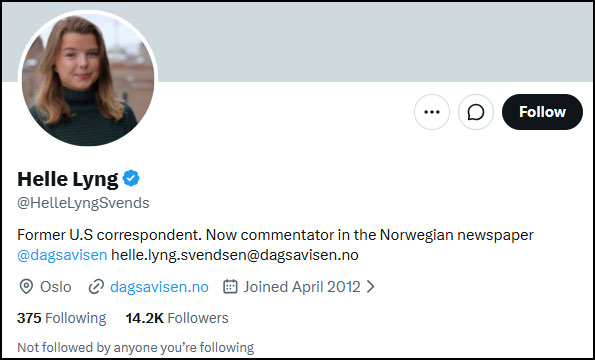
On 18th May (local time), a Norwegian “journalist”, Helle Lyng, went viral on social media after she claimed that Prime Minister Narendra Modi “refused” to answer her questions on “human rights violations” in India. Helle Lyng, who is associated with a lesser-known media house, Dagsavisen, had only 800+ followers, and her social media handle on X was fairly dead, with the last post from April 2024, before she heckled PM Modi and proudly posted about it.
Source: X

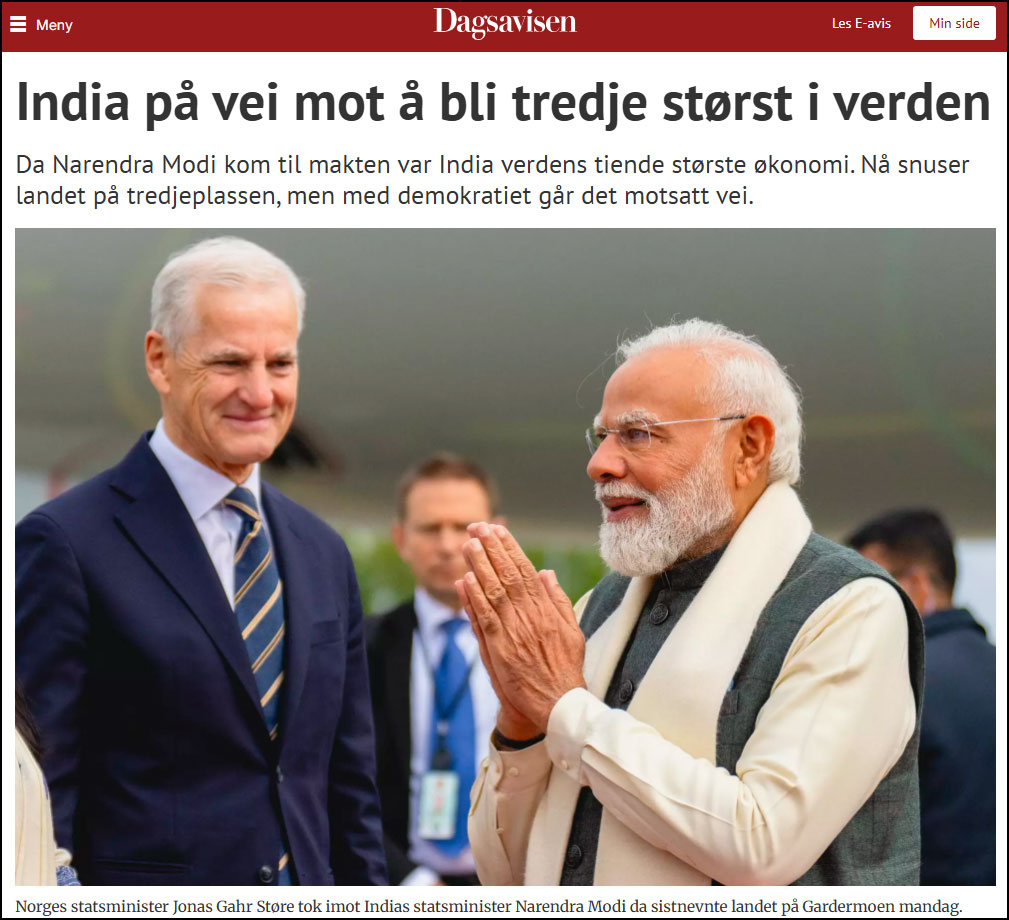
Within hours, Helle reached over 14,000 followers, and the opposition and left-liberals cheered her across X. Notably, the media house she is associated with has not posted on X since 22nd January this year. However, they are quite active on Facebook, where the video was posted. The publication has also published an article targeting India, suggesting that while India’s economy will soon secure 3rd place in the world, its democracy is “declining”.

The newspaper, which has been active since 1975, published a report by journalist Kenneth Lia Solberg on PM Modi’s Norway visit. In the report, initially, Solberg talked about how India is growing, but halfway through, the report took the path of criticising India’s democratic record under Prime Minister Narendra Modi.

In his report, Solberg claimed that while India’s economy has grown rapidly, its democracy has weakened. He cited V Dem’s Liberal Democracy Index to claim that India’s democratic level has fallen to its lowest since 1950.
Source: dagsavisen

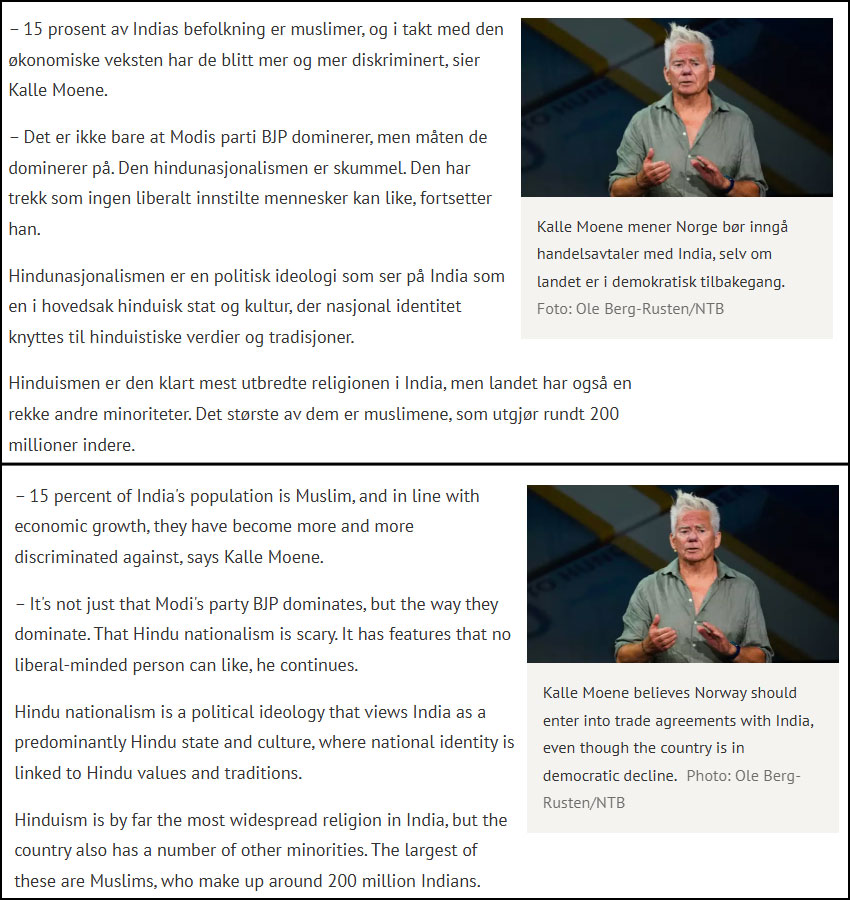
The report also criticised BJP’s dominance in Indian politics and “Hindutva politics”, calling Hindu nationalism “scary”. He argued that Muslims, who form around 15% of India’s population, have faced increasing discrimination, a fake claim that has been spearheaded by international and local anti-India actors since PM Modi took charge of the office for the first time in 2014.
Source: dagsavisen

He further argued that Norway should not ignore these concerns while signing trade agreements with India, even if such deals benefit both countries.

The report written by Solberg is on the same lines as Lyng’s questions. First of all, it was not a press briefing but a joint statement. Both the Indian and Norwegian Prime Ministers were not supposed to take questions. There was a panel of Ministry of External Affairs officials who took the questions later.

As PM Modi was leaving the podium after making the statement, she asked, “Prime Minister Modi, why don’t you take some questions from the freest press of the world?” PM Modi did not answer and walked away with his counterpart. This was exactly what Lyng was hoping for. She said, “Prime Minister of India, Narendra Modi, would not take my question. I was not expecting him to.”

And just like that, a new “hero” for the Indian left-liberal gang was born in Norway. When we looked at her “following” list on X, some handles caught the eye, including The Wire, Shivangi Deshwal of The Wire, propagandist posing as journalist Rana Ayyub, and Laura Loomer, the infamous US-based anti-India journalist. In fact, Leader of Opposition Rahul Gandhi has shared the video. In a post on X, he wrote, “When there is nothing to hide, there is nothing to fear. What happens to India’s image when the world sees a compromised PM panic and run from a few questions?”
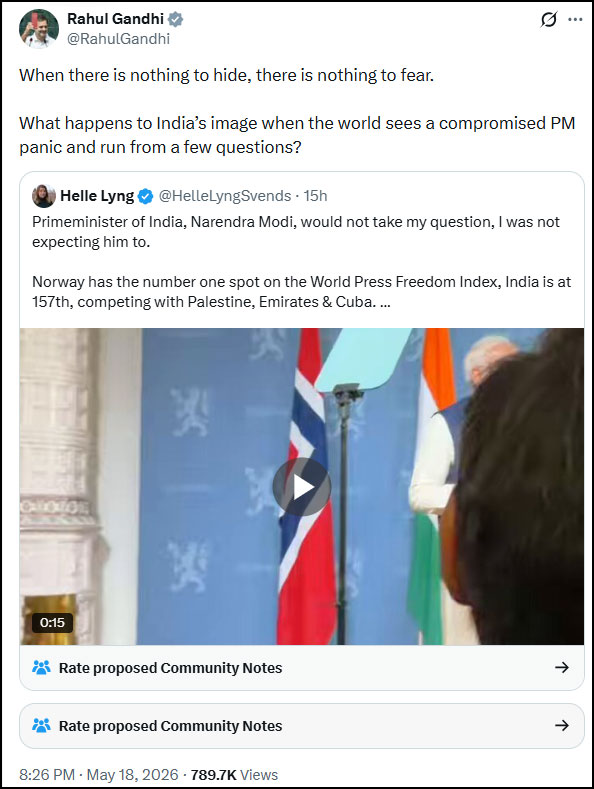
Source: X

Sinsing the oppurtunity, she sought time from Gandhii for a telephonic interview.

Ironically, the statement came from a leader whose only reply to uncomfortable questions is, “Are you a BJP-planted journalist?” In 2024, he almost got a journalist lynched for asking an uncomfortable question during his flagship politically motivated project, “Bharat Jodo Yatra”.

Apart from Gandhi, several other opposition leaders, propagandist YouTubers, fake historians, fake news peddlers and left-liberals jumped to support the Norwegian journalist as they were able to target PM Modi while doing so.

Rana Ayyub wrote, “Indian democracy on display as Prime Minister Modi visits Norway”.

TMC MP Mahua Moitra said Norwegian media exposed what “GodiMedia” cannot, adding that Modi should learn the ways of free societies.
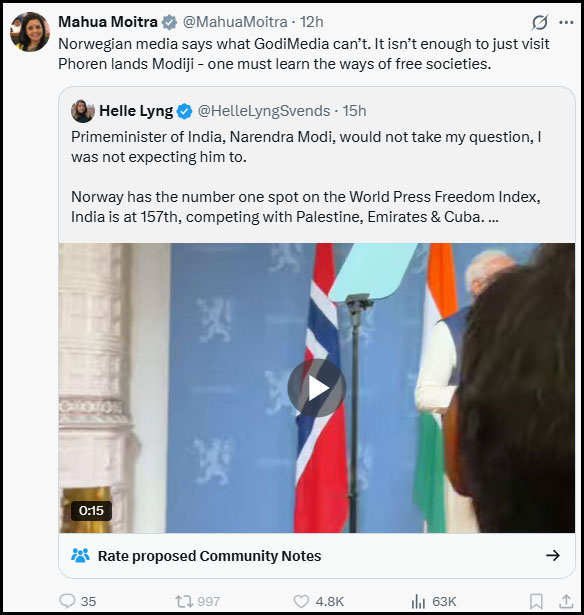
Source: X

TMC MP Sagarika Ghose mocked PM Modi by saying, “No questions please. We are the Vishwaguru.”
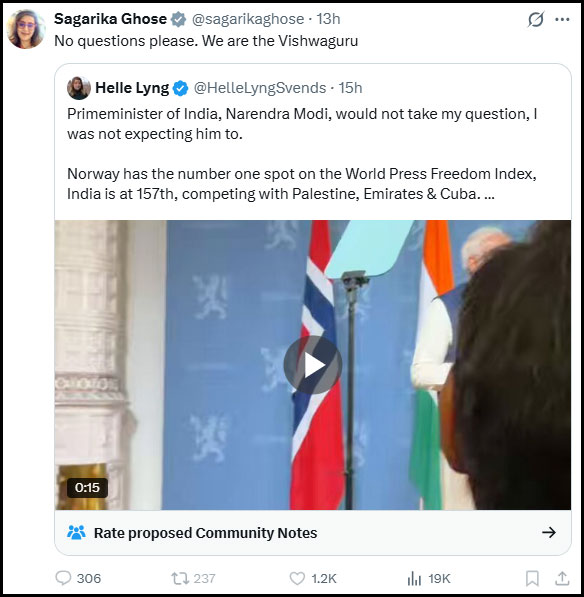
Source: X

Raju Parulekar said it reflects poorly on India that its PM cannot take questions from the world’s freest press.
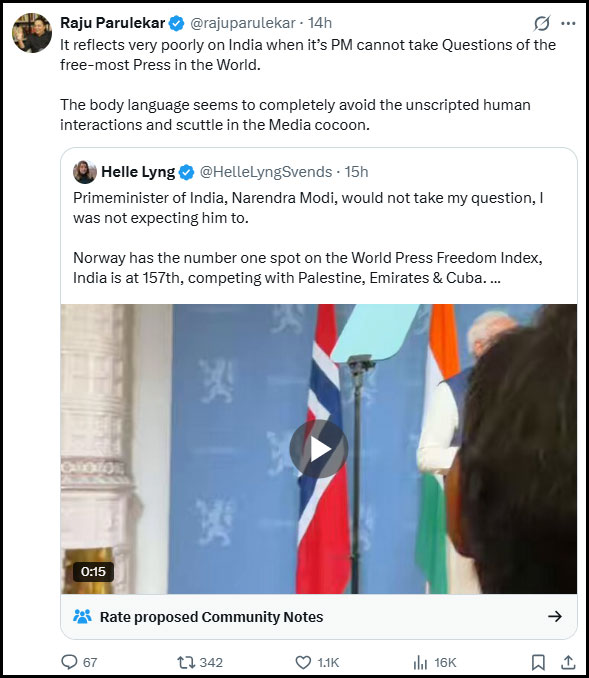
Source: X

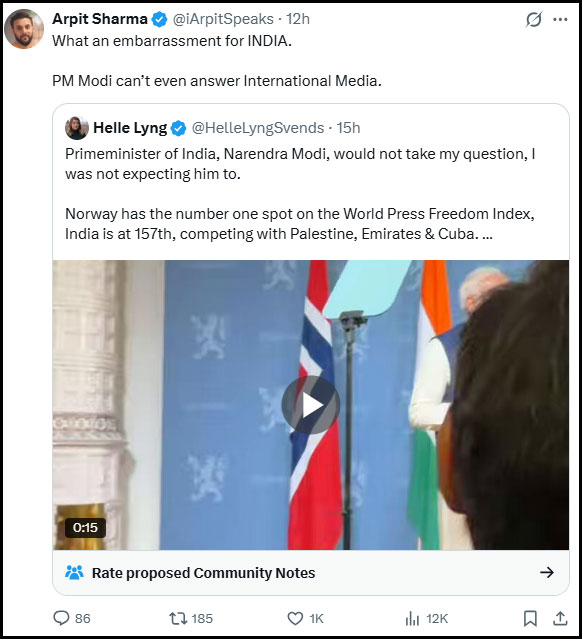
Propagandist YouTuber Arpit Sharma called it an embarrassment for India and said PM Modi could not even answer international media.
Source: X

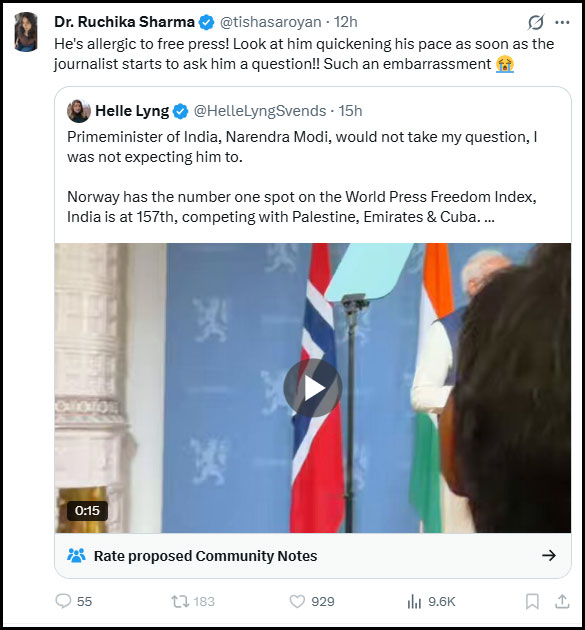
Fake historian Dr Ruchika Sharma claimed PM Modi was “allergic to free press” and quickened his pace when the journalist asked a question.
Source: X

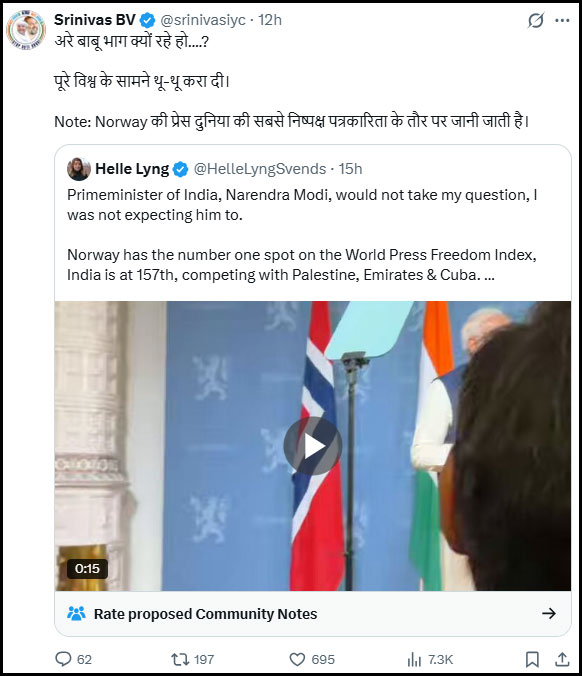
Congress leader Srinivas BV mocked PM Modi in Hindi, saying he was asking for votes abroad but got embarrassed before the world.
Source: X

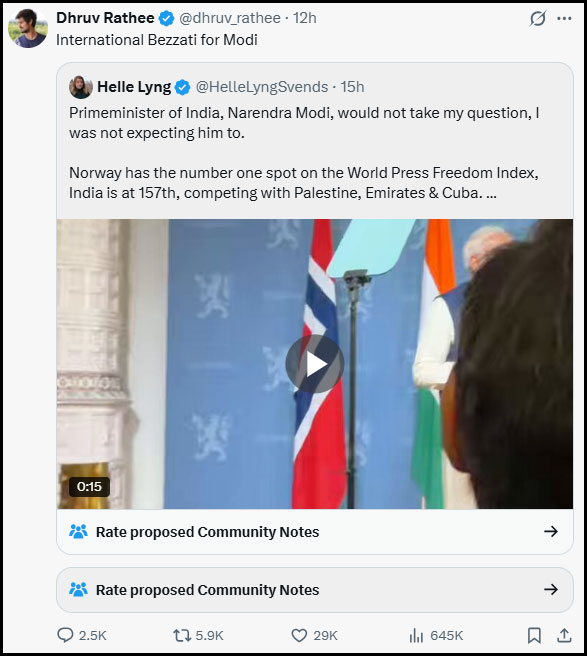
Fake news peddler posing as YouTuber Dhruv Rathee called it “international bezzati” for Modi.
Source: X

Propagandist posing as fact checker and Alt News co-founder Mohammed Zubair mocked the incident by saying ANI will not be present everywhere.
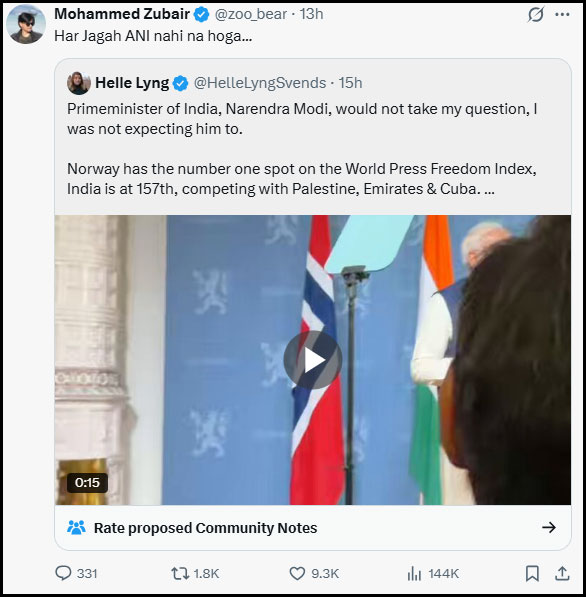
Source: X

When we checked Lyng’s authored articles on Muck Rack, we found that since January 2025, she has mentioned India only once in her articles when US President Trump threatened India with high tariffs. Furthermore, while her hate for Trump is visible in her reports, it seems she has a soft cornor for China. It is evident that her coverage has never been about India.
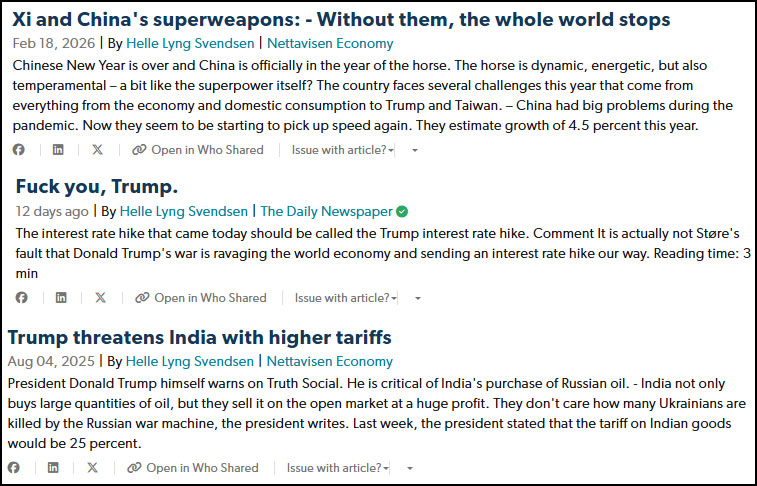
Source: Muck Rack

Suspected coordination with The Hindu

While Lyng hackled PM Modi, The Hindu journalist Suhasini Haider did the same with Norwegian Prime Minister Jonas Gahr Store. Interestingly, while Suhasini shared Lyng’s video, Lyng did the same for Haider.
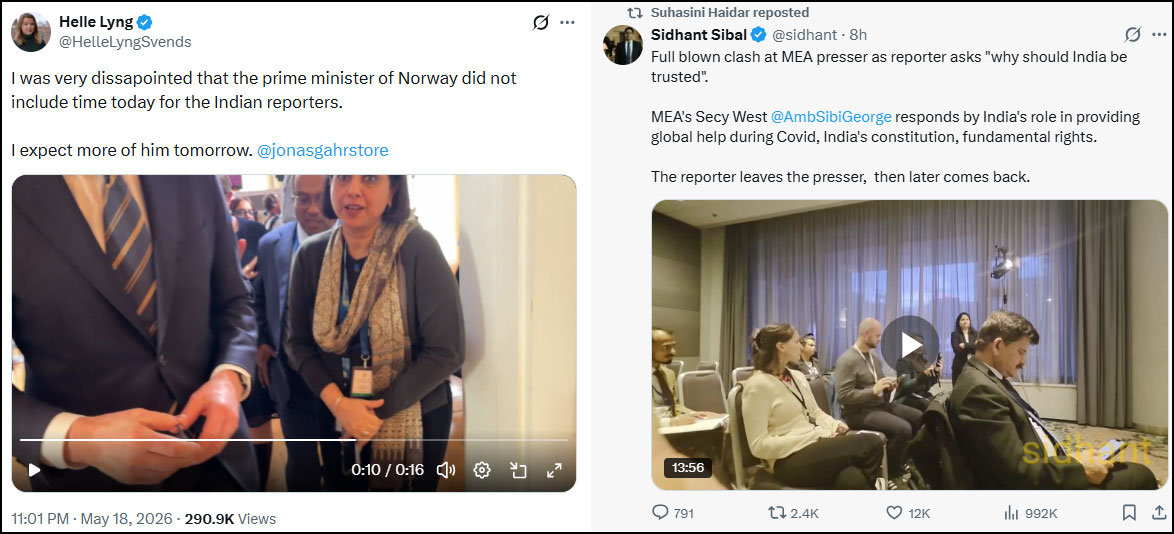
Source: X

Questions over timing and sudden focus on India

When we looked at the previous reports published by the media house Lyng works for, and her own body of work, India did not appear to be a major area of focus. There were some routine reports related to India, including earthquakes, Donald Trump imposing tariffs on India, and similar developments, but deep analytical pieces on India, its democracy, or its internal political landscape were largely missing. This makes the sudden moral grandstanding over India’s democracy and press freedom look less like routine journalistic interest and more like a pointed intervention timed around PM Modi’s visit.

The pattern raises questions over whether the episode was organic or a planned attempt to create an anti-Modi and anti-India spectacle on foreign soil. The fact that Lyng tried to frame PM Modi’s refusal to answer a shouted question after a joint statement as a press freedom issue only adds to the suspicion that the objective was not to seek an answer, but to manufacture a viral moment that could be used to tarnish India’s image internationally.

Another interesting detail is Lyng’s X profile, which clearly states that she has been verified since May 2026. This means she purchased X Premium very recently. The timing is notable because verified accounts generally receive better visibility on X and also create an impression of authenticity before a wider audience. In this context, her newly acquired verification, the sudden viral push, and the enthusiastic amplification by India’s left-liberal ecosystem together make the entire episode look far more calculated than accidental.
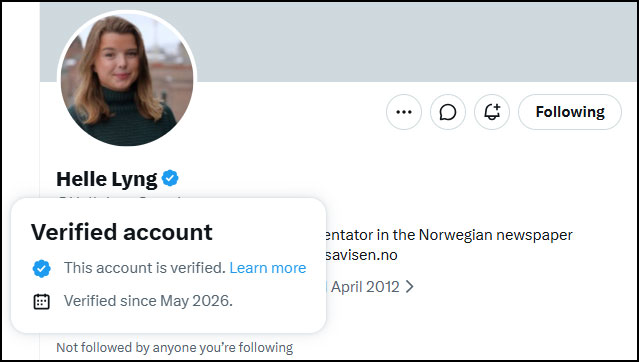
Source: X

When MEA schooled Helle Lyng

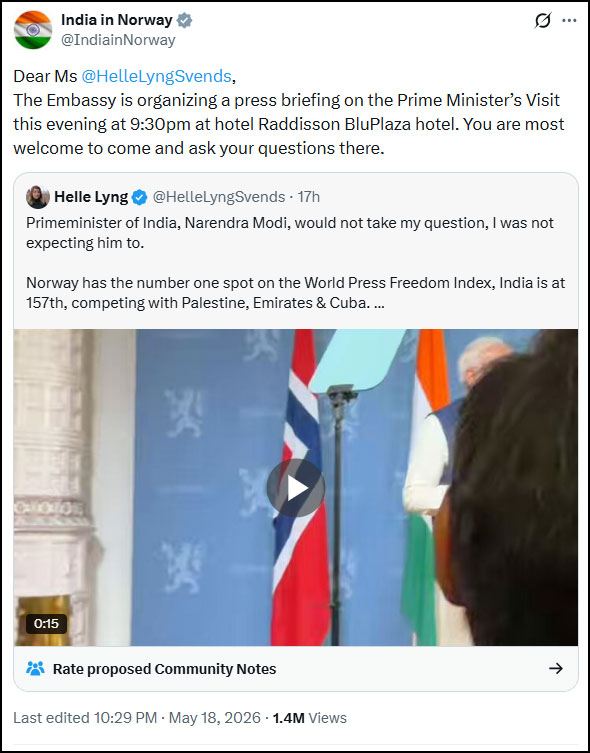
Indian Embassy in Norway quoted Lyng and informed her about press meet that was scheduled later that day. The Embassy wrote, “The Embassy is organizing a press briefing on the Prime Minister’s Visit this evening at 9:30pm at hotel Raddisson BluPlaza hotel. You are most welcome to come and ask your questions there.” Lyng was present at the press briefing and did what was expected from her.
During the briefing, she again tried to turn the interaction into a spectacle, this time in front of Indian officials. Introducing herself as a journalist from Dagsavisen, she asked why India should be trusted as Norway strengthens its partnership with New Delhi. She then clubbed it with loaded questions on alleged human rights violations and whether PM Modi would take “critical questions” from the Indian press.

However, instead of letting the question become another performative attack, Secretary in the Ministry of External Affairs Sibi George calmly took charge. When Lyng tried to interrupt him and demanded that he answer “straight away”, George firmly reminded her that she had asked a question and he had the right to answer it properly. “You asked me a question, let me answer it,” he said. As she continued to interrupt, George schooled her again, saying, “Please don’t interrupt me. You asked me a question. Please. This is my press conference.”

George then answered her first question, on why the world should trust India, by invoking India’s civilisational legacy and its contribution to humanity. “We are proud that we are a civilisational country of 5,000 years old. Continuous civilisation. Contributed immensely to the world,” he said, adding that concepts like zero, chess and yoga originated in India.

When Lyng again tried to force him to answer in her preferred format, George pushed back without losing his composure. “When to answer, where to answer, how to answer, these are my prerogatives. You asked a question. Don’t ask me to answer in a particular way. Let me answer,” he said. He then cited India’s conduct during Covid, saying India did not “hide in the cave” but came forward to help the world. “We supplied vaccines to more than 100 countries. That brings trust. We supplied medicines to 150 countries. That brings trust,” he said.

George also cited India’s role during its G20 presidency, pointing out that India brought a divided world together and secured the Delhi declaration. He also highlighted India’s efforts to bring the concerns of the Global South to the main table and the inclusion of the African Union as a permanent member of the G20. “This brings trust to the table because we were able to get the aspirations and challenges of the entire African continent, which was ignored, brought to the main table of G20,” he said.

On human rights and democracy, George said India is based on a Constitution that guarantees justice, liberty, equality and dignity to its citizens. “India is the largest democracy in the world,” he said, adding that nearly one billion people participated in the last general elections. He said every citizen in India has fundamental rights and the right to approach courts if those rights are violated.

Taking a dig at those who form opinions on India through selective reports, George said many people have no understanding of India’s scale. “People read one or two news reports published by some godforsaken ignorant NGOs and then come and ask questions. Don’t worry about it. We are proud to be a democracy,” he said.

By the time George moved to India’s constitutional framework and democratic traditions, Lyng had reportedly left the room. In the end, her attempt to heckle Indian officials ended with a detailed, firm and unapologetic response from the MEA Secretary, who made it clear that India would not allow a loaded question to be passed off as journalism.

Conclusion

The entire episode shows how a routine diplomatic visit was turned into a manufactured controversy by a journalist whose recent work had hardly shown any serious focus on India. Lyng was not denied a chance to ask questions. She was publicly invited by the Indian Embassy to attend the press briefing, where she got the opportunity to ask whatever she wanted. However, instead of engaging seriously with the answers, she repeatedly interrupted Indian officials and tried to dictate how they should respond.

What followed exposed the hollowness of the viral outrage. PM Modi had not walked away from a press conference. He had left after a joint statement where questions were not scheduled. The actual press interaction happened later, and MEA Secretary Sibi George answered the same line of questioning in detail, from India’s democratic structure and constitutional guarantees to its global role during Covid, G20, Global South outreach, and support for the African Union.

Yet, the Indian left liberal ecosystem picked only the staged moment and used it to attack PM Modi and India. The sudden rise of Lyng’s profile, her recent X verification, her publication’s anti India framing, and the instant amplification by Congress leaders, TMC MPs, propagandists and fake news peddlers suggest that this was less about journalism and more about creating a viral anti India spectacle on foreign soil.
‘Desecrating Ganga could hurt religious sentiments of Hindus’: What Allahabad HC said while granting bail to Muslim youths in Varanasi iftar case. Details inside

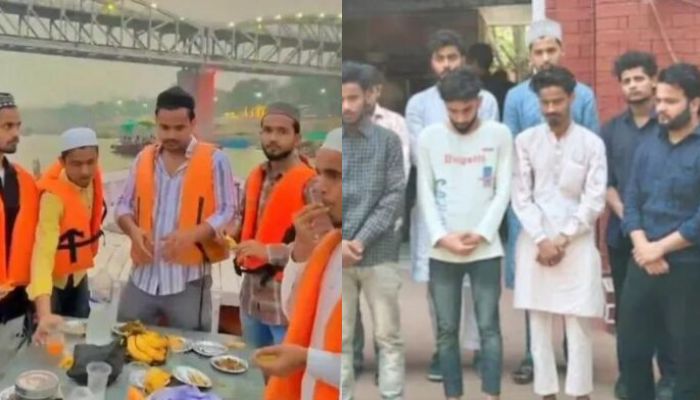
In the case involving several Muslim men throwing leftover chicken biryani into the Ganga in Varanasi after their Iftar party, the Allahabad High Court said on 15th May 2026, that throwing non-vegetarian food in the Ganga can hurt Hindu religious sentiments.

While hearing the bail application of the 14 accused Muslim youths, Justice Rajiv Lochan Shukla said that throwing non-veg food remains into the Ganga River “hurt religious sentiments of the Hindu community.”

The court, however, granted bail to five of the accused Muslim men on the ground of the petitioners and their families expressed remorse over their egregious act. Those who have been granted bail include Mohammed Azad Ali, Mohammed Tahseem, Nihal Afridi, Mohammed Tauseef Ahmad and Mohammed Anas.

Arguments presented by the counsel representing the Muslim accused and Advocate General Anoop Trivedi

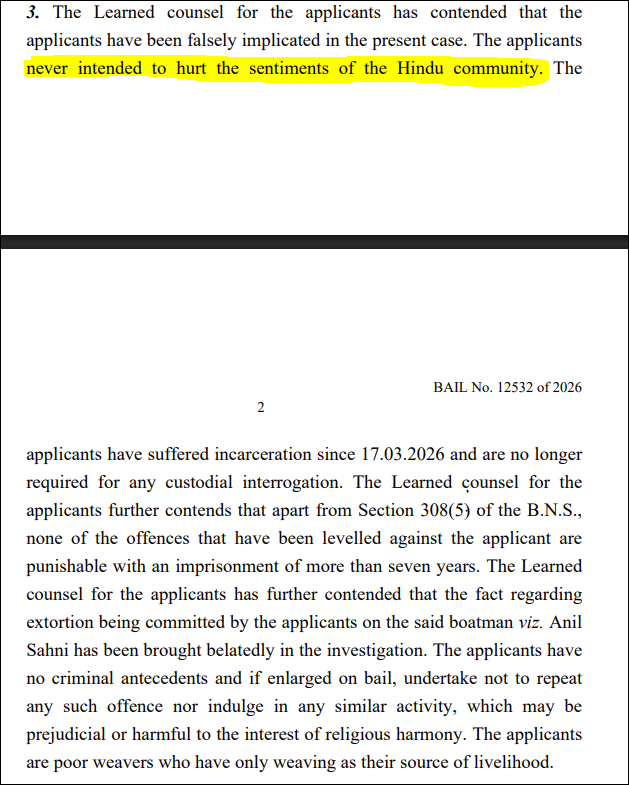
Appearing for the accused Muslim youth, advocate Raghuvansh Mishra claimed that his clients have been “falsely implicated” and that they “never intended to hurt the sentiments of the Hindu community.”

It was further contended that the accused persons have been incarcerated and are no longer required for custodial interrogation.

Moreover, advocate Mishra argued that other than Section 308(5) of the B.N.S., none of the offences that have been levelled against the applicant are punishable with an imprisonment of more than seven years. It was also argued that the Additional Advocate General, Anoop Trivedi, brought up the Muslim accused extorted money from boatman Anil Sahni angle belatedly in the probe.

“The applicants have no criminal antecedents and if enlarged on bail, undertake not to repeat any such offence nor indulge in any similar activity, which may be prejudicial or harmful to the interest of religious harmony. The applicants are poor weavers who have only weaving as their source of livelihood,” the advocate representing the accused persons said.

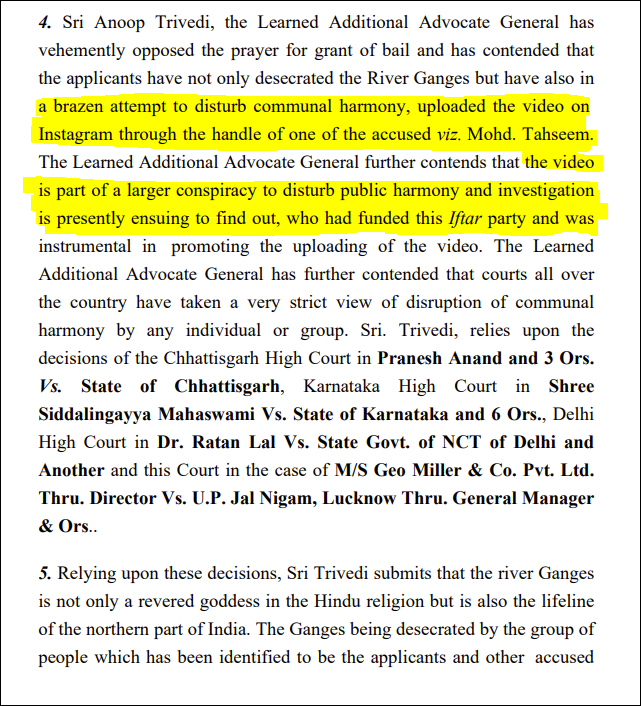
Meanwhile, Advocate General Anoop Trivedi, appearing for the State, strongly opposed the bail plea and argued that the Muslim accused have “not only desecrated the River Ganges but has also in a brazen attempt to disturb communal harmony, uploaded the video on Instagram through the handle of one of the accused viz. Mohd. Tahseem.”

Trivedi argued that the circulation of the video on social media was a deliberate act, a part of a larger conspiracy. “The video is part of a larger conspiracy to disturb public harmony, and an investigation is presently ensuing to find out who funded this Iftar party and was instrumental in promoting the uploading of the video,” he said.

Advocate Trivedi also emphasised the Hindu religious but also the national life-giving significance of the Ganga River.  Trivedi submitted, “The Ganges being desecrated by the group of people, which has been identified to be the applicants and other accused, has hurt the sentiments of the country at large and not only the Hindu community and has also created a serious situation of public order.”

The Allahabad High Court observations after hearing the bail plea of the Muslim accused,who threw remains of non-veg food in the Ganga River

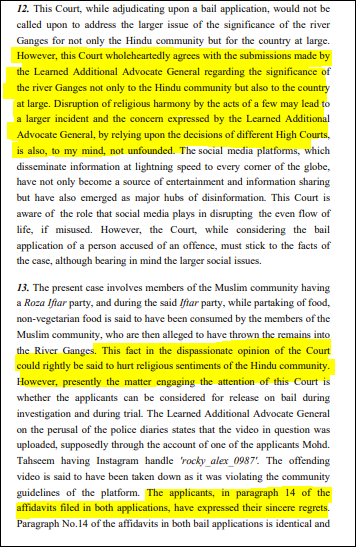
After taking note of the arguments presented by both sides, the Court said that it will not address the larger issue of the religious and national significance of the Ganga River. However, the court agreed “wholeheartedly” with advocate Trivedi’s points about the importance of the holy river and that the act as committed by the Muslim accused may disrupt communal harmony and snowball into a larger incident.

“…This Court wholeheartedly agrees with the submissions made by the Learned Additional Advocate General regarding the significance of the river Ganges not only to the Hindu community but also to the country at large. Disruption of religious harmony by the acts of a few may lead to a larger incident, and the concern expressed by the Learned Additional Advocate General, by relying upon the decisions of different High Courts, is also, to my mind, not unfounded,” the court observed, adding that social media has also emerged as a major hub of disinformation.

Addressing the issue of Muslim youth doing Iftar party on a boat on the holy Ganga River and throwing bones, Justice Rajiv Lochan Shukla said that such an act is hurtful to the sentiments of the Hindu community.

“The present case involves members of the Muslim community having a Roza Iftar party, and during the said Iftar party, while partaking of food, non-vegetarian food is said to have been consumed by the members of the Muslim community, who are then alleged to have thrown the remains into the River Ganges. This fact in the dispassionate opinion of the Court could rightly be said to hurt religious sentiments of the Hindu community,” the court said.

The court further stated that the video of accused Muslim youth throwing non-veg food leftovers in the Ganga River was uploaded on Instagram by one of the accused, Mohammed Tahseem, was taken down for violating the social media platform’s community guidelines. The court also noted that the accused persons have expressed regret over their act in their affidavits.

“That the perusal of the first information report affirm and reaffirm that no offence is constituted under the alleged sections but without admitting the applicants and their family most sincerely regrets and feels pain of what has been alleged against them in view of the society at large,” the affidavits filed by the petitioners read.

In view of the apparent remorse expressed by the incarcerated Muslim men, the court opined that the regret expressed in the affidavits filed by the counsels of the accused on their behalf does not come across as an attempt to simply escape the punishment of the law.

The court highlighted that the incarcerated Muslim men have been booked under sections 298, 299, 196(1)(b), 270, 279, 223(b) & 24 B.N.S. and Section 24 of the Water (Prevention and Control of Pollution) Act, 1974, none of which carry punishment for more than seven years.

Justice Shukla also sees the story of boatman Anil Sahni through a lens of suspicion since the allegations of the accused persons threatening him Sahni were added later.

Pertinently, however, the court stated that the investigation into the Iftar party, the offensive video and the alleged conspiracy to stoke communal tensions can continue.

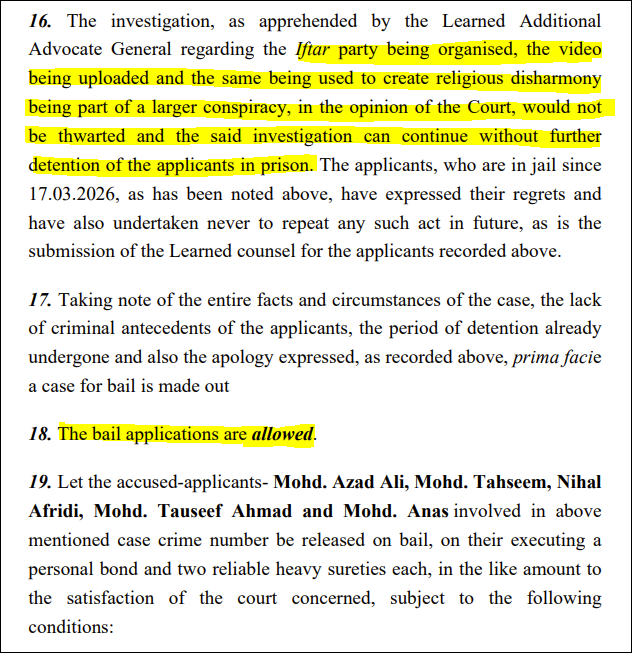
“The investigation, as apprehended by the Learned Additional Advocate General regarding the Iftar party being organised, the video being uploaded and the same being used to create religious disharmony being part of a larger conspiracy, in the opinion of the Court, would not be thwarted and the said investigation can continue without further detention of the applicants in prison. The applicants, who are in jail since 17.03.2026, as has been noted above, have expressed their regrets and have also undertaken never to repeat any such act in future, as is the submission of the Learned counsel for the applicants recorded above,” the court said, noting that five of the accused persons don’t have any criminal antecedents.

“Taking note of the entire facts and circumstances of the case, the lack of criminal antecedents of the applicants, the period of detention already undergone and also the apology expressed, as recorded above, prima facie a case for bail is made out. The bail applications are allowed,” the court ruled.

The court also made it clear that the observations made in this matter are “exclusively for deciding the instant bail application and are not to be considered to be an opinion on the merits of the case.”

In a separate order passed on 15th May, Justice Jitendra Kumar granted bail to other accused persons, Mohammad Sameer, Mohammad Ahmad Raza and Mohammad Faizan. The decision came in the wake of the accused Muslim youths assuring not to repeat such anti-Hindu acts in the future.

“The applicants have been languishing in jail since 17.03.2026 and they have undertaken to file affidavit before the learned Court concerned and the concerned police station that they will not indulge in/repeat similar activities in future,” the court said, adding that the accused will furnish a bond of Rs 50,000 each along with two sureties under bail bond procedure.

Ganga sacrilege and Muslim victimhood

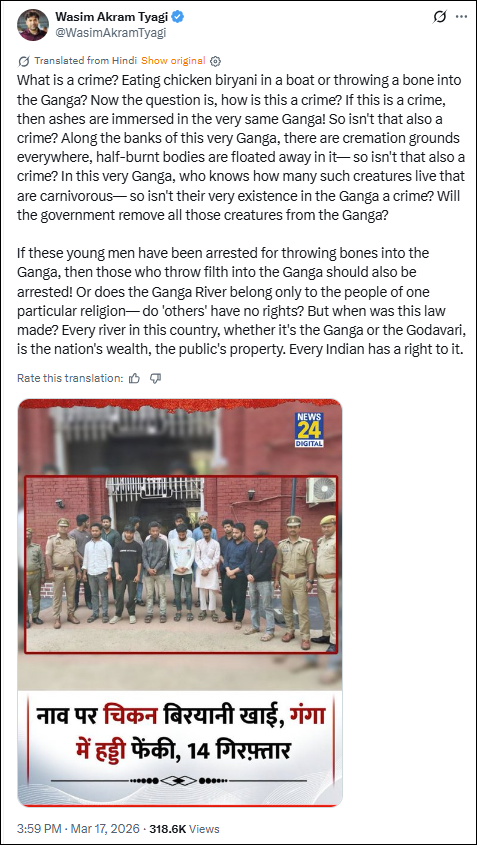
On 17th March, 14 Muslim youths were arrested for throwing leftover chicken biryani into the Ganga in Varanasi after their Iftar party, not very far from the Bindu Madhav Temple. The arrest came after outrage erupted on social media over the video of the incident uploaded on Instagram by one of the accused, Mohammed Tahseem. As Hindus outraged on social media, a case was soon registered based on the complaint lodged by the Bharatiya Janata Yuva Morcha (BJYM) Varanasi president, Rajat Jaiswal.

 On 16th March, a Muslim youth arranged a Roza Iftar party and invited people. Dry fruits and chicken biryani were served during the party. The video shows people eating together from a vessel.

Rajat Jaiswal stated in his complaint that people ate chicken biryani and threw the bones into the sacred Ganga River, hurting religious sentiments. He further said that this has hurt the sentiments of Sanatanis and that young people in the Muslim community are deliberately promoting a jihadist mindset.

After the controversy, Varanasi boat operators formulated new rules, and the BJP government in Uttar Pradesh announced that it would launch a dedicated online portal for boat operators.

A repetitive but interesting aspect of this entire episode was the Muslim victimhood propaganda peddled by the usual suspects in media, in politics and on social media. Congress leaders like Supriya Shrinate were quick to defend the Muslim youths who threw chewed bones in the Ganga River.

Islamist commentators, notorious for peddling fake news to further the Muslim victimhood bogey, also attempted to whitewash the anti-Hindu act of the accused persons. Some even went to the extent of invalidating the Hindu community’s outrage over Muslim throwing bones in the Ganga, claiming that even Hindus immerse the ashes of their deceased in the sacred river.

They shamelessly equated the throwing of chewed bones by Muslim men in the river Hindus worship as mother, with the act of immersing ashes of the deceased Hindus.

Islamist Wasim Akram Tyagi had posted on X, “What is a crime? Eating chicken biryani in a boat or throwing a bone into the Ganga? Now the question is, how is this a crime? If this is a crime, then ashes are immersed in the very same Ganga! So isn’t that also a crime? Along the banks of this very Ganga, there are cremation grounds everywhere, half-burnt bodies are floated away in it— so isn’t that also a crime? In this very Ganga, who knows how many such creatures live that are carnivorous— so isn’t their very existence in the Ganga a crime? Will the government remove all those creatures from the Ganga?”

Wasim Tyagi and many other such Islamists deliberately downplayed the significance of immersing ashes of the deceased in the Ganga River to justify the sacrilege committed by the accused.  As described in the Garuda Purana, immersing the remains after cremation is believed to help the departed soul attain moksha, heaven, or Brahmaloka. Since the Ganga is considered to have descended from the heavens, it is believed to liberate ancestral souls and break the cycle of rebirth.

Many even argued that the Ganga is not a Hindu-exclusive river and that Muslims too are equally allowed to use its waters, take a boat ride, have an Iftar party and throw non-veg food leftovers in the river, since their religion does not consider the Ganga River as sacred. However, if by the same logic, a Hindu or any non-Muslim goes inside a mosque and consumes pork there, especially during Ramzan, will that be acceptable since, unlike Muslims, pork is not considered haram by Kafirs?

OpIndia had reported earlier about leftist rag The Wire platforming a Delhi-based writer, translator and researcher, Rakhshanda Jalil, to secularise the Ganga River, in pursuit of whitewashing the sacrilege of the holy river by the Muslim youths. The article claimed that the Ganga River belongs to all faiths since many Muslim poets wrote couplets in the praise of the river’s scenic beauty. However, not one piece of poetry the article cited revered Ganga as Mother or Devi, the divine, as Hindus do.

Now, when the Allahabad High Court has said that throwing bones and other non-veg food leftovers in the sacred Ganga River can hurt Hindu religious sentiments, the same Islamo-leftist cabal is selectively highlighting only the Muslim accused getting bail part.

How did Imran Khan go from the chosen leader to the fallen prisoner? The cypher, regime change, and establishment that is controlled by the US

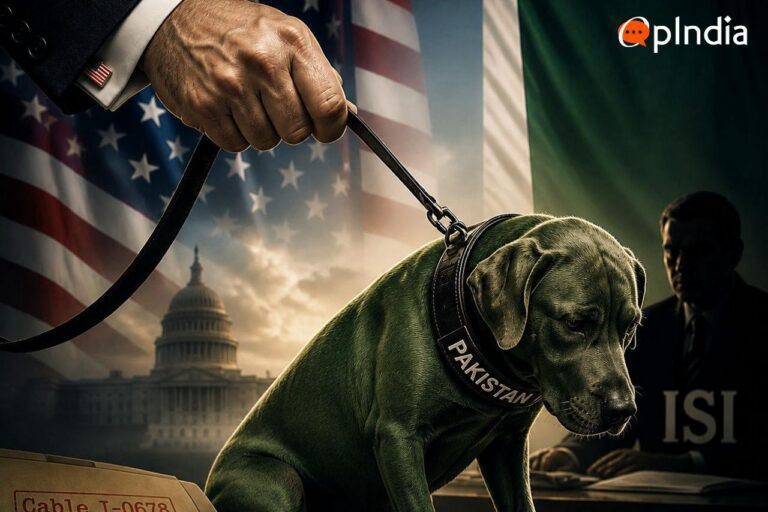
The full, original text of Pakistani diplomatic cable I-0678, the classified document at the centre of one of the most significant political disputes in Pakistan’s contemporary history, was released on May 17, 2026, by the investigative publication Drop Site News. For four years, the cable had been debated, cited, waved at demonstrations, prosecuted, and rejected. At last, it was out.

Asad Majeed Khan, Pakistan’s ambassador to Washington at the time, and Donald Lu, the US Assistant Secretary of State for South and Central Asian Affairs, met on March 7, 2022, according to the cypher, as it is known in Pakistan. According to the communication, Lu stated unequivocally that a parliamentary no-confidence vote to oust Prime Minister Imran Khan from office would significantly improve Pakistan’s relations with the United States and Europe. Lu reportedly declared, ‘All will be forgiven.’ The ambassador of Pakistan, who wrote the cable, stated in his evaluation that Lu could not have made such a direct declaration without the express approval of the White House.

An encrypted cable that is sent between a nation’s foreign embassies and its home government is known as a diplomatic cipher. It is a confidential conduit for private conversations that diplomats are confident will never be seen. Pakistan has been on fire for the past four years due to this.

A long-running debate has been rekindled by the release: was Imran Khan’s removal from office in April 2022 a genuine act of parliamentary democracy, or was it a planned departure shaped by a combination of Washington’s disapproval, Pakistan’s military establishment withdrawing its support, and an opposition coalition being given the go-ahead to relocate? There is no clear answer to that question provided by the cypher. Understanding the cypher requires understanding the system that created it. To understand the system, you must go back even further to another prime minister who, with some reason, believed he had been set up to fail.
The man before: Nawaz and the pattern

Nawaz Sharif served as prime minister three times. He was more familiar with Pakistan’s establishment, the formidable network of military and intelligence agencies known as ‘the establishment’ in Pakistani political jargon, than anybody else. He was also aware that it may turn on you.

The Supreme Court of Pakistan disqualified Sharif in 2017 after the Panama Papers revealed links between his family and offshore accounts. The ‘sadiq and ameen‘ clause of the constitution, which mandates that elected officials be trustworthy and honest, served as the legal mechanism. Both supporters and critics pointed out that the clause had never been applied so quickly and that institutional pressure was evident in the speed of the court procedures. Sharif’s description of what he called a judicial-military nexus working against him was supported by enough reliable sources, including those in the legal community, that it could not be completely disregarded.

By the time Sharif departed for London in 2019, supposedly for medical care, he had established himself as a pillar of luxurious exile. From a home that was more Mayfair than miserable, he went to meetings, conducted interviews, and maintained his political influence. His future rehabilitation was already being prepared for by Pakistan’s political system, which permits the controlled comeback of fallen leaders. The Brookings Institution, writing in 2023, would remark that the groundwork was being laid for Sharif’s comeback as the establishment’s next preferred choice, with his convictions being overturned with strange efficiency.

However, the establishment required a fresh face in 2017. Someone fresh, charismatic, and, hopefully, manageable. In cricket whites, they found their man.

Imran Khan: The chosen one

The path of Imran Khan’s political career is one of slow change that took longer than anyone anticipated. The 1992 world cricket champion, who was idealistic, principled, and routinely disregarded by the electorate, was a marginal character in Pakistani politics for more than 20 years. The Movement for Justice, or Pakistan Tehreek-e-Insaf (PTI), which he founded in 1996, won barely anything for years.

Then, in 2011, a huge PTI protest at Lahore’s Minar-e-Pakistan, a place rich in national significance, appeared out of nowhere with hundreds of thousands joining it. Suddenly, the Pakistani diaspora, young professionals, and urban middle class, who had grown up witnessing the nation’s elder parties exchange power and embezzle money, had their own candidate. In a way that traditional politicians could not match, Khan’s anti-corruption discourse and his story of ‘Naya Pakistan’, a new Pakistan, cut through.

The establishment’s involvement in enabling this rise was less openly declared, although it was well understood by political watchers. The tables were turned, as Brookings observed prior to the 2018 election, in a near mirror image of what would eventually happen to Khan himself. Khan was the preferred candidate, as Sharif was embroiled in legal issues. Election engineering, or what Pakistanis refer to as pre-poll rigging, benefitted PTI; rival parties’ candidates were under pressure from cases, and media coverage became unfavourable to the opposition. In the elections held in July 2018, Khan secured the majority and established a coalition government. He was, to put it frankly, ‘the project.’

Khan’s critics argue that he was an army backed invention, a claim that his supporters vehemently deny. The reality is likely more unsettling, Khan had sincere public support, genuine popular appeal, and real policy commitments. At the same time, he was helpful to an establishment that sought a civilian face that wouldn’t interrupt the core structure of military control in Pakistani governance.

The honeymoon and the falling out

From 2018 to around 2020, Khan’s government had an exceptional level of public goodwill between civilian and military officials. Khan and army head General Qamar Javed Bajwa attended public events together, spoke about national unity, and worked closely on policy. The relationship was, in the jargon of Pakistani political science, a ‘hybrid regime,’ civilian in form, with the military in full control of the true levers of power, foreign policy, security, and the constraints within which domestic politics operated.

Imran Khan with Bajwa, image via HT

The cracks started out slowly and then suddenly became visible.

Khan proved to be more difficult to handle than the establishment had thought. He tended to trust a close-knit group of people, personalise decision-making, and reject suggestions he didn’t agree with, especially when it came to appointments. The ISI chief was at the centre of the most important of these conflicts. In October 2021, Khan objected to the army’s selection of Lieutenant General Nadeem Anjum to lead the ISI, a denial that was equal to a civilian government opposing the army’s most sacrosanct institutional right in Pakistani civil-military relations. He eventually yielded, but the harm had been done.

Khan was having trouble managing his finances at the same time. Public unhappiness increased, the rupee declined, and inflation surged. The establishment started to reconsider after essentially funding the political climate that led to Khan’s rise to power. The civil-military collaboration, which had never genuinely been equal, was secretly renegotiated in favour of the army.

The world turns against Imran Khan

Khan’s difficulties were made worse by foreign policy, which ultimately proved to be deadly to his government.

His engagement with Saudi Arabia served as an example of how institutional necessity can conflict with personal belief. Riyadh has traditionally been one of the most influential foreign players in Pakistani politics due to the country’s reliance on Gulf funds for remittances, deposits in the State Bank, and financial assistance during difficult times. Khan’s intuition took a different turn. The Saudi Crown Prince Mohammed bin Salman saw his outspoken declarations of Muslim unity, his advocacy for a more autonomous Pakistani foreign policy, and his attempts to form a parallel axis with Turkey and Malaysia as direct challenges to Riyadh’s leadership of the Islamic world.

In a widely read article, Pakistani analyst Najam Sethi pointed out that General Bajwa had to travel to Riyadh several times to mend the ties that Khan’s statements had upset. According to reports, the Saudis responded by cutting back on financial assistance to Pakistan, making the government’s financial situation even more vulnerable.

Next came Moscow and Ukraine. Vladimir Putin, the president of Russia, declared the invasion of Ukraine on February 24, 2022. Imran Khan was sitting across from Putin in a meeting that had been planned for months at that precise moment while on a state visit to Moscow. The picture was heartbreaking. On the day of Europe’s worst military crisis since World War II, the prime minister of a country heavily dependent on Western assistance was physically present in the Russian capital.
In keeping with his long-standing ‘absolutely not‘ attitude against allowing US military activities on Pakistani territory, Khan presented Pakistan’s stance as principled neutrality, a reluctance to take sides in a conflict between world powers. Donald Lu met with Pakistan’s ambassador in Washington two weeks later, on March 7, 2022, and expressed his thoughts in unusually forthright words for diplomatic standards.
That conversation is documented in the cipher. Pakistan’s stance on Ukraine, according to Lu, is aggressively neutral, if such a position is even possible. According to the cable, he made it clear that Imran Khan was directly responsible for this position and that ties would greatly improve if the upcoming no-confidence vote was successful. In his own evaluation, Pakistan’s envoy expressed concern that such a strong demarche would not have been possible without White House consent. It appeared that the establishment had been closely monitoring the sentiment in the West. Once the inconvenient citizen had been dismissed, the realignment could commence.

The mechanics of a managed departure

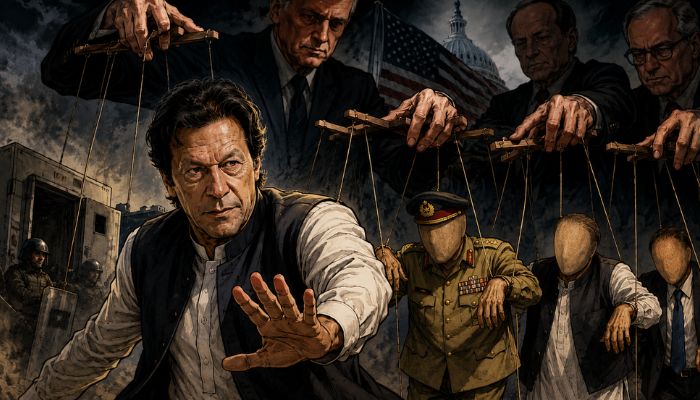
Prime Ministers are no longer removed by the establishment using tanks, at least not publicly. The machinery is more subdued, a whispered message to a prominent opposition figure, the removal of media protection, an abrupt release of the judiciary’s schedule, and a coalition of opposition parties that, until recently, could hardly stand to be in the same room finding a sudden unity of purpose.

That machinery turned against Khan at the beginning of 2022. A no-confidence resolution was introduced in parliament by the Pakistan Democratic Movement, a coalition of parties that included the Pakistan Peoples Party and Nawaz Sharif’s PML-N. Khan’s attempts to postpone the hearings were thwarted when the Supreme Court stepped in to make sure the process could not be stopped. The vote of no confidence was approved on April 10, 2022. A parliamentary vote of no confidence had toppled a prime minister for the first time in Pakistani history. The constitutional procedure was strictly adhered to.

Khan had known what was about to happen. Just two weeks prior to his departure, on March 27, 2022, he took a piece of paper out of his jacket pocket while standing in front of a sizable rally in Islamabad. He informed the assembly that the cypher demonstrated a foreign plot to have him removed. He waved it, quoted from it, and used it as the foundation for his whole future political story. A few days later, the National Security Committee, which he chaired, deemed the US meddling ‘blatant’ and ‘unacceptable under any circumstances.’

Just weeks later, the same committee reconvened under new Prime Minister Shehbaz Sharif and quietly reversed the assessment. The second committee came to the conclusion that although meddling had occurred, there was no proof of a conspiracy. Depending on who was chairing the session, the army chiefs who attended both meetings seemed to have come to different conclusions regarding the same document.

From project to prisoner

The establishment had not anticipated the months that followed Khan’s dismissal. Rather than withdrawing into opposition and waiting for his time, Khan took to the streets, something they hadn’t planned on. He attracted huge crowds to his rallies. His story, which claimed that Washington’s pressure and the army’s betrayal, using the old corrupt parties as tools, had removed him, struck a chord with millions of Pakistanis who were also witnessing the return of the same old faces to power and the decline of their purchasing power due to inflation. Surprisingly, he was more well-liked when he wasn’t in office. 

The state responded in a deliberate and intensifying manner. In the midst of spectacular chaos at an Islamabad courthouse in May 2023, Khan was arrested. In what became known as May 9, his supporters stormed military facilities and took to the streets. Senior PTI leaders either vanished into intimidated quiet, swapped sides, or were imprisoned. In the Toshakhana case, a corruption case involving the misappropriation of public gifts, Khan was found guilty in August 2023 and given a three-year sentence. As more cases accumulated, he stayed behind bars. In the Al-Qadir Trust case, he and his spouse, Bushra Bibi, were sentenced to 14 years in January 2025. In June 2024, the Islamabad High Court overturned the cypher case that had jailed him and former foreign minister Shah Mahmood Qureshi for ten years in prison.

The irony has not escaped the notice of onlookers. Khan was charged, in part, for disclosing the cypher, which, according to a secret ISI report acquired by The Intercept, his own intelligence agency privately assessed could not have jeopardised Pakistani national security in any technically serious way. The ISI’s own experts pointed out that the encryption key was never in danger. It was political in nature. General Asim Munir became army head and was later promoted to the rank of Field Marshal, an award previously held only by Ayub Khan. Munir had been briefly designated ISI chief under Khan before Khan attempted to remove him, an event that many feel sowed the roots of personal animosity. Pakistan’s military was solidifying its status as the only unchallenged judge of the nation’s political future.

The cypher returns, and so does the question

There is a way for the planet to come full circle. Drop Site News revealed cable I-0678 in its entirety in May 2026, just as Pakistan’s military regime was enjoying widespread recognition for mediating between the US and Iran during a risky escalation in the Gulf. The timing was perfect. Donald Trump referred to Pakistan’s army head as ‘my favourite Field Marshal‘. According to the cypher, Pakistan had effectively reintegrated into the American strategic orbit, which was exactly what Washington had desired from the moment it resisted Khan’s visit to Moscow.

The key question has been raised once more by the cipher’s complete disclosure. Were the statements made in it, such as ‘all will be forgiven’ and the clear connection between Khan’s dismissal and better bilateral ties, proof of American meddling in Pakistan’s domestic affairs? Or were they simply commonplace statements of diplomatic dissatisfaction, misinterpreted and politically weaponised?

Both statements may have some truth to them. It was evident that the US had a strong preference. Donald Lu seemed to be going above his brief, according to his own ambassador interlocutor, who expressed diplomatic unease. However, it is not the same as plotting a coup when a foreign power expresses its preferences. For a variety of factors, including the disagreement over ISI appointments, tensions with Saudi Arabia, poor economic management, and the growing animosity between Khan and the generals, Pakistan’s army made its own decision. On the scale, the cypher represented one weight. Another was the calculations made by the establishment itself.

The cypher does, beyond a reasonable doubt, prove that Khan’s narrative, that external pressure and internal military pullout united to push him out, was not manufactured. It was based on documents. His opponents used a law prohibiting the disclosure of state secrets to make it illegal to describe what the state had gone through, and they spent two years prosecuting him for simply saying the same thing.

The permanent cycle

Pakistan’s democratic future has always been a victim of this cycle. The cypher leak serves as a reminder that the system it describes is not a bug, regardless of whether you think it indicates a foreign conspiracy, institutional betrayal, or both. The military has historically operated in a geopolitical setting where influential external actors have an interest in who holds office in Islamabad, and civilian governments have long existed in Pakistan at the expense of the military. The complete architecture of the previous episode is now evident, which is what sets this moment apart. Everything is documented, including the leaked cable, the army’s confidential evaluations, the reversals of post-ouster policy, and the rehabilitation of defeated opponents.

Pakistan has a long history of elevating its leaders to high positions before carefully removing them. Its system has never been able to provide a persuasive explanation to the question of whether it will ever be able to create a system that does neither, where governments are chosen by popular vote rather than by decisions made in secrecy. Cable I-0678, the cypher, is unable to provide an answer. Even though it was published four years later and caused political inconvenience for nearly everyone, it at least guarantees that the question cannot be evaded. That might be the highest level of accountability accomplished in Pakistan, showing up just in time to expose the crime, but arriving too late to save anyone.

PM Modi’s Netherlands visit secures Dutch expertise for Gujarat’s Kalpasar Project: Read how the iconic Afsluitdijk Dam inspires the plan in Gulf of Khambhat

Prime Minister Narendra Modi’s visit to the Netherlands has emerged as one of the most significant chapters of his ongoing five-nation Europe and West Asia tour. After visiting the UAE, PM Modi travelled to the Netherlands, where his visit concluded on Sunday, 17th May. The visit, held at the invitation of Dutch Prime Minister Rob Jetten, became remarkable because India and the Netherlands elevated their ties to a full-fledged “Strategic Partnership.”

During the visit, both countries announced 17 major outcomes covering sectors such as semiconductors, defence, agriculture, education, water management and cultural cooperation. However, among all the agreements and announcements, one development stood out for its long-term importance to India’s water security and climate planning: the Dutch decision to support Gujarat’s ambitious Kalpasar Project.

Dutch expertise for Gujarat’s mega water project 

One of the biggest highlights of the entire diplomatic visit was the signing of a momentous Letter of Intent (LoI) between the two nations. This agreement directly brings world-class Dutch hydraulic engineering expertise to Gujarat’s highly ambitious Kalpasar Project. 

Signed formally between India’s Ministry of Jal Shakti and the Netherlands’ Ministry of Infrastructure and Water Management, the LoI establishes a framework for technical cooperation focused on coastal and water engineering. This collaboration is set to significantly strengthen India’s regional water security.

The Kalpasar Project is one of India’s most ambitious proposed water infrastructure plans. It aims to build a massive dam across the Gulf of Khambhat to create a giant freshwater reservoir. Dutch experts will assist India in areas such as tidal management, salinity control, delta engineering and coastal water infrastructure.

This cooperation deal between both countries is significant because the Netherlands is one of the countries in the world that is acknowledged as having immense expertise in water engineering and flood management. Around 26% to 30% of the Netherlands sits below sea level. Being located beneath sea level, the Dutch engineers have devised innovative methods for controlling floods, saltwater intrusion, and freshwater reserves.

PM Modi visits the iconic Afsluitdijk Dam

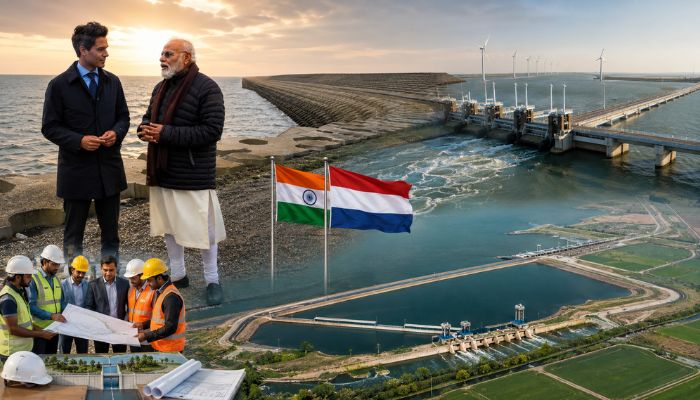
During his visit to the Netherlands, PM Modi also travelled to the famous Afsluitdijk dam along with Prime Minister Rob Jetten. The visit attracted major attention because the Afsluitdijk project is considered one of the greatest examples of modern water engineering in the world.

The visit was not just symbolic. According to the Ministry of External Affairs (MEA), the Afsluitdijk project has direct relevance to Gujarat’s Kalpasar Project because both involve large-scale coastal engineering, freshwater storage and flood protection systems.

Sharing his experience on X, PM Modi highlighted the importance of Dutch expertise in water management.

“An area in which the Netherlands has done pioneering work is water management. The entire international community can learn a great deal from this. This morning, I had the chance to visit the Afsluitdijk and gain insight into the key features of this project. I am grateful to Prime Minister Rob Jetten for accompanying me here. We are committed to bringing modern technology to India, designed to assist with irrigation, flood protection, and the expansion of the inland waterway network,” PM Modi said.

MEA spokesperson Randhir Jaiswal also described the visit as an important moment for future India-Netherlands cooperation.

“A symbol of engineering excellence and innovation! Accompanied by PM Rob Jetten of the Netherlands, PM Narendra Modi visited the iconic Afsluitdijk Dam, a symbol of Dutch excellence in water management, flood protection and freshwater storage. The visit highlighted the relevance of Dutch expertise for India’s Kalpasar Project in Gujarat, which aims to create a freshwater reservoir and dam near the Gulf of Khambhat,” Jaiswal posted on X.

Kalpasar is inspired by a similar Dutch engineering success

The broader idea behind PM Modi’s visit to the Afsluitdijk was clear: India wants to learn from Dutch expertise while planning the Kalpasar Project.

There are many similarities between Gujarat’s proposed project and the Dutch dam. Both involve dealing with seawater, tidal movements, freshwater storage and coastal engineering challenges. The Netherlands has already spent decades solving many of the same technical issues that India could face during the Kalpasar project.

This is why Dutch technical support is seen as highly valuable for Gujarat. Experts believe the Netherlands’ experience in managing massive coastal water systems can help India avoid costly engineering and environmental mistakes in the future.

Why the Afsluitdijk Dam matters

The Afsluitdijk is one of the Netherlands’ most famous engineering achievements and has played a central role in the country’s long battle against flooding and seawater intrusion.

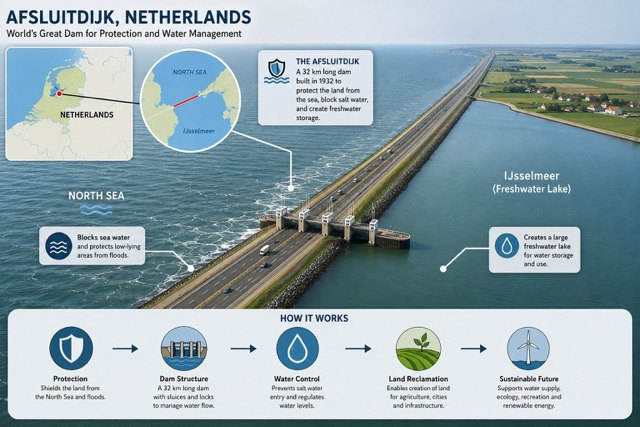
The 32-kilometre-long barrier dam was originally completed around 80 years ago. It separates the North Sea from the IJsselmeer freshwater lake and protects large parts of the low-lying Netherlands from severe floods.

But the project is not just about flood defence. The Afsluitdijk also supports freshwater storage, transport connectivity, navigation and renewable energy generation. Today, the Netherlands is modernising the structure through a massive “Afsluitdijk 2.0” programme designed to prepare the country for future climate challenges.

The upgraded project is being redesigned to withstand storms expected only once every 10,000 years. It includes stronger locks, advanced water discharge systems, fish migration corridors and renewable energy technologies using tidal flows, solar energy and wind power.

Dutch authorities estimate the modernisation project will cost around €800 million.

The Afsluitdijk has also become an example of how modern infrastructure can serve multiple purposes at once: flood control, freshwater security, climate resilience, transport, tourism and renewable energy.

What is the Kalpasar Project?

The Kalpasar Project has been discussed in Gujarat since the 1970s and is considered one of India’s most ambitious long-term water infrastructure proposals.

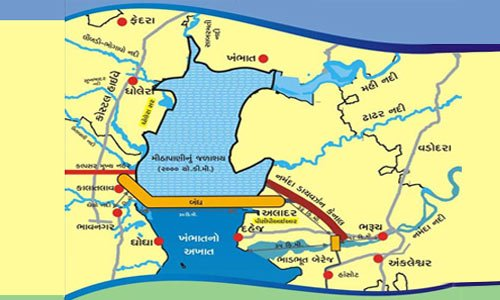
Map via Desh Gujarat

The idea first emerged in 1975 when the Gulf of Khambhat was identified as a possible location for tidal energy generation. Over time, the project expanded into a much larger plan focused on freshwater storage, flood control, irrigation and transport connectivity.

The original idea is to create a new freshwater reservoir by building a dam between Bhavnagar and Bharuch in the Gulf of Khambhat in Gujarat, and stop the inflow of seawater into the Gulf. This project will connect Saurashtra and South Gujarat.

The revised plan has three major components.

The first is the main Kalpasar dam that would connect the Bhavnagar district to the Bharuch district across the Gulf of Khambhat.

The second is the Bhadbhut barrage on the Narmada River near Bharuch. Its purpose is to prevent seawater intrusion and divert freshwater into the reservoir system.

The third component is a massive canal network that would distribute water across Saurashtra and nearby regions.

The project’s estimated cost has now risen to around ₹85,000-90,000 crore. If the project receives final approval and is found technically and environmentally feasible, experts estimate that construction alone could take between 12 and 15 years. The full project timeline could stretch close to two decades.

Water, irrigation and transport benefits

The Kalpasar Project is being planned as a multi-purpose infrastructure system.

The biggest objective is freshwater storage. Water flowing from rivers into the Gulf of Khambhat would be stored before entering the sea. This could help reduce water shortages in Bhavnagar and large parts of Saurashtra. The stored water could also support Kutch and other drought-prone regions currently dependent on the Narmada Canal system.

Apart from drinking water, the project is expected to improve irrigation for agriculture across Saurashtra and South Gujarat.

Another major benefit would be flood control. By regulating water flow more efficiently, authorities believe the project could reduce flood risks in nearby regions.

The project also proposes building a massive 10-lane transport corridor on top of the dam. This could sharply reduce travel distance between Bhavnagar and Bharuch, directly connecting Saurashtra with South Gujarat and improving trade and logistics.

Climate change and the future of water infrastructure 

PM Modi’s visit to the Afsluitdijk also reflects a much larger global conversation around climate change and water security.

Across the world, rising sea levels, unpredictable monsoons, glacier melt, prolonged droughts and extreme rainfall are forcing governments to rethink traditional infrastructure systems.

India faces a particularly difficult challenge because some regions suffer from severe floods while others struggle with water scarcity at the same time.

Projects like Kalpasar are part of a new approach focused on long-term climate resilience. But such mega-projects also raise difficult environmental, ecological and financial questions.

The Dutch model demonstrates that future infrastructure systems may need to combine flood defence, freshwater storage, renewable energy, transport connectivity and environmental management together instead of treating them separately.

PM Modi’s visit secures critical International support

At present, the Kalpasar Project is still in the planning stage. The Gujarat government recently informed the assembly that the Detailed Project Report (DPR) is being finalised. After that, it will require approval from both the state and central governments.

According to officials, around 43 technical studies have been commissioned for the project, with over 25 already completed.

This is where PM Modi’s Netherlands visit becomes strategically important. By securing Dutch cooperation, India now has access to some of the world’s best expertise in coastal engineering, flood protection and freshwater reservoir planning.

The Netherlands has already dealt with many of the same geographical and engineering challenges that Kalpasar may face. Dutch support could therefore play a major role in improving the project’s design, environmental safeguards and long-term sustainability.

India’s interest in the Dutch model is not only about engineering expertise. It is also about preparing for a future where climate resilience, water security and sustainable infrastructure may become some of the most important pillars of national development planning.

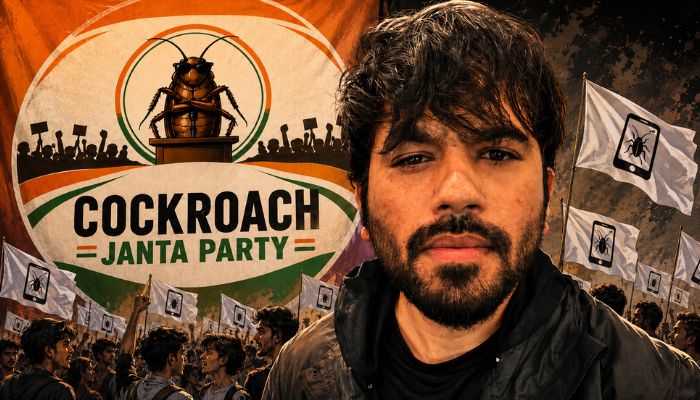
From spreading misinformation about CAA, Farmers Protest, elections and more: Who is the AAP ‘social media team lead’ who has started the ‘Cockroach Janta Party’, mocking CJI’s comments about people like him

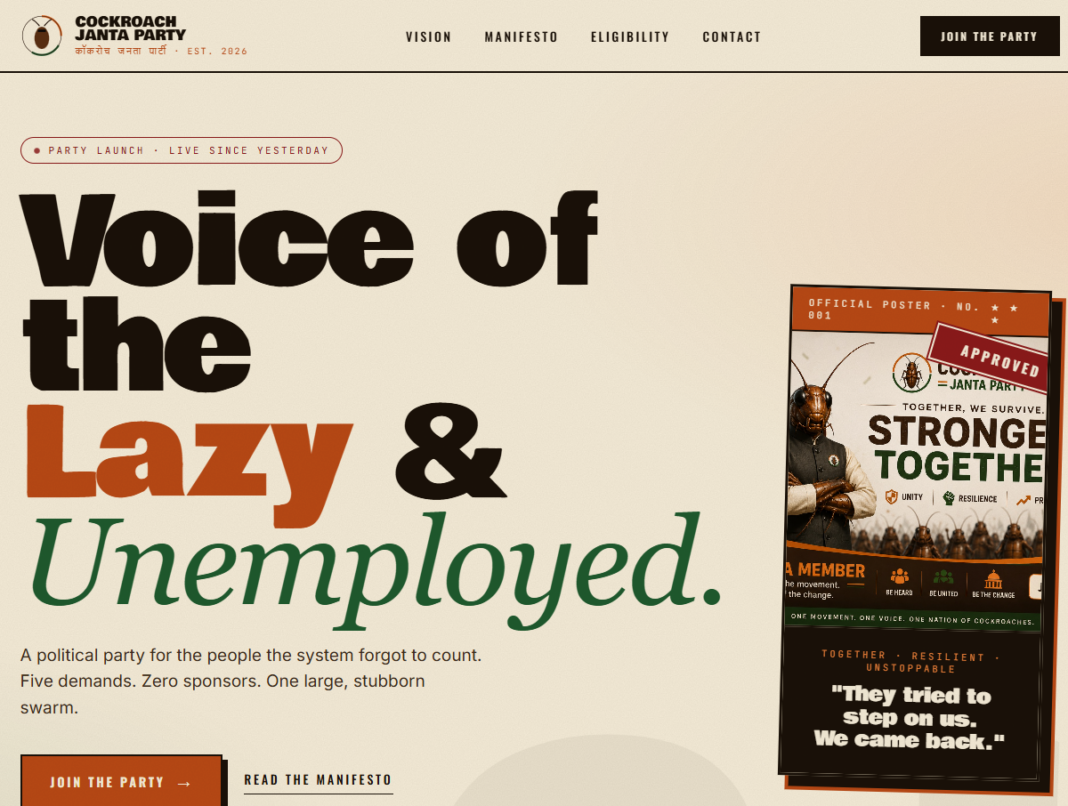
Recently, Chief Justice of India Surya Kant’s courtroom remarks about jobless youth, lawyers, journalists and RTI activists triggered debate on social media platforms. Following mixed reactions, including criticism, CJI clarified that he was not talking about professionals but about those who pose as professionals but have bogus degrees. On the sidelines of his remarks, a new “satirical” political outfit named Cockroach Janta Party has appeared on social media with a functioning website.

Source: CJP

The so-called party has been launched by Abhijeet Dipke, a self-styled political commentator who has served as part of the Aam Aadmi Party’s (AAP) social media machinery. Several media reports from the past have either a member or a team lead in AAP’s social media machinery.

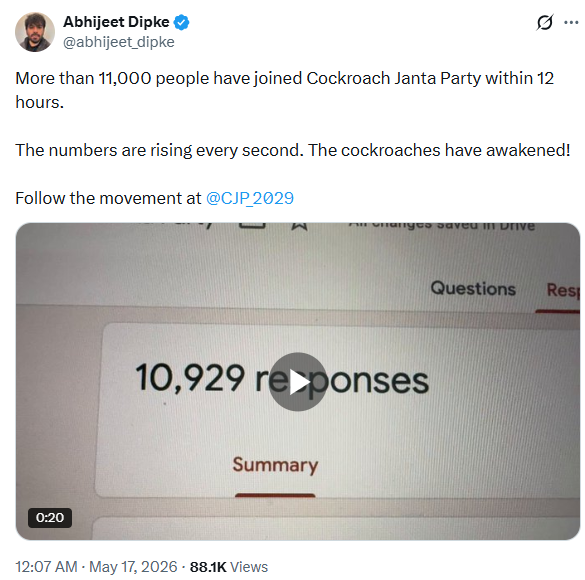
In a social media post, Dipke claimed “The cockroaches have awakened!” as if it is some sort of youth uprising which in itself should raise alarms as both Congress and AAP have tried to invoke Gen Z-led protests in India against the central government just like in neighbouring countries like Nepal. The website of the so-called party says it is “a political party for the people the system forgot to count” and describes itself as the “voice of the lazy and unemployed”. It further says, “They tried to step on us. We came back.”

Source: X

At first glance, Cockroach Janta Party may resemble just another meme page sparked by online outrage. However, examining the founder’s political connections, media coverage, and the party’s manifesto reveals that the satire functions as a pointed extension of persistent anti-BJP, anti-institution, and conspiratorial rhetoric often used by opposition circles.

CJP uses the CJI controversy to launch political satire

The immediate trigger for the CJP was the controversy around the CJI’s remarks in court. He had reportedly referred to certain “jobless” youth entering professions like law, journalism and activism as “cockroaches” and “parasites” attacking the system. After the backlash, he issued a clarification saying he had been misquoted and he was referring to those who entered the profession using bogus degrees.

Dipke used the controversy to launch the satirical political party CJP. The website says the party exists for young people who are called “lazy, chronically online, and most recently, cockroaches”. Its membership criteria include being “unemployed”, “lazy”, “chronically online” and able to “rant professionally”.

Source: CJP

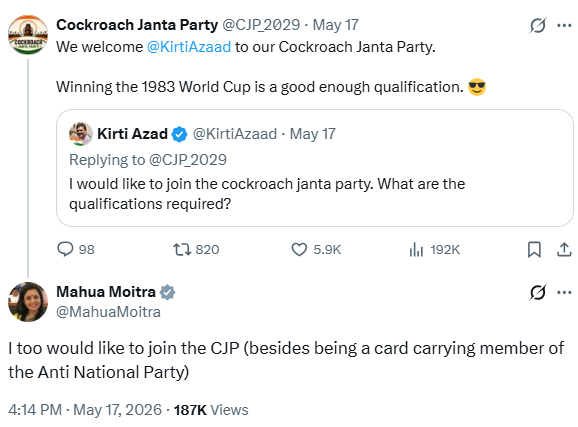
The online stunt also received attention from opposition leaders. TMC MP Kirti Azad jokingly asked what the qualifications were to join the Cockroach Janta Party, to which the CJP handle replied that winning the 1983 World Cup was good enough.

Source: X

TMC leader Mahua Moitra also joined the banter, saying that she too would like to join the CJP, apart from being a “card carrying member of the Anti National Party”.

The tone of CJP is deliberately comic, but the targets are very political.

Manifesto targets judiciary, Election Commission, media and big business

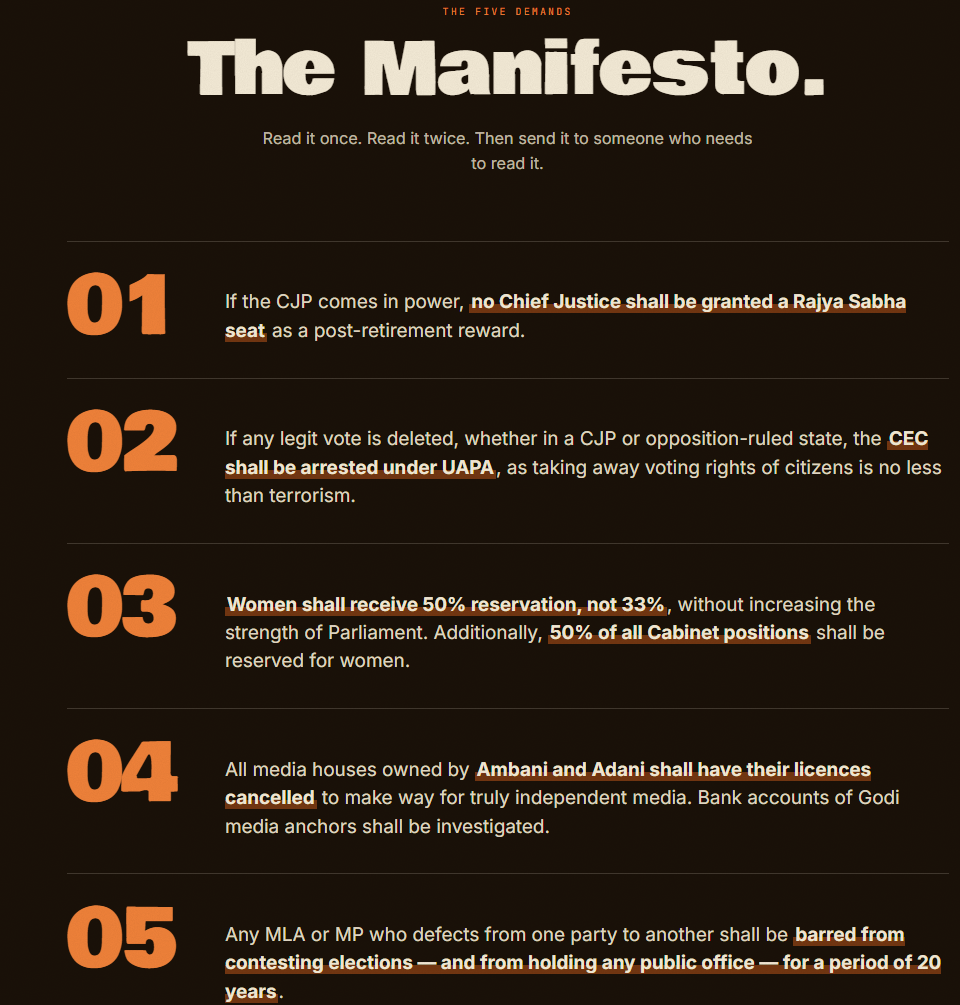
The manifesto of CJP says that if it comes to power, no CJI would be given a Rajya Sabha seat as a post-retirement reward. It also says that if any “legit vote” is deleted, the Chief Election Commissioner should be arrested under UAPA and claimed that taking away voting rights is “no less than terrorism”. It is clearly in line with the propaganda opposition parties including Congress and AAP, have spread in the past few months while targeting Special Intensive Revision (SIR) exercise.

Source: CJP

The manifesto further demands 50% reservation for women in Parliament without increasing the strength of Parliament and 50% reservation for women in all Cabinet positions. This is a direct attack on the scheduled delimitation exercise under the Central Government.

It also calls for cancellation of licences of media houses owned by Ambani and Adani and investigation into the bank accounts of “Godi media anchors”. Again, this is an attack on the BJP government at the Centre by claiming that channels owned by Ambani and Adani are the government’s mouthpieces.

Another demand says that any MLA or MP who defects should be barred from contesting elections and holding public office for 20 years.

Beneath its comedic surface, the platform systematically advances opposition stances—targeting the judiciary, Election Commission, corporate interests, media, and political defectors, thus disguising partisan messaging as satire.

Who is Abhijeet Dipke?

Abhijeet Dipke is not an apolitical, random social media user who suddenly entered public debate after the CJI controversy. He is directly linked to the Aam Aadmi Party’s election and social media campaigns.

During the 2020 Delhi Assembly elections, one media report described him as a 23-year-old from Pune who was behind AAP’s social media transformation. The report said AAP was using catchy one-liners, parody videos, short clips and memes to promote Arvind Kejriwal and attack the BJP and Congress.

Dipke was quoted explaining how political messaging had to be simplified for millennials and first-time voters through memes and videos. The report also stated that he reported to AAP IT media head Ankit Lal.

Another report on the Delhi election meme war identified Dipke as a media studies graduate from Pune who was behind several AAP memes. These memes used Bollywood scenes, edited images and pop culture references to project Kejriwal positively and target political opponents.

Dipke and AAP’s election war room

Dipke’s connection with AAP was also mentioned in reports about the party’s war room. In one such report, he was identified as in charge of national social media coordination for AAP.

The report said AAP’s social media wing was working across war rooms and preparing responses to Prime Minister Narendra Modi’s rally. Dipke was quoted as saying that the hashtag #DelhiWithKejriwal was meant to project Kejriwal as “apna banda” and “hamaara aadmi”.

He also claimed that AAP was focusing heavily on WhatsApp and Facebook and had moderators tracking BJP, Congress and other political handles to counter what the party called “fake news”.

In another report on AAP’s 2020 campaign strategy, Dipke was described as being at the forefront of the party’s meme and parody offensive, which used films, advertisements and social media trends to push “Brand Kejriwal”.

Farmers’ protest and anti-Modi messaging

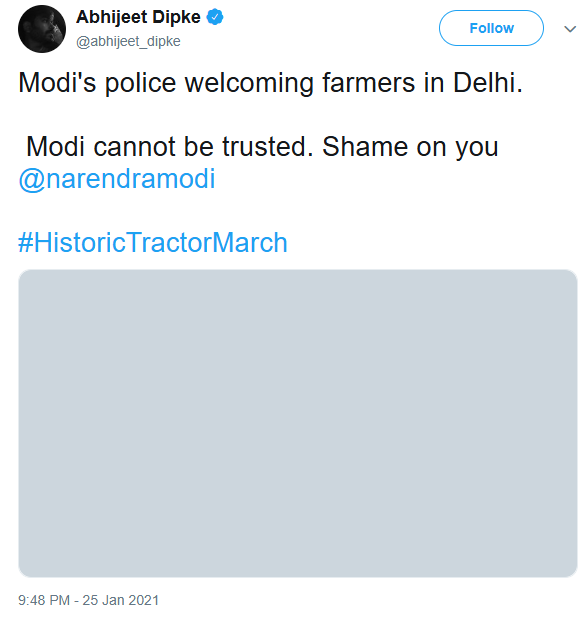
Dipke’s past social media activity also shows a clear political line. During the tractor rally chaos in Delhi, when police used tear gas and lathi charge after protesters broke barricades, Dipke shared videos and photos of the police action and attacked Prime Minister Narendra Modi.

Now-deleted post of Dipke from farmer protests. (Source: WayBackMachine/X)

He wrote, “Modi’s police welcoming farmers in Delhi. Modi cannot be trusted. Shame on you @narendramodi #HistoricTractorMarch.”

This was not neutral commentary. It was political messaging against the Modi government during a volatile protest where several violent incidents were reported.

Election claims and voter deletion narrative

Dipke has also pushed claims around the credibility of election outcomes. In one post, he argued that doubts over election results were rising because the BJP’s popularity had allegedly declined after 2024, but the party continued to win elections. He claimed this would not have been possible without deleting voters across states.

This narrative now appears inside the CJP manifesto, where “vote deletion” is compared to terrorism and the arrest of the CEC under UAPA is demanded. This should be considered as a direct political threat against the Election Commission by someone who is posing as a satirical character.

Therefore, the CJP is not merely mocking one remark made by the CJI. It is also amplifying election-related conspiracy claims that have already been pushed by Dipke and others in the opposition ecosystem.

CJP tries to tap student anger over NEET

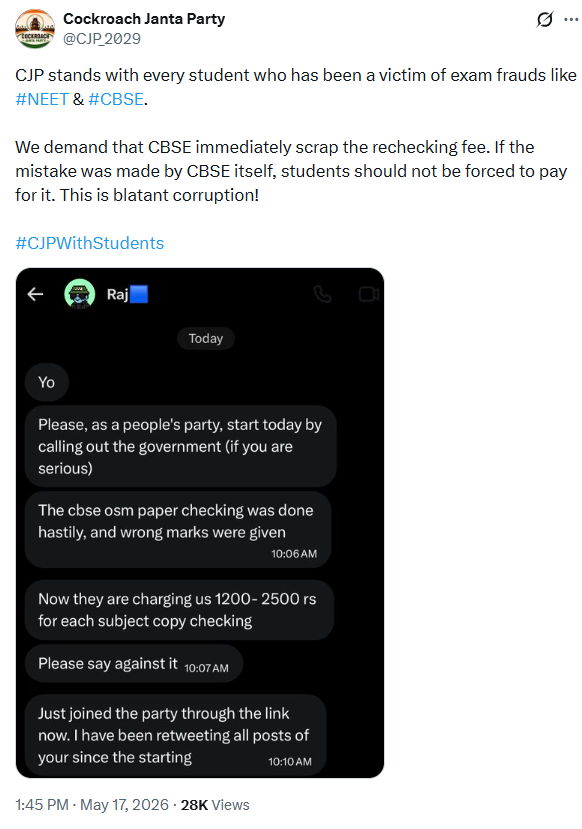
The Cockroach Janta Party has also tried to insert itself into the debate around students and exam fraud. It says it stands with every student who has suffered due to exam fraud like NEET and CBSE. It also demands that CBSE scrap rechecking fees if the mistake was made by the board.

Source: X

This too follows a familiar template. Student anger is being used as a political tool. It must be remembered that Arvind Kejriwal was anyway instigating violence over NEET. Now, a person from the AAP social media ecosystem is trying to repackage student issues under a meme party branding.

A meme party with familiar politics

The Cockroach Janta Party is being sold as satire, but its politics are not difficult to identify. Its founder has been linked to AAP’s social media team and Kejriwal-centred election campaigns. Its manifesto attacks the judiciary, Election Commission, media, corporate houses and opposition targets in language familiar to the anti-BJP ecosystem.

The party may use jokes, memes and “chronically online” humour, but behind the branding lies a familiar political project, one that uses outrage, misinformation and online mobilisation to create the impression of an organic youth uprising.

In reality, the “Cockroach Janta Party” looks less like a spontaneous movement of unemployed youth and more like another digital experiment by an AAP-linked social media operative.

‘Ignored complaints, blamed victim, told her to let go of the accused’: Inside the court order denying bail to TCS POSH Committee member in Nashik forced conversion case

On 15th May (Friday), Additional Sessions Judge V. V. Kathare rejected the bail application of Ashwini Ashok Chainani in relation to the forced conversion and sexual harassment scandal at Tata Consultancy Services (TCS) Business Process Outsourcing (BPO), Nashik in Maharashtra.

The decision was made on the grounds of her negligence in addressing the grave complaints, even though she was a member of the Prevention of Sexual Harassment (POSH) Committee. She was bound by her position to extend help, but instead, she resorted to blaming the victim and pushed her to spare the accused.

Meanwhile, the court had also dismissed bail pleas of accused Asif Ansari, Raza Memon, Tausif Attar and Shahrukh Qureshi.

The informant’s ordeal, continuous torment and Chanani’s flagrant indifference, victim-blaming

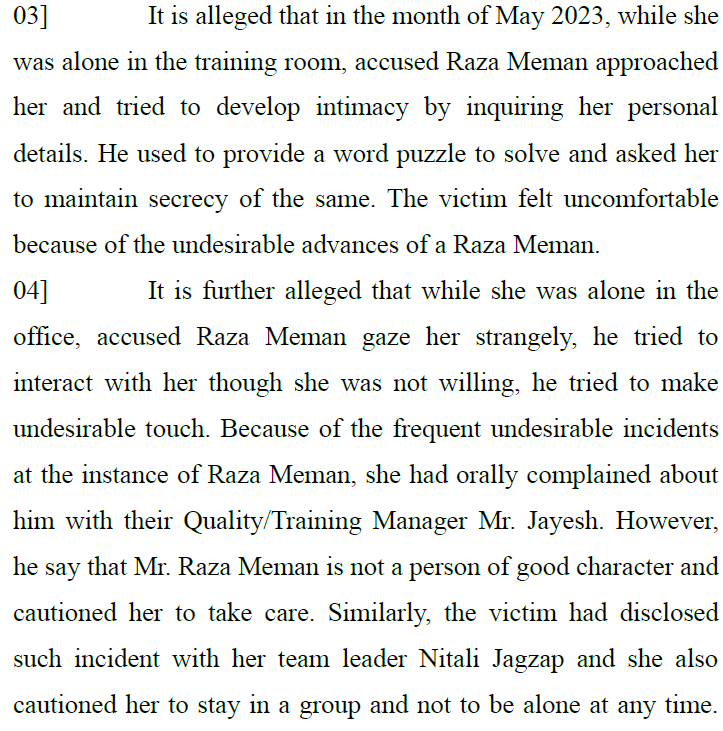
Chainani served as site supervisor of the victim (informant) who worked as an associate under the team leader Raza Meman. He contacted the woman in May 2023 while she was by herself in the training area and attempted to establish intimacy by asking her personal information. He would present her a word puzzle to solve and ask her to keep it a secret. The unwanted advances made her feel uneasy. He “gazed her strangely,” sought to engage with her against her will and made inappropriate physical contact when she was alone in the office.

The victim orally informed the quality and training manager, who warned her to be careful and stated that Memon was not a person of good character. She likewise alerted another team leader Nitali Jagzap who advised her to never be alone and always remain in a group.

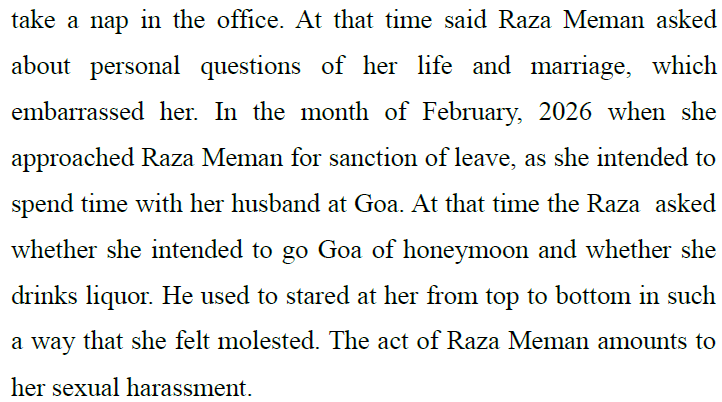
Meman learnt about the same and purposefully linked her name with a male coworker Abhishekh and disparaged her by claiming that the two were having an affair. The victim tied the knot in last November. She used to nap at the office after lunch. The perpetrator further embarrassed her by enquiring about private aspects of her marriage and life at the time. Afterwards, she requested him to grant her a leave of absence in February to spend with her spouse in Goa.

However, he probed into whether she indulged in alcohol and was planning to celebrate her honeymoon there. She felt assaulted by the way he stared at her from head to toe and his actions “amounted to sexual harassment.” Additionally, it was laid out that Meman managed her work in a manner that led to a significant strain with the intention of harassing her.

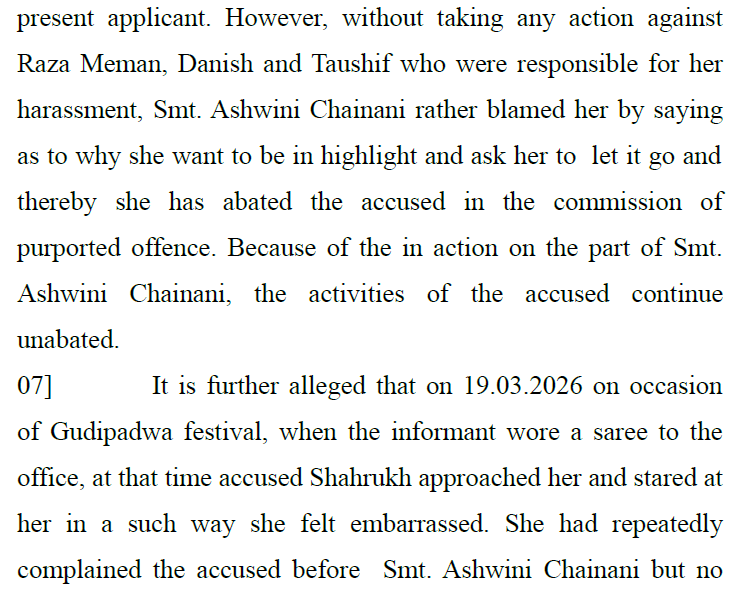
Her frustration prompted her to report the ordeal to the office head Chainani who preferred to partake in victim blaming instead of confronting the offenders. “However, without taking any action against Raza Meman, Danish and Taushif who were responsible for her harassment, Ashwini Chainani rather blamed her by saying as to why she wants to be in highlight and ask her to let it go,” the order read. It added that as a result she abated them concerning the crime and their objectionable behaviour persisted due to her conduct.

On 19th March (Gudipadwa), the woman was wearing a saree (sari) to work when Shahrukh came up to her and looked at her with an expression that left her ashamed. She had often protested about him before Chainani. However, the latter did nothing which only emboldened him.

The court points to facts to eliminate Chainani’s weak arguments

It was contended that the applicant had been drawn into the matter on the pretext that, as the head (delivery partner) she had failed to react appropriately to the oral complaints made to her, consequently aiding and abetting the violations. The submission insisted “discrimination” and asserted that she was “operating and posted at the Pune office of TCS and the day-to-day work at a Nashik office was not under her direct supervision.” Hence, she was oblivious about the instances and “did not received any report or complaint of sexual harassment.”

It was also alleged that she has been assisting in the inquiry and her son’s wedding is scheduled for 26th June. However, the state of Maharashtra pointed out that Chainani “failed to take timely cognisance of the oral complaints of sexual harassment made by the informant against co-accused and as a result the activities of the co-accused continue unbridled. The investigation is in progress and in the event of release of applicant on bail the prosecution apprehends influencing witnesses and to tamper with the prosecution evidence.”

Chanini also voiced dissatisfaction at the lack of action taken against Jayesh and Jagzap. Nevertheless, the court emphasised that a comparison cannot be made as the duo “not only not cautioned the informant about the immoral character of the accused Meman but also advised her to stay in a group to avoid any unword instance.”

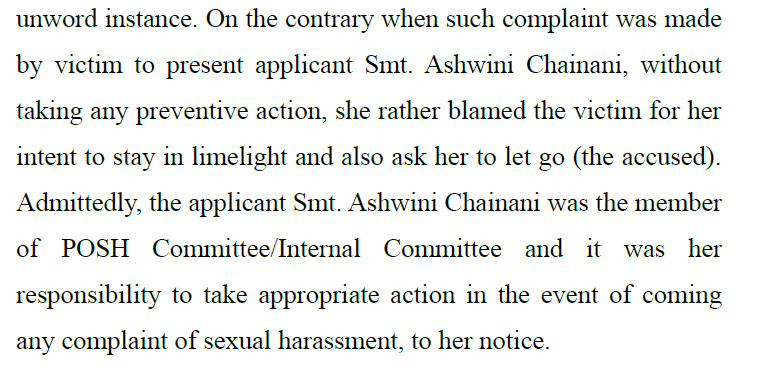
On the other hand, when the victim lodged a report to Chainani, she accused her of wanting to remain in the spotlight and urged her to let go the accused instead of taking any precautionary step. The latter “admittedly” was member of the “POSH Committee (Internal Committee), and it was her responsibility to take appropriate action in the event of coming any complaint of sexual harassment, to her notice.”

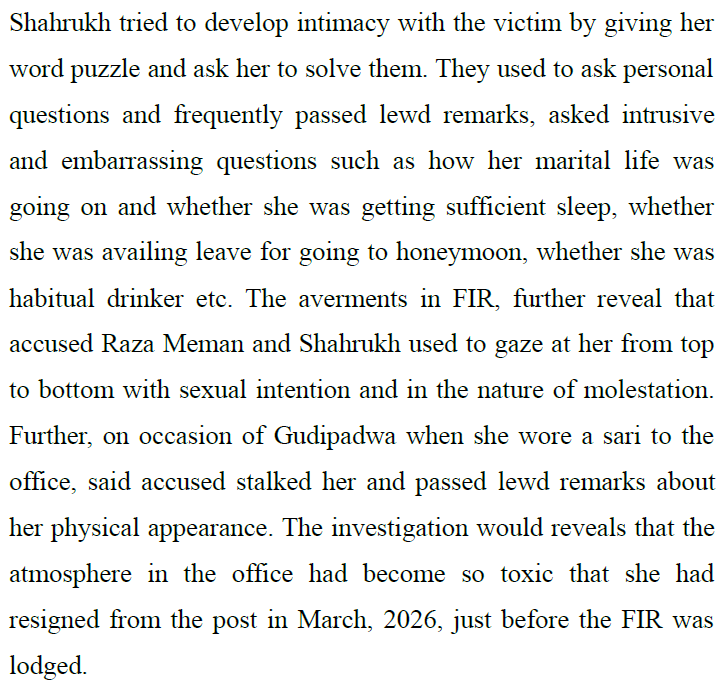
The court noted the gravity of the situation by restating the offences perpetrated by the accused, which included their endeavours to cultivate intimacy. “They used to ask personal questions and frequently passed lewd remarks, asked intrusive and embarrassing questions such as how her marital life was going on and whether she was getting sufficient sleep, whether she was availing leave for going to honeymoon, whether she was habitual drinker etc.,” it mentioned.

The allegations in the FIR (First Information Report) illustrated that Shahrukh and Meman molested her by staring at her from head to toe with a sexual motive. They even stalked her and uttered crude comments about her beauty when she wore a saree on Gudipadwa. According to the probe, she resigned from the position in March 2026, shortly before the official complaint was registered owing to the toxic atmosphere of the office.

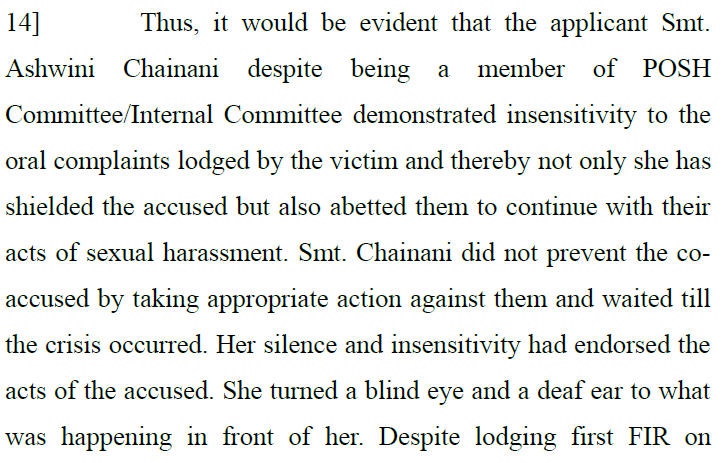
The court pronounced, “Thus, it would be evident that the applicant despite being a member of POSH Committee (Internal Committee) demonstrated insensitivity to the oral complaints lodged by the victim and thereby not only she has shielded the accused but also abetted them to continue with their acts of sexual harassment.”

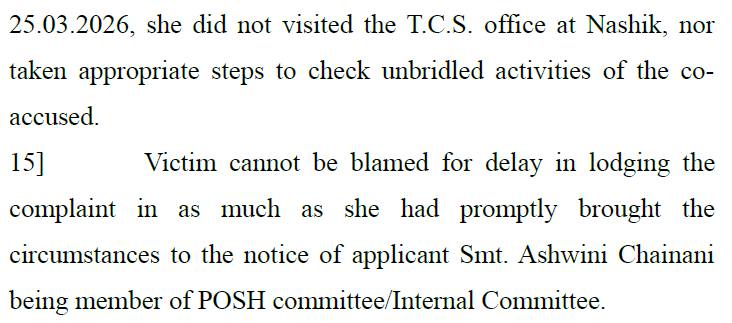
Chainani waited for the crisis to materialise rather than taking proper action against the co-accused. Her apathy and silence enabled their deeds. “She turned a blind eye and a deaf ear to what was happening in front of her. Despite lodging first FIR on 25 March, she did not visit the T.C.S. office at Nashik, nor took appropriate steps to check unbridled activities of the co-accused,” the judge observed.

He stated that the victim cannot be held accountable for the holdup in posting the complaint because she instantly informed Chainani of the circumstances.

The reasons for the delay in the complaint are justified

The court also stated that section 9 of “The sexual harassment of women at work place (Prevention, prohibition and redressal) Act, 2013 which prescribes that where such complaint cannot be made in writing, the Presiding Officer or any member of the Internal Committee etc. as the case may be, shall render all reasonable assistance to the women for making the complaint in writing,” against the discussion in relation to the lack of a written complaint, terming it as an “after thought” of the victim.

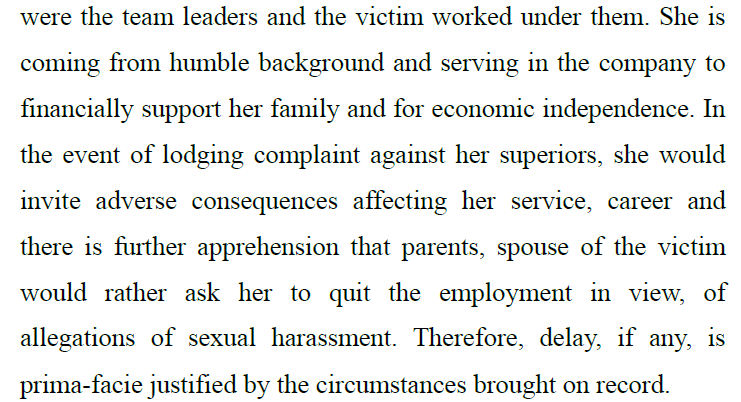
The judge outlined, “It can be seen that the complaint of sexual harassment has to be routed through the accused persons who were the team leaders and the victim worked under them. She is coming from humble background and serving in the company to financially support her family and for economic independence.”

The court acknowledged that she would face negative repercussions that would impact her career and service in the light of a complaint against her bosses. There is also concern that the victim’s spouse and parents might prefer that she resign from her job due to charges of sexual harassment. As a result, each postponement is primarily justified by the conditions documented in the case.

It was brought to the court’s attention that Chainani was not cooperating with the investigating officer. Hence, the personnel arrested her on short notice, citing explanations after considering the possibility of flight risk. Chainani even referred to a past verdict involving a principal to maintain that her actions do not amount to abetment.

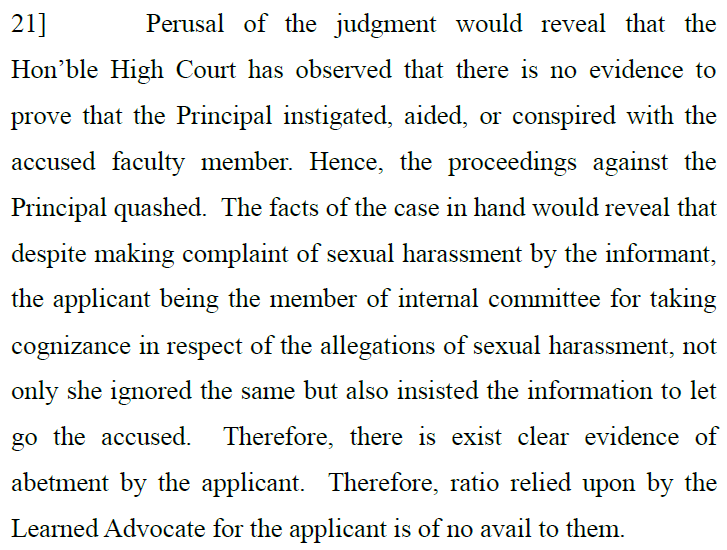
However, the court ruled that there was insufficient proof that the principal encouraged, assisted or colluded with the accused faculty member. Thus, the proceedings were junked.

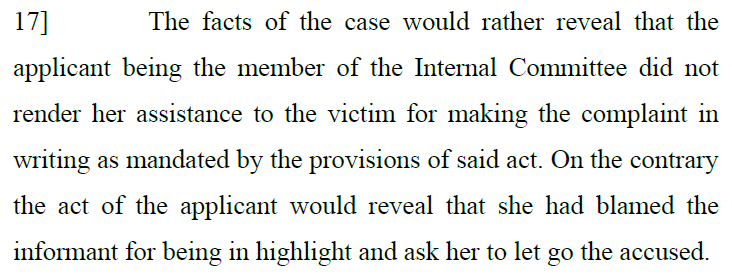
“The facts of the case in hand would reveal that despite making complaint of sexual harassment by the informant, the applicant being the member of internal committee for taking cognizance in respect of the allegations of sexual harassment, not only she ignored the same but also insisted the information to let go the accused. Therefore, there exists clear evidence of abetment by the applicant,” it declared.

“The investigation in the matter is at the nascent stage. Considering the influential nature of the applicant and co-accused there is every likelihood of influencing witnesses and tampering with the prosecution evidence in the event of release on bail. Hence, the application deserves to be rejected,” the judge concluded.

When NCW flagged toxic work culture and “zero POSH compliance” in its report

On 11th May, the National Commission for Women (NCW) conveyed that the Maharashtra government had received a comprehensive report from its fact-finding committee, which was established to look into the matter. According to the body, the examination uncovered a “deeply disturbing and toxic workplace environment” which revolved around systematic bullying, sexual harassment, misuse of authority and constant anti-Hindu statements made against female employees.

It strongly disapproved of the Nashik office’s application of the POSH Act and pointed out that Pune and Nashik shared a common Internal Committee, which is an infraction of the law. Moreover, no IC members had ever visited or assessed the Nashik unit for enforcement of these guidelines.

The committee expressed that the office did not have any signs, boards or posters detailing POSH conformity. Similarly, there was no visible content alerting staff to the consequences of breaking these rules and no board with the contact details and names of IC members. The report also noted the absence of employee awareness drives and IC member induction programs. According to the committee, there was “zero compliance” with the POSH Act.

The latest judgment has also confirmed the extremely compromised system of the firm and how the individuals who had to ensure the safety of the vulnerable Hindu women turned out to be its prominent violators.

Leaked Pakistani document shows how US pressure, Pakistan Army’s sellout politics and Washington-backed ‘regime change’ removed Imran Khan from power

On 17th May (local time), a leaked Pakistani diplomatic cypher surfaced that brought the 2022 ouster of former Prime Minister Imran Khan into focus. The cypher showed how the United States views his removal through a no-confidence vote as the way to reset the relationship with Islamabad.

The document, which was marked “SECRET” and “No circulation”, had information about a meeting that took place on 7th March 2022 between then-ambassador of Pakistan to Washington, Asad Majeed Khan and then-US Assistant Secretary of State for South and Central Asian Affairs, Donald Lu.

It is a fact that Imran Khan is no saint. His own politics, governance record and ideological contradictions caused enough trouble for India’s hostile neighbour. However, the cypher does show something far more dangerous for Pakistan as a state. It showed how Khan’s foreign policy line was treated by Washington as a problem to be corrected and how the military establishment of Pakistan appeared to have found its utility in serving American interests. It further showed how the eventual political arrangement after Khan’s removal brought Islamabad back into the familiar role of a client state for the US.

The leaked cable has been published by Drop Site News. It has strengthened the allegations that the regime change that happened in 2022 in Pakistan was backed by the US. The document draws a connection between Khan’s Russian policy, which was disliked by the US, and the internal no-confidence vote that removed him from office. It also records a blunt signal from the American side that if Khan is removed, Washington will “forgive everything”.

What the cypher actually records

Pakistan’s Washington mission had sent the cypher to Foreign Islamabad on 7th March 2022. It records that Asad Majeed Khan had a lunch meeting with Donald Lu, who was accompanied by Deputy Assistant Secretary of State Les Viguerie. Pakistan’s Deputy Chief of Mission and Counsellor Qasim also joined the meeting.

During the meeting, Lu referred to Pakistan’s position on the Ukraine crisis and stated that people in Europe were concerned about why Pakistan was taking an “aggressively neutral position” in the matter. He further claimed that such a position did not seem possible to Washington and that it appeared to be Khan’s policy.

Pakistan’s ambassador asked if the reaction coming from Washington was because Pakistan abstained from voting in the United Nations General Assembly. Lu reportedly replied in the negative and stated that the issue was due to Khan’s visit to Moscow. He then added that if the no-confidence vote against him succeeded, “all will be forgiven in Washington”, because the Russia visit was being looked at as a decision of PM Khan. Otherwise, he warned, “it will be tough going ahead”.

In simple words, the US gave a clear message beyond merely diplomatic displeasure. It linked the future of Pakistan’s relationship with Washington to the fate of Khan’s government. Lu reportedly added that he could not say how Europe would react. However, he suspected the reaction would be similar. He further added that isolation of PM Khan would become “very strong” from Europe and the US.

It cannot be seen as a vague geopolitical assessment but a direct message that if Khan survived the no-confidence vote, Pakistan would face trouble. However, if the political situation changed, Washington would move on.

During the conversation, Lu again made the point clearer. When the Pakistani ambassador expressed hope that PM Khan’s Russian visit would not affect bilateral ties, Lu reported replies that it had “already created a dent in the relationship”. He added that they should wait for a few days to see whether the political situation changed, which would mean that Washington would not have a “big disagreement” and the issue would “go away very quickly”.

The cypher also records that Pakistan’s ambassador pushed back strongly against Lu’s framing. He said it was wrong to present Khan’s Moscow visit as an isolated personal decision. He stated that the visit had been in the works for years and was the result of a deliberate institutional process. He also said that when Khan flew to Moscow, the Russian military action of Ukraine had not started, and there was still hope for a peaceful resolution.

The ambassador further said that Pakistan’s position on Ukraine was dictated by its desire to keep communication channels open with all sides. He stressed that Pakistan had reaffirmed its commitment to the principles of the UN Charter, including non-use of force, sovereignty, territorial integrity and peaceful settlement of disputes.

He also told Lu that Pakistan was worried about how the Ukraine crisis would affect Afghanistan. Islamabad’s priority, he said, was peace and stability in Afghanistan, for which coordination with all major powers, including Russia, was essential. Pakistan did not want the Ukraine crisis to divert attention away from Afghanistan.

The pushback matters because it shows that Islamabad’s official diplomatic position was more nuanced than what Washington wanted to accept. Yet the American side appeared determined to personalise the issue around Khan, as if Pakistan’s entire foreign policy disagreement could be solved by removing one Prime Minister.

The US expected obedience, and the Pakistan Army delivered it.

The cypher records another important complaint from Pakistan’s ambassador. He told Lu that over the past year, Islamabad had sensed reluctance from the US leadership to engage with Pakistan’s leadership. This had created a perception that Pakistan was being ignored and taken for granted. He said the US expected Pakistan’s support on issues important to Washington, but did not reciprocate on issues important to Pakistan, particularly Kashmir.

When Khan was elected, the US expected Pakistan to act as a loyal instrument. It was believed that Khan became Prime Minister with Washington’s backing, and there was chatter that he was a puppet of the US. However, as time passed by, his foreign policy, among other things, appeared to have angered the “bosses” sitting in Washington.

After Khan’s removal in April 2022, the new government, backed by the Pakistani military establishment, moved to repair ties with Washington. According to the report, Pakistan soon emerged as a quiet supplier of artillery shells and other military equipment to Ukraine. The weapons were reportedly routed through US defence contractors and third-country intermediaries.

The report also said that American support for Pakistan’s next IMF programme was linked to the continuation of the weapons pipeline. In July 2023, the IMF approved a 3-billion-dollar standby arrangement for Pakistan.

The sellout could not have been clearer. Under Khan, Pakistan abstained at the UN and tried to maintain a neutral line. After his ouster, Pakistan’s military-backed dispensation became useful to Washington’s Ukraine war effort. Sovereignty became negotiable. Foreign policy became a commodity. The Pakistan Army, once again, pimped the country’s strategic position to foreign powers in exchange for survival, acceptance and money.

The India comparison exposes American double standards.

Interestingly, the cypher also contains a conversation on India. Pakistan’s ambassador told Lu that he had seen Lu’s defence of the Indian position on Ukraine during the Senate Subcommittee hearing on US-India relations. He added that it appeared that the US was applying different criteria to India and Pakistan.

Lu responded that US lawmakers had strong feelings about India’s abstentions in the UN Security Council and UN General Assembly. However, he then said Washington looked at the US-India relationship through the lens of what was happening in China. He also claimed that while India had a close relationship with Moscow, Washington believed there would be a change in India’s policy once all Indian students were out of Ukraine.

It has consistently had an independent position on the Russia-Ukraine conflict, and it has been treated as a strategic complication because India matters in the larger China equation. Pakistan’s independent position was treated as disobedience by a client that needed to be disciplined.

It has to be noted that Washington never cared about the democracy of the rules-based order. All it cares about is utility. While India has a strategic value, Pakistan was expected to function as a rented-out security state.

While things have changed over the years, especially after India refused to give credit to US President Donald Trump for the ceasefire between India and Pakistan during Operation Sindoor, Pakistan’s puppet-like role in front of the US has continued to remain consistent. Especially after Khan’s government did not behave like one, and Washington’s displeasure was communicated in the language of political consequences.

The ambassador’s assessment directly flagged US interference

Towards the end of the cypher, there was the ambassador’s own assessment, where he wrote that Lu could not have conveyed such a strong demarche without the express approval of the White House, to which Lu had repeatedly referred. The assessment further stated that Lu “spoke out of turn on Pakistan’s internal political process”. It added that Pakistan needed to seriously reflect on this and consider making an appropriate démarche to the US chargé d’affaires in Islamabad.

Shehbaz Sharif and Asim Munir became Washington’s eager courtiers

The aftermath of Khan’s ouster shows how quickly Pakistan’s rulers returned to their default setting. Prime Minister Shehbaz Sharif and Army chief Asim Munir, who preside over a Pakistan where Khan remains jailed and the military establishment dominates politics, have increasingly presented themselves as useful partners for Washington.

Shehbaz Sharif recently described Pakistan’s role in US-Iran engagement as “one of the shining moments in our history”. Former Pakistani ambassador Masood Khan went even further, saying Pakistan was “in seventh heaven and on cloud nine” and had never been on “such a high pedestal”.

This language does not sound like the confidence of a sovereign state. It sounds like the excitement of a regime that has once again received approval from its foreign master.

Munir’s own rise has coincided with Pakistan’s deepening submission to American strategic priorities. According to the report, after becoming Army chief in November 2022, Munir consolidated power, Khan remained in prison, and Pakistan’s military-led order strengthened its control over politics. The report also said Munir later promoted himself to Field Marshal and created new arrangements that placed Pakistan’s nuclear command under his personal authority.

Trump reportedly called Munir “my favourite Field Marshal”. That one line sums up the current arrangement. Washington gets a pliant military strongman in a nuclear-armed Islamic country. Pakistan’s generals get international legitimacy. Shehbaz Sharif gets to sit in power. The Pakistani public gets rigged politics, jailed opposition and a state that keeps offering itself to foreign powers.

Pakistan’s fake mediator role and its one-sided tilt towards Trump

Pakistan has also tried to project itself as a mediator in US-Iran tensions. Pakistani officials promoted Islamabad’s role in possible talks involving Washington and Tehran, while the country’s military media arm quietly briefed reporters about Iran-related diplomatic developments.

However, Iranian voices questioned Pakistan’s credibility. Iranian national security spokesperson Ebrahim Rezaei reportedly said Pakistan was not a suitable intermediary because it always took Trump’s interests into account and did not say a word against American wishes. He added that a mediator must be impartial, not always leaning to one side.

The real scandal is not Imran Khan’s fall alone, but Pakistan’s permanent capture

The cypher does not demand that anyone romanticise Imran Khan. He had his own failures, contradictions and political sins. However, the document does show that Washington saw Khan’s removal as a way to fix a foreign policy problem. It also shows that Pakistan’s own ambassador believed Donald Lu had spoken out of turn on Pakistan’s internal political process and could not have done so without White House approval.

The larger scandal is Pakistan’s permanent capture by its military establishment and foreign patrons. The United States wanted a more obedient Pakistan. The Pakistani Army wanted to regain value in Washington. Shehbaz Sharif and Pakistan’s dynastic parties wanted power. The result was the 2022 regime change that removed Khan, restored the old order and pushed Pakistan back into America’s strategic lap.

The ‘Cypher’ made appearance in 2023

This is not the first time “Cypher” of the “secret cabal” has made its way to the media. Back in August 2023, The Intercept published a report based on this same cypher. However, at that time, only the text was published and not the actual document. Our detailed report from that time can be checked here.

Donald Lu and the wider South Asia pattern

The Pakistan cypher controversy also fits into a wider pattern in South Asia, where Donald Lu’s name has repeatedly appeared around political turbulence, pressure campaigns and regime change narratives.

Lu, who has served as the US Assistant Secretary of State for South and Central Asian Affairs since September 2021, was accused by Imran Khan of facilitating his ouster, an allegation Lu dismissed as a conspiracy theory. However, Pakistan was not the only country where his role came under scrutiny.

Bangladesh witnessed violent unrest that eventually forced Sheikh Hasina to flee the country, while Sri Lanka saw similar scenes in 2022 when protesters stormed the presidential residence and Gotabaya Rajapaksa resigned. Lu’s earlier diplomatic tenures in Albania and Kyrgyzstan have also remained controversial, with allegations that he publicly encouraged political pressure against governments.

In India too, Lu’s comments on Jammu and Kashmir, human rights, journalists and domestic issues have raised concerns about American interference in internal matters. His sudden visit to Chennai during the 2024 Lok Sabha elections also raised eyebrows. Around the same larger period of US engagement with Indian politics, Congress leader Rahul Gandhi reportedly met Donald Lu and other Biden administration officials during a secret White House visit, while also making remarks abroad about seeking foreign attention over India’s democracy.

Washington dresses up pressure campaigns in the language of democracy and human rights, while its diplomats apply pressure wherever a government refuses to fall in line with American strategic interests.

Madhya Pradesh HC urges govt to bring back Saraswati idol from British Museum to Bhojshala: Read about the 2 idols mentioned in the verdict and how they reached London

The recent Madhya Pradesh High Court verdict that upheld the Hindu religious nature of the long-disputed Bhojshala complex in Dhar, Madhya Pradesh, also threw light on a lesser-known aspect of the temple’s history. The verdict drew national attention to the ancient Goddess Saraswati Pratima (consecrated statue) belonging to the temple, which was smuggled out of the country during the British era.

Petitioners from the Hindu side had requested the High Court to issue directions for the repatriation of the Goddess Saraswati Pratima, which is currently kept at the British Museum in London, United Kingdom. As per the submissions made by the petitioners, an inscription at the base of Goddess Saraswati Pratima states that Vararuci, an official in the Paramara kingdom, had made two pratimas: one of Vagdevi and another of Amba (both representing Goddess Saraswati). Both the Pratimas are now placed in the British Museum in London.

“That an inscription on the base of a Pratima notes that Vararuci, an official in Paramara kingdom, had made two pratimas, together with the pratima of 3 Jinas (tirthankaras): one of Vagdevi and another of Amba. Both forms Vagdevi and Amba represent the divinity of Saraswati. The two Pratima of Saraswati, are both over 1000 years antiquity and are now held in the British Museum. British Museum should return the Pratima for puja (worship) in Saraswati Mandiram (temple), Dhar, Central India,” a submission stated.

An excerpt from the judgment

After hearing the submissions of the petitioners and examining the historical evidence, a Division Bench of Vijay Kumar Shukla and Alok Awasthi noted that the Pratimas were removed by British officials and are now preserved in the British Museum in the United Kingdom. “Based on the various documentaries, evidences available in all the cases, it is established as fact that British officials, recognizing their significance, removed and preserved two idols found near the disputed Bhojshala complex in Dhar, which is now housed in a museum in London,” the High Court observed.

The High Court asked the central government to consider the representations of the petitioners and repatriate the Pratima from the London Museum and re-establish it within the temple complex. “So far the relief claimed by the petitioners to bring back the Pratima of goddess Saraswati from London Museum, UK and re-establish same within the Bhojshala complex, the petitioners in WP No.10497/2022 and WP No.10484/2022 have already made number of representations to the Government of India, the Government of India may consider their representations to bring back the Pratima of goddess Saraswati from London Museum and re-establish the same within the complex,” the Court said.

An excerpt from the judgment

The pratimas, which originally stood inside the shrine complex during the reign of King Bhoj in the 11th century, have been on display in the museum since 1903. According to the petitioners and the ASI (Archaeological Survey of India) records, Major General William Kincaid, a British political agent, excavated the Bhojshala complex site in 1875. During the excavation, he found the statue of Vagdevi (Saraswati), which had been buried there by Muslim rulers. In 1903, Lord Curzon took away the idol of Vagdevi found within the temple complex, and the same has since been kept in the museum in the United Kingdom.

An excerpt from the judgment

The verdict states that the second idol in London has been labelled as “Jain Vidyadevi”, and it is universally accepted that Saraswati is the goddess of Vidya (knowledge). The idol has a book in a hand, making it clear that it is Saraswati.

The Vagdevi Idol

The Vagdevi (Saraswati) idol is a remarkable 11th-century marble sculpture created during the reign of Raja Bhoja of the Paramara dynasty in Dhar, Madhya Pradesh. Carved from coarse white marble, the standing figure measures approximately 1,285 mm (about 4 feet 2.5 inches) in height, 586 mm in width, and 265 mm in depth, weighing around 250 kg.

Depicted in high relief against a plain slab background with an offset inscribed base, the goddess originally possessed four arms, though two are now broken. In the surviving hands, she holds an elephant goad (aṅkuśa) and what appears to be the lower part of a noose or the stalk of a plant.

She wears a distinctive tiered beehive-style (karaṇḍa) crown, with her long hair gathered into a small bun on one side, and the sculpture features fine detailing of jewellery and drapery typical of medieval Indian artistry. A small incised figure of a kneeling female donor is visible on one stepped face of the base, accompanied by Sanskrit inscriptions in Devanagari script.

Discovered in 1875 by British officer Major General William Kincaid, the idol was later transported to England and acquired by the British Museum around 1880, where it is registered as museum number 1909,1224.1 and currently displayed in Gallery 33. The museum has listed it as “Jaina yakṣiṇī Ambikā”.

The Amba Idol

The second idol mentioned in the verdict is another significant 11th-century marble sculpture linked to the Paramara dynasty and the scholarly heritage of King Bhoja’s temple complex in Dhar, Madhya Pradesh. It is currently displayed at the British Museum, registered as British Museum number 1880.349 and displayed at section 1 of Gallery 33.

Carved from white marble, this standing figure measures approximately 66.1 cm (about 26 inches) in height. It depicts a four-armed Jain Vidyādevī (goddess of knowledge), revered in Indian tradition as a form associated with Saraswati or Vagdevi. The goddess holds a rosary (akṣamālā) in her upraised left hand and a small book (pustaka) in her lower left hand, while her right hands are now broken.

She wears a distinctive beehive-shaped crown (karaṇḍa) with her hair arranged in a large bun, complemented by an elaborate pearled necklace with loops passing under the breasts, a girdle with a long pendant reaching the ankles, and festoons draped over the thighs. The figure is framed by an elaborately moulded niche featuring seated Jinas above, flying celestials, donor figures, and female attendants holding flywhisks at the base, along with subsidiary goddesses in small niches displaying the boon-granting gesture (varadamudrā) and lotus tendrils.

The idol has a two-line inscription in Devnagari on the pedestal. The British Museum states that the idol was probably found in southern Rajasthan.

Bhojshala

The Bhojshala complex was established as a major seat of Sanskrit learning in Dhar during the reign of Raja Bhoj of the Parmara dynasty. Scholars studied grammar, philosophy and literature at the institution. The Saraswati Pratima was installed inside the Bhojshala complex as the presiding deity.

The Bhojshala complex endured repeated destruction and vandalism at the hands of Islamic invaders. Large portions of the complex were destroyed during Alauddin Khilji’s invasion in 1305. This was followed by another bout of destruction in 1401 by the Islamist invader Dilawar Khan, who demolished the temple and transformed part of it into a dargah.

Later in 1514, Mehmud Shah Khilji further converted parts of land outside the Bhojshala into a dargah, establishing the Kamal Maula Makbara. It was constructed 204 years after death of Maulana Kamaluddin, who died at Karnawati (present day Ahmedabad) in 1310. Centuries later, the British carried out an excavation at the Bhojshala complex in 1875, during which several historical pieces of evidence, including the Saraswati pratima, were unearthed.

Pertinently, the Indian government has recently secured the return of several artefacts associated with the Indian cultural heritage. Earlier this week, the Dutch government returned 11th-century Anaimangalam copper plates, also known as the Leiden Plates, to India. In January this year, the Smithsonian’s National Museum of Asian Art in Washington, D.C., returned three stolen Indian bronze statues to the Indian government. 

Adhik maas: The extra month that keeps the Indian calendar in balance- read why it sometimes becomes Adhik Jyeshtha and sometimes Adhik Shravan

The Indian calendar has never been only about fixing festival dates. For thousands of years, it has also been a system to understand time, changing seasons, the movement of the Sun and Moon, and their effect on life. While most of the world today follows the Gregorian calendar, India’s traditional Panchang developed a different way of measuring time by combining both lunar and solar movements.

This is why the Indian calendar is called a lunisolar system. One of the most interesting results of this system is Adhik Maas, also known as Purushottam Maas, an extra month that appears after some years to maintain balance in the calendar.

The Adhik Jyeshtha month has begun this year, and once again, people have started discussing why this extra month comes, why it does not appear every year, why it is sometimes linked with Jyeshtha and sometimes with Shravan, and why many auspicious events are usually avoided during this period, even though it is considered spiritually important. The answer lies not only in mythology but also in astronomy and calendar mathematics.

How the Indian panchang works differently from the Western calendar

The Gregorian calendar used worldwide is based only on the solar cycle. The Earth takes around 365 days and nearly six hours to complete one orbit around the Sun. To adjust this extra time, one additional day is added every four years as a leap year.

The Indian Panchang follows a different method. It gives importance to both the Sun and the Moon. Months are mainly calculated according to the Moon’s cycle, while the Sun’s movement keeps the calendar connected with seasons. Because of this combination, the Panchang includes not just dates but also Tithi, Var, Nakshatra, Yoga and Karan, which together form the five parts of the Panchang.

In this system, the Moon decides the months while the Sun helps maintain seasonal balance. Ancient Indian scholars understood that if only lunar months were followed, festivals and seasons would slowly move out of sync. Therefore, a correction system was needed.

The difference between lunar and solar years created the need for Adhik Maas

The Moon takes around 29.5 days to complete one cycle from full moon to full moon. Twelve such lunar months together make a lunar year of about 354 days.

On the other hand, the solar year is around 365 days long.

This creates a yearly gap of around 11 days between the lunar and solar years. If this difference continued without adjustment, the calendar would slowly move away from the seasonal cycle. Over time, festivals linked to particular seasons would shift completely. A situation could arise where winter festivals appear in summer or harvest festivals move to different seasons.

Ancient Indian astronomers noticed this issue long ago and developed a solution, adding an entire extra month after the difference became large enough.

Why Adhik Maas appears after around 32 months and not every year

Since the gap between lunar and solar years is about eleven days each year, after nearly three years, the accumulated difference becomes around 33 days, which is almost equal to one lunar month.

Because of this, an additional month is inserted after approximately 32 months, 16 days and a few hours. This becomes Adhik Maas.

This is different from the Western leap year system. In the Gregorian calendar, only one day is added every four years. In the Indian calendar, a full month is added because the issue is not simply adjusting days but balancing the entire lunar and solar cycles together.

This arrangement reflects the depth of ancient Indian timekeeping methods. Without modern instruments, scholars created a system that kept festivals, seasons and celestial cycles connected.

How is it decided which month will become Adhik Maas?

Many people think Adhik Maas is simply a fixed extra month arriving every three years, but its calculation is more detailed.

Its determination depends on Sankranti, which means the Sun entering a new zodiac sign. Normally, during every lunar month, the Sun changes one zodiac sign, and a Sankranti occurs.

However, if a lunar month passes without any Sankranti, meaning the Sun does not move into a new zodiac sign during that period, that month becomes Adhik Maas. This rule is the reason why the extra month does not always have the same name.

If this condition happens during Jyeshtha, it becomes Adhik Jyeshtha. If it happens during Shravan, it becomes Adhik Shravan. Similarly, Ashwin or other months can also become Adhik.

This year, the extra month has appeared in Jyeshtha, so it is called Adhik Jyeshtha.

Why does Adhik Maas sometimes fall in Jyeshtha and sometimes in Shravan?

This is one of the most common questions among people because many associate Adhik Maas mainly with Shravan.

The answer again lies in the movement of the Sun and Moon. The lunar months keep moving according to the Moon’s cycle. Meanwhile, the Sun moves through zodiac signs at its own pace. Sometimes, during the lunar month of Jyeshtha, the Sun may not change its zodiac sign at all. In such a case, Jyeshtha becomes Adhik Jyeshtha.

At another time, the same condition may occur during Shravan. Then Shravan becomes Adhik Shravan. So the extra month is not fixed to any one month. Its occurrence depends completely on celestial calculations and Sankranti rules.

This is why people may see Adhik Jyeshtha in one cycle and Adhik Shravan in another.

Why Adhik Shravan gets more attention among people

Even though any month can become Adhik, people usually remember Adhik Shravan more.

The reason is social and religious rather than astronomical. Shravan or Sawan holds a special place in Hindu tradition. It is strongly connected with the worship of Lord Shiva. Kanwar Yatra, Monday fasts, Shiva temples and various religious practices make this month highly visible in public life.

When an extra Shravan appears, the number of Mondays and religious observances increases, making it more noticeable among devotees.

For example, during Adhik Shravan years, devotees may observe eight Shravan Mondays and nine Tuesdays, making the period longer than usual. Because of such occasions, many people started believing that Adhik Maas always means extra Shravan, though this is not correct.

Shravan, Chaturmas, and extended worship during Adhik Shravan

Shravan is considered the first month of Chaturmas, the four holy months consisting of Shravan, Bhadrapada, Ashwin and Kartik.

According to traditions, Goddess Parvati performed strict penance and fasting during Shravan to obtain Lord Shiva as her husband. Pleased with her devotion, Lord Shiva accepted her wish. Because of this belief, Shravan became especially important for Shiva and Parvati worship.

During Adhik Shravan years, the month becomes longer due to the extra lunar month. Devotees often keep fasts on Mondays for Lord Shiva and on Tuesdays for Goddess Parvati.

Women observe Tuesday fasts seeking well-being and long life for their families. Wednesdays are linked with Lord Vitthal, Thursdays with Gurus, Fridays with Goddess Lakshmi and Tulsi, Saturdays with Lord Shani and Sundays with Surya Dev.

Devotees also perform Abhishek, offering Panchamrit made from milk, honey, curd, sugar and ghee to Lord Shiva. Bilva leaves are offered, and mantras like Mahamrityunjaya Mantra, Gayatri Mantra and Rudra Gayatri are recited.

Many followers also adopt a Sattvic lifestyle, avoiding non-vegetarian food, alcohol and tobacco during this period.

Different calendar systems also affect the Shravan dates

Another reason behind confusion regarding Shravan is the existence of two lunar calendar traditions in India.

Northern states such as Haryana, Punjab, Uttar Pradesh, Rajasthan, Madhya Pradesh and Himachal Pradesh generally follow the Purnimanta calendar, where the month ends on the full moon.

States including Maharashtra, Gujarat, Karnataka, Goa, Andhra Pradesh and Tamil Nadu largely follow the Amanta system, where the month ends on the new moon.

Because of this difference, Shravan dates may vary across regions even though the religious significance remains similar.

From Malmas to Purushottam Maas: The mythological story

Adhik Maas also has an important place in mythology. Stories from the Padma Purana and Skanda Purana explain how the extra month was earlier called Malmas.

According to tradition, when this additional month was created, the other twelve months refused to accept it because it was not linked with any Sankranti. It was seen as neglected and without importance.

The word Mal here was not used in the sense of dirt but in the meaning of abandoned or ignored. Feeling insulted, the month approached Lord Vishnu and expressed its sorrow.

Lord Vishnu then accepted it and gave it the name Purushottam, one of His sacred names, meaning the Supreme Being. From that point, Malmas became Purushottam Maas and gained special spiritual importance.

The story also carries a social message that something once ignored can later receive honour and value.

Why lord Vishnu is closely linked with Purushottam Maas

Purushottam Maas is especially important in the Vaishnava tradition.

During this period, worship of Lord Vishnu, Lord Krishna and their different forms receives special attention. Devotees read scriptures such as the Bhagavad Gita, Shrimad Bhagavatam, and chant Vishnu Sahasranama.

Many temples organise katha sessions, bhajans and religious gatherings.

Tradition says that during Chaturmas, Lord Vishnu enters Yoga Nidra on Adi Shesha in the cosmic ocean, while Lord Shiva takes charge of cosmic activities. This is symbolically seen as the cycle where old patterns make space for renewal and change.

Why marriages and new beginnings are usually avoided

Even though Purushottam Maas is considered sacred, many families avoid marriages, housewarming ceremonies, idol installations and starting new businesses during this period.

Traditionally, the month was viewed as a time for inner reflection rather than social celebrations. It was considered a pause within the yearly cycle, a period dedicated to prayer, charity, meditation and devotion. People focused more on spiritual activities instead of worldly events.

This explains why the month is respected yet often separated from major ceremonies.

Adhik maas was also important in social life and agriculture

Historically, Panchang was not limited to temples or rituals.

It influenced farming seasons, pilgrimage schedules, festivals and daily life. Therefore, systems like Adhik Maas helped maintain harmony between seasonal cycles and social activities.

Different regions developed their own traditions during this month. Some focused on donations and charity, some organised Bhagavad Katha events, while others gave more importance to Vishnu worship.

This made Adhik Maas not just a mathematical adjustment but a part of cultural life.

Adhik Maas shows the meeting point of science and faith

Modern discussions often place science and faith on opposite sides, but Adhik Maas presents a different picture. Its origin lies in solving an astronomical problem, balancing the lunar and solar years.

Later, religious meaning and cultural practices became attached to it. As a result, Adhik Maas today stands at the meeting point of astronomy, calendar science, mythology and social traditions.

The month reminds people that Indian timekeeping was not limited to counting days. It tried to connect celestial movement, seasons, agriculture, festivals and human life into one system.

This is perhaps why Adhik Maas, despite being thousands of years old, continues to remain relevant even today.

NCB seizes ₹182 crore worth ‘Jihadi Drug’ under Operation Ragepill: Read how Captagon funds ISIS and fuels West Asia’s narco economy

In a major breakthrough in India’s operations against an international drug trafficking syndicate, the Narcotics Control Bureau (NCB) seized around 227.7 kg of synthetic drug Captagon, worth ₹182 crore. The agency also arrested a Syrian national, who is part of the transnational drug smuggling syndicate and was found overstaying his tourist visa. The seizure of the drug, also known as the ‘Jihadi Drug’, was carried out by the NCB this week under its ‘Operation Ragepill’. The drug consignment was meant to be transshipped to the Gulf region, and India was being used as a transit route.

Union Home Minister Amit Shah congratulated the agency for the remarkable achievement in its anti-drug operations. Shah reiterated the Modi government’s resolve to make a ‘Drug-Free India’ and said that no amount of drugs will be allowed to enter or leave the country. “Modi govt is resolved for a ‘Drug-Free India’. Glad to share that through ‘Operation RAGEPILL’, our agencies have achieved the first-ever seizure of Captagon, the so-called “Jihadi Drug”, worth ₹182 crore. The busting of the drug consignment destined for the Middle East and the arrest of a foreign national stand out as shining examples of our commitment to zero tolerance against drugs. I repeat, we will clamp down on every gram of drugs entering India or leaving the country using our territory as the transit route. Kudos to the brave and vigilant warriors of the NCB,” Shah wrote on X on Saturday (16th May).

As per reports, the Indian anti-drug agency received inputs from a foreign drug law enforcement agency indicating that transnational drug syndicates were using India as a transit route for Captagon shipments. Acting on the inputs, the Indian anti-drug agency had identified a house in Neb Sarai, New Delhi and raided it on May 11, 2026. The raid led to the discovery of 31.5 Kg Captagon Tablets, carefully concealed in a commercial chapati cutting machine. The drug consignment was to be exported to Jeddah in Saudi Arabia. Preliminary investigation into the discovery revealed that the Syrian national had been overstaying his visa. He entered India on a tourist visa on November 15, 2024, but his visa expired last year, on January 12, 2025. He had been illegally staying as a tenant in the house in Neb Sarai.

The interrogation of the Syrian national led to the discovery of another consignment of Captagon sealed in 3 bags, weighing about 196.2 Kgs. The agencies seized the drug in powdered form concealed inside a wool consignment from a container in the Container Facilitation Station (CFS) at Mundra, Gujarat, on May 14, 2026. The container was imported from Syria and was bound for the Gulf countries, including Saudi Arabia, where the consumption of the drug has increased significantly, creating a public health concern for law enforcement. The total amount of the drugs seized under Operation Ragepill amounts to 227.7 Kg of Captagon in both Tablet and Powder form.

What is Operation Ragepill?

Operation Ragepill is an NCB initiative that involves coordination among multiple agencies. The operation marks the first-ever seizure of Captagon in India and the exposure of the Syria-linked drug cartel, which has been using India as a transit route for illegal drugs bound for the Middle Eastern countries.

The operation involved intelligence-led surveillance, coordination with customs and local law‑enforcement units, controlled interception of the consignment, and resultant seizure and arrest. Under the operation, the NCB targeted transnational drug smuggling syndicates, which have been using India as a transit route. Recently, another major action by the NCB led to the discovery and seizure of 349 Kg of cocaine in Mumbai. The drug was concealed in a container originating from Ecuador.

The NCB has been working in compliance with the Modi government’s zero-tolerance policy against drug abuse and trafficking. In light of the strategy adopted by international drug cartels to route drug consignments via India, the NCB has initiated a comprehensive investigation to identify the source of procurement, financial and hawala linkages, logistics facilitators, international receivers, and the wider transnational network associated with the drug syndicate.

The agency, in cooperation with foreign drug law enforcement agencies, has been putting a collective response to the international drug cartels operating in multiple jurisdictions. This global coordination has been crucial in obtaining intelligence inputs, which ultimately led to the seizure of illegal drugs and the capture of people working as part of these international drug cartels. In addition to the international cooperation, the NCB has also urged public participation in the fight against drug trafficking. The NCB has requested citizens to report narcotics-related information through the MANAS Helpline (Toll-Free: 1933). The identity of informers is kept strictly confidential.

What is the Captagon drug?

Captagon is a synthetic drug, mainly containing psychostimulants like Fenetylline and Amphetamine, that was originally invented in Germany in 1960 to treat attention disorders and narcolepsy (a sleep disorder). It was banned across the world during the 1980s after its highly addictive properties became known. The effects of consumption of the drug include increased alertness, peaked energy levels, sleeplessness, temporary euphoria, suppressed appetite, reduced fatigue and increased aggression and risk-taking behaviour.

Notably, Fenetylline and Amphetamine are classified as Psychotropic Substances under the NDPS Act, which makes Captagon a prohibited drug in India. The current composition of Captagon includes a mixture of amphetamine, methamphetamine, caffeine and other synthetic stimulants.

How the drug came to be called the ‘Jihadi Drug’

The Captagon drug, which was originally meant to treat sleep and attention disorders, came to be widely used or rather abused, by terrorist organisations in West Asia due to its stimulant effects. Because of its widespread consumption by Jihadis and terrorists, particularly in the Middle Eastern region, the drug came to be known as the ‘Jihadi Drug’. As per reports, several Islamic terrorist organisations, including ISIS, have been linked to the trade of the Jihadi Drug. The terrorist organisations have been using the drug for a two-fold purpose: to enhance the performance of their terrorists and as a source of revenue to fund terrorist activities and obtain weapons.

According to international agencies, the Jihadi Drug is one of the fastest-growing synthetic drug threats in the region. The trafficking of the drug has reportedly emerged as a high-profit-making part of the narco-economy in the West Asian region. It is estimated that 80% per the Jihadi Drugs’ global supply is produced in Syria. The drug has emerged as a serious public health and national security concern for the Gulf countries.