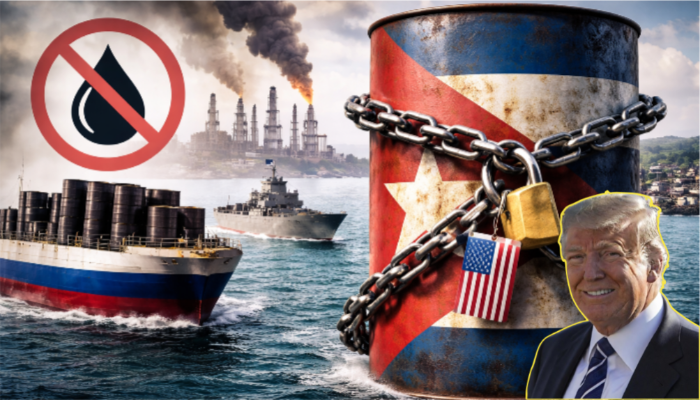
On 31st March (Tuesday), the United States permitted a Russian-flagged ship “Anatoly Kolodkin” bearing 100,000 tonnes of oil to enter Cuban seas. The vessel reportedly arrived at the Matanzas port of the island nation reeling under severe fuel blockade by the White House, prompting a critical energy crisis which has even resulted in deaths.
🇷🇺🇨🇺 Russian Embassy in Cuba:
On March 31, Russian tanker Anatoly Kolodkin arrived at the Cuban port of Matanzas carrying a humanitarian cargo of 100,000 tonnes of oil.
“I can only confirm that this issue was indeed raised in advance during contacts with our American counterparts,” mentioned Dmitry Peskov while confirming the development, reported CNN. The spokesman for President Vladimir Putin added that “its their duty to step up and provide necessary assistance to our Cuban friends.”
There is no moderation in our policy: US
However, the Trump administration declared that it would determine the extent to which foreign oil flows to Cuba on an individual basis. It indicated that Washington’s stance of upholding the interdiction against Havana has not changed by enabling access to a Russian oil tanker.
“This is not a policy change. There has not been a formal change in sanctions policy. As the president said last night, we allowed this ship to reach Cuba in order to provide humanitarian needs to the Cuban people,” White House press secretary Karoline Leavitt stated before the media. She added, “The US still reserves the right to seize vessels, if legally applicable, that are headed toward Cuba and violate US sanctions policy.”
“We have a tanker out there. We don’t mind having somebody get a boatload, because they have to survive. If a country wants to send some oil into Cuba right now, I have no problem with that, whether it’s Russia or not. I’d prefer letting it in, whether it’s Russia or anybody else, because the people need heat and cooling and all of the other things that you need,” President Donald Trump expressed, a day earlier.
He insisted, “Cuba is finished. They have a bad regime. They have very bad and corrupt leadership, and whether or not they get a boat of oil, it’s not going to matter.”
The tensions in West Asia triggered a massive interruption in global supply chain of energy and the prices skyrocketed after which the US granted a license for the sale of Russian oil that is stranded at sea. The authorisation which expires on 11th April does not cover Iran, North Korea, Cuba and Crimea. However, the Russian oil is going to offer only modest relief to the 10 million strong nation and won’t even last long.
Mexico tries to resume oil shipments to Cuba
Mexican President Claudia Sheinbaum stated that governments of Mexico and Cuba are collaborating to resume oil exports via their respective trade agreements.
“Mexico has every right to send fuel, whether for humanitarian or commercial reasons, but we do not want to harm the country with tariffs resulting from Donald Trump’s oil embargo. We are working with them on both issues,” she conveyed and pointed out that her government “always seeks (to send) humanitarian aid, and it is in that context that we will make the decision.”
According to Sheinbaum, private Cuban enterprises, including hotels, reached out to the country about acquiring oil from Pemex, the state-owned energy company. “There are private companies that buy oil from Mexico and report where they are taking it. Because it’s not necessarily a government-to-government agreement, there are companies that specialise in fuel transportation,” the president highlighted.
She promised that Mexico would keep delivering humanitarian help to the Caribbean country and voiced, “There should be no blockades, because trade blockades harm the people. Formally, they’re directed against governments, but who do they harm? The people. Mexico has been shipping hydrocarbons to Cuba since 1993 in small quantities, but the volume rose dramatically in 2024, one month after Sheinbaum took power.
On the other hand, two sailboats transporting humanitarian aid from southern Mexico to Cuba disappeared for several days and were spotted by the Mexican Navy after which they anchored at Havana on 28th March (Saturday). On 20th March, the boats with 8 or 9 passengers from Poland, France, Cuba and the US on board left Quintana Roo’s Isla Mujeres and lost contact giving rise to alarm. “They were located 80 nautical miles northwest of Havana,” Mexico revealed.
La Secretaría de Marina informa que una aeronave de la Armada de México localizó a las embarcaciones tipo catamarán que se estaban buscando en el Caribe.
Fueron localizados a 80 millas náuticas al noroeste de La Habana, Cuba.
The sailing convoy’s coordinator, Adnaan Stumo, later disclosed that the delay was brought on by inclement weather as they were forced to take an extended course, but the sailors were “never in any serious danger.”
Cuba faces mounting problems and US threatens military intervention
According to President Miguel Diaz-Canel, Cuba had not received an oil tanker in 3 months, aggravating an energy shortage that caused regular nationwide blackouts for many hours, inflation, rigorous gasoline rationing and put public transit, hospitals and agricultural output in danger of crumbling. “A total disconnection of the SEN (Electro-Energy System) has occurred. The causes are being investigated and protocols for restoration are beginning to be activated,” Ministry of Energy and Mines posted on 16th March.
Se ha producido una desconexión total del SEN, se investigan las causas y comienzan a activarse los protocolos para el restablecimiento.
— Ministerio de Energía y Minas Cuba 🇨🇺 (@EnergiaMinasCub) March 16, 2026
Havana has similarly seen power outages, a build-up of trash as hospitals are finding it difficult to accommodate patients and maintain operating rooms. Cuban health professionals fear that the situation has heightened a possibility of death for cancer patients, particularly youngsters. The lack of fuel has prompted the United Nations to alert people of an approaching humanitarian “collapse” there.
The present circumstances are the outcome of punishing American action to exert pressure on President Miguel Diaz-Canel’s communist government. Long-standing structural issues and policy moves, such as lack of investment in the energy sector, have contributed to Cuba’s economic and energy woes, but Trump’s return to office deteriorated the situation.
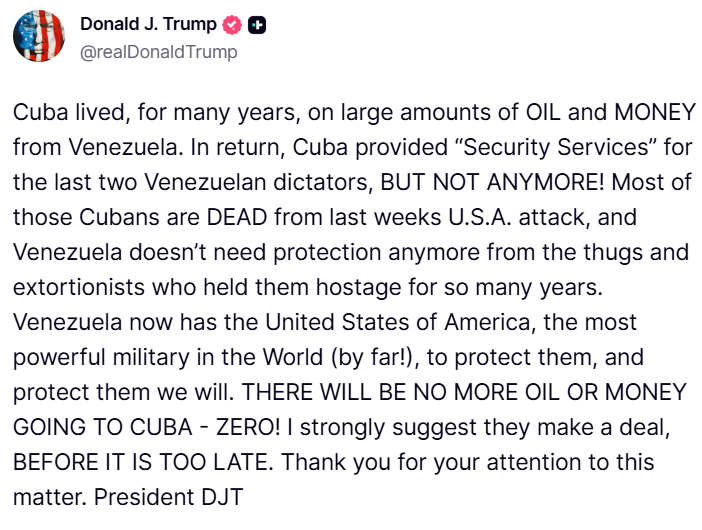
On 11th March, Trump pronounced that Cuba will not be given “more oil or money” from Venezuela which endured a US incursion. On 29th January, his administration published an executive order vowing to levy taxes on any country that provides fuel to Cuba. According to senior US officials, the ultimate objective of these efforts is to liberalise Cuban economy and politics, including the potential ouster of Miguel.
“Cuba’s non-functional economy cannot be fixed unless they undergo dramatic political and leadership change, but there has been no formal change,” Secretary of State Marco Rubio has reiterated frequently. Interestingly, his parents migrated from Cuba to Florida prior to Fidel Castro’s rule.
Trump also alluded at an attack on Cuba, repeating military operations in Venezuela and Iran. “I built this great military. I said, you’ll never have to use it. But sometimes you have to use it. And Cuba is next, by the way,” he threatened on 27th March (Friday) and then added, “But pretend I didn’t say that.”
On 16th March, Trump remarked, “I think Cuba is seeing the end.” Moreover, he declared intend to earn the “honour” of “taking Cuba in some form” and alleged that he could “free it” or “take it” and is even capable of doing “anything” he wants with the “very weak” country.
Meanwhile, US officials asserted that negotiations are underway, and Trump suggested that a deal might be concluded. However, alternative possibilities are available. He noted that all attention will be directed at Cuba after the war in Iran.
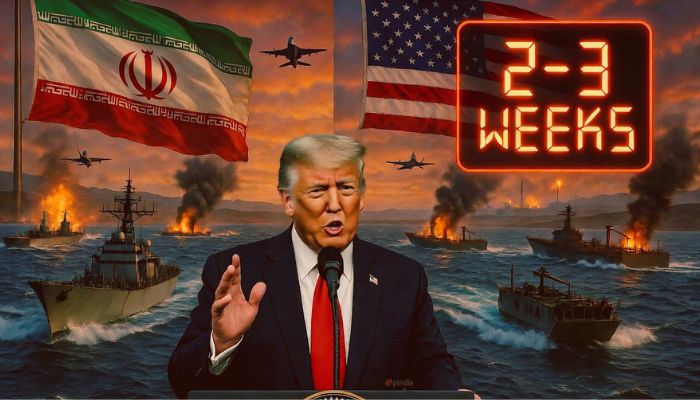
The US-Israel joint front’s war against Iran has become a theatre of mind games and ego. While the war rages on, US President Donald Trump has claimed that the US forces could end their attacks on Iran within two to three weeks, even if Tehran does not make a deal, and the war may “end soon”.
‘We will leave Iran within two-three weeks’,Trump said that US forces may end campaign even if Tehran does not cut a ‘peace’ deal
During a media interaction at the White House on Tuesday, Trump said, “We’ll be leaving very soon. I would say within two weeks, maybe three. We knocked out a tremendous amount of missile-making facilities.”
When asked if a diplomatic agreement is to be credited for the potential end of war, Trump said, “Iran doesn’t have to make a deal, no…No, they don’t have to make a deal with me.”
Trump, however, asserted that America’s military offensive against Iran would conclude only after Iran had been “put into the Stone Age”. He added that when Iran’s ability to develop a nuclear weapon is destroyed, “Then we’ll leave,” he said.
US President Donald Trump said on Tuesday that the American forces would end the war and leave Iran within two to three weeks, saying that there is nothing left to do in Tehran. He suggested that the US had achieved the goal it set out for. "I had one goal. They will have no… pic.twitter.com/A13MJE33Cj
Trump hints at end of Iran war as IRGC threatens to strike the offices of major US tech companies
The US President’s ‘end of war’ statement comes right after Iran’s military, Islamic Revolutionary Guards Corps (IRGC) threatened to target American tech giants including Apple, Meta (Facebook), Google, Microsoft, Intel, IBM, Dell, Tesla, Nvidia, Boeing, HP, Cisco, Oracle, Planter, JP Morgan, GE, Spire Solutions, and G42. The IRGC describes these as “terrorist” companies, which provided intelligence and technical assistance to Israel and the US, making it easier to locate and kill Iranian leaders.
Frustration over Europe not joining US in attacking Iran: Trump goes from ‘Get your own oil’ or ‘we’ll leave soon’ within 48 hours
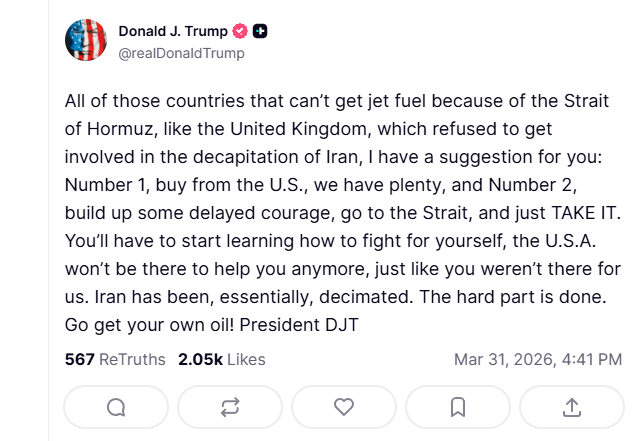
Interestingly, just hours before giving a tentative timeframe of the end of the Iran war, Trump had expressed frustration over the refusal of major allies refusing to join American forces in clearing the Strait of Hormuz blockade, amidst supply disruptions and skyrocketing prices. He urged France and other countries which want to secure oil or gas to either buy it from the US, or go to the Strait, and “get your own oil”.
Ironically, the Strait of Hormuz blockade was caused by the US and Israel, by attacking Iran.
“All of those countries that can’t get jet fuel because of the Strait of Hormuz, like the United Kingdom, which refused to get involved in the decapitation of Iran, I have a suggestion for you: Number 1, buy from the U.S., we have plenty, and Number 2, build up some delayed courage, go to the Strait, and just TAKE IT. You’ll have to start learning how to fight for yourself; the U.S.A. won’t be there to help you anymore, just like you weren’t there for us. Iran has been, essentially, decimated. The hard part is done. Go get your own oil!” Trump wrote on Truth Social on 31st March.
This came after China, France, Japan, South Korea, the United Kingdom and other countries refused Trump’s call to deploy their warships to clear the Iranian blockade of the Strait of Hormuz. Soon after, Australia and Japan also declined Trump’s appeal.
Trump says war against Iran will end soon and US forces will leave within two weeks, while the Pentagon expands military presence in West Asia
It appears that Donald Trump is playing mind games against the Iranian regime by throwing hints of US forces backing out, that too, without forcing the Mullah regime into entering a US-favouring ‘peace’ deal. On one hand, Trump is bashing allies for refusing to come to America’s aid and hinting at winding up the military campaign against Iran; on the other, the Pentagon is rapidly fortifying its forward presence in the Gulf states, Kuwait, Qatar, Bahrain, UAE, and Saudi Arabia, as staging grounds and logistics hubs for contingencies. The rapid expansion of the presence of American troops and warships in West Asia indicates that Washington might be planning a ground invasion of Iranian territory.
As per the US Central Command, the USS Tripoli, carrying 3,500 sailors and Marines from the 31st Marine Expeditionary Unit, had arrived in recent weeks. So far, 5,000 United States troops, including 2,500 Marines, have made their way to West Asia, waiting for a go-ahead from the American Commander-in-Chief to launch a ground invasion against Iran.
In the last week of March 2026, around 2,000 to 4,000 paratroopers from the elite 82nd Airborne Division were being flown in as an “Immediate Response Force” prepared for quick insertion operations, in addition to over 4,000 Marines and sailors onboard USS Tripoli and USS Boxer (2,500 Marines and sailors). These reinforcements, which could increase the total ground-force presence to 17,000 if further waves of up to 10,000 troops are approved, would aid the campaign of the American forces to pound Iranian infrastructure in the oil-export hub, particularly in Kharg Island, and sites near the Strait of Hormuz.
Earlier, Trump had said expressed interest in occupying Kharg Island, Iran’s main oil export hub, and has said that seizing control of Iran’s oil is a preferred option. He had also said that the Island might be targeted again “just for fun”.
Amidst domestic pressure over dragging America into distant and prolonged wars, inflicting human and economic costs, reports indicate that America might be pressing Gulf countries targeted by Iran to cover war expenses.
These pressures, coupled with the mounting embarrassment of failing to subjugate the IRGC, are perhaps forcing Trump to wind up the offensive against Iran as early as possible. The Iranian regime’s recalcitrance is only hurting Trump’s ego and self-asserted peacemaker image. Moreover, Trump’s emphasis on winding up the military campaign, in line with America’s history of “no-conditions exit” strategy, against Iran only after the West Asian nation’s ability to develop nuclear weapons, which Israel sees as an existential threat, is obliterated, is all the more reason to believe that the US offensive might end within two or three weeks, but not without ground invasion and Trump’s vacillating rhetoric is only a deflection tactic.
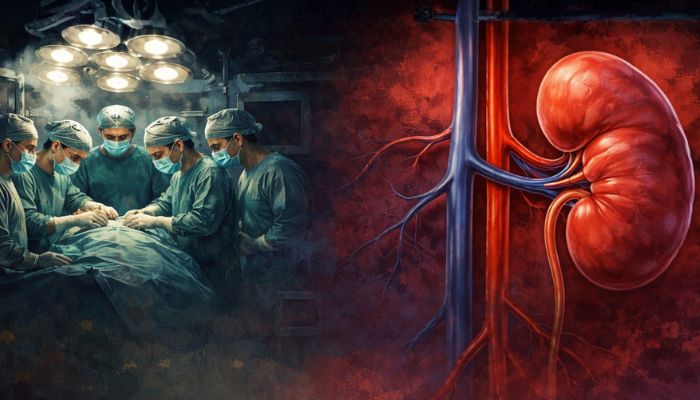
On the intervening night of 30th March and 31st March, Kanpur police in Uttar Pradesh busted a multi-crore illegal kidney transplant racket involving at least six doctors and eight others. The information about the organ trade came to light over a dispute of Rs 50,000. One of the ‘donors’, who was promised Rs 10 lakh in exchange for his one kidney, received only Rs 9.5 lakh. Irked by the loss of Rs 50,000, he approached the police and revealed details of the racket.
थाना-रावतपुर व सर्विलांश टीम पश्चिम जोन की संयुक्त कार्यवाही.. कानपुर नगर में किडनी ट्रांसप्लांट रैकेट का खुलासा, 6 गिरफ्तार रैकेट में शामिल अन्य 04 की तलाश जारी..
कमिश्नरेट कानपुर नगर में अपराधियों के विरुद्ध चलाए जा रहे अभियान के क्रम में पुलिस को एक बड़ी सफलता प्राप्त हुई है।… pic.twitter.com/RvWGLfPUz5
— POLICE COMMISSIONERATE KANPUR NAGAR (@kanpurnagarpol) March 31, 2026
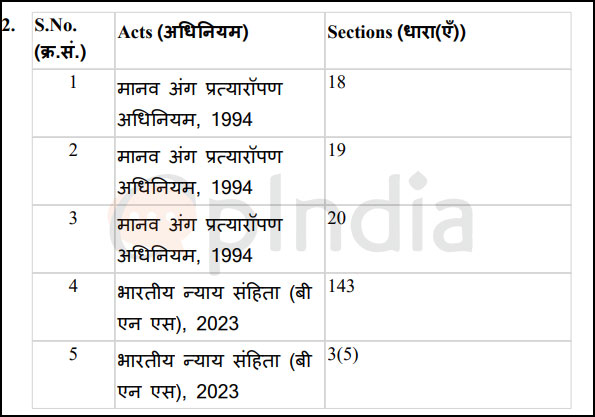
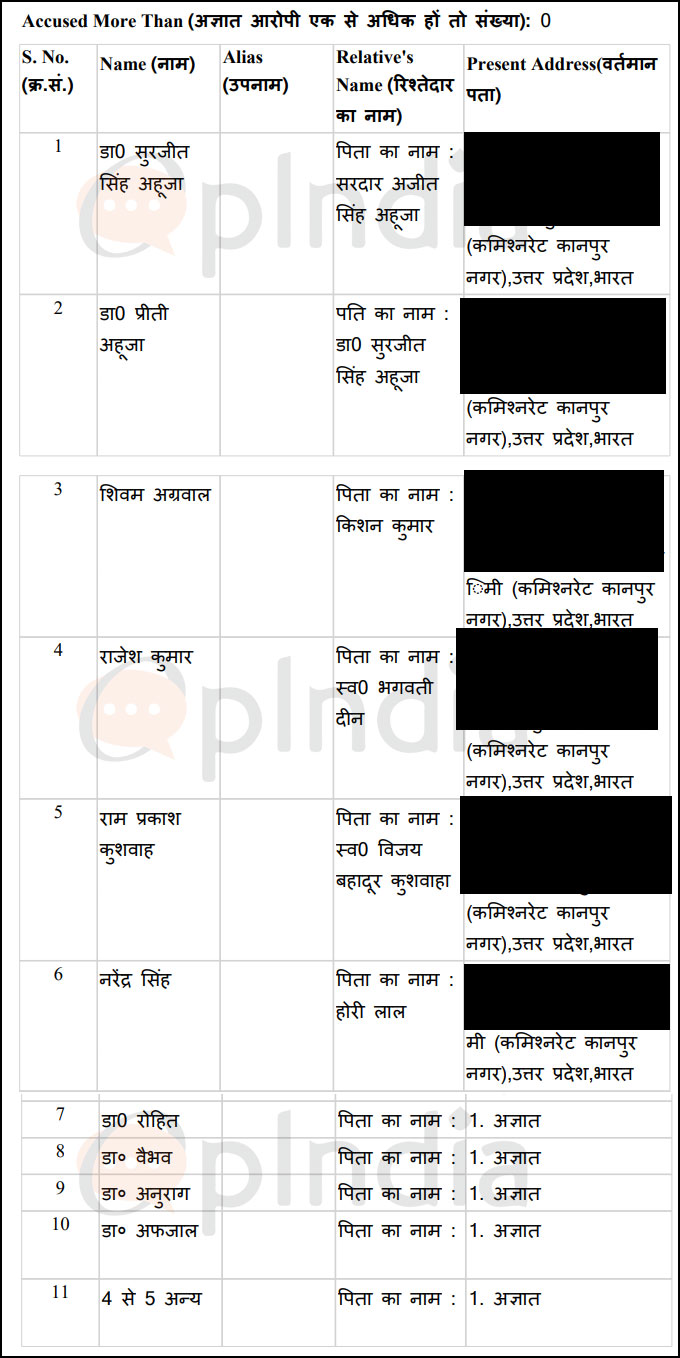
Police have booked six doctors, Dr Surjeet Singh Ahuja, Dr Preeti Ahuja, Dr Rohit, Dr Vaibhav, Dr Anurag and Dr Afzal, Shivam Agarwal, Rajesh Kumar, Ram prakash Kushwaha, Narendra Singh and others in the matter. At least six people have been arrested so far. OpIndia accessed the FIR registered in the matter, which has been registered on the complaint of Sub Inspector Mukesh Kumar under Sections 18, 19 and 20 of the Transplantation of Human Organs Act, 1994 and Sections 143 and 3(5) of the Bharatiya Nyay Sanhita (BNS).
Source: UP police
Multiple hospitals are involved in the racket, including Priya Hospital and Trauma Centre, Ahuja Hospital and Medlife Hospital. Media reports suggested that Dr Afzal, Dr Rohit, Dr Vaibhav and Dr Anurag were the key masterminds behind the racket, while Dr Surjeet and his wife owned Ahuja Hospital where operations were carried out.
How Rs 50,000 dispute exposed the racket
According to media reports, a kidney donor approached the police claiming that he had been cheated of Rs 50,000 from the agreed amount. The donor has been identified as Ayush, an MBA student who hails from Samastipur in Bihar and has been living in Meerut. He claimed that he agreed to sell one of his kidneys for Rs 10 lakh due to financial distress.
However, he received only Rs 9.5 lakh, which triggered the dispute. Frustrated by repeated delays and short payment, he approached the police, which set off an investigation exposing layers of an organised organ trade running in the city.
Donors lured through deception, organs sold at huge profits
During the investigation, police found that an ambulance driver from Kalyanpur, identified as Shivam Agarwal, used platforms such as Telegram to lure financially vulnerable youth. He posed as a facilitator for medical needs and convinced donors that kidneys were required for relatives.
In Ayush’s case, the kidney was allegedly sold to the family of a woman from Muzaffarnagar for amounts ranging between Rs 60 lakh and over Rs 90 lakh, while the donor received only a fraction of the total transaction. In another suspected instance, a female student was reportedly paid around Rs 4 lakh, while her organ may have been sold for Rs 45 to Rs 50 lakh.
Three-hospital model used to avoid detection
Police investigations indicate that the racket followed a structured three-hospital model to evade scrutiny. The kidney extraction was carried out at one facility, after which the donor and recipient were briefly kept together before being shifted to separate hospitals for post operative care.
Ayush was moved to another hospital under a different identity, while the recipient was shifted elsewhere. This ensured that no single hospital had complete records of the transplant process.
What the FIR says
OpIndia accessed the FIR in the matter. According to the FIR, police were alerted about the kidney racket at Ahuja Hospital when they were on duty checking suspicious persons and vehicles near Maswanpur crossing. The informant told police that doctors not from the hospital were conducting transplants on individuals brought from other places by luring them with money. He also told police that an operation was underway at that time.
Source: UP police
Police immediately swung into action and informed senior officials. A team of additional police personnel and a medical team led by Assistant Chief Medical Officer Dr Ramit Rastogi was formed. They reached the hospital and first encountered Shivam Agarwal, who initially denied knowledge of any transplant activity and directed them to Dr Surjeet Singh Ahuja.
When Dr Ahuja and his wife Dr Preeti Ahuja saw the police, they became nervous. Initially, they denied any wrongdoing. However, when questioned, it was found that the CCTV cameras at the hospital were not functioning, and Dr Ahuja admitted that they were deliberately switched off on days when illegal transplants took place.
According to the FIR, both doctors and Shivam admitted to being involved in the illegal activity for financial gain. They confirmed that an illegal transplant had been conducted in the hospital’s operation theatre the previous night. They further told police that it was Shivam’s job to arrange donors and patients. The hospital’s operation theatre was used for surgeries in exchange for Rs 2,75,000 in cash.
The surgical team for the transplant was led by Dr Rohit along with Dr Vaibhav, Dr Anurag, Dr Afzal and others, who reportedly arrived from outside, conducted operations at night and left thereafter. The FIR further stated that all medicines and arrangements were handled by this external team, and after surgery, the donor and recipient were shifted separately to different hospitals.
During inspection, four cartons containing medicines and equipment used in the operation were recovered and sealed. The FIR noted that the recipient, Parul Tomar, and the donor, Ayush Kumar, were traced to separate hospitals, where medical officers confirmed that both had undergone kidney surgery.
The FIR also recorded that hospital admissions were made without documentation and that Shivam Agarwal admitted to facilitating multiple such cases since 2024. Following recovery of evidence and interrogation, the accused were taken into custody.
Investigators said Dr Afzal allegedly identified patients at dialysis centres and persuaded them to undergo transplants, while surgical teams were reportedly brought in from cities such as Lucknow and Noida to carry out operations.
Organised nexus spanning hospitals and medical professionals
Investigators believe that the racket was not an isolated operation but a coordinated nexus involving brokers, hospital operators and medical professionals. Brokers arranged donors, hospitals facilitated illegal procedures and doctors allegedly conducted transplants without proper documentation. Operations were often conducted late at night, and patients were shifted immediately after surgery to avoid detection.
Inter-state and international links suspected
Police Commissioner Raghuveer Lal indicated that the network could have links beyond Kanpur, extending to cities such as Delhi, Mumbai and Kolkata, and even internationally to Nepal and South Africa.
Preliminary findings suggest that between 40 and 50 illegal transplants may have been carried out, including on foreign nationals.
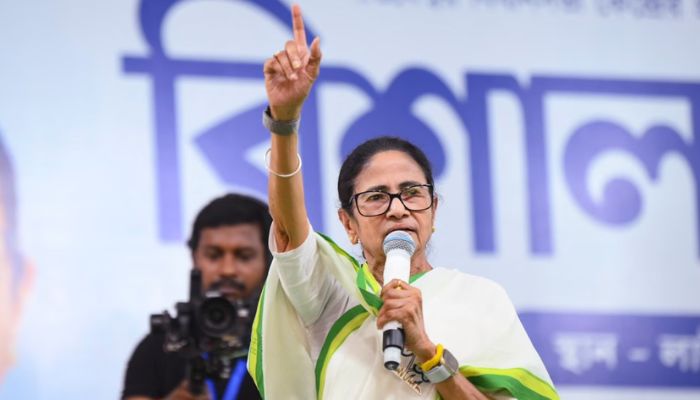
The language politics in West Bengal have once again come into sharp focus, with claims that Chief Minister Mamata Banerjee is promoting Urdu at the cost of Bengali identity to consolidate support ahead of elections. BJP MP Saumitra Khan claims to replace Bengali cultural markers with Urdu in public and political communication.
As mentioned in the X post by Saumitra Khan, “Stop Urdu imposition. From ‘Khela Hobe’ to ‘Ishtehar,’ you’re erasing Bengali culture for Urdu.” It can be noted that the manifesto of Mamata Banerjee being referred to as “Ishtehar,” which is an Urdu term, even though the text itself is written in Bengali. It can thus be noted that these changes are not merely changes in the use of Bengali or Urdu but are a part of a larger trend.
Mamata Banerjee’s Eid speech in Urdu
Mamata Banerjee addressed a huge gathering of Muslims on the occasion of Eid. She delivered the entire speech in the Urdu language instead of Bengali and Hindi.
In her speech, she referred to her long-held wishes in her heart. She said, “Allah has already accepted them. May Allah bless them for their well-being and their families. Whoever wants to target Bengal will go to hell.”
The decision of Mamata Banerjee to deliver her speech in Urdu sparked controversy, as her decision to choose Urdu over other languages for this public event is nothing but a hidden agenda to attract voters from the Muslim community, especially in these critical times.
Urdu as the second language in West Bengal
The controversy is also connected to a decision made by the state government earlier. Under the previous government headed by Mamata Banerjee, the status of Urdu as a second language was granted in those areas where the population of Urdu-speaking people is over 10%.
The decision applies to those areas covered by the Calcutta Municipal Corporation and other municipalities such as Islampur in North Dinajpur district, Garulia, Kamarhati, Bhatpara, and Titagarh in North 24-Parganas district, and Chapdani, Bansberia, Rishra, and Bhadreshwar in Hooghly district.
Two blocks in North Dinajpur Goalpokhor I and II were also included. Later, more areas were added, including regions under the Asansol Municipal Corporation, Bally in Howrah, and Kulti and Jamuria in Burdwan.
According to this decision, Urdu can be used in government offices, official documents, and educational institutions. The state also intends to open primary schools with Urdu as the medium of instruction and introduce Urdu as an elective subject in secondary schools and colleges. Government offices will also respond in Urdu to letters written in Urdu. Employees conversant in the language will be posted in the areas. This decision is part of the election manifesto of Mamata Banerjee.
Why Urdu has become politically important
Urdu has a long history in India, especially from the Mughal period when it developed as a language used in administration, poetry and everyday communication in many parts of North India. Over time, it came to be associated with sections of the Muslim community, even though people speak it from different backgrounds.
This perception is now being used politically in West Bengal, where promoting Urdu is seen as a way to connect with Muslim voters. At the same time, Mamata Banerjee’s repeated references to “outsiders” have added another layer to the debate.
From blaming people from Bihar after unrest in Uttar Dinajpur to linking Ram Navami violence to outsiders, and earlier remarks during elections targeting people from Uttar Pradesh, Bihar and Rajasthan, her statements have often focused on non-Bengali groups. She has also used similar language in other contexts, including political campaigns outside the state and during protests in Kolkata.
Such remarks create fear among Bengalis that their identity is under threat, while also making migrants and non-Bengali speakers feel targeted in the state.
Conclusion
The ongoing debate shows how language and identity have become central to politics in West Bengal. Mamata Banerjee is promoting Urdu in governance and public messaging; she is also encouraging people to see non-Bengali-speaking communities as “outsiders.”
This approach is creating a divide, bringing one group together through language-based outreach while pushing another away, raising concerns about social harmony in the state ahead of elections.
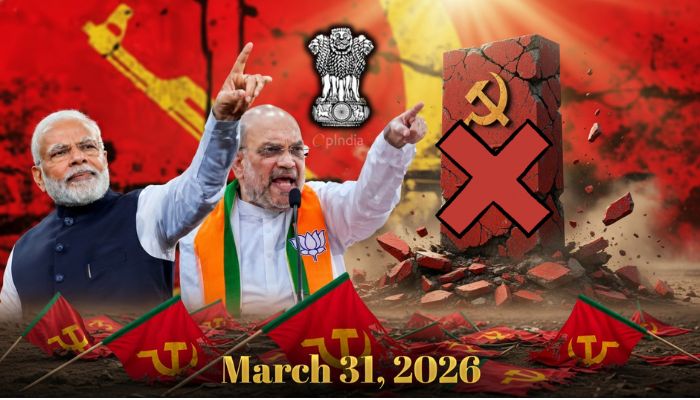
The 31st of March 2026 marks the Modi government-set deadline for the absolute eradication of Naxalism or Left-wing extremism (LWE) in India. Union Home Minister Amit Shah has repeatedly affirmed this deadline, describing it as the end of decades of red terror that once controlled vast swathes of central and eastern India. As India becomes free from the menace of Maoist-Leftist terrorism, here is a look back at the birth, life and death of Naxalism in India.
The birth and life of Naxalism: From 1970s to 2010s
Naxalism in India traces its origin back to May 1967 in the village of Naxalbari in West Bengal’s Darjeeling district. Some local peasants, tribals, landless labourers, led by radical CPI(M) leaders Charu Majumdar, Kanu Sanyal, Jangal Santhal, among others, rose against those they described as exploitative landlords and jotedars over land, debt, and feudal oppression. Inspired by Mao Zedang’s Chinese model, these people, armed with bows, arrows, and lathis, began raiding granaries and declared a “protracted people’s war”.
With the state’s crackdown resulting in the death of over a dozen tribals who joined the Naxalites, the ideology garnered support and state units of CPI (M) in Uttar Pradesh and Jammu and Kashmir, and some sections in Bihar and Andhra Pradesh joined in.
While the ‘uprising’ was crushed within weeks by the state police, it sparked a nationwide ideological fire that even went on to devour thousands of Indian people over the decades.
Charu Majumdar
Majumdar was the principal ideologue behind the Naxalite ‘movement’. He founded the Communist Party of India (Marist-Leninist) in 1969, and authored the ‘Historic Eight Documents’ which formed the ideological foundation of the violent campaign. Majumdar essentially argued for the overthrow of the Indian state, labelling it a “bourgeois-landlord” regime. He infamously advocated that “power grows out of the barrel of a gun”.
After Majumdar’s death, rebels split from mainstream communism, forming the CPI(ML) and later factions, including the People’s War Group (PWG) and Maoist Communist Centre (MCC). These groups rejected parliamentary democracy; instead, they laid emphasis on armed ‘revolution’ to overthrow the “semi-feudal” and “semi-colonial” Indian state. These Maoists posited themselves as the ‘protectors’ of adivasis and the poor people against ‘exploiters’ to consolidate power.
Their tactics often involved extortion, an illegal levy on businesses, contractors, and even government schemes. In addition, they resorted to landmine ambushes, beheadings, and selective killings of mainstream political leaders and armed forces personnel to enforce control, deter informants, and instil fear in the hearts of locals opposed to their violent methods.
Disgracefully, some state governments and political ecosystems treated the Maoist-Naxalite menace as a ‘socio-political’ and ‘law and order’ issue rather than existential terrorism and a national security issue. This flawed approach led to periodic ceasefires, peace talks, and even negotiations, like the infamous 2004 in Andhra Pradesh under YS Rajashekhara Reddy, which collapsed after Maoists regrouped. Similar attempts were made in Odisha and Jharkhand. These talks and the political coddling of Naxalites gave the latter breathing spaces and media attention.
For decades, a network of urban sympathisers of Naxalites, or simply Urban Naxals, comprising leftist academics like Arundhati Roy, activists, lawyers, and journalists, provided ideological justification, whitewashing of violent Naxalite activities, legal aid, media coverage, and sometimes even logistical cover. This ecosystem, coupled with pliable political leadership, essentially helped sustain recruitment and international narratives framing the Indian Republic as an aggressor while the violent Naxalite terrorists as ‘heroes’.
On 28th March 2010, author and radical leftist activist, Arundhati Roy, spent around two weeks in Maoist-controlled Dantewada. She wrote essays, articles and even a book glorifying Naxalites, their violent tactics and anti-national activities.
Just a month later, on 6th April 2010, Maoists carried out a massive attack in Chhattisgarh’s Dantewada, wherein 75 Central Reserve Police Force (CRPF) and state police personnel were killed in the Mukrana forest.
The CRPF team was attacked while they were taking a break after a long, tiring night of travelling. The team had completed its three-day anti-Maoist operation and was on its way. They took a break at around 6 am after travelling all night, when they were ambushed by up to 1,000 Maoists positioned on the neighbouring hilltop. The Naxals, fully aware of the CRPF troop movement, launched an attack with deadly precision, giving the soldiers no chance to mount a response. They blew up an anti-landmine vehicle and then began firing indiscriminately.
Instead of unleashing hell on Maoist terrorists, Home Minister P Chidambaram begged them to announce a 72-hour ceasefire and hold talks with the government. Emboldened by the Congress government’s embrace of cowardice, Maoist terrorists rejected the ceasefire ‘request’.
While Maoists/Naxalites carried out attacks after attacks, be it the Dantewada ambush in April 2010, Naxal ambush in Narayanpur, which killed 26 CRPF personnel in June 2010, Jnaneswari Express train derailment in May 2010, wherein 48 passengers lost their lives in the incident and more than 200 passengers were injured, or the IED attack by Naxalites on Congress cadres in Darbha Valley, Chhattisgarh, wherein 27 people, including Chhattisgarh Congress leaders, including state secretary Nand Kumar Patel, his son Dinesh, former Union minister VC Shukla and former state minister Mahendra Karma, the Congress-led Central government prioritised talks or tough action, coddling over crackdown.
Killings, beheadings, and kidnappings of government officials, including the much-talked-about kidnapping of Malkangiri collector R V Krishna by Maoists and the release of Maoists in exchange, were the norm in the 2000s.
The soft approach of the previous Congress-led government continued even as the human cost of Maoist-Naxalite terrorism exceeded 12,000 since 2000 alone, including over 4000 civilians, 2,723 security force personnel, informants, and tribals brainwashed into joining the Naxalite armed ‘movement’. Tribals and villagers in the Dandakaranya region bore the brunt of extortion, forced Naxalite recruitment on one hand, summary executions of informers, and displacement on the other. Local economies were shattered, and governance was disallowed to operate. People willing to join the mainstream were either killed, terrorised into silence or brainwashed into joining Maoist terrorism.
While Prime Minister Manmohan Singh once called Maoist terrorism India’s “single biggest internal security threat”, this statement was confined to mere acknowledgement and did not trigger any policy shift for decisive action. The result? Maoist insurgency survived and sustained, found ideological sympathisers and glorifiers across cinema, media, and fascinated those who emerged as pro-Naxal ‘intellectuals’.
Discarding previous ‘socio-political’ issue approach, Modi government declared Naxalism as national security threat: How a change in approach led to end of Naxalism
The historic victory of the Bhartiya Janata Party-led NDA marked the beginning of a new era on multiple fronts, particularly in national security. The Modi government reframed Naxalism unambiguously as a national security and terrorism issue, not a socio-political or development bargaining chip. This zero-tolerance approach birthed a coordinated national strategy against Naxalism, which comprised security operations, targeted development, choking lifelines, and rehabilitation schemes for those willing to surrender and join the mainstream.
The last few years have witnessed massive, intelligence-driven operations by the police in Chhattisgarh, Jharkhand, Madhya Pradesh, Maharashtra, Andhra Pradesh, and Telangana, encompassing the entire Naxal-infected Dandakaranya region. The state police departments expanded Andhra Pradesh’s greyhounds model, and elite forces intensified the anti-Naxal crackdown.
With coordinated efforts and a strong political will, HM Amit Shah soon began yielding results as a leadership decapitation in the Maoist camp began. Top Maoist commanders, like Basavaraju and Madvi Hidma, among others, were neutralised in large numbers while surrenders hit record highs, crossing over 2000 in 2025 alone.
In addition to eliminating intransigent Naxalites, the authorities focused on draining the Maoist financial lifelines. Dedicated NIA verticals, Enforcement Directorate probes, raids, and state action resulted in the seizure of assets worth crores. Demonetization, coupled with tighter banking and telecom penetration in forests, and a crackdown on extortion rackets operating in the Dandakaranya region, starved the Maoists of cash and logistics, while their mainstream ideological sympathisers cried victimhood.
The Modi government also gave special attention to not giving attention to the open letters, pleas, and propaganda peddled by Urban Naxals against the state crackdown on Maoists.
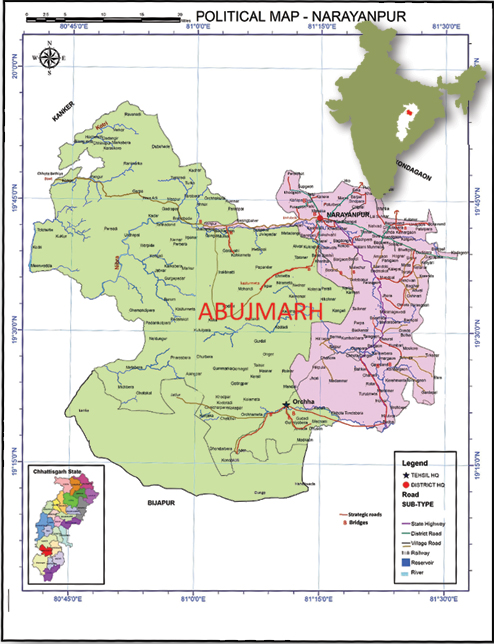
In May 2025, Indian security forces achieved a major breakthrough in the war against left-wing extremism or Naxalism by eliminating top Maoist terrorist Nambala Keshav Rao, also known as Basavaraju. The Maoist leader was killed in an encounter in the Abujhmadh (also spelt Abujmarh) forests of Chhattisgarh’s Narayanpur district.
Nambala Kesava Rao alias Basavaraju was among the 26 Naxal terrorists killed by the security forces on the 21st of May 2025. Basavaraju, the general secretary of the banned outfit Communist Party of India-Maoist (CPI-M). The 70-year-old Maoist leader was among India’s most wanted Maoist leaders and had a bounty of Rs 1.5 crore on his head. He was behind the 2010 Chintalnar massacre of 76 CRPF jawans and the 2013 attack in Jhiram Ghati, wherein several Congress leaders were killed.
Abujh means what cannot be understood, while Madh means hill. Abujhmadh has been the only piece of land in India which has had no revenue map; villagers have no title deeds (patta) to the land they live in or cultivate, even though the area (4000 km) is bigger than the state of Goa.
Due to Naxalism, this area had little to no civil administration. With a population of around 40 to 45 thousand, mostly Abhujhmadhia tribe people, Abujhmadh included the Orcha block and some regions of the Narayanpur district. Abujhmadhia are among the Particularly Vulnerable Tribal Groups (PVTGs) of Chhattisgarh and are entitled to special benefits and rights from the government meant for endangered groups like them. The area also includes the parts of Dantewada and Bijapur in Chhattisgarh, and Gadhchiroli in Maharashtra.
There has been no roads, hospitals and other basic facilities in Abujhmadh since the Naxalites would not allow any development work or any step towards mainstreaming of this region and its people take place. As per locals, Naxalites used to set buses ablaze if they entered villages in Abujhmadh. Maoists made sure that no land deeds were earmarked in Abujhmadh, no motorable roads are constructed and no development ever reaches the villages on this hill. To ensure this, the Maoist terrorsts would either resort to violence or propaganda, mostly both.
By 2000s, the Maoists transformed Abujhmadh into their stronghold. They destroyed roads, burnt over 50 schools and cut off the region from whatever connected it to the mainstream. The Maoists began operating “Jantana Sarkar” in Abujhmadh. They ran their own schools in Murumwada and Botor, where, even till the recent years, Maoists taught their own syllabus.
Abujhmadh is covered by the single Assembly constituency of Narayanpur. Around 90 per cent of its area remains unsurveyed. Back in April 2017, a revenue survey was conducted in Akabeda and other villages with the assistance of IIT-Roorkee; however, the survey could not make much progress due to security concerns and a lack of infrastructure.
Abujhmadh got its first operation theatre and two new mobile towers in 2023; however, over most of the area has been without a mobile network.
In December 2024, a District Reserve Guard (DRG) head constable was killed by Maoists in Abujhmadh’s Kohkameta during an encounter. Maoists have also been killing former Sarpanch (village leaders) in areas controlled by them. In 2024, two ex-sarpanches, including a BJP functionary, were killed by Maoists in Bijapur district under south Bastar. In 2023, an ex-Sarpanch named Ramji Dodi from the Zara village in Abujhmadh was abducted by Maoists along with his two nephews and taken to a jungle area where he was strangled to death. The sarpanch was brutally murdered by Maoists for being a ‘Mukhbir’ or police informer.
Despite the challenges, the security forces and the government relentlessly continued their efforts to end the Naxal menace not only in Abujhmadh but also in the entire Dandakaranya region.
The elimination of Basavaraju, who once dominated the unofficial headquarters of Maoists, Abujhmadh, shocked the remaining Maoist cadres and their Urban Naxal supporters. With his death, the end of Naxalism began to appear inevitable even to the Modi government’s ideological adversaries.
In November 2025, it was reported that around 80% of the Naxals active in the Abujhmad region of Chhattisgarh had laid down their weapons.
Before this, security forces conducted ‘Operation Black Forest’ to break the backbone of Naxals near Karreguttalu Hill (KGH) at the Chhattisgarh-Telangana border. The 21-day-long operation carried out by the joint forces of the Central Reserve Police Force (CRPF) and state police between April 21 and May 11 neutralised 31 Naxals carrying a bounty of Rs 1.72 crore. A total of 214 Naxal hideouts and bunkers were destroyed in the operation, and a total of 450 IEDs, 818 BGL shells, 899 bundles of Codex, detonators and a huge amount of explosive material have been recovered during the searches. In addition, nearly 12,000 kilograms of food supplies have also been recovered.
The government launched Operation Kagar in January 2024, a multi-pronged strategy combining aggressive military operations, enhanced coordination between Central and State forces, and development efforts to address the root causes of Naxalism. Under this operation, around 1 lakh para-military troops, including the Central Reserve Police Force (CRPF), its elite CoBRA units, District Reserve Guards DRG), and state police, have been deployed in the left-wing terrorism affected areas. These security personnel are equipped with modern technology like drones for information gathering, AI for intelligence gathering, and satellite imagery, among others. The security forces have been undertaking operations in the Naxal-infected Dandakaranya region spanning multiple states.
Apart from neutralising Naxal leaders and urging Maoist cadres to surrender, the government is also carrying out development work in Naxal-affected regions to connect them to the mainstream. The government has constructed 11,503 kilometres of highways in Naxal-affected areas. The minister added that 20,000 kilometres of rural roads were built.
One of the biggest game-changers in this transformation has been the work done by the Border Roads Organisation (BRO). According to a report by The Indian Express, over the last 15 months, the BRO has built 20 Bailey bridges and completed 75 km of road construction in extremely difficult terrain across Maoist-affected districts like Bijapur and Sukma.
In November 2024, the BRO was assigned the task of developing a 130-km road network in these districts, areas that had seen some of the worst Maoist violence. The project includes over 10 separate road works that had remained incomplete for years due to constant threats from Naxals.
A BRO official highlighted the challenges, saying, “80% of the road projects were lying dormant for over half a decade on account of poor response from local contractors due to constant threat from Naxals.”
In the past, Maoists frequently targeted road construction. Equipment was destroyed, contractors were killed, and even security personnel deployed for protection were attacked. As recently as last year, a contractor was killed in Bijapur’s Pamed area.
As the flame flickers before extinguishing, Maoists continued to make last-ditch efforts to ‘fight back’. Officials revealed that Maoists had planted a 50-kg improvised explosive device (IED) in Basaguda, which was later defused by the CRPF.
Meanwhile, Chhattisgarh Chief Minister Vishnu Deo Sai made a strong statement on 18th March, stating that Naxalism in the state is effectively over.
“Naxalism has ended. Only a formal declaration awaits,” he said while speaking to reporters. He added, “It is indeed welcome that due to the strong leadership of our Prime Minister Narendra Modi and the Home Minister, and the courage of our security forces, the government’s commitment to eliminate Naxalism across the country by March 31, 2026, is being fulfilled…”
Operation Kagar’s success can be understood from the fact that from 2015 to 2025, the number of Naxal-affected districts reduced from 106 to 18. Of these districts, 12 were considered the worst-affected by Naxalism. However, this number was further reduced to only 6 worst Naxal-affected districts, including Bijapur, Kanker, Narayanpur, and Sukma in Chhattisgarh, West Singhbhum in Jharkhand, and Gadhchiroli in Maharashtra.
On 19th February, Bihar authorities announced that the state is now “Naxal-free” after the surrender of prominent Maoist Suresh Koda, also known as Mustakim, who had a reward of Rs 3 lakh. He surrendered himself to the Special Task Force (STF) of the Munger district police a day ago. It is pertinent to note that the number of districts affected by left-wing extremists (LWE) has also decreased to seven, as per a recent analysis of the affected region.
In January this year, the Centre released a detailed 10-point plan to ensure that areas cleared of Left-Wing Extremism remain peaceful. The plan is meant for the post-Left-Wing Extremism phase and focuses on stabilising districts that have lived through years of violence.
The Modi government’s new security doctrine, a clear message to Maoists, give up arms or die, resulted in voluntary surrenders, elimination of intransigent Naxalites, clearing of Naxal strongholds, and return of countless surrendered Naxalites into the mainstream.
As pressure began to build and the Maoist structure began to collapse, calls for a “ceasefire” suddenly grew louder. These appeals were amplified by left-leaning activists and sections of civil society that had long argued for talks. But this was not a peace initiative, but a pressure tactic from a weakening insurgency.
Ceasefires have historically allowed Maoist groups to regroup, rearm, and regain relevance. The government’s refusal to pause the operations shows confidence. Negotiations are tools of resolution, not rescue mechanisms for collapsing movements. By rejecting ceasefire demands, the state made its intent unmistakable: this phase was not about managing Naxalism’s decline, but taking the fight against Naxalism to its decisive conclusion.
Jayaram Reddy, Nambala Keshava Rao alias Basavaraju, Pappu Lohara, Prabhat Ganjhu, Tulsi Bhuiyan, Sudhakar alias Gautam, Sahdeo Soren, Madvi Hidma, Meturu Joga Rao, are among the top Naxalite leaders killed by the security forces in 2025 alone. These killings created a leadership vacuum with the Politburo and Central Committee shrinking from 45 to less than 10 members.
As pointed out by Home Minister Amit Shah on the floor of the Parliament on 30th March 2026, a Red Corridor had been created across 12 states, including Chhattisgarh, Telangana, Andhra Pradesh, Odisha, Maharashtra, Madhya Pradesh, Jharkhand, Bihar, Bengal, Kerala, parts of Karnataka, and 3 districts of Uttar Pradesh. In these areas, 12 crore people lived in poverty for years, and 20,000 youths lost their lives. Who is responsible for this? Shah said that the root cause of Naxalism is not the demand for development, but Left-wing ideology, which was accepted by the leader of the then ruling party to win the Presidential election in 1969.
The movement that started from Naxalbari spread to 12 states, covering 17% of the country’s land area and more than 10% of its population, with the tacit backing of the previous ruling dispensation. However, the Modi government has crushed this Red corridor and freed it from the disease of Naxalism. The end of Naxalism today reflects a decisive shift in treating an armed ideology-driven insurgency as a national security issue and unleashing proportionate measures, instead of begging for talks, mollycoddling gun-yielding terrorists and letting a whole leftist cabal run propaganda humanising the enemies of the Indian Republic.
What a change in approach towards tackling internal national security threats like Naxalism brought can be understood from how times changed from the Indian government requesting Maoists to declare a ceasefire and hold talks under Congress rule to Maoists writing letters and relaying radio messages begging the Modi government to pause anti-Naxal operations, and allow them time to coordinate the surrender of other Naxalites.
OpIndia earlier reported how the leftists in an open letter blatantly sided with the Maoist terrorists and emphasised that the government should discontinue its anti-Naxal crackdown. However, despite all the challenges and hurdles brought up by Maoists and their cheerleaders in politics and ‘civil society’, the Modi government and the security forces have continued their crackdown on the Naxalites unabated.
Now, as the Red Terror crumbled, the supporters of left-wing terrorists came out last year, using the pretext of protesting against air pollution in Delhi to demonstrate their support for the infamous slain Maoist Madvi Hidma with his posters, amid slogans of “Comrade Hidma Amar Rahe.”
While the pockets of residual extremism may linger quite some more time, the ‘Kitne Hidma maaroge’ brigade might make headlines once or twice in a year to find relevance for their dead cause, the organised threat of Naxalism that terrorist vast regions of India for nearly six decades stands defeated at the hands of Indian security forces and the Modi government right on the pre-decided deadline, 31st March 2026.
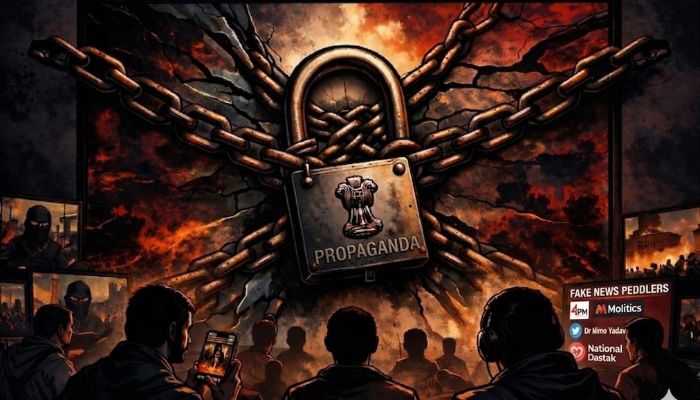
In recent days, several social media accounts and content platforms such as 4PM, Molitics, and National Dastak have been withheld in India. Immediately after the restriction, sections of the left ecosystem framed the move as an attack on free speech, claiming that dissent was being silenced, and the claims gained traction across platforms. However, such a characterisation raises a more fundamental question: was this action arbitrary, or did it precede a consistent pattern of content warranting closer scrutiny?
A closer look at what these platforms are putting out suggests the problem isn’t as simple as it seems. In many cases, their content seems to depend on sensational framing, selective fact-picking, and claims that are sometimes proven wrong by subsequent information or later verification. From narratives later deemed misleading and from repeated cases of speculation presented with a degree of certainty, the pattern points to a style of content in which impact often takes precedence over accuracy. In that context, the focus shifts from a singular act of restriction to a broader question of accountability within digital information ecosystems.
The Ecosystem: Platforms, Personalities, and Narrative Building
At first glance, Platforms such as 4PM, Molitics and National Dastak portray themselves as alternative voices. They present their content as bold, independent and unfiltered. Their appeal largely rests on the claim of challenging mainstream narratives and “speaking truth to power.” However, their content strategy appears to prioritise high-impact presentation over substantiated reporting.
Common features include dramatic thumbnails, strong headlines, and framing that elicits an emotional response. Complex issues are frequently reduced to simplified narratives, in which speculation is presented with a degree of certainty while verification remains unclear or absent.
This creates an ecosystem in which speculation is presented as near-certainty, isolated developments are framed as systemic collapse, and opinion-driven narratives are packaged as factual reporting. This is not just about where you stand on issues. Media platforms across the board have strong opinions. But the difference in the method is whether claims are supported by verifiable proof, or whether proof comes after the claim.
On these platforms, the repeated use of amplification rather than authentication raises important questions about editorial standards and intent. Just not one post; this bigger ecosystem helps us understand why the government may have gotten involved.
Layer 1: When Presentation Alters Perception
A misleading post by National Dastak
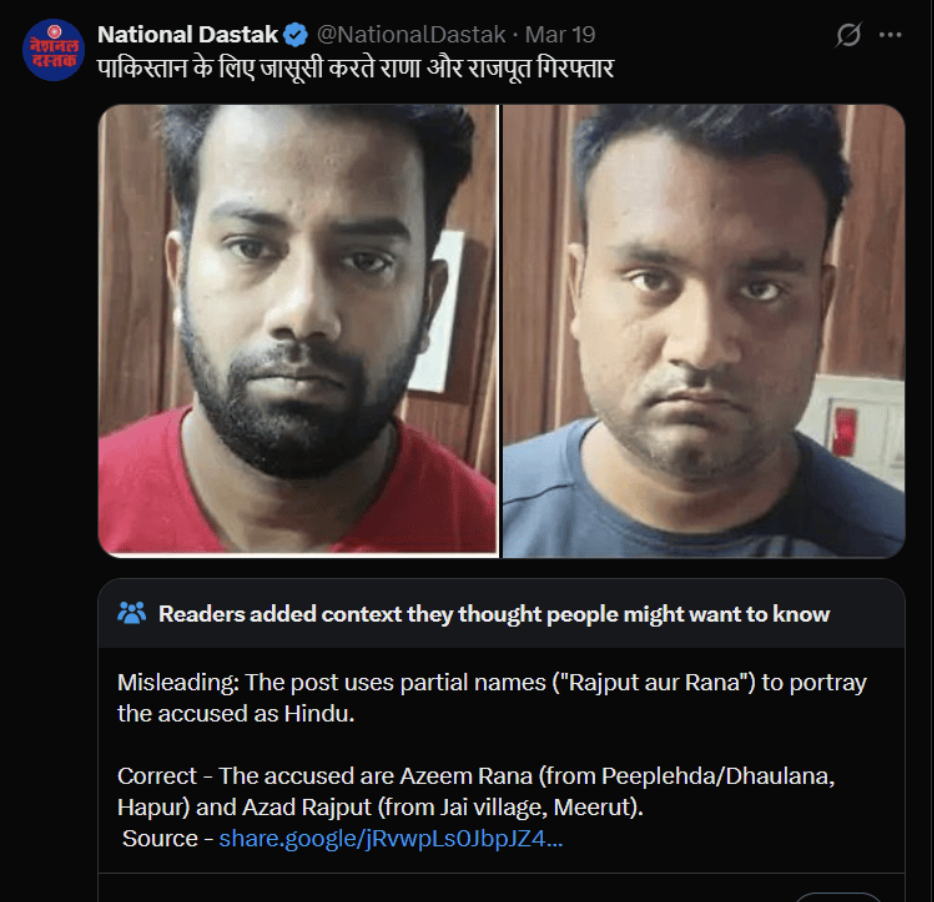
In one instance, a post amplified by National Dastak referred to accused individuals using partial identifiers such as “Rajput” and “Rana.” This appeared to suggest as a Hindu identity. However, additional context later indicated that the individuals’ full identities did not align with the implied narrative. Actually, the accused names were “Azeem Rana” and “Azad Rajput”. Both accusers belonged to the Muslim identity, but the National Dastak was portraying the case as a crime committed by Hindu individuals.
Notably, a community Note flagged the post as misleading, stating that partial naming was used in a way that could create a false impression. In other instances, claims or presentations circulated by these platforms were later found to be incomplete, misleading, or contradicted by additional context.
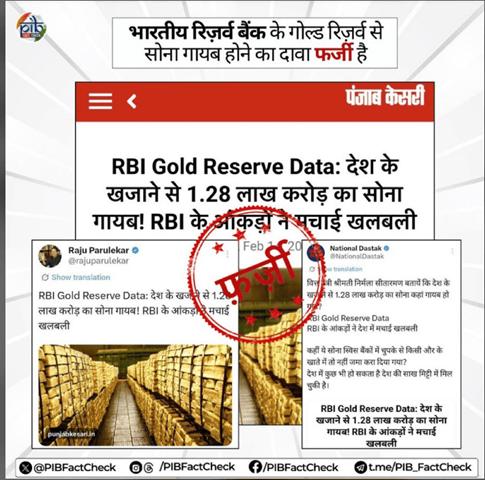
One of the most widely amplified examples involved assertions that a significant portion of India’s gold reserves, valued at over ₹1 lakh crore, had gone “missing” from the Reserve Bank of India. The claim was presented in an alarming manner, often suggesting institutional opacity or large-scale financial irregularity. However, the Press Information Bureau has officially fact-checked the unit and later clarified that the claim was misleading, noting that the figures had been misinterpreted and taken out of context.
Despite this clarification, the narrative continued to circulate across multiple handles, often without reference to the correction. The persistence of such claims highlights how high-impact financial misinformation can continue to shape perception even after being addressed.
Taken together, these instances demonstrate how National Dastak and similar media organisations use selective presentation, the omission of context, or partial interpretation of facts to significantly alter public understanding of an issue.
Layer 2: Visual Narratives and Context Gaps
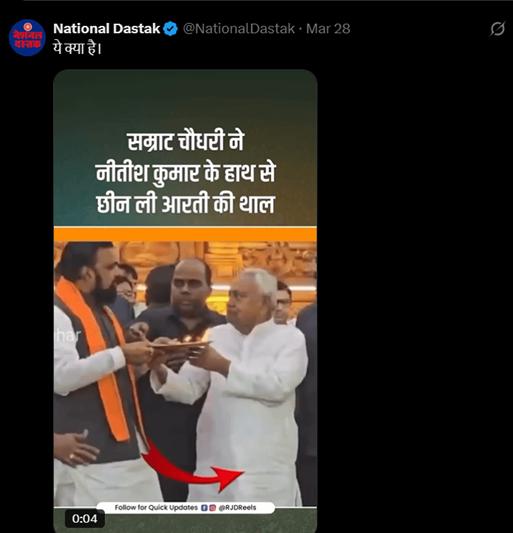
Another recurring pattern emerges in the use of short video clips and selective visuals, often presented without full context. In one instance, a clip showing Nitish Kumar holding an aarti plate was circulated with the caption “Samrat Chaudhary snatched the aarti plate from Nitish Kumar’s hands” It was presented in isolation; the visual appeared to suggest a particular message. However, without the full sequence of events or surrounding context, such interpretations remain, at best, partial.
This method of presentation is not uncommon in high-velocity digital content ecosystems, where short clips are often detached from their original setting and repurposed to align with a broader narrative. In such cases, what is omitted can be as significant as what is shown. The concern here is not merely about a single video, but about a broader pattern in which visuals are curated to appear to support pre-existing conclusions. When context is limited or absent, audiences are left to interpret fragments as a complete reality. Over time, repeated exposure to such selectively framed visuals can reinforce specific perceptions regardless of whether the full context supports those conclusions.
Layer 3: Sensationalism as a Content Strategy
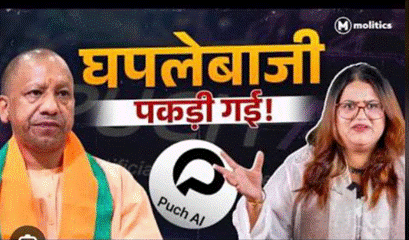
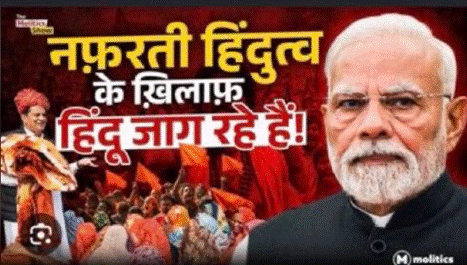
Beyond what is said or shown, another critical dimension lies in how content is packaged and presented to audiences. Platforms like Molitics rely consistently on high-intensity, attention-grabbing language. Phrases such as:“घपलेबाजी पकड़ी गई” (Scam exposed), “बड़ा खुलासा” (Big revelation), “तहलका मच गया” (Shockwaves created), “मोदी को बड़ा झटका” (Big blow to Modi) , “घपलेबाजी पकड़ी गई,” “नफरती हिंदुत्व,” and “आतंकी संगठन” are presented with a tone of certainty, often positioning complex or contested issues as settled conclusions.
They are frequently used in thumbnails, captions, and video titles, often conveying a sense of urgency and certainty, even when the corresponding evidence is not clearly presented.
This style of presentation is deliberate. Thumbnails act as the first point of engagement. Their framing shapes viewer perception before the content is consumed. Consistent use of dramatic language creates an environment in which every development is framed as a major scandal or crisis. Most of the time, their framing work is based on the Anti-Hindutva narrative, where Hindus are shown as the villain or oppressor. News with no significance is run through as sensational.
Sometimes, the intensity of the claim in the thumbnail or headline does not appear to be proportionate to the verifiable documentation or primary sources within the content itself. This gap between presentation and substantiation becomes significant, particularly when such content reaches large audiences.
Over time, repeated exposure to such framing can normalise a perception of constant upheaval and systemic wrongdoing, irrespective of whether each claim holds up under scrutiny.
Layer 4: Escalation into Defamatory and Speculative Narratives
Beyond patterns of sensationalism and selective framing, certain instances reflect a shift towards speculative, and at times potentially defamatory, assertions involving public institutions and individuals.
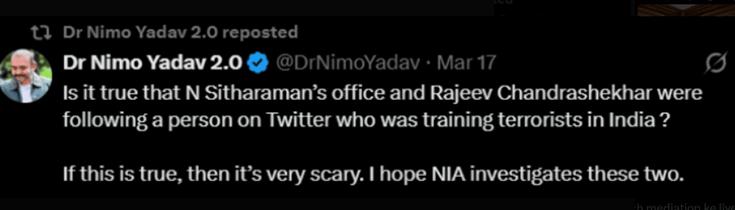
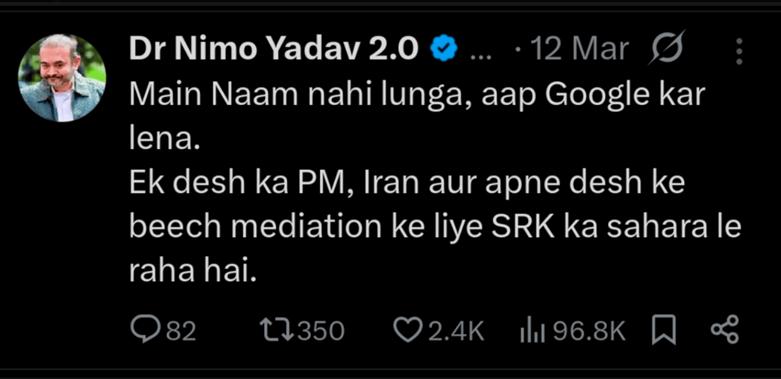
One such example involves content posted by the account named Dr Nimo Yadav 2.0, run by Prateek Sharma, which raised questions suggesting that offices of Union ministers were linked to an individual allegedly involved in terrorist training activities.
The post framed this as a possibility and called for investigation, despite no publicly established evidence being cited to substantiate such a serious implication. Even though they are worded as questions, these kinds of statements, especially when they are spread to large groups of people, can strongly suggest things that aren’t true.
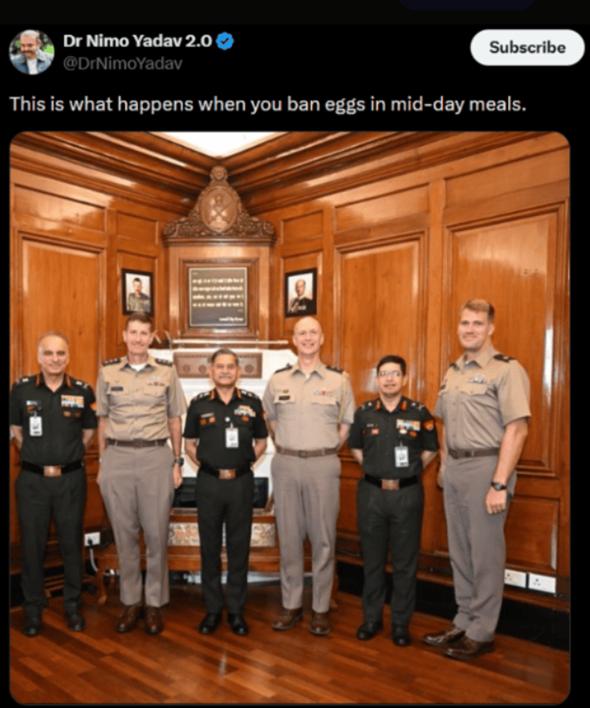
In another case, commentary that accompanied a picture of Indian Army officials seemed to use satire to link their appearance to a policy decision on mid-day meals. Humour and satire are part of public discourse, but this kind of framing could be seen as making fun of or belittling institutions that people generally respect, and it also shows the mentality of those who make fun of their own army that fights to protect them.
The one who has never achieved in their life will always make fun of people who are running and protecting the whole country. Nimo Yadav and these accounts run on the payroll of the Anti-India agenda, where their whole work is to shift the narrative from talking about India to making fun and creating against India
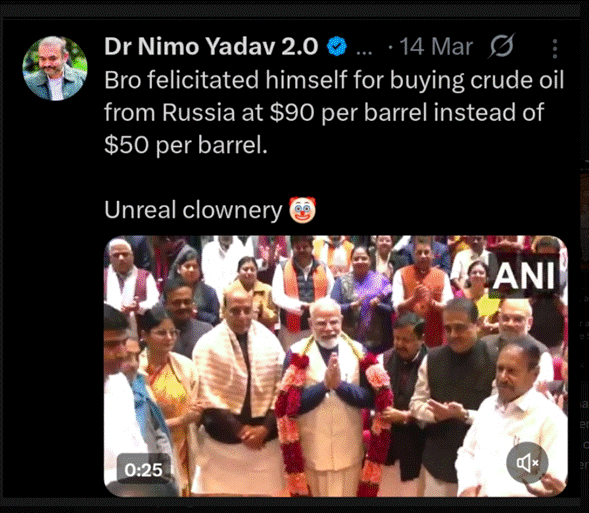
Also, posts about India’s foreign policy and energy choices reached conclusions suggesting strategic or economic failure, even though publicly available data showed more complex realities, such as India securing cheaper crude oil from Russia despite global pressure.
Similarly, certain claims hinted at high-level diplomatic manoeuvres involving unrelated personalities, without citing verifiable evidence, thereby contributing to speculative narratives presented with an air of plausibility.
In addition to speculative assertions, certain instances involve highly provocative and offensive language directed at specific communities. For example, while reporting, the reporter of National Dashtak stated these provocative lines against the Brahmin community. He stated that the “Brahmins are a disgrace, beat them with shoes and throw them out” Such statements raise serious concerns about the normalisation of extreme language in public discourse and targeting a specific community.
These types of organisation then demand “free speech but the question is whether freedom of speech also exists for the brahmin community, on which they spread their narrative. When such content is amplified without restraint, it risks deepening social divisions and lowering the threshold of acceptable expression.
Taken together, these examples reflect a pattern in which accounts that make serious allegations and are framed as questions use satire to intersect with sensitive institutions and complex geopolitical developments, and are simplified into definitive conclusions, with the end goal of spreading misinformation and creating a fearmongering situation among civilians.
Layer 5: Predictive narratives presented as certainty
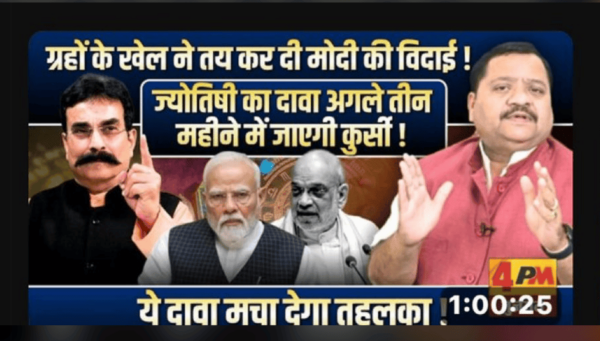
A video by 4pm
A particularly noticeable trend is the recurrence of political predictions, most notably in content from YouTube channels like 4PM. A review of their video titles, thumbnails and recurring narratives indicates a consistent projection of imminent political upheaval. Their entire content relies on a surge of fear-mongering, with phrases suggesting that the government is on the verge of collapse, that major “game-changing” developments are underway, or that leadership transitions are imminent, appearing with notable frequency.
These claims are often presented with a high degree of urgency and frequently portrayed as some insider information or unfolding developments. However, when we observed it over time, many such predictions do not appear to materialise as suggested.
This creates a recurring cycle that starts with Thumbnails featuring shocking words, a high-impact claim is introduced, amplified through dramatic presentation, and gradually replaced by a new prediction without acknowledging earlier outcomes. Over time, this pattern contributes to a perception of constant political instability, even in the absence of corresponding real-world developments.
It is important to note that political analysis and speculation are legitimate aspects of media discourse. However, the distinction lies in how such speculation is presented. When predictive assertions are repeatedly framed as near-certainties without any verifiable grounding or subsequent accountability. It raises questions about editorial intent and credibility. In effect, the issue is not a single incorrect prediction but a sustained pattern in which speculation is elevated to the level of expectation.
The Pattern That Emerges
Individually, each of these accounts, which are withheld in India, might be viewed as editorial choice, opinion or even a single error. However, when analysed collectively, a more consistent pattern emerges. From making false financial claims to identity framing to visual presentation, the content exhibits certain repeating features. Facts may be presented selectively or incompletely, claims may be unsubstantiated, and narratives may not fit with recent developments.
This trend is perpetuated by how content is packaged and distributed. Sensational headlines, emotionally charged images, and definitive language provide the impression of certainty even when the underlying evidence is uncertain or debatable.
Over time, such repetition can significantly shape audience perception. What begins as a claim or speculation can, through consistent amplification, acquire the appearance of credibility. There is a famous quote by Joseph Goebbels: “A lie told once remains a lie, but a lie told a thousand times becomes the truth.” The whole narrative of these accounts revolves around this quote.
The initial stage of this narrative begins with hating the government, which gradually turns into hatred for India, which eventually reflects in their content. For example, in the above section of Layer 4: Escalation into Defamatory and Speculative Narratives, the account named Nimo Yadav made fun of the Indian Army, which is not related to any political party, as the army of this country is far above politics, but these types of accounts are unable to stop at a critical level.
The concern, therefore, is not limited to individual posts but extends to a broader content ecosystem where narrative construction and engagement may take precedence over verification and contextual accuracy.
Conclusion: Between expression and accountability
The debate surrounding the restriction of these accounts has largely been framed in terms of free speech versus censorship. However, such a binary framing overlooks the underlying context. Freedom of expression remains a fundamental pillar of any democratic society. The ability to question, critique, and dissent is essential to public discourse. At the same time, the scale and speed at which information travels in the digital ecosystem introduce new challenges, particularly when content has the potential to misinform or mislead large audiences.
In this context, the issue is not about suppressing viewpoints, but about examining whether repeated patterns of selective framing, unverified claims, and narrative-driven content can be treated as reliable information dissemination. As submissions before the Delhi High Court indicate, concerns raised by authorities include the spread of misleading narratives, defamatory content, and potential implications for public order.
At the same time, platforms have raised questions about proportionality and due process, highlighting the complexity of regulating digital speech. Therefore, the conversation is not a simple one. But one aspect remains clear: when content consistently prioritises impact over accuracy, and repetition over verification, it invites scrutiny.
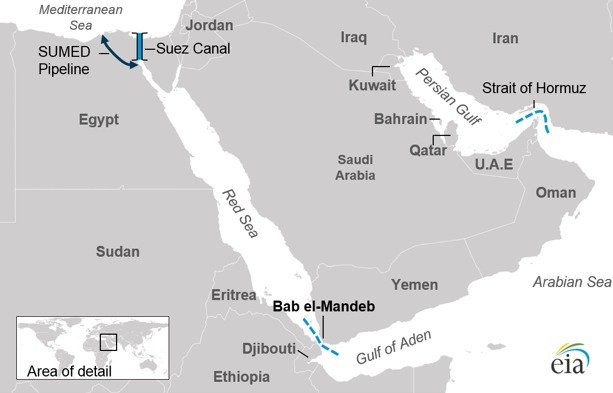
A 30 kilometer wide stretch of water silently bears the weight of the entire globe somewhere between the volcanic coastline of Djibouti and the scorching deserts of Yemen. It is called Bab el-Mandeb, Arabic for the Gate of Grief or Gate of Tears. Ancient Arab legend holds that it was named after the thousands drowned when an earthquake split the Horn of Africa from the Arabian Peninsula. The grief of today is different, it is strategic, economic, and intensely political. If things go wrong, there will be tears shed in both European capitals and Asian boardrooms.
The maritime route that links Europe and Asia without going around the whole African continent is this narrow strait, which is situated at the southernmost point of the Red Sea. Between 10 and 12 percent of all global maritime trade passes through it every single year. According to the U.S. Energy Information Administration, 9.3 million barrels of crude oil and petroleum products passed through this route daily in 2023, accounting for about 12% of all seaborne oil traded globally. It’s more than just a waterway. It is an essential component of the global economy, and it is currently under serious threat.
Two straits, two worlds: Hormuz vs. Bab el-Mandeb
To comprehend Bab el-Mandeb, one must first separate it from the Strait of Hormuz, the two are frequently spoken together, but they are fundamentally distinct in character and consequence.
Image cia CNN
The most important oil choke point in the world is the Strait of Hormuz, which is located between Iran and Oman. Every day, more than 20 million barrels of oil, roughly one-fifth of the world’s petroleum consumption, pass through it. Tehran has unparalleled geographic clout because Iran directly borders it. Brent crude prices rise within hours of Iran threatening to close Hormuz, sending shock waves through the markets. Persian Gulf oil has virtually no escape route other than through this small opening, making it a dead end. Partial relief is provided by Saudi Arabia’s East-West pipeline, which transports up to 5 million barrels of oil per day overland to Red Sea ports. However, in order for that oil to reach its markets, it must first pass through Bab el-Mandeb.
Bab el-Mandeb is unique. Ships can theoretically enter and exit from a variety of directions, hence it is not a dead end. But what makes it just as hazardous are the banks. A bankrupt state on one side and the world’s most contentious military real estate on the other. Iran does not physically border Bab el-Mandeb, in contrast to Hormuz. Rather, Tehran uses the Houthis of Yemen, a much more sneaky tool, to control it. Finally, there is no land bypass for container ships. There are some pipeline options for Hormuz. Bab el-Mandeb doesn’t have any.
Iran’s long shadow: The Houthis and the proxy war
In the 1990s, the Houthis, formerly known as Ansar Allah, started out as a political and religious movement in north-west Yemen. By 2014, they had taken control of Sanaa, the capital of Yemen, starting a civil war that attracted Iran and a military coalition led by Saudi Arabia. Since then, Tehran has given the Houthis intelligence, ballistic missiles, drones, and ideological support, turning what was initially a local insurgency into a fully armed paramilitary organisation that can attack targets hundreds of kilometres away.
Their link to Iran is more than just practical; it is a key component of Tehran’s ‘Axis of Resistance,’ a network of proxy groups that includes Hamas in Gaza, Hezbollah in Lebanon, and militias in Iraq. Bab el-Mandeb is the preferred weapon of the Houthis, who act as Iran’s long arm in the Arabian Sea. The Houthis have attacked commercial shipping in the Red Sea more than 190 times since the start of the Israel-Gaza war in late 2023. They have used drones, ballistic missiles, and anti-ship missiles to target ships thought to be connected to Israel, the US, or the UK.
The repercussions were severe and quick. Between December 2023 and early 2024, container shipping across the Red Sea decreased by 90%. Large shipping companies like Maersk, Hapag-Lloyd, and MSC diverted their ships around the Cape of Good Hope, resulting in an additional 14 days and more than $1 million in fuel expenses per trip. Between October 2023 and May 2024 alone, items valued at than $1trillion were disrupted, according to the Russell Group. Every disturbance in this strait adds an invisible tax to global inflation, one that the general public must pay in the form of higher prices for fuel, gadgets, and groceries.
Europe bleeds first
When Bab el-Mandeb is destabilised, Europe bears the brunt of the pain. Most traffic between Asian and European ports is handled by the Suez Canal route, which Bab el-Mandeb directly feeds. According to France 24, this corridor serves as the main conduit for everything from industrial machinery to consumer electronics between the two continents. European importers bear the consequences of ships diverting to the Cape route, including delayed delivery, higher insurance premiums, and increased prices for commodities.
The energy vulnerability of Europe is far more severe. The continent imports large amounts of LNG from Qatar, which must travel via Hormuz and Bab-al-Mandeb both before arriving at installations in Europe. As winter drew near, Qatar halted LNG tanker operations in the Red Sea following the Houthi strikes, raising concerns throughout Europe. Following the Ukraine crisis, European nations sought to replace Russian pipeline gas with LNG, making this sea route not just commercially significant but also existential. Agricultural goods such as wheat, fertilisers, and edible oils also move through this corridor, linking food security to the security of this 30-kilometre stretch.
Acknowledging this risk, the European Union initiated countermeasures. Operation Aspides, a naval convoy and escort mission mandated through at least February 2026, began in early 2024. In the meantime, Egypt’s Suez Canal, which depends solely on traffic passing through Bab el-Mandeb, saw its quarterly revenues plummet from $2.4 billion to just $880 million. This is a devastating blow to an already struggling economy and a sobering example of how economic shockwaves in this region do not remain contained.
Djibouti: One of the busiest shorline squeeze
Djibouti, a country the size of Mizoram with a population of just one million, is located on the African side of the strait and is possibly the most militarily significant territory on the planet. The United States supports drone operations and counterterrorism missions throughout East Africa and the Arabian Peninsula from Camp Lemonnier, its sole permanent military post in Africa, located in Djibouti. The previous colonial power, France, also keeps a permanent military there. On this little piece of land, military stations are also run by Saudi Arabia, Japan, Italy, Germany, and a number of other countries.
Then there’s China. The People’s Liberation Army Support Base in Djibouti became Beijing’s first military base abroad in 2017. Constructed at an estimated $590 million, it is officially referred to as a ‘logistics facility,’ yet it can accommodate huge Navy warships and is continuously growing in size. Approximately 25% of China’s imports and exports go via the Red Sea and Bab el-Mandeb, demonstrating the country’s clear business interests. However, the base also serves as a strategic declaration, giving Beijing direct access to one of the most important waterways in the world and making it abundantly evident to Washington that Chinese military might has transcended the Indo-Pacific.
China’s growing influence in Djibouti provides a complicated new variable for both Europe and America, the European Council on Foreign Relations warns, especially as Beijing has shown a desire to keep profitable ties with both sides of the conflict, including Iran. One of the most remarkable geopolitical spectacles of our time is the existence of American, French, Chinese, Japanese, and Italian military stations within kilometers of one another on this little country.
If the gate closes: Scenarios and consequences
Technically speaking, it is unlikely that Bab el-Mandeb will be completely closed physically because the strait is too broad to be blocked. However, a physical barrier is not necessary for closure in contemporary conflict. The similar outcome can be obtained in insurance markets. At least 88 distinct Houthi attacks on commercial vessels from November 2023 were documented by the U.S. Maritime Administration (MARAD), impacting businesses from more than 55 nations. Even in the absence of an actual attack, the threat was sufficient to make many voyages commercially unfeasible due to the sharp increase in war risk insurance costs.
Over 30% of the world’s seaborne oil would be blocked if both Hormuz and Bab el-Mandeb were disrupted simultaneously, a possibility that analysts are actively cautioning about, according to Al Jazeera . The price of oil would rise to levels not seen since the energy crisis of the 1970s. Already struggling with the lingering impacts of post-pandemic inflation, central banks would have to choose between raising rates and stifling growth or holding them and letting prices rise again. Pharmaceutical, industrial, and electronics supply chains would collapse. Importantly, transit through Bab el-Mandeb reached a record low in June 2025, down 65% from June 2023, despite a drop in active Houthi strikes in 2025, according to ACLED’s regional study. The harm to market confidence will outlast the missiles.
Where does this go?
Bab el-Mandeb’s strategic calculation is changing in real time. Every asymmetric actor on the planet is analysing the Houthis’ demonstration to the world that a non-state actor equipped with reasonably priced drones and missiles can hold the international economy hostage. According to NBC News, an unidentified Iranian military officer has specifically identified Bab el-Mandeb as a possible theatre of reprisal in the event that Iran’s territory or islands are attacked. This indicates that Tehran considers this strait to be an operational deterrent rather than merely a theoretical leverage point.
Regardless of whether attacks continue, freight rates and insurance premiums should stay high in the near future. Global shipping markets now permanently incorporate the psychological risk premium associated with this route. Although no pipeline on Earth can replace the container shipping that passes through Bab el-Mandeb, Saudi Arabia and the United Arab Emirates will face growing pressure in the medium term to construct pipeline infrastructure that avoids both straits. Meanwhile, Europe will strengthen its naval commitments in the Red Sea while concurrently accelerating energy diversification at home with more LNG gasification terminals, more capacity for renewable energy sources, and more pipeline agreements with North Africa. China, as usual, will play all sides, increasing its military and economic presence in Djibouti while keeping profitable trading connections with Iran and quietly placing diplomatic pressure on the Houthis when its own economic interests are endangered.
The long game, however, goes to whoever can stabilise Yemen. The Washington Institute warns that the future security of these maritime lanes will be heavily influenced by Iran-US tensions and the international community’s readiness to firmly implement arms embargoes against the Houthis. Without a long-term political settlement in Sanaa that cuts off the Houthis’ supply stream from Tehran, no naval convoy, insurance policy, or pipeline reroute can provide a permanent solution. The Gate of Tears will continue to be just that.
Conclusion
The Bab el-Mandeb Strait has borne nations’ pain for a long time. Today, it carries the weight of global trade, energy security, and great power competition in a corridor hardly broader than a city’s morning commute. For decades, the world took it for granted, a path that merely functions, subtly and silently, day in and day out. The Houthis, with Iranian assistance and asymmetric creativity, have utterly shattered that assumption. What happens in Yemen does not remain in Yemen. It affects European grocery expenses, Asian manufacturing schedules, American fuel prices, and regular people’s savings accounts on every continent. The Gate of Tears is once again living up to its name, and the world should finally take it seriously.
The strife between the United States and Iran seems to be shaped by controversial interests that extend beyond just the removal of a hardline Islamic government that represses its citizens and tries to make nuclear weapons to threaten the West and its allies.
According to the fresh revelation, a broker for American Defence Secretary Pete Hegseth tried to secure a substantial investment in prominent defence firms. The event took place in the weeks preceding the assault on Iran. The information was shared by three persons with insight into the matter with the Financial Times.
FT has stated that Hegseth’s Morgan Stanley broker approached BlackRock about putting millions of dollars in the asset manager’s Defence Industrials Active ETF (Exchange-Traded Fund) last month just prior to the assassination of Supreme Leader Ayatollah Ali Khamenei. BlackRock internally highlighted the inquiry on behalf of the prominent prospective client.
The $3.2 billion equity fund with the ticker IDEF, seeks “growth opportunities by investing in companies that might benefit from increased government spending on defence and security amid geopolitical fragmentation and economic competition,” as reported by BlackRock. Its major interests include data integration expert Palantir and defence corporations such as RTX, Lockheed Martin and Northrop Grumman, whose largest client is the US Department of defence.
Why the investment did not materialise
The fund debuted in May of last year and was not yet accessible for Morgan Stanley customers to acquire, thus the plan presented by the broker could not move forward. It’s uncertain if a different defence-focused company was chosen for the staggering amount.
The majority of large broking and trading platforms only provide a portion of the more than 14,000 ETFs available, despite the fact that they are created to be traded much like stocks. ETFs are selected over mutual funds due to their lower fees, superior tax management and convenience in transactions. The IDEF fund, which is listed on the Nasdaq, has increased by 28% in the last year but has decreased by about 13% in the last month due to the Middle East tensions.
Hegseth’s broker was eager for the investment when his department was nearly ready to begin an intense military campaign, even though the abortive nature of the approach to BlackRock probably prevented temporary losses. Furthermore, the conversation over the defence investment coincides with Wall Street experts closely scrutinising financial and prediction market trades in advance of the Trump administration’s decisions.
Pentagon dismisses allegations
On the other hand, chief Pentagon spokesperson Sean Parnell swiftly refuted the article as “false and fabricated.” He claimed, “Neither Secretary Hegseth nor any of his representatives approached BlackRock about any such investment. This is yet another baseless, dishonest smear designed to mislead the public,” asking for an “immediate retraction.”
Parnell added that Hegseth and Department of War are steadfast in their dedication to maintain the highest ethical principles and thorough compliance with all relevant laws and regulations.
This allegation is entirely false and fabricated. Neither Secretary Hegseth nor any of his representatives approached BlackRock about any such investment. This is yet another baseless, dishonest smear designed to mislead the public.
Hegseth is one of the primary strategists of the war in Iran and among the most outspoken supporters of the assault, frequently showcasing US military power. President Donald Trump has identified him as the first member of his national security circle to advocate for the military campaign.
According to a disclosure form filed for his Senate confirmation, Hegseth’s salary at Fox News from 2022 to 2024 was $4.6 million. During these years, he also earned between $100,001 and $1 million in royalties from two book advances totalling close to $500,000. Additionally, he received about $900,000 in speaking charges. He sold shares in 29 separate companies, with values that vary from $1,001 to $50,000 each, as per to his current financial report, which was made public in June 2025.
Did Trump engage in stock manipulation
Trump declared a halt to military action against Iran on 23rd March (Monday) after which serious concerns were raised about whether the geopolitical messaging was meant to manipulate the oil market. It was also inquired if some individuals would have benefited from anticipation or prior knowledge.
OpIndia earlier unveiled that there was evidence that the incident was not confined to specific oil deals based on new data and trade analysis. It required a well-coordinated multi-market strategy that could have produced profits in the hundreds of millions of dollars in a span of minutes.
The data showed that approximately 6,200 Brent and West Texas Intermediate futures contracts changed hands between 6:49 and 6:50 am New York time on Monday. This occurred around 15 minutes ahead of Trump’s post on the social media site Truth Social, in which he proclaimed that his country had “productive conversations” with Iran. These oil trades alone were estimated to be worth $580 million. The level of activity during pre-market hours was much higher than usual.
According to market monitoring websites, traders carried out two coordinated bets across various asset classes at the same time. Initially, a sizable, long position in S and P 500 futures was taken. It was estimated to be worth $1.5 billion and was set up for an upsurge in stock prices if geopolitical tensions declined.
Sources: LSEG • *Number of contracts traded/US Eastern Time/Dall-E
Traders also sold almost $192 million worth of oil futures, believing that if the perceived danger of disruption in supply from the US-Iran confrontation diminished, petroleum prices would drop. The total worth of these transactions was more than $1.7 billion or more than Rs 14,000 crore. These deals were executed in a short period of time before Trump’s message.
Meanwhile, Iran’s Parliament Speaker, Mohammad Bagher Ghalibaf, countered that no exchanges had taken place between Washington and Tehran, asserting that “fake news is used to manipulate the financial and oil markets and escape the quagmire in which the US and Israel are trapped.” The nation’s Foreign Ministry likewise affirmed that there had been no direct or indirect talks with the US during the continuing confrontation.
Trump brags about profits from oil after starting a war in Asia, Western companies reap benefits
As the international community grapples with a critical energy supply crisis and hike in prices, Trump boasted that America could potentially gain massive financial benefits from the elevated cost of oil influenced by the geopolitical turmoil. “The United States is the largest oil producer in the world, by far, so when oil prices go up, we make a lot of money. But, of far greater interest and importance to me, as president, is stopping an evil empire, Iran, from having nuclear weapons, and destroying the Middle East and, indeed, the world,” he wrote.
Oil prices remain high with WTI (West Texas Intermediate) crude close to $102-$106 per barrel and global benchmark Brent crude between $107 and $114 per barrel due to the dispute. “The international oil benchmark remains on track for a record monthly surge of over 60%,” reported Trading Economics.
Brent crude has so far averaged almost $97 per barrel in March, jumping 33% from February and $69 in January. The value of natural gas has escalated even further in certain regions. The United States is the world’s biggest producer of Liquefied Natural Gas (LNG) and currently the biggest oil exporter after Middle East’s energy output was shut down due to Iranian attacks and the blockade of the Strait of Hormuz which is used to transport one-fifth of the global supply.
The war has hindered the production and transportation of fuels in the Persian Gulf and Western corporations that pump and process natural gas and oil are among the top winners. The weeks following the start of the fighting experienced a 65% climb in oil prices. The natural gas became pricier, especially in Asia and Europe, which rely largely on imports.
Businesses in the Persian Gulf have had to close a large number of their wells while much higher returns are enjoyed from each barrel sold by those that extract oil from parts like West Texas.
The circumstances might be similar to 2022, when Russia-Ukraine war in February shook the energy markets and oil businesses broke earnings records. They gave shareholders record dividends and share repurchases that year.
“The first quarter is going to be phenomenal for these companies. I don’t think there’s any way around that,” Reuters quoted Leo Mariani of Roth Capital Partners. American shale producers and other enterprises without major ventures in the Middle East are set to profit the most from these hikes since they won’t have to shell out money for production suspensions, stranded tankers or expensive repairs to infrastructure damaged by the hostilities.
“Month on month, we get a better check right now for our oil,” mentioned Mike Party as cited by The New York Times. He is the president of West Texas oil firm, Beryl Oil and Gas. There are initial signs that American companies are responding to the extraordinary surge in prices. Ron Guse conveyed that “there are some early signs that US companies are responding to higher prices,” and he has “started to hear from firms that are looking to prepare more of their wells to start producing oil.”
Guse is the CEO of Liberty Energy, which provides oil field services to many of the largest producers in the US. “You’re feeling a little bit of acceleration,” he pointed out.
The United States has long been acknowledged for participating in warfare in the name of promoting democracy to serve its strategic and national interests. This pattern seems to be surfacing in the current context as well. The country and its defence contractors are well-known for capitalising on similar confrontations. Now, its oil corporations are also exploiting the situation and maximising the perks of much higher energy rates, even with the unpredictability surrounding the future.
There are two worlds. One where people simply live, and another where they are constantly seen living. That second world is the world of influencers. It runs parallel to everyday life, feeds off it, reshapes it, and at times, distorts it. In the first world, people go about their routines, work, family, responsibilities, small ambitions, and private struggles. In the second, the same routine is curated, edited, narrated, and presented to an audience to consume, digest, and share.
Source: Instagram
Recently, a humble-looking content creator, Pujarani Pradhan (lifeofpujaa), has become a topic of narrative war between the “elite” side and the masses. Pradhan sits precisely at the intersection of the two worlds described above. She is a woman from rural West Bengal who speaks English with a clear rural accent. She reviews books and movies, shares opinions, and now, she has found herself pulled into the influencer ecosystem in a way that invites both admiration and suspicion.
Who is Pujarani Pradhan
Pradhan is a around 40-year-old woman. She lives in a rural household, has a child, and creates content primarily in English. Her accent reflects her background, something she neither hides nor tries to polish artificially. Instead, she embraces it, even when mocked.
Her content includes book reviews, commentary on feminism and social issues, and reflections from her everyday life. She speaks about authors, films, and ideas with a tone that is curious, sometimes exploratory, sometimes assertive. She has around 680,000 followers on Instagram and has collaborated with brands including Netflix, Frido, and ChatGPT. She shares her views about c-section, feminism and more.
She also carries a personality that is quietly disarming. When people mock her pronunciation, she often responds with humour or constructive replies. In one video, she struggled to pronounce the word “responsibilities”, giggled, and continued. The moments from those videos stayed, they were not edited out as flaws but retained as part of the experience.
That video was just about her struggle with English, which is clearly not her native language, or even a fluent one. She appears to be one of those who thinks in her mother tongue, translates it into English, and then speaks, or listens to something in English and translates it into her mother tongue to understand. This is how most multilinguals go around languages they are not fluent in.
At the same time, her videos are clearly edited. There are cuts, pauses smoothed out, sentences stitched together. That is not unusual. Editing is part of content creation. But it becomes relevant because it feeds into the debate about authenticity.
The trigger – When ‘management’ becomes ‘manipulation’
The controversy began when a content creator, Niharika Jain, who goes by the handle “iam_therapissed“, accused her of being “fake” and an “industry plant”, primarily because she was associated with an agency. The implication was simple, if someone is managed, they are not real.
Another content creator, Aishwarya Subramanyam, who goes by the handle “otherwarya”, jumped in and questioned her authenticity but somewhat sided with her. Her second video actually made people believe that Subramanyam was calling Pradhan “evil”, but that was not the case. There are many influencers and netizens who are debating over Pradhan’s content and life. Some like her, some do not, and it happens. It is common with influencers. They have followers comprised of fans and haters. Both are, in fact, important.
Now, coming back to the controversy, what Jain said, her arguments collapsed quickly under scrutiny. Why? Because having an agency is not an anomaly in the influencer ecosystem, it is the norm. What it revealed instead was a deeper suspicion, that someone like Pradhan should not be able to reach this level of visibility without hidden backing.
Jain, later made her account private. Reportedly, she has posted three stories where she claimed she was being cyberbullied. She also claimed that some 4,000-5,000 bot accounts followed her and called it a tactic to affect her account’s organic engagement.
Source: Reddit
On the other hand, Pradhan’s response video addressed the controversy directly. She explained how she initially worked with an agency that allegedly exploited her financially, offering her ₹30,000 per day while securing a much larger deal from the brand. She left that arrangement and later joined another team that now handles her brand deals more consistently.
She made it clear that her content, scripting, shooting, and editing are done by her alone. The agency handles only the business side. That distinction is important, but often ignored in public debates.
What is an influencer, really
An influencer today is not just a person posting videos. It is a role that combines storytelling, audience building, and commercial viability.
Influencers operate as individual media units. They create, edit, publish, engage, and monetise. Their value lies in the trust they build with their audience and the consistency of that engagement.
In this context, Pradhan is not an exception. She is part of a broader system where individuals convert personal expression into a form of digital capital. Her rural setting does not exclude her from this system, it simply makes her entry into it more visible and, for some, more uncomfortable.
Why brands collaborate with influencers
Brands collaborate with influencers for one reason, access to attention. Traditional advertising pushes messages outward. Influencer marketing embeds those messages within trusted voices. If a creator has a loyal audience, the brand effectively borrows that trust.
I used to see someone or the other share lifeofpuja’s reels almost every day. Different kinds of content she was putting out kept popping up, and I eventually got hooked. Naturally, we at Frido started tracking her engagement, the audience that follows her, the conversations… https://t.co/8oJt5ACJqI
Pradhan’s collaborations with major brands indicate that she has crossed a certain threshold of influence. She is no longer just speaking to an audience, she is part of a commercial ecosystem where her voice carries measurable value.
The role of agencies – Middlemen or enablers
Agencies exist to bridge the gap between creators and brands. They negotiate deals, manage contracts, and ensure consistency in collaborations.
For many creators, especially those from non-urban backgrounds, agencies provide access to opportunities they would otherwise struggle to reach. At the same time, the relationship is not always balanced. As Pradhan’s own experience suggests, exploitation is possible, particularly when creators are new and unaware of market rates.
But to equate agency involvement with inauthenticity is to misunderstand the structure of the industry. Agencies, in most cases, do not create the core identity of a creator. They polish it and then monetise it.
The editing question – Does polish reduce authenticity
One of the subtle criticisms against Pradhan is the presence of multiple cuts in her videos. Sentences are stitched together, pauses removed, delivery made smoother.
This is standard practice. Every creator edits. The difference lies in perception. When a highly polished urban influencer does it, it is seen as professionalism. When someone like Pradhan does it, it becomes evidence of “manufacturing”.
The expectation seems to be that authenticity must also look raw, unedited, and imperfect. But even imperfection is often curated.
Language, accent and the politics of mockery
A significant part of the reaction to Pradhan is tied to her English. Not the content of what she says, but how she says it.
Her pronunciation becomes a point of humour. Her accent becomes a point of judgement. Yet, she responds with composure, often turning mockery into engagement.
Source: X
This reveals a deeper hierarchy. English in India is not just a language, it is a marker of class. Accent, fluency, and tone become signals of belonging.
When someone speaks English outside these accepted codes, it unsettles expectations. It forces audiences to confront an uncomfortable question, who decides what “good English” sounds like. In fact, on X, she quoted someone who mocked people speaking English with bad pronunciation and gave a decent reply without being sarcastic or playing victimhood.
Elitism versus authenticity
The fascination with Pradhan lies partly in this contrast. A rural setting combined with English-speaking content disrupts a long-held association between language and class.
But this disruption also invites scrutiny. Her past posts allegedly disappearing from Instagram, her current image appearing more aligned with a certain aesthetic, her collaborations with brands, all of this feeds into a narrative that she is “constructed”.
Yet, all influencers are constructed to some extent. The difference is that some constructions align with what audiences expect, and others do not.
Who decides authenticity
Authenticity is one of the most overused and least defined terms in the influencer ecosystem. Is a creator authentic because they show their real life, because they do not have an agency, because they make mistakes on camera, or because they come from a certain background.
Pradhan’s own statement captures this confusion. She says she does not know how to “pretend to be authentic”. That line is telling, because it exposes the paradox, authenticity itself has become a performance standard.
Audiences demand it, platforms reward it, and creators navigate it. But no one clearly defines it.
The jeans, the past, and the performance of identity
A recent video where she wore jeans and a kurta for the first time after taking permission from her mother-in-law became a moment of celebration for her. It was framed as a personal milestone, a small assertion of choice.
In an older video, she had said she loved to wear jeans, suggesting that this was not entirely new. Perhaps something she had stopped after marriage.
This detail shows how complicated lives can be. It shows how identity is not static. It shifts with circumstances, family structures, and personal choices.
But in the influencer world, such shifts are often interpreted as contradictions, because audiences expect continuity. They believe that anything that has changed from the time when the person was not an “influencer” is curated and maybe agency-srive, which is not always the case.
Influencers and narrative power
Influencers do not just create content. They shape narratives. When Pradhan speaks about feminism, class, or daily life, she is not just sharing opinions. She is influencing how her audience interprets these ideas.
This is where the discomfort intensifies. Because narrative power is expected to come from certain spaces, urban, educated, institutionally backed. When it emerges from elsewhere, it is questioned more aggressively.
More than just a controversy
The Pujarani Pradhan episode is not just about one creator being called fake. It is about the uneasy relationship between authenticity, class, and visibility in India’s digital space.
It reveals how influencer culture claims to democratise expression but still carries inherited biases. It shows how agency involvement is misunderstood, how editing is selectively criticised, and how language continues to act as a gatekeeper.
Most importantly, it raises a simple question with no clear answer. In a world where everything is curated, edited, and monetised, what does authenticity even mean anymore.
Several car insurance companies offer instant policy approval and same-day issuance. Some of the providers include ACKO, HDFC ERGO, IFFCO-Tokio, Tata AIG, and ICICI Lombard.
With these insurers, you can buy or renew motor insurance online instantly within minutes. However, the policy document is sent to you through email or a mobile app. For these leading insurers, the policy approval process has become easier and hassle-free. Policyholders can get insured legally without delay.
Top 5 car insurance companies offering instant issuance and policy approval
Many car insurance companies in India now offer instant issuance. You also get a same-day policy approval facility. Here are the top 5 insurers well-known for their quick policy issuance:
ACKO Insurance
ACKO is a completely digital insurance company. It offers a paperless and fast process of buying car insurance. Customers can purchase or renew policies directly on the ACKO mobile app or the website. The entire process takes only a few minutes if you provide the correct details.
Once you complete payment, the policy document is generated. With ACKO insurance, you can also avail low premiums, zero commission, and digital claim services. This makes it stand out from other insurers.
HDFC ERGO Insurance
HDFC ERGO offers a convenient online service for purchasing and renewing motor insurance. Policyholders can enter their car details, compare available coverage, and pay online.
Upon payment, the car insurance policy is issued immediately. It is sent via email. Additionally, the insurer offers over 12,000 cashless garages in India. You also get options of various add-on covers for enhanced protection.
IFFCO-Tokio Insurance
IFFCO-Tokio enables customers to purchase or renew car insurance online. It requires a minimal documentation process. For a smooth online process, you must enter vehicle details and select coverage. Then complete the payment.
The company offers services like 24/7 support and minimal documentation. It also provides quick responses to claims.
Tata AIG Insurance
Tata AIG offers car insurance online with minimal paperwork. The customers can get an instant quote, cover, and complete payment online with ease. The insurer also offers access to 5,900+ cashless garages. It provides quick claim services for faster coverage.
ICICI Lombard Insurance
ICICI Lombard is another leading insurer offering online car insurance policies with the feature of instant issuance. Other benefits include the use of AI to process insurance claims, roadside services, and cashless repair services. This makes the overall process of insurance easier and simpler.
These insurers ensure instant policy issuance with same-day approval. It enables car owners to stay legally insured without delay.
Comparison between top-rated providers offering instant services online
The table below highlights the comparison between top-rated motor insurance companies in 2026 offering instant services:
Insurance Company
Key Features
ACKO Insurance
Paperless process, faster claim, and completely online purchase
HDFC ERGO Insurance
Plan customisation, fastest delivery, instant quotes online
Simple comparison online, customisation of add-ons, and digital payment
ICICI Lombard Insurance
Roadside assistance, faster online purchase, and an AI-enabled claim process
Most leading insurers allow customers to compare plans and make payments online. The policy is issued instantly through email. For this digital process, there is minimal paperwork and policy issuance takes place within minutes.
How does instant car insurance policy issuance work?
The instant car insurance policy issuance is an easy online process, allowing users to get cover in a few minutes.
First, the vehicle owner must provide the insurer with vehicle information. It includes the registration number, the model, and the type of fuel on the website or app of the insurer. Next, compare the available plans and select the necessary coverage with add-ons.
After policy selection, the customer makes payment online through card, UPI or net banking. After successful payment, the insurer verifies the information. The policy is then delivered through email or a mobile application.
Things to consider before choosing instant car insurance
Here are the things to consider before choosing the right car insurance offering instant policy approval:
Claim Settlement Ratio: A high claim settlement ratio signifies that the company is capable of processing claims efficiently.
Comparison of Coverage Options: Find out whether the chosen policy offers comprehensive coverage, safeguards against damages, theft, and natural disasters.
Review Add-ons: Including add-ons such as zero depreciation cover, roadside assistance, and engine protection enhances overall coverage.
Network Garages: Select insurers with a substantial network of cashless garages for quick repairs.
Review Customer Reviews: Customer feedback provides insights into the speed of claim processing and service quality.
Easy Digital Support: Search for insurers offering immediate access to a policy with quick online support.
Conclusion
Instant policy approval and same-day issuance have made purchasing car insurance in India much easier. Many insurance providers allow customers to purchase the insurance online. However, it is advisable to carefully compare coverage options and claim support. Also, review network garages before choosing the insurer that suits your needs.