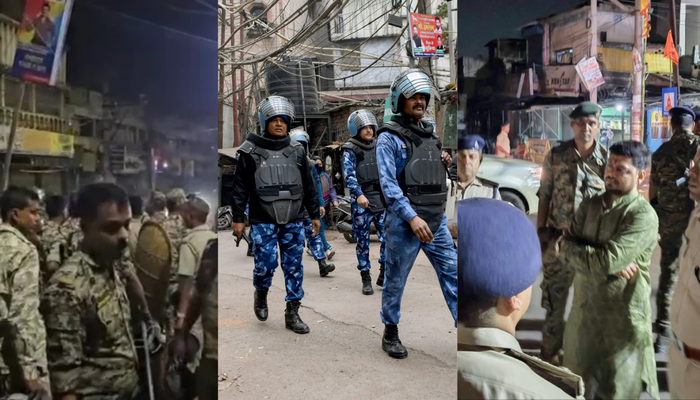
Ram Navami celebrations in the country have come under attack in various areas in the past couple of days. Several incidents of stone and brick pelting by Islamists on Ram Navami processions and devotees have come to light in multiple states, including Bihar, Jharkhand, Maharashtra and West Bengal. Many civilians as well as policemen sustained injuries in the attacks. Here are some of the incidents of violence during Ram Navami processions:
West Bengal: Communal clashes during Ram Navami procession in Murshidabad
An incident of stone-pelting, violence and vandalism during a Ram Navami procession was reported in the Raghunathganj area of Murshidabad on Friday (27th March). The attack was reportedly triggered by the music playing in the procession. As the procession headed towards Mackenzie Park in Raghunathganj, an argument broke out between Hindu devotees and local Muslims, which resulted in the violence. At least 12 people were arrested by the polie and prohibitory orders were issued to maintain law and order.
Subsequently, communal clashes erupted again in the Jangipur area of Murshidabad, West Bengal, when a Ram Navami procession was passing through the area. As the procession reached the Phultala intersection in Jangipur, several Islamists started hurling stones and bricks at it. This led to violent clashes and the market shutdown.
Upon receiving information about the clashes, a heavy police force, accompanied by central forces, rushed to the scene. The security personnel resorted to a lathi charge to disperse the crowd. Security personnel were deployed in the area to maintain peace in the area.
Speaking to the media after the incident, DIG Murshidabad Ajit Singh said that teams of police have been formed to carry out raids. He said that the miscreants involved in the attack will be identified through CCTV footage, and strict action will be taken against them.
#WATCH | DIG Murshidabad Ajit Singh Yadav says, "An incident occurred here during Ram Navami procession. We have deployed more forces and senior officers. Situation is under control…But we have formed our raid teams. Raids are being carried out in various locations. CRPF and… https://t.co/6xF6nBZCo5pic.twitter.com/dyXVby9GRE
Jharkhand: Stone pelting on Ram Navami procession in Dhanbad
Some people from the Muslim community pelted stones at a Ram Navami procession on Friday (27th March) in the Bhikrajpur area of the Dhanbad district of Jharkhand. At least six people were injured in the stone-pelting. According to police, the stone-pelting started after an argument between two teenagers from the Hindu and the Muslim community escalated.
Teams of police and additional security forces immediately reached the spot and brought the situation under control. Deputy Commissioner Dhanbad, Aditya Ranjan, said teams of police are patrolling in the area and that stringent action would be taken against the culprits.
“Today, after the disturbances during the Ram Navami procession in Bhikhrajpur, I visited the area late at night. The administration swiftly took action to control the situation and deployed additional security forces. The investigation into the incident is ongoing, and strict action will be taken against the anti-social elements involved in the disturbances. The situation is currently normal, police patrolling continues in the area, and an appeal has been made to the people to maintain peace,” DC Dhanbad said in an X post after the incident.
आज भिखराजपुर में रामनवमी जुलूस के दौरान हुए उपद्रव के बाद देर रात क्षेत्र का दौरा किया। प्रशासन ने त्वरित कार्रवाई करते हुए स्थिति को नियंत्रित कर अतिरिक्त सुरक्षा बल तैनात किया। घटना की जांच जारी है, उपद्रव में शामिल असामाजिक तत्वों की पहचान कर सख्त कार्रवाई की जाएगी। फिलहाल… pic.twitter.com/qhzI1ixEVd
Six people were arrested by the police in connection with the violence, and prohibitory orders were issued in the area. The police are interrogating the arrestee, and an investigation into the matter is underway.
Rajasthan: Stone pelting on Ram Navami procession in Jodhpur
An incident of stone pelting on a Ram Navami procession in Jodhpur, Rajasthan. According to locals, some bike-born intoxicated men from the Muslim community hit some devotees, including women, in the procession. This led to a heated argument between the devotees and the men, and soon the argument escalated to violence and stone pelting between the two groups. The police arrived at the scene and controlled the situation. The police detained some of the people involved in the violence. An investigation is going on into the matter.
Other similar incidents of attacks on the Ram Navami processions
Similar incidents of attacks on Ram Navami processions happened in Maharashtra’s Ahilyanagar and Mumbai, Jharkhand’s Garhwa, and parts of Bihar. In Ahilyanagar, Maharashtra, a Ram Navami procession was attacked with stones and bricks by Islamists around 4:00 pm on Thursday (26th March) as it reached a mosque situated at Sayyad Baba Chowk in Srirampur city. Several devotees were injured in the attack, and an FIR was registered.
In Mumbai, Maharashtra, Hindu devotees putting up flags to welcome a Ram Navami procession were attacked near a mosque in the Malvani (Malad) area. Videos of the incident went viral on social media. Police intervened and erected barricades to prevent further clashes. A complaint was filed by Hindu devotees against the attackers.
In a similar incident, Islamists pelted stones at a Ram Navami procession in the Garhwa district of Jharkhand on Thursday evening (26th March). Some members of the Muslim community blocked the procession near the Kauakhoh Shiv Chabutra and pelted stones. A few incidents of communal tensions flaring up during the Ram Navami procession were also reported in some areas of Bihar, after which the police ramped up the security.
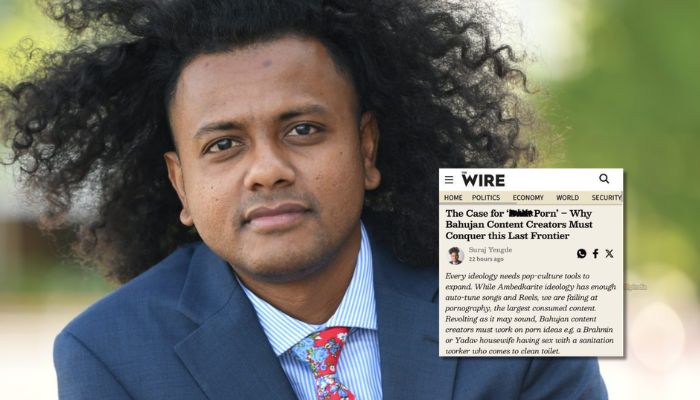
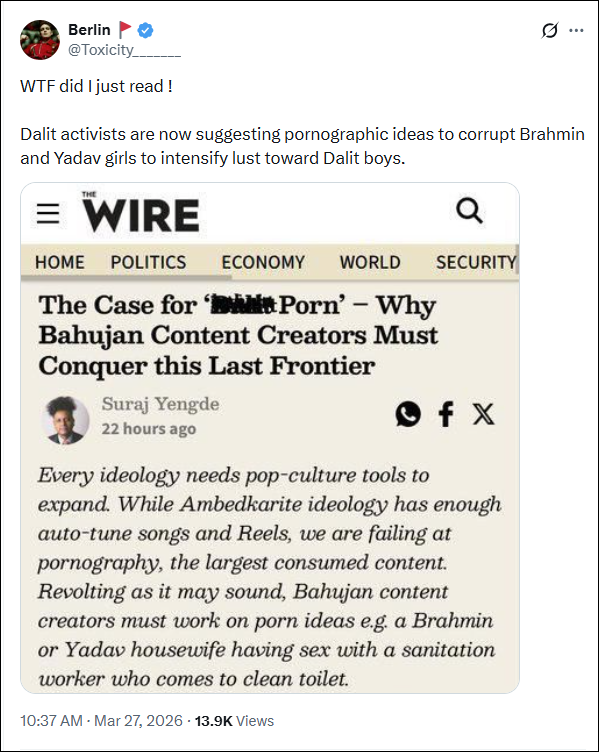
A screenshot of a purported article by Islamo-leftist portal The Wire, advocating for ‘Bahujan’ content creators to “conquer” porn, which the author, Suraj Yengde, calls the “last frontier”, has gone viral online. As per the viral screenshot, the Dalit rights activist argues that Ambedkarite ideology must penetrate the ‘frontier’ of pornography for ideological expansion by targeting Brahmin women. Though the screenshot carries believability given the anti-GC shenanigans of both Yengde and The Wire, it is fabricated, rather satirised.
In the viral screenshot, the headline of the article that was never published reads,“The Case for Dalit ‘Porn’ – Why Bahujan Content Creators Must Conquer this Last Frontier.”
Meanwhile, the summary reads, “Every ideology needs pop-culture tools to expand. While Ambedkarite ideology has enough auto-tune songs and Reels, we are failing at pornography, the largest consumed content. Revolting as it may sound, Bahujan content creators must work on porn ideas e.g. a Brahmin or Yadav housewife having sex with a sanitation worker who comes to clean toilet.”
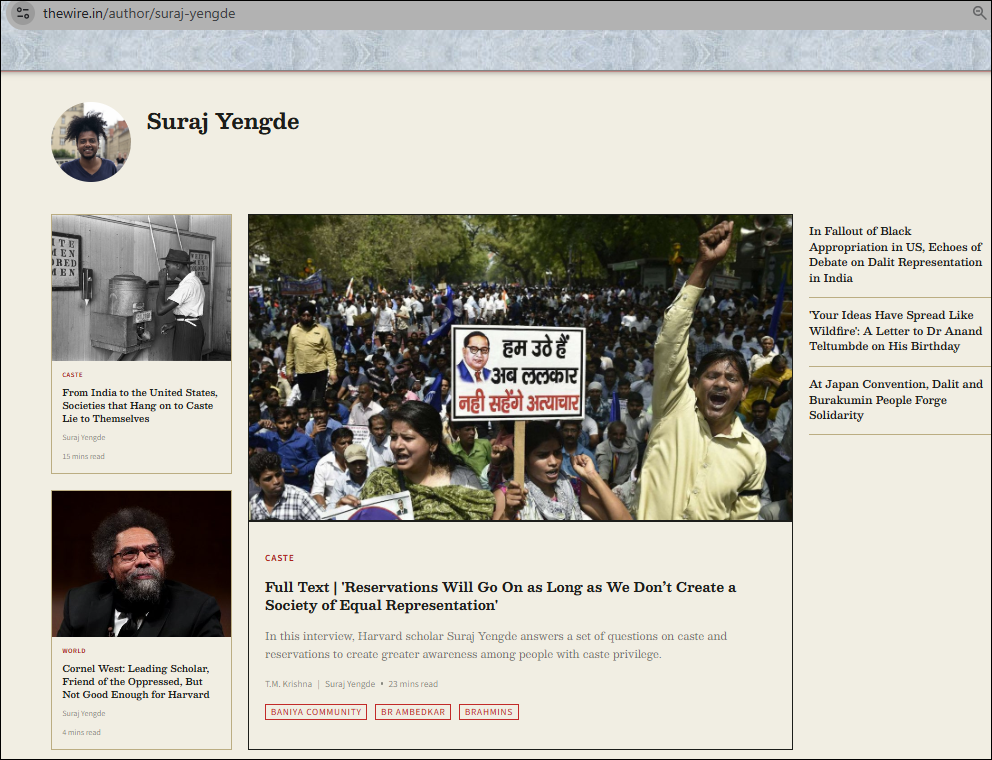
OpIndia scanned The Wire’s website and social media handles to check if the article the viral screenshot features was ever published, modified or deleted. It turned out that no such anti-Brahmin piece was written by Suraj Yengde, nor was it published by The Wire. As per our research, the viral screenshot is most likely fake.
Siddharth Varadarajan, the Founding Editor of The Wire, put out an X post on 27th March, blaming ‘casteist, Hindutva-infected Hindus’ for the creation and circulation of the fabricated screenshot, claiming that these people fabricated a fake story and tried to pin it on ‘respected scholar’ Suraj Yengde and The Wire.
Hatred and perversity among casteist Hindus, especially those infected with Hindutva, knows no bounds. Some of them have gone to the extent of fabricating a fake 'story' based on their sick minds and tried to pin it on a respected Dalit scholar, and on The Wire. https://t.co/XKYd6g0R9X
“Hatred and perversity among casteist Hindus, especially those infected with Hindutva, know no bounds. Some of them have gone to the extent of fabricating a fake ‘story’ based on their sick minds and tried to pin it on a respected Dalit scholar, and on The Wire,” Varadarajan wrote.
The screenshot is fake, but why did people think it was real?
While Varadarajan was quick to drag ‘casteist’ Hindus and Hindutva into the matter, and hailed Suraj Yengde as a ‘respected scholar’, the fabricated screenshot landed as plausible since it neatly fitted into the pattern of Yengde’s anti-Brahmin rhetoric rooted in caste ‘conquest, as well as The Wire’s persistent anti-Hindu propaganda.
Yengde has written numerous articles on ‘Brahminical patriarchy’, with an obsessive focus on Brahmin women. His articles and social media posts often villainise upper-caste Hindus for supposedly not marrying their daughters to Dalits due to their belief in caste purity.
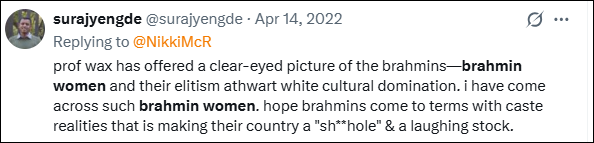
Suraj Yengde’s anti-Brahmin rhetoric goes beyond scholarly commentary and is seeped into blatant misogyny and objectification of Brahmin women, as exemplified by his social media posts.
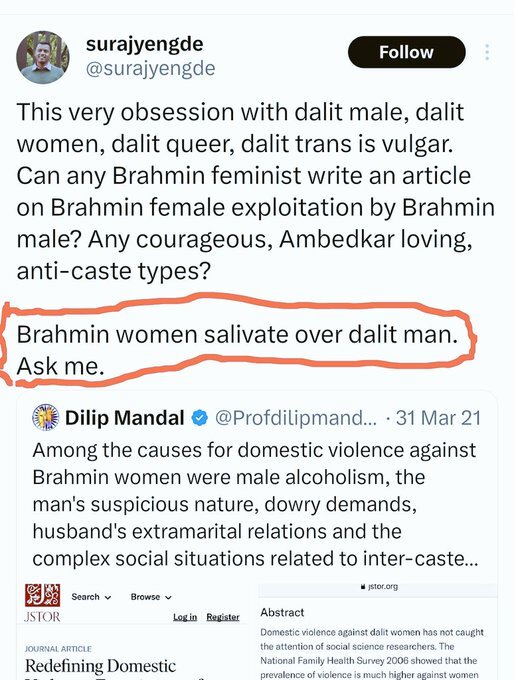
In one such post, Yengde wrote, “Brahmin girls salivate over Dalit man. Ask me.”
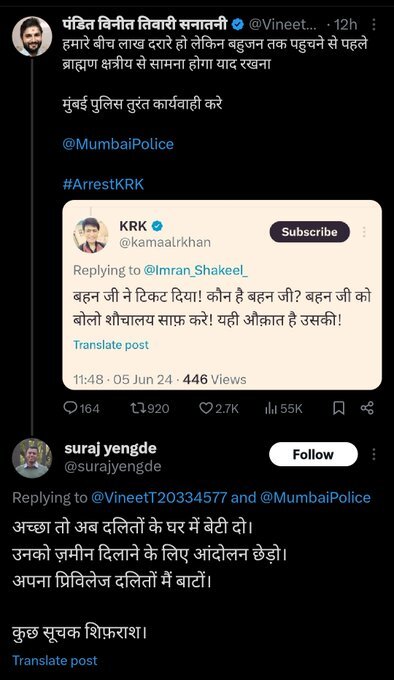
In another post, Suraj Yengde, while responding to a Brahmin man’s post, asked the Brahmin community to “give away” their daughters to Dalits, as if they are some objects, and are expected to share their ‘privilege’ among Dalits, as if the women are things that should be passed around.
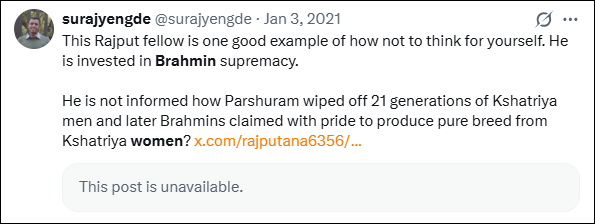
He also has a record of distorting Hindu history and scriptures to peddle anti-Brahmin propaganda.
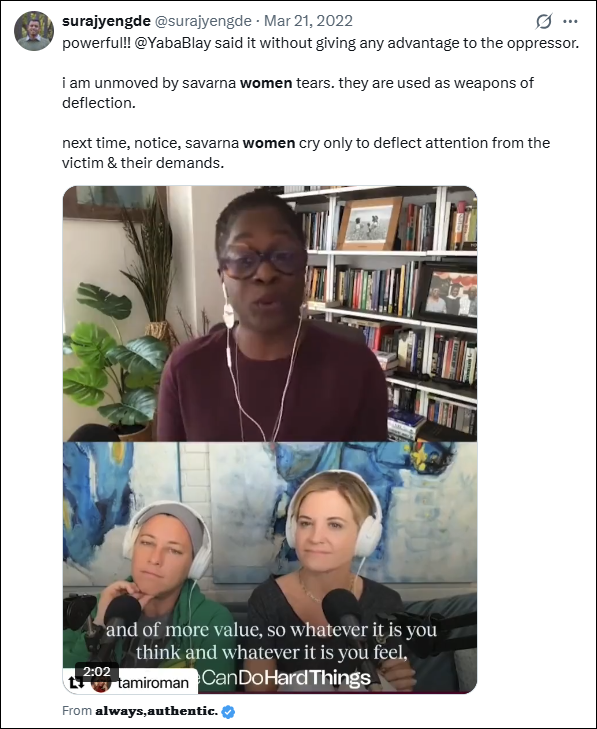
In addition to sexualisation and objectification of Brahmin women, Yengde harbours blatant hatred for them, calling them the “weapons of deflection” and having no sympathy for them.
With such a demonstration of caste-revenge fantasy, extreme extrapolations like the porn-industry “last frontier” claim come across as real. There have been many occasions when Dalit ‘social justice’ activists advocated for ‘claiming’ upper caste women as some sort of trophies of historical payback.
Read this thread 👇 We have hundreds of videos, lakhs of posts who express same desires for GC women.
There are multiple instances of Dalit voices and activists openly objectifying general-caste women, especially in India. Not just politicians, even IAS officers have given statements asserting that women of the general caste are some sort of trophies or objects that must be shared with Dalits for the social justice agenda to become successful.
Excerpts from Dalit Nation magazine👇
"If you want to finish brahmins, marry brahmin women. Dalits should marry brahmin women & take them out of their varna. Brahmins will have no women left to marry & breed. They'll die a natural death & become extinct"
Also, with the influence of Western liberal ideas of segregating everything from food, music, and literature into distorted binaries of ‘black and white’, Indian Liberals too have started a movement of copy-paste, applying the same ideas in an Indian context, which is inherently wrong, because Indian cultural nuances have not worked in Western parallels. Indian cultural diversity has evolved in its own distinct hues where Western categorisation cannot fit.
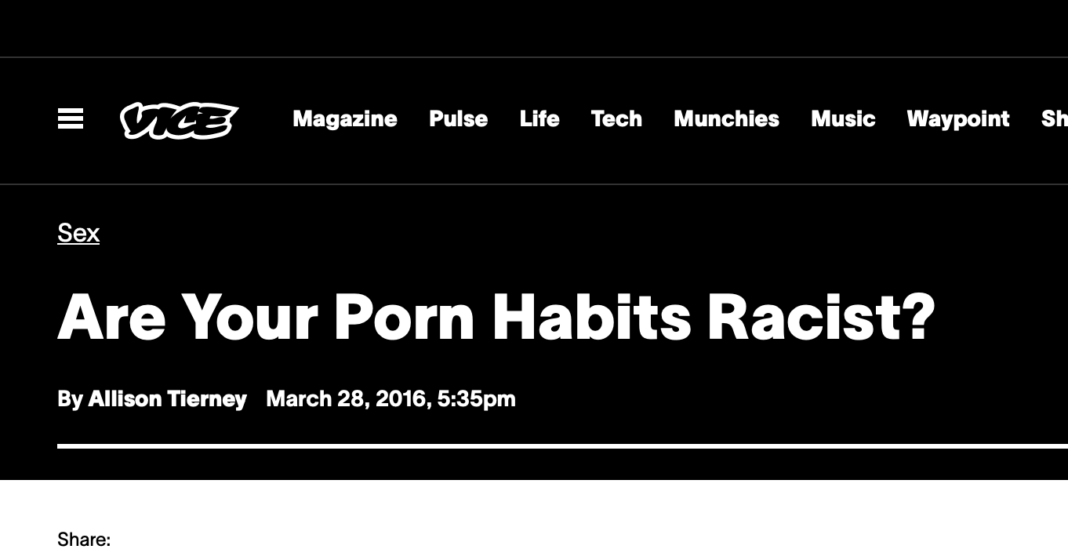
screenshot of an article in Vice
There has been a plethora of articles, books and discussions about Dalit food, Dalit music, Dalit ‘Gods’, Dalit practices and whatnot, where Indian Left-liberals, in their desperate efforts to fit into Western SJW circles, categorise Indian socio-cultural aspects into the dishonest and insufficient binaries of Dalit Vs Upper Caste. These discussions have often turned into ludicrous comparisons and wrong claims.
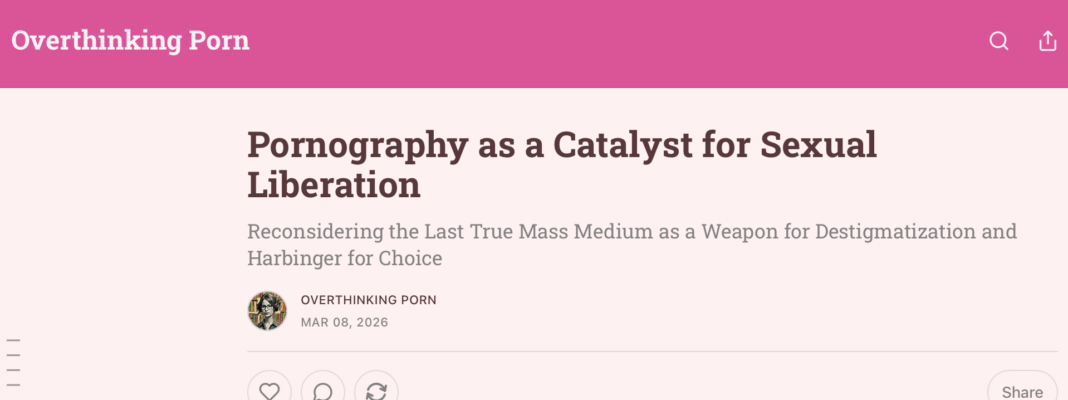
Screenshot of an article justifying and supporting porn as a ‘weapon of destigmatisation’
The plausible believability of the viral screenshot is an effect of the collective mainstreaming of such debates. Satire is a humorous take on what is happening in society. The fact that elements of a distinct ‘Dalit’ identity were mixed with the usual left-liberal sexual ‘liberation’ tropes to create the satirical screenshot, and that seemed so ‘real’ to many, is also a satire in itself.
An investigative series by Fox News has revealed that the Chinese Communist Party stooge Neville Roy Singham pumped nearly $600 million in his pro-China information and narrative laundering network spread across five continents. Roy Singham has been funding several organisations that are involved in anti-India activities.
Roy Singham’s network, often described as the “House of Singham” is operating a sophisticated “information laundering” or “narrative laundering” machinery that picks up specific issues, transforms raw activism into polished propaganda, which is then amplified the Roy-Singham-funded network to sow discord in the US, India and other major democracies while burnishing a Communist China’s image as a ‘benevolent’ counterweight to ‘imperialism’ and ‘fascism’.
This pro-China transnational network helmed by Neville Roy Singham comprises non-profits, activist groups, think tanks, and media outlets, operating as the propaganda machinery of the Chinese Communist Party (CCP). Several Roy Singham-funded organisations are consistently pushing anti-India and pro-China narratives in India.
TriContinental: CCP stooge Neville Roy Singham funds, the propaganda machinery delivers
TriContinental, a Massachusetts-based Marxist think tank created by ‘journalist’ Vijay Prashad, was one of the nonprofit companies that received funding from Neville Roy Singham and promoted Chinese propaganda. Neville Roy Singham is on the international advisory board of the said think-tank, accused of financing Chinese propaganda using American non-profit organisations. He is also the editor of Left Word Books and Chief Correspondent at Globetrotter.
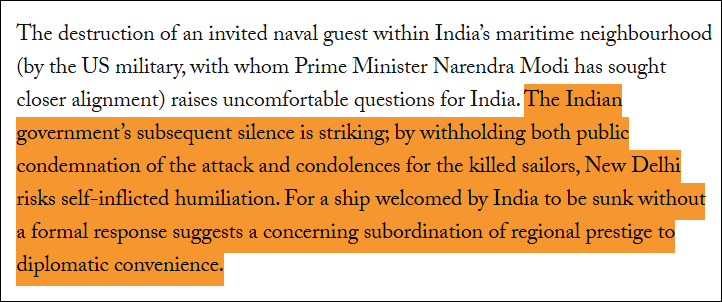
TriContinental has been consistently pushing pro-China and anti-India narratives through its articles and newsletters. Amidst the ongoing war between Iran and the joint US-Israel front, TriContinental criticised the Modi government’s foreign policy, citing the supposed silence after the sinking of the Iranian warship IRIS Dena in the Indian Ocean as ‘self-inflicted humiliation’. The piece authored by economist Bodapati Srujana also cried hoarse over PM Modi’s visit to Israel.
TriContinental presented the sinking of the IRIS Dena in the Indian Ocean as India’s ‘failure’ to protect the Iranian frigate that participated in India’s MILAN 2026 naval exercise. This alarming misrepresentation came even as the ship was operating approximately 20 nautical miles west of Galle, within the SAR region under Sri Lankan responsibility, nowhere near India’s territorial waters. Despite this, India had offered sanctuary to IRIS Dena three days before it was torpedoed by a US submarine. Just because IRIS Dena partook in an Indian naval exercise, the Indian Navy was not obliged to provide a safe escort to the Iranian warship all the way back home. India could only have extended a humanitarian hand in the form of search and rescue operations, which the Indian Navy was already conducting.
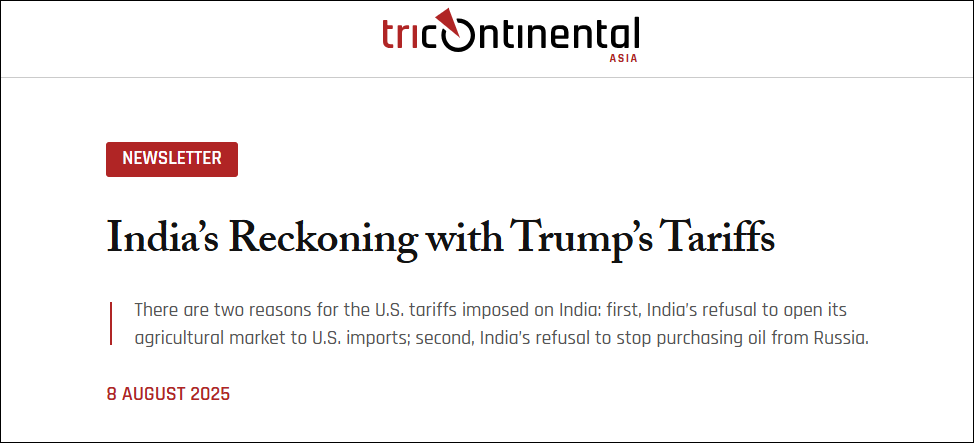
Similarly, TriContinental published an article last year on how India was navigating its way as US President Donald Trump launched a tariff war. Somehow, the leftist propaganda outlet inserted China in the picture and showered praises on the country.
The organisation’s website is replete with articles glorifying Chinese Communist history and technological advancements, giving an impression that China under a Communist regime is a utopia that the rest of the world should replicate.
What inspires TriContinental is the Tricontinental Conference held in Cuba in January 1966, since it led to the creation of national liberation Marxism. In addition to an inter-regional office, TriContinental has its offices in Argentina, Brazil, India, and South Africa. Karl Marx and his works remain the outfit’s central inspiration.
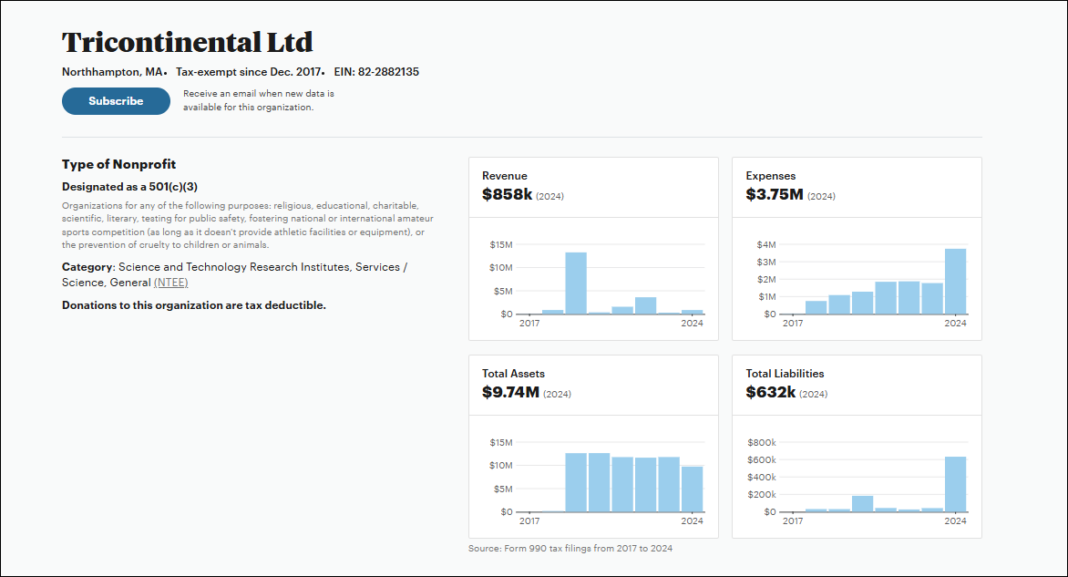
In 2024, TriContinental, which has Vijay Prashad as its treasurer, registered a total revenue of $857,945 with expenses standing around $3,745,069.
Neville Roy Singham has poured millions into various pro-China and anti-India propaganda outlets, including People’s Dispatch, where Vijay Prashad has contributed numerous articles. People’s Dispatch is a media portal that touts itself to be an “international media project with the mission of bringing to the world voices from people’s movements and organisations across the globe.” In one of the articles from January 2020, Prashad has sympathised with the JNU protesters and inveighed against the Modi government.
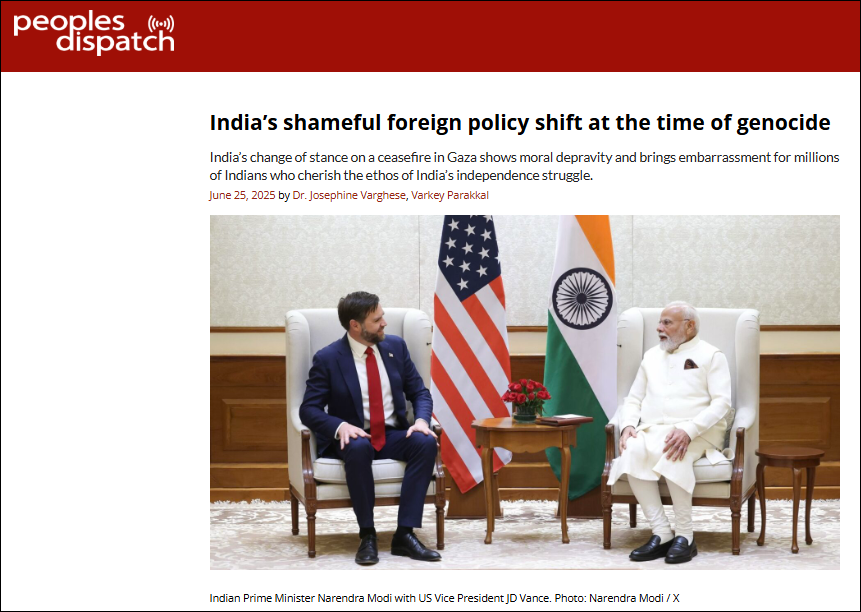
In June 2025, People’s Dispatch published an article calling India’s foreign policy “shameful”, over India’s abstention from Spain’s UN resolution seeking an immediate ceasefire in Gaza. The Marxist propagandist authors of the piece, Dr Josephine Varghese and Varkey Parakkal, attributed the supposed shift in India’s policy towards Palestine and Israel to the so-called “Hindutva-Zionist” alliance.
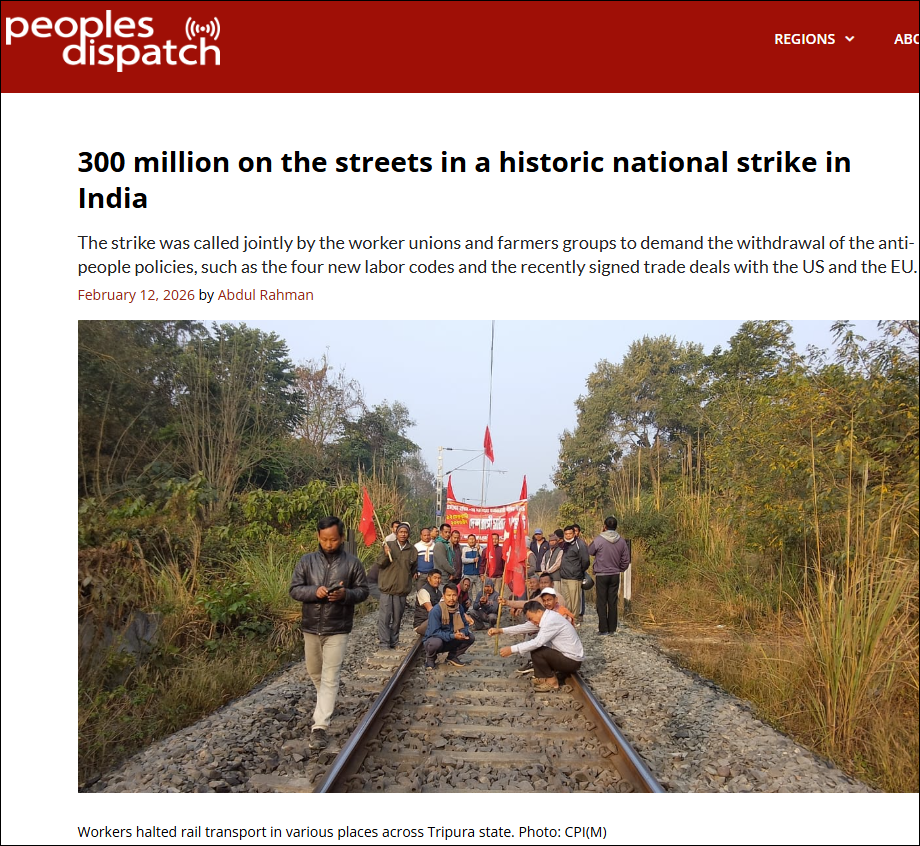
Besides the usual anti-India and anti-Hindu propaganda, People’s Dispatch also peddles fake news. In February this year, the Roy Singham-funded Marxist propaganda outlet published an article headlined: “300 million on the streets in a historic national strike in India”, claiming that such a massive number of people were hitting the streets to protest against the new labour codes and the US-India trade deal understanding.
While there was an agitation, the claim of “300 million” participants, which was also amplified by the left liberal coterie, including other propaganda organisations funded by the Roy Singham network, was exaggerated. Such inflated numbers are often repeated by pro-anarchist groups, ideological publications, and political actors looking to project a sense of crisis. India has a population of over 1.4 billion people. In a country of this scale, even large mobilisations can happen without paralysing the nation.
Calling every protest “unprecedented” or proof of systemic collapse is misleading. Despite some protests here and there, normal life was largely unaffected across all states. Normal life was largely unaffected.
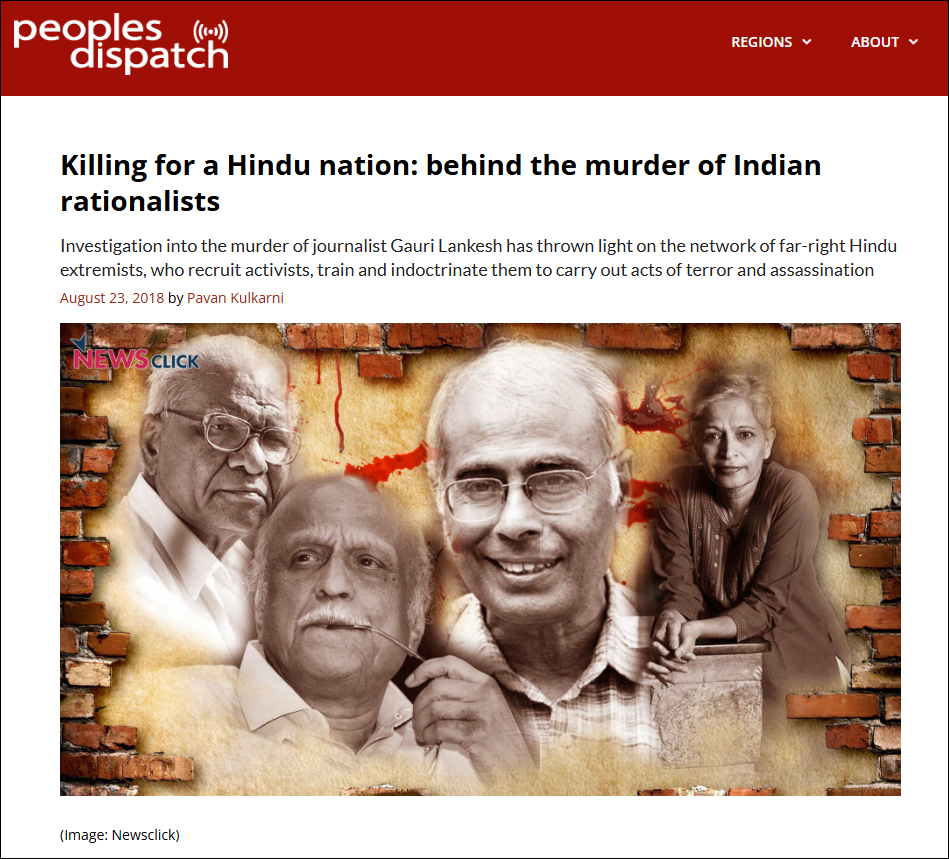
People’s Dispatch has, on multiple occasions, displayed its blatant disdain for Hindus. The propaganda outlet also sympathises with and glorifies radical leftists like Narendra Dabholkar, Gauri Lankesh, Govind Pansare, Kalburgi, among others.
Moreover, People’s Dispatch and Vijay Prashad have been involved in attempts to spark global backlash against India for its defence relations with Israel.
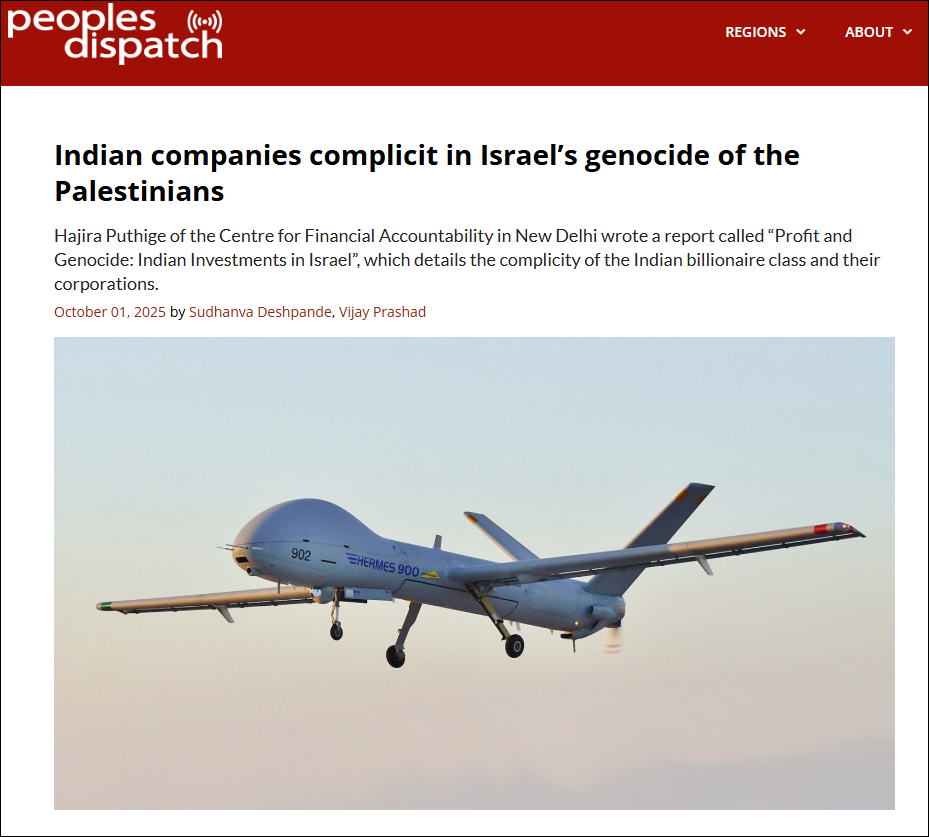
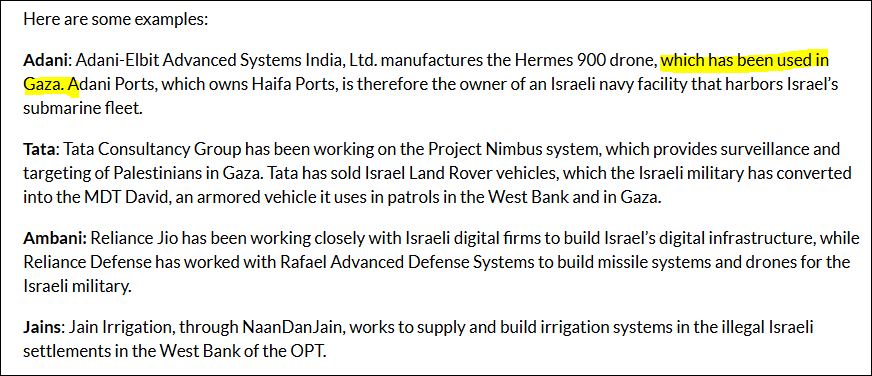
The Dispatch, which regularly villainises Israel as genocidaire, while never really condemning Hamas’s October 7 massacre, framed the Adani-Elbit drones-manufacturing joint venture in Hyderabad, Tata’s Project Nimbus system, and Reliance Jio’s partnerships in Israel as ‘complicity’ of Indian companies in ‘genocide’ of Palestinians.
This propaganda piece was authored by Vijay Prashad and one Sudhanva Deshpande, peddled blatant lies about the Adani-Elbit defence manufacturing venture. While it was true that Israel used Hermes 900 drones in its operations in Gaza, there is no evidence that India has exported Hermes 900 drones or any ‘missiles’ to Israel for use against Iran. This entire claim that the Adani-Elbit defence manufacturing unit in Hyderabad is making drones for Israel’s war against Iran is an absolute propaganda spin.
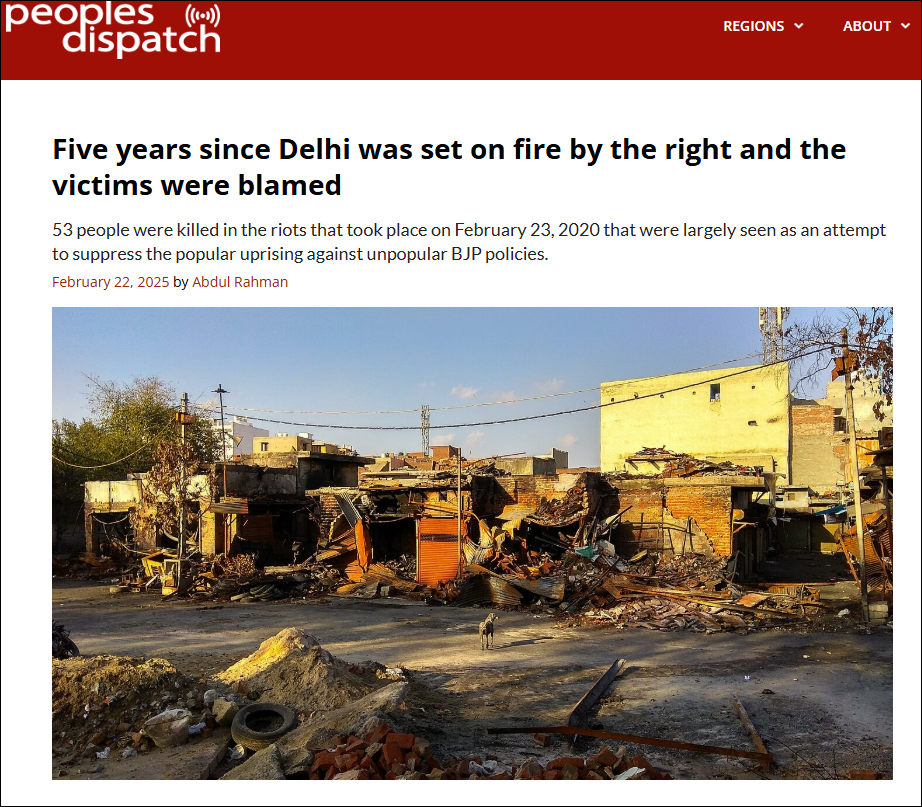
People’s Dispatch, like most Islamo-leftist propaganda portals, frames the 2020 anti-Hindu Delhi Riots as ‘Hindutva’ violence against oppressed, suppressed, depressed Muslim ‘minorities’ while in reality, it was a pre-planned Islamist conspiracy against Hindus.
It also paints Islamists like Umar Khalid, Khalid Saifi, Sharjeel Imam, and Gulfisha Fatima, who are accused of orchestrating and inciting the riots under the pretext of anti-CAA protests, as ‘victims’.
In one of the articles, the publication laments the delay in the hearing of Umar Khalid, the accused mastermind of the riots, blaming it on courts postponing his bail hearings.
Contrary to the victimhood narrative pushed by the Islamo-leftist propaganda cabal, Umar Khalid’s prolonged incarceration is his own doing. OpIndia has reported earlier that out of the 14 adjournments in 2023 and 2024, 7 delays and adjournments were sought by Umar Khalid himself. It therefore becomes evident that the withdrawal was certainly not because of the famed “delay” in hearing. While the Islamo-leftist ecosystem continues to cry ‘injustice’, it is the alleged failed forum shopping attempts of the accused’s lawyer that have Khalid rotting in jail for so long.
OpIndia’s analysis has been corroborated by former Chief Justice DY Chandrachud’s statement that the real problem lies in the mindset of some lawyers and political groups who want their cases heard only by certain judges. Highlighting what OpIndia has reported multiple times, the former CJI said that court records showed that Khalid’s legal team, led by Sibal, had sought at least seven adjournments before finally withdrawing the bail plea in February 2024, citing “a change in circumstances.”
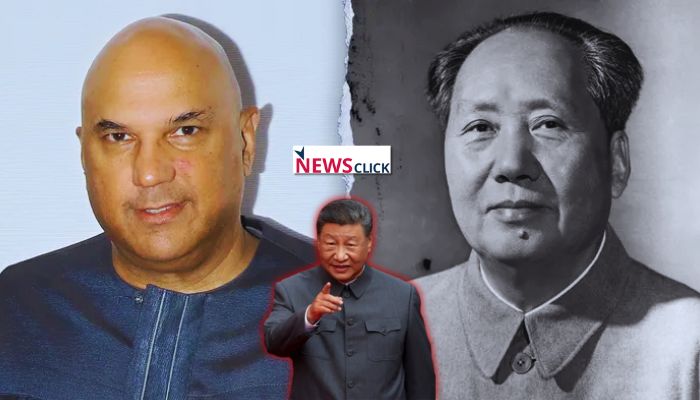
NewsClick: Neville Roy Singham-funded media outlet has been under radar for peddling pro-China propaganda
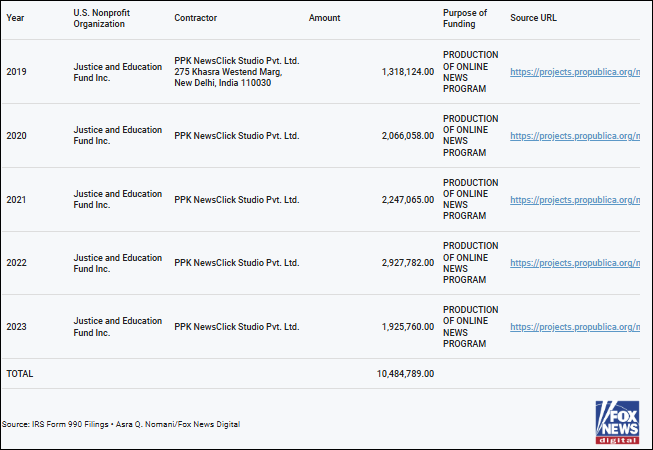
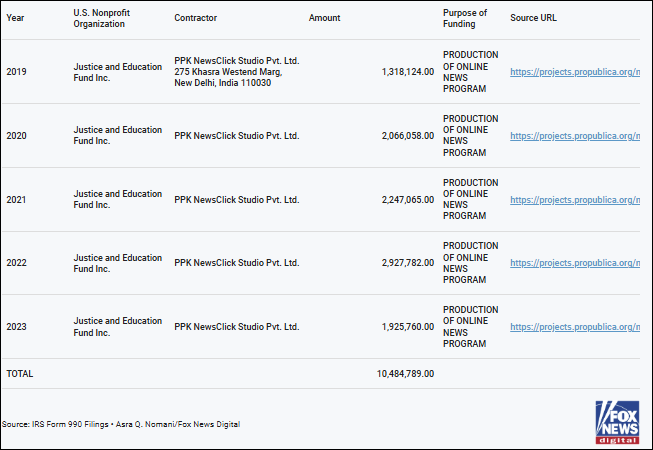
Neville Roy Singham’s Justice and Education Fund donated $10.5 million to Delhi-based pro-China propaganda outlet, NewsClick. Vijay Prashad has contributed several propaganda articles to NewsClick. Prashad is the nephew of Brinda Karat, a CPI(M) leader and wife of Prakash Karat, also a senior CPI(M) leader, whose email exchanges with Neville Roy Singham earlier revealed their close ties in the NewsClick Chinese funding scandal.
NewsClick first made headlines when it came under the radar of the Enforcement Directorate in 2021. The portal was reportedly accused of fraudulently receiving foreign funds amounting to around Rs. 38 crores. As a New York Times investigative report published in 2023 unravelled Roy Singham’s network’s alleged Chinese funding and propagandism, Vijay Prashad dubbed it “McCarthyism”.
Vijay Prashad has also been a council member of the Progressive International, an international organisation that mobilises leftist activists and groups globally. OpIndia earlier highlighted how this outfit persistently publishes propaganda articles and statements peddling the insidious Muslim victimhood narrative to slander the Modi government. The Progressive International hosts a dozen anti-India, particularly anti-Hindu propaganda pieces authored by notorious anti-Hindu and Islamic terror apologist elements like Harsh Mander. The Progressive International also has Islamo-leftist cheerleaders like Jayati Ghosh and former Labour MP Jeremy Corbyn as its council members.
Progressive International also has a Tides Foundation connection. The outfit has a pro-Hamas group, the Arab Resource and Organising Centre, as one of its members, which is sponsored by the Tides Foundation. Now, Tides Foundation has a Roy Singham-funded NewsClick connection.
Tides Foundation is notorious for funding several anti-Hindu, anti-India organisations and elements. The Foundation gave grants to Hindus for Human Rights (HfHR), which has links to Islamists and Khalistanis, and was formed in 2019 by two Islamist advocacy groups, the Indian American Muslim Council (IAMC) athe nd Organisation for Minorities of India (OFMI).
Tides also funded AMAN Public Charitable Trust (AMAN). This trust is connected to the NewsClick-China funding scandal, where it is alleged that Chinese entities funded NewsClick to disrupt Indian sovereignty.
Among Indians introduced by Neville Roy Singham to his larger team, who worked with Tricontinental, one of the nonprofits that the New York Times said was involved in pushing Chinese talking points, were Prabir Purkayastha, Srujana, Prasanth, and Vijay Prashad.
Prashad also has close ties with Urban Naxal P Sainath, whose propaganda portal PARI recently removed references to Singham after his connection with the Chinese propaganda arm had come to light.
Newsclick’s anti-Hindu bias is not hidden. Moreover, Newsclick is also under scrutiny for its alleged connections with the Chinese Communist Party (CCP). In 2023, an investigation by the New York Times uncovered an ecosystem of activist organisations, non-profits, shell corporations, and their intimate ties to China and Chinese propaganda, with Neville Roy Singham at its helm. A Delhi Police chargesheet filed in 2024 called the Chinese state the “ultimate paymaster”, with funds routed to stoke anti-India narratives, especially regarding Kashmir, and farmers’ protests. The case is ongoing in the court.
In 2021, OpIndia conducted a detailed investigation into the links of NewsClick and uncovered how it was linked to several individuals who regularly spew venom against India, from Urban Naxals to those like Teesta Setalvad, Abhisar Sharma and several others. That investigation by OpIndia can be read here.
People’s Forum pushing narratives seeped in Kashmir separatism, anti-Hindu tropes, and obsession with Kerala’s ‘Communist’ Model
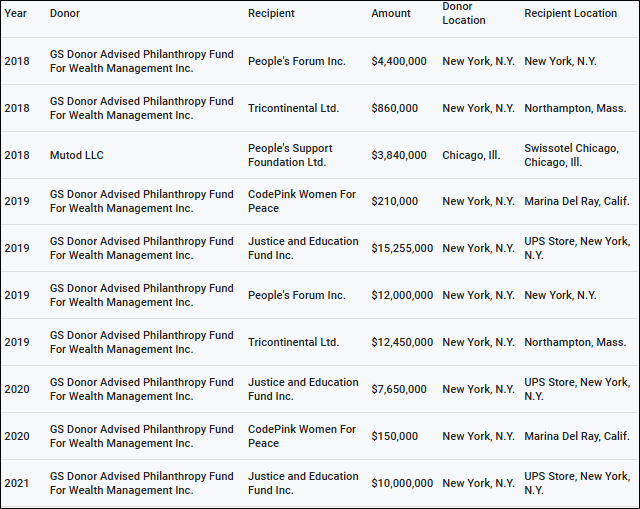
The Fox News report analysed the financial transaction flows of the House of Singham via publicly available records and found that there is one organisation by the name People’s Forum, which received $22.4 million from Neville Roy Singham.
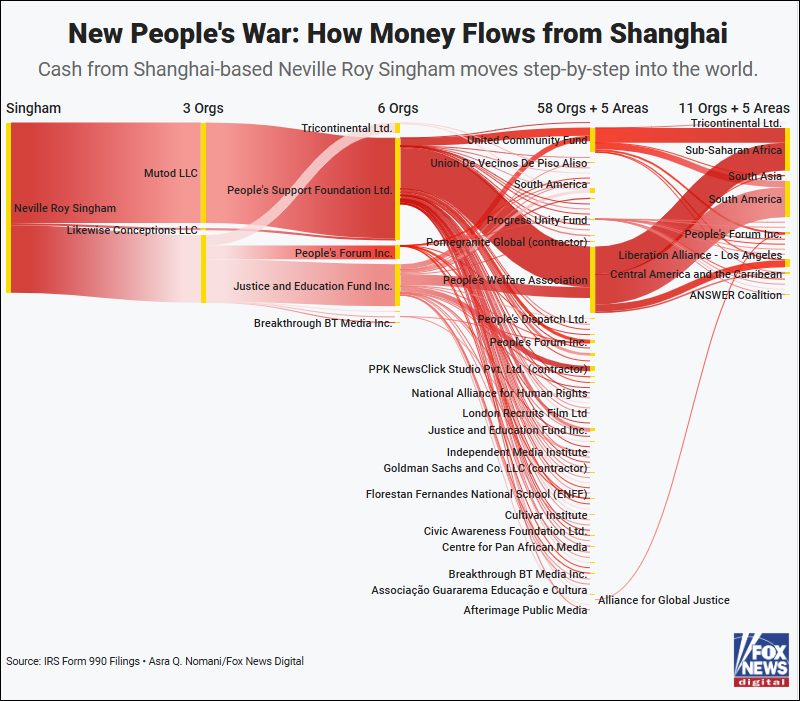
From three organisations, GS Donors Advised Philanthropy Fund for Wealth Management Inc., and the two apparent shell companies, Roy Singham allegedly pumped $278 million into six nonprofits, one
People’s Forum, which, like several other Roy Singham-funded propaganda factories, has been one of the major instigators of anti-Israel protests in the US since October 2023. CodePink, co-founder and Neville Roy Singham’s wife, Jodie Evans, donated over $20.4 million to the organisation between 2017 and 2022. However, People’s Forum’s propaganda peddling activities are not confined to the US alone; rather, it extends to India as well. The outlet has been pushing anti-India narratives since 2019.
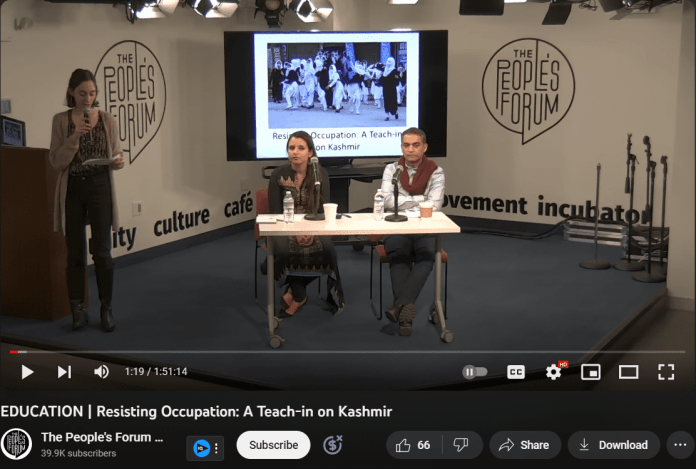
Over the years, ‘The People’s Forum’ has been organising teach-in sessions, seminars and movie screenings to disseminate a distorted idea of Jammu and Kashmir to its global audience.
Previously, the pro-China propaganda outlet has called for the secession of the integral part of Jammu and Kashmir and extended support to extremist elements, calling for ‘Azadi.‘ On March 18, 2019, the organisation conducted a 1 hour 50 minute 50-minute-long session, presenting India as an ‘occupying’ force in Jammu and Kashmir. The Forum calls the integral part of the Indian territory “Indian occupied”, even as the only portion of Jammu and Kashmir that is actually illegally occupied is— the Pakistan-occupied-Jammu and Kashmir.
The outfit also has a history of platforming rabid India-haters and Pakistan’s ISI-linked elements to push anti-India narratives. One such is Hafsa Kanjwal, who had earlier downplayed the Pulwama terror attack in an opinion piece in The Washington Post.
In 2019, Kanjwal appeared at a People’s Forum-hosted seminar as an instructor. Kanjwal has maintained close ties with convicted ISI agent Ghulam Nabi Fai through her organisation ‘Stand With Kashmir (SWK)’. She is an Assistant Professor at Lafayette College and featured prominently in several events of ‘The People’s Forum.’
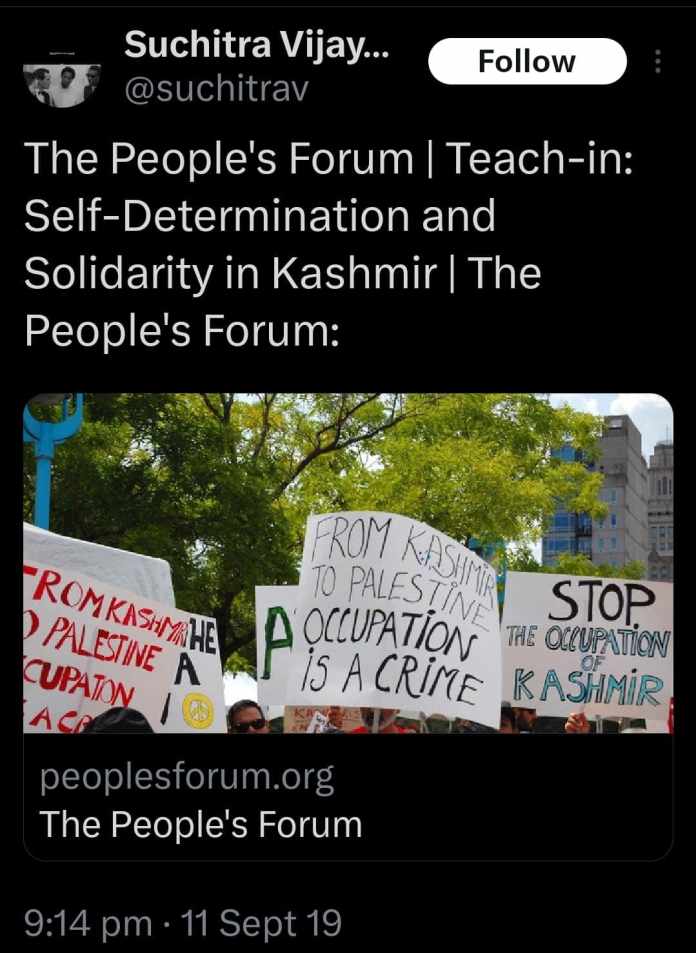
On 14th September 2019, the Neville Roy Singham-funded organisation conducted another ‘teach-in session’ dubbed ‘Self-Determination and Solidarity in Kashmir.’ The anti-India event was sponsored by the likes of ‘Codepink’, founded by Neville Roy Singham’s wife, Jodie Evans.
“This teach-in is geared towards building solidarity between the Kashmiri and Palestinian anti-occupation movements. The instructors will give a history of the Kashmiri struggle for self-determination, provide an analysis of the Indian occupation of Kashmir, and reflect on the ties between India and Israel, as well as the need for greater mobilization between the Palestinian and Kashmiri solidarity movements,” the synopsis of the programme read.
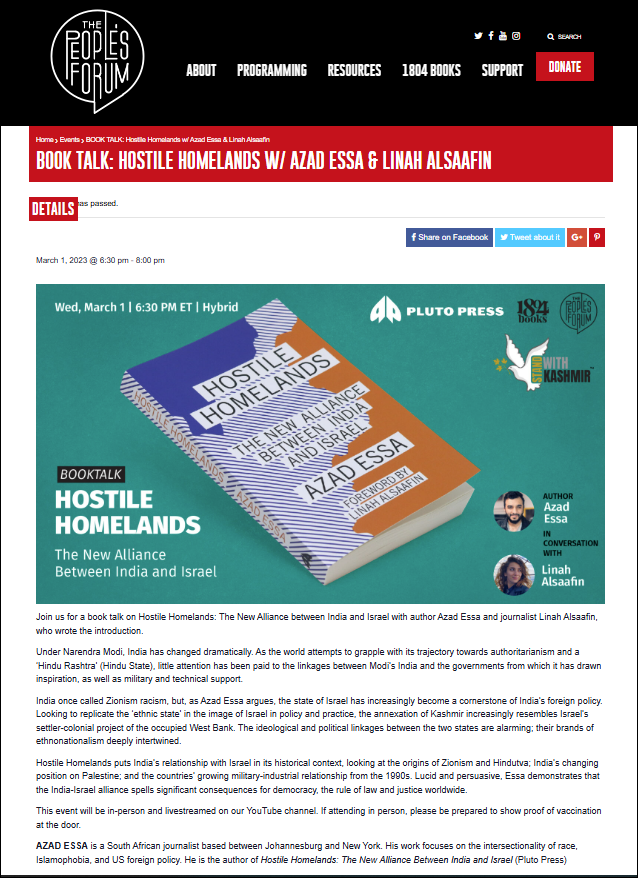
In March 2023, Hafsa Kanjwal was invited by ‘The People’s Forum’ to promote his book ‘Hostile Homelands: The New Alliance between India and Israel.’
The People’s Forum also promoted his propaganda film on the Indian State of Jammu and Kashmir, titled ‘Out of Sight.’
In the run-up to the 2019 Lok Sabha elections, The People’s Forum conducted a seminar by a Communist Party-affiliated Student Federation of India (SFI) leader, V Srinivasa Rao.
The event titled ‘Make the land proud: India’s Peasant Struggles and the 2019 Election’ hoped to capitalise on the growing resentment of farmers towards the Modi government and impact the outcome of the polls.
The description of the seminar gave away the anti-India outfit’s nefarious agenda–
“Earlier this year (2019) more than 160 million peasants and workers went on strike in India. In the last few years, India has seen an upsurge of peasant struggles across the country as the Indian politics have moved to the far right under Modi’s rule.This has been one of the largest general strikes in the world. The workers, exhausted by almost three decades of neoliberal policies and by the attack on their rights, came onto the streets to make their case for better livelihoods and workplace democracy. Because of India’s government policies, agrarian distress is acute: An average of 12,000 farmers committed suicide every year of this government’s rule.“
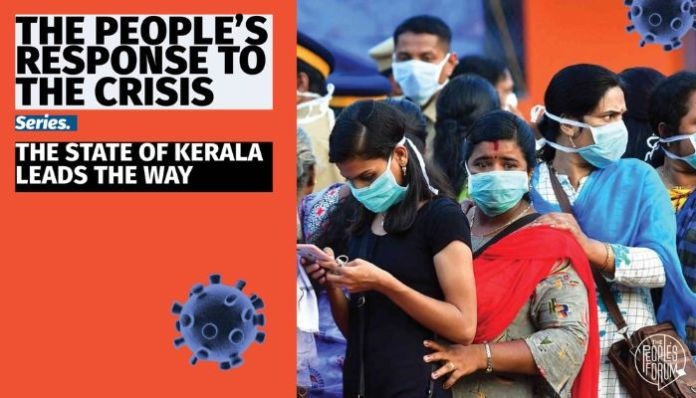
Unsurprisingly, the pro-China and pro-Communist propaganda organisation funded by Neville Roy Singham also has a record of disseminating the myth of the ‘Kerala Model’ in one of its events.
In an April 2020 event, The People’s Forum claimed, “While Indian PM Modi follows the example of fellow neoliberal strongmen around the world, and fails to protect lives from this pandemic while downplaying the crisis, Kerala offers a different example. The state of Kerala, led by a coalition of leftist and communist parties, has set the standard in successful testing, containment, and socialized care for the well-being of its people. How has this been achieved in Kerala, and what can we learn from this experience? Join researcher Subin Dennis and journalist Prasanth R for the discussion.“
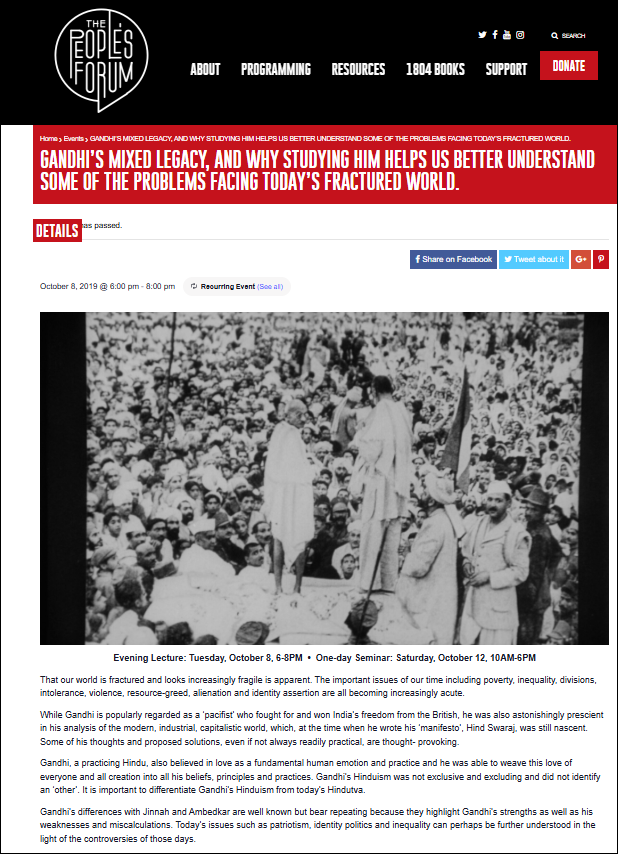
Back in October 2019, the Neville Roy Singham-financed organisation held a seminar on Mohandas Karamchand Gandhi and launched an attack on Hinduism under the pretext of condemning ‘Hindutva’.
“Gandhi, a practicing Hindu, also believed in love as a fundamental human emotion and practice and he was able to weave this love of everyone and all creation into all his beliefs, principles and practices. Gandhi’s Hinduism was not exclusive and excluding and did not identify an ‘other’. It is important to differentiate Gandhi’s Hinduism from today’s Hindutva.“
It has become a convenient tactic for Islamo-leftists to use the term Hindutva to attack Hinduism. In reality, they do not make any such distinction. Interestingly, the event was co-sponsored by Hindus for Human Rights (HfHR).
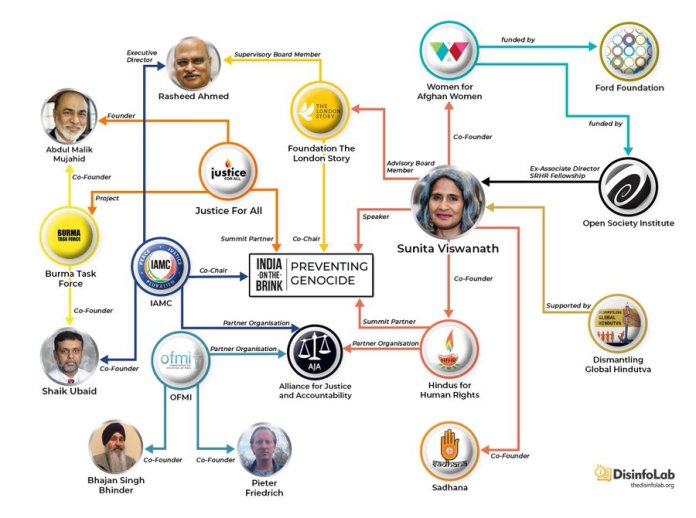
Earlier, HfHR was also seen endorsing the Hinduphobic event titled, ‘Dismantling Global Hindutva’ conference. As per OSINT handle ‘Disinfo Lab’, HfHR was formed in the year 2019 by the Indian American Muslim Council (IAMC) and the Organisation for Minorities of India (OFMI).
Sunita Vishwanath, the co-founder of ‘Hindus for Human Rights’ had also tried to create hysteria and panic among Indian Muslims about the National Register of Citizens (NRC) in 2019.
“We are especially appalled by the most recent nightmare of the Kashmiri people, and the situation of 1.9 million people in India who are rendered stateless due to the imposition of the travesty called the National Register of Citizens,” she claimed.
Sunita Vishwanath is also the co-founder of an organisation named ‘Women for Afghan Women’, which is funded by George Soros’ Open Society Foundations (OSF)/ Open Society Institute (OSI). In October 2023, the X (formerly Twitter) account of HfHr was withheld in India.
Through his Open Society Foundation, which began operations in India in 1999 by offering scholarships and fellowships to pursue studies and research at Indian institutions, George Soros has made great strides in creating disorder in India. Soros-linked entities lend support to anti-India elements to undermine Indian democracy, all while in the name of ‘strengthening’ it.
In 2023, Vishwanath attended an event at the National Press Club, Stanford University, where Congress leader Rahul Gandhi was present.
Sunita Vishwanath had backed Zohran Mamdani, a Democrat Socialist, a serial liar, and a Hinduphobe, during his NYC mayoral election campaign. Mamdani, who once called Hindus ‘Harami’, peddled blatant lies about the 2002 Gujarat Riots, and claimed imaginary erasure of Gujarat Muslims, received financial and propaganda support from anti-India Islamist outfits like CAIR and IAMC.
Vishwanath’s HfHR was founded in the year 2019 by two Islamist advocacy groups named Indian American Muslim Council (IAMC) and the Organisation for Minorities of India (OFMI).
Interestingly, Shanti Singham, the sister of Neville Roy Singham, made significant financial contributions to the Parliamentary Action Committee (PAC) named New Yorkers for Lower Cost, which backed Democratic Socialist Zohran Mamdani during the last New York City mayoral elections. Shanti Singham contributed around $1,000 in June 2025, while her husband, Daniel Goodwin, donated $3,500. Goodwin previously served as the executive of Neville Roy Singham-owned Thoughtworks software company.
Shanti Marie Singham holds a key position at the CCP-linked East China Normal University in Shanghai. She shares her brother’s political ideology and is reported to be an important player in the furtherance of the same.
What Neville Roy Singham, with the backing of the CCP, has built is not a philanthropy or activism network but a Marxist-Maoist transnational apparatus designed to weaponise issues, nonprofit laws, digital media, and every other resource at hand to undermine rival states, influence policy decisions, and gain a geopolitical edge. This is a form of modern subversion. Fuelled by both ink and blood, this is a subtle, sophisticated and effective tactic of ensuring that the enemy state is eaten up by CCP-cultivated termites.
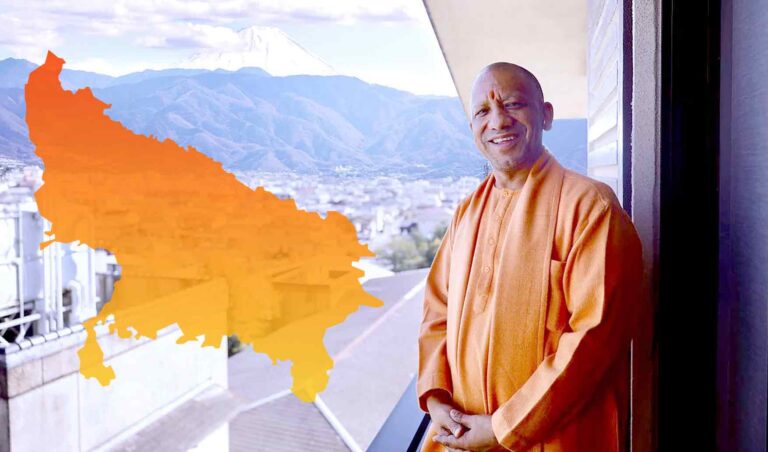
India’s most populous state, Uttar Pradesh, has undergone a remarkable transformation over the past nine years—one that extends far beyond administrative change and reflects a broader narrative of development, governance, and social progress. Under the leadership of Yogi Adityanath, the state has embraced a vision of “reconstruction” that is steadily translating into a roadmap for sustained prosperity.
Perhaps the most visible shift has been in the realm of law and order. Once frequently associated with crime and disorder, Uttar Pradesh has repositioned itself as a safer and more stable destination for both citizens and investors. The government’s tough stance on organized crime, including stringent action against mafia networks and the high-profile demolition of illegally acquired properties, has reinforced a sense of security among the public. This improved law-and-order environment has also played a crucial role in unlocking economic potential by boosting investor confidence.
On the economic front, Uttar Pradesh has made significant strides. The state’s ambition to become a trillion-dollar economy is not merely aspirational but grounded in strategic planning and policy execution. A balanced approach to development—encompassing agriculture, industry, and services—has been central to this progress. In agriculture, efforts such as ensuring Minimum Support Price (MSP), expanding irrigation infrastructure, and promoting technological interventions have improved productivity and farmer incomes. Simultaneously, initiatives like the “One District, One Product” (ODOP) scheme have revitalized traditional industries and enabled local products to gain global visibility, strengthening the MSME ecosystem.
Infrastructure development has emerged as a cornerstone of Uttar Pradesh’s growth story. The construction of major expressways, including the Purvanchal Expressway, Bundelkhand Expressway, and the ambitious Ganga Expressway, has significantly enhanced connectivity across regions. These projects are not just about faster transportation; they are catalysts for industrial growth, regional integration, and job creation. Additionally, the expansion of airports and the development of metro rail systems in cities have contributed to modern urbanization and improved quality of life.
The energy sector has also witnessed considerable progress. Ensuring reliable electricity supply—especially in rural areas—has been a key priority. The extension of electrification to remote villages and the push for uninterrupted power supply have strengthened the rural economy and supported small-scale industries. Energy reforms have thus played an essential role in bridging the urban-rural divide.
In the social sectors of education and healthcare, the government has undertaken several reforms aimed at improving access and quality. The transformation of primary schools through infrastructure upgrades, digital learning initiatives, and teacher training programs has begun to yield positive outcomes. In healthcare, the expansion of medical colleges, upgradation of district hospitals, and effective implementation of welfare schemes like Ayushman Bharat have improved healthcare accessibility for millions. These measures have contributed to building a more inclusive development framework.
Women’s empowerment has been another important pillar of the state’s development agenda. Programs such as Mission Shakti have focused on enhancing women’s safety, dignity, and economic participation. Self-help groups have been actively promoted, enabling women to become financially independent and play a more significant role in community development. This focus on gender inclusion reflects a broader commitment to equitable growth.
Digital governance and transparency have further strengthened the administration. The digitization of government services has reduced bureaucratic delays and minimized corruption, making public services more accessible and efficient. Direct Benefit Transfer (DBT) mechanisms have ensured that welfare benefits reach intended beneficiaries without leakages, thereby enhancing trust in governance.
Tourism has also received a significant boost, particularly through the development of religious and cultural sites. Landmark projects such as the Kashi Vishwanath Dham corridor and the grand construction of the Ayodhya Ram Mandir have not only revitalized India’s spiritual heritage but also attracted global attention. Cities like Varanasi, Ayodhya, and Mathura are witnessing increased tourist inflow, contributing to local economies and job creation.
Despite these achievements, challenges remain. Issues such as unemployment, disparities in educational outcomes, and the rural-urban divide continue to demand attention. While the state has made progress in addressing these concerns, sustained efforts and policy innovation will be necessary to ensure that growth is both inclusive and equitable.
The journey of the past nine years demonstrates that Uttar Pradesh is steadily shedding its earlier image as a lagging state and emerging as a dynamic contributor to India’s growth story. This transformation is not merely the result of policy measures but also of a clear vision, strong political will, and consistent governance.
In conclusion, Uttar Pradesh’s reconstruction over the past decade represents a significant chapter in India’s development narrative. The “golden resolve” for prosperity is not just a slogan but a tangible process that is reshaping the state’s economic and social landscape. If this momentum continues with the same focus and commitment, Uttar Pradesh is well-positioned to become not only a key driver of India’s economy but also a model of large-scale transformation on the global stage.
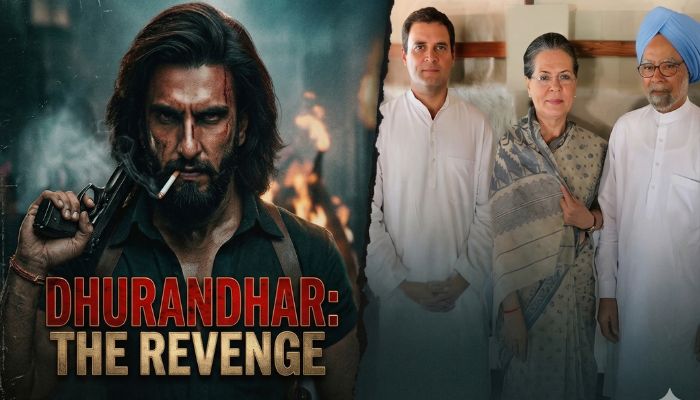
‘Dhurandhar: The Revenge’, directed by Aditya Dhar, hit the theatres on 19th March this year. The film, which has been a raging hit among the public, highlighted the poor state of security and intelligence apparatus in India during the Congress-led UPA era (2004–2014).
It drew a sharp contrast with the national security approach of the Modi government and its resolve to take firm decisions in the interest of the country. Soon after the release of the film, netizens began sharing news stories from the early 2010s to highlight the appeasement politics and grim state of affairs during the UPA era.
The trend started on Friday (20th March) with the re-sharing of a Dec 2014 tweet by a Pakistan handle ‘@afzaal_k’, which talked about the arrest of gangster Uzair Baloch at the Dubai airport.
In ‘Dhurandhar 2’, Uzair Baloch is one of the most talked-about characters of the movie due to the sheer brutality of his role. He is the brother of the notorious gangster Rehman Dakait. Baloch’s character brought a barbaric and unpredictable energy to the big screen.
Netizens heaped praises on Aditya Dhar for his peak detailing and bringing historical accuracy to the film. This sparked off discussions about other aspects of ‘Dhurandhar: The Revenge’, such as Congress-led UPA’s failure to act on intelligence that could have prevented the 26/11 attacks.
Lack of political will, decision-making ability and friendliness with Islamists on the part of the UPA regime became the focus of the discussion on social media. Netizens dug up old tweets which showed how India was truly in a messed-up state.
1. Friendliness with Islamists
A series of tweets dating back to early 2010s show how the UPA regime delayed the execution of Islamic terrorist Afzal Guru, who orchestrated deadly attack on the Indian Parliament.
In order to avoid facing flak from Muslims, the Congress described his hanging as a ‘decision taken as per law’ and not a ‘political decision.’
The Court ordered Afzal Guru’s execution for October 2006, but the UPA deliberately froze his mercy petition for 7 long years to appease a specific vote-bank.
After Afzal Guru was executed on the orders of the Supreme Court of India, Prime Minister Manmohan Singh expressed unhappiness over delay in informing the terrorist’s family.
Sources: PM upset over delay in informing Afzal Guru's family about his execution.
Congress leader Salman Khurshid had infamously said that party supremo Sonia Gandhi cried after the Delhi police neutralised the Batla House terrorists in 2008.
Reactions: Pictures of Batla case brought tears in Sonia's eyes: Salman Khurshid: http://t.co/ctW1ZVXR
The Congress party, which manufactured the lie of ‘Hindu terror’ during the UPA era, attempted to blame Hindus for terror attacks in Malegaon, Mecca Masjid and Samjhauta train.
Samjhauta blast, Mecca Masjid, Malegaon blast. By planting bombs & then blaming minorities: HM Sushil Kumar Shinde
In May 2010, WikiLeaks reported that Rahul Gandhi went on to tell a US envoy that so-called ‘Hindu terror’ groups are a bigger threat in India than LeT.
FLASH: Rahul Gandhi spoke to US envoy about Hindu terror group, said Hindu terror is bigger threat in India than LeT – WikiLeaks #ht
The Congress party, which signed a Memorandum of Understanding (MoU) with the Chinese Communist Party (CCP), was fraternising with China when its troops were 19 km inside the Indian territory. Salman Khurshid had infamously said that he would love to live in Beijing.
Imagine your Foreign Minister fraternising with the Enemy, saying he wants to live in Beijing when Chinese troops were 19km inside Indian territory at the exact same time https://t.co/Fs9xvzAqvbpic.twitter.com/ByKwNdLMvO
In May 2010, Congress leader Jairam Ramesh had infamously said that India needs Chinese experts for infrastructure projects in Arunachal Pradesh, which China fraudulently claims as its own.
4. Scared of theUS
While the Congress party is claiming that the Modi government has somehow failed to navigate the ongoing US-Iran conflict and hold India’s interests, it must be mentioned that the ‘scared’ Congress-led UPA government had banned urea imports from Iran ahead of Hillary Clinton’s visit to India.
Exclusive: India bans urea imports from Iran ahead of Hillary's visit http://t.co/gfw3Y0mh
It is well known that the Congress government remained a mute spectator after Pakistan orchestrated one of the deadliest terror attacks on Indian soil on 26th November, 2008.
Old India
This was when Pakistan’s Home Minister flew into Delhi and told Indians that Kargil martyr Captain Saurabh Kalia had died due to bad weather.
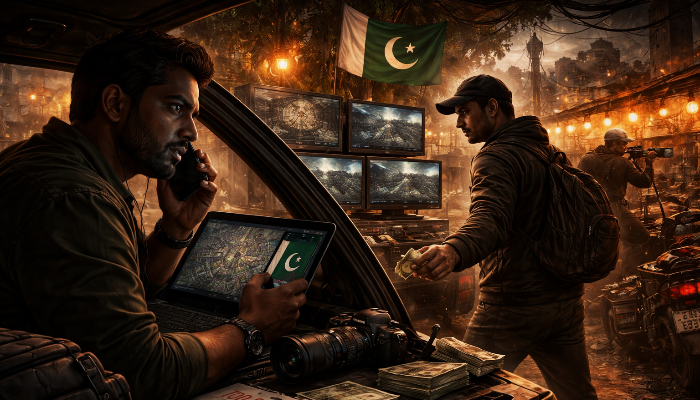
The authorities have recently dismantled a significant Pakistan-tied espionage ring in Ghaziabad, Uttar Pradesh. 22 people have been nabbed, including 6 minors who were involved in various spy operations throughout the nation, and alarming revelations have been emerging during the investigation.
They set up CCTV cameras and utilised them, social media and encrypted applications to transmit live footage of troop movements, routes and weaponry to Pakistan. Solar-powered CCTV cameras were deployed at Delhi Cantonment and Sonepat as 50 additional spots were to follow suit across India, including the Delhi-Jammu railway corridor. Police have retrieved the cameras and forwarded them for forensic analysis. The cell phones of the accused have also been confiscated.
These people also created WhatsApp groups to disseminate visuals of key structures, including railway stations and temples, as well as GPS coordinates of such crucial places, along with other information, to foreign numbers. They were compensated for their services with funds via intermediaries who also passed orders to them. The costs range from Rs 500 to several thousand.
The money trail is under inquiry. Ganesh, a citizen of Nepal who has been imprisoned, informed the police that a handler, Sardar Jora, used hawala to send funds to the country. Afterwards, it was moved to accounts in India or distributed through cash after being channelled using casinos, businesspeople and mobile routes. The middlemen took a 20% cut.
A potential terror-plot in motion
The actions indicated a pre-attack monitoring effort, not solely espionage. The online training modules were imported, and more than 450 files have been traced to Pakistan.
“Sameer downloaded an app from Play Store to capture and transmit material and was trained online to use it. He also lured several boys into the gang with money and got them to carry out reconnaissance. In the last year alone, he added more than 12 youths to the group,” the police outlined.
The focus was also to entrap women and minors to lower suspicion. The recruitment also concentrated on young adults with technical abilities, including experience at mobile repair shops, CCTV technicians and even rudimentary networking knowledge.
The names Sardar Jora, also known as Sarfaraz or Zora Singh and Shahzad, referred to as Bhatti, who are based in the Islamic Republic, along with Waqar alias Vicky Jat, have surfaced in the case. Jat was running a parallel syndicate similar to the other two and was in touch with the arrested individuals.
The accused were working on the directions of their Pakistani handlers and pretended to be Hindus to participate in anti-national activities through espionage and reconnaissance. They changed their identities out of the fear of being exposed and to evade detection, just as Suhail Malik posed as Romeo, Naushad Ali disguised himself as Lalu, Sameer presented himself as Shooter and Sane Iram masqueraded as Mahek.
Interestingly, Naushad had opened a shop for fixing punctures at a petrol pump a few months ago in Nachauli village of the Faridabad district in Haryana.
Muslims pretended to be Hindus, love jihad angle suspected
The probea also found that Muslims working to establish ISI network India were using Hindu names and attire. For example, Suhel alias Romeo wears a sacred thread and a Rudraksha around his neck, and puts a Tilak. Naushad, Iran and other Muslims arrested in the case also similarly pretended to be Hindus.
It is believed that they not only alter their names for anti-India acts, but love jihad could also serve as a motive for the same, and the security agencies are looking into it. Notably, Suhail, Naushad and Sameer were scheduled to travel to Jammu-Kashmir and Leh-Ladakh for recce on the orders of their Pakistani master. However, Suhail abandoned the mission to attend his Hindu girlfriend’s birthday. She resides in Himachal Pradesh’s Baddi, and he met her as Romeo. According to sources, he could be a part of a love jihad gang.
Suhail, Meera Thakur, Ganesh, Hrithik Gangwar, Naushad and Sameer visited Haridwar and Rishikesh a few days prior. They bathed in Ganga at Har ki Pauri, performed Ganga Aarti and then did surveillance following the darshan at Mansa Devi and Neelkanth Mahadev temples. Afterwards, the group arrived at Sikar’s Ringas railway station in Rajasthan by train and went to the Khatu-Shyam temple and then proceeded to an army camp situated approximately 15 kilometre away and returned after carrying out their illegal scouting.
A conspiracy to target the Hindu community
Pakistan’s Inter-Services Intelligence (ISI) agents maintained constant communication with Suhail and Iram and told them to increasingly recruit young Hindu men and women into the network. Economically disadvantaged youths fell victim to their sinister scheme. They were intended to be exploited in dangerous plans with high risk to life. The responsibility for storing weapons was also going to be handed over to them.
The Pakistanis were persistently instructing them to reach out to more Hindus and give them access to critical information after they are deemed completely reliable. They were asked to refrain from unveiling the identities of their associates in the neighbouring country in light of any doubt or unsurety. The pair upheld this approach.
Suhail successfully targeted several people from the Hindu community after which Shiva Valmiki, Raj Valmiki, Hrithik and Praveen joined the spy-web. Parveen was deeply trusted by Suhail and the handlers and was assigned the task of setting up cameras in Sonepat. According to the agencies, the aim was to defame the Hindu community and protect the Muslims.
Suhail also directed his attention at those who had received education only from the 5th to the 12th grade. He added mobile mechanics, daily wage earners, fast food and fruit vendors to the network as they needed help to meet their internet expenses. They were enticed with the promise of financial incentives and taken to different areas under the guise of filming reels.
They completed their assigned duties ensuring that their true intentions remained under wraps. They even travelled in groups and transmitted details regarding Israeli hotels and VVIPs alongside of areas such as Connaught Place and Paharganj in the national capital.
Speeches of Maulana Masood Azhar, Hafiz Saeed were used to brainwash
The accused, including Suhail and Iram, were scared after brothers Zeeshan and Gulfam, who tried to behead ex-Muslim Saleem Wastik, were shot dead by the Uttar Pradesh police during an encounter. They began to distance themselves from the Pakistani handlers. Suhail even talked about this with them. Hence, the Pakistanis indoctrinated him over an extended period.
The ISI handlers claimed that the Islamist siblings were not actually deceased but had achieved martyrdom and would enter paradise. It was asserted that the earthly existence pales in comparison to the life in heaven, and they declared the pair as martyrs. The audio and video recordings of the inflammatory speeches of Jaish-e-Mohammed supremo Muhammad Masood Azhar Alvi alias Masood Azhar’s and Lashkar-e-Taiba founder Hafiz Muhammad Saeed were sent with the goal to brainwash.
Masood Azhar rambled about “jihad, martyrdom and jannat” in these old addresses which proved effective and all the Muslim accused continued their ties with the Pakistanis. They also succeeded in luring Hindus in Pune where Suhail spent three years and worked as a baker. However, it was merely a front as he was receiving money and directives from the ISI. There he targeted those who were in the same profession. Suhail was awarded Rs 10,000 for every video clip he provided.
The involvement in firing at Salman Khan’s house
An attack occurred at the residence of Bollywood actor Salman Khan in 2024. The involvement of Mumbai gangster Mohammad Khan, also known as Wasim Chikna, was uncovered in relation to this incident. The probe has disclosed that Meera, Ganesh, Suhail, Iram and Sameer executed reconnaissance of the house for Wasim who was later caught alongside others.
Their handlers are discovered to be in various nations, including Pakistan, Malaysia, Dubai, the United Kingdom, Nepal, Canada, amonng others. The investigation has shown that all the accused using fake names had Indian SIM cards and employed Voice over Internet Protocol (VoIP) for their calls. This method allowed them to conceal their actual location and edit the phone number.
The present matter is under inquiry as agencies are looking for other active spies and the identities of these handlers. The investigators are also examining the places whose details had been dispatched to the Pakistanis and the devices that were utilised for this. The police have assured that the masterminds will be revealed soon.
OTP and SIM given to foreign actors
An investigation into an OTP and SIM supply ring was initiated simultaneously. The accused sent Indian OTPs overseas, allowing those outside India to use Indian numbers for social media and WhatsApp accounts. The payments were between Rs 500 and Rs 5,000.
The foundation of SIM acquisition was a collection of interchangeable strategies, comprising pre-activated SIMs via agents, phishing, snatching and falsified IDs. UPI was applied to transfer funds, but personal accounts were not used. There was limited traceability because the amount circulated through Jan Seva Kendras, small businesses and cash withdrawals.
Air Force civilian staffer arrested
On 22nd March (Sunday), a civilian Air Force worker was apprehended on suspicion of espionage for Pakistan at the Chabua Air Force Station in the Dibrugarh district, Assam, in a separate case. He was working as a Multi-Tasking Staff member and has been identified as 36-year-old Sumit Kumar, a native of Prayagraj. He is charged with offering critical Air Force intelligence to his handlers for money. He has been in continuous touch with them since 2023.
Kumar divulged vital details concerning Air Force facilities, such as Air Force Station Chabua and Air Force Station Nal in Bikaner. Confidential data on commanders and staff was supplied in addition to the positions of fighter planes and missile systems. He also aided Pakistani agents in establishing social media accounts with mobile numbers that were listed in his name.
Kumar was moved to the Central Interrogation Center in Jaipur after he was taken into custody. He has been booked under pertinent sections of Bharatiya Nyaya Sanhita (BNS) and Official Secrets Act. He was eventually arrested after Jhabararam from Jaisalmer was nabbed in January. The authorities busted a larger spy network that highlighted Pakistani ties as a result of the latter’s interrogation and thorough probe.
The Western media is finally waking up to what OpIndia has been highlighting for years about a transnational network of non-profits, activist groups, think tanks, and media outlets, operating as the propaganda machinery of the Chinese Communist Party (CCP). Fox News has come up with an investigative series examining the pro-China information laundering network helmed by Neville Roy Singham, the US-born tech tycoon who sold his IT consulting firm Thoughtworks for about $785 million in 2017 before relocating to Shanghai.
The three reports of the five-part series delve into how the “House of Singham” is operating a sophisticated “information laundering” or “narrative launder” machinery that modifies raw activism into polished propaganda, which is then amplified the Roy-Singham-funded network to sow discord in the US and other democracies while burnishing China’s image as a ‘benevolent’ counterweight to ‘imperialism’, particularly, American imperialism, with the ongoing left-wing activism in Cuba being a textbook case of this.
The drill is simple: do everything it takes to push the narrative that somehow Marxist-Maoist ideology is the best suited and is inherently good, while American capitalist-imperialist ideology is downright evil and the root of almost all problems across the world.
Nevill Roy Singham-led propaganda network on CCP payroll: Hundreds of organisations and activists selling Chinese propaganda and undermining rival states from within, like termites
In early March 2026, an official inquiry was launched into the alleged connections between the CCP and the House of Singham. The US authorities are investigating Neville Roy Singham’s Chinese funding sources, media influence, political outreach, and their impact on American interests.
From pro-Palestine activism in the US, influx of far-left activists in Cuba amidst President Trump’s rising interest in the country, to ‘No War’ activism over the Iran war, these seemingly spontaneous and genuine anti-war protests are in reality, a part of well-organised, well-funded, and politically-motivated campaign, orchestrated by organisations and activists all finding their roots in the Neville Roy Singham’s network of philanthropic organisations, think thanks, media, and activists, intellectuals, celebrities, political organisers and comrades.
The Fox News investigation relied on analysis of hundreds of IRS tax filings, organisational records, financial transactions, social media content, and historical documents using large language models and open-source methods.
The analysis reveals that Neville Roy Singham has funnelled over $278 million directly into his pro-China propaganda network since 2017, with total money flows exceeding $591 million across 223 transactions spanning five continents through the year 2025. The massive amount was pumped into over a thousand interconnected organisations, of which around 200 are directly involved in generating and propagating pro-China and anti-America messaging at the behest of the CCP.
“Singham and Evans have activated a global network that now numbers an estimated 2,000 hard-left organizations that parrot anti-U.S. propaganda supporting autocratic regimes leading China, Russia, Iran, Cuba, North Korea, Venezuela and Gaza. Within activist circles, far-left critics refer to leftists who align with authoritarian regimes as “tankies.” Many groups and leaders from Singham’s network, including Evans and Benjamin, are part of the pro-communist convoy now in Cuba,” a Fox News article headlined “Power Couple of Chaos: How a tycoon and activist built a ‘Revolutionary Base’ at the House of Singham”reads.
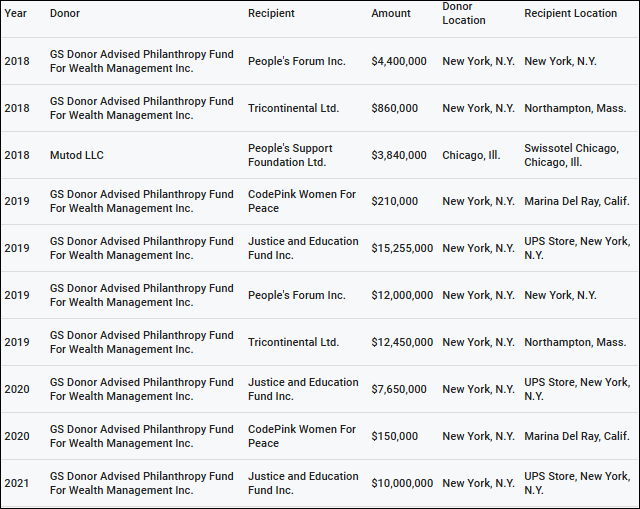
Allegedly, Neville Roy Singham first established a system to funnel tax-exempt dollars via two shell entities and a donor-advised fund with links to Goldman Sachs, “GS Donor Advised Philanthropy Fund for Wealth Management Inc.”
Fox News reports that Goldman Sachs philanthropy arm “terminated” Singham’s donor-advised fund in February 2024.
The origins of this pro-China propaganda and activism network are traced to Neville Roy Singham’s wedding to Jodie Evans, the co-founder of CodePink Women for Peace, in Jamaica in 2017. The wedding event was attended by more than 80 core leaders, including Vijay Prashad of “TriContinental: Institute for Social Research”. Vijay Prashad, a Marxist journalist, later populated other boards within the network across shell-like entities, including Mutod LLC and Likewise Conceptions LLC. Fox News investigation finds that many of these organisations are registered at generic locations like hotels or UPS stores, apparently to obscure flows.
The has eleven US non-profits serving as a hub, redistributing funds, coordination protests, media content generation, political education, and “Liberation Centers” that are similar to infamous 20th century Chinese leader, Mao Zedong’s “united front” strategy of embedding ‘revolutionary’ actors in superficially independent, social, media, labour, cultural, and educational groups to abrade the targeted country’s state legitimacy from within.
From three organisations, GS Donors Advised Philanthropy Fund for Wealth Management Inc., and the two apparent shell companies, Roy Singham allegedly pumped $278 million into six nonprofits.
These nonprofit organisations include People’s Forum, which received $22.4 million, People’s Support Foundation, which received $167.5 million from Singham-linked sources, and Justice and Education Fund, which received $68.7 million. BreakThrough BT Media, CodePink, which is co-founded by Singham’s wife Jodie Evans, and Tricontinental Ltd, which has Marxist ‘journalist’ Vijay Prashad as its Director.
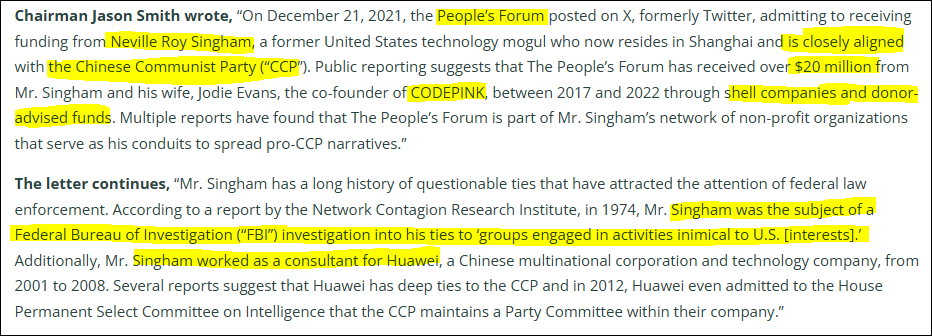
Notably, in September 2025, Ways and Means Committee Chairman Jason Smith records linked to The People’s Forum, after allegations emerged that it has direct links with the Chinese Communist Party (CCP) and that it had received millions of dollars in funding from a CCP ally, Neville Roy Singham, “while enjoying the benefits of U.S. tax-exempt status.”
Smith wrote that The People’s Forum justified the October 7 massacre of Israeli civilians by the Palestinian Islamic terror group, Hamas, incited anti-ICE protests and violence across colleges in the US, admitted to receiving over $20 million in funding from Neville Roy Singham, and hosted events and courses pushing CCP propaganda.
The Ways and Means Committee head wrote, “Public reporting suggests that The People’s Forum has received over $20 million from Mr. Singham and his wife, Jodie Evans, the co-founder of CODEPINK, between 2017 and 2022 through shell companies and donor-advised funds. Multiple reports have found that The People’s Forum is part of Mr. Singham’s network of non-profit organizations that serve as his conduits to spread pro-CCP narratives.
“Mr. Singham has a long history of questionable ties that have attracted the attention of federal law enforcement. According to a report by the Network Contagion Research Institute, in 1974, Mr. Singham was the subject of a Federal Bureau of Investigation (“FBI”) investigation into his ties to ‘groups engaged in activities inimical to U.S. [interests].’ Additionally, Mr. Singham worked as a consultant for Huawei, a Chinese multinational corporation and technology company, from 2001 to 2008. Several reports suggest that Huawei has deep ties to the CCP, and in 2012, Huawei even admitted to the House Permanent Select Committee on Intelligence that the CCP maintains a Party Committee within their company,” he added.
Experts like Adam Sohn of the Network Contagion Research Institute and co-founder of Narravance opine that this structure enables an information laundering operation and a narrative laundering operation that is selling China’s propaganda to the world while sowing discord in America. The Fox News report cites the grassroots-looking protests, be it against ICE enforcement, US offensive against Iran, abduction of Venezuelan leader Nicholas Maduro, or in support of the Communist regime in Cuba, are all filmed, packaged into videos and commentary by House of Singham-linked media outlets like BreakThrough News, and recirculated to form a chimaera of organic global ‘resistance’.
During a House Committee hearing in February this year, Sohn, while highlighting how the Roy Singham-led pro-China propaganda and activism network is undermining America, said, “This is not grassroots protest. It is a repeatable system for paralyzing American infrastructure on demand, financed through U.S. tax law, and aligned with a hostile foreign power. It is an active vulnerability we cannot afford to leave intact.”
Relevant excerpt taken from Ways and Means House Committee’s website
Roy Singham-funded -linked Party for Socialism and Liberation-linked Jihadi killed Israeli embassy staffers in the US in 2025
Beyond protests, propaganda, and activism, Roy Singham’s network has blood on its hands. It must be recalled that in May 2025, Elias Rodriguez, a leftist Islamist terrorist, killed two Israeli Embassy staffers in Washington DC after raising ‘Free Palestine’ slogans. It turned out that Rodriguez had links with the radical leftist group Party for Socialism and Liberation (PSL), a Communist group, funded by Chinese propagandist Neville Roy Singham, his activist wife, Jodie Evans.
Rodriguez is also a member of another leftist group, ANSWER coalition, and has raised funds for the group in the past. As per the report, both PSL and ANSWER coalition are connected to People’s Forum, the Manhattan-based non-profit group with ties to the Chinese Communist Party through Neville Singham.
Unsurprisingly, PSL had accused the Modi government of the Gujarat riots, Persecution of Muslims, Mass neoliberalization, anti-labour policies, anti-farmer laws and unemployment as its six reasons to the opposition. Party for Socialism and Liberation also strongly objected to the Indian government’s action against NewsClick for spreading Chinese propaganda. PSL also had protested outside the office of News York Times for exposing the link between NewsClick and its editor, Prabir Purkayastha, with China.
PSL had alleged that “the Modi government has been turning to increasingly repressive methods and accusing left-wing critics of being ‘anti-national’.” They claimed that NewsClick was targeted by the Indian govt for raising ‘their voice against the anti-China narrative.’
BreakThrough News: Neville Roy Singham-funded ‘media’ outlet which amplifies House of Singham-created pro-China propaganda
Notably, BreakThroughNews.org was registered online in December 2019. In March 2020, “Breakthrough / BT Media Inc.” was registered in Delaware as a new company. It got IRS 501(c)(3) nonprofit status in June 2020 as Breakthrough BT Media Inc. Neville Roy Singham donated $1.1 million to BreakThrough BT Media Inc. in the name of ‘public service and medical/public services. While the outfit claims to be unbiased, it is a part of the International People’s Media Network, which regularly pushes pro-China propaganda.
BreakThrough News consistently produces and amplifies pro-Palestine, anti-Israel, pro-Venezuela/Maduro, pro-Cuba, and other such content, which are always aligned with China’s foreign policy interests and against those of the US.
The third Fox News report titled, “Shanghai sabotage: Inside Singham’s secret strategy to demonize America”, cites the example of CodePink activist Olivia DiNucci’s participation in pro-Cuba communist protest in Havana, the symbolism, including fist gestures, renaming of a boat as “Granma 2.0,” in a tribute to the yacht Fidel Castro’s guerrillas used to launch the Cuban Revolution in 1956, raising slogans as how all of its is an act, based on a pre-decided script. A BreakThrough News reporter was present at the event, recorded videos and published them on the propaganda outlet’s official social media handles as some sort of ‘revolutionary political resistance’ against a ‘fascist’ Trump regime. In no time, several major Communist propaganda outlets picked up the visuals and amplified the pro-Communist narrative around DiNucci’s activism.
"Trump thinks he can do anything, but the people are stronger."
The first Nuestra América flotilla vessel arrived in Cuba Tuesday with 14 tons of food and medicine and 73 solar panels. @ldejesusreyes reports from Havana. pic.twitter.com/7WvuEaYCJE
Basically, such protests are pro-Communist content generation theatrics. A protest is organised by Roy Singham network-linked entities and activists, it gets coverage, again from the same network’s media machinery, and then amplified via various channels as genuine activism and not what it actually is, a politically-ideologically-motivated gimmick which has the ultimate purpose of influencing policy decisions, villainising the state and garnering sympathy and support of Communists and by extension the CCP.
Meanwhile, in the second instalment of the five-part investigative series, Fox Newsreports, “Policymakers and law enforcement officials have gotten a glimpse into pieces of Singham’s influence, from anti-Israel protests in the U.S. to a propaganda machine in India and the hijacking of a labor union in South Africa. But the broader picture is more expansive: a transnational network buried in layer upon layer of companies entangled with shared leaders, shared addresses and a shared mission to spread Marxism and promote China as a global counterweight to the U.S. in a new Cold War.”
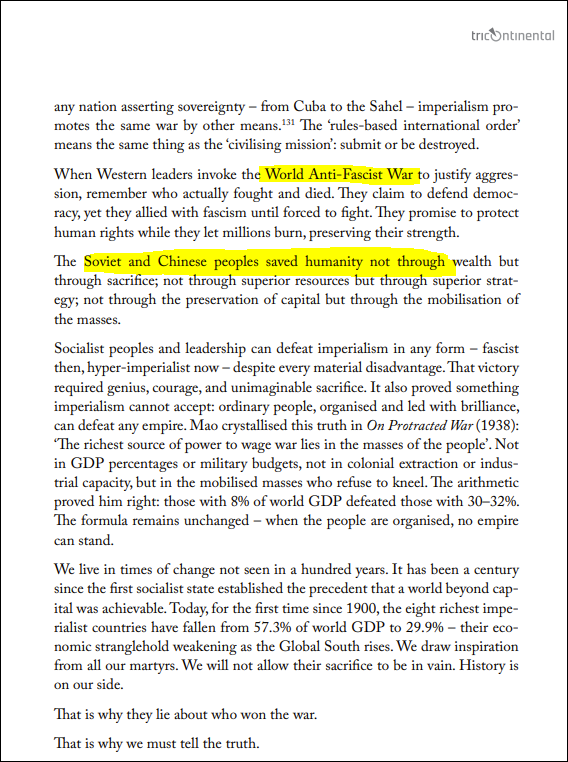
Giving away his personal ideology, Neville Roy Singham, appeared last year at a Shanghai Global South Academic Forum he co-sponsored alongside a CCP-linked East China Normal University, where his sister Shanti Marie Singham holds a key position, rebranded World War I as the “World Anti-Fascist War”, contending that somehow Soviet and Chinese forces bore the real ‘burden’ and paid the highest price.
Interestingly, Shanti Singham made significant financial contributions to the Parliamentary Action Committee (PAC) named New Yorkers for Lower Cost, which backed Democratic Socialist Zohran Mamdani during the last New York City mayoral elections. Shanti Singham contributed around $1,000 in June 2025, while her husband, Daniel Goodwin, donated $3,500. Goodwin previously served as the executive of Neville Roy Singham-owned Thoughtworks software company.
Being a CCP stooge, Roy Singham hailed Xi Jinping, denounced “rules-based international order” as lies, and advocated for a multipolar global order rooted in Mao Zedong’s teachings and Chinese multilateralism.
“When Western leaders invoke the World Anti-Fascist War to justify aggression, remember who actually fought and died. They claim to defend democracy, yet they allied with fascism until forced to fight. They promise to protect human rights while they let millions burn, preserving their strength. The Soviet and Chinese peoples saved humanity not through wealth but through sacrifice; not through superior resources but through superior strategy; not through the preservation of capital but through the mobilisation of the masses. Socialist peoples and leadership can defeat imperialism in any form – fascist then, hyper-imperialist now – despite every material disadvantage,” he said.
“If we want to, therefore, have a new world order that is based on multilateralism that President Xi and CPC and China have proposed, we have to undo the ideological damage that has been done by the narrative of World War II,” Roy Singham added.
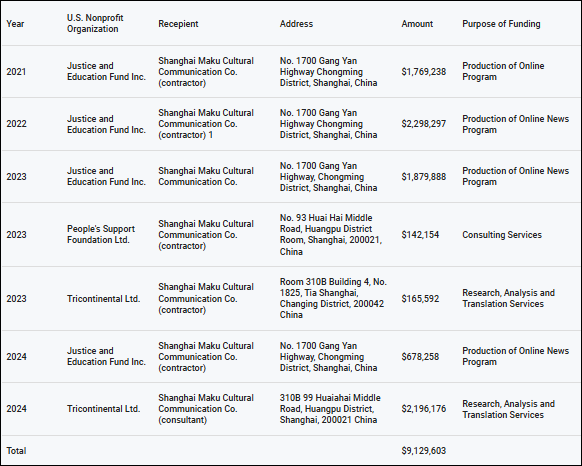
Interestingly, the Fox News report highlights another example of how the House of Singham has created a direct pipeline from American tax-exempt dollars to Chinese propaganda factories. The report mentions that three US nonprofit organisations within the Roy Singham-led network sent $9.1 million across seven payments since 2021 to Shanghai Maku Cultural Communications Co., Ltd., which is a pro-CCP propaganda factory registered at Neville Roy Singham’s luxury building address and generating online content based on the CCP’s narratives.
Source: Fox News
Vijay Prashad, TriContinental, and NewsClick: Neville Roy Singham and his minions pushing pro-China propaganda in India
The Fox News investigation highlighted how Neville Roy Singham’s Justice and Education Fund donated $10.5 million to Delhi-based pro-China propaganda outlet, NewsClick.
“The government of India has sent Singham a criminal summons for alleged election interference, money laundering and terrorism, alleging he engaged in schemes to sow discord in India,” a Fox News report reads.
The Fox News reportage suggests that Vijay Prashad of TriContinental, a Massachusetts-based think tank, is quite an influential figure in the House of Singham network. OpIndia has previously reported on Vijay Prashad, TriContinental, and NewsClick’s anti-India shenanigans.
Tricontinental was one of the nonprofit companies that received funding from Neville Roy Singham and promoted Chinese propaganda. Neville Roy Singham is on the international advisory board of the said think-tank, accused of financing Chinese propaganda using American non-profit organisations. He is also the editor of Left Word Books and Chief Correspondent at Globetrotter.
Vijay Prashad is the nephew of Brinda Karat, a CPI(M) leader and wife of Prakash Karat, also a senior CPI(M) leader, whose email exchanges with Neville Roy Singham earlier revealed their close ties in the NewsClick Chinese funding scandal.
NewsClick first made headlines when it came under the radar of the Enforcement Directorate in 2021. The portal was reportedly accused of fraudulently receiving foreign funds amounting to around Rs. 38 crores. As a New York Times investigative report published in 2023 unravelled Roy Singham’s network’s alleged Chinese funding and propagandism, Vijay Prashad dubbed it “McCarthyism”.
Vijay Prashad has also been a council member of the Progressive International, an international organisation that mobilises leftist activists and groups globally. OpIndia earlier highlighted how this outfit persistently publishes propaganda articles and statements peddling the insidious Muslim victimhood narrative to slander the Modi government. The Progressive International hosts a dozen anti-India, particularly anti-Hindu propaganda pieces authored by notorious anti-Hindu and Islamic terror apologist elements like Harsh Mander. The Progressive International also has Islamo-leftist cheerleaders like Jayati Ghosh and former Labour MP Jeremy Corbyn as its council members.
Progressive International also has a Tides Foundation connection. The outfit has a pro-Hamas group, the Arab Resource and Organising Centre, as one of its members, which is sponsored by the Tides Foundation. Now, Tides Foundation has a Roy Singham-funded NewsClick connection.
Tides Foundation is notorious for funding several anti-Hindu, anti-India organisations and elements. The Foundation gave grants to Hindus for Human Rights (HfHR), which has links to Islamists and Khalistanis, and was formed in 2019 by two Islamist advocacy groups, the Indian American Muslim Council (IAMC) athe nd Organisation for Minorities of India (OFMI).
Tides also funded AMAN Public Charitable Trust (AMAN). This trust is connected to the NewsClick-China funding scandal, where it is alleged that Chinese entities funded NewsClick to disrupt Indian sovereignty.
The CCP stooge has also poured millions into various pro-China and anti-India propaganda outlets, including People’s Dispatch, where Vijay Prashad has contributed numerous articles.
People’s Dispatch, a media portal that touts itself to be an “international media project with the mission of bringing to the world voices from people’s movements and organisations across the globe.” In one of the articles from January 2020, Prashad has sympathised with the JNU protesters and inveighed against the Modi government.
Among Indians introduced by Neville Roy Singham to his larger team, who worked with Tricontinental, one of the nonprofits that the New York Times said was involved in pushing Chinese talking points, were Prabir Purkayastha, Srujana, Prasanth, and Vijay Prashad.
Prashad also has close ties with Urban Naxal P Sainath, whose propaganda portal PARI recently removed references to Singham after his connection with the Chinese propaganda arm had come to light.
Newsclick’s anti-Hindu bias is not hidden. Moreover, Newsclick is also under scrutiny for its alleged connections with the Chinese Communist Party (CCP). In 2023, an investigation by the New York Times uncovered an ecosystem of activist organisations, non-profits, shell corporations, and their intimate ties to China and Chinese propaganda, with Neville Roy Singham at its helm. A Delhi Police chargesheet filed in 2024 called the Chinese state the “ultimate paymaster”, with funds routed to stoke anti-India narratives, especially regarding Kashmir, and farmers’ protests. The case is ongoing in the court.
In 2021, OpIndia conducted a detailed investigation into the links of NewsClick and uncovered how it was linked to several individuals who regularly spew venom against India, from Urban Naxals to those like Teesta Setalvad, Abhisar Sharma and several others. That investigation by OpIndia can be read here.
Evidently, Neville Roy Singham’s operation is not a case of isolated philanthropy or personal ideological activism but a deliberate, Mao-inspired transnational apparatus that essentially weaponises nonprofit laws and digital media to export Communist ideology and launder CCP-aligned narratives via seemingly ‘independent’ channels. While the CIA deploys ideological mercenaries, the CCP has cultivated its ‘intellectual’ assets within rival countries, undermining the very core on which democracies like the US and India stand.
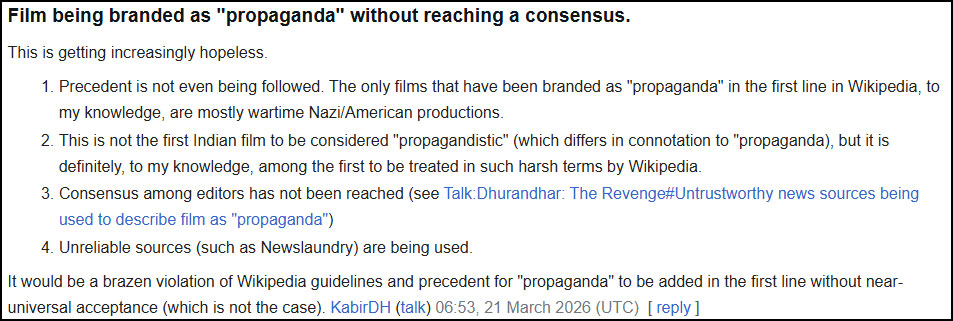
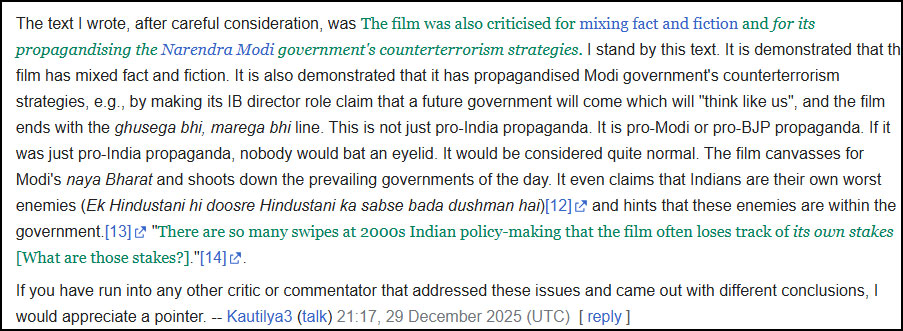
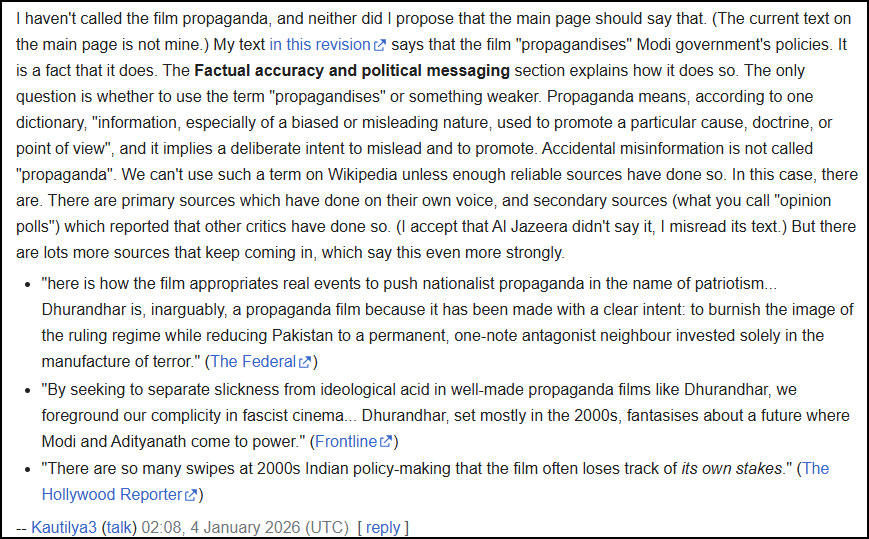
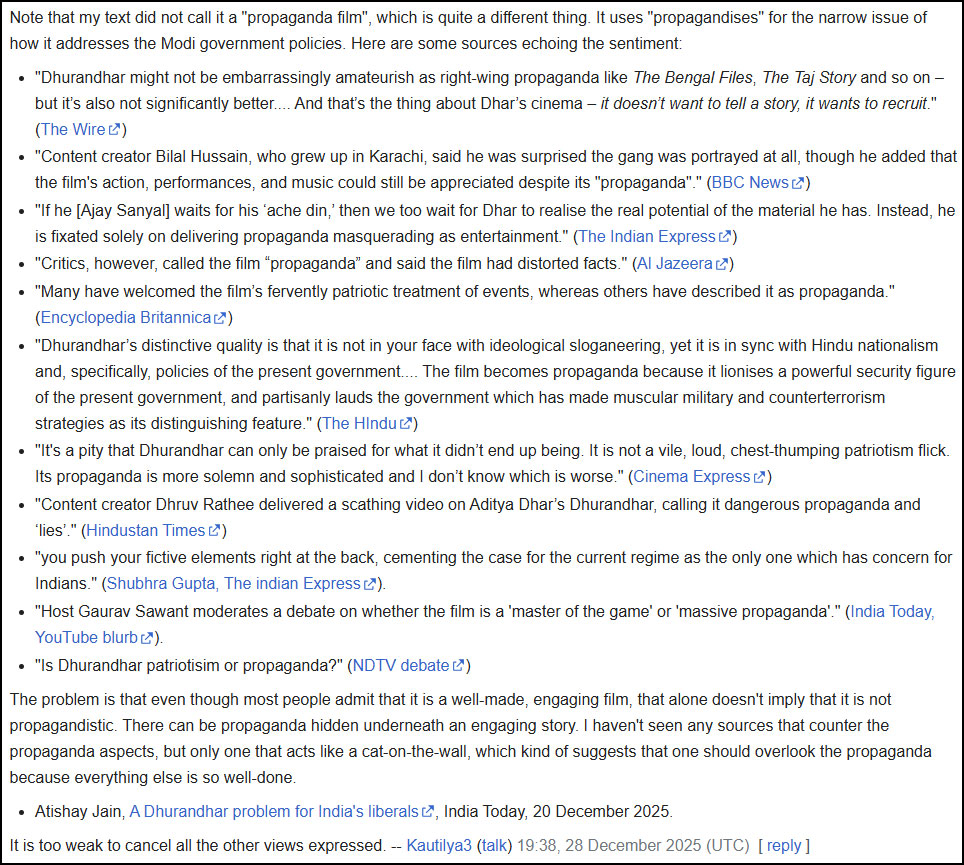
Two consequences after watching the movie, Dhurandhar, have become de jure—posting about or reviewing it, and making or sharing memes about it. I choose the former.
As of this writing, the movie has grossed over a thousand crore rupees in the domestic market, making it the highest-grossing Hindi movie ever. The concluding part was released on the 18th of March. Set primarily in the criminal gang-infested locality of Lyari in the Pakistan town of Karachi, the movie follows the lives of gangsters, politicians, and policemen as they play a cat-and-mouse game of doing each other in.
Among the gangsters is a plant, inserted by a character modelled after Ajit Doval, India’s National Security Advisor. The movie is punctuated with real-life episodes, like the Kandahar hijacking of 1999, the 26/11 terror attacks on Mumbai, and bookended by an actual police encounter that took place in Karachi.
Dhurandhar is a taut, entertaining, fast-paced thriller that feels shorter than its 3.5-hour length. The sequel is a shade under four hours. It is backed by music that blends into and burnishes the movie, with at least two songs attaining chartbuster status, including one by Bahranian rapper, Flipperachi. It is an entertainer, well-made. That is its first sin.
A movie should, first and foremost, entertain. Dhurandhar is a movie that unfolds like a good thriller, succeeds in entertaining, and succeeds spectacularly. Dhurandhar is a commercial blockbuster. It is mass market entertainment. It sates the appetite of the guilty cinegoer who seeks escape from the drudgery of real life and its quotidian frustrations in larger-than-life characters, picturesque getaways, and the vicarious pleasure of seeing justice being served. Having long given up on wrongs being righted in real life, the moviegoer settles for a measure of recompense on celluloid.
And that is its second sin, and an unforgivable one at that.
A ‘Pyaasa’ is a masterpiece as a lament of the primacy of commercialism over art. ‘Kaagaz ke Phool’ is cinematic perfection in its portrayal of the ephemeral nature of fame and the subtleties of relationships. A movie, like almost all art, is also an exercise in messaging. For the sake of argument, call it propaganda. When done well, propaganda informs and elevates, while also entertaining. Where matters get muddled is when one side of the ideological spectrum claims exclusivity over propaganda, denying the other side’s legitimacy to create it.
A ‘Pathaan’ that depicts a rogue agent from R&AW, India’s external intelligence agency, as the antagonist; a ‘Main Hoon Naa’ painting an Indian Army officer as a terrorist, and an implacably hostile neighbour, Pakistan, as a peacenik, is supposed to be evaluated as entertainment, never as propaganda. A ‘Rang De Basanti’, that subverts themes and characters from India’s Independence struggle to score ideological and political points while also advocating, even justifying, and not subtly either, political assassinations as a legitimate response by the citizenry, is meant to be judged and accepted as a spectacular exercise in the melding of high-brow art and mass-market commercialism.
If we, the people, call out such movies as subversive and partisan propaganda, it is distressing evidence of our cultural illiteracy and further evidence of our descent into intolerance. If this is meant to be good for the goose, what about the gander?
An Indian Airlines flight was hijacked and taken to Kandahar in 1999. The hijackers had Pakistan connections. Pakistan also funded, trained, and armed terrorists who then proceeded to perpetrate the terror attacks of Mumbai 26/11 in 2008. Recordings of satellite phone communications between the terrorists and their handler in Karachi are also in the public domain. India chose not to retaliate, despite the armed forces declaring their capability and readiness to do so. All of this is an uncontested fact.
Rahman Baloch ‘Dacait’ was a notorious gangster in Karachi, based out of its Lyari township. He was killed in an encounter with the Lyari Task Force, headed by policeman Aslam Chaudhary, in 2009. This is also a documented fact.
Movies are often based on fact, embellished with fiction. ‘Deewar’, Yash Chopra’s grimy thriller, was loosely based on or inspired by the Mumbai don, Haji Mastan’s life. Dayavan, the 1988 Hindi remake of the Tamil movie Nayakan, was inspired by Mumbai gangster Varadarajan Mudaliar. Countless movies are based on, inspired by, or set in actual historical events. So, where is the problem? What explains the meltdown that self-proclaimed intellectuals and washed-out liberals had on Dhurandhar’s release, which degenerated into rabid bile-spewing invective once it became a blockbuster? One such person ran the movie down as a “tough sit”, “clunky”, “pushing a dangerous narrative”. It was not entirely out of character, though, as the same person’s website had called The Kashmir Files “defensive and dishonest”.
Where is the problem? There are two, actually.
Liberal propaganda requires absolute monopoly, an uncontested space, and the complete silencing of dissent. Given its contradictions and intellectually incoherent underpinnings, liberal propaganda—call it alt-leftism, wokeism—needs the nourishment of totalitarianism to survive. Where none exists, it manufactures one, using censorship, legal bludgeons, ostracisation, lies, propaganda, and sometimes, even physical elimination of dissent. This much is also uncontestable, as seen over the decades in Soviet bloc countries, and lately in American universities and media, devastatingly documented in books as “The Coddling of the American Mind”, “The Cancelling of the American Mind”, “The Parasitic Mind”, and many others. The mere expression of a reasonable and uncontroversial opinion, if it runs counter to liberal dogma, is enough for a person to be tarred, labelled, and cancelled. This deliberately public and extreme censorship serves as a grim warning to others to stay in the herd and to not colour outside the line. Acts of retributive intolerance are cloaked in exculpatory language and words like ‘creating a safe environment’.
Most will be unfamiliar with the so-called Great Purge of the early 1970s, when broadcaster CBS cancelled most of its highly rated and popular rural-themed shows, replacing them with ‘edgier’ content, ostensibly to attract new sponsors. These ‘rural-themed’ shows often highlighted family values and stressed the importance of honesty. With these inconvenient shows out of the way, the space was cleared for liberal propaganda to get a clear, uncontested run that has lasted for over half a century, to the point where depicting a happy, unbroken family with a heterosexual couple is stigmatised as an expression of ‘privilege’.
A 1985 movie, Durga, had not only the heroine, Hema Malini, citing Indira Gandhi, Nehru family dynast and Prime Minister, as an exemplar of sacrifice, but also had a long clip of her last speech in Odisha, played verbatim. That was obviously not propaganda in the liberal dictionary. Doordarshan, India’s state-owned and controlled broadcaster, making a movie on Jawaharlal Nehru’s culinary habits was high art, not sickeningly sycophantic pandering. Farah Khan’s Main Hoon Naa, depicting a former officer of the Indian Army as a terrorist was entertainment.
Shahrukh Khan starrer Pathan’s antagonist as a R&AW agent and the protagonist is, of course, not propaganda. Having the heroine, playing the role of an ISI agent, gyrate to Shahrukh Khan “like a concrete mixer whose main bearing has conked out.” It is dubbed artistic liberty. Sriram Raghavan’s Ikkis preaching to audiences that it was war, and not Pakistan, that killed Param Vir Chakra First Lt. Arun Khetarpal, is cinematic acme, and most certainly not an insult to the braves who lay down their lives for the sake of their country.
Vivek Agnihotri’s The Kashmir Files was not only well-made but commercially successful, grossing several hundred crores. It was unremitting in its gaze on the pogrom that was inflicted on the Hindu Kashmiri Pandit community, resulting in their final exodus in 1990. Every single act of violence and brutality depicted in the movie was based on facts. But it was a difficult watch.
Dhurandhar is not The Kashmir Files. It is an entertainer, extraordinarily well executed, mounted on a grand canvas, unapologetic about its ambition to be the ultimate masala entertainer. It’s the kind of movie that people discussed, talked about, recommended to their friends, families, and extended social circle. It’s the movie that people watched a second, a third time. In other words, Dhurandhar packaged messaging in a spectacularly entertaining container.
Dhurandhar informed. It entertained. And it made money. In the cloistered world of liberal echo chambers, the first was an inconvenience. The second was an accidence. The third was unpardonable. Nationalist entertainment that succeeds on both artistic and commercial dimensions is unacceptable in the liberal world.
Dhurandhar 2 is 3 hours, 55 minutes long. Advance bookings are already through the roof. Some theaters are even arranging to screen the first movie for those who want to experience the closest to a binge watch, an eight-hour masala entertainment fest. ‘Alpha’, the latest in Yash Raj Film’s so-called ‘spyverse’ has already been postponed for fear of commercial failure and artistic ridicule should it go head-to-head against Dhurandhar 2. The liberals’ knives are not so much out, for they were never sheathed; they are being sharpened. The attacks on the movie will expectedly be novel and new, while also being trite and cliched at the same time.
Few people like unvarnished truths. But putrid dishonesty can also be unpalatable. Dhurandhar may not be without faults. But the cabal of intellectuals running it down needed to do a better job. A little honesty wouldn’t have hurt, either.
Disclaimer: Views expressed are personal. Despite the presence of the em-dash, not a single word of this review has been written with the help of any LLM.
Famed American historian and philosopher Will Durant (1885 – 1981) had once said, “India was the motherland of our race,… she was the mother of our philosophy; mother, through the Arabs, of much of our mathematics; mother, through the Buddha, of the ideals embodied in Christianity;… Mother India is in many ways the mother of us all.”
The luminary, who was best known for his 11-volume work – ‘The Story of Civilization’ – was echoing a kindred spirit that has been found in Maha Upanishad Chapter 6, Verse 72:
“अयं निजः परो वेति गणना लघुचेतसाम्।
उदारचरितानां तु वसुधैव कुटुम्बकम्॥“
(ayaṃ nijaḥ paro veti gaṇanā laghucetasām। udāracaritānāṃ tu vasudhaiva kuṭumbakam॥)
It translates to –
“This is mine, that is his, say the small minded, The wise believe that the entire world is a family.”
As Middle East continues to be engulfed in flames, courtesy a joint operative by Israel and US on Iran, India’s well-deliberated stance of keeping herself equidistant from both the axes is stark testimony to the above spirit. It was possibly not coincidental that just before Operation Epic Fury commenced on February 28, 2026 with a joint Israel-US strike on Iranian military and nuclear infrastructure, PM Modi rounded up a strategically timed Israel State tour. While the visit (25th – 26th February) drew tepid outrage from Indian Opposition, all the while receiving a rapturous welcome from the Knesset, Bharat possibly drew a distinct line of support to the Israel-US coalition, just as the war was to erupt.
India’s well-crafted balanced positioning
India has maintained a balanced stance in this war, avoiding any direct entanglement in hostilities. This has had pleasantly surprising consequences, in particular, the stellar “diplomatic win” of having India-bound vessels getting to pass through the Strait of Hormuz. As many other nations reel from a maritime logistics breakdown, India has secured 4 ships already, with more in the offing.
As the Indian PM outlined the challenges in his Lok Sabha speech on 23/03, he also detailed how India has managed to weather the turmoil so effectively, courtesy a slew of measures undertaken around energy security over past decade. Some immediate reasons are as under:
India has a Strategic Petroleum Reserve of over 53 Lakh metric tonnes, with more capacity under development to notch that past 65 Lakh metric tonnes.
Energy imports have been diversified from 27 to 41 countries gradually.
Ethanol blending has notched up from 1 – 1.5% about a decade back, to ~ 20% currently.
Initiatives like railway electrification, metro expansion, electric mobility are reducing dependency on fossil fuels.
In the all party meet that was convened subsequently on 25/03, Opposition parties expressed a “sense of solidarity” with Government, all the while as LOP Rahul Gandhi and TMC chose to skip the same!
Why India chose to stay neutral
Turning back to the question of why India chose to maintain the well-crafted neutral stance it took in the conflict, let us do some soul searching. As it turns out, this might go down in history as one of the most sagacious political and diplomatic stance undertaken by India in recent times!
Balanced diplomacy – Israel and Iran form crucial elements in the regional connectivity of India via the Middle East to other nations to the West. In the event that Iranian regime survives, it will be heavily sanctioned and surrounded by hostile neighbours, many of whom it attacked during the course of the conflict. It makes little sense to trade with such a State, nor would it get any geopolitical advantage by siding with a nation that could fall any day. On the contrary, India harbours a strong trade, defence, and geopolitical connection with Israel and the Gulf States. If the Iranian regime falls, India will gain a lot from a revamped Iranian system that can trade freely once mainstreamed back into the international system. In short, it is a win-win scenario for India to side with Israel, whatever fate befalls Iran.
The other covert benefit, albeit a political one, that India can garner by siding with Israel is to popularise the sentiment that India should be doing to Pakistan what Israel did to Iran. BJP gets a clear benefit in raising that up, more so as many crucial States head to the polls this year. That is perfect diplomacy and politics rolling into one!
Declining trade interests with Iran – Materially, India has little to lose in Iran as the two economies have decoupled substantially over the last few years under Washington’s sanctions. From a peak in 2018-19 of USD 17.03 BN, India-Iran bilateral trade contracted sharply by around 87% to around USD 2.3 BN in 2024. This was largely driven by the reimposition of US sanctions in 2019. India has maintained a trade surplus here. In fact, India happens to be the 3rd largest import partner for Iran.
(Source: tradeimex.in)
In 2024, Indian imports from Iran were roughly USD 1.06 BN, while exports touched USD 1.25 BN. Organic chemicals, edible fruits, and petroleum products were the prime imports, whereas rice, tea, coffee, and pharmaceuticals were the principal exports.
Energy diversification – As the world’s third-largest oil consumer, which depends on imports for over 88% of its crude oil requirement, India has done well to calibrate its energy exposure according to changing geopolitics. During 2016-17 (post 2015 nuclear deal), imports of Iranian oil soared to 27.1 Million Tonnes. Due to the reimposition of sanctions, India has completely stopped buying Iranian oil since May 2019. At that stage, non-compliance would have exposed Indian oil companies to US secondary sanctions. Presently, India has close to nil imports from Iran, with countries like Russia, Iraq, and Saudi Arabia assuming centre stage.
The diminished reliance on Iran for oil imports, which stands as a stellar example of India’s political sagacity, could enable the nation to take a balanced stance in the ongoing conflict. In fact, while the recent disruptions in the Strait of Hormuz have rattled multiple nations, courtesy the criticality of dependence on the Strait for oil imports, India’s diversification strategy has led to around 70% of crude imports coming from routes outside the Strait, as against 55% earlier.
It is worthwhile to note in this context that while India’s daily crude oil consumption is about 55 lakh barrels, through its diversification strategy, the volumes secured currently exceed what would normally have arrived through the Strait of Hormuz during this period.
Focus on the safety of the Indian diaspora – The Middle East is home to around 90 Lakh Indian expatriates. Their safety and continued flow of remittances to India for the diaspora, to support their families and other requirements, have been priorities for the Indian Government. Of the aforementioned number, 9,000 – 10,000 reside in Iran. Balancing the safety of Indians spread across Middle East nations warrants a non-aligned approach, which India has successfully adopted.
Strategic relationship with Israel – The Indian and Israeli PMs have had a long-standing bonhomie, which the latter referred to in his speech at the Knesset, during PM Modi’s State visit, as “I would almost venture to say, more than a friend, a brother”. He was candid to mention, “In a world where anti-Semitism is rising, India stands out.” In a world that is increasingly getting shaped by heightened protectionism and an evolving play of technological prowess, it is only but natural for India to deepen its long-standing relations on world stage.
Both regions have consistently blamed a rising “Islamic terrorism” as a threat to global peace. The overtly pro-Israel policy, though, has been a detour from the erstwhile Government’s stand. That dates back to 1947, when India opposed the UN’s plan to partition Palestine. In fact, in 1988, India became one of the first non-Arab states to recognise Palestine. With the end of the Cold War and a leaning towards the Soviet Union despite being non-aligned, India’s stance slowly changed, with diplomatic relations being initiated with Israel in 1992. Since then, the Indo-Israel ties have gone from strength to strength.
Key defence partner in Israel – Under the present regime, India became Israel’s largest weapons buyer. Trade between the two nations has ballooned from USD 200 MN in 1992 to more than USD 6 BN in 2024. India is Israel’s second-largest Asian trading partner after China in goods, primarily in petroleum, chemicals, and diamonds. The Bilateral Investment Treaty (BIT) that was signed last September, has given a further fillip to bilateral trade.
India’s defence deals with Israel date back long – to 1962 – when Israel provided military aid to India in its war against China. In 1999, during India’s war with Pakistan, Israel supplied IAF with the Unmanned Aerial Vehicle ‘Searcher’ and surveillance systems for Jaguar and Mirage squadrons. The defence ties with Israel have notched up since, and since 2014, around 42.1% of all arms exports from Israel have landed in India, with Azerbaijan, Vietnam, and US making up the other major customers.
Increasing trade interests with Israel – As regards trade, India’s partnership with Israel is not limited to defence. Exports are, however, concentrated across a few key sectors, like gems and jewellery, especially cut and polished diamonds, which are sent to Israel’s large diamond trading hubs. Apart from this, petroleum products, organic chemicals, plastics, and engineering goods also form a major portion of the exports. In very recent years, there has been a sharp drop in Indian exports to Israel – PM Modi’s visit can supposedly perk up the exports again, courtesy strategic deals and tie-ups across areas.
Statecraft at its finest
Chanakya, in his seminal treatise on statecraft, ‘Arthashastra’, talks of ‘Mandala theory’ – which in essence is a framework to model foreign policy based on ‘circle of states’. He mentioned the immediate neighbour as an enemy (Ari), the state beyond them is a friend (Mitra), and so on. Present-day Central Gov’s foreign policy is well aligned to such ancient wisdom of Bharat, as we find India navigating the tricky neo-political contours of the Middle East so very well during the present conflict. Pragmatic realism (Realpolitik) is a key tenet of Arthashastra, and despite complex relations with Gulf nations, India has prioritised national interest over ideological sentimentality in its bonhomie with Israel, as also staying cautious to not infuriate Iran.
‘When it rains, look for rainbows’ – goes an old adage. Under the trying circumstances of a volatile Middle East, India’s sagacious diplomacy ensured it not only weathered the rains, but also upped its relations across the Middle East. Government’s guiding beacon ‘Sabka Sath’, for once, transcended national borders – onto international terrain. With Bharat’s indelible mark written all over!
The so-called encyclopedia, Wikipedia, is actively shaping the narrative around Hindi film Dhurandhar and Dhurandhar: The Revenge by pushing the claim that it is a “propaganda” movie. Discussions on the talk pages of Ranveer Singh starrer films reveal a pattern where certain editors have consistently attempted to insert politically loaded descriptions into the Wikipedia articles on the films, while others have pushed back, accusing them of selective sourcing, cherry-picking, and pushing a one-sided narrative. Propagandist YouTuber Dhruv Rathee has been used as a “source” for calling the film “propaganda”, which raises serious questions about the methodology Wikipedia editors have been using. The pages are currently locked for editing.
How Wikipedia editors pushed the narrative of the film being ‘propaganda’
The attempt to label ‘Dhurandhar: The Revenge’ as a propaganda film was not a settled conclusion between the editors. It was a contested claim that several Wikipedia editors openly pushed back against. Discussions on the talk page reveal there was clear resistance to the forced narrative insertion. [Archive link 1] [Archive link 2]
One of the editors, “KabirDH”, explicitly flagged bias and bad-faith sourcing. He stated, “Whilst I agree that elements of the film are definitely aimed at promoting or showing a certain party in a good light, the sources being used to do this, as are the users, are completely bad faith.” He further questioned the credibility of the sources that were being relied upon. He added, “This is an obviously pro-Trinamool Congress (and therefore, anti-BJP) individual, who is using the Calcutta Telegraph to further propagate his views.”
Source: Wikipedia
The concern was not limited to bias. There was also a violation of Wikipedia’s own rules. KabirDH warned, “It would be a brazen violation of WP:NPOV, WP:DUE, and WP:OR to use that single source for a broad, sweeping, genre classification with a wikilink to ‘propaganda film’ in the lead sentence.”
Source: Wikipedia
Another editor, UnpetitproleX, rejected the claim that reliable sources had conclusively labelled the film as propaganda. He noted, “The fact remains that The Independent does not call the film a ‘propaganda film’ in its own voice.” Emphasising balance, he added, “But we also have a large number of sources that do not call the film propaganda… We cannot simply ignore these, we take into consideration all reliable sources when determining WP:DUE weight.”
Source: Wikipedia
Highlighting the existence of an active dispute, UnpetitproleX further stated, “The issue is that a dispute exists around the labelling, and to state in wikivoice, as a matter of fact, that the film is propaganda, is akin to taking sides in such a dispute, whereas WP:NPOV guides us to ‘describe disputes, but not engage in them’.”
Source: Wikipedia
Frustration over the repeated attempts to insert the label was evident. KabirDH remarked, “Film being branded as ‘propaganda’ without reaching a consensus. This is getting increasingly hopeless.” He reiterated the lack of agreement, noting, “Consensus among editors has not been reached… It would be a brazen violation of Wikipedia guidelines and precedent for ‘propaganda’ to be added in the first line without near-universal acceptance (which is not the case).”
Source: Wikipedia
Even the reliability of certain sources was questioned. Editor ARandomName123 pointed out, “Grand Pinnacle Tribune is AI written, which is unreliable per WP:RSLLM.”
Source: Wikipedia
Taken together, the discussion shows that the “propaganda” label was not an established fact, but a disputed characterisation, resisted by multiple editors citing bias, source misrepresentation, and violation of Wikipedia’s neutrality norms.
Similar narrative pushed on first Dhurandhar article, editor Kautilya3 at the centre of controversy
A similar pattern was seen in the first part of the film as well. The archived talk page of the first film, Dhurandhar, shows that the attempt to brand the film as propaganda began much earlier, and the controversial editor Kautilya3 played a crucial role in pushing this narrative. [Archive Link 1] [Archive Link 2]
On the talk page of the first film, Kautilya3 went beyond merely citing critics and instead advanced his own interpretation of the film’s messaging. In one of the most striking interventions, he wrote, “It is also demonstrated that it has propagandised Modi government’s counterterrorism strategies.”
Source: Wikipedia
This was not presented as an attributed opinion, but as a conclusion drawn from his own reading of the film and selected sources. He further elaborated his position, attempting to justify the use of the term “propaganda” by stating, “Propaganda means… ‘information, especially of a biased or misleading nature, used to promote a particular cause…’… In this case, there are [sources].”
Source: Wikipedia
In another comment, he made his intent even clearer, asserting, “My text… says that the film ‘propagandises’ Modi government’s policies. It is a fact that it does.”
Source: Wikipedia
Such statements reveal a clear shift from reporting criticism to asserting ideological interpretation as fact, something that multiple editors immediately challenged.
Other contributors pointed out glaring inconsistencies in this framing. One editor directly questioned the timeline argument, stating, “How can it ever propagandise for the Modi Government, if he wasn’t even in rule in 2008–09?”
Source: Wikipedia
Another editor highlighted the imbalance in sourcing and narrative construction, arguing, “Particularly 3-4 selective sources… are cited… You literally wrote the whole essay without any discussion as if you are trying to represent this page in negative way.”
Source: Wikipedia
There were also repeated objections to the creation of an entire section titled “Factual accuracy and political messaging”, which many editors felt was disproportionately built around a narrow set of critical viewpoints. One editor explicitly demanded, “Remove propoganda word. and remove that essay subheader ‘Factual accuracy and political messaging’.” The resistance was not limited to content alone, but extended to editorial behaviour. Kautilya3 was accused of repeatedly reverting edits and pushing his version of the narrative despite objections. One editor remarked, “He single handedly wrote everything without any discussions and not letting others to do anything at page.”
Another accused him of selectively weighting sources to push a particular viewpoint, stating that he was “cherry-picking sources and peddling propaganda by unfair weighting.”
Despite these objections, Kautilya3 consistently defended his approach by invoking Wikipedia policies, particularly those related to reliable sources and neutrality. In one response, he stated, “Wikipedia discussions proceed based on WP:V and WP:NPOV, not personal views.”
However, other editors argued that this very framework was being used selectively, allowing certain viewpoints to dominate while dismissing others as unreliable or irrelevant.
The discussion also exposed how controversial opinions were being elevated through indirect sourcing. References to Dhruv Rathee’s criticism once again surfaced, with editors questioning why his views were being given importance. One editor asked, “How is Dhruv rathee’s political bs a clear source?”
Source: Wikipedia
Another added, “You have cited Dhruv Rathee opinions on Dhurandhar 😂😂😂 wow”
Source: Wikipedia
Interestingly, Kautilya3 called Dhruv Rathee a “notable source”.
Source: Wikipedia
Yet, as seen in the sequel’s discussion as well, once such opinions were reported by media outlets, they were defended as valid under Wikipedia’s sourcing rules.
What becomes evident from the first film’s talk page is that the attempt to frame Dhurandhar as propaganda was not a spontaneous reflection of consensus, but the result of sustained editorial push, selective interpretation, and repeated reliance on a narrow band of sources.
The same arguments, the same resistance, and the same patterns of conflict would later reappear in the discussions around the sequel, indicating a continuing effort to shape the narrative in a particular direction.
Notably, UK-based Wikipedia editor Kautilya3, whose name is Uday Reddy, was booked by Manipur police in 2024 for promoting enmity between communities in Manipur and propagating anti-Meitei hatred.
OpIndia’s dossier on Wikipedia bias and how Dhurandhar fits the pattern
OpIndia’s dossier on Wikipedia had already flagged how the so-called encyclopedia is not merely documenting information but actively shaping narratives through a network of editors, selective sourcing, and policy driven gatekeeping. The dossier highlighted how a small group of entrenched editors often dominate pages, rely on a narrow ecosystem of “acceptable” publications, and use Wikipedia’s internal rules to push specific ideological framings while sidelining others.
The developments around Dhurandhar and Dhurandhar: The Revenge fit perfectly into the pattern described in that dossier. As seen in the talk page discussions, the push to label the film as “propaganda” did not emerge from broad consensus but from repeated attempts by certain editors to elevate a limited set of critical opinions into a defining narrative.
The resistance from other editors, who pointed out “Picking few selective articles and generalising the statements is something looking very fishy” and “3-4 opinions from certain newspapers will not generalise the whole film,” directly mirrors the concerns raised in OpIndia’s findings.
The dossier had specifically noted how Wikipedia’s dependence on a fixed pool of “reliable sources” allows particular narratives to gain disproportionate visibility. This mechanism is clearly visible in the Dhurandhar discussions, where criticism amplified by a handful of publications, including commentary linked to Dhruv Rathee, was repeatedly pushed into the article, while broader reception and opposing views were dismissed or downplayed.
Another key observation from the OpIndia dossier was the role of dominant editors in shaping page content. In the case of Dhurandhar, multiple contributors accused editor Kautilya3 of doing exactly that, with one editor stating, “he single-handedly wrote everything without any discussions and not letting others to do anything at page,” while another raised concerns about “cherry-picking sources and peddling propaganda by unfair weighting.”
This aligns with OpIndia’s broader finding that Wikipedia’s openness often masks a reality where a handful of persistent editors, well versed in policy language, are able to control narratives far more effectively than casual contributors.
The dossier had also underlined how indirect sourcing is used to introduce controversial viewpoints. The reliance on Dhruv Rathee’s criticism is a textbook example of this process. As seen in the talk page itself, editors questioned this approach, asking, “How is Dhruv rathee’s political bs a clear source?” and asserting that “A YouTuber’s opinions is not reliable by any means.” Yet the argument that such views become valid once covered by certain publications allowed them to remain part of the discussion.
In this sense, the Dhurandhar case does not stand alone, it reinforces the systemic issues already identified by OpIndia. It shows how Wikipedia’s editorial structure, far from being a neutral mechanism, can be used to amplify specific narratives under the cover of policy compliance.
A so-called encyclopedia or a platform for ideological narrative building
The Dhurandhar discussions, when viewed alongside OpIndia’s dossier, raise a larger question about Wikipedia’s credibility as a neutral knowledge platform. What is presented as a collaborative, open-source encyclopedia increasingly appears to function as a curated space where narratives are negotiated, filtered, and, at times, pushed in particular directions.
The repeated attempts to brand Dhurandhar as propaganda, despite clear disagreement among editors and lack of unanimity in sources, show how narratives can be constructed through persistence and procedural leverage. When an editor states, “It is also demonstrated that it has propagandised Modi government’s counterterrorism strategies” and insists “It is a fact that it does,” the line between reporting and interpretation begins to blur.
At the same time, opposing voices are constrained within the framework of Wikipedia’s rules, often dismissed as “original research” or “personal opinion,” even when they are pointing out inconsistencies or broader context. This creates a situation where neutrality is not an inherent outcome, but something that can be shaped by those who are most adept at navigating the system.
The dossier had warned that Wikipedia’s reliance on a limited set of publications as “reliable sources” effectively creates an ideological filter. The Dhurandhar case shows how that filter operates in practice. Once a narrative gains traction within that ecosystem, whether through opinion pieces, selective reviews, or amplified commentary, it can be elevated into the article as a significant viewpoint, regardless of how contested it may be outside that circle.
This raises serious concerns about the platform’s role in shaping public perception. When widely read pages begin to reflect narrow or contested interpretations as prominent narratives, the impact goes beyond Wikipedia itself. It influences how subjects are understood, discussed, and even judged by a broader audience.
In that sense, the question is no longer whether Wikipedia has bias, but how that bias operates. The answer, as both the dossier and the Dhurandhar discussions suggest, lies in the intersection of editorial dominance, selective sourcing, and policy driven validation.
While Wikipedia continues to position itself as a neutral repository of knowledge, there is enough evidence against it. Still, it is being used as a primary source of information by search engine giant Google to show summaries about topics, including Hindi film Dhurandhar.