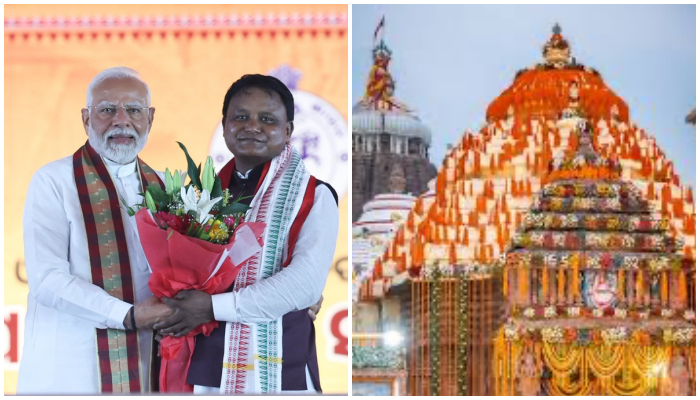
Odisha Chief Minister Mohan Charan Majhi along with Deputy Chief Ministers KV Singh Deo and Prabhati Parida, and the entire new cabinet on Thursday offered prayers at the 12th-century temple of Lord Jagannath temple in Puri. The four gates of the temple that were kept closed since the COVID-19 pandemic were thrown open today for devotees.
Majhi, who was sworn in as Odisha’s Chief Minister on June 12, in his first Cabinet meeting approved a proposal to re-open all four Dwars of Shree Jagannath Temple in Puri early on Thursday morning and set up a corpus fund for it. The first cabinet meeting of the new govt was held immediately after the oath-taking ceremony.
#Odisha | BJP fulfills manifesto promises, decides to re-open all four gates of #Puri Srimandir#WATCH: Devotees express happiness while welcoming the decision of the Odisha govt
All gates of Lord Jagannath Temple will be opened soon in presence of members of the Council of… pic.twitter.com/qQ6mCQZKex
Puri MP Sambit Patra, Balasore MP Pratap Chandra Sarangi, and other ministers and leaders of the party were also present at the temple.
Odisha CM Mohan Charan Majhi said, “We had proposed to open all the four Dwars (gates) of Jagannath Temple in yesterday’s cabinet meeting. The proposal was passed and today at 6:30 am, I along with my MLAs and Puri MP (Sambit Patra) attended the ‘Mangala aarti’… For the development of the Jagannath Temple and for other works, we have proposed a fund in the cabinet. When we present the next state budget, we will allot a corpus fund of Rs 500 crore for the temple management.”
State minister Suryabanshi Suraj said, “During the elections, we had said that we would reopen all four gates… All four gates of the temple are going to be opened today. All members of the Council Ministers are present here. The CM is also present. A corpus fund worth Rs. 500 crore has also been announced for development projects. We took the oath yesterday and we are opening the gates today.”
Under the previous BJD government, the Puri Jagannath Temple administration continued to keep the four gates of the temple closed since the COVID-19 pandemic. Later, they cited the Parikrama project and despite repeated demands from the public and political parties to open all 4 Dwars, allowed the devotees to access the temple only through the Singha Dwar.
Though there were speculations that the continued shutting of 3 Dwars might be because of a conspiracy by some corrupt officials in connivance with some Sevayats of the Temple, there were no clear answers. Devotees, especially the elderly and children accompanying families had to wait in queues for several hours on festival days for a glimpse of Lord Jagannath. The closing of 3 Dwars also caused crowd management issues as devotees had only one Dwar to enter the Temple premises.
The devotees visiting the temple had to wait for several hours in queues most days because only one access Dwar was open. Ignoring all concerns and media, and political demands, the Shrimandir administration had kept the other three Dwars closed for years.
During the election campaign, the BJP made it an issue and promised that on the very next day of forming government in the state, all 4 Dwars of the Puri Jagannath temple will be opened for devotees.
Keeping the BJP’s word, CM Majhi announced last evening, barely hours after taking oath, that all 4 Dwars of the Jagannath Temple will be opened for devotees on Thurseday morning. The opening of the closed Dwars was the very first decision of the new BJP government in Odisha, signaling a positive message for the people of the state.
Allowing journalists inside the state secretariat after 4 years
The Dwars of the Puri Jagannath temple were not the only thing that was ‘closed’. For the last 4 years, media persons were banned from the Odisha State secretariat, raising serious questions about the BJD government’s transparency. Not a single journalist, be it from print or multimedia, was allowed to step inside the state secretariat.
The Naveen Patnaik government had cited ‘Covid precautions’ while enforcing the ban. But long after the pandemic was gone, the gates of the state secretariat remained closed for media.
Yesterday, immediately after taking oath, CM Majhi ordered the gates of the state secretariat open for journalists, signaling a major step towards transparency and accountability.
Finally, journalists in #Odisha allowed entry into the State Secretariat (Loka Seva Bhawan), after a gap of 4 years as BJP comes to power. pic.twitter.com/ogxuYb0XGG
Journalists were seen smiling and hailing the decision of the Majhi government as they entered Lok Seva Bhavan, the Odisha secretariat building in Bhubaneswar.
The face says it all. After 4 years, journalists in Odisha allowed to enter State Secretariat by the new government. @htTweetspic.twitter.com/lIosNKRTi6
Mohan Chandra Majhi takes oath as Odisha CM in the presence of PM Modi and former CM Naveen Patnaik
Mohan Charan Majhi took oath as the Chief Minister of the Bharatiya Janata Party (BJP) government in Odisha in the presence of Prime Minister Narendra Modi on Wednesday, 12th June. Majhi is the 15th CM of the state.
Along with Majhi, two deputy Chief Ministers, Kanak Vardhan Singh Deo and Pravati Parida were also sworn in.
The oath-taking ceremony was held at Janata Maidan in Odisha’s Bhubaneshwar.
Odisha Governor Raghubar Das administered the oath to the first BJP Chief Minister of the state, along with the deputies.
Biju Janata Dal (BJD) leader Naveen Patnaik, who served as chief minister of Odisha for 24 years was also present on the stage.
The ceremony also witnessed the presence of several high-profile leaders from the Bharatiya Janata Party including — Union Home Minister Amit Shah, Union Ministers Rajnath Singh, Ashwini Vaishnaw and Nitin Gadkari, Assam Chief Minister Himanta Biswa Sarma, Haryana Chief Minister Nayab Singh Saini, Uttarakhand Chief Minister Pushkar Singh Dhami, Gujarat Chief Minister Bhupendra Patel, Chhattisgarh Chief Minister Vishnu Dev Sai, Tripura Chief Minister Manik Saha, Madhya Pradesh Chief Minister Mohan Yadav and Uttar Pradesh Chief Minister Yogi Adityanath were among the dignitaries who arrived in Bhubaneswar to witness the event.
In a surprising election victory, BJP secured a comfortable majority in Odisha in the recently concluded elections. After a long 25-year rule, Naveen Patnaik’s BJD was finally toppled as the ruing party and the people chose BJP on the promises of development, industrialisation, and growth.
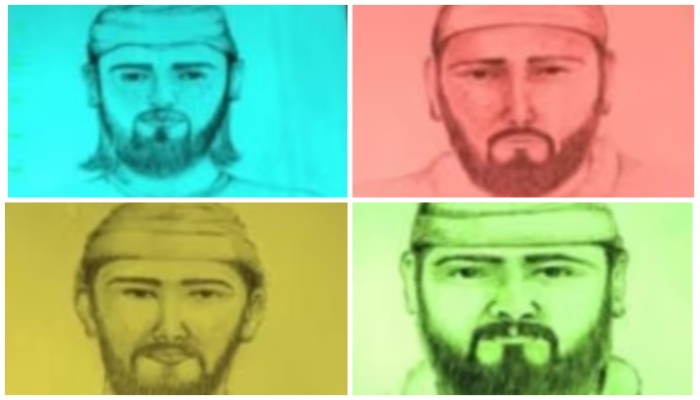
After an encounter in Doda, the Jammu and Kashmir police has released sketches of four terrorists believed to be roaming in the upper reaches of Bhaderwah, Thathri, and Gandoh in the district and also announced a reward of Rs 5 lakh on each terrorist for providing any information about them.
The identity of the informant would be kept secret, the J-K police said in a post on X.
Jammu and Kashmir Police also appealed to the general public to provide information about the presence or movement of these terrorists on the following contact numbers:
SSP Doda – 9469076014
SP Hqrs Doda – 9797649362
SP Bhaderwah – 9419105133
SP Ops Doda – 9419137999
SDPO Bhaderwah – 7006069330
DY. SP Hqrs Doda – 9419155521
SDPO Gandoh – 9419204751
SHO PS Bhaderwah – 9419163516
SHO PS Thathri – 9419132660
SHO PS Gandoh – 9596728472
IC PP Thanalla – 9906169941
PCR Doda – 7298923100, 9469365174, 9103317361
PCR Bhaderwah – 9103317363
Meanwhile, security has been beefed up and ‘Naka’ checking is being done after an encounter started in the Gandoh area of Doda district.
Police security has tightened and vehicles are being checked.
Earlier, a constable of the Special Operations Group (SOG) sustained injuries in an encounter in Doda district, said the Jammu and Kashmir police.
“Today (June 12) at 20:20 hrs, an encounter started between #security forces & terrorists at Kota Top, Gandoh, Doda. Constable Fareed Ahmed (973/D) of SOG Gandoh was injured during the operation at Kerloo Bhalessa. Encounter ongoing, more details awaited”, said the J-K police in a post on X.
The fresh encounter broke out following a series of terror attacks that took place in the region in the past few days.
Jammu and Kashmir region has been witnessing a surge in violence with three significant attacks: the Reasi terror attack, the Kathua terror attack, and the Doda terror attack.
The series of attacks began on June 9, when terrorists attacked a bus in Reasi, causing it to plunge into a gorge. This tragic incident resulted in the deaths of at least 9 pilgrims and left 42 others injured.
(This news report is published from a syndicated feed. Except for the headline, the content has not been written or edited by OpIndia staff)
A case of attempted proselytization which follows the plot of the Bollywood film ‘The Kerala Story’ has come to light from Dehradun, Uttarakhand. In this real-life case, a Muslim girl is accused of forcing a Hindu girl to convert to Islam and marry her Muslim friend.
The accused girl, Mubina Yusuf, is the classmate of the victim Hindu girl. It is alleged that she had been forcing the Hindu victim to convert to Islam and marry her Muslim friend. It is further alleged that she threatened the victim that if she refused religious conversion, she would leak her private pictures on social media and get her killed by her relative who is jailed in Gurugram, Haryana.
Based on the victim’s complaint, the police have registered a case against the accused girl in Rajpur police station and have started investigating the matter.
As per reports, the victim student lives in the Rajpur Road area of Dehradun and is studying law at a private Law College in Dehradun. The accused Mubina Yusuf is the victim’s classmate. She is a resident of Anantnag in Jammu and Kashmir. She was forcing the Hindu victim to marry her Muslim friend who is also a resident of Jammu and Kashmir.
She was pressuring the Hindu victim to do religious conversion and threatened to leak her private photos on social media. Additionally, the victim received a threatening phone call from some miscreants who were lodged in Gurugram jail in Haryana.
The victim said that Mubina came to her house several times to gain her confidence and also met her relatives. In January 2023, Mubina took her to Jammu and Kashmir. During this time, the victim told her family that she was going to Jammu and Kashmir for two to three days, but Mubina returned with her after 10 days. Mubina introduced her to her Muslim friend there.
As per reports, it is also alleged that Mubina demanded money from the victim. It is also alleged that after taking her into confidence, the accused girl took her private photo. However, the victim said that she did not know when the accused girl took her private photo.
According to reports, the accused girl repeatedly told the victim about the special aspects of her religion, claiming that it was the best and that the victim should leave her own religion and convert. She also said that she would get the victim married to her Muslim friend, after which she would not face any problems. She claimed that if the victim married her Muslim friend, she would delete her private photos.
Additionally, the accused girl threatened her, stating that she has relations with a gangster from Gurgaon who is currently in jail and that she could have her killed.
Furthermore, it is also alleged that the girl asked her to make friends with new boys and also asked them to take money from them and give it to her.
After repeated threats from Mubina, the victim became depressed and stopped leaving her house. However, on the insistence of her relatives, whenever she went to college, Mubina would again pressure her to convert and marry her Muslim friend. The victim’s mother, who is an advocate, pressed her for details, and the victim then narrated the entire incident. Afterward, the scared victim approached the police and narrated her ordeal.
The victim girl told the police that Mubina Yusuf, a resident of a railway station near Qaziganj in Anantnag (Jammu and Kashmir), is her classmate. About six to seven months ago, Mubina grew close to her and started pressurizing her for religious conversion by showing videos of Muslim religious leaders. After this, she told the student about one of her Muslim friends residing in Anantnag. Calling him influential, she started pressurizing her to marry him.
SSP Ajay Singh said that based on the student’s complaint, a case has been registered against the accused Mubina Yusuf and an investigation has been started. The Police have registered a case against the accused girl under extortion, criminal intimidation, and the Uttarakhand Anti-Conversion Law.
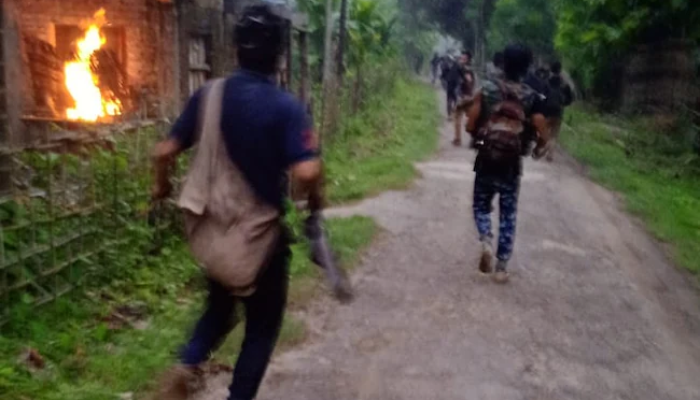
An increasing number of armed Kuki militants are making their way into Jiribam in Manipur from various areas as they continue their ruthless attack to seize total control of the district that borders Assam. Kuki insurgents, who began their onslaught on 3rd May last year have resumed the operation after suspending it briefly for the Lok Sabha election. Many unverified alarming videos featuring the Kuki militants have also been making the rounds on social media. They can be seen brandishing weapons and marching into the region through land and water.
They have targeted the Hindu Meitei population of Jiribam in their attempt to acquire control of both the Jiribam district and NH 37 (the Imphal-Jiribam highway). On 6th June, they brutally killed 59-year-old farmer Soibam Saratkumar Singh, a Meitei civilian to begin their aggressive campaign in Jiribam. Furthermore, they also set fire to at least 72 Meitei homes and three police stations there. According to sources, an increasing number of Kuki militants are currently travelling toward Jiribam via land and sea channels with the terrifying goal of purging the region of Meiteis.
Motorboats transporting a significant contingent of Kuki insurgents with sophisticated weaponry have been spotted moving from Lakhimpur into Jiribam employing the Jiri and Barak rivers. Additionally, Kuki militants are camped in the Kuki-Zo villages including Moinathol and Bethel across the Barak River in the Cachar region of Assam. The sources revealed that they roam around various neighbourhoods of Jiribam during the night. According to various social media posts, multiple groups of Kuki militants have also been heading toward Jiribam along the Jiribam-Tipaimukh road.
Kuki insurgents have reportedly destroyed numerous important bridges, severely disrupting the area and endangering its connectivity. This has led to an upsurge in the expanding unrest in the Jiribam district. The Harinagar bridge was one of the targeted bridges, however, Assam Rifles troops intervened and repaired it right away. The Goakhal and Latingkhal bridges were also discovered to be dismantled by them. Moreover, they set fire to the Makhabosti Forest Beat adding to the growing list of strikes against the district’s infrastructure. The already precarious situation in Jiribam, which has observed a boom in violence in the wake of the recent general election result is being exacerbated by these nefarious acts of sabotage.
Meitei residents of villages some distance from the Jiribam district headquarters have left their homes and relocated to relief camps erected at the district headquarters after learning of the large number of Kuki militants continuing towards Jiribam from different directions. According to the sources, despite the Manipur government sending more state troops to Jiribam, no security arrangements have been made for the displaced people’s rehabilitation in their home villages as of yet.
Kuki militants ambush CM’s security convoy
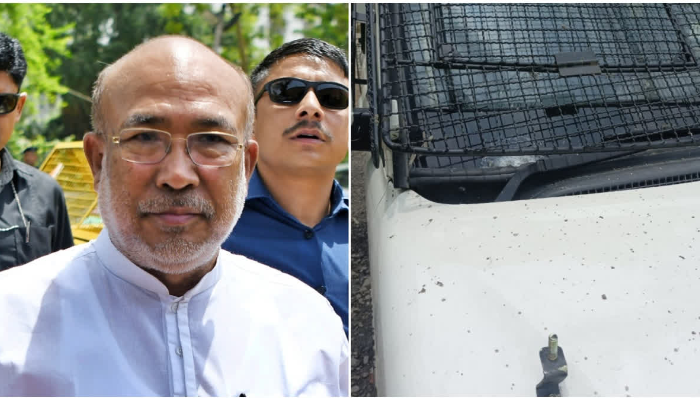
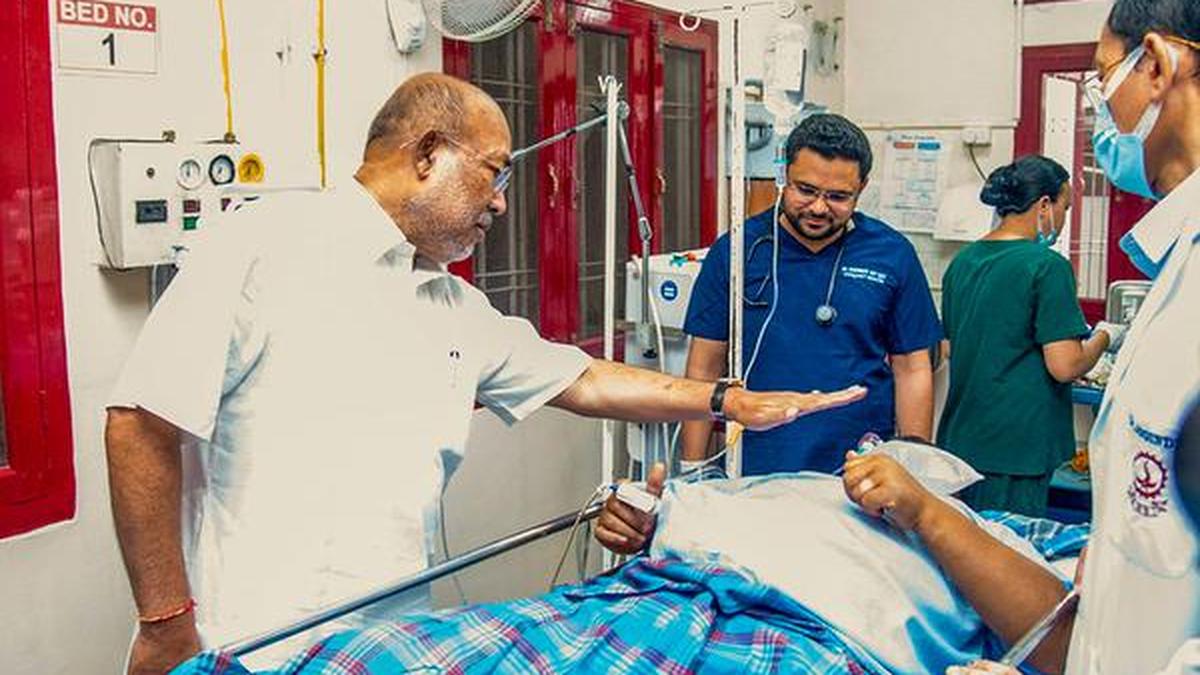
10th June witnessed a significant spike in violence when Kuki militants ambushed Manipur Chief Minister N. Biren Singh’s security convoy along National Highway 37 at T. Laijang, close to Kotlen village in the Kangpokpi district. 28-year-old escort driver Bobo, also known as Moirangthem Ajesh, from Thanga Ngaram in the Bishnupur region suffered injuries in the assault. He was admitted to the Shija Hospitals and Research Institute (SHRI) in Langol, Imphal.
A leaked video has surfaced from the Kuki_Hmar_Zo Community WhatsApp group, depicting the orchestrated attack on Manipur Chief Minister N. Biren Singh's convoy. The assailants, allegedly Kuki insurgents, targeted the convoy with meticulous planning and executed it with precision,… pic.twitter.com/iPriV8MRg8
The convoy was headed to Jiribam at roughly 10:50 am when the assault transpired, ahead of the chief minister’s scheduled visit to the volatile district on 11th June. The driver was shot in the right shoulder and was taken to the hospital around midday under strict security. Doctors stated that his condition was not critical. The incident happened soon after Chief Minister N. Biren Singh returned to Imphal in the afternoon following his attendance at Prime Minister Narendra Modi’s swearing-in ceremony in New Delhi on the evening of 9th June.
N Biren Singh visited the injured security personnel in the hospital. (Source: The Hindu)
The objective of the visit to Jiribam was to address the rising violence levels and restore the district’s peace. A group of Manipur police, including members of the Commando unit, were sent to the spot immediately after the instance. Afterwards, a coordinated search and rescue effort was started with the help of the Assam Rifles to capture the attackers and ensure the area’s safety.
Furthermore, the insurgents also attacked numerous police outposts and set houses on fire when they arrived in three or four boats on a river in the Jiribam region of Manipur. The attack began at 12:30 am in Chotobekra, Jiribam on the banks of the Barak River. According to a police officer, the Jiribam district’s Lamtai Khunou, Dibong Khunou, Nunkhal and Begra villages are the most seriously impacted.
Another officer stationed at a police outpost (OP) in Borobekra, Jiribam subdivision, a little distance from Chotobekra reported that the militants started targeting the OP at about 2:30 in the morning. Many hamlets along the river were attacked by them, based on police sources. They also verified the footage featuring gleeful insurgents rejoicing and setting houses on fire.
Kuki militants set homes on fire in Jiribam. (Source: NDTV)
Assam Rifles step in to rescue Meiteis
Tensions in Jiribam intensified after Soibam Saratkumar Singh’s body was uncovered on 6th June, per Assam Rifles. Miscreants burned a few homes, ruining the law and order in the neighbourhood. The Assam Rifles informed in a press release that it had taken important measures to protect the locals, put an end to vandalism and prevent the security situation from deteriorating worse. Assam Rifles also dispatched columns to different areas. The Assam Rifles and Manipur Police carried out intense cooperation and foiled an attempt by miscreants to steal firearms from the Jiribam Police Station.
The press announcement added that Assam Rifles guarded remote areas with residents in Phaitol and Raniveng, thwarting potential attacks. They were successful in rescuing 86 residents of Dibong Khunao, Raniveng and Monbung who belonged to both Meitei and Kuki communities. On 7th June, the next day, miscreants started shooting in the Raniveng sector of Jiribam at about 5:30 pm. Assam Rifles personnel promptly mobilized over the region and conducted operations to avert any further unfortunate incidents. Approximately 66 residents of the Kuki community were saved and securely evacuated during the operation. 237 Meitei residents from the villages of Lamdaikhunao and Monbung were also securely moved to an internally displaced personnel (IDP) camp earlier in the day.
On 7th June officials declared that over 239 Meitei people, mostly women and children were evacuated from Jiribam’s surrounding districts and taken to a newly created relief camp located at a multi-sports complex in the district. Prohibitory orders were placed in Jiribam when villagers, upset at the farmer’s killing, set a few abandoned structures on fire upon the retrieval of his body. In addition, locals demonstrated in front of the Jiribam Police Station, demanding the restoration of their legally owned weapons that had been impounded before the election.
In order to address the concerns of the local population and to reaffirm the steps being taken to maintain peace and order in the area, the Assam Rifles, in cooperation with the civil administration, State Police, CRPF, and other security forces also organized a security meeting in Jiribam. The goal of the cooperative meeting which included leaders from the community and a range of stakeholders, was to foster collaboration and confidence between the inhabitants and the security personnel. The press release affirmed, “The Assam Rifles remain committed to the safety and security of the people of Manipur and will continue to take proactive steps to maintain peace and uphold the rule of law. The swift actions of Assam Rifles were instrumental in mitigating further damage and loss of life despite the challenging conditions and roadblocks set up by miscreants.”
Meanwhile, the Rongmei Naga Student’s Organization Manipur (RNSOM) opposed the call made by Kuki organizations for a 24-hour closure which commenced at midnight on 10th June. The former asserted that there would not be a complete shutdown along the NH-37 (Imphal-Jiribam Road) in Rongmei Naga territory. The RNSOM in a statement announced that the Kuki Women Union Moltam Region, Kuki Students Organization South West Sadar Hills and Kuki Inpi South West Sadar Hills have all demanded the closure of Kuki-dominated areas along NH-37.
On the other hand, the RNSOM affirmed that the whole region from Imphal to Jiribam is the ancestral land of the Rongmei Naga, in spite of claims expressed by the Kukis, whom they referred to as “new settlers.” Jeanthui Panmei, General Secretary of RNSOM pointed out, “We remind every community once again that the whole stretch of land from Imphal to Jiribam is Rongmei Naga ancestral land, despite the claims made by the Kukis, who are recent settlers. Any untoward incidents arising from this shutdown will be the responsibility of the Kuki community.”
According to the RNSOM, NH-37 is a key lifeline for the area, passing through the centre of Rongmei land, which belongs to all the groups that reside in and around Manipur. They emphasized that no group should be allowed to use the highway as a platform for terrorism and denounced the shutdown as unjustified. The RNSOM vehemently declared that NH-37 cannot be used as a venue for any terrorist act, past, present, or future, by any group or individual.
The group also criticized the recent “barbaric indiscriminate attack” by Kuki militants that targeted state police and the security personnel of the chief minister along NH-37. They issued a warning that attacking communities that value peace while serving in the armed forces could set off a chain reaction of events and be viewed as an “open invitation to join the fights.”
Declare Kuki community as a criminal tribe: Manipur International Youth Centre (MIYC)
Manipur International Youth Centre (MIYC) blamed Kuki militants for the fresh turmoil in the state. According to a press release from MIYC, Kuki militants are working with central security forces to form another “Kuki Occupied Manipur” in Jiribam. They demanded that the Kuki people be designated as a criminal tribe due to their involvement in hostilities in Bangladesh as well as Manipur.
Although armed Kukis attacked Meitei homes and residents on 3rd May last year, resulting in widespread bloodshed throughout the state, Jiribam had managed to maintain the calm after a Peace Committee was established on 5th May of the same year. According to MIYC, Jiribam was peaceful until 5th June 2024. However, the murder of Soibam Saratkumar Singh destroyed it. Two police outposts, a forest beat office, and more than eighty Meitei houses were set on fire in the aftermath. MIYC condemned the state and central security forces for their passivity throughout these incidents. It charged that by funding a campaign of terrorism, the central government was using the Kuki community as a front in a proxy war in Manipur.
It alleged that the restoration of the same government to the centre is correlated with the resurgence of violence. Furthermore, MIYC highlighted remarks made by Prime Minister Sheikh Hasina of Bangladesh who cautioned of a larger geopolitical plot to destabilize Bangladesh, Myanmar and several northeastern Indian states, including Manipur, to create a Christian state. She had urged India to act wisely against Kuki militants rather than aiding them. According to Sheikh Hasina’s remark, the Indian government is using Kuki terrorists to further its geopolitical goals in Myanmar, repress the Meitei people and erase Manipur’s historical relevance as a strong sovereign state in Southeast Asia, MIYC argued.
Coordination Committee on Manipur Integrity (COCOMI) demands terrorist tag for armed Kuki groups
The Coordination Committee on Manipur Integrity (COCOMI) demanded that all armed Kuki groups be designated as terrorist outfits in response to the attack that armed Kuki groups pulled off on the chief minister’s advance security convoy en route to Jiribam, which resulted in the injuries of two security personnel. The occurrence, according to a release from COCOMI media coordinator Y Surjitkumar Khuman, illustrated the growing tension between the state administration and Kuki terrorist organizations, which is rendered worse by the alleged complicity of Indian central security forces.
COCOMI voiced that their inaction in the face of such an overt attack on state apparatus is quite concerning and opined that the ongoing war, which was initially mislabeled as communal violence, is clearly an act of targeted aggression by Kuki terrorist groups against the state administration. Surjitkumar stated that Kuki propagandists have made a concentrated effort to portray the violence as a communal matter since the first attacks on Meitei individuals in Churachandpur and Torbung Kangvai on 3rd May. However, he claimed that these actions were calculated manoeuvres by Kuki narco-terrorists to topple the state government.
He accused that the authority of the government has been undermined in addition to jeopardizing the safety of its residents due to the central government’s indifference during these attacks. He noted that the Indian state’s tacit support for the Kuki groups against the interests of their own state government was indicated by the central forces’ failure to aid state forces in reprisal or defence against these attacks, which fueled further violence and instability. Surjitkumar sought a thorough inquiry into the alleged protection and complicity of Indian security personnel with Kuki terrorist groups and called for the government of India to act decisively and immediately to handle the problem.
Manipur government alerted thrice in January about Jiribam threats
Three letters from the state government to the Director General of Police (DGP) had been sent almost six months before Kuki-Zo militants assaulted villages and police outposts in Manipur’s Jiribam district, reported NDTV. The letters asked the senior official to increase security and take action against any threat. According to the letters, the state government urged the DGP on multiple occasions to maintain strict security in Jiribam and anticipate threats from the Kuki-Zo insurgents. However, recent attacks and the exodus of residents from Jiribam especially the Meitei community suggest that the government’s intelligence reports have not been implemented.
The first letter which was written on 15th January read, “It has been reported that about 200 armed Kuki-Zo militants have moved from Churachandpur and reached Phaitol village, Old and New Kaiphundai area of Tamenglong district bordering Jiribam district.” The DGP was instructed by the state administration to react to any threat and take action to stop violence. The state administration requested that the top cop take “effective counter-measures” in the second letter, which was written on 27th January, including soliciting the aid of the central forces.
The letter, which made reference to shooting incidents that were reported on 31st December 2023 as well as 1st and 21st January mentioned, “Considering reports of movement of armed miscreants from Churachandpur towards Vangai Range bordering areas Jiribam, Director General of Police is requested to take adequate measures to pre-empt spread of the current law and order situation to Jiribam district and to take up effective counter-measures including domination of strategic locations using central/state forces.” In the same letter, the state administration stated that “the ITLF is reportedly considering cutting off supply lines to Imphal valley via Jiribam,” alluding to the Kuki-Zo organization Indigenous Tribal Leaders’ Forum (ITLF).
The third letter, dated 31st January, was composed by the state government to the DGP and the Security Adviser alerting them to a potential effort to pilfer weapons and ammunition from the 7 India Reserve Battalion (IRB) in Jiribam. The letters came to light after the state government provided multiple inputs almost six months prior regarding the likelihood of an insurgent attack in Jiribam, and the Biren Singh government asked for a police report explaining why villages were attacked by these groups.
Chief Minister not part of the unified command
According to government sources, the chief minister was not included in the unified command which had elements from both state and central forces that was established in May of last year following the start of ethnic conflict. Government sources noted that the set-up should have deterred the 200 Kuki-Zo militants from heading toward the highlands that border Jiribam.
The ambush of the police convoy and the attack on Meitei villages in Jiribam, according to government sources, bore clear similarities to the strategies employed by suspected Kuki militants in the trading town of Moreh, which borders Myanmar. In addition to targeting police in the border town itself, the insurgents then assaulted Manipur Police convoys travelling from Imphal to Moreh.
On 17th April, the United Kuki National Army (UKNA), a little-known militant group, took responsibility for the attack on civilian fuel trucks on National Highway 37 which happened a day earlier. A truck driver was wounded and the tankers leaked oil and gas. The UKNA described the assault as the “first offensive operation” against the supply of necessities and “weaponry” to Meiteis in a statement delivered to the media.
The UKNA is not a party to the tripartite suspension of operations (SoO) agreement, which is a form of ceasefire signed between over two dozen Kuki-Zo insurgent groups, the centre, and the state. On 5th May 5, UKNA camp commander Thangminlal Haokip was shot and killed by his own security in the Kuki-dominated Churachandpur district.
Now, about 150 police commandos were airlifted to Jiribam by the state government in response to the recent threat. Six flights were undertaken by the helicopter to transport the commandos between Imphal and Jiribam. Meanwhile, a school in Jiribam is now home to around 400 Meitei community members, with some moving to Assam which is nearby. Moreover, at least 200 Kuki tribe members have sought refuge in Assam and at least 800 persons are now taking shelter in the state’s Cachar district.
Jiribam, which is 220 kilometres from Imphal, has 43,838 residents as of the 2011 census. Although Meiteis make up a large portion of the population, the district is home to other communities as well. The district of Jiribam is bordered by the Assam districts of Cachar, Pherzawl and Tousem sub-divisions of Tamenglong. The territory is drained by the Jiri and Barak Rivers. The Jiribam district serves as Manipur’s entry point to the West, and the Imphal-Jiribam highway is currently the sole route that can be relied upon for the reliable transit of necessities, especially in the Imphal valley. Notably, Jiribam, home to Meiteis, Muslims, Nagas, Kukis and non-Manipuris, had previously remained unaffected by the ethnic strife.
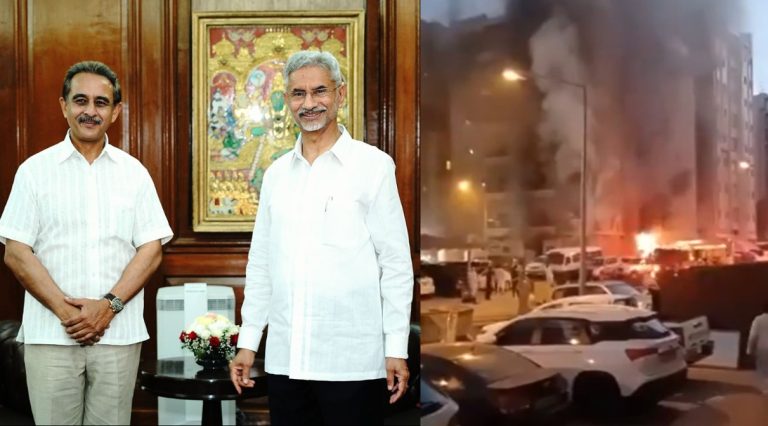
Minister of State for External Affairs Kirti Vardhan Singh is urgently travelling to Kuwait on the instructions of PM Modi to oversee assistance to Indians injured in the fire tragedy in a southern city of the country early on Wednesday.
The minister will also coordinate with local authorities for early repatriation of the mortal remains of those who have died.
“As directed by PM @narendramodi, MoS for External Affairs @KVSinghMPGonda is urgently travelling to Kuwait to oversee assistance to those injured in the fire tragedy and to coordinate with local authorities for early repatriation of mortal remains of those who have died in this unfortunate incident,” Ministry of External Affairs spokesperson Randhir Jaiswal said in a post on X.
As directed by PM @narendramodi, MoS for External Affairs @KVSinghMPGonda is urgently travelling to Kuwait to oversee assistance to those injured in the fire tragedy and to coordinate with local authorities for early repatriation of mortal remains of those who have died in this…
Kriti Vardhan Singh, who took charge of his office on Tuesday, told the media that PM Modi has called a meeting. He said immediate action will be taken.
“PM Modi has called us for a meeting and after the meeting we will visit Kuwait. An immediate action will be taken,” he said.
A fire broke out in a building housing workers in the city of Mangaf in southern Kuwait early on Wednesday.
India’s ambassador to Kuwait, Adarsh Swaika, visited the Al-Adan hospital where over 30 Indian workers are being treated.
Amb @AdarshSwaika visited the Al-Adan hospital where over 30 Indian workers injured in today’s fire incident have been admitted. He met a number of patients and assured them of full assistance from the Embassy,” the Indian Embassy in Kuwait shared on X.
The ambassador also visited Farwaniya Hospital, where six workers, who are expected to be mostly Indians, who got injured in the fire incident were admitted.
Among those six, the hospital authorities confirmed that four of them have been released, one has shifted to Jahra Hospital and one in the ward is stable now.
Earlier, External Affairs Minister S Jaishankar expressed his deep shock over the news of the fire incident.
“Deeply shocked by the news of the fire incident in Kuwait city. There are reportedly over 40 deaths and over 50 have been hospitalized. Our Ambassador has gone to the camp. We are awaiting further information. Deepest condolences to the families of those who tragically lost their lives. Wish early and full recovery to those who have been injured. Our Embassy will render the fullest assistance to all concerned in this regard.”
The Indian Embassy has put in place an emergency helpline number +965-65505246 in connection with the tragic fire-accident involving Indian workers today.
“All concerned are requested to connect over this helpline for updates. Embassy remains committed to render all possible assistance,” it said in a post on X.
After this tragic incident, Deputy Prime Minister Sheikh Fahad al-Yousuf al-Sabah paid a visit to the site and ordered the arrest of the building’s owner, as per Al Jazeera.
(This news report is published from a syndicated feed. Except for the headline, the content has not been written or edited by OpIndia staff)
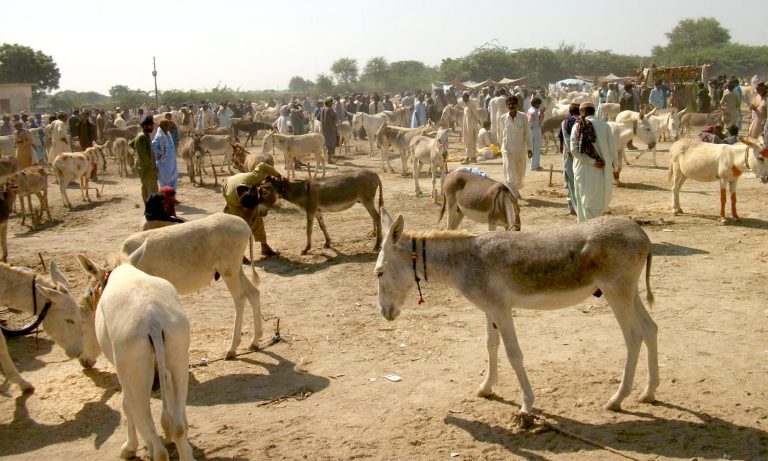
The recent Pakistan Economic Survey for 2023-24 showed a significant increase in the nation’s donkey population, reaching 5.9 million, representing a growth of 1.72 per cent from the previous fiscal year.
Despite this rise in the donkey population, Pakistan’s overall economic growth failed to meet expectations. The economy is expected to have grown by 2.4 per cent in the current fiscal year, which is lower than the government’s target of 3.5 per cent as stated in the latest economic survey.
Donkeys play a significant role in Pakistan’s economy, particularly in rural areas.
They are used for various tasks such as transportation of goods and people, agriculture, and as a source of livelihood for many families.
Donkeys are valued for their strength, reliability, and ability to navigate rugged terrains, making them indispensable for certain industries and communities, especially in regions where modern transportation infrastructure is lacking.
Therefore, the increase in the donkey population highlighted in the economic survey indicates its importance and relevance to the country’s economy.
On the other hand, Pakistan is facing several challenges in achieving its economic growth targets.
High inflation rates and unsustainable fiscal deficits have undermined investor confidence while hampering business activities.
Security challenges, such as terrorism and insurgency have disrupted supply chains and increased security-related expenses, further impeding development. Structural weaknesses, such as inadequate infrastructure and an inefficient bureaucracy, also constrain productivity and hinder economic expansion.
During the unveiling of the Pakistan Economic Survey on Tuesday, Finance Minister Muhammad Aurangzeb revealed that the economy fell short of most targets set in the previous budget due to challenging conditions.
(This news report is published from a syndicated feed. Except for the headline, the content has not been written or edited by OpIndia staff)
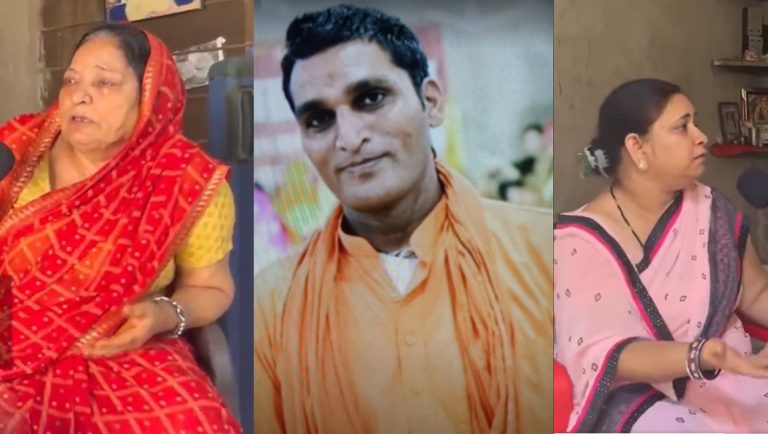
The mother of the deceased Pujari Akhilesh Sharma who reportedly committed suicide on 4th June in Rajasthan’s Alwar, took the drastic step and attempted to commit suicide for not getting Justice for his deceased son. Notably, the family has claimed that Akhilesh committed suicide as he went into depression after a suspended Policeman filed a false case against him under the SC/ST act and started blackmailing him to extort money.
Speaking with a NeoPolitico journalist, the family alleged that no arrests had been made in the case, even 8 days after the deceased victim took the extreme step. They added that the Police neither came to record his mother’s statement nor gave an FIR copy to the grieving family. While crying inconsolably, his mother mentioned that she had attempted to commit suicide claiming that there was no one left to take care of her. The family added that they had not received any support from the local Hindu community or political leaders.
Hear the loud cry of a Brahmin mother who lost her Pujari son due to the false case of the SC-ST act in Rajasthan. She has been begging for justice for the last 8 days but not a single policeman come to even record her statement. No accused involved has been arrested yet. No copy… pic.twitter.com/CbHQir9h2C
Listen to the Bhabhi of Pujari Akhilesh Sharma who committed suic!de after being booked in a false SC ST act case in Rajasthan. No surprise why BJP lost elections in this state. The ground reality ?
The incident reportedly occured on Tuesday night (4th June) when the 40-year-old priest committed suicide by hanging himself. Akhilesh Sharma was the Pujari of a Shiv Hanuman temple which is located in Kotwali police station area of Alwar city. The family had accused a suspended Policeman of blackmailing Akhilesh which according to them was the reason why he took the extreme step of hanging himself.
The police had conducted a post-mortem of the body and handed it over to the family members. According to the police, the incident of the suicide of the priest took place in Hanumanji Street located in Sidhpur Mohalla of the Kotwali area. The family members have blamed a policeman for this and have made serious allegations against him.
Omprakash Vashishtha, the family member of the deceased, said that Akhilesh Sharma used to work as a priest in the temple located in Rath Nagar of the city. A suspended policeman Dhaniram also works as a guard there.
He added that about a month ago, an argument broke out between them regarding the puja donations. After that, the suspended policeman filed a case under the SC-ST Act against Akhilesh.
As per reports, Dhaniram Khatik was earlier caught by the ACB. As a result, he was suspended from police service.
The family alleges that the accused policeman, Dhaniram Khatik, was demanding Rs 1 lakh from Akhilesh in exchange for withdrawing the case. According to them, Akhilesh did not share anything with his family members. However, he became fed up with the blackmailing, fell into depression, and committed suicide by hanging himself.
Meanwhile, the police are investigating the entire matter.
Congress leader Rahul Gandhi on 12th June stated at a roadshow in Kerala’s Malappuram that he was in a dilemma over choosing between the Wayanad and Raebareli constituencies. The Congress leader has won Lok Sabha elections from both the constituencies in Kerala and Uttar Pradesh respectively, and he has to leave one constituency before he takes oath as a member of the Lok Sabha.
Rahul Gandhi said, “What I will commit to you is that both Wayand and Raebareli will be happy with my decision.” Rahul Gandhi also attacked Prime Minister Narendra Modi and claimed that he was led by ‘his God, the poor of the country, the people of Wayanad,’ as opposed to the latter, ‘who was prompted by God to take significant decisions benefitting Adani and Ambani.’
The 53-year-old alleged, “I have a dilemma in front of me – Will I be a Member of Parliament of Wayanad or Raebareli? Unfortunately, like the Prime Minister, I am not guided by God. I am a human being. You saw how the Prime Minister said ‘400-paar’ which disappeared and then came ‘300-paar.’ After that, he said, ‘I am not biological. I do not take any decision. I have been put on this earth by ‘Parmatma’ and he takes decisions.’ His strange ‘Parmatma’ makes him take all the decisions in favour of Ambani and Adani. He tells him to give Bombay airport, Lucknow airport and power plants to Adani and help him with schemes like ‘Agniveer.’ Unfortunately, I do not have the luxury of receiving instructions from God. For me, it’s much simpler. My God is the poor people of India, the people of Wayanad. I go and talk to those people and my God tells me what to do.”
The Gandhi scion thanked the electorate after winning the Wayanad Lok Sabha seat by a wide majority for the second time in a row. He also emerged victorious in Rae Bareli Lok Sabha seat. This was his first visit to the region after the election results were announced. He added, “I look forward to seeing you soon.” Interestingly, the party flags of the Congress and its ally Indian Union Muslim League (IUML) which could not be spotted anywhere during his roadshow in Wayanad in April, appeared during his roadshow at Edavanna.
I have a dilemma in front of me — Will I be a Member of Parliament of Wayanad or Raebareli?
Unfortunately, like the Prime Minister, I am not guided by God. I am a human being.
You saw how the Prime Minister said ‘400-paar’ which disappeared and then came ‘300-paar’. After… pic.twitter.com/OCD3BXRmm0
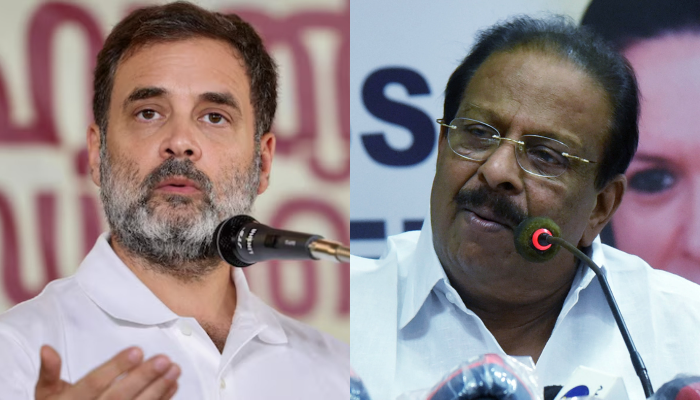
While Rahul Gandhi said he is yet to decide which seat to retain, Kerala Pradesh Congress Committee (KPCC) president K Sudhakaran claimed that Rahul Gandhi is planning to vacate the Wayanad seat for the sake of Raebareli. He said that Rahul Gandhi will have to leave the Kerala seat as he can’t lead India as Wayanad MP.
K Sudhakaran said while speaking at the public event organised for Rahul Gandhi to thank his supporters, “It is sad to hear that Rahul Gandhi is leaving Wayanad. Rahul Gandhi cannot stay in Wayanad to lead India. A mother was crying because Rahul Gandhi was leaving Wayanad which made me sad as well. We don’t have to be sad”.
He added, “We should not be upset as Rahul Gandhi who is supposed to lead the nation cannot be expected to remain in Wayanad. Therefore, we should not be sad. Everyone should understand that and give all their wishes and support to him.”
Kerala | Congress leader K Sudhakaran says, "It is sad to hear that Rahul Gandhi is leaving Wayanad. Rahul Gandhi cannot stay in Wayanad to lead India. A mother was crying because Rahul Gandhi was leaving Wayanad which made me sad as well. We don't have to be sad…" pic.twitter.com/RsO4FxNxOR
Meanwhile, Congress workers from Wayanad want Priyanka Gandhi Vadra to take her brother’s place if Rahul Gandhi leaves the seat and held a message which read, “Dear big brother Rahulji, Please don’t leave us. You are our best hope. But if you must, please ask sister (Priyankaji) to take care of us.” The appeal was made by the Indian National Congress-led United Democratic Front (UDF) alliance.
Notably, despite all the noise and chest-thumping, the grand old party couldn’t even touch three digits and was restricted to 99 seats even after ten consecutive years in opposition while the Bharatiya Janata Party was also reduced to 240 seats. The National Democratic Alliance headed by the saffron party secured 293 seats while Congress’ I.N.D.I. Alliance obtained 232 seats.
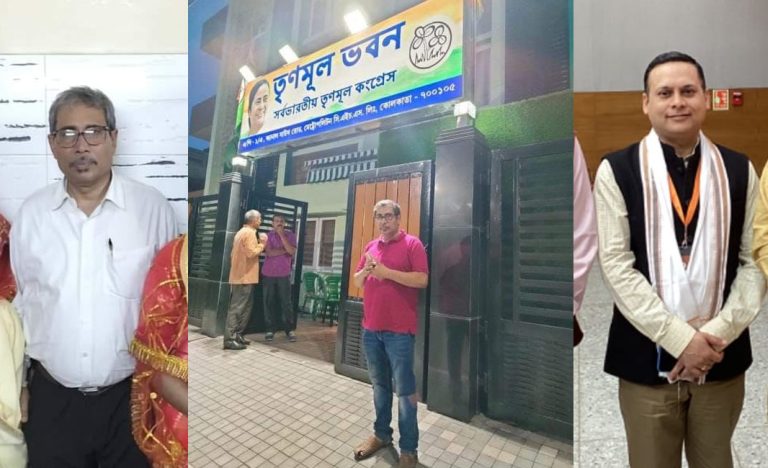
In a shocking development, Santanu Sinha, who made sexual misconduct allegations against BJP social media head Amit Malviya and later apologised after receiving a defamation notice, was earlier seen outside the Trinamool Congress party office, as reported by some journalists.
Notably, on 12th June, News 18 journalist Pallavi Ghosh tweeted, “Now a twist in the allegations case against @amitmalviya – a picture of Santanu Sinha, who accused Amit Malviya and BJP Bengal leaders of sexual abuse outside TMC office has been released.”
Now a twist in the allegations case against @amitmalviya -a picture of Santanu Sinha, who accused Amit Malviya and BJP Bengal leaders of sexual abuse outside TMC office has been released .. pic.twitter.com/1cdBKly4H9
Additionally, journalist Rohan Dua shared the pictures of Sinha outside the TMC office, where he was allegedly meeting with TMC leaders. In his post, Dua asked whether TMC colluded with Sinha to vilify its rival, Bharatiya Janata Party.
He wrote, “Santanu Sinha, who first made accusations against BJP National Information Technology department head Amit Malviya @amitmalviya before retracting them, has courted a row after his own photos with TMC leaders & visit to TMC office surface. Did TMC collude with him to villify BJP?”
Santanu Sinha, who first made accusations against BJP National Information Technology department head Amit Malviya @amitmalviya before retracting them, has courted a row after his own photos with TMC leaders & visit to TMC office surface. Did TMC collude with him to villify BJP? pic.twitter.com/hVXZUjkfEp
Sharing Sinha’s picture outside the TMC party office, several X users questioned whether TMC could be behind the conspiracy to malign the image of BJP leaders and if the ruling party orchestrated this to counter allegations made by local villagers and women in Sandeshkhali.
BJP IT department head Amit Malviya exposed Sandeshkhali issue.
Santanu Sinha made baseless accusations against @amitmalviya.
— Shashank Shekhar Jha (@shashank_ssj) June 12, 2024
INDI alliance exposed!
So called RSS Worker Santanu Sinha who imposed fake allegations on @amitmalviya spotted at TMC office.
INDI alliance created this whole conspiracy to distract people from Sandeshkhali. pic.twitter.com/HammsMCkSu
— Unofficial Zoo Bear: LKFC (@JagatJananii) June 12, 2024
The current controversy erupted after Santanu Sinha made a Facebook post on 7th June in which he accused Amit Malviya and other senior leadership of the BJP of accepting sexual favours from leaders in West Bengal and in exchange providing them positions in the party. He accused West Bengal BJP leaders of sending women to Malviya and other senior leaders of BJP in 5-star hotels to secure the president’s posts.
These allegations were then used by Congress and Trinamool Congress to attack the BJP and Malviya. However, after Amit Malviya sent a legal notice of defamation to him, he retracted his statement. In another Facebook post on 11 June, Sinha claimed that he did not level sexual harassment allegations against Amit Malviya and that his Facebook post had been deliberately misinterpreted by the Indian National Congress.
However, he claimed that his post was to warn against getting entangled in a honey trap, not to target Malviya. The alleged RSS member, Sinha also said that he does not want BJP and its office bearers getting undermined in any manner by misinterpretation of his post. He added that as he didn’t write anything untoward in the post, he is not deleting it.
Consequently, after Sinha asserted that he is not deleting the post, Malviya announced on 12th June that he had decided to pursue criminal defamation proceedings against Sinha even after he retracted his allegations of sexual misconduct against the BJP leader. In a post on X, Amit Malviya said that the statement by Hindu Samhati President, Santanu Sinha retracting his allegations was qualified and not unequivocal.
Amit Malviya said in the statement, “The alleged post was defamatory, calculated and malicious. The wide dissemination by opposition parties has added to the defamation. As such, I have decided to pursue Criminal Defamation against Santanu Sinha, under appropriate sections of the IPC. Other civil remedies may also follow, as would be advised.”
Statement on slanderous post by Santanu Sinha, President Hindu Samhati, West Bengal. pic.twitter.com/AwGXGPH9Th
Malviya added how Sinha’s allegations were propagated by Congress and Trinamool Congress leaders.
Now in a shocking turn of events, Sinha’s picture outside the TMC office surfaced on social media, igniting a political storm.
It is pertinent to note that it is not the first time that questions have been raised over the collusion of Trinamool Congress with members of the Hindu Samhati. Incidentally, in 2018, both BJP and the Left had branded Hindu Samhati as the ‘Trinamool’s Hindutva wing’.
For those unversed, Hindu Samhati has grown rapidly in various parts of Bengal since its foundation in 2008. It was founded by Tapan Ghosh but he later quit the organisation accusing it of “lacking courage”.
Tapan Ghosh was a pracharak of Rashtriya Swayamsevak Sangh in West Bengal. He had joined the RSS in 1975 but he left RSS over differences in the way of functioning of the organisation. He established Hindu Samhati, a Hindu nationalist organisation with the goal of protecting Bengali Hindus.
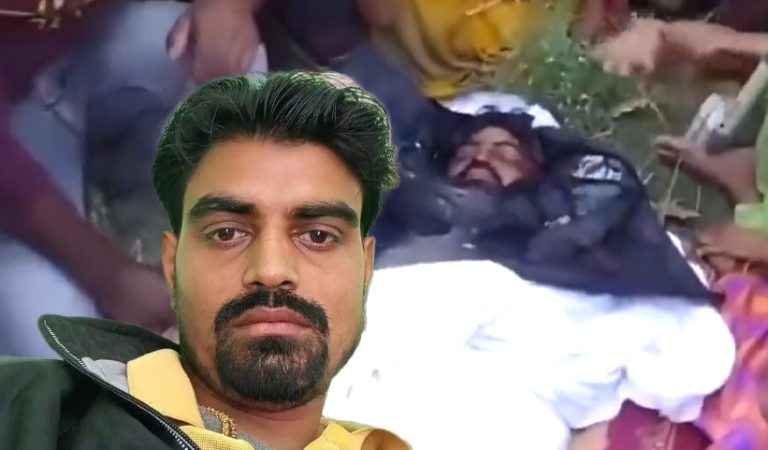
In a shocking incident, a BJP worker identified as Sanjay Mishra was found brutally murdered in Uttar Pradesh. As per a report by Organizer, he clashed with activists from the opposition Samajwadi Party (SP) during the campaign. When the election results were published, SP supporters allegedly went to Sanjay’s house and attacked him, causing serious injuries and leading to his death. The incident is said to have happened in Uttar Pradesh’s Shravasti district.
According to reports, Sanjay Mishra was an active BJP member who was named Panna Pramukh for the Shivpuri Bankat area. He’d been actively campaigning for the BJP.
On the day the results were announced, June 4, Mishra went to Sunil Verma’s residence for a lunch invitation. At Sunil’s house, a fight broke out between Mishra and Ghanshyam over political ties, with Mishra supporting the BJP and Ghanshyam supporting the SP. During the fight, Ghanshyam assaulted Mishra, causing him to file a complaint with the police. However, no complaint was lodged by the police.
Mishra spent the days following the altercation at home.
On June 7, the attackers arrived at Sanjay Mishra’s home after knowing that he had informed the police following an earlier assault. Mishra’s lynching began in front of his family members. When his wife and children intervened, the attackers threatened to kill them, too.
The assailants mercilessly assaulted Mishra with bamboo sticks. He tried to flee to the terrace, but the assailants pursued and shoved him down. Even after throwing him down, they continued their assault by hurling stones at him.
After the perpetrators departed, Mishra’s family hurried him to the Community Health Centre (CHC), where he was pronounced dead. A video of his family after the deceased body was taken home was made public on social media.
The hospital staff notified the authorities, and a case was subsequently filed. A First Information Report (FIR number 69/2024) has been filed, and authorities are actively investigating the case.
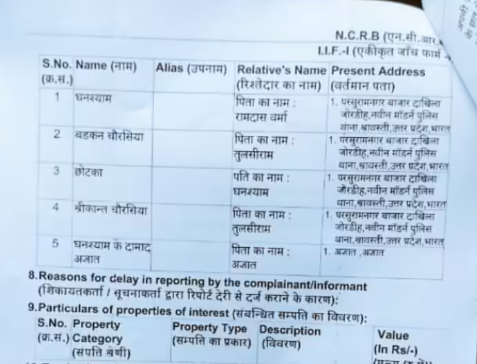
According to the FIR, Mishra’s wife, Nandana Devi, told the police that her husband was attacked and killed by villagers because of past animosity. She identified those involved as Ghanshyam, Badkan Chaurasiya, Chhotka, Shrikant Chaurasiya, and others.
Accused persons named in the FIR
SP Ghanshyam Chaurasia investigated the area after learning of the incident. The SP verified that a case has been filed, and an investigation is underway. He has given Station In-Charge Gannath Prasad significant orders to arrest the offenders immediately.
The accused have been booked under IPC sections 147 (Rioting), 149 (Unlawful Assembly), 302 (Murder), 323 (Voluntarily Causing Hurt), 504 (Intentional Insult with Intent to Provoke Breach of the Peace) and 506 (Criminal Intimidation).
After Mishra’s death, his wife Nandana is left to care for their daughter (7) and two kids (5 and 3 years old). Mishra, whose parents died when he was a minor, lived with his maternal grandparents in Shravasti and worked as a farmer.
It is worth noting that Ram Shiromani Verma, leader of the Samajwadi Party, won the Shravasti Lok Sabha constituency with 511,055 votes. Saket Mishra, the BJP candidate, came second with 434,382 votes. The Bahujan Samaj Party (BSP) fielded a Muslim candidate, Muinuddin Ahmad Khan, also known as Hazi Daddan Khan, who secured the third important position in the recently concluded Lok Sabha Elections 2024.