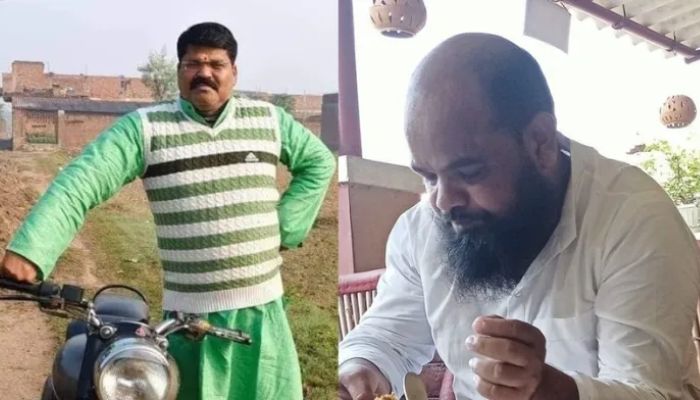
In Amroha, Uttar Pradesh, a girl has filed a complaint against against Wasim, who claims to have her explicit video and has threatened to post it on social media. The girl has also been threatened with an acid attack and a bogus rape case against her brothers. The incident transpired on 8th May and a First Information Report was registered on 14th May against a total of five persons, Wasim, Qasim, Dilnawaz, Kamil and Munna. The authorities have started their investigation and taken necessary action.
This matter pertains to the Kotwali Nagar of Amroha district. The victim submitted a complaint charging that the perpetrators, who live in her locality, harass her. Wasim regularly torments her and pressurises her to marry him. However, when she refused, Wasim threatened that he had some obscene footage of her in his possession and would make it viral if she didn’t listen to him.
The girl then narrated her ordeal to her brothers and when they protested, Wasim threatened to send them to jail by falsely accusing them of raping his disabled sister. The threat scared them but Wasim grew more audacious after which he called the girl, and started threatening to throw acid on her face and murder her if she didn’t wed him.
The girl also mentioned the incident of 8th May when she was returning home from the market with her sister-in-law. She reached the street behind the local mosque at around 7 pm and was stopped by the culprits. They declared, “We won’t leave you to show your face anywhere after today,” and tried to abduct her after which she started to scream in terror and people began to gather around.
The victim expressed that an untoward instance would have happened if people had not come together and her life would have been ruined. She charged that Wasim had defamed her by making her pictures viral on various social media platforms. She remained silent for a long time out of fear. However, the victim eventually mustered enough courage to lodge a complaint and has also attached all her photographs posted online by the accused.
She requested strict action against the perpetrators at the end of the complaint and the police filed an official case against Wasim, Qasim, Dilnawaz, Kamil and Munna. Dilnawaz is also known as Rohit in the area. They have been booked under sections 294, 354, 504 and 506 of the Indian Penal Code along with section 67 of the Information Technology (IT) Act. The accused and the victim belong to the same community. OpIndia has the complaint copy.
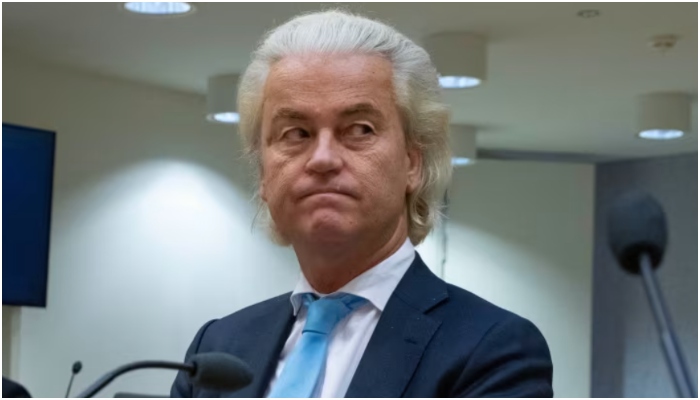
On Wednesday (15th May), conservative Dutch leader Geert Wilders who earlier hailed former BJP leader Nupur Sharma calling her a ‘brave lady’, and three other Dutch party leaders in the Netherlands said that they had reached a provisional coalition agreement, bringing like-minded ideologies to the government into yet another European Union country. To note, Wilder and his party, Partij voor de Vrijheid (PVV) is known for its anti-Islamic views.
The party leaders stated that they would distribute the document to their party’s legislators before a formal government agreement was revealed. However, the parties in the coalition have yet to agree on the next prime minister, who is believed to be a technocrat from outside the party institutions.
Currently holding or heading six administrations within the 27-nation bloc, these conservative parties seem well-positioned to gain ground in the upcoming European Parliament election on June 6–9. “We have a deal among negotiators and we will return to the position of prime minister at a later moment,” said Wilders.
Wilders meanwhile has reluctantly admitted that he will not succeed Mark Rutte and has instead advocated for an outsider for the position of prime minister. Speculation has centered on Ronald Plasterk of the Labour Party, who rose to prominence this year as the first “scout” to meet with party leaders about potential combinations.
Wilders has described Plasterk as a “creative spirit” with political experience who is also sufficiently removed from the current political environment. As per the reports, Wilders’ Party for Freedom won 37 seats in the 150-seat lower house of the Dutch parliament, giving the four parties a comfortable majority of 88 MPs.
After two decades in opposition, Wilders appeared to have a chance at governing the country, but he has stepped aside in order to get through the majority of his policy.
From Finland to Croatia, several political parties known for their anti-Islamic views are part of European government coalitions. Further, Hungary, Slovakia, and Italy are also reportedly governed by conservative prime ministers.
Who is Geert Wilders?
Geert Wilders is a Dutch politician who is known for his anti-Islam stand. Wilders, who has been under police protection since 2004, has been surrounded by controversies for his statements against Islamist ideology, Muslim immigrants and Islamic terrorism.
He has been active in Dutch politics for 25 years without holding any office. Born on 6th September 1963 in Venlo, Netherlands, he served as a member of the Dutch House of Representatives from 1998 and as a leader of the PVV from 2006. The leader was born into a middle-class family and he lived in Israel from 1981 to 1983 and travelled across the Middle East.
He was also convicted of discrimination against Moroccans over raising slogans during a campaign rally in 2014. In 2021, the Supreme Court of the Netherlands upheld his conviction. Wilders called it a “witch hunt” against him, resulting from a broken legal system.
Over time, he toned down some of his views. However, he continued with his strict anti-immigration, Dutch-first approach, which increased his popularity throughout the elections. In October 2022, Wilders supported former Bharatiya Janata Party (BJP) spokesperson Nupur Sharma after Islamists hounded her for her remarks during a debate on Times Now.
Nupur Sharma is a hero who spoke nothing but the truth. The whole world should be proud of her. She deserves the Nobel Prize. And India is a Hindu nation, the Indian government is obliged to strongly defend Hindus against Islamic hate and violence.
In a post on X, he wrote, “Nupur Sharma is a hero who spoke nothing but the truth. The whole world should be proud of her. She deserves the Nobel Prize. And India is a Hindu nation, the Indian government is obliged to strongly defend Hindus against Islamic hate and violence.” He also raised the matter of violence against Hindus and urged the Dutch government to clear its stand.
Geert Wilders giving up hope of being the next Dutch prime minister
It is important to note that in March this year, the Dutch leader said that he had lost hope of becoming the Prime Minister as he did not have enough support from the coalition parties. Wilders had said that he was giving up his bid, at least for now, to become prime minister because he did not have the full support of all three parties he was negotiating with to form a ruling coalition.
“I can only become premier if ALL parties in the coalition support that. That wasn’t the case,” he had posted on X.
Later he seemed unhappy about not becoming prime minister despite his election triumph, reflecting latent tensions between potential government partners. His statement came after Dutch media, citing unnamed sources, reported a breakthrough in coalition discussions in the Netherlands.
It was believed that the leaders of all four parties participating in the long-running coalition negotiations would remain in parliament. This would establish the possibility of some form of technical Cabinet comprised of experts.
However, later he had said that though he wanted to become the Prime Minister, he could not. But he would continue to be the driving force of the next administration. “Don’t forget: I will still become premier of the Netherlands. With the support of even more Dutch people. If not tomorrow, then the day after tomorrow. Because the voice of millions of Dutch people will be heard!” he said.
Wilders has often advocated for a ban on mosques, Islamic schools, and the Quran. In January, however, he pulled draft legislation to enact the bans in order to appease potential coalition partners.
The Netherlands is not alone in experiencing a tilt to the anti-Islamic stance. As per the reports, populist parties are also anticipated to make major gains in the European Union’s parliamentary elections scheduled to happen in June.
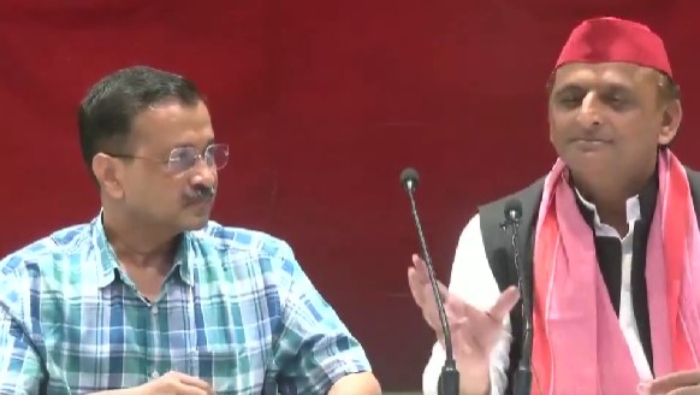
AAP leader Arvind Kejriwal and Samajwadi Party chairman Akhilesh Yadav attended a joint news conference on Thursday, May 16, in Lucknow. Kejriwal was observed sidestepping questions about the controversy surrounding the Swati Maliwal assault. While Kejriwal chose to remain silent, Samajwadi Party chief Akhilesh Yadav jumped in to defend the out-on-bail Delhi CM. He declared that there were other important issues to be discussed other than Swati Maliwal.
Reportedly, as the issue of the assault on Swati Maliwal came up in the joint press conference, Kejriwal passed the microphone to Akhilesh who said, “There are more important things than this.”
#WATCH | Lucknow, UP: Delhi CM Arvind Kejriwal refuses to answer when asked about AAP Rajya Sabha MP Swati Maliwal's assault case.
SP chief Akhilesh Yadav says "There are other issues that are more important than this…" pic.twitter.com/0FDkRiFhrs
AAP MP Sanjay Singh who has so far issued statements on the alleged assault on Rajya Sabha MP Swati Maliwal at Kejriwal’s residence by Bibhav Kumar and assured action against CM’s PA then opted to speak on the issue.
However he, too, used the standard tactic to deflect attention from the real issue at hand. Rather than address the reason behind his party’s lack of action against the chief minister’s aide, Sanjay Singh raked up Manipur, Prajwal Revanna, and the wrestlers’ complaint against former chief Wrestlist Federation of India Brij Bhushan Sharan Singh.
“The wife of a Kargil hero was paraded naked in Manipur and the prime minister remained silent. Prajwal Revanna assaulted and raped several women and PM Modi asked for votes for him. And the government helped him to flee. When women wrestlers were protesting, this Swati Maliwal went to meet them at night and police beat her up. We have seen PM Modi’s silence on Hathras, Kuldeep Sengar,” Sanjay Singh said.
“Aam Aadmi Party is a family. The party has already clarified its stand on this issue. I want the BJP to answer on all these issues, including when Swati Maliwal was beaten up by the police. They should not do politics over this,” Sanjay Singh said.
While bringing up all these irrelevant issues, Sanjay Singh failed to clarify what steps the Aam Aadmi Party had taken to penalize Bibhav Kumar. Why hasn’t an FIR been brought against him yet? How and why Swati Maliwal disappeared out of nowhere after reporting the alleged attack on her at the chief minister’s house by Arvind Kejriwal’s PA, Bibhav Kumar. Why did the party permit Bibhav Kumar to go with Kejriwal to the airport in Lucknow if they had condemned the incident?
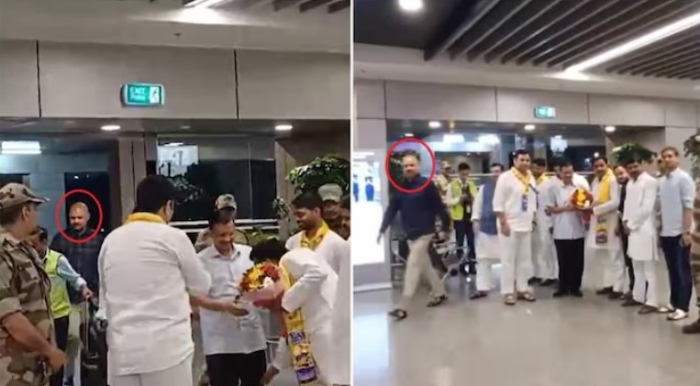
Bibhav Kumar seen comfortably accompanying Kejriwal at Lucknow airport
It has been more than 72 hours since senior AAP leader and Rajya Sabha MP Sanjay Singh confirmed that Bibhav Kumar who is the Personal assistant of Delhi CM and AAP supremo Arvind Kejriwal assaulted and misbehaved with fellow Rajya Sabha MP Swati Maliwal at Kejriwal’s house. He had assured that CM Kejriwal has taken cognisance of the matter and will take appropriate action against him. However, now a picture has gone viral on social media where Bibhav Kumar can be seen accompanying Kejriwal at the Lucknow airport.
On Monday (13th May), Swati Maliwal, the AAP Rajya Sabha MP and former Delhi Commission for Women (DCW) Chief accused Bibhav Kumar, the personal assistant of Arvind Kejriwal, of assaulting her inside the Chief Minister’s residence. Reportedly, a call was made to the Police Control Room (PCR) from the residence of Delhi CM Arvind Kejriwal at 10 am. Following the call, a team of police reached the spot.
In a decree signed by the President of Peru on 10th May, the country has officially classified transgender, non-binary, and intersex individuals as ‘mentally ill’ while offering free mental health care. President Dina Boluarte signed a decree identifying transsexualism, dual-role transvestism, gender identity disorder in childhood, other gender identity disorders, and fetishistic transvestism as mental illnesses.
The Peruvian government’s decision occurred just before the 34th anniversary of the World Health Organisation’s elimination of homosexuality from the International Classification of Diseases (ICD). The Peruvian health ministry stated that the decision would ‘guarantee full coverage of medical attention for mental health’ for the trans population. The Peruvian health ministry, however, stated that the ruling does not require transgender or LGBTQ+ people to undergo conversion therapy.
In a later statement, the ministry said, “The Minsa ratifies its position that gender and sexual diversity are not diseases; in this framework, we express our respect for gender identities, as well as our rejection of the stigmatization of sexual diversity in the country. The sexual orientation and gender identity of a person does not constitute in itself a physical or mental health disorder and, therefore, they should not be subjected to treatment or medical care or to so-called reconversion therapies, such as It is established by Ministerial Resolution No. 753-2021/Minsa…”
“To guarantee that care coverage is complete in mental health, the Essential Health Insurance Plan (PEAS) was updated, in compliance with the Third Complementary Provision Modifying Law 30947, Mental Health Law of May 23, 2019. This update is carried out in response to the need to ensure the benefit of comprehensive mental health interventions, as conditions for the full exercise of the right to health and well-being of the person, the family and the community,” the health ministry added.
A 100 años de la despenalización de la homosexualidad el @Minsa_Peru no tiene mejor idea que incluir a las personas trans en la categoría de enfermedades mentales. Exigimos y no descansaremos hasta su derogaracion. pic.twitter.com/gKczZeq0OI
LGBTQ+ activist groups across Peru, on the other hand, condemned the decision as a significant setback in the fight for their rights and safety. Jheinser Pacaya, director of OutfestPeru wrote on X, “100 years after the decriminalization of homosexuality, the @Minsa_Peru has no better idea than to include trans people in the category of mental illnesses. We demand and we will not rest until its repeal.”
According to a new report by property consultancy CBRE on Wednesday, May 15, India emerged as the country with the largest operational data centre capacity, of around 950 megawatts (MW) in the January-March 2024 quarter. India has surpassed other big players like Australia, Hong Kong SAR, Japan, Singapore, and Korea.
According to the survey, India is expected to maintain its dominance with a capacity addition of about 850 MW between 2024 and 2026, more than its significant counterparts in the region. According to the report, the combined capacity of operational and non-operational data centres, which was estimated to be 1,030 MW by the end of 2023, is expected to rise by 30% annually to reach 1,370 MW in the current calendar year.
“India’s data centre sector, with its resilience and potential for attractive returns, has emerged as a beacon of opportunity for investors. The sector’s allure is further enhanced by the fact that between 2018 – 2023, India secured investment commitments of more than USD 40 billion from both global and domestic investors,” the report states.
What exactly is a Data Centre
A data centre is a specialised facility with networking hardware, computers, and storage devices housed inside that are used to process, handle, store, and distribute data. The support of several IT activities and services, such as data storage, backup, recovery, management, and hosting of websites and apps, depends on these centres.
Importance of a Data Centre
Improved data accessibility, dependability, and efficiency are the results of centralised data administration and storage. In the event of a disturbance, data centres guarantee prompt service restoration by offering strong backup and recovery solutions. In order to facilitate corporate expansion, they provide scalable solutions that can handle increasing data and user needs. Centralising IT resources also improves efficiency by lowering operational expenses and complexity of maintenance. By taking use of economies of scale and common infrastructure, data centres can save capital and operating costs. Data security and legal compliance are guaranteed by cutting-edge security measures and strict adherence to regulations.
Additionally, data centres facilitate cloud services, which offer online access to scalable, adaptable, and on-demand IT resources. Data centres enable global corporate operations and remote work by providing quick and dependable connectivity.
India as a date centre leader
India’s digital transformation has led to an exponential increase in data generation, necessitating robust data infrastructure. Initiatives like Digital India and supportive regulatory frameworks have encouraged investments in data centres.
The Indian data centre industry continues to attract the attention of international investors, many of whom are interested in forming alliances and joint ventures with regional operators. Given the increasing number of competitors in the market, M&A activity among operators is expected to speed up in the upcoming years. This should lead to some consolidation before the industry gets too fragmented.
The data centre industry in India has become a bright spot for investors due to its durability and potential for high profits. The fact that India received investment commitments of over USD 40 billion from both domestic and foreign investors between 2018 and 2023 adds even more allure to the sector. This substantial capital inflow highlights the industry’s high-return potential, which has made it an attractive option for investors, with a preponderance of foreign investments.
Maharashtra, Uttar Pradesh, West Bengal, and Tamil Nadu are the four states with the highest cumulative investment commitments. Additionally, India is drawing attention from international hyper scalers who see it as a great place to grow, with many choosing to use their bespoke build-to-suit (BTS) facilities.
Modern IT services and commercial operations rely heavily on data centres, vital to the digital age’s infrastructure. Motivated by investment, well-trained labour, and supportive policies, India’s dominance in the data centre sector highlights its strategic significance in the global digital economy. India will probably play a bigger role as a hub for data centres as data generation rises, which will greatly advance the country’s economic growth and technological development.
Adani Group to develop India’s first integrated data centre in Visakhapatnam
Last year it was reported that the Adani Group is developing an integrated data centre and technology business park in Visakhapatnam to boost the local technology ecosystem in the region. The investments will be on top of the Rs 20,000 crore already invested in the state, which created more than 18,000 direct and 54,000 indirect jobs, according to a statement from the Group. AdaniConneX, a 50:50 joint venture between Adani Group and EdgeConneX, will host within the park an integrated 300 MW data centre facility.
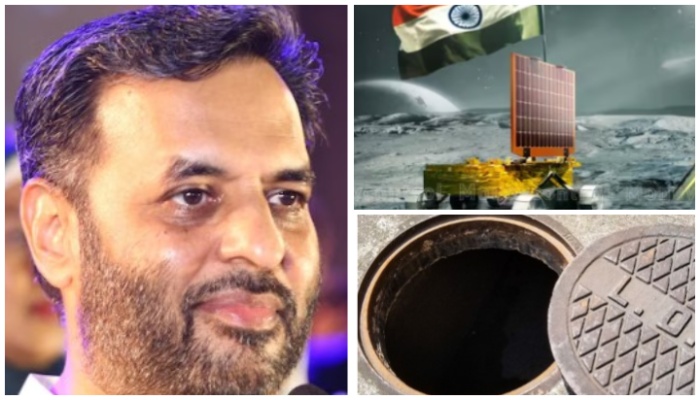
Pakistani lawmaker Syed Mustafa Kamal drew a comparison between India’s achievements and the precarious situation in Karachi, by mentioning India’s moon landing mission.
The Muttahida Quami Movement Pakistan (MQM-P) leader said that while India is landing on the moon, Karachi is making news of children being killed by falling in open gutters.
“Today, the condition in Karachi is that, while the world is going to the moon, children are dying by falling into gutter in Karachi. On the same screen, there is news that India landed on the moon, and just after two seconds, the news is that a child died in an open gutter in Karachi,” Kamal said in his address to the Parliament on Wednesday.
He further highlighted the lack of fresh water in Karachi. The MQM-P leader also said citing a report that there are 70 lakh children in Karachi and over 2.6 crore children in Pakistan, who are not able to go to schools.
“Karachi is the revenue engine of Pakistan. The two seaports operational in Pakistan since its inception, are both in Karachi. We (Karachi) are the gateway to the entire Pakistan, Central Asia to Afghanistan…For 15 years, Karachi was not given even a bit of fresh water. Even the water that came, the tanker mafia hoarded it and sold it to the people of Karachi,” Kamal said.
“We have a total of 48,000 schools, but a new report says that out of that 11,000 are ‘ghost schools’. 70 lakh children in Sindh don’t go to school and a total of 2,62,00,000 children in the country don’t go to school…if we just focus on this, the leaders of the country shouldn’t even get proper sleep,” the Pakistani Parliamentarian added.
In August last year, India’s Chandrayaan-3 lander became the first spacecraft from the country to safely reach the lunar surface in August 2023.
India also became the first country in the world to land on the South Pole of the moon.
Meanwhile, Pakistan — which is grappling with economic distress, high inflation, and mounting debt — is seeking a new loan programme from the International Monetary Fund (IMF) under the Extended Fund Facility (EFF).
A team of the global lender is currently in Pakistan to hold talks on the issue. It has urged Islamabad to bring “strong cost-side reforms” to restore the viability of the country’s energy sector, reported ARY News. It has also urged an ‘overhaul’ of its tax system.
Last month, Pakistan completed a short-term USD 3 billion program, that helped stave off sovereign default, however, the government has highlighted the need for a fresh, longer-term program, according to Dawn.
The incumbent Odisha Chief Minister Naveen Patnaik is seeking a sixth term in office in the ongoing Assembly elections in the state. He has been the state’s CM since March 2000 and if elected again, he will become the country’s longest-serving CM in August, surpassing Sikkim ex-CM Pawan Chamling. However, anti-incumbency, particularly the acute crisis of distressed migration in areas in and around his assembly constituency, could be a major cause for concern for the BJD Supremo.
‘Dadan Khati’, the colloquial Odia term for poor labourers migrating out of the state in search of work and livelihoods, is a major election issue this time. The BJP has asserted employment generation and industrialisation in its poll promises, targeting the BJD government of Naveen Patnaik for failing to generate employment in the state in 5 terms of their rule.
PM Modi has been raising this issue in all his speeches in the state.
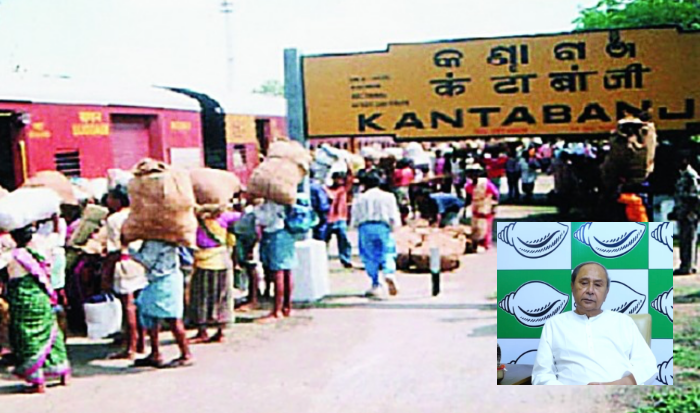
Notably, BJD president Naveen Patnaik is fighting from two assembly constituencies. He is contesting from his traditional Hinjili seat in the Ganjam district which he has won five straight times. Additionally, he is also in the fray from the Kantabanji assembly constituency in the Bolangir district of Western Odisha.
In the 2019 assembly elections, he had also contested from two seats and won both of them. But he resigned from the Bijepur assembly seat which falls in the Bargarh district of western Odisha, and served as the MLA from the Hinjili seat. However, distressed migration which has been a pervasive issue across all 30 districts of the state is more pronounced in the Western belt in districts like Koraput, Balangir, Nuapada, Ganjam, and Kalahandi among others.
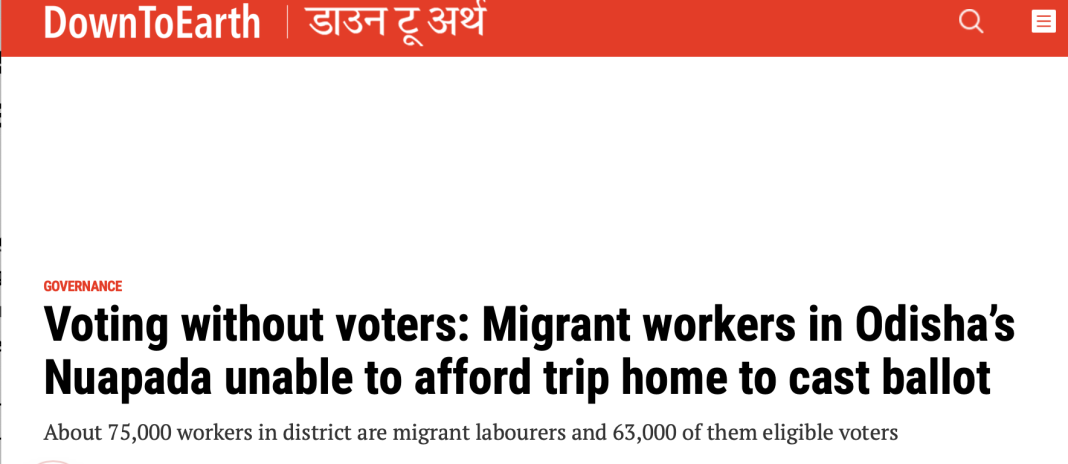
A report in Down to earth about migrant workers from Nuapada unable to come back for voting
As per a BBC ground report of Chief Minister Naveen Patnaik’s assembly constituency, Hinjili, it is estimated that nearly 50% of the youth of this region are migrant labourers as the area lacks industries and factories.
According to 2019 data, there were approximately 22 lakh eligible voters in this assembly. Locals and those knowledgeable about the situation estimate that nearly 50% of the population has been compelled to migrate to other areas—both within and outside the state. Particularly, destinations such as Surat in Gujarat, Mumbai in Maharashtra, and other major cities in Kerala are sought after for better employment opportunities.
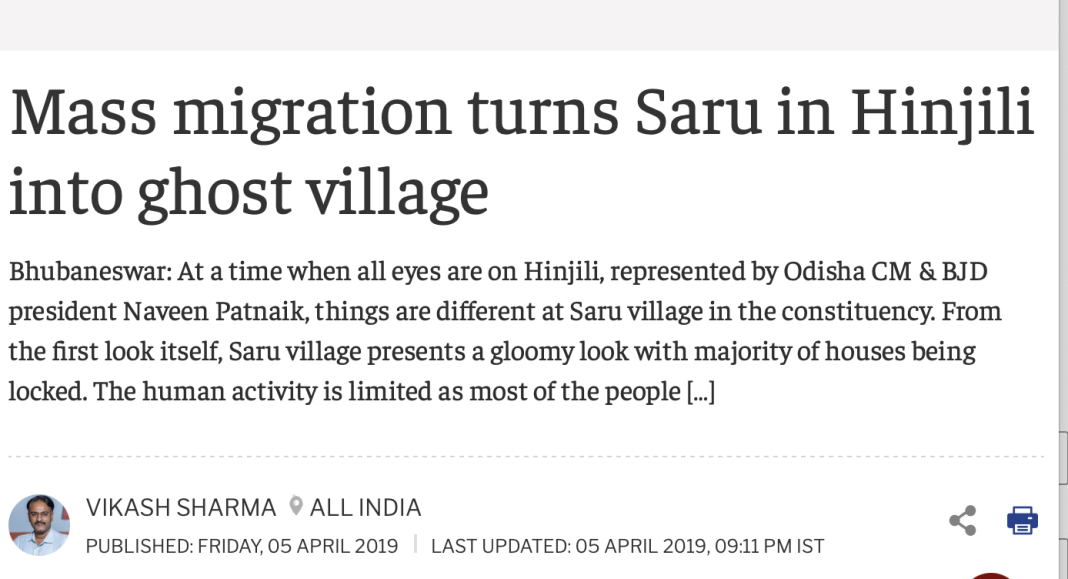
A 2019 report by OTV
After his father’s demise in 1997, Naveen Patnaik made a foray into politics and won from this constituency in 2000 when he was 54 years of age. He has represented this constituency for 24 years and despite being the Chief Minister of the state, the issue of distressed migration is far from over rather it has turned into a more acute crisis for the region.
According to a BBC ground report, nearly half of the houses in Saru village, just 6 kilometers away from Hinjili, have locks on their gates, indicating that residents have migrated to other areas in search of job opportunities. Even if one encounters a young person in this village, they often reveal that they have returned home for a brief holiday lasting 10-15 days.
ओडिशा में इस बार एक साथ लोकसभा और विधानसभा के चुनाव हो रहे हैं. बीते 25 सालों से यहां नवीन पटनायक मुख्यमंत्री हैं. वो पांच बार हिंजिली विधानसभा से जीते हैं. यहां के लोगों के मुद्दे क्या हैं?
Speaking with BBC News Hindi, Shambu Das (18), a native of Saru village, mentioned that he attends college and also works outside the state. He pointed out that while the area has educational institutions, there are not enough employment opportunities available. He expressed disappointment that while one can find private work, educated individuals struggle to secure decent employment. He added that earning Rs 12,000-15,000 would be satisfactory. ‘We have to migrate to other places because there are limited employment opportunities here,’ he said.
Another young resident, Dadda Sahu (25), echoed the same sentiment, stating that although he had worked in his village, the opportunities were not satisfactory.
Shivshankar Sahu, who returned for his marriage, expressed that there are no industries or factories in this area. He mentioned that if Naveen Patnaik had established an industry here, the youth would have been happy, and they could have avoided migrating outside the state for work. Unfortunately, they are forced to leave their elderly parents behind. The situation is such that there is no one to care for them.
An elderly woman named Jambubati Sahu has four children and all of them have migrated from the village to earn a better livelihood.
In another village, Ramchandrapur, a resident woman said that nearly 75% of the villagers have left the village to find better employment opportunities. Now people from all the villages are going outside for a job.
However, many of the villagers feared to come on record as they feared that they would be targeted for airing their grievances.
The BJP candidate from Hinjili, Shishir Mishra, stated that despite Naveen Patnaik serving as the Chief Minister and an MLA from this area for over 25 years, he has not built even a safety pin plant. He added that although Hinjili supplies vegetables to the entire state, it lacks adequate agricultural infrastructure.
Similar scenes in Kantabanji, the other seat where Naveen Patnaik is contesting
Similar scenes of empty houses and missing voters working in faraway states are also visible in Kantabanji, the other seat where Patnaik is contesting in the current assembly elections. Scores of villagers from rural areas of Bangomunda, Muribahal etc work in brick kilns of Telangana and elsewhere. Many families have at least one, or some times more members working in other states. Most of these voters are likely to miss voting on May 20.
Sadly, scores of migrant workers from the Kantabanji Assembly seat of Bolangir, where CM Naveen Patnaik is contesting the election, are most likely to miss the opportunity to cast their votes as they are stuck outside the state.#Odisha#OdishaElections2024pic.twitter.com/uuZAEdho4O
Odisha government rubbishes Dadan Khati as a non-issue, accused of gross under-reporting of numbers
Lack of employment-induced migration has been a major concern in the region, yet the BJD has been reluctant to acknowledge it as an important issue.
Last year in November, the Odisha government released interstate labour migration numbers. In the written statement, Labour Minister Sarada Prasad Nayak noted that 40,088 labourers from the State have migrated to other States in search of employment through the network of 626 licensed labour contractors.
As per a January report in The New Indian Express, contractors from other states have been running buses daily to ferry migrant workers from several districts in Odisha. Additionally, mediators engaged by various companies arrive in the Kandhamal district and lure unemployed people with job offers.
On the condition of anonymity, some of the migrant workers said that they prefer to go outside as livelihood options are limited at their native places.
A Congress leader and zilla parishad member of Raikia, Satyaban Patra alleged that distress migration is continuing in the district but the administration and Labour department have turned a blind eye to the practice.
Covid lockdown saw return of 10 lakh people
After the COVID outbreak, the coastal state, infamous for the exodus of skilled and unskilled labourers to other parts of the country for employment opportunities, witnessed a return of over 10 lakh people.
Despite the enormous magnitude of migration, the Odisha government gave the migrant numbers at around 40,000 underscoring that the state government had grossly under-reported the migrant figures to hide the dismal ground realities of lack of employment avenues in the coastal State.
As per the report, the state government had earlier put the interstate migrant workers’ figure at 1.35 lakh.
An activist named Umi Daniel said that with an abysmal lack of employment opportunities and the absence of an irrigation network for agrarian activities, people from these backward belts of the State migrate to different States. In the process, these defenseless people are ensnared in a bondage labour system and fall prey to the exploitative practices of tyrannical employers.
Daniel added that every year, around one thousand cases of torture and exploitation of migrant Odia labourers are reported. While the government puts the migration figure at 40,088, the actual figure could go up by twenty-fold, he claimed.
However, according to the officials, the State Government is making consistent endeavours through the Field Departments and field functionaries to secure the livelihood of those who are the most vulnerable in society.
The officials said that the Odisha government has initiated a slew of measures like initiatives like providing care and education to the migrating workmen families, rescuing the workmen caught in difficult conditions, and setting up help desks for migrant Odia workmen in the destination states like Telangana, Andhra Pradesh, Tamilnadu, Karnataka, and Delhi.
Distressed migration causing major changes in Odisha’s villages
As per a study by IDR, increasing labour migration from Odisha has led to significant economic, social, and cultural changes in some villages. To understand the profile of migration from southern Odisha, they carried out four empirical studies between 2019 and 2021 that covered one block each in the Gajapati, Ganjam, Kandhamal, and Kalahandi districts.
The study revealed that between 18 and 31 percent of households had at least one member who had migrated for employment outside Odisha. Of this percentage, less than 20 percent engaged in seasonal migration lasting less than six months, indicating that the majority of migrants remained at their work destinations for longer durations exceeding six months.
The lack of employment opportunities leading to distressed migration causes emotional distress and presents challenges in accessing adequate healthcare for the elderly parents and women left behind. It prevents migrant workers from regularly attending to their families, spending time with them, and visiting during festivals or emergencies, among other challenges.
Apart from the social and economic issues, ‘Dadan Khati’ has other consequences, some even criminal. Every day, Odia newspapers are full of stories from rural, undeveloped areas where families are searching for a missing son, missing husband, or missing father wh went to work for some contractor and never returned.
There are reports of gross exploitation, non-payment of dues, rape, even murder where the uneducated, gullible victims of distressed migration have nowhere to go. The local authorities sometimes try and prevent agents of contractors in Hyderabad or Chennai from taking dozens of people from interior villages, they sometimes succeed, but the people have no other means to earn money, so eventually they do end up in brick kilns of Telangana and Tamil Nadu.
With the issue of distressed migrants getting more pronounced in CM Naveen Patnaik’s bastion which falls in Western Odisha, it poses a major concern for the BJD chief to not just defeat the resurgent BJP in the state but also overcome more than two decades of anti-incumbency.
It has been more than 72 hours since senior AAP leader and Rajya Sabha MP Sanjay Singh confirmed that Bibhav Kumar who is the Personal assistant of Delhi CM and AAP supremo Arvind Kejriwal assaulted and misbehaved with fellow Rajya Sabha MP Swati Maliwal at Kejriwal’s house. He had assured that CM Kejriwal has taken cognisance of the matter and will take appropriate action against him. However, now a picture has gone viral on social media where Bibhav Kumar can be seen accompanying Kejriwal at the Lucknow airport.
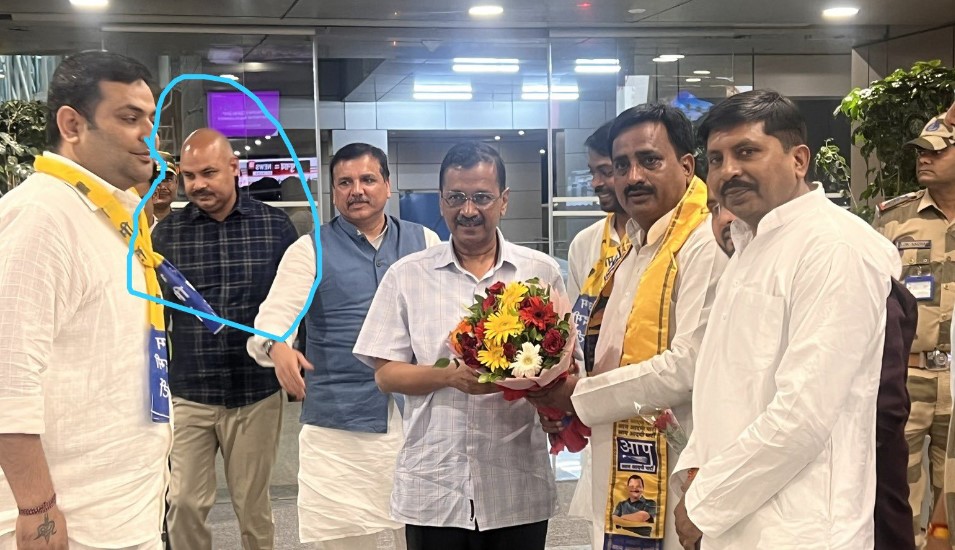
BJP spokesperson Shehzad Poonawala took to X, formally Twitter, to share the picture where a few AAP leaders are seen accompanying Kejriwal at the Lucknow airport. In the picture, Bibhav Kumar, Arvind Kejriwal’s aide, who misbehaved with Swati Maliwal, was spotted with the Delhi Chief Minister at the Lucknow airport. Aam Aadmi Party leader Sanjay Singh was also seen with the Chief Minister.
Image source: Shehzad Poonawala X handle
The out-on-bail Delhi CM had left for Lucknow on Wednesday. Kejriwal will meet Samajwadi Party (SP) national president Akhilesh Yadav on Thursday (May 16). The two leaders will then address a joint press conference at the SP state headquarters in Lucknow. This will be Kejriwal’s first visit to Uttar Pradesh since his release from Delhi’s Tihar jail on May 10.
Sharing the picture, the BJP spokesperson Shehzad Poonawala launched a scathing attack on Kejriwal. He questioned the dramatic claims made by the AAP to punish Bibhav Kumar for allegedly assaulting Swati Maliwal. The leader of the BJP, in fact, said that Swati Maliwal was attacked at the behest of Kejriwal himself.
72 hours No FIR on Bibhav Kumar instead Kejriwal is protecting him ! Roaming around with him..
It is clear- attack on Swati Maliwal was done at behest of Kejriwal himself
Sheesh Mahal is Apradh Mahal & just like Draupadi cheerharan – a woman Rajya Sabha MP was subjected to… pic.twitter.com/1ig50VqHbT
— Shehzad Jai Hind (Modi Ka Parivar) (@Shehzad_Ind) May 16, 2024
“72 hours No FIR on Bibhav Kumar instead Kejriwal is protecting him ! Roaming around with him.. It is clear- attack on Swati Maliwal was done at behest of Kejriwal himself Sheesh Mahal is Apradh Mahal & just like Draupadi cheerharan – a woman Rajya Sabha MP was subjected to violence , assault Now she is being pressured to keep Silent or change her story as is evident from statements of Naveen Jaihind & Nitin Tyagi of AAP hence she hasn’t approached the police yet True face of AAP – Anti women anarchist party,” Poonawala wrote in a long post.
BJP leader Tajinder Bagga also slammed Arvind Kejriwal and questioned him about punishing Bibhav Kumar for allegedly misbehaving with Swati Maliwal.
Citing Singh’s statement that Bibhav Kumar, ‘misbehaved’ with Maliwal and Kejriwal directed stern action on the matter, Bagga wrote on X in Hindi which roughly translates to, “Sanjay Singh ji was saying that you will take strict action against Bibhav but you started making him tour the whole country.”
बहुत कड़ी सजा दी हैं एक महिला सांसद @SwatiJaiHind पर हमला करने वाले बिभव कुमार को @ArvindKejriwal जी ? संजय सिंह जी तो कह रहे थे की आप बिभव पर कड़ी कार्यवाई करेंगे लेकिन आपने तो पूरे देश में दौरा करवाना शुरू कर दिया। pic.twitter.com/veTbCMUjcj
— Tajinder Bagga (Modi Ka Parivar) (@TajinderBagga) May 15, 2024
On Monday (13th May), Swati Maliwal, the AAP Rajya Sabha MP and former Delhi Commission for Women (DCW) Chief accused Bibhav Kumar, the personal assistant of Arvind Kejriwal, of assaulting her inside the Chief Minister’s residence. Reportedly, a call was made to the Police Control Room (PCR) from the residence of Delhi CM Arvind Kejriwal at 10 am. Following the call, a team of police reached the spot.
The next day, senior AAP leader and Rajya Sabha MP Sanjay Singh confirmed that his fellow Rajya Sabha MP Swati Maliwal was assaulted yesterday at the residence of Delhi Chief Minister Arvind Kejriwal. Addressing a press conference in Delhi, Singh added that Bibhav Kumar who is the Personal assistant of Delhi CM assaulted and misbehaved with her. He condemned the incident and asserted that CM Kejriwal has taken cognisance of the matter and will take appropriate action against him.
Now, more than 72 hours have passed and the AAP has not taken any action against Kejriwal’s aide Bibhav Kumar. Let alone taking any action, he is seen comfortably roaming around with the AAP supremo Arvind Kejriwal.
On Monday (13th May), a 43-year-old journalist, Ashutosh Srivastava, was shot dead in the Shahganj area of Jaunpur, Uttar Pradesh. At around 9.30 am, unidentified assailants shot him at the intersection near Jaunpur-Shahganj Road when he was on his way to Imranganj market. A day later, the brother of the deceased journalist filed a complaint against 4 named individuals and 5 other unidentified persons. The accused named in the FIR include Nasir Jamal who is a relative of Samajwadi Party leader Abu Azmi.
Based on the complaint, the Police registered an FIR and arrested Jamiruddin Qureshi, an accused named in the FIR. The Police nabbed him from the Bhiwandi area of Mumbai and further legal action is being taken to bring him to Jaunpur.
According to reports, the arrested accused Jamiruddin Qureshi is a history sheeter and a notorious cow smuggler. He is an accused in 16 cases. According to the Police, he is the mastermind in the murder case of journalist, Ashutosh Srivastava.
Shahganj Deputy SP stated that Jamiruddin Qureshi has been arrested with the help of Maharashtra Police. Currently, he has been kept in the Bhiwandi police station. The Jaunpur Police has left for Mumbai to take Jamiruddin on transit remand. More revelations are expected in the case after his interrogation.
जौनपुर में पत्रकार #आशुतोषश्रीवास्तव की हत्या की साजिश मुंबई में रची गई थी, हत्याकांड के मुख्य अभियुक्त व साजिशकर्ता जमीरउद्दीन कुरैशी को मुम्बई के भिवंडी इलाके से गिरफ्तार किया गया. मुम्बई से जौनपुर लाया जा रहा है. गोकशी व पशुतस्करों की काली करतूत को अंजाम देने वाले अपराधियों के… pic.twitter.com/SWNH3wptGl
Meanwhile, Jaunpur Police has intensified their search to nab the other accused in the journalist’s murder case. They have formed multiple teams who are searching the attackers in different parts of the country.
According to the statement released by the sister-in-law of the deceased journalist, the Police had called Ashutosh to the Police station a week ago where they told him that he should stay at his home as there was a danger to his life.
It is said that two shooters were after his life but Srivastava refused to stay at home and continued to go out for work every day. Nonetheless, after learning that his life was in danger, he had sought protection from the police.
On the day of the incident, Ashutosh left after having breakfast at 9 am and stated that he would have dinner after returning home. The name of the main accused in his murder is Nasir Jamal, who is a relative of Samajwadi Party leader Abu Azmi. According to locals, Ashutosh was continuously writing news against cow smugglers, which angered them.
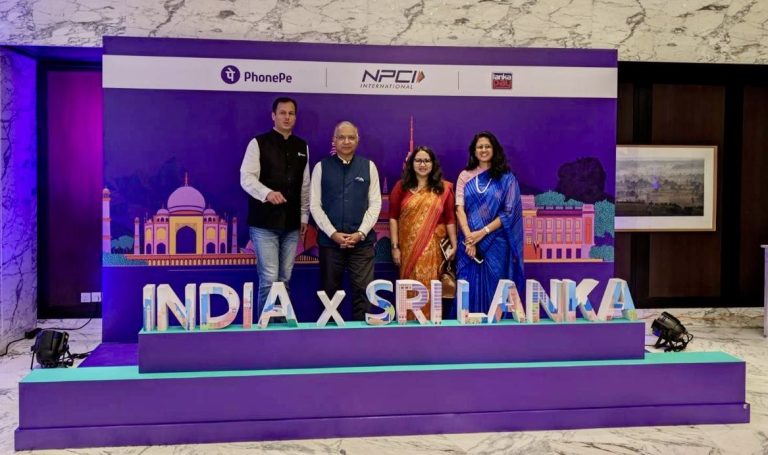
India’s fintech company PhonePe Unified Payments Interface (UPI) has been launched in Sri Lanka. Central Bank of Sri Lanka Governor Nandalal Weerasinghe and India’s High Commissioner to Sri Lanka Santosh Jha attended the launch event in Sri Lanka.
In a post on X, the Indian High Commission in Sri Lanka stated, “Unlocking new frontiers in fintech connectivity! @PhonePe UPI payments goes live in Sri Lanka with HC @santjha & @CBSL Governor Dr. Nandalal Weerasinghe gracing the launch event. Giving a boost to @UPI_NPCI services, the launch will further strengthen ease for tourists in Sri Lanka.”
Unlocking new frontiers in fintech connectivity! @PhonePe UPI payments goes live in ?? with HC @santjha & @CBSL Governor Dr. Nandalal Weerasinghe gracing the launch event. Giving a boost to @UPI_NPCI services, the launch will further strengthen ease for ?? tourists in ??. pic.twitter.com/VksYE0ZHg3
On May 15, PhonePe announced that it has enabled UPI payment acceptance in collaboration with LankaPay. In a statement, PhonePe announced that its app users visiting Sri Lanka can now make payments using UPI across LankaPayQR merchants across the nation.
According to the statement, PhonePe users can simply scan LankaQR code to make secure and quick payments without carrying cash or calculating currency conversions.
Earlier in February, India’s instant payment technology service, the Unified Payment Interface (UPI), was launched in Sri Lanka and Mauritius in a virtual event that was attended by Prime Minister Narendra Modi, his Mauritius counterpart Pravind Jugnauth and President of Sri Lanka Ranil Wickremesinghe.
India, which has emerged as a leader in fintech innovation and Digital Public Infrastructure placed a strong emphasis on sharing its development experiences and innovation with partner countries.
Addressing the occasion via video conferencing, PM Modi said it was an important event for three countries in the Indian Ocean region.
“Today is a special day for three friendly countries in the Indian Ocean region. Today we are connecting our historical relations in a modern digital way. This is proof of our commitment to the development of our people,” PM Modi said.
He said fintech connectivity will not only strengthen cross-border transactions but also cross-border connections.
“FinTech connectivity will not only boost cross-border transactions but also connections. India’s UPI (Unified Payment Interface) is now playing the role of ‘Uniting Partners with India’,” PM Modi said.He asserted that Digital Public Infrastructure such as UPI has brought about changes in the smallest of villages in India, as the technology is convenient and fast.In 2023, a record 100 billion transactions valued at Rs 2 trillion were made via UPI, PM Modi said.
“Digital Public Infrastructure has brought about a revolutionary change in India. Even the smallest businessman in our smallest village is making digital payments because it has convenience as well as speed,” he said.
UPI is India’s mobile-based fast payment system, which facilitates customers to make round-the-clock payments instantly, using a Virtual Payment Address (VPA) created by the customer.
(This news report is published from a syndicated feed. Except for the headline, the content has not been written or edited by OpIndia staff)