Never before Oct 8. had Israel been flooded with so many Indian reporters. Of the few thousand foreign journalists who rushed to Israel to cover the war, over a hundred arrived from India, including many of the most famous faces of Indian media.
I received multiple offers for reporting positions, and I chose Republic TV, India’s most viewed and most right-wing TV network. When I travelled to the residence of President Yitzhak Herzog to request an interview with our anchor in Delhi, they informed me that they were not intentionally ignoring my channel’s previous requests, but were simply swamped by inquiries from no fewer than 37 Indian outlets, each claiming it was the biggest in India.
Even more unusual than the sheer magnitude of Indian-focused coverage is the fact that Indian media was staunchly supportive of Israel. Excepting Communist-oriented media (such as the prestigious magazine ‘Frontline’) and most Muslim-Indian reporters, Indian media was so enthusiastic in their support for Israel that Qatari-owned outlets began calling them out for “Zionism” and “Islamophobia”.
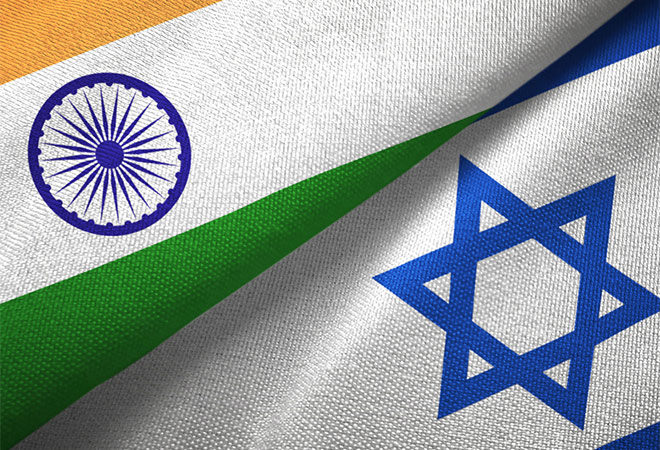
Israelis may take for granted the strength of Israel-India relations and the warm welcome they receive in India, but merely a few decades ago our relationship was completely different.
From the Indian Independence Movement to Diplomatic Relations with Israel
Full diplomatic relations between India and Israel were only established in 1992 following the Madrid Conference, on the heels of over forty years of hostility. Since the inception of the Indian Independence movement, its leaders – from both the Indian National Congress and the All-India Muslim League – were hostile towards Zionism (though not Jews) for a variety of reasons (For a full overview of the stances of the founders of India on Zionism see: Shimon Lev (Hebrew) שמעון לב, נהירין לנו שבילין דהודו (גמא, 2018)).
Muslim leaders of the Indian independence movement such as Muhammad Ali Jinnah, who later demanded Pakistan as a state for Muslims, found themselves in the paradoxical stance of demanding the partition of India but not of Palestine. Mahatma Gandhi did not understand why Jews were coming to Arab Palestine in the first place. Both India and Pakistan voted “No” to the establishment of Israel.
Jawaharlal Nehru, who followed Gandhi as India’s first Prime Minister, was a product of Cambridge education and a Socialist by conviction. He harboured idealistic, perhaps even unrealistic, views on foreign policy that shaped India’s direction from 1947 until the 1990s. Nehru’s vision included leading non-aligned nations in the post-colonial and Third World landscape, fostering a sense of fraternity with Asian countries like China and Russia, and harbouring a strong aversion to American dominance and capitalist ideals. He also shared a close bond with Gamal Abdel Nasser, the secular Socialist leader and President of Egypt.
The only exception was V.D. Savarkar, godfather of Hindu Nationalism, the political creed of PM Modi and the BJP party. Savakar wrote an open letter congratulating Israel upon its founding.
It is the backdrop of the long-standing Nehruvian legacy that makes the current Israel-India relations so surprising.
Indian Economy and Political Power
Beyond mere friendship however, India is also accruing a newfound importance, to Israel and globally. From a country famous for masses living in abject poverty and neglect, hostile to USA and its allies, and with leaders famous for populism and corruption, India is finally being regarded as the rising global power it had always envisioned itself.
The initial economic liberalization that saved India from bankruptcy in 1992 has now led India to represent – as of 2022 – 7.2% of the global economy, with the 5th largest nominal GDP.
Pro-American sentiment is on the rise, even as Indian Minister of External Affairs, S. Jaishankar, plots a course in foreign affairs that is asserting Indian independence from Western dictates. The greatest trophy for this independent Indian foreign policy would be a permanent seat on the UN Security Council. Although it would force India to take stances rather than remain silently “non-aligned,” it would further the narrative of India as master of its own destiny.
The Indian government is at ideological loggerheads with both Western progressives regarding nationalism and Islam, and with American Evangelicals over the proselytization of Hindus. But beyond the snarky moralizing exemplified in Western media, Indian officials enjoy ever-growing collaboration with the highest levels of Western governments.
Aside from the goal of containing China, the primary reason for this red-carpet-treatment is the influence of India’s most valuable export: Indian brainpower. India exports enormous numbers of its best, brightest, and most ambitious citizens, who have become leaders in the fields of STEM and management, including the current CEOs of illustrious tech brands such as Google, Microsoft, Adobe, and Palo Alto Networks. Indians and Israelis are the two most dominant minorities in Silicon Valley, and usually cultivate excellent work relationships, a sentiment echoed by former PM Naftali Bennet when speaking about his years as a high-tech CEO in the U.S.
Decades of elite immigration have led the 5-million-strong Indian-American community to supersede the Jews as the richest and most educated minority in the U.S. Yet a newer phenomenon is the Indian diaspora’s rising political power. Two Indian-originating Americans, Nikki Haley and Vivek Ramaswamy, are now contending for the Republican presidential nomination. Democratic Vice President, Kamala Harris, is half-Indian. There are five Indian Americans in Congress, ranging from radical ‘Squad’ member, Pramila Jayapal, to Shri Tenadar, who has founded a ‘Hindu Caucus.’ Rishi Sunak, PM of the UK, is a proud Hindu, as is former Home Secretary, Priti Patel, both Conservatives. Leo Vardakar is the PM of Ireland. Indians also lead countries in the Indies and South America such as Trinidad and Tobago, and Suriname.
In the U.S., Indian-American advocacy organizations, such as the Hindu American Foundation (HAF), are collaborating with Jewish advocacy organizations like AJC and the Simon Wiesenthal Center, and are even candidly adopting their methods; For example, modeling the definition of “Hinduphobia” along the contours of the IHRA definition for antisemitism. As a conspicuous minority of non-white, non-Christian overachievers, Hindus have become targets of hate-crimes, and many Hindus, such as HAF leadership, are staunchly pro-Israel, as they are keenly aware that most of the anti-Hindu and and-Israel hatred originates from the same sources, with near-identical motivations.
Israel-India Conservative Alliance
We now begin to understand the common interests of India and Israel. Some such interests are shared by Jewish and Hindu diasporas, and some are unique to their respective motherlands.
Both share the existential threat of the global Red-Green Alliance of Progressives and Islamists. Many Hindus in the U.S. and UK were horrified by the post-Oct. 7 pro-Hamas rallies and the dramatic spike seen in antisemitic attacks. Given a chance, these same mobs will come for the Hindus, as has already been the case in the UK.
This opens up the possibility of a global conservative counter-alliance, although some obvious difficulties would have to be overcome: Israeli conservatives publish primarily in Hebrew and are largely unknown in the Anglosphere. And like most Westerners, they are unfamiliar with modern India and its discourse.
Hindu conservatives (“Nationalists” is their preferred term) don’t get along with Evangelicals, and for all their deep admiration of Israel, they are generally unaware of the basics of Jewish and Israeli history and heritage. If a long-standing bridge is to be built, deeper foundations must promptly be laid.
However, the recent wartime TV appearances of conservatives such as Douglas Murray are leading to a growing awareness and appreciation of Western conservatives, with whom Indians have had only a love-hate relationship since colonial times. And never before have so many Israeli experts and dignitaries appeared en masse on Indian screens.
Israel, India, and Islam
One major building block for further unity is the fact that Israel and India both share the common threat of Islamic terrorism, albeit from different terrorists and countries. India is already the Israeli defense industries’ largest client, and it will take years more for India to fully modernize its defense forces. According to foreign sources, it was an emergency shipment of Israeli precise armaments that allowed India to triumph over Pakistan in the Kargil War of 1999. This was the watershed moment in India-Israel relations, long before the rise of PM Modi, in 2014.
The primary Islamic threat to India is from Pakistan, in which wild incitement against India is inculcated in public schools, madrassas, mosques, and media. The Pakistani military recruits terrorists to organizations such as Lashkar-e Taiba (LeT) for its cross-border attacks on Indian Kashmir, hidden behind a thin veil of plausible deniability. LeT was also responsible for the 26/11/2008 attacks on Mumbai, which killed 166 people, including four Israelis and two other Jews. Recently, Israel finalized its designation of LeT as a terrorist organization, and is lobbying for Hamas to be recognized as such by India.
Indian Muslims number an estimated 200 million, roughly 15% of the 1.4 billion Indians. The majority are not radical, except for known enclaves in places such as Kerala, West Bengal, Hyderabad, and Kashmir.
However, the Oct. 28 televised speech of Hamas leader, Khaled Mashaal, to a Jamaat-I Islami (India’s Muslim Brotherhood) rally was an alarming development. The rally was part of a campaign titled “Uproot Hindutva and Apartheid Zionism.” Hindutva, the ideology of Hindu Nationalists – here just a code word for Hindus – was equated with Zionism by Muslim Brotherhood leaders in a candid attempt to export Hamas ideology and methods to India. BJP leadership responded with outrage, but Kerala is governed by the Communist Party of India (CPI), who align with Islamists, and it is unclear just how the central government will deal with these clear threats.
Yet on a deeper level, here too, critical infrastructure is lacking: Although India has defense research and Pakistan experts, shockingly, for a country that will soon have the largest Muslim population in the world, it has almost no experts on Islam or the Middle East. This is due to both the Marxist-Communist orientation of Indian humanities faculties that dictated the downplaying of all religions, and to the weakness in foreign language instruction. Here, Israeli scholars can play a role and collaborate with various institutions, especially with the young up-and-coming right-wing Indian intelligentsia, who are mainly STEM graduates who transitioned to humanities, and who have yet to fully find their intellectual voice.
Israel has few experts of South Asian Islam, no leading experts on South Asian Islamic terrorism, and almost no Urdu speakers. The Israeli intelligence community invests little effort in this part of the world, which is traditionally seen as lacking influence on Israel. I believe this assumption is incorrect.
Israel, India, and the Global Order
The most tangible, immediate dividends in Israel-India relations have been aptly demonstrated by recent geopolitical realignments.
The history of the subcontinent is inextricably intertwined with that of the nearby Arabian Peninsula, even more so since the rise of Arab Petro-economies. In the UAE, South Asians (2.8 million Indians, 1.29 million Pakistanis, and 0.75 million Bangladeshis) number around half of the population, filling every position, from bellboys to billionaire CEOs. The UAE is India’s 3rd largest trading partner. Saudi Arabia (KSA) is itself home to 2.12 million Bangladeshis, 1.88 million Indians, and 1.81 million Pakistanis.
Cold War politics placed India in the non-aligned, de facto pro-Soviet camp. Pakistan aligned with the USA, as did the KSA and UAE, who both needed American military protection, and, as Salafi fundamentalists, espoused a visceral hatred of the “Godless Communists.”
Following the Cold War’s thaw, India moved ever closer to the West and its competitive economies, while Pakistan never recovered from the Islamic extremism, violence, and economic damage inflicted by Gen. Zia Ul-Haq’s Islamic reforms of 1978, and subsequent support for terrorism as a state tool. Gulf countries therefore increasingly courted India, while sending only nominal humanitarian aid to Pakistan. Subsequently, India-Israel relations hit a glass ceiling: India would not part ways with the rich Gulf states and had to maintain a delicate balancing act.
This changed dramatically with the Abraham Accords. Suddenly, India did not have to choose sides. On the contrary: if the UAE was warming up to Israel – and it was obvious the KSA had given a green light – India could join the party.
This logic engendered the mini-lateral alliance of I2U2 (Israel, India, UAE, USA). Israel would bring tech and defense capabilities, India would supply skilled and menial labor, UAE would bring finance, and the USA would defend the alliance diplomatically and with its fleets. While the alliance remained amorphic, business boomed, as did defense and intelligence ties.
Since the Arab spring of 2011, the UAE had become hostile to radical Islam, wiping out the local branch of the Muslim Brotherhood (Al Islah) by 2014. As India legally integrated Kashmir in 2019, the UAE’s response to Pakistani outcries was granting the Medal of the Order of Prince Zaid to PM Modi. Kashmir apparently did not constitute an Islamic cause.
By the time the Abraham Accords were signed in 2020, the UAE had developed a vision of inter-religious tolerance, which resonates deeply with India. The rise of Mohammad Bin Salman (MBS) and his vision for the KSA hold a similar promise, though yet to be fully implemented. These developments led to various interfaith initiatives. Currently, both countries align with Israel and India in their battle against radical Islam.
G-20, IMEC, and Oct. 7
The showcase initiative announced at the Delhi G-20 Summit in September was the India-Middle East-Europe Corridor (IMEC). IMEC is a proposed route for Indian goods to Europe that would cut transit times by 60%. Goods would transit from India’s northwestern ports to the Jebel Ali port in the UAE, and from there to the Indian-owned port of Haifa via freight trains running through the UAE, KSA, Jordan and Israel, and finally from the Haifa port to Greece. New energy pipelines and communications lines would be laid as well.
This was India’s first successful counter to Chinese encirclement, and posed a strong blow to Pakistan, further alienating it from the KSA and the UAE and cementing its status as a Chinese client.
Although G-20 delegates were careful not to mention it, it was clear that the corridor proposal carried with it implications of KSA normalizing relations with Israel. Messages of normalization were delivered in Western media months before the summit.
This was the working logic of the Abraham Accords in Israeli foreign policy: More Muslim nations were destined to join in, and KSA was to be the biggest catch. KSA is the leader of the Sunni world, and other Sunni states couldn’t be more Catholic than the pope and would immediately follow suit. Shortly before the Oct 7. attacks, Foreign Minister Eli Cohen spoke of 6 other Muslim states that would normalize relations after KSA. The Palestinian veto on the Islamic world’s normalization with Israel seemed over at last.
Then came the Oct. 7 attacks. Muslim masses rallied emotionally behind Gaza, against Israel. The current Muslim popular sentiment is extremely anti-Israel, and some commentators have pronounced IMEC dead on arrival.
While IMEC and Israel-KSA normalization may have been delayed, I firmly believe they will materialize. Too many powerful parties are too deeply invested for it to fail.
In summary, IMEC represents staggering economic interests for all the involved parties, as well as the continuation of geopolitical realignments that began years ago – India realigning with the West and Israel, joined by a KSA and UAE inimical to radical Islam.
In this arena, China (which de-facto supports Hamas) is an anti-Western force that must be countered, as is the Progressive wing of President Biden’s Democratic Party, which has rallied so shockingly for Hamas. If Israel-KSA normalization has been postponed, it may well happen under a Republican president.
Epilogue
I agree with our ambassador in Delhi, Naor Gilon, who stated that Indian love for Israel is “something I cannot fully explain.” While the straightforward explanation posits the fascination of Hindu Nationalists with Israel as a paradigm of a high-functioning Religious-Nationalist state (contrary to secularist accusations of them creating “a Hindu Pakistan”), there does seem to be a deeper metaphysical connection, akin to our relationship with Evangelicals who view Jews as objects of veneration.
As Evangelical support is suffering a dramatic decline amongst young Americans, one could only hope that Indian Nationalists fill the void, maybe even in the UN Security Council. Although lacking the Biblical backdrop, and any in-depth knowledge of Israel, this newfound and unrealized strategic partnership must be fostered carefully. Israel must invest swift efforts to build a steady, direct, and mutual flow of information and expertise with India, unhindered by third parties such as the New York Times or the Guardian, who have become a steady source of hostile disinformation about both Israel and India. It is my hope that the recent peak of Indian interest in Israel may be leveraged to great effect in future times of peace.
(The article was published on Hashiloach and has been republished here with the consent of the author and the publication)