Home Blog Page 177

Congress party’s latest allegations of Modi govt favouring Adani are nothing but repeated lies, baseless claims and bizarre accusations

On 18th September, the Securities and Exchange Board of India (SEBI) dismissed the allegations of stock manipulation against Gautam Adani and his group of companies made by U.S. short-seller Hindenburg Research. In its conclusion, SEBI said that there was no violation of listing agreement or SEBI Listing Obligations and Disclosure Requirements (LODR).

SEBI made the conclusion on its probe on Hindenburg’s allegations that Adani entities used Milestone and Rehvar as conduits to funnel money, avoiding disclosure as related party loans. SEBI found that while funds were indeed rotated via Milestone and Rehvar, all loans were genuine, interest-bearing, and repaid. Moreover, at the time, the LODR definition of RPTs did not cover such indirect transactions. While an amendment in 2021 included such transactions, it was prospective, not retrospective, therefore there was no violation as per law applicable at that time.

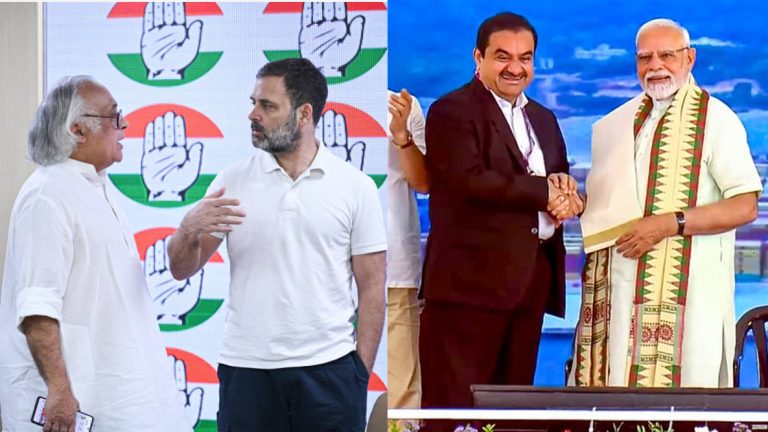
Following the clean chit by SEBI, the Congress party has renewed is ‘Modani’ attack on Modi government and Adani Group. Party leader Jairam Ramesh on Friday released a statement reiterating its 100 questioned asked in 2023 under the title “Hum Adani ke hain kaun”.

In the statement Congress party mentioned several allegations against the Modi government, accusing it of misusing govt agencies and laws to benefit the Adani Group. The specific allegations mentioned in the statement are: “The misuse of agencies such as the ED, CBI, and Income Tax Department to force companies to sell off their assets to the Adani Group. Biased privatisation of critical infrastructure assets like airports and ports for the companies to sell off their assets to the Adani Group, Biased privatisation of critical infrastructure assets like airports and ports for the benefit of only the Adani Group, the misuse of diplomatic resources to funnel contracts to the Adani Group in different countries, especially in the neighbourhood, the import of over-invoiced coal by Ahli and Chang, which contributed to sharp increases in the prices of electricity drawn from Adani power stations in Gujarat, a 2,000 crore ($250 million) bribery scheme allegedly orchestrated by Gautam Adani and seven associates to secure high-priced solar power contracts in India -regarding which the Modi government has refused, for nearly a year, to serve a US SEC summons to the PM’s partner.”

While these are serious allegations against the Modi government, all of them are baseless, and most have already been debunked earlier.

Allegation of govt pressure

Congress claims govt misused central probe agencies to sell assets to Adani. While they didn’t name any company in the statement, Jairam Ramesh mentioned about Adani Ports buying Dhamra Port in Odisha from L&T and Tata Steel in 2014. The port was built by L&T and Tata in 2011, and they sold it to Adani in 2014. The deal was announced in May 2014, the month when Narendra Modi became the Prime Minister for the time.

As the deal was completed in May 2014, it is clear that the talks for the deal was going on for several months, as such corporate deals don’t happen in just days. Which means, the entire deal took place when Dr. Manmohan Singh was the prime minister. If there was any pressure from govt agencies on L&T and Tata to sell the port to Adani, it will mean such pressure would have come from the Congress government.

Moreover, L&T and Tata Steel are major corporate houses of India, and have considerable legal strength. They are also among the most respected companies for their integrity. If there were any pressure on them, they would have contested it instead of surrendering. By making the allegations against Modi government and Adani Group, Congress is also making allegations against Tata Steel and L&T, accusing them of not disclosing vital information.

Similarly, earlier the Congress had accused that GVK was forced to sale its stake in Mumbai airport to Adani Airports. But the fact is, GVK was in heavy debt burden and was forced to sale Mumbai airport. Responding to Rahul Gandhi’s allegations in parliament that the company was forced by the govt, GVK had denied any such pressure.

The company had said in a statement, “GVK reiterates that the decision to sell its stakes in Mumbai Airport to Adani, was taken by the management and there was absolutely no question of any extraneous pressure being exerted on us.”

GVK Group Vice Chairman Sanjay Reddy had said, “whatever we did was in the interest of the company and the lenders who we had to repay and therefore, we had to close the transaction with Adani because we didn’t see any light of day with the other investors.”

Privatisation

Congress then accuses “biased privatisation of critical infrastructure assets like airports and ports,” alleging wrongdoing in Adani group winning bids to operate several ports and airports in the country. Jairam Ramesh wants people to believe that such airports and ports were personally handed over to Gautam Adani by PM Narendra Modi.

But the fact is, all such privatisations took place after elaborate tender processes where several companies submitted bids. While ports are privatised at the state level, airports are awarded based on competitive bidding. In case of airports, bidder which bids highest value for each passenger wins the bid to operate the airport.

Therefore, Adani group won the bids by offering highest value for Indian passengers. If the Congress party has problem with that, it means that it does not want private companies to pay highest value for Indian passengers at airports.

In November 2018, the central government had cleared the privatisation of six AAI-run airports—Ahmedabad, Guwahati, Jaipur, Thiruvananthapuram, Mangaluru and Lucknow—on a public-private partnership model. As many as 32 technical bids were received from 10 companies to operate these six airports. Adani Airports won the mandate to operate all the six government-owned airports for the lease period of 50 years. The Adani Group offered ₹177, ₹174, ₹171, ₹168, ₹115 and ₹160 for Ahmedabad, Jaipur, Lucknow, Thiruvananthapuram, Mangaluru and Guwahati airports, respectively, highest bids for all of them.

It is important to note that by winning bids, the company does not own the airport, it only wins the right to operate the airport for the defined period of time.

The Congress party’s allegations on airport deals is not new, they have been repeating it for years, and have been comprehensively debunked. In its 100 questions, Congress alleged that Adani was awarded the 6 airports despite having zero experience in running airports. But when GMR and GVK were awarded Delhi and Mumbai airports respectively during the Manmohan Singh government, these companies also didn’t have any airport experience.

Diplomatic pressure

The next claim of Congress, that Modi govt put diplomatic pressure on foreign governments forcing them to hand over projects to Adani group is most bizarre. It is outlandish to even think that sovereign governments of major economies will take economic decisions based on diplomatic pressure.

Moreover, Jairam Ramesh seems to have forgotten that when Adani group won mining bids in Australia, his own party was in power. Carmichael coal mine in Queensland was handed over to Adani group in 2011-12, when Dr Manmohan Singh’s UPA-2 government was in power.

In 2022, Adani Port won the bid to acquire Haifa Port in Israel in collaboration with Israel’s Gadot Group, which has been considered as a very important and strategic purchase by the company. Adani-Gadot won the tender against stiff competition from local and global players. It was one of the largest privatisation by the Israel government, and it is bizarre to even suggest that the Israeli govt selected the winning bidder on Modi government’s pressure.

Moreover, if there was any hint of any wrongdoing, other bidders in the tender would have gone to court, which didn’t happen. The same is true with bids won by the company in the India, the companies that lost the bids have not accused any bias in awarding the tenders.

It is notable that Haifa Port will be a major transit point in the upcoming India-Middle East-Europe Economic Corridor. Therefore, the port has strategic importance to India. Therefore, it serves the interest of the country if the port is owned by an Indian company. By questioning the deal, the Congress party is opposing India having such strategic advantage in the global stage.

Electricity prices

Jairam Ramesh claimed that prices of electricity supplied by Adani power stations in Gujarat increased because of alleged over-invoicing of coal. This is another baseless allegation, because, if price of a power plant is much higher than competitors, it would not find any buyer.

The power distribution companies sign power purchase agreement with power generators, where the price is determined. Power generators can’t dictate price, as the Congress party is alleging. Even though Adani Power is India’s largest private sector thermal power producer in India, majority of power in the country is produced by public sector entities by NTPC and NHPC. Therefore, private sector power producers can’t charge arbitrarily higher prices.

Moreover, Adani Power has supplied power to several states under Congress governments too. This implies that the Congress party is accusing its own state governments of purchasing electricity from Adani Power at higher prices.

Solar power bribery allegation

At last, Jairam Ramesh raised the allegation that Adani group paid bribes of around ₹2,000 crore to officials of several states to sign power purchase agreements with Solar Energy Corporation of India (SECI). The allegations had surfaced after the charges were made against the company by a US court.

However, apart from that case in the US, there is no other evidence of any such bribery. ₹2,000 crore is a lot of money, and unless this money is found and traced back to the company, this remains just an allegation.

Adani Group had appointed an independent law firm to look into the allegations, and the review found the Adani Green and its subsidiaries were in compliance with all applicable laws and regulations. Andra Pradesh government, one of the states where officials allegedly received bribes, have also said that there is no evidence to support the allegations.

Notably, as per filings by the US Securities and Exchange Commission (SEC), Gautam Adani met with the Chief Minister of Andhra Pradesh in 2021. At that time the CM of Andhra Pradesh was YSRCP chief YS Jagan Mohan Reddy. In fact, none of the states alleged to have received bribes between 2021 to 2022 were ruled by BJP during that time, all of them had anti-BJP parties in power.

Conclusion

Therefore, all the allegations made by Congress leader Jairam Ramesh are false, baseless, and some are bizarre. Tenders won by Adani group in India and in other countries were result of competitive bidding processes, and there is no evidence or even any allegation of undue pressure from Modi govt on those bids. Similarly, power purchase agreements are signed under transparent processes. And it is laughable to even allege that Modi govt can influence foreign governments like Australia and Israel to decide on major deals.

These are not new allegations, the Congress party has been making the for years, and all of have been debunked earlier. By continuously making allegations on major economic events in the country, the Congress party is attacking not just the Modi government, but also targeting India’s growth story.

Kerala HC turns to Sharia in a case about a blind beggar threatening his wife with polygamy, cites Quran in judgement: Full details

0

The Kerala High Court on Monday (15th September) cited Muslim customary Law and Quranic principles to assert that Muslim men cannot take multiple wives if he cannot treat them equally. Ironically, the court even asked the state to protect women who are victims of polygamy.

Justice PV Kunhikrishnan made the observation while hearing a plea by a 39-year-old Perinthalmanna woman seeking ₹10,000 monthly maintenance from her husband, who lives by begging.

Earlier, the petitioner had moved the Family Court, which dismissed her plea on the ground that her 46-year-old husband from Kumbadi, Palakkad, who survives by begging, could not be ordered to pay maintenance.

The court, in a satirical vein, even invoked a Malayalam adage meaning “Don’t put your hand into a begging bowl.”

The High Court took note of the wife’s submission that the husband threatened to pronounce Talaq on her and marry for a third time.

Justice Kunhikrishnan, however, noted that the husband was no saint. “Even though he is blind and a beggar, as the petitioner, his second wife, claims, he has been threatening her with a third marriage,” the court remarked.

The Court also urged the state to provide counselling to the blind Muslim man to convince him not to perform a third marriage.

“Appropriate counselling should be given to the respondent to avoid another marriage by him, resulting in another woman being left as a destitute wife. The Department concerned of the government should provide counselling to the respondent, assisted by competent counsellors, including religious leaders,” the High Court noted.

“This is his second marriage, while his first wife is alive…In addition to that, the affidavit of the petitioner is that the respondent is going to marry again after pronouncing Talaq to the petitioner. He is blind and admittedly a beggar. Admittedly, the respondent belongs to the Muslim Community, and he is taking the benefit of his customary law, which, according to him, allows him to marry twice or thrice,” the High Court observed.

Monogamy is the rule and polygamy is the exception: HC

The judge remarked that polygamy among the Muslim community is practised in ignorance of the Muslim customary law. Explaining the Muslim law and Quranic principles, the judge said that a Muslim man, who has no capacity to maintain a second or a third wife, is not permitted to marry again.

“These types of marriages happen in the Muslim community because of the lack of education, lack of knowledge of the customary law of Muslims, etc. A court of law cannot simply recognise the first, second or third marriage of a Muslim man when he has no capacity to maintain his wives, “the High Court said.

“There is a misconception that a Muslim man can marry more than one woman in all situations if he wishes to do so…If a Muslim man can give justice to his first wife, second wife, third wife and fourth wife, then only marriage more than once is permissible,” the court added.

State government to provide food and clothing to the man and his wives: HC

Empathising with the blind man, the High Court said that the State should ensure that no citizen begs for a livelihood and provide food and clothing to such persons. However, the court acknowledged that it is not possible for the government to be aware of all the persons begging. ” It is the duty of the elected government in a democratic country to ensure that its citizens do not beg. The government may not always be aware of individual cases of begging, and therefore, this court cannot blame the government,” the court stated.

The High Court said that the government should ensure that the Muslim man and his wives are provided food and clothing and directed that a copy of the judgment be forwarded to the Secretary, Social Welfare Department, State of Kerala.

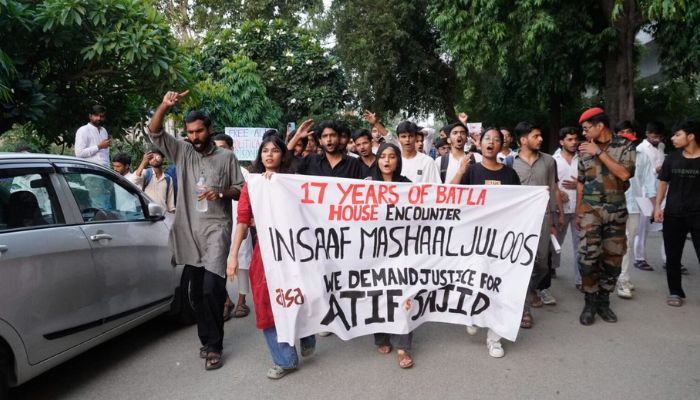
Delhi Police detain 12 Jamia students during march marking 17 years of Batla House encounter, AISA alleges peaceful protestors mishandled, police deny claims

0

Delhi Police detained at least 12 students of Jamia Millia Islamia on Friday, 19th September, during a march held to mark 17 years since the Batla House encounter. Police said the students were stopped only after they tried to move outside the campus and raised what officers described as “provocative slogans.”

The students, however, told a different story. They said the march has been organised every year, except during the COVID pandemic, in Jamia Nagar to demand a judicial inquiry into the 2008 encounter. They also said they had decided beforehand not to raise slogans or do anything that could cause confrontation with the police.

Students at Jamia said Friday’s march was peaceful but was interrupted near the university’s Gate No. 7. According to them, police took them off campus and detained them. The All India Students’ Association (AISA) said that the incident happened in full public view while the SHO of Jamia Nagar police station was present. AISA claimed that women students were among those detained and that some students were taken far outside Delhi.

The police, however, denied these claims. An officer said the students had tried to come off campus while shouting slogans, which is when 12 of them were detained. They were all released within two hours, the officer added, and no student is currently under detention.

Still, the incident has upset many on campus. Mishkat Tehrim, AISA President, said, “I thought we would be safe inside campus… I have never seen something like this after the CAA-NRC protests.”

Saiyed Ishfaq, AISA’s Delhi State President, who was among those detained, also alleged that students were forcibly picked up and dropped far from the university. 

“The Jamia administration purposely left the gate open, creating confusion… I was detained on campus. Women students were dragged by guards…”, Ishfaq further added. 

Police denied these claims and said no student was dragged. The Jamia administration has not given any official response yet.

Background of the Batla House encounter

The Batla House encounter happened on 19th September 2008, following a series of bomb explosions in Delhi, which resulted in the deaths of 39 individuals and injuries to 159. 

Delhi Police’s Special Cell, acting on a tip-off, stormed into a flat in Jamia Nagar, Okhla, where suspected terrorists had taken shelter. During the ensuing gunfight, Inspector Mohan Chand Sharma and Head Constable Balwant Singh were wounded; Sharma later died of his injuries. Two men in the flat, Atif Ameen and Mohammad Sajid, were also killed.

Twenty-four-year-old Atif Amin was a student of Jamia Millia Islamia, and 17-year-old Sajid was an aspirant of Jamia School.

The killing of Atif Amin, who was the chief bomber of the terrorist outfit ‘Indian Mujahideen’, had dealt a severe blow to the group, which had earlier been responsible for terror attacks between 2007 and 2009, in Delhi, Ahmedabad, Jaipur, Surat and Faizabad.

On the second anniversary of the encounter, a shooting took place at the gates of historic Jama Masjid, Delhi, in which two foreign tourists were injured; apart from that, a car bomb with a failed timer was also found in the vicinity.

Two others accused, Shahzad Ahmad and Ariz Khan, were arrested in 2010 and 2018 for the murder of Inspector Mohan Chand Sharma. They were firstly given the death sentence, which was later reduced to life imprisonment. 

The National Human Rights Commission (NHRC) had also given clean chit to Delhi Police of any foul play in the encounter, and the Delhi High Court had also rejected a plea seeking a magisterial inquiry.

US, UK and France join hands to shoot down nefarious bid of Pakistan and China to sanction the Balochistan Liberation Army at the United Nations

0

The United States, France and the United Kingdom have blocked a joint Pakistan-China bid to list the Majeed Brigade and the Balochistan Liberation Army (BLA) under the United Nations (UN) 1267 sanctions regime.

They have placed the listing on “technical hold” for six months, citing a lack of evidence linking the two Baloch groups to Al-Qaeda and ISIL (Islamic State of Iraq and the Levant).

The development transpired more than a month after Washington, in the midst of its newfound bonhomie with Islamabad, designated both organisations as Foreign Terrorist Organisations.

The UN Security Council Resolution 1267 of 1999 also known as the “UN 1267 regime,” places restrictions on people or organisations associated with Al-Qaida, the Taliban and ISIL, including travel prohibitions, asset freezes and arms sanctions.

China and Pakistan applied to the UN Security Council to impose sanctions on the BLA and its Majeed Brigade.

ISIL-K (Khorasan), Al-Qaeda, Tehrik-e-Taliban Pakistan, the BLA and its Majeed Brigade are among the terrorist organisations active and initiating cross-border assaults from Afghanistan, according to Ambassador Asim Iftikhar Ahmed who is Islamabad’s Permanent Representative to the UN, on 17th September.

He added that his country’s biggest national security danger continues to be terrorism emanating from Afghanistan and encouraged the Taliban-led Afghan government to adhere to its promises regarding international counterterrorism. “We hope the Council will act swiftly on this listing to curb their terrorist activities,” he further stated.

Nonetheless, the terror state’s expectations have been thwarted by its Western ally for a minimum of the next few months.

Pakistan’s Baloch problem

Balochistan is Pakistan’s largest province which is strategically important for the country due to its position and wealth of natural resources, particularly oil. The region has low population but its citizens live in poverty in comparison to the rest of the nation as the government continues to exploit its natural gifts for other parts especially Punjab.

The province has had numerous violent insurgencies, severe state repression and a persistent Baloch nationalist movement since 1948, when former Baloch chiefdoms were compelled to join the Islamic Republic. There have been five Baloch “wars of independence” to date. However, they have been brutally suppressed by the Pakistani government which has been accused of arbitrary arrests, torture, executions, and kidnappings.

On the one hand, Islamabad has been involved in severe violations of human rights in Balochistan, while on the other hand, it has made every effort to deplete the region of its resources, diverting the benefits directly to other regions while disregarding the entire area and forcing it to live in poverty and despair.

The malicious scheme did not cease there as Islamabad extended an invitation to Beijing to advance the exploitation under the guise of the China Pakistan Economic Corridor (CPEC). The 62 billion dollar project is intended to advance China’s aspirations to become the sole superpower in the area and occupy the region.

It seeks to take over the Baloch Sea and reduce the local population to a minority. China believes that the CPEC will enable its troops to reach the warm water in Gwadar. As a result, hundreds of thousands of Baloch were made to leave the CPEC’s surrounding districts. Hundreds of tiny towns and villages were reduced to ashes in order to keep the population away from the alleged progress that Pakistan and China were bringing.

People were driven to abandon their homes, towns, villages, property and valuables. All of this was carried out by Pakistani security personnel to protect Chinese officials and engineers involved in the project.

The Baloch community has tirelessly voiced their opposition to this oppression, however, rather than addressing the atrocities, Islamabad has only intensified its violent measures to silence the protesters with brutal force. Similarly, the two “all-weather friends” are desperate to demonize the Baloch groups that are fighting for the rights and freedom of their people, on the international platform.

TMC MP Saket Gokhale comes up with fresh false claims, alleges COVID-19 vaccines were not free and calls PM CARES Fund a ‘personal scam’: Here is the truth

Trinamool Congress MP Saket Gokhale, known for peddling fake news who is also accused of Money laundering scam, sparked another controversy with a fresh claim against the Modi government. On Friday, 19th September, in a long post on X (formerly Twitter), he alleged that Prime Minister Narendra Modi lied to Indians during the COVID-19 pandemic by presenting vaccines as “free” when, according to him, they were not. 

Gokhale claimed that the Government of India had borrowed billions of dollars from foreign banks to procure vaccines, and therefore, citizens were now repaying those loans through their taxes. He went further and described the PM CARES Fund as a scam, accusing the government of creating a “personal fund” for Modi that was kept away from public accountability.

This is not the first time that the TMC leader has attacked the Modi government on sensationalized charges. Gokhale, over the years, has acquired a reputation for distorting facts, producing doctored documents, and combining half-truths with speculation.

His latest post is no different. By selectively presenting details about India’s pandemic borrowings, he attempted to give the impression that citizens were tricked into believing the vaccines were free, while in reality, the government had simply followed a path taken by almost every country in the world facing a once-in-a-century health crisis.

Gokhale’s claim about free vaccines

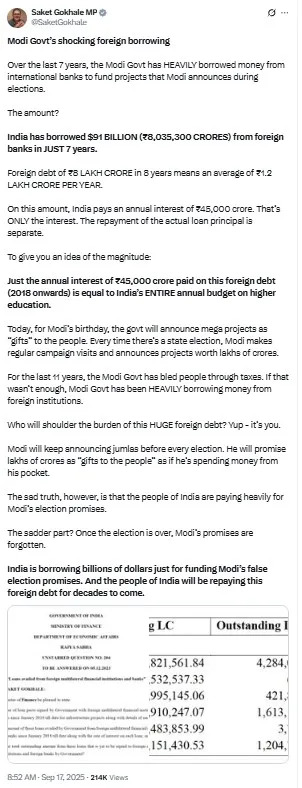
In his post, Saket Gokhale wrote that the Modi government misled the nation by claiming vaccines were a “gift from Modi.” He pointed to foreign loans worth $3 billion (₹26,460 crore) that India borrowed specifically for vaccines, and another $7.25 billion (₹64,000 crore) borrowed for the wider COVID-19 response. 

He then argued that these borrowings were ultimately being repaid by taxpayers, thereby proving that the vaccines were never really free. To give his claim more weight, Gokhale posted screenshots of official documents listing loans taken under the COVID-19 Active Response and Expenditure Support Programs and the Responsive Vaccines for Recovery Projects.

He also dragged the PM CARES Fund into his allegations, questioning why the government had to borrow money if such a large amount was collected through donations in the fund. According to him, PM CARES is nothing but a “personal and secret” fund that serves the BJP’s political interests.

In first instance, Gokhale’s post may appear convincing to those unfamiliar with government finance. But a closer look shows that his argument is misleading on multiple counts. Borrowing for public health emergencies is a common global practice, and free vaccines meant that citizens did not have to pay anything when they went to government vaccination centres. The fact that the government used its resources, whether through revenue or loans, does not change the fact that for ordinary Indians, vaccination remained completely free.

The global context: Many countries borrowed loan during COVID-19

The world’s biggest economy, the United States, borrowed a record amount during the COVID-19 pandemic. As of the latest available data, the U.S. Government Accountability Office (GAO) reported that, as of 31st January, 2023, the federal government had provided approximately $4.6 trillion in relief funds to respond to and recover from the COVID-19 pandemic. 

These comprised the CARES Act of 2020, valued at $2.2 trillion, the Consolidated Appropriations Act of 2021 valued at $900 billion, and the American Rescue Plan Act of 2021, valued at $1.9 trillion. The national debt of the U.S. rose by close to $7.8 trillion between 2019 and 2022, with approximately $5-6 trillion associated directly with the management of COVID-19.

Similarly, the United Kingdom, Japan, Germany, and almost every developed country borrowed heavily during the pandemic to fund healthcare, support citizens, and revive their economies. No government had “free money” lying around to deal with such a massive crisis. Borrowing was the only way to ensure immediate relief and health support.

What “free vaccine” actually means

The most misleading part of Gokhale’s narrative is his twisting of the word “free.” When the government announced free vaccines, it clearly meant that vaccines would be free for Indian citizens at the point of delivery. Millions of people walked into government hospitals and vaccination centres, received their shots, and were not asked to pay a single rupee. That is what free means in public policy, citizens are not directly charged for the service.

The government naturally has to bear the cost of such large-scale programmes, and it does so either from its revenue, from borrowing, or from special funds such as PM CARES. This is how governments across the world provide free healthcare, free education, or free welfare benefits. Citizens do not pay directly at the counter, but the government covers the expenses. To argue otherwise, as Gokhale has done, is nothing but playing with semantics to confuse the public.

If Saket Gokhale’s argument is accepted, that will mean there is no free service by any government, including West Bengal. All governmemt services like health, education, sanitation etc are funded by revenue earned by government from different sources, including taxes paid by citizens. Ministers in the government or the political party in power do not fund public welfare schemes from their own pockets, as Gokhale wants people to believe.

The details of vaccine procurement

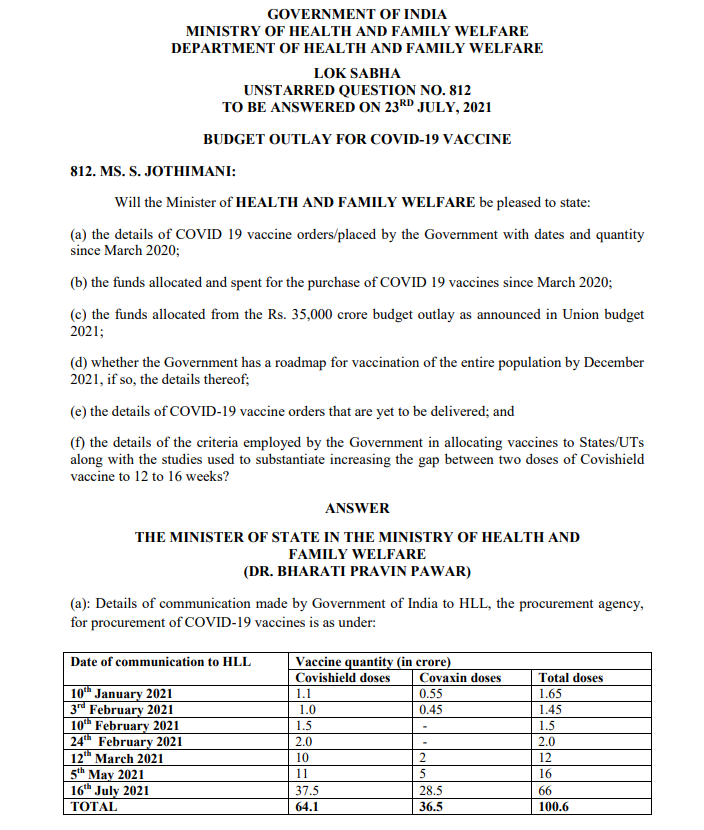
The Ministry of Health and Family Welfare has already placed these details on record. In its official record, the ministry confirmed that between January and July 2021, the government had placed orders for over 100 crore doses of vaccines. This included 64.1 crore doses of Covishield and 36.5 crore doses of Covaxin. All of these were procured centrally by the Government of India and distributed free of cost to states.

Screengrab of the Ministry’s official record

By the end of the vaccination drive, India had administered more than 220 crore doses, a remarkable achievement given the size of the population. The loans highlighted by Gokhale were part of the government’s financing strategy to ensure timely procurement, not evidence of a scam.

Gokhale’s history of half-truths and misinformation

This episode is not an isolated one. Saket Gokhale has often been caught spreading false or misleading claims against the Modi government. 

On Wednesday, (17th September), Saket Gokhale, in his long post on X, he alleged that the Modi government had borrowed a massive ₹8 lakh crore from foreign banks in just seven years, presenting it as if the entire debt burden lay on the Centre alone. 

But fact-checks soon revealed how Gokhale had twisted facts by quoting selectively from the Finance Ministry’s 2023 Rajya Sabha reply. Official records easily revealed that the cumulative figure he had mentioned also included loans borrowed by several state governments, including West Bengal, ruled by his own party, the Trinamool Congress.

In September 2024, Gokhale claimed that the cost of construction of these trains has been increased to 50%. He alleged a ‘quid pro quo corruption’ on the part of the Modi government. He claimed that the number of trains has been decreased to 133 in the new contract and that the cost of making one train has increased to ₹436 crores from ₹290 crores. However, the lies of Saket Gokhale were soon debunked by the Ministry of Railways, which highlighted a missing fact in his propaganda-laden tweet.

In June 2020, Saket Gokhale peddled wild conspiracy theories about a ‘ventilator scam’ after the first batch of ventilators procured using the PM CARES fund was made available to hospitals.

In a seven-part thread, Gokhale alleged that ₹750+ crore had gone ‘missing’ from the funds allotted for procuring ventilators under the PM CARES fund.

Soon, other Congress minions spread the same as gospel truth and claimed that there was a ‘ventilator scam’ underway.

All the fake claims were then debunked by the CMD of BEL (Bharat Electronic Limited), a professional Defence electronics company in India. In February 2021, BEL filed a ₹1 crore defamation suit against the RTI activist for spreading lies.

He also misused photographs to falsely accuse Facebook’s public policy director Ankhi Das of links with the RSS, going so far as to use a picture of her twin sister to push his theory. On another occasion, he misled the public by twisting data about Remdesivir supplies in Maharashtra, defending the state government despite clear evidence of mismanagement.

In April 2021, he was caught peddling lies to defend the Maharashtra government’s harassment of Bruck Pharma director over Remdesivir supply. He later complained with Maharashtra Home Minister about how Leader of the Opposition Devendra Fadnavis or the BJP, as private players, could obtain a crucial drug when its sale is allowed only to the state government. 

These repeated instances show that Gokhale relies on creating viral noise rather than presenting facts. His latest claim about vaccines fits neatly into this pattern.

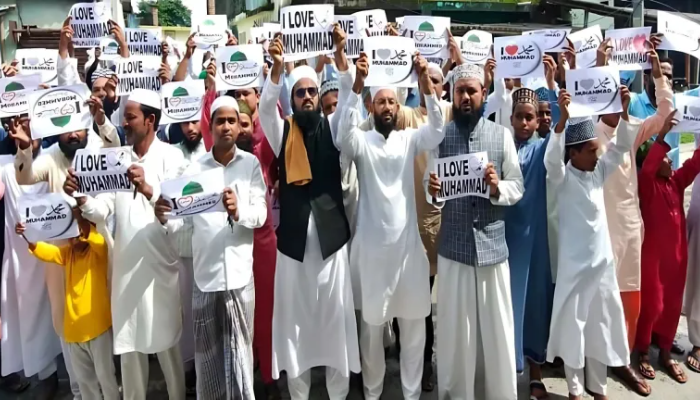
Muslims unleash chaos alleging FIR on putting up ‘I love Muhammad’ banner in Kanpur, conveniently hide the fact that they destroyed Hindu religious posters: Details

A significant controversy has emerged following the alleged removal of an “I Love Muhammad” banner in Uttar Pradesh’s Kanpur. The members of the Muslim community have launched agitations in multiple regions across the country, from Bihar to Hyderabad. The incidents have even led to violence in Godhra, where extremists have vandalised a police station.

Furthermore, an organised campaign is taking place on social media with Muslim youths disseminating posts under the hashtag ‘I Love Muhammad.’ The occurrence has been labelled as an “insult to the Prophet” of Islam and is cited as the reason behind the protests in the nation.

The authorities have initiated legal proceedings against approximately twelve young men related to the unrest. Meanwhile, attempts have been made to convey that the dispute revolves exclusively around the “I Love Muhammad” poster.

What is the truth

While a disagreement arose regarding the installation of an “I Love Muhammad” poster, the complete narrative extends beyond this row. The official complaint disclosed that the conflict commenced on 4th September when the Muslim community set up an “I Love Muhammad” light board in front of Zafar Wali Gali within the Syed Nagar area of the Rawatpur police station for an event.

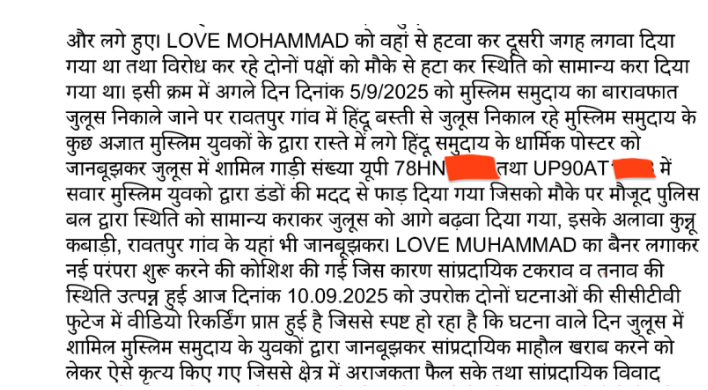
OpIndia has a copy of the FIR submitted by the police and it revealed, “This had never occurred before and it was a new tradition initiated by the organizers of the Muslim community’s Barawafat program.” Barawafat denotes the observance of both the birth and the death of Prophet Muhammad which occurs in the third month of the Islamic calendar.

Local residents expressed their discontent in relation to the development which resulted in a confrontation between the opposing sides. The cops intervened by removing the board and relocating it to a different site. The issue was resolved. The FIR explicitly mentioned that the board remained in place when the resolution was reached.

However, the conflict commenced on 5th September coinciding with the scheduled Barawafat procession. “During the procession, certain unidentified Muslim youths who were in a vehicle participating in the event, intentionally used sticks to destroy the religious posters belonging to the Hindu community that had been placed along the road in the Hindu locality of the Rawatpur village with the aim to create communal disturbance,” highlighted the FIR.

On 10th September the authorities also acquired CCTV footage pertaining to the instance. The FIR indicated, “The CCTV recording clearly showed that on the day of the incident, the young individuals from the Muslim community who participated in the event, deliberately engaged in such actions with the intention of disrupting the communal harmony and inciting chaos as well as communal discord in the region.”

Image via OpIndia Hindi

This matter is not limited to the “I Love Muhammad” poster, which represents only a fraction of the issue. The core matter is related to the destruction of Hindu religious posters at the hands of the Muslims. In an interview with OpIndia, Krishna Mishra, the Station House Officer of Rawatpur police station, verified that the FIR was not filed for the display of the “I Love Muhammad” poster. He stated that the accused implicated in the case tried to undermine communal harmony.

Therefore, it has been clarified that the FIR was not lodged because of the reason prompting Muslims to protest across the nation. However, the reality is being obscured and half-truths have been circulated to escalate the controversy in the name of these demonstrations. Given the violence that has erupted in Gujarat, it is crucial to be more vigilant regarding such protests in the future.

What are Trump’s Gold, Platinum, and Corporate cards? Costs, benefits, eligibility, and why critics call it ‘residency for sale’

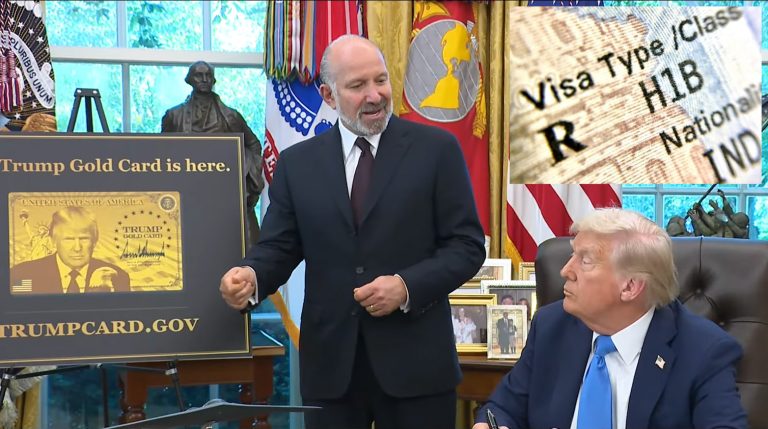
US President Donald Trump on Friday unveiled the “Trump Gold Card”, a new immigration initiative designed to attract wealthy individuals and corporations by offering them a fast-tracked pathway to lawful permanent residency in the United States. Marketed as a bold reform of the legal immigration system, the programme is aimed at raising billions in revenue while simultaneously tightening rules for skilled worker visas like the H-1B.

“It’s going to raise billions of dollars, billions and billions of dollars, which is going to go to reduce taxes, pay off debt and for other good things,” Trump said at the Oval Office launch.

What is the Trump Gold card?

The Trump Gold Card is essentially a residency-by-investment programme.

  • Price: $1 million for individuals; $2 million per employee for corporations.
  • Benefit: Provides accelerated processing and lawful permanent residency (Green Card) through existing EB-1 or EB-2 visa categories, after standard vetting.
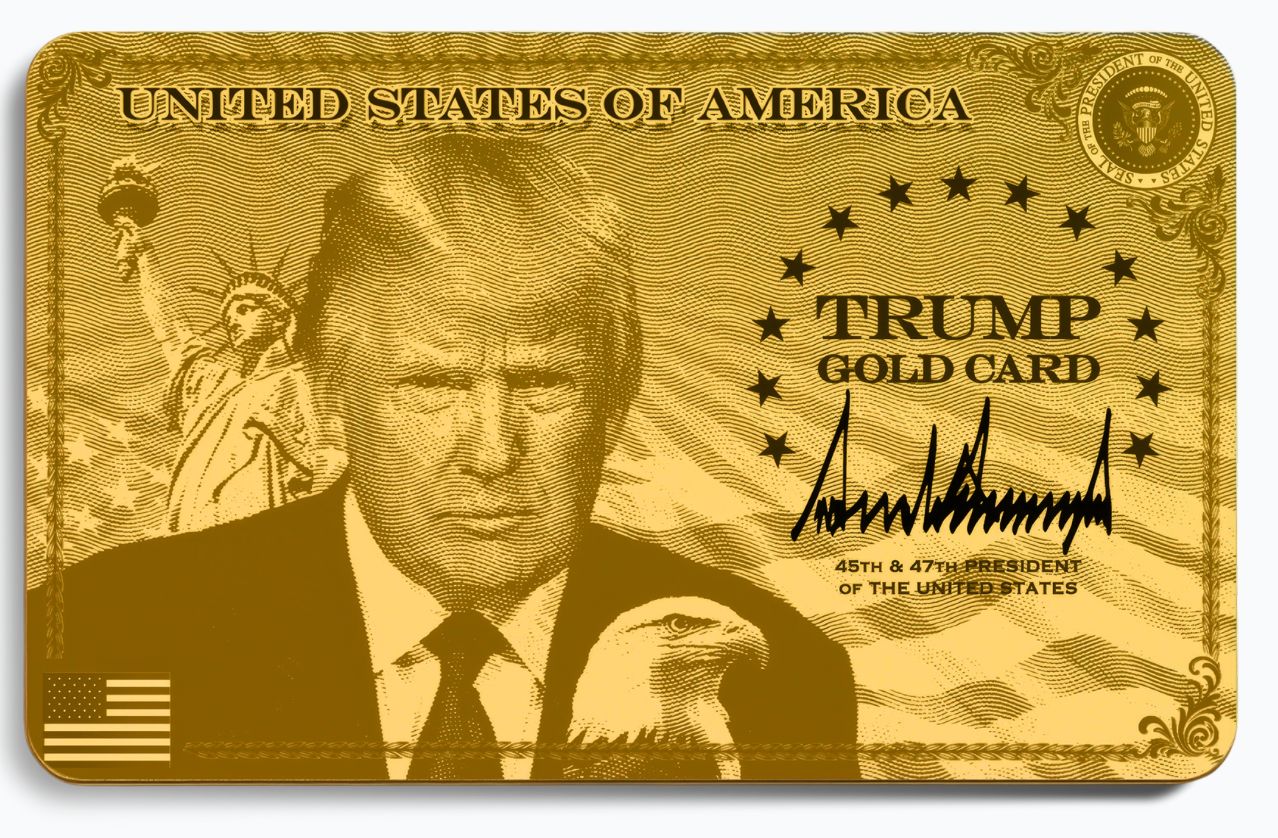
  • Design: The physical card features a gold background with Trump’s portrait, the Statue of Liberty, and the American flag, prominently labelled “Trump Gold Card.”
Trump Gold card
Trump Gold Card (Trumpcard.gov)

Trump described the initiative as a way for American taxpayers to finally “benefit from our LEGAL immigration system.”

How to apply

Applicants must follow a five-step process outlined on the official website (trumpcard.gov):

  1. Pay the non-refundable processing fee to initiate the application.
  2. Submit supporting documents including identity, financial records, and other details.
  3. Undergo vetting by USCIS and the Department of Homeland Security, including security, criminal, and health checks.
  4. Make the $1 million contribution (for individuals) once approved. This “gift” to the US government is treated as proof that the applicant substantially benefits the country.
  5. Receive permanent residency under EB-1/EB-2 categories, along with the Trump Gold Card for nationwide use.

Corporate gold card

For businesses, the Trump Corporate Gold Card offers residency for employees at a cost of $2 million per employee.

  • Companies may transfer the card from one employee to another, subject to a transfer fee and renewed vetting.
  • An annual maintenance fee also applies.
  • Corporations can apply for multiple cards simultaneously.

Who is eligible?

Applicants must:

  • Qualify for lawful permanent residency under EB-1/EB-2 visa categories.
  • Pass security, criminal, and health screenings.
  • Ensure a visa number is available at the time of adjudication.
  • Provide proof of identity, source of funds, and the $1 million (or $2 million) contribution.

Only individuals and companies that meet both legal and financial requirements will be approved.

Platinum card coming soon

Trump also announced a forthcoming Trump Platinum Card, priced at $5 million.

  • Holders may spend up to 270 days a year in the US.
  • Crucially, they are exempt from US taxation on non-US income, making it especially attractive to ultra-high-net-worth individuals.
  • Applications will open later, with DHS conducting vetting.

Revenue target

Commerce Secretary Howard Lutnick projected that the Gold Card programme could raise $100 billion in the short term. Trump remains optimistic despite expert warnings that parts of the plan may require congressional approval.

“The main thing is we’re going to have great people coming in, and they’re going to be paying,” Trump said.

Revocation risks

Like all US visas, the Trump Gold Card can be revoked if the holder:

  • Poses a national security threat.
  • Commits fraud, misrepresentation, or criminal activity.
  • Violates visa conditions or becomes otherwise inadmissible

Gold card announced amidst executive order to kill H1B visa program

The announcement of the Trump Gold Card came just hours before President Trump signed a sweeping executive order on H-1B visas, dramatically raising the annual fee for skilled foreign workers from $215 to $100,000. The move, which the White House said was aimed at “protecting American jobs,” is expected to hit Indian IT professionals and US-based tech firms the hardest.

While the Gold Card opens America’s doors to the ultra-wealthy, the sharp hike in H-1B fees signals Trump’s intent to discourage companies from relying on cheaper foreign talent. Instead, the administration is positioning wealth-based immigration as the preferred model—offering Green Cards to those who can pay millions, while making it prohibitively expensive for skilled professionals to enter through traditional employment routes.

Immigration analysts noted the stark contrast: on the same day that Trump announced a “fast track” for millionaires and corporations willing to contribute financially, he imposed one of the toughest financial barriers ever on skilled workers, fundamentally reshaping the US immigration landscape.

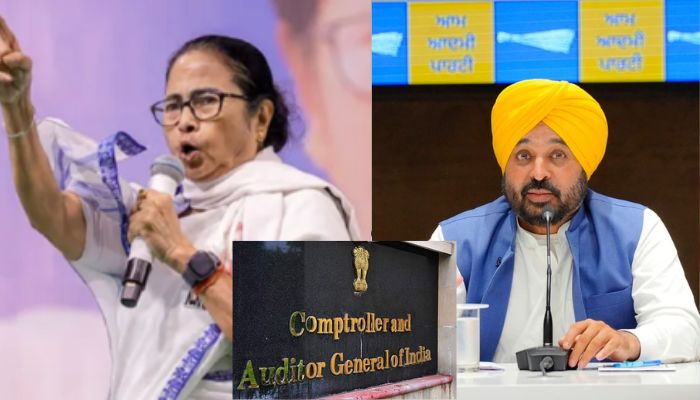
Debt of AAP-ruled Punjab reaches 40% of its GSDP, West Bengal under Mamata continues to suffer from massive liabilities: Here are the revelations made in CAG report

The Comptroller and Auditor General of India (CAG) has released a first-of-its-kind report that shows how India’s states are managing their finances. The report was released on Friday (19th September) by CAG K. Sanjay Murthy during the State Finance Secretaries Conference. 

The total public debt of all 28 states has increased more than threefold in the past decade, rising from ₹17.57 lakh crore in 2013-14 to ₹59.60 lakh crore in 2022-23. The states possess among the highest debt-to-GSDP ratios in India, meaning debt is perilously huge relative to the scale of their economies.

As of 31st March 2023, eight states had a public debt liability of over 30 per cent of their GSDP; six states had a public debt liability of below 20 per cent of their GSDP, and the remaining 14 states had a public debt liability between 20 to 30 per cent of their respective GSDP during FY 2022-23,” the report added.

Punjab worst hit with 40% debt-to-GSDP ratio

According to the report , the AAP-ruled state of Punjab is the most burdened, with a debt-to-GSDP ratio of 40.35%, the highest among all states. To put it simply, Punjab owes money worth nearly half of its annual economic output.

This problem is not new. Punjab has been battling a lean revenue base and increasing expenditure for a long time, and the CAG report confirmed that the situation is becoming unsustainable. For a state already facing unemployment, distress in agriculture, and few options for industrial growth, such a high debt cripples its capacity to invest in development enormously.

Instead of focusing on capital expenditure, spending on things like infrastructure that create future growth, Punjab is now forced to use large portions of its borrowed money just to cover day-to-day expenses.

West Bengal follows close behind

The situation is no different in Mamata Banerjee’s Trinamool Congress (TMC)-ruled West Bengal either. The state’s debt-to-GSDP ratio now touches 33.7%, one of the highest in the country, the CAG report said.

In the last decade, West Bengal has seen a sharp jump in its debt burden. Like Punjab, West Bengal also falls into the category of 11 states that are using borrowed funds to finance routine expenditure, such as salaries, subsidies, and administrative costs, rather than creating assets that could improve the state’s financial health in the long run.

Public debt has fluctuated by an average of 20% of the GSDP: CAG

The report further said, “On average, public debt of the states has been about 150 per cent of their revenue receipts / total non-debt receipts. Similarly, public debt has fluctuated between 17-25 per cent of the GSDP and, on average, 20 per cent of the GSDP. The major increase of 4 per cent, from 21 per cent of GSDP in FY 2019-20 to 25 per cent in FY 2020-21, is due to a decline in GSDP in FY 2020-21 being a Covid year. The rise in loans of the Union Government between 2020-21 to 2022-23 was due to back-to-back loans rather than GST compensation shortfall and special aid as loans to states for capital spending.”

The situation is worst in Punjab, Nagaland, and West Bengal, but most other states are not much behind. Conversely, some states, such as Odisha, Maharashtra, and Gujarat, have been able to maintain their debt ratios relatively under control, displaying a diametrical difference in fiscal prudence.

The other concerning indicator brought to the fore by the report is that in 11 states, such as Punjab, West Bengal, and Nagaland, capital spending was less than the net borrowings during 2022–23.

In Andhra Pradesh and Punjab, for example, capital expenditure was only 17% and 26% of their net borrowings, respectively. This means most of the money borrowed went into plugging deficits instead of creating new assets.

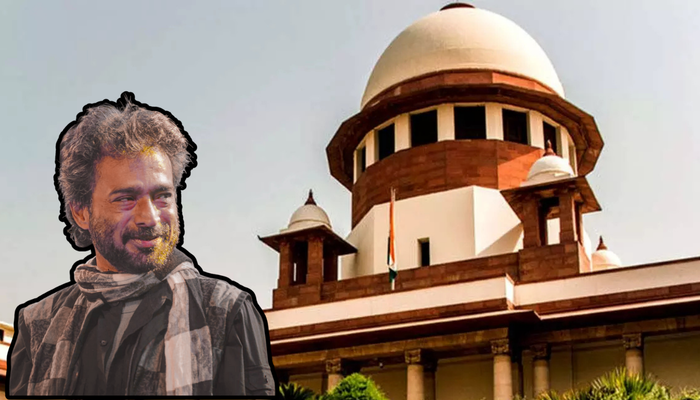
Calcutta High Court claims ‘lack of evidence’ to turn down petition against TMC supporter Nachiketa despite viral video of him abusing Lord Ram

0

The Calcutta High Court on Friday (19th September) dismissed a petition accusing Bengali singer, composer and musician Nachiketa Chakraborty of hurting the religious sentiments of Hindus by making objectionable remarks about Lord Ram during a live performance. The criminal revision petition filed before the High Court challenged the order of dismissal of the trial court for want of jurisdiction.

The petitioner contended before the High Court that the Learned Magistrate erred in law by failing to appreciate that the complaint against the singer was filed within the jurisdiction of the complainant’s place of residence. A single bench of Justice Ajay Kumar Gupta of the High Court, however, dismissed the petition, citing a lack of evidence. “This court endorses such findings of the Learned Magistrate because the petitioner failed to satisfy the learned court as well as this court, as regards the whereabouts of the alleged concert that was performed,” noted the High Court.

A complaint was filed by the Secretary of the Bishwa Hindu Parishad, before the Officer-in-Charge, Shyampukur Police Station, on May 5, 2023 and before the Deputy Commissioner of Police on May 10, 2023, alleging that “Nachiketa Chakraborty (a Bengali singer, composer and musician) during a live concert, tried to provoke the common people, particularly citizens of India and outraged the religious sentiments of the followers of Lord Ram” by making certain insulting remarks. However, the case was dismissed by the Learned Additional Chief Metropolitan Magistrate, Court – I.

Notably, a video of the said live performance went viral on social media, in which the singer, who is a TMC supporter, can be heard making objectionable remarks against Ram Janmabhoomi in Ayodhya. He same the song before the inaguration of the Ram Mandir.

During the performance, Nachiketa Chakraborty said, “There is a lot of fuss about this Ram Janmabhoomi in our country, it is not a matter of religion, it is actually a political game.” Then he sang, “If we believe in Ram, then why not Dashrath? If we want to know the birthplace of Ram, Dashrath should be called on a planchette. Only he can tell where Ram was born! Otherwise Ram will continue to be born every hour sometimes in Ayodhya, sometimes Kishkindha and sometimes Dharmatala.”

Cannot take cognisance of the offence based only on social media content: HC

The High Court acknowledged that the allegation was serious in nature, however, it said that solely social media content without any mention of the date, time and place of the concert cannot be a ground for taking cognisance of such offence. “This Court also finds upon perusal of the application filed u/s 156(3) of Cr.P.C. that only the contents of social media mentioning, without any date, time and place of the concert and without any authenticity, cannot be the ground to take cognisance of such offence even though the allegation of offence is serious in nature. This Court also notes that even the record does not reflect any other allegation(s) or any incident of riot in this regard from any corner to date. No other complaints were found in the records either,” the judge said.

“In the backdrop of the aforesaid facts, and due to lack of sufficient materials placed on the part of the Petitioner, this Court does not find any illegality, infirmity or perversity against the order dated 04.08.2023 passed by the Learned Additional Chief Metropolitan Magistrate for rejecting the application under Section 156(3) of Cr.P.C. filed by the petitioner before him. Therefore, this present revisional application is devoid of merit,” it added.

Donald Trump kills H1B visa program with $100,000 annual fee impacting the Indians most, companies ask H1B visa holders outside US to return within 24 hours

In a sweeping move, President Donald Trump signed a proclamation late Friday imposing a staggering additional $100,000 annual fee on H-1B visa applications. The new fee is effective immediately for new filings and will be effective from 12:01 a.m. eastern daylight time on September 21, 2025 for renewals.

White House said that the visa fee has been hiked as a “crackdown on systemic abuse” of the H1B vista system. It stated that “the key facilitator for this influx of foreign STEM labor has been the abuse of the H-1B visa.” The presidential order further claims that American companies are laying off American workers to hire aliens on H1B visa on lower salaries.

The Executive Order by President Trump claims that “Information technology (IT) firms in particular have prominently manipulated the H-1B system, significantly harming American workers in computer-related fields.”

The H1B is already an expensive visa, costing around $1,700 to $4,500, depending on whether the visa is expedited. Now an amount of $100,000, around ₹88 lakh, will be added to this fee. The H1B fee is paid by employers, who consider this as a business expense. The Executive Order states a new or renewal application for H1B visa must be accompanied by the additional $100,000 fee, without which the application will be rejected. The additional fee is effective for 12 months, unless extended later.

The EO states, “Employers shall, prior to filing an H-1B petition on behalf of an alien outside the United States, obtain and retain documentation showing that the payment described in section 1 of this proclamation has been made.”

The hiked fee makes it almost impossible for companies to hire foreign skilled workers under this visa, it is higher than the average salary of an H1B visa holder. Only few top companies may be willing to pay this astronomical amount, that too for their most valuable foreign employees. Mid-level companies will stop hiring foreigners altogether, and big companies may hire only a handful of foreigners.

Notably, while the presidential proclamation said that $100,000 must be paid at the time of new or renewal visa application, implying it to be an annual fee, Commerce Secretary Howard Lutnick said that it is an annual fee. Therefore, if a company retains a foreign employee for 6 year, the maximum validity of H1B visa, the company will have to pay a staggering $600,000 fee.

India set to hit most hard by this move, as around 70% of H1B visa holders are Indians, with approximately 300,000 of its citizens currently working in the U.S. on H-1B visas—predominantly in IT, engineering, and healthcare fields. Indian firms like TCS, Infosys, Wipro, and HCL Technologies, which sponsor a significant portion of these visas, could face billions in added costs, potentially jeopardizing thousands of offshore jobs.

Similarly, global tech giants like Google, Amazon, Meta, IBM, Microsoft, Apple etc are also set to hit hard, as they have relied on the visa program to hire skilled employees from India and other countries.

“Trump’s $100K H-1B visa fee hits Indian IT firms hard: 13,000+ jobs at risk, soaring costs for TCS, Infosys, Wipro. US talent crunch forces major shift in India’s global tech strategy,” said investor Pariman Ade in a widely shared ? post that garnered hundreds of engagements.

It is expected that a large number H1B visas will not be renewed by the companies after their expiry, and the affected people will return to their countries. As a result, remittances from Indian H-1B workers, which topped $37 billion last year, can come down drastically within months.

Exemptions

The new rule is exempt for all foreign employees working in a company or in an industry considered to be of national interest by the administration. The text of the EO says, “The restriction imposed pursuant to subsections (a) and (b) of this section shall not apply to any individual alien, all aliens working for a company, or all aliens working in an industry, if the Secretary of Homeland Security determines, in the Secretary’s discretion, that the hiring of such aliens to be employed as H-1B specialty occupation workers is in the national interest and does not pose a threat to the security or welfare of the United States.”

However, it does not elaborate on this, which may be clarified separately. However, it is expected that healthcare, critical infrastructure, defence etc could be among the exempted industries.

Visa holders outside USA asked to return within 24 hours

While existing H1B holders are not impacted by the fee hike, the situation is different from those who are currently outside USA. As the Presidential Proclamation is structured as a travel restriction, it has been interpreted by companies to mean that it also applies on H1B visa holders currently not in the USA.

The order states, “The Secretary of Homeland Security shall restrict decisions on petitions not accompanied by a $100,000 payment for H-1B specialty occupation workers under section 101(a)(15)(H)(i)(b) of the INA, who are currently outside the United States, for 12 months following the effective date of this proclamation as set forth in subsection (a) of this section.”

As per the order, beginning at 12:01 am eastern time on September 21, 2025, individuals will not be able to enter/return to the U.S. in H1B status unless their petition is accompanied by an additional $100,000 payment. Therefore, major companies have asked their employees to return before the deadline expires, which means within 24 hours, which may not be possible for many.

The timing of the proclamation, mere hours before the weekend, has triggered a frantic scramble among affected employees and employers. Several companies including Microsoft, Meta, Amazon, JPMorgan Chase, Apple, TCS and others have sent messages to its global workforce explicitly urging all H-1B visa holders currently outside the U.S. to “promptly return before the September 21 deadline” to secure stamping and avoid renewal complications.

Moreover, they have asked the foreign employees to not leave USA, to avoid complications in return. “Do not leave the U.S. for the foreseeable future,” one Amazon executive reportedly advised in a company-wide Slack message, according to leaked communications shared on social media.

Notably, while the Presidential order mentions only H1B visa, the companies have asked the H-4 dependent visa holders also to follow the same instructions.

One such memo shared on X states, “If you are in H-1B or H-4 status and are currently outside the U.S., we strongly recommend that you do what you can to return to the U.S. tomorrow before the deadline. The Proclamation was released within the last 30 minutes, so we realise that there isn’t much time to make sudden travel arrangements. But again, we strongly encourage you to do your best to return.”

Apple and Tata Consultancy Services (TCS), which rely heavily on Indian talent, are also reportedly mobilising logistics teams to facilitate rapid returns, fearing a cascade of visa denials that could sideline key projects.

Social Media posts also show that many H1B visa holders who were about to travel outside the USA for personal or work-related reasons disembarked from flights in the USA after boarding as soon as they got information about the new rule. They stayed back as they feared that they won’t be allowed re-entry without the $100,000 fee.

With this steep fee hike, Donald Trump has effectively killed the famed H1B program. Now hardly any company will be willing to pay this steep fee to hire foreign talent. U.S. tech behemoths, which secured roughly two-thirds of H-1B visas in recent years, now will have to grapple with a talent crunch that could stifle growth. Smaller firms and startups, already cash-strapped, may abandon international hiring altogether. However, question remains on whether they will able local workers with similar skills.

It is almost certain that there will be no new H1B visa applications. Moreover, as the visa comes with a validity period of 3 years, which can be extended to maximum 6 years, the existing visa holders will gradually have to leave the country as and when their visa expires. President Trump has also tightened the Green Card regulations, which means the dream of graduating to Green Card from H1B visa is also killed.

It will be interesting to see how US-based companies deal with this, whether they will hire more locals as Trump intends, or whether they move operations overseas to hire foreign workers.