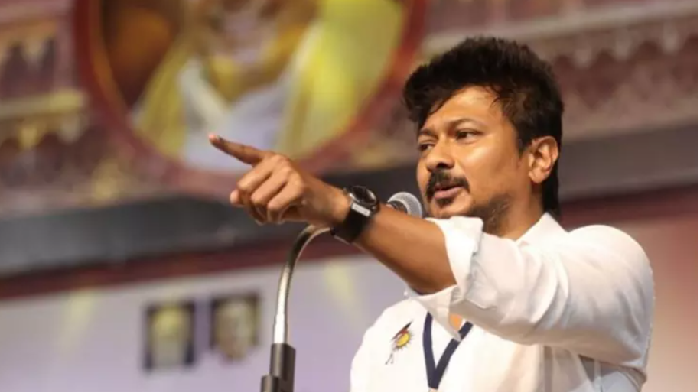
On Thursday, September 7, DMK leader and Tamil Nadu Minister Udhayanidhi Stalin claimed that BJP is twisting his remarks on Sanatan Dharma and using his statements to divert attention. The Tamil Nadu politician stated that he would face all legal implications associated with what he said. Udhayanidhi Stalin further claimed that the BJP is alleging that he called for the genocide of Hindus. This is days after Udhayanidhi Stalin generated a political storm earlier this week by comparing the Hindu civilizational religious philosophy with ‘malaria’ and ‘dengue’ and called for the annihilation of Sanatan Dharma.
“I believe, like the spread of diseases like COVID-19, Dengue, and Malaria by mosquitoes, that Sanatan Dharma is responsible for many social evils. I will say it today, tomorrow, and forever: Our resolve to stop Sanathana Dharma from the Dravidian land would not reduce even a bit,” he was quoted as saying.
He also opined that “Sanatan Dharma is a principle that divides people in the name of caste and religion.” However, releasing a statement on Twitter (X) on 7 September, the DMK leader blatantly attacked the Centre and Prime Minister Narendra Modi, accusing them of twisting his anti-Hindu remarks.
“For the last 9 years, all your (BJP) promises are empty promises. What have you exactly done for our welfare is a question currently being raised in unison by the entire country against an unarmed, fascist BJP government. It is in this background that the BJP leaders have twisted my speech at the TNPWAA conference as ‘inciting genocide’. They consider it a weapon to protect themselves,” he said.
“What is surprising is that those like Union Minister Amit Shah and Chief Ministers of BJP-ruled states were demanding action against me based on fake news,” Udhayanidhi claimed.
Let us resolve to work for the victory of the ideologies of Periyar, Anna, Kalaignar and Perasiriyar. Let Social Justice flourish forever. pic.twitter.com/Eyc9pBcdaL
He further stated that he should be the one filing criminal and other judicial charges against BJP supporters and leaders for spreading defamation while occupying positions of respect. “But I am aware that this is their mode of survival. They don’t know how else to survive, so I decided not to do that,” he noted.
Udhayanidhi meanwhile also stated that the DMK supports all religions that teach that all lives have been created equal. “Everyone knows that we are not enemies of any religion,” he added.
“I would like to quote Anna’s comment on religions which remains relevant even today. If religion leads people toward equality and teaches them fraternity, then I too am a spiritualist. If a religion divides people in the name of castes, if it teaches them untouchability and slavery, I would be the first person to oppose religion,” he said quoting Annadurai.
Udhayanidhi meanwhile also stated that the DMK supports all religions that teach that all lives have been created equal. “Everyone knows that we are not enemies of any religion,” he added.
“But without an iota of understanding about any of these, Thiru Modi and Co are solely dependent on such slanders to face the Parliamentary elections. For the last 9 years, Modi has been doing nothing. Occasionally he demonetizes money, builds walls to hide huts, builds new Parliamentary buildings, erects a Sengol (sceptre) there, and plays around by changing the name of the country, standing at the border and making the white flag work,” the statement by Stalin read.
He alleged that PM Modi and the BJP workers were attempting to divert people’s attention from the clashes happening in Manipur. “Thiru Modi and co are using the Sanatan ploy to divert the attention from the facts including the killing of more than 250 people in the riots incited in Manipur and the Rs 7.5 lakh crore corruption,” he charged.
This comes as BJP leaders from Tamil Nadu met Governor RN Ravi on Thursday, September 7, and submitted a memorandum for his intervention in filing cases against Udhayanidhi Stalin for his alleged hate speech against Sanatan Dharma.
BJP leaders from Tamil Nadu met Governor RN Ravi & submitted a memorandum for his intervention in filing cases (in line with the Hon Supreme Court’s guidelines) against Udhayanidhi Stalin for his alleged hate speech at the 'Sanatana Eradication' conference and for the dismissal… pic.twitter.com/wuPUq8YceQ
The leaders also demanded the dismissal of Minister PK Sekar Babu for being a part of the ‘Sanatana Eradication’ conference. They said that the Minister had violated his oath to office by attending the conference.
On Saturday, September 2, the Minister for Youth Welfare and Sports Development of Tamil Nadu said, “Mosquitoes, dengue, flu, malaria, corona – we should not oppose these things. They’ve to be eradicated completely.”
Udhayanidhi Stalin, son of Tamilnadu CM MK Stalin, and a minister in the DMK Govt, has linked Sanatana Dharma to malaria and dengue… He is of the opinion that it must be eradicated and not merely opposed. In short, he is calling for genocide of 80% population of Bharat, who… pic.twitter.com/4G8TmdheFo
“The same is the case with Santanam (Hinduism). Our first work should be to abolish/eradicate Sanatanam instead of opposing it. So, my appreciation to you all for giving an apt title to the meeting,” he further added.
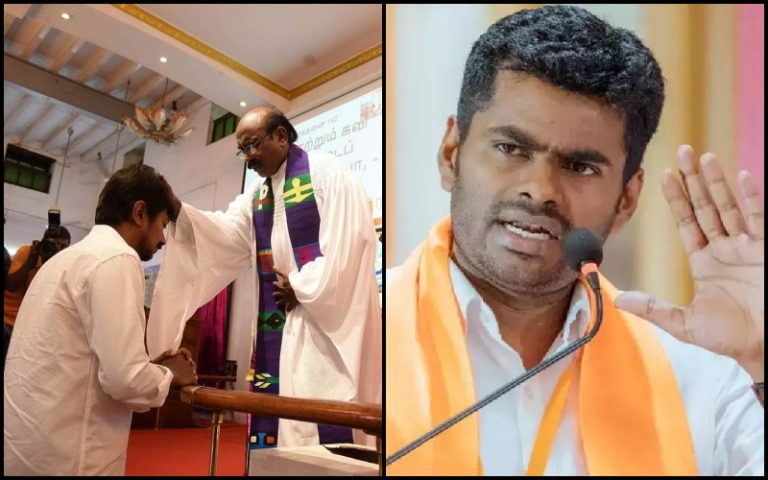
Earlier in December 2022, Udhayanidhi Stalin announced that he and his wife belong to the Christian Faith. “I am proud to call myself a Christian, all the Sanghis today will be burning,” he was quoted as saying.
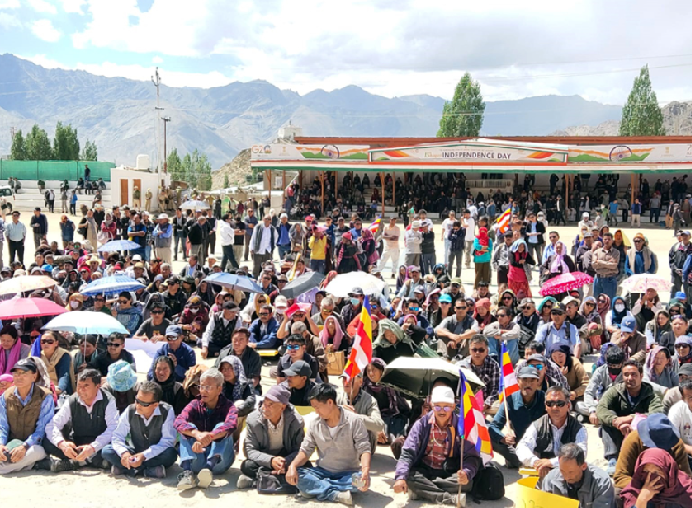
On Wednesday, September 6, massive tensions erupted in the Kargil region of Ladakh over a Muslim man named Manzoor Ahmed marrying a Buddhist girl and converting her to Islam. Locals led by the Ladakh Buddhist Association (LBA) staged protests in the region and demanded the implementation of anti-conversion law in the Union Territory. The locals held posters and placards and also raised slogans saying, “Love Jihad Band Karo (Stop Love Jihad).”
According to the reports, all the businesses and commercial services also remained closed as the protesters conducted a rally in Kargil raising their voices against Love Jihad. The demonstrators also submitted a written memorandum to B D Mishra, Lieutenant governor of Ladakh demanding anti-conversion law in the UT.
According to the memorandum submitted by the demonstrators, an agreement was executed about 30 years ago between the Muslims of Leh and the Ladakh Buddhist Association pledging not to convert people, especially women, through monetary allurement, misrepresentation, and fraudulent tactics. This agreement specified stringent criteria requiring all communities to swiftly return converted women to their parents in order to promote community cohesion and fraternity.
“However, it has been seen that the vested interests with strong communal dispositions seek to violate the agreement at will,” read the memorandum.
The locals stated that incidents of forceful conversion can disturb the religious harmony and tranquillity of Ladakh. They have also demanded strict action against the Muslim man who lured the Buddhist girl for money and married her. The two are absconding at present.
The incident is said to have happened on July 20 this year. BJP’s Ladakh unit vice-president Nazir Ahmed’s (74) son Manzoor Ahmed (39) married a Buddhist woman and also is said to have converted her by luring her for money. Manzoor reportedly is already married and his first wife works in a private company in Delhi.
Following the incident, the BJP expelled Nazir Ahmed from his position in the party and stated that the party had approached Nazir Ahmed to lodge an FIR in the matter but he did not respond.
Ahmed said that he and his wife had gone on Haj pilgrimage for the last 40 days and they knew about their son’s marriage only after they reached Srinagar on July 20 on their way back to Leh. He said that his son had married a Buddhist woman without informing them. “My son went against us and married the girl. I didn’t do anything wrong,” Nazir was quoted as saying as he got expelled from the party.
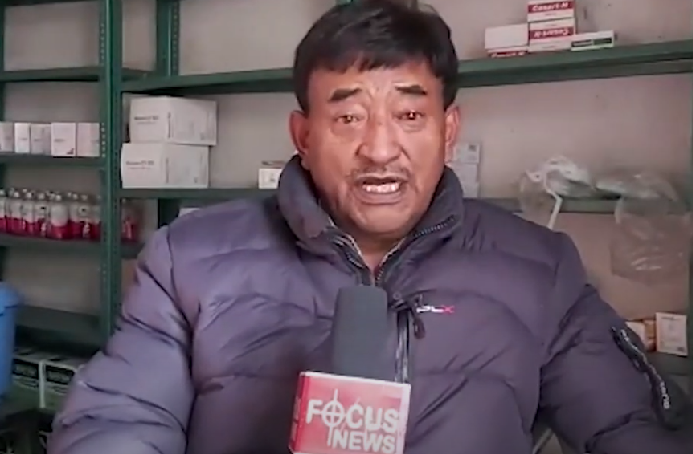
Nazir Ahmed was expelled from BJP (Focus News)
He also said that he went to Srinagar and Delhi to look for his son but could not find him and the girl. “I had asked the party to give me some time. But I was expelled. I will always remain a BJP loyalist. I don’t support my son in his decision,” Ahmed said.
Meanwhile, the BJP stated that the decision to expel Nazir was made at a party executive meeting presided over by BJP’s Ladakh unit president Phunchok Stanzin. It stated that Nazir was given “ample time” and an opportunity to explain his involvement in a sensitive issue.
In the absence of a satisfactory response from him, the official statement stated that “a decision has been reached to promptly relieve Nazir Ahmed of his responsibilities as [BJP’s Ladakh unit] vice-president and revoke his primary membership [of the party] with immediate effect.”
Nazir was also summoned by the party on July 27 but he said that his son had gone untraceable with the woman. “I also contacted the travel agency where he worked (in Leh) but they expressed helplessness,” Nazir had said in his explanation to the party.
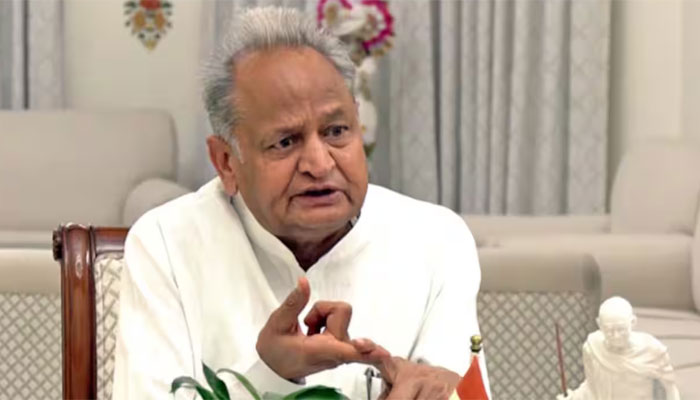
On 6th September, Rajasthan Chief Minister Ashok Gehlot faced an awkward situation when he stopped his convoy near a group of youth at Bhilwara but got greeted with chants of Modi-Modi. As per reports, Gehlot reached Bhilwara at night to participate in Maharana Pratap Sabhagar of Municipality for Mission 2030 event. He was scheduled to meet business owners at the event.
राजस्थान: भीलवाड़ा में युवाओं को देखकर मुख्यमंत्री अशोक गहलोत ने रोका अपना काफिला, तो युवाओं ने मुख्यमंत्री के सामने ही लगा दिए मोदी-मोदी के नारे।
नारेबाज़ी के बीच गहलोत अपनी गाड़ी से निकलकर सभी का हाथ जोड़कर अभिवादन करते हुए मुस्कुराए और वापस गाड़ी में बैठ गए।#Rajasthan… pic.twitter.com/up5VyNxiq9
Following the meeting, CM Ashok Gehlot left for the circuit house for the night and noticed a group of people standing near Saraswati Circle. His convoy stopped right next to the group of youth, and he came out of the vehicle to wave at the group. However, the situation turned awkward for the CM as the youth started chanting Modi-Modi. Gehlot smiled and sat back in the vehicle immediately. As soon as the convoy started moving again, the youth started chanting Jai Shri Ram.
This is not the first time Gehlot has faced such a situation. In April this year, Gehlot attended an IPL match between Rajasthan Royals and Lucknow Super Giants in Jaipur. Upon seeing him on the ground, people started chanting Modi-Modi. A video of the incident went viral on social media.
Rajasthan Assembly Elections
The term of the Gehlot-led Congress government in Rajasthan is reaching its end. The assembly elections in the state are to be held around November 2023. The last assembly elections took place in December 2018. The term for the current government will end on 14th January 2024.
Recently, there has been a media buzz over the claims that the Modi government at the center is planning to ‘change’ the official name of the country ‘from’ India ‘to’ Bharat. A lot of politicians and intellectuals have come up with their opinions on the rights and wrongs and in-betweens of the idea.
Ministers in the government have already clarified that there is no ambiguity about the names and as the constitution clearly mentions, they mean one and the same. The usage of the word ‘Bharat’ in some ceremonial communications, like the dinner invite for G20 delegates from the Rastrapati Bhavan had triggered the buzz, and many political voices, mostly the Left and Congress, have jumped into the outrage.
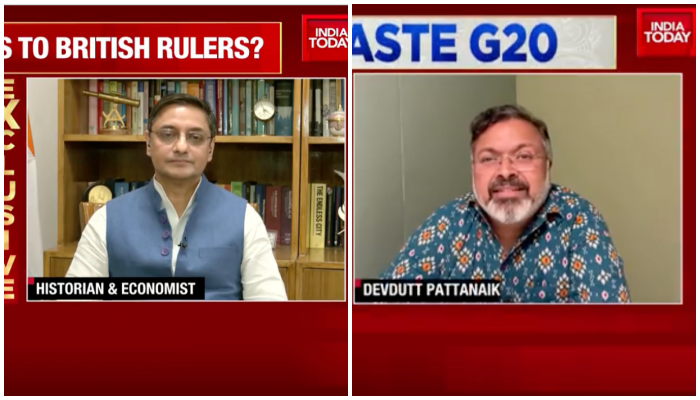
In discussion with India Today’s Rahul Kanwal, ‘mythologist’ Devdutt Pattanaik made some bizarre claims about the origin of the country’s name. He tried to relate it to the Left favorite topics of casteism, Brahminism, and intolerance. Rahul Kanwal then asked economist and author Sanjeev Sanyal about Devdutt Pattanaik’s claims. Sanjeev Sanyal, who has written best-selling books, ‘The Incredible History of India’s Geography’, and ‘The Ocean of Churn’, dispelled the usual Leftist tropes and meaningless claims that Devdutt Pattanaik was trying to force into the discussion around the country’s name.
When Rahul Kanwal asked how Pattanaik responds to the claims that ‘Bharat’ is of Bharatiya origin and ‘India’ is ‘foreign’, Pattnaik claimed the idea of singularity is ‘Middle Eastern ideology’ while the concept of plurality is Indian. So when we promote ‘one name’, we are drifting towards the Middle East. Like our many gods with many names, Indians should celebrate diversity and encourage many names.
Rahul Kanwal then took the answer to Sanjeev Sanyal and asked him whether he agrees with the claim that picking one name means heading towards Middle Eastern sensibilities, and whether the names India and Bharat co-exist.
Sanjeev Sanyal said, “I don’t even understand what the debate is about. Bharat is a well-established name for India. It is right there in the Constitution. So is India. The Indian languages use ‘Bharat’ and we are all habituated to say India when communicating in English. There is nothing anywhere that says Bharat cannot be used. Using the word Bharat is not an ‘intrustion’ into the English language as some people are trying to claim.
The word ‘India’ has Indic origins, it is not ‘foreign’, says Pattanaik
Rahul Kanwal’s next question to Pattnaik was, “What is your understanding of the roots and origins of the name India?”
Pattanaik said, “The word India is not ‘foreign’ as some people are trying to claim. It comes from ‘Sindhu’, a river, that passes through India for several hundred kilometres. Arabs cannot pronounce ‘Sa’ so they started calling it ‘Hindhu’, Sapta Sindhu became Hapta Hindhu, Sindh Desha became Hindh, and 2500 years ago, a Persian king referred to India as ‘Hind’. The Greeks came to India, they could not say ‘Ha’ so they used ‘EE’, so instead of Hindu, they say Indu. Thus Sindh became Hindh, and then Ind-Indus.
Pattnaik even linked the word Indus to Indumati, Lord Ram’s grandmother. He claimed that the word originated from Sanskrit, from the Rigveda.
Rahul Kanwal then took the same question to Sanjeev Sanyal, asking him his opinion about the word India being ‘foreign’ and Bharat being ‘native’.
Sanjeev Sanyal cites the Battle of Ten Kings from Rigveda, the Bharata tribe, and their Ashwamedha Yagya
Sanyal, in his quintessential style, stuck to facts and evidence. Sanyal clarified that the word India is foreign with an Indian origin. The term Bharat, Sanyal explained has 2 origin stories. The older origin story is from the Rigveda where a tribe named Bharata lived in the Sapta Sindhu region.
In the early bronze age, a tribe named Bharata lived in the area that is now roughly Haryana, they used to call their homeland ‘Sapta Sindhu’. The Bharatas were attacked from the West, by a coalition of 10 other tribes. There was a great war on the banks of Ravi, then called Parushni. The Bharatas completely decimated the attacking tribes and emerged victorious. They also defeated another tribe named Bhedas around the banks of Yamuna. The Bharatas thus established the first ’empire’ in those times. Their chieftain, named Sudas, performed the first Ashwamedha Yagya to become the first Chakravartin Samrat of India. His symbol was the wheel. What we see in the later Mauryan symbol, the wheel in our flag, actually goes back to the early bronze age, to the Bharata tribe.
The Bharata tribe lived in the Sapta Sindhu. The Bharatas reached out to all the tribes around them and compiled the Vedas, adapting their gods, and their traditions, and assimilating their cultures, knowledge and belief systems in a grand ritual. All the gods and all the identities of the tribes were given a place in the form of the first 3 Vedas.
The very last chant of the Rigveda is a ‘contract’, the idea of assimilation and plurality that creates the idea of being ‘Bharatiya’. By the Iron Age, the whole landscape of the Indian subcontinent assimilated around a common identity, the idea of the Indian civilization. That last chant of the Rigveda, symbolic of our shared identity as a civilization, is commonly used even today.
It mentions the seven rivers, the tributaries of the ancient Saraswati. The southern rivers of Godavari and Kaveri, find a mention here too, Sanyal explained.
“The Sapta Sindhu becomes the land of the Bharatiyas. In Persian texts, there is a phonetic shift. Sa becomes Ha, like in modern Assamese. Sindhu does not mean the Indus river in isolation, it links to the ancient Sapta Sindhu, the 7 rivers around which the Rigvedic civilization was built. The Hindu eventually becomes India, as Devdutt explained. However, the random extrapolation of Indumati is unrelated to the word India”, Sanyal narrated.
Devdutt Pattnaik tries to bring in casteism, Brahminism, untouchability, etc. randomly into his statements
Rahul Kanwal asks Pattanaik if he sees the emergence of the word Bharat in the context of this being the native name of our country.
Pattnaik then gives the Rigvedic origin of the word Bharat. He then says that the word is again mentioned in Mahabharat, which happens in the northern parts of India, the Kuru Panchala region that is the modern Delhi, Mathura etc. The first instance of the word ‘Bharata Varsha’ carved in stone is seen in Odisha’s Hati Gumpha (elephant caves), 2500 years ago, referring to only the Gangetic region, northern India, not the entire India.
Devdutt Pattnaik claims that Bharat is a name given by ‘Brahmins’
Pattnaik says that Bharat is a name given by Brahmins, referring to some parts of Northern India. He then adds that even ideas like Bharat Varsha, Arya Desha, Bharat, etc. are very ‘North Indian, Brahminical words’. There is another Bharat, in Jain traditions, the son of Rishabhdev, a Jain Tirthankara. Pattnaik then claims that he actually believes that the word Bharat came from Jain traditions but “we don’t value Jain traditions”. Jainism was very powerful at one time, but it was driven out. In Karnataka and Tamil Nadu etc, Bharata Chakravathi is known in a big way, but it is not the North Indian Bharat. The South Indian Bharat comes from Jain traditions.
So after he gave the Rigvedic origin of the word Bharat, Devdutt Pattanaik claimed North Indian Brahmins obliterated the idea of South Indian Bharat in his very next statement.
Sanjeev Sanyal busts the myth and explains how the claim of Brahminical dominance is meaningless
Rahul Kanwal then asks Sanjeev Sanyal his opinions on the North Indian Bharat vs. South Indian Bharat and Pattanaik’s claim that the idea of Bharat is a ‘Brahminical creation’ by the Brahmins in the way they saw history.
Sanyal states in a matter-of-fact tone that though some of the things said by Devdutt are correct, his interpretation is completely garbled, and even incorrect in some instances. Citing examples, Sanyal explains that Pattnaik’s claim that the battle of ten Kings happened in the Kurukshetra is entirely wrong. It happened on the banks of Parushni, that is Ravi, Western Punjab. Though the claim of Pauranik and Jain traditions are right, and there indeed was a Jain King Bharat, who was a Chakravartin Samrat, a descendant of Jain king Rishabhdeva, the founder of Jain traditions.
Sanyal then explains that Rishabhdeva’s son Nabhi also was a great conqueror and the land of Jambudweepa was also known as Nabhi Varsha. Sanyal added that it is meaningless to claim that there is a North India vs. South India or Brahminical vs. Jain idea behind this. By the time the Pauranas were written, South India had been more than comfortably a part of the wider identity of Indic civilization, he adds.
The oldest Tamil text, Tolkaippyam, the Tamil Grammar, the first enunciation of Tamil identity, is mentioned as being based firmly on the 4 Vedas, Sanyal adds. “When the Tamils proclaim that they are the people living between the Venkata hills in the North and Kumari hills in the South, they agree that their identity is based on the Vedas”, he explains.
Bharat word is imposed by Brahmins, India is older: claims Devdutt Pattanaik
Devdutt Pattnaik disagrees with Rahul, claiming the outsider Vs indic narrative comes from Chanakya Neeti of divide and rule, like Sam, Dam, Dand, and Bheda. He added that the word India, though called so by Greeks and Persians, did not originate from them, it comes from an Indian river. “It is the Brahmins who controlled the literature of our land. The word Aryan comes from Brahmins, but the Jains and Buddhists look at Aryans very differently”, he claims next.
Pattanaik then makes a complete flip and reverses his timeline, claiming that it can be argued that the Brahmins appropriated the word Bharat from the Jains, but the word Sindhu is a Vedic word. Even the idea of ‘internal’ and ‘external’ is Brahminical, because Brahmins claim that what is internal is pure, what is external is ‘Mlechha’, or impure. He then went ahead and claimed that suggesting that the word India is foreign is a very ‘Casteist, Brahminical’ mindset like Sita became ‘impure’ when she crosses the Laksham Rekha.
Launching a totally random tirade about casteism and untouchability, Pattanaik then went ahead to claim that we should just ‘allow’ plurality and discard the ideas of inside and outside, native and foreign because technically, ‘we are all genetically African’.
He added that politicians are more powerful so they control the narrative.
Sanyal debunks Pattanaik’s bizarre claims of Brahminical dominance
Responding to the tirade of Pattanaik, and claims of ‘Brahminical dominance’ asserting the word Bharat was appropriated from Jainism, Sanyal first pointed out to Rahul Kanwal that Pattnaik has just repeated the word Brahminical and Brahminism several times and has not answered the question at all.
The fact of the matter is the Vedic tradition predates that of Pauranic traditions and Jain traditions. The ideas of the Sapta Sindhu and Bharata tribes have been around since times older than these traditions. Coming to the Puranas, they say clearly that the people living south of the Himalayas and north of the ocean are called ‘Bharatiya’. “I don’t understand why this should be a garbled argument about Jains vs. Brahmins. All the Indic religions clearly understand and celebrate the fact that there is a civilization living between the Himalayas and the ocean that calls themselves Bharatiya.”
“The word India has origins in India agreed, but it is not an Indian word. By the time Sindhu became Hindu and it is started to be called India, it became a foreign word. It is not a bad word, everyone uses it, and I use it myself. Nowhere the government has said it cannot or should not be used”, Sanjeev Sanyal stated.
‘We change names when we change religion’: Pattanaik goes incoherent again
Pattnaik then claimed that we change names when we change religion or discard a belief system. “Changing names is a ‘conversion idea’. Politicians do it when they want to ‘convert’ from one identity to another”, he argued. Citing examples of China, Bhutan, Egypt, Germany etc, Pattanaik added that all great civilizations are called differently inside and outside and are comfortable with it. He then added that if Indians do not want to be called Indians (and rather call themselves Bharatiya), it means that they no longer want to be a great civilization and become monotheists. He then insinuated that choosing one name is a ‘Brahminical idea’. At the same time, Pattanaik claimed that this Brahminical idea is more like a Middle Eastern idea.
India is Bharat, and the constituent assembly agreed on this, The Constitution says it: Sanyal
Sanyal again asks what is the point of a debate when ‘India that is Bharat’ is accepted, enshrined, and acknowledged by the government and the people. “The Constitution of India begins by saying ‘India that is Bharat’, the Hindi version says ‘Bharat arthaat India’. So there is just no debate about one word being more important than the other. If everyone agrees that is alright to have multiple names, why is it that the usage of Bharat has rankled up the old elite. I think when the old elite was reading the constitution, they misread it as ‘India that WAS Bharat’. it is not so. The Constitution says ‘India that IS Bharat’, concludes Sanyal.
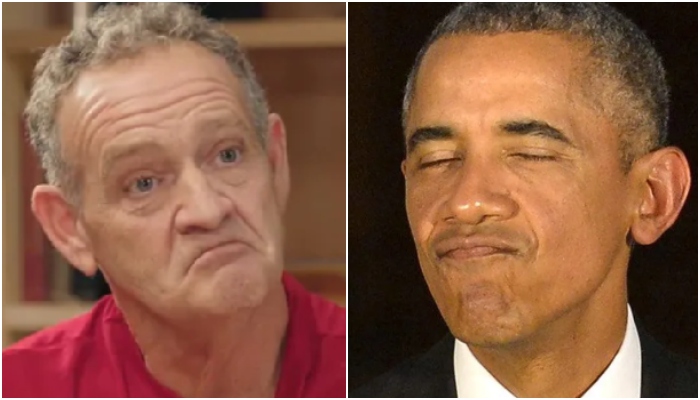
On September 7, in an exclusive interview with Tucker Carlson, an American commentator, author Larry Sinclair revealed that he had gay sex with former US President Barack Obama twice in the year 1999. He also claimed that Obama snorted cocaine with him and had no problem with engaging in gay sex.
“I was in Chicago looking for a party. I asked the driver and made him clear what exactly I was looking for. Then I was holed up in a bar outside. There was this guy who introduced himself as Barack Obama. The driver knew him well as he called Barack his friend. He dropped me and then I left. I gave Barack $250 to pay for coke and start putting a line on a CD tray, and just snort,” Sinclair said.
He also added that he did not know who Barack Obama was then and that he was not aware of his political background, if any. “The bar where we met was quiet and after some time when we headed to the car, I just started rubbing my hand along his thighs to see where it was going, and it went the direction I had intended it to go,” Larry added who has written a book on the incident named, ‘Barack Obama and Larry Sinclair: Cocaine, Sex, Lies and Murder’.
Ep. 22 Larry Sinclair says he had a night of crack cocaine-fueled sex with Barack Obama, and that Obama came back for more the next day. Assess for yourself. Here’s our interview. pic.twitter.com/R6CXwKv6gs
Larry reiterated that he had sex with the former US President that night and also indicated that Obama had been engaged in gay sex for quite a long before meeting him. “It was definitely not Barack’s first time,” said Sinclair, when Carlson asked him if the intercourse was transactional.
The driver then dropped Larry to his hotel and the next morning, Barack again arrived at Larry’s room with intentions to have more sex. “The same thing happened. He smoked crack and we picked up from where we left last night,” Sinclair indicated.
On asking how he felt after he learned that Obama had begun campaigning to become the US President in the year 2004, Sinclair laughed and said that he was shocked. “I hit the floor. I laughed hard and could not believe that this was the same person. I even told my friends that I had sex with Obama twice in the year 1999 and all were shocked,” Sinclair added.
Further during the interview, Sinclair claimed in considerable detail to have had sex with Obama twice, once in the back of a limo and once in a hotel room in Gurnee, Illinois.
Notably, Larry Sinclair had made similar statements in the year 2008 in a press conference at the National Press Club. He had stated that he had sex and snorted drugs with Barack Obama in the back of a limousine in 1999 while Obama was a state legislator.
The ‘claims’ were however rubbished by Obama and Sinclair was arrested after the press meeting at the National Press Club. However, reports mention that Sinclair never offered any proof of his ‘allegations’. Sinclair also holds an extensive criminal record that comprises charges of forgery, fraud, and larceny. He reportedly has also served time in an Arizona prison.
Obama’s personal life was never a secret. Earlier, DuJan, founder and editor of the Hillary Clinton-supporting website HillBuzz.org stated that Obama was a homosexual and used to visit several gay bars in Chicago. “Nobody who knew Obama in the gay bar scene thought he could possibly be president. Obama used to go to the gay bars during the week, most often on Wednesday, and they said he was very much into older white guys,” he was quoted as saying.
Also, Wayne Madsen, an investigative journalist who served as a Navy intelligence analyst for the National Security Agency from 1984 until 1988 stated that Obama was a member of the East Bank Club in Chicago, which is one of several locations described by the Chicago LGBT community as a “gay gym,” where gay persons gather and engage in sexual activities.
Meanwhile, Tucker Carlson asserted that the media withheld reporting on the charges put up by Sinclair in the past, out of fear of losing access to the top politician. “Nobody reported it not because they were squeamish about sex or drugs but because the Obama campaign said anyone who reports on this gets no access to the Obama campaign,” he said.
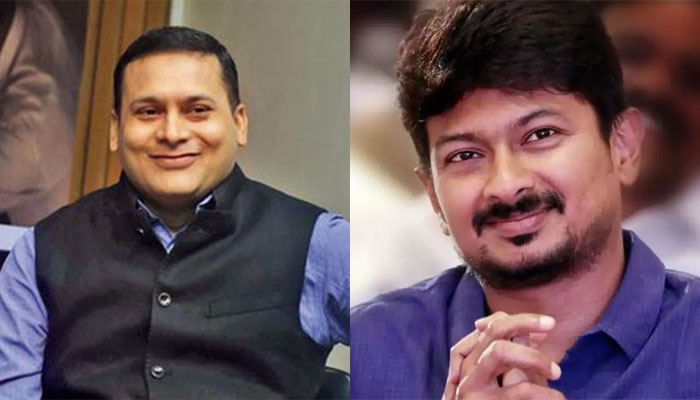
On September 6, Tiruchirappalli police said in a statement that they have filed an FIR against Bharatiya Janata Party (BJP) IT Cell head Amit Malviya following a complaint suggesting he ‘distorted’ DMK Minister Udhayanidhi Stalin’s remarks on Sanatan Dharma. Speaking to PTI news agency, police said a case of deliberately misrepresenting Stalin’s remarks to cause disharmony and enmity among different sections of society has been registered against Malviya.
As per reports, the complainant said that Udhayanidhi Stalin gave a speech at an event held by Tamil Nadu Progressive Writers Forum where he said that Sanatan Dharma should be eradicated like mosquitoes, malaria, dengue and corona. The complainant claimed Malviya distorted the statement and posted on social media that Stalin called for the genocide of Hindus.
In a post, Amit Malviya said, “Udhayanidhi Stalin, son of Tamilnadu CM MK Stalin, and a minister in the DMK Govt, has linked Sanatana Dharma to malaria and dengue… He is of the opinion that it must be eradicated and not merely opposed. In short, he is calling for genocide of 80% population of Bharat, who follow Sanatan Dharma. DMK is a prominent member of the Opposition block and a long standing ally of the Congress. Is this what was agreed in the Mumbai meet?”
Udhayanidhi Stalin, son of Tamilnadu CM MK Stalin, and a minister in the DMK Govt, has linked Sanatana Dharma to malaria and dengue… He is of the opinion that it must be eradicated and not merely opposed. In short, he is calling for genocide of 80% population of Bharat, who… pic.twitter.com/4G8TmdheFo
Notably, Udhayanidhi and Karnataka minister Priyank Kharge were booked by Uttar Pradesh police on the complaint of a lawyer, Ram Singh Lodhi, for “outraging religious sentiments”. Both were booked under Sections 295A and 153A of the Indian Penal Code (IPC). Rampur Police said, “A case has been registered against Udhayanidhi for his statement calling for the eradication of Sanatana Dharma and against Kharge for supporting the statement.”
In his complaint, Lodhi said, “Udhayanidhi compared Sanatana Dharma with diseases like dengue and malaria, and said it should be eradicated… This remark hurt the religious feelings of Sanatanis like me and should be seen as an act of creating hatred among people.”
The development came hours after he courted controversy for comparing the Hindu civilisational, religious philosophy with ‘malaria’ and ‘dengue.’ While talking to X (formerly Twitter), Udhayanidhi Stalin wrote, “Sanatan Dharma is a principle that divides people in the name of caste and religion.”
“Uprooting Sanatan Dharma is upholding humanity and human equality…I spoke on behalf of the oppressed & marginalised who suffer from the Sanatan Dharma. I spoke on behalf of the oppressed & marginalised, who suffer due to the Sanatan Dharma,” he said.
“Let me reiterate the crucial aspect of my speech: I believe, like the spread of diseases like COVID-19, Dengue, and Malaria by mosquitoes, that Sanatan Dharma is responsible for many social evils,” he further emphasised.
The recent hate speech by Tamil Nadu Chief Minister Stalin’s son and minister as well as anointed heir to the throne, Udhayanidhi Stalin against Hindus has produced a variety of interesting responses from Hindus – both inside and outside the right wing or BJP ecosystem.
Before we get to that, let us understand a few things clearly. Because it puts things in perspective and helps us in responding.
This is nothing new. Anti-Hindu statements are as hold as the hills when it comes to DMK and its affiliate parties.
Open admiration for and worship of Islam & Christianity is also nothing new. Whether this is due to electoral, financial or other considerations you can guess yourself.
One hint – they rarely express admiration for Buddhism, an indigenous faith, that has none of the “defects” they claim are part of Hinduism. Ambedkar, first among those genuinely trying to uplift the downtrodden, embraced it for that reason. Is it because it is not proselytising and doesn’t have billions of dollars to back it up? Is it because its followers don’t believe in violence as a remedy No 1?
In other words, their rationalism has been a farce for a long, long time. Lack of faith in Hindu gods is just one among a long list of things they don’t believe in – integrity, decency, respect for others, obedience to law and civilised conduct. Ask the late Jayalalitha.
It is exactly because their rationalism is a farce, it has been a grand failure. Remember, they had nearly six decades of continuous rule – almost twice as long as Marxists had in Bengal. Yet today TN is far more religious than it has ever been! There are holy ashes on the foreheads of lots and lots of people and temples are still well patronised. The challenge from evangelist dollars is altogether a different topic and I am ignoring it for this purpose.
As if that’s not enough, within DMK itself, today you see ministers sporting Kumkum or Ashes on foreheads, something for which they were expelled not too long ago! Is this newfound tolerance or practical realisation that their Hindu hate stock in trade has ceased to be a vote puller, I leave it to you to guess.
Yet another factor is that there are other ‘competitors’ that have picked up the same anti-Brahmin/Hindu theme and DMK cannot be seen as abandoning it. They are far more abusive and even violent. It is to the credit of ADMK that they have not fallen in this trap.
I think this anti-Brahmin/Hindu hate is being worked up mainly to cover up the fact that the entire “movement” has degenerated into a business venture that empowers and enriches one family.
Remember, Sri Lankan issue, which was milked for years by the first family has now been demonetised. No more farcical “fast unto death” from 9am to 12noon when the biriyani is ready to be served. What is left? Go back to anti-Hindu hate.
Let us now turn to the issue of handling this latest challenge.
I am amused to see Twitteratti and others trying to “educate” the DMK on Sanatana Dharma or point out the fact that Tamil Nadu has been Hindu for aeons. They know this. It is a waste of time.
It is also pointless to get into wordplay with them about Sanatana, Hinduism, Hindutva and so on. They are far better in that game and will beat you in straight sets. After all, to quote a Subramanya Bharati phrase, they are nothing but “warriors of the tongue”. The “genocide” charge, while perfectly valid, was washed off in no time by their ecosystem, by making silly comparisons to “Congress mukt”. This is exactly how they operate.
It is also pointless to mount lawsuits, even if our woke lordships will simply not smile at the threat of violence or genocide on Hindus as Justice Thomas did. It will not be settled in our lifetimes anyway. Unless you change your name to Ranaa Ayuub.
Asking for an apology is also pointless, especially after the entire ecosystem has backed him up. It will help them to move on. To another set of hate speech and abuse.
Then what can be done? Simply ignore? Rollover and play dead?
NO!
My suggestion is simple – let people like Annamalai handle it. Any number of North Indians of any caste, let alone upper caste, wading into it will only play into their hands. His response so far has been brilliant and focused.
Secondly, go after the money trail.
After all, as I pointed out, not just “rationalism” but the entire “self-respect” movement that Periyar spawned, is reduced to a sick joke and farce. Just look at the abject sycophancy, falling at feet and the North Korean variety of praise that is a daily staple at DMK. The fancy titles they award themselves and the crass worship of one family will repulse and disgust anyone who even has 0.001% self-respect inside him.
It is now plain and simple a business venture. And business runs on money. Even a child on the streets of Chennai knows this family has money beyond the dreams of anyone. Even minor cadet branches of the family live in palatial bungalows with mysterious sources of wealth.
Modi Sarkar I am sure has enough intelligence to go after the money trail and make sure the people of Tamil Nadu see the evidence and the fact that they have been fooled all these years. It is much easier in the post-9/11 world to get intelligence on overseas deposits and investments. BEPS norms make it easier.
I am not talking of dramatic arrests and NATO (no action talk only). I am talking of painstaking evidence gathering, effective prosecution and going after benamis that will shake the foundation.
You may very well see Udhayanidhi sporting ash on his forehead if this is done the right way.
Thirdly, do the political work on the ground, quietly and effectively. Again, I would say just leave it to Annamalai and focus on cloning more Annamalai’s. Take the message directly to the people. They are ripe for genuine alternatives.
Can BJP convince TN voters that egalitarianism, rationalism, linguistic chauvinism, and anti-Hindu hate are just facades to cover up unbridled corruption and dynastic entitlement? Can it convince TN voters that a bunch of super-rich dynasts that never had to work for their princely life talking about “privileges by birth” is the biggest farce and reduces the entire argument to a joke?
It is interesting to notice one thing – AIADMK has not openly challenged the remark. But it is not to say they agree – they know there is other ways to take this on. Instead, they are going after “corruption” and “misrule”.
The empire that seems to be in top form and power, is rotting from within. This is usually the case. BJP and every nationalist Indian or Tamilian just need to understand this and work towards the goal. All else is just noise.
On Wednesday, 6th September 2023, the Punjab and Haryana High Court slammed Punjab Police when it stated that police officers appeared to have colluded with individuals involved in illicit mining activities in the Ropar region. The court further noted that the authorities were selectively targeting only economically disadvantaged individuals in their legal actions.
The Bench also criticised the police for the “sorry state of affairs” as they seemed to be making efforts to protect the actual culprits “at whose instance the illegal mining were being carried out.” Justice NS Shekhawat of the High Court further ordered the Ropar Senior Superintendent of Police to submit a comprehensive report explaining why those involved in illegal mining activities had not been named as accused in the case. Additionally, the SHO in question was instructed to appear before the court in person.
These instructions were issued in response to a petition filed by Aajamdeen against the state of Punjab, seeking pre-arrest bail in connection with an FIR filed on 27th July 2023 under the provisions of the Mines and Minerals (Regulation of Development) Act at the Nangal police station in Ropar district.
During the hearing before the Bench, Aajamdeen’s lawyer argued that the petitioner had no connection with the alleged incident and was identified as the driver of a vehicle allegedly used in the commission of the crime. The counsel further contended that the petitioner was not present at the scene and had been wrongly implicated in the case. Additionally, he cited a court order from a different case in which interim anticipatory bail had been granted to another individual.
The Bench issued a notice of motion to the state and instructed the petitioner to cooperate with the investigation. It clarified that he would be granted interim bail if arrested. Examining the case record, the Bench emphasised that only individuals of poor economic backgrounds, such as the JCB driver and a tipper operator, had been named as accused.
The court said, “It is a sorry state of affairs that the police are trying their best to shield the real culprits, at whose instance the illegal mining operations were being carried out. On advance notice, an ASI present in the court has informed that to date the police have not been able to ascertain as to at whose instance the illegal mining operations were being carried out.” The next hearing of this matter is scheduled for the second week of September 2023.
Amid the buzz that the government is reviving the second name of the country, Bharat, in a bid to rekindle civilisational legacy, another Bollywood actor has come out in support of this move.
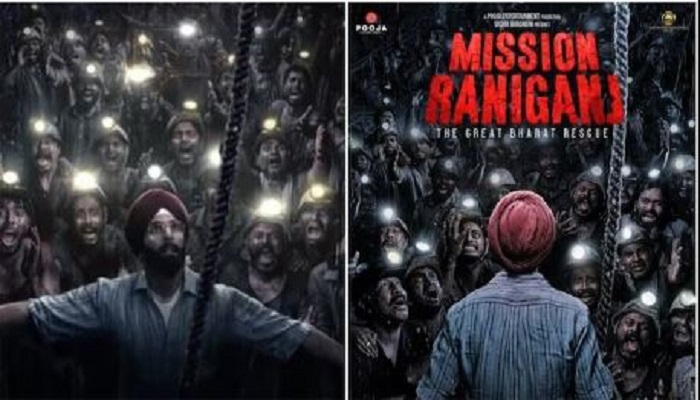
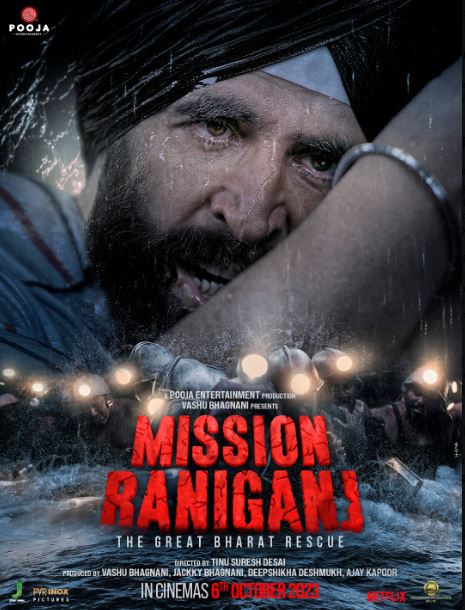
Evidently, Akshay Kumar has changed the name of his upcoming film and the title of the movie will now be ‘Mission Raniganj: The Great Bharat Rescue.’ The title change was announced by the filmmakers along with the first look poster of the upcoming film.
It is important to note that earlier the Akshay Kumar-starrer movie was titled ‘Mission Ranigan: The Great Indian Rescue.’ But the strong buzz seems to have prompted the makers to change the title and replace ‘Indian’ with ‘Bharat’.
(Image Source – Akshay Kumar X handle)
Taking to X, Akshay Kumar wrote, “Heroes don’t wait for medals to do what’s right! Watch the story of Bharat’s true hero with Mission Raniganj in cinemas on 6th October. Teaser out tomorrow!” He posted posters of the movie to be released on 6 October, which said that the title of the movie is ‘Mission Raniganj: The Great Bharat Rescue.’
Earlier, while speaking on the supposed name change issue Jackie Shroff dismissed the needless opposition by the leaders of the I.N.D.I.A. bloc. The Bollywood actor claimed that there was nothing wrong with calling the country Bharat.
#WATCH | On G20 Summit dinner invitations at Rashtrapati Bhawan sent in the name of ‘President of Bharat', Actor Jackie Shroff says, "If Bharat is being called Bharat, it is not a bad thing…we won't change even if the name is changed" (05/09) pic.twitter.com/PTzHE1I3Sa
Sharing her opinion in a Twitter post on the name change row, Kangana Ranaut said, “It’s (India) not our name we are Bhartiya, not Indians.
What is there to love in this name? First of all they couldn’t pronounce ‘Sindhu’ toh usko bigad ke ‘ Indus’ kar diya. Phir kabhi Hindos kabhi Indos kuch bhi gol mol karke India bana diya. From the time of Mahabharata, all the kingdoms who participated in the Great War of… https://t.co/R11hrMcjbH
Apart from Bollywood stars, the move has found support from legendary cricketer Virender Sehwag, who also urged BCCI to inscribe the name Bharat on the jersey of our cricket team for the upcoming Cricket World Cup.
Mission Raniganj
The movie is said to be inspired by a real-life incident that unfolded at “Raniganj Coalfield”. The lead character (to be played by Akshay Kumar) will reportedly take inspiration from the heroic act of the Late Jaswant Singh Gill who led a rescue mission beneath the 350-foot-deep coal mine in November 1989.
In a heroic act, Gill played a significant role and rescued all the surviving miners trapped inside a flooded coal mine in Raniganj which was a successful rescue mission in Bharat against all odds.
The film will hit cinema theatres on the 6th of October 2023. The star cast of the movie includes Akshay Kumar, Parineeti Chopra, Kumud Mishra, Ravi Kishan, Varun Badola, and Dibyendu Bhattacharya among others.
India is hosting the G20 conference this year in which top leaders, diplomats and businessmen of 20 major economies of the world are scheduled to stay in Delhi during the period. The face of the entire national capital has been modified. It took several months to prepare for the momentous occasion.
Since India assumed the presidency of the G20 in December 2022, significant events related to the highly reputed conference have been organised in parts of the country from Srinagar in Jammu and Kashmir to Thiruvananthapuram in Kerala and from Guwahati in Assam to Kutch in Gujarat. Multiple cities hosted important international events.
Any country that is given the honour to host a global event is provided with the golden opportunity to exhibit its capabilities, promote its culture and impart knowledge about its public welfare programmes to the rest of the world.
Prime Minister Narendra Modi made it crystal clear from the very beginning that India’s G20 presidency would be employed to advance the idea of ‘One Earth, One Family, One Future.’ India counted green development and women-led progress among the priorities of its G20 presidency.
Now, let us travel back in time to 2020 when there was a different government in the country. Dr Manmohan Singh was the Prime Minister and the Congress-led United Progressive Alliance, known as UPA (which has now abandoned the name and formed a new alliance called I.N.D.I.A.) was in power at that time.
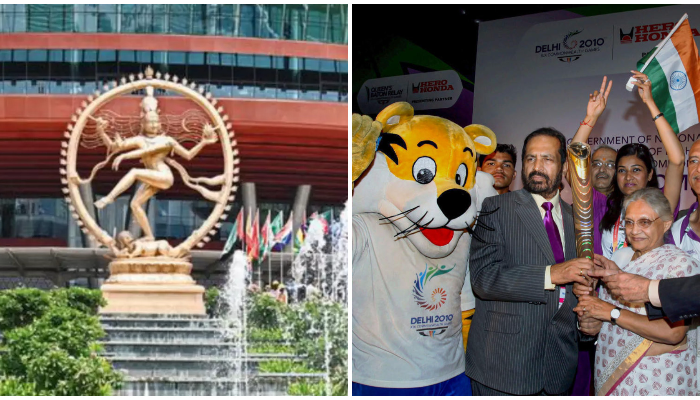
Former Congress president and Rae Bareli MP Sonia Gandhi was at the helm of affairs. India had the chance to demonstrate its power to the world even then. With six years in office, the Congress government had ample time to accomplish a lot of things. Commonwealth Games were held in India in 2010 in which 4352 players from 71 countries participated.
However, what did the previous government do with the chance? Not only was it lost, but the country’s image was also tarnished due to scams that people believed India was incapable of hosting even the most basic international event, let alone promotion of the culture.
Although India had already hosted the Asian Games in 1951 and 1982, the 2010 Commonwealth Games were the biggest sporting event to take place in Delhi up until that point. The fraud in the Commonwealth Games cost the nation the most money in the chain of severe corruption scandals witnessed during the UPA period.
The event didn’t deliver any good news for India in terms of safety or sanitation, labourers’ allowances and conditions, delayed work, claims of racism, allegations of a rise in prostitution, or in any other area.
Whenever India showcases its strength to the world through G20 and makes the world aware of its culture, the time has come to assess how the country missed the opportunity in 2010 whereas the chance received in 2023 was used in the best possible way and that too without any controversy.
However, as opposed to the Commonwealth Games, which was a sporting event, the G20 is a diplomatic gathering, but there is a connection between the two because both are global events. The former could have been utilised to enhance India’s position on the international stage if the government of the day had displayed the right intentions.
A major reason for this was that during the UPA era, the administration had nothing to show in the name of achievements and on the other hand the Modi government is active in the implementation of the schemes.
2010 Commonwealth Games: Corruption, negativity and blot at nation’s image
Crores of rupees were spent for the Commonwealth Games, but the conditions in Delhi did not improve at all. It was promised that the national capital would be transformed into a city of international stature, but nothing of the sort occurred. Furthermore, the accommodation for the players and foreign nationals wasn’t completely prepared.
Imagine the impression that those who came to India from outside would have had of the country. The stadiums were not functioning properly, including one ‘Shivaji Stadium’ which was not even ready to host any game.
Even the ticket sales did not begin on schedule. Many roads were dug out and several had potholes in various places. Demolition was carried out in the name of the Commonwealth Games, but no repair and beautification work was undertaken. The planning for the event had a fixed deadline of March 2010, but it had to be extended to June, then to July, and eventually to August.
The crucial point is that it was established in 2003 that Delhi would host the Commonwealth Games in 2010. An estimate of Rs 19,500 crore was proposed for organising the Commonwealth Games, and as the budget grew, it became three times more, however, the result was underwhelming.
The proposed budget for the Commonwealth Games was Rs 19,500 crore, but the outcome was underwhelming even though the budget went up three times. The expense of restoring the stadiums was in the millions. The budget for the event was hiked numerous times and money was wasted, despite the fact that India was experiencing grave problems at the time, including poverty and malnutrition.
Today, while work is in full coordination for the G20, Mani Shankar Aiyar, who was a prominent Congress leader at that time had wished for the failure of the Commonwealth Games. Mani Shankar Aiyar served as the UPA’s Sports Minister at one point in spite of his opinion.
He stated that he would be very sad if the event became successful because then there would be more sporting events in the future. He opined, “I am delighted in a way because rains are causing difficulties for the Commonwealth Games. Basically, I will be very unhappy, if the Games are successful because then they will start bringing Asian Games, Olympic Games and all these.”
The state of education, infrastructure and health facilities was in such a poor condition that even Wipro founder Azim Premji criticized the expenditure. However, now, India not only provided 200 crore doses of indigenous vaccine during the Corona period but also sent them to more than 100 countries.
Let us have a look at how the underprivileged were treated during the Commonwealth Games. Two lakh people were ejected forcibly from 19 regions of Delhi under the pretext of work. This was discovered as a result of a study conducted by a non-governmental organisation (NGO) named the Housing and Land Rights Network (HLRN).
The majority of these individuals were not even relocated, whereas in the present, Prime Minister Narendra Modi refers to workers as “Shramjivi” and honours them during special occasions like project inspections and inaugurations as well as interacts with them.
Now, understand what happened during the Commonwealth Games. The working conditions were extremely poor. The employees were forced to work the entire day for less than 100 rupees and when many of them were hurt in accidents, they weren’t even allowed time off for treatment.
The Commonwealth Games saw widespread instances of child labour, notwithstanding the fact that it is forbidden in India. There were dozens of cases of both child labour and forced labour. The event registered a considerable upsurge in prostitution as well. The members of the escort service earned a lot of money. Just consider how a programme that could have helped India’s tourism industry was reduced to.
Women from other states were being brought as sex workers. One NGO even charged that more than 40,000 women were transported from the northeastern states alone. A ‘toilet paper scandal,’ which was a fraud in toilets also surfaced during the time. One toilet paper was bought by the organisers for $80. Similarly, liquid soap was purchased for $61 and first aid kits were purchased for $125. A tissue paper was purchased for 1500, in terms of rupees.
The Comptroller and Auditor General of India (CAG) discussed these frauds in-depth as well. About half of the volunteers quit their positions right before the Commonwealth Games. They weren’t offered any money and a certificate was used to tempt them.
Half of the 22,000 refused to work after training because of the poor system. These games were not even attended by spectators. There were complaints that the players were treated like animals in the opening ceremony. Australian athletes alleged that they were mistreated.
Racist incidents that targeted African sportsmen came to light. The highest honours are now bestowed upon Prime Minister Narendra Modi by nations like Papua New Guinea. African nations received Corona vaccines from India.
The situation in the newly constructed sports village was likewise dismal. Thousands of used condoms clogged the drainage system there. A number of countries also threatened to boycott the Commonwealth.
Suresh Kalmadi was given the task of planning the event and afterwards, the Central Bureau of Investigation (CBI) designated him as the primary accused in its charge sheet. It was revealed how he handed over several contacts to businesses in contravention of the law. He was released on bail after serving an 11-month sentence in Tihar Jail.
Now, think about the effect all of this would have had on the country’s image. There was time to use the occasion to improve our reputation, but instead, India’s standing fell so much that the nation had to deal with disgrace.
G20: India made good use of the opportunity and promoted its culture
The G20 is being successfully organised in India and no scam-related news has come to the fore. India is heavily promoting tourism under the umbrella as well. The Delhi Metro offers special passes so that visitors from other countries can visit significant locations in the city.
There was a separate meeting of the culture ministers of these nations and they ranged from tourism working groups to finance working groups. India has used the grand platform to regularly update the world about its accomplishments in the digital industry.
India’s most hi-tech convention centre was built in Delhi on 123 acres, free from any controversy. Not only was it named ‘Bharat Mandapam’ inspired by Lord Basaveshwara of Karnataka, but it also housed an idol of Nataraja, the presiding deity of the Chidambaram temple in Tamil Nadu.
There were no accusations of any corruption in the construction of the complex built at a cost of Rs 2700 crore. Prime Minister honoured the labourers and they did not face any issues here.
Numerous G20-related events were held in more than 50 Indian cities and boosted tourism. The important fact is that Delhi and the centre had the same party government during the Commonwealth Games. However, currently, there is Arvind Kejriwal’s government in Delhi, which remains in the headlines due to its conflicts with the Lieutenant Governor (LG) and the centre administration.
Despite this, there was no negligence in the development of infrastructure. The Lieutenant Governor has assured that these development works are set to continue in this manner. The Dhaulakuan-Airport route in Delhi was illuminated in addition to the roadways near Pragati Maidan. Numerous metro stations were renovated.
Up to Rs 100 crore in funding has been given, according to the New Delhi Municipal Council’s (NDMC) announcement from December 2022, to upgrade Delhi’s infrastructure. There are now new parks. The key aspect is that it is evident where the funds are being allocated. Additionally, it is visible how the Indian government is advancing our culture.
Today, when more than a billion transactions were made through the Unified Payments Interface (UPI) in the month of August 2023, the success of “Digital India” reflects the new story of India. Overall, more than Rs 15 lakh crore was transferred through UPI this month. The German minister used it to buy vegetables on the roadside and praised the system.
Where the opportunity was missed during the Commonwealth Games, this time it was capitalised on. A new Parliament building is built as part of the Rs 13,00 crore Central Vista Project. Moreover, money was not a topic of contention here either.
It is not that only one party can make such events successful. It is possible if the objective is right and the leadership is strong. Take Odisha as a case in point. It benefited immensely from the impressive organisation of the Hockey World Cup and its image uplifted to a level where the state raised an investment of Rs 10.3 lakh crore through ‘Make in Odisha Conclave.’ The event took place in January 2023 and a grand stadium was built in Rourkela in just 15 months.
Notably, during the Commonwealth Games in which the country’s image was tarnished, today the secretary of the same Commonwealth, Patricia Scotland has lauded India during the G20 Summit.
According to her, doing so would render it easier to address global concerns. Furthermore, she applauded the Indian Space Research Organisation’s (ISRO) “Aditya L1” and “Chandrayaan 3” missions. She also supported India’s digital transformation. India, based on her, is achieving extraordinary success.