On Sunday (June 18), the National Commission for Protection of Child Rights (NCPCR) took suo motu cognisance of a viral video wherein minor children were seen pelting stones at the police in Junagadh city of Gujarat.
In its letter to the SP (Junagadh), NCPCR said, “It has been brought to the notice that a massive violence took place in Junagadh, Gujarat on 17th June 2023 after the Junagadh Municipal Corporation issued notice to a Mosque near Majewadi Gate for illegal encroachment.”
“Through the said video, it is evident that many minor children have been seen stoning…as part of the mob,” it noted. NCPRC pointed out that it is a prima facie violation of Section 75 and Section 83(2) of the Juvenile Justice Act of 2015 and other relevant provisions of the Indian Penal Code (IPC).
National Commission for Protection of Child Rights (NCPCR) writes to Junagadh SP and requests his offices to initiate necessary inquiry, appropriate and necessary action in Junagadh Violence in which minor children are made to be part of the violence activities: NCPCR https://t.co/2ezmjvKkb6pic.twitter.com/sb01otgp7c
Whoever, having the actual charge of, or control over, a child, assaults, abandons, abuses, exposes or wilfully neglects the child or causes or procures the child to be assaulted, abandoned, abused, exposed or neglected in a manner likely to cause such child unnecessary mental or physical suffering, shall be punishable with imprisonment for a term which may extend to three years or with a fine of one lakh rupees or with both.
Similarly, Section 83(2) of the said legislation makes it clear –
Any adult or an adult group that uses children for illegal activities either individually or as a gang shall be liable for rigorous imprisonment for a term which may extend to seven years and shall also be liable to a fine of five lakh rupees.
NCPRC has requested the Superintendent of Police (Junagadh) to initiate an inquiry into the matter and register a First Information Report (FIR) against those found violating the above-mentioned Sections. The Commission has also asked the police to submit a report within 7 days of receiving the letter.
Violent mob attacks police and sets vehicles on fire in Junagadh
On Friday (June 16), a mob comprising hundreds of people attacked a police post in Majievadi Chowk in the Junagadh district of Gujarat after a notice was issued to demolish an illegal dargah located near Uperkot Extension.
The angry mob vandalised public property and set fire to vehicles parked outside the police post. The mob pelted stones at the police personnel present there, leaving several police officers including Deputy SP and a woman PSI injured.
The visuals of the incident emerged online wherein it is seen that the large mob hurls stones at the police while officers try to bring the situation under control by using tear gas shells.
An additional police force was deployed and a lathi charge was done to control the violent mob. Several vehicles were burnt and multiple police personnel were injured.
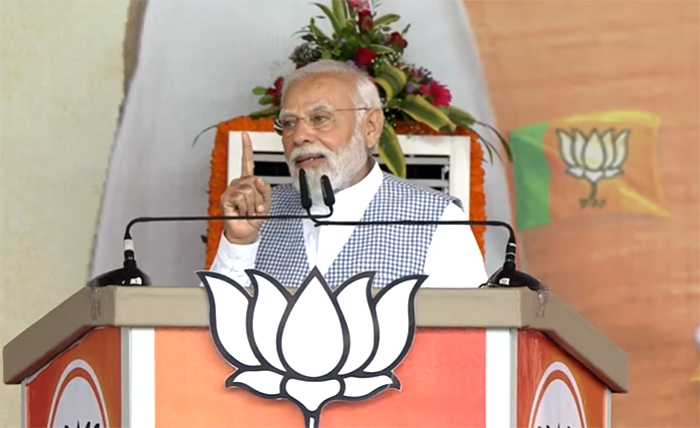
On Sunday, June 18, Prime Minister Narendra Modi addressed the 102nd edition of his monthly radio show ‘Mann Ki Baat.’ The flagship radio programme, which is traditionally broadcasted on the last Sunday of every month, aired a week earlier this month because of PM Modi’s upcoming State visit to the United States from June 21 to 24.
During his address, the Prime Minister remarked, “As you all know, I will be in America next week, and the schedule there is going to be very busy, so I thought what could be better than the blessings of the people to give me energy.”
"Usually 'Mann Ki Baat' comes to you on the last Sunday of every month, but this time it is happening a week earlier. As you all know, I will be in America next week and the schedule there is going to be very busy, so I thought what could be better than the blessings of the… pic.twitter.com/vKPO8SANL7
The PM called India the mother of democracy and reminded the country of the emergency and described it as a dark era in the country’s history when crimes were committed against people who supported democracy. “India is the mother of democracy. We cannot forget June 25. The day when emergency was imposed. It was a dark period in the history of India. Millions of people opposed the emergency with all their might. The supporters of democracy were tortured so much during that time that even today, the mind shudders.”
He mentioned, “Today, when we celebrate Azadi Ka Amrit Mahotsav we must also observe such crimes. This will teach the young generations the meaning and importance of democracy.”
In addition, he highlighted that many books have been written on these atrocities; the punishment meted out by the police and administration and pointed out that he had also got the opportunity to write a book titled Sangharsh Ma Gujarat at that time. He talked about another book on the subject titled ‘Torture of Political Prisoners in India.’
PM Modi also hailed the courage of the people of Gujarat who successfully braved cyclone Biparjoy. He asserted that the teamwork of the people reduced the damages inflicted due to the cyclone which made landfall in Gujarat on June 15.
“The strength of disaster management that India has developed over the years is becoming an example today. Cyclone Biparjoy wrecked so much havoc in Kutch, but the people of Kutch faced it with full courage and preparedness”, PM Modi said.
“There is a great way to combat natural calamities – conservation of nature. Nowadays, in the time of monsoon, in this direction, our responsibility increases even more,” he observed and stressed the need and significance of conservation of nature.
PM Modi praised Chhatrapati Shivaji Maharaj and noted that there is much to be learned from his managerial and leadership abilities. “When it comes to management, we should look at Chhatrapati Shivaji Maharaj. Along with his bravery, a lot is to be learned from his governance. His management skills particularly water management and the Navy still remain the pride of India”, he added.
He revealed the theme for this year’s International Yoga Day which is celebrated on June 21. “Yoga for Vasudhaiva Kutumbakam,” which means “Yoga for the Welfare of All as One World-One Family,” is the concept and it embodies the inclusive and all-encompassing nature of yoga. He is scheduled to lead the international event at the headquarters of the United Nations.
PM Modi will travel to the US from June 20 to June 24. President Joe Biden will host him at the White House, where the Indian Prime Minister will address a joint session of Congress. This is the third State visit that the US President has hosted in his tenure so far, the others being for Presidents of France and South Korea. Afterward, PM Modi will take a flight to Egypt on June 24 and 25, where he will meet with President Abdel Fattah El-Sisi and further develop bilateral trade and strategic ties. This will be PM Modi’s first visit to the country.
The curfew in a violence-hit Imphal Valley of Manipur has been relaxed from 5 am to 5 pm on Sunday, June 18, while the Indian Army conducted a flag march there.
#WATCH | Manipur: Indian Army conducted a flag march in the violence-affected area in Imphal Valley
The circular issued by the district magistrate, Imphal East, Khumanthem Diana Devi stated, “Total public curfew under Section 144 CrPC, 1973 prohibiting the movement of any person outside their respective residences imposed in Imphal East District vide this Office Order dated 3rd May 2023 is hereby relaxed from 5 AM to 5 PM on 18th June 2023 except for the area for which the schedule is given below in order to facilitate the general public to purchase essential items including medicines and food supplies”.
Hatta crossing to RDS crossing, the Imphal river from Sanjenthong to Minuthong, Minuthong to Hatta crossing, and RDS crossing to Sanjenthong are among those areas where the curfew would be relaxed.
In Manipur, a curfew has been imposed under Section 144 following conflicts between the Kuki and Meitei communities on the third of May. The ensuing violence took over 100 lives while thousands were displaced.
The state government has extended the internet shutdown until June 20.
A mob vandalised the BJP office in Manipur’s Thongju on Friday, according to officials. Reportedly, nine people were killed and more than ten were injured during fresh violence in Manipur on Wednesday.
Union Minister Rajkumar Ranjan Singh’s residence in Kongba, Imphal, was set on fire on Thursday night when the minister was in Kerala. Despite being a member of the Meitei community, he has continued imploring both sides to stop violence and allow the state to return to peace. Miscreants also attempted to set fire to Manipur minister Nemcha Kipgen’s official residence in Imphal West, partially destroying it.
On Saturday, officials informed that protesters clashed with security personnel through the night. Attempts were also made to set Bharatiya Janata Party leaders’ houses on fire, which led to the injuries to two individuals.
A mob of around 1000 individuals assembled to torch buildings adjacent to the palace grounds. It was dispersed by the Rapid Action Force (RAF) using tear gas and rubber bullets. It also cleared out an additional crowd that wanted to set MLA Thongam Biswajeet Singh’s residence on fire.
Manipur was rocked by violence on May 3 this year when confrontations broke out during a rally called by the All Tribals Students Union (ATSU) to protest the demand that Meitei be included in the Scheduled Tribe (ST) list. Since the Manipur High Court ordered the state administration to consider incorporating the community into the ST list, ethnic violence has been continuing in the state for more than a month. In order to quell the unrest, central paramilitary forces are stationed there.
Manoj Muntashir, who wrote the dialogues for the movie Adipurush, has said that the ‘problematic’ dialogues of the movie will be replaced. This follows a day after he had defended the dialogues after there was massive outrage over the language used by the characters in the movie based on Ramayana, especially lines spoken by the character of Hanuman.
Released on the 16th of June, Adipurush has found itself stuck in one controversy after another. At the centre of it lies the ‘problematic’ dialogues including those attributed to Hanuman, named Bajrang in Adipurush. Now, Adipurush’s writer Manoj Muntashir has come out publicly to address those concerns.
Following widespread criticism, Muntashir has announced that the problematic dialogues of Adipurush will be revised within this week itself. He shared this announcement through his official Twitter handle. However, he claimed that the team created Adipurush for Sanatan Seva, which audiences are seeing in large numbers and will keep seeing in the future as well.
Message from Adipurush’s writer Manoj Muntashir
In his tweet, Muntashir claimed that the first lesson anyone can learn from Ramakatha is to respect every emotion. He added that with time, right and wrong keep changing and only feeling remains. He asserted that he wrote more than 4000 lines in Adipurush and out of those, 5 lines hurt the sentiments of some people.
Muntashir claimed that he deserved praise for hundreds of lines where he glorified Shri Ram, and described Maa Sita’s chastity but he got none of it. He further claimed that instead of praises his own brothers (fans or Twitter supporters) wrote indecent words for him.
Further, he expressed, “The same people who I regarded as my own, for whom I recited poems in honor of their respected mothers on television, directed indecent words towards my own mother.”
Highlighting the fact that he wrote songs like ‘Jai Shri Ram’, ‘Shivoham’, and ‘Ram Siya Ram’ in the same film, he claimed that it was quick and inappropriate to label him as Sanatan-Drohi.
Muntashir added that the team has created Adipurush for Sanatan Seva, which audiences are seeing in large numbers and will keep seeing in the future as well.
Respecting the feelings of the fans, he said, “..for me there is nothing greater than your feeling. I can give countless arguments in favor of my dialogues, but this will not reduce your pain. Me and the producer-director of the film have decided that some of the dialogues which are hurting you, We’ll revise them, and they’ll be added to the film this week.”
रामकथा से पहला पाठ जो कोई सीख सकता है, वो है हर भावना का सम्मान करना. सही या ग़लत, समय के अनुसार बदल जाता है, भावना रह जाती है. आदिपुरुष में 4000 से भी ज़्यादा पंक्तियों के संवाद मैंने लिखे, 5 पंक्तियों पर कुछ भावनाएँ आहत हुईं. उन सैकड़ों पंक्तियों में जहाँ श्री राम का यशगान…
— Manoj Muntashir Shukla (@manojmuntashir) June 18, 2023
What was the controversy?
Adipurush makers drew flakes from fans and the general public alike for using uncouth language in Adipurush. Several dialogues of Adipurush went viral on social media where netizens claimed that they demeaned, trivialised Hindu Mahakavya Ramayana, and hurt the sentiments of Hindus.
In the film, there are several characters that have used street-level language like “Bete”, “Tere Baap ki Jali” and ”Bua ka Bagicha” among others. A few of those dialogues are as follows –
“कपड़ा तेरे बाप का! तेल तेरे बाप का! जलेगी भी तेरे बाप की”
“तेरी बुआ का बगीचा है क्या जो हवा खाने चला आया”
“जो हमारी बहनों को हाथ लगाएंगे उनकी लंका लगा देंगे”
“आप अपने काल के लिए कालीन बिछा रहे हैं”
“मेरे एक सपोले ने तुम्हारे शेषनाग को लंबा कर दिया अभी तो पूरा पिटारा भरा पड़ा है”
Earlier, Muntashir defended his approach and asserted that he intentionally crafted relatable dialogues to connect with the audience. The makers also claimed that they had not altered the original Ramayana. However, when the controversy spiralled they claimed that Adipurush is not an adaptation of Ramayana rather it is heavily inspired by Ramayana.
Despite intense criticism and fans registering their protests, Adipurush has entered Rs 200 crore club.
Manoj Muntashir had defended the dialogues
Earlier, Manoj Muntashir had defended the use of uncivilized dialogues, claiming that a very meticulous thought process has gone into writing the dialogues. In an interview given to Republic, he had said that it was not an error, and it was done deliberately. He stated that he wrote the dialogues keeping the ‘modern, contemporary’ speaking styles of the general public in the country.
Talking on Lallantop, he even went on to compare the controversy with the opposition faced by poet Tulsidas for writing Ramcharitmanas in Awadhi language instead of Sanskrit.
On June 18, wrestler and Bharatiya Janata Party leader Babita Phogat refuted the claims of one of the protesting wrestlers Sakshi Malik and her husband, Satyawart Kadian, that she helped in getting permission for protests at Jantar Mantar in January. In a detailed statement on Twitter, Babita called Sakshi a puppet of Congress and urged her to answer the public about their real intentions.
Babita Phogat’s statement
Babita said, “There is a saying, Don’t say such a thing about a friend that you need to hide it later. It will leave a sign of stigma on your forehead for a lifetime.”
एक कहावत है कि ज़िंदगी भर के लिये आपके माथे पर कलंक की निशानी पड़ जाए। बात ऐसी ना कहो दोस्त की कह के फिर छिपानी पड़ जाएँ । मुझे कल बड़ा दुःख भी हुआ और हँसी भी आई जब मैं अपनी छोटी बहन और उनके पतिदेव का विडीओ देख रही थी , सबसे पहले तो मैं ये स्पष्ट कर दूँ की जो अनुमति का काग़ज़… https://t.co/UqDMAF0qap
Yesterday, while watching the video of my younger sister and her brother, I was sad and laughed too. First of all, let me be clear that the permission letter shown by my younger sister has no proof of my signature or my consent anywhere, nor do I have anything to do with it far and wide.
Since day one, I have been saying that I have faith in our honourable Prime Minister and the Judicial System of the country. The truth will definitely come out. As a female sportsperson, I was always with all the country’s players; I am with them and will always be with them. However, I was never in favour of a sit-in protest since the beginning. I always told the wrestlers they should meet the PM or Home Minister as the solution would come from there.
However, you saw the solution in Deepender S Hooda, Congress, Priyanka Gandhi and their accomplices, who themselves are accused of rape and convicted in other cases. The country’s people have now recognised the faces of the opposition, and now they should come out in front of the country and answer soldiers, farmers and women wrestlers whose emotions were used for political gain.
The views of the women players who sat together on the sit-in were given a direction with all the prejudices where only your political benefits were visible. Today, when this video of yours is in front of everyone, now the people of the country will understand how much your protest on the holy day of the inauguration of the new Parliament building and the matter of flowing the medal won for the nation into the Ganges was embarrassing the country.
The country’s people have understood that you have become a puppet in the hands of Congress. Now the time has come for you to tell your real intention because the public is asking you questions.”
Sakshi Malik and Satyawart Kadian’s video statement
Babita’s tweet responded to an 11-minute video statement released by protesting wrestler Sakshi Malik and her husband, Satyawart Kadian. In the video statement, Kadian said that there were allegations in the media that Congress leader Deepender S Hooda instigated them to sit in protest. Contrary to the media reports, Kadian claimed that the permission for protests at Jantar Mantar in January 2023 was taken by two BJP leaders, Tirath Rana and Babita Phogat. Kadian said, “How could Congress be behind the protests?”
He further claims wrestlers and people aware of the matter knew such incidents, including harassment, were happening to female wrestlers. He added, “Some proof was given by coaches in media. People wanted to raise their voices against it, but there was a lack of support in the wrestling community.” He further accused the former WFI president of creating problems in the career of wrestlers who raised voices against him individually.
He further added the fight was not against the government as both the accused and those who got permission for the protests were from BJP.
Speaking about the delay in raising a voice against the WFI president, Sakshi claimed no one came forward because of a lack of support. Further, she claimed there was a lot of pressure on the minor victim to change the statement. She said, “The top wrestlers raised voices there, and you saw what all they had to face after that”.
Kadian further claimed that Khap leaders called the Mahila Mahapanchayat, and they were unaware of the inauguration of the New Parliament Building on May 28. He then claimed they felt broken after what happened on May 28 and decided to submerge their medals in the Ganga River. “But we became a victim of the system’s conspiracy. On that day, a man from the system pulled Bajrang away and made him talk to several leaders. They urged Bajrang to wait till 7 PM as a meeting was going on.” He further claimed at 7 PM, more people linked to some “system” came in large numbers. The situation was created, so there would have been violence if we immersed medals after that. So we decided not to immerse.”
He then thanked Sanyukt Kisan Morcha, Bhim Army chief Chandrashekhar Ravan, Satyapal Malik, women’s organisations and others for their support.
Kadian then thanked Rana and Phogat for supporting the wrestlers from the beginning. He said they became mediators and got a committee formed for investigation, but there was no result.
Discrepancies in Sakshi and Satyawart’s statement
OpIndia found a few discrepancies in the statements of Sakshi and Satyawart. First, they claimed that Tirath Rana and Babita Phogat got permission from the police station for the protest. While Babita denied involvement in the matter, the letter had no signatures of Phogat.
Babita Phogat’s name appeared without signature in the letter in question. Source: Sakshi Malik video
OpIndia spoke to Tirath Rana, who refused to comment on it. He said he was always with the protesters and would stand with them to get justice. When we talked about the signature in Hindi on the letter, it did not match the signature on the affidavit that he submitted to Election Commission in the 2019 Haryana Assembly Elections, Rana again said he would prefer not to comment. Here are the two signatures. On the left, you can see the signatures as shown on the letter presented by Malik and Kadian. On the right, you can see signatures from the affidavit available on ECI’s website.
Signatures of Tirath Rana mismatched. Source: Sakshi Malik video+ECI
Furthermore, Kadian claimed they were unaware of the inauguration of the new building scheduled for May 28. The decision to hold Mahila Mahapanchayat was taken by Maham Chaubisi Khap, a cluster of 24 villages in Maham town of Haryana’s Rohtak district. By that time, the inauguration was announced on May 19, 2023. The decision to hold Mahila Mahapanchayat was taken on May 21, two days after the announcement by the government.
One of the protesting wrestlers, Bajrang Punia, issued a statement after attending Khap Panchayat on May 21. He said, “We had declared that we’ll take some big decisions today if Singh is not arrested in 15 days. It has been decided that a Mahila maha panchayat will be held outside the new parliament building on May 28, and the wrestlers will attend.”
Some posts clearly show Sakshi Malik at the Maham Khap Panchayat.
लड़ेंगे और जीतेंगे
आज महम चबूतरे पर आयोजित पहलवानों के समर्थन में खाप पंचायत में हिस्सा लिया और अपने विचार रखे। जो पंचायत में हमारे बड़े बुजुर्गो ने फैसले लिए हम उनका सम्मान करते हैं। मैं पहलवानों को कहना चाहती हूं की इस लड़ाई में हम सब आपके आखिरी सांस तक खड़े हैं। pic.twitter.com/RiEV38jvGl
On May 22, Sakshi Malik shared a post that clearly mentioned that the Mahila Mahapanchayat would occur at New Parliament Building.
Source: Twitter
On May 23, Vinesh Phogat issued a statement to the media about the May 28 Maha Panchayat. Sakshi was standing next to her. When Vinesh said, “outside Sansad”, Sakshi interrupted her and said, “Nai Sansad”.
#WATCH | We have decided to hold a peaceful women's Maha Panchayat in front of the new Parliament on 28th May: Wrestler Vinesh Phogat pic.twitter.com/O2WPu7AFhw
It is unclear why they claimed no one among them knew that the inauguration of the New Parliament Building would take place on the same day announced Mahila Mahapanchayat outside the new building when the dates were announced two days before the decision by Khap was made.
18 June marks the 40th year of the execution of 10 Baha’i women in the Islamic Republic of Iran. 40 years ago on 18 June 1983, when the seeds of ‘Raliv, Galiv, Chaliv’ (convert, die or leave) were being sown on the Kashmiri soil by jihadis, 10 Baha’i women in Iran were executed for refusing to renounce their faith. Their only option was “Islam or execution.”
This day bears the spirit of Iran’s 10 Baha’i women who were executed for their faith by the Shia-majority country. Officially they were charged with various crimes including espionage, but it is well known that it was just a facade, and their real crime was refusal to convert to Islam.
The women were arrested in October and November 1982. They were tortured, denied the right to a lawyer, and were offered the opportunity to save their lives by converting to Islam. They were asked to sign statements declaring that they are not Baha’i, but they refused to do so. As a result, they were taken to Chowgan Square in Shiraz from the prison and were hanged one by one, which means those who were executed later were forced to witness the hanging of others.
Just two days before, several men were executed at the same spot, and some were relatives of the women.
These deaths continue to horrify Baha’i people but also inspire them in their continued fight against discrimination even today by the Islamic regime in Iran.
The fateful night of 18 June 1983
As nightfall began to sneak in, Mona Mahmudnizhad, along with her 9 peers, was dragged from the Adilabad prison in Shiraz. They were driven out to a polo field, where Mona’s father was executed merely days ago. What transpired after that sends shivers down one’s spine.
The driver of the minibus in which the prisoners were taken recounts the horror that transpired before his eyes.
The 10 women were hanged one after the other. The Revolutionary Guards perpetrated the murders in descending order of their age.
The eldest, 57, was Ezzat-Janami Eshraghi who was hanged first. The youngest was 17-year-old Mona Mahmudnizhad who had to witness nine executions before her turn came. At last, this brave young girl became a woman that night as she embraced the gallows and forever etched her name in the hearts of even her jihadi murderers. She smiled at her execution and sparked a revolution in Iran that continues to this day.
Roya Eshraghi, 23, was executed along with her mother, Ezzat-Janami Eshraghi, 57. Her father was executed two days ago on 16 June 1983. (Source: Iran Wire).
The ten Baha’i women executed in Shiraz on June 18, 1983, were:
Mona Mahmudnezhad, 17;
Roya Eshraghi, 23, was executed along with her mother;
Simin Saberi, 24;
Shahin (Shirin) Dalvand, 25;
Akhtar Sabet, 25;
Mahshid Niroumand, 28;
Zarrin Moghimi-Abyaneh, 29;
Tahereh Arjomandi Siyavashi, 30. Her husband, Jamshid Siavashi, was executed two days earlier;
Nosrat Ghufrani Yaldaie, 46. Her son, Bahram Yaldaie, was executed two days earlier;
Ezzat-Janami Eshraghi, 57, along with her daughter Roya, 23. Her husband, Enayatullah Eshraghi was executed two days earlier.
Mashid Niroumand, 28 (Source: Baha’i International Community).
Killed for their Baha’i faith
The 10 women were arrested in 1982 on the charges of “spying for Israel,” “insulting Islam,” and “teaching Baha’i children’s classes”.
Nosrat Ghufrani Yaldaie, 46. Her son was executed on 16 June 1983, merely two days before her hanging. (Sources: Baha’i Chronicles).
“Baha’i nistam” (I am not a Baha’i). These were the words they had to say in order to escape death. They were given four opportunities to say these two words.
Simin Saberi, 24 (Source: Baha’i International Community).
Little did the radical Iranian regime know that their faith was more dear to them than life itself; that life was a right, not an option to be lured into and that death was worthy when embraced out of faith than fear.
Shahin (Shirin) Dalvand, 25. (Source: Baha’i International Community).
They refused to utter the ugly lie that they were lured into speaking.
Akhtar Sabet, hanged at 25. (Source: Baha’i International Community).
Mona Mahmudnizhad & Her Essay
Months before her execution, Mona Mahmudnizhad wrote a revolutionary essay that got the Iranian regime’s knickers in a twist. The topic of the essay assigned by her religious studies teacher was “The fruit of Islam is freedom of conscience and liberty.”
Mona, 17, was the youngest among the 10 women and witnessed 9 executions one after the other only to “kiss the gallows during her turn.”
Knowing very well that she is expected to sing false praises for Islam, Mona stuck to the truth and wrote the following golden words:
“Freedom is the most brilliant word, but there have always been powerful and unjust men who have resorted to “oppression and tyranny. Why in my country are those who are members of my religion abducted from their homes at night and taken to mosques in their nightgowns, and subjected to whipping? As we have recently witnessed in our own city, Shiraz, their homes are looted and set on fire. Hundreds of people leave their homes in fear. Why? Because of the gift of liberty that Islam has brought? Why am I not free to express my ideas in this society? Why do I not have freedom of speech so that I can write in the newspapers, and express my ideas on the radio and television? Why don’t you let me be free…to say who I am and what I want? Yes, liberty is a Divine gift, and this gift is for us (Baha’is) also, but you don’t let us have it…Why don’t you push aside that thick veil from your eyes?”
Mona Mahmudnizhad with her father Yad’u’llah Mahmudnizhad, who was executed on 12 March 1983, almost a month before Mona’s hanging. Her father was hanged in the same polo ground where death awaited her next.
On the evening of 23 October 1982, there was a loud thud at Mona’s doorstep. Ruhollah Khomeini’s Revolutionary Guards barged into her residence, ransacked her family home, grabbed her and her father, and took them away.
Mona’s mother pleaded, “She’s just a child.” The jihadis produced Mona’s essay and said, “The person who wrote this isn’t a child.”
They were right. How could a woman of all but 17, fighting a deadly battle for truth with just her pen against an army led by a rancid mullah, be a child?
She was a voice they feared deeply.
Mona, as is clear from her essay, was undaunting and uncompromising in the pursuit of her faith.
According to U.S. govt records, during the trial of the 10 women, Judge Qazai questioned Mona, “You are just a child. How could you possibly know the real meaning of the world religion?”
To this, a bold Mona replied saying, “What more proof do you need than that I was dragged out of school and put in jail and now, for many months, have endured all these interrogations for the sake of my religion? What else but my faith could give me the strength and power to stand here in front of you and answer your questions?”
Death followed eight long months of torture
After her arrest, Mona was incarcerated in a filthy, stenchful prison cell and was subjected to torture. This survivor’s account narrates the ordeal faced by the prisoners including Mona.
Ruhi Jahanpour, another Baha’i woman, who shared the prison with Mona, said, “They blindfolded me and tied me to a kind of bed, and then they put my feet there…after a few lashes they would pause for a little bit because they knew our feet were getting numb and they wanted us to feel the pain. They would continuously say things like, ‘If you deny your faith, I’ll let you go.'”
Baha’i persecution by Islamists
The persecution and abuse of the Baha’i people continue in the Arab world to this day. After the Iranian Revolution in 1979, systematic persecution of religious minorities and women began to rise. Crackdown on Baha’i institutions, community activities, holy places, cemeteries, and properties became rampant. Executions, economic deprivation, mysterious disappearances of Baha’i people, detentions, and interrogations became an everyday routine constituting grave human rights violations.
More than 200 Baha’is have been executed or murdered. This is only the reported number, unreported cases could be much higher. Thousands have been arrested, detained, and interrogated, and tens of thousands more have been deprived of jobs, pensions, and opportunities for higher education.
August 1980: 9 Baha’i officials abducted
Nine members of the National Spiritual Assembly – a democratically elected national council that forms part of the Baha’i administrative structure in all countries – together with two individuals serving on other Baha’i institutions, were abducted by a group of armed men from their meeting in a private home and taken to an unknown location. They disappeared without a trace, presumably the victims of extrajudicial killings. The Iranian authorities have never admitted to this crime.
29 August 1983: Baha’i administrative activities banned
The then-Iranian Attorney General announced a legal ban on all Baha’i administrative and community activities in Iran, making membership in Baha’i administrative institutions a criminal offense.
11 December 2022: Baha’i women sentenced to second imprisonment
Regarded as the symbols of resilience in Iran, two Baha’i women, Mahvash Sabet and Fariba Kamalabadi, were sentenced to a second term of 10-year imprisonment after already having served 10 years.
They were arrested on 31 July 2022 for a second time in a series of fresh crackdown on Baha’is.
25 May 2023: Houthi gunmen abduct 17 Baha’is
Heavily-armed Houthi terrorists in Yemen stormed a peaceful Baha’i annual general meeting at a private residence in Sanaa. The Iran-backed Houthi terrorists abducted 17 Baha’i members including 5 women.
BREAKING#Yemen: Armed #Houthi gunmen stormed a peaceful #Bahai annual general meeting in Sanaa today, after years of persecution, detaining at least 17 including 5 women. Other homes also raided.
Yemeni Baha’is on Zoom captured this video. Details and our statement to follow. pic.twitter.com/CbMXsz3UY9
— Baha'i International Community (@BahaiBIC) May 25, 2023
On 2 June 2023, Mufti Shamseddin Sharafeddin, while delivering the Friday prayers, accused the abducted Baha’is of being traitors and said that if they did not repent, they will be killed.
Who are the Baha’is?
The Baha’i faith originated in Iran. Baha’is are the followers of the messenger Baha’U’llah born in Tehran in 1817, who founded the religion. Baha’U’llah attained spiritual realization upon pursuing the Babi Movement. Teachings of Baha’U’llah aka Mirza Husayn-‘Ali’ form the basis of the Baha’i belief.
The premise of the Baha’i faith finds similarities with Hinduism. Baha’is believe in pursuing the truth, oneness, harmony of science and religion among others, and being free from materialism. Albeit, even the messengers were not spared from the wrath of the tyrants. In 1850, the Bab was charged by Shi’i religious officials with heresy and was gunned to death.
Crackdown on his followers continued including on Baha’U’llah who was confined to an underground prison in Tehran. He was exiled to Baghdad in 1853 where he founded the Baha’i religion.
Baha’is are considered impure in Islam
While the Islamic nation recognises several other minority religions like Christianity, Judaism and Zoroastrianism, Iran does not recognise Baha’i faith. The country also accuses Baha’i people of being agents of Israel.
Hatred for Baha’is in Islam stems primarily from the fact that the former consider themselves a religion separate from Islam. Their (Baha’is) belief in Baha’U’llah negates the Islamist belief in the existence of Prophet Muhammad.
The teachings of the Baha’is religion are considered as posing a direct challenge to the doctrines of Islam. While Baha’is are proponents of maintaining a rational balance between science and religion, Islam still largely believes that the earth is flat, to say the least, because their messenger Prophet Muhammad said so.
Former Supreme leader of Iran Ruhollah Khomeini. (Source: Tablet Magazine)
When the 10 Baha’i women were in jail, survivor Ruhi Jahanpour explained that the prison guards were told that torturing the women would hasten the return of the Hidden Twelfth Imam awaited by the Shia Muslims.
“We have to get rid of all of you to prepare the way for him to come. The only reason that he hasn’t come yet is because of you dirty people,” the guards said.
Prison wardens, in order to avoid any physical contact with the “unclean,” and “impure” Baha’i prisoners, while guiding them to the interrogation room would give them one end of a folded newspaper and hold the other end.
Baha’is also believe that men and women are equal and deserve to be treated as such. This too directly challenges the many Islamic practices and sermons against women.
Iranian women’s resistance continues
The persecution of the Baha’is, especially women, serves as a reminder to the present-day Iranian woman to continue the fight for their rights. Women, including those from minority communities, in Iran, are still fighting for equal opportunities, for their right to not wear the hijab, the right to equal opportunity in education and employment, and so on.
Hijab is one such key issue that Iranian women are pushing against. Hijab, a headscarf, is mandatory clothing in Islam meant to cover women’s hair.
This month alone, the Iranian police have made over 300 arrests in a bid to enforce the confining dress code. Nearly a million warnings have been issued over text too. Arrests, detentions, and public beatings of women resisting this diktat are common news even today.
Breaking News New wave of systematic killing in Iran
Two young students have died in a suspicious manner during protests in Abdanan, Iran.
Mansoreh Sagvand, 19, was a young girl who was a former member of the police force. But, she too joined the protests. She died yesterday… pic.twitter.com/VnWKsIr67G
Iranian journalist and activist Masih Alinejad is a key voice running campaigns against the dogmatic Islamic Republic.
The Morality Police confiscated her car because she was not wearing the mandatory hijab . Her defiant response, “They cannot stop us by such appalling actions. We’re not afraid. They took my car away, Now I am walking, still without a hijab continuing our fight.”… pic.twitter.com/Q4RQitbIin
Campaigns like “White Wednesdays,” “My Camera Is My Weapon,” and “My Stealthy Freedom” have made the fascist Iranian regime foam at the mouth.
Tributes pour in for the 10 Baha’i Bravehearts
The Baha’i International Community today is marking the 40th anniversary dedicated to the 10 brave Baha’i women with the campaign #OurStoryIsOne.
Comedian Omid Djalili @omid9 made a video mirroring the last days of Mona Mahmudnizhad in the present-day context.
True story. To commemorate 40th anniversary of the horrific injustice done to the 10 Bahá’í women of Shiraz 18th of June 1983 @TinySpeck_ & I made this. Pippa Walton mirrors the last days of the life of Mona Mahmoudnizhad who was hanged aged 17. #OurStoryIsOne#GenderEqualitypic.twitter.com/aQnFaxz5PI
Prime Minister of India Narendra Modi and the then-President Ram Nath Kovind marked the 200th anniversary of the birth of the messenger Baha’U’llah.
In his letter to the Baha’i community of India, PM Modi wrote, “Baha’i Faith gives the world a vision of universal brotherhood.”
“The arduous path to gender equality in Iran has been walked by countless women over the decades. That road has been marked by the sacrifices of those who chose to stand for their principles even over their lives,” said Simin Fahandej, the Bahai International Community (BIC) representative to the United Nations in Geneva.
On Saturday, June 17, the Karnataka Chamber of Commerce and Industries (KCC&I) called for a “bandh” on June 22 in the wake of the abrupt electricity price hike by electricity supply companies (ESCOMs).
The KCC&I stated in its statement that it tried for eight days to communicate the impact of the high electricity rates, but all efforts were in vain.
“We request all the trade and industry to close their establishment on June 22. This is in protest of abnormal price hike in the electricity charges by ESCOMs. For last 8 days we have made attempts to convey the seriousness of the impact of the hike in electricity charges. However, no solution is forthcoming from the Officials or Government representatives.”
The KCC&I further urged all members to join the strike in order to bring the issue to the CM Siddaramaiah-led government’s notice.
“To draw the attention of the government, we are calling for this Bandh. We wish to find a solution and get a reduction in the electricity charges. We hope that the Government will respond to our request,” the letter further stated.
Karnataka Chamber of Commerce and Industries (KCC&I) has called for a Karnataka bandh on June 22nd to protest against the abnormal price hike in electricity charges: KCC&I pic.twitter.com/vlV4r3cjMg
Moreover, KCCI added in its letter that the District Chambers of Gadag, Bijapur, Ranebennur, Raichur, Talikoti, Vijaynagar, Mysore, Davangere, Koppal, Bagalkoti, Dharwad, Sirsi, Karwar, Bidar, Shivamoga, Kolar, Mandya, Chickmangalore, Yadgir, Chitradurga, KalyanKarnataka, Haveri, Hassan, Bellary and other Industry Associations have also agreed to join the agitation.
KCC&I statement calling for a bandh in the state of Karnataka on June 22 (Image via ANI)
Reacting to the KCC&I’s call for a Karnataka bandh on June 22, BJP leader Basanagouda R Patil tweeted, “In couple of years there will be exodus of industries from Karnataka to neighbouring states if government doesn’t consider the demands of the Industries.”
Karnataka Chamber of Commerce and Industry has called for bandh on 22nd June.
In couple of years there will be exodus of industries from Karnataka to neighbouring states if government doesn’t consider the demands of the Industries. pic.twitter.com/mevLnCXHiY
— Basanagouda R Patil (Yatnal) (@BasanagoudaBJP) June 17, 2023
Earlier, OpIndia reported that the energy costs and power tariffs in Karnataka have been increased by Rs 2.89 per unit in June despite Siddaramaiah’s state government’s free electricity pledge. Now the citizens will have to pay an additional Rs 2.89 per unit if their power usage exceeds the 200 units slab while paying the power bill.
The ‘fixed costs’ in the electricity bills produced by Escoms for June experienced a significant hike, ranging from Rs 50 to Rs 75 depending on the usage load. According to a Senior Bescom official, the invoices were created by the price decision issued by the Karnataka Electricity Regulatory Commission (KERC) notwithstanding widespread criticism of the Escoms.
A tariff increase of 70 paise was mandated by the KERC on May 13 with retroactive effect beginning on April 1, 2023. Similarly, the KERC updated the tariff a few days ago by including changes for gasoline and electricity purchase costs. “As KERC ordered us to collect the pending dues for April too along with that of May, the bill issued in June appears to be inflated. They will become normal from next month onwards,” a senior engineer with Bescom was quoted as saying.
On June 5, B.V. Gopal Reddy president Federation of Karnataka Chambers of Commerce & Industry (FKCCI) said that the hike of Rs 2.89 per unit in power bill has come as a dampener as it will increase the prices of their products & services and reduce their profit margin.
“Our feedback from our members reveals that some of the most vulnerable sections like micro and small-scale industries and small traders are finding it difficult to even survive due to high input costs. If recurring costs like power go up, they may even be forced to contemplate shutting shop. Those operating in the neighbourhood of other states may even explore possibilities of shifting to other states where such costs are lesser. We therefore fervently appeal to the government to first talk to representatives of Industry & Trade, take stock of their situation, and only then consider such issues of tariff revision,” Reddy stated.
The FKCCI further stated that any more load on the industry would be a “tipping point” for them to take drastic steps such as shutting down, shifting operations to other states, or reducing labour intake, consequently fueling unemployment.
The iconic Jain temple in Shima, Himachal Pradesh, has prohibited devotees, both men and women, from wearing revealing clothes, including shorts, mini skirts etc while visiting. A board with the order of the Digambar Jain Sabha is now placed in front of the holy place. According to the temple administration, this action was taken to preserve the tradition and culture of the place.
The regulation is reportedly ordered by the temple situated in the Middle Bazar of Shimla. There is an appeal for attention with Jai Jinendra at the top of the board. “All men and women are requested to come to the temple in decent clothes. Those wearing short clothes, half pants, Bermuda, mini skirt, night suit, torn jeans, frock, and three-quarter jeans among other outfits, please cooperate by visiting from outside only.” Shri Digambar Jain Sabha Shimla is listed as the signatory below.
Sanjay Jain, the temple priest, discussed the guideline with the media. People, he asserted, are losing touch with their cultural heritage. He stated that women not covering their heads is an example of this. He charged that numerous men have entered the temple without permission, and such behaviour, in his opinion, hurt the religious sentiments of the believers. He has also provided guidance to the followers on how to perform the darshan with devotion in mind.
Sanjay Jain pointed out that problem of entering the temple in inappropriate attire is not only restricted to Shimla but it is a problem in the entire country. He further continued that prayer for world peace and prosperity is held within the temple and hence decorum should be observed. He insisted on modest clothes in every sacred Sanatani place. Notably, last month Bollywood actress Kangana Ranaut shared pictures of females wearing shorts to temples and advised them to dress properly.
A proper dress code is in place for several of the temples in Maharashtra, Uttar Pradesh, and Uttarakhand. Last week, the same was introduced at the Ashok Nagar Temple in Madhya Pradesh.
Two sisters identified as 30-year-old Pinky 30 and 29-year-old Jyoti were fatally shot by an unidentified group of assailants in southwest Delhi’s R K Puram. The incident took place in the early hours of Sunday following a dispute about a loan that was given by their brother to some individuals. They died at the Safdarjung Hospital where they were taken for the treatment.
Delhi | Two women were shot dead by unidentified assailants in Ambedkar Basti area of RK Puram PS limits, today.
The deceased have been identified as Pinky (30) and Jyoti (29). The assailants came for the victim's brother primarily. Prima facie seems to be a money settlement… pic.twitter.com/D8FkYiHQwp
According to the family, the attack followed a heated argument between their brother and some people who had taken some money on loan from him. The brother Lalit had asked them to return the money, which resulted in an argument. Later, the borrowers arrived at the house in the night to kill Lalit, but his sisters came in the way and the assailants shot them instead.
“My elder brother, Lalit gave a loan to someone and yesterday he went to take it back where he had a heated argument with some people. He came back and we were sleeping when some people started knocking on our door at around 2.10 am,” said Lala, another one of their brothers.
He added. “All my relatives, including my sisters, stayed in the same locality and I called them up for help. After some time, all the attackers left. However, later, they returned, carrying weapons. They came to eliminate my brother, but my sisters came to rescue him and they shot them.”
Another eyewitness said that there were 7-8 people and they threw stones at the door and then broke the steel door before returning with guns.
Afterwards, an alleged video of the occurrence that showed a group of four to five persons cursing and shooting at the women went viral on social media.
According to Manoj C, deputy commissioner of police for the southwest, around 4:40 am, the RK Puram police station received a call from someone informing that their sisters had been shot at Dr Ambedkar Basti. He stated that both the primary suspect and his accomplice had been taken into custody.
He revealed, “We received a PCR call around 4:40 am at RK Puram police station from a man stating that some people shot at his sisters at Ambedkar Basti. Prima facie, the murders seem to be over the money settlement issue. The man said that some people have shot his sisters.” The police noted that they are registering a murder case and exploring other Indian Penal Code sections which are applicable to this case. Lalit, the brother of the victims, was the purported target of the attack.
Three persons have been arrested in connection with the case, identified as Arjun, Michael and Dev.
#UPDATE | Three people identified as Arjun, Michael and Dev have been arrested in connection with the murder of two women in Ambedkar Basti area. Further probe is being done: Manoj C, DCP South West, Delhi pic.twitter.com/W41LpFiSDD
In the meanwhile, Delhi CM Arvind Kejriwal didn’t miss to use this tragic incident to play politics. He alleged that instead of maintaining law and order, the central govt is conspiring to capture the entire Delhi govt.
दोनों महिलाओं के परिवारों के साथ हमारी संवेदनायें। भगवान उनकी आत्मा को शांति दें।
दिल्ली के लोग अपने आप को बहुत असुरक्षित महसूस करने लगे हैं। जिन लोगों को दिल्ली की क़ानून व्यवस्था सँभालनी है, वो क़ानून व्यवस्था ठीक करने के बजाय पूरी दिल्ली सरकार पर क़ब्ज़ा करने के षड्यंत्र कर… https://t.co/PxT6A2KnkK
On Saturday (June 17), billionaire businessman Elon Musk conceded that ‘Twitter shadowban’ is real and that the Twitter team did not know that such a thing was embedded in the Source code.
He made the revelations while reacting to a popular Twitter handle (@TitterDaily), which informed that the engineers at the micro-blogging site have recently found ‘shadowbans’ buried deep in Twitter code.
It said, “Just last week they found a measure that stopped accounts assigned a low ‘Reputation score’ from trending. This shadowban even applied to Elon’s account and prevented his tweets from trending.”
True. So many skeletons in the closet. No one at the company knew this code existed.
“The Reputation score applied to accounts was simply based on how many times an account was reported. This wasn’t relative to follower count – so anyone with a large following would be hit,” the Twitter handle emphasised.
While reacting to the tweet, Elon Musk acknowledged, “True. So many skeletons in the closet. No one at the company knew this code existed.” On Friday (June 16), the billionaire businessman vowed to increase transparency on social media.
He assured to introduce a feature, which would show users whether the Twitter code had shadowbanned them and the reason for the same. “If your account is in any way affected by the Twitter system, then you can see it clearly,” Musk remarked.
Elon Musk confirmed that Twitter is working on a feature which will allow users to see their account status.
It will be great because users can check themselves if they are shadowbanned or not & will also get to know the reason for the same. pic.twitter.com/B2w5s7Tpaj
Earlier this month, he spoke to the popular satirical website ‘The Babylon Bee’ and said, “Last week, we discovered a hidden layer of censorship, written in 2012…Censorship is maybe the wrong word…It would basically suppress…It had like a list of words…”
On June 13, a news report emerged which claimed that in the USA, nearly 100% of the fact-checkers’ contribution went to the Democrats and that they had a liberal bias.
“The study reviewed political donations over the past four election cycles. $22,580 of the $22,683 in political donations went to Democrats. Only three, obviously very small donations went to any Republicans!”, the report claimed.
Responding to this news, Elon Musk, the owner of Twitter, tweeted that all fact-checkers were biased. “The so-called fact-checkers are huge liars and incredibly biased”, he emphasised.