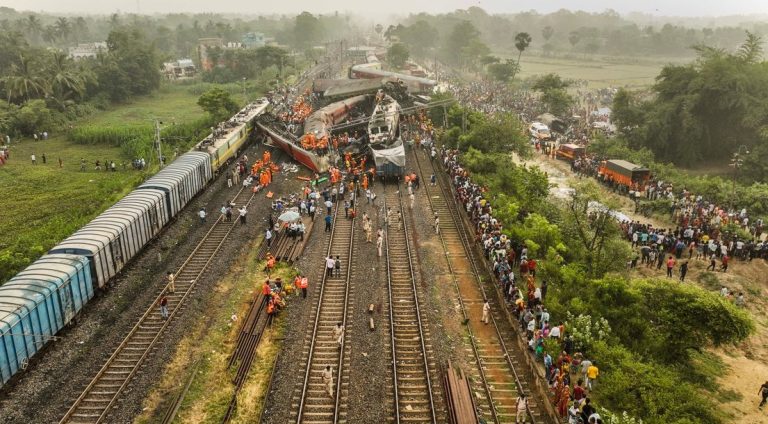
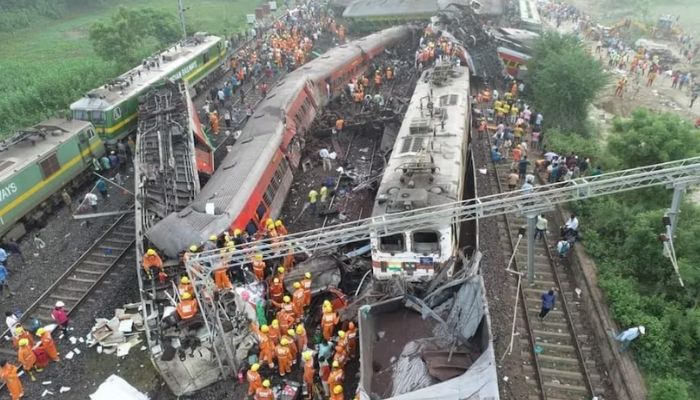
Union Railway Minister Ashwini Vaishnaw on Sunday said that the Railway Board had recommended the probe of the tragic Odisha train accident that claimed the lives of 275 people and leaving over 1000 injured, to the Central Bureau of Investigation (CBI).
While talking to the media, Ashwini Vaishnaw said, “Rescue operation was completed and restoration work is underway. The work related to the track is done and overhead wiring work is going on. Patients are being treated at hospitals. Along with rescue operation, the restoration work was also started.” “The way this accident happened, looking at the conditions, and according to the administrative information. The Railway Board is recommending the probe to the CBI,” he added.
The Balasore train accident where two passenger trains and a goods carriage were involved claimed 275 lives so far while over 1,000 people sustained injuries, Odisha Chief Secy Pradeep Jena said on Sunday.
Earlier today, Ashwini Vaishnaw said that the tragic train accident in Odisha’s Balasore occurred due to a “change in electronic interlocking”.
Electronic interlocking is an arrangement of signal apparatus that prevents conflicting movements between trains through an arrangement of tracks. It is basically a safety measure to prevent signals from being changed in improper sequence. The aim of this system is that no train gets the signal to proceed unless the route is proven safe.
Speaking to ANI, Ashwini Vaishnaw said, “This is a different issue. It is about a point machine, electronic interlocking. The change that occurred during electronic interlocking, the accident happened due to that. Whoever did it and how it happened will be found out after proper investigation.
“Speaking to ANI, Ashwini Vaihsnaw said, “This is a different issue. It is about point machine, electronic interlocking. The change that occurred during electronic interlocking, the accident happened due to that. Whoever did it and how it happened will be found out after proper investigation.”
Ashwini Vaishnaw who took stock of the restoration work at the Balasore train accident site in Odisha on Sunday said that the “down main line restored”.
“Down main line made fit at 12:05 hrs today,” Railways Minister Vaishnaw tweeted.
Meanwhile, as per the official figures, the accident on Friday night left 275 people dead and over 1000 injured.The three-way accident involved Bengaluru-Howrah Superfast Express, the Coromandel Express and a goods trains on three separate tracks at Bahanaga Bazar Station in the Balasore district.
(This news report is published from a syndicated feed. Except for the headline, the content has not been written or edited by OpIndia staff)
As the damaged tracks at the Bahanaga Bazar station in Odisha are being restored so that train operations can be resumed on the route, the focus has shifted to the cause of the horrific train accident involving three trains. According to the latest reports, 270 lives have been lost in the tragedy, and over 800 people are being treated in various hospitals.
Today Railway Minister Ashwini Vaishnaw said that the cause of the accident and the people responsible for the same has been identified. While he said that the matter is being investigated by the Commissioner of Railway Safety and it will not be proper for him to comment on it, he added that the accident took place due to a change in electronic interlocking.
It is notable that the Commissioner of Railway Safety is under the Civil Aviation Ministry.
Vaishnaw also said that the accident has nothing to do with the absence of the Kavach anti-collision system, adding that things like electronic interlocking, point machines etc were involved in the matter.
Before the comments of the railway minister, a preliminary probe report on the accident was leaked to the media. From the comments of the railway minister and the preliminary probe report, here is what can be derived on what had happened and how it could have taken place.
First, let’s first understand what really happened on Friday evening at the small railway station named Bahanaga Bazar station in Balasore district in Odisha on the Kharagpur–Puri line. This line is part of the Howrah–Chennai main line under Kharagpur railway division of South Eastern Railway zone, headquartered at Garden Reach, Kolkata.
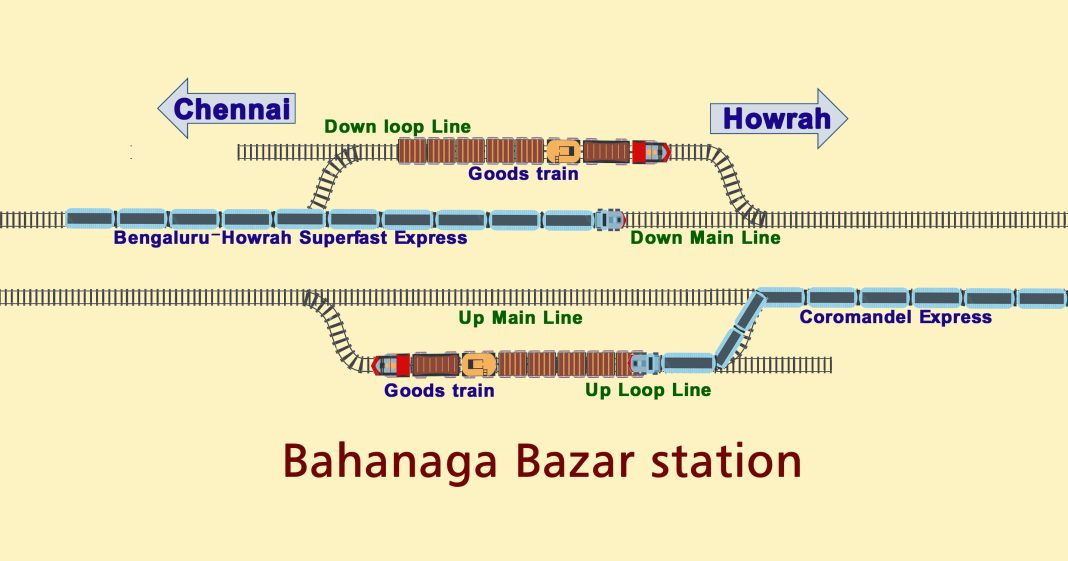
As it is a dual-track route, there are two main lines at the station. Apart from that, there are two loop lines on the outer side of both the main lines. Actually, there is another loop line next to the up main line, but it was unoccupied, therefore keeping it out of the discussion for simplicity. The loop lines are used to halt trains to allow faster or more important trains to pass them.
Bahanaga Bazar station (OpIndia illustration)
At the time of the accident, both the loop lines were occupied by two freight trains. At around 7 PM, Shalimar-Chennai Coromandel Express (12841) and Bengaluru-Howrah Superfast Express (12864) were to cross each other at the station on the main lines. Coromandel Express was travelling from Shalimar in Howrah to Chennai on the up main line, and the other train was in the opposite direction on the down main line, heading towards Howrah from Bengaluru. There was no stoppage of the two passenger trains at the stations and therefore they were running at high speed.
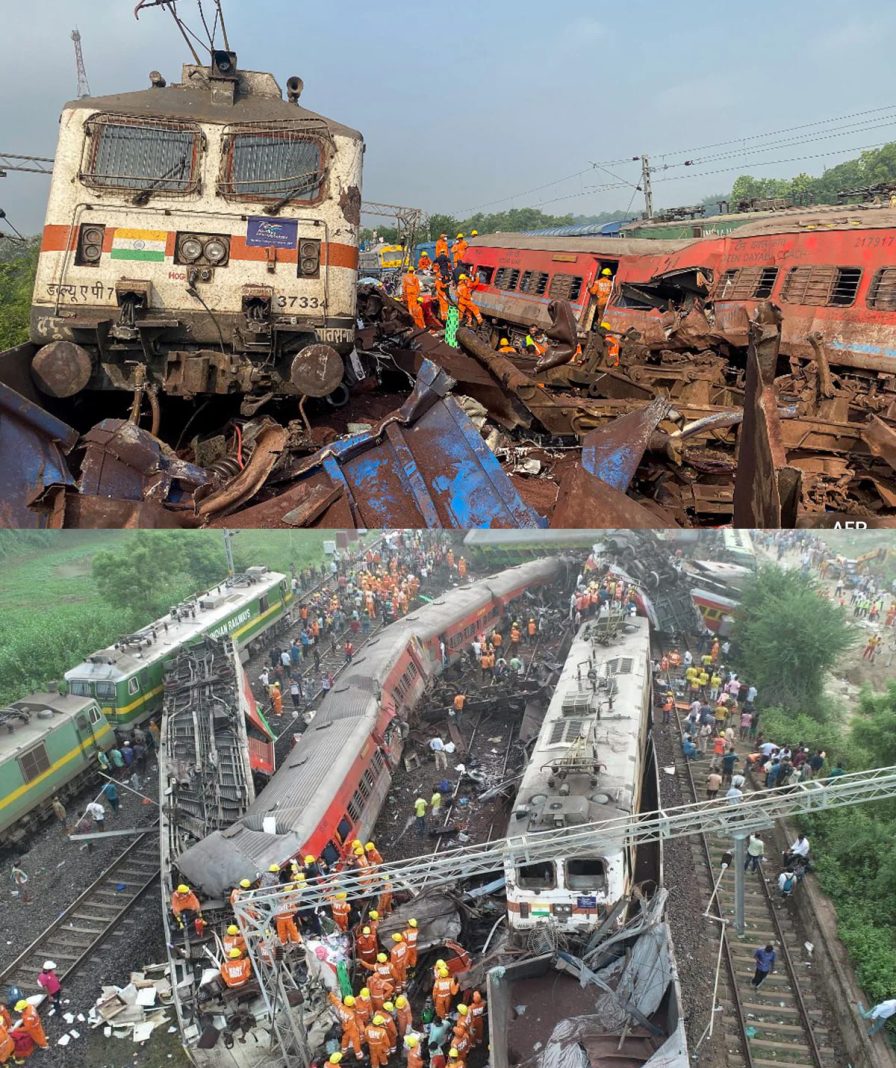
But when the Coromandel Express entered the station, it diverted to the up loop line instead of continuing on the up main line. As a result, it smashed into the parked goods train on the loop line. Such was the speed of the Coromandel Express that its locomotive climbed onto a wagon of the freight train. As a result, its coaches derailed.
Locomotive No WAP-7/37334 climbed onto a wagon of the train carrying iron ore after hitting it
At that moment, Bengaluru-Howrah Superfast Express had already arrived and almost crossed the station. But its last few coaches were hit by the derailed coaches of the Coromandel Express, resulting in the second passenger train also to derail.
The goods train that the Coromandel Express crashed into was loaded with iron ore, therefore, it was very heavy. As a result, it didn’t move much due to the impact, and the entire force of the impact was absorbed by the coaches of the passenger train.
Therefore, it has been almost confirmed that the deadly accident took place because the Coromandel Express entered the loop line instead of going straight on the main line.
Interlocking system
As the passenger train entered the wrong track and smashed into the goods train, this means the interlocking system, which selects whether the train will go to the main line or the loop line, was wrongly set. Both the preliminary report and the railway minister has confirmed this.
The interlocking system is a set of systems that ensures that the correct track is selected for an incoming or outgoing train, and the correct signal is displayed accordingly. This system consists of the points or switches, through which one track merges with another. The points enable the trains to move from one track to another.
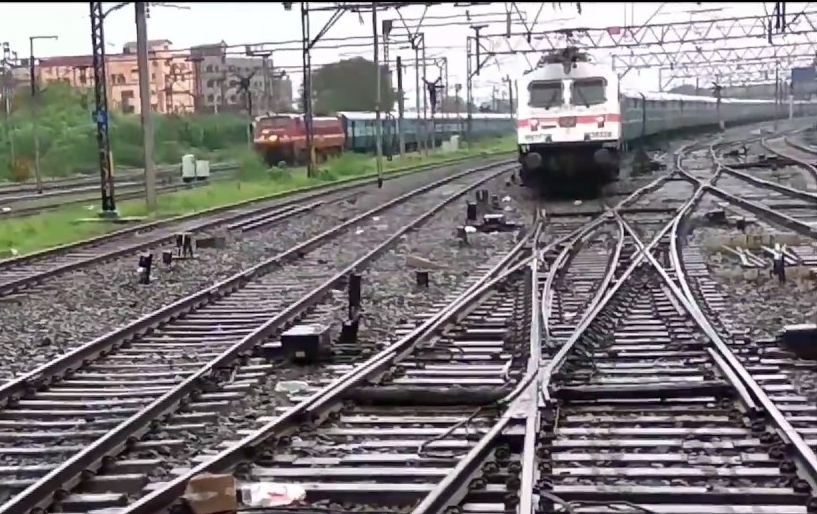
Points at Howrah
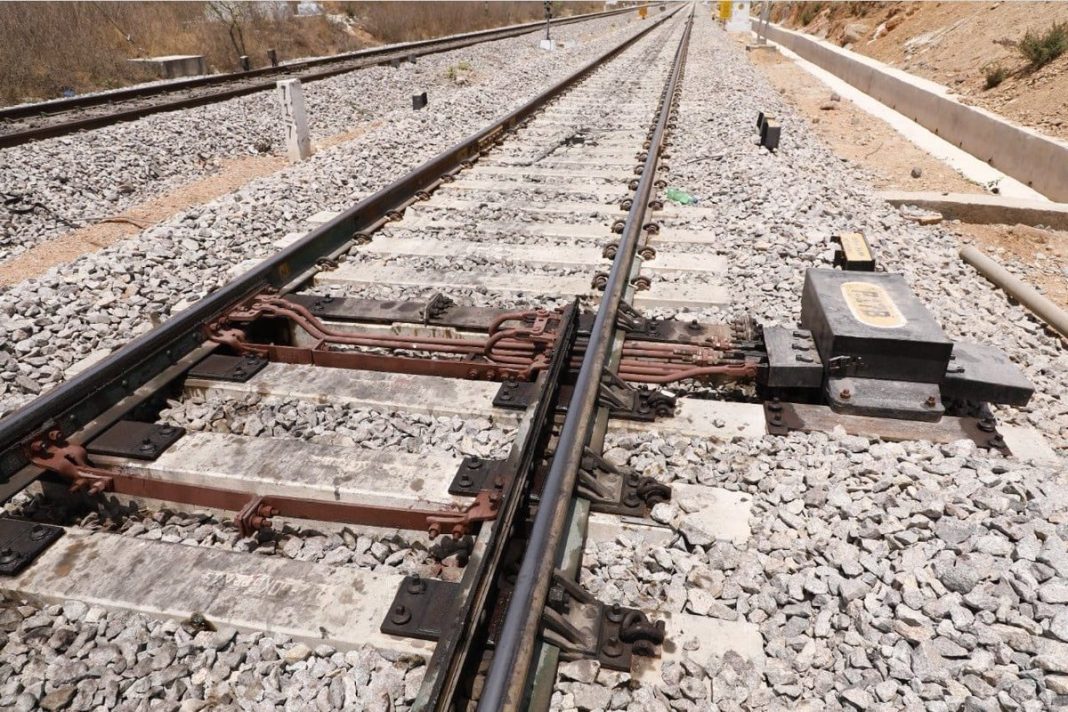
The points are laterally moveable rails with tapered ends, which can be aligned with either of the two tracks and then locked in position. To change alignment, it is unlocked, moved, and locked to the new position. The signals are linked to this mechanism, which ensures that wrong signals can’t be given.
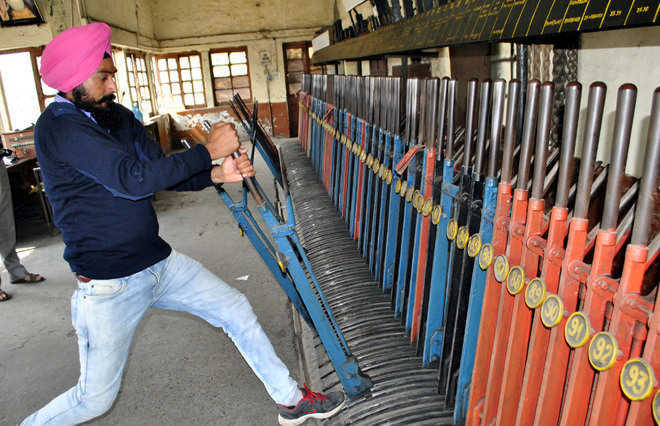
Earlier, the points were moved manually using levers. It this system, the points are attached to cables and rods, and going through a system of pullies, they end at levers positioned at the signal room. The levers are moved manually to switch the points. Later, the manual switching systems were replaced with mechanical systems that use electrical power to move the points and change the signals.
Lever-operated manual switching system
Now, electronic interlocking systems are used, which perform the same task, but with electronic and electrical devices. In this system, points are moved by pressing switches on the control panel, and based on the signal from the panel, tracks are moved by electronic point machines installed at the points. These devices have motors and other equipment to move the points and are located next to the switching points, connected with them via rods. The point machines are connected to the control room by wires. Based on the position of the points, information is shown on the dashboard in the control room.
Electronic Point Machine
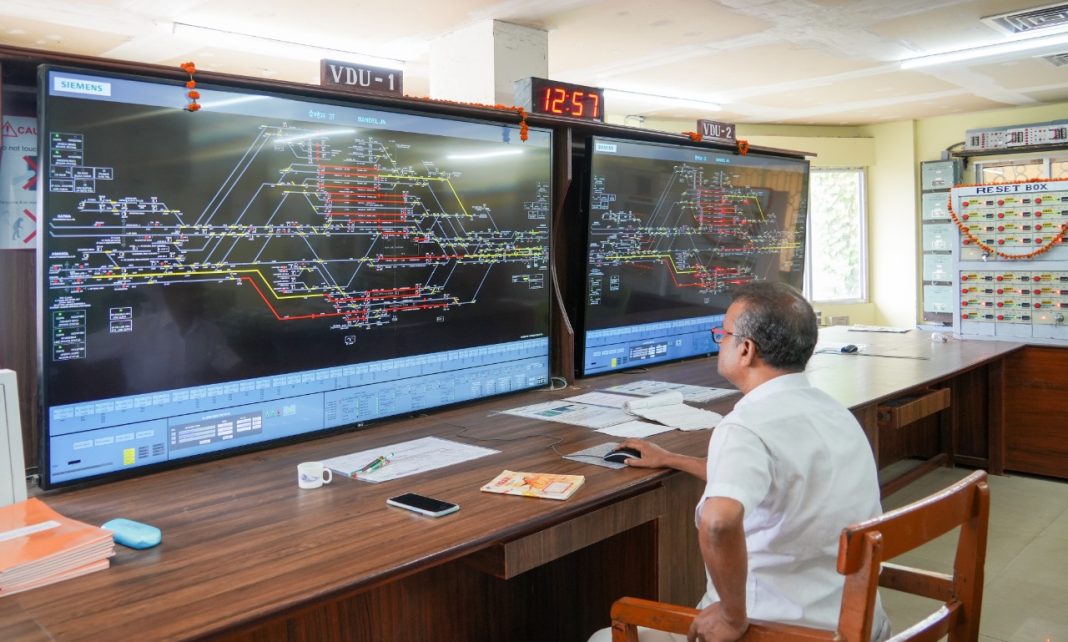
The positions of the points are displayed on a dashboard in the signal room either using coloured lights on a layout of the tracks or a digital display screen. When the point is set for the train to continue on the main line, it is called the normal position. And when it is set for the train to enter the loop line, it is called the reverse position. The current positions of all point machines are displayed on the screen on a real-time basis. The screen also displays the positions of trains on various tracks.
Electronic Interlocking System control room at Bandel Junction in West Bengal
After all the points are set correctly for a train, the signals are automatically set to green by the interlocking system.
In smaller stations like Bahanaga Bazar, there are only a small number of lines and switching points, and a train can be given the green signal by setting just one point in the correct position. But in bigger stations, junctions and terminals with a large number of tracks, dozens of switches are required to be set to the correct position for a train to be given the green signal.
The root cause
When the goods train carrying iron ore arrived on the up line at the station, it was diverted to the up loop line by setting point 17A to reverse position. After that, the point was to be switched back to the normal position, so that Coromandel Express can move ahead on the main line, as it does not have a stoppage at the station.
According to the preliminary report, a signal was given for the main line for the passenger train, but it was subsequently switched off. This means, while the point was switched to the normal position, it was changed back to the reverse position. This led the train to the loop line, causing the accident.
The preliminary report states that point no 17A was set for the loop line in the reverse position. However, in the panel, it was showing that the main line and the point were in normal position. This means, there was some fault which caused the panel to not show that the point was actually at the reverse position, leading the passenger train to the loop line, and instead it showed the normal position.
Two officials of Railways, Principal Executive Director of Signalling Sandeep Mathur and Member of Operation and Business Development Jaya Varma Sinha, have also confirmed the cause of the accident. “Only one train was involved in the accident, it was the Coromandel Express. The Coromandel Express crashed with the goods train and its coaches went on top of the goods train,” said Sinha.
She added that there was no question of overspeeding by both the passenger trains, and they were running at their approved speeds. She also said that there was no fault by the driver of Coromandel Express, as loco pilots depend on the interlocking system, believing it is set correctly by the station staff.
Railway Minister Ashwini Vaishnaw said that the person responsible for this has been identified, which indicates that the fault took place due to an error by someone responsible to operate the points. It is being speculated by some that point 17A was set to reverse after the iron ore train arrived so that it can be moved to the loop line and the passenger train can proceed straight. But after that goods train entered the loop line, the point was not set for the normal position due to some reason, causing the passenger train also to enter the loop line.
However, why the incident took place is a matter of a detailed investigation. It was most probably a mistake by Railway staff, but conspiracy theorists are claiming that it was deliberate. That is a very serious allegation, therefore it will be better to wait till more information emerges.
But it is by now confirmed that the accident took place after the Coromandel Express entered the wrong track due to a wrongly set interlocking system, causing it to smash into a goods train. It is also confirmed by now that it was not a head-on collision between two passenger trains. Such collisions mostly don’t happen these days due to the presence of dual tracks. But the passenger train did move into a track that already had another train and hit it at high speed, resulting in a rear-end collision.
This also dismisses the claim that the Coromandel Express derailed on its own and then its coaches hit the goods train and the other passenger train. If that had happened, the Locomotive of the Coromandel Express would not have ended up on the top of a wagon carrying iron ore.
In a recent order, a Sessions Court in Mumbai denied anticipatory bail pleas of a 42-year-old assistant manager and a 30-year-old sales manager of a real estate company. The two have been accused of sexually harassing the front office executive of the company.
The court noted that telling a female coworker repeatedly that she has a beautiful figure and has maintained herself well amounts to outraging her modesty. The accused duo further repeatedly asked the complainant woman for a date, which further added to the harassment allegations leveled by her.
In two separate orders issued last week, the bench led by Judge AZ Khan stated, “There are several aspects involved in the case whereby custodial interrogation of the accused is essential, otherwise the right to interrogate, by the investigation officer would be taken away, which certainly would affect the prosecution’s case and, ultimately, the complainant’s case on merit.”
The matter pertains to a woman who on April 24, 2023, lodged a police complaint alleging workplace sexual harassment. Acting on the allegation, the police charged the two with outraging a woman’s modesty, 354A for sexual harassment, 354D for stalking, and 509 for word, gesture, or act meant to insult the modesty of a woman.
Reportedly, the prosecution presented in court witness statements and documentation demonstrating that the accused persons sexually harassed the victim between March 1 and April 14. The accused duo would tell her, “Madam, you have maintained yourself… your figure is very is very beautiful… have you thought about going out with me?”
Following this, the woman went to the police station after complaining at her office.
On May 2, the accused filed bail pleas. They disputed the allegations and claimed they had been falsely implicated. In an order pertaining to the sales manager, the court stated that his father attempted to put pressure on the complaint and other employees.
In both orders, Judge AZ Khan stated, “No doubt, the offence is serious and against the woman. The present accused, along with the other accused, alleged to have outraged the modesty and uttered such filthy language towards the complainant in the working place and tried to pressurise the complainant and employers.”
Congress leader DK Shivakumar has finally spoken about taking the position of Karnataka’s deputy chief minister a few weeks after being chosen for the position. He stated that on the advice of Rahul Gandhi, Sonia Gandhi, and Congress national president Mallikarjun Kharge, he chose to give up the race for the office of the chief minister and to practise patience instead. After Congress won the Karnataka elections, there was a contest between Siddaramaiah and Shivakumar for the post of CM, but ultimately the party chose Siddaramaiah. While DK Shivakumar was made the deputy CM.
The 61-year-old, who also received the plum portfolios of Bengaluru City Development and Water Resources, visited his constituency to express his gratitude to voters. “You voted for me in large numbers to make me the chief minister, but what to do? A decision was made. Rahul Gandhi, Sonia Gandhi and Mallikarjun Kharge gave me some advice. I had to bow my head to their words,” he shared while addressing a public meeting.
He added, “I have to be patient. But the wish of God and the wish of all you people will never fall flat. Let’s be patient. That’s all I can say now.”
He also talked to the electorate in Shivanahalli, Kalahalli and Harohalli. His chief ministerial aspirations again came up Kalahalli. “From the point of view of bagging the chief minister’s post, people in the entire Old Mysuru region expressed their pride. But nobody needs to be disappointed,” he remarked.
The Karnataka Pradesh Congress Committee president positioned himself as the next Vokkaliga CM of the Congress after SM Krishna (1999-2004) in the run-up to the May 10 state election. He personally requested the people to support his bid for the post.
Government formation in Karnataka last month was preceded by several frantic negotiations between Siddaramaiah and DK Shivakumar and the party hierarchy in New Delhi. After Congress won 135 of the 224 seats in the recent assembly election the results of which were declared on May 13 both the two state Congress leaders faced intense rivalry for the position of chief minister.
He argued that since he had worked hard to revitalise the party in the state and achieve a resounding victory, he ought to be granted the post. Additionally, he asserted that in the most recent assembly elections, the Vokkaligas, who had previously supported the Janata Dal (Secular), had flipped their allegiance and supported him and the Congress, securing the highest vote total for the party in the Old Mysuru area.
He thanked the residents of his area for their warm reception and show of support and encouraged them to start making preparation for the panchayat elections. “I have come here to thank you and to take your blessings.” The largest margin in the state, 1.22 lakh votes, determined his victory in Kanakapura.
Since the Modi government came to power in 2014, a lot of work has been done to improve Indian Railways. From starting dedicated trains for tourism, introducing Vande Bharat Express, modernising Railway stations, and improving sanitary on stations and in trains, to developing technology and implementing projects to improve the safety of trains, the Modi government has managed to change the face of the Indian Railways.
Railway accidents were reduced substantially after the Modi government came to power
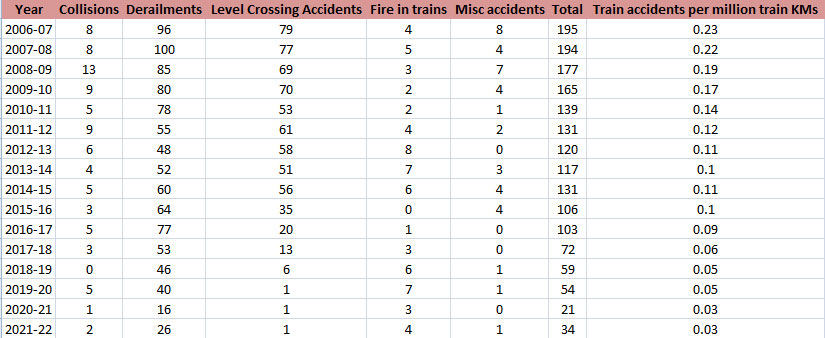
As per data available, in Financial Year 2006-07, there were a total of 195 train accidents in India. In FY 2007-08, there were 194 accidents followed by 177 in FY 2008-09, 165 in 2009-10, 139 in 2010-11, 131 in 2011-12, 120 in 2012-13, 117 in 2013-14, and 131 in 2014-15. Human Error has been the cause of over 80 percent of the accidents.
Data does not contain numbers from Konkan Railways. Source: Indian Railways.
Though the number of accidents was reducing, after the Modi government took charge, the situation started to change drastically. In FY 2015-16, 106 train accidents were reported. 103 accidents were reported in FY 2016-17, 72 in 2017-18, 59 in FY 2018-19, 54 in FY 2019-20, 21 in FY 2020-21 and 34 in FY 2021-22.
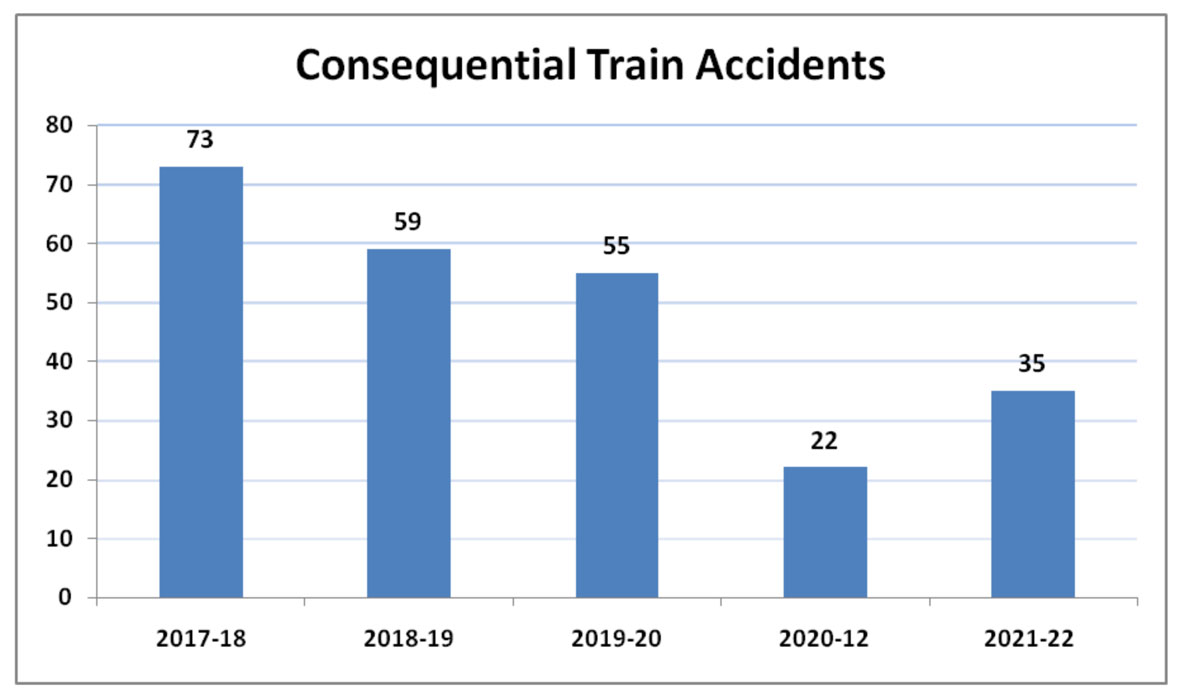
Data shows that the consequential train accidents including accidents at unmanned level crossings are down from 195 in 2006-07 to 55 in 2019-20, 22 in 2020-21, and till March 31, 2022. The accidents have come down despite the fact that Indian Railways has increased its traffic volume substantially over the past nine years.
Source: Indian Railways
The accident per million train kilometres is an important index of safety. It used to be 0.23 in 2006-07, it came down to 0.05 in 2019-20 and further to 0.03 in the year 2020-21.
Steps taken by the government to make travel via trains safer
The Indian Railway has developed Kavach which is made-in-India Automatic Train Protection (ATP) System. Kavach will not only aid Loco Pilot to avoid Signal Passing At Danger (SPAD) and overspeeding but will also help in operating trains during inclement weather conditions such as dense fog. In current times, fog causes serious delays and cancellation of trains due to the high risk of accidents. Kavach has the potential to solve the problem.
Indian Railways has introduced Automatic Fire and Smoke Detection system in the AC coaches. Furthermore, a fire detection and suppression system has been installed in power and pantry cars.
To improve fire safety in the coaches, IR installed fire retardant curtains, partition paneling, roof ceiling, flooring, seat, and berths along with cushioning material and seat covers, Windows and UIC Vestibules etc.
IR has also taken several measures to curb accidents at unmanned level crossings. It has introduced the interlocking of Level Crossing Gates. As on March 9, 2022, IR installed interlocking with Signals at 11,919 Level Crossing Gates. The railways have further decided to progressively eliminate level crossings to ensure the safety of road users and train passengers.
Data suggests that the government is working extensively in eliminating such crossings. In 2020-21, 961 manned level crossings were eliminated. In 2021-22, 686 such crossings were eliminated. Notably, all unmanned LCs on Broad Gauge have already been eliminated by January 31, 2019.
Based on the traffic congestion, IR is actively replacing level crossings with Road Over/Under Bridges/Subways in a phased manner. In 2018-19, 1,477 such crossings were eliminated followed by 1,315 in 2019-20, 1,113 in 2020-21 and 790 in 2021-22.
IR uses a lot of bridges across the country. To ensure the safety of the passengers, the bridges are being strengthened, rehabilitated and rebuilt as required. In 2020-21, work at 1,114 bridges was completed and in 2021-22 the number rose to 1,401.
IR is actively renewing tracks as well. In 2019-20 5,181 KM of tracks were renewed followed by 5,510 KM in 2020-21 and 3,966 KM in 2021-22.
To cover the expenses on these projects, the Government of India introduced Rashtriya Rail Sanraksha Kosh (RRSK) in 2017-18 with a budget of Rs 1 lakh crores for five years and an annual outlay of Rs 20,000 crores.
On 3rd June 2023, the All Kerala Men’s Association (AKMA) felicitated Savad Sha, accused of flashing and masturbating in front of women on a bus, as he walked out of jail on bail. He was apprehended by the Kerala Police last month on charges of indecent exposure and self-pleasuring while aboard a Kerala State Road Transport Corporation (KSRTC) bus.
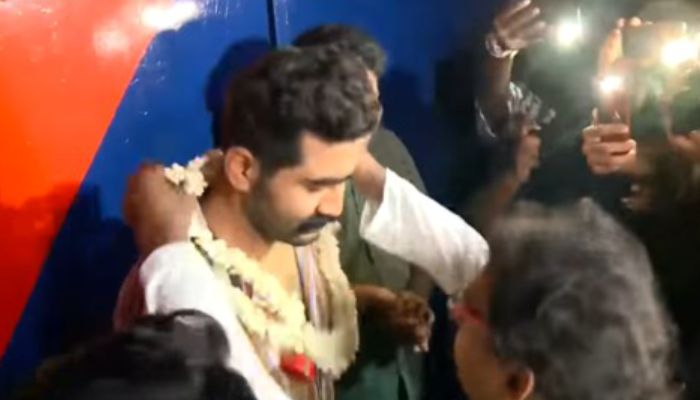
AKMA President, Ajith Kumar from Vattiyoorkavu, had announced that their organisation will greet the 28-year-old individual, who was lodged in Aluva Sub-jail, with a garland upon his release on bail. The organisation accordingly welcomed him upon his release today.
According to Ajith Kumar, Savad was allegedly arrested by the police following a false complaint lodged by a woman, and he is now reportedly in a critical state, contemplating self-harm. However, Savad Sha was seen smiling when he was honoured by this so-called Men’s Rights association.
Ajith Kumar had said, “Initially, everyone including us was supporting the complainant. But later we realised that it was an evil scheme by the woman who has destroyed the life of a young man. This should not happen to any other men in Kerala.”
Additionally, Ajith Kumar asserted that the woman, with the intention of gaining publicity and increasing her social media following, had uploaded an edited video on Instagram. He claimed that the complainant woman has disappeared after her ill will was exposed.
Ajit Kumar expressed his belief that existing laws are biased against men and advocated for the establishment of a Men’s Commission to address the alleged misuse of these laws.
Savad Sha, hailing from Kozhikode, was taken into custody on May 18 following a complaint filed by Nandita Sankara, an actor and model. According to Nandita, the incident took place during a KSRTC bus journey from Thrissur to Nedumbassery. Savad Sha boarded the bus from Angamaly and occupied a seat next to Nandita. After some time, he allegedly began touching her inappropriately. To her shock, Nandita also noticed that he was masturbating. Faced with this disturbing sight, Nandita decided to record the act and confront Shah in front of other passengers.
As the incident unfolded, Nandita tried to distance herself from Savad Sha’s advances. She captured his actions on video and bravely confronted him, exposing his behaviour to fellow passengers. In an attempt to escape, Savad Sha forcefully pushed aside the conductor and made an effort to flee the bus. However, the driver and conductor managed to apprehend him, leading to his subsequent handover to the Nedumbassery Police.
Initially, Nandita received widespread admiration for her courage in getting the accused arrested. However, in the following days, a targeted social media campaign emerged, casting doubt on her allegations and accusing her of seeking publicity through false accusations. These allegations created a divisive atmosphere around the incident, overshadowing the initial support received by Nandita.
In an exciting surprise for BTS fans, the band’s lead vocalist Jeon Jungkook is set to release his debut solo album on July 14, 2023. Jungkook will be the sixth member of the South Korean boy band to release a solo album. According to Sports Chosun, the BTS member will make his solo debut on July 14 with an album that will include an English B-side track.
BTS’ management agency BIGHIT, however, has issued a statement and said that an announcement regarding the schedule of the release of Jungkook’s debut album will be made once it is confirmed.
“We will make an announcement once the release schedule for Jungkook’s solo album has been confirmed,” BIGHIT stated.
The BTS ARMYs have long awaited Jungkook’s solo debut, as Jeon Jungkook has won their hearts as a singer not only as a member of BTS but also with solo songs such as “Still With You” and “My You”. His singles including the 2022 FIFA Qatar World Cup theme song “Dreamers” have rocked up the charts.
Interestingly, BTS members Jin, J-hope, RM, Jimin, and Suga have already released their solo albums. Jungkook and V are the only two members who have yet to release solo albums.
Jungkook from BTS has become the fastest solo K-pop artist to reach 1 billion streams on @Spotify (male).
It took him just 409 days with only three different tracks available to stream. pic.twitter.com/n5FJvmGRo1
In May this year, Jungkook set a Guinness World Record for the fastest K-pop soloist to reach 1 billion streams on Spotify in a record 409 days.
BIGHIT Music recently announced that BTS will release the digital song Take Two in June to commemorate the music group’s tenth anniversary. Take Two will be released on June 9 at 1 p.m. KST (9.30 a.m. IST). BTS made its debut under BIGHIT Entertainment a decade ago with the single album 2 Cool 4 Skool, which was released on June 12, 2013.
On Friday, 2nd June 2023, a triple train accident took place at Balasore in Odisha. Yeshvantpur (Bengaluru)-Howrah Superfast Express, a goods train, and the Coromandel Express were the three trains that collided in this complex accident. As many as 17 coaches of these two passenger trains were derailed and severely damaged in the accident on Friday evening leaving 288 passengers dead and injuring over 1,000 people.
Railway Minister Ashwini Vaishnaw, who reviewed the restoration work at the Balasore triple train collision site on Sunday, said the root cause of the accident has been identified and the track will likely be restored soon.
“Restoration work is ongoing at Warfooting at the train accident site in Balasore, Odisha with 1000+ Manpower working tirelessly. At present, more than 7 Poclain Machines, 2 Accident Relief Trains, and 3-4 Railway and Road Cranes have been deployed for early restoration. Officials are closely monitoring the restoration process at the accident site,” read the post on the official Twitter handle of the Railways ministry.
The Coromandel Express has encountered many accidents even in the past. This recent accident in Balasore, therefore, reminds people of the old mishaps with the same train that runs between Chennai and Howrah.
Derailment of Coromandel Express in 2002
The Coromandel Express, running between Howrah and Chennai, underwent a derailment on March 15, 2002, around 2:40 pm. The incident took place at the Padugupadu road over-bridge in Kovuru Mandal, situated in the Nellore district of Tamil Nadu. The investigation identified the deteriorated state of the primary railway track between Chennai and Vijayawada as the underlying cause of the accident.
Derailment and accident of Coromandel Express in 2009
On February 13, 2009, the Howrah-Chennai Coromandel Express encountered another unfortunate incident when it derailed approximately 100 km away from Bhubaneshwar in Orissa. 13-14 coaches of the train were derailed. The specific location was Jajpur Keonjhar Road. Tragically, the derailment resulted in the loss of 16 lives, while 161 others sustained injuries. Some of the injured individuals were in critical condition and later passed away due to their injuries. Following the incident, the Railways initiated a high-level investigation to determine the cause of the derailment; however, the exact reason remains unknown.
In another unfortunate accident involving the Coromandel Express, on 30th December 2012, in Odisha’s Ganjam district, six elephants, including two calves, lost their lives. Additionally, a Coromandel staff member also tragically died in the accident, although the exact cause of their death remains unclear.
Derailment of Coromandel Express near Nellore in 2011
The Coromandel Express experienced a derailment near Nellore in Andhra Pradesh on December 6, 2011. Tragically, the incident led to the loss of 32 passengers’ lives and caused injuries to numerous individuals.
Fire mishap in the train in 2012
On January 14, 2012, a fire incident occurred in the general compartment of the Chennai-Howrah Coromandel Express near Lingaraj Railway station. The fire originated in the second coach from the engine. Thankfully, the fire was swiftly brought under control within 20 minutes, and no injuries were reported. Initial findings indicated that the fire was likely caused by the negligence of certain passengers. Consequently, an additional investigation was initiated to delve into the incident.
Fire on the train again in 2015
A separate incident took place on April 18, 2015, when a fire broke out on the Coromandel Express at Nidadavolu Junction, resulting in damage to at least two coaches. The fire incident caused significant harm to the affected coaches of the train.
The triple train accident of 2023
The latest mishap with the Coromandel Express is one of the most horrific accidents in the history of Indian railways. On June 2, 2023, a recent collision occurred near Bahanaga Bazar railway station in Odisha’s Balasore district, resulting in the derailment of approximately 17 coaches of the Coromandel Express. This collision involved three trains, the Coromandel Express, a goods train, and the Bengaluru-Howrah superfast express. This accident claimed 288 lives.
A new development has taken place in the Savitribai Phule controversy. Indic Tales, Hindu Post, and the Twitter account TrueIndology were all named in an FIR filed by the Mumbai Police on Wednesday night. The case has been filed for allegedly “spreading false and malicious” content against social reformer Kratijyoti Savitribai Phule. It has been alleged that the content published by them was intended to inflame feelings and foster animosity between different groups.
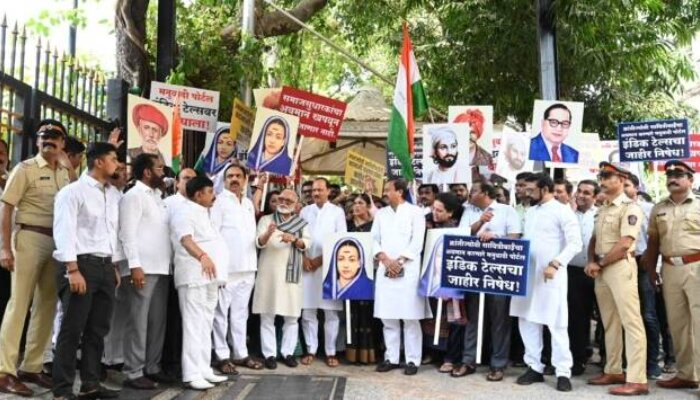
A group of NCP leaders protested outside the Mumbai Police Commissioner’s office earlier on Wednesday in response to ‘derogatory’ content on the websites Indic Tales and Hindu Post. They were led by Maharashtra Leader of the Opposition Ajit Pawar, former Minister Chhagan Bhujbal, and NCP State Chief Jayant Patil.
The leaders met with the chief of the Mumbai city police department and handed him a letter signed by the three NCP stalwarts demanding that these websites be shut down. They also claimed that the articles, which denigrated Savitribai Phule’s contributions, had been published with the intention of stirring up trouble.
Chhagan Bhujbal stated, “Indic Tales and Hindu Post have projected Savotribai Phule in a wrong manner. They have made highly objectionable remarks that cannot be tolerated in a progressive state like Maharashtra. Savitribai Phule was a great social worker. She had done pioneering work in the field of women and education. She started the first school for women in Pune.”
After they arrived at his office, Maharashtra Chief Minister Eknath Shinde immediately gave Chief Secretary Manoj Saunik instructions to look into the situation and file a report, adding that any insults to public figures like Savitribai Phule would not be condoned.
“The website ‘Indic Tales’ has written many objectionable things about Krantijyoti Savitribai Phule in its published article, and many political organizations and social organizations have raised objections to the government. Taking cognizance of these objections, Chief Minister Eknath Shinde has directed to check the content of this website and take action against it,” the CM informed in a statement issued by the Chief Minister’s Office (CMO).
क्रांतीज्योती सावित्रीबाई फुले यांच्याविषयी आक्षेपार्ह लिखाण करणाऱ्या 'इंडिक टेल्स' या वेबसाईटवर कारवाई करण्याचे निर्देश मुख्यमंत्री @mieknathshinde यांनी मुख्य सचिवांना दिले आहेत.
'इंडिक टेल्स' या वेबसाईटने क्रांतीज्योती सावित्रीबाई फुले यांच्याविषयी प्रसिद्ध केलेल्या… pic.twitter.com/8FJPaHJNL5
It further cautioned, “While writing about revered personalities of our society, it should be well researched and the authors, and publishers should ensure that it won’t lead to disrespect any of the respected personalities.” It is pertinent to note that the FIR has been filed against popular Twitter handle TrueIndology as well.
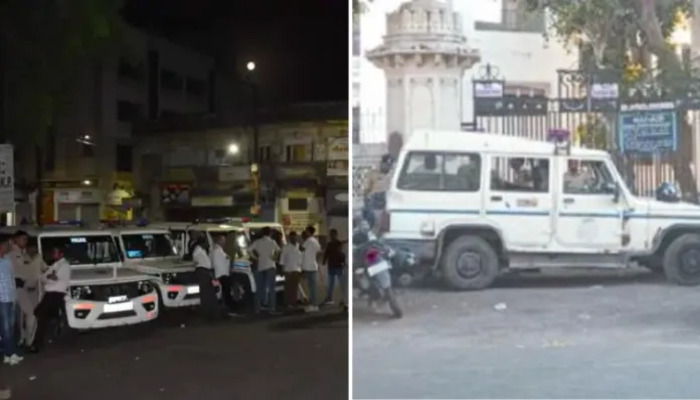
On Saturday, June 3, an illegal dargah built inside the Sajuba Girls High School premises in the Jamnagar district of Gujarat was demolished by the local administrative authorities. The demolition drive was carried out amidst a heavy police presence at midnight. SDM Bhavesh Kher, SP Premsukh Delun, and Deputy SP Vaghela were also present at the demolition site in addition to 400 cops.
The now-demolished dargah named Syed Jinnat Bibi Ma Nagani was illegally constructed inside the premises of Sajuba Girls High School on Ranjt Road. There were regular complaints of schoolgirls being disturbed by the burning of incense and frankincense at the illegal dargah. The principal of the school also complained about this to the administration of Jamnagar while the Hindu organisation ‘Hindu Sena’ also voiced the demand for the removal of this illegal religious structure. Following the demolition, Hindu Sena chief Prateek Bhatt welcomed the action taken by the authorities.
The local authority of Jamnagar carried out the operation to demolish the construction amid long-standing objections on the intervening night of Friday (2 June) and Saturday (3 June). District Police Chief Premsukh Delu, SDM, Naib Mamlatdar, and other officers arrived, and Jamnagar LCB, SOG Branch, CT A Division, B Division, and C Division police station officers and other personnel were also deployed at the site.
On Saturday morning, District Superintendent of Police Premsukh Delu told the media that after receiving a memorandum about the encroachment in Jamnagar’s prominent government Sajuba Girls High School, the case was verified with the collector, and action was taken to remove the encroachment. A total of 400 police officers were deployed. Even now, many other such encroachments are on the administration’s radar.
Before this, on May 27, Junagadh’s local authorities carried out a demolition drive of illegal encroachments amidst protests by up to 2000 Muslims. Many illegal Mazars were also demolished in the action carried out against such illegal structures.