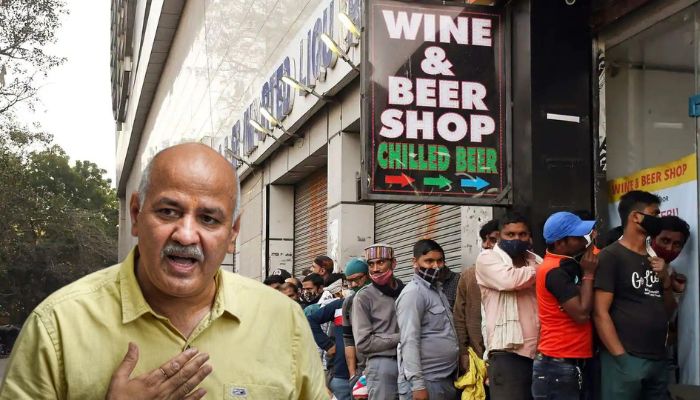
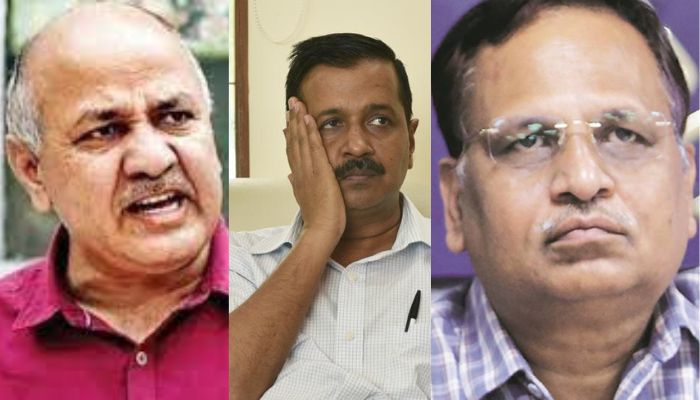
On Monday (February 27), a Delhi court remanded Deputy Chief Minister Manish Sisodia to 5 days in Central Bureau of Investigation (CBI) custody in connection to the liquor policy scam case.
A day earlier, the Aam Aadmi Party (AAP) leader appeared for questioning at the CBi office in Delhi and was eventually arrested by the central agency.
At the heart of the controversy is the Delhi Excise Policy 2021-2022, which has been explained in 10 simple points.
The liquor policy was first proposed in September 2020 but came into effect only in November 2021.
It changed the manner in which alcohol was being sold in the National Capital. Introduced private players in the market and marked the exit of government-owned liquor vendors.
Delhi was divided into 32 zones and a total of 27 private vendors were to ply in each zone. Every municipal ward had 2-3 liquor vendors operating in the area.
Proposals such as home delivery of liquor, allowing liquor vendors to offer unlimited discounts, opening of stores till 3 am were also tabled before the Delhi Cabinet.
The drastic policy change resulted in a 27% increase in government revenue to ₹8900 crores. At the same time, it marked the complete exit of the Delhi government from the liquor business.
While the objective of Excise Policy 2021-2022 was to end black marketing and the liquor mafia, the Delhi government soon came under fire over allegations of corruption.
Chief Secretary of Delhi, Naresh Kumar, found irregularities and procedural lapses in the new liquor policy. Lieutenant Governor VK Saxena ordered a CBI probe on the recommendation of Naresh Kumar.
Manish Sisodia waived off ₹144.36 crores on the license fee, to be paid by the private liquor vendors, under the garb of the Coronavirus pandemic. Incurred loss to the Excise Department and benefitted liquor licensees by waiving the import pass fee of ₹50 per beer case.
All these changes were made without the final approval of the Lieutenant Governor and thus considered illegal under the Delhi Excise Rules of 2010 and Transaction of Business Rules of 1993.
Thus, the Delhi government made a U-turn on its new excise policy in July 2022. A month later, CBI booked Manish Sisodia, ex-Only Much Louder (OML) CEO Vijay Nair and 13 others in an FIR for irregularities in the implementation of the Delhi Excise Policy 2021-2022.
Arvind Kejriwal comes to the defence of Manish Sisodia
Not until long ago, AAP supremo Arvind Kejriwal was out with all guns blazing against corruption, trying to portray himself as an anti-corruption crusader in this process.
However, when it came to one of his close aides, the Delhi CM deserted his anti-corruption stance and resorted to blaming institutions, questioning the motives of the Centre instead of cooperation with the investigating authorities in unearthing the corruption.
Arvind Kejriwal, who mouthed platitudes over the years about making India corruption free, decided to retract his own rules when it came to Manish Sisodia.
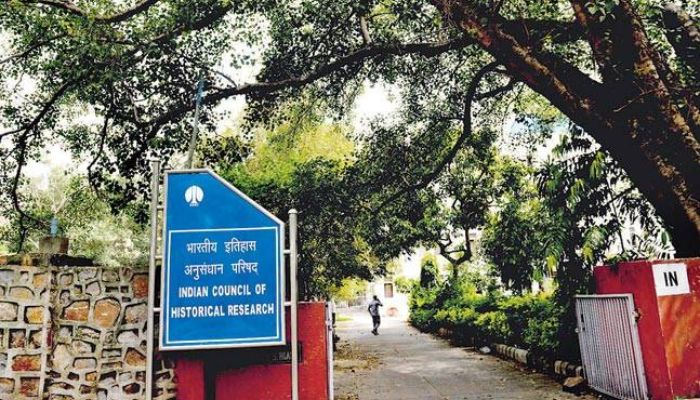
On Friday (February 24), the Indian Council for Historical Research (ICHR) put an end to the singing of the national anthem by its staffers within its campus.
This was, despite the fact it had been a daily routine at ICHR for the past 6 months. Not only that, the images of Bharat Mata and educationist Deendayal Upadhyaya were also removed from the ICHR conference room and office of member secretary Umesh Kadam.
The decision was reportedly made after receiving objections about the same. It must be mentioned that the Indian Council for Historical Research is an autonomous body under the Union Ministry of Education.
While speaking to The Indian Express, a senior official informed, “The singing of the national anthem started based on a verbal order last September and stopped today, also on a verbal order. There was no written order to remove images of Bharat Mata and Upadhyaya but these were removed today from both places.”
Member Secretary Umesh Kadam added, “There was no written order (to put these images). People come and present such things and we install them at an appropriate place.”
ICHR chairman Raghuvendra Tanwar also stated, “It is true that there was no proper permission (for images and national anthem). Neither from the (Governing) Council, nor from me.”
“But I have no role in the removal of the images or stopping the national anthem. I have not visited the ICHR office since February 10. ICHR is a non-sectarian body, and we have to maintain its sanctity,” he told The Indian Express.
ICHR exhibits 50 Indian dynasties, leaves out Islamic empires
The Indian Council of Historical Research had earlier decided to not feature Islamic dynasties during an exhibition on ‘Glory of Medieval India: Manifestation of the Unexplored -Indian Dynasties, 8th-18th Centuries.’
The said exhibition was inaugurated on January 30 this year at the Lalit Kala Akademi in Delhi by the Minister of State for External Affairs, Dr Rajkumar Ranjan Singh. It was open to the public until February 6, 2023.
While speaking about his decision to exclude Islamic dynasties, Professor Umesh Ashok Kadam said, “Those people (Muslims) came from the Middle East and didn’t have a direct connect with Indian culture.”
“Islam and Christianity came to India during the Medieval period and uprooted civilisation and destroyed the knowledge system,” he emphasised stating that Indian history should not be defined by Mughals and Delhi Sultanate.
He also informed that he did not consider Islamic invaders as Indian dynasties. The Exhibition on Medieval Indian dynasties thus excluded invaders such as Bahmani and Adil Shahi.
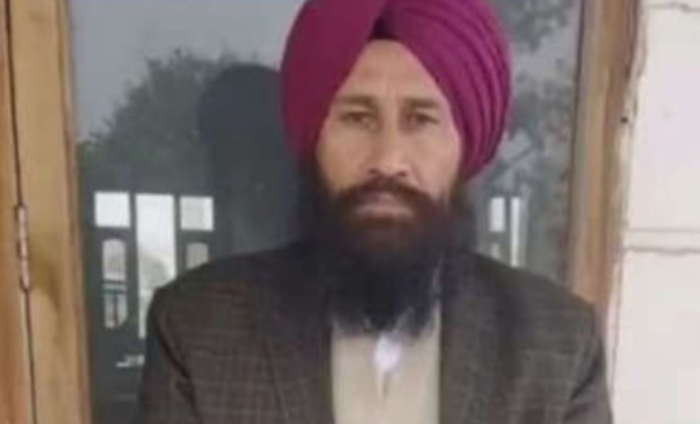
On Monday, February 26, Congress leader Major Singh Dhaliwal was shot dead by a woman in Punjab’s Tarn Taran district. Gurmeet Chauhan, Senior Superintendent of Police in Tarn Taran, stated that the woman was related to Dhaliwal and reportedly murdered him for ‘personal reasons.’
The woman opened fire on the Congress politician near a marriage palace owned by the politician in Sangwa village, a bordering town of Patti. According to police, the woman fired several shots at him. Two bullets hit the leader leaving him dead on the spot.
Meanwhile, the Tarn Taran police said that they have dispatched teams to nab the accused.
During the previous Congress regime, Dhaliwal was the head of the Patti market committee.
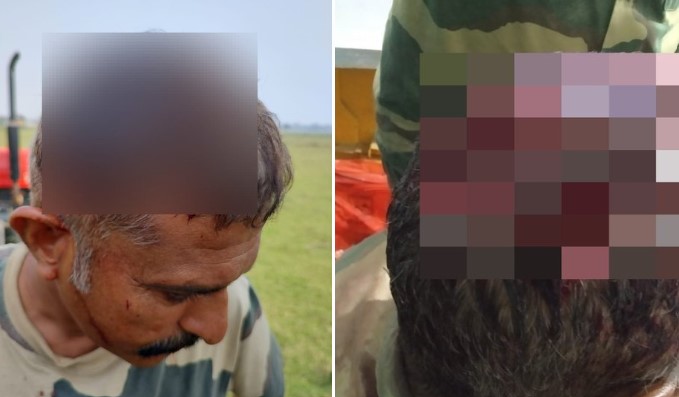
On Sunday, February 26, two Border Security Force (BSF) soldiers were seriously injured and their weapons snatched after more than a hundred Bangladeshi villagers attacked them with sharp-edged weapons in a field along the India-Bangladesh border in West Bengal. According to the BSF, the incident occurred at the Nirmalchar border outpost while two jawans from the 35th battalion were patrolling it. The BSF has lodged an FIR.
According to reports, the incident happened when the jawans stopped the Bangladeshi farmers from bringing their cattle to India.
Photos shared by the BSF-South Bengal Frontier showed deep cuts on the heads of the jawans and their uniforms soaked in blood.
26 Feb 2023 Two Brave jawan of BOP-Nirmalchar,@BSF_SOUTHBENGAL, got severe injuries on the line of duty in the attack by Bangladeshi miscreants,who forcefully entered in Indian territory in large numbers with the intention of destroying the crops of Indian farmer’s.#NationFirstpic.twitter.com/yJlqVUUZlw
“BSF jawans of border outpost Nirmalchar were on duty when they stopped Bangladeshi farmers from bringing their cattle to the fields of Indian farmers.
“Immediately, more than a hundred villagers and miscreants from Bangladesh entered the Indian side and attacked the jawans with sticks and sharp-edged weapons (Dahs),” a BSF spokesperson for South Bengal frontier headquartered in Kolkata said.
According to reports, two soldiers on duty on the border stopped Bangladeshi farmers from bringing their cattle to India. Within minutes, over a hundred Bangladeshi villagers and miscreants entered the Indian side and attacked the jawans with sticks and sharp weapons.
The two jawans were critically hurt in the incident. The miscreants fled with the soldiers’ weapons. Other BSF jawans arrived at the scene after receiving information and evacuated the injured jawans to the nearest hospital for treatment.
BSF accused the Border Guards Bangladesh of taking “no concrete action” to prevent such instances
The BSF officers informed the Border Guards Bangladesh (BGB) of the incident and requested that a flag meeting be held to recover the jawans’ weapons from the Bangladeshi miscreants and to ensure that such instances do not occur again.
The BSF accused the BGB of taking “no concrete action” to prevent such instances despite being aware of “several incidents” of Indian farmers’ crops being destroyed as Bangladeshis forcibly brought their livestock to graze on Indian soil.
“When smugglers and people with criminal intent do not achieve success in their illegal activities across the border, they attack the jawans. BSF jawans have been attacked several times in the past by miscreants and their accomplices in a planned manner, but still, the jawans do not let their plans succeed,” the spokesperson of the South Bengal Frontier said.
“The area of Nirmalchar is very difficult, and despite the lack of facilities, the BSF jawans are guarding the border day and night. Indian farmers have been complaining about the theft and damage to their crop by Bangladeshi villagers and this time, the BSF has set a forward post to protect them while they work in their fields,” the spokesperson added.
Notably, on-duty Border Security Force (BSF) officers are frequently attacked across the Indo-Bangladesh border in West Bengal, especially by Bangladeshi cattle smugglers operating along the international border with Bangladesh. Last month, a Border Security Force (BSF) jawan was severely injured after smugglers attacked him at the Indo-Bangla border in the Nadia district of West Bengal. The incident happened when Bangladeshi smugglers tried to enter India illegally
Iranian state media reported that school girls in Qom city in South Tehran were ‘deliberately’ poisoned in order to restrain education for them. Younes Panahi, the deputy health minister of the country on Sunday also confirmed the news of the poisoning and said that it had been a deliberate attempt with the aim of shutting down education for girls. He, however, said that no arrest has been made in the case.
It is pertinent to note here that earlier, Youssef Nouri, the Minister of Education had called the reports about the poisoning of schoolgirls “rumours”, claiming that the students taken to the hospital had “underlying diseases”.
According to reports, the first such incident was reported in Qom, a deeply conservative and religious city, in November last year. Then the incident of about 18 girls getting ill together in a school in Qom city came to light. They were then taken to the hospital. All the girls reportedly felt difficulty in breathing along with vomiting, abdominal pain and a sharp sensation in their hands and feet.
Subsequently, girls from neighbouring cities also fell sick. Since then, hundreds of cases of respiratory poisoning have been reported among schoolgirls.
On Sunday, Majid Monemi, the deputy governor of Lorestan, said 50 female students of a high school in Borujerd, western Iran, were poisoned again.
“It has been revealed that the chemical compounds used to poison students are not war chemicals, and the poisoned students do not need aggressive treatment, and a large percentage of the chemical agents used are treatable,” he told a press conference.
“After the poisoning of several students in Qom schools, it was found that some people wanted all schools, especially girls’ schools, to be closed,” local media agencies cited IRNA state news agency, which in turn quoted Panahi as saying.
Homayoun Sameh Najafabadi, a member of the health committee of the parliament, also confirmed in an interview with the Didbaniran website that the poisoning of female students in schools of Qom and Borujerd is intentional.
Reports in local media say this could be the work of Islamist fanatics who want to prevent girls from attending school.
According to IRNA, on February 14, parents of the ill students gathered outside the city’s governorate to “demand an explanation” from the authorities.
The next day, government spokesman Ali Bahadori Jahromi stated the intelligence and education ministries were investigating the cause of poisoning.
Prosecutor General Mohammad Jafar Montazeri launched a judicial investigation into the event last week.
Anti-hijab protests raged across Iran
Significantly, the poisoning began in late November, amidst unprecedented protests against Iran’s regime for the death of 22-year-old Mahsa Amini in police custody. She was arrested by the ‘Morality Police’ in Tehran for “improper hijab”, which means she had not fully covered her hair. She was arrested by the police and then beaten in the police van while being taken to a detention centre, dubbed as a ‘re-education class’ for not conforming to the country’s mandatory hijab rules.
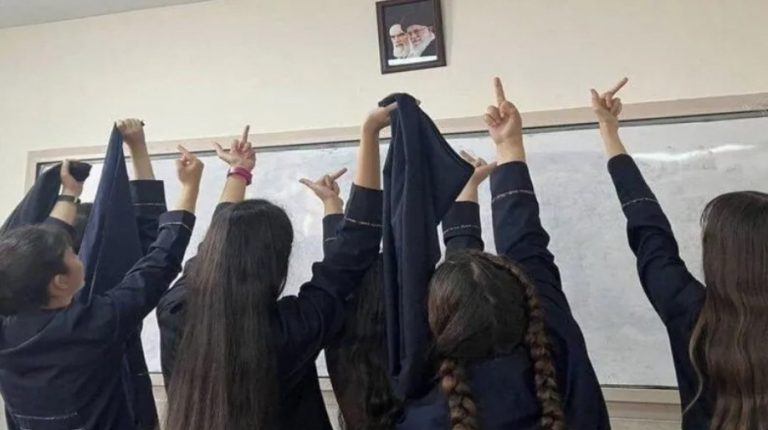
Soon after, Iran saw a wave of protests following her killing, with many women taking to the streets to take a stand. In support of the victims, a number of women, including schoolgirls, burnt their hijabs, and women everywhere chopped their hair in protest. Protests broke out in hundreds of places around the nation after her death.
The Police used brutal force to contain the protests, which died down after several weeks after the govt used excessive force to control it, where several protesters, including minors, were killed, and thousands were arrested.
In the wee hours of Sunday, February 26th, Islamic terrorists killed yet another Kashmiri Pandit in the Pulwama district of Jammu and Kashmir.
Sanjay Sharma, the latest victim of Islamic terrorism underway in the Valley, worked as an armed guard at a bank in his village in the Achan area. He was shot while he was going to the market, after which he was shifted to a hospital. But he succumbed to the injuries.
Kashmir Freedom Fighters, an offshoot of Pakistan-sponsored terror group Jaish-e-Mohammed, released a statement claiming responsibility for the killing of Kashmiri Pandit Sanjay Sharma and issued a fresh threat of continuing to kill Kashmiri Pandits and other Hindus, living in the region, including tourists.
In a statement, it said, “Today in wee hours our cadre eliminated a Kashmiri Pandit namely Sanjay Sharma, son of Kashinath Sharma, resident of Achan Pulwama,” Waseem Mir, spokesperson of the terror outfit, said in the message.
He issued a warning to Kashmiri Pandits, Hindus and tourists of additional strikes by the group, and referred to them as “pawns of occupation.”
“We already have warned many times in the recent past that any Kashmiri pandit, Hindus or Tourists from India will be Eliminated,” the statement by the terror group said.
“After the Removal of Article 370, these people are nothing but pawns of occupation to further their settler colonialism agenda. So it’s not too far Think again or be ready for your turn,” it added, confirming that the jihadis are killing Hindus in the region in retaliation for the revocation of Article 370.
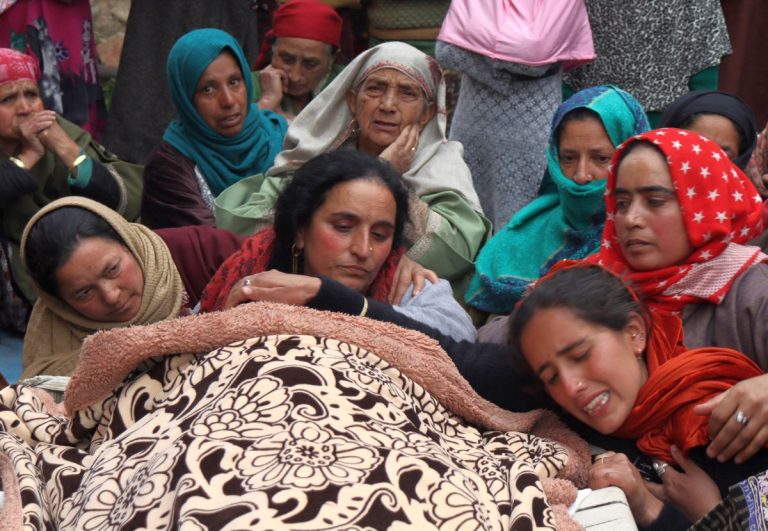
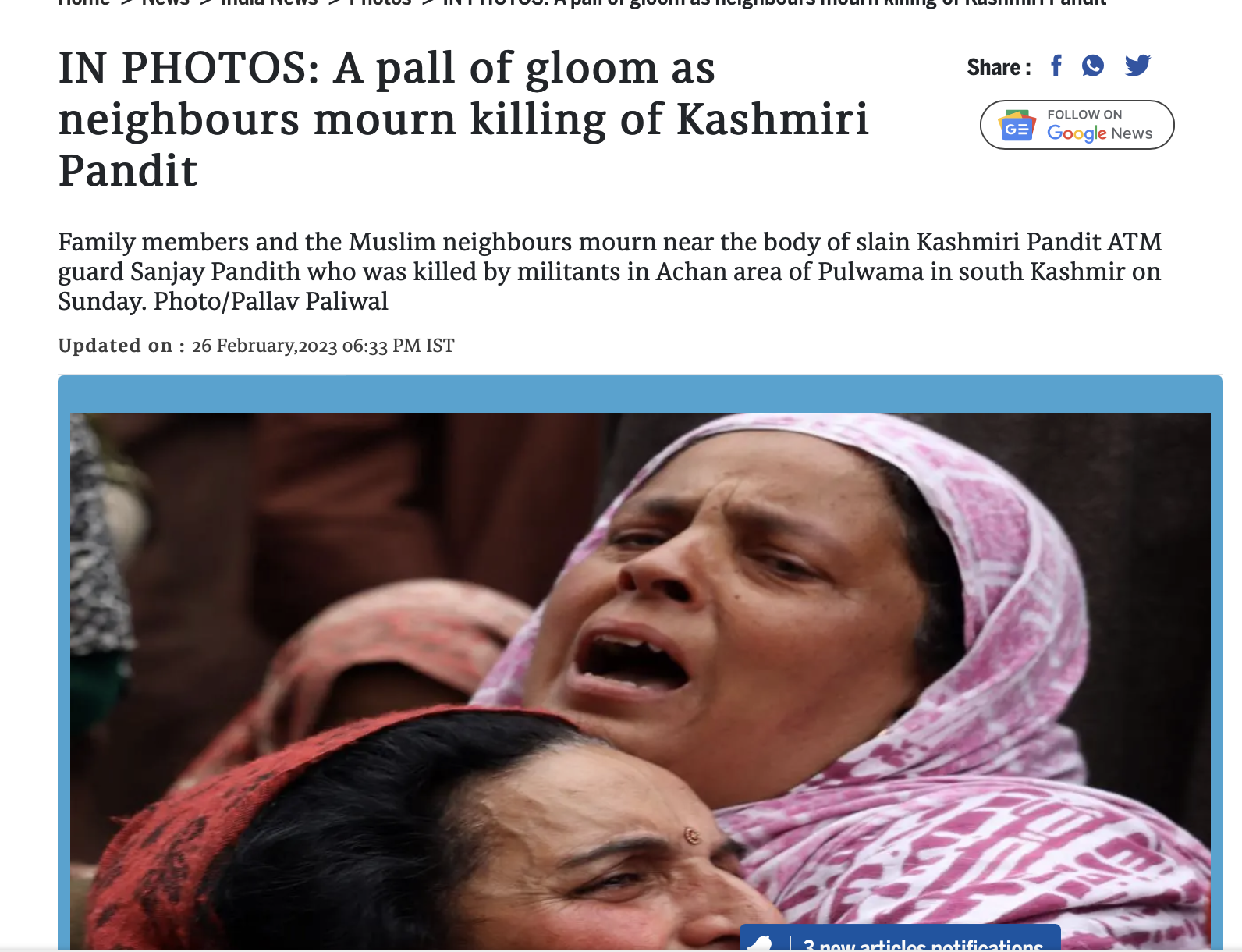
No sooner did the news of yet another Kashmiri Pandit killed in a dastardly attack come to the fore than the media was replete with news reports claiming the ‘Muslim neighbourhood was in grief’ following the attack on Sanjay Sharma.
Media organisations hesitant to attribute the attack to Islamic supremacism quickly highlighted how Muslim communities and neighbours shared the grief of the Sharma family.
Source: Times NowSource: Greater Kashmir
But this is not the first time that media organisations tried to effect psychological manipulation by pushing a narrative that glosses over the scourge of Islamic terrorism plaguing the Valley and deflects public attention from the issue at hand.
For years now, several of the mainstream media organisations and ‘secular’ journalists have treated Islamic terrorism in Jammu and Kashmir as a hot potato—not expressly calling it out—and instead focusing on mythical interfaith harmony to cover up the religiously motivated targeted killings. Those who highlight the religious motive behind the attack are shouted down, ostracised, or even vilified—as witnessed in the wake of the release of The Kashmir Files—a movie that did not sugarcoat the reality and chronicled the unvarnished truth about the ethnic cleansing of the Kashmiri Hindus from the early nineties.
In 2021, after a Kashmiri Pandit woman was killed in Bandipora, Kashmir, news reports of Muslim neighbourhood sharing the grief with the victim’s family started doing the rounds.
Death of Pandit woman: Kashmiri Muslim neighbors share grief of Pandit family
Bandipora, June 4: Muslim neighbourhood shared the grief and sorrow of a Pandit family after the death of an elderly Pandit lady in Ajar locality of North Kashmir’s Bandipora.
Similarly in 2022 as well, reports of Muslim neighbourhoods drowning in grief over the death of a Kashmiri Pandit were widely shared in the aftermath of a targeted killing of a Hindu.
As the lifeless body of Purna Krishan Bhat reached his native village, the entire Muslim neighbourhood sank in grief. The cries of the members of both the communities filled the air for quite some time. I write for @TheLeaflet_inhttps://t.co/HCynhUbV4T
Even though Islamic terrorists explicitly target Hindus and make no bones about the religious bigotry that underpins their attacks, media organisations and ‘secular’ journalists continue to downplay the menace of Islamic terrorism and treachery of the Muslim residents, often by drawing attention toward how the Muslim neighbourhood of the slain victim paid condolences and sunk in grief with the bereaved families.
However, what such narratives do is that they draw a veil over the most fundamental problems facing the Kashmir society. While some neighbouring Muslims would be naturally moaning about the death of one of their Hindu domiciles but it is also a harsh reality, as per credible accounts, that many Muslim residents had rattled their Hindu neighbours to Islamic terrorists which led to their killings.
For instance, the murder of BK Ganjoo, who would have probably been alive today if it were not for his Muslim neighbours signalled Islamic terrorists about his whereabouts. In 1990, when terrorists came searching for engineer BK Ganjoo, his Muslim neighbours reportedly informed them that he had been hiding in a rice barrel. The terrorists fired multiple rounds at the rice barrel allowing the blood to drip out of the container. The rice soaked in the blood was then forcefully fed to Ganjoo’s wife.
How media and their colluders divert public attention from Islamic terrorists and Muslim mobs toward rare, obscure benevolence
But media organisations and the ‘secular’ lobby continue to cite random incidents of tolerance, which only serve to minimise the Islamic fanaticism that undergirds every targeted killing in the region. However, this perversion is not just restricted to Jammu and Kashmir. Across the country, the Left has been cunningly pushing the narrative to shield Islamists and paint them as saviours and upholders of the ‘secular ethos’ of the country.
When Hindu temples come under the attack of Islamist mobs, the secular-liberal establishment bends over backwards to divert public attention by highlighting obscure stray incidents of a Muslim group protecting a Hindu temple and using it as a broad leitmotif to muddle the reality.
In July 2019, a Muslim mob reportedly desecrated an ancient temple in the old Delhi neighbourhood of Hauz Qazi. In the heart of Delhi, a Durga Temple was desecrated, idols broken, and according to the local Hindus, the Muslim mob responsible even urinated in the temple. After simmering communal tension, Vishwa Hindu Parishad organised an event for the ‘Praan Pratishtha’ of the idols and also organised a feast for the locals (Bhandara). While the chants of Jai Shree Ram reverberated in the bylanes of Chandni Chowk, one photo of Muslims serving food to the Hindus took the media by storm.
Media organisations were replete with reports that Muslim residents came forward to serve food to the Hindus of the areas during the ritual. The underlying theme of the media reports was that peace-loving Muslims of the Aman Committee had contributed to the consecrated ritual as a gesture of peace.
Hindu activists who were present at the consecrated ceremony in Hauz Qazi and those who were a part of organising the event categorically denied these reports. VHP, the organiser of the event, said the money for the event came from donations by Hindus. The Muslims of Hauz Qazi did not pay any amount towards the Praan Pratishtha event and hence, reports that they ‘helped install new idols’ in the Durga Temple were outright lies, the VHP said.
Similarly, whether it is violence during the Muharram rally or the Ram Navami, the blame is laid on the feet of Hindus for either indulging in violence with Muslim protesters or instigating Muslims by merely carrying out a procession through what the media and liberal ideologues have come to define as ‘Muslim areas‘—a religious enclave with a Muslim majority population in a seemingly secular country. If the Left and their propagandists are to be believed, Hindus commit a crime the moment they decide to carry out their religious processions through Muslim-majority localities.
Likewise, when riots broke out in the southern metropolis of Bengaluru in August 2020, the media deftly shifted the narrative from riots caused by Islamists over a Facebook post on Prophet Muhammad to how Muslim youth formed a ‘human chain’ to ‘safeguard’ a temple from ‘unruly mob’.
Very cleverly, ‘temples’ (plural) was used as a hashtag and the religion of the ‘unruly mob’ was hidden while the religion of men in the ‘human chain’ was highlighted. Fact: The religion of the ‘unruly mob’ was also Islam. But the media organisation went ahead with the distorted narrative that Muslims formed a human chain to save a Hindu temple from an ‘unruly mob’.
Therefore, when media organisations swoon over Kashmiri Muslim residents sharing grief with their Hindu counterparts, one cannot but wonder if it is yet another attempt to sweep under the rug the growing menace of Islamic terrorism by propagating the misbegotten trope that ‘Muslim neighbourhood in grief’ over the death of a fellow Hindu.
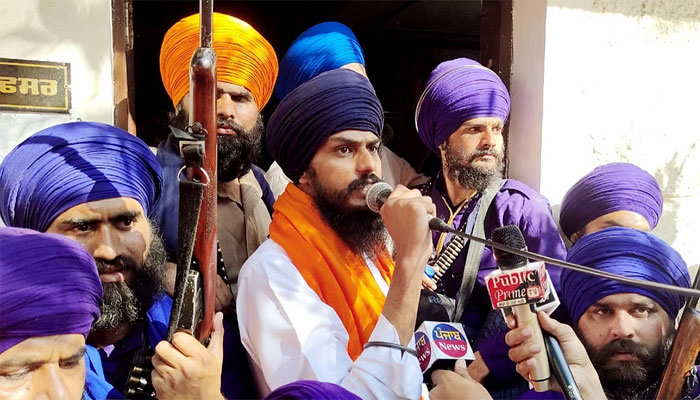
In a recent op-ed, Sarju Kaul, the resident editor of the Times of India, talked about Amritpal Singh’s rising popularity and insinuated as if Sikhs, in general, are the ‘anti-establishment’. First and foremost, using anti-establishment is in itself problematic in this case. Anti-establishment essentially means opposition to the conventional social, political, and economic principles of a society. It is a political philosophy. The Khalistan movement is anything but that. It is a terrorist movement that wants to break India and has historically been involved in mass murders of Hindus. Times of India, therefore, at the very outset, whitewashed the Khalistan movement by calling it anti-establishment instead of what it really is – anti-India.
Going through the op-ed as a Punjabi Hindu, there are a lot of aspects that need to be discussed. Kaul started with a very problematic statement ‘ Punjab is never in sync with Delhi’. To prove her point, the author used the historic anti-establishment sentiments that the people of Punjab had before India gained independence. It was claimed that the sentiment drives support for all causes and protests at an organic level.
But how far is it true? It is a well-established fact that the farmers’ protests were not limited to the repealing of farm laws alone. Some elements propagated pro-Khalistan sentiments during the protests and attempted to drive youth towards the demand of Khalistan. Notably, actors like the late Deep Sidhu, who established Waris Punjab De before his death, tried his best to target youth during farmer protests and make it about not just the farm laws but the religion itself.
The author compared the recent anti-India sentiments during farmer protests to the pre-partition Punjab where the sentiment was not against India but against imperialists. By such a comparison, was she trying to propagate that the whole of Punjab does not want to stay with India? There are many Sikhs and Punjabis who are against the idea of Khalistan, and they often openly speak on social media and offline about it. Even leaders like General Secretary of Shiromani Akali Dal Bikram Singh Majithia has spoken against the idea of Khalistan in connection to the rise of Amritpal Singh in the state.
Sikhs have been historically against the invaders. The formation of Khalsa was to fight Mughal invaders and later British invaders. Kaul talked about the concept of Miri-Piri given by Shri Guru Hargobind Singh Ji, the sixth Sikh Guru. The concept discusses temporal authority (Miri) and spiritual authority (Piri). Guru Hargobind Singh Ji was the first Sikh Guru to establish an army to fight against the invaders, i.e. Mughals. Comparing that resistance with the rise of anti-India sentiments in today’s Punjab due to alleged injustice in sacrilege cases, demolition drives, and police firing holds no ground.
Differentiate between centre and state matters
Punjab, which is known for its agricultural stature, is the biggest beneficiary of the procurement drives of the central government. Data that is present with OpIndia shows that since 2014, there has been a substantial increase in the MSP and procurement every year. Thus, the issue of alleged injustice by the central government is hard to digest. Furthermore, the problems like sacrilege, police firing etc., are state matters. If there has to be any resistance, it should be at the state level.
If we talk about the central and state-level “injustice,” it should be mentioned that for years the Central Government tried to pay the money against procurement directly to the farmers. Still, the state government created hurdles in it. The state wanted the procurement payments to occur via arthias or middlemen. It was only in 2022 that the payments were made directly to the farmers in Punjab. From infrastructure to industrialisation and schemes for farmers to the general public, most issues are state subjects. If there are any anti-establishment sentiments, they should be against the state government. How is it linked to Punjab being part of India?
Later in the op-ed, the author compared Bhagat Singh to Sidhu Moosewala. Putting these two in a single sentence is unimaginable at every level. First, Amritpal Singh and his followers do not consider Bhagat Singh, their hero. On the other hand, they despise the murder of Sidhu Moose Wala as he talks about “the issues of Punjab” through his songs.
Bhagat Singh’s ideology is immaterial – the fact is that he lived and died for India and her independence. Bhindranwale and his followers in the past, or Amritpal Singh and his followers in the present times, follow a radical religious ideology. These two segments are entirely different. Bhagat Singh talked about ‘one nation, one language’. On the other hand, those who call for Khalistan demand a separate nation. The ideologies and the structural demands are different from each other. Furthermore, Moosewala was possibly killed due to personal enmity and not because he resisted the state or the centre. Pertinently, Moosewala was also a strong proponent of Khalistan and therefore, it is unthinkable that the Times of India would compare him to Bhagat Singh – a patriot.
The political loss of SAD
Shiromani Akali Dal lost its ground in Punjab in the recent Assembly elections. It was portrayed by the author as if it was a sign of SAD’s inability to side with Punjabis’ sentiments. It has been claimed that the SAD-controlled Shiromani Gurudwara Prabandhak Committee (SGPC) is losing the ground support it gained by invoking Sikh identity and religion. The loss that has been because of the unhinged politics is seen as the reason for the resistance in the youth towards the traditional parties and favouring the separatist values.
However, in reality, the people of Punjab, let it be the majority of Sikhs or Hindus or other communities, would not prefer a separate nation. They chose to bring a fourth party to the play to give them a chance to rule the state. Had there been any sentiments of a separate state, Shiromani Akali Dal (Amritsar) would have contested and won all seats in the Punjab Assembly elections.
Punjabi Youth and future in farming
The author further said that Punjabi youth wants to shift to other countries like Australia and Canada as they do not see any future in agriculture. Had it been the way it was presented, why were there protests against the Agriculture Laws in the first place? The youth would have sold land and shifted to other countries, something a percentage of Punjabis have already done. The reality is Sikhs, or Punjabis will never leave their motherland and Agriculture. Many landlords rent out their farms and enjoy a good income.
The youth of Punjab needs support from the state government, and that too beyond the lines of politics. There have been practices in farming that are not sustainable and need an overhaul. There is no need to demand a separate nation for Sikhs but a dedicated government that the people of Punjab have failed to choose for decades. There is a need to come out of the fear that industrialisation or capitalism will ruin the state. It will help the state in bringing sustainable income. There is a need to educate youngsters to stay away from drugs and guns and not push them towards the sentiments of a separate nation.
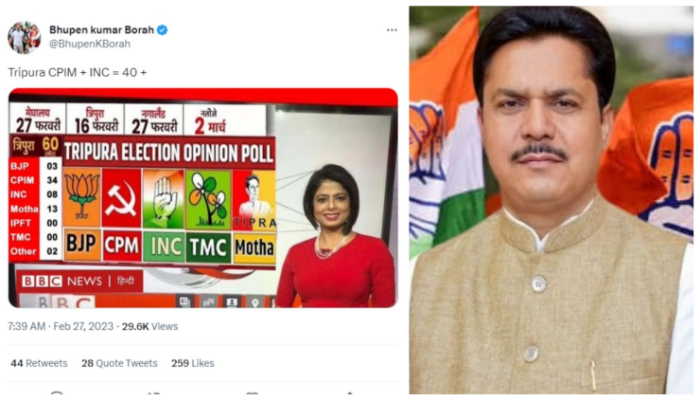
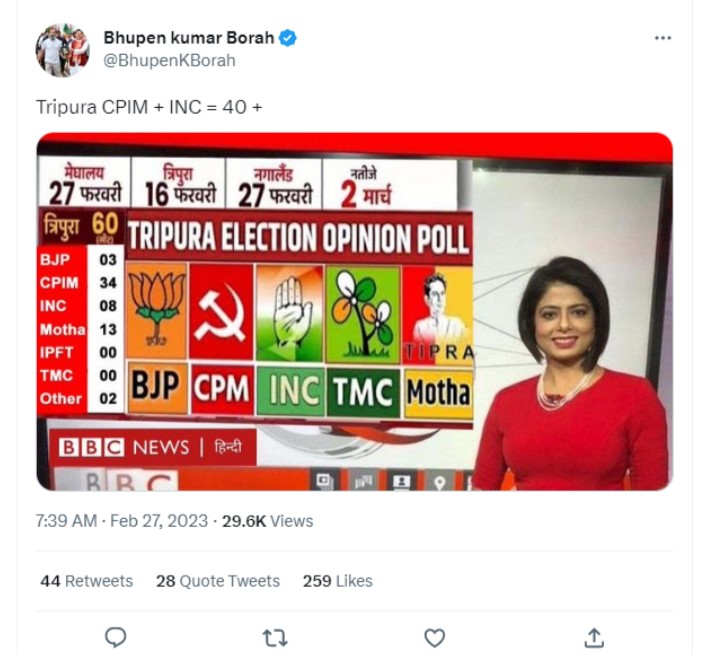
Today (February 27), when exit polls are getting announced by pollsters and News Sites, Bhupen Kumar Borah, the chief of the Assam State Congress Committee, has tweeted a fake BBC poll about the Tripura elections in 2023. In his tweet, he clubbed a Tripura Elections opinion poll graphics with a BBC news logo.
The Congress leader, however, quickly withdrew his tweet when netizens called him out for unethically uploading a modified fake opinion poll to show that exit surveys gave a win for his alliance.
SS of Borah’s now-deleted tweet
Assam Congress chief, in the caption of his now-deleted tweet, indicated that his party and Communist Party of India- Marxist (CPI-M) will get over 40 seats in the Tripura Elections 2023 results. Both political parties, who are direct opponents in Kerala, joined hands to form an alliance ahead of the elections.
The Congress state chief, Bhupen Kumar, poorly edited the opinion survey in his eagerness to show his party as the clear winner of the poll. As seen in his tweet, the BBC logo can be seen below the screenshot of the opinion poll pasted on top of the logo, plainly suggesting that it is a false opinion poll.
Soon after the Congress state chief tweeted the BBC fake poll, netizens identified his post as false and chastised the Congress leader for propagating misleading information.
Assam minister and BJP leader Pijush Hazarik took to Twitter to share a screenshot of the fake BBC opinion poll graphic posted by Bhupen Kumar Borah alongside a screenshot of the original BBC news logo on which the opinion poll was superimposed.
“After non stop defeat in elections, Congress has been reduced to using poor edited fake opinion polls Was this the grand strategy decided at AICC Plenary @BhupenKborah ji? PS: You have also violated the law by sharing fake opinion polls on polling day,” tweeted the BJP leader.
After non stop defeat in elections, Congress has been reduced to using poor edited fake opinion polls
Was this the grand strategy decided at AICC Plenary @BhupenKborah ji?
PS: You have also violated the law by sharing fake opinion polls on polling day. pic.twitter.com/Ktvg47clZS
Congress files police complaint against Jan Ki Baat’s Pradeep Bhandari after the polls predicted BJP victory
It may be recalled that on Tuesday, February 14, the Tripura unit of the Congress party lodged a complaint against Jan Ki Baat founder Pradeep Bhandari over the recently released opinion polls that predicted a victory for the Bhartiya Janata Party (BJP) in the state.
Apparently, the opinion poll did not go down well with the Congress leaders who filed a police complaint against Bhandari saying that despite a directive issued by the Election Commission on the broadcast of opinion and exit polls, the Jan Ki Baat opinion poll was released.
Congress leaders Dr Ajoy Kumar and Gaurav Gogoi, along with party workers, reached the local police station to file a complaint against Bhandari seeking action against him for allegedly violating the Model Code of Conduct.
Tripura Elections ended on February 16 with unprecedented voter turnout. According to election commission data, Tripura recorded an 87.6% voter turnout out of a total of 28.13 lakh electorates. From 1993 until 2018, the Left Front ruled Tripura for over 25 years. However, during the most recent assembly elections, the state voted out the Left government giving an overwhelming majority to BJP.
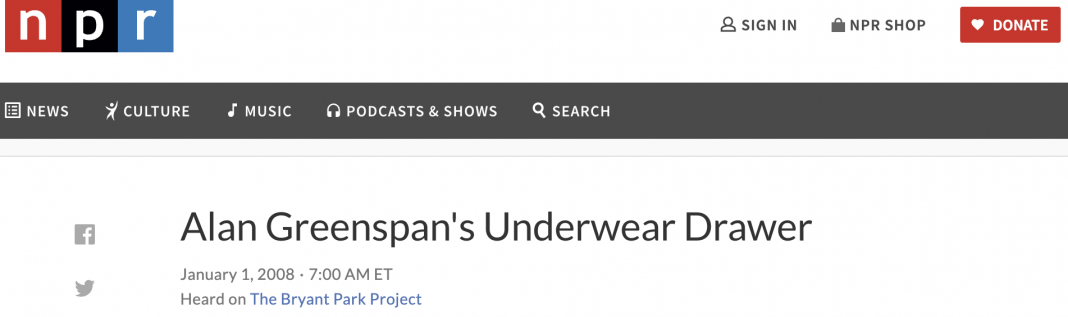
Apparently, when men throw hygiene out of window, that is the prime indicator that the country’s economy is in shambles, if this Economic Times article is to be believed. In an article titled, “गिर रही है पुरुषों के अंडरवियर की बिक्री, क्या इकोनॉमी को लगने वाला है जोर का झटका?” (Sale of men’s underwear is falling, is economy declining?), ET claimed that US Federal Reserve’s Alan Greenspan had attached sale of men’s underwear as an economy indicator.
ET claimed that as per Greenspan, a man’s underwear is his most private thing and is ‘hidden’. Hence, whenever economic crisis leads to pinch in the wallet, they stop changing their underwear. Here one truly hopes ET meant they don’t buy new underwear and not that men just refuse to change their underwear till economy improves because the second option is quite revolting. Not that it would make sense in either case.
ET claims that for the quarter ending December 2022, the sale of underwear dropped by 55% for men. Because of rising prices, people are not left with enough money to buy new underwear. Hence, men not buying new underwear is a prime indication of slowdown of economy. Without giving any specific details, ET claimed that there has been a decrease in sales in the third quarter in men’s underwear companies like Jockey and Lux Cozy. Even Rupa, which makes men’s underwear, showed reduction of 52% sales.
This decrease in sale of men’s underwear could be a cause of concern, reported ET. Usually, Jockey underwear is sold in urban market and in such a case if there is decrease in sale of underwear it is something to be cautious about.
Shekhar Gupta, the ‘chaddi’ psychic… but wait
What ET thought now, Shekhar Gupta had already predicted in 2019. Months after 2019 general elections, when PM Modi returned to power with a stronger majority, Shekhar Gupta’s ThePrint had published an article titled “Indians are not buying underwear. That’s how bad the economy is”. ThePrint had reached out to manufacturers and retailers of men’s underwears to paint Indian economy in shambles.
ThePrint had at that time blamed GST and demonetisation for men not buying chaddis but ET does not even have anything to blame. They just decided men not buying new chaddis is economic crisis. They had interviewed top men’s underwear manufacturers to write about their economic woes.
Except…
It was an Economic Times report from August 2019 linking sale of chaddis and economy that triggered Gupta.
ET and chaddi crisis
Before Gupta’s ThePrint went off for investigative journalism on chaddi sale, in August 2019 Economic Times had published an article claiming that innerwear sale reveals a slowdown. And surprise, surprise, this article cites Alan Greenspan. Same man who has been cited by ET in its recent report.
Over the years, Greenspan has tracked sale of men’s underwear to predict economy around the world.
Alan Greenspan underwear
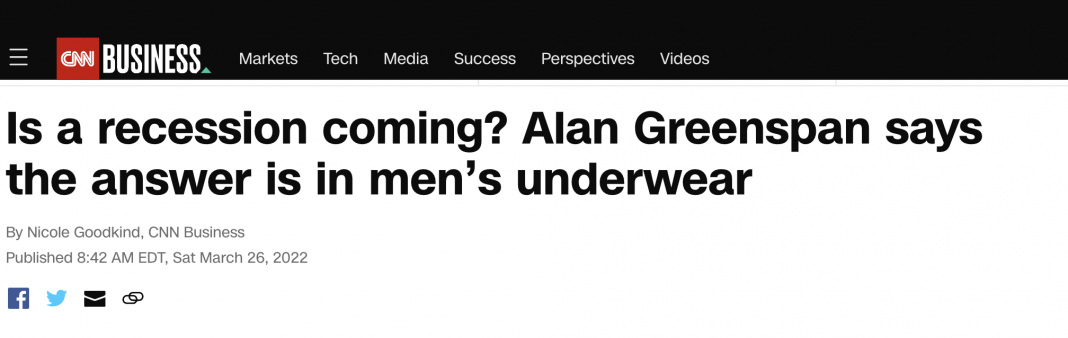
In March 2022, CNN reported Greenspan’s quirk of using innerwear as economic indicator.
Quartz report
In March 2016, Greenspan was saying how economy was improving after increase in sale of men’s underwear.
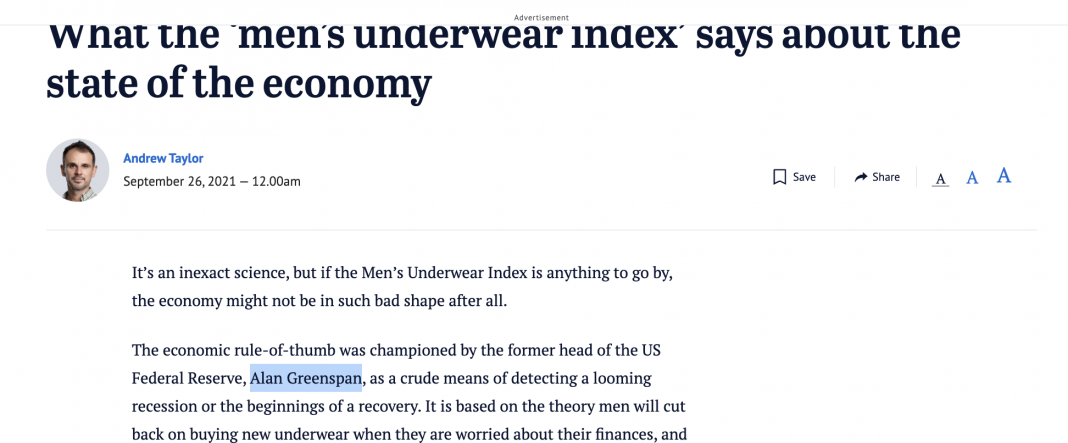
Sept 2021
In September 2021, he was cited by Sydney Morning Herald.
Greenspan has been tracking underwear sale for men for over a decade.
2008 underwears
In fact, there have been articles analysing his underwear theories and how it could be flawed.
Greenspan chaddi theory criticism
In October 2009, NYMag had criticised Greenspan’s underwear theory. Turns out his theory is not new and he had come up with it in the 70s. That means over 40 years of chaddi sale tracking.
Greenspan’s chaddi chronicles reminded me of the time this one guy I had briefly known years ago told me his ‘secret’ that he ‘stores underwears in suitcases’. A teenaged me was so taken aback I asked him if he stored women’s underwears and were they used or unused. “Like a trophy?” I asked. He said, no. He said he collected and stored only unused men’s underwears. Needless to say, I never spoke to him again.
Chaddi is a necessity
On that note, I may not be an economist, but I will stick my neck out and say that chaddis are necessity and are not quite price elastic. Hence, unless you are talking about luxury underwear for men or if these underwears come studded with diamond, one hopes men change their underwear as frequently as needed to, you know, save themselves from various infections.
With Manish Sisodia’s arrest by the Central Bureau of Investigation on Sunday, 26th February 2023, two of the total seven ministers of the Delhi government’s cabinet are lodged in jail. Interestingly, both ministers together head a dozen departments while the chief minister of Delhi and Aam Aadmi Party’s convenor Arvind Kejriwal heads no specific department.
In the 2020 assembly elections of Delhi, Satyendra Jain won from the Shakur Basti constituency for the consecutive third time. In the cabinet of the Arvind Kejriwal government, Satyendra Jain heads ministries viz. health and family welfare, industries, home, power, water, urban development, irrigation & flood control.
In the 2020 assembly elections of Delhi, Manish Sisodia won from the Patparganj constituency for the consecutive third time. In the cabinet of the Arvind Kejriwal government, Manish Sisodia heads ministries viz. finance, education, tourism, public works department, labour, planning, land & building, vigilance, services, art, culture, and language.
In this way, two of the seven ministers in Arvind Kejriwal’s cabinet are responsible for 19 departments. On the other hand, chief minister Arvind Kejriwal does not have any specific department. With Satyendra Jain and now Manish Sisodia getting arrested, the caretakers of the 19 departments of the Delhi government are behind the bars.
Satyendra Jain’s arrest
The ED attached assets worth Rs 4.81 crores linked to Jain and his family in April. The ED launched an investigation in the case based on an FIR which was registered by the Central Bureau of Investigation (CBI) against Jain and others under relevant sections of the Indian Penal Code and the Prevention of Corruption Act.
It is alleged that while Jain was a public servant, his companies received up to Rs. 4.81 crores from shell companies via the Hawala network. Satyendar Jain was arrested and detained by the Enforcement Directorate on May 31, 2022.
Manish Sisodia’s arrest
On Sunday, 26th February 2023, the Central Bureau of Investigation (CBI) arrested Delhi Deputy Chief Minister Manish Sisodia in connection with the alleged Delhi liquor excise policy case, after eight hours of questioning. However, Sisodia has not been named an accused in the chargesheet filed in the case. Arrested businessmen Vijay Nair and Abhishek are among the seven accused named in the chargesheet.
In August last year, the CBI searched Sisodia’s bank locker in connection with the case. The deputy CM claimed the sleuths did not find any incriminating material in his locker. The CBI launched a probe in the matter on the basis of a report forwarded by the Delhi chief secretary to L-G Saxena recommending a probe by the central agency.