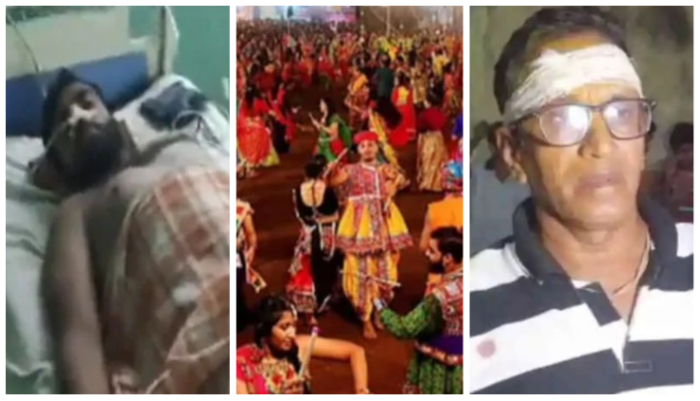
In another case of atrocities on Hindus in Pakistan, a Hindu lady was stripped, tortured, and gang raped by Muslim landlord Mohammad Akram when she went to him for wages. The incident occurred in Bhawalpur in Punjab, Pakistan, after the lady approached Muslim landlord Mohammad Akram to request payment. Akram subsequently returned to the woman’s residence and threatened her with guns. He then abducted her and brutally raped and tortured her.
Six or seven men hung the woman, the wife of bonded labourer Gangaram, upside down, battered, and gang-raped her. Her sole transgression was going to the landlord to request payment of her salary.
The lady stated in a video, “He kidnapped me and took me to an unknown place. Over there they stripped me naked and kept beating me. ” She went on to say that they had covered her face and continued to beat her. She went there to collect her pay, but instead of settling the dues, they threatened that they would beat her if she asked for money.
According to reports, the suspected landlord has also been attempting to cover up the issue by negotiating with medics who are treating the victim. A complaint has been filed, and three persons have been detained in connection with the crime.
According to local media sources, the woman was beaten up over a fake theft accusation. The woman was transferred to a hospital, where she was refused treatment. She also rejected providing her with a medical certificate.
As the news of the tragedy became public, members of the Hindu community flocked to the streets to condemn the horrors. The protesters demanded an impartial investigation and harsh punishment for the assailants and medics.
Recently in March of this year, Pooja Oad, an 18-year-old girl, was shot dead in the street of the Sindh district in March of this year after she resisted efforts to kidnap her. She was shot dead after resisting an abduction attempt in Rohi, Sukkur.
Hindus, a minority in the Islamic country of Pakistan, are frequently targeted with hatred, kidnappings, rapes, forced marriages, and death. According to the Peoples Commission for Minorities’ Rights and the Centre for Social Justice, there were 156 cases of forced conversions between 2013 and 2019.
Pakistan’s courts have continuously failed to provide justice for Hindus in Pakistan. In reality, in several cases, judges have granted immunity to those involved in abducting and forcibly converting Hindu and Christian minorities.
A 2019 field investigation report by the Human Rights Commission of Pakistan has reaffirmed an unpleasant reality that is already known for far too long—minorities in Pakistan live under constant fear of persecution as their perpetrators enjoy court sanctions, support from the influential and affluent section of the society and patronage from political leaders.
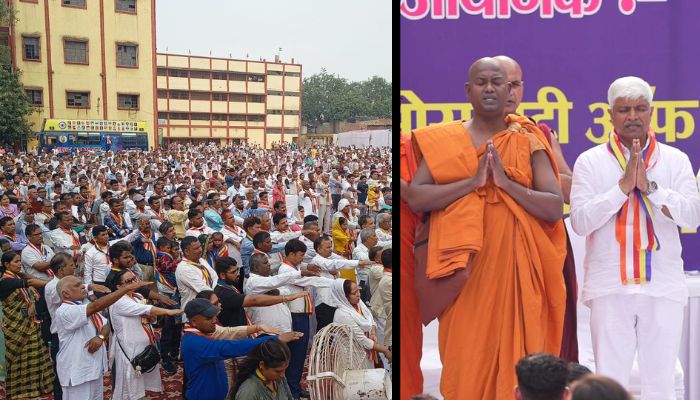
On Wednesday (October 5), AAP MLA (Seemapuri) Rajendra Pal Gautam was spotted at an event where 10,000 Hindus were converted en masse to Buddhism.
The controversial event, organised by the Buddhist Society of India, was conducted at the Dr. BR Ambedkar Bhavan in Jhandewalan in New Delhi.
Gautam, who serves as the Social Welfare Minister in the Delhi Cabinet took to Twitter to gloat over the mass conversion of Hindus. The event coincided with the Dusshera celebrations during which the Hindu community celebrates the victory of Lord Ram over Ravana.
चलो बुद्ध की ओर मिशन जय भीम बुलाता है।
आज “मिशन जय भीम” के तत्वाधान में अशोका विजयदशमी पर डॉ०अंबेडकर भवन रानी झांसी रोड पर 10,000 से ज्यादा बुद्धिजीवियों ने तथागत गौतम बुद्ध के धम्म में घर वापसी कर जाति विहीन व छुआछूत मुक्त भारत बनाने की शपथ ली।
The AAP leader wrote, “With the support of Mission Jai Bhim”, more than 10,000 intellectuals took a pledge to make a caste-free and untouchable India by converting to the Faith of Gautam Buddha.” The archived version of the tweet can be accessed here.
During the event, a saffron-clad man administered an oath to the crowd, which closely resembled the controversial 22 vows of BR Ambedkar. The man urged the Hindus to disassociate themselves from their original Faith and desist from the worship of deities.
“I shall have no faith in Brahma, Vishnu and Maheshwara, nor shall I worship them. I shall have no faith in Rama and Krishna who are believed to be the incarnation of God nor shall I worship them,” he was heard as saying.
“I do not and shall not believe that Lord Buddha was the incarnation of Vishnu. I believe this to be sheer madness and false propaganda. I shall not perform ‘Shraddha’ nor shall I give ‘pind-dan’,” he further added.
The man, dressed in saffron, continued, “I shall not allow any ceremonies to be performed by Brahmins. I renounce Hinduism which is harmful to humanity and impedes the advancement and development of humanity because it is based on inequality, and adopt Buddhism as my religion.”
During the event, AAP Minister Rajendra Pal Gautam was seen repeating the controversial vows and sharing the stage with the man.
Later, he was seen delivering a speech wherein he urged Hindus to renounce their Faith and tread the path of Dr Ambedkar. “If you don’t want to be called a traitor, then, we need to spread this message of BR Ambedkar to every household,” Gautam said.
“If caste has been made by nature, why there is no caste in France, China, Korea, Australia, New Zealand?” the AAP leader displayed his ignorance about social hierarchy and affirmative action in other nations.
“Who benefitted from this caste system and who suffered the most? BR Ambedkar had found the medicine to this disease and we are now spreading it,” he was heard as saying.
Rajendra Pal Gautam also lamented how BR Ambedkar died within a month of converting to Buddhism and failed to convert the whole nation. Known as Dhamma Chakra Pravartan Din, Ambedkar converted to Lord Buddha’s Faith on October 14, 1956 along with 3,80,000 of his followers.
‘We are working to turn India into a Buddhist country’: Rajendra Pal in 2020 interview
It is worth noting that in a 2020 interview, Pal revealed that they are working to turn India into a Buddhist country. “It is time to turn India into a Buddhist country. We are working to convert India into a Buddhist nation. Our target is to convert 10 crore people to Buddhism by October 2025,” he had said.
We are working to make India a Buddhist country & our target is to convert atleast 10 crore people by October 2025 : Kejriwal’s minister @AdvRajendraPalpic.twitter.com/tXpbR9i3fe
In March this year, Arvind Kejriwal mocked the genocide of Hindus during his address in the Delhi assembly under the pretext of criticising Vivek Agnihotri’s movie ‘The Kashmir Files.’
He had insinuated that the plot is not grounded in reality and that it is a “jhoothi” (fake) film.
The AAP supremo had earlier tried to rebrand himself as a ‘Hanuman bhakt’. At that time, netizens pointed out how he derided Hindu sentiments to make a political statement.
When leftists had attacked ABVP students over semester form at Jawaharlal Nehru University in January 2020, Kejriwal shared an objectionable cartoon. The graphic showed a belligerent Lord Hanuman setting the university campus on fire.
Ahead of the 2019 general elections, Kejriwal shared an image where a man with a broom was seen hitting the Swastika symbol. The seasoned politician shares the derogatory image, despite being well-aware of the sanctity of the symbol in Hinduism, Buddhism and Jainism.
Screengrab of the tweet by Arvind Kejriwal
In August 2020, the official Twitter handle of AAP shared pictures of Kanchenjunga in Sikkim, Kamet Peak, and Nanda Devi hills in Uttarakhand and drew analogies with a humongous landfill at Ghazipur in Delhi.
The contentious tweet was accompanied by the caption, “Highest Mountains of India.”
Screengrab of the tweet
In 2018, the AAP supremo deliberately drew false equivalences between building universities and temples to suggest that the construction of the latter would undermine development in the country.
“I was thinking what would have happened if Jawaharlal Nehru built temples instead of the Steel Authority of India? Would India have developed after Independence?” he said during a public address, mocking the construction of Ram Mandir.
Even in 2014, he tried to trick Hindus into guilty for supposedly demanding the construction of Ram Mandir atop the debris of a mosque.
Thus, it comes as no wonder that AAP Minister, Rajendra Pal Gautam, was part of the mass conversion event.
On Thursday, the accused of the rape of a minor was caught and brutally lynched by an angry mob in Bihar’s Hasanganj. The accused has been identified as Mohammad Sagir (35), a resident of Hasanganj Bazar under the Hasanganj police station.
Om Prakash, sub-divisional officer of Katihar Sadar said the incident happened when the girl informed her family members that she was sexually assaulted on Wednesday.
Katihar, Bihar | A man who allegedly raped a minor girl was tied to a tree and beaten by locals in the Hasanganj area yesterday. Later, the district hospital confirmed that the man was brought dead. Further investigation underway.
The police stated that the 9-year-old victim was sleeping with her mother inside the house, when the accused arrived and took her away silently.
“He first brought the victim to his house before taking her to a remote location to commit the crime. She called out for aid as they raped her. In the meantime, the victim’s mother awoke and began looking for her child in the village. Soon, other villagers also began searching and they reached the crime scene after hearing the cries,” the police said.
Notably, the accused Mohammad Sagir had committed a similar crime earlier and had served jail time for rape.
“We went there right away to rescue the accused after hearing about the incident. He was taken to a nearby hospital where he died. Sagir was a serial rapist. He had previously served jail term after being convicted on similar offences” said an investigating officer.
In a video shared by Patna-based Pratyek News, the family members of the deceased Mohammad Sagir stated that the relatives of the girl had thrashed Sagir brutally and caused his death. Speaking to the media, Sagir’s brother-in-law stated that one Md Abbas and others were the ones thrashing Sagir. Another relative mentioned that Abbas, Firoz, Afroz, Rukhsana and some of their relatives were the ones behind the brutal mob lynching of Md Sagir.
Sagir’s family have stated that they will file a written complaint with the police seeking justice. They told that they have received the body after post-mortem and other formalities.
As per a ZeeNews report, the accused lured the girl, took her near a secluded place and raped her. However, the victim’s cry for help was heard by villagers who caught the accused and brought him to the village where a Panchayat ordered instant justice and reportedly asked the relatives of the rape victim to thrash the rapist. After this, the accused was brutally thrashed by an angry mob and was handed over to the police as they arrived.
Hasanganj police have sent the rape accused’s body to Sadar hospital for postmortem and further investigation is underway. Meanwhile, the victim is also getting treatment in a hospital.
In the Bidar district of Karnataka, 9 Hindus were booked by the police for merely entering a Mosque and offering prayers. The police action came after the videos of Hindus offering prayers at the Mahmood Gewan Madarsa and Mosque went viral on social media. The incident reportedly took place on Dussehra on the 6th of October.
In an assault against the syncretic and composite culture of India, the Muslim community filed an FIR against the Hindus alleging that Hindus tried to break the locks of the Mosque and raised “Bharat Mata Ki Jai” slogans. The complainants also warned the police to aggravate their protests on Friday if the accused persons are not arrested. According to reports, Hindus have been booked merely for offering puja, however, nobody has been arrested so far.
While the Muslim community has been outraged by the actions of these Hindus, the Superintendent of Police Dekka Kishore Babu said, “It is a regular practice from the Nizam period of performing Pooja during Dasara. There is a minar inside the mosque complex. Usually, 2-4 people visit but this time there was more number of people who entered the place. Nobody illegally broke the lock to enter the mosque. We have registered an FIR and will be arresting the miscreants.”
Inspector General of Police, Gulbarga said that every year Hindus go near the Masjid to perform Puja on Vijaydashmi and this occurrence is not new. It would seem like it was only this year that the Muslims of the area decided to stop Hindus and raise alarm over the incident.
While the police said there was nothing unusual about Hindus offering prayers in the premises of this Mosque and no lock was broken, AIMIM chief Asaduddin Owaisi took to Twitter to fear monger.
Visuals from historic Mahmud Gawan masjid & madrasa, Bidar, #Karnataka (5th October). Extremists broke the gate lock & attempted to desecrate. @bidar_police@BSBommai how can you allow this to happen? BJP is promoting such activity only to demean Muslims pic.twitter.com/WDw1Gd1b93
It is pertinent to note that the police have gone on the record to say that Hindus offering Puja at the Mahmood Gewan Madarsa and Mosque on Vijaydashmi is an event that takes place every year. They have also clarified that contrary to what Muslim leaders like Asaduddin Owaisi are claiming, nobody attempted to break the lock of the mosque to illegally enter it.
Despite this, the running narrative on social media has been that Hindus “desecrated” the faith of the Muslim community by offering prayers at the Mosque and raising the slogan that pays respect to Bharat as a Goddess to be revered.
Interestingly, in the past, there have been several instances of Muslims offering Namaz inside temples that have been hailed as an example of the inclusive, tolerant and syncretic culture of India where faiths inter-mingle freely.
In April 2022, in Gujarat’s Dalvana village, a historic Hindu temple opened its doors and invited Muslims to break their Ramzan fast and offer Namaz at its premises. The media hailed the move as a signal of brotherhood and love while reports of communal strife emerged from various parts of the country. According to the report, some 100 Muslim rozedaars of the village were given an invitation to offer Maghrib Namaz (Jumma Namaz) and break their day-long fast during Ramzan inside the premises of a 1,200-year-old temple holding great social and religious significance for the people of Dalvana.
In 2018 as well, reports emerged from Uttar Pradesh that Hindus in a village had offered to 100s of Muslims that they could use the temple premises for offering Namaz. A Deccan Herald report read, “In an example of Hindu-Muslim unity, a group of Muslims offered ‘namaz’ (prayer) at a Shiva temple in Uttar Pradesh’s Bulandshahar district, about 500 kilometre from Lucknow, on Sunday.
The report further read, “According to reports, a group of Muslims were returning home after participating in a religious meet, attended by thousands of their community members. The group was caught in a jam. The members of the group were desperately looking for a suitable place for offering ‘zuhr’ (namaz offered at midday) prayer as it was time for the same. Sensing their desperation, some Hindus from the nearby Jounpur village suggested to their Muslim brethren that they could offer the prayer at the Shiva Temple, which was very close to which they agreed readily. The gates of the temple were opened and arrangements were made for the prayer, reports said adding that around one hundred Muslims offered prayers at the temple and its adjoining ‘dharamshala’ (inn)”.
In fact, there was widespread outrage when members of the Muslim community were booked for offering Namaz at Mathura temple recently. In 2020, a Hindustan Times report read. “According to the FIR, the four accused — Faizal Khan, Chand Mohammad, Alok Ratan and Neelesh Gupta — reached the temple at about 12.30 pm on October 29 and performed the “84 kos parikrama” that is common in Hindu prayers in the Mathura’s Braj area. “[Later] photographs of the two Muslims offering ‘namaz’ in the temple premises were uploaded on social media by Faizal Khan. This has hurt Hindu sentiments,” alleged Goswami. “No permission was sought from the priests or administration for offering ‘namaz’. Also, the photos of the ‘namaz’ were made viral on social media,” Goswami said in the FIR, adding that these images could be misused to fan communal tensions”.
When the Mathura incident happened, there were several “liberal” portals and individuals who condemned the arrests. One such cartoon by Manjul posted on FirstPost said that nobody could be sure if the Muslim men had been arrested for offering Namaz in a temple or “spreading love and communal harmony”.
Police have booked four people after a video clip showing members of their group offering namaz on the premises of a temple in #Mathura surfaced on social media, officials said.
It was said that Faisal Khan was a Gandhian activist working for Communal Harmony by offering Namaz inside the Mathura temple and that it was “turned communal” when he was arrested for celebrating India’s syncretic culture.
The Khudai Khidmatgar's national convenor Faisal Khan said his visit to a Mathura temple was to promote harmony, but it has been turned into a communal controversy after he offered namaz inside the temple compound. | @gaurav5173 reports.https://t.co/zYSpPSqoXd
In fact, it was alleged that Faisal Khan has been offering Namaz in temples for the sake of communal harmony for decades. But it was only under Yogi Adityanath that he is seen as a threat.
Faisal Khan has spent decades visiting temples, doing Hindu pilgrimages, reciting the Gita and the Ramcharitmanas, all for communal harmony. In today’s UP, he is seen as a threat.
Profiling the activist arrested for offering namaz in a Mathura temple. https://t.co/JM6hmgmmBS
One has to wonder why the incident of Hindus offering Puja in a Mosque is different from the incident of Muslims offering Namaz in temples which were viewed as exercises in maintaining communal harmony and promoting brotherhood by the very people who are today outraging against the Hindus.
A 17-year-old youth named Shivam was stabbed to death in the Jahangirpuri area of Delhi on 5th October 2022 late in the night. He was returning home after the Vijaya Dashami procession.
The youth was killed in DDA flats in the Jahangirpuri police station area of Delhi. 17-year-old Shivam, a resident of Mukundpur, had gone to Jahangirpuri to see the Vijaydashmi fair. When he was returning from there, Shivam had an argument with some boys near the DDA flats. Soon the argument turned into a scuffle and it turned violent.
Three to four miscreants stabbed Shivam one after the other with knives and fled from the spot. When the people around saw Shivam on the ground in a pool of blood, he was immediately taken to the nearby Babu Jagjivan Ram Hospital where the doctors declared Shivam dead during treatment. A knife was still stuck in his chest when the killers fled and the locals saw him.
The matter was reported to the police. Jahangirpuri police station also reached the spot. Shivam’s family members reached the hospital after they were informed. At present, the police are questioning the people near the spot to investigate the whole matter. A case under Section 302 (murder) of the Indian Penal Code has been registered at the Jahangirpuri police station. According to the police, the accused have been identified and efforts are on to nab them. Reportedly, two of the accused have been already arrested, and they have been identified as Nitin and Sachin, both aged 18 years. The search is on for the others.
Deputy Commissioner of Police (Northwest) Usha Rangnani said, “A call was received at 11.48 pm from BJRM Hospital in Jahangirpuri informing that a man had injury marks on his chest and that he was admitted to the hospital. The witness, who took Shivam to the hospital, said he saw a fight between some people at a park near G-Block in Jahangirpuri and later found him in an injured condition.”
“My son came to see the Ramlila. He would have turned 18 in the new year. We want strictest of punishments for those responsible. They should be hanged,” Shivam’s father said.
This is not the first case of stabbing someone over minor altercations. Such cases have increased in Delhi in the recent past. Recently, three Muslim assailants stabbed a Hindu youth to death over an old rivalry.
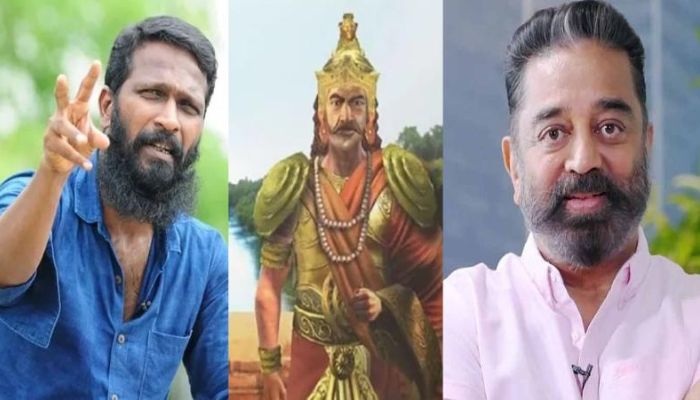
Actor-turned-politician Kamal Hassan has jumped into the current row about the Chola king Rajaraja Chola. The controversy erupted after director Vetrimaaran claimed that the Chola king was not a Hindu. Kamal Hassan has said that there was no Hindu religion during the time of the Chola king. After the controversy erupted, a video clip from Kamal Hassan’s old interview has gone viral on social media. In this video clip, Kamal Hassan said that he once used to spread the word of Christ to the world.
The film ‘Ponniyin Selvan-1’, based on the life of the king of the Chola dynasty, is well-liked across the country. The film has crossed the magical figure of Rs 300 crores at the worldwide box office collection. Rajaraja Chola has also been discussed in the same film. Rajaraja Chola the first was one of the most glorious kings of this empire.
A few days after the release of the film, Tamil director Vetrimaaran made a controversial statement about the Chola dynasty. Vetrimaaran claimed while speaking at an event, “Rajaraja Chola was not a Hindu king. Our symbols are constantly being snatched from us. Saffronising Thiruvalluvar or calling Rajaraja Chola a Hindu king is the latest example of this. Cinema is for the common man, so it is important to understand the politics behind it.”
The BJP has hit back at Vetrimaaran’s controversial remarks on Chola kings who built grand and huge temples in south India. BJP leader H Raja said Rajaraja Chola was a Hindu king. He said, “I am not as well aware of history as Vetrimaaran, but can he name the two churches and mosques built by Rajaraja Chola? The king called himself Sivapada Sekaran. Wasn’t he a Hindu then?”
Kamal Haasan has come out in support of the director after BJP leader H Raja objected to Vetrimaaran’s claim. Kamal Haasan said, “There was no name called ‘Hindu religion’ during Raja Raja Cholan’s period. At that time there were Vaishnavas and Shaivites. It was the British who coined the term ‘Hindu’ because they did not know how to express it collectively. It’s just like they turned Thoothukudi into Tuticorin.” Haasan further said that many religions and faiths were flourishing among the people in the eighth century.
Kamal Hassan watched this film with its crew and actors. After watching the film, Kamal Haasan also proposed that this be the time to recognize a work of fiction that is based on historical events. He said, “Let’s not exaggerate or twist history or bring language issues into this.”
I was working with Christian Arts and Communication Center, spreading the word of Christ…to the world ~ Kamal Haasan pic.twitter.com/cS0iFaqPjq
Interestingly, an old video of Kamal Hassan’s interview with Karan Thapar is going viral on social media after this remark by the actor. In this video, he said that he used to spread the message of Christ to the world.
Chola Copper Plates provide a detailed lineage that tracks their geneaology.
Starting with Thirumaal (Vishnu), Brahma and eventually Surya.
Cholas considered themselves Suryavanshis.
Interestingly, the devout Shiva bhakts Cholas, name Vishnu as the first king of their dynasty! pic.twitter.com/7ffkxn6ybe
It should also be noted that Cholas were Hindus only. Explaining more about this, Tamizh Labs tweeted, “Chola Copper Plates provide a detailed lineage that tracks their genealogy. Starting with Thirumaal (Vishnu), Brahma, and eventually Surya. Cholas considered themselves Suryavanshis. Interestingly, the devout Shiva bhakts Cholas, name Vishnu as the first king of their dynasty!”
While it is true that the term Hindu didn’t exist at the time of Cholas, it does not mean Hinduism or the Sanathan Dharma didn’t exist at that time. The Chola kingdom had built several magnificent Hidu temples.
Radical Islamists wantonly indulging in violence and vandalism during Hindu festivities has become increasingly common, not only in India but across the world. Be it the Hindu religious processions for Hanuman Jayanti, Ram Navami, Navratri, or Saraswati Puja, Islamists have never missed an opportunity to create disturbances. In fact, several incidents of stone-pelting, arson, and vandalism are documented each year, but what is concerning is how these vicious attacks on Hindus are increasing in both number and intensity with each passing year.
This year, Islamists attacked the recently concluded celebration of the feminine divine during Durga Puja/Navratri besides attacking Hindu festivals such as Hanuman Jayanti, Ram Navami, and Saraswati Puja. Several such cases have come to the fore where Islamists have either forcefully or by concealing their identity entered the Navratri Garba event and created a ruckus. Even incidents of stone pelting and violence at Garba venues have been reported from many parts of the country.
Below we have tried to chronicle the wanton attacks carried out by Islamists during the year’s Navratri festival. This year, the annual nine-day festival of Navratri, wherein Hindus across the world celebrate and worship the Hindu goddess Durga, commenced on September 26 and ended on October 5.
Youths from ‘samuday vishesh’ spray acid-like inflammable liquid on a girl in Durga Puja Pandal in Jabalpur, MP
On Wednesday, October 5, the police said that a group of men allegedly sprayed an acid-like inflammable substance on a girl at a Durga Puja Pandal in Madhya Pradesh’s Jabalpur.
According to a report by Amar Ujala, all the 10 accused in this incident belong to ‘samuday vishesh’. As soon as the Hindu organisations received the information about the incident, they reached the police station and staged a protest. 10 people have been arrested so far in the case.
Arif and Zahir lead a mob, pelt stones during Navratri celebrations in Kheda
On October 4, the Navratri celebration in Kheda turned violent after a Muslim mob led by two youths identified as Arif and Zahir pelted stones at the Hindu devotees.
Reports stated that during Navratri celebrations, Arif and Zahir led a mob and created a ruckus during Navratri celebration. The leaders of the village tried to broker peace but the mob did not back off. They returned and started pelting stones. Local residents of the village said they asked the Navratri celebrations to be called off in the area and said that the Navratri could not be celebrated there.
Islamists pelt stones, attack Hindus with iron axes at a Garba pandal in Madhya Pradesh
On the night of October 2, a stone pelting incident took place at a Garba event in Surjani village which comes under the Sitamau police station area in Mandasur district, Madhya Pradesh. Not just stone pelting, some villagers were also attacked with iron axes by the mob. Four people were reportedly injured in the incident.
Anurag Sujania, Superintendent of police, said in a statement, “After receiving information about stone pelting at a Garba pandal due to a dispute between two groups, the police reached the spot and brought the situation under control.” The police registered a case against 19 people and apprehended seven of them during the initial investigation.
Giving details about the incident, the officer said, “Devotees were playing Garba while worshipping Mata on Saturday night in Surjani village of Sitamau police station area. Salman Khan started hitting the pandal with his bike. One of the organisers, Shivlal Patidar, objected and also complained to his father. On Sunday, Salman along with others reached the Garba venue and started beating Shivlal and other organisers. Salman hit the head of a villager, Mahesh, with an iron axe.”
During the investigation, the panchayat department accessed the documents and found that three houses that belonged to Salman’s father Aklu Pathan, Sohail’s father Jafar Khan, and Raes Khan were constructed without taking proper permission. Notices were issued in this regard on October 3 and houses were razed on October 4.
Muslim teacher in Gujarat makes students perform Tajia instead of Garba during Navratri
On October 2 OpIndia reported how students in the Play Center School of Hataj village in Nadiad, Kheda district, Gujarat, were made to perform Tajia instead of Garba during a function organised at the school. On September 30th, the school hosted a one-day Garba event. A Muslim teacher allegedly forced the children to perform Tajia music instead of Garba.
Students were requested to come to school to play Garba, but Tajia music was played instead, and children were seen performing Tajia while wearing t-shirts with heretical names. Instead of performing Garba, the male and female students of the school were shown in the video banging their chests with both hands, as part of mourning during the Muharram procession.
Hindu youth stabbed for resisting molestation of girls at Garba event in Bikaner, Rajasthan
A youth named Madhusudan Modi was attacked with a knife by three Islamists named Shahrukh, Zubair, and Samir at a dandiya event held in Bikaner in Rajasthan on October 1, 2022. These Muslim youths were molesting girls who had come to play Garba. As Madhusudan Modi resisted them, they had an argument with him.
As Madhusudan and his friends came out of the pandal, 15-20 boys were standing near Saras Booth in the lane opposite the railway ground. As soon as all these people reached there, they tried to kill Madhusudan and attacked him with sticks, rods, and sharp knives. During this time, some people were holding Madhusudan and one of them stabbed Madhusudan on the right side of his stomach with a knife. Immediately after the attack, Madhusudan’s friends admitted him to PBM hospital’s trauma centre. His condition remains critical.
On the basis of the statement of Madhusudan’s father, the police have registered a case against Sameer Nadsa, Shahrukh Pathan, Zubair Pathan, and others under Sections 307, 323, 324, 341, and Section 143 of the IPC. The police have managed to arrest Sameer Nadsa, the main accused in the case of the fatal attack on Madhusudan Modi, while the others are said to be absconding. The police have been raiding locations to apprehend the other accused.
Muslim students attack Hindu students with iron belts, stones after they were asked not to play Islamic songs during Garba event in Vadodara
On October 1, six Hindu students were attackedby four accused, identified as Rathod Amin Gulab Nabi, Nizami Moin Nurmahammad, Ganchi Amanbhai Firozbhai, and Chauhan Mahamadnuman Mahamadhanif, for objecting to Islamic songs being played during a Garba event at BK Patel Arts & Commerce College of Savli in Vadodara. The four accused attacked the Hindu students with iron belts and stones.
Muslim youths forcefully enter Garba pandal, flee after VHP, Bajrang Dal intervene
On September 30, Friday, some Muslim youths forcefully entered the Garba venue in Jaipur, Rajasthan. The Muslim youths, however, fled as soon as the Vishwa Hindu Parishad (VHP) and Bajrang Dal activists arrived.
According to the reports, the matter pertains to the Garba function organised at Narayan Vatika Marriage Garden in Jaipur’s Murlipura Police Station area. Some Muslim youths arrived at the Garba venue and argued with the security guard to allow them entry. After the guard refused to allow them entry, the Muslim youths forcibly entered the Garba Pandal.
The guard informed the organizers about the incident and they decided to call the police. However, before police, VHP and Bajrang Dal activists arrived at the Garba venue and checked the identity cards of all the people present at the venue. The Garba program had to be stalled for one hour. Meanwhile, the Muslim youths escaped out of fear.
Muslim youths arrested for making videos of Hindu girls after they entered the pandal pretending to be Hindu
On Wednesday, September 29, seven Muslim youths were arrested by the police from the Garba pandal of Pandharinath in Indore. They were reportedly making videos of Hindu girls.
According to reports, when the Bajrang workers asked for the names of suspected Muslim youths and asked for their IDs, initially, the Muslim youths used Hindu names and did not even show IDs. However, after further questioning, once their real names were known, they were handed over to the police. A case was filed under the prohibitory sections against Muslim youths.
The above list, which is certainly not an exhaustive but an indicative one, provides a peek into the violent Islamist doctrine that fosters pathological hatred against non-Muslims and causes fanatics to attack Hindus, their places of worship, and their festivals.
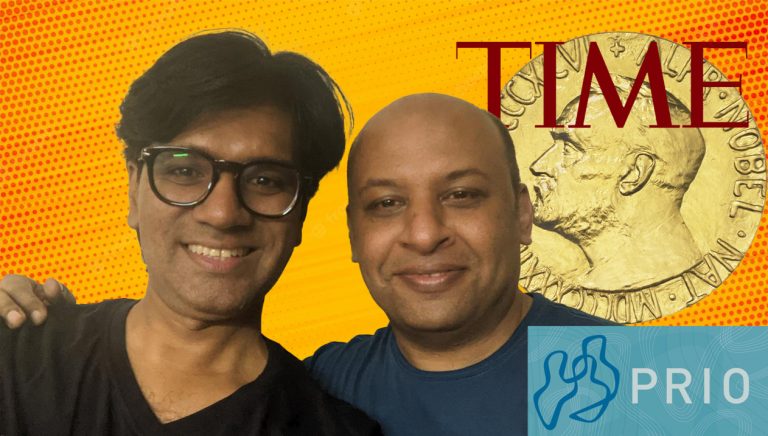
October 5 was no less than Eid for the liberal cabal as their two favourite self-proclaimed fact-checkers and founders of propaganda website Alt News, Muhammed Zubair and Pratik Sinha, made the list of Time’s “favourites to win the 2022 Nobel Peace Prize“. The list of “favourites” was published by Time based on nominations that were made public via “Norwegian lawmakers, bookmakers’ odds, and a personal shortlist by the director of the Peace Research Institute Oslo (PRIO).”
Ukrainian President Volodymyr Zelensky, Belarusian opposition politician Sviatlana Tsikhanouskaya, Russia’s jailed opposition leader and anti-corruption activist Alexey Navalny, The United Nations High Commissioner for Refugees (UNHCR), World Health Organization, Tuvalu’s foreign minister Simon Kofe, Swedish climate activist Greta Thunberg, and the Myanmar National Unity Government were among the top favourites of Times along with Pratik Sinha and Mohammed Zubair. Time also mentioned another Indian name that was Harsh Mander, for his project Karwan-e-Mohabbat.
As Time’s report authored by Sanya Mansoor got published, several Indian media houses jumped to the front to announce that the duo got “nominated” for the Nobel Peace Prize or at least suggested that they are indeed in the race.
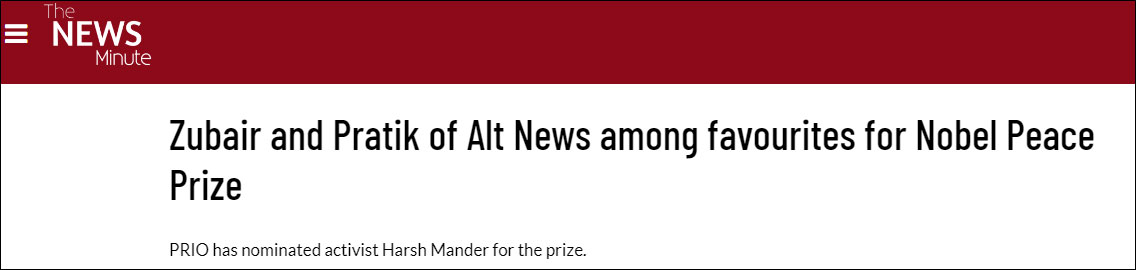
The News Minute published a report titled “Zubair and Pratik of Alt News among favourites for Nobel Peace Prize”, and in the sub-heading, they wrote, “PRIO has nominated activist Harsh Mander for the prize.” They noted that PRIO had listed them as nominees last year, and this year, they named Harsh Mander. Interestingly, when we checked 2021, 2020, 2019 and 2018 lists of PRIO, the duo were mentioned nowhere. It is unclear which PRIO list The News Minute checked where the duo were mentioned.
Source: The News Minute
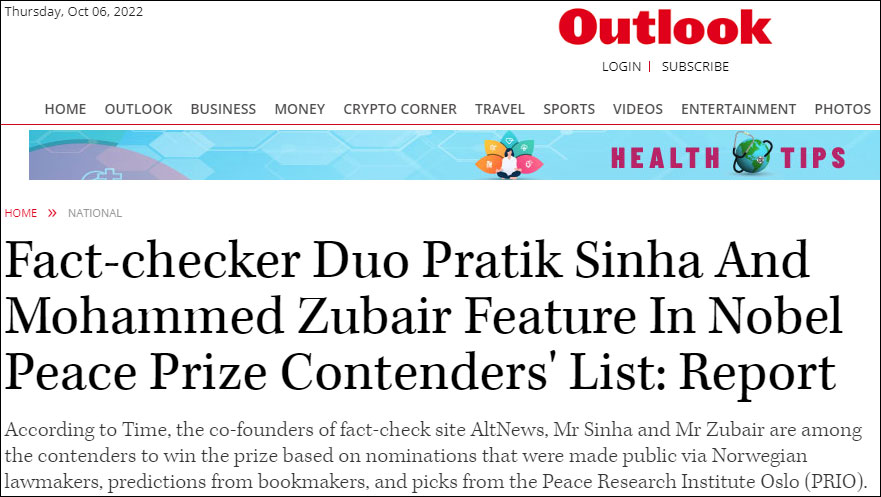
Outlook India published a report titled “Fact-checker Duo Pratik Sinha And Mohammed Zubair Feature In Nobel Peace Prize Contenders’ List”. They also failed to explain where Time might have come up with the conclusion that the duo had been nominated by someone.
Source: Outlook
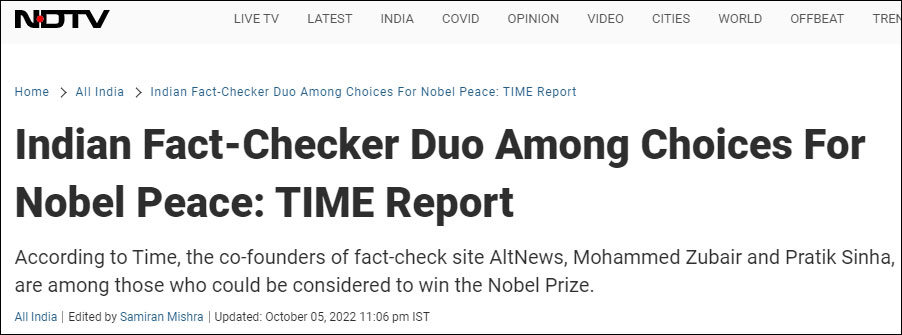
NDTV published a report titled “Indian Fact-Checker Duo Among Choices For Nobel Peace” and put it on Time. The report read, “According to Time, the co-founders of fact-check site AltNews, Mr Sinha and Mr Zubair, are among those who could be considered to win the prize based on nominations that were made public via Norwegian lawmakers, predictions from bookmakers, and picks from the Peace Research Institute Oslo (PRIO).” Interestingly, Time never said so. It just said the list is “their favourites”.
Source: NDTV
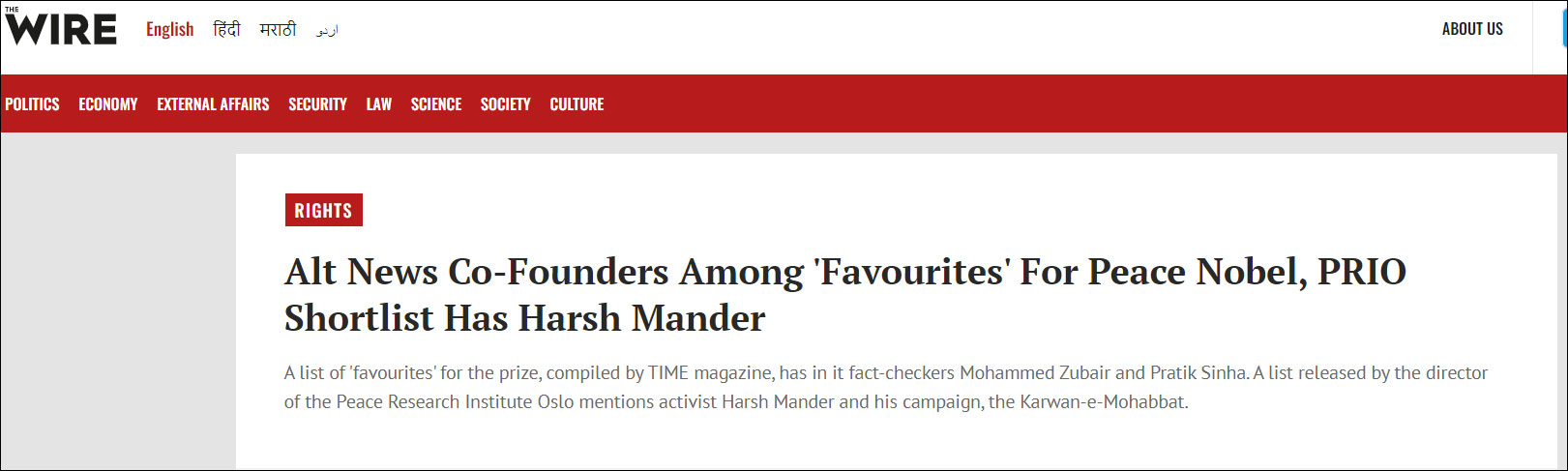
The Wire published a report titled “Alt News Co-Founders Among ‘Favourites’ For Peace Nobel, PRIO Shortlist Has Harsh Mander”. Again, The Wire also described what was written in Time’s report and what was written about Harsh in PRIO’s list but did not explain where Time could have gotten the impression that the duo had been nominated for the Peace Prize.
Source: Wire
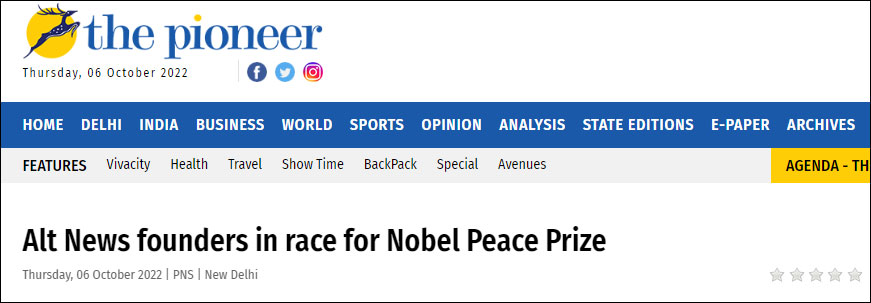
The Pioneer decided to ride without holding back and published a report titled “Alt News founders in the race for Nobel Peace Prize” without explaining how Time might have come up with the names.
Source: The Pioneer
Every media house said that Time’s list was based on the nominations made public by Norwegian lawmakers, predictions from bookmakers and picks from the PRIO director’s personal list. There have been no specifics given by Time or any other media house about the duo’s names mentioned by someone authentic.
The liberal cabal enjoyed the fiction ride with Time
After media houses, how can the liberal cabal stay put and not speak about the so-called nominations! Many congratulated the duo on their ‘nominations’. Here are some of our favourites.
Propaganda website The Logical Indian wrote in a tweet, “According to Time, Mohammed Zubair and Pratik Sinha, co-founders of the fact-checking platform AltNews, are among the contenders for the Nobel Peace Prize in 2022.”
Source: Twitter
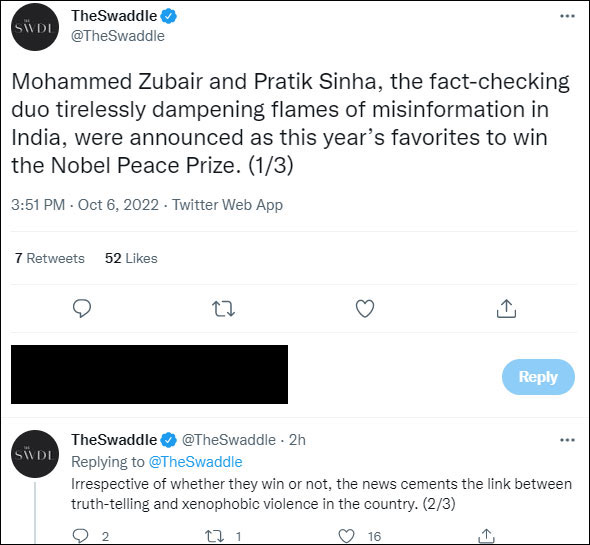
TS Studio said, “Mohammed Zubair and Pratik Sinha, the fact-checking duo tirelessly dampening flames of misinformation in India, were announced as this year’s favorites to win the Nobel Peace Prize. Irrespective of whether they win or not, the news cements the link between truth-telling and xenophobic violence in the country.” They even published a piece explaining why the nomination holds the importance. A nomination that we will later explain does not even exist.
Source: Twitter
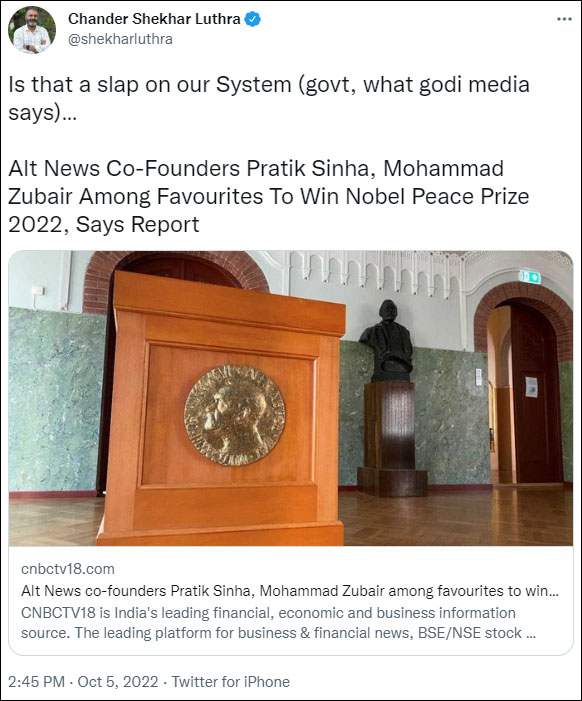
Press Club of India’s treasurer Chander Shekhar Luthra said, “Is that a slap on our System (govt, what godi media says).”
Source: Twitter
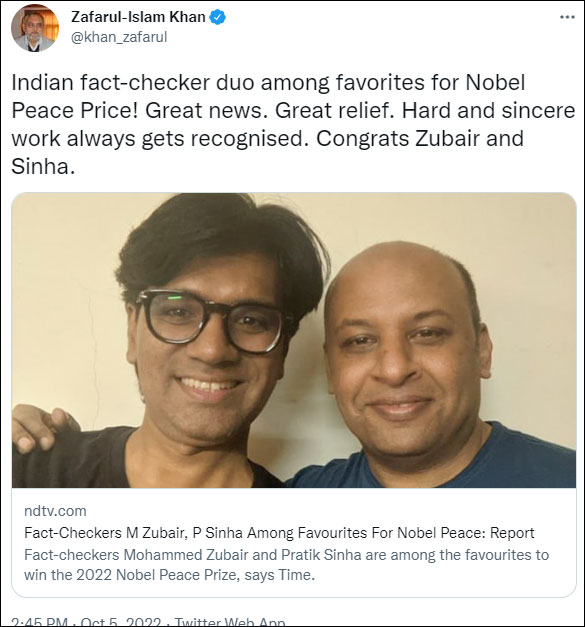
Islamist portal Milli Gazette’s founder Zafarul-Islam Khan said, “Indian fact-checker duo among favorites for Nobel Peace Price! Great news. Great relief. Hard and sincere work always gets recognised. Congrats Zubair and Sinha.”
Source: Twitter
BBC correspondent Vineet Khare said, “Pratik Sinha and Mohammed Zubair are among the favourites to win this year’s Nobel Peace Prize!!! All the best!!!”
Source: Twitter
General Secretary SFI Mayukh Biswas said, “Alt News cofounders Pratik Sinha and Mohammed Zubair nominated and shortlisted for Nobel Peace Prize.”
Source: Twitter
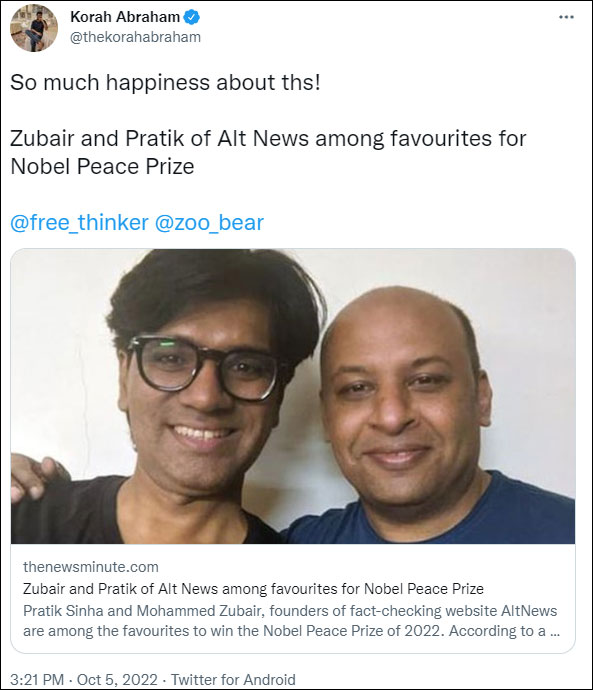
The News Minute journalist Korah Abraham said, “So much happiness about this! Zubair and Pratik of Alt News among favourites for Nobel Peace Prize.”
Source: Twitter
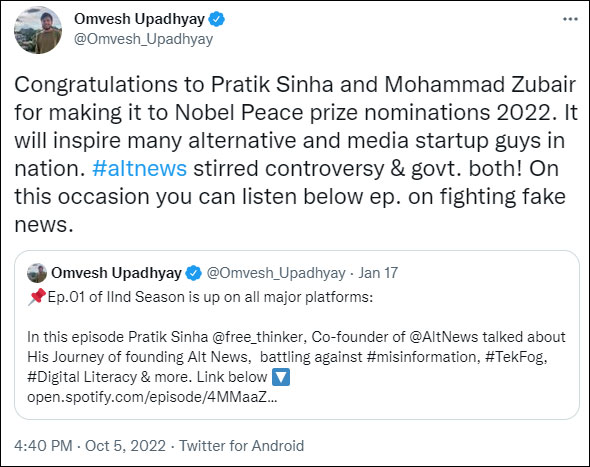
Journalist Omvesh Upadhyay said, “Congratulations to Pratik Sinha and Mohammad Zubair for making it to Nobel Peace prize nominations 2022. It will inspire many alternative and media startup guys in nation. #altnews stirred controversy & govt. both! On this occasion you can listen below ep. on fighting fake news.”
Source: Twitter
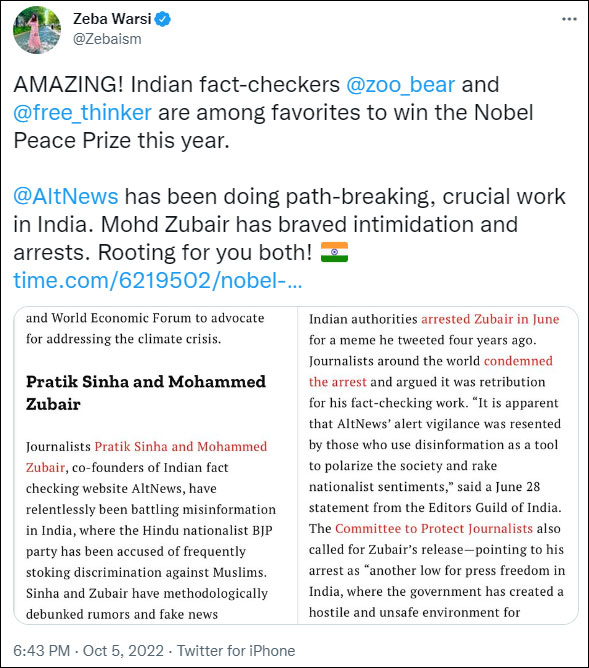
Journalist Zeba Warsi said, “AMAZING! Indian fact-checkers Pratik Sinha and Mohammed Zubair are among favorites to win the Nobel Peace Prize this year. Alt News has been doing path-breaking, crucial work in India. Mohd Zubair has braved intimidation and arrests. Rooting for you both!”
Source: Twitter
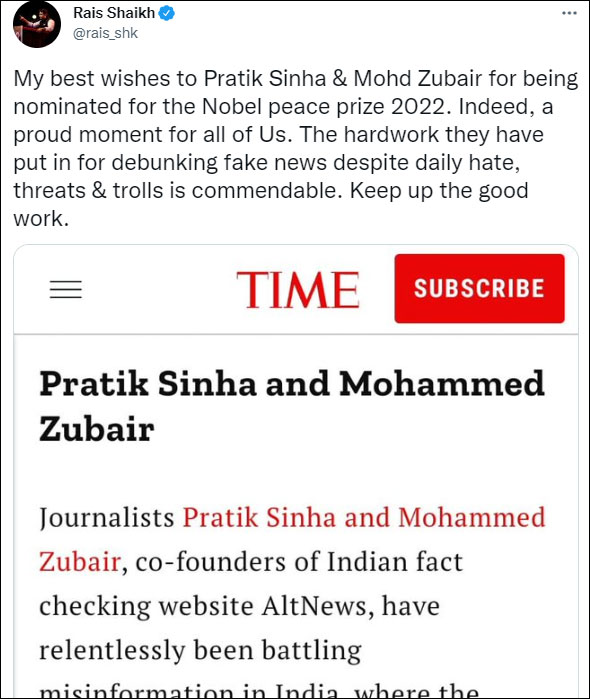
MLA Rais Shaikh said, “My best wishes to Pratik Sinha & Mohd Zubair for being nominated for the Nobel peace prize 2022. Indeed, a proud moment for all of Us. The hardwork they have put in for debunking fake news despite daily hate, threats & trolls is commendable. Keep up the good work.”
Source: Twitter
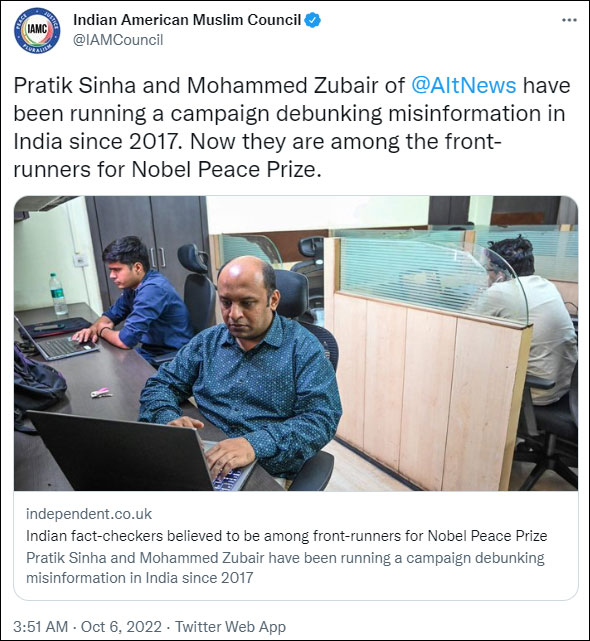
Islamist organisation Indian American Muslim Council said, “Pratik Sinha and Mohammed Zubair of Alt News have been running a campaign debunking misinformation in India since 2017. Now they are among the front-runners for Nobel Peace Prize.”
Source: Twitter
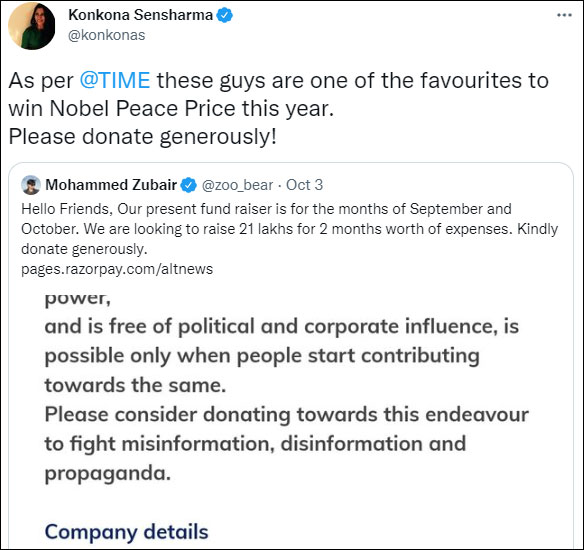
Actress Konkona Sen Sharma urged people to donate for Alt News as its founders were nominated for Nobel. She said, “As per TIME these guys are one of the favourites to win Nobel Peace Prize this year. Please donate generously!”
Source: Twitter
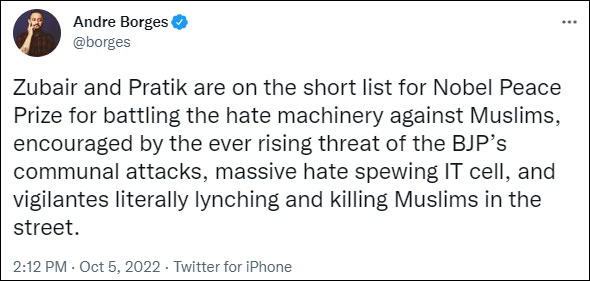
Ex-Buzzfeed India employee Andre Borger said, “Zubair and Pratik are on the short list for Nobel Peace Prize for battling the hate machinery against Muslims, encouraged by the ever rising threat of the BJP’s communal attacks, massive hate spewing IT cell, and vigilantes literally lynching and killing Muslims in the street.”
Source: Twitter
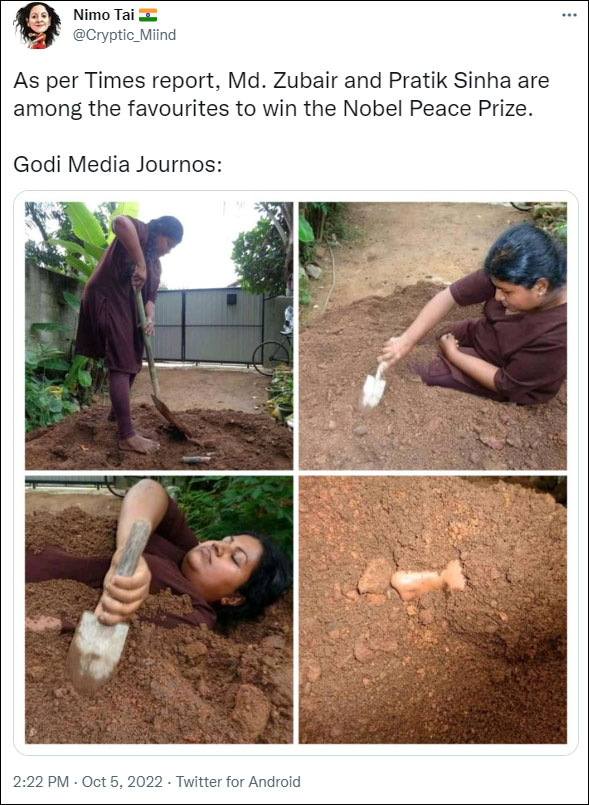
Famous troll Nimo Tai said, “As per Times report, Md. Zubair and Pratik Sinha are among the favourites to win the Nobel Peace Prize” and added photos of a lady burying herself suggesting that was the state of “Godi media” a term used for media houses allegedly siding with PM Modi-led central government. Writer Hussain Haidry said, “So happy and thrilled to see Pratik Sinha and Mohammed Zubair being nominated for the Nobel Peace Prize! Many congratulations and duas for both.”
Source: Twitter
The fact of the ‘nomination’ of Zubair and Pratik
All these claims of Muhammed Zubair and Pratik Sinha are misleading and wrong, and there is no certainty that they are being considered for the elite prize. The Nobel committee does not reveal shortlists for awards for 50 years, but the source where the duo’s name comes from makes it clear that they are not in the official nomination or shortlist. Actually, the duo’s name was added as an afterthought in a Nobel Peace prize shortlist made by Peace Research Institute Oslo (PRIO), which had actually ‘shortlisted’ Harsh Mander, and added the names of Md Zubair and Pratik Sinha as other probable names from India.
In February this year, Peace Research Institute Oslo (PRIO) shortlisted people from around the world who they deemed fit to receive the Nobel Prize. Though their list has nothing to do with the actual list of laureates that receive the prize, they have been doing it since 2002. According to PRIO’s website, their list is widely covered by the international media. This year, PRIO’s director Henrik Urdal, who has been in the post since 2017, named Harsh Mander as one of the five shortlisted candidates that he thinks would be the best fit to receive the Nobel Prize.
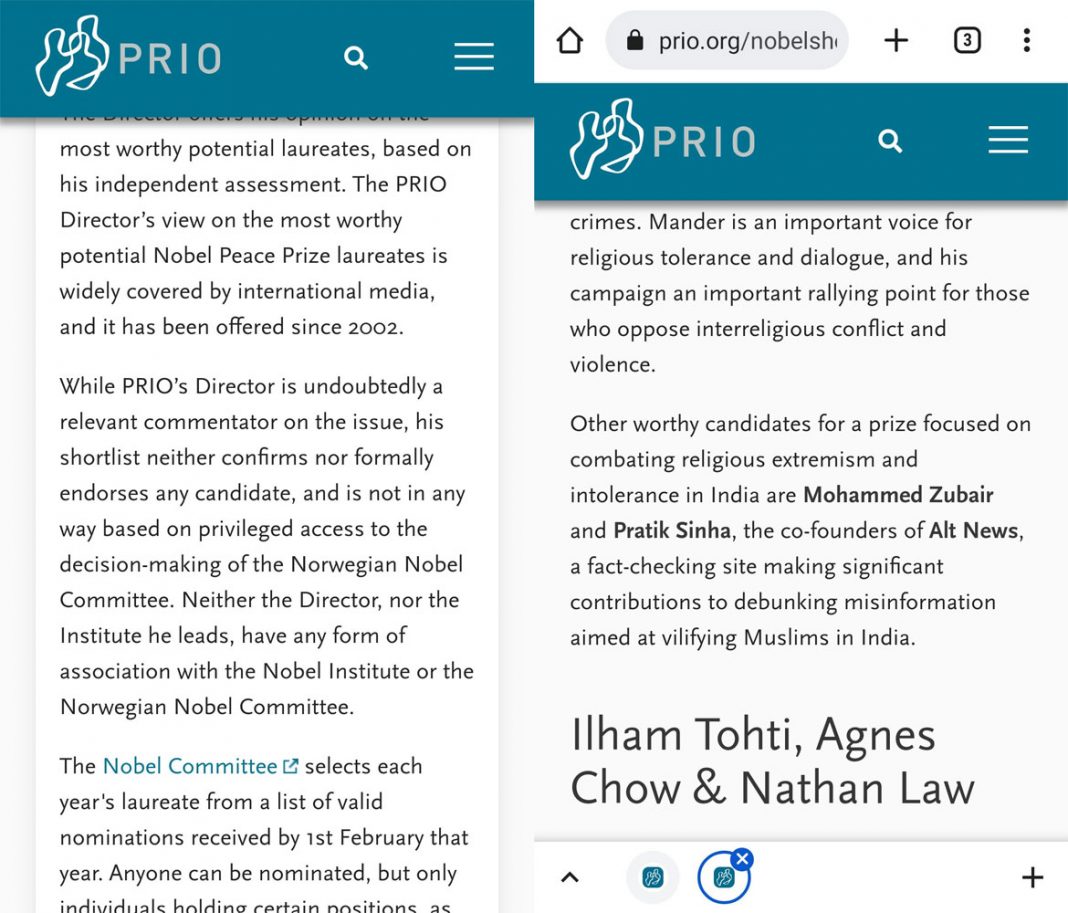
PRIO did not name the duo as nominees but only named them as “worthy contenders”. Source: PRIO
In the para on shortlisted Harsh Mander, Alt News’s Mohammed Zubair and Pratik Sinha were also listed as worthy candidates for a prize focused on “combating religious extremism and intolerance in India” as they have contributed significantly “to debunking misinformation aimed at vilifying Muslims in India.” However, they did not find a place in the five names and were mentioned under Harsh Mander’s “nomination” as an afterthought.
The five shortlisted by PRIO were 1. Sviatlana Tsikhanouskaya & Alexei Navalny, 2. International Court of Justice, 3. Harsh Mander & Karwan-e-Mohabbat, 4. Ilham Tohti, Agnes Chow & Nathan Law, and 5. HRDAG & CANVAS, and the Alt News founders were not among them. They were just mentioned under the para of Harsh Mander & Karwan-e-Mohabbat.
Now, it has to be noted that the PRIO’s list has nothing to do with the Nobel Peace Prize. As per the guidelines laid down by the Nobel Committee, the director of PRIO is eligible to nominate anyone for the prize. However, according to PRIO’s website, PRIO’s director does not nominate anyone for the prize because of his active role as a commentator on the Peace Prize. It further reads, “Neither the Director nor the Institute he leads have any form of association with the Nobel Institute or the Norwegian Nobel Committee.”
It is further notable that PRIO has links to George Soros’s Open Society Foundation. George Soros’s Open Society Foundation has funded PRIO for two consecutive years, 2019 and 2020. Under the section Sources of Income for those two years, PRIO has listed the Open Society Foundation as a donor.
The description of the list reads, “This list is sorted by size of income and includes all those exceeding 50,000 NOK per year.” That means PRIO got at least USD 5,600 from the Open Society Foundation in 2019 and 2020. The 2021 annual report is yet to be published by PRIO.
On Soros’s website, PRIO has been listed as one of the beneficiaries of the Soros grant. As per the records, PRIO received $1,40,000 in 2017 for a two-year term.
Not to forget, Harsh Mander, who was listed as one of the deserving candidates for the Nobel Prize by PRIO’s director, has been associated with the Open Society Foundation. He has served as an Advisory Board member of the international grantmaking network founded by George Soros. His role in instigating the Anti-Hindu Delhi riots, particularly the violence around the Jamia Millia Islamia campus in December 2019, has been under scrutiny for some time now. Ironically, he had later filed a PIL in the Delhi High Court seeking the arrest of BJP leaders Anurag Thakur and Kapil Mishra for instigating violence.
Notably, George Soros has been fueling a dangerous anti-India narrative using media and ‘civil society. The Hungarian-American businessman and a self-proclaimed philanthropist who had vowed to ‘fight nationalists’ and conservative governments worldwide, which he often refers to as ‘authoritarian governments. During the course of his life, if there is one thing George Soros has hated the most, it is India and its nationalist government led by Prime Minister Modi.
Investigation to other public nominations to search for the duo’s name
As PRIO’s list cannot be considered a “nomination for the Novel Peace Prize”, we searched for other resources mentioned by Time as they compiled the list based on these public nominations itself.
The Time mentioned Reuter’s survey. When we checked the list, we found Belarusian opposition politician Sviatlana Tsikhanouskaya, British nature broadcaster David Attenborough, the World Health Organization, environmental activist Greta Thunberg, Pope Francis, Tuvalu’s foreign minister Simon Kofe, and Myanmar’s National Unity government among the list of the nominees by the Norwegian lawmakers. We could not find the duo’s name. Al Jazeera also named the nominees based on publicly available names. The Alt News duo was not there on this list as well. Even the name of Harsh Mander does not appear in these lists.
Then came the bookmakers’ odds. For those who do know who bookmakers are, it is a term used for the persons or organisations whose job is to take bets on something. They also announce odds for the nominees of the Nobel Peace Prize, among many other things. In India, we call it “Satta” or “Jua”. We hope this makes things clearer.
Anyway, we checked multiple websites that listed the odds for the Nobel Peace Prize, including Lithub, bookmakers.net, oddschecker.com and others but could not find any list that has the names of Mohammed Zubair or Pratik Sinha or Alt News.
Conclusion points towards PRIO
After all the research, we can assume that Time’s mention of Pratik Sinha and Mohammed Zubair came from PRIO’s list. A list that does not even mention them in the main shortlist for the Nobel Peace prize for the year 2022. A list that does not even make a difference to who wins the Nobel Peace Prize. Speaking about Time, it is unclear how they claim that the duo is among the favourite when no one has nominated them, at least we could not find any authentic source of their nomination.
The curious case of nomination and its effect
The way Alt News’ founders’ names got propagated as contenders for the Nobel Peace Prize is not only dangerous but also raises several red flags. None of the media houses tried to verify if they were nominated. Earlier, we explained how nominations are made and presented the facts that the list of nominations for any particular year is not made public before 50 years of the prize distribution. Despite this fact, everyone jumped and made it look as if the duo were actually nominated. Based on this alleged nomination, people like Konkona Sen even asked to donate to Alt News.
In the long run, this propaganda will be used to establish the authenticity of the highly biased “fact-checking” website i.e. Alt News. They may not use it themselves, but just like Sen, others will openly use this non-existing nomination for years to come.
The Nobel Peace Prize winner’s name will be announced on October 7, 2022.
Dawat-e-Islami is a Pakistan-based Sunni Islamic organisation that runs several Islamic educational institutions and online courses in Pakistan and many other countries. Dawat-e-Islami, which means “Invitation to Islam,” was established in 1981 by Maulana Abu Bilal Muhammad Ilyas Attari. The extremist group has expanded into several nations around the world from its base in India. It began as a revivalist group influenced by Sufi beliefs, but it has since transformed into an extremist Islamist group with overt ties to terrorism.
After the brutal murder of a Hindu tailor Kanhaiyalal in June this year for supporting former BJP leader Nupur Sharma, Rajasthan police found in its probe that the murderers of Kanhaiyalal had links with Dawat-e-Islami and one of the two accused (Riyaz Khatri and Ghous Mohammad) in the deadly attack in Udaipur was inspired by Islam and visited Karachi in 2014. Notably, Pakistan refuted the claims of the involvement of a Pakistan-based organisation in the Kanhaiyalal murder case.
However, in an exclusive report, India Today has made shocking revelations that expose the lies of Pakistan. Dawat-e-Islami has employed technology as a weapon to push its Jihadist ideology and instill hatred into the hearts of Indian Muslims.
The official website of Dawat-e-Islami provides a number of online programmes on religious subjects. Notably, the organisation is operational in Bangladesh, Canada, Hong Kong, the UK, and the USA but not in India.
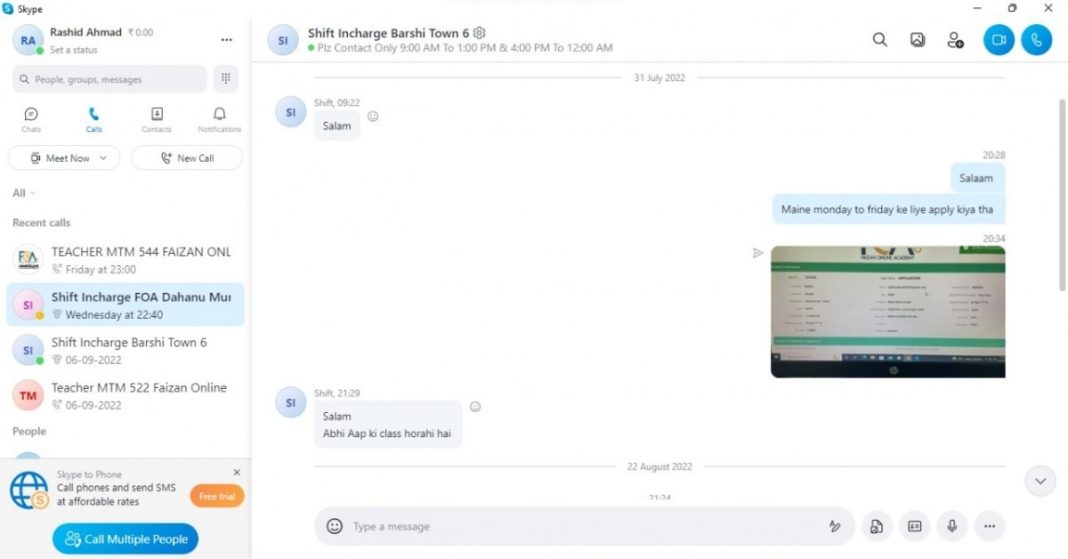
However, India Today in its report claims that when its investigative reporter applied for one of Dawat-e-Islami’s courses under a fake name, Rashid Ahmed, he received a response within hours over mail.
Image credit: IndiaToday
A person named Hasin Ahmed claiming to be from the Madhya Pradesh branch of Dawat-e-Islami reportedly called the reporter and inquired about the reporter’s application for the course. The two discussed the fees and timings of the course.
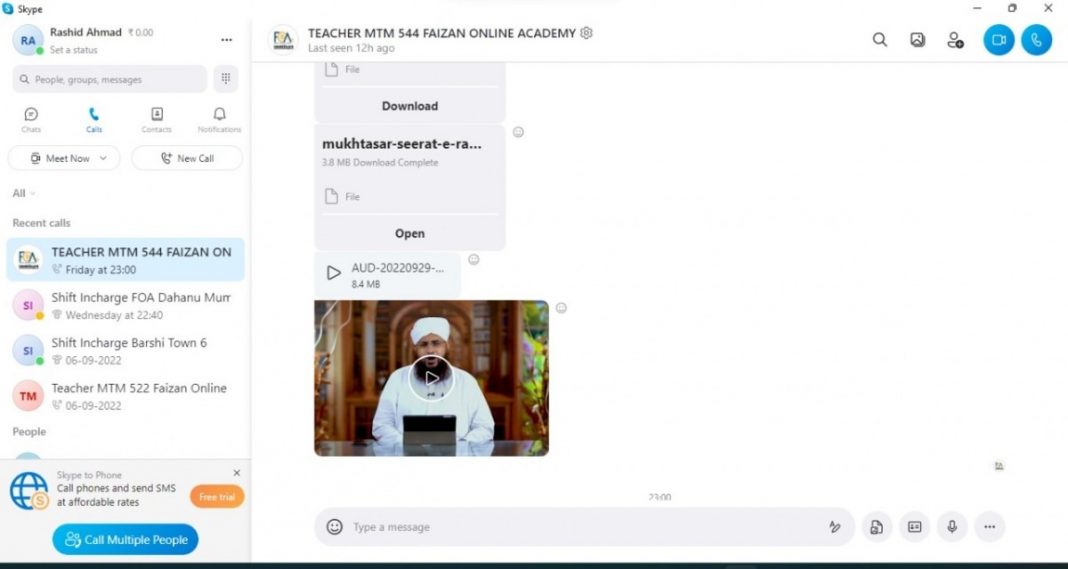
Notably, online classes were claimed to be strictly audio-based while the medium was Skype. As per the report, “Teacher MTM 522 Faizan Online Academy” ID began sharing several audio and video files with the reporter.
The files sent to Rashid Ahmed (the pseudonym used by the reporter) had content glorifying Pakistan and manipulating Indian Muslims to contribute towards strengthening Pakistan as a bastion of Islam.
In its pre-recorded audio messages, Dawat-e-Islami urged Indian Muslims to confront infidels (Kafirs), and even resort to violence for this cause.
“The country of Pakistan is a great blessing to us. We need to assist in its building”, the lessons said. In one audio clip, a man remarked, “We wish our country became the bastion of Islam in reality. Those who gave their lives for Khuda aren’t dead. They are very much alive. You’re simply not aware. People who have been killed for adhering to Khuda’s way shouldn’t even be considered dead, let alone be given the title of the dead. They’re still alive. People simply don’t comprehend that”.
Image credit: IndiaToday
Reportedly, the content provided by Dawat-e-Islami also championed sacrifices (Qurbani) in the name of Din-e-Islam.
“Islam relies on sacrifices; we must lay down our lives for Din for it to exist. Muslims who strengthen their consciences give Islam strength. Another audio message advised Muslims to always be ready to make a sacrifice in the name of Islam. Muslims have become complacent. Sin exists everywhere. Non-Muslims have become dominant. If anyone sacrifices their life, it’s only for worldly reasons. The vision for the afterlife has eroded.”
Involvement of Data-e-Islami was not only reported in Kanhaiyalal ‘sar tan se juda’ case but also in the murder of Kishan Bharwad. On January, 25, Kishan Bharwad was shot dead by two men on a bike over a social media post that had the image of Prophet Mohammad. In February, it was reported that over 2000 donation boxes for Dawat-e-Islami were found in Gujarat’s Ahmedabad.
According to the report, under the pretence of giving Muslims access to Islamic education, the money collected in the donation boxes is instead used to brainwash Muslims after being transferred to Pakistan and then returned to India via Dubai. Maulana Usmani, whose name had surfaced as a suspect in the murder of Kishan Bharwad, was accused of running a Dawat-e-Islami centre. Dawat-e-Islami has been allegedly calling upon Indian Muslims to work for Ghazwa-e-Hind, which is turning India into an Islamic state.
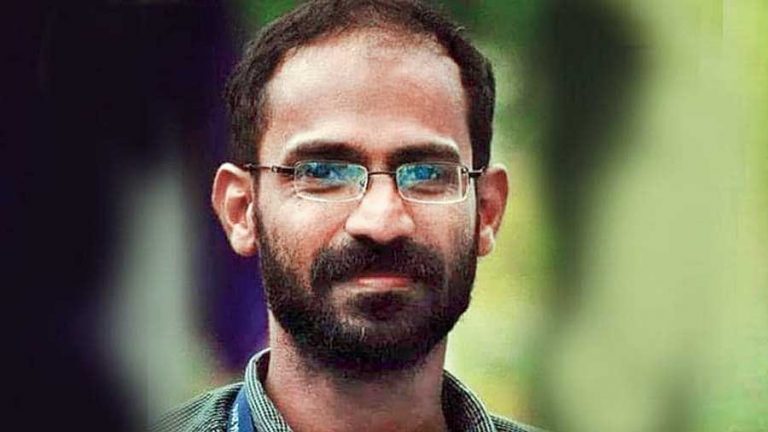
An event to express solidarity with UAPA accused ‘journalist’ Siddique Kappan has been called off. According to reports, the organisers themselves called off the program that was supposed to be held at Kozhikode Town Hall on Wednesday evening. The organisers of the event cited a BJP complaint and a police report suggesting the possibility of law-and-order issues as the reason for cancelling the event.
Police sources, however, refuted the claims confirming that there were no instructions from the authorities to deny permission for the event. The organisers had voluntarily cancelled the programme, they added.
Moreover, reports from Kozhikode suggest that the elected peoples’ representatives withdrew from the programme, hence the authorities cancelled it.
The event ‘Freedom of Expression Protection Meeting’ was being organised by a group of ‘activists’ working under the banner Pauravakasha Vedhi (Forum for Citizen’s Rights). Munavvar Ali Shihab Thangal, a leader of the Indian Union Muslim League, a Congress ally, that has ties with Jammat-e-Islami and the Social Democratic Party of India (SDPI), both accused by the National Investigation Agency (NIA) of spreading radicalism in Kerala, was scheduled to inaugurate the event.
The event was being held to show solidarity with Siddique Kappan, the terror-accused journalist with PFI links, after he was released on bail on September 9, after spending 2 years in jail. Notably, the Supreme Court had granted him bail to Kappan on the condition that he deposits his passport and marks regular attendance at the police station as he was released on bail after 2 years.
Notably, Siddique Kappan was arrested by the UP Police on October 5, 2020, while he was proceeding to Hathras case where a 19-year-old Dalit woman had died after a strangulation attempt. He was arrested along with three other persons, under stringent sections of UAPA and sedition charges for attempting to create a caste conflict in the state amidst the Hathras case controversy.
As per reports, besides Indian Union Muslim League (IUML) leader Munavvar Ali Shihab Thangal, Lok Sabha member MK Raghavan, MLAs KK Rema, P. Ubaidulla, and Kappan’s wife Raihanath Kappan and daughter Mehnaz Kappan were among those listed as speakers at the event.
NP Chekutty, a member of the Pauravakasha Vedhi, was quoted by The Telegraph as saying that an officer from the police special branch spoke to him on Wednesday morning and cited the possibility of law and order issues at the venue. “I got a call from a special branch officer who said there could be law-and-order issues. He even asked us to apply for police security. We (the organisers) then took a call to cancel the event not wanting to start another controversy,” he said.
“It is a tragic situation that well-meaning citizens aren’t even allowed to organise to uphold basic rights like free speech,” he added.
Reportedly, Kozhikode district president of BJP VK Sajeevan had addressed a news conference against the event on Tuesday saying that the decision to hold the meeting would challenge law and order and the ongoing probe by the NIA into anti-national activities. The BJP district leader also asked the organisers to cancel the event because it could give a boost to the anti-national forces. They had asked the authorities at the Kozhikode Town Hall not to allow such a programme to take place on its premises. They had petitioned the revenue and police chiefs not to allow such a programme.