Home Blog Page 2950

Allahabad high court upholds the conviction of journalists and newspaper publisher in defamation case filed by a bureaucrat in 1994

0

In a criminal defamation case filed by bureaucrat Anant Kumar Singh over an interview published in 1994, the Allahabad High Court upheld the convictions of two journalists and a newspaper publisher. In 1994, an interview with Anant Kumar Singh – the then-district magistrate of Muzaffarnagar – was published in the Pioneer and the Swatantra Bharat newspapers. In this interview, the DM was quoted as saying that seeing a lady in a secluded location like a jungle makes any man want to rape her. The DM, on the other hand, denied giving any such interview. The bench of Justice Dinesh Kumar Singh tabled its decision on Monday 8th August 2022.

The court heard criminal revision petitions submitted by reporter Raman Kripal, executive editor A.K. Bhattacharyathe, and Pioneer News Paper, New Delhi printer, and publisher Sajive Kanwar. On July 16, the verdict in Kanwar and Bhattacharya’s petitions was announced. On Monday, August 8, the Court gave the ruling on Kripal’s plea. The court convicted the accused under section 500 of the Indian Penal Code.

However, the court concluded that because the crime occurred 28 years ago, the benefit of Section 4 of the Probation of Offenders Act may be provided in this case. As a result, while allowing the three revisionists’ acquittal on probation, the Court also ordered Kripal to pay Rs 1 lakh and Bhattacharya and Kanwar to pay Rs 50,000 each to Singh within one month.

After the interview was published in 1994, the same day, Anant Kumar Singh sent a denial letter stating that no such interview was conducted. However, a week after that, the letter was printed in the “Letter to Editor” column in a truncated form with the reporter’s retort, leaving the impression that the interview was conducted and the district magistrate made the objectionable statements. Singh then filed a defamation suit.

In 2007, the special chief judicial magistrate of Lucknow convicted and sentenced the accused. In 2012, the court of extra sessions judge affirmed the conviction, which the three accused had challenged in the high court.

No reservation to converts, concealing religion for marriage punishable: Stringent provisions included in new anti-conversion bill of Himachal Pradesh

Cases of conversions appear in the country every day. In these cases of conversion, cases ranging from forced conversion to fraudulent conversion and marriages with a concealed purpose of conversion are common. The conversion business in the country is, therefore, a matter of worry. Strict laws are being made by the governments of different states to control this practice. The Jai Ram Thakur government in Himachal Pradesh has introduced the ‘Himachal Pradesh Freedom of Religion (Amendment) Bill, 2022’ with an aim to make changes to the existing law of conversion in the state.

The Himachal Pradesh Freedom of Religion Act, 2019 was notified on December 21, 2020. The bill was passed with the aim to bring changes to the conversion law of 2006. In fact, the Himachal Pradesh anti-conversion law of 2006 was stayed by the Himachal High Court in 2012, saying it was a violation of religious freedom. After this, in the year 2019, the state government reintroduced the bill by making 10 amendments to the 2006 law. This bill was passed in the form of law in December 2020.

The Himachal Pradesh Freedom of Religion (Amendment) Bill, 2022

The ‘Freedom of Religion (Amendment) Bill, 2022’, introduced by the Himachal Pradesh government, provides for stringent punishment as compared to the previous law. The new amendment bill introduced by the Jai Ram Thakur government proposes to increase the jail term for forced conversion from 7 years to a maximum of 10 years.

Further, according to the proposed provision in the Bill, no police officer below the rank of sub-inspector will be able to investigate all complaints made under the anti-conversion law. Not only this, the entire hearing of such a case will be held in the sessions court.

The amendment bill introduced by the Jai Ram Thakur government also provides that if a person hides his religion to marry a person of another religion, the guilty person can be punished for a minimum of 3 years. There is also a provision to extend this sentence to ten years. Further, in the Bill, the minimum penalty has been raised to ₹50,000 (Rs 50,000), which can be increased to Rs 100,000 (Rs 1 lakh).

The Bill also provides for an increase in punishment for mass conversion. According to the current law, there is a provision of 7 years imprisonment and a maximum fine of fifty thousand rupees for mass conversion. The new bill states that the conversion of two or more persons will be considered as mass conversion and in doing so, the accused can be punished with a minimum of 5 years. The sentence can be extended up to 10 years. Apart from this, a provision has been made for a fine of at least Rs 1.5 lakh for mass conversion, which can be increased to two lakh rupees.

No reservations after conversion

If a person, even after conversion, avails of the facilities available under his original religion, then it will come under the category of crime, according to this bill. A provision of 2 years imprisonment has been made for the person doing so, which can be extended to 5 years. Also, the fine can be increased from 50 thousand to one lakh rupees.

It can be understood that if people of Scheduled Castes or Tribes or OBC category convert, then they will not get any kind of reservation after that. Also, if they keep taking advantage of reservations by hiding their religious conversion, then they will have to serve a term of 5 years in jail and they will also have to pay a fine of 50000 to one lakh rupees.

Not only this, but the bill also makes it mandatory to submit an affidavit before the District Magistrate one month before the religious conversion. In this affidavit, it has to be stated that the person is voluntarily converting. However, if one wants to return to one’s original religion one will not need to give any kind of affidavit.

The Chief Minister, while introducing the bill, said “Some minor changes are being made in the sections of punishment to make the Act more effective. The Act prohibits religious conversions by misrepresentation, force, undue influence, coercion, inducement, marriage, or any fraudulent manner. Any marriage for the sole purpose of religious conversion is declared “null and void (meaning illegal)” under Section 5 of the Act.”

Anti-conversion laws in other states

Apart from Himachal Pradesh, recently strict laws on conversion have also been made in some other states including Madhya Pradesh, and Uttar Pradesh.

In Madhya Pradesh, according to the Freedom of Religion Act 2020, no person can convert another directly or indirectly in the name of temptation, threat or forced marriage, or in any other kind of fraud. Violation of this law provides for imprisonment ranging from 1 to 10 years and a fine of up to Rs 1 lakh. Not only this, there is a provision of punishment from 3 years to 10 years and a fine of Rs 50,000 for the crime of marriage by hiding religion. Also, information about marriage in another religion has to be given 2 months in advance. If the marriage takes place without notice, then it is considered void.

According to the Uttar Pradesh Prohibition of Religious Conversion Ordinance, 2020, there is a provision of imprisonment of 1 to 5 years with a minimum fine of Rs 15000 for forcible conversion. Apart from this, there is a provision of punishment ranging from three to 10 years for the conversion of minors and women from the SC/ST community. For forced mass conversion, there is a provision of punishment ranging from 3 to 10 years and a fine of Rs 50,000. If it is found that the sole purpose of the marriage was to convert, then such marriages are declared illegal.

Rahul Gandhi targets Modi govt over price rise: Here is how data proves his claims are wrong aimed to create inflation hysteria

As the Enforcement Directorate continues to question Congress president Sonia Gandhi and her son Rahul Gandhi in the National Herald case, the Congress party has launched an attack against the Modi govt. The party have organised several protests against the govt making various allegation. One of the subjects they have chosen to target the union govt is the inflation and price rise.

As part of this campaign, Rahul Gandhi has been making allegations of price rise in recent times. On August 10th, he posted a comment on Facebook alleging that prices of pulses have gone up by 20% in the last 15 days. Calling the Modi govt ‘Tanashah’, Rahul Gandhi said that govt is denying inflation while prices have risen sharply.

The Congress MP claimed that prices of various pluses like Urad, Moong, Arhar, Masoor and Channa have gone up by 10-25% in the last 15 days.

While price rise is indeed a matter of grave concern for common people, the claims made by Rahul Gandhi are not correct. The prices of food products did go up in recent past, but they have not gone up by the extent the Congress leader is claiming. Data shows that none of pulse products have become costlier by 10-20% in the last 15 days, as Rahul Gandhi is saying.

In fact, in the period from 28 July to 12 August, prices of pulses have gone up by 1-4%, not 10-25% as claimed by Rahul Gandhi. Data of retail prices for the period shows that prices of Channa, Moong and Urad have gone up by 1.3-1.5% in last 15 days, while the prices of Arhar and Urad increased by 3.3-3.9% in the same period.

Therefore, the claim of Rahul Gandhi that prices of pulses increased by 20% in the last 15% is completely false and not based on facts.

Moreover, after the price rises a few years ago, the prices of pulses have remained stable in the last year, thanks to various preventive measures taken by the govt. The prices have remained almost unchanged, with minor upward and downward changes on a month-to-month basis.

The CPI inflation rate for pulses was (-) 0.42% in May, 2022, (-)1.02% in June, 2022 and 0.18% in July, 2022. The union govt has asked the states and UTs to enforce stock disclosure under the Essential Commodities Act, 1955 for some products like Arhar, to prevent hoarding by traders.

Not just pulses, prices of several other food products are now stable, after increases in 2-4 years ago.

Earlier on August 2, Rahul Gandhi had posted a tweet saying that prices of several commodities like fuel, salt, Arhar, edible, tea etc have increased by 33-113% in the last 3 years. While these rates of increase in 2022 over 2019 are largely correct, the Congress leader missed a very important aspect.

The prices of these commodities have been largely stable in the last one year, while the prices had gone up sharply in 2019 and 2020. It is notable that those periods mark the global economic slowdown and then the Covid-19 pandemic. Due to massive disruptions in the supply chain caused by the pandemic, prices of most commodities had gone up in the last two years.

But for last one year, the prices have stabilised, and saw only marginal increase in prices for most products, while the prices of some commodities have come down in the recent months.

In fact, prices of almost all essential commodities have come down in the last few months, including pulses and edibles, two categories that had seen the maximum price rise. Prices of mustard oil, vanaspati, soybean oil, sunflower oil, palm oil, sunflower oil, channa dal, moong dal, tea, masoor dal, potato, tomato, onion etc have come down in the last few months.

Here is the price summary of essential items in recent times:

1.         Compared to last month, dip in the prices of Mustard Oil (-₹5), Vanaspati (-₹7), Soybean Oil (-₹7), Sunflower Oil (-₹4), Palm Oil (-₹6), Tomato (-₹9).

2.         Compared to last 2 months, dip in the prices of Mustard Oil (-₹10), Vanaspati (-₹13), Soybean (-₹12), Sunflower Oil (-₹12), Palm Oil (-₹18), Tomato (-₹18), Channa & Moong Dal (-₹2).

3.         Compared to last 3 months, (last quarter) dip in the prices of Mustard Oil (-₹14), Vanaspati (-₹10), Soybean (-₹13), Sunflower Oil (-₹12), Palm Oil (-₹23), Tea (-₹4), Tomato (-₹4), Channa Dal (-₹3), Moong Dal (-₹2).

4.         Compared to last 4 months, dip in the prices of Mustard Oil (-₹13), Vanaspati (-₹3), Soybean Oil (-₹5), Sunflower Oil (-₹4), Palm Oil (-₹12), Channa Dal (-₹2).

5.         Compared to last 5 months, dip in the prices of Mustard Oil (-₹18), Soybean Oil (-₹2), Palm Oil (-₹13), Gram Dal (-₹3), Moong & Masoor Dal (-₹2), Onion (-₹9).

6.         Compared to last 6 months, dip in the prices of Mustard Oil (-₹18), Channa Dal (-₹3), Onion (-₹10), Tea (-₹4).

7.         Compared to last 7 months, dip in the prices of Mustard Oil (-₹10), Onion (-₹8), Tomato (-₹4).

8.         Compared to last 8 months, dip in the prices of Mustard Oil (-₹16), Channa Dal (-₹4), Urad Dal (-₹2), Onion (-₹10), Tomato (-₹28).

9.         Compared to last 9 months, dip in the prices of Mustard Oil (-₹14), Channa Dal (-₹5), Moong Dal (-₹2), Onion (-₹16), Tomato (-₹22).

10.       Compared to last 10 months, dip in the prices of Mustard Oil (-₹12), Gram Dal (-₹4), Onion (-₹9), Tomato (-₹3).

11.       Compared to last 11 months, dip in the prices of Mustard Oil (-₹5), Gram Dal (-₹4), Onion (-₹3).

12.       Compared to last year, dip in the prices of Gram Dal (-₹4), Onion (-₹5)

13.       Compared to last 2 years, dip in the prices of Potato (-₹4), Potato (-₹14), Moong Dal (-₹2)

As prices of several items have either come down or remained stable in the last one year, Rahul Gandhi cleverly picked data for last for the period 2019-2022, which included the Covid-19 period during which everything had gone costlier by a great extent.

Bar Council of India condemns Prashant Bhushan’s remarks against SC during his address to Islamist IAMC, calls it a ‘rant against the nation’

0

The Bar Council of India (BCI) on Saturday heavily criticized advocate Prashant Bhushan for his recent remarks against the apex court. “People are misusing the fundamental rights of freedom of speech and expression. We cannot imagine the existence of such people like Prashant in countries like China and Russia”, said BCI chairman Manan Kumar Mishra.

This is days after advocate Prashant Bhushan passed critical comments about the Supreme Court and its judges. On August 10, Bhushan addressed a webinar organized by the Indian American Muslim Council (IAMC) and said that in its recent judgments in the Zakia Jafri, Himanshu Kumar, and Prevention of Money Laundering Act (PMLA) cases, the Supreme Court effectively abdicated its position as the custodian of civil liberties and basic rights in India.

“These judgments in Zakia Jafri, Himanshu Kumar, and PMLA are extremely painful. This takes the assault of the Supreme Court or abdication of its duty to a different level where the person who has petitioned the Supreme Court is now being penalized for having approached the Supreme Court and the same thing they have done in the Himanshu Kumar case. It is something beyond bizarre that the Supreme Court has done”, he had said.

Mishra while condemning the words put forth by Bhushan, said that the latter had crossed all his limits at the webinar hosted by Indian-American Muslim Council. “He not only criticized and used filthy, demeaning words for our Judges of Supreme Court but, exposed himself by uttering that by doing so, he intended to deter some of the Judges of Supreme Court of India”, he said.

During his address on August 10, Bhushan mentioned former Chief Justice of India Ranjan Gogoi and said that the latter gave the Ayodhya and Rafale judgments before retiring and was appointed to the Rajya Sabha soon after. He also mentioned former Supreme Court Justice Arun Mishra, who was appointed head of the National Human Rights Commission (NHRC) soon after retiring and was permitted to keep his official house for 9 months in contravention of the norms.

Bhushan also chastised Justice AM Khanwilkar, who resigned recently following rulings on Zakia Jafri, Himanshu Kumar, and the Prevention of Money Laundering Act (PMLA). In a press release published on Friday, the BCI noted that Bhushan’s comments are not only foolish but also “reprehensible and a rant against the nation”.

In response to advocate Bhushan’s concern on post-retirement appointments of judges, the BCI stated that such appointments cannot be attacked in such an impolite manner since specific roles can only be allocated to retired judges under certain statutes.

“Bar Councils have always been raising the issue, but, respectfully before the appropriate forum. Maligning the image of our judges or the institution for these matters is quite improper and unjustified,” the press release stated. The Bar cannot be expected to be stronger unless the sanctity and authority of the court are preserved, and similarly, a strong and brave bar is required for a strong and independent judiciary.

No one has the authority to ridicule the Supreme Court of India, its Judges, or the Judiciary. You cannot make a mockery of the system, as a citizen of India more so, so long as you are an advocate, or else be ready to face the consequences. You can criticize anyone, but, you cannot cross the Laxman Rekha, always mind your language. The license to practice does not empower you to misuse your position as a lawyer,” Mishra was quoted.

The BCI also stated that though no action would be taken by the SC against the advocate, the such nuisance will not be tolerated. “You cannot make a mockery of the system, as the citizen of India more so, as you are an Advocate, or else be ready to face the consequences. You can criticize anyone, but, you cannot cross the Laxman Rekha,” the press release noted.

As Fareed Zakaria condemns the attack on Salman Rushdie, here is what his father’s open letter said condemning the Satanic Verses

Following the brutal attack on Author Salman Rushdie during a program in New York, political commentator and author Fareed Zakaria condemned the incident labelling Rushdie as a “brilliant, brave man.” In a tweet quoting the news by The New York Times, he said, “I’m sickened by this ghastly attack. Salman is a brilliant, brave man – one of the greats. Hoping and wishing for good news.”

It is worth noting that while Zakaria has supported Rushdie, calling him brave and intelligent, his father had earlier criticised Rushdie’s work The Satanic Verses. Rafiq Zakaria, Fareed Zakaria’s father, was a politician and an Islamic preacher who issued an open letter condemning Salman Rushdie’s book and supporting the ban on it by the then Prime Minister of India Rajiv Gandhi.

In an open letter to its author Salman Rushdie published in The Illustrated Weekly Of India on October 23, 1988, Rafiq Zakaria praised Rajiv Gandhi’s decision to ban The Satanic Verses. Rafiq asked Rushdie ten questions in the letter and demanded clarification on them. He also indicated that he was aware that the book’s prohibition would not be removed in any circumstance. Referring to Rajiv Gandhi, he said,” he may ignore it as most heads of government do.”

The questions asked in the letter range from the name of the prophet used by Rushdie in the book to the names of different personalities in the Islamic faith. Rafiq Zakaria even questioned Rushdie if he would say that the characters in the book don’t resemble any living or dead personality. “Can you, with your hand on your heart, say that they really don’t resemble the characters and situations in the life of the Prophet of Islam. And if they do. what should the authorities do to control a likely occurrence which you as well as I know may disturb the tranquillity of the land,” he asked.

Zakaria also stated that the tradition of banning such literature was not new in India and it existed from the times of Lord Macaulay who “incorporated the need for such a ban in our legal system to prevent disorder.” At last, Rafiq Zakaria wrote, “Do not pontificate, Mr Rushdie; be logical and face the facts. Answer your critics if you can.”

It is notable that Salman Rushdie was attacked on Friday as he prepared to give a lecture in western New York. Rushdie is best known for his book ‘The Satanic Verses,’ which sparked death threats from Islamists all over the world, particularly from Iran in the 1980s. Rushdie was punched and stabbed as he prepared to deliver a speech at the Chautauqua Institution in New York.

Pakistanis, including Dawn journalist, celebrate stabbing of Salman Rushdie, hail assailant as ‘Ghazi’

0

Hours after Salman Rushdie was brutally stabbed by 24-year-old Hadi Matar in western New York, several Pakistanis took to social media to celebrate the deadly attack. Senior Correspondent at Dawn News, Ali Waqar led the celebrations as he hailed the assailant as a ‘young freedom fighter’. He wrote, “Freedom of hate, Freedom of torture, Freedom of disgrace is not freedom of speech.”

“A person who hurt billion plus Muslims is a serious threat to humanity, not this young freedom fighter. Fighting for Ummah’s dignity,” the journalist concluded.

Screengrab of the tweet by Ali Waqar

Another user named Harris appealed to Allah to give enough strength to Hadi Matar to send the author of ‘The Satanic Verses’ to hell.

Screengrab of the tweet

Social media influencer Faysal Butt Rizvi wrote, “This Ghazi is proud of Muslim Ummah who single-handedly attacked Salman Rushdie. May Allah bless him.”

Screengrab of the tweet

“Big News for ummah! A Ghazi today attacked Salman Rushdie. Rushdie is a shameful person who wrote blasphemous book against Islam. Well done you are the pride of Muslim Ummah”, wrote one Abdullah Iftikhar.

One self-proclaimed advocate Habib Muhammad Khan wrote, “No one should have right to abuse sentiments of Muslim and get away with it. Good to see him getting attacked.”

Screengrab of the tweet

“This is the young man who killed the great enemy of Islam, Salman Rushdie. Brother may God protect you,” rejoiced another Islamist Ubaid Jadoon.

Attack on Salman Rushdie

On Friday (August 12), Salman Rushdie was stabbed during an event at the Chautauqua Institution in western New York. The man involved in the attack was identified as 24-year-old Hadi Matar. A resident of Fairview in New Jersey, Hadi jumped onto the stage and attacked the novelist with a knife.

The accused reportedly had a pass for the event where Rushdie was invited to deliver a lecture. The authorities also seized a backpack, belonging to the accused, from the crime scene. They claimed that the attacker might have been alone and have launched a probe to determine whether that’s the case.

As per a report by New York Times, the local police have sought help from the Federal Bureau of Investigation for determining the background and motives of Hadi Matar. Rushdie’s agent Andrew Wylie informed that he is still in a critical state.

He added that Rushdie was being put on ventilator support and that he could not speak. “The news is not good. Salman will likely lose one eye; the nerves in his arm were severed, and his liver was stabbed and damaged,” Wylie said.

The author of ‘The Satanic Verses’ was reportedly provided immediate medical attention by an audience member named Rita Landman. She informed that Salman Rushdie received multiple stab wounds, one to his neck and another to his abdomen.

Salman Rushdie’s attacker used a fake license with the name ‘Hassan Mughniyah’, a Hezbollah commander close to Iranian General Qassem Soleimani

0

A day after author Salman Rushdie was stabbed in western New York, reports emerged stating that the accused named Hadi Matar used a fake driver’s license bearing the name Hassan Mughniyah. This name is a mix of two senior officials of the terror group Hezbollah. The Hezbollah’s current leader is Hassan Nasrallah while Imad Mughniyeh was a senior Hezbollah official close to Iran’s Islamic Revolutionary Guard Corps Quds Force chief Qassem Soleimani.

Qassem Soleimani was assassinated by the US forces in January 2020 in Iraq in a targeted attack.

The information was shared by Belgian Member of Parliament Darya Safai who claimed that Rushdie’s attacker used a fake driver’s license. “His fake identity was Hassan Mughniyah, a reminder of Imad Mughniyeh, a senior Hezbollah official close to Iran’s IRGC Quds Force chief Qassem Soleimani”, she tweeted.

According to the reports, Rushdie was attacked on August 12 when he was about to give a lecture at Chautauqua Institution in New York. As per eyewitnesses, a man stormed the stage and started punching and stabbing Rushdie when he was being introduced. The author fell to the floor, and the assailant was restrained.

It was reported that Salman Rushdie has been stabbed in his neck and airlifted to a hospital. In a press release, the New York State police said they are investigating the attack against Salman Rushdie at the Chautauqua Institution in Chautauqua, NY.

“Rushdie suffered an apparent stab wound to the neck and was transported by helicopter to an area hospital. His condition is not yet known. The interviewer suffered a minor head injury,” the statement by the New York State Police read.

The arrested accused named Hadi Matar was born in California and had just relocated to New Jersey. According to the news report, Matar’s social media posts reveal that he is sympathetic to Shia radicalism. The official stated that no ties existed between the IRGC and Hadi Matar.

Rushdie who is under treatment started receiving threats after his book ‘The Satanic Verses’ which was banned in 1988 by a host of countries, including India. The book was banned over its content which Muslims consider ‘blasphemous’. A year later, Iran’s Ayatollah Ruhollah Khomeini also issued a fatwa, calling for Rushdie’s death. A bounty was offered to anyone who kills Rushdie.

Hindu leader gets beheading threats for condemning incident where Islamists raised ‘sar tan se juda’ slogans during Muharram in Khandwa, case filed

The country has recently been going through a tumultuous period, with Islamists becoming emboldened and issuing threats to everyone who does not share their worldview. In another such incident, Ashok Paliwal, a Rashtriya Veer Yuva Manch leader approached the police after getting death threats on social media from a Muslim youth.

According to Times Now, a Muslim youth threatened to behead the Hindu leader for condemning Madhya Pradesh’s Khadwa incident, wherein a group of fanatic Muslims chanted ‘gustakh-e-Rasool ki ek hi saza, sar tan se juda sar tan se juda’ slogans during the Muharram procession.

Ashok Paliwal was reportedly called as a guest speaker on a YouTube channel to speak about the spate of threats and murders of Hindus at the hands of Islamists for alleged ‘blasphemy’. During the discussion, when Paliwal criticised the Khadwa incident, in which Islamists raised ‘Sar Tan Se Juda’ slogans during the Muharram procession, a Muslim youth threatened him with beheading in the comments section.

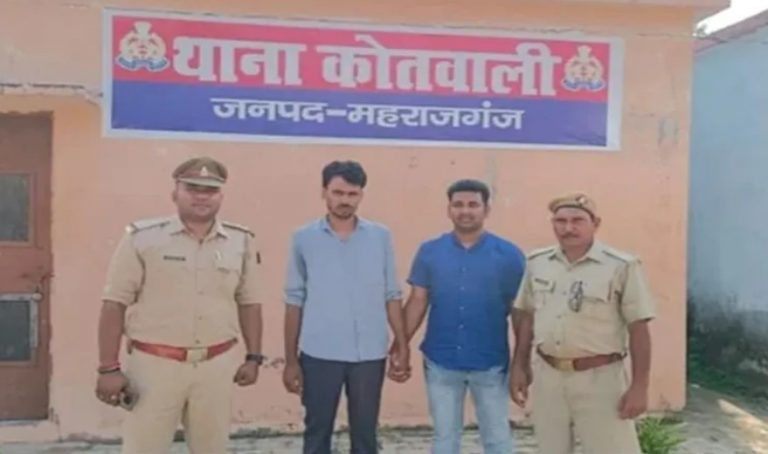
Enraged by this, members of the Hindu organisation surrounded the Kotwali Police Station and staged a demonstration. They urged strict action against the perpetrator. The police, in turn, registered a case against the accused. City Police Superintendent Poonam Chand Yadav assured prompt action in the case.

It may be recalled, that a video has been doing rounds on social media wherein a group of fanatic Muslims taking part in a Muharram procession can be heard chanting ‘gustakh-e-Rasool ki ek hi saza, sar tan se juda sar tan se juda’. The incident reportedly took place in Madhya Pradesh’s Khandwa district on August 10, Wednesday.

Taking cognizance of the video, the Madhya Pradesh police have registered an FIR against as many as 25 people and are trying to nab them.

In a similar incident, the Jaunpur police in Uttar Pradesh had arrested four people after a video went viral where a Muslim mob was heard raising ‘sar tan se juda’ and ‘Pakistan zindabad’ slogans during a Muharram procession. The video of the incident went viral on social media on August 10, Wednesday.

The incident reportedly took place in the Karianv Bazar of Mirganj police station area of ​​Jaunpur. On Wednesday, a group of Muslims were participating in the Tazia procession in the evening, when some Islamists in the crowd started shouting objectionable slogans and also tried to instigate the people belonging to the other community.

After the video went viral, the police sprung into action. It registered an FIR and arrested the people who chanted these slogans.

Nawab Malik claim false, former NCB officer Sameer Wankhede and his father are not Muslim and never gave up Hinduism: Committee findings

The caste verification committee has cleared former NCB official Sameer Wankhede in the caste certificate matter, bringing an end to a year-long controversy. In 2021, Nawab Malik – the former cabinet minister in the then Maha Vikas Aghadi government in Maharashtra – alleged that Sameer Wankhede is not a Muslim by birth because his father Dnyaneshwar Wankhede gave up Hinduism and became a Muslim to get married for the second time. Malik accused Wankhede of furnishing fake documents to verify his caste and denying the opportunity of a government job to one candidate from a scheduled caste. Now, the caste verification committee has proven Nawab Malik’s claims to be false.

Anita Meshram (Wankhede) presided over the caste scrutiny committee, which included Salima Tadvi as a member and Sunita Mate as a member secretary. The committee found that the accusation by former Maharastra cabinet minister and NCP leader Nawab Malik, as well as other complainants such as Manoj Sansare, Ashok Kamble, and Sanjay Kamble, who had objected to Sameer Wankhede’s caste certificate, could not be substantiated.

Sameer Wankhede’s caste certificate was likewise confirmed by the committee. The committee had taken down arguments from both sides in a 91-page verdict before concluding that Wankhede was not a Muslim by birth. Additionally, the committee found that Sameer Wankhede and his father Dyaneshwar Wankhede had not converted to Islam from Hinduism. According to the ruling, Sameer Wankhede and his father are members of the Mahar-37 Scheduled Caste, which is recognized in Hinduism.

Sameer Wankhede posted on Twitter, “Satyameva Jayate” which means ‘Truth Always Triumphs’. He said while talking to the media, “All my life I have worked for the service of the people, but what hurt me was the fact that my family and dead mother were also not spared. My family was hurt and my morale was also broken. Though we are trained to face such cases in our service, the manner in which we were targeted was shocking. I will not comment on the politics of all this.”

He further said, “The Bombay High Court had also used derogatory language for me, and my family has already approached the High Court in this regard. I will continue to do my job fearlessly.” The whole matter came to light last year when Wankhede was the head of the Narcotic Control Bureau in Mumbai. Wankhede alleged that Malik had raised the issue of his caste certificate as a cabinet minister at that time only because his team had arrested Malik’s son-in-law Sameer Khan in a drug case.

After Sameer Khan was released, Malik started making these allegations. Sameer Wankhede was also an investigating officer in the Cruise Drug Case of 2021 in which Shah Rukh Khan’s son Aryan Khan was also named. NCP leader Nawab Malik was the first to allege that the NCB raid was fake and an attempt to extort money from the film superstar.

October 5, 1988: When Rajiv Gandhi-led India became the first country to ban Salman Rushdie’s Satanic Verses, aided by Fareed Zakaria’s father

Noted novelist Salman Rushdie was stabbed repeatedly ahead of a speaking event in Chautauqua, New York, on Friday, August 13, 2022. Rushdie was always living on borrowed time once Iran’s Ayatollah Khomeini issued a fatwa against him in February 1989. However, when it came to banning Satanic Verses, India was months ahead of Iran, banning the book in October 1988 much before any other country.

Rushdie was ironically going to discuss the topic, “America’s role as an asylum for writers and other artists in exile and as a home for freedom of creative expression”, before he was stabbed in America for his writings from over 3 decades back.

Rushdie’s stabbing has once again brought the focus back on Satanic Verses, the book that got Rushdie in so much trouble that he had to live fearing for his life for the past 33 years, ever since Iran issued a fatwa in his name in February 1989. Iran’s Ayatollah Khomeini issued a fatwa against Salman Rushdie on February 14 that year, but interestingly, they were not the first country to get upset over the Satanic Verses and ban it, that honour belongs to India.

Indian Prime Minister at the time, Rajiv Gandhi, had already shown his willingness to bow down to Islamists in the Shah Bano case in 1985, and he did it again by leading the world in banning Satanic Verses. Interestingly, India never banned the book outright, instead, they imposed the ban through Finance Ministry, imposing a ban on the import of the book under the Customs act.

The Congress government even imposed a travel ban on Salman Rushdie, barring him from coming to India. The ban was eventually lifted by the Vajpayee government in 1999, 11 years later.

The book was first published in Britain on 26th September 1988, by banning its import within 10 days, India effectively banned the book. However, some copies had already found their way to India, but after looking at the fate of Nupur Sharma supporters, we can well understand why nobody is going to come out and admit to having a copy.

The call for a ban on the book was led by Congress MPs Syed Shahabuddin and Khursheed Alam Khan (father of Salman Khursheed). The book was banned after Shahabuddin filed a petition against it claiming that it is a threat to public order. Rafiq Zakaria, the father of CNN’s Fareed Zakaria, was also at the forefront of calling for a ban on Rushdie’s book.

A weak Prime Minister like Rajiv Gandhi did what was expected of him, bowed to the pressure from his party’s Muslim MPs, and banned the book, starting a fire which is evidently burning till today. Following the ban by India, the book was banned in Sudan, Bangladesh, Sri Lanka, and South Africa.

Even though Britain, where the book was first published, saw large-scale protests and book burnings, Margaret Thatcher government refused to ban the book. The protests soon spread to perpetually offended Pakistan, and even America saw several protests against the book.

With more and more countries seeing the protests against the book, Ayatollah Khomeini, the supreme leader of Iran, jumped into the controversy and issued his fatwa. On Valentine’s Day in 1989, Khomeini issued a fatwa on Rushdie’s life and his publishers. He never gave any reason for the fatwa on Rushdie’s head but Iran soon announced $6 Million reward on Rushdie’s head.

With no expiry dates on fatwas, that remains valid to date, and may well have inspired the attacker who stabbed Rushdie in the neck last night. The spark provided by Rajiv Gandhi in October 1988 when he led the world in banning Satanic Verses, continues to fuel the fire of intolerance that burns till today.