Home Blog Page 3057

Udaipur murder: Police constable controlling the mob attacked with sharp weapon in Rajsamand where killers were arrested

Kanhaiya Lal’s gruesome murder by Islamists in Udaipur has triggered unrest in Rajasthan. A police constable named Sandeep has sustained serious injuries in Rajsamand when a person from the mob he was trying to control suddenly attacked him with a sharp weapon on Wednesday 29th June 2022.

The policeman sustained serious injuries and he was referred to a hospital in Ajmer immediately.

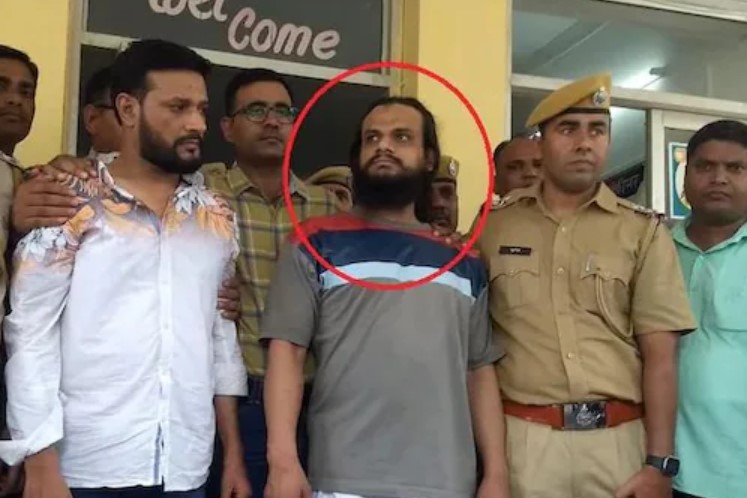
Situations in Rajsamand were tense just like those in Udaipur when the Bhim police station staff arrested the two accused who were on the run after killing Kanhaiya Lal on Tuesday 28th June 2022. A video of the arrest was also released. Soon after the arrest, a large group of people started protesting. Even on Wednesday, the crowd started to gather in big numbers in the morning and they eventually took a form of a rally.

At around 2 pm, the crowd was protesting in the Bhim police station area of Rajsamand, which the police were constantly trying to control. In the meantime, one of the men from the mob stabbed constable Sandeep on the neck with a sharp weapon. The constable was immediately referred to Ajmer in an injured condition. According to reports, his condition is serious.

It is notable here that the murderers of Kanhaiya Lal named Mohammed Riyaz Akhtar and Gos Mohammed had fled to Rajsamand after killing the tailor inside his shop in Udaipur on Tuesday. They were arrested by the police from Rajsamand soon after the incident. The killers had filmed the act and had later made another video where they were seen brandishing their knives and declaring that they want to kill PM Modi in a similar manner.

Kanhaiya Lal was cremated on Wednesday, June 29. A large number of people were present for the last rites. Kanhaiya Lal was a tailor in Udaipur who was beheaded on Tuesday, June 28 by two Islamists for supporting Nupur Sharma’s allegedly insulting remarks against the Prophet Muhammad.

Islamist apologists don’t want you to know a ‘Samuday Vishesh’ neighbour next door might behead you, hence appeals against the circulation of video

On 28 June 2022, social media websites were awash with a gut-wrenching video of a Hindu man, Kanhaiya Lal, being beheaded by two Islamists for supporting former BJP spokesperson Nupur Sharma after religious zealots, instigated by Mohammed Zubair, targeted her for her remarks on Prophet Muhammad.

In the horrific crime that has emerged following the Nupur Sharma controversy, it has been learnt that the incident took place near the Bhoot Mahal on Maldas Street in Udaipur. The victim who is a tailor and proprietor of Supreme tailors was killed in broad daylight amidst the hustle-bustle on the adjoining road. The Udaipur Police rushed to the scene after the enraged merchants in the surrounding area complained of the inhumane incident.

In the video posted by Delhi BJP politician Tajinder Pal Singh Bagga, it could be seen that one Muslim man entered the victim’s shop as a customer while the other was possibly shooting the video. While the tailor was taking the man’s body measurements, he grabbed his neck and attacked him from the back. After this, the man started hitting the tailor, with the victim pleading with him to let him go.

The gruesome video of Islamists murdering Kanhaiya Lal in cold blood sent shivers down the spine of viewers and evoked feelings of horror and anger among those who could not bring themselves to believe what they were viewing with their eyes. The video showed that the Islamist barbarity was not a result of the spur-of-the-moment rage but an outcome of a cold, calculated plan aimed at silencing those who dared something as innocuous as extending one’s support to the beleaguered ex-BJP leader.

Soon after the video went viral on the internet, many social media users, including journalists and left-leaning liberals, tried to water down the incident by understating the impact of Mohammed Zubair’s dog-whistling and the inherent radicalisation among the Muslim community that brought the situation to pass.

In their efforts at whitewashing the horrifying atrocity and laying claim to the moral high ground, they made platitudinous appeals to their followers on social media to not view the incident from a religious prism and condemn the act of terrorism, which they claimed had no religion. Intriguingly, they also asked people not to watch or circulate the video of Lal’s murder, citing the blood-curdling content of the clips to make their case.

Even law enforcement officials partook in this exercise to dissuade people from watching the video and encouraged them against their circulation. A Rajasthan police official warned against watching the video, stating that it was too grisly to watch. Several appeals were made on Twitter and other social media platforms, including by well-meaning folks who demanded justice for the Hindu man. But they, too, requested their followers to abstain from sharing and circulating the gory video of Lal’s murder.

The appeals against the circulation of the Kanhaiya Lal beheading video are meant to downplay the extent of Islamism plaguing the society

As requests asking people not to share Kanhaiya Lal’s beheading are made, it is worth noting what the gruesome clips reveal and what limiting their circulation would achieve. The videos, in essence, illustrate that Islamic terror attacks are no longer limited to well-trained terrorists wielding sophisticated weapons but even seemingly ordinary citizens brainwashed with supremacist beliefs and religious zealotry are capable of matching them in their barbarity.

The attack on Kanhaiya Lal and the savagery with which it was committed busts myths about the equality of all religions. For far too long, the propagandists and apologists of Islamists have peddled the straw man of “All religions are equal” to shield Islamists and whitewash religiously motivated crimes.

But the brutal beheading of Kanhaiya Lal by Islamists egged on by the incendiary dog-whistling from Mohammed Zubair puts paid to the propaganda and brings to the fore a stark reality that all religions are not equal and one particular religion is an outlier whose followers feel no qualms in espousing violence and murdering adherents of other religions over alleged ‘blasphemy’ against their faith.

The apologists and propagandists do not want Hindus and others to know that the Islamist next door might behead them at the slightest ‘provocation’ or after being incited over ‘blasphemy’. It is for this reason that they are appealing against watching the videos of Kanhaiya Lal’s beheading, which showed how Islamists, egged on by religious fanaticism, killed the Hindu tailor for simply extending his support to Nupur Sharma.

Pictures and visuals have a powerful agency to stir a collective conscience and the Left wants to rob Hindus of this agency

The apologists of Islamists do not want Hindus to wake up from their slumber and take cognisance of the threat facing them. They want Hindus to remain oblivious to the danger posed by the Islamists as the awakening could mobilise Hindus and prove catastrophic to their political relevance.

Pictures and visuals have a powerful impact on the psyche of people. They possess the ability to stir public opinion and shake the collective conscience of the society, which is why the drowned image of a Syrian kid or the picture of a man pleading with folded hands were so widely shared across platforms.

The spine-chilling video of Kanhaiya Lal’s egregious beheading stands to expose the religious zealotry of the Islamists and their readiness to kill non-Muslims over alleged ‘blasphemy’. The Islamists are literally waiting for incitement to unleash their murderous zeal on non-Muslims and Kafirs. The apologists of such Islamists do not want Hindus to reckon with the unfortunate reality of Islamic fundamentalism that has slowly but steadily gnawed away at the country’s plural ethos. For these reasons, they are continuously imploring people against the circulation of the video, for the video has the potential to marshal Hindus in a way that no other means can and bring a realisation of the threats lurking in their neighbourhood.

Madhya Pradesh: Khargone administration erect barricades in few lanes to maintain peace in riot-hit area, leftist media twist it to portray as anti-Muslim

On April 10, 2022, during the year’s Ram Navami celebrations, Khargone in Madhya Pradesh came under vicious attack by Islamists, who pelted stones and indulged in arson and violence. The cops had resorted to firing tear gas shells to bring the situation under control. During the events of violence, a total of 24 people were injured, including six police personnel. Even the Superintendent of Police (Khargone) Siddharth Chaudhary has sustained bullet injuries.

The state administration sprung into action after the brutal attack on the Hindus taking part in the Ram Navami Shobha Yatra. While the Madhya Pradesh Chief Minister Shivraj Singh Chouhan announced financial assistance to the people who lost their homes in the Khargone riots, the police started rounding up the Islamists who had unleashed mayhem on the streets during this year’s Ram Navami celebrations. The illegally constructed buildings were bulldozed by the administration, who also took l other measures to prevent further escalations.

In one such preventive measure, the Khargone administration erected barricades and constructed walls in some sensitive areas where Islamists had run riots on April 10th, 2022. The government’s decision was taken purely from a security perspective, primarily to maintain peace in the riot-hit area and to avert further friction between the communities.

The leftist media, however, was quick to use this measure taken by the authorities to spin a narrative to disparage the BJP government in the state. With their dramatic articles with exaggerated headlines, the far-left media houses deftly twisted the state administration’s decision to make it appear completely anti-Muslim.

Propaganda media gives a different twist

Soon after the administration implemented the decision to erect barricades in a few lanes and bylanes to prevent riots, an effort was made to paint the situation in a different light. The Indian Express compared the situation to the 1947 partition of India and Pakistan. Hindi daily Dainik Bhaskar used another dramatic headline to call out the Madhya Pradesh administration. It read, “Wall of Hate for Peace.” The Times of India gave its article an emotional spin by using a picture of a young boy watching the road from behind a barricade installed in a lane.

“The Wall Dividing Post-Violence Khargone – Delaying Normalcy or Ensuring Peace?” the leftist propaganda news website The Quint headlined its article.

Islamist media outlet “Two Circle,” continued to support the fundamentalists by referring to Muslims in Khargone as prisoners. Furthermore, it blatantly referred to the April 10 riots as “anti-Muslim,” despite the fact that the area’s Hindu population had been attacked by fanatical Islamists.

How the leftist media twisted the Madhya Pradesh govt’s decision taken with an intent to maintain peace

Another Islamist media outfit Maktoob media also published an article with the headline, “Khargone violence: Admin build walls dividing religious settlements”. They too went on to audaciously lie by calling the violence that broke out in Madhya Pradesh’s Khargone ‘anti-Muslim’.

Article published by Islamist media outlet Maktoob media

‘We feel safe because of the wall’: a Hindu resident of Khargone speaks to OpIndia

Ashish Pandit, a local of Khargone’s Bhatwadi, a neighbourhood plagued by violence on this year’s Ram Navami, spoke with OpIndia. “I buy and sell used two-wheelers,” he said, further recalling how stones and gas bombs were thrown at his residence on the day of the violence. “My uncle Kailash Pandit’s shop was burned down and plundered. It was a good decision to erect a barricade in the middle of the lane. The same approach, which had been guarded, has been used by the perpetrators not only once, but several times. They enter through small alleyways and then use the same lanes to flee.

There has been violence along those roads in the past

“Violent attacks on our side have escalated over the past few years,” Ashish stated. “Both in 2018 and in 2014, there were violent incidents around Dussehra. The streets that are now blocked off with barricades were utilised during that period. Also, stone-pelting incidents have occurred 2-4 times in the past. The area we (Hindus) live in is right in the middle, encircled on all sides by Muslim-dominated neighbourhoods,” said Ashish.

Erecting barricades does not mean blocking the road: Ashish Pandit, a local of Khargone

Ashish further told OpIndia that “those who are protesting and making a big deal about the government’s decision to erect barricades ought to be aware that just some of the lanes have these barriers in place. For instance, in my neighbourhood, barricades have been placed in only two lanes; nevertheless, other routes are still open and are frequented by individuals from different neighbourhoods.”

How can we buy things from people who stoned out houses, questions Ashish

“The owner of a flour mill who has been cited by numerous media outlets may be the one who owns a store close to the mosque at Talab Chowk, where the riot first started on April 10 and later spread to other areas of the city. Even though his business is still open, many Hindus no longer go there to get their flour milled. How can someone continue doing business with someone who threw stones at their home? No one has instigated anyone, instead, the Hindus who were affected by the violence made this decision on their own,” Ashish told OpIndia.

Islamists entered from the lane which has now been barricaded to plunder and burn down my shop: Khargone Hindu victim

Recalling the horror meted out to the Hindus on April 10, 2022, another Hindu named Kailash, who runs a grocery store called Kaushik grocery in the Bhatwadi mohalla of Khargone, told OpIndia, “The narrow lane which the authorities have now barricaded was the one the rampaging mob of around 150 Islamists had used on the day of the violence to approach my shop. They robbed my shop and set fire to whatever was left,” he said.

Kailash added that “people continued to look on in terror as the Islamists ran riots. Police had to use tear gas to drive them away. We incurred a loss of roughly Rs 7 lakh due to the vandalism and arson carried out by the radicals. I received a Rs 2 lakh compensation from the government. The installation of a gate here is a good decision from our security perspective. In the past also, armed Islamist mobs have used this narrow lane to enter our area and run riots. Now that this barricade is in place, it will stop the mobs from entering our area at their whim and causing mayhem”, said the Hindu victim.

These are mere excuses, many other approach roads are still open

The riots victim Kailash continued, “This is merely a pretext. Several other routes are still open and can be used by individuals to enter the area. The government is keeping an eye on all these entry and exit points, though.

The police officers were stationed in these areas day and night when the violence had occurred, but they cannot be stationed here permanently, he said, recalling how the enraged Islamist mob had later set fire to the homes of three Hindus in his neighbourhood. Now that these barricades have been erected in the narrow lanes that had become the rioters’ preferred route, at least the mobs won’t be able to arrive unexpectedly, and the commotion will now be brought under control, said Kailash, appearing visibly at ease.

We could open our shops only after administration erected these barricades, said a Khargone Hindu resident

The unruly mob set fire to Rajesh alias Raju Pal’s tailoring shop. When speaking to OpIndia, store owner Raju stated, “I had me shop by the name of Mary Ann Tailors, in which merchandise worth roughly 25 lakh rupees was burned to ashes. I received a 2 lakh rupee compensation from the government. From a security perspective, gates have now been installed, which was actually very important. Now, young children may cross it, but a sudden influx of people will be impossible,” said Raju who has been working to rebuild his business by operating from a different shop rather than his own destroyed one since the violence devastated his family.

“It is shameful that some people are advancing their nefarious agenda by using the installation of barricades by the state administration as a tool. This is important for our safety,” lamented the Hindu victim.

List of names of the Islamists accused of burning down Rajesh alias Raju Pal’s tailoring shop

Was threatened again after opening the shop: Rajesh alias Raju Pal

Raju Pal continued, “About a dozen Muslims came to threaten me when I reopened my shop. After my shop was set on fire, I named a few accused, which infuriated them. They threatened me, saying even my newly reopened shop wouldn’t last long if I didn’t remove the names of Muslims from the case. Additionally, I reported this incident to the police. The same road where the barricade has now been erected is where those who set my shop on fire had come from. For those residing on that side, there are other alternative routes which can be used.

Raju’s shop that the Islamists set on fire

The routes used during the violence were already marked

Khargone’s district general secretary for the Vishwa Hindu Parishad, Vivek Singh, asserted that “some specific roads were already marked, from which the Islamist mob came and ran riots on April 10.” Only a few of these roads have been barricaded, but they haven’t been completely blocked off as some media outlets have claimed. Even before this incident, violent rioters were moving between these lanes. Singh added that when the victims of violence were questioned if they were okay with the barricades being placed and whether they thought it was important for their security, they replied that the barricades had been erected in response to demands made by the Hindu victims in the neighbourhood.

BJP leaders opined how barricades are necessary

BJP leaders from Khargone Anoop Goswami and Jignesh Patel concurred that barricades must be erected to ensure the safety of the locals. They affirmed that nobody in the area is against the idea of barriers being built in a few key locations, despite the media’s exaggerated and unjustified portrayal of the community’s opposition to the idea.

The barricades were installed by the municipal administration: Khargone Police

The roadblock and other obstructions were decided upon by the municipal administration rather than the police administration, according to the TI of Khargone Kotwali. When OpIndia spoke to the SP of Khargone, he declined to comment on the matter. The DM office’s phone went unanswered. OpIndia would update the report once the police releases its official statement on the matter.

Rajasthan: Post-mortem report reveals Kanhaiya Lal was hacked over 24 times, 7-8 times on the neck

On Wednesday, the post-mortem report of a deceased Kanhaiya Lal, who was killed by the Islamists in Rajasthan’s Udaipur district revealed that he was attacked 26 times on his body from his neck to shoulder. Kanhaiya Lal, after being attacked with sharp weapons, died due to excessive bleeding.

According to the reports, the deceased was stabbed 7 to 8 times specifically on his neck while he had more than 24 injury marks on his entire body. He was killed by two radical Islamists who have been identified as Mohammed Riyaz Akhtar and Gos Mohammed. The duo killed Kanhaiya Lal for sharing a social media post in support of ex-BJP spokesperson Nupur Sharma.

Reports further stated that Kanhaiya’s hand was cut too during the attack. Due to repeated attacks by the sharp weapons, multiple blood vessels in his body had been severed, causing excessive bleeding and death. Images of Kanhaiya Kumar’s body lying in a large pool of blood have been going viral on social media.

Reports mention that the victim was being threatened previously for sharing a social media post in support of Sharma. He continued to receive death threats since his 8-year-old son had accidentally shared the post from Kanhaiya Lal’s mobile.

Reportedly, the Police had also arrested Kanhaiya Lal in the past for his social media post. Even after arresting Kanhaiya Lal, the murderers were threatening to intimidate him and kill him. On this, the victim had informed the Dhanmandi police station and requested protection but the police did not take the matter seriously.

On June 29, the wife of the deceased confirmed that Kanhaiya Lal was being threatened by the Islamists. She said that her husband had stopped going to his tailoring shop due to the continuous death threats. It is on June 28 that he resumed work and was brutally killed by the Islamists.

According to Kanhaiya Lal’s wife, the two radical Islamists had disguised as customers and entered the shop of the deceased. While the 48-year-old was busy taking the measurements, one of the accused attacked him with a large knife. The other one blatantly shot the entire act. Videos of the murder have been viral on social media. The duo had later made another video displaying their knives and declaring that they plan to kill PM Modi too.

Reports mention that the name and location of Kanhaiya Lal was leaked by his neighbour Nazim on WhatsApp who had also filed a complaint against Kanhaiya Lal for his alleged post in support of Nupur Sharma. Nazim on Tuesday made viral the name, photograph, and location of Kanhaiya, making it easy for the murderers to locate him near the Bhoot Mahal on Maldas Street in Udaipur. The two brutal killers were however arrested from the neighbouring district of Rajsamand.

The mortal remains of the deceased arrived at his native place after the post-mortem report. Reportedly, several people joined the funeral procession of Kanhaiya Lal before he was cremated today.

The Police in the case have asked the cyber police stations across the city to intensify social media monitoring and flag posts, images, and videos with the potential to inflame communal tension. The Police have also issued prohibitory orders and have banned gathering of more than four or five persons across the state for a month. Internet services have been suspended for the next 24 hours. The HMO has initiated an NIA investigation in the case.

NIA registers case in Kanhaiya Lal Teli murder case under several sections of IPC and UAPA including terror charges

After the union home ministry handed over the Kanhaiya Lal murder case in Udaipur to the National Investigation Agency, the agency has filed a case against the culprits under several sections of the IPC and UAPA.

The Indian Penal Code sections invoked by the NIA are 452 (House-trespass after preparation for hurt, assault or wrong­ful restraint), 302 (murder), 153A (Promoting enmity between different groups on grounds of religion, race, place of birth, residence, language, etc), 153B (Imputations, assertions prejudicial to national-integration), 295A (Deliberate and malicious acts, intended to outrage reli­gious feelings of any class by insulting its religion or reli­gious beliefs), 34 (Acts done by several persons in furtherance of common intention).

Similarly, the sections of stringent Unlawful Activities (Prevention) Act, 1967 attached to the case by the NIA are the sections 16 (terrorist act), 18 (conspiracy), 20 (member of terrorist gang or organisation). With the inclusion of these sections, the NIA has made it clear that they are considering the case as an act of terrorism.

The NIA says that the case has been filed against the accused who have conspired, planned and committed the heinous murder of Kanhaiya Lal Teli on 28th June in Udaipur in Rajasthan.

The agency also informed that the case was initially registered as FIR no 81/2022 at Dhanmandi police station in Udaipur by local police. Now, the NIA has re-registered the case RC-27/2022/NIA/DLI today. NIA states that the two accused, who have been arrested by the police, had inflicted multiple injuries to the victim with sharp weapons. They had also circulated a video of the criminal at in social media claiming responsibility for the murder in order to trigger panic and strike terror among the masses across the country, the agency said in a statement.

Earlier in the day, the union home ministry had informed that the case has been handed over to NIA. The ministry had said that the the involvement of any organisation and international links in the murder case will be thoroughly investigated.

Murder of Kanhaiya Lal

On June 28, Hindu man named Kanhaiya Lal was brutally murdered in Udaipur, Rajasthan, over an alleged post in favour of former Bharatiya Janata Party (BJP) spokesperson Nupur Sharma. The post was allegedly made by accident from Kanhaiya Lal’s phone by his 8-years-old son while playing a video game. Earlier Kanhaiya Lal was arrested for making the post after his neighbour Nazim filed a complaint about the same.

After getting released on bail, Kanhaiya Lal started to receive threats. He was threatened not to open his tailoring shop. Kanhaiya Lal had approached Police for legal action against those who were threatening him and requested Police protection so that he could open the shop.

However, the police did nothing to restrain those who were threatening him, and didn’t provide security to Kanhaiya. The police had called them and made them sign a compromise agreement. Kanhaiya Lal then submitted another application on the same day that he did not want legal action following the compromise. Scared for his life, Kanhaiya Lal kept his shop shut for six days. On the 7th day, when he opened his shop, he was brutally murdered by two Islamists identified as Mohammed Riyaz Akhtar and Mohammed Gos. Notably, Kanhaiya Lal’s photograph, address and other information were distributed by Nazim and others. They had urged their community members to kill Kanhaiya Lal if they see him the open or he opened his shop.

‘Udaipur murder is symptom, we are ignoring the disease’: Kerala Governor says madrasas are teaching that beheading is the only punishment for blasphemy

On June 29, Kerala Governor Arif Mohammad Khan reacted to the murder of Kanhaiya Lal, a Hindu tailor from Udaipur, by two Islamists. In a statement, Khan said the deeper disease is being ignored despite the symptoms being visible. He pointed out the rampant radicalisation going on inside madrasas and stated, “children studying there are being taught that the punishment for blasphemy is beheading.”

He said, “We worry when symptoms come but refuse to notice the deeper disease. Children are being taught in madarsas that punishment for blasphemy is beheading. It’s being taught as the law of God. What’s being taught, there should be examined.”

Murder of Kanhaiya Lal

A Hindu tailor named Kanhaiya Lal was brutally murdered by two Islamists identified as Mohammed Riyaz Akhtar and Mohammed Gos on June 28. The murder was reportedly in retaliation to a social media post by Kanhaiya Lal in support of former Bharatiya Janata Party (BJP) spokesperson Nupur Sharma. Earlier, Kanhaiya Lal was arrested for the post based on the complaint of his neighbour Nazim.

After getting released on bail, Kanhaiya Lal continued to receive threats. He noticed 5-7 people, including Nazim, continuously did recce of his shop, and he was threatened not to open his tailoring shop. Kanhaiya Lal approached Police for legal action against those who were threatening him and requested Police protection so that he could open the shop.

The Police, instead of arresting those who were threatening him, called them and made them sign a compromise agreement. Kanhaiya Lal had submitted another application on the same day that he did not want legal action following the compromise. Scared for his life, Kanhaiya Lal kept his shop shut for six days. When he finally decided to open his shop, he was brutally murdered by the two Islamists who posed as his customers.

The killers made a video attacking him and also made a video later gloating about the crime. They also threatened to kill Prime Minister Narendra Modi in the video.

MHA has handed over the investigation to NIA.

‘Remarks are completely unwarranted, misleading and unacceptable’: MEA Spokesperson on UN Human Rights’ comment on Teesta Setalvad’s arrest

The Ministry of External Affairs Spokesperson Arindam Bagchi has lashed out at United Nations Human Rights Commission over their unwarranted comment on the arrest of Teesta Setalvad and two others. The MEA has called out the UN body’s comments as misleading and unacceptable.

The arrest of Setalvad, ex-Police officer Sanjiv Bhatt and former Gujarat DGP & AAP leader RB Sreekumar came after they were accused of generating sensation by lying to investigators about the 2002 Gujarat riots. The arrests had come soon after the Supreme Court gave its verdict on the Zakia Jafri case, citing how lies were spread to incite violence and ‘keep the pot boiling’.

Upon the development, the UN Human Rights Commission put out a tweet against the arrest of the so-called activist and ex-police officials.

In a tweet, the UN Human rights body said, “We are very concerned by the arrest and detention of Teesta Setalvad and two ex-police officers and call for their immediate release. They must not be persecuted for their activism and solidarity with the victims of the 2002 Gujarat Riots.”

With its comment, the committee suggested that Setalvad and others were being persecuted for their activism.

In a stern reply by the Ministry of External Affairs, Official Spokesperson Shri Arindam Bagchi said, “We have seen a comment by the Office of the High Commissioner for Human Rights (OHCHR) regarding legal action against Teesta Setalvad and two other persons. The remarks by OHCHR are completely unwarranted and constitute an interference in India’s independent judicial system.”

“Authorities in India act against violations of law strictly in accordance with established judicial processes. Labelling such legal actions as persecution for activism is misleading and unacceptable,” he further added.

On June 26, the Gujarat Anti-Terrorism Squad took so-called activist Teesta Setalvad into custody after an FIR for forgery was registered against her and others under several sections of the Indian Penal Code. Setalvad, who under the guise of her activism, was found influencing witnesses in the Gujarat riots case, was booked under IPC 468 (Forgery for the purpose of cheating), 471 (using forged document or record as genuine), 194 (Giving or fabricating false evidence with intent to procure conviction of capital offence) and other sections of the IPC alongside two others.

After Udaipur murder, similar killing of Umesh Kolhe in Maharashtra raises questions, BJP leader claims he was killed for supporting Nupur Sharma

On June 22, Umesh Kolhe, a chemist living in Maharashtra’s Amravati, was murdered by four Muslim assailants while he was returning from his pharmacy that night. While the reasons of the murder are not clear yet, Maharashtra BJP Spokesperson Shivrai Kulkarni has alleged that he was killed for supporting Nupur Sharma. Kulkarni has said that the police should investigate whether Kolhe was killed over a post in support of Nupur Sharma on social media.

The 54-year-old Medical professional ran a pharmacy ‘Amit Medical’ in the Tehsil office area, in Maharashtra’s Amravati. On the night of the murder, on June 22, Umesh Kolhe was on his way home with his son Sanket and daughter-in-law Vaishnavi on different bikes. In the attack, Kolhe was attacked with a knife from the back on his neck in which he was seriously injured. With heavy blood overflowing, Kolhe died on the spot.

Kolhe’s son and daughter-in-law rushed to his aid, but the assailants had managed to escape because of darkness. As told by Kolhe’s son to the police, there were two men stopped the vehicle and attacked it. The Crime Branch and the City Kotwali Police launched a joint investigation and arrested the two suspects named Mudassir Ahmed Sheikh Ibrahim and Shah Rukh Pathan Inayat Khan. The police have also arrested two more accused – Abdul Taufiq and Shoaib Khan in connection with Kolhe’s murder.

Upon investigation, it was learnt that the assailants were doing reiki of the area in which Kolhe was killed. While it is suspected that there is a religious angle to the case, the Amravati City Police have said that they would continue to investigate the matter involving through every probable angle.

Maharashtra BJP leader alleges Nupur Sharma angle

Maharashtra BJP leader and spokesperson Shivrai Kulkarni has alleged that the case might involve a Nupur Sharma angle to it. Kulkarni has said that the police should investigate whether Umesh Kolhe’s death was avenged over his posts supportive of ex-BJP spokesperson Nupur Sharma on Social Media sites. “Since the police has Kolhe’s phone, it should probed whether he was getting death threats over posts supporting Nupur Sharma. It doesn’t look like this murder was done over normal loot,” Kulkarni said.

“The case is very suspicious. The assailants did not have much criminal background before murdering Kolhe. Mr Kolhe had shared some posts regarding Nupur Sharma on social media and some Whatsapp groups. It is imperative that the police investigate whether this fact has to do with his gruesome murder,” Kulkarni said in a video.

Further, he informed that the attack on Umesh Kolhe was done in a very ‘professional’ way with a 5-inch Chinese knife. “The assailants who attacked Kolhe on his neck did not even bother to touch the money lying in his bag. They were keeping a watch on him for a week. The Police should investigate this angle without any outside pressure,” Kulkarni informed after meeting the family of the deceased.

Ex-BJP corporator from Amravati Tushar Bhartiya has demanded that the findings of the investigation should also be shared with the Anti-Terrorism Squad (ATS) through an application to Maharashtra Leader of Opposition Devendra Fadnavis.

Arrested culprits say they wanted to rob Umesh Kolhe

While demands are made to probe the religious angle, the police have claimed to have cracked the case, saying that it was a robbery case gone wrong. According to the police, the arrested accused have said that they keep an eye on traders in the night, and rob them after finding a proper opportunity. Accordingly, they were studying the movements of Kolhe, and on that day, they followed him after he started to move towards his home after shutting his shop. They had chosen a lane that Kolhe takes, which remains mostly deserted at that time. They stopped him in the lane and tried to rob him, but Umesh Kolhe tried to fight them and also raised an alarm. Therefore, one of the attackers stabbed in his stomach using a Chinese knife. They immediately fled as Umesh’s son Sanket, who was riding behind him, had reached there by that time.

Incidentally, although there is a CCTV camera where the incident took place, it was no help as the area was completely dark. Police than scanned the CCTV cameras of the entire area, and also scanned mobile phones which were active at that time at the crime scene. Based on these information, police were able to nab Mudassir Ahmed Sheikh Ibrahim and Shah Rukh Pathan Ihayat Khan. Later the other two were arrested in connection with the case. All of them have made the robbery claim.

However, their claim is questionable as they didn’t take anything from Kolhe after killing him. The victim had around Rs 35,000 with him, and the money was found intact. Therefore, the cause of the murder remains a mystery.

On Tuesday, a tailor in Rajasthan’s Udaipur, Kanhaiya Lal was beheaded in broad daylight by two Islamist assailants days after they targeted him with death threats over posts supporting ex BJP-spokesperson Nupur Sharma.

From ‘hospital in place of Ram Mandir’ to wearing Hindu identity on sleeve: Hindutva as response to Left Liberal and deep Nehruvian State

As 90s urban kids, we have been exposed to modernity where it was cool to blame Hindus for 2002. Secularism was a badge of honour we proudly wore on our sleeves and believed there should be hospital or school in place of Bhavya Ram Mandir at Ram Janmabhoomi in Ayodhya where disputed structure called Babri Masjid once stood. Mahabharata was mythology and our culture was scoffed at.

We were made to believe our constitution was “inspired” deeply from west where we adopted Soviet’s socialism, American democracy and French secularism. Imagine the kind of indoctrination happened subconsciously and our society was becoming deracinated and rotten. It is still “not cool” to wear cultural identity and you are looked down upon if you glorify your civilizational heroes.

This all changed after 2014, albeit, subconsciously. As if there was a slight nudge. I have seen people being more assertive and have started considering India as a civilisational state where “modernity” is in sync with your cultural values.

Let us first understand what is Hindutva? A lot of authors and philosopher have their share of definition. Hindutva essentially means “Hindu + Tattva” which roughly translates as “soul and existence of Hinduism”. In today’s time we consider Hindutva as Hinduism which resists.

Now essential question arises resistance from whom? I will try to explain.

Resistance from Abrahamic and monolithic faiths. In tradition of Sanatan Dharma and Hindu faith one characterstic is particularly noteworthy. In the long history not a single instance of spread of faith by use of force is available. Cambodia is named after Rishi Kamboj. He went to Cambodia and came back. He never went to conquer it or used aggression / army. Widely revered Prabhu Shri Ram went to Lanka defeated Ravana and made Vibhishan emperor. Came back to rule Ayodhya.

On the other hand, the whole history of spread of Abrahamic faiths is the use of force in various ways. The expansion of these faiths happened by use of force. It is either by economic might or by political might or by combination of these factors. In expansion of these faiths there are a few things one must understand about them.

The Abrahamic faiths annihilated religious places of other faiths. They broke or defiled sacred images of Gods, destroyed idols, temples, burnt their sacred scriptures to ashes, and made complete and untiring effort to destroy their cultures, root and branch.

I do not want to go into details but people should read upon the Goa inquisition by Portuguese. Entire state was terrorised and temples were taken hostage to repressive, bloody, racist and genocidal chapters ever witnessed in human history.

The second example is Ajmer and Muhammed Ghauri. They used method of deceit which is commonly known as “Al-Taqqiya” in Islam. We Hindus never learnt from bloody history where they used “Moinuddin Chishti” as a Sufi ‘saint’ who came to India on the orders of Ghauri and spied on the troop movement of Prithviraj Chauhan. Our “secular”, “modern” and “inclusive” Hindus still offer cooked rice and Chadar at Majar of genocide enabler and barbarian called Chishti.

Despite the onslaught from aggressive monolithic faiths, our civilisation still continue to survive, grow and thrive. But subconsciously, this “left -liberal” and deep Nehruvian state used education, and specifically History as a tool to subvert the Dharmic society. Since they have been in power for majority of time since independence, they also used constitution as a tool tool pervert the society.

Secularism by definition means separation of Christian Church and State. The function of the state was not only to supervise and control the “worldly/secular” life of its subjects but also secure their salvation in the next world. The key to secure their salvation was use of the church. If any citizen who disregard the Chruch was excommunicated. Gates of heaven were closed for them. The state used to burn them or torture them in prison. In the language of the Church, the State was referred to as “Secular arm’’ of the Church and State admitted publicly that it used to serve the Church.

Now, please tell me how a western concept of “secularism” created by “Church” today which is used heavily in modern politics not a perversion of society? In fact, our constitution assembly headed by Dr Bhimrao Ambedkar disregarded the word “secular’’ and “socialist’’ from the original constitution. It was only during Emergency when entire opposition was in jail, to please the communists, and the Left – Liberal intelligentsia Indira Gandhi inserted these draconian words in our constitution and we are still suffering from this disease.

Ram Mandir movement in 1991 was a unified effort by the Dharmic civilisation to take down symbol of oppression. Who was Babur and what was Babri Masjid? Babur was an invader who kidnapped, raped and looted Hindus in India. His tenure symbolised the modern ISIS killings. This is written by him in Baburnama. Still we have roads and monuments named after him, many in even the heart of national capital in Delhi.

Only a society which suffers from Stockholm Syndrome will glorify those who committed genocide on your civilisation. Although things have changed and despite resistance from usual quarters the name of Aurangzeb Road in Delhi was changed to Dr APJ Abdul Kalam road. It would not have been possible before 2014.

To conclude, India is a civilisational state. Our sense of nationhood comes from strong sense of civilisation. Every country that has risen to top of the world had a grand narrative. Forget what the world thinks about you. Do not care whether articles in anti-India international media platforms such as Washington Post , NYTimes call CM of UP as “Militant Monk” but glorify “Biden” who takes oath on bible and stresses the use of Christian values to run the country. In fact, these are the very same societies which lecture India on tolerance but have completely wiped natives out of their land and have been instrumental in extinction of several cultures and wreaked havoc on nature on an unprecedented scale.

They still believe “Columbus Voyage” must be seen as glorious and heroic achievement which Christianised America by ‘liberating’ tribes and indigenous societies which practiced their own culture.

Rebel Shiv Sena MLAs donate Rs 51 lakhs to the Assam CM’s relief fund for flood relief, to shift to a place closer to Mumbai ahead of floor test

Amid the political crisis ongoing in the state of Maharahstra, the rebel Shiv Sena MLAs led by Eknath Shinde on Wednesday announced that they have donated Rs 51 lakhs for the flood relief work in Assam. Shinde and dissident Sena 42 MLAs and some independent have been camping in the Radisson Blu hotel in Assam’s Guwahati since the last week.

“Shiv Sena MLAs and allies have decided to contribute Rs 51 lakhs to the Assam CM’s relief fund to help the flood-affected people”, tweeted rebel Shiv Sena leader Eknath Shinde on June 29.

Also, rebel leader Deepak Kesarkar spoke about the donation and stated that the plight of people suffering from the floods in Assam cannot be ignored. “Shinde has donated Rs 51 lakh to the Assam Chief Minister’s Relief Fund as our contribution to their ongoing rescue work”, he said.

Assam chief minister Himanta Biswa Sarma acknowledged the donation made by the Maharashtra MLAs to the CM’s relief fund. “Heartfelt gratitude to Hon’ble Shiv Sena MLAs led by Shri @mieknathshinde
ji for contributing ₹51 lakh to CM Relief Fund. The contribution shall go a long way in reaching out to the flood victims and ensuring relief in flood-affected areas of our State,” he tweeted.

The CM also tweeted the same in Marathi.

It may be noted that after staying more than a week in Guwahati, the rebel MLAs are returning to Maharashtra today, as the governor has ordered a floor test tomorrow. According to media speculation, they will move to Goa, and will arrive at Mumbai tomorrow morning in time for the assembly session. However, as the Shiv Sena has moved Supreme Court against the governor’s order, if the court stays or refers the voting in confidence motion, the plans of the MLAs also can change. The MLAs today visited the Kamakhya temple in Guwahati to offer prayers before leaving the state.

Deepak Kesarkar also added that the rebel MLAs had decided to shift to a place close to Mumbai after Maharashtra Governor asked the Uddhav Thackeray-led Maha Vikas Aghadi (MVA) government to face a floor test on June 30. “We will be staying at a place that is one-hour air distance from Mumbai, so that that we can comfortably reach the state capital for the floor test. The decision (of floor test) will be what we have been demanding for a long time from our leadership”, Kesarkar was quoted.

According to the reports, the Shiv Sena rebel MLAs will be staying in a hotel in Goa from where they will reach Mumbai by 9:30 on Thursday. Eknath Shinde meanwhile, also released a series of videos of the MLAs supporting him from Guwahati. The rebel MLAs confessed on the video that they were not forced by anyone to rebel against the MVA government.

They also reiterated that the ideologies of Shiv Sena led by Uddhav Thackeray differed from the ideologies of party supremo Balasaheb Thackeray. The leaders clarified that they were not in touch with any of the other leaders or party office-bearers except Eknath Shinde at present. The rebel Shiv Sena MLAs who have been camping in Guwahati hotel in Assam are expected to leave for Maharashtra to be present in the Assembly tomorrow morning.

Floods in Assam

Massive floods erupted in the state of Assam that affected around 24.92 lakh people from 28 districts. Several people have died in the floods with several other areas remaining submerged. According to the reports, most of the areas in the Silchar town of Cachar have been submerged for more than a week. The number of people who lost their lives in the floods has increased to 139.

Rivers like Brahmaputra, Beki, Kopili, Barak, and Kushiyara are flowing above the danger mark. Meanwhile, various relief centers have been started at several places across the state and medical officers and paramedical staff have been deployed to look after the affected. Health camps have also been set up to prevent the spread of diseases.

Reports by Assam State Disaster Management Authority reveal that a total of 2,389 villages have been affected by the floods and around 1,76,201 people are staying in 555 relief camps. Flood waters have damaged 155 roads and five bridges, while seven embankments have been broken.