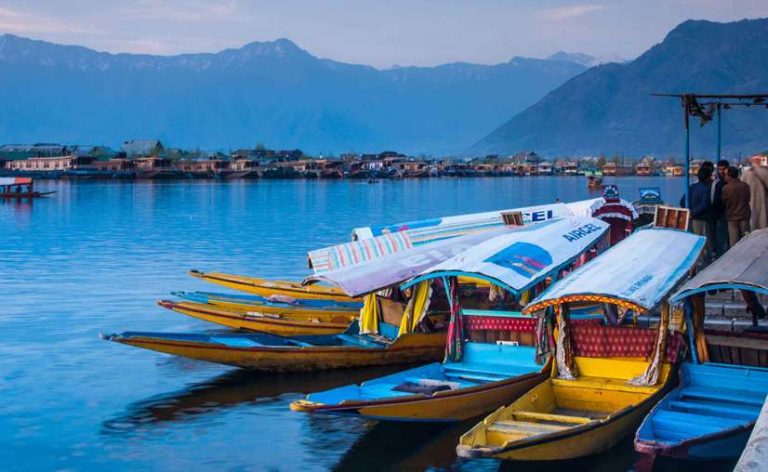
As the rising mercury levels in the rest of the country leave Indians sweating, it is bringing great joy to Kashmir and its tourism industry. For the first time in a decade, Kashmir witnessed as many as 1.8 Lakh tourists in the month of March in 2022, as per Tourism Director GN Itoo.
With the rising temperatures elsewhere, more and more tourists are expected to head to Kashmir during this season. Tourism numbers will also be bolstered by the resumption of the Amarnath Yatra. The holy pilgrimage was suspended in 2020 and 2021 due to Coronavirus. The yatra will begin on 30th June and continue for 43 days.
“This is a record number and we are expecting a further increase in it. The credit for the record number of tourist arrivals goes to collective efforts of all the stakeholders including travel agents, tour operators, houseboat owners, and even pony wallas”, Director Itoo said.
Secretary Tourism and Culture Jammu & Kashmir, Sarmad Hafeez said that credited a series of roadshows and promotion campaigns in various cities of India for the bumper tourist season. Promotion of tourist attractions like Tulip Garden, Mughal Gardens has also paid dividends as per Hafeez.
He also mentioned that majority of the hotels and houseboats have already received the advance payment against their bookings so they expect a good tourist season to continue in the coming months.
This is the first full tourist season in Kashmir after the removal of article 370 in 2019. During the past 2 years, the tourism sector in the Union Territory suffered terribly due to Coronavirus and the resulting restrictions on travel.
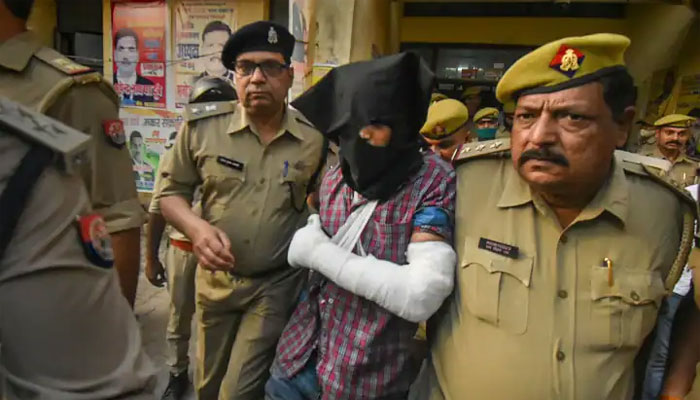
The doctor who treated Gorakhnath temple attacker Ahmad Murtaza Abbasi refuted the claims that he was mentally unstable. Speaking to Times Now, Superintendent in Chief of Gorakhpur District Hospital JSP Singh said the accused was talking coherently during the medical examination. He was responding to the queries of the Police and the doctors. He further added Abbasi did not display any signs of being violent, which made the doctors believe he was not mentally unstable.
“Murtaza Abbasi mentally fit and fine”, says doctor who treated the Gorakhpur horror accused; refutes claims made by accused’s family.@Amir_Haque joins @DEKAMEGHNA with this ground report & analysis.
JSP Singh said though he was not available when Abbasi’s medical examination was done, the doctor who briefed him about the case did not mention that Abbasi was calm and composed while replying to the queries. When asked if he was answering the doctors, Singh said, “The doctor who treated him could not talk to him as Police had circled around them. He was cooperating in the treatment. During the treatment, the Police were questioning him, to which he was replying calmly.”
Murtaza’s name was on the list of suspects sent by the intelligence
News Nation, in a report, claimed that on March 31, intelligence agencies had sent a list of 16 suspects to UP Police. Ahmad Murtaza’s name was on the list. Earlier, it was reported that Murtaza was under ATS’s scanner. Furthermore, the investigation agencies have sealed Murtaza’s house for further investigation.
On April 3, a man identified as Ahmad Murtaza Abbasi attacked Police personnel outside Gorakhnath Temple, Gorakhpur. The incident took place a day before CM Yogi Adityanath was scheduled to visit the temple. Abbasi severely injured two Police personnel with a sharp weapon. Reports suggest he was with another man who escaped when Abbasi was overpowered by the Police personnel. During the investigation, the security agencies found he was influenced by banned Islamic preacher Zakir Naik and might have ISIS links.
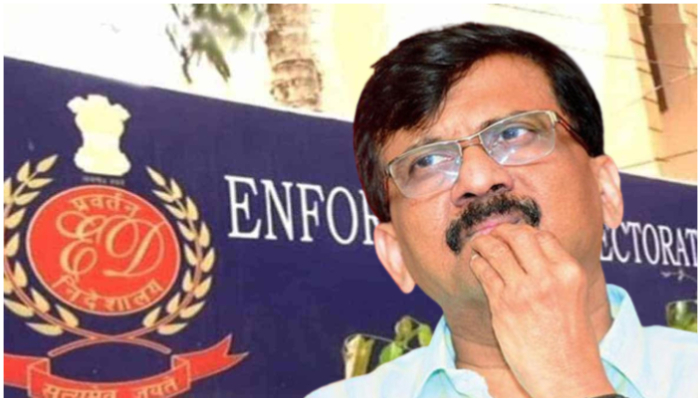
On Tuesday, the Enforcement Directorate provisionally attached properties worth Rs 11.5 crores owned by Shiv Sena leader Sanjay Raut and his family members in connection with its probe into the Rs 1034 crore floor space index (FSI) fraud at Patra Chawl in Goregaon. The properties seized include eight land parcels in Alibaug and one flat at Dadar in Mumbai.
Sanjay Raut responding to the seizure said that he will expose the BJP led government and that he will not stay quiet. “I’m not one to get scared, seize my property, shoot me, or send me to jail, Sanjay Raut is Balasaheb Thackeray’s follower and a Shiv Sainik, he’ll fight & expose everyone. I’m not one to stay quiet, let them dance. The truth will prevail”, he added.
#WATCH “… I’m not one to get scared, seize my property, shoot me, or send me to jail, Sanjay Raut is Balasaheb Thackeray’s follower & a Shiv Sainik, he’ll fight & expose everyone. I’m not one to stay quiet, let them dance. The truth will prevail”: Shiv Sena leader Sanjay Raut pic.twitter.com/UzIdBKN9mc
This is months after the ED arrested Maharashtra-based businessman Pravin Raut in this case and later filed a charge sheet too. The attachment is linked to a money-laundering probe linked to a Rs 1,034 crore worth scam related to the redevelopment of a chawl in Mumbai. The ED had also questioned Sujit Patkar, a business associate of the daughters of Shiv Sena leader Sanjay Raut, Purvashi and Vidhita in the case.
On February 3, the ED initiated an investigation under the provisions of PMLA on the basis of the FIR registered by the Economic Offences Wing. The agency informed that Guru Ashish Construction Pvt Ltd had entered into a tripartite agreement with the tenants and MHADA to redevelop Patra Chawl. The Patra Chawl at Goregaon has 672 tenants in tenements on 47 acres of land belonging to the Maharashtra Housing Area Development Authority (MHADA).
Guru Ashish Construction Pvt Ltd is a subsidiary company of Housing Development Infrastructure Ltd (HDIL), which is already accused of a Rs 4,300 crore fraud at the Punjab and Maharashtra Cooperative (PMC) Bank. According to the reports, Parvin Raut illegally sold FSI to various builders for Rs 1,034 crore with the help of Rakesh Kumar Wadhawan and Sarang Wadhawan, Directors of Guru Ashish Constructions Pvt Ltd. This was done without constructing the rehab flats and flats to be handed over to MHADA, which was the pre-requisite. The trio also obtained a bank loan in addition to Rs 1,034 crore received from various builders.
The investigation by the ED had also revealed that Pravin Raut being Director of Guru Ashish Construction Pvt Ltd played an active role in the redevelopment project and the Wadhwans managed to divert the proceeds of crime of more than Rs 1,000 crore by harming the interest of 672 tenants and buyers.
The ED back then had also questioned Shiv Sena MP Sanjay Raut’s wife Varsha Raut in connection with the PMC Bank case and her purported links with Pravin Raut’s wife. It had been found that Praveen Raut had transferred around Rs 1.6 crore to his wife who is a business partner of Sanjay Raut’s wife Varsha Raut. Of this Rs 1.6 crore, an amount of Rs 55 lakhs was allegedly transferred to Varsha Raut’s account as an interest-free loan. This money was then allegedly invested by Varsha in buying a flat at Dadar.
The ED on April 4 has seized the flat at Dadar owned by Shiv Sena leader Sanjay Raut and is investigating his role in the Rs 1,034 crore re-development land scam.
On Monday (April 4), the Delhi Jal Board announced that Muslim employees would be granted a daily leave of 2 hours during the month of Ramzan. Delhi Jal Board is an agency under the Arvind Kejriwal-led-Delhi government that supplies water to most of the National Capital Territory region.
In a circular, the Assistant Commissioner of Delhi Jal Board Virender Singh stated, “The Competent Authority has accorded approval to allow short leave (approx. two hours a day) by the concerned DDO/Controlling Officer to the Muslim employees during the days /f R28 i.e. from 03/04/2022 to 02/05/2022.”
It added that the provision of the 2-hour leave might be extended in case of a delay in the declaration of Eid-ul-Fitr. The notification stated that the Muslim employees are expected to complete their work within the remaining office hours to avail this leave.
Screengrab of the circular by the Delhi government
Meanwhile, none of the Delhi government departments have extended any such concession to the Hindus fasting during Navratri. The 9 days Navratri fast, which started on the 2nd of April, will continue till the 10th of April 2022. However, nearly half way through Navratri, the devotees observing the fast don’t seem to be getting any such special treatment to help them during their fast.
Delhi joins Telangana and Rajasthan in making special concessions during Ramzan
On April 1 this year, the K Chandrashekar Rao-led Telangana government announced that all Muslim employees would be allowed to leave offices an hour early during the Islamic month of Ramzan. The notification was issued by the Chief Secretary of the state Somesh Kumar.
The notification added that all Muslim government employees could leave at 4 pm between April 3 and May 2 this year to perform necessary rituals, except when their presence is required due to exigencies of services during the same period.
On the same day, the Rajasthan government-led-Jodhpur electricity distribution company promised an uninterrupted power supply to Muslim-dominated areas. Also known as Jodhpur Discom, it has issued directives that there would not be any power cuts in any of the Muslim areas for the entire month of Ramzan.
Opindia had reached out to KG Agarwal, the PA to the Managing Director of Jodhpur Discom, who informed us that the order was issued in response to a motion introduced in the State Assembly by Congress MLA Zahida Khan.
On April 3, Sunday, a 75-year-old Indian Sikh was attacked while he was on his way to Gurudwara Sahib in Queens, New York to offer his obeisance. The victim, identified as Nirmal Singh, suffered a broken nose and bruising to his face. The New York police said that the attack that took place on 95th Avenue and Lefferts Boulevard at around 6:45 am was unprovoked since no words were exchanged prior to the assault.
According to reports, Nirmal Singh was taking a morning walk when he was attacked from behind. The miscreants punched his face, causing him to fall to the ground, leaving him severely bleeding. Some local residents witnessed Singh sitting with bloodstains on his clothes and face on a bench on the street and clicked his photographs and posted them online.
The attacker did not say a word and fled after the assault, the police said, confirming that the incident was being investigated as a hate crime.
Please note: The below post contains graphic images that may be disturbing to viewers.
Singh had come to New York City for the first time, two weeks ago. The area where he was attacked is roughly a block away from the Sikh Cultural Society, where Singh had been staying.
Harpreet Singh Toor, chairman of the Sikh Cultural Society, told CBS New York media in New York, “He was just walking and a man came from behind and hit him in the face.”
“Any attack just because you look different is an attack against everybody, not just that person (who has been attacked) and it has to stop,” Toor added.
Following the incident, the South Asian community in New York are outraged. Many have come forward to condemn the act and express their concern for the safety of the Indian diaspora in the area.
Japneet Singh, a community activist, contended that the attack on Nirmal Singh was racially motivated. “People approach us in a certain way because of the way we look,” he lambasted, adding that, within the South Asian community, Sikh men are the most vulnerable to hate crimes due to the turban they wear.
Meanwhile, the USA-based Sikh Coalition also tweeted about the attack. In a thread of Tweets, the Sikh organisation not only condemned the attack on the 75-year-old Sikh but also provided updates on the developments that have taken place post the assault. The organisation said that “Nirmal Singh, the elderly Sikh man who was attacked in Queens, NY on Sunday, has retained the Sikh Coalition to provide him with free legal aid moving forward.”
Additional Update: Mr. Nirmal Singh, the elderly Sikh man who was attacked in Queens, NY on Sunday, has retained the Sikh Coalition to provide him with free legal aid moving forward.
It also said that “with the assistance of local community leaders, the @sikh_coalition has made indirect contact with the community member who was assaulted in Queens, NY on Sunday morning.”
Responding to the Tweet posted by Sikh Coalition, Queens Borough president Donovan Richards’ Tweeted on April 4, “My office is also aware of this incident in #RichmondHill earlier today, and we are contacting the @NYPDnews to learn more details about this reported attack. Our thoughts are with him and we wish for nothing less than a full recovery.”
My office is also aware of this incident in #RichmondHill earlier today, and we are contacting the @NYPDnews to learn more details about this reported attack.
Our thoughts are with him and we wish for nothing less than a full recovery. https://t.co/toM9Hy8mGf
— Queens Borough President Donovan Richards (@QnsBPRichards) April 3, 2022
Adrienne Adams, speaker of the New York City Council also Tweeted about the violent attack on the Indian Sikh.
Meanwhile, Nirmal Singh’s son, Manjit Singh Kalley, who lives in Abbotsford, responded to the incident by saying, “Dad is feeling really bad.” It was the first time he went there and this happened.”
“Whatever happened needs justice. Why did it happen? Every time, why do people attack my community? This shouldn’t happen to just my community but any community. No one should go through this,” Kalley said.
Kalley said his father lives in India but recently got a visa to travel to the United States and Canada. He planned to go to the U.S. first for a few weeks, despite his family discouraging him from going to NYC alone. Kalley said he hopes to fly to New York to be with his father this week.
The New York Police Department (NYPD) has, meanwhile, launched an investigation into the case. NYPD Lt. Thomas Antonetti was quoted by local media as saying that the NYPD’s Hate Crime Task Force is investigating the incident. However, as of Monday, the New York police had not been able to identify any suspects nor make any arrests in the case.
In a similar racist attack, on September 11, 2021, a 44-year-old Hindu man and his family were performing a small religious ceremony in the Streetsville park in Mississauga city, Canada at around 5:30 PM when two male teens approached them and started abusing them. They also assaulted the man and threw rocks at him. The man was able to flee from the park with his family in the car. The accused kept throwing rocks at them while they were leaving the park resulting in damaging the car.
Last year, Canadian-Indians who had organised a rally to celebrate India-Canada ties were attacked by pro-Khalistani elements who not only hurled abuses at them and ask them to ‘go drink urine’, but also insulted the Indian National Flag.
Likewise in October 2019, Canada’s New Democratic Party (NDP) leader Jagmeet Singh, was asked to ‘cut his turban off’ by a stranger in the streets of Montreal’s Atwater Market. Singh had later taken to Twitter to talk about the incident and said, “do not change who you are”.
In fact, data released by Vancouver police last year had revealed an increasing trend of anti-Asian hate crimes in Canada. The data had suggested that the number of incidents had increased from 142 in 2019 to 280 in 2020, an increase of 97 per cent. There had also been an increase in hate crimes, particularly those against people of Asian descent. The Vancouver police data said that anti-Asian hate crimes rose from 12 cases in 2019 to 142 such incidents in 2020, a 717 per cent increase.
A woman on Twitter, who had shared her story of feeling violated at a hospital during a medical procedure, was advised by journalist associated with Leftist propaganda website, The Wire, to not to use her privilege against a man she presumed to be from the lower class.
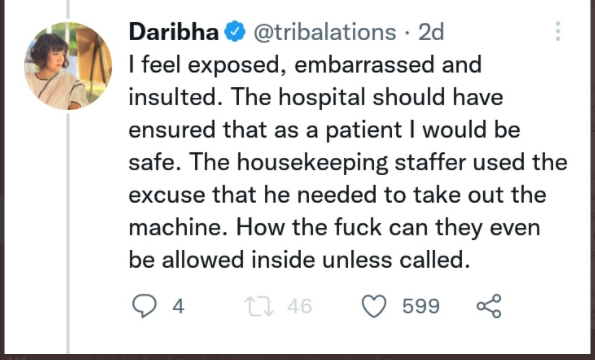
The issue stemmed from a Twitter thread by one Daribha Lyndem, in which she expressed her discomfort and frustration after going to a hospital for an ECG (Electrocardiogram) test and laying on the bed naked as a cleaning employee strolled into the trauma ward where the test was being performed.
In a subsequent tweet, she wrote, “I feel exposed, embarrassed and insulted. The hospital should have ensured that as a patient I would be safe. The housekeeping staffer used the excuse that he needed to take out the machine. How the fu** can they even be allowed inside unless called.”
The tweet.
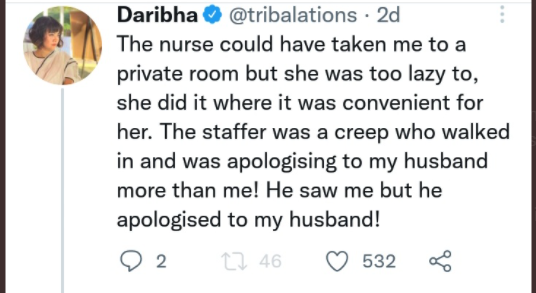
In another tweet in the thread, she further wrote, “The nurse could have taken me to a private room but she was too lazy to, she did it where it was convenient for her. The staffer was a creep who walked in and was apologising to my husband more than me! He saw me but he apologised to my husband!”
The tweet.
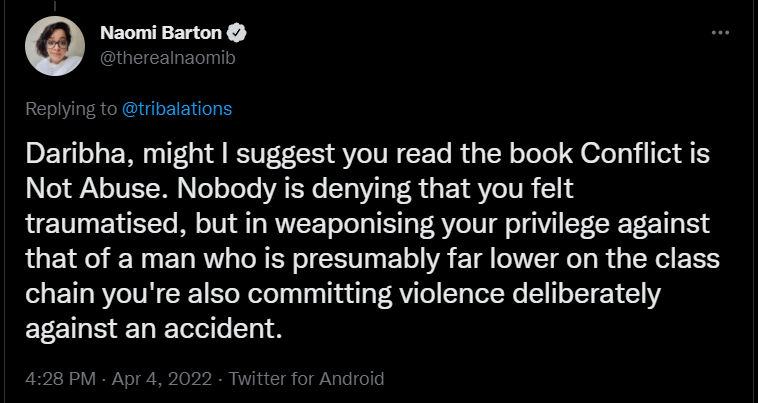
However, The Wire journalist then, posted a tweet telling Daribha that she was committing deliberate “violence” against an accident by “weaponizing” her privilege against that of a man who was likely far lower on the social ladder.
The Wire’s Naomi Barton’s tweet
In the tweet, Naomi wrote, “Daribha, might I suggest you read the book Conflict is Not Abuse. Nobody is denying that you felt traumatised, but in weaponising your privilege against that of a man who is presumably far lower on the class chain you’re also committing violence deliberately against an accident.”
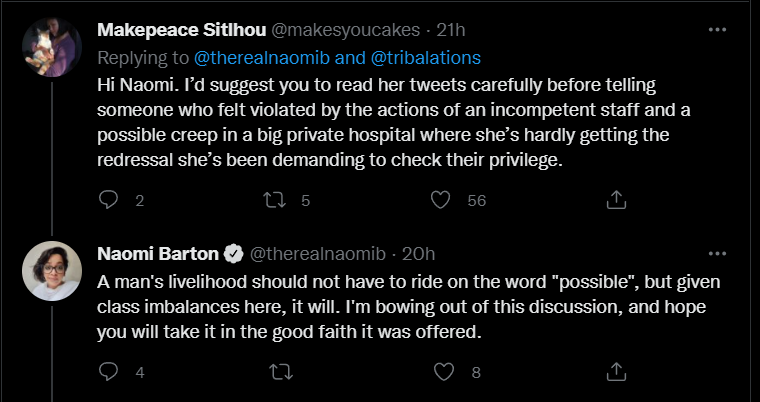
When a Twitter user requested her to relook the tweets before making any admonishing statements, she reiterated her point that it is all an attribute of class imbalances and one should not conclude for something that is “possible.”
The reply by The Wire’s Naomi Barton
It is worth noting that, while other people were sympathising with Daribha’s plight, The Wire’s Naomi Barton rushed in to play her “class imbalance” game, piling up on the victim rather than the perpetrator.
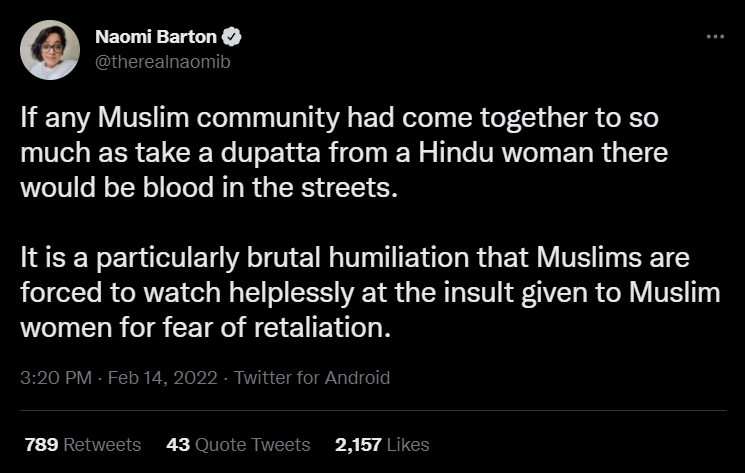
Recently, The Wire journalist appeared to have leveraged the hijab controversy to normalise violence against Hindus.
The tweet.
Barton had expressed that if a Muslim woman’s dupatta was taken away from her, the former would have swarmed to the streets, without thinking twice before sacrificing the blood of Muslims. Many people on social media saw this as an inflammatory Tweet intended to incite Muslims to respond with violence in response to the hijab controversy.
The Wire and its problematic stand on sexual harassment
In January 2018, a journalist at The Wire had revealed on Facebook how she was heckled and manhandled while covering a story. The Wire journalist Damayantee Dhar was covering a story in Ahmedabad on alleged caste discrimination when she was heckled and abused. The attackers as per her were Dalit men. She alleged that one Keval Rathod, advocate/dalit activist, kept screaming “Brahmanwad Manuwad media” and threatened her with an atrocities case.
However, what shook Dhar more was that when she narrated the ordeal to the Editors at The Wire, she was asked to let it go and accept it as a professional hazard. That if she filed and complaint or spoke about it, it would harm to “movement”. Some even tried to scare her saying that if she spoke up, she would invite counter complaints against herself.
In October 2018, their Consulting Editor Vinod Dua was accused of stalking and sexual abuse by filmmaker Nishtha Jain. Soon after, another filmmaker had accused him of inappropriate behaviour. Despite the accuser’s wishes that Dua be fired so that a fair investigation could take place, the Wire continued to have him as their Consulting Editor. In December 2018, Dua refused to face the woman who had accused him of molestation and the external committee that was set up to probe the allegations then dissolved itself in frustration as it was ‘unable to proceed further’ due to lack of unconditional consent.
Similarly, another journalist associated with The Wire, Akhil Kumar, who was accused of rape, was put back to work without offering any explanation. At least two women had accused Akhil Kumar of sexual assault and emotional harassment. However, The Wire had not issued any statement with regard to these allegations.
On April 5, the Central Ministry of Information and Broadcasting has blocked 22 Youtube Channels ad certain social media handles for spreading disinformation related to India’s national security and cooking up stories about India’s war with other powers of the world. The Ministry has taken this decision under its powers of IT Rules, 2021.
.@MIB_India blocks 22 YouTube channels for spreading disinformation related to India’s national security, foreign relations, and public order
18 Indian YouTube news channels blocked for the first time under IT Rules, 2021. 1/2
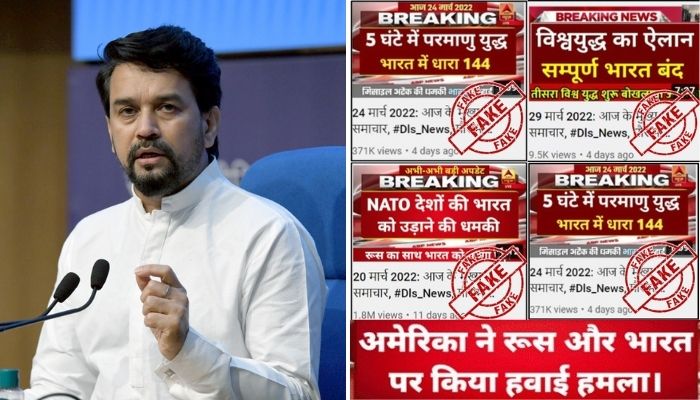
On Tuesday, The Press Information Bureau released a notice regarding the blockage of 22 Youtube channels, 1 Facebook account, 3 Twitter Accounts and 1 website which were continuously engaged in a misinformation campaign against India with malicious intent. The collective viewership of these channels was 260 crore.
According to the Ministry, these channels were engaged in an active fake news campaign against India and published fictitious reports of India participating in a war with other countries. Reports from these channels were being actively shared on social media when they selectively chose to write on subjects sensitive from the perspective of national security, India’s foreign relations, and public order.
In this action around 18 Indian Youtube Channels and 4 Pakistani YouTube Channels have been blocked by the Indian Government. The YouTube channels were used to post fake news and anti-India content on various subjects on the Indian Armed Forces, Jammu and Kashmir, etc. The social media accounts blocked in the action were being operated in a coordinated manner from Pakistan. “It was observed that a significant amount of false content published by these Indian YouTube channels related to the ongoing situation in Ukraine, and aimed at jeopardizing India’s foreign relations with other countries,” the press release says.
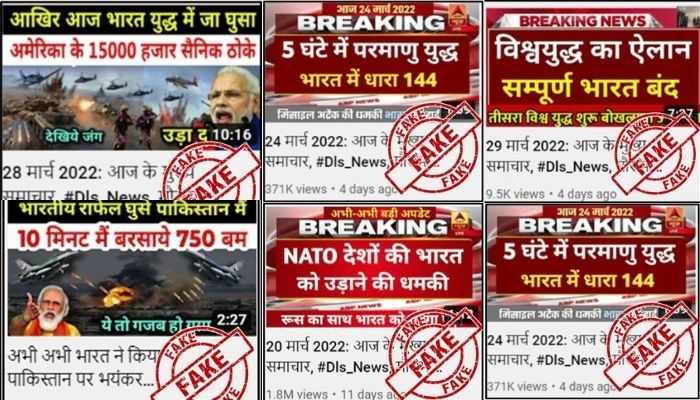
Snapshots of the Controversial video thumbnails posted by the blocked Youtube Channels
As noted in the press release, the blocked YouTube channels were using templates and identities of popular TV news channels, including images of the news anchors to mislead the viewers for being authentic. Among the channels blocked in the action include ARP News, AOP News, LDC News, SarkariBabu, SS ZONE Hindi, Online Khabar, and News23Hindi among others. Pakistani Twitter accounts namely Ghulam Nabi Madni, Dunya Mery Aagy and Haqeeqat TV were blocked.
“The Government of India remains committed to ensuring an authentic, trustworthy, and safe online news media environment, and thwart any attempts at undermining India’s sovereignty and integrity, national security, foreign relations, and public order,” the government stated.
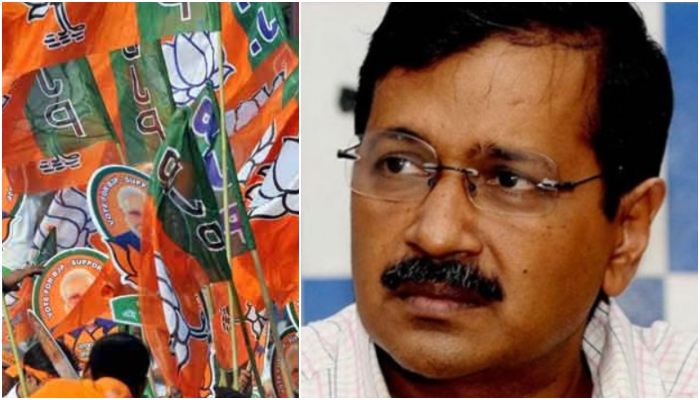
In a major setback to the Aam Aadmi Party (AAP) which is striving to become an alternative to the BJP in the state of Gujarat, over 150 leaders and workers of the AAP have joined the BJP on Monday. Not only AAP, but Congress has also suffered in this turmoil as several members of Congress also shifted to BJP.
The massive exodus from AAP has happened in less than 48 hours after AAP chief Kejriwal returned to Delhi after his visit to Gujarat.
This is a day after AAP supremo Arvind Kejriwal and Punjab CM Bhagwant Mann returned from a two-day Gujarat tour. Gujarat BJP general secretary Pradeepsinh Vaghela welcoming the AAP members to BJP said that Arvind Kejriwal cannot fool the people of Gujarat. “Delhi CM and Punjab CM were yet to sit down for food after reaching home and many people of their party joined BJP. The blessings of the people of Gujarat are with the BJP”, he said.
“भाजपा है तो भरोसा है”
वडोदरा जिले के राजकीय एवं सामाजिक कार्यकर्ता भाजपा में शामिल हुए, सभी का भाजपा परिवार में स्वागत है । pic.twitter.com/uQIf0ToSqN
He also added that the members who have newly joined the party are important for the development of the state and that they should have faith in BJP. “Today you left AAP and Congress. They will say that you were of no use. But, I would like to say that you are very important for the development of Gujarat and are welcome to BJP. There is a BJP government in Gujarat for a long time because people have faith in us and in the leadership of PM Narendra Modi”, he stated.
As the state of Gujarat plans to vote later this year, AAP’s Arvind Kejriwal has shifted his focus to Gujarat after the party’s massive victory in Punjab. Kejriwal on April 2 visited the Sabarmati Ashram in Ahmedabad and participated in a roadshow that AAP had named the Tiranga Yatra. He also addressed the roadshow where he said that the BJP has been in power in Gujarat for 25 years but could not end corruption.
“I am not here to criticise any party. I have not come here to defeat the BJP. I have not come to defeat Congress. I have come to make Gujarat win. We have to make Gujarat and Gujaratis victorious. We have to end corruption in Gujarat,” he said.
27 साल राज के बाद भाजपा में अहंकार आ गया है। जनता की आवाज़ सुनना बंद कर दी। गुजरात को ऐसी सरकार चाहिए जो जनता की आवाज़ सुने
हमारा मक़सद भाजपा या कांग्रेस हराना नहीं। हमारा मक़सद देश जीतना चाहिए। गुजरात जीतना चाहिए। दिल्ली की तरह गुजरात में भी भ्रष्टाचार दूर हो, जनता के काम हो https://t.co/sn7lqfURwg
He also added that after ruling the state for 25 years, BJP had become arrogant and that the party had pledged not to listen to the public anymore. “They don’t listen to the people anymore. Give one chance to Aam Aadmi Party, as the people of Punjab did, the people of Delhi did. Give one chance to Aam Aadmi Party, if you don’t like us, change us the next time. Give one chance to Aam Aadmi Party, you will forget all parties,” he stated.
According to the reports, AAP members who joined BJP on Monday include joint secretary of AAP Gujarat Satish Makwana, former assembly seat candidate from Vadodara, Jayshriben Gohil, Niranjan Joshi, Pritesh Patel and many more. Meanwhile, Congress cadres Harivandan Patel, Bhikhabhai Tailor and Pravinbhai Patel also joined BJP. Legislative Assembly elections will be held in Gujarat in December 2022 to elect 182 members of the Gujarat Legislative Assembly.
The last few days have seen an intense debate over the validity of the imposition of the Islamic practice of halal on unsuspecting non-Muslims. While this debate is not new, like any other Islamist edict, it evoked polarising reactions from both, the proponents as well as the opponents of the said practice.
Social media websites were rife with posts that called for the popularisation of ‘jhatka’ meat in place of Halal, describing the latter as religiously discriminatory against non-Muslims. Calls for boycott of companies that promote Halal-certified products were made. Pharmaceutical company Himalaya found itself at the centre of a social media storm with the #BoycottHimalayaProducts hashtag trending on the microblogging app Twitter. This came after a social media post went viral with the ‘Halal policy’ of Himalaya.
Before long, apologists of Halal jumped in the fray, passionately defending the practice and proffering misleading and dishonest arguments to undermine legitimate concerns raised by the critics. Instead of discussing the problematic aspects of Halal certification and how it discriminated against non-Muslims, the supporters of Halal came up with meretricious arguments that Himalaya is being specifically targeted because it is a company controlled by Muslims and that are other organisations who adhere to Halal certification.
Still, others contended that organisations, by their nature, are profit-driven and since the Halal food industry is too big to be ignored, they comply with the requirements that are critical for their survival and penetration in markets where Halal certification is sine-qua-non.
While there is some merit in the argument that businesses are driven by profitability and market requirements, what the apologists studiously gloss over or rather try to paper over is the controversial aspects that entail the Halal practice.
What is Halal and how it is a religiously discriminatory practice?
Though its supporters try to downplay Halal as a mere dietary preference along the lines of vegetarian and non-vegetarian food, it is much more than that. It is explicitly religious discrimination, meted out against non-Muslims.
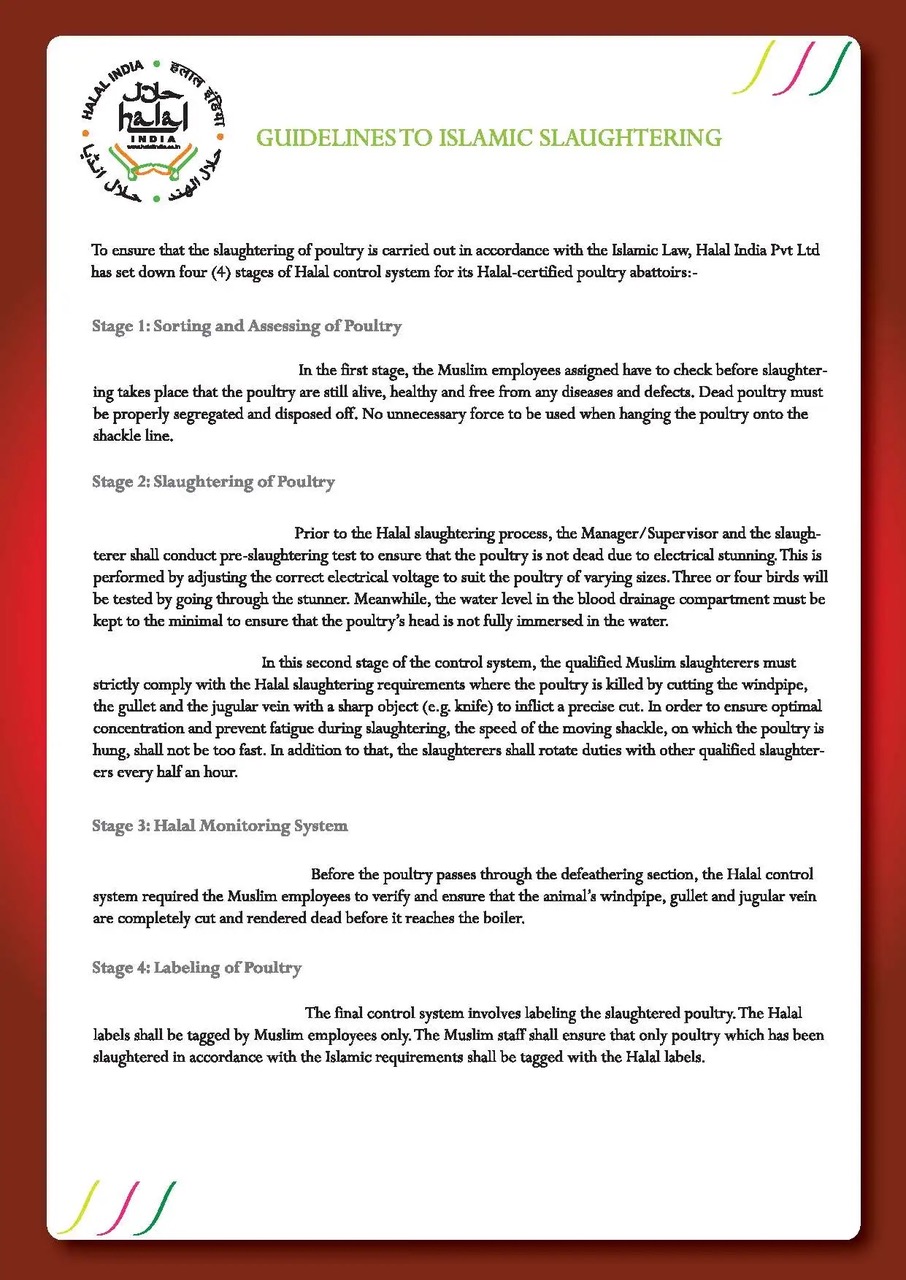
Halal can only be performed by a Muslim man. Thus, non-Muslims are automatically denied employment at a Halal firm. There are certain other conditions that must be fulfilled that make it quite clear that it is intrinsically an Islamic practice. Guidelines are available on the official website of a certification authority of Halal in India which makes it clear that non-Muslim employees cannot be employed in any part of the slaughtering process.
Guidelines to Islamic Slaughtering as per Halal India website
Throughout the document that lists the guidelines for Islamic slaughtering, care is taken to mention the religion of the employees involved. It makes it abundantly clear that only Muslim employees are allowed to participate in the entire process at every stage. Even the labelling of the meat can be done by Muslims only.
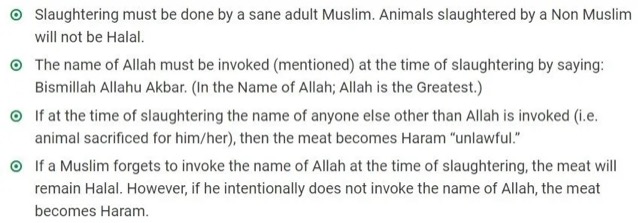
The Department of Halal Certification of the European Union makes it even more clear that employment opportunities at a Halal firm will be exclusively available to Muslims. It says, “Slaughtering must be done by a sane adult Muslim. Animals slaughtered by a Non-Muslim will not be Halal.” It states further, “The name of Allah must be invoked (mentioned) at the time of slaughtering by saying: Bismillah Allahu Akbar. (In the Name of Allah; Allah is the Greatest.) If at the time of slaughtering the name of anyone else other than Allah is invoked (i.e. animal sacrificed for him/her), then the meat becomes Haram “unlawful.”
Source: Department of Halal Certification EU
Thus, it’s quite apparent that when a person demands that he be served only Halal meat, he isn’t merely exercising a diet preference but he is also playing a part in deciding who is involved in the process of slaughtering the animal and labelling it. Furthermore, Muslims are barred by their scriptures from consuming non-halal food. Thus, when a Muslim specifically demands Halal meat, it’s an explicit instance of them demanding a service that can only be performed by Muslims. The obvious implication is that a Muslim denies service from a non-Muslim due to his religious identity.
In addition to this, Halal certification has gradually crept into other sectors as well and is not just limited to the meat industry alone. Even vegetarian products are now being issued Halal certificates, signifying how the Halal lobby is insidiously spreading its tentacles to businesses and sectors hitherto untouched.
Proponents of Halal turn a blind eye to its problematic aspects, deviously term opposition to it as “Islamophobic” and “bigoted”
In the light of these developments, the rumblings against the religiously discriminatory practice of Halal assume greater significance. The discontent among the public is not because an organisation’s higher leadership are followers of Islam, as the apologists would have us believe. Rather, it is against the very practice of imposing Halal-certified products on unsuspecting non-Muslims who are not obligated by their religion to comply with a decree that is patently discriminatory against adherents of other religions. At present, consumers who want to consume non-Halal meat or non-Halal products have limited options as companies and businesses continue to offer only Halal certified products, not providing an alternative to the consumers.
However, for the left-leaning liberals who have been enthusiastically supporting Halal, there exist no discrimination. They continue to cast opposition to Halal as religiously motivated, with many branding it ‘Islamophobic’—a trick that has been employed lately to suppress genuine criticism by referring to it as religious bigotry.
Earlier in March 2022, trusts of many temples in Karnataka ordered that only Hindu vendors will be allowed to set up stalls in the temple precincts for the upcoming annual festival. Many detractors, who are now passionately supporting Halal certification, had then deemed orders by temple trusts as discriminatory and prejudicial against the interests of non-Hindu shopkeepers.
However, the same breed of apologists of Islamism conveniently turns a blind eye to the religious discrimination that embodies Halal certification, which can be performed by Muslims only and the name of “Allah” is to be invoked at the time of slaughtering an animal. Therefore, no Hindu or non-Muslim can take part in such an exercise. But for the apologists, there is no discrimination as far as Halal certification is concerned. Such unabashed hypocrisy is why these “intellectuals” are seldom taken seriously and concerns raised by them are often flagged as motivated propaganda.
How Halal certification infringes upon the right of freedom of choice to consumers
Nevertheless, it is worth noting that the anti-halal movement that is taking root among the collective conscience of the country is not to oppose the Halal practice per se, but it is against the lack of choice offered to those who are not comfortable with products that are certified by a practice that is inherently discriminatory against their religion. The critics claim Halal certification can continue business-as-usual but organisations and governments must provide choices to the consumers who prefer ‘Jhatka’ meat or are simply uncomfortable patronising a practice that endorses discrimination against their co-religionists.
One of the reasons why Halal established its monopoly over the meat industry is because its supporters have been uncompromising in their demands to consume only Halal-certified products. By contrast, Hindus, Jews, Sikhs, Christians or for that matter any other non-Muslim is not religiously obligated to consume meat or use products that abide by a specific set of instructions. This is why ‘Jhatka’ did not become as popular as Halal because non-Muslims were not fully aware of the implications that Halal-certified products had on them and their general lack of concern about the type of meat they consumed.
This indifference towards the type of meat they consumed and laissez-faire attitude is what led organisations and businesses to focus on providing only Halal-certified products, doing away with the cost of maintaining a separate line of non-halal products. As a consequence, non-Muslims were, wittingly or unwittingly, enlisted in the process of perpetuating the discriminatory practice of Halal as organisations and businesses focused on maximising their profits by having to maintain only Halal-certified products and not ‘Jhatka’ meat or non-Halal products. This is one of the primary reasons why ‘Jhatka’ lost to Halal.
Why the anti-halal movement has to be people-driven for governments and businesses to take cognisance of
However, as the awareness about the true implications of Halal certification has risen, more and more people have joined the chorus demanding companies and businesses to offer choices to them instead of foisting Halal-certified products on them. Even so, the governments and organisations can do little as far as Halal certification or popularisation of Jhatka is concerned unless the intermittent outbursts of outrage on social media coalesce into a robust and sustainable movement, forcing them to reconsider their stand on the issue.
As such, in a democratic country with a free-market economy, changes in any domain of life, be it social or food consumption is brought about only by popular will and always driven by public demand. It is always the resilience and the determination of the people that compels governments, organisations and multinationals to reevaluate their existing outlook and accommodate the demands of the people.
Politicians, like businesses, would respond to such demands only when they see the electoral benefit in meeting the demand of the people (the demand is about the establishment and popularisation of Jhatka), just like businesses would respond to demands of ‘Jhatka’ or ‘non-Halal’ certified products when they see a potent market segment emerging that would provide them with sustainable profitability.
For the governments, businesses and organisations to take cognisance of the anti-halal campaign, the sporadic outbursts of outrage against Halal need to be consolidated into a sustained and robust people’s movement, uncompromising in its demands and immune to the vicissitudes of time. For it to bring a lasting change in the attitude of the government and businesses toward offering alternatives to Halal-certified products to consumers, the anti-halal movement cannot afford to remain confined to the realm of social media, it has to spiral out of the digital world into the real-life, unrelenting and ceaseless in its nature until its objectives are met.
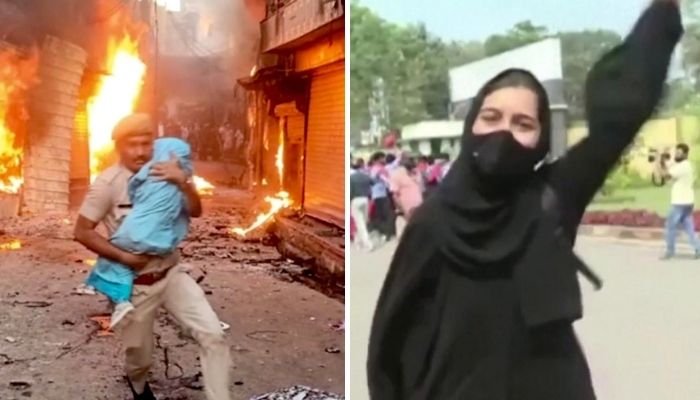
The jarring image of a constable running through the narrow alleys of Karauli with a child in his hand, in a backdrop burning in Islamist violence appeared on Indian Twitter. The image of the constable Netresh Sharma rescuing a child was posted by Shamli SSP Sukirti Madhav Mishra, while praising the cop who had saved the lives of two other women that day. It sent shockwaves everywhere when people pondered how drastically things sparked after stones were hurled from households at a Hindu Rally in Karauli’s Muslim-dominated neighbourhood.
“तम में प्रकाश हूँ, कठिन वक़्त की आस हूँ।” So proud of constable Netresh Sharma of Rajasthan Police for saving a precious life. This picture is in deed worth a thousand words.. pic.twitter.com/U2DMRE3EpR
— Sukirti Madhav Mishra (@SukirtiMadhav) April 4, 2022
On April 2, when Hindus across the world were celebrating their new year, religious tensions broke in Rajasthan’s Karauli when a motorcycle rally marking Nav Samvatsar passed through a Muslim Neighbourhood. Incidentally, 42 people including cops were injured in the communal violence that broke out when stones were targetted at the rally conducted by Hindus. Amidst all of this, when houses and vehicles were set on fire, Policemen like Netresh Sharma came as heroes to rescue the victims who were grappled in the communal outpour.
The next day, Rajasthan CM Ashok Gehlot called Sharma to congratulate him for his bravery. For this selfless act, in which he put his life in danger, Rajasthan Police decided to promote Netresh Sharma as a head constable. While Sharma rightfully received rounds of veneration on social media, his heroic persistence to save lives from Islamic mobs failed narrative setters in India to identify the superhero inside him. His recognition was restricted to certain nationalistic circles in India, while liberal media decided to look the other way. No graphics were made, interviews were published and op-eds were written to glorify him as a ‘symbol of resistance’.
Netresh Sharma’s courage did not remind us of Rao Satal Rathore, who in the 15th century, went out of the way to bring back 140 girls abducted by Afghans near the village of Mertia. Rao Satal is considered one of the greatest martyrs from his lineage, who fought for saving the lives of his subjects till his last breath. Netresh Sharma’s unparalleled bravery in rescuing people from a riot-torn ablaze neighbourhood is forgotten by media circles which are busy wrapped around the next-day news cycle.
It is upon people to choose their heroes, and preserve their stories as serve as hope for the future. Netresh Sharma ran through the burning alleys of Karauli as a hero without a cape, in a uniform. It is also upon us to note that no international media will take cognizance of the Karauli violence and Sharma’s selfless act. No Pulitzer will be won for the disturbing scenes that have been captured. It would be only foolish to expect placard-holding actor-cum-activists to make sweeping comments against a community for the blame. A similar feeling was expressed by netizens on social media…
— ˥¡HOW ∀ᴚʇOH˥∀W?? मोहिल मल्होत्रा?? (@TRULYMM8) April 4, 2022
A constable of Rajasthan Police Netresh Sharma saved a child from lsIamic Jihαd in Karauli. But his image will not go viral because his name is not Muskan Khan. #Rajasthan#Karauli CR- Ranveer… pic.twitter.com/EavG1jATaS
The reality of Hindus being victims does not hold much water against the trope of the ‘Dara-Hua-Musalmaan’ narrative efficiently peddled by forces hell-bent upon demeaning India as a totalitarian state. Hence, a burqa-clad Muskan Khan who shouts ‘Allahu Akbar’ slogan while being challenged by a group of Hindu students to wear the college uniform becomes a symbol of resistance. She is hailed as a feminist for standing up against the society that ‘has no right to tell her what to wear.’ Should it be convenient for us today to forget the life of Harsha, a Hindutva activist who was brutally murdered by elements that held direct radicalised assumptions of what Muskan apparently upheld?
Netresh Sharma’s story will be sidelined because there is no victim from the so-called minority community here. Telling his story should only serve the agenda of those, who do not wish to see this nation giving up on secular fundamentalism. While Hindu victims of violence are sufficiently brushed off the air, the stories of courage from the community are also not heralded. Today, the instream media acts as certifying agency granting victimization and lionization as per the convenience of the narrative. If a burqa-clad girl giving Jihadist slogans can be glorified for giving a tough fight to preserve some medieval-era ideals, Netresh Sharma, on the other side deserves a rightful place in the light of the day as a real-life hero who saved lives from enraged Islamism.