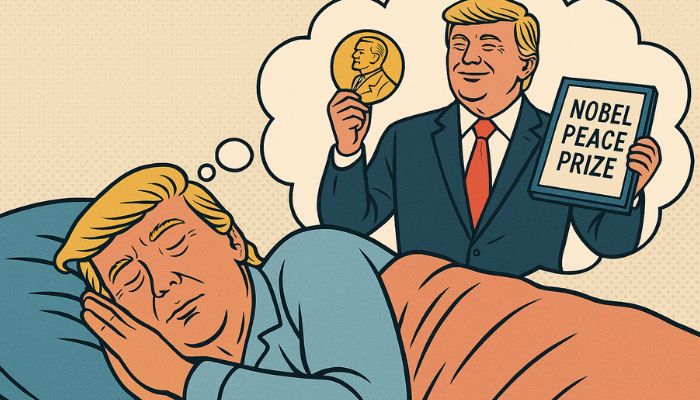
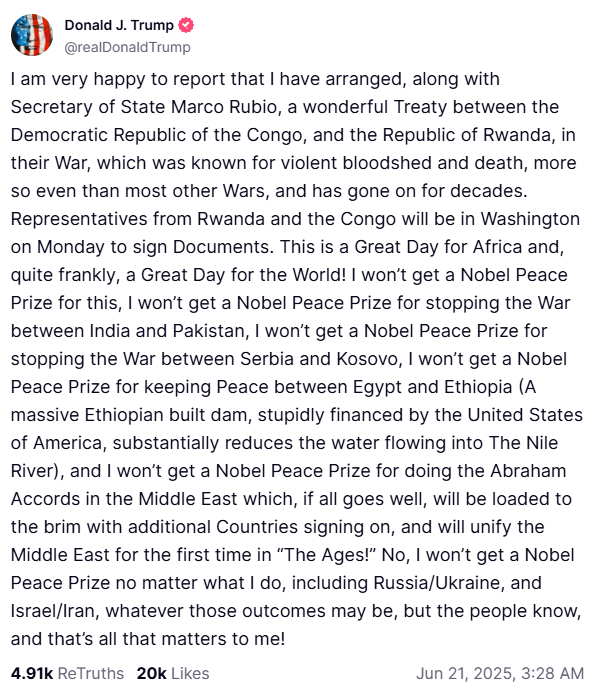
President of the United States, Donald Trump, is once again making headlines. No, he is not in the news for “resolving” a major global conflict, but for publicly lamenting the fact that he has not been awarded the Nobel Peace Prize. In a long-winded post on Truth Social, Trump claimed that a treaty has been signed between Rwanda and the Democratic Republic of Congo (DRC) and declared it a “Great Day for Africa”.
By extension, “a Great Day for the World” is what this treaty is, according to Trump. Simultaneously, he launched a self-congratulatory tirade on why he deserved global recognition.
Source: Truth Social
Interestingly, Trump repeatedly insisted that he would not be given a Nobel Peace Prize for this treaty, or for several other interventions he listed, including the claims that he “stopped” war between India and Pakistan.
Pakistan angle – Did Trump get himself nominated?
Recently, reports emerged that Trump might have orchestrated a nomination for the Nobel Peace Prize with the help of Pakistan. According to reports, highly placed diplomatic sources claimed that Trump allegedly used his proximity to Pakistan Army Chief General Asim Munir to push through a nomination citing “peace efforts” during the India-Pakistan conflict that emerged due to the Pahalgam terrorist attack.
The Resistance Front, a proxy of Pakistan-based terrorist group Lashkar-e-Taiba, took responsibility for the attack. India retaliated by attacking terrorist camps in Pakistan and Pakistan-occupied Jammu and Kashmir. Pakistan, irked by the damage caused to terror camps by Indian armed forces, fired rockets, missiles and drones which were neutralised by the Indian defence system. All this happened between 22nd April, the day of the terror attack, and 9th May, the last day of Operation Sindoor, codename for India’s military action against terrorists and Pakistan’s armed forces.
On 10th May, Pakistan’s DGMO called India’s DGMO seeking a ceasefire. In between, the US tried to intervene but India categorically refused to accept mediation while Pakistan pushed the US to force India to stop throwing bombs at it. At Pakistan’s DGMO’s request, India finally agreed to pause the military action but before any formal announcement could be made, Trump took credit for it out of nowhere. Since then, Trump has been claiming that he stopped the war, a claim India has categorically denied and said that no third party was involved in the decision.
Reports now suggest that Trump’s love for Pakistan is for a reason. His stance on Pakistan has mostly been a “display of mood swings” often swaying between confrontation and courtship depending on media cycle and personal advantage. This time, however, it seems because Pakistan nominated Trump for the Nobel Peace Prize, he agreed to let Munir get cosy in the White House. Not to forget, there was a time when Trump hated Pakistan and wanted the US to stop funding the nation that supports terrorism. After all, Osama was found and killed in Pakistan.
Rwanda-Congo peace deal – Real progress or opportunism?
In his Truth Social post, Trump claimed that he arranged, alongside Secretary of State Marco Rubio, a peace treaty between DRC and Rwanda. These two nations have a deeply complex and tragic history of conflict. While any attempt at diplomacy in the Great Lakes region is welcome, it has to be noted that the groundwork for the treaty had been in progress for years under African Union and UN-backed negotiations.
Notably, The Democratic Republic of the Congo and Rwanda have signed a provisional agreement to stop the conflict in eastern DRC. The draft agreement is due to be formally signed on June 27 by on both the governments. While US did play the role of a mediator, it was not alone, as Qatar was the other country that played a major role in the agreement. Earlier, Angola was also mediator, but it stepped down from that role in March.
However, Trump decided to claim full credit and stated, “Representatives from Rwanda and the Congo will be in Washington on Monday to sign Documents,” before veering off into a litany of grievances about not receiving the Nobel Peace Prize. While reports suggest that two nations would sign a treaty on 27th June in Washington, giving full credit to Trump would not be wise.
Is the obsession with Nobel stems from Obama’s Nobel Peace Prize?
Trump’s angst possibly stems from the fact that Barack Obama received a Nobel Peace Prize in 2009, barely months into his first term. Trump wrote, “I won’t get a Nobel Peace Prize no matter what I do.” He referred to several regions including India-Pakistan, Serbia-Kosovo, Egypt-Ethiopia, Israel-Iran and claimed to have prevented or resolved conflicts. The irony is that many of these regions remain flashpoints of conflict and new tensions brewing in the Middle East show his “diplomacy” is failing or is it that he has actually done nothing to bring peace per se other than claiming the credit? Is he ‘Gilderoy Lockhart’ in making?
Nobel by force?
Nobel Peace Prize nominations are typically submitted by qualified individuals or organisations. Trump’s alleged backchannel approach to get nominated via Pakistan exposes the desperation. It is no longer about peace but about prestige which he is losing every day with unsubstantiated claims. He wants the prize not necessarily for what he has done, but because, in his words, “The people know, and that’s all that matters to me.”
However, history might not be as generous. As conflicts rage on across continents, Trump’s list of “peace achievements” appear more like a wishlist than a resume. It is no longer a secret that Trump wants a Nobel Peace Prize. So badly, in fact, that he has begun listing conflicts across the globe, by his own admission, did something or the other that should have earned him the honour. It does not matter if the Middle East continues to be in conflict or Israel is getting hit by Iranian missiles. In Trump’s mind he seems to be fixated on the notion that if Obama got one, he deserves ten.
Uttar Pradesh, the fourth largest state by area and the largest state by population in the country, is finally witnessing large-scale transformation under the Yogi Adityanath government after seeing decades of misery and suffering under the previous Samajwadi Party and Bahujan Samaj Party regimes. The Hindi belt state, with huge untapped potential, endured years of Mafia Raj, poor law and order and lack of social and economic development.
The socio-economic indicators of Uttar Pradesh were so poor that the state was once a part of the acronym BIMARU, a term coined by demographer Ashish Bose, to refer to the state of Bihar, Madhya Pradesh, Rajasthan and Uttar Pradesh. The Hindi word for BIMARU is sickly. The BIMARU states lagged behind in most socio-economic indicators, including economic growth and infrastructural development.
In addition to this, the people of Uttar Pradesh were agonised by the Mafia Raj which thrived under the patronage of the previous state governments. The state witnessed an era under the SP and the BSP governments when mafias and gangsters enjoyed power and protection of the state. Instead of facing the law, these gangsters were given tickets by these parties to contest elections. These gangsters were so dreaded that even judges refused to hear cases against them.
However, after the BJP came to power in 2017, Uttar Pradesh saw a sea change, which seemed far from possible until now. CM Yogi made law and order his administration’s top priority and adopted a zero-tolerance policy towards crime and criminals. This resulted an 85% decline in heinous crimes and the dismantling of deeply entrenched mafia network in the state. Reduction in crimes also created a conducive environment for the growth of businesses. The 8 years’ tenure of the Yogi government has marked a transformative shift in Uttar Pradesh by converting a BIMARU state into one of the fastest growing states in the country. Here is a look at the completed and ongoing infrastructure projects in the state under Yogi government-
Expressways
While six expressways have already been made operational, the construction work of six other expressways is underway. The operational expressways are-
Yamuna Expressway – This 165.5 km long expressway connects Delhi to Agra and is also known as Taj Expressway. It was built in three phases with a total cost of Rs 13,330 crores
Noida-Greater Noida Expressway – This is an extension of the Taj Expressway and runs from Southeast section of Okhla Bird Sanctuary to Noida Sector 168. It is 24.53 km long and was built at a cost of Rs 400 crore.
Agra-Lucknow Expressway – It is a greenfield expressway linking Agra to Lucknow. It is 302 km long and was constructed at a cost of Rs 15,000 crore.
Delhi-Meerut Expressway – It is a mix of brownfield and greenfield projects and is 96 km long. It was built at a cost of Rs 7, 855.87 crore.
Purvanchal Expressway – The 340.82 km long expressway runs through nine major districts of Ghazipur, Mau, Azamgarh, Ambedkar Nagar, Ayodhya, Sultanpur, Amethi, Barabanki, and Lucknow.
Bundelkhand Expressway – This is one of the fastest built expressways completed within 28 months. It is 296.07 km long and was built at a total cost of Rs 7766.81 crore.
The state government is working on 6 new expressways, including Gorakhpur Link Expressway (91 km), Ganga Expressway (594 km), Lucknow-Kanpur Expressway (63 km), Ghaziabad-Kanpur Expressway (380 km), Gorakhpur-Siliguri Expressway (519 km), Delhi-Saharanpur-Dehradun Expressway (210 km) and Ghazipur Ballia Manjhighat Expressway (117 km).
Airports
In order to increase and improve air connectivity, the Yogi government is working on ambitious plan of constructing 18 airports across Uttar Pradesh, including 5 international airports. At present, there are 10 functional airports in the state, including the recently inaugurated Maharishi Valmiki International Airport in Ayodhya. An international airport at Jewar, Gautam Budhh Nagar is set to be inaugurated soon.
The state government plans to develop five airports in Aligarh, Azamgarh, Chitrakoot, Pyorpur (Sonbhadra) and Shravasti under the Regional Connectivity scheme in order to develop them in line with the specifications for Airbus A-321. With improved air connectivity, the movement of passengers as well as cargo will become smoother adding to economic growth.
Metro Rail
Uttar Pradesh has the greatest number of cities with metro rail connectivity. The metro rail in the state is currently operational in the cities of Lucknow, Kanpur, Ghaziabad, Noida, and Greater Noida. The Uttar Pradesh Metro rail corporation is currently expanding the metro rail network to Agra and Meerut. The government is also considering plans for taking metro rail connectivity to Varanasi, Prayagraj, Gorakhpur and Bareilly.
The construction of the Delhi-Meerut Regional Rapid Transit System (RRTS) route is also nearing its completion. 11 stations covering a 55-kilometre stretch are already operational and the work on remaining 27-kilometre portion is progressing rapidly. To enhance connectivity, a 72.26 km-long Regional Rapid Transit System (RRTS) will link Jewar Airport with Ghaziabad, Greater Noida, and Yamuna Authority. The Detailed Project Report (DPR) for this Rs 20,637 crore project has been submitted to the Government of India.
The 82-kilometre-long corridor, known as the Namo Bharat corridor, is being implemented by the National Capital Region Transport Corporation (NCRTC) as a high-speed regional connectivity project.
Film City and other projects
Major projects like the Film City, Medical Device Park, Logistics Park, Fintech City, IT City and Data Centre Park are also in the pipeline. The proposed Film City in Noida is going to be the biggest film city in the country. It will provide unprecedented work opportunities to local as well artists from across the country. It is being established at a cost of Rs 10,000 crore in about 1000 acres. The Film City is also expected to be a centre of tourism. The Film Institute inside the upcoming Film City will make use of advanced technologies like animation, OTT and gaming at par with international standards will prepare students to seek work opportunities globally. A data centre will also be constructed in the Film City for preproduction and post production of films.
Medical Infrastructure
Creation and improvement of existing health infrastructure is also a top priority of Yogi government. Medical colleges are being run by the state government in 65 districts, including AIIMS in Gorakhpur and Raebareli. In addition to that, the government is constructing 22 medical colleges across the state. During the COVID-19 pandemic, the yogi government was praised by the World Health Organisation for its COVID-19 management strategy describing it as a “good example”. Uttar Pradesh has excelled among states, giving more than 38 crore vaccine doses. Apart from this, 6.51 crore people of the state have received Ayushman card to avail health insurance cover of up to Rs 5 lakh.
With the entire gamut of completed, ongoing and proposed infrastructural development projects across Uttar Pradesh, Yogi government is rapidly transforming a BIMARU state into a leader of socio-economic growth.
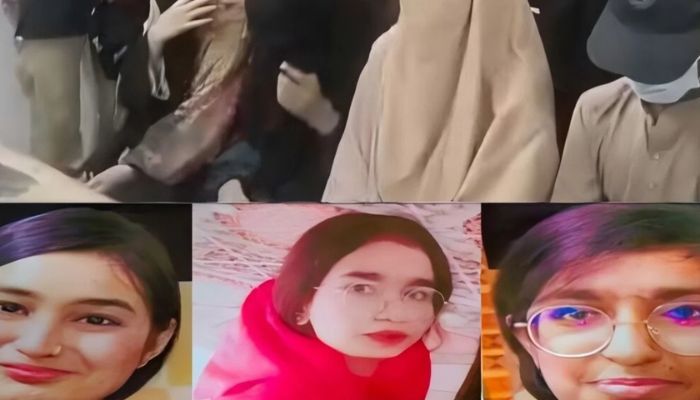
A deeply disturbing incident in Shahdadpur, Sindh province, Pakistan, has again created fear within the Hindu community and renewed concerns over the persecution of religious minorities in the country. Four Hindu siblings—three sisters and their brother—were kidnapped and forcibly converted to Islam.
The victims are identified as 22-year-old Jia Bai, 20-year-old Dia Bai, 16-year-old Disha Bai, and their 13-year-old brother, Harjeet Kumar. Their mother, desperately seeking justice, publicly accused local computer teacher Farhan Khaskheli of seducing and abducting her children. “I had three daughters, and Farhan took them all,” she stated tearfully at a press conference. She made a specific plea for the return of her young son, arguing he is too immature to comprehend religious conversion, and appealed to PPP leader Bilawal Bhutto Zardari for intervention.
A viral social media video purportedly showing the children’s conversion has been condemned by community leaders as “cultural terrorism.” Rajesh Kumar, head of the Hindu Panchayat, called the event both a family tragedy and a community disaster, questioning the minors’ capacity to voluntarily change religion given their ages.
Conflicting narratives and legal action
Following family protests, police presented the siblings in a Shahdadpur court. The court ordered the two adult sisters, Jia and Dia (medical students), to be sent to a shelter home in Karachi. The two minors, Disha (15) and Harjeet (13), were returned to their parents.
Pakistani media reported the conversions as voluntary. However, the family and their lawyer contested this, asserting the children were abducted from Shahdadpur, forcibly converted, and recovered from Karachi. They also said that the children were acting under police pressure during the proceedings. Crucially, based on the girls’ statements in court, the two accused individuals, Zulfikar Khaskheli and Farhan, were acquitted of kidnapping charges. The girls are suspected to be under duress and were probably making the statements under pressure.
Decades of systemic persecution
This atrocity underscores a persistent pattern of persecution against Pakistan’s Hindu minority, particularly in Sindh, dating back to the 1947 Partition. Human rights organizations document alarming trends:
Over 1,000 Hindu girls are abducted annually for forced conversion and marriage, often with alleged police complicity.
Blasphemy laws are weaponized against minorities for personal vendettas.
Powerful groups systematically dispossess Hindu families through land grabbing.
Despite reserved parliamentary seats and constitutional guarantees, protections remain unenforced. Political neglect perpetuates vulnerability, transforming Sindh into a hotspot for what international bodies condemn as religious cleansing. Extremists frequently act with impunity, confident of escaping accountability. Experts argue that until Pakistan enforces meaningful legal safeguards and dismantles institutionalized bigotry, Hindus and other religious minorities will remain second-class citizens in their homeland.
In a major crackdown on Air India following the Ahmedabad crash, the DGCA has ordered the removal of three top officials for repeated violations in scheduling and rostering of staff. An order issued by the Directorate General of Civil Aviation on 20th June stated that the violations were voluntarily disclosed by Air India, after which action has been ordered against the erring officials.
The order stated that repeated and serious violations were voluntarily disclosed by Air India concerning flight crew being scheduled and operated despite lapses in licensing, rest, and recency requirements. “These violations were discovered during the post-transition review from ARMS to the CAE Flight and Crew Management System,” DGCA said.
The regular said that the voluntary disclosures point to systemic failures in crew scheduling, compliance monitoring, and internal accountability. It added, “Of particular concern is the absence of strict disciplinary measures against key officials directly responsible for these operational lapses.”
Therefore, DGCA has directed the removal of three officials from all roles and responsibilities related to crew scheduling and rostering. They are, Choorah Singh- Divisional Vice President, Pinky Mittal- Chief Manager – DOPS, Crew Scheduling, and Payal Arora- Crew Scheduling – Planning.
As per DGCA, these officials have been involved in serious and repeated lapses including but not limited to, Unauthorized and non-compliant crew pairings, Violation of mandatory licensing and recency norms, Systemic failures in scheduling protocol and oversight.
The regulator further stated that internal disciplinary proceedings must be initiated against these officials without delay, and the outcome of such proceedings shall be reported to the DGCA within 10 days from the date of issue of the order.
DGCA further said, “the aforementioned officials shall be reassigned to non-operational roles pending conclusion of corrective reforms in scheduling practices, and shall not hold any position involving direct influence over flight safety and crew compliance until further notice.”
It added that any future violation of crew scheduling norms, licensing, or flight time limitations detected in any post-audit or inspection, will attract strict enforcement action, including but not limited to penalties, license suspension, or withdrawal of operator permissions as applicable.
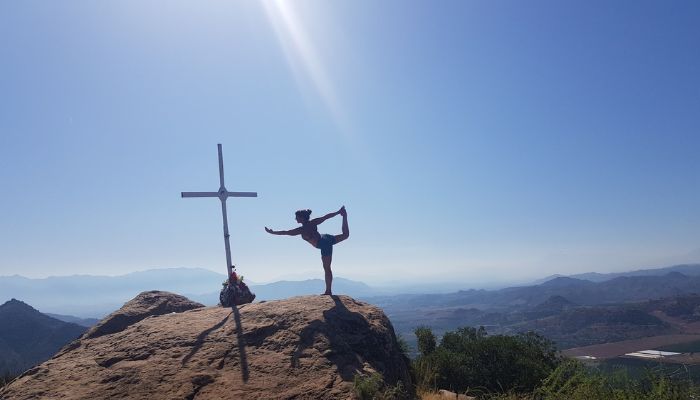
The assault on Hindu civilization takes many forms, some violent, some insidious. None is more treacherous than the whitewashing of yoga, our most profound spiritual practice, into a sterile fitness routine baptized with Christian prayers.
Yoga is not a modular fitness regimen to be dismembered and repackaged; it is the beating heart of Sanatana Dharma. As Patanjali’s Yoga Sutras (circa 200 BCE) codified, yoga is an eight-limbed path (ashtanga) integrating ethics, meditation, and devotion toward moksha (liberation). This holistic system emerged from Vedic fire rituals and Upanishadic contemplation (1500–500 BCE), later refined by Hindu rishis who viewed the body as a vehicle for transcendent union (yuj = “to unite”). Yet Western appropriators surgically try to remove its spiritual core, reducing dhyana (meditation) to “mindfulness” and pranayama to “breathwork” as if dissecting a living being to display its organs.
The colonial playbook: Erasure by rebranding
Christian yoga brands like “Holy Yoga,” “PraiseMoves,” “Yahweh Yoga” are not benign adaptations but theological land grabs. They replace Om with crosses, chant Biblical verses during surya namaskar, and market “Christian psalms”. This mirrors colonial missionary tactics: first demonize Hinduism as Mark Driscoll decries yoga as “hypersexualized” and “demonic”, then rebrand its practices as “redeemed” Christian tools. As scholar-priest Aseem Shukla of the Hindu American Foundation’s ‘Take Back Yoga’ campaign argues, this erasure perpetuates the myth that Hinduism contributed “nothing but superstition” to civilization .
Scholarly betrayal: Fabricating a “secular” Yoga
Western academia abets this theft. Mark Singleton’s Yoga Body (2010) disingenuously claims modern postural yoga is “largely 20th-century invention,” ignoring Krishnamacharya’s synthesis of Hatha Yoga Pradipika (15th c. CE) with Indian wrestling exercises (danda) and South Indian martial arts like Kalaripayattu and Silambam. Similarly, Jain’s Selling Yoga (2014) declares yoga “belongs to no religion,” disregarding that Bhagavad Gita (4.13) explicitly links yoga to Krishna-consciousness. This revisionism enables Christianizers to plead, “We’re not stealing Hinduism We’re using neutral exercise!”
Worst thing is, corporations like “Yoga Alliance” certify instructors with zero knowledge of Hindu philosophy. Matthew Remski, a college dropout with no Indology credentials teaches the Bhagavad Gita while dismissing its Hindu context. This is the ultimate colonization: White men profiting from dismembered Hinduism while denying us authorship.
Silent genocide: When appropriation erases identity
Pew Research confirms only 7% of Hindus practice yoga daily. Why? Because yoga’s commodification has alienated Hindus from their own heritage. Studios exclude South Asian teachers, while “decolonisation” activists ironically partner with Hinduphobes to police yoga’s “use”. The Hindu American Foundation’s #TakeBackYoga campaign exposed this crisis: 92% of U.S. yoga studios never mention “Hinduism”. Yoga is reduced to a headstand in designer leggings, a spiritual amputation cheered by those who once burned our scriptures.
The Hindu Resistance: Reclaiming our legacy
Hindus must reject this spiritual colonialism. As the Indian government’s 2015 International Yoga Day manifesto asserts: “Yoga is India’s gift to the world, rooted in Vedanta and Tantra”. We cannot tolerate pastors like Rev. Anthony Randazzo, who slathers Christian dogma onto asanas while denying their prana-activating purpose. Nor can we abide by “Christianized yoga manuals” that replace Yamas (ethical vows) with Beatitudes. Yoga’s ontology atman-Brahman unity, karma-samsara cycle is irreducibly Dharmic. To amputate this is to murder yoga itself.
Our duty: Spiritual decolonization
Let us declare: Yoga is not “stretching with Jesus.” It is the science of kaivalya (liberation) transmitted through Guru-shishya parampara for millennia. Prime Minister Modi’s promotion of International Yoga Day is a start, but soft-power diplomacy means nothing if we won’t name yoga’s mother: Sanatana Dharma.
Let this be our call:
• Legislate cultural integrity: Mandate yoga certification includes Hindu philosophy.
• Boycott appropriators: Shut down studios teaching “Christian yoga.”
• Demand acknowledgment: No more “mindfulness” euphemisms, say “Hindu spirituality.”
As scholar Ramesh Rao thundered, “Yoga has been shamelessly rebranded to appease those who still see Hinduism as pagan. We will not let our sacred science be orphaned!” The Christianization of yoga is spiritual imperialism in Lululemon clothing. Either we fight for yoga’s Hindu soul, or we surrender our last fortress to those who worship a god that demands exclusivity. On this Yoga Day, bend your body but never your dignity.
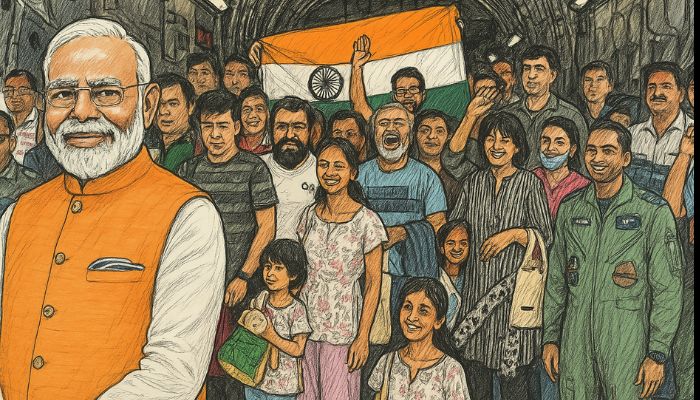
The Modi government, which came to power in May 2014, has time and again reiterated its commitment to the safety and security of each Indian national, irrespective of their presence within the country or in a foreign nation. In its last 11 years of seva, the government launched 12 rescue missions to evacuate stranded Indian nationals from conflict-torn countries.
These nations include Iraq, Ukraine, Russia, Iran, Nepal, Yemen, Syria, Sudan, Afghanistan, Libya and others. The Ministry of External Affairs, under the Modi government, left no stone unturned to create a safe passage for Indian nationals and airlift them to India in the midst of ongoing war and conflicts.
Through its diplomatic missions abroad, the lives of countless Indian nationals were saved between 2014 and 2025. Here is the timeline and details of the 12 Operations undertaken by the Modi government in the last 11 years
Indians evacuated amid Israel-Iran war
On Wednesday (18th June), the Modi government launched ‘Operation Sindhu’ to evacuate Indian nationals, stranded in Iran, amid an increase in hostilities with Israel.
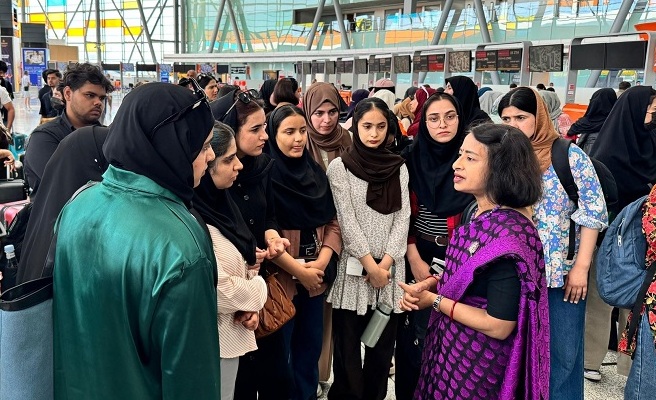
The government first facilitated the travel of 110 Indian students from Iran to Armenia through its diplomatic missions, and then arranged a special flight to bring them back to New Delhi.
Due to the diplomacy of the Modi government, Iran made an exception and opened its airspace for the rescue of Indian nationals. It arranged a special flight and evacuated 290 more Indian students on Friday (20th June).
An additional 117 Indians were brought to New Delhi through another special evacuation flight from Turkmenistan. According to the Indian Ministry of External Affairs, about 517 Indian nationals have been evacuated from Iran.
An estimated 1000 Indian nationals will be airlifted under ‘Operation Sindhu.’
Modi govt evacuates Indian nationals from Syria in 2024
On 10th December last year, the Modi government rescued 75 Indian nationals, who were stuck in Syria, following the overthrow of President Bashar Assad by rebels.
Amid the civil war, the Indian government did not shy away from its responsibility and coordinated with its embassies in Beirut and Damascus to facilitate the evacuation.
In a statement, the MEA pointed out, “The Government of India today evacuated 75 Indian nationals from Syria, following recent developments in that country.”
Indians evacuated from Syria, image via The Hindu
“The evacuees included 44 ‘zaireen’ from Jammu and Kashmir who were stranded at Saida Zainab. All Indian nationals have safely crossed over to Lebanon and will return by available commercial flights to India.”
Operation Kaveri in 2023
Between 24th April and 5th May 2023, the government of India launched Operation Kaveri to evacuate Indians from war-hit Sudan. Minister of State for External Affairs V Muraleedharan went to Jeddah, Saudi Arabia, to manage the evacuation.
Minister of External Affairs Dr S Jaishankar regularly updated about the evacuation process on social media. Apart from Indian Nationals, foreign nationals were also evacuated by India.
The Indians were evacuated from Port Sudan to Jeddah after the Sudanese army and the paramilitary Rapid Support Forces (RSF) agreed to extend their ceasefire amid ongoing violence in the capital Khartoum and the western Darfur region.
An estimated 3,862 people were evacuated in less than 2 weeks.
Operation Ganga in 2022
Operation Ganga was one of India’s biggest rescue operations. Under the mission, around 25000 Indian nationals were rescued from Ukraine amid the outbreak of war with Russia. Besides, 147 foreign nationals were also evacuated.
Operation Ganga was launched on 26th February 2022 and lasted until 11th March that year. Several special flights from Poland, Romania, and Hungary were organised to bring the students home.
Air India, Air India Express, IndiGo, and SpiceJet had also joined the mission, operating multiple flights from Ukraine’s neighbouring countries to Delhi and Mumbai.
The Indian government had sent 4 Union Ministers, namely, Hardeep Singh Puri, Jyotiraditya Scindia, Kiren Rijiju, and General (Retd) VK Singh to Hungary, Romania and Moldova, Slovakia, and Poland, respectively, to coordinate Operation Ganga.
It must be mentioned that the Ukrainian airspace was closed for civilian aircraft from the day the war between Russia and Ukraine broke out. As such, the Indian embassy in Ukraine had to coordinate with the embassies of neighbouring countries in Poland, Romania, and Hungary to create safe evacuation channels.
Under ‘Operation Ganga’, Indians were first taken in batches from Ukraine to bordering countries via buses/commutes arranged by the embassy. They were then airlifted to Delhi or Mumbai through chartered Air India flights.
Operation Devi Shakti in 2021
Operation Devi Shakti was launched by the Modi government to bring back Indians stranded in Afghanistan after the Taliban took over the country in 2021. IThe evacuation mission was launched on 16th August than year and lasted until 21st August 2021.
An estimated 800 people were airlifted by the Modi government from Afghnaistan. Apart from Indians, several foreign nationals were also rescued by India during the operation.
The evacuation mission was jointly carried out by the Indian Air Force and the Ministry of External Affairs carried out the operation Devi Shakti.
The Modi government in December 2021 facilitated the evacuation of Sikhs from Afghanistan and brought them to India along with 3 hand-written Swaroop of Shri Guru Granth Sahib.
They were received at the airport by Union Minister Hardeep Singh Puri and Minister of State, Ministry of External Affairs V Muraleedharan.
Operation Samudra Setu and Operation Vande Bharat in 2020
The COVID outbreak hit the world in 2020, leading the world to a grinding halt and chaotic situation. A large number of Indians also got stranded abroad. The Modi government launched ‘Operation Samudra Setu’ and ‘Vande Bharat Mission’ to rescue stranded Indians worldwide.
The Navy deployed its ships Jalashwa, Magar, and Airavat, along with Shardul, for this purpose. During this period, the Navy safely brought back 3992 people from different countries.
While flights were suspended worldwide during the COVID, the Modi government, through the ‘Vande Bharat Mission,’ brought back its citizens from more than 100 countries.
In a reply given in Parliament in March 2022, the Ministry of External Affairs stated that it had provided assistance to 2.97 crore people. During this time, Indians were rescued from countries including China, the United States, and Russia.
2019: Modi govt brings back stranded CRPF troops from Libya
With the security situation on the ground rapidly deteriorating in Libya, the then External Affairs Minister Sushma Swaraj in April 2019 announced that an entire contingent of CRPF troops was removed from the conflict zone. The root of the crisis that continues to plague Libya to this day is the unrest that sparked the Arab Spring in 2011.
The infighting between warring factions had escalated in 2019 with the launch of a military campaign known as the Western Libya campaign, initiated on 4 April 2019 by Operation Flood of Dignity of the Libyan National Army to capture the western region of Libya and eventually the capital Tripoli held by the United Nations Security Council-recognised Government of National Accord.
The Indian government initiated a massive evacuation plan to rescue the marooned people from the country. Later, the then External Affairs Minister Sushma Swaraj tweeted that the evacuation of an entire contingent of CRPF forces was carried out as the situation in Tripoli had worsened.
During this time, some Indians residing in Tripoli were still hesitant to leave everything behind and get rescued from the war-torn country. With more than 500 Indians still in Tripoli, the then EAM Sushma Swaraj requested families and friends of people in Libya’s capital city Tripoli to persuade them to leave immediately amid an emergency.
‘Operation Sankat Mochan’ in 2016
In 2016, a severe conflict erupted in the newest country in the world, South Sudan. The situation escalated into a civil war between the government and rebels. The then-president of South Sudan accused his former ally of rebellion. The country was already grappling with various problems, and the situation worsened. In July 2016, the Modi government announced ‘Operation Sankat Mochan’ to rescue its stranded citizens from the conflict-hit nation.
Under Operation Sankat Mochan, 300 Indians stranded in violence-hit South Sudan were rescued by the Modi government. Additionally, Indian armed forces also rescued other foreign nationals including Nepali citizens.
Again, it was General VK Singh who rose to the occasion and oversaw the execution of the rescue mission while remaining in the Middle-eastern region. The same was widely appreciated by the citizens for his relentless efforts in service of the nation like that of a soldier.
Operation Maitri in 2015
In April 2015, high seismicity earthquakes wreaked havoc in Nepal and some parts of India but given the strained economic and social condition of the Himalayan nation, it needed support and aid from multiple channels.
Acting swiftly, the Modi government announced ‘Operation Maitri’ to give a massive thrust to its rescue and relief mission in quake-devastated Nepal.
India had deployed 12 heavy-duty military aircraft and 18 helicopters. Additionally, the country opened its four land routes to connect to Kathmandu and Pokhara Valley to safeguard men and materials.
In addition to aiding Nepal, India successfully evacuated over 43,000 stranded Indians via land routes by 30th April that year.
The Air Force and Army conducted more than 11,000 evacuation missions, totaling over 2200 sorties, to transport people to safety.
Moreover, Indian forces delivered over 1700 tons of aid supplies during this time. Additionally, Indian forces also conducted numerous rescues of Nepalese citizens.
Operation Raahat in 2015
In April 2015, as fighting raged between the Houthi rebels and the Yemeni government, thousands of Indians got stranded. This prompted the Modi government to launch ‘Operation Rahat’ to evacuate Indian citizens and foreign nationals from Yemen.
Since Yemen was not accessible by air due to a no-fly zone announced by Saudi Arabia, India chose Djibouti initially as a centre to carry out initial evacuation by sea. The Indian government also sent the then Minister of State for Overseas Indian Affairs General (Retd) V.K. Singh to oversee operations from the nearest port of Djibouti city.
The operation was launched on 1st April 2015 and ended on 11th April after ensuring the safety of all stranded Indians.
Under Operation Rahat, India rescued about 4,640 Indians stranded in Yemen, along with 960 foreign nationals from more than 41 countries including the US and the UK.
Some of the countries did not have the operational capability to carry out a complex evacuation process so they sought India’s help. India happily obliged and rescued the beleaguered foreign nationals.
The then external affairs minister Sushma Swaraj had later revealed that PM Modi’s personnel connect in the form of a direct phone call to the Saudi King had facilitated this massive evacuation mission.
2014: Evacuation of Indian nurses from ISIS captivity in Iraq
In June 2014, depressing news trickled in from strife-torn Iraq, where the Islamic State was making rapid territorial gains. The ISIS terrorists had managed to intrude into Tikrit as the Civil War between them and the Iraqi Army escalated. A contingent of Indian nurses was deployed to a hospital in Tikrit to look after the injured and sick. It was just weeks after Narendra Modi had sworn in as the Prime Minister with a very new cabinet.
46 Indian nurses were stranded in the hospital. All except one of the 46 nurses were from Kerala. For days on end, the nurses lived in perpetual fear of being assaulted and executed at the hands of their ISIS captors, who were also known for committing unspeakable atrocities against women and holding them as sex slaves.
Throughout their ordeal, the Indian Embassy in Baghdad steadfastly kept in touch with them on the phone and at times recharged their prepaid cell phones. On June 30, the nurses were ferried to the border by the ISIS terrorists. From their office at the border, another bus was arranged to transport the nurses to the Indian rescue team.
They were then taken to the military office, and then Erbil airport after their documents were verified. The Indian Government had arranged a special flight from Delhi to Erbil to fly the nurses back. After 23 days of traumatic experience, the nurses, unscathed and unharmed, finally boarded the flight on July 5 and returned home.
The then External Affairs Minister Sushma Swaraj had maintained a continuous touch with all the major countries, including Saudi Arabia and Iraq. It is believed that New Delhi activated informal channels and established peripheral contacts with ISIS, and other splinter groups in Iraq to precipitate the rescue.
Conclusion
Since 2014, the Modi government has consistently demonstrated a deep commitment to the safety and well-being of Indian citizens who were stranded abroad during a state of crisis.
It braved wars, natural disasters, the Covid-19 pandemic and has successfully executed complex evacuation operations. The Modi government has always prioritised bringing Indians home safely.
This prompt action reflects a larger philosophy that the life of every Indian is valuable, irrespective of the nature of the situation in which they are stranded.
During the 12 rescue missions carried out in 11 years of seva, the Modi government used all available assets and diplomatic channels to ensure that every Indian national is protected from harm.
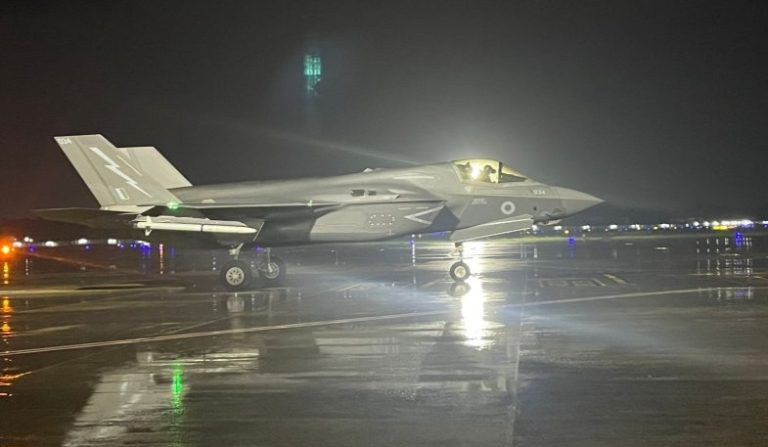
The British Royal Navy F-35B fighter jet, which had made an emergency landing at Thiruvananthapuram airport, has developed a hydraulic failure, and possibly, it would be taken back in a military transport aircraft, said defence officials on Friday.
According to the officials, a bigger maintenance team is expected to come to recover the aircraft and if required, the aircraft may even be taken back in a military transport aircraft.
The officials said, “A few days ago, the F-35 fighter jet of the UK Navy had made an emergency landing due to low fuel, after which the Indian Air Force had provided all required support, including refuelling. However, when the aircraft was going back, it developed a hydraulic failure and could not go back.”
“A maintenance team of the UK Navy had come and tried to rectify the problem, but could not. A bigger maintenance team is expected to come to recover the aircraft. If required, the aircraft may even be taken back in a military transport aircraft,” they added.
Earlier, the Indian Air Force (IAF) confirmed that a British Royal Navy F-35B fighter jet made an emergency landing at Thiruvananthapuram airport on June 14 night.
The aircraft was operating from UK Aircraft Carrier, HMS Prince of Wales, it was undertaking routine flying outside Indian ADIZ with Thiruvananthapuram earmarked as the emergency recovery airfield.
In a post on X, the IAF had said, “A Royal Navy F-35B fighter recovered off an emergency landing at Thiruvananthapuram International Airport on the night of 14 June 25. Operating from UK Aircraft Carrier, HMS Prince of Wales, it was undertaking routine flying outside Indian ADIZ with Thiruvananthapuram earmarked as the emergency recovery airfield.”
“On having declared a diversion off an emergency, the F-35 B was detected and identified by the IAF’s IACCS network and cleared for the recovery. IAF is providing all necessary support for the rectification and subsequent return of the aircraft,” the IAF added.
(This news report is published from a syndicated feed. Except for the headline, the content has not been written or edited by OpIndia staff)
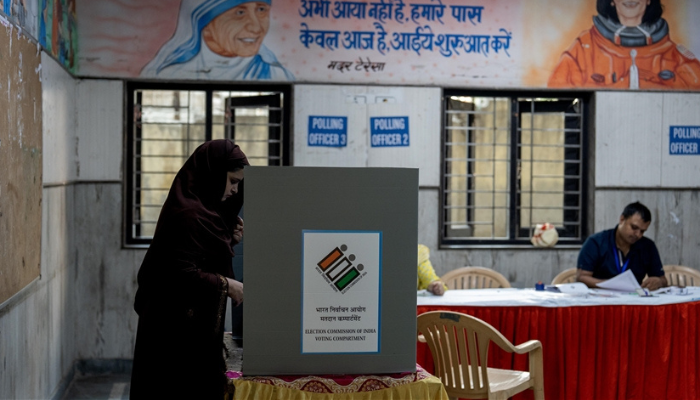
In a decisive move aimed at curbing misinformation, the Election Commission of India (ECI) has ordered the destruction of election-related CCTV, webcasting, and video footage within 45 days of results declaration unless legally challenged. The directive, issued to state electoral officers on May 30, significantly shortens previous preservation mandates and intensifies debates over electoral transparency.
According to Indian Express report, the instruction sent to the chief electoral officers (CEO’s) of all states have cited “recent abuse”. The commission said that videography of the electoral process is not mandatory by Law, but merely the tool of internal management. The commission wrote, “In recent times there have been incidents of misuse of these materials by non-candidates, where they were distorted on social media, removed from context, spreading misinformation and malicious narratives. There was no legal consequences, so a review was necessary.”
The new directive is different from the previous guidelines issued on September 6, 2024, which said that recordings of different were preserved for 3 months to 1 year. For example, there were instructions to reserve prior to nomination for 3 months and recordings related to voting and counting from 6 months to 1 year. Now the commission has linked this to a maximum of legal time limit of 45 days for filing an election petition. If a petition is filed within this period, the recording will be reserved as long as the matter is pending in the court. These guidelines will be applicable in the future.
Amendment made after the High Court direction
The Amendments was made in December 2024 after the Punjab and Haryana High Court has directed the release of video recordings and documents related to the Haryana Assembly elections on a petition filed by Mahmood Pracha. This decision of the Election Commission has raised questions about transparency. Opposition parties and civic organisations also have demanded voter voting data and public availability of Form !7C. In march 2025, the Supreme Court heard a petition by the Association for Democratic Reforms (ADR), seeking to publish booth-wise voting data within 48 hours. The commission had rejected the demand saying that it was legally bound to share Form 17C only with poling agents and not with the general public or the media.
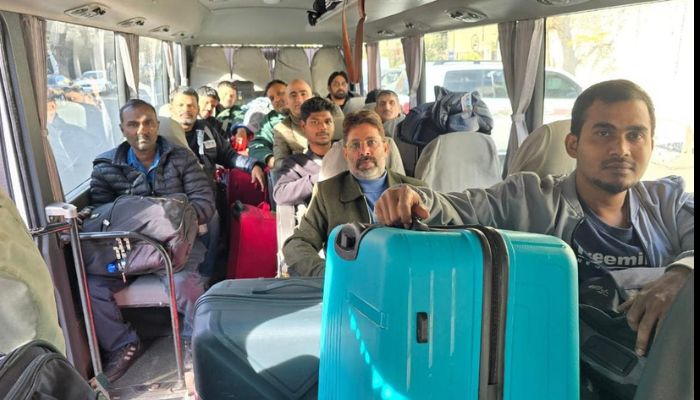
Kashmiri students evacuated by Indian government from conflict-torn Iran under Operation Sindhu, are unhappy that they were not provided flights after arriving in India to return to their homes. Bringing these students back to India was not a cakewalk for the Indian government as the Iranian air space is closed due the ongoing conflict between Israel and Iran which has entered its 7th day. They were first brought to Armenia via land border and from there they were flown back to India.
The rescue flight landed in Delhi, where bus services were arranged for the students for their journey back to their homes in Jammu and Kashmir. However, in a sheer display of entitlement and lack of gratitude, some of the Kashmiri students, who were brought back unharmed by Modi government from the middle of an ongoing war between Israel and Iran, began complaining about “poor transport arrangements” from Delhi.
While an ordinary reasonable person stuck in a similar situation would have felt immense gratitude towards the government of their country for bringing him back home safe from a war-torn region, these students were busy complaining about the lack of comfort in the last leg of their journey. There is no war situation in India, if they didn’t like the govt provided transport, they or their families could have easily arranged for their transport from Delhi to their hometown via air, train or road. But they complained about ‘bad transport’ arranged by govt.
Perhaps, this entitlement emanates from the historical legacy of Jammu and Kashmir region, which enjoyed a ‘special status’ for decades prior to the abrogation of Article 370. Their behaviour is reflective of the disdain felt by radical Kashmiris for the rest of Indians that arises from a deep embedded privilege and sense of superiority in their minds. The feeling that the central or the state government owes these students a comfortable and luxurious mode of transport, as per their own standards, to their homes, is rooted in this sense of superiority.
Nonetheless, one wonders what makes the Kashmiri students prefer Iran for higher studies over India which has a gamut of educational institutions, offering specialisations across disciplines.
Why Kashmiri students go to Iran for studying
Even a cursory comparison between the educational institutions of India and Iran can tell that the standard of education in India, across the fields, far exceeds that of Iran. India’s education sector is vast and growing. After the US and the Europe, India is a preferred educational destination among foreign students.
In the latest QS rankings of global educational institutions, three Indian universities of IIT Delhi, IIT Bombay and IIT Madras made it into the top 200 while no Iranian university was named in the top 200. A total of 54 Indian educational institutions made it to the list of QS rankings making India the fourth most represented nation in the list after the US, the UK and China.
And yet these Kashmiri students travel all the way to the Middle East, a perpetually conflict-ridden region, to pursue higher studies. Several reports suggest that these students go to the Shia country to study medicine and engineering. However, considering that Iran has not achieved any major breakthrough in either medicine or engineering in the recent past, it does not seem a plausible reason for attracting Indian students to Iran.
Also, the political environment in Iran has been far from ideal to provide a conducive environment for the development of disciplines like medicine and engineering that require critical and rational approach. Iran’s political regime prioritises imposing regressive and sexist religious regulations like the hijab mandate.
The heavy-handed measures adopted by the Iranian regime to suppress anti-hijab protests, often resulting in deaths of protestors, underscores the troubled political environment in the country. Therefore, while students may claim that they go for studying medicine and engineering, it cannot be denied that religion plays a key role in their decision-making to opt for Iran as their choice of destination to pursue higher studies.
Iran is also a popular tourist destination among Indian Muslims, mostly Shias. The country houses the famous Imam Reza Shrine in Mashhad, which is a major tourist attraction among Muslims globally. The Shia shrine is one of the largest mosque complexes in the world. It has the mausoleum of Imam Reza, the eighth Imam, who belonged to the lineage of Hazrat Ali and Fatima Zahra – the daughter of the Prophet Mohammed. Around three crore people from all around the world visit his grave every year, with Indian Muslims forming a prominent part of the tourists.
What separates Kashmiri students from students hailing from other Indian states
This is not the first time that India has recsued its citizens from foreign countries affected by regional military conflicts or natural disasters. In 2022, when a war broke out between Russia and Ukraine, India rescued over 20,000 Indian nationals, mostly students, from Ukraine under Operation Ganga. These Indian students were pursuing medical studies in Ukrainian universities and were dispersed throughout the country after evacuating.
On the request of the Indian government, the Russian government worked on halting the war and creating a humanitarian corridor for evacuation. The students hailed from different states of India, including Kerala, UP, Haryana, Tamil Nadu, Gujarat, Maharashtra, Bihar and Rajasthan. None of these students complained about “poor transport arrangements” or the lack of comfort in the offered mode of conveyance as they breathed a sigh of relief for being able to return to their home country safe and sound by escaping a war.
What separates the students evacuated from Ukraine from the students evacuated from Iran is the region they came from. While the students rescued from Ukraine were mostly non-Kashmiris, the students evacuated from Iran are mostly Kashmiris. This goes on to show how decades of exceptional, previleged treatment can permanently shape the minds of people and make them feel entitled to the country’s resources without realising their duty to contribute to the country’s growth.
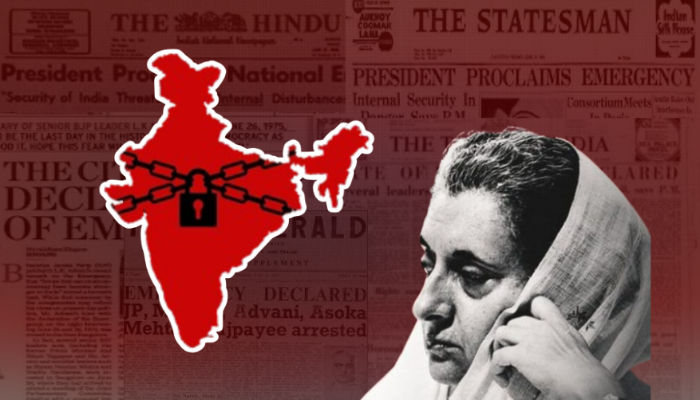
It will soon be fifty years since the late Prime Minister Indira Gandhi declared an internal emergency in the country. It is the “darkest period” of independent India, from 25th June 1975 to 21st March 1977, when all civil rights were suspended and the right to free speech and expression was suppressed. The emergency dealt a severe blow to the democratic values that the nation had held dear since gaining its freedom.
Each institution that was already under the Congress government’s authority was turned into a mechanism of oppression to enhance its punitive control over various sections of society. The citizens became easy prey for the government to carry out its inhumane agenda, while anyone who dared to voice dissent was met with brutality, including the young students who were assaulted, imprisoned and even killed on unfounded accusations.
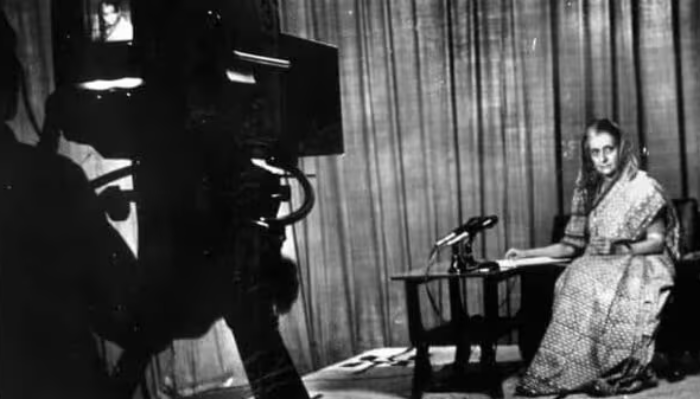
The government similarly enforced harsh censorship on the media, seeking to control and manipulate it to stifle public opinion. The press was perceived as the only independent mass media in India at that time, as the government controlled both radio and television. Notably, just as individuals who collaborated with the tyrannical regime of Indira were rewarded, so too did the elements in media who profited from the misery and anguish of the whole nation.
Print media and the Emergency
Freedom entails the obligation to protect it at all costs. Unfortunately, the majority of India’s domestic dailies abandoned the fight for press freedom following the first protest during the Emergency. There was some pushback from a portion of the print media over the first two days. Blank editorials sprouted to protest the atrocious decision, however, they quickly disappeared due to official threats. The severe restriction of press and personal liberties that followed was largely met with acquiescence.
This regression was famously summarized by Bharatiya Janata Party veteran and former deputy prime minister of India, Lal Krishna (LK) Advani, who remarked, “When Indira Gandhi commanded the media to bend, it crawled.” Furthermore, “Fawning accounts of national events, flattering pictures of Mrs. Gandhi and her ambitious son, and not coincidentally, lucrative government advertising” were spread all over their pages.
Indira Gandhi announcing the Emergency in India. (Source: Mint)
The Hindustan Times, one of the top English-language newspapers, turned into a resolute ally of the government, under the management of industrialist Krishna Kumar Birla. The Times of India also handed over its independence and adopted the official stance, as a third of its directors were government candidates. Overnight, political cartoons ceased to exist and no one risked to publish any disparaging caricatures of the prime minister.
Likewise, The Hindu acted in accordance with its belief that caution was superior to bravery. Khushwant Singh, the editor of “The Illustrated Weekly of India” at the time was also among the prominent journalists who supported Emergency. He claimed that by May 1975 public demonstrations opposing the Indira government had taken on a nationwide scale and frequently escalated into violence.
“With my own eyes I saw slogan-chanting processions go down Bombay thoroughfares smashing cars parked on the roadsides and breaking shop-windows as they went along. Leaders of opposition parties watched the country sliding into chaos as bemused spectators hoping that the mounting chaos would force Indira to resign,” he stated. He was later sent to the Rajya Sabha under her leadership and even recieved the second highest civilan honour, Padma Vibhushan, in 2007.
A compliant press
Journalists, owners and proprietors claimed that they had private reasons for staying silent, or pliant, if not openly endorsing the Emergency. The board of The Times of India declared that the publication would not protest the Emergency since, regardless of their position, the law had to be accepted and this was the legislation in effect at the moment.
“We cannot speak against it, it was decided, and as it was a privately owned paper, we had to follow suit. A few of us proposed that if we couldn’t speak against it, we wouldn’t support it either, and that was the final position the paper took,” conveyed senior journalist Inder Malhotra who was associated with the paper. He wrote a political and personal biography of Indira Gandhi in 1991.
This sterile and disinterested approach was also mirrored in the newspaper. The Ministry of Information and Broadcasting’s ineffective government handouts were mentioned in “India’s Sterile Press” which was a reference to the sterilization campaign of the Indira government. It was overseen by her son Sanjay Gandhi. The majority of the news amounted to propaganda from the government.
LK Advani pointed out, “Following the censorship of the Press there was hardly any difference between one paper and another. They were all drab and dull, inane and insipid, mere reproductions of official handouts.”
According to writer Gnani Sankaran, there was no other alternative for the media outlets. He was a correspondent for the Chennai edition of the Indian Express at the time. “The censor wanted to kill newspapers by delaying approvals. Along with letting pages go blank, sometimes innocuous and frivolous stuff like how to make onion raita (salad) had to be printed since political news could not be taken without consent,” he voiced.
Several newspapers vehemently opposed censorship during the Emergency, alongside numerous smaller, independent newspapers and journals. However, it was evident that Indira Gandhi had just as much control over the nation’s press as she did over its politics, irrespective of some fearless battles and uncompromising positions by these print media.
The giant yet pliant media houses alleged that the use of coercion during the emergency limited the options accessible to newspapers and reporters. According to Indu B. Singh, Indira employed three strategies to control the media: the distribution of government advertising, the shotgun merger of news organizations and the incitement of fear in newspaper publishers, journalists and individual shareholders.
Conformity to glamorizing the Emergency
The leading media platforms not only followed the government’s orders but also tried to depict the Emergency in a favorable light. They claimed that the anti-democratic decision was beneficial for the nation and its people. According to a piece in India Today, officials asserted that the announcement received a positive reception in the southern states including Hyderabad, Bangalore (Bengaluru), Madras (Chennai) and Trivandrum (Thiruvananthapuram). It was originally published on 15th December 1975.
It reported that people even went so far as to suggest that the move should have transpired as early as 1947. It praised the uncomfortable quiet that followed the violent suppression of opposition political parties, labour groups and all other agitators, which was labeled as “thuggish behaviour.” The artcile stated that consumers had an adequate supply of wheat and rice while prices were tightly regulated and did not increase due to seasonal demand.
It cited Congress Chief Minister Devaraj Urs, who asserted that there was a noticeable improvement in the pace of work and everyone was feeling more accountable. It was declared that a record for the collection of tax arrears had already been achieved by Andhra Pradesh which allowed the government to increase its annual plan by Rs 340 million to Rs 1870 million in addition to clearing its overdraft with the Reserve Bank, to illustrate the Emergency as a financial boon.
The report even quoted statements endorsing the Emergency as a blessing in a ugly disguise for the nation and its citizens. It was painted as an influential tool that cultivated a sense of consciousness within society, encouraging individuals to reflect more cautiously before engaging in any unlawful behavior, contrary to their customary conduct.
The article maintained that people from the lowest tiers of society, like cobblers, were provided the opportunity to have bank accounts, a privilege that was seldom available, especially for the poor, during the Congress regime. The 20-point economic plan of Indira government was commended as a solution to the nation’s long-term issues with agricultural output and the efficient distribution of basic goods, as well as its immediate issues, primarily the price increase and productivity decline.
According to the story, Congress President Devkanta Barooah questioned, “Who lives if India dies? And who dies if India lives,” at a meeting hosted by the Hindustani Mercantile Association on 11th November. He alleged that organized trade, industry, public administration, educational institutions and economic institutions would all stop operating if a few vocal and anti-democratic elements attempted to undermine peace and stability at home.
Krishan Kumar Birla who was also present there then stated that the economy was in better shape during the Emergency. Indians living overseas were provided incentives for investment and improved facilities for sending money home, while the parallel economy operated by smugglers, tax evaders, foreign exchange racketeers and hoarders was progressively being destroyed.
India Today referred to the officials as Babu (petty pen pusher) and the business community as Baniya (petty profiteer) in a highly derogatory attack and then dubbed them as the two historically strongest representations of corruption in the country and asserted that the Emeregncy made it mandatory to display commodity prices and improved administrative office efficiency.
It then applauded the Emergency for bringing students into classrooms and initiate actions to give them more affordable and simpler ways to learn. The report emphasised that in order to address the problems of unemployment and brain drain, the government had introduced vocational training and work experience.
It is important to note that Indira Gandhi became infamous for nationalizing banks and imposing state control over enterprises. Her 20-point formula also faced severe criticism for advocating increased state control over the economy, and it was also condemned as a possible barrier to the growth and efficiency of the private sector.
Stunning rationale for the Emergency and victim-blaming
Indira Gandhi had often maintained that she did not want to stifle the press, according to India Today, which also noted that there has been global concern over the restrictions placed on the press since the Emergency. Conveniently, it added that determining the boundaries between freedom and responsibility is a challenge for democracies.
It claimed that the Western media could not carry out unverified stories owing to the strict libel laws, nevertheless, in India, the process is so intricate that the media does not even regard them before publishing unsubstantiated reports and hence could share any news or rumours without supporting evidence.
The article then termed the Indian press as “wild” instead of “lively” and slammed its use of unprecedented offensive language. It then declared that press censorship laws are progressively being loosened to permit constructive criticism of government policy during the Emergency.
India Today described those opposing the Emergency as a “noisy minority” and shockingly asked, “Is discipline, efficiency and hard work without violence incompatible with democracy? Must discipline, efficiency and social responsibility be a product of fear and coercion?” It stated that while there have been grievances regarding the opposition’s silencing, non-Congress governments are functioning reasonably well in Gujarat and Tamil Nadu.
The article also attacked the politics of the coalition and charged that it only existed to overthrow Indira Gandhi and lacked ideological alignment. It also claimed that a small number of opposition members who were involved in various agitations were arrested for engaging in outrageous actions prior to the emergency.
Ironically, it also mocked freedom fighter Jayaprakash Narayan who prolclaimed a national revolution the day he was jailed and stated that he was wrong about the movement.
Adding salt to the wounds of the victims, India Today inquired, “Where is the Emergency? What a handful would consider suppression, millions of Indians do seem to consider emancipation. Whereas six months ago visitors to India heard little else but complaints about the lack of consumer products and unbearable soaring prices, the average person is grateful he can now feed his family and get more value for his rupee.”
“Where are the soldiers? Where are the guns? Where is the Emergency,” it quoted an alleged television reporter who landed in the national capital from New York. Furthermore, as if the aforementioned insensitivity was not enough, it also included the shocking comments of a politician in Delhi who, in all his wisdom, declared, “We can utilize the Emergency to enhance tourism in India. The tagline for promotional campaigns should be: Come to India to witness the Emergency. Nothing of this nature has ever occurred in any democracy before.”
Indira, the greatest oppressor of press freedom, was portrayed as receptive to criticism. The emergency was depicted as a common occurrence with no cause for concern while those who expressed legitimate worries were characterized as villains and subjected to mockery. .
Obligation to Indira Gandhi
Media organizations had their own personal motivations ranging from fear to financial incentives to back the Congress. Similarly, some aligned themselves with the oppressive Indira regime due to a profound sense of obligation towards the Nehru-Gandhi family along with financial favours and “The Times Group” was one such entity.
Ramkrishna Dalmia, part of the Sahu-Jain family, bought the group from its British owners shortly after independence. However, he abused his office as chairman of an insurance firm in the process. Pandit Jawaharlal Nehru’s government at the time disregarded this anomaly.
However Feroze Gandhi, Indira Gandhi’s husband brought up the matter in parliament and demanded an investigation. As a result, Dalmia was found guilty of financial wrongdoing after the matter proceeded to trial. He spent two years in Tihar Jail. Nehru permitted the group’s ownership to be transferred to Sahu Shanti Prasad Jain, the grandfather of the present Jain brothers and the son-in-law of the Dalmia family, despite the evidence of this deception.
The group’s new owner, Sahu Shanti Prasad Jain, was convicted of selling government-provided subsidized newsprint in the black market in the 1960s. This was against the law and a betrayal of confidence. He was imprisoned and the Indian government also acquired possession of the group and their ownership continued for more than 10 years.
However, during the Emergency, Indira Gandhi, granted ownership of “The Times Group” to Ashok Kumar Jain, the son of Sahu Shanti Prasad Jain. He is the father of Vineet Jain and Samir Jain, the current owners. It might be the sole occasion when she genuinely cared about a private company, but only to leverage their allegiance.
The majority of top journalists who were critical of the Nehru-Gandhi family and nationalist reporters were later fired by Ashok Jain. Interestingly, Jains have been regularly accused of involvement in money laundering schemes. Ashok Jain was forced to leave India when the Enforcement Directorate conducted a rigorous investigation into a case concerning the transfer of US$1.25 million illegally to a foreign account in Switzerland.
Indira’s war on press freedom
During the Emeregency era, media consisted of printed newspapers and periodicals, which were mostly dependent on the electrical supply to publish their editions. The center of newsprint in New Delhi was the Bahadur Shah Zafar Marg. The disruption in its power supply, which was managed by government firms, resulted in a significant delay or cancellation of the print for the following day’s publication.
Foreign correspondents were driven out by the regime. 29 foreign journalists were prohibited from entering India and 7 were expelled. 54 Indian journalists, including two cartoonists and six photographers, had their accreditation revoked by the enter. The majority of them were well-known for criticizing government actions and policies while they were active in New Delhi while about 250 journalists had been imprisoned.
Advertisement generated revenue for the media. The amount that users or news consumers paid was insufficient to cover the expenses of news collection, publication and broadcasting. Government advertisements contributed a significant portion of advertising revenue. The authorities employed this reality as a means of manipulation.
Meanwhile, nobody truly realized this until the government at the time used arm-twisting during the Emergency. However, the same was already red-flagged in 1965 by Chanchal Sarkar who is regarded as the father of Indian journalism. He highlighted that “government’s advertising policy has undertones of political pressure and indirect control.”
Vidya Charan Shukla, the Information and Broadcasting minister chosen by Sanjay Gandhi successfully carried out Indira’s authoritarian posture against the print media. “The press and films, otherwise outside the control of government were made to dance to the tune of the rulers by a set of draconian laws which reduced press freedom to naught and there was consistent abuse of authority in the matter of disbursing advertisement, allocation of newsprint and release of raw stock for films,” as the White Paper on Misuse of Mass Media during the Internal Emergency emphasized.
The Prevention of Publication of Objectionable Matters Act, 1976 was the final straw for Indian journalists. The act gave the government the power to ban publications for any reason related to Article 19 (2). As a result, the act essentially prohibited any media coverage of protests against government policies or anti-government criticism. It even gave right to the authorities to seize or close printing presses or to return security deposits for publishing “objectionable matter,” which comprised anything and everything.
“Indira Gandhi did not accept the basic philosophy of a newspaper is that it has to convey the people’s problems, not the government view, that a columnist must carry the voice of dissent in the corridors of power,” outlined Durga Das, head of India News and Feature Alliance. Indira’s glaring abuse of leadership during the Emergency was not surprising because this had been her policy and approach to the Indian press since the start of her rule.
Conclusion
It was clear that the Indira Gandhi’s implementation of the emergency was unethical. However, the majority of the media’s response was unbecoming. “The first and most crucial round of battle for freedom of the Press and civil liberties was lost without a struggle in the first week after the emergency,” voiced former attorney-general for India Soli Jehangir Sorabjee.
The newspapers and their editors were aware of the ridiculousness and illegality of the censor’s conduct but with the exception of a few courageous individuals, none of them were prepared to contest it in court. Printers did not want to risk losing their presses while editors were more concerned with keeping their jobs.
The Congress party and its liberal media affiliates along with their entire ecosystem have adopted a principle from propaganda strategy of Joseph Goebbels, which stated, “Accuse the other side of that of which you are guilty.” While they accuse the Modi government of restricting media freedom and even coin the phrase “Godi Media” to disparage journalists who do not tow their narrative, the truth is quite the opposite. Rudyard Kipling famously wrote:
The Pope may launch his Interdict, The Union it’s decree, But the bubble is blown and the bubble is pricked By Us and such as We. Remember the battle and stand aside While Thrones and Powers confess That King over all the children of pride Is the Press – the Press – the Press
However, there has never been a more profound attack on the media and the press than during the tenure of Congress and there are no journalists more submissive than those loyal to the grand old party.