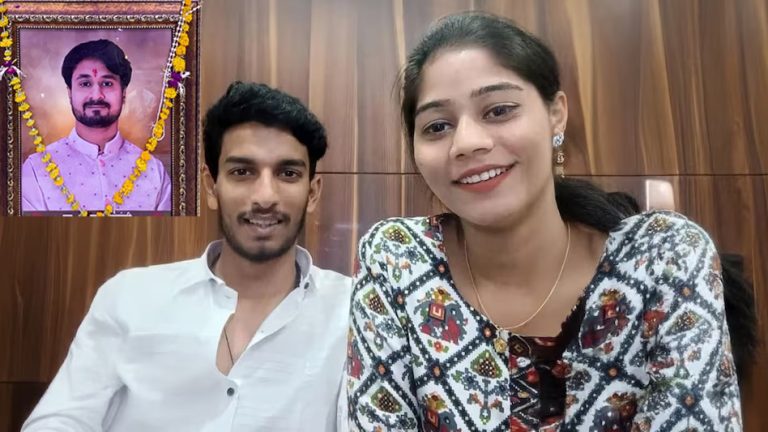
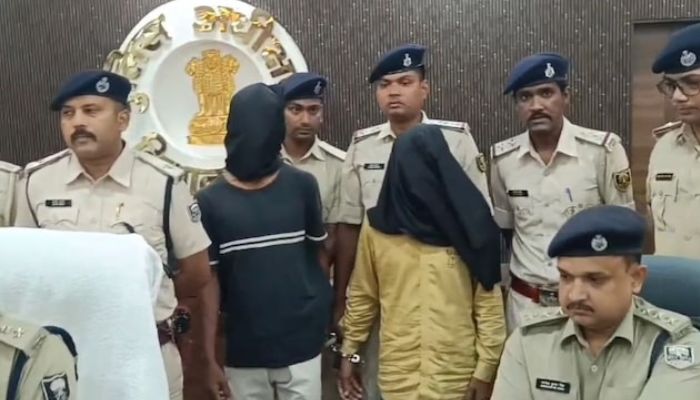
A district and sessions court in Meghalaya’s Shillong on Saturday sent Sonam Raghuvanshi and Raj Kushwaha to 13 days of judicial custody in connection with the Raja Raghuvanshi murder case.
Superintendent of Police (SP) of East Khasi Hills district Vivek Syiem told ANI that Raghuvanshi and Kushwaha have been remanded to 13-day judicial custody.
Assistant Public Prosecutor Tushar Chanda also said the accused have been remanded to judicial custody since the police didn’t ask for custody.
“The court has remanded both the accused for 13 days of judicial custody. The police did not ask for custody. The Investigating Officer pleaded for judicial custody. The court granted 13-day judicial custody,” Chanda told ANI.
On Thursday, the district and sessions court sent the remaining accused — Akash Rajput, Vishal Singh Chauhan, and Anand — to 14-day judicial custody.
This development came after the Meghalaya Police arrested five people in connection with the murder of Raja Raghuvanshi, a newlywed who had come to the state on his honeymoon. Those arrested include his wife, Sonam Raghuvanshi, and four others: Akash Rajput, Vishal Singh Chauhan, Raj Singh Kushwaha, and Anand. Raja Raghuvanshi’s body was found in a gorge near Sohra (Cherrapunji) on June 2.
Sonam was later found near a roadside dhaba along the Varanasi-Ghazipur highway. The couple, both residents of Indore in Madhya Pradesh, had gone missing during their honeymoon trip to Meghalaya.
Earlier, as part of its investigation, the Meghalaya Police SIT reconstructed the crime scene as part of their investigations into the murder of Raja Raghuvanshi. The murder scene was recreated by the SIT team in Sohra in the presence of the accused, Sonam Raghuvanshi, and three others.
SP Vivek Syiem said that the reconstruction of the crime scene was very successful as the police then “got a very clear picture.”
Detailing the reconstruction of the crime scene, SP Vivek Syiem said that one more machete used to murder Raja Raghuvanshi still needs to be recovered.
“The SIT visited several places to re-enact how the accused did it. We started from the parking lot where they had kept their two-wheelers. We went to the viewpoint, and ascertained who was standing where just before the murder. There were three blows – first by Vishal, second by Anand and the last blow by Akash. We have ascertained that one more machete still needs to be recovered. The accused replayed how they threw the machete. SDRF are trying to recover the second weapon,” he said.
Speaking to the media, SP Vivek Syiem also informed that Sonam Raghuvanshi and Vishal damaged Raja Raghuvanshi’s phone after the murder. “We have ascertained what happened to Raja’s mobile phone. Sonam damaged it, and then Vishal damaged it. This whole thing was played out, and also their exit from here,” he said.”We have ascertained that the victim was hit with the weapon. The first hit was by Vishal aka Vicky. When Raja was hit and blood came out, Sonam moved away from the spot. The three accused threw the body down,” he added.
(This news report is published from a syndicated feed. Except for the headline, the content has not been written or edited by OpIndia staff)
On June 19, a Muslim woman and her baby were murdered in Kishanganj district of Bihar. The case is from Telibasti in Pothia police station area, where the brutal murder of 23-year-old Ansari Begum and her one and half year old daughter by slitting their throats was solved by the police within 24 hours.
Police arrested Ansari’s 55-year-old father-in-law Farooq Alam and 19-year-old brother-in-law Ehsan Alam. Both of them confessed to the crime during interrogation.
On June 19, police received information that the dead bodies of a woman and a girl were found in suspicious condition in their house. The police reached the spot and took the bodies in their custody. An FIR was registered on the complaint of the deceased’s father Nazimuddin. A special investigation team was formed to probe the case.
Investigation revealed that deceased Ansari Begum was married to the elder son of the accused father-in-law Farooq Alam 6 years ago. The elder son, Ansari Begum’s husband, died 2 years ago. Since then, father-in-law Farooq Alam was pressuring his widowed daughter-in-law Ansari Begum to have sex with him. However, she rejected his advances.
At the same time, Farooq Alam’s younger son Ehsan Alam was also trying to make her his wife. But she was not agreeing to him also, SP Sagar Kumar Jha said.
किशनगंज जिलांतर्गत पोठिया थाना क्षेत्रांतर्गत माँ–बेटी हत्याकांड का उद्भेदन महज 24 घंटों के अंदर करते हुए घटना में शामिल 02 अभियुक्तों को किया गया गिरफ्तार । pic.twitter.com/076w7lkoMk
— Kishanganj Police (@KISHANGNJPOLICE) June 20, 2025
Angry at Ansari’s repeated refusal, the two got angry and entered his room at night and killed the mother and daughter by slitting their throats with a sharp weapon. They then tried to make it look like a case of suicide. They locked the door from inside, got out of the house through a ventilator, and fled from the spot.
However, based on the investigation, the police nabbed both of them from Telibhitta in Tayabpur. The weapons and other evidence used in the murder were also recovered. Ansari’s Abu Nazimuddin has also accused the in-laws of threatening him.
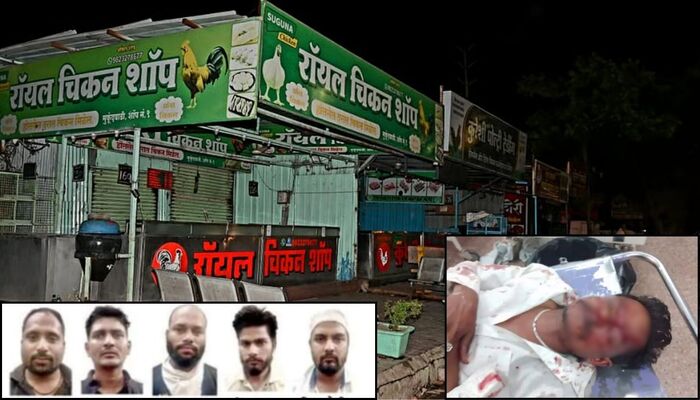
In a horrifying incident a Hindu man was hacked to death by a group of Muslims in the Mukundwadi area of Sambhajinagar in Maharashtra on Thursday (19th June) night. Two others, including brother of the deceased sustained serious injuries.
According to reports, MIDC Cidco Police have arrested Mastan Qureshi alias Nanna (29), Samir Khan (19), Babar Shaikh (32), Sajid Qureshi alias Sajju (29) and Nasir Khan (20), who have been booked under relevant provisions of Scheduled Castes and the Scheduled Tribes (Prevention of Atrocities) Act, 1989 and Bharatiya Nyaya Sanhita, 2023. Deputy Commissioner of Police, Prashant Swami said that the accused were granted bail on Friday after being produced before a special court set up under the SC, ST Act on ground of technical reasons.
What was the incident
Deceased Nitin Sonaji Sankpal, his brother Sachin Sonaji Sankpal and their friend Datta Balaji Jadhav were having dinner in a local eatery in the Mukundwadi area. After dinner, when Nitin went out to urinate behind a nearby chicken shop, Mastan Qureshi objected to it and a heated altercation ensued between the two. According to police, “The argument escalated, drawing in Sachin and Datta, who rushed out on noticing the commotion. A fight ensued between the three men and Qureshi. In a fit of rage, Qureshi allegedly grabbed a clever used for chopping meat and attacked all the three men.”
All three injured were rushed to the hospital where Nitin was declared dead while the other two sustained serious injuries.
Nitin had a friendly nature
Nitin and Sachin lost their father at a very young age. Their mother raised them single-handedly. Nitin ran a tea and egg stall near the Cidco bus stand and was fond of photography. He was known to have a friendly nature and was socially well-connected. Nitin is survived by his wife and three children. His brother Sachin, who worked in lift maintenance in Pune, has two children.
The Congress-led Karnataka government faces a monumental corruption scandal after a leaked audio recording featuring senior Congress MLA B.R. Patil revealed explosive allegations of systematic bribery in the allocation of state housing schemes, triggering fierce condemnation from BJP spokesperson Shehzad Poonawalla and opposition leaders.
Audio Exposes “Pay-to-Get” Housing Scheme
In the viral audio clip, authenticated by BR Patil himself, the Aland MLA is heard confronting Sarfaraz Khan—personal assistant to Housing Minister Zameer Ahmed Khan—about rampant corruption within the Rajiv Gandhi Housing Corporation Limited. Patil alleges officials deliberately ignored legitimate beneficiary recommendations from elected representatives, instead allocating houses to applicants who paid bribes. “Is this a business where only those who pay get houses?” Patil demands in the recording, citing specific irregularities in 950 houses across Aland, Afzalpur, and Hosapete constituencies. He shockingly warns, “If I open my mouth, the government will be shaken”. Patil later confirmed to media that officials demanded ₹25,000 per house allotment, branding the scam as widespread.
BJP’s Scathing Attack: “Khatakhat Jhoot & Loot Model
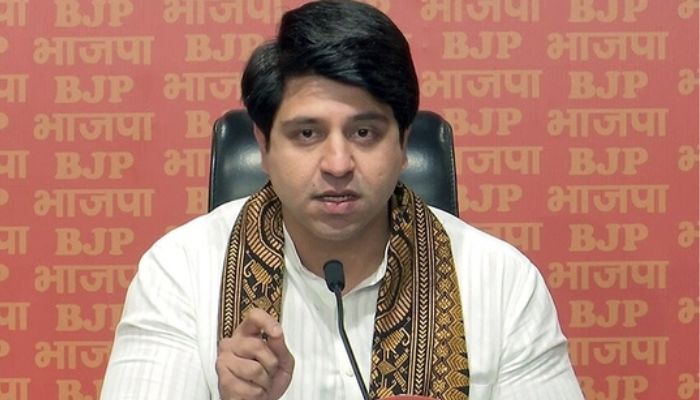
BJP national spokesperson Shehzad Poonawalla launched a blistering assault on the Congress government, linking the housing scam to a broader pattern of corruption. “Congress has only given Karnataka a khatakhat jhoot and loot model. First, false guarantees, now looting with both hands MUDA scam, liquor scam, rice scam, and now selling houses meant for the poorest,” Poonawalla declared.
He demanded an immediate CBI or judicial probe, stressing that the allegations originated from the ruling party’s own MLA, not the opposition. Poonawalla further lambasted the government’s recent withdrawal of general consent for CBI investigations, calling it the act of a “professional thief” aimed at shielding corruption.
Government in Damage Control Mode
Housing Minister Zameer Ahmed Khan ordered an internal inquiry following the leak, while Deputy Chief Minister D.K. Shivakumar claimed ignorance of the allegations. Chief Minister Siddaramaiah, already embroiled in the MUDA land scam probe , faces mounting pressure. Opposition Leader R. Ashok demanded Khan’s resignation, while JD(S) leader H.D. Kumaraswamy asserted corruption was “continuous” across departments.
Political Fallout and Demands
The scandal strikes at Congress’s anti-corruption image, having previously accused the prior BJP government of “40% commission.” With Patil’s audio corroborating earlier claims by Congress MLA Basavaraj Rayaraddi that Karnataka is “number one in corruption,” the BJP has intensified calls for a High Court-monitored probe and Housing Minister Khan’s resignation.
On 17th June, a violent Muslim mob attacked Scheduled Caste Hindus in Gopinathpur village of Jagatsinghpur district in Odisha. According to an exclusive report by Hinduphobia Tracker, a group of local Muslims launched the assault following an unrelated theft incident from the previous night that happened in a Muslim-dominated area.
According to the reports, sacred Hindu symbols were desecrated, caste-based slurs were hurled, and numerous Hindu residents, including women and children, were brutally attacked with rods, sticks, steel pipes and sharp weapons.
Hinduphobia Tracker Exclusive: In Jagatsinghpur, Odisha, a violent Muslim mob attacked Hindus during preparations for the Raja festival. Over 100 Islamists brutally assaulted men, women & even children with rods, pipes, & weapons. A handicapped minor boy was also beaten. pic.twitter.com/744FXHJiHo
— Hinduphobia Tracker (@hinduphobia_tr) June 20, 2025
A Bajrang Dal functionary told Hinduphobia Tracker that the Hindu community was busy in preparations for the Raja festival, a traditional celebration in Odisha, when the incident happened. He described the assault as extremely brutal and noted that even Hindu women and small children were not spared. Among the victims, there was one handicapped minor boy who was brutally assaulted by the Muslim mob. While the attack happened on a Hindu community by the Muslim mob, police told Hinduphobia Tracker that there was no communal angle to the incident.
Details of the incident
An FIR was registered on the complaint of the victims at Biridi police station on 18th June under Sections 126(2), 115(2), 303(2), 351(3), and 324(5) of the Bharatiya Nyaya Sanhita and Sections 3(5), 3(1)(r), 3(1)(s) and 3(2)(va) of the SC/ST Act against Raja Miyan, Siraj Alli, Sona Miyan, Kapil Suleman, Jani Miyan, Bahadul Alli and others.
According to the FIR accessed in the matter, on the morning of 17th June, residents of Sial Sahi were discussing arrangements for the festival when police arrived with a sniffer dog to investigate the previous night’s theft in the Muslim-dominant area. Around 100–200 local Muslims accompanied the police.
The Hindu residents cooperated fully with the investigation. However, the situation unexpectedly escalated and the accompanying Muslim mob quickly turned hostile. They launched a coordinated and violent attack on the Hindus.
They attacked Hindu men, women, and even children without any restraint. The attackers desecrated a Tulsi plant that had been decorated for the festival and vandalised a local Hindu temple at the community clubhouse. They threw stones at the temple and some assailants urinated near the sacred site in a deliberate act of desecration.
The Muslim mob hurled caste-based slurs and questioned the right of Dalit Hindus to worship or even reside in the area. They issued violent threats, including warnings to Hindu women not to step outside and threats to behead local Hindu men. The Muslim attackers snatched a gold ring from one of the Hindu women during the chaos. One young Hindu man, Hemant Bhoi, was dragged out from the temple and beaten in public view. Others, including Ashok Bhoi, Sanjay Bhoi, and Mani Bhoi, suffered serious injuries.
Though the police were present at the scene, the mob went on a rampage for over an hour, leaving dozens injured and traumatised. Later, members of the assaulted community contacted the Bajrang Dal, which assisted the victims to file the complaint.
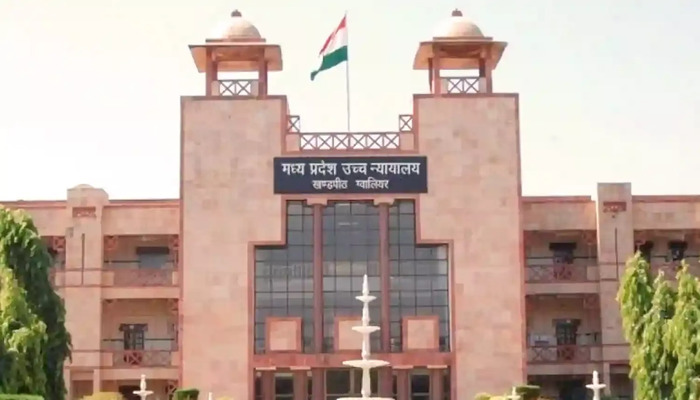
The Madhya Pradesh High Court on Thursday reduced the sentence granted to a person convicted of raping a four-year-old girl, from capital punishment to rigorous life imprisonment saying that that his “act was brutal” but “he has not committed brutality”.
A bench of Justices Vivek Agarwal and Devnarayan Mishra wrote in the order passed on 19th June, “Looking to the above observations and discussions, in this case, no doubt that appellant’s act was brutal as he has committed rape upon the victim of four years and three months of age and after committing rape also throttled her treating her dead and thrown the victim in such a place where she could not be searched and left the spot but it is also clear that he has not committed brutality.”
Convict did not get a proper atmosphere to grow up: HC
While commuting his death sentence, the High Court took into consideration the background of the convict. The court noted that the convict was a poor, uneducated tribal, whose did not get a “proper atmosphere” to grow up.
“…he is uneducated youth of 20 years of age and belongs to the tribal community and his parents never tried to give him education and not properly take care of him, therefore he has left his house and was self-bread earner and living and working in a Dhaba (Restaurant). Atmosphere in the Dhaba is not such, by which it can be inferred that he was given the proper atmosphere to grow up. Hence, sentence imposed upon the appellant for the offence punishable under Sections 363, 450, 307, 201 of the Indian Penal Code is affirmed but his sentence for the offence punishable under Sections 6 of the POCSO Act is converted from Capital Punishment to the rigorous imprisonment of 25 years with the fine amount of Rs.10,000/- and in default of fine amount (actual incarceration without remission/commission under Section 432 and 433 of Code of Criminal Procedure), the appellant shall further suffer rigorous imprisonment of one year,” the Court noted while reducing his punishment.
The High Court observed that the aggravating circumstances in the case were the ages of the victim and the convict. “There are aggravating circumstances that the victim was four years old and the rape was committed upon such a kid and offence was committed in such a way that the private part of the victim was torn and after committing the offence, the victim was thrown in the solitary place treating her that she had died,” the judges said.
Background of the case
The convict, Rajaram, had challenged the conviction order passed the Special Judge (POCSO Act), District Khandwa, which sentenced him to death on 21 April 2023 under Section 6 of the POCSO Act. He was also convicted under Sections 363, 376AB, 307, 450, and 201 of the Indian Penal Code. On the day of the incident, Rajaram barged into the victim’s hut and kidnapped her. He brutally raped the child and then left her unconscious in a mango orchard believing her to be dead. However, the victim somehow survived.
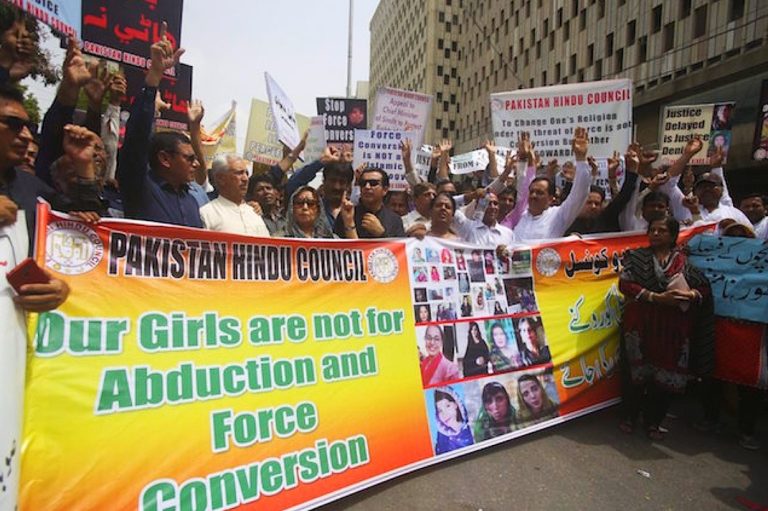
In yet another incident that illustrates threats besieging Hindus in Pakistan, a court in the Sindh province has ordered two Hindu families to furnish a security bond of PKR 10 million (approx. ₹1 crore) each as a precondition to regaining custody of their minor children who were abducted and forcibly converted to Islam.
The damning details of the case highlights how Pakistani judiciary has been legitimising forced conversions of Hindus taking place in Pakistan, effectively empowering and encouraging radicals to carry on with the abduction of non-Muslims and bring them under the fold of Islam forcibly.
A Pakistani court has ordered two Hindu families to pay 1 crore rupees each as bond just to get custody of their minor children kidnapped and forcibly converted to Islam
Court said the bond is to ensure the families do not make the kids revert to their old religion
The shocking judicial directive is a brazen attempt to whitewash forced conversions under a façade of legal procedure.
The case
The case, reported from the Sanghar district, involves three Hindu sisters and a male cousin, all of whom suddenly went missing earlier this year. Their families, belonging to the minority Hindu community, filed missing person complaints, strongly suspecting abduction.
Police investigations later located the children. They were discovered living with members of the Muslim majority and had reportedly converted to Islam. The families challenged this, citing coercion and abduction.
Court proceedings and ruling
When the matter reached court, the judges made the following observations:
Two girls, Diya and Jiya, were declared to be above 18, and the court ruled that they could not be forced to return to their families, citing “free will.”
The other two children, Dashina and Harjeet, were found to be minors.
While acknowledging the parental rights over minors, the court attached a controversial condition:
The families must deposit PKR 1 crore (10 million rupees) each as a bond to guarantee that they will not try to “reconvert” the children to Hinduism.
This condition, effectively criminalizing any return to their ancestral faith, has sparked outrage.
The Sanghar case lays bare the chilling reality of religious persecution in Pakistan, where kidnapping, forced conversions, and legal intimidation have become tools to erase minority identities. The imposition of financial bonds as a barrier to religious freedom for Hindu minors sets a dangerous precedent—one that codifies state-sponsored religious apartheid under the pretense of judicial order.
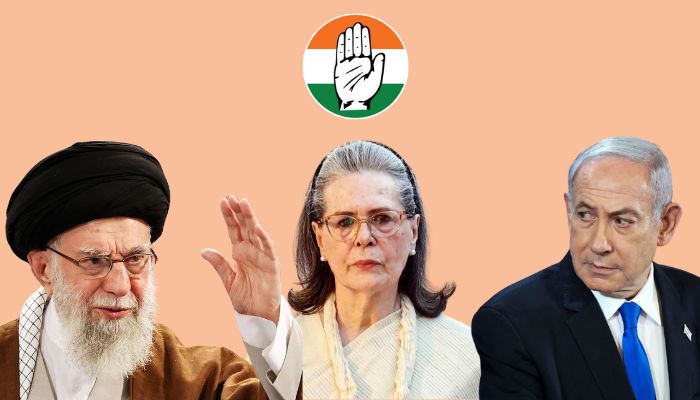
On Saturday (21st June), ex-Congress Chairperson Sonia Gandhi wrote an opinion piece in The Hindu newspaper wherein she extended support to the Islamic Republic of Iran amid the ongoing conflict with the Jewish State of Israel. Additionally, she blamed the Modi government for not choosing sides and maintaining diplomatic balance.
This was done by the former Congress Chairperson with the sole objective of appeasing its homegrown ‘Muslim vote bank’, which has thrown its weight behind Iran in the interests of the ‘Ummah’ and conveniently forgotten that Iran is a Shia-majority nation in the face of conflict with the Jewish State of Israel.
Sonia Gandhi, in her opinion piece, portrayed Iran as the victim of Western hegemony and Israeli aggression. She also claimed that the Islamic Republic under Ali Hosseini Khamenei has been a ‘long-standing friend’ of India.
"New Delhi's silence on the devastation in Gaza and now on the unprovoked escalation against Iran reflects a disturbing departure from our moral and diplomatic traditions. This represents not just a loss of voice but also a surrender of values.
To substantiate her claims, the ex-Congress Chairperson wrote, “In 1994, Iran helped block a resolution critical of India at the UN Commission on Human Rights on the Kashmir issue.” However, she failed to mention the multiple U-turns of Iran on Kashmir and the hostile anti-India remarks that its Supreme leader made on social media.
Iran had supported the ‘Right to Self-Determination’ of Kashmirs in the OIC (Organisation of Islamic Cooperation) Kashmir Contact Group, thereby lending credence to the stance of Pakistan. Ali Hosseini Khamenei has also made the stance of his Islamic Republic crystal clear on Jammu & Kashmir, which is an integral part of India.
Since 2017, the Supreme leader of Iran has tried to present Kashmir as an ‘independent territory’ in several statements and social media posts. He had infamously claimed, “Everyone should openly support people of Yemen, Bahrain, and Kashmir.”
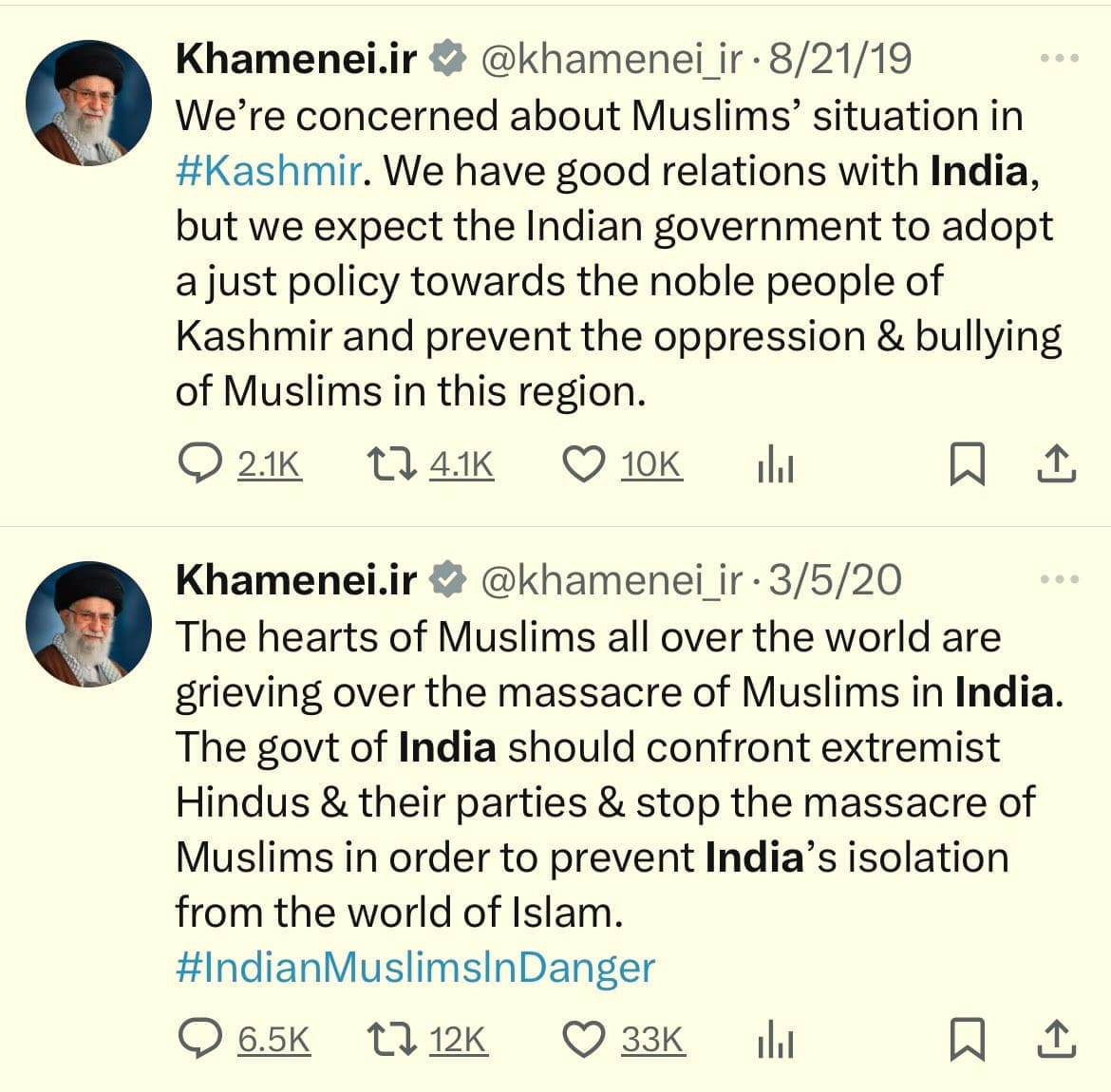
In a tweet posted in August 2019, shortly after the abrogation of Article 370, Ali Hosseini Khamenei claimed, “We’re concerned about Muslims’ situation in #Kashmir. We have good relations with India, but we expect the Indian government to adopt a just policy towards the noble people of Kashmir and prevent the oppression & bullying of Muslims in this region.“
Screengrab of the tweets by Ali Hosseini Khamenei
A similar tweet followed in March 2020 – “The hearts of Muslims all over the world are grieving over the massacre of Muslims in India. The govt of India should confront extremist Hindus & their parties & stop the massacre of Muslims in order to prevent India’s isolation from the world of Islam.“
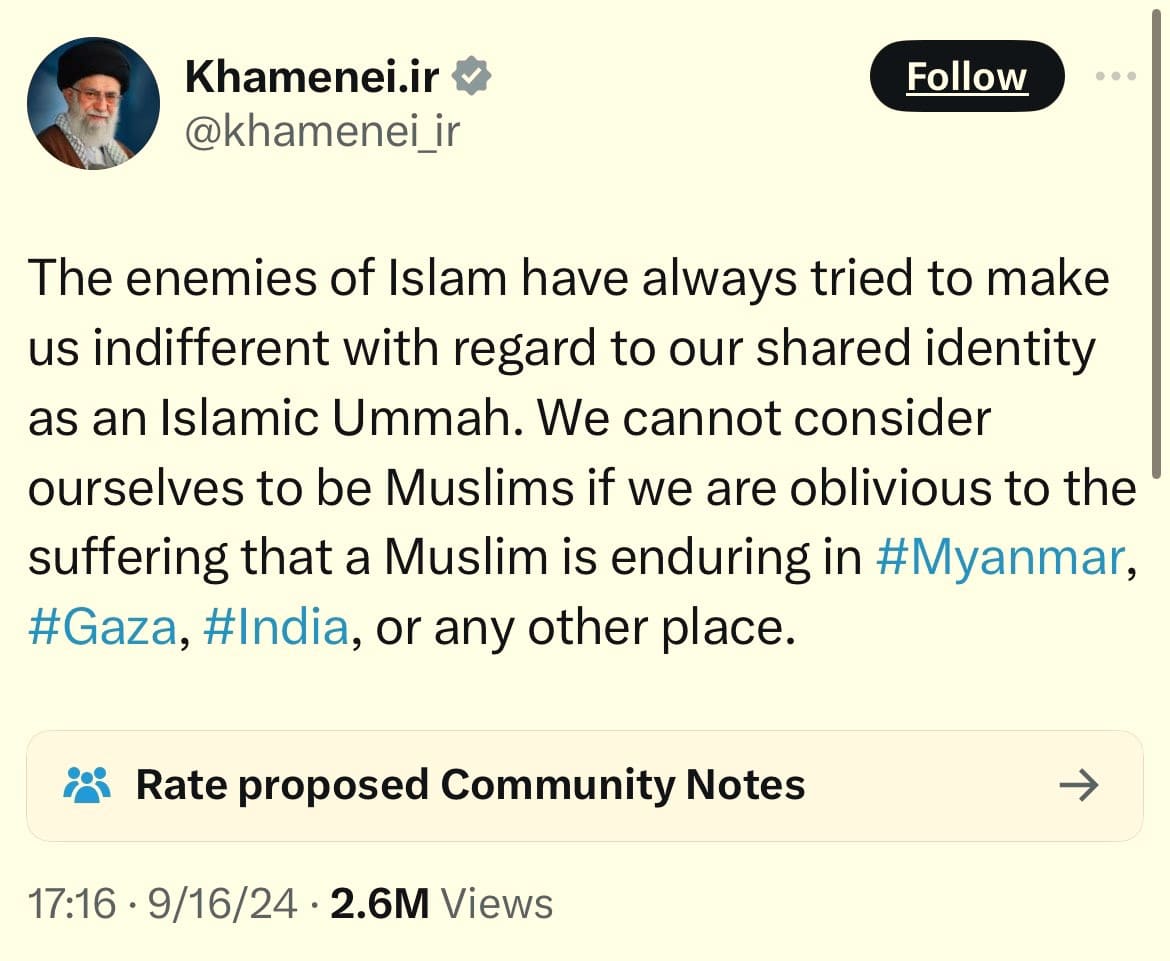
“The enemies of Islam have always tried to make us indifferent with regard to our shared identity as an Islamic Ummah. We cannot consider ourselves to be Muslims if we are oblivious to the suffering that a Muslim is enduring in #Myanmar, Gaza, #India, or any other place,” Ali Hosseini Khamenei posted last year.
As such, it is evident that the Islamic Republic of Iran is not a ‘long-standing friend’ of India, especially when it comes to Jammu and Kashmir. Israel, on the other hand, has been a vocal supporter of India and has extended help to us during wars against Pakistan.
Screengrab of the tweet by Ali Hosseini Khamenei
Sonia Gandhi’s article in The Hindu, demonising Israel and eulogising Iran, has less to do with geopolitics and more to do with ideological alignment with its core vote bank within the country ahead of elections.
The Israel-Iran conflict provided a window of opportunity to the Congress to signal its Muslim supporters that the grand-old-party is on the side of Ummah in conflict with ‘Yahudi’ Israel. This also explains why Congress leader Priyanka Gandhi Vadra had earlier lashed out at Israeli government earlier in March this year.
Sonia Gandhi, in her opinion piece, blamed the Modi government for not choosing sides during the Israel-Iran conflict.
“In the face of this humanitarian catastrophe, the Narendra Modi government has all but abandoned India’s long-standing and principled commitment to a peaceful two-state solution, one that envisions a sovereign, independent Palestine living side-by-side with Israel in mutual security and dignity,” she alleged.
“New Delhi’s silence on the devastation in Gaza and now on the unprovoked escalation against Iran reflects a disturbing departure from our moral and diplomatic traditions. This represents not just a loss of voice but also a surrender of values. It is still not too late. India must speak clearly, act responsibly, and use every diplomatic channel available to defuse tensions and promote a return to dialogue in West Asia,” the former Congress Chairperson concluded.
The stance of the Modi government on global conflicts
Unlike the Congress party that is willing to jeopardise diplomatic relations to pacify its domestic vote bank, the Modi government has exerted caution, restraint and showcased strategic balance in the face of global conflicts.
Prime Minister Narendra Modi has time and again reiterated that India is on the side of peace. During the Ukraine-Russia war, India has refused to side with either of the two countries. This was despite the pressure from Western countries, which was exacerbating the war by supplying arms to Ukraine.
The repeated appeal for peace, calls for de-escalation, resulted in Russia providing crude oil at cheaper rates amid a global energy crunch. India was also successful in creating safe passages for Indian nationals in both Russia and Ukraine and airlifting them home under ‘Operation Ganga.’
A similar script was followed during the Israel-Hamas War. India unequivocally condemned terror outfit Hamas and its dastardly attack on Israeli civilians but sent humanitarian support for the Palestinian people.
India refrained from voting on any resolution on the conflict and has made its stance clear in response to a question asked in the Indian Parliament.
“India’s policy towards Palestine has been long standing and consistent. We have supported a negotiated two State solution, towards establishment of a sovereign, independent and viable State of Palestine within secure and recognized borders, living side by side in peace with Israel,” the Modi government said in February 2024.
It further added, “India has strongly condemned the terror attacks on Israel on 07 October 2023 and the loss of civilian lives in the ongoing Israel-Hamas conflict. We have called for restraint and de-escalation and emphasized peaceful resolution of the conflict through dialogue and diplomacy. We have also called for release of remaining hostages. Prime Minister and External Affairs Minister have spoken to several leaders, including President, Prime Minister and Foreign Minister of Israel and the President and Foreign Minister of Palestine. External Affairs Minister met the Foreign Minister of Palestine on 20 January 2024 in Kampala and reiterated India’s support for a two State solution.“
Amid the ongoing Iran-Israel conflict, India has showcased a delicate balance and used its diplomatic relations to evacuate Indian nationals stranded in both countries under ‘Operation Sindhu’.
India has maintained strong defence, intelligence, and trade with Israel, including annual military hardware (missiles, drones, surveillance) imports of over $2 billion. At the same time, it is working closely with Iran on key strategic and economic projects such as the International North-South Transport Corridor (INSTC) and Chabahar Port, besides enhancing trade.
The conflict in the Middle East is multi-faceted, complex and complicated. A neutral, diplomatic stance, as showcased by the Modi government in the face of external pressure, is the reason why India continues to benefit from all sides.
For instance, a total of 8 Islamic countries, namely, Saudi Arabia, Afghanistan, Palestine, Maldives, United Arab Emirates, Bahrain, Egypt and Kuwait, have felicitated Prime Minister Narendra Modi with their civilian awards. These include –
Order of King Abdulaziz (2016) – Second-highest civilian award of Saudi Arabia
Order of Amanullah Khan (2016) – Highest civilian award of Afghanistan
Order of the State of Palestine (2018) – Highest civilian award of Palestine
Order of Izzuddin (2019) – Highest civilian award of Maldives given to foreign dignitaries.
Order of Zayed (2019) – Highest civilian award of United Arab Emirates (UAE)
Order of the Renaissance (2019) – Third highest civilian award of Bahrain
Order of the Nile (2023) – Highest civilian award of Egypt
Order of Mubarak the Great (2024) – Highest civilian award of Kuwait
Conclusion
These awards are a testament to the diplomatic balance, the strong personality of Prime Minister Narendra Modi and the growing influence of India in the world order.
Had India been actively choosing sides and resorted to partisanship in global conflicts, we would have had to bear the brunt of hampered trade relations, alienation of friendly nations and unintentional entanglement in wars that we did not start.
While Congress party can blame Modi government for not choosing sides in the Iran-Israel conflict or the Israel-Hamas war, in hindsight, it was/ is and continues to remain the best decision for India.
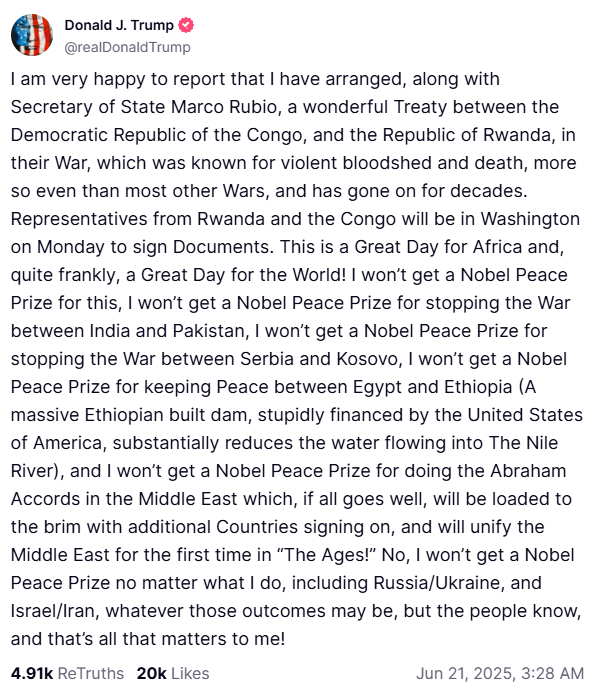
President of the United States, Donald Trump, is once again making headlines. No, he is not in the news for “resolving” a major global conflict, but for publicly lamenting the fact that he has not been awarded the Nobel Peace Prize. In a long-winded post on Truth Social, Trump claimed that a treaty has been signed between Rwanda and the Democratic Republic of Congo (DRC) and declared it a “Great Day for Africa”.
By extension, “a Great Day for the World” is what this treaty is, according to Trump. Simultaneously, he launched a self-congratulatory tirade on why he deserved global recognition.
Source: Truth Social
Interestingly, Trump repeatedly insisted that he would not be given a Nobel Peace Prize for this treaty, or for several other interventions he listed, including the claims that he “stopped” war between India and Pakistan.
Pakistan angle – Did Trump get himself nominated?
Recently, reports emerged that Trump might have orchestrated a nomination for the Nobel Peace Prize with the help of Pakistan. According to reports, highly placed diplomatic sources claimed that Trump allegedly used his proximity to Pakistan Army Chief General Asim Munir to push through a nomination citing “peace efforts” during the India-Pakistan conflict that emerged due to the Pahalgam terrorist attack.
The Resistance Front, a proxy of Pakistan-based terrorist group Lashkar-e-Taiba, took responsibility for the attack. India retaliated by attacking terrorist camps in Pakistan and Pakistan-occupied Jammu and Kashmir. Pakistan, irked by the damage caused to terror camps by Indian armed forces, fired rockets, missiles and drones which were neutralised by the Indian defence system. All this happened between 22nd April, the day of the terror attack, and 9th May, the last day of Operation Sindoor, codename for India’s military action against terrorists and Pakistan’s armed forces.
On 10th May, Pakistan’s DGMO called India’s DGMO seeking a ceasefire. In between, the US tried to intervene but India categorically refused to accept mediation while Pakistan pushed the US to force India to stop throwing bombs at it. At Pakistan’s DGMO’s request, India finally agreed to pause the military action but before any formal announcement could be made, Trump took credit for it out of nowhere. Since then, Trump has been claiming that he stopped the war, a claim India has categorically denied and said that no third party was involved in the decision.
Reports now suggest that Trump’s love for Pakistan is for a reason. His stance on Pakistan has mostly been a “display of mood swings” often swaying between confrontation and courtship depending on media cycle and personal advantage. This time, however, it seems because Pakistan nominated Trump for the Nobel Peace Prize, he agreed to let Munir get cosy in the White House. Not to forget, there was a time when Trump hated Pakistan and wanted the US to stop funding the nation that supports terrorism. After all, Osama was found and killed in Pakistan.
Rwanda-Congo peace deal – Real progress or opportunism?
In his Truth Social post, Trump claimed that he arranged, alongside Secretary of State Marco Rubio, a peace treaty between DRC and Rwanda. These two nations have a deeply complex and tragic history of conflict. While any attempt at diplomacy in the Great Lakes region is welcome, it has to be noted that the groundwork for the treaty had been in progress for years under African Union and UN-backed negotiations.
Notably, The Democratic Republic of the Congo and Rwanda have signed a provisional agreement to stop the conflict in eastern DRC. The draft agreement is due to be formally signed on June 27 by on both the governments. While US did play the role of a mediator, it was not alone, as Qatar was the other country that played a major role in the agreement. Earlier, Angola was also mediator, but it stepped down from that role in March.
However, Trump decided to claim full credit and stated, “Representatives from Rwanda and the Congo will be in Washington on Monday to sign Documents,” before veering off into a litany of grievances about not receiving the Nobel Peace Prize. While reports suggest that two nations would sign a treaty on 27th June in Washington, giving full credit to Trump would not be wise.
Is the obsession with Nobel stems from Obama’s Nobel Peace Prize?
Trump’s angst possibly stems from the fact that Barack Obama received a Nobel Peace Prize in 2009, barely months into his first term. Trump wrote, “I won’t get a Nobel Peace Prize no matter what I do.” He referred to several regions including India-Pakistan, Serbia-Kosovo, Egypt-Ethiopia, Israel-Iran and claimed to have prevented or resolved conflicts. The irony is that many of these regions remain flashpoints of conflict and new tensions brewing in the Middle East show his “diplomacy” is failing or is it that he has actually done nothing to bring peace per se other than claiming the credit? Is he ‘Gilderoy Lockhart’ in making?
Nobel by force?
Nobel Peace Prize nominations are typically submitted by qualified individuals or organisations. Trump’s alleged backchannel approach to get nominated via Pakistan exposes the desperation. It is no longer about peace but about prestige which he is losing every day with unsubstantiated claims. He wants the prize not necessarily for what he has done, but because, in his words, “The people know, and that’s all that matters to me.”
However, history might not be as generous. As conflicts rage on across continents, Trump’s list of “peace achievements” appear more like a wishlist than a resume. It is no longer a secret that Trump wants a Nobel Peace Prize. So badly, in fact, that he has begun listing conflicts across the globe, by his own admission, did something or the other that should have earned him the honour. It does not matter if the Middle East continues to be in conflict or Israel is getting hit by Iranian missiles. In Trump’s mind he seems to be fixated on the notion that if Obama got one, he deserves ten.
Uttar Pradesh, the fourth largest state by area and the largest state by population in the country, is finally witnessing large-scale transformation under the Yogi Adityanath government after seeing decades of misery and suffering under the previous Samajwadi Party and Bahujan Samaj Party regimes. The Hindi belt state, with huge untapped potential, endured years of Mafia Raj, poor law and order and lack of social and economic development.
The socio-economic indicators of Uttar Pradesh were so poor that the state was once a part of the acronym BIMARU, a term coined by demographer Ashish Bose, to refer to the state of Bihar, Madhya Pradesh, Rajasthan and Uttar Pradesh. The Hindi word for BIMARU is sickly. The BIMARU states lagged behind in most socio-economic indicators, including economic growth and infrastructural development.
In addition to this, the people of Uttar Pradesh were agonised by the Mafia Raj which thrived under the patronage of the previous state governments. The state witnessed an era under the SP and the BSP governments when mafias and gangsters enjoyed power and protection of the state. Instead of facing the law, these gangsters were given tickets by these parties to contest elections. These gangsters were so dreaded that even judges refused to hear cases against them.
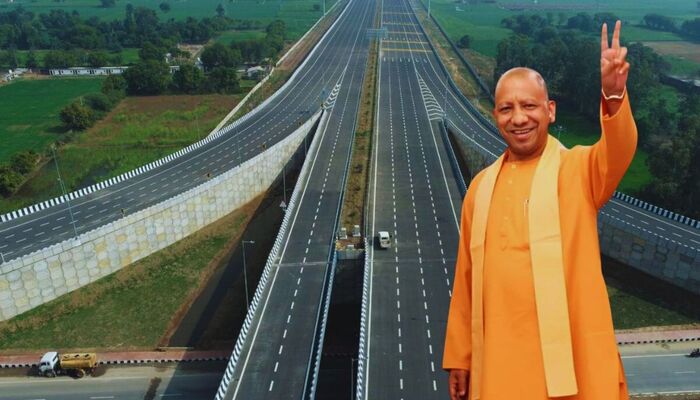
However, after the BJP came to power in 2017, Uttar Pradesh saw a sea change, which seemed far from possible until now. CM Yogi made law and order his administration’s top priority and adopted a zero-tolerance policy towards crime and criminals. This resulted an 85% decline in heinous crimes and the dismantling of deeply entrenched mafia network in the state. Reduction in crimes also created a conducive environment for the growth of businesses. The 8 years’ tenure of the Yogi government has marked a transformative shift in Uttar Pradesh by converting a BIMARU state into one of the fastest growing states in the country. Here is a look at the completed and ongoing infrastructure projects in the state under Yogi government-
Expressways
While six expressways have already been made operational, the construction work of six other expressways is underway. The operational expressways are-
Yamuna Expressway – This 165.5 km long expressway connects Delhi to Agra and is also known as Taj Expressway. It was built in three phases with a total cost of Rs 13,330 crores
Noida-Greater Noida Expressway – This is an extension of the Taj Expressway and runs from Southeast section of Okhla Bird Sanctuary to Noida Sector 168. It is 24.53 km long and was built at a cost of Rs 400 crore.
Agra-Lucknow Expressway – It is a greenfield expressway linking Agra to Lucknow. It is 302 km long and was constructed at a cost of Rs 15,000 crore.
Delhi-Meerut Expressway – It is a mix of brownfield and greenfield projects and is 96 km long. It was built at a cost of Rs 7, 855.87 crore.
Purvanchal Expressway – The 340.82 km long expressway runs through nine major districts of Ghazipur, Mau, Azamgarh, Ambedkar Nagar, Ayodhya, Sultanpur, Amethi, Barabanki, and Lucknow.
Bundelkhand Expressway – This is one of the fastest built expressways completed within 28 months. It is 296.07 km long and was built at a total cost of Rs 7766.81 crore.
The state government is working on 6 new expressways, including Gorakhpur Link Expressway (91 km), Ganga Expressway (594 km), Lucknow-Kanpur Expressway (63 km), Ghaziabad-Kanpur Expressway (380 km), Gorakhpur-Siliguri Expressway (519 km), Delhi-Saharanpur-Dehradun Expressway (210 km) and Ghazipur Ballia Manjhighat Expressway (117 km).
Airports
In order to increase and improve air connectivity, the Yogi government is working on ambitious plan of constructing 18 airports across Uttar Pradesh, including 5 international airports. At present, there are 10 functional airports in the state, including the recently inaugurated Maharishi Valmiki International Airport in Ayodhya. An international airport at Jewar, Gautam Budhh Nagar is set to be inaugurated soon.
The state government plans to develop five airports in Aligarh, Azamgarh, Chitrakoot, Pyorpur (Sonbhadra) and Shravasti under the Regional Connectivity scheme in order to develop them in line with the specifications for Airbus A-321. With improved air connectivity, the movement of passengers as well as cargo will become smoother adding to economic growth.
Metro Rail
Uttar Pradesh has the greatest number of cities with metro rail connectivity. The metro rail in the state is currently operational in the cities of Lucknow, Kanpur, Ghaziabad, Noida, and Greater Noida. The Uttar Pradesh Metro rail corporation is currently expanding the metro rail network to Agra and Meerut. The government is also considering plans for taking metro rail connectivity to Varanasi, Prayagraj, Gorakhpur and Bareilly.
The construction of the Delhi-Meerut Regional Rapid Transit System (RRTS) route is also nearing its completion. 11 stations covering a 55-kilometre stretch are already operational and the work on remaining 27-kilometre portion is progressing rapidly. To enhance connectivity, a 72.26 km-long Regional Rapid Transit System (RRTS) will link Jewar Airport with Ghaziabad, Greater Noida, and Yamuna Authority. The Detailed Project Report (DPR) for this Rs 20,637 crore project has been submitted to the Government of India.
The 82-kilometre-long corridor, known as the Namo Bharat corridor, is being implemented by the National Capital Region Transport Corporation (NCRTC) as a high-speed regional connectivity project.
Film City and other projects
Major projects like the Film City, Medical Device Park, Logistics Park, Fintech City, IT City and Data Centre Park are also in the pipeline. The proposed Film City in Noida is going to be the biggest film city in the country. It will provide unprecedented work opportunities to local as well artists from across the country. It is being established at a cost of Rs 10,000 crore in about 1000 acres. The Film City is also expected to be a centre of tourism. The Film Institute inside the upcoming Film City will make use of advanced technologies like animation, OTT and gaming at par with international standards will prepare students to seek work opportunities globally. A data centre will also be constructed in the Film City for preproduction and post production of films.
Medical Infrastructure
Creation and improvement of existing health infrastructure is also a top priority of Yogi government. Medical colleges are being run by the state government in 65 districts, including AIIMS in Gorakhpur and Raebareli. In addition to that, the government is constructing 22 medical colleges across the state. During the COVID-19 pandemic, the yogi government was praised by the World Health Organisation for its COVID-19 management strategy describing it as a “good example”. Uttar Pradesh has excelled among states, giving more than 38 crore vaccine doses. Apart from this, 6.51 crore people of the state have received Ayushman card to avail health insurance cover of up to Rs 5 lakh.
With the entire gamut of completed, ongoing and proposed infrastructural development projects across Uttar Pradesh, Yogi government is rapidly transforming a BIMARU state into a leader of socio-economic growth.