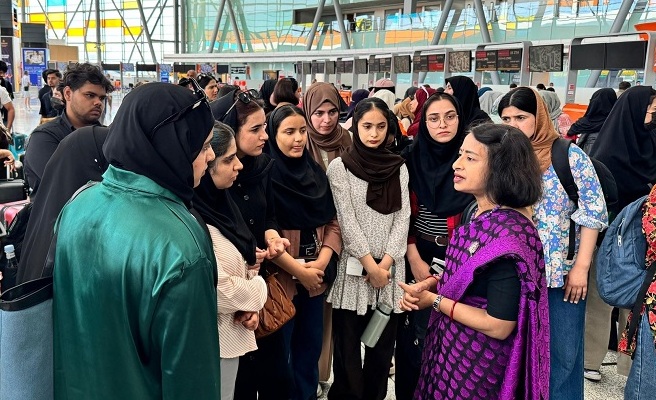
Kashmiri students evacuated by Indian government from conflict-torn Iran under Operation Sindhu, are unhappy that they were not provided flights after arriving in India to return to their homes. Bringing these students back to India was not a cakewalk for the Indian government as the Iranian air space is closed due the ongoing conflict between Israel and Iran which has entered its 7th day. They were first brought to Armenia via land border and from there they were flown back to India.
The rescue flight landed in Delhi, where bus services were arranged for the students for their journey back to their homes in Jammu and Kashmir. However, in a sheer display of entitlement and lack of gratitude, some of the Kashmiri students, who were brought back unharmed by Modi government from the middle of an ongoing war between Israel and Iran, began complaining about “poor transport arrangements” from Delhi.
While an ordinary reasonable person stuck in a similar situation would have felt immense gratitude towards the government of their country for bringing him back home safe from a war-torn region, these students were busy complaining about the lack of comfort in the last leg of their journey. There is no war situation in India, if they didn’t like the govt provided transport, they or their families could have easily arranged for their transport from Delhi to their hometown via air, train or road. But they complained about ‘bad transport’ arranged by govt.
Perhaps, this entitlement emanates from the historical legacy of Jammu and Kashmir region, which enjoyed a ‘special status’ for decades prior to the abrogation of Article 370. Their behaviour is reflective of the disdain felt by radical Kashmiris for the rest of Indians that arises from a deep embedded privilege and sense of superiority in their minds. The feeling that the central or the state government owes these students a comfortable and luxurious mode of transport, as per their own standards, to their homes, is rooted in this sense of superiority.
Nonetheless, one wonders what makes the Kashmiri students prefer Iran for higher studies over India which has a gamut of educational institutions, offering specialisations across disciplines.
Why Kashmiri students go to Iran for studying
Even a cursory comparison between the educational institutions of India and Iran can tell that the standard of education in India, across the fields, far exceeds that of Iran. India’s education sector is vast and growing. After the US and the Europe, India is a preferred educational destination among foreign students.
In the latest QS rankings of global educational institutions, three Indian universities of IIT Delhi, IIT Bombay and IIT Madras made it into the top 200 while no Iranian university was named in the top 200. A total of 54 Indian educational institutions made it to the list of QS rankings making India the fourth most represented nation in the list after the US, the UK and China.
And yet these Kashmiri students travel all the way to the Middle East, a perpetually conflict-ridden region, to pursue higher studies. Several reports suggest that these students go to the Shia country to study medicine and engineering. However, considering that Iran has not achieved any major breakthrough in either medicine or engineering in the recent past, it does not seem a plausible reason for attracting Indian students to Iran.
Also, the political environment in Iran has been far from ideal to provide a conducive environment for the development of disciplines like medicine and engineering that require critical and rational approach. Iran’s political regime prioritises imposing regressive and sexist religious regulations like the hijab mandate.
The heavy-handed measures adopted by the Iranian regime to suppress anti-hijab protests, often resulting in deaths of protestors, underscores the troubled political environment in the country. Therefore, while students may claim that they go for studying medicine and engineering, it cannot be denied that religion plays a key role in their decision-making to opt for Iran as their choice of destination to pursue higher studies.
Iran is also a popular tourist destination among Indian Muslims, mostly Shias. The country houses the famous Imam Reza Shrine in Mashhad, which is a major tourist attraction among Muslims globally. The Shia shrine is one of the largest mosque complexes in the world. It has the mausoleum of Imam Reza, the eighth Imam, who belonged to the lineage of Hazrat Ali and Fatima Zahra – the daughter of the Prophet Mohammed. Around three crore people from all around the world visit his grave every year, with Indian Muslims forming a prominent part of the tourists.
What separates Kashmiri students from students hailing from other Indian states
This is not the first time that India has recsued its citizens from foreign countries affected by regional military conflicts or natural disasters. In 2022, when a war broke out between Russia and Ukraine, India rescued over 20,000 Indian nationals, mostly students, from Ukraine under Operation Ganga. These Indian students were pursuing medical studies in Ukrainian universities and were dispersed throughout the country after evacuating.
On the request of the Indian government, the Russian government worked on halting the war and creating a humanitarian corridor for evacuation. The students hailed from different states of India, including Kerala, UP, Haryana, Tamil Nadu, Gujarat, Maharashtra, Bihar and Rajasthan. None of these students complained about “poor transport arrangements” or the lack of comfort in the offered mode of conveyance as they breathed a sigh of relief for being able to return to their home country safe and sound by escaping a war.
What separates the students evacuated from Ukraine from the students evacuated from Iran is the region they came from. While the students rescued from Ukraine were mostly non-Kashmiris, the students evacuated from Iran are mostly Kashmiris. This goes on to show how decades of exceptional, previleged treatment can permanently shape the minds of people and make them feel entitled to the country’s resources without realising their duty to contribute to the country’s growth.
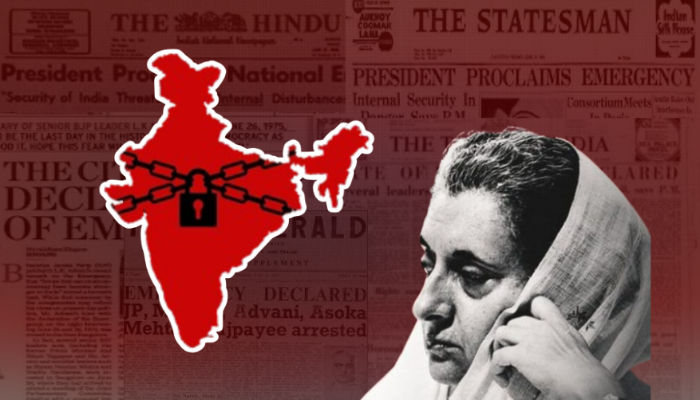
It will soon be fifty years since the late Prime Minister Indira Gandhi declared an internal emergency in the country. It is the “darkest period” of independent India, from 25th June 1975 to 21st March 1977, when all civil rights were suspended and the right to free speech and expression was suppressed. The emergency dealt a severe blow to the democratic values that the nation had held dear since gaining its freedom.
Each institution that was already under the Congress government’s authority was turned into a mechanism of oppression to enhance its punitive control over various sections of society. The citizens became easy prey for the government to carry out its inhumane agenda, while anyone who dared to voice dissent was met with brutality, including the young students who were assaulted, imprisoned and even killed on unfounded accusations.
The government similarly enforced harsh censorship on the media, seeking to control and manipulate it to stifle public opinion. The press was perceived as the only independent mass media in India at that time, as the government controlled both radio and television. Notably, just as individuals who collaborated with the tyrannical regime of Indira were rewarded, so too did the elements in media who profited from the misery and anguish of the whole nation.
Print media and the Emergency
Freedom entails the obligation to protect it at all costs. Unfortunately, the majority of India’s domestic dailies abandoned the fight for press freedom following the first protest during the Emergency. There was some pushback from a portion of the print media over the first two days. Blank editorials sprouted to protest the atrocious decision, however, they quickly disappeared due to official threats. The severe restriction of press and personal liberties that followed was largely met with acquiescence.
This regression was famously summarized by Bharatiya Janata Party veteran and former deputy prime minister of India, Lal Krishna (LK) Advani, who remarked, “When Indira Gandhi commanded the media to bend, it crawled.” Furthermore, “Fawning accounts of national events, flattering pictures of Mrs. Gandhi and her ambitious son, and not coincidentally, lucrative government advertising” were spread all over their pages.
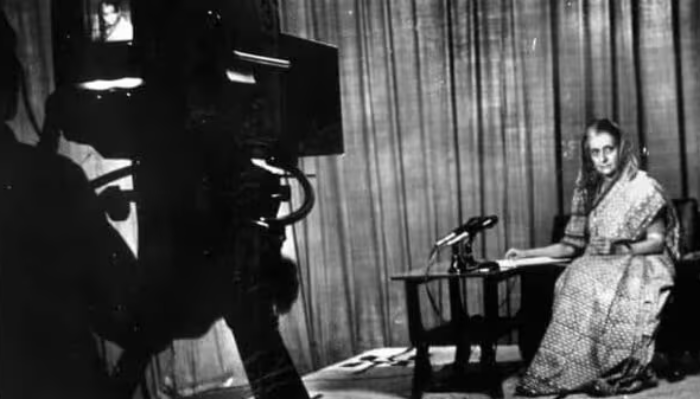
Indira Gandhi announcing the Emergency in India. (Source: Mint)
The Hindustan Times, one of the top English-language newspapers, turned into a resolute ally of the government, under the management of industrialist Krishna Kumar Birla. The Times of India also handed over its independence and adopted the official stance, as a third of its directors were government candidates. Overnight, political cartoons ceased to exist and no one risked to publish any disparaging caricatures of the prime minister.
Likewise, The Hindu acted in accordance with its belief that caution was superior to bravery. Khushwant Singh, the editor of “The Illustrated Weekly of India” at the time was also among the prominent journalists who supported Emergency. He claimed that by May 1975 public demonstrations opposing the Indira government had taken on a nationwide scale and frequently escalated into violence.
“With my own eyes I saw slogan-chanting processions go down Bombay thoroughfares smashing cars parked on the roadsides and breaking shop-windows as they went along. Leaders of opposition parties watched the country sliding into chaos as bemused spectators hoping that the mounting chaos would force Indira to resign,” he stated. He was later sent to the Rajya Sabha under her leadership and even recieved the second highest civilan honour, Padma Vibhushan, in 2007.
A compliant press
Journalists, owners and proprietors claimed that they had private reasons for staying silent, or pliant, if not openly endorsing the Emergency. The board of The Times of India declared that the publication would not protest the Emergency since, regardless of their position, the law had to be accepted and this was the legislation in effect at the moment.
“We cannot speak against it, it was decided, and as it was a privately owned paper, we had to follow suit. A few of us proposed that if we couldn’t speak against it, we wouldn’t support it either, and that was the final position the paper took,” conveyed senior journalist Inder Malhotra who was associated with the paper. He wrote a political and personal biography of Indira Gandhi in 1991.
This sterile and disinterested approach was also mirrored in the newspaper. The Ministry of Information and Broadcasting’s ineffective government handouts were mentioned in “India’s Sterile Press” which was a reference to the sterilization campaign of the Indira government. It was overseen by her son Sanjay Gandhi. The majority of the news amounted to propaganda from the government.
LK Advani pointed out, “Following the censorship of the Press there was hardly any difference between one paper and another. They were all drab and dull, inane and insipid, mere reproductions of official handouts.”
According to writer Gnani Sankaran, there was no other alternative for the media outlets. He was a correspondent for the Chennai edition of the Indian Express at the time. “The censor wanted to kill newspapers by delaying approvals. Along with letting pages go blank, sometimes innocuous and frivolous stuff like how to make onion raita (salad) had to be printed since political news could not be taken without consent,” he voiced.
Several newspapers vehemently opposed censorship during the Emergency, alongside numerous smaller, independent newspapers and journals. However, it was evident that Indira Gandhi had just as much control over the nation’s press as she did over its politics, irrespective of some fearless battles and uncompromising positions by these print media.
The giant yet pliant media houses alleged that the use of coercion during the emergency limited the options accessible to newspapers and reporters. According to Indu B. Singh, Indira employed three strategies to control the media: the distribution of government advertising, the shotgun merger of news organizations and the incitement of fear in newspaper publishers, journalists and individual shareholders.
Conformity to glamorizing the Emergency
The leading media platforms not only followed the government’s orders but also tried to depict the Emergency in a favorable light. They claimed that the anti-democratic decision was beneficial for the nation and its people. According to a piece in India Today, officials asserted that the announcement received a positive reception in the southern states including Hyderabad, Bangalore (Bengaluru), Madras (Chennai) and Trivandrum (Thiruvananthapuram). It was originally published on 15th December 1975.
It reported that people even went so far as to suggest that the move should have transpired as early as 1947. It praised the uncomfortable quiet that followed the violent suppression of opposition political parties, labour groups and all other agitators, which was labeled as “thuggish behaviour.” The artcile stated that consumers had an adequate supply of wheat and rice while prices were tightly regulated and did not increase due to seasonal demand.
It cited Congress Chief Minister Devaraj Urs, who asserted that there was a noticeable improvement in the pace of work and everyone was feeling more accountable. It was declared that a record for the collection of tax arrears had already been achieved by Andhra Pradesh which allowed the government to increase its annual plan by Rs 340 million to Rs 1870 million in addition to clearing its overdraft with the Reserve Bank, to illustrate the Emergency as a financial boon.
The report even quoted statements endorsing the Emergency as a blessing in a ugly disguise for the nation and its citizens. It was painted as an influential tool that cultivated a sense of consciousness within society, encouraging individuals to reflect more cautiously before engaging in any unlawful behavior, contrary to their customary conduct.
The article maintained that people from the lowest tiers of society, like cobblers, were provided the opportunity to have bank accounts, a privilege that was seldom available, especially for the poor, during the Congress regime. The 20-point economic plan of Indira government was commended as a solution to the nation’s long-term issues with agricultural output and the efficient distribution of basic goods, as well as its immediate issues, primarily the price increase and productivity decline.
According to the story, Congress President Devkanta Barooah questioned, “Who lives if India dies? And who dies if India lives,” at a meeting hosted by the Hindustani Mercantile Association on 11th November. He alleged that organized trade, industry, public administration, educational institutions and economic institutions would all stop operating if a few vocal and anti-democratic elements attempted to undermine peace and stability at home.
Krishan Kumar Birla who was also present there then stated that the economy was in better shape during the Emergency. Indians living overseas were provided incentives for investment and improved facilities for sending money home, while the parallel economy operated by smugglers, tax evaders, foreign exchange racketeers and hoarders was progressively being destroyed.
India Today referred to the officials as Babu (petty pen pusher) and the business community as Baniya (petty profiteer) in a highly derogatory attack and then dubbed them as the two historically strongest representations of corruption in the country and asserted that the Emeregncy made it mandatory to display commodity prices and improved administrative office efficiency.
It then applauded the Emergency for bringing students into classrooms and initiate actions to give them more affordable and simpler ways to learn. The report emphasised that in order to address the problems of unemployment and brain drain, the government had introduced vocational training and work experience.
It is important to note that Indira Gandhi became infamous for nationalizing banks and imposing state control over enterprises. Her 20-point formula also faced severe criticism for advocating increased state control over the economy, and it was also condemned as a possible barrier to the growth and efficiency of the private sector.
Stunning rationale for the Emergency and victim-blaming
Indira Gandhi had often maintained that she did not want to stifle the press, according to India Today, which also noted that there has been global concern over the restrictions placed on the press since the Emergency. Conveniently, it added that determining the boundaries between freedom and responsibility is a challenge for democracies.
It claimed that the Western media could not carry out unverified stories owing to the strict libel laws, nevertheless, in India, the process is so intricate that the media does not even regard them before publishing unsubstantiated reports and hence could share any news or rumours without supporting evidence.
The article then termed the Indian press as “wild” instead of “lively” and slammed its use of unprecedented offensive language. It then declared that press censorship laws are progressively being loosened to permit constructive criticism of government policy during the Emergency.
India Today described those opposing the Emergency as a “noisy minority” and shockingly asked, “Is discipline, efficiency and hard work without violence incompatible with democracy? Must discipline, efficiency and social responsibility be a product of fear and coercion?” It stated that while there have been grievances regarding the opposition’s silencing, non-Congress governments are functioning reasonably well in Gujarat and Tamil Nadu.
The article also attacked the politics of the coalition and charged that it only existed to overthrow Indira Gandhi and lacked ideological alignment. It also claimed that a small number of opposition members who were involved in various agitations were arrested for engaging in outrageous actions prior to the emergency.
Ironically, it also mocked freedom fighter Jayaprakash Narayan who prolclaimed a national revolution the day he was jailed and stated that he was wrong about the movement.
Adding salt to the wounds of the victims, India Today inquired, “Where is the Emergency? What a handful would consider suppression, millions of Indians do seem to consider emancipation. Whereas six months ago visitors to India heard little else but complaints about the lack of consumer products and unbearable soaring prices, the average person is grateful he can now feed his family and get more value for his rupee.”
“Where are the soldiers? Where are the guns? Where is the Emergency,” it quoted an alleged television reporter who landed in the national capital from New York. Furthermore, as if the aforementioned insensitivity was not enough, it also included the shocking comments of a politician in Delhi who, in all his wisdom, declared, “We can utilize the Emergency to enhance tourism in India. The tagline for promotional campaigns should be: Come to India to witness the Emergency. Nothing of this nature has ever occurred in any democracy before.”
Indira, the greatest oppressor of press freedom, was portrayed as receptive to criticism. The emergency was depicted as a common occurrence with no cause for concern while those who expressed legitimate worries were characterized as villains and subjected to mockery. .
Obligation to Indira Gandhi
Media organizations had their own personal motivations ranging from fear to financial incentives to back the Congress. Similarly, some aligned themselves with the oppressive Indira regime due to a profound sense of obligation towards the Nehru-Gandhi family along with financial favours and “The Times Group” was one such entity.
Ramkrishna Dalmia, part of the Sahu-Jain family, bought the group from its British owners shortly after independence. However, he abused his office as chairman of an insurance firm in the process. Pandit Jawaharlal Nehru’s government at the time disregarded this anomaly.
However Feroze Gandhi, Indira Gandhi’s husband brought up the matter in parliament and demanded an investigation. As a result, Dalmia was found guilty of financial wrongdoing after the matter proceeded to trial. He spent two years in Tihar Jail. Nehru permitted the group’s ownership to be transferred to Sahu Shanti Prasad Jain, the grandfather of the present Jain brothers and the son-in-law of the Dalmia family, despite the evidence of this deception.
The group’s new owner, Sahu Shanti Prasad Jain, was convicted of selling government-provided subsidized newsprint in the black market in the 1960s. This was against the law and a betrayal of confidence. He was imprisoned and the Indian government also acquired possession of the group and their ownership continued for more than 10 years.
However, during the Emergency, Indira Gandhi, granted ownership of “The Times Group” to Ashok Kumar Jain, the son of Sahu Shanti Prasad Jain. He is the father of Vineet Jain and Samir Jain, the current owners. It might be the sole occasion when she genuinely cared about a private company, but only to leverage their allegiance.
The majority of top journalists who were critical of the Nehru-Gandhi family and nationalist reporters were later fired by Ashok Jain. Interestingly, Jains have been regularly accused of involvement in money laundering schemes. Ashok Jain was forced to leave India when the Enforcement Directorate conducted a rigorous investigation into a case concerning the transfer of US$1.25 million illegally to a foreign account in Switzerland.
Indira’s war on press freedom
During the Emeregency era, media consisted of printed newspapers and periodicals, which were mostly dependent on the electrical supply to publish their editions. The center of newsprint in New Delhi was the Bahadur Shah Zafar Marg. The disruption in its power supply, which was managed by government firms, resulted in a significant delay or cancellation of the print for the following day’s publication.
Foreign correspondents were driven out by the regime. 29 foreign journalists were prohibited from entering India and 7 were expelled. 54 Indian journalists, including two cartoonists and six photographers, had their accreditation revoked by the enter. The majority of them were well-known for criticizing government actions and policies while they were active in New Delhi while about 250 journalists had been imprisoned.
Advertisement generated revenue for the media. The amount that users or news consumers paid was insufficient to cover the expenses of news collection, publication and broadcasting. Government advertisements contributed a significant portion of advertising revenue. The authorities employed this reality as a means of manipulation.
Meanwhile, nobody truly realized this until the government at the time used arm-twisting during the Emergency. However, the same was already red-flagged in 1965 by Chanchal Sarkar who is regarded as the father of Indian journalism. He highlighted that “government’s advertising policy has undertones of political pressure and indirect control.”
Vidya Charan Shukla, the Information and Broadcasting minister chosen by Sanjay Gandhi successfully carried out Indira’s authoritarian posture against the print media. “The press and films, otherwise outside the control of government were made to dance to the tune of the rulers by a set of draconian laws which reduced press freedom to naught and there was consistent abuse of authority in the matter of disbursing advertisement, allocation of newsprint and release of raw stock for films,” as the White Paper on Misuse of Mass Media during the Internal Emergency emphasized.
The Prevention of Publication of Objectionable Matters Act, 1976 was the final straw for Indian journalists. The act gave the government the power to ban publications for any reason related to Article 19 (2). As a result, the act essentially prohibited any media coverage of protests against government policies or anti-government criticism. It even gave right to the authorities to seize or close printing presses or to return security deposits for publishing “objectionable matter,” which comprised anything and everything.
“Indira Gandhi did not accept the basic philosophy of a newspaper is that it has to convey the people’s problems, not the government view, that a columnist must carry the voice of dissent in the corridors of power,” outlined Durga Das, head of India News and Feature Alliance. Indira’s glaring abuse of leadership during the Emergency was not surprising because this had been her policy and approach to the Indian press since the start of her rule.
Conclusion
It was clear that the Indira Gandhi’s implementation of the emergency was unethical. However, the majority of the media’s response was unbecoming. “The first and most crucial round of battle for freedom of the Press and civil liberties was lost without a struggle in the first week after the emergency,” voiced former attorney-general for India Soli Jehangir Sorabjee.
The newspapers and their editors were aware of the ridiculousness and illegality of the censor’s conduct but with the exception of a few courageous individuals, none of them were prepared to contest it in court. Printers did not want to risk losing their presses while editors were more concerned with keeping their jobs.
The Congress party and its liberal media affiliates along with their entire ecosystem have adopted a principle from propaganda strategy of Joseph Goebbels, which stated, “Accuse the other side of that of which you are guilty.” While they accuse the Modi government of restricting media freedom and even coin the phrase “Godi Media” to disparage journalists who do not tow their narrative, the truth is quite the opposite. Rudyard Kipling famously wrote:
The Pope may launch his Interdict, The Union it’s decree, But the bubble is blown and the bubble is pricked By Us and such as We. Remember the battle and stand aside While Thrones and Powers confess That King over all the children of pride Is the Press – the Press – the Press
However, there has never been a more profound attack on the media and the press than during the tenure of Congress and there are no journalists more submissive than those loyal to the grand old party.
Emphasising the importance of private sector involvement in the defence aviation industry, Defence Secretary Rajesh Kumar Singh said on Friday that the production of India’s fifth-generation fighter jet, the Advanced Medium Combat Aircraft (AMCA), will be open to private companies.
In an exclusive interview with ANI, Defence Secretary Rajesh Kumar Singh underscored the need for at least two aircraft manufacturers in India. He noted that the presence of private sector players would foster healthy competition, ultimately benefiting the country’s public sector aerospace company, Hindustan Aeronautics Limited (HAL).
“We’ve not reached a stage where I can talk about anything specific being done. What I can talk about is that our fifth-generation fighter, which will be the AMCA…We’ve kept it open for the public and private sectors for the first time. The intent is that we need to have at least two aircraft manufacturers in the country, if not more. And once that gets some traction, we will hopefully move towards self-reliance in this critical area. For the AMCA, the timeline is about eight years,” Singh said.
Defence Minister Rajnath Singh had last month approved the Advanced Medium Combat Aircraft (AMCA) Programme Execution Model.
The Execution Model approach provides equal opportunities to both the private and public sectors on a competitive basis. They can bid either independently, as a joint venture, or as a consortium. The entity or bidder should be an Indian company that is compliant with the laws and regulations of the country.
The Defence Secretary said HAL will gain from healthy competition.
“There was a committee headed by me, which essentially sort of gave the report that we need to open it up for the entire manufacturing ecosystem of the country. Whoever wants to come in should come in and… HAL will also gain from healthy competition of this type,” he said.
Answering a query, he said HAL has the first-mover advantage and is the only military aircraft maker in the country, and there is a need to bring some competition.
“I would say to any premature criticism of HAL. HAL has its own constraints. I mean, the LCA production line has not stabilised, largely because of the delays in engine supplies from the US. But the fact is that they also have their order books full. I think that they already have six years of orders with them. They have their hands full as well. And therefore, I mean, you can’t explicitly bar anybody from competing, particularly in the public sector. But you would like to create a level-playing field where others can also bid. They have the first-mover advantage. They are the only military aircraft maker in the country. So they will always have that advantage. But the intent is to bring in some competition, because monopolies are never good. For even a public sector monopoly,” Singh said.
The Defence Secretary stated that India’s reliance on Russian defence equipment has declined compared to the past. He also noted that the country now imports defence equipment from a broader range of nations, including Israel, France, and the United States.
He pointed out that ongoing geopolitical tensions and global conflicts have impacted the timely delivery of defence equipment.
“Russians are one of our leading suppliers. I think the percentage would have come down…maybe 40 per cent or so, from about 65-70 per cent earlier. I mean, it’s not just the Ukraine conflict, which, of course, it has affected some supplies from Russia, the prime example being the S-400s, which are delayed, but where we now have a firm schedule; they’ll come next year by April, and one by April, one battery by the end of next year,” Singh said.
“Others – I mean, to be very frank, some of our contracts with Israel also got held up because of their issues, the conflict that they have. So yeah, it’s probably inevitable. But the fact is that Israel, Russia, and France – these are ours, and increasingly the US also – they are some of our primary sorts of weapon suppliers now. And to some extent, all of them have been affected by the supply chain disruptions that came after COVID and thereafter by the geopolitical conflicts,” Singh said.
On whether India is eyeing American or Russian fifth-generation fighter jets, the Defence Secretary said that the discussions with the countries are not in the formal stage yet. “I mean, whatever has been discussed has been informal. We don’t really have any formal consultations going on on these. Our intent, of course, will have to be to acquire critical technologies through selective foreign purchases,” he added.
(This news report is published from a syndicated feed. Except for the headline, the content has not been written or edited by OpIndia staff)
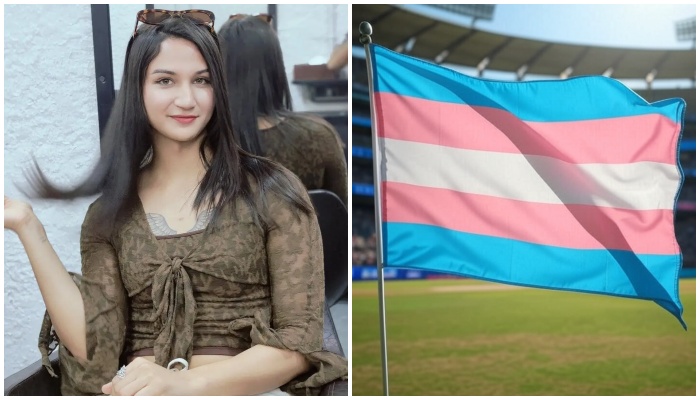
Anaya Bangar, the daughter of ex-Indian cricketer Sanjay Bangar, is in the limelight recently after she requested the International Cricket Council (ICC) and the Board of Control for Cricket in India (BCCI) to permit transgender athletes to play women’s cricket. Anaya was born as Aryan, but with hormone replacement therapy (HRT) and gender reaffirmation surgery, she has identified herself as a woman. She even published a comprehensive report to validate her assertion that she is physically capable of playing women’s cricket.
Her emotional argument, backed by information regarding muscle strength and oxygen levels, has had mixed reactions. Although Anaya’s openness is to be appreciated, the bigger question is: Is it right to permit biological males, irrespective of whether they go through the ‘transition’ or not, to take part in women’s sports?
Let’s be honest. Sports, particularly physical ones such as cricket, rely greatly on biological variations—strength, speed, endurance, reflexes, and even bone structure. No dose of hormone treatment can eliminate the physical benefits a male body has attained during puberty. Men generally possess bigger hearts, heavier bones, more muscle, and greater haemoglobin levels. These characteristics don’t just disappear with HRT. Enabling ‘trans women’ to compete alongside biological women is a serious issue of fairness and safety.
What about fairness for women?
This is not merely a theoretical problem. All over the world, biological female athletes are losing spots, scholarships, and even championships to ‘trans women’ who, even after transition, continue to possess physical advantages. The very essence of women’s sport was to provide a level playing field. If that arena is lost or rendered unequal, then what is the use of keeping competitions gender-divided altogether?
Former American swimmer Riley Gaines has been among the most vocal voices criticising this inequality. She has publicly expressed how unjust it is when biological men compete against women. Gaines lost a medal to a trans competitor and ever since has dedicated herself to advocating on behalf of biological female athletes’ rights. She has also been criticised and met with resistance, but she does not waver from her position: Let women compete fairly.
Simone Biles, arguably one of the greatest gymnasts ever, also entered this debate. Most recently, while commenting on transgender rights in sports, she chastised Riley Gaines and stood up for trans inclusion. Even Biles’ entry into the fray, however, illustrates how polarised the issue has become, even among elite athletes.
Algerian boxer Imane Khelif’s participation in women’s boxing in the last Olympics and defeating biological women to win a gold medal eventually had further escalated this debate. Khelif, who has been a biological male, participated in the Olympics despite objections from the International Boxing Association. Multiple reports have surfaced stating how Khelif is still a biological male and has been allowed to participate and beat women, drawing widespread criticism and demands for the withdrawal of the Olympic Gold.
Khelif was not permitted to compete in the 2023 World Championship gold medal bout in New Delhi by the International Boxing Association for failing tests to confirm ‘womanhood’.
When celebrities speak out
This argument is not exclusive to sports. Author J.K. Rowling has also had a lot to say on this topic. She recently came after TV personality John Oliver after he employed his HBO program Last Week Tonight to advocate for the participation of trans women in women’s sports. Rowling had a strong reply, stating that disregarding questions about safety and fairness is irresponsible. She stated that it’s not hateful to demand fairness, it’s required.
I understand why men like Oliver, who've consistently mocked anti-science people on the right, sold out initially. They didn't want to blow up their careers. Taking fashionable anti-women's rights positions was the cost of doing business.
What Rowling and countless others are attempting to communicate is straightforward: biological sex does matter, particularly in the context of athletics and facilities where physical disparities cannot be disregarded. Whether it is a playing field, a bathroom, or even a jail cell, women are entitled to equal and secure spaces. And in much of the world, those spaces are diminishing.
Let women have their space
We also cannot forget that women’s spaces, be it in sports, bathrooms, or shelters against violent crimes, have a purpose. Women have struggled for decades to be acknowledged, heard, and treated with respect in these spaces. Adding ‘trans women’ to these spaces without strict rules or boundaries not only endangers fairness but also safety in certain situations.
In certain Western nations, biological men who call themselves women are now being permitted in women’s restrooms, gyms, and even prisons. It has resulted in numerous horrific cases and issues of safety. We need to learn from these instances and consider things thoroughly before treading the same route.
Is there a middle ground?
There is a solution that treats everyone better. Rather than pushing transgender athletes into women’s sports and disadvantaging biological women, why not establish a third category for them? Just as we have men’s and women’s, why not a third? That way, nobody gets left out, and nobody gets unreasonably advantaged or injured.
Yes, it would require time and planning. There may not be sufficient participants initially. But change also begins small. Having a distinct category guarantees that transgender athletes will be able to compete at their best without killing the essence of fair competition among women.
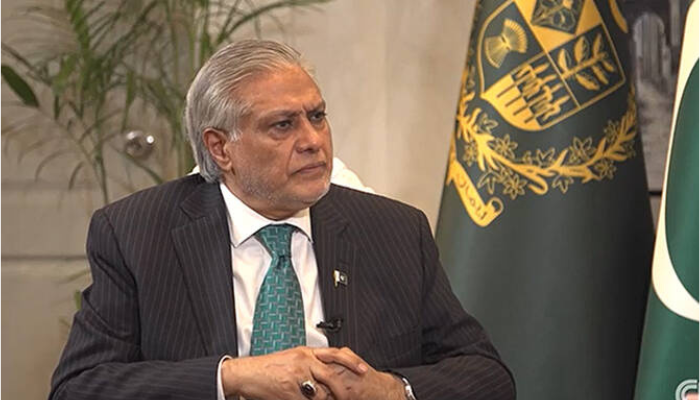
Pakistan’s Deputy Prime Minister Ishaq Dar has delivered a stunning admission, publicly confirming that Islamabad urgently sought a ceasefire with India following precision military strikes on critical Pakistani air bases, including the strategically vital Nur Khan Airbase near Islamabad, during Operation Sindoor. This revelation directly contradicts Pakistan’s long-standing narrative and may finally resolve India’s political debate over the ceasefire’s origins, particularly the Congress party’s persistent questions and former U.S. President Donald Trump’s disputed claims of personal mediation.
Operation Sindoor, launched by India on the night of May 6-7, 2025, was a decisive response to the April 22 Pahalgam terror attack that killed 26 civilians. The meticulously coordinated tri-service assault deployed SCALP cruise missiles, HAMMER smart bombs, and loitering munitions against nine terror camps and key military installations. The strikes inflicted catastrophic damage, particularly at Nur Khan Airbase – a nerve center for Pakistan’s VIP transport and air operations just 10 km from Islamabad – and Shorkot Air Base (PAF Base Rafiqui), a major fighter base. Satellite imagery later confirmed the destruction of command trailers and Pakistan’s critical Airborne Warning and Control System (AWACS) at Nur Khan, crippling its air defence capabilities.
In a televised interview with Geo News, Dar revealed Pakistan’s desperation in the immediate aftermath: “India launched missile strikes at 2:30 AM… Within 45 minutes, Saudi Prince Faisal called me. He asked if he was authorized to tell S. Jaishankar that we are ready if they stop. I said yes.” This confession confirms Saudi Arabia’s role as an immediate mediator at Pakistan’s request, exposes Pakistan’s military unpreparedness, and directly contradicts Pakistani Prime Minister Shehbaz Sharif’s earlier boasts of a “strong response.”
Pakistan Deputy PM Ishaq Dar' openly admits 2 things in this interview
?India struck the Nir Khan Air base and Shorkot Air base
? Ishaq Dar' says Saudi Prince Faisal called him asking "Am I authorised to talk to Jaishankar also and CONVEY ..and you are READY TO TALK"… pic.twitter.com/45TJqnlWKu
Dar’s admission directly addresses the Indian opposition Congress party’s major criticisms of the ceasefire process. Congress had relentlessly questioned the government, citing Donald Trump‘s repeated boasts that “I stopped the war,” his controversial lunch with Pakistan Army Chief Gen. Asim Munir (whose rhetoric fueled the Pahalgam attack), and demanding PM Modi clarify the ceasefire terms in Parliament. However, Dar’s confirmation of Pakistan initiating the plea via military hotlines and third-party messengers like Saudi Arabia – not the U.S. – aligns with India’s consistent stance and undermines Congress’s position. Senior Congress MP Shashi Tharoor had already conceded: “Trump wasn’t directly involved… We were only reacting to terrorism. The moment Pakistan stopped, we stopped.”
Simultaneously, Dar’s statement unravels Donald Trump’s narrative. For weeks, Trump insisted he brokered the truce by threatening trade cuts against India and Pakistan. However, following a 35-minute call with PM Modi on June 18, Trump dramatically reversed course, suddenly crediting “two smart people, Modi and Munir” for averting nuclear war, a U-turn aligning with India’s position that no U.S. mediation occurred.
The geopolitical implications are significant: Dar’s confession exposes Pakistan’s military vulnerability, validates India’s precision-strike strategy in achieving objectives without escalation, and clarifies the roles of Saudi Arabia (as messenger) and the U.S. (reportedly instructing Pakistan to use official channels). With Pakistan’s deputy PM now confirming India’s account and Trump retreating from his claims, the Congress party faces mounting pressure to drop its skepticism. As the facts solidify – revealing a decisive counter-terror operation that ended only when the aggressor capitulated – continued criticism risks appearing detached from the strategic realities validated by Pakistan’s own admission. Operation Sindoor’s legacy now extends beyond shattered terror camps to a forced public confession that reasserts India’s red lines on sovereignty and security.
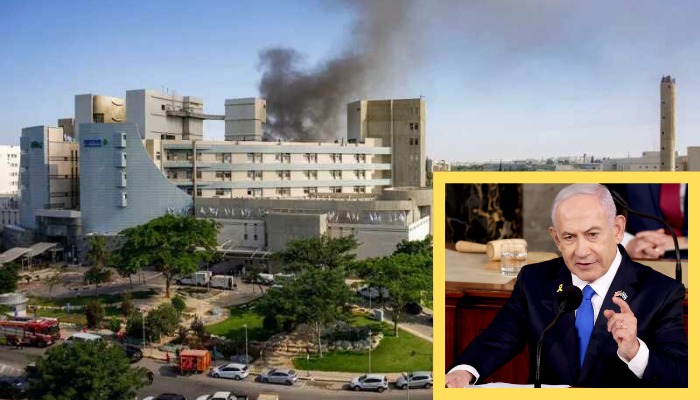
Israeli PM Benjamin Netanyahu shared his ‘personal loss’ story after an Iranian missile struck the Saroka hospital, Beer Sheva, in Israel on Thursday, June 19. Netanyahu shared that his son Avner’s has been postponed twice in last 7 months die to the tensions in the region. The insensitive remark of comparing postponement of a wedding to the death and destruction during the war has led to widespread criticism.
While speaking to the media outside the hospital, where he was on a visit to see the damage, Netanyahu said, “We are going through a blitz. Some people were killed, families who grieved loved ones, I appreciate that. Each of us bears a personal cost, and my family has not been exempt. My son even had to cancel his wedding.”
Many people online were upset at the bizarre comparison between the 2 and Israeli PM’s attempt to show he is also suffering personally due to the war.
?Netanyahu’s Narcissistic Megalomania: At Soroka Hospital—devastated by an Iranian missile this morning—he pauses to lament his family’s burdens: his son’s postponed lavish wedding, his wife’s sacrificing "the best years of her life” to bring him to this moment of war with Iran. pic.twitter.com/mhJbQAT3Ki
Upset over the tone deaf remark, a user posted that it is not just tone deaf, but is grotesque.
Netanyahu: "There are personal costs in a war, my son even had to cancel his wedding".
Thousands of children are being killed, entire families wiped out — and this is what he considers a personal cost? A postponed wedding? It's not just tone-deaf — it's grotesque. pic.twitter.com/l9YLJyZnGK
A total of 241 people were injured by the Iranian missile on Thursday. Around four were left with serious injuries, Israel’s Ministry of Health said. The spokesperson for the Saroka Medical Center informed that no serious injuries to patients or staff had occurred, as the part of the hospital that was hit directly had already been evacuated.
Last night, Soroka Hospital in Be’er Sheva was heavily damaged by an Iranian missile.
The Iranian regime is not hiding who they are. They deliberately targeted a civilian hospital.
Israel’s Minister of Foreign Affairs, Gideon Sa’ar called this missile attack a “clear war… pic.twitter.com/i9ZtUXxrxr
— Embassy of Israel to the USA (@IsraelinUSA) June 20, 2025
The ‘extensive damage’ led many people to be trapped inside before the paramedics ran for help. An Israeli made a video in a hurry, just after the attack, saying Iran is targeting their community nonstop!
The conflict between Iran and Israel entered a second week today. Israel initiated the attack last Friday, with the aim to prevent its longtime enemy from developing nuclear weapons. On the other hand, Iran retaliated with missile and drone strikes on Israel. The Persian nation claims its nuclear programme is peaceful. The missile strike is a huge blow for the well-known academic research at the institute, which is internationally known for its contributions to Life Sciences, Physics, and Chemistry.
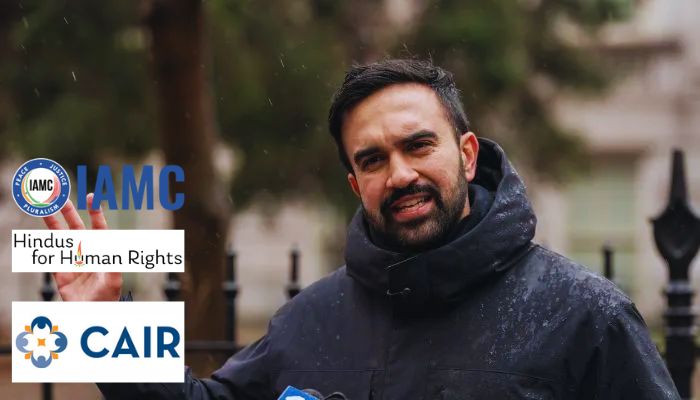
Zohran Mamdani, New York City mayoral candidate and Democratic Socialist is making headlines for all the wrong reasons. From calling Prime Minister Narendra Modi a ‘fascist’, lying about 2002 Gujarat riots, to repeatedly making Hinduphobic commentary, Mamdani is doing everything it takes to garner support of the anti-India elements in the United States and win the elections. Predictably, Zohran Mamdani has managed to garner support of anti-India and anti-Hindu lobby of the Council on American-Islamic Relations (CAIR).
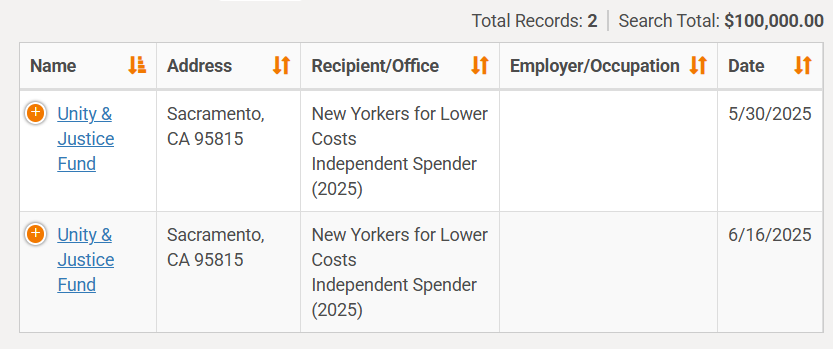
Islamist outfit CAIR has contributed $100,000 to New Yorkers for Lower Costs, the largest Parliamentary Action Committee (PAC) backing Zohran Mamdani. The campaign records show that CAIR, through its Unity & Justice Fund, gave ‘gift’ to Mamdani in two instalments. A $25,000 gift on 30th May and a $75,000 donation on 16th June 2025.
Unsurprisingly, while Zohran Mamdani is projecting himself as a ‘progressive’ Muslim leader, he is taking support from antisemitic entities like CAIR, suggests that beyond the façade of a ‘progressive’ and ‘moderate’ Muslim candidate fighting for social justice and cutting costs, Mamdani is anti-India, anti-Hindu and anti-Israel Islamist.
Recently, Mamdani defended the anti-semitic “Globalise the Intifada” cry, which essentially calls for hatred and violence against Jews across the world. He also refused to acknowledge Israel’s right to exist, a common trait among Islamists and their liberal cheerleaders. Not to forget, CAIR officials were among those who celebrated Palestinian Islamic terror group Hamas’s massacre of innocent Israeli civilians on 7th October 2023.
Mamdani, on The Bulwark podcast, says ‘Globalize the Intifada’ chant signifies, to him, a call for Palestinian human rights.
Adds: “The word has been used by the Holocaust Museum when translating the Warsaw Ghetto Uprising into Arabic — because it’s a word that means struggle.” pic.twitter.com/k2yeiSJpMy
Other than CAIR, Anti-Semitic activist Linda Sarsour contributed $2,500 to the Unity & Justice Fund. End the Occupation, affiliated with the anti-Israel group IfNotNow, contributed $1,000 this week. The Truth Project, a New Jersey-based group that accuses Israel of “genocide,” gave $10,000 to New Yorkers for Lower Costs on June 9, Free Beacon reported.
Anti-India and anti-Hindu activities of CAIR, IAMC and other anti-Hindu outfits backing Zohran Mamdani
CAIR identifies itself as a Muslim civil rights organisation in the United States that claims to protect ‘civil rights, enhance understanding of Islam, promote justice, and empower American Muslims’.The fact, however, is that CAIR is an Islamist group that has spoken against India and Hindus on several occasions. The organisation has been vehemently pushing Hinduphobia and anti-Hindu propaganda in India.
In 2022, CAIR released a report titled “Still Suspect: The Impact of Structural Islamophobia”, in which it said that there has been a rise in discrimination against Muslims living in the United States.
In its report, CAIR claimed that it had received 6,720 complaints nationwide last year involving a range of issues, including immigration, travel discrimination, law enforcement, government overreach, hate and bias incidents, custody rights, school incidents, and free speech incidents.
The CAIR claimed that government discrimination and bias continue to have a disproportionate effect on American Muslims and further demonstrate that Islamic communities continue to be viewed with suspicion. The report also listed the impacts of severe structural and interpersonal Islamophobia in the United States.
Ironically, CAIR, which always complains about alleged Islamophobia in the United States, has been aggressively promoting Hinduphobia and anti-Hindu propaganda in India. We are aware of how CAIR had extended support for the extremely Hinduphobic ‘Dismantling Global Hindutva‘ conference.
Not only this, but in December last year, CAIR had reportedly taken offence at the display of the names of the LeT terrorists and scenes from the deadly 26/11 terror attack that were displayed on a mobile billboard truck in New Jersey. While calling the movement of the vehicle ‘deliberate and well co-ordinated’, CAIR criticised the broadcast of 26/11 footage as ‘messages of hate.’ This was despite the fact that the mobile billboard truck did not display anything contentious but the truth.
In January 2022, CAIR launched Hinduphobic propaganda based on a report by alleged journalist Rana Ayyub. In a press release, CAIR demanded the movie theatres not to release Sooryavanshi, a Hindi movie. In the press release, CAIR alleged the movie spreads “disgusting and dangerous” anti-Muslim propaganda inspired by the ‘fascist Hindutva movement.’
The organisation has also called for the release of 49-year-old Pakistani terrorist Aafia Siddiqui, who is currently serving 86 years in prison for attacking US Army and FBI personnel in Afghanistan.
It is noteworthy that CAIR has links with the Palestinian Islamist fundamentalist terror organisation Hamas. Hamas has a long history of violating human rights. Hamas is designated as a terrorist organisation by several countries, including The European Union, the United States, Canada, Israel, Japan, Australia, the United Kingdom etc. No wonder, CAIR is backing a Hamas cheerleader, since the Islamist outfit is itself a Hamas sympathiser.
Interestingly, CAIR is also linked to the Indian American Muslim Council (IAMC), a Washington-based Islamist outfit which has been involved in anti-India activities and pushing anti-Hindu agenda for many years. In 2021, both CAIR and IAMC campaigned to designate India as a “Country of Particular Concern”.
Even during the recent India-Pakistan conflict, IAMC and CAIR condemned India’s Operation Sindoor against Pakistan Army-backed terror establishments in Pakistan.
The Indian Americal Muslim Council is reported to have links with the banned Islamic terror outfit, Students’ Islamic Movement of India (SIMI). Besides, the Indian American Muslim Council has ties with Lashkar-e-Taiba (LeT) and Jamaat-e-Islami (JeI) through its founder Shaik Ubaid. The IAMC is a Jamat-e-Islami-backed lobbyist organisation claiming to be a rights advocacy group.
In the past, it had reportedly collaborated with and even paid money to various groups in the USA to get India blacklisted by the USCIRF (United States Commission on International Religious Freedom). IAMC had been caught spreading fake news and misinformation to further the Islamist cause in India. It had also been slapped with the UAPA in 2021. The IAMC often publishes dubious reports and propaganda materials slandering American Hindus and Hindus in India, under pretext of countering ‘Hindu nationalism’.
Interestingly, Zohran Mamdani has also received support, although not financial, from Sunita Vishwanath, the co-founder of Hindus for Human Rights (HfHR), a regime change specialist George Soros-funded anti-Hindu group.
In a recent post, Sunita Vishwanath, who has nothing remotely Hindu about her except her name, said that she “as a Hindu”, stands with Zohran Mamdani as he faced backlash for supporting anti-semitism and his anti-Hindu comments.
HfHR was formed in the year 2019 by two Islamist advocacy groups named Indian American Muslim Council (IAMC) and the Organization for Minorities of India (OFMI). Interestingly, the three organisations had formed another outfit called the Alliance for Justice and Accountability (AJA), which, alongside IAMC, had been at the forefront of leading demonstrations against the visit of PM Modi to Houston on September 22, 2019.
Not to forget, Sunita Vishwanath, who was pictured alongside Rahul Gandhi, had tried to create hysteria and panic among Indian Muslims about the National Register of Citizens (NRC). HfHR’s founding member Raju also heads EKTA. It is an associate organization of IAMC. The sole purpose was to have Hindus on the panel to project that the Hindus, in general, were against Hindutva. Interestingly, HfHR ran Facebook ads to promote previous USCIRF reports.
Zohran Mamdani echoing anti-India and anti-Hindu rhetoric IAMC, CAIR and HfHR have longed propagated
For a meteoric rise in Islamo-leftist ecosystem, slandering Indian Prime Minister Narendra Modi is the most convenient and effective way. In May this year, New York City mayoral candidate and Democratic Socialist Zohran Mamdani employed the same tactic and called PM Modi, a “war criminal” during a public forum. He said in context of the 2002 Gujarat Riots which erupted after Islamists burnt a train bogey full of 59 Hindu pilgrims returning from Ayodhya who were burnt alive. Mamdani claimed that Modi, who was then the Chief Minister of Gujarat, helped the slaughter of Muslims and that hardly any Gujarati Muslims are there. This, however, was blatant lie as the Indian Supreme Court already has given clean chit to PM Modi. Moreover, the population of Muslims in Gujarat, forget decreasing, it has only increased over the years.
At the event, titled “New Mayor, New Media”, Mamdani also compared Modi to Israeli PM Netanyahu, saying, “This is someone we should view in the same manner we do Benjamin Netanyahu. This is a war criminal.”
Notably, Mamdani, was born in Uganda to ‘filmmaker’ Mira Nair and ‘author’ Mahmood Mamdani, is known for making derogatory remarks against Indian Hindu leaders, especially PM Modi. In 2020, he called Hindus associated with Modi’s party “fascists” and attacked fellow New York politicians Jenifer Rajkumar and Kevin Thomas for not denouncing Modi. At that time, Rajkumar responded strongly, calling Mamdani’s comments “extreme and divisive,” and urged voters to “reject hate, whether from the far left or far right.”
When Ram Mandir was being built in Ayodhya, he led a rally against it in 2020. While he was speaking at the rally, derogatory remarks against Hindus were being raised behind him. The rally was organised by Khalistani elements.
In 2023 as well, when PM Modi was scheduled to visit New York, he spewed venom against him accusing him for the 2002 Gujarat Riots.
Besides, garnering funding and endorsements from Islamist organisations and Hinduphobic and anti-semitic elements, Zohran Mamdani has also found supporters in the Indian Islamo-leftist media cabal. OpIndia reported earlier, however, the Indian leftist media has long been glorifying Mamdani, even as his own anti-Hindu, anti-India and anti-semitic proclivities expose his carefully crafted image of a ‘progressive Muslim’.
Outrage swept social media platforms after an old post by Alt News cofounder Mohammed Zubair insulting Brahmins went viral on X, formerly known as X. Since then demands seeking action against Zubair, infamous for painting a target behind Nupur Sharma and unleashing Sar Tan Se Juda gang against her, have been made online.
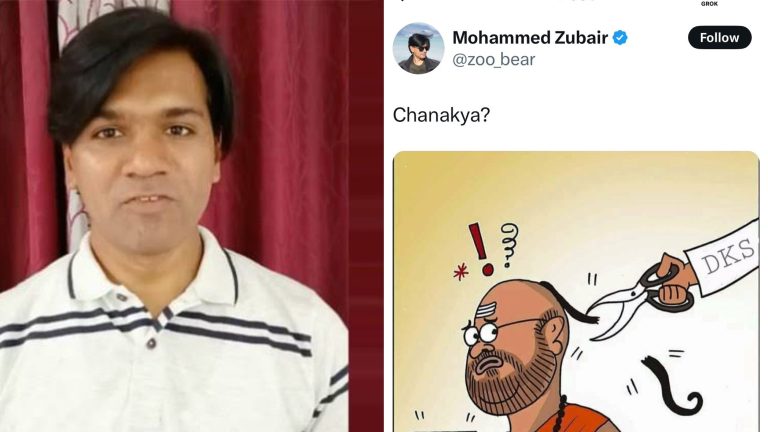
In a tweet published in 2018, Zubair shared a caricature of BJP leader Amit Shah dressed as a Chanakya, with his Shikha or choti snapped by a hand with ‘DKS’ written on it.
However, the post insulting the Brahmin community went viral this week, exposing the staggering double standards of the Alt News cofounder, who doesn’t misses a beat to inflame communal passions when it comes to Islamic beliefs — from Prophet Muhammad to Mughal tyrant Aurangzeb.
But when it comes to Hindu beliefs and sensitivities, everything is considered fairgame, and any questions raised on Zubair are met with “Islamophobia” from the left ecosystem — as if being a Muslim is a license to post derogatory tweets on Hindu beliefs.
“This post by @zoo_bear is a clear attempt to mock and insult the Brahmin community by ridiculing the revered figure of Acharya Chanakya, a symbol of wisdom and strategy in Indian history,” Advocate Ashutosh Dubey tweeted along with the screenshot of Zubair’s post, adding that such content not only hurts religious sentiments but also spreads communal provocation.
This post by @zoo_bear is a clear attempt to mock and insult the Brahmin community by ridiculing the revered figure of Acharya Chanakya, a symbol of wisdom and strategy in Indian history. @Uppolice@dgpup@cyberpoliceup
— ADV. ASHUTOSH J. DUBEY ?? (@AdvAshutoshBJP) June 20, 2025
Others too demanded action against the polarising figure who has also been booked in connection with the Islamist attack against Dasna Devi Temple. In October last year, an FIR was filed against Alt News co-founder Mohammed Zubair following the attack on Dasna Devi Temple in Ghaziabad, alleging that Zubair and two other Muslim leaders, including Arshad Madani and Asaduddin Owaisi, tried to incite Muslims around the country and got local Muslims to get outsiders to destroy the ShivShakti Dham in Dasna.
Notably, this is not the first time Zubair has been under fire for his Hinduphobia. Back in 2022, a controversy erupted after Zubair’s old post mocking Hindu Gods and Goddesses had gone viral. In one of the tweets, Zubair was seen mocking Shivling and comparing it with the top view of the Vatican City. He said the post comparing Shivling with the Vatican City inspired him to come up with a parody Facebook page, ‘Unofficial: Subramanian Swamy’ in 2014.
Apparently, one of the posts on the Facebook page ‘Unofficial Mohammed Zubair‘ mocked Arun Govil to take a swipe at Lord Ram, suggesting that ISRO must consult the actor because he would know more about the rocketry.
Another post by ‘Unofficial Mohammed Zubair’ shows an aeroplane under water with the caption: “Breaking: Underwater Pushpak Vimana used by Raavan 5000 years found in the Indian Ocean.”
Besides ridiculing Hindu Gods, Zubair has also poked fun at Hindu beliefs and even mocked Sanskrit, the ancient language that forms the basis of Hindu texts.
Consequently, Zubair had deactivated his troll account ‘Unofficial: Subramanian Swamy’ after multiple FIRs were lodged against him for hurting Hindu religious sentiments.
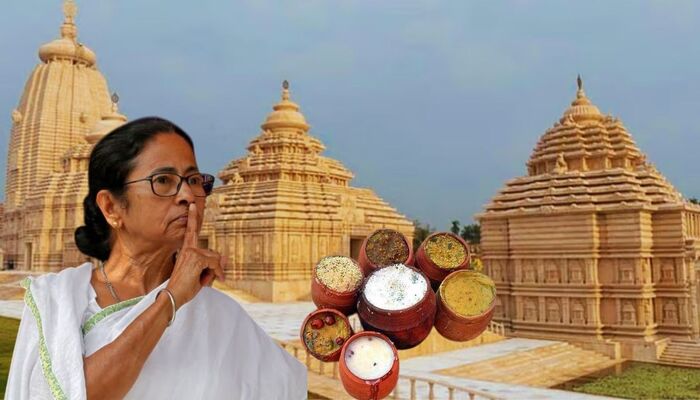
Since its inauguration in April this year, the replica of the Odisha’s Jagannath temple constructed by Mamata government in Digha, West Bengal, has consistently been at the centre of controversies, with the latest one involving the temple prasad.
The BJP has accused the West Bengal government of entrusting the task of preparing the prasad of the temple to Muslim-owned shops. BJP IT Cell Head, Amit Malviya slammed the Mamata government on Tuesday (17th June) saying that the government was “trampling on Hindu sentiments with impunity in West Bengal”. Malviya shared a document on X showing a list of names of shops that he claimed were owned by Muslims.
Malviya said that these shops owned by Muslims were involved in preparing Gaja and Pera, sweets being distributed as prasad from the Digha Jagannath temple. “In the Suti 1 Block of Murshidabad district, sweet shops and ration dealers — majority of them Muslim — have reportedly been entrusted with the preparation and distribution of Gaja and Pera, which are being labelled as Prabhu Jagannath Dev’s sacred prasad. This is not just administrative carelessness. This is a deliberate provocation,” Malviya said.
Mamata Banerjee is trampling on Hindu sentiments with impunity in West Bengal!
In the Suti 1 Block of Murshidabad district, sweet shops and ration dealers — majority of them Muslim — have reportedly been entrusted with the preparation and distribution of Gaja and Pera, which are… https://t.co/NVU921fPQ6pic.twitter.com/zhnIRB4PL8
Malviya pointed out while the original Jagannath temple in Puri, Odisha does not allow the entry of non-Hindus, the Mamata government was violating the sanctity of the temple by distributing prasad prepared by Muslims. “In Puri, even today, non-Hindus are not allowed to enter the Jagannath Temple – such is the sanctity attached to the Lord and His traditions. And yet, in Mamata Banerjee’s Bengal, prasad meant for devotees of Lord Jagannath is being sourced from shops run by those who do not even follow the faith!,” Malviya added.
Earlier this month, Leader of Opposition in West Bengal Assembly, Suvendu Adhikari, had called out the Mamata government for distributing sweets from local shops in the name of Jagannath temple prasad. The West Bengal government has been distributing prasad through its ‘Duare Sarkar’ scheme of doorstep delivery of ration under the Public Distribution System.
“All District Magistrates were ordered to distribute prasad through Duare ration. The boxes of sweets being bought from the local sweet shop is basically demeaning Hindu dharma,” Adhikari said adding that the TMC government allocated ₹20 for a packet of prasad.
Responding to BJP’s attack, senior TMC leader Firhad Hakim described it “mean thinking” and called Adhikari and atheist. “Bhagawan is for everyone and his prasad is also for everyone. This whole world is created by God and if a prasad is for him, then it is for everyone. One who is willing will accept it, and one like Suvendu Adhikari, who is an atheist, will not accept it,” Hakim said.
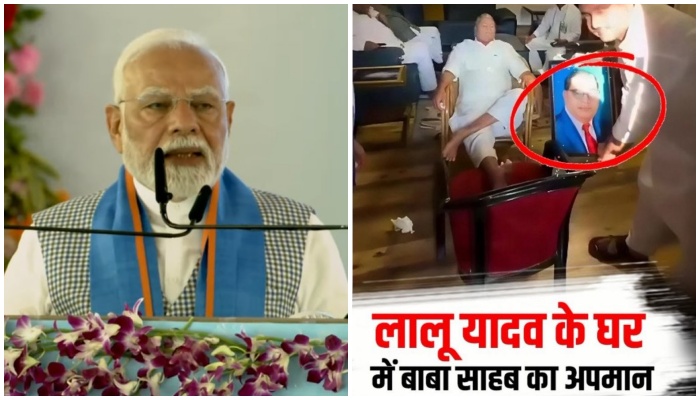
Speaking in Siwan, Bihar, PM Modi today reminded people how RJD and Congress have insulted Babasaheb Ambedkar and his principles throughout their rule.
“They (Congress and RJD) have always played dirty politics where they focus all their energy on promoting their selfish interests and promoting nepotism. They only want to do ‘Vikas’ of their own family members. Babasaheb Ambedkar himself disliked this kind of politics. Perhaps that is the reason these parties keep insulting him. I saw recently, there are posters in Bihar, asking Lalu Prasad Yadav and his family to apologise for insulting Babasaheb Ambedkar’s portrait. But I know, they will never apologise. They do not have any respect for the Dalits, Mahadalit and backward castes. RJD and Congress disregard and disrespect the image of Babasaheb, keep it on their feet, but Modi keeps him in his heart. These parties want to portray themselves as bigger than Babasaheb by insulting his picture, but the people of Bihar will never forget it”, PM Modi said.
PM Modi was referring to the viral video, where it was seen that RJD supremo Lalu Prasad Yadav was sitting with his legs spread on a chair. He was presented with a portrait of Ambedkar, but he declined, seeming uninterested in touching it. The person who brought the photo was seen placing the photo near Lalu’s propped-up feet on a chair to pose for a photograph.
अपराध, भ्रष्टाचार और परिवारवाद के स्टार प्रचारक ने किया बाबासाहेब अंबेडकर का अपमान।
देश में संविधान के 75 वर्षों का कार्यक्रम चल रहा है। हम संविधान के निर्माता को श्रद्धांजलि अर्पित कर रहे है और ऐसे में लालू यादव का हमारे आराध्य बाबासाहेब के प्रति व्यवहार दुखद है।#Babasahebpic.twitter.com/eDlLxfsQ6O
— Dr. Guru Prakash Paswan (@IGuruPrakash) June 19, 2025
The video, reportedly from June 14, had gone viral on social media and the BJP in Bihar has been demanding the apology of Lalu Yadav and his family over it.