Home Blog Page 3509

Burqa row in Karnataka threatens communal harmony and peace. Here is an indicative list where ‘peaceful protests’ culminated into large scale communal riots

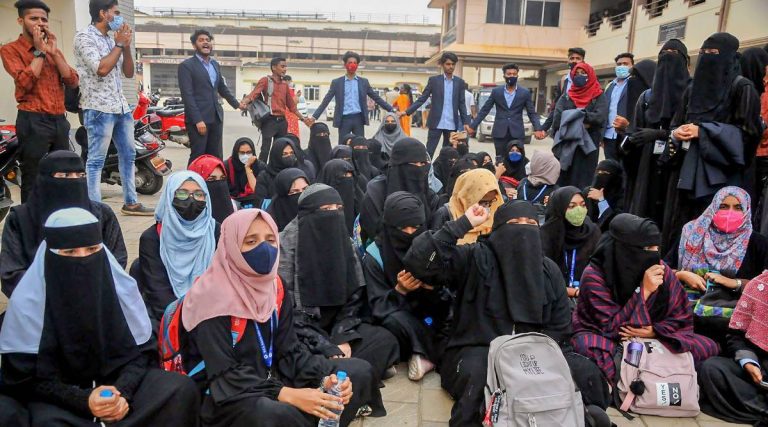
While the whole world was celebrating the occasion of New Year, the coastal town of Udupi in Karnataka was getting embroiled in a controversy. On January 1, some female Muslim students of a Pre-University College (PUC) in Udupi tried to enter their classes with hijabs, in defiance of the uniform dress code.

The school insisted that the students wear the school uniform and barred their entry into the classrooms with hijab. According to Karnataka’s Education Minister BC Nagesh, uniforms had been in existence in the said government PUC since 1985. He said that there had never been an issue to date regarding uniforms.

The girls then launched a protest outside their classrooms for several days to allow them entry with their hijabs. They then moved the High Court and the Supreme Court in the hopes of getting an exclusive religious exemption. Aggrieved by the situation, Hindu students launched a counter-protest sporting saffron shawls and demanded uniformity in school attire.

‘Peaceful’ Burqa protests take violent form

The issue, which started out at a college in Udupi, became internationalised after French footballer Paul Pogba shared a post supporting Hijab in colleges. Although the protests by Muslims were initially ‘peaceful’, they soon escalated to include instances of violence, assault and vandalism.

The protestors soon graduated from wearing a hijab (headscarf) to a burqa (full body veil) and insisted it was a choice. However, there have been innumerable cases in countries like Afghanistan where women are killed for not wearing burqa, hijab, proving how hijab is a choice only if you are privileged enough to not get killed for choosing to not wear one.

On February 11, OpIndia reported another incidence of violence in the Malebennur town of Davangere district wherein a Muslim mob attacked a person and stabbed him for allegedly uploading a post against hijab on his WhatsApp status. In a similar incident in Nallur village of Davangere district, another mob of Muslims have attacked a person and his 60-year-old mother for their alleged posts on social media on the hijab controversy. 

Islamists had also issued death threats to Udupi BJP MLA K Raghupathi Bhat and Prime Minister Narendra Modi. Samajwadi Party leader Rubina Khanum in UP had threatened to chop arms of those ‘putting hands on hijab’. In West Bengal, Islamists pelted stones and also hurled bombs at a school after students were asked to wear uniforms instead of the burqa.

Further reports have emerged that these protests are backed by Islamist outfits like Popular Front of India and its students’ wing, Campus Front of India (CFI). The girls have admitted to have been in touch with the members of CFI who have been guiding them on the protests.

History is replete with instances when Islamists put up a facade of ‘peaceful protest’ to get their demands met by the administration. And whenever the system refused to bend over backwards to accommodate their exclusivist demands, Islamists shed the nuance of peace, resorted to all-out violence and took the State to ransom.

Here is a list of ‘peaceful protests’ by Islamists that led to full-blown violence:

1980 Moradabad riots over ‘pig’

On August 13, 1980, a violent clash broke out between a Muslim mob of 75000 and officials of the Provincial Armed Constabulary (PAC). The incident took place on the occasion of Eid when a large group of Muslims had gathered at the Idgah mosque in Moradabad in Uttar Pradesh.

Indian Express had reported that the chaos started after a stray pig (considered ‘Haram’ in Islam) made its way into the mosque premises. The Muslims, praying inside, believed that the pig was ‘let loose’ by the police officials who were deployed there to avoid any untoward incident.

When the mob asked the cops to remove the pig, they allegedly refused to do so. The agitated Muslims pelted stones at the PAC officials, resulting in retaliatory gunfire that officially claimed 24 lives.
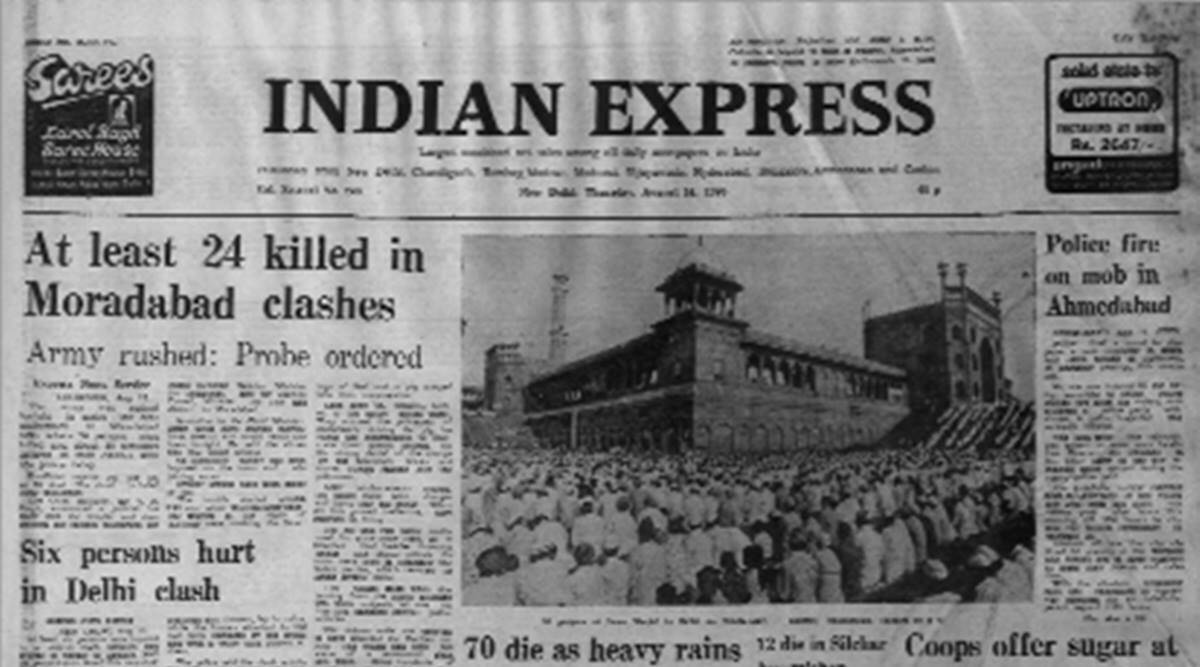
Screengrab of the Indian Express report from August 1980

The then Uttar Pradesh government had appointed Justice MP Saxena of the Allahabad High Court to submit his findings on the incident. In his report submitted towards the end of that year, Justice Saxena informed that there were no pigs in the vicinity of the mosque and that the clash was not caused by the entry of the animal in the Islamic place of prayer.

India Today reported that the outbreak of violence was caused by Muslim League (UP) President Shamim Ahmed Khan and two other leaders. Justice Saxena Commission gave a clean chit to PAC and noted that most casualties were caused by stampede rather than police firing. It also absolved the role of any Hindu organisiation, such as the RSS, in instigating the violence.

No action was ever taken against the perpetrators, given that the report found Muslim leaders ‘involved’ in engineering the clash. The then DGP (prosecution) Dharamvir Mehta had justified the firing by the cops and the PAC. “I had to be Mr Poison to cure cancer. Desperate maladies need desperate remedies,” he had remarked. Interestingly, his ‘iron hand strategy’ bore fruits as the city did not witness communal violence for several decades after the incident.

Islamists rioted in Mumbai over ‘The Satanic Verses’ in 1989

Following the publication of ‘The Satanic Verses’ by Salman Rushdie in September 1988, Islamists were up in arms against the author for committing ‘blasphemy’ and insulting their Faith. Iran’s first Supreme Leader, Ayatollah Khomeini, even called upon all Muslims to kill Salman Rushdie.

By that time, the ‘secular’ government of Rajiv Gandhi had already banned the book in India. Khomeini’s call for the killing of Rushdie inspired and mobilised Islamists, who called for a ‘bandh‘ on February 24, 1989, in the city of Mumbai. A large demonstration was held.
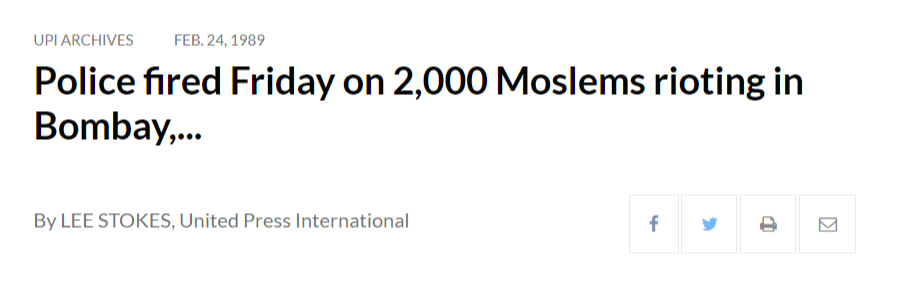
Screengrab of 1989 report of United Press International

The frenzied Muslim mob was stopped by cops after they tried to march on the British diplomatic mission, which was in Mumbai at that time. The Islamists were protesting against the protection provided to Salman Rushdie by the British government. The mob of 2000 rioters burnt cars, buses, motorcycles in South Mumbai and also torched a police station.

They also open-fired at the police. It was then that the cops resorted to retaliatory firing and neutralised 12 Islamists in this process. Similar processions were banned for the day. A total of 500 Islamists were detained and 800 others were arrested.

1989 Badaun riots over ‘Urdu’

The adoption of Urdu as the second language of Uttar Pradesh in 1989 resulted in violence and vandalism in the city of Badaun, which has about 56% Hindus and 43% Muslim population.

Even before the Urdu Bill was tabled in the State Legislative Assembly on September 28, 1989, political and religious turmoil gripped the region of Western Uttar Pradesh. The student wing of the BJP, Akhil Bharatiya Vidya Parishad (ABVP), staged a procession in Badaun over the decision of the Congress government to include Urdu as an official State language.

Screengrab of the news report by Desert News

A counter pro-Urdu procession was organised on September 28 that year by students of Islamia Inter College, during which they attacked a college. This fired off a series of killings and arson attacks, with gun-wielding rioters shooting at people from rooftops.

“The riot claimed 27 lives according to some media reports. Other accounts assessed the total at more than 60 killed. Violence also spread to the countryside. During an attack on the Kasganj–Kashipur train, 13 passengers were killed by a mob. Other sources put the death toll of this attack at 24,” the report by SciencesPo.

Riots in Kota in 1989 over religious processsion

It was the last day of the Ganesha festival (September 14, 1989) for that year. A major riot broke out in the Kota city of Rajasthan after a Hindu Anant Chaturdashi procession was attacked while it passed through a Muslim-dominated neighbourhood.

“How the riot started is a subject of dispute. The Moslems say the Hindus chanted blasphemous, provocative slogans against Islam. The Hindus say the Moslems began throwing stones and acid bombs at them without warning. Either way, the streets were ablaze within minutes and shots rang out, as both sides scrambled for guns and other weapons,” a report in The Washington Post read.

According to a report in SciencesPo, Akhara members and Hindu activists allegedly chanted anti-Muslim slogans while the Muslim mobs attacked the procession when it was passing by a mosque in the Ghantaghar area of Kota. This sparked off large-scale rioting in the city, followed by looting and arson attacks.

As per the Urdu newspaper Tulu-e-Subh, a total of 26 people (22 Muslims and 4 Hindus) lost their lives in the rioting that ensued in Kota.

Riots in Uttar Pradesh between 1990 and 1992 over Ram Janmabhoomi

On September 30, 1990, a Durga Puja procession was targeted by Islamists in the Colonelganj tehsil in Gonda district of Uttar Pradesh after the Hindu devotees raised slogans in support of Ram Mandir. During the attack, Muslim mobs pelted stones and petrol bombs at the Hindu religious procession.

This sparked off riots in Colonelganj, with the violence eventually spreading to rural areas. The Hindu mobs retaliated by burning down Muslim houses. A total of 42 people (official count) were killed during the riots, although unofficial sources put the death count to more than 300. Reportedly, the nearby villages of Kanje Mau and Pandey Chaura were also affected.

During the Ram Janmabhoomi movement, Khurja in the Bulandshahar district of Uttar Pradesh also witnessed riots on 2 occasions. The first riot began on December 15, 1990, and lasted till December 23 of that year. It claimed the lives of 74 people, including 12 Hindus and 62 Muslims. The riot was sparked by a fake news report published by a Hindi newspaper named Aaj wherein it claimed that a Muslim man, who was earlier stabbed and was being treated in Delhi, had succumbed to his injuries.

The second riot started on January 31, 1991, when a bomb exploded in a Muslim household. It resulted in a total of 22 casualties, including 4 Hindus and 18 Muslims. On the day of the demolition of the Babri Masjid, Muslim mobs in the communally sensitive town of Kanpur began looting Hindu shops and administrative offices. It was December 6, 1992. This sparked off riots with Hindu mobs targeting Muslim houses.

“Particularly notorious incidents occurred in the southern periphery of the city, where the riot spun out of control. According to official sources, 11 people died during four days of rioting in the town. Unofficial reports put the death toll much higher,” SciencesPo reported, adding that the riots peaked on December 9 and 10.

Islamists wrecked havoc in Lucknow in 2006 over Danish Mohammed cartoons

Lucknow, a city not known for Hindu-Muslim riots, had become a hotbed of religious turmoil following the publication of 12 editorial cartoons on Prophet Muhammad by a Danish conservative newspaper named Jyllands-Posten on 30 September 2005.

Initially, the demonstrations against the publication of cartoons were largely muted in India but they gained momentum after a Muslim politician fanned the fire of communalism. Hindustan Times reported that on February 17, 2006, Samajwadi Party leader Haji Yaqoob Qureshi offered prize money of ₹51 crores for killing Danish cartoonist Kurt Westergaard for committing blasphemy.

This culminated in violent protests in Lucknow, two days later on February 19 of that year. A five-star hotel, a Pizza Hut and a Cafe Coffee Day outlet was vandalised by Muslim mobs. In the following days, anti-US and anti-Denmark sentiment gripped the capital city of Uttar Pradesh.

On March 3, 2006, Islamists took out a protest against the visit of United States President George Bush to India. “The Muslims from the localities of Aminabad, Kaiserganj, and Latoosh Road staged large demonstrations after Friday prayers. The violence started when they forced Hindu shopkeepers to close their shutters. Their procession was then stoned and a riot erupted, in which four persons were killed,” read a report by ScincesPo.

The Times of India had reported that the violence lasted for over 4 hours since most of the police were deployed for the visit of President APJ Abdul Kalam to the city. A total of 4 people were killed and 8 others had sustained bullet injuries.

While highlighting the extent of damage caused by Islamists, the TOI report noted, “Seven shops were gutted at Mumtaz market in Aminabad while portion of a bank building and some 27 two-wheelers parked outside it were reduced to ashes in Maulviganj. Half-a-dozen two-wheelers were torched on Cantonment road connecting Kaiserbagh crossing.”

Islamists took Vadodara hostage in 2006 after unauthorised dargah was demolished

Municipal corporations in India regularly demolish unauthorised constructions as part of urban development and city planning. In May 2006, the Vadodara Municipal Corporation (VMC) had set out to demolish one such ‘unauthorised’ dargah to widen the city’s roads.

The Muslim community alleged that the dargah was the shrine of a medieval Sufi saint named Syed Chishti Rashiduddin and was 300 years old. However, no official record existed that could corroborate such ‘outlandish’ claims. Prior to that, the civic body had demolished several old temples and received no resistance from the majority Hindu community.

The ‘naive’ VMC officials thus believed that there would be no trouble when they set out to demolish the dargah, which was located in the Mandvi area of Vadodara. They were greeted with stones by unruly Muslim mobs, forcing the police to open fire at the rioters. A total of 6 Islamists were killed in retaliatory police firing.
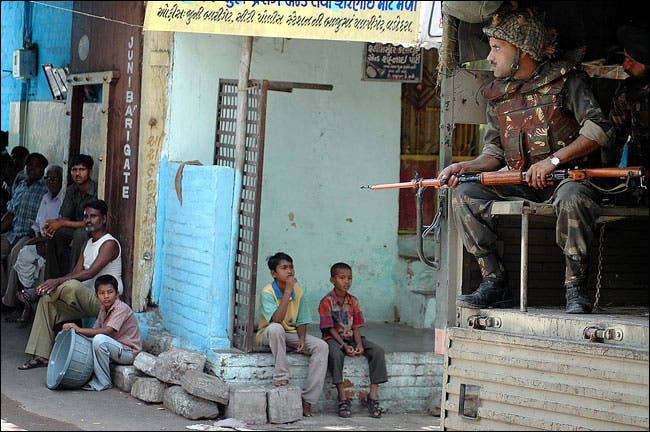
Police patrolling increased in Vadodara after violence, image via Ajit Solanki/Associated Press

“What followed was a grim reminder of the infamous 2002 Vadodara riots. Mobs of both communities thronged the streets, rioting, pelting stones and even stabbing people,” reported India Today. Hindus, whose houses were attacked by Islamists, resorted to violence and killed a Muslim driver. An army jawan, who was passing through a Muslim dominated area, was also killed.

When the police failed to contain the riots, the State government sought help from the reserve forces. NGOs such as the People’s Union for Civil Liberties tried to rationalise the destruction caused by Islamists by finding faults in the decision of the Vadodara Municipal Corporation.

Imam of Jama Masjid in Ahmedabad, Shabbir Alam Siddiqui, had warned, “The Muslims will oppose any attempt to demolish dargahs that have been here before the town planning schemes came into force.” Islamists were also quick to link the dominance of the BJP in the Vadodara Municipal Corporation with the decision to demolish the dargah and further the series of violent attacks.

The then Chief Minister Narendra Modi had visited the riot-torn city and warned anti-social elements with dire consequences. “All those who want to jeopardise the safety of common citizens by spreading this orgy of violence will be dealt with sternly,” he had announced.

2012 Azad Maidan riots

On 11 August 2012, Raza academy had staged a morcha at Azad Maidan ground to protest against the alleged atrocities on Muslims in Assam and Myanmar. However, the protest turned violent after the notorious group attacked the policemen.

This led to police firing, resulting in 2 deaths and 63 injuries. Raza Academy had earlier assured the Mumbai Police that only 1500 people would turn up for the protest. However, more than 15000 people assembled at the Azad Maidan, which later increased to 40000.
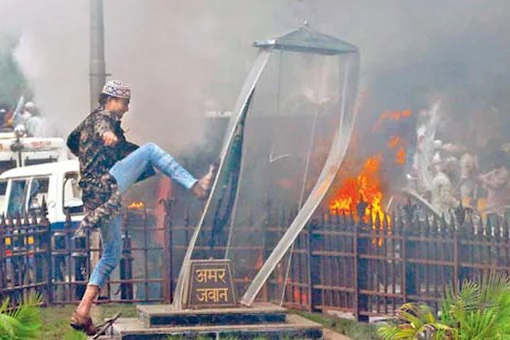
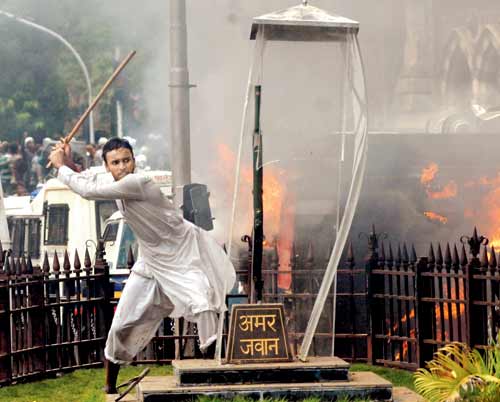
Amar Jawan Jyoti desecrated by rioter in August 2012, image via MidDay/Atul Kamble

The most shocking incident of the Azad Maidan Riots was the desecration of the Amar Jawan Jyoti memorial by the Muslim mobs. Later, it came to light that the police waited for one week until Eid to arrest the 35-40 Muslim youths, who were involved in rioting. The riots had caused approximately Rs 2.72 crores worth of damages to various public properties.

2013 Muzaffarnagar riots

The deadly riots reportedly started after a Muslim youth named Shah Nawaz allegedly eve-teased a Hindu Jat girl in Kawal village of Muzaffarnagar, following which the accused was allegedly killed by her brothers Sachin Singh and Gaurav Singh. The duo was then lynched to death by a frenzied Muslim mob while they were trying to escape. The incident took place on August 27, 2013.

Another theory into the origins of the Muzaffarnagar riots suggests a bike collision between Gaurav and Shahnawaz (as claimed by the latter’s father Salim), leading to a scuffle. However, according to Gaurav’s father Ravinder Kumar, the deceased had a bike accident with a Muslim youth named Mujassim.

The FIR also named other Muslim youths, namely, Mujibulla, Furqan, Jehangir, Nadeem, Afzal and Kalua. OpIndia had even published a ground report about how the then SP government jailed the family of Gaurav. A counter-FIR filed in the death of Shahnawaz named Prahlad, Gaurav, Sachin, Vishan, Tendu, Devendra, Yogender and Jitendra.

Despite a ban on public assembly, Islamists gathered in large numbers at Shaheed Chowk on August 30 and made inflammatory speeches. On the next day, about 40,000 people assembled at Nangla Mandoud Panchayat, attacked a car carrying a family and set it on fire.
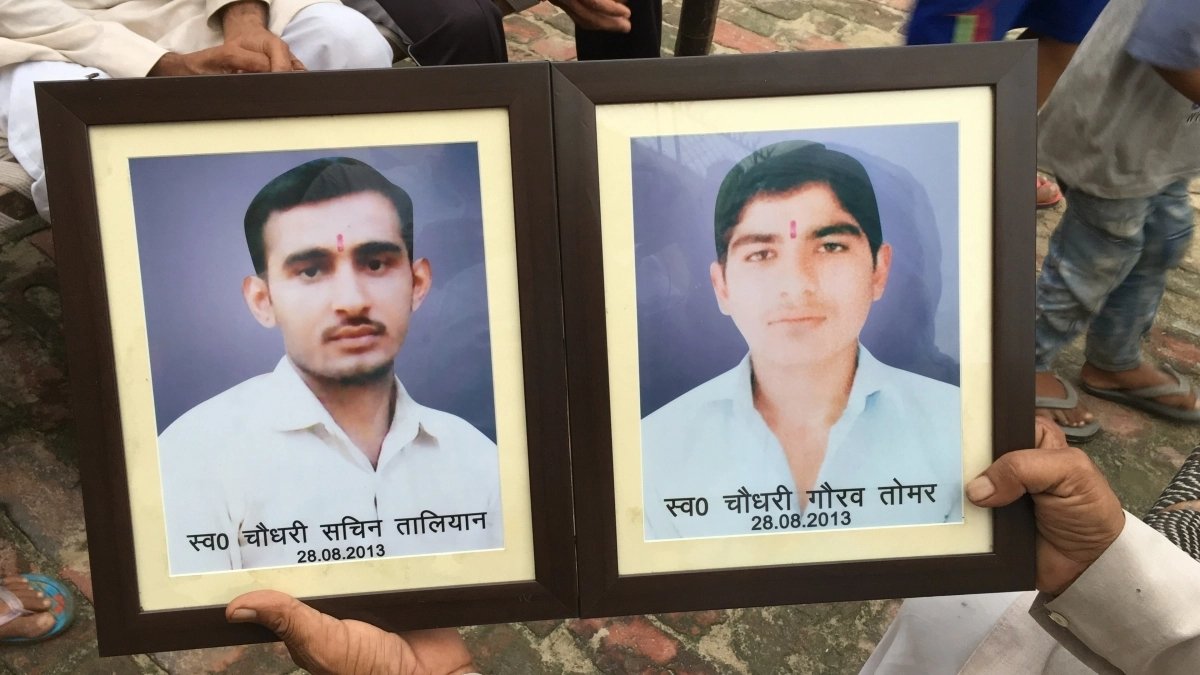
Sachin Singh and Gaurav Singh were lynhced to death by a Muslim mob.

A First Information Report (FIR) was registered against political leaders who made provocative speeches at public meetings in Nangla Mandoud and Shahid Chowk. On September 2, 2013, BJP called for a bandh in Muzaffarnagar after a place of worship was vandalised in Sanjhak and Titavi.

A case was registered against MLA Sangeet Som for circulating a fake video of the Kawal incident. It sparked off violence in the town of Shamli. An outbreak of sporadic violence was witnessed in Muzaffarnagar. The Bharatiya Kisan Union (BKU) had called for a panchayat meeting at Nangla Mandoud on September 6.
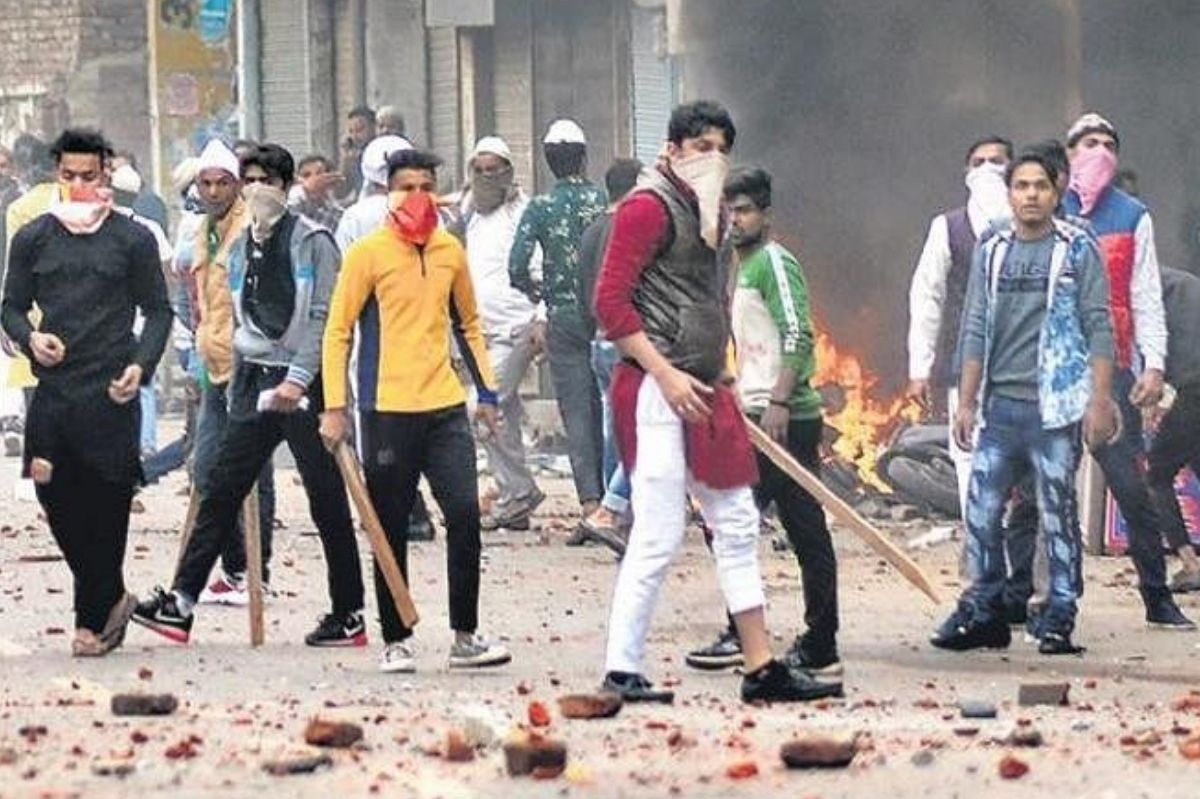
Rioters on the loose in Muzaffarnagar in 2013, image via Rediff

On the following day, people who were going to attend the panchayat was attacked. “Firing from both sides in Muzaffarnagar town as stoning, arson go unabated. Army called in and town put under indefinite curfew. 10 killed, more than a score injured in the violence,” reported India TV. The 2013 Muzaffarnagar riots resulted in 62 deaths, including 42 Muslims and 20 Hindus.

2020 Anti-Hindu riots in Delhi

The cycle of violence that started in the first ten days of December 2019 during anti-CAA protests culminated with the Delhi anti-Hindu riots that claimed the lives of over 50 people. The media went hammer and tongs alleging that the Delhi riots were an ‘anti-Muslim pogrom‘, trying to paint the Modi government as Nazis and the Muslims as Jews.

On the day the then US President Donald Trump arrived in India for his official visit, the 24th of February,, 2020, widespread anarchy and chaos erupted across the national capital. Muslim mobs went on a rampage again in Delhi and a head constable of the Delhi Police lost his life. A petrol pump was set on fire at Bhajanpura in East Delhi and many vehicles were burnt. Another DCP has been injured during clashes between two groups in Delhi’s Gokulpuri.

In the midst of all this, the photograph of a certain gun-wielding rioter wearing a maroon/red t-shirt had gone viral on social media. Some people claimed that the gunman who opened fire at police during the Delhi riots is from the ‘rightwing’ while others have claimed that the said person is a Muslim rioter. Later, the gunman was identified as Shahrukh and was arrested.
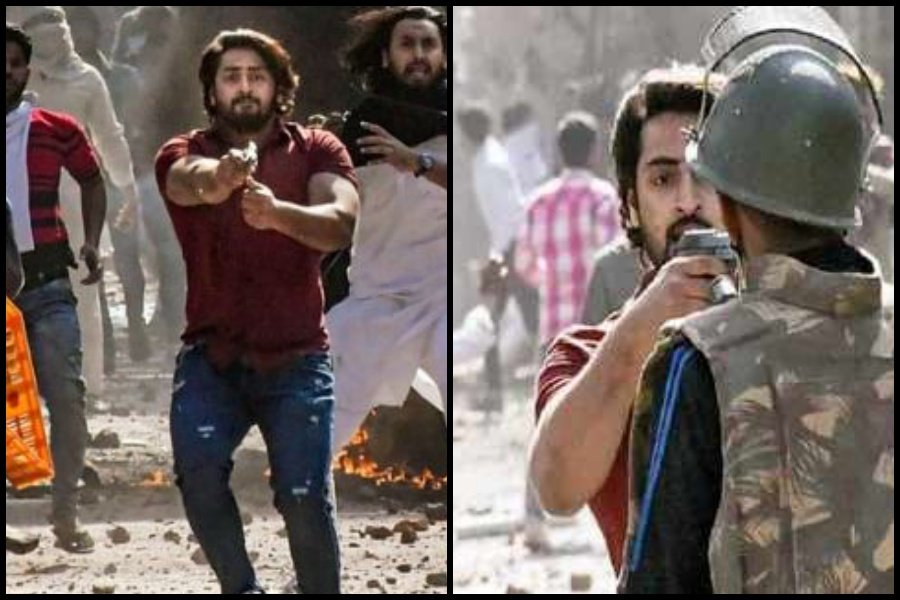
Shahrukh Pathan intimidated a cop during the Delhi riots

Since then, there was chaos in Delhi. The dead body of an Intelligence Bureau constable was recovered from a drain in Chand Bagh, spearheaded by Tahir Hussain. A Hindu man was murdered in Brahmapuri amidst chants of ‘Allah Hu Akbar’ and ‘Nara e Taqbeer’. The death toll has mounted over 50 and hundreds of people have been injured. Mosques have also been said to be damaged. A great deal of property has been damaged across the national capital.

The Delhi High Court observed, “The riots which shook the National Capital of the country in February 2020 evidently did not take place in a spur of the moment, and the conduct of the protestors who are present in the video footage which has been placed on record by the prosecution visibly portrays that it was a calculated attempt to dislocate the functioning of the Government as well as to disrupt the normal life of the people in the city.”

The court further added that the CCTV cameras were destroyed systematically that confirmed the existence of a pre-planned and pre-meditated conspiracy to disturb law and order in the city. It said, “This is also evident from the fact that innumerable rioters ruthlessly act that in descended with sticks, dandas, bats etc., upon a hopelessly outnumbered cohort of police officials.”

Interestingly, even the deadly anti-Hindu riots of 2020 started off as ‘peaceful protests’ under the pretext of saving the Constitutional idea of India. And when the opportunity presented itself, Islamists were quick to weaponise violence under the garb of ‘provocation’ to get their writ established.

While the ongoing Burqa row might look ‘peaceful’ and a fight to save ‘right to Religion’, it has already begun taking a sinister form with incidents of stone pelting and targeted attacks. It is just a matter of time when the mask of peace falls and Islamists resort to their usual tactics.

The outbreak of communal violence in post-Independent India has time and again shown how so-called peaceful protests by Islamists on socio-political and religious issues usually pave way for violence which is eventually justified by ‘liberals’ and Islamists in the name of ‘religious freedom’.

References: Violette Graff Juliette Galonnier, Hindu-Muslim Communal Riots in India II (1986-2011), Mass Violence & Résistance, [online], published on: 20 August, 2013, accessed 17/05/2021, http://bo-k2s.sciences-po.fr/mass-violence-war-massacre-resistance/en/document/hindu-muslim-communal-riots-india-ii-1986-2011, ISSN 1961-9898
Indian cricketer Wriddhiman Saha shares chat with journalist forcing him for an interview, netizens speculate

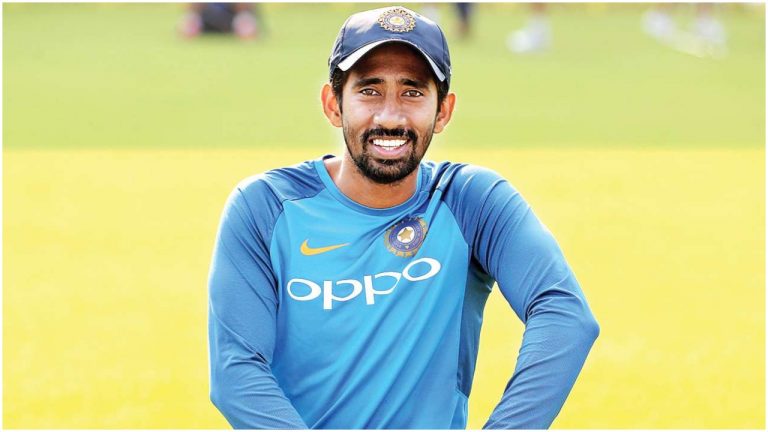
On Saturday, Indian cricketer Wriddhiman Saha took to Twitter to share a screenshot of disturbing messages sent to him by a journalist forcing him for an interview and then using disdainful language to deride him for not responding.

“After all of my contributions to Indian cricket..this is what I face from a so called “Respected” journalist! This is where the journalism has gone,” Saha wrote in his tweet as he shared the screenshot.

In the purported conversation, the alleged journalist is asking Saha to do an interview with him.

The journalist also says that he will not be pushing Saha for an interview, however, the wicket-keeper must choose the person who can help him the most.

In the screenshot shared by the cricketer, one can see a notification of a missed call from the journalist.

As Saha did not entertain the alleged journalist’s request or call him back, the angry journalist said he would never again take his interview.

He further stated in the message that he would not take this insult kindly. The journalist even warned Saha that he should not have behaved in this manner.

This revelation from Saha came after the Indian selection committee headed by Chetan Sharma announced the India team for the T20I and Test series against Sri Lanka, leaving out Wriddhiman Saha from the squad.

The exclusion did not surprise many, as Saha revealed that he was informed about the committee’s decision to not pick him by coach Rahul Dravid in South Africa itself. 

Netizens speculate the identity of the journalist

Following Wriddhiman Saha’s sensational tweet disclosing the threats he received by a journalist, netizens began to speculate about the identity of the individual who indulged in such an act.

Social media users expressed their anger against the journalist for disrespecting a senior cricketer. They took a wild guess saying that it was either journalist Vikrant Gupta or Boria Majumdar who threatened Wriddhiman Saha.

One user even tagged Vikrant Gupta to say that she did not expect this kind of behaviour from him. Gupta wittingly responded to the user by saying that even he did not expect such behaviour, subtly denying the allegations.

A social media user named Vicky Sherlock Singh decoded the text messages sent to Wriddhiman Saha to ask whether it was Boria Majumdar who indulged in a low-level act.

According to the user, Boria Majumdar’s old tweets and the text messages Saha had put out shared a similar pattern, indicating that Majumdar may have been the person who threatened Saha for an interview. The social media user pointed out that Majumdar had committed a typo ‘ypu’ instead of ‘you’ in many of his tweets

Interestingly, the same mistake can be seen in the text messages that were shared by Saha.

Rushil also shared a similar opinion saying that Boria Majumdar was the only journalist who spelt ‘you’ as ‘ypu’ every single time. He also said that he does not believe it was Boria as Saha was talking about “respected” ones.

Another user said that Boria Majumdar had erroneously tweeted ‘ypu’ in place of ‘you’ in the past out of anger or excitement.

The incident has now triggered a massive debate on social media platforms, accusing some respected journalists of misusing their influence to threaten and harass senior cricketers.

Weapons left by US military in Afghanistan found with terrorists killed in Kashmir, Afghan terrorists reaching LoC to infiltrate into India: Army official

0

The large cache of arms and ammunition that the USA had left behind in Afghanistan have now found their way to Kashmir in India, as the Pakistani terrorists operating in the valley are seen using such weapons. A senior Army official has confirmed that Afghan terrorists are now infiltrating into India, and American weapons from Afghanistan were recovered from the terrorists that were recently killed in Indian Army operations.

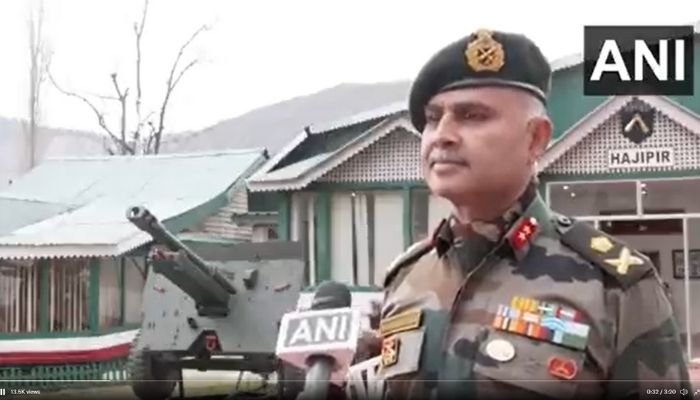
Major General Ajay Chandpuria, General Officer Commanding (GOC) 19 Infantry Division stationed in Baramulla of North Kashmir has said in an interview with the news agency ANI that high tech modern weapons and advanced night vision devices left behind by Americans in Afghanistan after the fall of Kabul in August 2021 are now finding their ways to Indian Union Territory of Jammu & Kashmir via Pakistan through the Line of Control (LoC).

19 Infantry Division falls under the 15th Chinar Corps and is responsible for the counter-terror grid and security preparedness along with some crucial areas of Line of Control with Pakistan in North Kashmir.

Major General Chandpuria has said, “It has been 75 years. We fought in 1947, 1965, 1971. Today’s terrorism began in 1990. Things were different when the US troops were present in Afghanistan. Now after the fall of Kabul, from terrorists who were fighting against the US in Afghanistan to high-tech weapons and night-vision devices have made their way to the Kashmir LoC via Pakistan.”

He further added, “As per our analysis, 100 to 120 terrorists are ready to infiltrate Kashmir anytime. Their training camps in the launch pads have been shut down. Our deployment at LoC and our intel network have failed their plans to infiltrate. But still, there are few old terrorists here and others coming from different parts of the country.”

Hw further informed, “Around 150 to 200 terrorists are present in Kashmir valley. This number is calculated without counting in the brainwashed local youth. Their training is reduced to zero and they are used only for throwing hand grenades or a pistol firing. We called them hybrid terrorists or unidentified terrorists. So, the number of properly trained terrorists comes from 150 to 200. 40 to 45 percent of them are present in the Kashmir valley even now.”

Major General Abhay Chandpuria further said, “But the situations in the north Kashmir are almost normal. You must have visited the places and met the people. Terrorist activities are reduced to a few. Recruitment of the terrorists has come down to one-third of what it had been in the last year. The number of terrorists has also been reduced.”

He added, “We believe that Pakistan will not stop its effort. Despite ceasefire understanding, there have been 6 incidents of infiltration reported. We have neutralized terrorists. Besides, there are terrorists here in front of us.”

Informing about the weapons and devices recovered from the terrorists he said, “The weapons and devices recovered from the terrorists killed at the LoC were not those commonly seen. These weapons and devices were in Afghanistan when the US troops left. So it is our analysis that not only the weapons but the terrorists also can come to Kashmir.”

Meet Yash Vyas, 2008 Ahmedabad serial blast survivor, who saw his brother and father perish at age 8 but did not lose hope

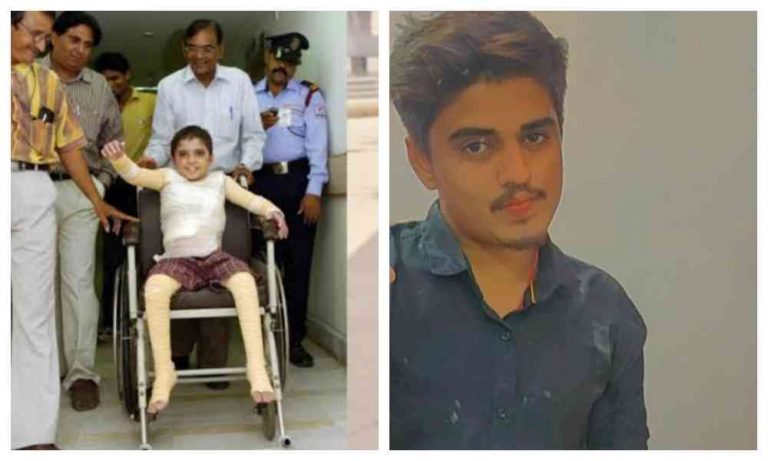
On 26 July 2008, 8 year old Yash Vyas with his 10-11 year old brother Rohan and father, Dushyant Vyas, stepped out of home to learn how to cycle. They rode the cycle for about 2-3 hours. At around 7:30-7:45 PM, someone called up his father and asked him to wait at the Civil Hospital. Yash doesn’t know exact details, but his father who worked at Ahmedabad Civil Hospital’s cancer department’s laboratory, waited.

10 minutes later, an ambulance rolled in. His father asked his two sons to wait for him with the cycle and went to check in the ambulance. And there was another blast. “I am not sure if the blast took place inside ambulance or a vehicle that passed by, but the blast was so powerful it could be heard till two kms. My brother was standing with the cycle and he was burnt beyond recognition. I ran the other way because I was so scared,” Yash said while speaking to OpIndia.

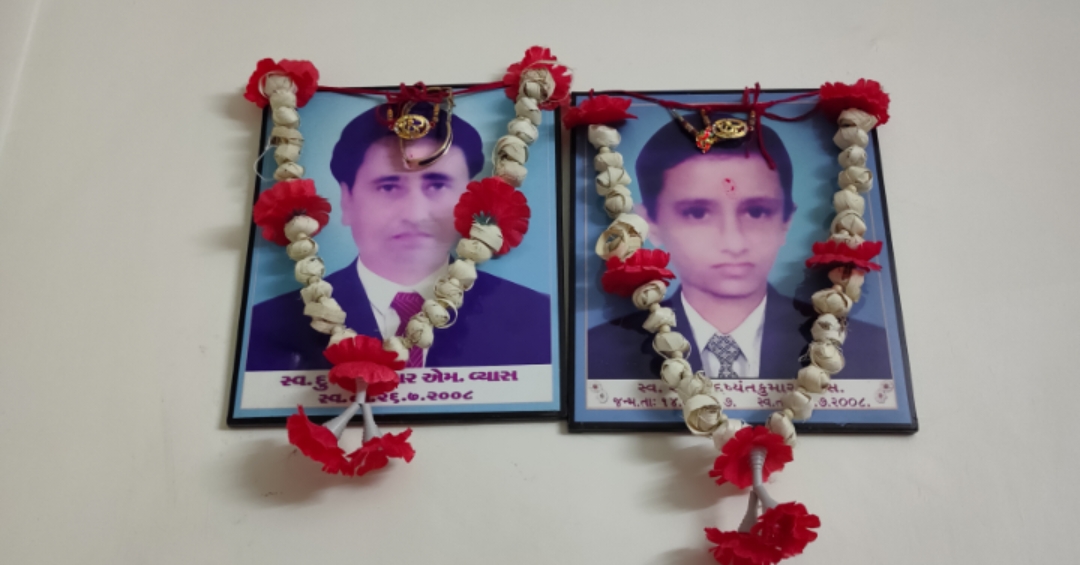
Dushyant Vyas and Rohan Vyas

Yash started running towards his house, in injured state, but someone, likely a student or someone at the hospital, saw an injured child and got him admitted instead.

“I last saw my father at 8:30 PM on the day of the blast. They were taking him away on a stretcher. I then fell unconscious,” Yash said.

Dushyant Vyas was badly injured on his legs and he bled to death because of severe loss of blood, says Yash.

At first he was admitted to the Civil Hospital. “Modi Saheb had assured the best treatment to me. He said that the state government was ready to get me admitted in any hospital in any part of the world to ensure treatment. I was then shifted to Apollo Hospital where I was in ICU for next three months. I then spent a month outside of ICU,” he said.

“Dr Shrikant Lagwankar and Dr Jyotindra Kaur of Apollo took great care of me,” he said. Yash said that Rs 1.62 crore bill was footed by the state government. The state government gave monetary compensation for the injury as loss of lives to the bereaved family.

Yash is now pursuing B.Sc. (Bachelors in Science) and wants to then take up Masters.

On the recent death sentence awarded to the convicts, Vyas said, “They should have been hanged long back. They killed innocent people, so why should they be spared. Life imprisonment is of no use to them.”

There was a certain ring in his voice of having some feeling of justice being served after over a decade. “I sometimes have difficulty in hearing because the blast sound was so loud,” he said. It was tough for him and his mother and grandmother to accept how their lives had changed forever, but they have been resilient.

He saw his brother perish in front of his eyes and father bleed to death. Instead of being vengeful and taking up route of violence, Yash chose to get himself educated and wants to finish his Masters in chemistry and take up a job somewhere, ‘like a lab’, he said.

Meanwhile, Jamiat Ulama-e-Hind has opposed the death penalty to the convicts and has said that they will take up the fight to the High Court and even Supreme Court if needed.

A special court in Ahmedabad announced the sentences in the 2008 Ahmedabad bomb blast case on Friday 18th February 2022. In the verdict, the court had awarded death sentences to as many as 38 convicts out of the 49 accused who were convicted in this case, while the remaining 11 had been sentenced to life imprisonment until death. As per law, the death sentences will need to be confirmed by the Gujarat High Court. You could read about other terror accused who were provided legal aide and support by Jamiat Ulama-i-Hind here.

Assam CM Himanta Biswa Sarma asks the Centre to ban PFI for involvement in ‘subversive activities and radicalisation’

0

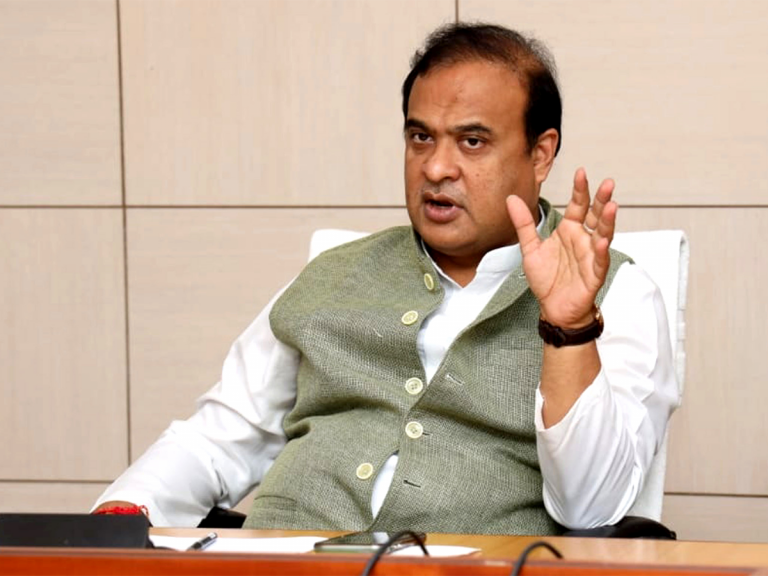
The chief minister of Assam Himanta Biswa Sarma on Saturday said the Assam government has asked the centre to impose an immediate and complete ban on the Popular Front of India(PFI). Sarma, however, added that the request was made not because of PFI’s stand on the hijab row but for their direct involvement in ‘subversive activities and radicalisation’.

“Assam has demanded an immediate complete ban on PFI (Popular Front of India) from the central govt, not because of the hijab issue, it’s their democratic right, but because of their direct involvement with subversive activities & radicalisation,” Assam CM Himanta Biswa Sarma was quoted as saying by news agency ANI.

Notably, the Popular Front of India had recently lamented over the 2008 Ahmedabad serial blast verdict wherein the court sentenced the death penalty to 38 convicts while 11 others were awarded life imprisonment. PFI chairman OMA Salam raised aspersions on the verdict, stating that the verdict in the case is a “result of a tainted process, questionable investigation and draconian laws”.

A special court in Ahmedabad announced the sentences in the 2008 Ahmedabad bomb blast case on Friday 18th February 2022. In the verdict, the court has awarded death sentences to as many as 38 convicts out of the 49 accused who were convicted in this case, while the remaining 11 have been sentenced to life imprisonment until death. Earlier on 8th February 2022, the court had convicted 49 out of 77 accused in the case. The serial bomb blasts that took place in Ahmedabad on 26th July 2008 had caused 56 deaths and 243 innocent citizens were injured in the blasts.

PFI involvement in fuelling protests over hijab row

Recently, the role of the Campus Front of India(CFI), the notorious student wing of the radical Islamist outfit Popular Front of India, in instigating the Muslim students to create the hijab controversy in Udupi, Karnataka, had come to light. According to a January 19, 2022 report by The News Minute, the Muslim students who are protesting against uniform regulations in the state were in contact with radical Islamist outfit CFI. The students admitted that they began wearing the hijab in college only in December 2021, realising that there was no particular rule banning the hijab in the college rulebook. 

Reportedly, the Women’s Government Pre-University College in Udupi, the epicentre of the burqa protests, has become a hub for PFI to carry out its communal political events, especially over the last year. It is being said that a few Muslim students of the college had participated in a protest organised by ABVP in October 2021.

PFI being funded for promoting Islam and radicalisation drives in India: Reports

Last year, a Kerala-based journalist had made a sensational disclosure regarding how radical Islamic organisations such as the Popular Front of India and Jamaat-e-Islami were receiving funds to promote Islamism in India. In a Clubhouse discussion, Kerala-based journalist MP Basheer had revealed details about the international funding to advance radical Islam in the country.

In his disclosure, Basheer had said that he had accessed a letter written by Jamaat-e-Islami requesting the King Abdul Aziz University in Saudi Arabia to increase the financial grant to the radical Islamic organisation so that they could create awareness and promote the Islamic dress code in Kerala and India. He had further stated that Jamaat had objected to certain Muslim women journalists not wearing hijabs and had stated that Basheer should tell them to wear hijabs.

Sikhs who returned from Afghanistan thank PM Modi for saving the lives of Hindus and Sikhs and also the great culture heritage

0

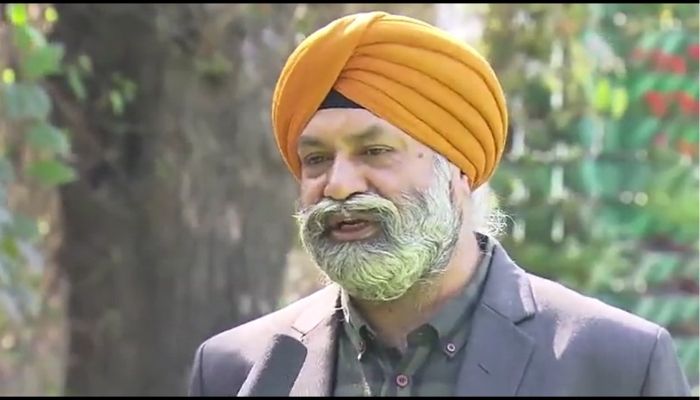
A day before Punjab goes to voting for the state assembly elections, a video has appeared on social media in which the Sikhs who returned from Afghanistan while the Taliban were taking over that country in August 2021 have expressed their gratitude towards PM Modi for saving not only the lives of Hindus and Sikhs in Afghanistan but also the great inheritance of culture.

Parminder Singh Brar, an England-based lawyer, and ex OSD to Deputy CM of Punjab has shared a video in which the Sikhs who were saved from the Taliban by the Modi government in July 2021 are seen expressing their gratitude towards the government and especially towards the Prime Minister. The video covers the bytes by many including Nidan Singh Sachdeva who was brought back to India safely in July 2021.

The video opens with a Sikh person saying “I would say that if there is anything impossible in the world, it becomes possible when it comes to Narendra Modi. We people understand what kind of a person Narendra Modi is and how helpful he had been to us. He had finished the tasks that many others could not. And moreover, he has showered love upon us that we can never forget.”

Another person who used to offer his services in a Gurudwara there has said in this video, “I used to work in Kabul. I would offer my services in a Gurudwara there. The Taliban abducted me from the Gurudwara and took me away. I am very happy that I am alive today all thanks to Hindustan especially PM Modi who has helped me a lot.”

Next to this, another Sikh person is seen in this video who has said, “He (PM Modi) brought our people back, sent airplanes for them. There were 400 to 500 years old copies of Shri Guru Granth Sahib, Shrimadbhagvadgeeta, Ramayana, etc. PM Modi has brought back all the historic and cultural inheritance. He walks the talk.”

Another Sikh person has said, “Many of our problems are solved including the CAA issue. There were issues regarding our commutation to and fro India. These issues were pending for the last 25 years but they were addressed and solved only after the BJP was elected to power and Modi became the PM.”

Another Sikh person in this video has said, “The Prime Minister has saved the lives of Hindus and Sikhs living in Afghanistan. The airports in Afghanistan were not operative. The airplanes of the Indian Air Force arrived and took them out of the danger.”

After this, another Sikh person in this video has said, “Besides the Hindu and Sikh Indians in Afghanistan, the Muslims there also love him so much that we can’t sum it up in words. He takes bold decisions which are actually in the good interest of all of us including Hindus, Muslims, and Sikhs. Everyone gets benefitted by this.”

‘Not a single Hindu woman come outside homes wearing religious symbols’: Islamists in Bangladesh issue threats while protesting ‘hijab ban’ in India

Amidst the ongoing ‘Hijab row’ in Karnataka which has now spread to other states, Islamists have threatened Hindus living in Bangladesh with dire consequences if Muslim students are not allowed entry into Indian classrooms with Hijab.

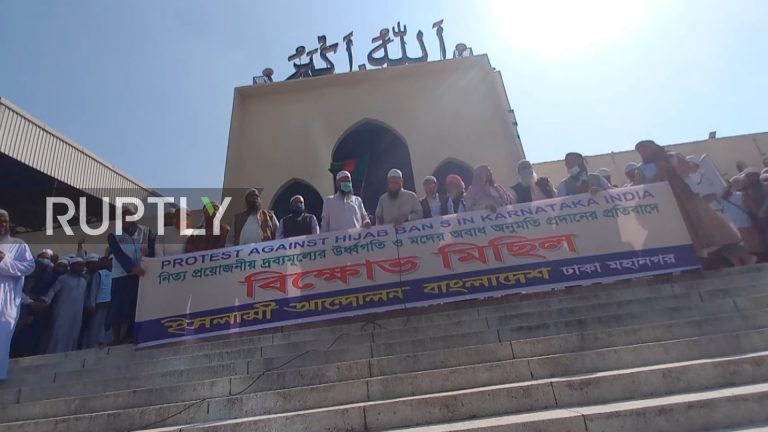
On Friday (February 18), radical Muslim mobs gathered in large numbers in Dhaka to protest against the ‘Hijab ban’ in Indian schools, reported Ruptly. They also protested against the rising price of commodities and large scale issuance of wine shop licences.

In a video shared by a Bangladeshi Twitter user, a large group of Muslims could be seen marching on the streets with placards while raising anti-India slogans. “The conspiracy about stopping education of Muslim girls in India should be stopped,” read one placard.

The mob, associated with the radical Islamist party Islami Andolan Bangladesh, also raised slogans of ‘Allahu Akbar’ while they rallied in support of the hijab on the streets of Dhaka. While threatening Hindus living in Bangladesh, an Islamist warned that life would become miserable for Hindu women in the country.

“Not a single Bangladeshi Hindu woman come outside homes and walk on the street with a religious symbol like Shaka, Sindoor…,” he threatened. The Islamist received overwhelming support from the Muslim mob standing in his vicinity.

Earlier on February 9 this year, the Islami Chhatra Andolan Bangladesh had staged a protest in Dhaka against the refusal of permission to some female Muslim students to attend classes in hijab in Udupi town of Karnataka.

A similar protest march was conducted by the Muslim women associated with the Bangladeshi Islami Mahila Majlis in Dhaka on February 10. “Wearing Hijab is a religious right of Muslim women,” read a banner carried by the Burqa-clad protestors.

Jamaat-e-Islami women in Pakistan extend support to hijabi girls in Karnataka

On February 10, 100s of Pakistani women, who are associated with Jamaat-e-Islami, rallied in support of the ‘right to wear hijab in schools’ of India. They held placards that read, “Hijab is our right”, “Modi Stop Terrorism” and “Why is the world silent on this extremism?”

“We salute the courage and bravery of our Muslim daughter Muskan Khan. She chanted the slogan of ‘Allahu Akbar’. She declared that Muslims would not allow our values to be infringed under any circumstances,” remarked a JeI protestor.

Another niqab-clad female protestor said, “We demand from the government of India, which has a secular constitution to allow Muslim citizens, women and girls, to live according to their culture and values.” One Jamaat-e-Islami agitator drew false equivalences with the Hindu way of life to claim that girls should be allowed to wear hijab in schools.

Besides protests in Karachi, Islamists also burnt the effigy of Indian Prime Minister Narendra Modi in Lahore city and demanded that Muslim girls be allowed to wear hijab to schools.

Relatives of Ahmedabad bomb blast convicts seen campaigning with SP chief, alleges UP CM Yogi Adityanath

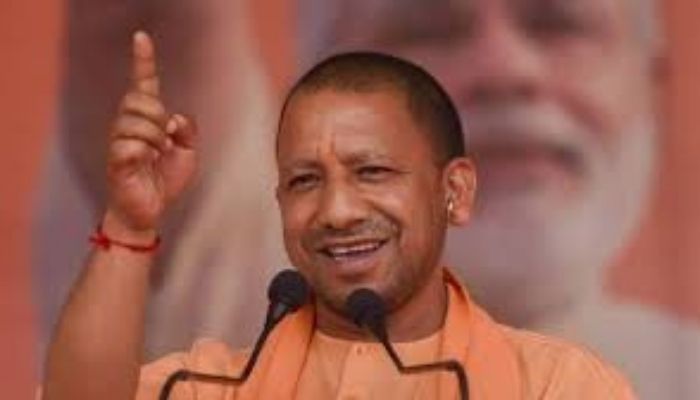
UP CM Yogi Adityanath has alleged in an election campaign rally at Plibhit in Uttar Pradesh that the relatives of the convicts in the Ahmedabad bomb blast case are seen campaigning with SP chief Akhilesh Yadav. This statement by Yogi Adityanath has come days before the third phase of the ongoing assembly elections in Uttar Pradesh.

Yogi Adityanath, during his address at a public meeting in Bisalpur of Pilibhit, said, “You can imagine. There is a new wave, but the SP is the same as before. SP is standing by the terrorists. This has been seen once again.” Yogi Adityanath also mentioned the verdict given by an Ahmedabad court in the 13-year old case of serial bomb blasts in Ahmedabad that took place in 2008.

Yogi Adityanath said “Capital punishment and life imprisonments were awarded. The convicts included some terrorists from UP too. The family members of one of them were seen with the SP chief asking for votes for the party.”

Comparing the rule of previous governments with the current BJP government he said “In the SP and BSP regimes, even electricity had a specific religion. There used to be an uninterrupted power supply on the occasion of Eid and Muharram. On the other hand, Holi and Deepawali used to witness frequent power cuts. This is not the case in the BJP government. Electricity in the BJP rule has no religion. It is supplied without any interruption to everyone.”

Yogi Adityanath also promised a medical college at Pilibhit. Polling for the third phase of the elections will take place on 20th February 2022. 59 seats from 16 districts are covered in this phase. The counting of votes will take place on 10th March 2022.

It is worth noting that Md Saif, son of SP leader Shadab Ahmed, was one of the convicts in the Ahmedabad bomb blast case. He was arrested in September 2008 following the blasts in July that year. Saif was nabbed from Delhi’s Jamia Nagar where he was staying at that time. His roommates Atif and Sajid were killed in a police shootout when they had tried to flee, while Saif was injured. After the arrest, Shadab Ahmed had said that his son had told him that he was doing an English speaking course in Delhi.

Ahmedabad Bomb Blast verdict: 38 convicts awarded death sentence, 11 others get life imprisonment

A special court in Ahmedabad announced the sentences in the 2008 Ahmedabad bomb blast case on Friday 18th February 2022. In the verdict, the court has awarded death sentences to as many as 38 convicts out of the 49 accused who were convicted in this case, while the remaining 11 have been sentenced to life imprisonment until death. Earlier on 8th February 2022, the court had convicted 49 out of 77 accused in the case. The serial bomb blasts that took place in Ahmedabad on 26th July 2008 had caused 56 deaths and 243 innocent citizens were injured in the blasts.

On 26th July 2008, 20 serial bomb blasts had left the city of Ahmedabad in shock. The haunting memories of this terror attack still leave the people in a trauma-like situation. Within three weeks of the attack, major arrests, in this case, had taken place owing to the coordinated efforts of the Gujarat police and the ATS. A big network of the Indian Mujahidin terrorists was exposed. These terrorists were also involved in the bomb blasts in other cities of the country. Then Gujarat CM Narendra Modi had extended every possible support to the investigating officers in order to ensure that a strong case is built against the terrorists.

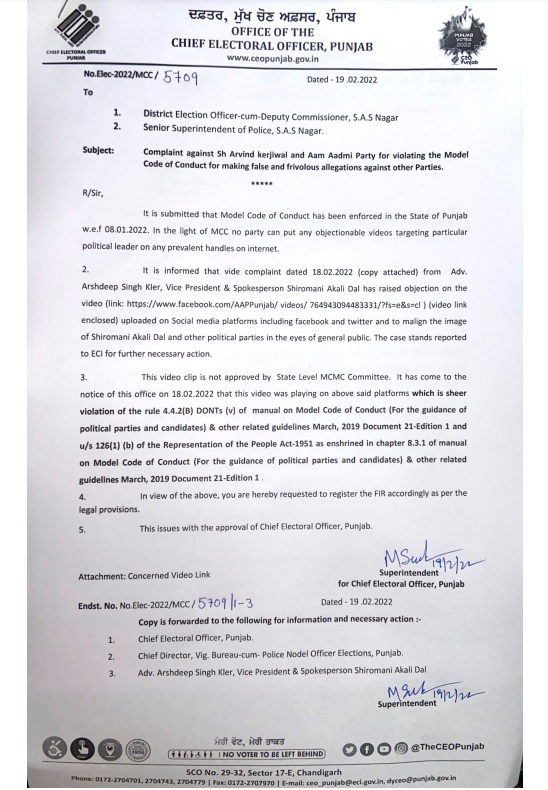
‘Sheer violation of rule’: EC asks Punjab police to register FIR against Arvind Kejriwal for violating model code of conduct

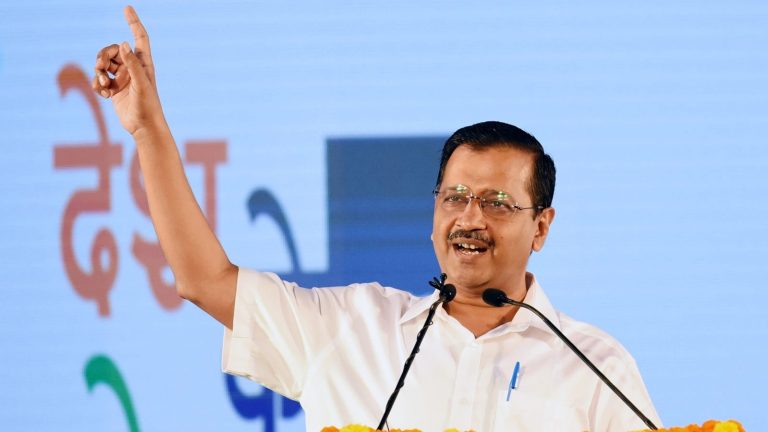
The ongoing Punjab assembly elections have taken a dramatic turn after the Chief Electoral Officer of Punjab requested the senior superintendent of police Sahibjada Ajit Singh Nagar to register an FIR against AAP convenor and Delhi CM Arvind Kejriwal for violating the model code of conduct and making frivolous allegations against other parties. This request was sent through a letter dated 19th February 2022. The Chief Electoral Officer has taken this step in response to a complaint raised by the Shiromani Akali Dal on 18th February 2022.

The letter by the Chief Electoral Commission to the police officials.

According to the copy of the letter posted by ANI, the state election commission has directed the Mohali administration to file a case against Delhi CM Arvind Kejriwal for violating the guidelines of the election commission. Kejriwal had released a video in which he had thrown allegations against Sukhbir Singh Badal’s party Shiromani Akali Dal. The Chief Electoral Officer of Punjab has informed that the clip was not approved by the state-level media certification and monitoring committee.

The CEO in the letter said that the video was ‘sheer violation of the rule 4.4.2(B) DONT’s (v) of manual on Model Code of Conduct’ and other related guidelines. Therefore, the EC official requested the SSP of SAS Nagar to register the FIR as per legal provisions.

The video uploaded on the Facebook account of AAP Punjab, URL (https://www.facebook.com/AAPPunjab/videos/4737478313015438) of which has been mentioned by the EC in the letter, has been removed by AAP Punjab now.

Earlier, Shiromani Akali Dal had objected to the video appeal of Kejriwal addressed to Akali Dal voters. The party had then filed a complaint with Punjab’s Chief Electoral Officer against Arvind Kejriwal. Advocate Arshdeep Singh Kler is the vice president and the spokesperson of the party. He had registered a complaint on 18th February 2022.

Video appeal by Arvind Kejriwal released on 18th February 2022

The party had said “Arvind Kejriwal released a video message making an appeal to the voters of Shiromani Akali Dal to vote for AAP on the basis of unsubstantiated, false and frivolous claims misleading the people of Punjab. Shiromani Akali Dal strictly objects to such malicious and immoral tactics which are against the spirit of the Model Code of Conduct which provides a level playing field to all political parties.”

Party had also cited the case of Bikram Singh Majithia and said that Kejriwal keeps alleging other leaders and parties and then furnishes an apology.

Indore municipal official who was assaulted by BJP MLA Akash Vijayvargiya with a cricket bat takes U-turn in court, says he does not know who had hit him

0

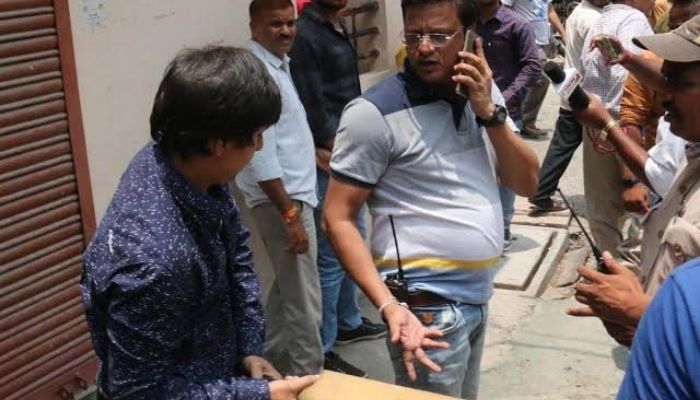
Three years after an Indore municipal corporation was beaten in front of the public by BJP MLA Akash Vijayvargiya using a cricket bat, the official has turned hostile in court, saying he does not know who had hit him. According to reports, the official Dhirendra Byas has now told the Indore district court that he does not recognise the person who had assaulted him.

On 18th February 2022, he told the court that he was talking on the mobile phone when the incident happened, and he didn’t see the attacker. Earlier, he had named Akash Vijayvargiya in his complaint as the attacker.

He further said as he was assaulted from his backside, he does not know who exactly was the one to hit him. He also said that when he turned back, he had seen three-four people holding bats in their hands and he had then named Akash Vijayvargiya in his complaint as he was also holding a cricket bat in his hands. The court will hear this matter next on 25th February 2022.

It may be noted that the incident was caught on camera, where BJP MLA Akash Vijayvargiya was seen assaulting Dhirendra Byas with a cricket bat. He was arrested following the incident, and a case was registered against him.

Akash Vijayvargiya had a fight of words with the municipal corporation officials of Indore over razing down an old building in the Ganji Compound area of Indore. He had hit the then corporation officer Dheerendra Bais with a cricket bat. Akash Vijayvargiya was arrested in this incident that took place on 26th June 2019. Till now this matter was being heard in a special court at Bhopal. Now that a special court has been formed in Indore in this regard, the statement recorded by the complainant officer Dheerendra Bais was cross-examined.

Senior lawyer Avinash Sirpurkar representing the BJP MLA in this case has informed that the complainant has told the judge that there were more than a hundred people when he had reached on the spot to raze the building. After 15 minutes, Akash Vijayvargiya had arrived there.

Reportedly, Bais has told the judge that he was talking on the mobile phone when he was assaulted with a cricket bat from behind. Turning back, he saw three-four people holding cricket bats in their hands. Akash Vijayvargiya was one of them. He was also holding a bat in his hands. So, Bais named him in the complaint. Other witnesses will be cross-examined on 25th February 2022, said Sirpurkar.