Home Blog Page 3624

The Double Engine of Modi and Yogi governments have turned Uttar Pradesh into Expressway Pradesh: Here is how

Uttar Pradesh had essentially contributed to the states which would once be included in the word BIMARU which literally means sick. But in Indian polity, the word was used to imply how states of the Hindi heartland are underdeveloped and hence being an obstacle in national growth. This acronym was coined by Ashish Bose in the eighties. The word was popularly used to abbreviate Bihar, Madhya Pradesh, Rajasthan, and Uttar Pradesh. It must be noted that in the eighties and nineties when the word was most popular, Chhattisgarh, Uttarakhand, and Jharkhand were carved out of Madhya Pradesh, Uttar Pradesh, and Bihar respectively.

So this all put together is home to almost half of the Indian population which would then usually seek growth opportunities out of the states, especially in cities like Delhi or Mumbai. UP, even after the formation of Uttarakhand, has been the largest contributor to this so-called mess. But after Modi became the Prime Minister in 2014 and especially after Yogi joined him as the state CM in 2017, the situation has drastically changed. Uttar Pradesh is scripting an altogether different story of development and the road to glory the state is aspiring to reach is negotiated along the lengths and breadths of the iconic network of the expressways the Modi-Yogi duo is building in Uttar Pradesh, not to forget the special attention put in by Nitin Gadkari, the union minister for Road Transport and Highways.

Yogi’s UP : Road to Development

The state which was once ill known for its bad public services including basic infrastructures is changing very rapidly under the workaholic leadership of Yogi Adityanath. Of all the things Yogi had taken on priority since assuming the charge of the CM post, roadways top the chart. The state has now become the one to have the longest of the expressways and is now called Expressway Pradesh.

When Yogi Adityanath assumed the CM office, he had received in legacy from the former CM Akhilesh Yadav, an incomplete stretch of a highway between Agra and Lucknow which would connect the state capital to the Agra Delhi highway which is also known as the Yamuna Expressway, thereby connecting Lucknow to the National Capital Region via a rapid transport amenity. Yogi not only completed the remaining works of the 302KM long Agra Lucknow expressway but with the help of the BJP government in the center, he went on to add another 641KM of expressways in the state.

The network of the highways is spread such that no corner of the state remains remote for either the state capital or the national capital. The biggest state of the country now has the longest of the expressways. The highway web includes Yamuna Expressway, Agra Lucknow Expressway, Purvanchal Expressway, Bundelkhand Expressway, Gorakhpur Link Expressway, and coming soon is the grand Ganga Expressway. The tally comes to be around 1800KM and no other state has this much length of the expressways. Besides Yogi Adityanath government in the state is stepping ahead rapidly to complete its 15000KM rural road network project. With all the tehsil places already connected to a two-lane road, and rich water resources in the state, Uttar Pradesh attracting most of the FDIs has become more than obvious.

The Yamuna Expressway

In 2001, there was a BJP government in Uttar Pradesh. Current defence minister Rajnath Singh was the chief minister of the state in that government. This government led by Rajnath Singh came up with the idea of reducing travel time between Agra and Delhi. But the project could not start because of the frequent changes of the Uttar Pradesh state government till 2003. The project was reinitiated in 2007 when Mayawati became the chief minister of the state. It was scheduled to complete in 2010 but it took 2 years more than the scheduled time. It was completed in May 2012 and the then chief minister Akhilesh Yadav inaugurated it in August 2012. It is very important to revisit this whole timeline because what followed in the Yogi Adityanath government is very different than this. Yogi Adityanath government is paying keen attention to completing the projects within stipulated time periods. The budgets of the projects are also revised that too on the lower side saving the taxpayers’ hard-earned money. The project cost for Yamuna Expressway was Rs. 13000 Crores.

The Agra Lucknow Expressway

The 302KM long Agra Lucknow Expressway was built in Akhilesh Yadav’s tenure as the CM of the state. The foundation stone was laid in November 2014 while the expressway was opened for heavy vehicles in December 2016. Akhilesh Yadav had projected this highway as one of the major works his government had accomplished. But later when Yogi Adityanath became the chief minister he had pointed out the incomplete patches of the work. It was as late as January 2018 that the toll collection started on this road. The total cost of this project was Rs. 11526 Crore excluding the land costs. This expressway cut down the travel time between two cities from five and half hours to three hours. Due to this expressway, anyone in the state capital Lucknow could now reach Delhi within six hours, as from Agra, the Yamuna Expressway was already functional.

Barely after the four months of its inauguration, this work came under Yogi Adityanath’s scanner as there were some alleged irregularities in the land deals executed for this project in Akhilesh Yadav’s tenure. Farmlands were allegedly passed as lands for residential areas in order to get higher rates of compensation. Besides, accidents on this highway had tarnished the hype Akhilesh Yadav created about this road. Crash barriers were erected on one side of the road. After Yogi Adityanath became the CM when works for other new highways started, lacunae in this highway were also taken care of and crash barriers were added in the road divider also.

The Purvanchal Expressway

One of the major game-changers in both the politics and economy of Uttar Pradesh is the Purvanchal Expressway which is conceived, built, completed, opened to the public, and started to operate in Yogi Adityanath’s tenure. The longest expressway in the country is 340KM long and the total project cost is Rs. 22494 Crore. The foundation stone was laid down by PM Narendra Modi in July 2018. The construction work started in October 2018. The Purvanchal Expressway was opened for the public on 16th November 2021 when Prime Minister Narendra Modi inaugurated it.

This speed and scale of work have connected eastern parts of Uttar Pradesh straight to the National capital. The expressway stretches from Lucknow to Ghazipur. Its farthest end is in Hyderiya of Ghazipur district which is not too far from the Bihar border. The route of this expressway passes through Barabanki, Amethi, Sultanpur, Ayodhya, Ambedkar Nagar, Azamgarh, Mau, and Ghazipur. It must be noted that Rahul Gandhi once used to be the MP from the Amethi Lok Sabha constituency and Akhilesh Yadav is the incumbent MP from Azamgarh. Afzal Ansari, brother of notorious criminal Mukhtar Ansari is the current MP from Ghazipur. But the Purvanchal expressway is set to change the very identity of this region.
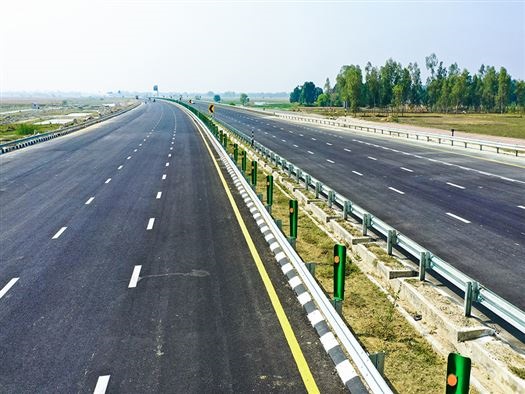
Purvanchal Expressway : Image Source https://upeida.up.gov.in/en

Earlier, it took 6 hours from Lucknow to reach Ghazipur. Now the time is reduced to 3 hours. The minimum tender for this project was 5.19% less than the actual estimated cost and this has benefitted the Uttar Pradesh Expressways and Industrial Development Authority (UPEIDA) with a profit of Rs 614 Crores. This expressway is set to bring the produce of the connected districts to cities like Lucknow and further send it easily to Delhi. The markets for raw goods will be connected to industries and thus, this highway will play a key role in boosting the economy of the state. This six-lane expressway is expandable into an eight-lane expressway.

The Gorakhpur Link Expressway

Yogi Adityanath had been the MP of Gorakhpur five times in a row from 1998 to 2017. He knows the challenges faced by the region very well. To connect the region with the mainstream developing areas of the state, he had conceived the idea of the Gorakhpur Link Expressway which connects four districts of eastern Uttar Pradesh to the iconic Purvanchal expressway. These four districts are Gorakhpur, Ambedkar Nagar, Azamgarh, and Sant Kabir Nagar. The actual construction of this highway started in February 2020 and it is scheduled to complete by the end of April 2022.

The Bundelkhand Expressway

Previous governments were very vocal about announcing various schemes for Bundelkhand but nothing great actually happened on the ground. No project made in Lucknow could reach Bundelkhand as reaching somewhere needs good road connectivity in the first place. The Bundelkhand expressway is a 296KM long project which starts at Bharatkoop in the Chitrakoot district and meets the Agra Lucknow expressway at Kudrail village in Etawah district. By this highway, the remotest part of Bundelkhand is now directly connected to Delhi. This four-lane expressway which is expandable into a six-lane expressway covers seven districts viz Chitrakoot, Banda, Mahoba, Hamirpur, Jalaun, Auraiya, and Etawah.

The transparent e-tendering process for this expressway has again benefitted UPEIDA as the minimum tender for the project has come down by about 12.72% from the estimated cost thereby saving Rs. 1132 Crores. The main carriageway of the expressway is opened in December 2021 and the expected time of completion of the project is March 2022.

The Ganga Expressway

The 594KM long Ganga expressway is Yogi Adityanath’s dream project. It starts in Meerut district and terminates at Prayagraj. It covers twelve districts viz Meerut, Hapur, Bulandshahar, Amroha, Sambhal, Badaun, Shahjahanpur, Hardoi, Unnao, Rae Bareli, Pratapgarh, and Prayagraj. It will be a six-lane highway which can further be converted into an eight-lane highway. More than 60% of the land for this expressway has been acquired and the bid for this project will soon take place.

Uttar Pradesh is now The Expressway Pradesh

Inaugurated in 2018, the ‘Agra Lucknow Expressway’, recently completed 340KM long Purvanchal the upcoming 296 km long ‘Bundelkhand Expressway’, 91 km long ‘Gorakhpur Link Expressway’ and 594 km long ‘Ganga Expressway’ will change the entire picture of Uttar Pradesh. After completion of all these, a network of 1788 km long expressway will be laid in Uttar Pradesh, whereas at present a network of 2049 km expressway is laid all over India. So Uttar Pradesh in true sense will soon become the Expressway Pradesh of India.

Rural Connectivity

It is not that roads are being built only in big cities or expressways are being built to show the world. Yogi Adityanath’s government has so far constructed 15,000 km of roads in rural areas only. The work of strengthening connectivity and infrastructure is going on more rapidly in the villages. The construction of 15,246 km of roads in 5 years breaks the records of all the previous governments. Tehsil and block level offices are being connected by wide two-lane roads. This is also benefiting the farmers, who can travel far and wide with their produce. The common people also benefit by connecting the villages with the cities through good roads.

The Yogi government has identified 1557 ‘revenue villages’ and to connect them with cities, 1763 km of roads are being constructed for Rs 1114 crore. So far 1546 ‘revenue villages’ have been connected through 1740.24 km of roads. Also, 1717 villages have been connected with major highways through 2173.60 km of roads by spending Rs 1407 crore.

Apart from this, 33 ‘revenue villages’ have been connected by spending Rs 14.35 crore by constructing 29 km of roads under ‘Mukhyamantri Samagra Gram Vikas Yojana’. There were 26 such tehsil headquarters that were not connected by two-lane roads. For this, 270 km of roads were built and Rs 387 crore was spent on it. Similarly, 144 block headquarters are being connected through roads of 1282 km, in which Rs 2088 crore is being spent. Pothole free roads are Yogi’s mantra to ensure the quality of the work being done.

The Impact of the roadways development

The very first tangible benefit of all these roadways projects to the people of Uttar Pradesh is the reduction in travel time and savings of precious fuels. All the districts on average need three hours less to reach Lucknow than the time it took earlier. The remotest parts like Ghazipur and Chitrakoot are also directly linked to the national capital through a series of expressways. The roads are a boon to the agro products as the agro products, in general, have a lower shelf life and these products can now reach the market before getting perished.

Uttar Pradesh Expressways and Industrial Development Authority is focussing to connect all the projected industrial clusters through the roadways network which will connect the raw material producers, process manufacturers and markets with each other. This is why Uttar Pradesh is attracting record FDIs ensuring industrial development in the state. Real estate prices in the areas near the highways are already shooting up. Auraiya has an NTPC power plant and GAIL’s gas-based petrochemical complex, which will benefit from the commissioning of ‘Bundelkhand Expressway’

The road connectivity will bolster the other development projects in the state such as new medical colleges, AIIMS and weapon factories which are to be set up in the Defense Corridor planned to be built in the state. The expressways built in Yogi Adityanath’s tenure cover more than thirty districts of the state. The state government has undertaken the initiative of one district one product. By this initiative, one special local product from every district will be patronized and promoted by the government. Roadways connectivity is a key step in order to make these special local products popular in the outer markets.

The terminal end of the Purvanchal expressway is at a distance of 18KM from the Bihar border. With the Bihar government extending their highways network to the state border, Lucknow and Patna can soon be connected with expressways. Therefore these expressways are connecting Bihar with Delhi through state of the art rapid transport amenities. Development projects and highways made in the BSP and SP governments were mostly centred in the western UP. But Yogi Adityanath’s government has ensured that Purvanchal and Bundelkhand come into the mainstream development. The Ganga Expressway when completed will become the heartline of the state as it will be built at a distance of 10KM from the banks of river Ganga which gives a strong backup to the waterways within the state.

Uttar Pradesh has been the house for many places of dharmik and spiritual importance. Taking this into consideration, railways have already started projects like Ramayana Express which received a very good response from the pilgrims. Similarly UP tourism department is focussing on Ramayana Circuit and Buddha Circuit for tourism. Road connectivity is a major boost for these initiatives.

Committed Leadership

Along with the state chief minister Yogi Adityanath, the whole central government has been very keenly interested when it comes to developing Uttar Pradesh. So far the development of the roadway is concerned, Nitin Gadkari, Union Minister for Highways Development and Transport, has said that in the coming future, roads in Uttar Pradesh will compete with those in America. This comparison by the minister who has so far walked his talk holds more importance in the times when Congress leaders are still seen promising of the roads smoother than the cheeks of film actresses. Gadkari has said that his department has already spent a fund of Rs. 3 Lakh crores for roads in UP and they are looking forward to spending Rs. 5 Lakh crore more for the upcoming development projects.

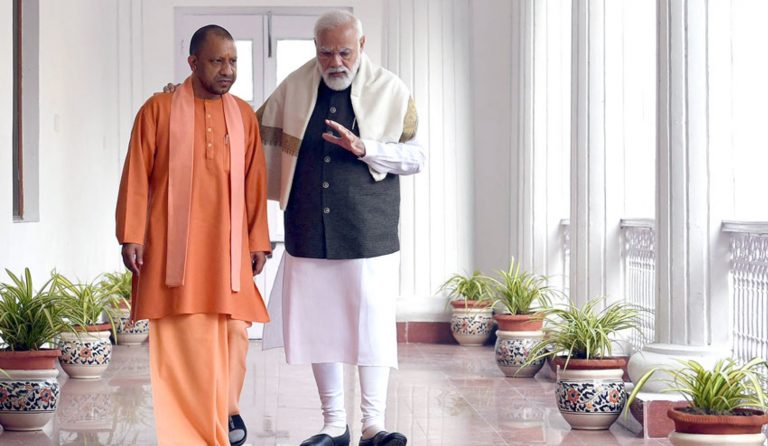
PM Narendra Modi who had rallied in Uttar Pradesh in the last month for inaugurating various projects and laying foundation stones of different upcoming projects has shown his full faith in the state leadership especially the chief minister Yogi Adityanath on various occasions. His whole focus has been to explain to the people of Uttar Pradesh the benefits they are getting from what he calls the double engine government that is a BJP government both in the state and the centre.

Uttar Pradesh is all set to play a major role in Narendra Modi’s New India.
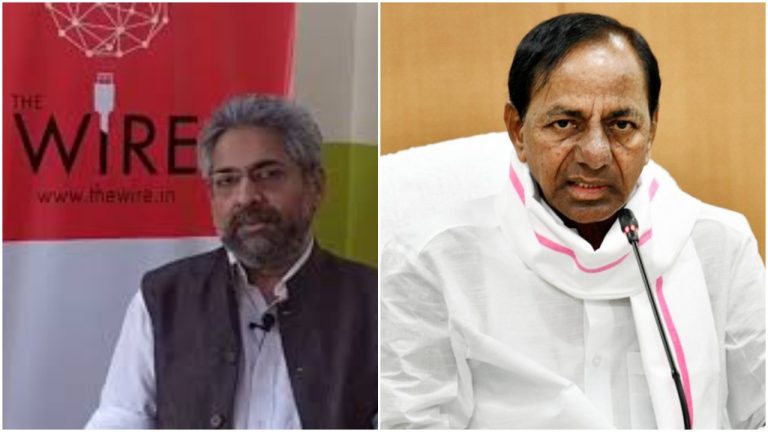
Telangana institute headed by CM KCR invites Wire’s Siddharth Varadarajan, who had sought US sanctions against India, to ‘train’ officers

Dr Marri Channa Reddy (MCR) HRD Institute Hyderabad, an institute headed by the Telangana CM K Chandrasekhara Rao has launched a special foundation course for All India Services and Central Civil Services officers. The institute has invited American citizen Siddharth Varadarajan, the founding editor of the left-wing propaganda portal The Wire who wanted the US to put sanctions against India as one of its guest lecturers.

Netizens have been criticising the Telangana government-run institute’s panel selection for the course, which will begin on January 17, 2022, and run until April 28, 2022. A user shared the event schedule to highlight how the Telangana institute which is headed by the CM himself has invited Siddharth Varadarajan “who runs propaganda against India and Hindu” in the central Training Program for IPS/IFoS and other civil servants.

Tagging Dr Jitendra Singh, the Minister of State for the Ministry of Science and Technology, Union Home Minister Amit Shah and the Department of Personnel & Training in his Tweet, the user raised concerns on how a govt aided institute was encouraging the anti-India propagandist by including him in the panel.

Siddharth Varadarajan has responded to the Twitter users and has been gloating over the invitation.

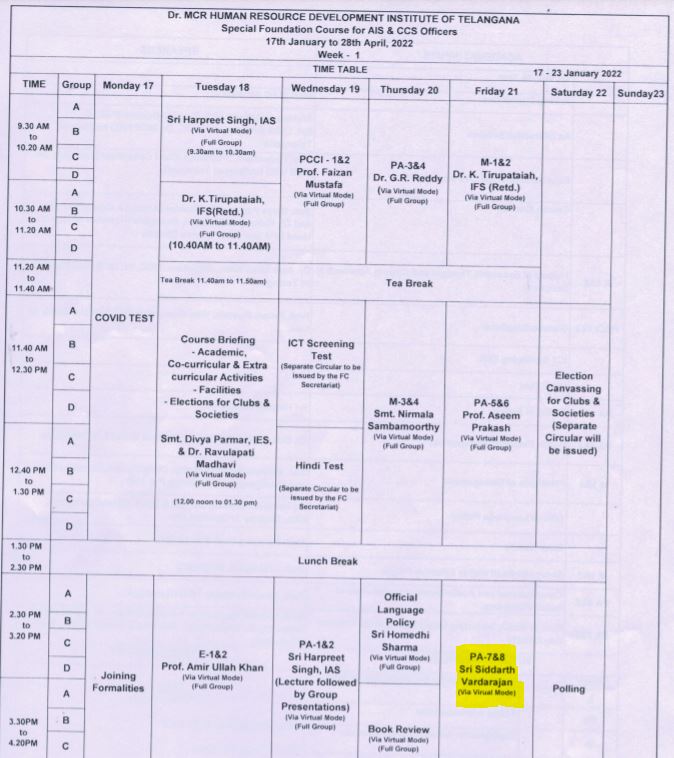
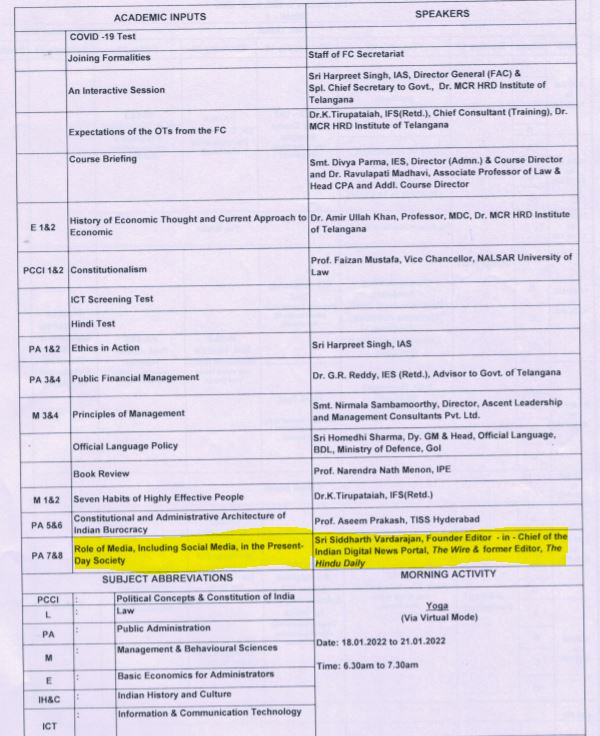
A closer look at the event schedule of the first week reveals that the Telangana institute has invited the far-left Siddharth Varadarajan on January 21 to address the trainees. He will be speaking virtually on the ‘role of media, including social media in present-day society.’

The Week-1 event schedule being conducted by the Dr Marri Channa Reddy (MCR) HRD institute Telangana

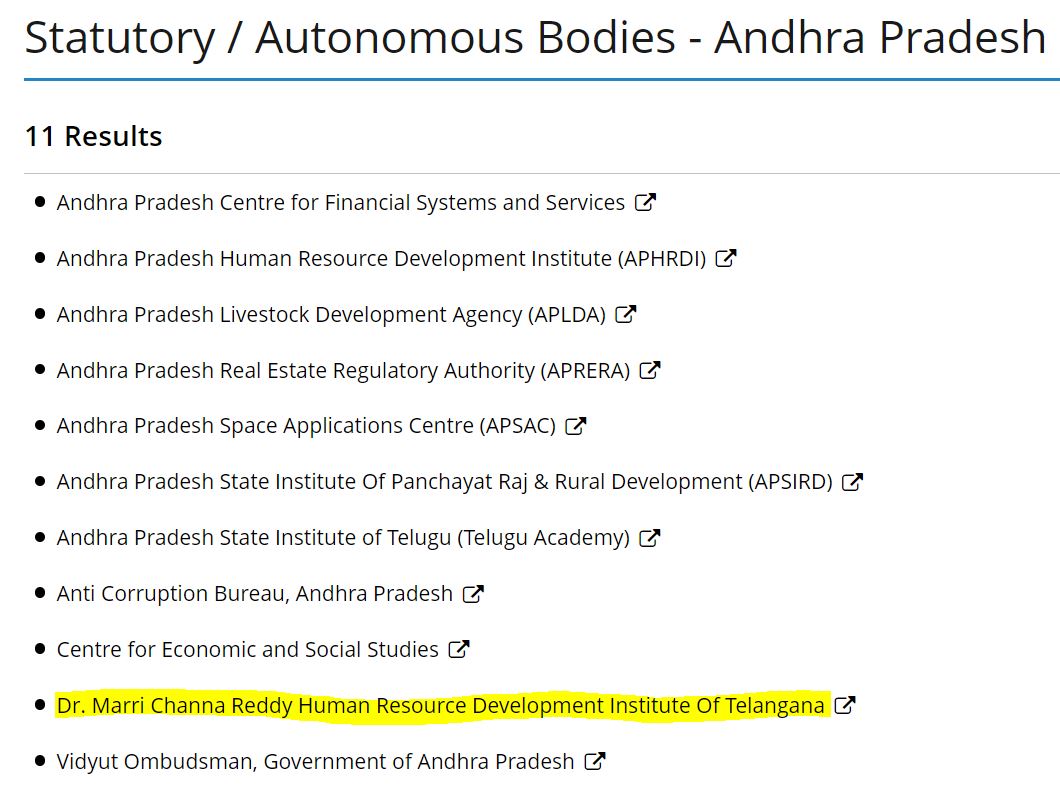
Dr Marri Channa Reddy (MCR) HRD Institute Hyderabad is also one of the 11 Statutory/Autonomous bodies of Andhra Pradesh.

The official website of the institute, states that the Government of Andhra Pradesh had established the Institute as Institute of Administration (IOA) in the year 1976 to cater to the training needs of the State Government Officials. The nomenclature of the Institute has been changed twice so far. In the first instance, in the year 1997, the Institute of Administration was re-named as Dr M Channa Reddy Institute of Administration. Later, in 1998, it was again re-christened as Dr Marri Channa Reddy Human Resource Development Institute of Andhra Pradesh.

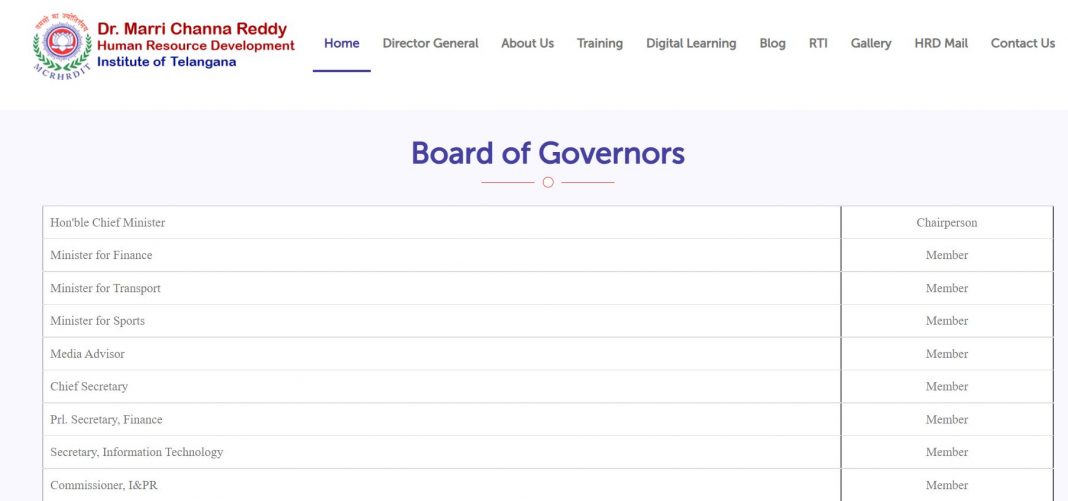
Telangana Chief Minister K Chandrashekar Rao is the institute’s chairperson. Other members of the board of governors include the state’s finance, transportation, and sports ministers, as well as a number of other state officials.

Dr M Channa Reddy Institute of HRD is headed by the Telangana CM

It is notable here that The Wire’s founder Siddharth Varadarajan is a habitual fake news peddler and is often found sharing misinformation and toxic biased views against India.

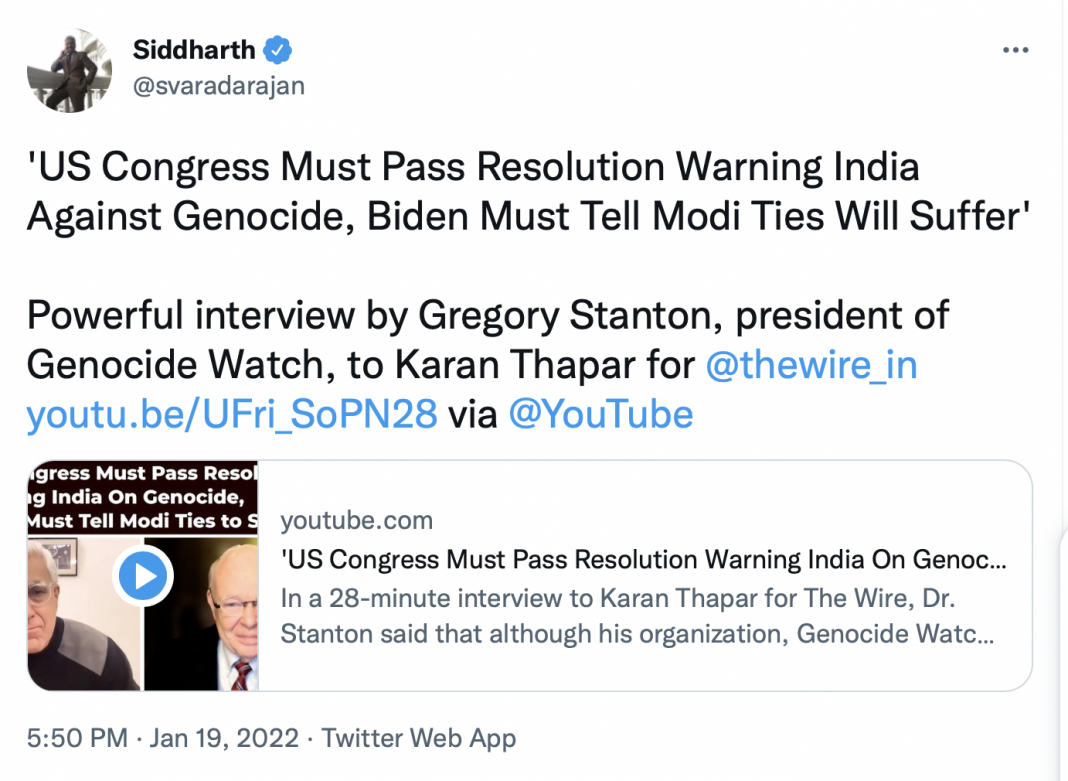
Recently, sharing an interview by Gregory Stanton, president of ‘Genocide Watch’, to Karan Thapar for The Wire, the founding editor of the leftist propaganda website had openly asked the US to place sanctions on India. ‘US Congress Must Pass Resolution Warning India Against Genocide, Biden Must Tell Modi Ties Will Suffer’, Siddharth Varadarajan had Tweeted.

Varadarajan’s tweet endorsing sanctions against India

Siddharth Varadarajan, fake news and his previous run-ins with the Uttar Pradesh government

In April last year, The Wire Founder-Editor had mischievously latched on to the same fake news that the ‘Logical Indians’ handle had apologised for just a day ago, in his attempt to malign the Kumbh Mela. Interestingly, even after The Logical Indian apologised for spreading fake news, Siddharth Varadarajan took to Twitter to spread the same fake news and even demand that other media houses join in.

In January 2021, a complaint was registered in Uttar Pradesh against The Wire Editor Siddharth Varadarajan for publishing and circulating false propaganda with intent to cause violence after he had tweeted an article void of any facts pertaining to the death of a rioter during the tractor rally.

The complaint was registered against Varadarajan under Section 153B and  505 of the IPC in Rampur police station for trying to instigate the crowd by peddling false information about the death of a rioter named Navreet Singh, who had died during the tractor rally after his tractor turtled.

In fact, after the FIR was filed against Siddharth Varadarajan for spreading fake news in a bid to shield the Tablighi Jamaat, several ‘liberals’ had come out to cry Freedom of Expression and even threatened the Yogi Adityanath government with USA pressure to ensure that the case against Varadarajan was withdrawn.

In April 2020, two FIRs had been registered against The Wire Founder-Editor Siddharth Varadarajan for spreading fake news against Uttar Pradesh Chief Minister Yogi Adityanath. Varadarajan, in a bid to whitewash the deeds of Tablighi Jamaat, had wrongly attributed a fake quote to the UP CM. 

Mrityunjay Kumar, the media advisor to the Uttar Pradesh Chief Minister, had informed that despite the warning from the state government, Varadarajan neither deleted the false article and nor apologised for the same. Therefore, an FIR had been registered against him.

PM Modi tops the list of world leaders, bags highest approval rating of 71%: Read full details

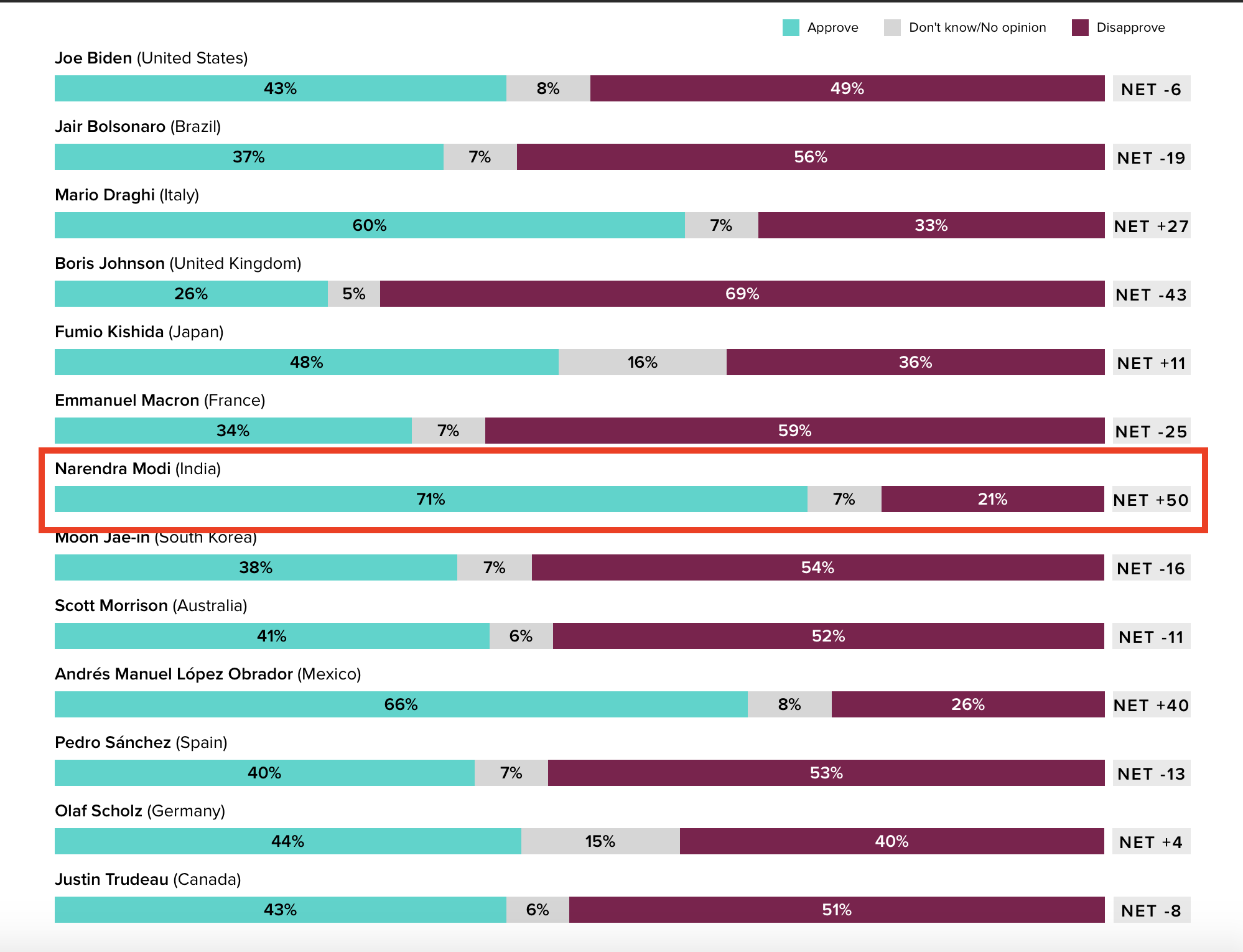
On 21st January 2022, Morning Consult Political Intelligence, a US-based data intelligence company, reported that Indian Prime Minister Narendra Modi’s approval rating is the highest among world leaders. The approval rating chart by Morning Consult conducted this survey for 11 world leaders, including PM Narendra Modi, President Joe Biden and others. According to Morning Consult, PM Modi has an approval rating of 71%.

Morning Consult approval rating

According to the list of 11 world leaders surveyed by Morning Consult, PM Modi has the highest approval rating of 71%.

A distant second in approval ratings was Andres Manuel Lopez Obrador, the President of Mexico, with an approval rating of 66%. Third in that list was Mario Draghi, the Prime Minister of Italy, with an approval rating of 60%.

Interestingly, President Joe Biden of USA had an approval rating of only 43%.

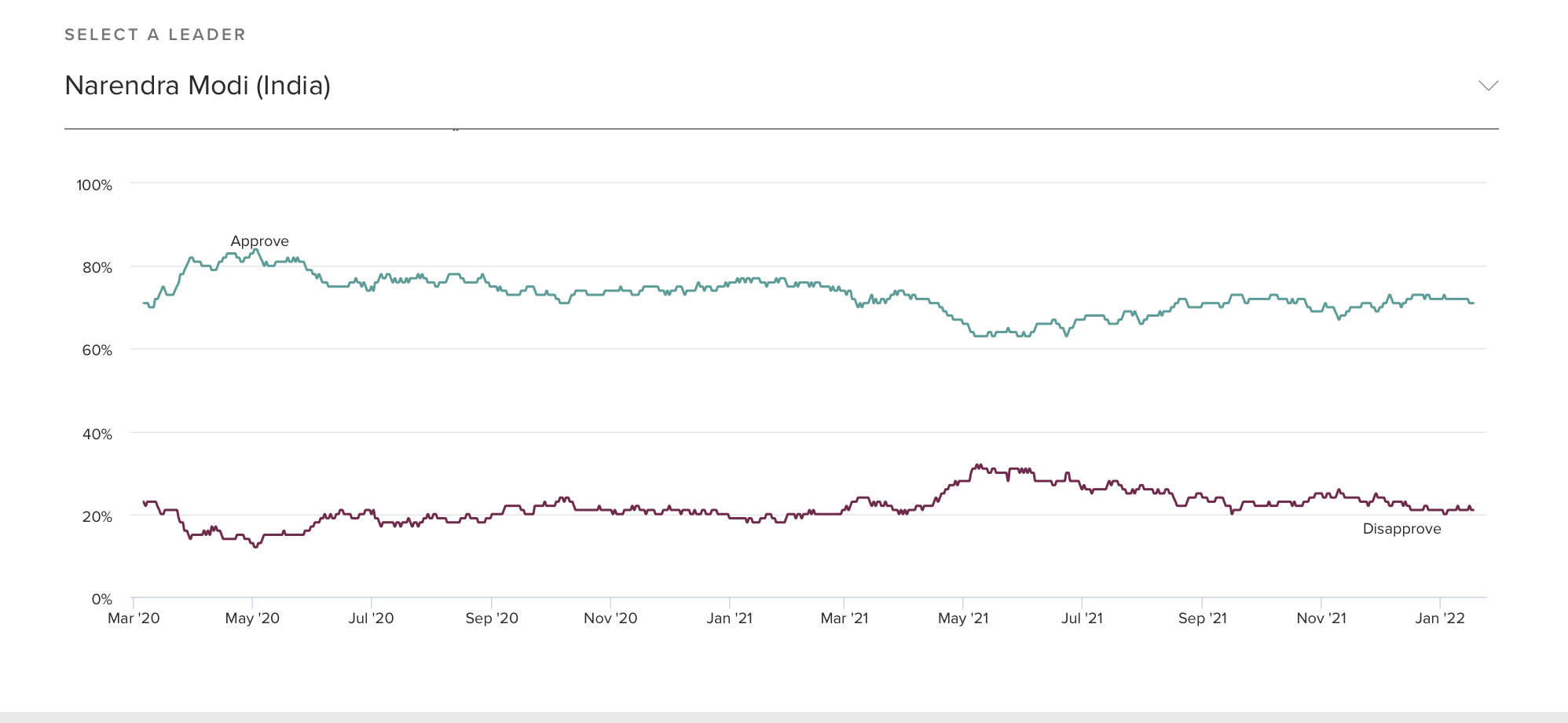
According to the graph of PM Modi’s approval rating historically, he was at his lowest in June 2020 when it was at 63%, still higher than other world leaders.

Morning Consult approval rating graph of PM Modi

“The latest approval rating is based on data collected from January 13 to 19, 2022. Approval ratings are based on a seven-day moving average or adult residents in each country, with sample sizes varying” by the demographic,” Morning Consult Political Intelligence mentioned on its website while explaining the process of voting the most popular political leader. It is pertinent to mention that this is not the first time PM Modi was voted the most popular leader. In May 2020, he topped the list with 84% popularity. However, in May 2021, the approval rating dipped to 63%. Although, in September 2021, PM Modi was again ranked the most approved global leader.

According to Morning Consult, they conduct more than 11,000 daily interviews globally about leadership approval. They also daily interview 4,000 registered voters in the US for the approval rating of the US president. Daily global survey data is based on a 7-day moving average of all adults in a given country with a margin of error of between +/- 1-3%.

Evangelist and founder of Global Peace Initiative KA Paul approaches Supreme Court against Centre cancelling FCRA registrations of NGOs

The Supreme Court agreed to hear a case on Thursday seeking the quashing of the Centre’s orders refusing to renew or revoke FCRA registration of various NGOs who failed to justify their donations. Kilari Anand Paul, an Indian Evangelist based in the United States, has made the appeal.

The case filed by US-based NGO Global Peace Initiative, headed by Kilari Anand Paul, is scheduled for hearing on January 24 by a bench consisting of Justices AM Khanwilkar and Dinesh Maheshwari.

The plea asks the Supreme Court to urge the Central government to exempt ‘humanitarian’ organisations from the purview of FCRA.

Kilari Anand Paul’s NGO argued before the Supreme Court that NGOs played a critical role in reaching out to people and assisting the country during the Covid pandemic and that suspending the licenses of nearly 6000 NGOs at this time would thwart relief efforts and result in the neglect of aid to poor and needy.

“List this matter on January 24 2022, before the appropriate Bench. As prayed, liberty is granted to serve advance copy of petition on the Standing Counsel for the Central Agency,” according to reports, the bench remarked.

Advocates Sanjay Hegde and Pranjal Kishore are representing Killari Anand Paul.

Who is Kilari Anand Paul?

Kilari Anand Paul is an Indian evangelist and the founder of the Global Peace Initiative and Gospel to the Unreached Millions, both based in the United States. He has also run orphanages, notably Charity City in Hyderabad.

The Global Peace Initiative claims to be working for a more sustainable and peaceful world, whereas Gospel to the Unreached Millions claims to be preaching the gospel of Jesus around the world, assisting orphans and widows, training youth to be Christ, and peace missionaries, and instituting missions around the world. Preaching the gospel and the message of peace through peace rallies, schools, training centers, and weekly television, especially in developing nations, is the stated goal of the Gospel to the Unreached Millions.

There were cases filed against Gospel to the Unreached Millions for misappropriation of donations back in 2010-2012. Anand, Kilari Paul was also detained in May 2012 in Ongole, Prakasam district, on charges of planning to murder a person. According to reports, Paul planned to kill one Koteswara Rao, who was a suspect in the February 2010 murder of Paul’s brother David Raju in Mahbubnagar’s Addakula district. Paul was charged with criminal conspiracy to abduct under articles 120B and 307 (Attempt to Murder) of the Indian Penal Code.

Cancellation of FCRA Licences of NGOs

After failing to file for renewal of their Foreign Contribution (Regulation) Act (FCRA) license, over 6,000 non-governmental organizations (NGOs) lost their license on January 1, 2022.

As of January 1, 2022, there were 16,829 active or living NGOs registered under the FCRA, down from 22,762 a day before. According to the official website, 12,580 NGOs are judged to have halted or expired due to the expiration of their certificate’s validity. The NGOs lost their FCRA registration because they neglected to file for renewal, according to a source quoted by Times of India’s Bharti Jain.

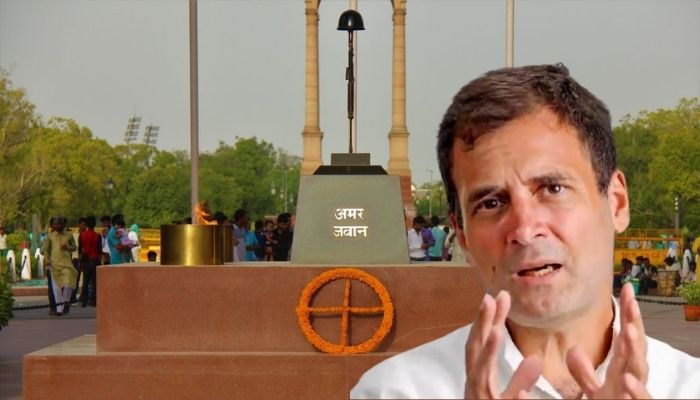
Rahul Gandhi claims the Modi government will extinguish the flame at ‘Amar Jawan Jyoti’: Here is why he is wrong

On Friday (January 21), Congress scion Rahul Gandhi took to Twitter to peddle misinformation about the eternal fire of ‘Amar Jawan Jyoti’ that has been burning for over 50 years at the India Gate.

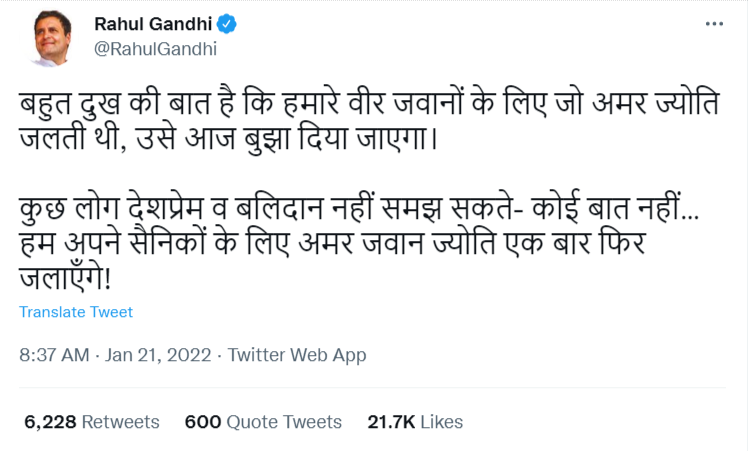
In a tweet, Rahul Gandhi alleged, “It is a matter of grief that the light of Amar Jawan Jyoti will be extinguished today. Some people will never understand the concept of patriotism and supreme sacrifice. Never mind. We will once again light the Amar Jawan Jyoti in memory of our brave soldiers.”

Screengrab of the tweet by Rahul Gandhi

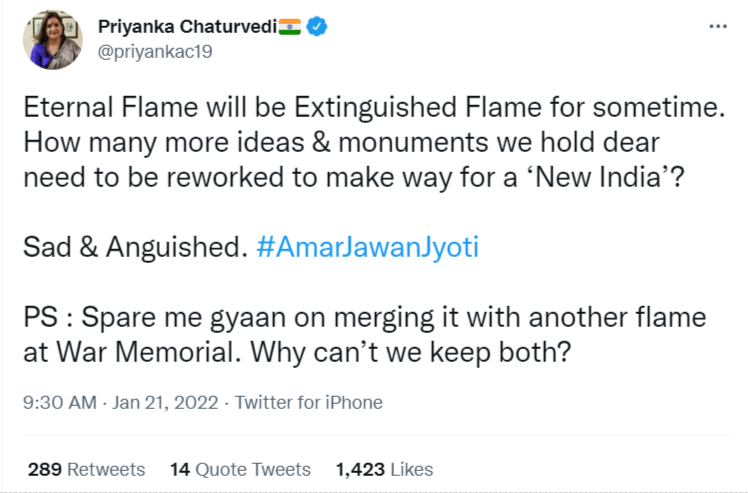
Shiv Sena, an ally of the Congress party in the Maha Vikas Aghadi government, also cast aspersions about the fate of Amar Jawan Jyoti. In a tweet, Sena leader Priyanka Chaturvedi claimed, “Eternal Flame will be Extinguished Flame for sometime. How many more ideas & monuments we hold dear need to be reworked to make way for a ‘New India’? Sad & Anguished. #AmarJawanJyoti. PS : Spare me gyaan on merging it with another flame at War Memorial. Why can’t we keep both?”

Screengrab of the tweet by Priyanka Chaturvedi

It must be mentioned that the India Gate was unveiled by the British government on February 12, 1931, to pay tribute to the 70,000 soldiers of the British Indian Army, who died between 1914-1921. Following the India-Pakistan war of 1971, the Indira Gandhi government placed the Amar Jawan Jyoti at the India Gate.

Indian government debunked fake claims by Rahul Gandhi

After Rahul Gandhi alleged that the Modi government would extinguish the eternal fire of Amar Jawan Jyoti, sources in the government dismissed the outrageous claims of Congress scion and his stooges. While speaking to DD News, a source informed, “There is a lot of misinformation circulating regarding the flame of the #AmarJawanJyoti The flame of the Amar Jawan Jyoti is not being extinguished. It is being merged with the flame at the #National War Memorial.”

The source further stated, “The names inscribed on the India Gate are of only some martyrs who fought for the British in the World War 1 & the Anglo Afghan War & thus is a symbol of our colonial past. The names of all Indian martyrs from all the wars, including 1971 and wars before and after it are housed at the National War Memorial. Hence it is a true shraddhanjali to have the flame paying tribute to martyrs there.”

Retired Army General Satish Dua, who was part of the design selection and construction process of the National War Memorial (NWM), has been a strong proponent of the merger of the eternal flames of India Gate and NWM.

He added, “India Gate is a memorial to the fallen heroes of First World War. The Amar Jawan Jyoti was added in 1972 as we did not have another memorial. National War Memorial pays homage to the fallen Bravehearts after independence. All homage ceremonies had shifted to NWM already.”

After a long wait and failure of previous governments, the Narendra Modi government constructed the National War Memorial near the India Gate complex. Inaugurated in February 2019, the memorial pays tribute to more than 22,500 Indian soldiers who were martyred following India’s Independence.

Ever since the opening of the national war memorial, all military ceremonial events have been shifted to it from India Gate. For example, on every Republic Day, the Prime Minister, the President, and the three service staff chiefs used to a place wreath at Amar Jawan Jyoti and pay homage to the dead and unknown soldiers.

However, from 2020 onward, the wreath is placed at the National War Memorial instead of Amar Jawan Jyoti. The service chiefs also visit the new memorial on their respective Service Days to pay tribute to the fallen soldiers. As such, it made sense to merge the eternal fire of NWM and India Gate.

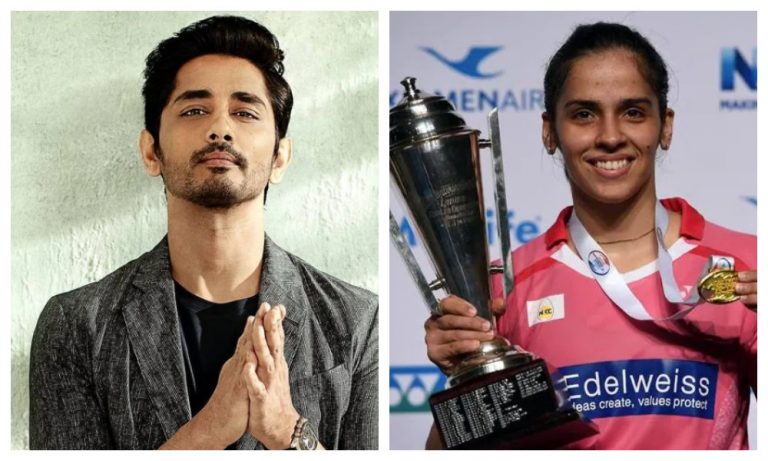
Chennai Police summons actor Siddharth for his crass sexual comments on Saina Nehwal

On Thursday, the Chennai Police summoned actor Siddharth for his derogatory tweet on badminton champion Saina Nehwal after receiving two complaints against the actor in this regard. Chennai Police Commissioner Shankar Jiwal informed that referring to the complaints filed in Hyderabad, action can be taken only for defamation, no criminal action is viable against him.

“We have issued summon to actor Siddharth to record his statement”, Jiwal added. He added that two complaints have been received against the actor for his controversial comments and one is defamation in a legal frame, not a criminal case.

On January 12, the Hyderabad cyber police had registered a case against Siddharth for his tweet about Saina Nehwal under section 67 of the IT Act and IPC section 509 (insult to modesty of a woman).

Siddharth’s crass comments against Saina

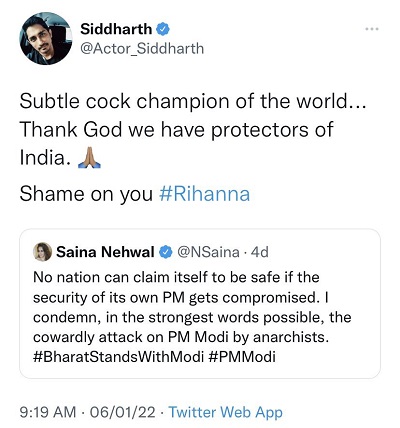
Siddharth had attacked Nehwal with a crass, sexual comment responding to her tweet on PM Modi’s security lapse in Punjab. “Subtle cock champion of the world… Thank God we have protectors of India. Shame on you #Rihanna”, he had said. ‘Cock’ is a slang used for the male sexual organ. By twisting the badminton term ‘shuttlecock’, Siddharth was trying to insult Saina in a crass, sexual manner.

Siddharth’s crass comments were widely criticised on social media. After sharing a lame excuse trying to justify his earlier comment, Siddharth had written an open letter to the Badminton Champion, apologizing for his behaviour.

Identifying himself as an ‘ally’ of the feminist movement, Siddharth had said that he was being funny and had no intentions to disrespect a woman. “I want to apologize to you for my rude joke. I may disagree with you on many things but even my disappointment or anger when I read your tweet, cannot justify my tone and words. Sorry about a joke that didn’t land”, the letter read.

Not stretching the issue, Saina had responded to Siddharth’s apology saying that the matter was about women. “He only said it and he is now apologizing. He shouldn’t target a woman like that but it’s okay, I am not bothered about it, I am happy in my space and god bless him,” she had said.

Pertinently the National Commission for Women (NCW) had also urged Twitter India to block the actor’s account. The NCW had written to the Maharashtra police seeking registration of a First Information Report (FIR) against actor Siddharth.

Dadra-Nagar Haveli and Daman-Diu declares cow slaughter non-bailable offence, punishable with life imprisonment, fine up to ₹5 lakh

The combined Union Territory of Dadra and Nagar Haveli and Daman and Diu has decided to apply stringent provisions in its law against cow slaughter. The territory has banned transportation of cow, calf, heifer, bull, bullock, ox within the territory borders for the purpose of slaughter.

According to the reports, the penalties introduced for the purpose include a monetary fine of up to Rs 5 lakh and starting from 10 years in jail to imprisonment for life.

The Union Territories of Dadra-Nagar Haveli and Daman-Diu (Adaptation of State Laws) Second Order 2022, notified by the Ministry of Home Affairs, states that the Bombay Animal Protection Act, 1954, implemented in both the erstwhile Union Territories on Tuesday, has been amended. Reports mention that now the amendments will be applicable in the combined union territory as well.

According to the amendments introduced, cow slaughter will be considered a non-bailable offence across the UT of Dadra-Nagar Haveli and Daman-Diu. However, it would not be applicable in the case of the slaughter of any animal above the age of 15, other than cow, calf, heifer, bull, bullock and ox.

The amendment has also made mandatory the usage of permits while transportation of animals for agricultural or animal husbandry purposes. Any such transportation without the permit will be deemed that the animal was being transported for slaughter.

It is pertinent to note that the provisions mentioned in the new law are already applicable in the states of Goa and Gujarat. In Gujarat, cow slaughter is a non-bailable offence with punishment up to life imprisonment. Similarly, in Uttar Pradesh, there is a provision of 10 years jail and a fine of Rs 5 lakh for cow slaughter.

SC grants interim protection from arrest to Mamata Banerjee’s polling agent Sheikh Sufiyan in BJP worker Debarata Maity murder case: Details

0

The Supreme Court has granted weeklong interim protection from arrest to West Bengal Chief Minister Mamata Banerjee‘s election agent, Sheikh Sufiyan, in connection with the murder of a BJP worker Debarata Maity.

A bench comprising Justice Nageswara Rao and Justice BR Gavai passed the order of interim protection while hearing a special leave petition filed by Sufiyan challenging the Calcutta High Court’s order rejecting his anticipatory bail petition.

The SC bench dismissed the objections raised by solicitor general Tushar Mehta who said that Sufiyan was involved in a serious case of murder and should not be given any relief. Mehta who appeared for the CBI opposed the stay on arresting and said that the accused was politically powerful.

While the bench asked Mehta not to bring politics into this, it fixed January 31 as the date of hearing. The SC bench further stated that on January 31, no adjournment will be granted to the Special Leave Petition of Sufiyan and that the matter will be heard finally on that day. The bench also called for records of this case including statements recorded under Section 164 of the CrPC.

Mehta submitted before the court that many witnesses in their statement recorded under Section 164, have named Sufiyan. He said that the division bench comprising Justices Debangsu Basak and Bibahas Ranjan De of the Calcutta High Court on 29th November, last year, rejected his anticipatory bail petition. But despite the rejection of his petition and serious observation made by the court, Sufiyan managed not to be arrested till this date.

This is among the cases of political violence that CBI is investigating on the instruction of the Calcutta High Court passed on August 19, last year.

Sheikh Sufiyan was the election agent of Mamata Banerjee from Nandigram, a seat she lost to BJP’s Subhendu Adhikari. Debarata Maity, a BJP worker, was attacked by TMC goons on May 3rd, a day after the West Bengal Assembly poll results were announced. He succumbed to his injuries at SSKM Hospital on May 13.

Sheikh Sufiyan was summoned by the CBI back in September last year in connection with his alleged involvement in the murder of Maity.

India calls for recognition of hatred against Hindus, Buddhists and Sikhs at the United Nations: Details of ambassador Tirumurti’s statement

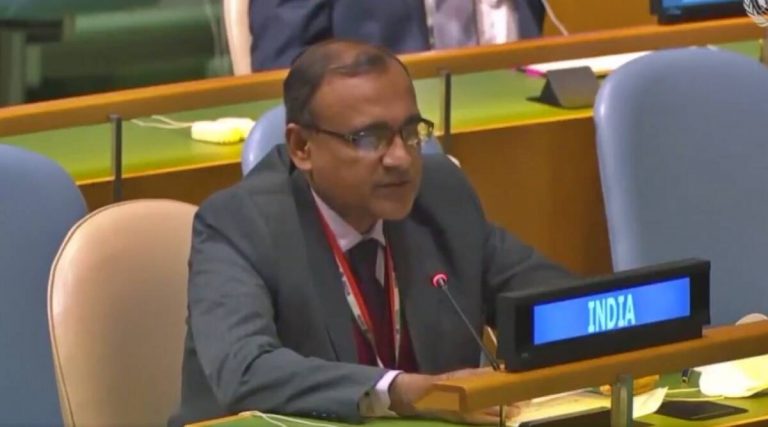
On Tuesday (January 18), the Permanent Representative of India to the United Nations, TS Tirumurti, called for the recognition of hatred and bias against religions such as Hinduism, Buddhism and Sikhism. He made the remarks during the International Counter-Terrorism Conference 2022, which was organised by the Global Counter-Terrorism Council of the United Nations.

In his statement, TS Tirumurti pointed out how phobias against three Abrahamic religions, namely, Islam, Christianity and Judaism was recognised by the Global Counter-Terrorism Strategy but the emergence of religiophobia against Hindus, Buddhists and Sikhs is not being fully recognised.

He stated, “The UN has highlighted some of them over the years, namely, those based on Islamophobia, Christianophobia and antisemitism – the three Abrahamic religions. These three find mention in the Global Counter-Terrorism Strategy. But new phobias, hatred or bias against other major religions of the world need to also be fully recognised.”

“The emergence of contemporary forms of religiophobia, especially anti-Hindu, anti-Buddhist and anti-Sikh phobias is a matter of serious concern and needs the attention of the UN and all Member States to address this threat. It is only then can we bring greater balance into our discussion on such topics”, the Permanent Representative of India to the United Nations added.

India spoke out against blatant categorisation of terrorism

TS Tirumurti emphasised how several UN member States had tried to put labels on acts of terrorism, based on political and religious motivations. “In the past two years, several member states, driven by their political, religious and other motivations, have been trying to label terrorism into categories such as racially and ethnically motivated violent extremism, violent nationalism, right-wing extremism, etc,” he said.

The Permanent Representative of India to the United Nations pointed out that it was against the accepted principles of the UN’s Global Counter-Terrorism Strategy. He added as to how there cannot be a justification of terrorism based on its form and manifestation and stated that all forms of terrorism are condemnable.”This will take us back to the pre 9/11 era of labelling terrorists as “Your Terrorists” and “My Terrorists” and erase the collective gains we have made over the last two decades…”

Furthermore, he stated, “We, therefore, need to be wary of providing a variety of classifications, which may militate against the concept of democracy itself. Fourth, even such labels are being given to so-called threats which are limited to certain national or regional contexts. The extrapolation of such national or regional narratives into a global narrative is misleading and erroneous. Such trends are neither global nor have any agreed global definition.”

Weaponisation of communication technology for terrorist propaganda

During his statement on the International Counter-Terrorism Conference 2022, the Indian Representative highlighted how information and communication technology was being weaponised for terrorist propaganda. “Misuse of information and communication technology such as internet and social media for terrorist propaganda, radicalization and recruitment of cadre, misuse of new payment methods and crowdfunding platforms for the financing of terrorism, and misuse of emerging technologies for terrorist purposes have emerged as the most serious threats of terrorism and will decide the counter-terrorism paradigm going forward.”

TS Tirumurti said, “Internet and social media platforms have turned into indispensable resources in the toolkit of Global Terrorist Groups (GTGs) for spreading terrorist propaganda and conspiracy theories aimed at spreading hatred among societies and communities and offer additional radicalization opportunities which may proliferate globally. The increased use of closed group communications adds to the concern. Covid-19 and the subsequent isolation has further accentuated the impact of the internet on people making them vulnerable to radicalization and recruitment by terrorist groups.”

Full transcript of the statement by TS Tirumurti

I thank the Global Counter-Terrorism Council (GCTC) for inviting me to this International Counter-Terrorism Conference 2022 and providing the opportunity to share my thoughts on counter-terrorism and the UN. I would like to clarify that I speak to you as Ambassador of India to the UN and not necessarily in my capacity as Chair of the Counter-Terrorism Committee. Allow me at the outset to express my deep appreciation for the tremendous breadth of the topics you are covering over the next several days. I commend you and wish you an enriching discussion.

  1. In the global counter-terrorism domain, the terrorist attacks of the 9/11 in 2001 had proved to be a turning point in our approach towards terrorism. The attacks highlighted the following:

The threat of terrorism is grave and universal and can only be defeated by collective efforts of all UN member states.
Terrorism in one place can directly impact peace and security in another. Consequently, the era of classifying terrorists as “your terrorist” and “my terrorist” was over.
Terrorism in all its forms and manifestations is to be condemned and there cannot be any exception or justification for any act of terrorism, regardless of motivations behind such acts, and wherever, whenever and by whomsoever committed.
The menace of terrorism should not be associated with any religion, nationality, civilization or ethnic group.

3. In 2001, through Security Council resolution 1373, the Security Council established the Counter-Terrorism Committee (or CTC), as its subsidiary body with a mandate to assess implementation of counter terrorism resolutions and decisions of the Security Council as well as General Assembly by member states, as well as identify compliance gaps and facilitate technical assistance to member states through relevant UN bodies to plug these gaps. Our fight against terrorism is as strong as the weakest link in the global chain of member states, and CTC plays very important role in identifying such weak links and strengthening them, including by facilitating necessary capacity building. In 2006, the UN General Assembly adopted its first Global Counter Terrorism Strategy or GCTS, putting in place the counter-terrorism policy framework at the UN. It is in this context that India has tried to strengthen the UN response to terrorism, including strengthening the CTC architecture, and the Global Counter-Terrorism Strategy.

Friends,

4. Over the past 2 decades, there has indeed been considerable progress in combatting terrorism. Elaborate mechanisms have been put in place. Terrorism faced reverses in the face of resolute Counter-Terrorism measures undertaken by countries individually or collectively. Many avenues of support were getting dried up or being plugged by forums like Financial Action Task Force (FATF) etc. However, we are recently witnessing a resurgence of terrorist activities both in their range and diversity as well as geographical space.

5. As UN Secretary General’s recent reports on threat posed by ISIL have been pointing out, ISIL has changed its modus operandi, with the ISIL core focus now on regaining ground in Syria and Iraq and its regional affiliates strengthening their expansion, especially in Africa as well as in Asia. Similarly, Al-Qaida remains a major threat and recent developments in Afghanistan have only served to re-energize them. Al-Qaida’s linkages with Security Council proscribed terrorist entities like Lashkar e-Tayyiba and Jaish-e-Mohammed has continued to strengthen. It’s regional affiliates in Africa continue to expand.

6. It is in this scenario that the Security Council adopted UNSC resolution 2593 on Afghanistan under India’s Presidency of the Council in August last year. Resolution 2593 took into account some of our collective concerns, in particular on terrorism, where it has noted the commitment of the Taliban not to allow the use of the Afghan soil for terrorism, including from terrorists and terrorist groups designated under resolution 1267. It has underlined that Afghan territory should not be used to threaten or attack any country or to shelter or train terrorists, or to plan or to finance terrorist acts. It’s therefore vital that sympathizers of Al-Qaida in Taliban stop their support to Al-Qaida and ISIL.

7. Further, developments in Afghanistan are being closely watched in Africa by terrorist and radical groups. We need to ensure that they and other regional affiliates of ISIL and Al-Qaeda don’t get emboldened and take advantage of armed conflict situations in and around the Sahel region and Lake Chad Basin area.

8. With this background, allow me to dwell on some counter-terrorism trends and developments at the UN, what impact will they have on the global counter-terrorism discourse and India’s approach towards them.

9. The first trend is what is being referred to as “emerging threats”. This is essentially a move to categorize terrorism and violent extremism conducive to terrorism, based on the motivations behind such acts. In the past two years, several member states, driven by their political, religious and other motivations, have been trying to label terrorism into categories such as racially and ethnically motivated violent extremism, violent nationalism, right wing extremism, etc. This tendency is dangerous for several reasons. First, this goes against some of the accepted principles agreed to by all UN Member States in the recently adopted Global Counter-Terrorism Strategy, which clearly states that terrorism in all its forms and manifestations should be condemned and there cannot be any justification for any act of terrorism, whatsoever. Second, this will take us back to the pre 9/11 era of labeling terrorists as “Your Terrorists” and “My Terrorists” and erase the collective gains we have made over the last two decades. Third, it is important to understand that in democracies right-wing and left-wing are part of the polity primarily because they come to power through the ballot reflecting the majority will of the people and also since democracy by definition contains a broad spectrum of ideologies and beliefs. We therefore need to be wary of providing a variety of classifications, which may militate against the concept of democracy itself. Fourth, even such labels are being given to so-called threats which are limited to certain national or regional contexts. The extrapolation of such national or regional narratives into a global narrative is misleading and erroneous. Such trends are neither global nor have any agreed global definition.

10. It is with such distortions in mind, and to combat them, that India’s External Affairs Minister Dr Jaishanker, when speaking to the Security Council, mentioned inter alia the following: First, we must all summon up the political will to combat terrorism. There must be no ifs and buts in this fight. Nor should we allow terrorism to be justified and terrorists glorified. All member states must fulfil their obligations enshrined in international counter terrorism instruments and conventions. Second, we must not countenance double standards in this battle. Terrorists are terrorists; there are no good and bad ones. Those who propagate this distinction have an agenda. And those who cover up for them are just as culpable. And third, we must firmly discourage exclusivist thinking that divides the world and harms our social fabric. Such approaches facilitate radicalization and recruitment by breeding fear, mistrust, and hatred among different communities. The Council should be on guard against new terminologies and false priorities that can dilute our focus.

Friends,

11. Another trend that has of late become prominent is highlighting certain religious phobias. The UN has highlighted some of them over the years, namely, those based on Islamophobia, Christianophobia and antisemitism – the three Abrahamic religions. These three find mention in the Global Counter-Terrorism Strategy. But new phobias, hatred or bias against other major religions of the world need to also be fully recognised. The emergence of contemporary forms of religiophobia, especially anti-Hindu, anti-Buddhist and anti-Sikh phobias is a matter of serious concern and needs attention of the UN and all Member States to address this threat. It is only then can we bring greater balance into our discussion on such topics.

12. Further, misuse of information and communication technology such as internet and social media for terrorist propaganda, radicalization and recruitment of cadre; misuse of new payment methods and crowdfunding platforms for financing of terrorism; and misuse of emerging technologies for terrorist purposes have emerged as the most serious threats of terrorism and will decide the counter-terrorism paradigm going forward. Internet and social media platforms have turned into indispensable resources in the toolkit of Global Terrorist Groups (GTGs) for spreading terrorist propaganda and conspiracy theories aimed at spreading hatred among societies and communities and offer additional radicalization opportunities which may proliferate globally. The increased use of closed group communications adds to the concern. Covid-19 and the subsequent isolation has further accentuated the impact of internet on people making them vulnerable to radicalization and recruitment by terrorist groups. Continuing advancements in evolving technologies, viz. Artificial Intelligence, Robotics, “Deep fakes”, Blockchain, Dark web, etc., are fraught with the risk of being abused by terrorists. Already, crypto currencies, virtual assets, crowdfunding platforms are helping terror financing, owing to anonymity and the un-traceable nature of these technologies. Added to this is the use of Drones. Being a low-cost option and easily available, utilization of these aerial/sub-surface platforms by terrorist groups for purposes such as intelligence collection, weapon/explosives delivery and targeted attacks have become a challenge for security agencies worldwide. In our context we have witnessed terrorists using UAS to smuggle weapons and drugs across the borders and also launch terrorist attacks. Given the transnational nature of these treats, this warrants a holistic collaborative approach by member states, private sector, civil society organizations etc. as well as to strengthening support to financial watchdogs such as FATF to ensure that member states bring their counter-financing structures at par with international standards.

Friends,

13. It is also important to point out that the existential threat of terrorism in Africa is rapidly evolving. Terrorism in Africa exacerbates state fragility and increases the vulnerability of communities because terrorism conflates with other pervasive challenges such as poverty, youth unemployment, forced migration, arms trafficking as well as growing cyber and transnational organized crime. As pointed out by our African colleagues in the Security Council, ISIL and Al-Qaeda linked and inspired groups in Africa are embedding themselves in multiple domestic conflicts, particularly in countries seeking to establish democratic institutions, with the terrorists attempting to influence and control the political agenda. Sustained peacebuilding efforts, giving due leadership role to countries of Africa, utilizing African wisdom for conflict resolution, harnessing the strength of Africa’s regional and sub-regional organizations are needed to deal with the fragility and insecurities facing the continent on a longer term. There is no doubt that the peacebuilding efforts should be complemented by international community extending support to regional counter-terrorism initiatives. For example, the countries of the Sahel and Lake Chad Basin are giving serious resistance to the terrorist groups. However due to weak economies, lack of financial resources, logistics and equipment shortcomings, they are unable to seriously counter the threat of terrorism. It is therefore important that the regional security initiatives of African countries such as G-5 Sahel Joint Force, and Multinational Joint Task Force (MNJTF) are provided more robust support from the Security Council including through UN assessed contributions. This has been their ask for quite some time. To discourage terrorist groups from any misadventure and drawing inspiration from events in Afghanistan, a united global call denouncing any attempts to hijack legitimate political aspirations of the people by ISIL and Al-Qaeda elements, is need of the hour.

Friends,

14. The UN sanctions regimes, including the one established by resolution 1267, are pivotal to the international efforts in preventing terror-financing, terrorist-travel, and access to arms by the terrorist organizations. However, implementation of these measures remains challenging. It is critical that all sanctions regimes established by the Council ensure due process in their working procedures and decision-making. The decision-making process and listing/delisting measures should be objective, swift, credible, evidence based and transparent, and not for political and religious considerations. Linkages between terrorism and transnational organized crime must be fully recognized and addressed vigorously. We have seen the crime syndicate responsible for the 1993 Mumbai bomb blasts not just given state protection but enjoying 5-star hospitality. Besides, a recent report of the Monitoring Team (MT) regarding asset freeze exemptions procedures pursuant to resolution 2560 (2020), points to the lacunae of asset freeze measures by Member States, partly due to deficiencies in the existing guidelines of the Committee. I am glad to inform that with an aim to removing these deficiencies and further strengthen the 1267 sanctions regime, India constructively participated in the negotiations of the resolution 2610, which was adopted by the Security Council on 17 December 2021.

15. Friends, needless to add there are other priorities in the UN and in the CTC which I have mentioned only in passing due to paucity of time. However, I would like to re-iterate that India’s action at the UN to address the above trends and developments will be driven by the 8 priorities set by our External Affairs Minister, in the UNSC Ministerial meeting on 20th Anniversary of Security Council Resolution 1373 and the establishment of the Counter Terrorism Committee, held on 12 January.

16. India has made the terrorism as a priority of our two-year tenure in the Security Council. These priorities envisage strengthening the multilateral response to counter terrorism. Equally important is to ensure that combating terrorism remains at the center of “Our Common Agenda” set out by the Secretary General, and not at its periphery. India held a high-level event during our Presidency which was chaired by our External Affairs Minister. Further on the sidelines of the 2nd counter terrorism week in June last year, our Mission in New York co-hosted along with France an event on “Countering the Financing of Terrorism in the post-COVID landscape”. We had robust participation from UN bodies like UNOCT, UNODC, UN CTED as well as FATF.

17. Let me conclude by commending you all once again for organizing an international conference on Terrorism and covering such a wide range of topics.

I thank you.

Congress ally Maulana Tauqeer Raza Khan, after threatening Hindus, now threatens journalist during an interview: Watch

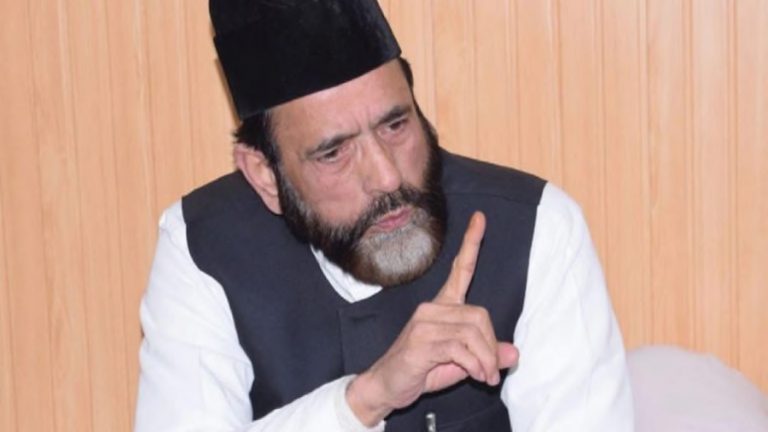
Maulana Tauqeer Raza Khan, Congress’ latest favourite Maulana who has bayed for Hindu blood in the recent past has now threatened a TV anchor because he failed to answer some tough questions posed to him. In an interview with News18 India TV anchor Aman Chopra, Maulana Tauqeer Raza Khan threatened to cause bodily harm simply because he was unable to answer the questions posed to him.

In the interview, anchor Aman Chopra asks him about the support Maulana Tauqeer has extended to Congress. The Maulana first says that if a woman (Priyanka Gandhi Vadra) is coming out and saying that she is a woman and she can fight (Ladki Hoon, Lad Sakti Hoon), then she should be supported by her ‘brothers’. Interestingly, his daughter-in-law had recently slammed the Congress party for accepting Maulana Tauqeer Raza’s support and questioned the party’s stand on women’s issues. She had said that the Maulana could not fight for her rights and therefore, it calls into question Congress’ commitment to women’s issues when they ally with individuals like Raza.

In turn, Aman Chopra asks him about his speeches against Hindus and asks him why he needs Congress’ support to fight against Hindus.

Tauqeer Raza Khan, replying to Aman Chopra, says that he was only talking about the ones involved in the Dharma Sansad and said that if Hindus come out to murder 20 lakh Muslims, then it would certainly not be possible to control the Muslims. In response to this, Aman Chopra asks him who was murdered by the Hindus and why he does not talk about people like Kamlesh Tiwari, who were brutally murdered due to religious hatred.

Interestingly, Tauqeer Raza Khan goes on a strange rant saying that even Aman Chopra knows who “really” killed Kamlesh Tiwari to “blame” the Muslims. He further said, “bomb blasts are done by you people and the blame is put on the Muslim community”. In the ensuing rant, Maulana Tauqeer blamed Aman Chopra for promoting terrorism and exonerated the Muslim community of all terrorist activities, implying (without saying it explicitly) that it is the Hindu community who does terrorism and blames the Muslim community falsely. Through his rant, Aman Chopra kept asking if he meant it is the Hindus who do bomb blasts, to which, he got no specific answer while the Maulana kept saying, “you people do bomb blasts”.

After his monologue, Maulana Tauqeer Raza gets riled up and starts threatening Aman Chopra who was perhaps one of the first TV anchors to ask him tough questions about the hate against Hindus that he seems to spread on a fairly regular basis. He says, “Tameez se baat karo warna mooh tod denge” (talk properly or we will break your face).

After the threat of violence, Aman Chopra asks Maulana Tauqeer Raza if he was threatening to do to him what was done to Kamlesh Tiwari. In his defence, Maulana says that his speech is from the 7th of January, and if he had said something anti-national, why was a case not filed against him. He then says that if Congress has done some mistakes, then Aman Chopra should ask questions to the party, not use his statements to target Congress, which he is now supporting.

Earlier in January, Maulana Tauqeer Raza Khan, the prominent Muslim cleric and chief of the Ittihad-e-Millat Council party (IMC) was seen brazenly provoking Muslims against Hindus. While addressing a crowd of 20 lakh Muslims in Bareilly, Uttar Pradesh, the radical Islamist brazenly threatens Hindus in India that the day Muslims rage flares, they would have nowhere to escape.

“I see the anger within my Muslim youths and I am afraid that the day this anger bursts out, the day I lose control over them… I want to warn my Hindu brothers that I’m scared that the day my Muslim youths are forced to take the law into their hands, you will not find a place to hide anywhere in India”, said the Islamic leader, while displaying his extreme hate for the Hindus.

This brazen display of Hinduphobia by Maulana Tauqeer Raza Khan isn’t new. In December last year, the radical Islamist had brazenly urged for a bloodbath in the country if CAA is not repealed. “We are Allah wale, what we say it happens, there will be blood bath Inshallah”, the Islamic leader had said while admonishing PM Modi for bringing in the Citizenship Amendment Act (CAA).

Maulana Tauqeer Raza Khan had also said that the terrorists killed in the Batla House encounter should be called ‘martyrs’. He had said that the Congress party had promised a probe into the case after coming to power in 2009. “Had there been a probe, the entire world would have known that those killed as terrorists should be given the martyr status”, he said.

Khan, who extended his support to the Congress party ahead of the UP Assembly Elections 2022, revealed that he had long-standing problems with the Congress party and that he had supported it in 2009 only for the Batla house case probe. “During 2009 elections, Congress had said to me that they would probe Batla House encounter if their govt is formed. They didn’t do it. Muslims will never forget this”, he had said. The statements by Maulana Tauqeer created a massive furore, however, no cognisance of his speeches have been taken thus far.