Home Blog Page 3999

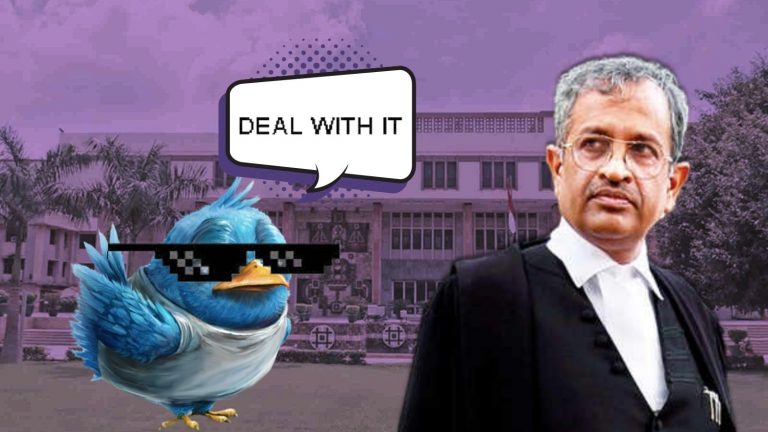
‘Live without it’: Delhi High Court denies urgent hearing for Adv Sanjay Hegde’s application over suspension of Twitter account

The Delhi High Court on Monday in an ‘early hearing’ of a petition filed by senior Supreme Court lawyer Sanjay Hegde on suspension of his social media account, ordered the petitioner to ‘live without Twitter.’

As per Live Law India, when the Counsel brought to the Bench’s notice that his client’s Twitter account had been suspended for over two years now, Justice Rakhi Palli remarked, “It is not urgent, your client can do without #twitter.”

Justice Palli further advised the senior advocate to join other available social media platforms such as Instagram. “We have more important matters today. None of us are on Twitter, he can switch to Instagram or any other platform,” she said. Thus, the Court denied an urgent hearing over his petition.

‘Have right to suspend any account’

Twitter in response to the same plea in July this year had informed the Delhi High Court that it ‘can suspend the account of any individual user found in breach of their service agreement and that it has a “contractual obligation” to do so.’

“…the provision of services on Twitter is pursuant to a contractual obligation which the petitioner (Hegde) has signed up for, and the said contract gives Respondent No 2 (Twitter) the right to suspend an account if it is in violation of the user agreement and its policies. This shows that Respondent No 2 is merely discharging its contractual obligations,” read Twitter’s response. 

The micro-blogging platform further stated that it is not in any way obliged to further the freedom of speech and expression guaranteed under the Indian Constitution.

In December 2019, the senior advocate had moved the high court challenging the permanent suspension of his account by Twitter. According to Hegde’s petition, he was allegedly suspended for quoting Kavita Krishnan, secretary of All India Progressive Women’s Association and member of CPI(ML) Tweet.

Hegde had contested that the suspension of his account was illegal and that it is also in violation of his right to free speech and expression guaranteed by Article 19 (1) (a)of the Indian Constitution.

Prior to the final suspension, Hegde’s Twitter account was suspended multiple times. In October 2019, he claimed his account was suspended for having the Nazi resistance image as his header image. The platform restored his account only after he deleted the image. 

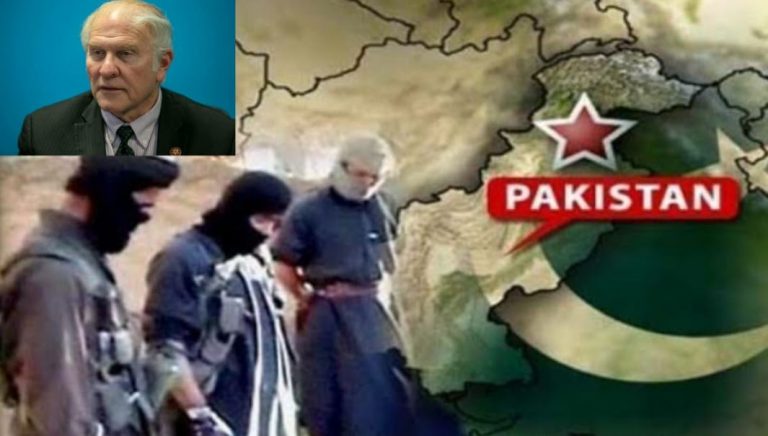
US Congressman Steve Chabot says Pakistan ISI played key role in Taliban takeover of Afghanistan, lauds India’s repatriation efforts

The US Republican lawmaker Steve Chabot has stated that Pakistan and its intelligence service have played a major role in encouraging the Taliban and allowing it to eventually take over Afghanistan. Condemning Pakistan for aiding the Taliban’s offensives, the US Congressman said that it is disgusting to watch Islamabad celebrate the group’s victory that will bring “untold brutality” to Afghans.

Chabot is the co-chair of the India Caucus.

Pakistan’s affirmation towards Taliban is quite well-established. Recently, Pakistan PM Imran Khan, on August 16, had justified the Taliban’s actions by claiming that the Afghan population had broken the ‘chains of slavery’. He also remarked that ‘cultural imposition’ (by the United States) was tantamount to ‘mental slavery.’ Taliban forces have been regrouping and training in Pakistan and ISI has been providing active support to Taliban radicals over the years.

US Congressman lauds India for repatriating citizens from Afghanistan

Meanwhile, in his address to the virtual gala of the Hindu Political Action Committee on Sunday, Chabot lauded the Indian government for repatriating the Afghan religious minorities, who he said have genuine reasons to fear persecution at the hands of the Taliban and their tyrannical government.

Steve Chabot condemns Pakistan for persecution of minorities

The Republican Congressman further added that Pakistan’s persecution of religious minorities, on the other hand, receives far less attention in the United States than it deserves. “We should educate our fellow people about these wrongdoings”, said Chabot adding that the horrible practice of kidnapping forced conversion to Islam, and forced marriage of teenage Hindu girls to older Muslim men that are carried out unabated by Pakistanis are all examples of persecution.

“These allegations are not mere hearsay”, Steve Chabot noted adding that over the years, many news agencies and human rights organisations have documented several heinous incidents wherein minor girls from minority communities are taken from their families and forced to adopt Islam and thereafter married to older Muslim men or trafficked. “These abuses are often just ignored”, said the Congressman.

With strong work ethic and high educational attainment, Hindus exemplify the American dream: US Congressman calls Hindus an integral part of US

In his address, Chabot furthered there are roughly 6 million Hindus in America who are unquestionably an integral part of society throughout the United States.

“Through strong work ethics and high educational attainment, Hindus exemplify the American dream. These virtues also allow Hindus to take on key roles in communities across the country, and also give back to those communities in so many ways,” he said.

Pakistani news anchor says women must wear Hijab to make Pakistan more powerful, later claims it was ‘satire’

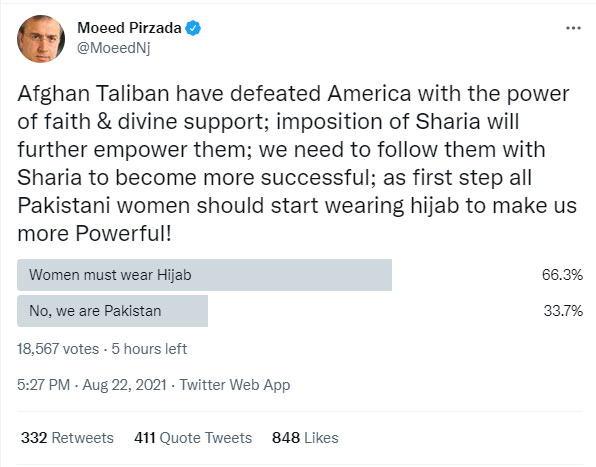
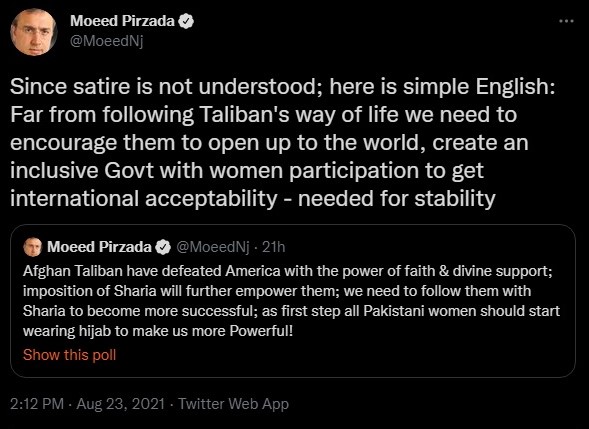
On August 22 (local time), Moeed Pirzada, TV Anchor at 92 News and CEO & Editor at Global Village Space, published a poll on Twitter in which he claimed Pakistan would get more powerful if all women start to wear Hijab.

He said, “Afghan Taliban have defeated America with the power of faith & divine support; imposition of Sharia will further empower them; we need to follow them with Sharia to become more successful; as first step, all Pakistani women should start wearing hijab to make us more Powerful!”

 moeed pirzada
Screenshot of Tweet posted by Moeed Pirzada supporting Hijab for all women in Pakistan (Source: Twitter)

At the time of writing this report, over 18,500 people had voted on the poll, with over 66% people in favour of imposing Hijab on all women in Pakistan. While many have echoed his thoughts about Hijab, the tweet is attracting a lot of criticism from both men and women.

A woman named Selma Khan claimed that there is nothing divine about Shariah and said, “What is Shariah but an interpretation. There is absolutely nothing divine about the Shariah, and in no way can it possibly be considered fixed and infallible. The Quran is not a book of laws but God’s direct self-revelation to humanity. It contains the moral code for a living.”

She further said, “A holy and pious life as a Muslim. But it was never meant to function as a legal code, which is precisely why scholars had to rely so heavily on extra-Quranic sources like ijma (consensus), qiyas (analogy), istislah (which refers to the common good of the people), and ijtihad.”

One Meher Bano Qureshi said. “Excuse us… I hope u were being sarcastic, but in certain, the respondents were not. Why do men just want to exert control over women and their choices? Let women chose! Humara jism hamari marzi, humara mustaqbil humari marzi aur hunara libas humari marzi. (Our body, our choice. Our future, our choice. Our clothes, our choice).”

Former Parliamentarian Saman Jafri said, “The clean-shaven Taliban. How about you get a beard before dictating to women how to dress. That’s also sharia, no?”

Moeed Pirzada claims ‘satire’

Moeed Pirzada, after he was criticised for his comment on social media, has decided to claim that it was satire.

 moeed pirzada
Source: Twitter

Moeed Pirzada said, “Since satire is not understood; here is simple English: Far from following Taliban’s way of life we need to encourage them to open up to the world, create an inclusive Govt with women participation to get international acceptability – needed for stability”.

Atrocities of Taliban against women in Afghanistan

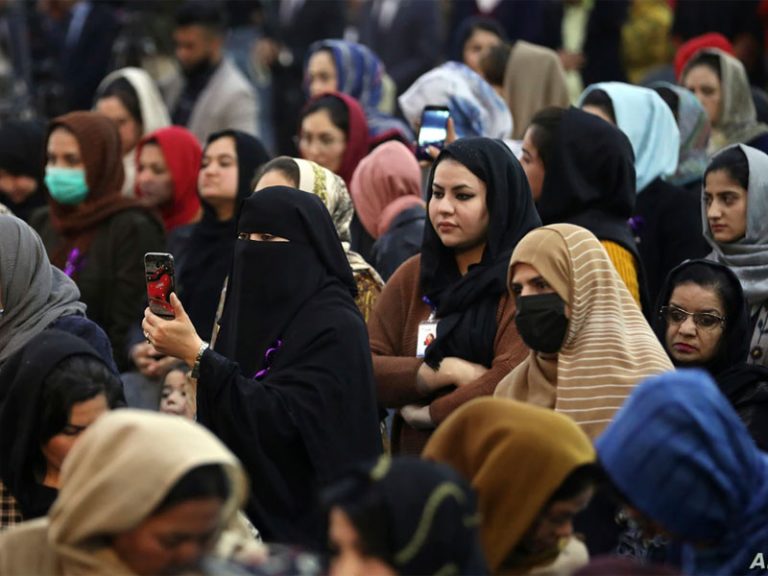
Pirzada appeared to be hailing the Islamist group Taliban for taking over the control of Afghanistan, but failed to acknowledge the atrocities in the hands of the Taliban against the women. Several reports have emerged since the Taliban took over Afghanistan that shows how they treat women under their rule. On August 22, it was reported that they had banned co-education in Herat. They have reportedly described co-education as the ‘root of all evils in the society and issue a ‘fatwa’ against it. Also, they banned female lecturers from teaching to male students.

Though the group has allowed women to continue their education, it is mandatory to wear a full burqa. Women are being killed in the country for not wearing a burqa and even reportedly burnt for not cooking properly. They also banned women employees from local radio stations in Ghazni.

Other reports suggest that the co-founder of an all-girl Afghan school had recently burnt all the documents of her students, fearing persecution in the hands of the Taliban. Another report suggested that the Taliban is hunting for girls and women between the ages of 12 to 45 to use them as sex slaves.

UK: Police to now use ‘rainbow coloured’ patrol cars to help the LGBT community

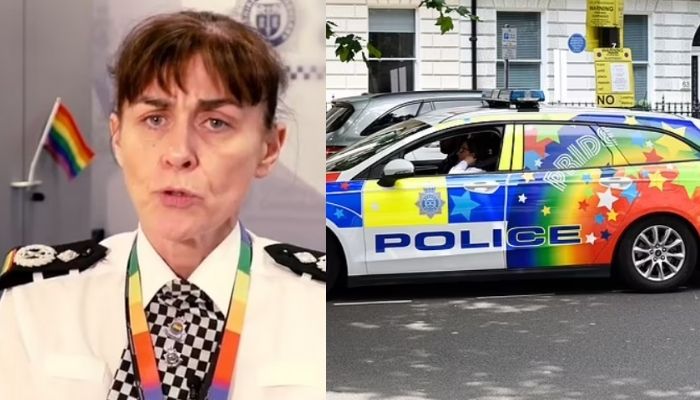
In a bid to encourage the LGBTQ+ community to lodge complaints of online hate crimes, the police in the United Kingdom have decided to paint their patrol cars in rainbow colours. The development apparently comes after complaints of increasing hate crimes against the transgender community.

On August 10, a video was shared by the official Instagram account of the UK police, wherein it was informed that squad cars will now be painted with rainbow colours. While speaking about the matter, Deputy Chief Constable Julie Cooke claimed, “The Rainbow cars, the hate crime cars, whatever you want to call them, they are part of our vehicle fleet. So, we are always replacing vehicles. They will get all of the police insignia put on them as normal (besides other add ons)… But they are out there as normal patrol vehicles.”

“Sometimes people will ask us: How can you afford to do that? That’s not right to spend money on putting a rainbow to a car. Well the cost is quite minimal but the confidence it can bring, by just having that rainbow on there…and the impact of seeing the rainbow is huge,” she added. Julie Cooke further claimed that the objective behind such patrol cars is to give confidence to LGBTQ and under-represented communities. It must be mentioned that Cooke is the LGBTQ lead of the National Police Chiefs’ Council (NPCC).

At this point, it remains unclear as to how many cars will be covered in rainbow colours. An NPCC spokesperson informed that it was up to individual forces to decide on the number of cars that they want to convert. Ever since the UK police unveiled their plans, they have been at the receiving end of criticism. Reportedly, critics have argued that the police are not focused on fighting real crimes such as knife stabbings and rape and focusing on ‘unproven’ allegations of hate crimes based on social media comments.

Criticism of the ‘rainbow coloured patrol car’ scheme

Even though a crime had not been committed, it can show up in a person’s criminal record. While speaking about the development, ex-cop Harry Miller lamented, “We don’t see the Met with special cars for knife crime, even though the number of stabbings in London is appalling. The problem is that the second that you see a rainbow car, you know that it is a police force that has made its mind up about some very contentious issues. You no longer see a police car or a police officer who is there to support everyone, from all political persuasions, without fear or favour.”

Miller, the founder of ‘Fair Cop’ campaign, emphasised that the cops are busy painting cars at a time when the prosecution rate for violent crimes is only 7%. “They have literally tied their colours to the mast and painted their cars with their political leanings,” he added. Miller had also accused the UK police of going estray and policing ‘speech (on social media)’ instead of policing real issues.

How apologists for radical Islam are attempting to deflect attention from Taliban’s atrocities by raking up ‘Islamophobia’ propaganda

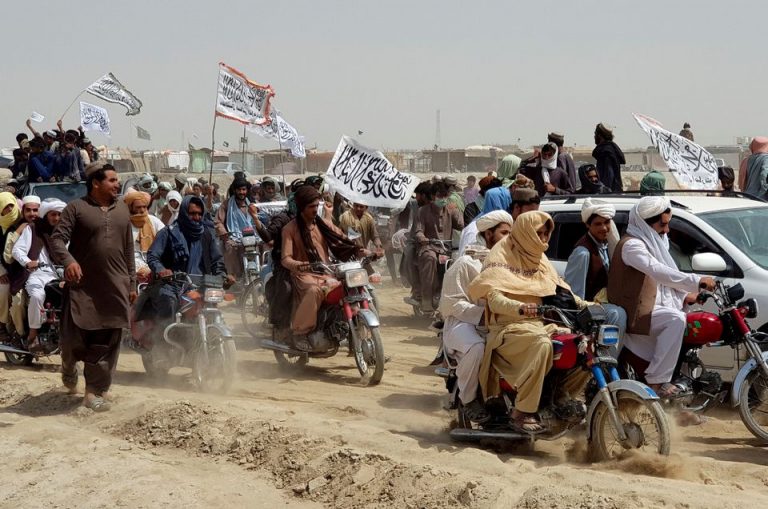
The Taliban takeover of Afghanistan, and the brutality that both preceded and succeeded it, has sent shockwaves throughout the world. While it was predicted that the US-backed Afghan Government would collapse at some point of time, nobody could foresee it collapsing within a week.

US President Joe Biden is at the receiving end of a great deal of criticism for botching up the withdrawal of US forces from the war-torn country. However, as it so happens, Biden is not the only one who is not entirely sure how to cope with the resurgence of Taliban in Afghanistan.

Liberals in India and those in the ‘secular’ camp are not too sure either how they should respond to the developments in India’s neighbourhood. On one hand, they are compelled to condemn the Taliban and its human rights violations and on the other, they are duty bound to shield Islamists as they are their reliable ally against Hindutva.

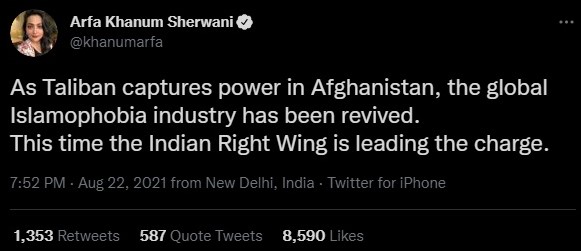
Thus, most of them, like Arfa Khanum Sherwani of The Wire, have decided to tread a fine line where both their intentions are served. A condemnation of the Taliban is offered and at the same time, enough overtures are geared towards Islamists to keep them happy as well.

Source: Twitter

Arfa Khanum Sherwani, commenting on the Taliban takeover of Afghanistan, has chosen to deflect attention towards the ‘Indian Right Wing’ instead, claiming that her domestic political rivals are leading the charge with respect to the the ‘global Islamophobia industry’.

At a time when Afghan women are being forced into sexual slavery, The Wire journalist here appears to believe so-called Islamophobia is a bigger concern. One would have thought that the rise of Taliban and ISIS has proved one thing if nothing else, that fear of radical Islam is not ‘irrational’. And therefore, the term ‘Islamophobia’ is a propaganda tool invented by Islamists and left-oriented propagandists to prevent legitimate criticism of radical Islam.

That the objective of the term is to serve as a defense for radical Islam is further given away by the fact that people of Sherwani’s ilk rake up the issue whenever radical Islam threatens to upend the lives of scores of individuals.

We see conversations around ‘Islamophobia’ doing the rounds in the aftermath of every terror attack. We saw it after the terror attacks in Nice, Paris, Berlin. And we saw the term making headlines again after the brutal murder of Kamlesh Tiwari in Uttar Pradesh and Samuel Paty in France.

The underlying theme on every occasion is that the discussions were preceded by a tragic event where lives had been lost due to the hatred fueled by radical Islam and despite the incendiary rhetoric about the threat posed by ‘Islamophobia’, retaliation never really happens. In the end, ‘Islamophobia’ prevents us from having honest discussions about the dangers of radical Islam and the measures a society would have to take to safeguard itself against the menace.

Once again, after Taliban took over Afghanistan, apologists for radical Islam have once again floated the mythical narrative of ‘Islamophobia’. This is at a time when Afghan women fear for their lives and their rights being violated under the Shariah regime that Taliban seeks to impose.

After the Taliban captured Afghanistan, there were significant sections of the Muslim population in India that cheered for the Jihadist outfit and celebrated their victory. Around a dozen were arrested in Assam for social media posts in favour of the group. A poet compared the outfit to Valmiki and a Delhi riots accused was jubilant over the matter as well.

The mindset that has thrown Afghanistan into chaos finds great support in India as well and that is something that ought to concern us all. It is this particular aspect of things which the national discourse ought to focus on but here we have apologists for the ideology attempting to brush the conversation under the carpet by raking up the mythical narrative of ‘Islamophobia’.

The fact of the matter is, it is just a distraction to deflect national attention from the very real threat posed by radical Islam. And Indians must be careful to avoid falling into the trap and breathing life into the propaganda initiative.

From Iraq to Yemen to Libya to Kabul: Some of the toughest evacuations executed by the Modi government

The Taliban takeover of Afghanistan has sent countries around the world scrambling to mount a swift evacuation plan to extricate their respective nationals from the strife-torn country.

But executing an evacuation plan is not an easy job. It’s a Herculean task, a disastrous nightmare that a country has to see through to safely rescue its people. The fluidity of the situation makes it incredibly difficult for the authorities to draw up a blueprint of the evacuation amidst perpetual volatility.

Not only does the government has to come up with pragmatic solutions to rescue its marooned citizens in a foreign country but they also have to manage the political crisis developing back home with the opposition parties and the kin of people stuck abroad putting pressure on the government to get their relatives to safety.

The complexity of the task at hand adds to the pressure on the government and the officials involved in the evacuation. The country is also severely constrained in case it does not share a contiguous border with the nation from where it plans to pull out its people.

But arguably, the most difficult part is to have a handle on the situation that the country and its diplomats and foreign ministry officials buckle down to tackle. To come up with a reasonably good plan to evacuate its people to safety, the officials involved in the evacuation process need to have an acute understanding of the unfolding crisis. The diplomats should anticipate much in advance about a possible humanitarian catastrophe and work towards hatching up a plan should the push comes to shove.

In case there is a hostile takeover of the country as is the case in Afghanistan or a war situation as was the case in Libya, Yemen and Iraq, the diplomats need to know who the current stakeholders are and explore opportunities to get into negotiations with them. After getting them on board, the final modalities of the evacuation can be smoothed over and the implementation of the rescue plan could be set in motion.

India, over the years, has been one of those countries that have been remarkably successful in executing its evacuation plans and bringing its stranded citizens back home. Its foreign policies had been disastrous for a couple of decades after the independence when it committed one after another ‘Nehruvian’ blunders. For instance, not obliterating Pakistan for its audacity of attacking and capturing Jammu and Kashmir in 1948 or serving the UNSC seat to China on a platter and later on misreading China’s intentions on Aksai Chin and Arunachal Pradesh that inevitably led to the catastrophic 1962 war.

But, in the last few years, after PM Modi came to power, there has been a radical shift in India’s foreign policy. It carried out Surgical Strikes across the border, both in the east and west, to demonstrate its willingness to go beyond the conventional methods to deal with the scourge of terrorism. With Balakot Airstrikes, it has shown the world that it is no longer the yesteryear’s India that will not sit back and lick its wound, but it will mount a swift offensive and exact revenge from its adversaries.

Additionally, under PM Modi, India has also aced in tackling hostage and humanitarian crises unfolding in foreign countries. Be it the Tikrit hostage situation in 2014 or the Yemen-Saudi war in 2016, or the Kabul evacuation much recently, India has demonstrated that it prizes the life of its nationals residing in other countries and would not abandon them to their fate.

Here are some of the successful evacuation operations carried out by India under the Modi government:-

46 Indian nurses rescued from ISIS captivity in strife-torn Iraq in 2014

In June 2014, depressing news trickled in from strife-torn Iraq, where the Islamic State was making rapid territorial gains. The ISIS terrorists had managed to intrude into Tikrit as the Civil War between them and the Iraqi Army escalated. A contingent of Indian nurses was deployed in a hospital in Tikrit to look after the injured and sick. It was just weeks after Narendra Modi had sworn in as the Prime Minister with a very new cabinet.

At midnight of 12 June 2014, all the nurses, both Indian and Iraqis, heard a crackle of bullets on a road nearby the hospital. For the Indian nurses, this was their first brush with Iraq’s changing reality as they heard a volley of bullets being fired, along with a loud thud of noise coming from grenade explosions. Soon, the Iraqi nurses whispered among themselves to flee the town. The Indians, on the other hand, knew they had nowhere to go. 46 Indian nurses were stranded in the hospital. All except one of the 46 nurses were from Kerala.

The next day, ISIS terrorists had occupied the ground floor of the hospital. The Indian nurses lived on the second floor of the hospital in the makeshift dormitories. All the hospital staff, including the patients, were hoarded up on the second floor as the incessant firing continued on the ground floor.

For days on end, the nurses lived in perpetual fear of being assaulted and executed at the hands of their ISIS captors, who were also known for committing unspeakable atrocities against women and holding them as sex slaves. They spent their time in captivity watching TV bulletins and surfing the news on their phones until the television stopped working and the internet was no longer available on the phones.

Throughout their ordeal, the Indian Embassy in Baghdad steadfastly kept in touch with them on phone and at times recharging their prepaid cell phones. On June 30, the nurses were ferried to the border by the ISIS terrorists. From their office at the border, another bus was arranged to transport the nurses to the Indian rescue team. They were then taken to the military office, and then Erbil airport after their documents were verified. The Indian Government had arranged a special flight from Delhi to Erbil to fly the nurses back. After 23 days of traumatic experience, the nurses, unscathed and unharmed, finally boarded the flight on July 5 and returned home.

The escape, which was dramatic and unprecedented, given that ISIS had become notorious for meting out brutalities on their hostages, is partly credited to the then External Affairs Minister Sushma Swaraj, who was continuously in touch with all the major countries, including Saudi Arabia and Iraq. It is believed that New Delhi activated informal channels and established peripheral contacts with ISIS, and other splinter groups in Iraq to precipitate the rescue. The foreign ministry later refused to identify interlocutors who had negotiated the release of the nurses.

More than 4,500 Indians and 960 foreigners evacuated from war ravaged Yemen in 2015

In 2015, as fighting raged between the Houthi rebels and the Yemeni government supported by aerial bombardment from the Saudi-led coalition, the Indian government once again found itself in a tight spot. Thousands of Indians were stranded in Yemen as the Royal Saudi Air Force led a coalition of Arab states in suppressing the Shiite Houthi rebels.

The Indian government launched Operation Rahat to evacuate Indian citizens and foreign nationals from Yemen. Since Yemen was not accessible by air due to a no-fly zone announced by Saudi Arabia, India chose Djibouti initially as a centre to carry out initial evacuation by sea. The Indian government also sent the then Minister of State for Overseas Indian Affairs General (Retd) V.K. Singh to oversee operations from the nearest port of Djibouti city.

Indians stuck in Yemen were asked to reach Sana’a and Aden, from where they would be ferried back to India. The Indian Navy redeployed the patrol vessel INS Sumitra (P59) from anti-piracy operations off the coast of Lakshadweep to the Yemeni port of Aden.

Besides, INS Mumbai and frigate INS Tarkash were also sent from Mumbai to provide protection and support to Indian ships and aircraft in the conflict zone. The Indian government also commissioned the Indian Air Force to help the Navy with the evacuation effort. Two C-17 Globemaster cargo aircraft with a capacity of 600 passengers were sent to Djibouti.

In addition to this, two ferries belonging to the Lakshadweep administration, MV Kavaratti and MV Corals, with a capacity of 1,500 passengers were sent to Aden, while two Air India Airbus A320 aircraft were dispatched to Muscat in neighbouring Oman. Then on April 1, 2015, INS Sumitra reached Aden to evacuate 349 Indians.

Prime Minister Narendra Modi personally spoke to the King Salman of Saudi Arabia to seek a safe passage for Indian nationals and evacuation effort. The Prime Minister’s Office was personally monitoring operations and looking over seamless cooperation between various arms of the state including ministries of external affairs, defence, shipping, railways, navy, IAF, Air India and various state governments to provide relief to those in distress.

After India was permitted to fly to Yemen on April 3, 2015, it began evacuating people from Sana’a to Djibouti and from there to Mumbai or Kochi. The two C-17 Globemasters flew nine sorties to Mumbai and two to Kochi to transport the expatriates back to India.

Over the next few days, India rescued about 4,640 Indians stranded in Yemen, along with 960 foreign nationals from more than 41 countries. Some of the countries did not have the operational capability to carry out a complex evacuation process so they sought India’s help. India happily obliged and rescued the beleaguered foreign nationals.

India exfiltrates CRPF contingent amidst escalating tensions in Libya in 2019

With the security situation on the ground rapidly deteriorating in Libya, the then External Affairs Minister Sushma Swaraj in April 2019 announced that an entire contingent of CRPF troops was removed from the conflict zone.

The root of the crisis that continues to plague Libya to this day is the unrest that sparked the Arab Spring in 2011. The uprising had then overthrown and killed long-ruling dictator Moammar Gadhafi and since his death, various rival factions within the country had been jousting for power.

An UN-backed internationally recognised government headed by Fayez al-Sarraj was installed but the rebels continued to fight with each other, in their bid to undermine the government and stake their claim to power.

The infighting escalated in 2019 with the launch of a military campaign known as the Western Libya campaign, initiated on 4 April 2019 by the Operation Flood of Dignity of the Libyan National Army, which represents the Libyan House of Representatives, to capture the western region of Libya and eventually the capital Tripoli held by the United Nations Security Council-recognised Government of National Accord. 

The Indian government initiated a massive evacuation plan to rescue the marooned people from the country. Later, the then External Affairs Minister Sushma Swaraj tweeted that the evacuation of an entire contingent of CRPF forces was carried out as the situation in Tripoli had worsened.

“Indian Embassy in Tunisia has evacuated the entire contingent of 15 CRPF personnel yesterday itself. I appreciate the excellent work by the Indian Embassy in Tunisia. #Libya,” she had tweeted.

With the situation exacerbating, the Indian government foresaw the possibility of the crisis devolving into a long-drawn-out conflict. During this time, some Indians residing in Tripoli were still hesitant to leave everything behind and get rescued from the war-torn country. With more than 500 Indians still in Tripoli, the then EAM Sushma Swaraj requested families and friends of people in Libya’s capital city Tripoli to persuade them to leave immediately amid an emergency.

Kabul evacuation in 2021 as the Taliban takes over Afghanistan

With the peace talks in Doha going sideways and the Taliban not holding up to its end of the bargain, the Indian authorities anticipated that there would come a time when New Delhi will have to decide whether to stay put or extricate itself from Afghanistan.

Then, on August 15, 2021, the Taliban terrorists walked into Kabul, facing no resistance from the Afghan armed forces and declaring themselves as Afghanistan’s rulers. Panic and fear had swept across the country after the fall of Kabul, following which a multitude of city residents flocked to the airport, in a desperate attempt to fly out of the country.

With India anticipating a humanitarian crisis emerging in Afghanistan, it had already laid the groundwork for initiating a swift evacuation campaign. Indians were dogged by primarily two concerns. Firstly, it didn’t share a contiguous border with Afghanistan, which meant that the evacuation had to be carried out at a broader level with an all-embracing approach. Secondly, India had no security footprint in Afghanistan.

“Our overriding concern was the security of our officials on the ground. So we prioritised it in our plan to exfiltrate them from Afghanistan should the Taliban gets hold of the country,” TOI quoted a senior official as saying, who wished to remain anonymous because of being unauthorised to speak on the issue.

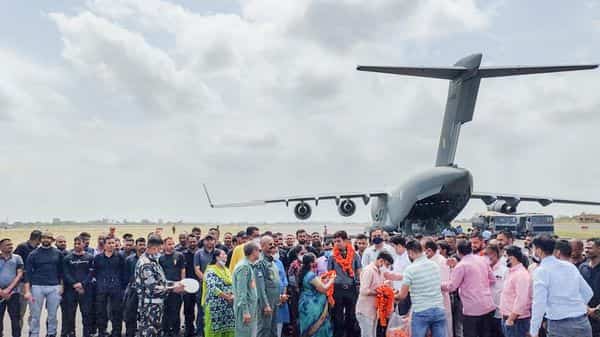
As of August 22, India brought back 392 people, including two Afghan lawmakers, in three different flights as a part of the mission to evacuate its nationals and Afghan partners from Kabul.

A total of 168 people, including 107 Indians and 23 Afghan Sikhs and Hindus, were flown from Kabul to Hindon airbase near Delhi in a C-17 heavy-lift military transport aircraft of the Indian Air Force (IAF). The evacuation plan is still underway as India undertakes repatriation of remaining Indians stranded in Afghanistan while helping other countries evacuate their marooned nationals.

The Indian government is still making all efforts to bring back Indian citizens as well as Hindus and Sikh Afghan nationals as well as other Afghans to India.


Sidhu vs Captain tussle escalates as former hails BJP ruled states over sugarcane pricing: Details

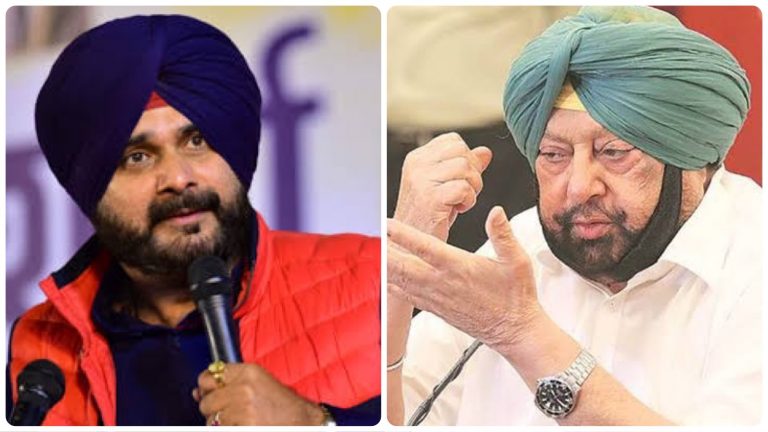
In yet another sign that the tenuous truce brokered between Punjab CM Captain Amarinder Singh and the President of Punjab Pradesh Congress Committee Navjot Singh Sidhu might be short-lived, the latter slammed Singh-led government in Punjab and hailed BJP-ruled states for higher State Assured Prices(SAP) for Sugarcane.

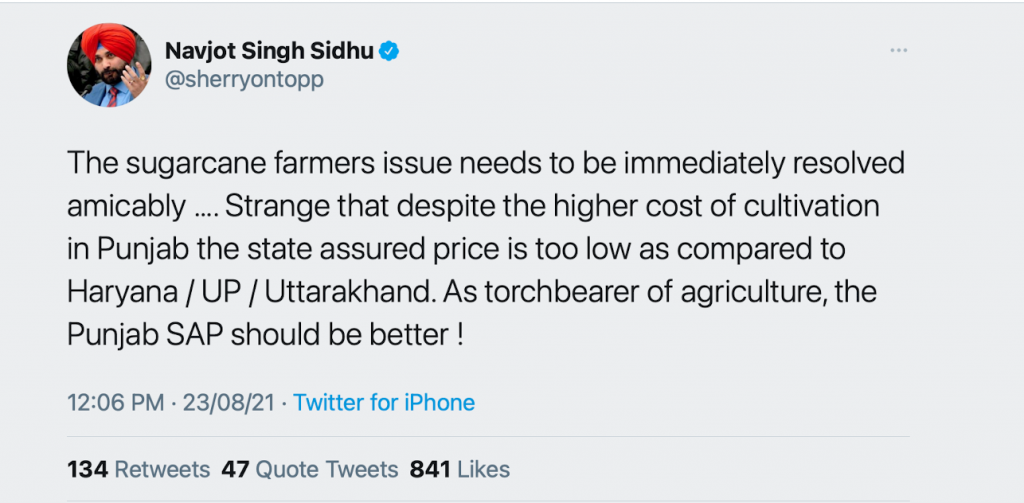
Sidhu on Monday posted a tweet calling for an increase in State Agreed Price (SAP) for sugarcane in Punjab, asserting that despite the higher cost of cultivation in the state, the SAP is lower than that received by farmers in BJP ruled states of Haryana, Uttar Pradesh and Uttarakhand.

“The sugarcane farmers issue needs to be immediately resolved amicably…Strange that despite the higher cost of cultivation in Punjab the state assured price is too low as compared to Haryana/UP/Uttarakhand. As a torchbearer of agriculture, the Punjab SAP should be better!” Sidhu tweeted.

Source: Twitter

The SAP of the sugarcane in Punjab for early, mid and late varieties is Rs 310, Rs 300 and Rs 295 per quintal, respectively. These three varities are harvested in November-December, January, and February-March, respectively.

By contrast, in Haryana, the SAP stands at Rs 345 and Rs 340 per quintal for the early and late varieties, respectively. In Uttrakhand, it is Rs 327 and Rs 317 for early and late varieties and in UP, it is Rs 325 and Rs 315 for early and late varieties, respectively.

Sugarcane farmers in Punjab launch agitation against low SAP

Sidhu’s tweet came in the wake of indefinite protests carried out by thousands of farmers and sugarcane producers affiliated to nearly 32 farmers’ organisations demanding the clearance of pending dues of sugarcane and enhancement in the State Agreed Price(SAP).

As many as 20,000 farmers participated in the protests on the first day of the agitation on the Dhanowali Road on the Jalandhar-Phagwara highway on Friday. Many farmers sat on dharna on rail tracks also.

The farmers lamented that despite letters written to the state government on the issue for the past many years, there has been no interest from them to resolve the issue and alleviate our concerns.

“The state government has forced us to launch an agitation. More than six have elapsed but the state government hasn’t increased the rates of SAP for sugarcane. The prices of fertilisers, labour, diesel rates are increasing. We have been giving demand letters to the government every year,” said Kuldip Singh, who heads the Doaba Kisan Union. “When the government came in power in 2017, there was just a 10 rupee increase in the rate while they had promised 20. Earlier, the Akalis didn’t increase the rate, then the Congress came and promised they will increase the rate by Rs 10 every year. If they increased even that much every year, we wouldn’t have complained. But we need the sugarcane SAP to be at least Rs 400 per quintal.”

The tussle between Navjot Singh Sidhu and Punjab CM Capt Amarinder Singh

As disgruntled sugarcane farmers in Punjab took to the streets, Congress state president Navjot Singh Sidhu seems to use the crisis to his advantage. It has once again brought to fore the infighting within the Punjab Congress unit, with Sidhu and Singh allegedly involved in a perpetual tussle to exert their dominance over the party.

In July 2021, as speculations of Sidhu being elevated to the position of President of Punjab Congress Pradesh Committee started doing the rounds, CM Captain Amarinder Singh hinted that he will accept Navjot Singh Sidhu as the chief of the Punjab Congress but with a caveat. The CM has refused to meet the dissident Congress leader unless Sindhu apologises to him first.

Captain Amarinder Singh has demanded a public apology from Navjor Singh Sidhu for his offensive comments and tweets and has refused to meet him until he receives the apology. Reportedly, the CM told this to Harish Rawat, the All India Congress Committee general secretary in charge of Punjab affairs.

For the last several months, Sidhu has been attacking Amarinder Singh with various allegations. He has accused the CM of colluding with the Badals of Akali Dal, accused of running a mafia raj in Punjab, and alleged that the CM is not taking action against sacrilege cases. Although several state leaders are not happy with Sidhu for such public outburst against the own govt, the high command is not willing to take action against him, eyeing the elections next year.

Months of bickering and speculations by the Punjab Congress leaders came to an end on July 19, with Congress supremo Sonia Gandhi setting aside reservations raised by Captain Amarinder Singh and anointing Navjot Singh Sidhu the new Punjab Congress Chief. 

Social media post from 2016 has Myntra in a soup, netizens trend #BoycottMyntra

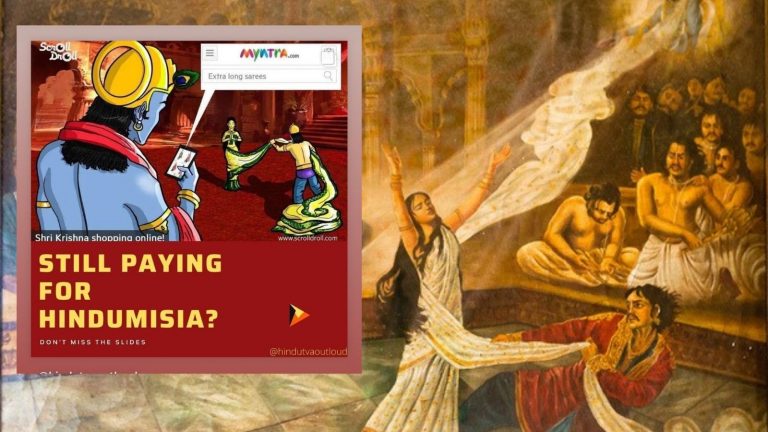
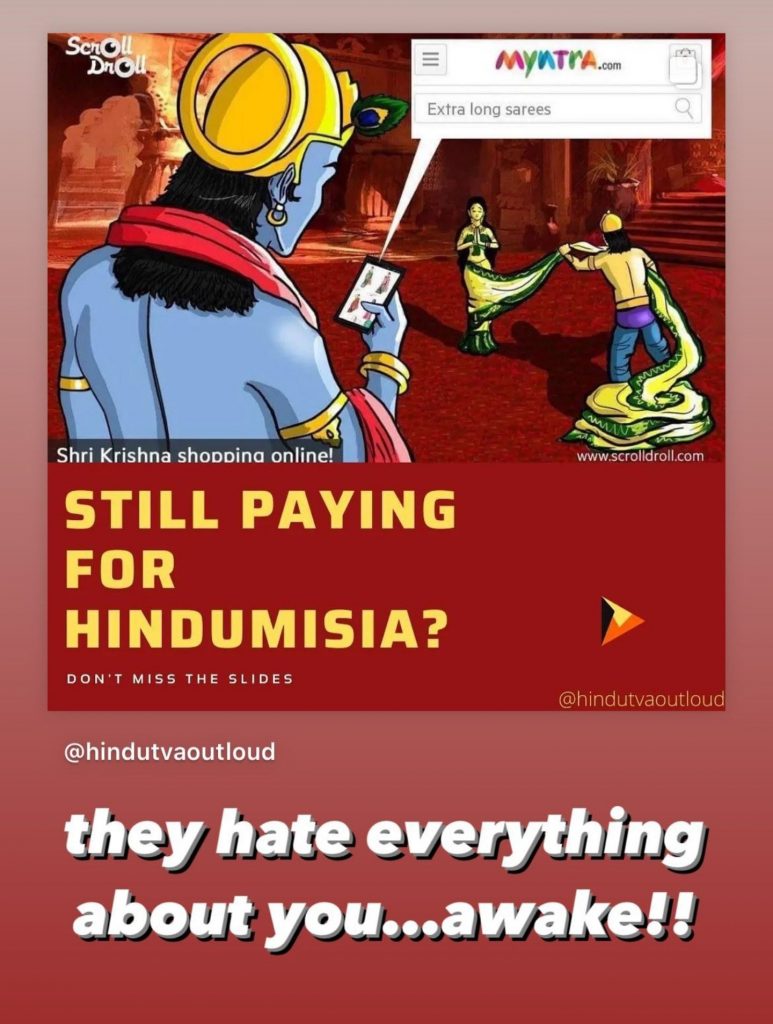
E-commerce lifestyle platform Myntra is embroiled in controversy after a social media post from 2016 featuring the brand has gone viral. Netizens have called for a boycott of the platform after the old Hinduphobic post allegedly created by a content marketing company Scrolldroll started doing rounds on social media. 

Viral post featuring Myntra

The post in question features a traumatic scene from the Hindu epic Mahabharata. In a distasteful take, Shri Krishna is shown ‘shopping online for long sarees’ from Myntra as Dushashan disrobes Panchali. 

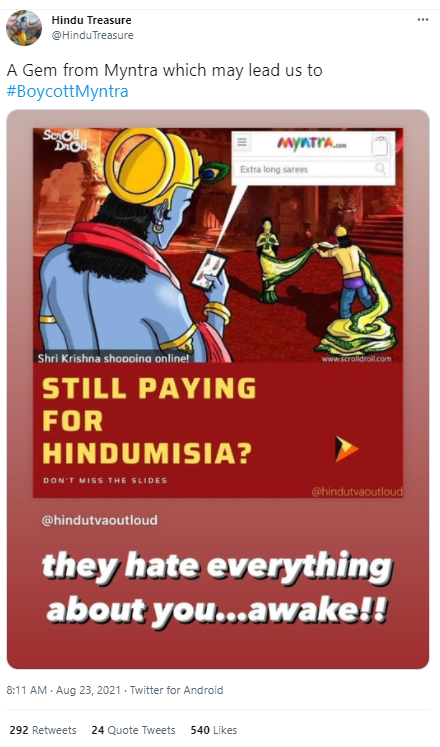
Owing to this, the netizens have called for a total boycott of the e-commerce brand. 

Tweet calling for boycott of Myntra

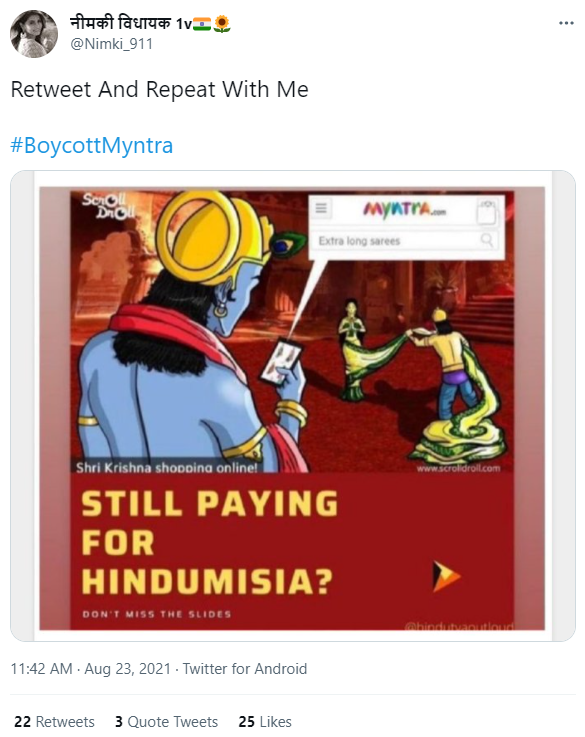
With over 9000 Tweets, the call for a boycott of the e-commerce platform is trending on the micro-blogging platform Twitter. 

Tweet calling for boycott of Myntra

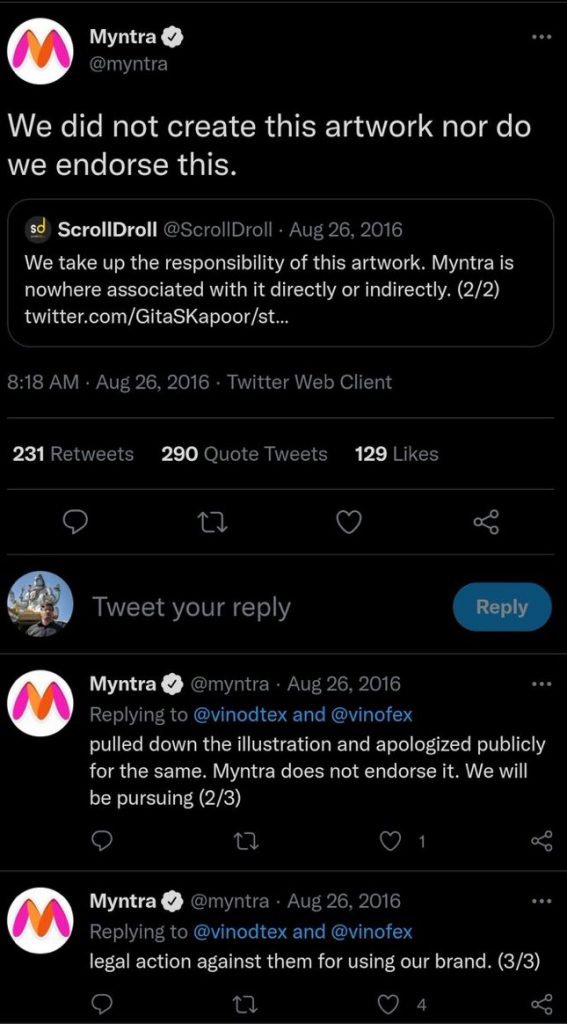
However, dissociating itself from the creative, the company had issued a clarification back in 2016 saying that the artwork was not created by them.

Myntra’s clarification Tweet from 2016

The platform also asserted that they do not endorse such content. In fact, the web portal ScrollDroll, which had made the creative illustration had also clarified that Myntra is not associated with the ad.

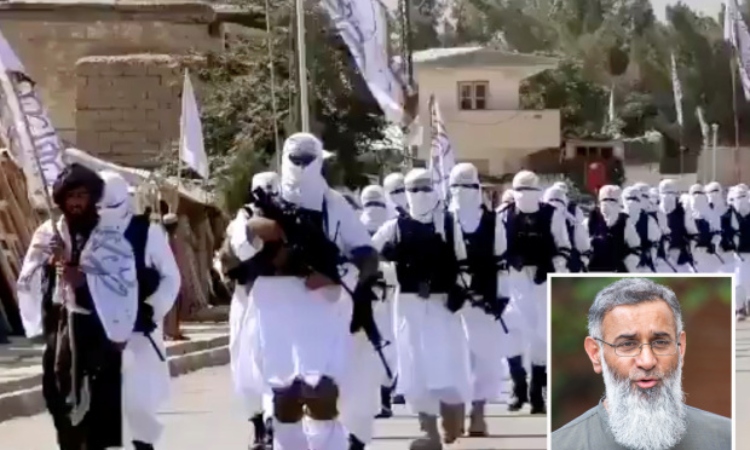
British Islamist preacher urges Taliban go even more hardline, wants them to stone adulterers and chop hands of thieves

Britain’s Islamist preacher Anjem Choudary has called on the ultra-hardline Taliban to become more fanatic than it already is. The radical cleric, who has inspired generations of jihadists, has urged Taliban to abolish all traces of Western culture from Afghanistan by banning “useless pursuits such as music, drama and philosophy”.

Insisting that the Islamist fundamentalist organisation must enforce the strictest Islamic sharia in the occupied country, Choudary in his venomous tirade, suggested that only strict sharia punishments, including chopping off thieves’ hands, lashing anyone caught drinking alcohol and stoning adulterers, must be enforced in Afghanistan.

Choudary opined, “The penal code or Hudood is the right of Allah. To cut the hand off the thief, stone the adulterer, implementing capital punishment upon the apostate and lashing those who drink alcohol (all after due court process and evidence) must be implemented without question and hesitation.”

He urged the Taliban that the non-Muslims living in Afghanistan must pay the ‘jizya’ tax to ensure that they receive protection. When India was under the Mughal rule, jizya was common practice and non-payment could lead to enslavement. The slaves were then sold to recover the taxes during that time.

His vile rant did not end at this. The Islamist preacher, who was jailed for five-and-a-half years in 2016 after being convicted of inviting support for the Islamic State group, also urged the Taliban to change the name of Afghanistan to Islamic State, which is what ISIS called its territory once it is declared a caliphate.

“There should be the removal of all borders and an invitation to all Muslims to become citizens of the new Islamic State to unite the Muslim land of the Indian sub-continent, to begin with, to be the precursor of greater unity under the Khilafah (caliphate),” he opined.

He also called on the Taliban to shut down Afghanistan’s embassies abroad, even in Muslim countries, and expelling the United Nations from Kabul.

The Islamist preachers advice comes at a time when the Afghans are staring at the resurgence of atrocities and oppression under Taliban rule. From the open execution of those trying to flee Kabul to multiple bans imposed on Afghan women under the Sharia law to the atrocities on the women and children of the war-torn country, the barbarity being executed by these Islamists fundamentalists on the innocent civilians from the time they have gained grounds in the country is very disturbing.

Kashmir: LeT’s affiliate TRF throws high-intensity hand-grenade at the home of Sarpanch in Baramulla

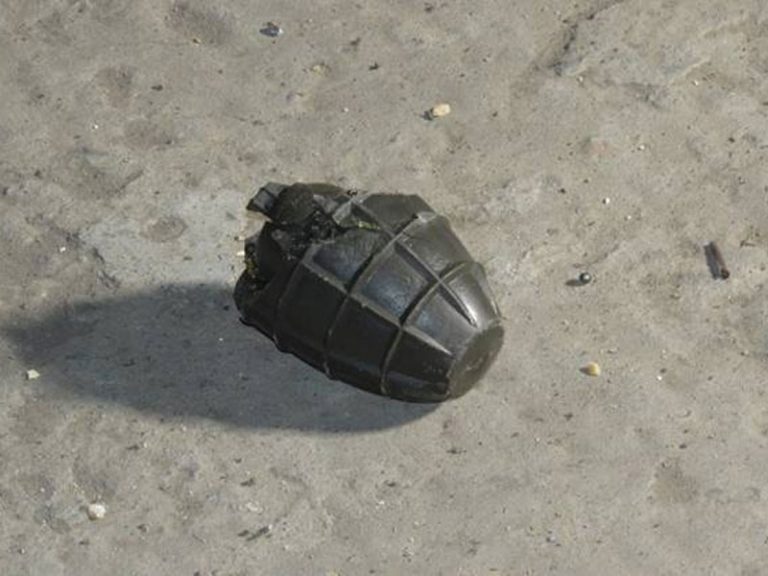
On August 22, The Resistance Front, an affiliate of terrorist group Lashkar-e-Taiba, attacked the home of Sarpanch Narinder Kaur in Baramulla with a high-intensity hand-grenade. The Sarpanch is reportedly also the mother of a GoaChronicle journalist who has been investigating the radicalization of youth in Kashmir by foreign and Indian Islamic radical groups.

As per the reports, the attack took place at around 9 PM on Saturday. The grenade fell in the compound of the house but caused no injuries. However, the compound and some portions of the house got damaged. The family of the Sarpanch is safe.

Savio Rodrigues, Founder & Editor-in-Chief, GoaChronicle, said in a statement, “The attack on a GoaChronicle journalist is not going to dampen the spirit of the team to further investigate into the radical groups in Kashmir and their intent to create disharmony in the nation. Our journalist will be back in action. His family is safe and strong. The army and police authorities are investigating the matter. They have taken the CCTVs recording.”

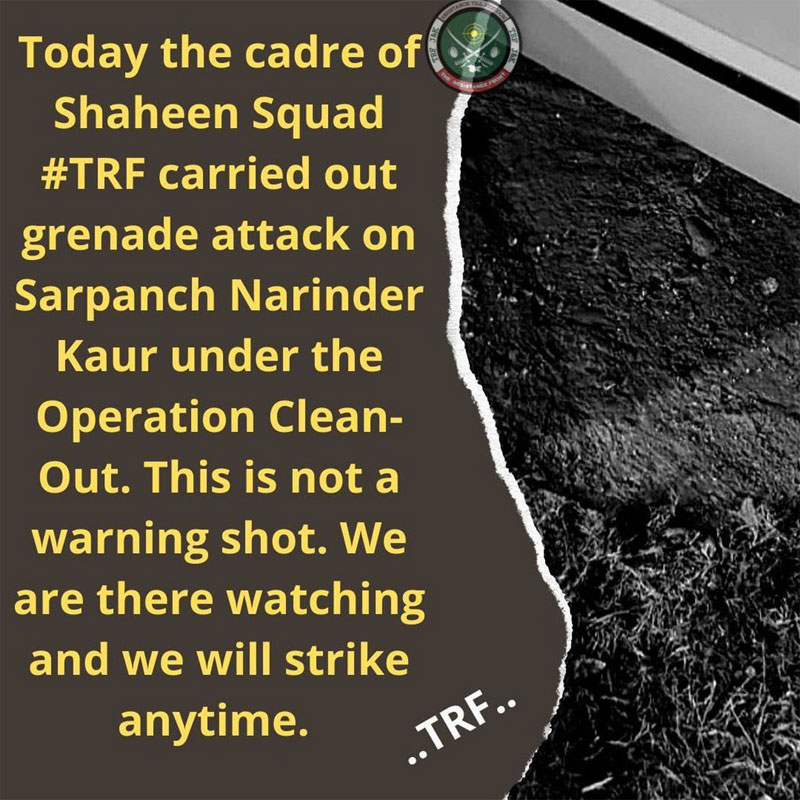
Terrorist rganisation TRF took responsibility for the attack

As per a GoaChronicle article, the TRF have issued a poster taking responsibility for the attack. They said, “Today, the Cadre of the Shaheen Squad #TRF carried out the grenade attack on Sarpanch Narinder Kaur under Operation Clean Out. This is not a warning shot. We are there watching and will strike anytime.”

Poster issued by TRF. Image: Savio Rodrigues/Twitter

Journalist was visiting his home after eight months

GoaChronicle reported that their journalist was away from his home for eight months as he was under the radar of the terrorists. He was visiting his home when the attack happened.

Recent attacks on leaders in Kashmir

On August 9, BJP Sarpanch Ghulam Rasool Bhat and his wife Jawahara Banoo were killed by Pakistan-sponsored Islamic terrorists. The incident took place in the Lal Chowk area in the Anantnag district of South Kashmir. In June this year, BJP leader Rakesh Pandita was shot dead by terrorists.

Recently, a bomb was thrown at BJP leader Jasbir Singh’s house in Jammu’s Rajouri. An infant was killed in the attack and several family members were injured.

In March, a group of terrorists opened fire at the guard post of BJP leader Anwar Khan’s residence in Nowgam, North Kashmir. One sentry who was critically injured in the attack succumbed to his injuries. In the same month, unidentified terrorist/terrorists attacked a Municipal council meeting in Sopore, chaired by State Secretary of BJP Fareeda Khan resulting in death of two including a police personnel.