Home Blog Page 4133

Overemphasis on Mughals, caste issues, no mention of Hindu kings, saints: Think-tank flags distortion in NCERT books before Parliamentary panel

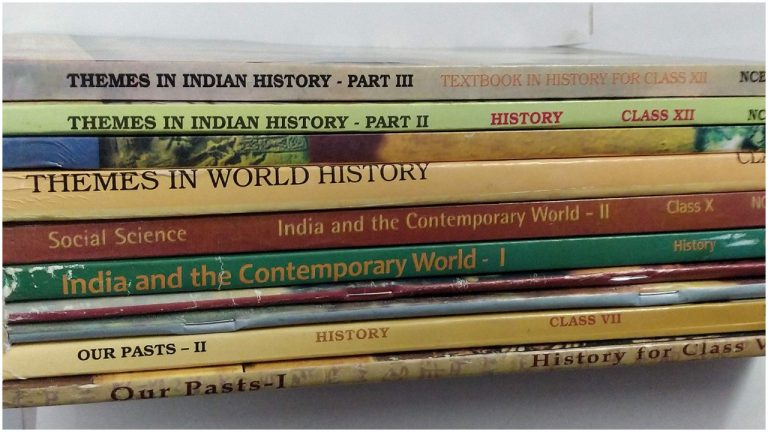
A research report published by a prestigious think tank presented before the Parliamentary Committee on education has stated that History textbooks published by the National Council of Educational Research and Training (NCERT) and textbooks issued by the Kerala government give disproportionate attention to Mughal rulers, caste issues and barely mentions the achievements of Hindu kings, Indian saints, social reformers etc.

According to a report by the Economic Times, the research produced by Public Policy Research Center (PPRC) director Sumeet Bhasin, researchers Chandni Sengupta, Deepa Kaushik and Sanket Kate, titled “Distortions and Misrepresentations of India’s Past: History Textbooks and Why they need to change“, has highlighted that NCERT textbooks have deliberately overstated the contributions of Mughal rulers to India.

Analysing the NCERT History textbooks in detail, the research think tank has revealed that there is an average of 97 references to Emperor Akbar, 30 references to Shah Jahan, Aurangzeb and Jahangir each. However, there are only eight references to Maratha king Chhatrapati Shivaji, and there are hardly any references to Rajput kings Rana Sanga and Maharana Pratap.

Think tank compares Kerala and Gujarat textbooks

The group of researchers have also compared history textbooks ordered by the education boards of the Kerala and Gujarat governments in detail to highlight the distortions and a skewed view of India’s history in Kerala textbooks.

According to the researchers, the NCERT and the Kerala textbooks has put greater emphasis on accounts of Muslim chroniclers like Ibn Batuta, along with social reform movements and reformers, and ignored the works of Chanakya, Bodhayan, Bhaskaracharya, Aryabhatta and the works of social reformers such as Swami Dayanand Saraswati and Swami Vivekananda, the ET report said.

The think tank also pointed out how Kerala textbooks “blacked out” references to ancient India and Rig Veda while overstating the caste of Hindu saints who led the Bhakti movement and also downplayed their philosophy and teachings. In their research, the think tank also said that NCERT textbooks excessively use words such as “gotra, jati, and varna”.

The research report praised the Gujarat government’s approach to history, wherein it “underplayed the caste system, valorised Rajput women and talked about the role women in ancient India played in society”.

The Gujarat textbooks, while mentioning the four varnas, have not gone into their details and have chapters on different temples of the country and how they survived assaults by invaders, an account missing in Kerala and NCERT textbooks, the report said.

On Kerala History textbooks, the research says it has just a few passing references to the 1857 uprising, while NCERT makes it centred around Mughal emperor Bahadur Shah Zafar, as opposed to Gujarat textbooks that have highlighted the role of Rani Laxmibai of Jhansi, Tatya Tope and Nanasaheb.

The report has also revealed that the textbooks gave prominence to MK Gandhi and Jawaharlal Nehru in chapters of Modern India from classes eight to twelve. At the same time, nationalists leaders such as Sardar Patel, Lokmanya Tilak, Bhagat Singh, Surya Sen, Khudiram Bose have been dropped from these chapters.

In its detailed report submitted to the Parliamentary panel, the researchers have also made nine recommendations, including one to stop the publication of textbook content glorifying the “invasions of Arabs, Turks, and Mughals”. They have also proposed a history rewriting project that will highlight the glorious past of India, its civilizing greatness, the rationality of Vedic rituals, development in the field of medicine and the importance of Sanskrit.

The researchers have recommended teaching topics such as the desecration of Hindu and Jain temples, particularly in the cases of the Somnath temple in Gujarat, the Quwwat-ul-Islam mosque in Delhi, Adhai Din Ka Jhonpra in Ajmer and others. They have also highlighted the need of highlighting stories of Hindu kings like Raja Dahir, Maratha and Rajput rulers like Tanhaji, Rani Durgavati and Rani Kiran Devi Rathore in the textbook.
NCB files 1000 page charge sheet against son-in-law of NCP leader Nawab Malik for procuring, purchasing, transporting and selling drugs

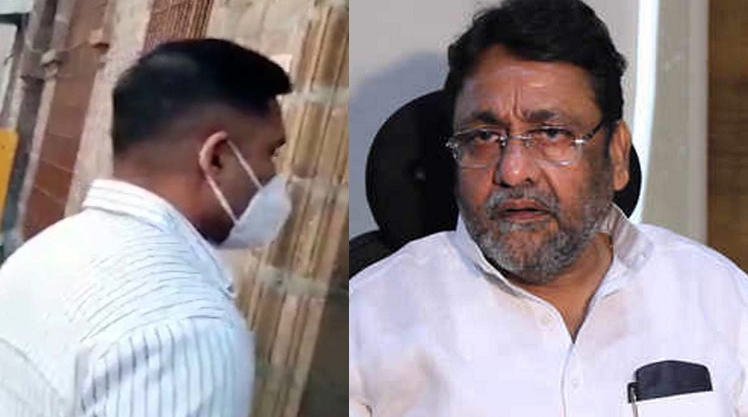
The Narcotics Control Bureau (NCB) probing the Bollywood drug nexus, deliberated by the death of actor Sushant Singh Rajput, has filed a 1,000-page charge sheet against Sameer Khan. Sameer Khan is the son-in-law of NCB leader and Maharashtra Minority Affairs and Skill Development Minister Nawab Malik, who had ‘predicted’ that Republic Editor Arnab Goswami will commit suicide after getting frustrated with numerous cases filed against him by the Maharashtra govt. He was arrested for possession of drugs on January 13th this year.

Along with Sameer Khan, Karan Sejnani, Rahila and Shaista Furniturewalas, Ramkumar Tiwari and alleged drug peddler Anuj Keshwani have also been named in the charge sheet. While Rahila Furniturewala is the former manager of activist and film actress Dia Mirza, Ramkumar Tiwari is one of the owners of Mumbai’s millionaire Paanwala- Muchhad Paanwala.

According to the charge sheet, Nawab Malik’s son-in-law and the other accused have been charged for procuring, purchasing, transporting and selling about 200 kilograms of ganja and six cannabidiol (CBD) sprays.

NCB Zonal Director Sameer Wankhede said the chemical analysis or forensic report shows the presence of 86 kg of cannabis, which is a commercial quantity as per the Narcotic Drugs and Psychotropic Substances (NDPS) Act.

Meanwhile, Khan and Rahila’s counsel, Advocate Taraq Sayyed, said after going through the chargesheet, “There is nothing in the chargesheet. The CA report says that there is only ganja and CBD, which do not fall under the definition of cannabis as per the NDPS.”

According to reports, the chemical analysis (CA) report had suggested that “On the basis of physical examination, chemical and instrumental analysis, and botanical examination report, presence of cannabidiol (CBD) was detected in substances in about 83 kg of material.” For the other 114 kg, the report states that the “presence of any narcotic drug and psychotropic substance could not be detected in the vegetative substances.”

Nevertheless, as per the norms, a special NDPS court will take cognisance of the chargesheet and the accused who are on bail will have to present themselves before the court during the procedure.

NCB which has been probing the alleged Bollywood-drugs nexus ever since the untimely demise of actor Sushant Singh Rajput has made several arrests in connection with the case. Last year, Komal Rampal, sister of Bollywood actor Arjun Rampal, was also interrogated by the NCB office in Mumbai, in the case.

Arjun Rampal was also probed in a drug-related case. He was questioned by the NCB on November 13 last year, after raids were conducted at his residence on November 9. His girlfriend Gabriella Demetriades was later questioned for six hours on the same day. 

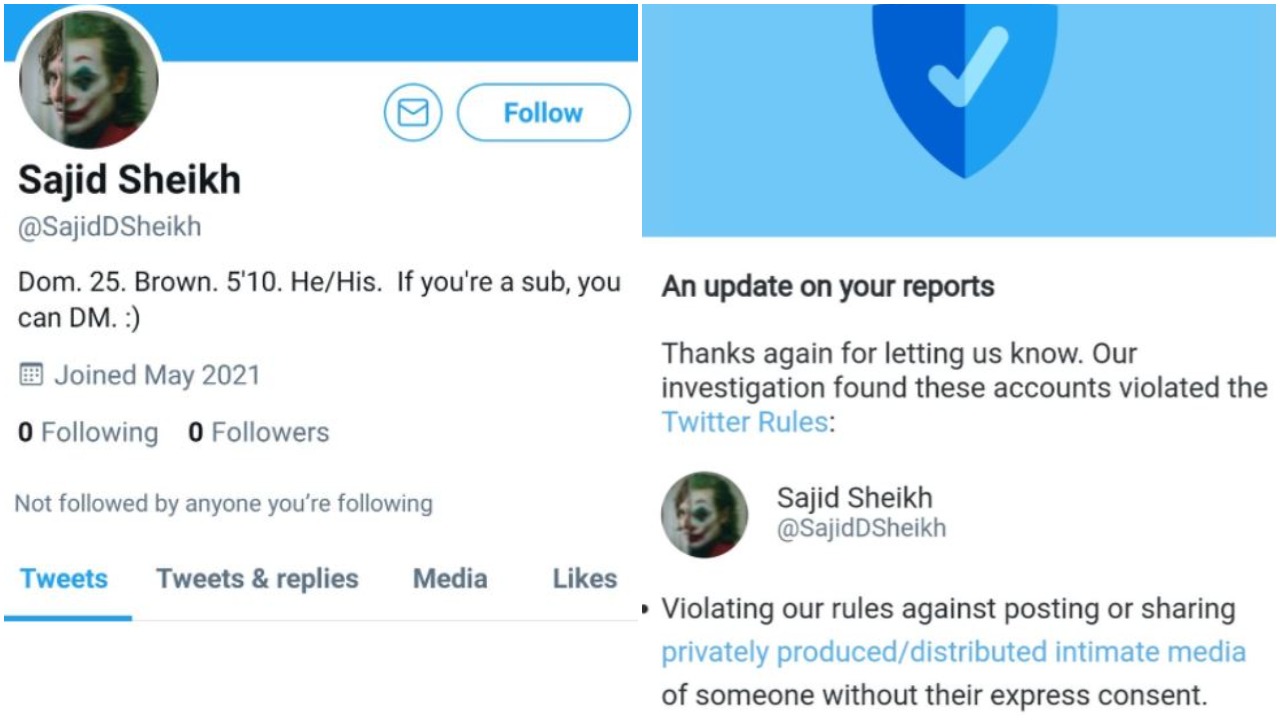
After NCW intervention, Twitter suspends one Sajid Sheikh’s account who was posting pornographic photos of Hindu woman

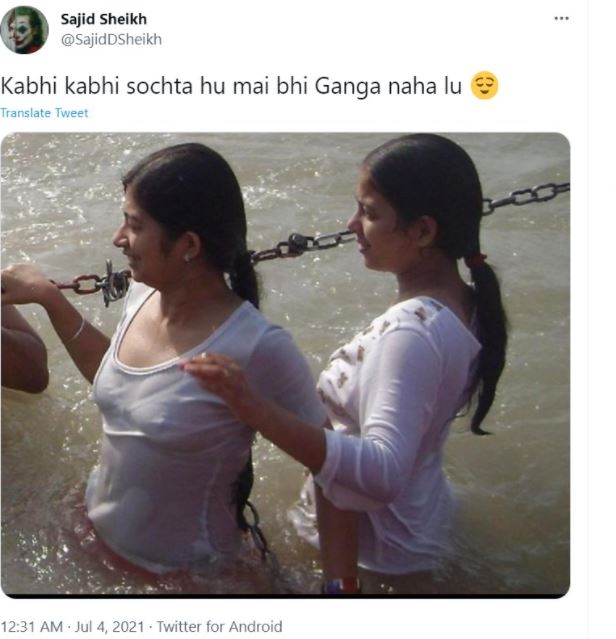
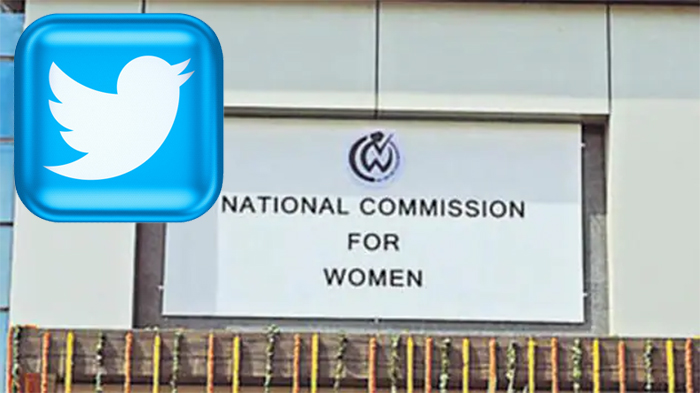
Social media giant Twitter has suspended the account of one user Sajid Shiekh (@SajidDSheikh), after the National Commission for Women (NCW) took cognisance and wrote to the microblogging site drawing its attention towards the sexist and hateful handle which shared pornographic photos to objectify Hindu women.

Twitter suspends the account of one Sajid Shiekh after NCW writes to Twitter about the sexist and hateful handle

Slamming Twitter for not taking independent action against such vile Tweets, Rekha Sharma Tweeted: “The account got suspended after @NCWIndia wrote to @TwitterIndia but the question is do we have to write everytime such tweets come up? Why @Twitter doesn’t have a check on these handles?”

NCW chairperson Rekha Sharma had taken cognisance of the matter after one Twitter user Aayush (@ModifiedAayush) flagged the issue. Sharing one such deplorable Tweet (which is now unavailable) by @SajidDSheikh and tagging NCW chairperson Rekha Sharma and Union Minister Smriti Irani, Aayush had Tweeted: Today everyone is silent on this tweet because he is Muslim. I magine if this one was a Hindu, then by now there would have been a ruckus on the whole of Twitter. I request to @NCWIndia and @smritiirani to take strict action against this person so that no one can commit such mistake https://twitter.com/SajidDSheikh/status/1411217201550356481“.

Welcoming the decision to suspend Sajid Shiekh’s Twitter handle, many social media users shared screenshots of the misogynistic, communal and hate-filled Tweets posted by the Muslim youth. In most of his Tweets, Shiekh dehumanised Hindu women by sharing pornographic images, obviously without the consent of the said women, claiming that the Hindu women lust for Muslim men.

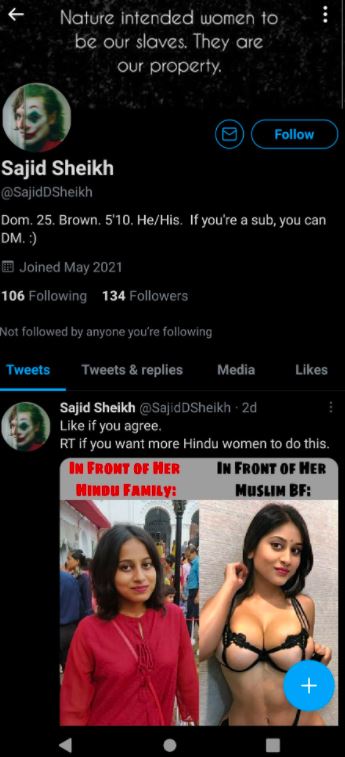
Shiekh humiliated Hindu women insinuating that they are deceitful and unethical, having two stark opposite characters, one which they paint in front of their family and the other which they present in front of their “Muslim BF”.

Screenshot of a Tweet from Sajid Sheikh’s now-suspended Twitter account

Displaying his deep-rooted prejudice against women and his misogynistic mindset, the Twitter user had written: “Nature intends women to be our slaves. They are our property.

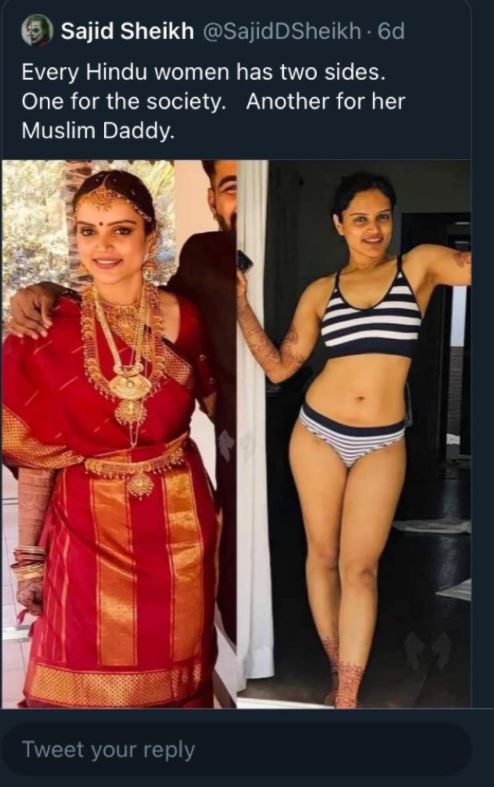
“Hindu woman has two sides, one for the society and another for her Muslim Daddy”. Shiekh wrote while posting two pictures of the same woman, one in a traditional attire alongside a picture of hers in a bikini to rationalize his unsavoury perception.

Screenshot of a Tweet from Sajid Sheikh’s now-suspended Twitter account

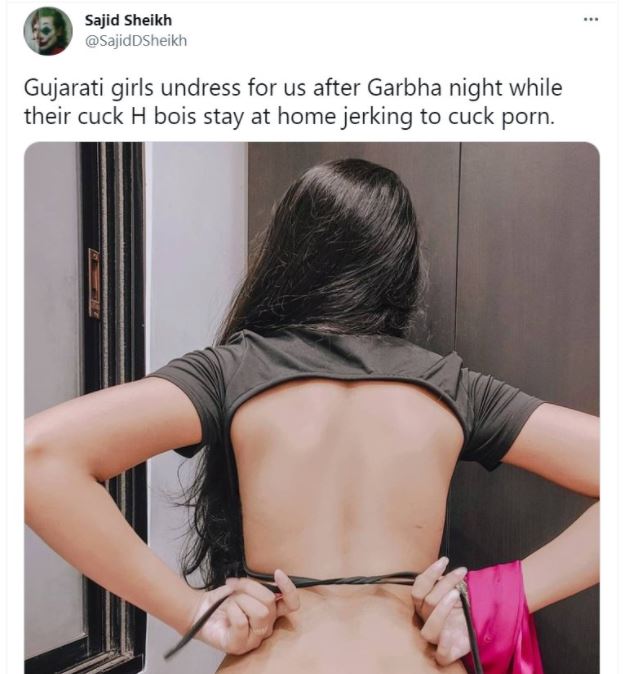
In another sexist Tweet, Sajid Sheikh went on to mock Hindu traditions and customs by posting a picture of women taking a holy dip in the river Ganga, a ritual considered sacred by the Hindus.

Sharing screenshots of these disgusting Tweets, many social media users had sought action against the pervert.

UP Law Commission floats population control bill draft: How the draft, in its current form, sacrifices merit in favour of fewer children

The Uttar Pradesh Law Commission on Saturday made available to the public its draft population control bill and sought suggestions from the public regarding the same. The Uttar Pradesh Population (Control, Stabilization and Welfare) Bill, 2021 envisions benefits for those with two children and more for those with only one with disincentives attached for those who act in contravention of the proposed bill.

While the proposed Bill was, no doubt, implemented with good intention, there are multiple fundamental flaws with the bill. One of the most fundamental flaws is that it does not establish the fundamental necessity of the Bill.

According to data available, population growth rate in Uttar Pradesh is already on the decline and the Total Fertility Rate (TFR), that is, the number of children per woman, was 2.7 in 2015-16, a sharp fall from 3.8 in 2005-06. Thus, the population growth rate is already declining without government intervention. Furthermore, in large parts of India, the TFR is less than 2.1 already, that is, the replacement level TFR at which population remains stable and does not decline or grow.

Thus, there does not appear to be any justification for the implementation of the Bill for the purposes intended. All of this aside, there are multiple provisions in the draft Bill that forces us to question the wisdom of it.

The problematic provisions of the UP population control bill draft

One of the most fundamental problems with the draft is that it sacrifices merit at the altar of population control. If the bill is implemented as law, then admissions to premier educational institutions and promotions will be based on the number of children one has.

The draft promises preference for single child in all admission in all educational institutions including AIIMS and IIM. Admission to institutions should be based on merit. There is no valid justification as to why a single child should be preferred over others for admission to educational institutions. It just does not make any sense at all.

The draft also envisions a preference for single child for appointment to government jobs. Again, running a government is not an easy job. And consequent appointment should be based on merit and ability. It is unclear how a preference for a single child figures into all of this.

The draft also bans people with more than two children from applying for government jobs and bans promotions for the same. All of this combined only confirms the death of merit.

Where is the money going to come from?

The draft also proposes multiple sops for those with two children and even more for those with one child and a lot of these are not limited to public servants but encompass the whole population. Furthermore, the UP Government is yet to provide the estimated cost of the said sops.

The draft proposes free education till graduation for the single child, free healthcare and insurance till the age of 20 years, and scholarship for higher studies till the age of 20. This is in addition to benefits provided for those with a maximum of two children.

The benefits for those abiding by the two-child norm include housing loan at nominal rates of interest, rebates on charges for utilities such as water and electricity among other things. The most contentious, however, is 12 months maternity or paternity leave with full pay and allowances. And these are benefits available for not just public servants but the general population as well.

It is not clear how this is going to work for those who work in the private sector. Who will pay the salary, the government or the company? And if it is the private company that has to pay for the maternity or paternity leave, then the cost of labour is going to increase exponentially in the state and the business environment is going to suffer as a consequence.

After all, why should the company hire someone they have to pay 12 months salary for no work at all? If the government says that they will bear the cost of salary and allowances, it is hard to see where the money is going to come from.

These are benefits that are available to all citizens, not just public servants. For public servants alone, increments are promised as well as subsidies for the purchase of plots for houses and “three per cent increase in the employer‘s contribution Fund under national pension scheme.”

Again, the estimated cost of all these sops has not been provided and it is not clear at all where the money is going to come from.

The permanence of the law

India is a democracy and all laws can be changed when a new government comes to power. Therefore, no law is permanent per se and subject to change via elections. The same goes for the proposed bill should it ever become law.

Consider this for a moment. A couple that would have otherwise had more than two children decides to limit themselves to two children due to the draft which may become a law. After 10 years, however, the law is repealed by a different government that comes to power and consequently, most of the benefits as well. What happens then? Perhaps, there is no cause for serious complaints here but it is a consideration that must be taken into account as well.

Moreover, democracy is dependent on the votes that are earned. What happens if a section of the population continues to violate the law and when they have reached a sufficient advantage in terms of numbers to win elections, they elect people who would then repeal the law?

All of these factors have to be taken under consideration while accepting the draft but such answers, thus far, have not been provided.

Javed Akhtar enters battleground pronouns, suggests ‘hesh’ and ‘shim’, gets mocked: Details

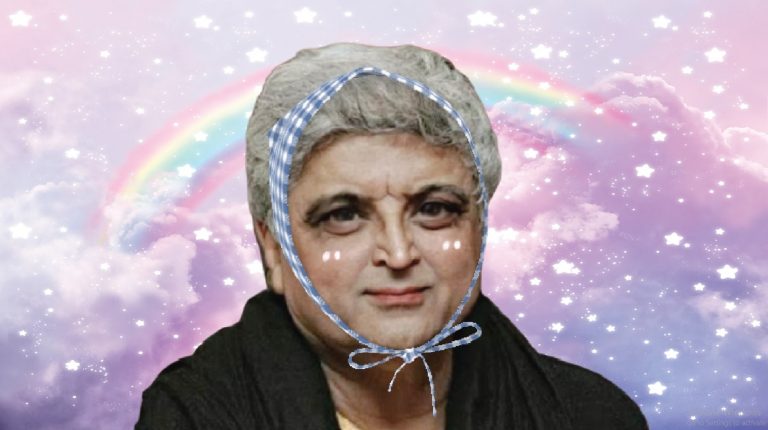
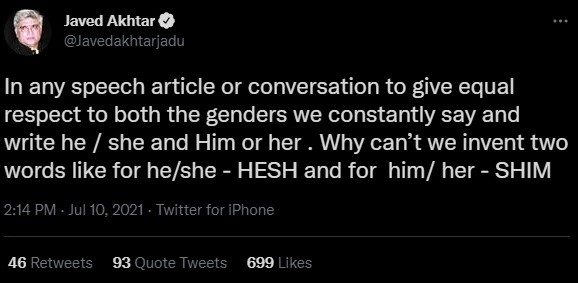
Bollywood lyricist Javed Akhtar has come up with a novel idea to rectify what he appears to consider gendered language. In his infinite wisdom, he reckons that we ought to substitute the pronouns ‘he’/’she’ and ‘him’/’her’ with gender neutral terms ‘hesh’ and ‘shim’ respectively.

Javed Akhtar does not appear to realise that despite his best intentions, the terms will be discarded by the very people he seeks to appease by suggesting such bizarre terms. One can be assured that the Woke camp will reject these terms because ‘hesh’ consists the pronoun ‘he’ and ‘shim’ contains ‘him’. Thus, it appears that his ‘toxic masculinity’ has once again motivated Akhtar to suggest words that emphasise toxic masculinity.

Javed Akhtar suggests ‘hesh’ and ‘shim’

Furthermore, he commits the grave error of claiming that there are only two genders, which is unpardonable. As we all know, there are an infinite number of genders. Jokes apart, the suggestion by Akhtar is bizarre and frankly, downright stupid. Therefore, it is not surprising that his suggestion sparked widespread mockery.

People also noted that if ‘hesh’ and ‘shim’ are mixed, they get ‘Himesh’.

It is quite clear that Akhtar is attempting to popularise himself by jumping on the pronoun bandwagon. But in doing so, he has only made a joke of himself. However, his tweet is further confirmation of the fact that the pronoun politics that has taken the West by storm is coming to India as well, brought here by anglophile elites.

While Akhtar may be grossly out of touch, other upcoming ‘activists’ are much more suave and savvy, and thus, pose a much greater threat to common sense and sensibilities.

Watch: Karnataka Congress leader DK Shivakumar slaps a party worker in public for trying to touch him

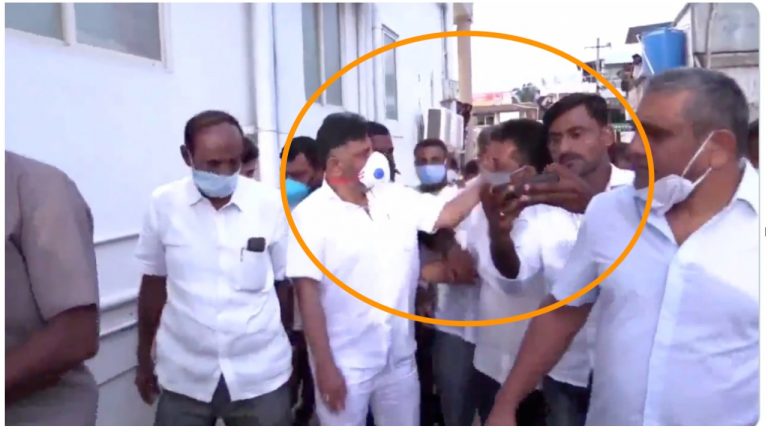
Karnataka Congress chief DK Shivakumar has courted yet another controversy after he was caught on camera slapping a party worker in public on Saturday.

In a video that has gone viral on the internet, Karnataka Congress chief DK Shivakumar was seen losing his cool after a party worker tried to approach him during his visit to Mandya on Saturday. As the party worker tried to touch the Congress leader, DK Shivkumar got angry and slapped him on his face.

Reportedly, the Congress leader was in Mandya on Friday to visit ailing Congress leader G Madegowda when the incident took place. The party worker had apparently tried to touch DK Shivakumar’s shoulder. This angered the Congress leader, who slapped him and told him to behave in front of the public.

“What is this behaviour at this place? I have given you freedom, but that doesn’t mean you can do this,” the Congress leader can be heard saying.

BJP leader CT Ravi shared the video on Twitter saying DK Shivakumar showed his might on an ordinary party worker and asked Gandhi-scion Rahul Gandhi whether he had given a license to commit violence against common men.

“If this is how the “former shishya” (protege) of Kotwal Ramachandra (former mafia don) treats his party worker, one can imagine what he would do with Others. Have you given DKS the “licence for violence”, tweeted BJP leader CT Ravi.

The video of the incident has gone viral on social media.

As DK Shivakumar realised that his act of arrogance was caught on the camera, he warned the media persons to delete the video.

This is not the first time that DK Shivakumar was seen attacking common party workers in public. In 2018, during a Congress election campaign in Bellary, DK Shivakumar had slapped another man who wanted to take a selfie with him.

Similarly, in another incident in 2017 in Belgaum, DK Shivakumar had slammed a man on his arm for taking a selfie. The incident took place in front of the reporters. The Congress leader had defended the attack saying the selfie was uncalled for and termed his reaction as normal.

DK Shivakumar, who is an MLA from Kanakapura, is currently on bail in connection with a money laundering case.

Sanjay Gandhi Animal Care Centre to be shut down temporarily after 40 years after dog was tortured, abused and killed: Maneka Gandhi

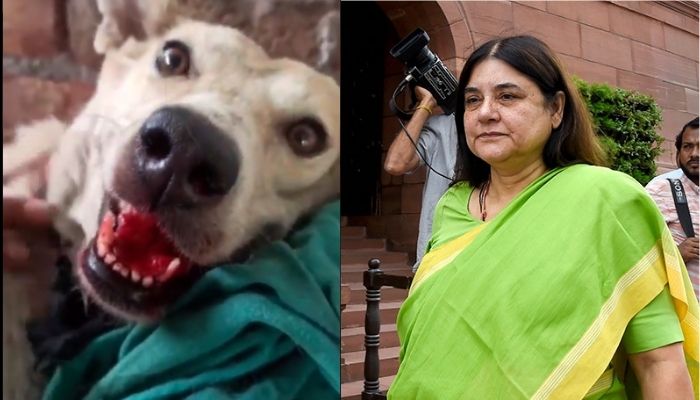
Days after a dog was brutally thrashed by two para vets at the Sanjay Gandhi Animal Care Centre (SGACC), BJP MP Maneka Gandhi has announced the temporary shutting down of the animal care facility.

In a statement on Twitter, Gandhi said, “This is a statement of grief and rage. Recently, a dog was brought in for a rescue to Sanjay Gandhi Animal Care Centre (SGACC) in New Delhi. Over the last year, SGACC has been short-staffed due to COVID-19, and two newly hired para-vets were providing support. The rescue took a regrettable turn when the dog — naturally agitated, as she was in extreme pain — bit the para-vet, who in turn retaliated with frightful violence. The dog died from her injuries.”

The BJP MP further added, “This incident has shocked us all to the core — I have been personally seething with rage and have been sick to my stomach since I watched the horrifying video. We immediately filed an FIR against the para-vets and they have been arrested. The doctor in charge of the section has been given the notice to leave. But this is not enough. SGACC has faltered in its mission and needs to be rebuilt again.” Maneka Gandhi announced temporary shutting down of Sanjay Gandhi Animal Care Centre and cessation of animal rescue missions, after 40 years of service.

She assured that all existing animals would be rehabilitated by the animal care facility. The BJP MP from Sultanpur vowed to rebuild the animal shelter physically, create new infrastructure and ensure adequate staff members. “We will overhaul the hospital management and its staff completely while ensuring everyone working there is provided with animal-sensitivity training. We will also review our internal policies and incentive mechanisms. It is time to re-build this institution from the ground-up, and ensure that such an incident is never repeated again,” she concluded.

Dog tortured, abused and killed by vets at SGACC

In a tweet on Monday (June 5), People for Animal (PFA) activist Kaveri Chowdhury shared a disturbing video of a dog being brutally abused by two para vets. She tweeted, “Poor Sick Dog Thrashed On Floor And Beaten On Mouth While The Staff Laughs. I received a series of Horrifying videos today from an anonymous reporter about this brutality at Sanjay Gandhi Animal Hospital. Its tormenting to the soul to even watch it!”

The informant was a girl, who worked at the same animal shelter. She identified the accused as para vets Satyam and Pradeep. The girl accused the duo of trying to rape the female dog. The animal was found with a bloated stomach and heavy vaginal bleeding. Unfortunately, the dog succumbed to the injuries and died.

‘Social media cannot be used to defame others’: SC slams professor Shaharyar Ali for his obscene remark on Facebook against Smriti Irani, denies anticipatory bail

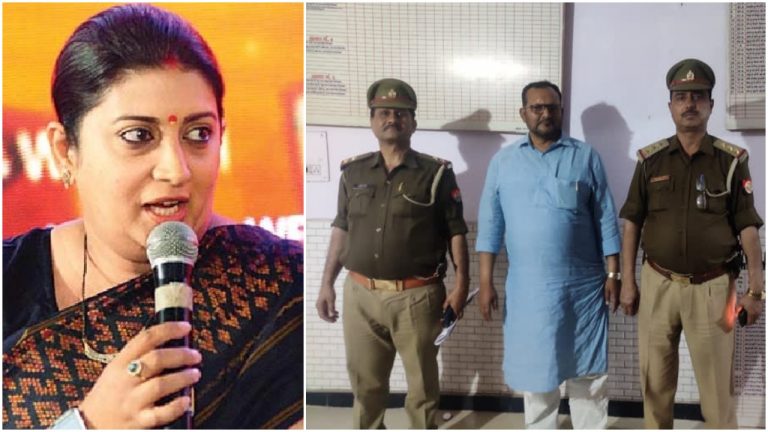
The Supreme Court has denied protection from arrest to professor Shaharyar Ali, the Head of the Department of History at SRK College, Firozabad, who allegedly made objectionable remarks on Facebook against Union minister Smriti Irani. While rejecting the same, the SC two-judge bench comprising of justices Sanjay Kishan Kaul and Hemant Gupta observed that social media cannot be used to defame others.

Not granting relief from arrest to the professor, the judges rebuked Ali, saying that people must remain mindful of the language they use against others while critiquing, criticising or mocking them on social media.

‘You can’t say anything you like and then want to get away’, SC slams Firozabad professor for his defamatory post against Smriti Irani

“You can’t defame women like this. You cannot use social media just to defame. What kind of language is being used? There is a language to criticise. There is a language to say jokes. You can’t say anything you like and then want to get away,” said the two-judge bench, denying anticipatory bail to Shaharyar Ali.

The matter had come for hearing in the Supreme Court on Friday (July 9, 2021). Professor Shaharyar Ali had approached the apex court after Allahabad High Court rejected his anticipatory bail application in May 2021.

The High Court had, while rejecting the bail application, observed that the professor’s conduct of this kind prima facie does not entitle him to anticipatory bail and had remarked that Ali was entitled to surrender and seek regular bail, which would then be considered in accordance with the law.

Professor’s counsel claims his FB was hacked

Challenging the Allahabad HC order, Ali’s counsel Vikas Singh defended his client before the Supreme Court saying that the professor’s Facebook account was hacked and that as soon as he came to know about the contentious post, he published an apology.

However, the Supreme Court bench remained unimpressed by the lame excuse submitted by Ali’s counsel in court. “What you are saying is an afterthought. You used the same account to post your apology but you say your account was hacked. This shows you are the one still using that account. Is there anything to show that your account had been hacked?” asked the court.

On this, the counsel said that though he had nothing to show about his account getting hacked, his conduct of posting the apology should be construed as being truthful.

Miffed by the explanation, the court retorted: “We are not able to believe your hacking story. If your account was hacked, how can you access your own account? It can’t be called hacking. And if someone has used your account to post something, you will still be liable prima facie. You can prove your innocence before the trial court if you have not done anything.”

Dismissing the professor’s anticipatory bail plea, the Supreme Court slammed Ali saying: “And then you think that by saying sorry, all your acts can be washed off. It is not like that. We are not persuaded,” added the bench, giving the Firozabad professor two weeks to surrender before the trial court in Firozabad.

Shaharyar Ali booked for posting “obscene content” about Smriti Irani on Facebook

For the uninitiated, the Firozabad police had booked the professor for an allegedly obscene Facebook post against Union Minister in March 2021. The FIR was filed against Ali based on the complaint filed by a BJP leader, who took strong objection to the professor’s defamatory post against the Union Minister.

Ali was booked for offences under Section 505 (2) of the Indian Penal Code for allegedly promoting enmity between communities, apart from Section 67A of the Information Technology Act for publishing obscene material.

Grooming Jihad: SC issues notice after parents of victim file petition regarding daughter’s safety

On Friday (July 9), the Supreme Court of India issued notices to the governments of Odisha, Jammu & Kashmir, and the Chandigarh administration in connection to a case of grooming jihad, reported The Times of India.

An Odia couple named Kabita and Kedarnath had moved a habeas corpus petition in the apex court, alleging that their daughter had gone missing after her marriage to a Muslim man. According to the couple, their daughter was a student of B.Pharma in Behrampur in Odisha. The girl had met the accused at her college. The Muslim man was a resident of Bandipora in Jammu and Kashmir. The victim and the accused first moved to Lucknow, followed by Chandigarh before disappearing in Bandipora.

While expressing fear about their daughter’s safety, the couple alleged that the duo married in Chandigarh. They told the Court that they were not opposed to interfaith marriage. The couple feared that their daughter was forced into marriage by the accused, who allegedly was a part of a grooming gang. The petitioners said that the girl’s husband was a part of a syndicate that played ‘with the lives of the Hindu girls.’ They went to Chandigarh to bring their daughter back but it was in vain.

They lamented, “The Muslim man and our daughter moved the Punjab and Haryana HC for protection. The petition was later withdrawn and the couple disappeared. We’re unable to contact her and fear that the crime syndicate may coerce her to do illegal acts or acts detrimental to national security. Her phone is switched off and we don’t know her whereabouts.” The case was heard by a 3-Judge Bench of Justices UU Lalit, Ajay Rastogi, and Aniruddha Bose. The Court directed the governments of Odisha, Jammu & Kashmir, and the Chandigarh administration to file their responses (counter-affidavits) by July 23.

Grooming Jihad cases on the rise

Another case of alleged Grooming Jihad had come to the light in Chhatarpur, Madhya Pradesh where a girl’s father has alleged that his daughter has been murdered by her husband and in-laws.

As per reports, the girl’s father, who is the complainant in the case, had stated that his daughter had become a victim of ‘love jihad’ in 2015 when Talib had approached her pretending to be a Hindu named ‘Tabbu’. He had married her and later they had two children too. However, later, the man started harassing her, forcing her to convert to Islam. The father had filed a complaint against the accused with the Civil Line Police Station.

Reportedly, the victim’s father has complained that on July 1, he had received a call from his daughter where she told that she is being abused and tortured by her in-laws and there is a threat to her life. When the father went to the girl’s marital home, he reportedly found that all rooms were locked up and the family had gone away. The father further added that neighbours in the place informed him that his daughter is no more and she had been killed.

Here is what UP population control bill draft says and how you can send feedback: Full details

The proposed draft of the Uttar Pradesh Population (Control, Stabilization and Welfare) Bill, 2021 was presented to the public with requests for suggestion and recommendations from the public. The proposed bill, if implemented into law, will provide benefits to those who have only up to two children.

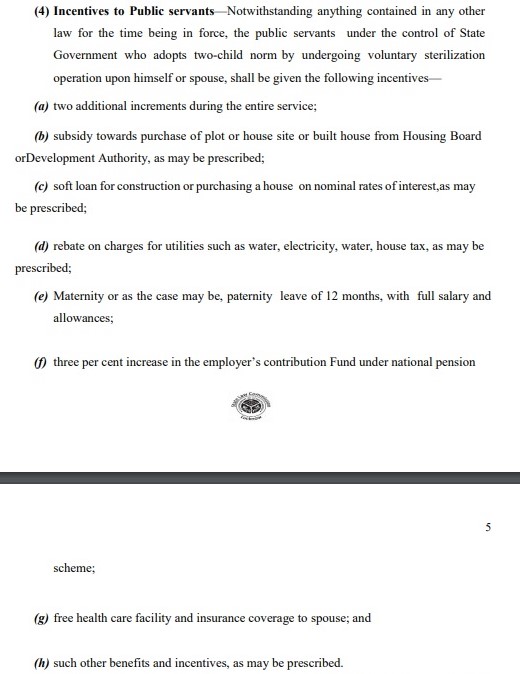
There are certain benefits promised to public servants with only two children and then there are more that are promised for those who have adopted the one-child norm. The proposed benefits for those with two children include “two additional increments during the entire service” and “rebate on charges for utilities such as water, electricity, water, house tax”. The bill also proposed “free health care facility and insurance coverage to spouse”.

Uttar Pradesh Population (Control, Stabilization and Welfare) Bill, 2021
The entire list of benefits for two-children

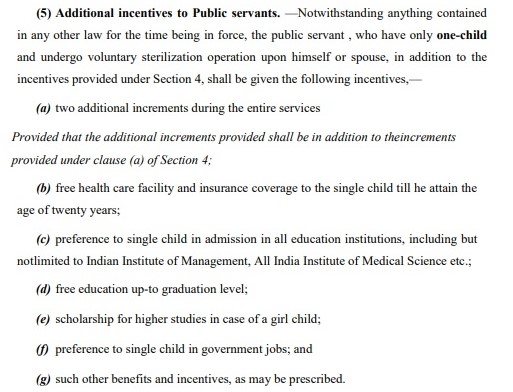
The proposed draft goes a step further and promises more benefits to those who adopt the one-child norm in addition to the ones already available for those with two children. Such benefits include free education till graduation, preference to single child in premier educational institutions such as IIM and AIIMS and government jobs.

Uttar Pradesh Population (Control, Stabilization and Welfare) Bill, 2021
The entire list of benefits for one-child

Some of these benefits are not limited only to public servant but also to the general public. The benefits available under clauses (c), (d), (e) and (h) of section 4 and clauses (b), (c), (d), (e) and (f) of section 5 is available for individuals who are not public servants as well.

The Act also envisions disincentives for those who do not follow the suggested policy. The disincentives include “debarring from benefit of Government sponsored welfare schemes” and limiting ration cards up to four. It also bans people with more than two children from applying for government jobs and also bans promotion in government services.

There are certain exceptions and concessions that are provided under the proposed bill for unforeseen circumstances such as multiple birth during the second pregnancy and in case of disability of a child or their death.

The proposed draft also says that in case of polygamous marriages, “it shall be deemed that the Action of the husband is in contravention of two child norm, if he has more than two children, from all his marital relationships.” In the case of the woman, she will be deemed to have violated the policy only if she has more than two children of her own.

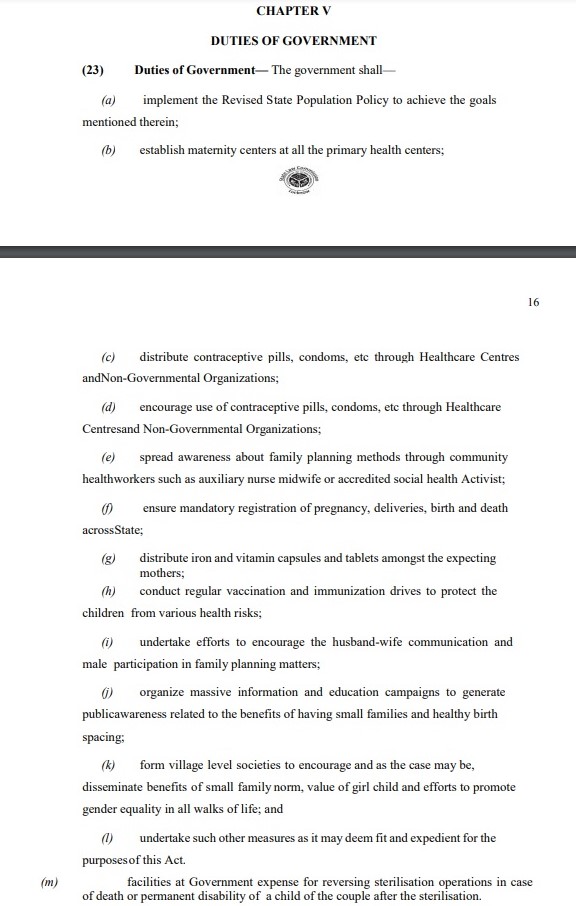
The draft also proposes the constitution of a ‘State Population Fund’ to implement the provisions of the proposed Act. The duties of the Government envisioned under the proposed draft include encouraging the use of contraceptive pills and condoms, ensure mandatory registration of pregnancy, deliveries, birth and death and other measures to achieve the goals mentioned in the Revised State Population Policy.

Duties of the Govt under the proposed bill

The UP Government seeks suggestions from people on the proposed Uttar Pradesh Population (Control, Stabilization and Welfare) Bill, 2021. Suggestions, if any, can be sent to [email protected] via email till the 19th of July, 2021.