Home Blog Page 4308

Kejriwal’s lies called out internationally, but AAP ministers continue to brazen it out

After being slammed by Singapore officials and the Ministry of External Affairs, the AAP government continues to further its claim of the Covid-19 ‘Singapore variant’ in India.

Coming out in support of his party leader, Delhi Health Minister Satyendra Jain said, “Wrong to say, there is no #COVID19 strain particular to Singapore. There are many strains in India, Will give clarification on the Singapore strain soon. But we assure you there is a new strain in India.”

Delhi’s Deputy Chief Minister Manish Sisodia too has parroted the same narrative, counter-attacking the central government over ‘focusing on Singapore’. Deflecting from the topic, Sisodia attacked the BJP for not focusing enough on the issue, despite the fact that neither Kejriwal nor his ministers Jain and Sisodia, presented any factual evidence of the existence of a ‘Singapore strain’.

After unnecessarily creating confusion and dragging the name of a friendly neighbourhood nation over unverified claims, AAP leaders continue to play politics, using the narrative for political attacks on the BJP.

The undeterred reaction comes as a shocker after Singapore took strong objection to Delhi Chief Minister’s unscrupulous claims citing it as ‘very dangerous.’

Arvind Kejriwal had spread misinformation

On Tuesday, Kejriwal had taken to Twitter to claim that a new variant of Covid-19 was found in Singapore and appealed to Indian government to shut down flights to and from Singapore to not let the ‘new variant’ reach India.

Image Source: Twitter

Hours after Kejriwal put out unverified claims pertaining to the so-called Singapore strain, the Singapore government refuted all the claims made by Arvind Kejriwal and stressed that no new coronavirus strain had been detected in the city-state.

MEA said ‘Delhi CM does not speak for India’

The official spokesperson of the Ministry of External Affairs revealed that the Singapore government had called the High Commission raising a strong objection to Kejriwal’s statement.

MEA had made it clear that Kejriwal has no authority to either pronounce Covid variants or decide India’s civil aviation policy.

Union Minister Dr S Jaishankar too responded sternly to Kejriwal’s unverifiable claims.

Singapore’s Foreign Minister Vivian Balakrishnan too took to Twitter to suggest that politicians should stick to facts and slammed Kejriwal’s statement reiterating that there is “no Singapore variant.”

Kejriwal had spread multiple misinformations in tweet. Apart from claiming about the ‘Singapore strain’ he had also asked the government to cancel flights to the city-state. Civil Aviation minister Hardeep S Puri had clarified that there are no civilian flights operational between India and Singapore since March 2020.

Ex-NDTV journalist removed from his post of Media Advisor to Uttarakhand CM

Ex-NDTV journalist Dinesh Mansera’s appointment as media advisor to Uttarakhand Chief Minister Tirath Rawat was canceled today.

Letter announcing cancellation of Dinesh Manesar’s appointment

His appointment as media advisor to the CM on May 17 resulted in a social media outrage after which Mansera deleted his Twitter account. Netizens were quick to call out his previous Tweets slandering the Kumbh, Prime Minister Narendra Modi and Home Minister Amit Shah.

Dinesh Mansera’s Tweets

A temporary post was created for Mansera which was to be valid till February 28, 2022.

Dinesh Mansera’s appointment letter

However, Mansera has now issued his statement via a post on Facebook. 

Mansera in his post claimed that he was appointed because of his experience and expertise, however, it did not go down well with many. Citing that he has never been keen on holding a government position, he accepts the decision as the atmosphere created around him would deter him from giving his best.

Dinesh Mansera’s Facebook post

Mansera is a Haldwani based journalist, who was associated with NDTV in the recent past and worked with a number of print publications in Hindi for the past two decades.

How did the left-liberals, Congress and their friendly media media become successful in creating ‘vaccine hesitancy’ in India

While India continues to struggle with the 2nd wave of the Coronavirus pandemic, vaccine hesitancy has been weakening the country’s fight against the Wuhan Coronavirus. Although a total of 18.58 crore doses have been administered so far, a growing population of the country is still hesitant to the idea of being jabbed against the deadly virus.

While speaking to ANI, an Ayush worker named Sadashiv Mandawar informed that residents of the Dhanora Tehsil villages in Gadchiroli in Maharashtra were hesitant to get inoculated. He said, “Only 40 people of the 45+ group took the vaccine. Others think they’ll die after inoculation. The elderly think vaccination for 18+ will make them infertile.”

“We share our experience with them that we’re healthy after taking the vaccine to encourage them. But they say frontline workers get different vaccines. We’re trying to create awareness with help of other departments in the village,” he concluded.

The motivated campaign of left-liberals, Congress and Opposition parties

Amidst the rising cases, we had witnessed how the left-liberals, Congress ecosystem, and other Opposition parties had tried to derail the ongoing vaccination drive. While some opposed vaccination programme to turn around their political fortunes, others targetted the vaccine manufacturers in a bid to demoralise them. One of the strategies employed by them was discrediting the indigenous Covaxin vaccine, developed by Bharat Biotech. The government had approved its emergency use in the month of January.

Using this as the primary tool for propaganda, Congress leaders such as Shashi Tharoor, Manish Tewari, and Chhattisgarh health Minister TS Singh Deo trivialised the vaccination drive altogether. This is despite the fact that Covishield (developed by Oxford-Astrazeneca) and manufactured by Serum Institue of India (SII) was primarily used until Covaxin completed the third phase trials (with 81% efficacy). Samajwadi Party leader Akhilesh Yadav had gone even a step further to claim that he could not trust ‘BJP’s vaccine’. He claimed that he would only get vaccinated when his government is formed after the next election.

Lawyer-turned-activist Prashant Bhushan had discouraged the Indian government in early February from procuring the Covershield vaccine from a private company, the Serum Institute of India (SII). He had blamed the government for supposedly splurging ₹35,000 crore funds for Coronavirus vaccines at a time when the pandemic is ‘naturally dying down’ in India.

Role of leftist media in creating vaccine hesitancy

One of the key roles played in the dissemination of ‘vaccine hesitancy’ has been the pivotal role played by a section of the media. The Print had been at the forefront of this campaign. Through its articles, it cast aspersions on the approval process for Covishield and Covaxin and propagated apprehensions about their safety and efficacy. It even insinuated that doctors were having doubts over the efficacy of Bharat Biotech’s Covaxin

Leftist propaganda site The Wire too published articles that played a part in promoting vaccine hesitancy. Casting doubts over which the vaccines were approved, and by extension questioning the efficacy of the vaccines, The Wire published an article whose headline read: “India has gained two vaccines but its regulators have tarnished Indian Science”. The article argued that none of the two—Covishield and Covaxin—have presented the requisite data needed for approval and yet they were permitted for emergency usage by the Drugs Controller General of India.

They collectively led a nefarious online campaign to create panic and cast aspersions about the efficacy of the Coronavirus vaccine, the result of which now reflects in news stories as shared above. This has aggravated the situation, with many refusing to get jabbed against the Wuhan Coronavirus. The continued effort at creating this ‘vaccine hesitancy’ is now endangering the lives of countless people, who have fallen prey to their vicious propaganda.

After Congress toolkit labels Kumbh as a Covid ‘super spreader’, Swami Avdheshanand condemns its politicisation

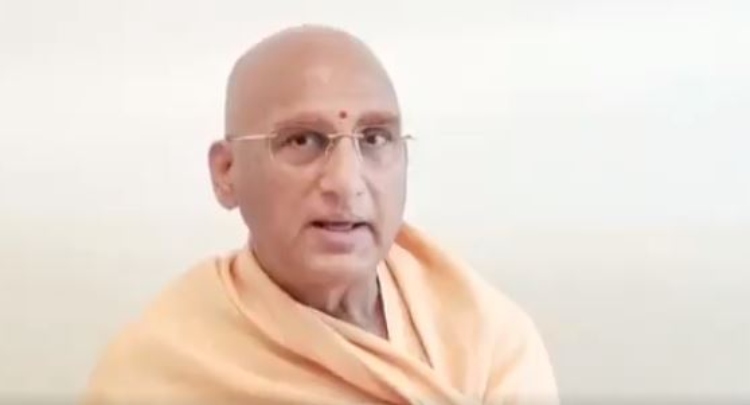
A day after the stunning expose of ‘defame PM Modi’ toolkit allegedly created by the Congress party, Swami Avdheshanand Giri, the Acharya Mahamandleshwar of the Juna Akhara, has issued a strong statement denouncing the opposition party and its friendly media’s efforts to paint the Maha Kumbh festival as a ‘Covid superspreader’ to malign the Hindu festival and the ruling party. 

In a video message, Swami Avdheshanand admonishes those who tried to defame the festival through the well-crafted ‘toolkit’.

“A toolkit has been spreading propaganda that Kumbh was the reason behind the spread of COVID-19 cases across the country. The culture, rituals, faith and traditions of the nation are being tarnished in a well-planned manner. Politicising the Kumbh is not good. The saint-community highly condemns this,” he said.

Politicising the Kumbh is not good: Swami Avdheshanand slams Congress toolkit

He says that Kumbh is not only exclusive to Hindus but has also received recognition from UNESCO. By maligning the religious festival, vested interests are tarnishing India’s culture, rituals, faith and traditions, said Swami Avdheshanand.

In 2017, Kumbh Mela, the largest peaceful gathering of pilgrims on earth, had made it to UNESCO’s list of Intangible Cultural Heritage of Humanity. 

In the video message, Swami Avdheshanand urged people to not fall for the malicious propaganda, instead carefully look over the facts before drawing any conclusion. He says that at the time when the Kumbh festival was being held in Uttarakhand, the cases in other states were already on the rise while the situation was not severe in the state (Uttarakhand).”

The Hindu saint expresses his vexation over vested interests, for their well-coordinated efforts to malign India’s culture, heritage and values.

He said, “A toolkit has been spreading propaganda that Kumbh was the reason behind the spread of COVID-19 cases across the country. While the Kumbh was ongoing in Uttarakhand, the cases in other states were already on the rise while the situation was not severe in the state (Uttarakhand).”

“The culture, rituals, faith and traditions of the nation are being tarnished in a well-planned manner. Politicising the Kumbh is not good. The saint-community highly condemns this,” he said.

Swami Giri reprimanded the propagandists who he believes exhibited their shallow mindset by politicising a religious festival like Kumbh to mint their political fortunes amidst the Covid-19 pandemic.

He further pointed out that the Kumbh was ended just after Prime Minister Narendra Modi requested for symbolic Kumbh in the view of rising coronavirus infections. “Have faith in the values and traditions of the country you are born in. Politicising Kumbh is not right,” he added.

Congress toolkit paints Kumbh as Covid superspreader, projects Eid as ‘happy gathering’

On May 18, a 4-page Congress toolkit designed to destroy PM Modi’s popularity and image over the government’s handling of the Covid crisis laid exposed.

The document gave a detailed description of how to attack Prime Minister Narendra Modi, defame Hindus, get ‘tailored’ articles attacking the Indian government in international media, and generally fan an anti-Modi hatred among the masses.

The document titled ‘Cornering Narendra Modi & Covid Mismanagement’ began by highlighting how the ‘Kumbh Mela is to be used to malign the Hindu festival and the ruling party. The “toolkit” suggested politicizing the congregation by repeatedly labelling it as a ‘super spreader’ to hint at BJP’s Hindu politics.

The viral “toolkit” purportedly asked Congress workers to use phrases such as “Indian strain” and “Modi strain” on social media and to “keep using the term super spreader Kumbh”. Besides, it encouraged non-party office bearers and supporters of the party to propagate Eid as a ‘happy gathering’.

Bengal: Day after dharna, CBI adds CM Mamata and WB Law Minister as parties in Narada scam hearing in HC

A day after West Bengal CM Mamata Banerjee and her ministers sat on a dharna at CBI’s Kolkata office while her agitated party supporters besieged the premises, the central probe agency has named her and two of her loyalists as parties in Narada scam hearing in the Calcutta High Court scheduled to be held at 2 pm today.

According to Times Now, CBI named WB CM and TMC supremo Mamata Banerjee, TMC MP Kalyan Banerjee and WB Law Minister Maloy Ghatak as parties, alleging that these respondents are very influential persons and they might influence or threaten the witnesses and the system.

Mamata Banerjee’s conduct an attempt to put pressure: SG Tushar Mehta in Calcutta HC

Opining that the aforementioned conduct of the WB CM and her ministers pose a threat to the CBI investigation into the Narada Scam in which the agency has arrested a few top TMC leaders, SC Tushar Mehta made Mamata Banerjee and her ministers parties in the hearing.

Yesterday, Solicitor General Tushar Mehta argued in HC that the incident of lawlessness carried out unabashedly by TMC supporters and minister outside and inside the CBI office premises was an attempt to put pressure on the system of administration of justice. He was referring to the 6-hour dharna staged by the WB CM outside the CBI office and the presence of Law Minister Moloy Ghatak in the trial court.

Maintaining that this reflects a total failure of rule of law, he sought the transfer of the trial of the case as per the provisions of Section 407 of the CrPC.

Calcutta High Court comes down heavily on the conduct of Mamata Banerjee

On May 18, the Calcutta High Court had taken serious exception to the conduct of the TMC supremo Mamata Banerjee where she herself sat on a dharna while organising a brute show of force by riotous mobs outside the Nizam Palace (which houses the CBI office) and the Raj Bhawan.

It took note of submissions made by Solicitor General of India Tushar Mehta, that while inside the CBI office, the Chief Minister demanded the ‘unconditional release’ of the four arrested.

The court also took exception to the fact that the West Bengal law minister Moloy Ghatak along with many Trinamool supporters, mobbed the lower court where the four arrested TMC leaders were to be produced. The law minister remained present in the court till the arguments by the counsels on behalf of the CBI and the arrested were heard.

The High Court concluded that any order passed by a court under such circumstances “will not have the faith and confidence of the people in the system of administration of justice”.

Saying so the bench comprising Chief Justice Rajesh Bindal and Justice Arijit Banerjee stayed the bail and remanded Ministers Firhad Hakim and Subrata Mukherjee, TMC MLA Madan Mitra and ex-legislator Sovan Chatterjee to judicial custody till May 19.

Mamata Banerjee sits on dharna for accused TMC leaders in Narada scam

For the uninitiated, on May 17, hours after Central Bureau of Investigation (CBI) arrested Mamata Banerjee’s ministers Firhad Hakim, Subrata Mukherjee and Trinamool Congress MLA Madan Mitra in the Narada case, the West Bengal CM Mamata Banerjee gheraoed the CBI office in Kolkata’s Nizam Palace.

While Mamata Banerjee staged a sit-in outside the 15th floor CBI office, a large number of TMC supporters who protested outside the CBI office over the arrest of its leaders reportedly pelted stones on security forces, tried to break barricades and attacked the media vehicles as well.

After the purported incident, the TMC leaders arrested by CBI in the five-year-old Narada sting operation case had been granted interim bail by the court of the Special CBI Judge (1) which was later stayed by the Calcutta High Court.

Nitin Gadkari clarifies his remarks on vaccine production, informs about govt’s efforts to ramp up manufacturing

While addressing a virtual press conference yesterday, Union Minister Nitin Gadkari had suggested that more pharmaceutical companies should be allowed to make the Covid-19 vaccines in the country to boost the inoculation drive.

“If the demand of vaccine is more than its supply then it creates a problem. So, instead of one company, 10 more companies should be allowed to make vaccines by paying 10 percent royalty to the original patent holder of the vaccine,” said Gadkari while speaking at a virtual conference organized by Swadesi Jagran Manch.

However, the Union Minister has now issued a clarification regarding his recommendation stating that he was unaware that the relevant Ministry has already taken efforts to ramp up the production to bridge the supply and demand gap.

Gadkari in a series of Tweet said, “I was unaware that before my speech Minister for Chemical & Fertilizers Shri @mansukhmandviya had explained government’s efforts to ramp up vaccine production. After conference, he also informed me that, GoI is already facilitating vaccine manufacturing by 12 different plants/companies and rapid ramp up of production is expected in near future as a result of these efforts.”

Congratulating the team for their timely efforts, Gadkari said that it was important for him to put the discussion on record. 

Vaccine availability and procurement

As per the latest press release by the Ministry of Health and Family Welfare, a total of 5 crore 86 lakh and 29 thousand doses will be provided free of cost by the Government of India to states/ UTs from May 01, 2021 to June 15, 2021.

Citing information received from the vaccine manufacturers, a total of 4 crore, 87 lakh and 55 thousand doses will be made available till the end of June 2021 for direct procurement by the states/UTs.

Moreover, in an attempt to provide a major boost to the vaccination drive, the Government of India’s procurement pipeline suggests that:

  • 75 crore doses of Covishield
  • 55 crore doses of Covaxin
  • 30 crore doses of Bio E Sub unit vaccine
  • 20 crore doses of SII Novavax 
  • 10 crore doses of BB Nasal vaccine
  • 06 crore doses of Gennova mRNA vaccine
  • 15 crore doses of Sputnik vaccine will be procured between August 2021 to December 2021

The Union Health Ministry has been providing advance information on the availability of Covid-19 vaccine doses to be supplied to the states/ UTs every fortnight.

Production by Bharat Biotech at Pune plant

The Bombay High Court permitted Biovet Private Limited, an associate company of Bharat Biotech, to take possession of a fully operational and ready-to-use vaccine manufacturing plant in Pune to produce Covaxin, the indigenous vaccine against Covid-19.

To support the largest vaccination drive being carried out by India, Bharat Biotech has ramped up the manufacturing capacity of Covaxin to 700 million doses per annum.

The manufacturing scale-up is happening in a step-wise manner across multiple facilities with newer ones being added to the list.

Toolkit controversy: Congress admits that one of the two ‘leaked’ documents was indeed created by them

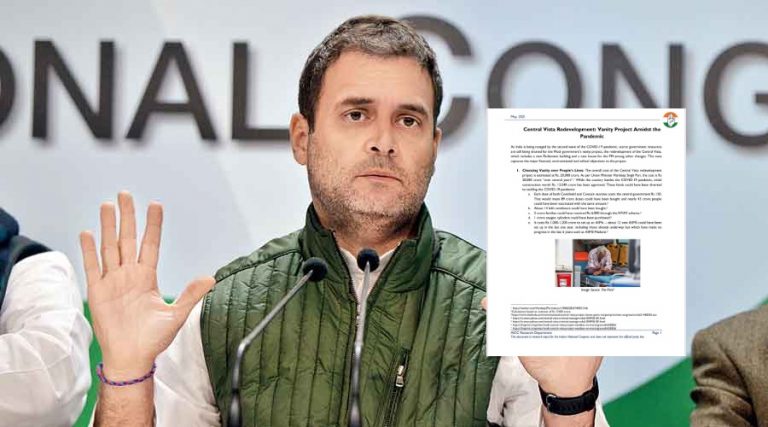
Congress leader Rajeev Gowda today took to Twitter to admit that one of the two ‘leaked’ documents of the ‘toolkit’ was indeed created by the All India Congress Committee (AICC) Research Department.

In a tweet, Gowda admitted that the AICC made a research note on Central Vista for the party and ‘it is genuine’ he said. He further claimed that he had yesterday rubbished the toolkit as ‘forged’ and ‘made up in BJP’. He claimed that the BJP is showing metadata/author of actual document and attributing to ‘fake’.

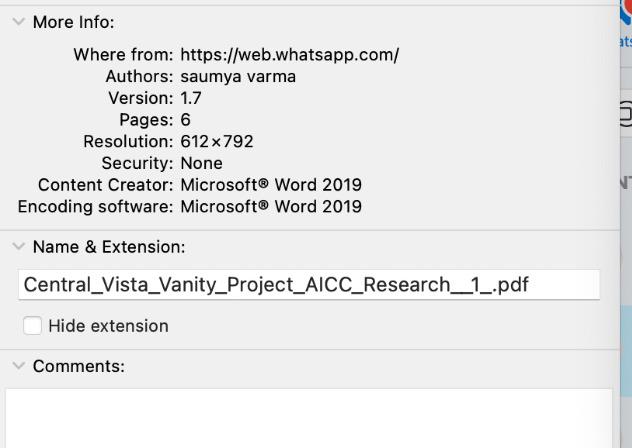
Earlier today, it was revealed that the creator of the document ‘Central Vista Vanity Project AICC Research’ is one Saumya Varma, a Rajeev Gowda aide.

Metadata of document

After the documents were ‘leaked’ Congress had claimed they are fake and threatened FIR. However, now Congress leader Rajeev Gowda has admitted that at least one of the documents is indeed genuine.

While OpIndia cannot comment on the authenticity of the documents, there indeed are similarities between both the ‘leaked’ documents.

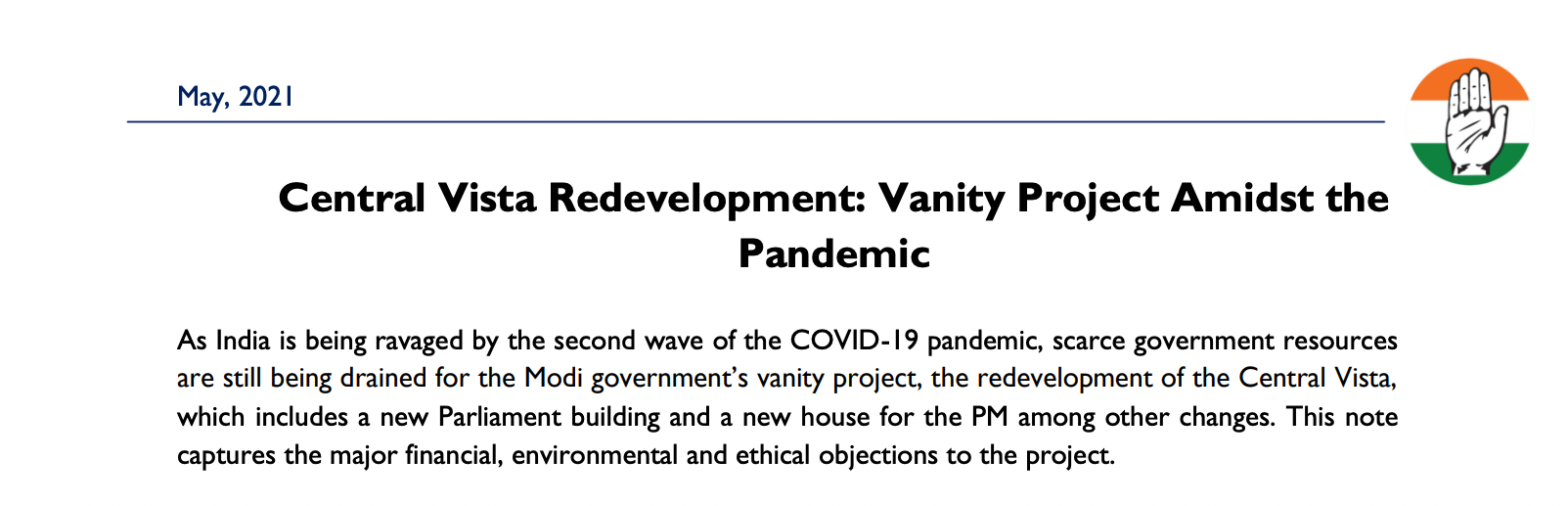
Here is the header of the document Rajeev Gowda admitted to be authentic.

Central Vista project document

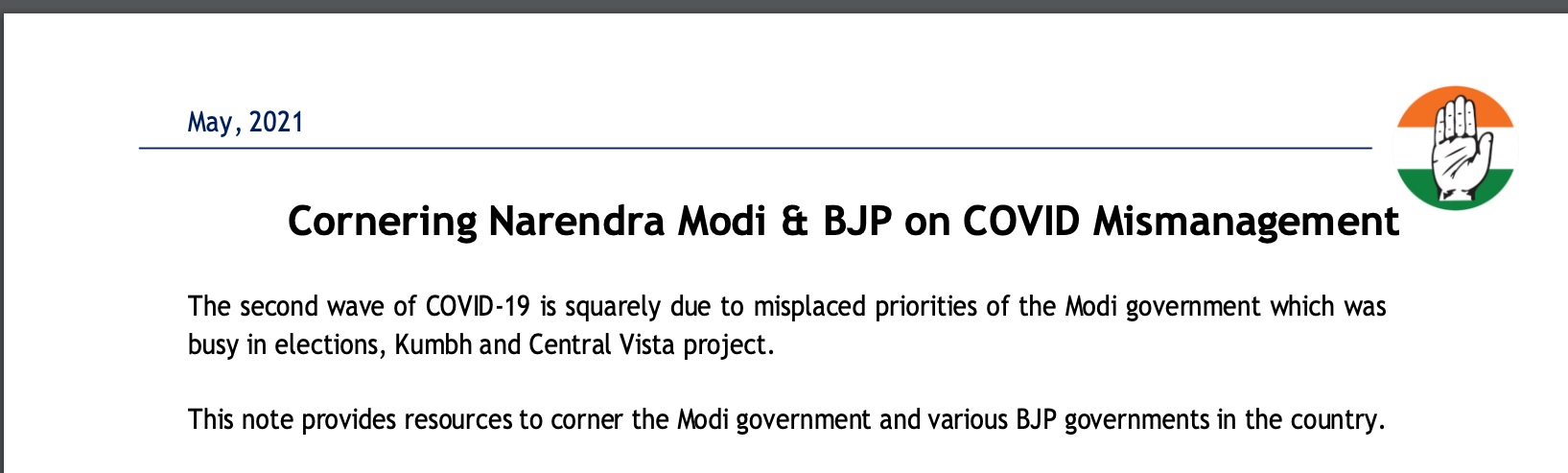
Here is the header of second document.

Corner Modi header

As one can see, the header formatting in both the documents is similar.

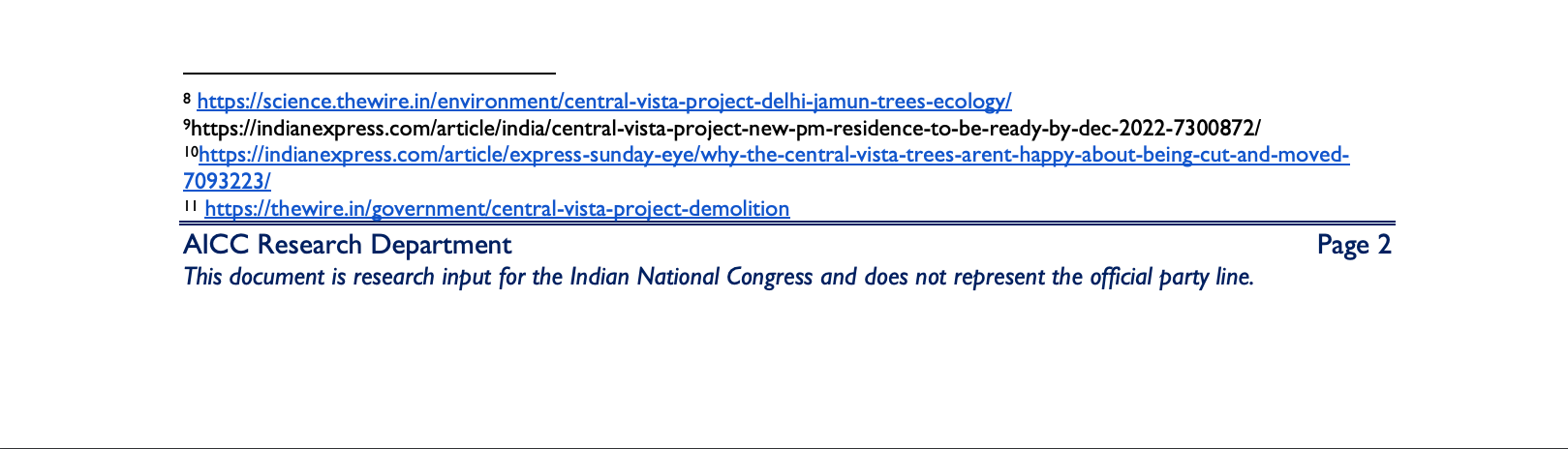
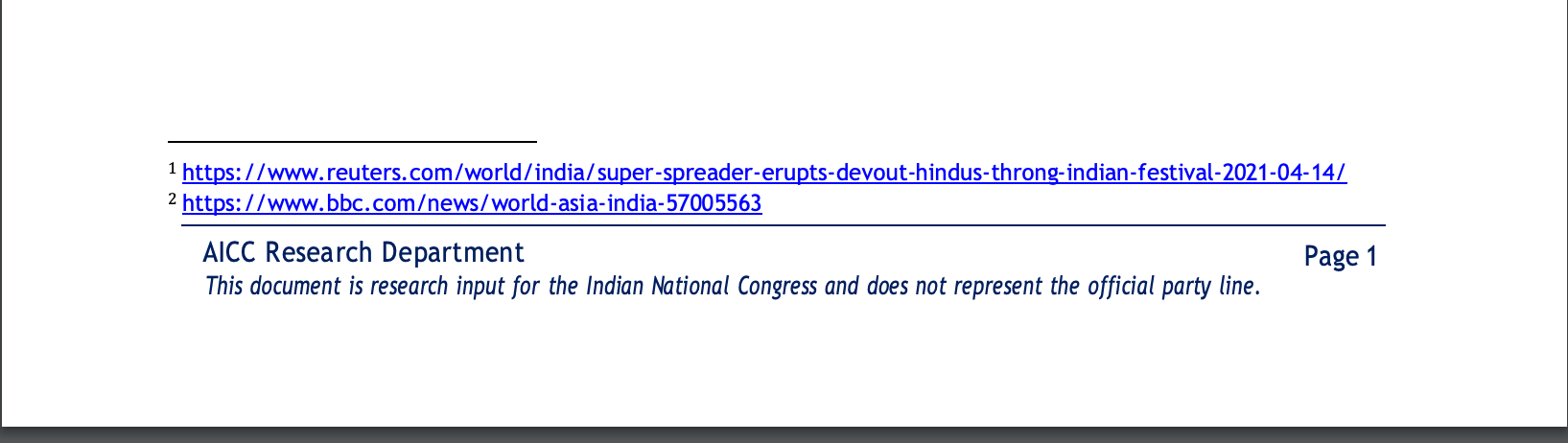
Similarly, here is the footer of the document Gowda admitted to being genuine.

Footer of AICC document

One can notice how the footnote carries the links of various news portals and tweets.

Here is the footer of another document.

Second footer

This document, too, has similar footnotes and formatting.

Congress toolkit

On Tuesday, two documents were ‘leaked’ on social media which gave point to point notes on how to question and discredit the Modi government on a few key points. The documents were allegedly created by the AICC research development. While Congress had refuted the documents as fake, there were some uncanny similarities between the instructions in the toolkit and how the narrative especially around the pandemic was built.

Congress has demanded an FIR and no official forensic analysis is available to prove or disprove the party’s claims.

Chhattisgarh: Locals deny police claim that three protestors killed in police firing in Silger were Maoists, demand probe

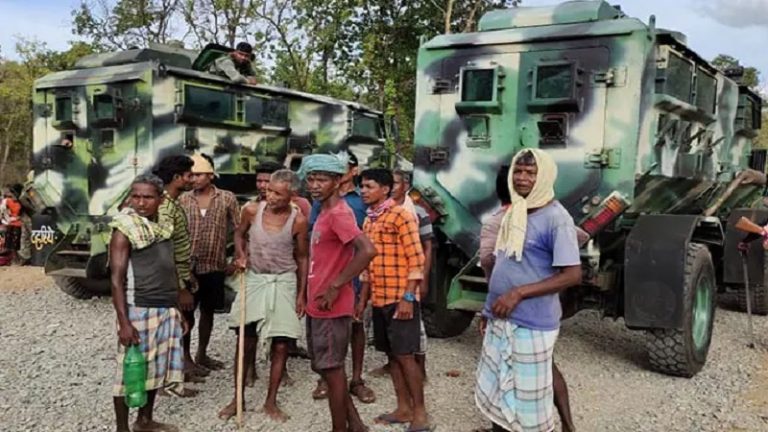
A controversy has erupted over what Chhattisgarh police claimed to be an encounter in Silger on the inter-district border of Bijapur and Sukma in the Bastar region of the state on May 17 (Monday). Villagers have claimed that the three people, namely Uika Pandu from Teemapura, Bheema Ursam from Gundam, and Kawasi Waga from Sudwa village, who died in police firing were ordinary civilians and not Maoists as claimed by the state police.

Alleging gross human right violation, villagers said that they were staging a peaceful protest close to the newly constructed Silger police camp when police opened fire to end the protest.

“We do not want a police camp, therefore, we are protesting and to end our demonstration police fired upon us,” said a villager named Madvi Hunga, adding that eighteen of the villagers are injured and six of us are still missing.

A local journalist named Shankar, who has been extensively covering the protest, confirmed: “The villagers are continuously protesting since May 12. However, for the last three days, the situation has been quite tense, and people wanted security forces to abandon the place at any cost. During the course, more than three times police carried out lathicharge, fired tear gas shells to disperse the villagers but the situation did not come under control”.

Journalist slams Rahul Gandhi for failing to protect the tribals in Congress-ruled Chhattisgarh

Denouncing the arbitrary conduct of the state police in the Congress-ruled Chhattisgarh, senior journalist Alok Putul took to Twitter on May 18 (Tuesday) to share a video related to Silger firing and tagged Congress leader Rahul Gandhi questioning the latter’s committment to protecting these tribals from violence.

A day after the firing incident, several human rights activists, tribal leaders of Bastar and civil society organisations condemned the killings and demanded a judicial probe into the incident. They also demanded compensation for the families of the deceased and said that criminal cases should be registered against those police officials (if found guilty) responsible for the firing.

Copy of a letter written by a civil society demanding judicial probe into the incident

Police claim Maoist killed in firing incident

Meanwhile, the Chhattisgarh police have refuted the allegations meted out at their department claiming that Maoists had taken the villagers as their shield during the protest.

“This was a Maoist-compelled protest against the police camp. The protest ended on Sunday night, but the Maoists forced the innocent villagers to return on Monday,” said Inspector-General of Police, Bastar Range, Sunderaj P, adding that the protest was being carried out by Maoists primarily because they do not want a police camp in their core area.

Maoists in Chhattisgarh call for bandh

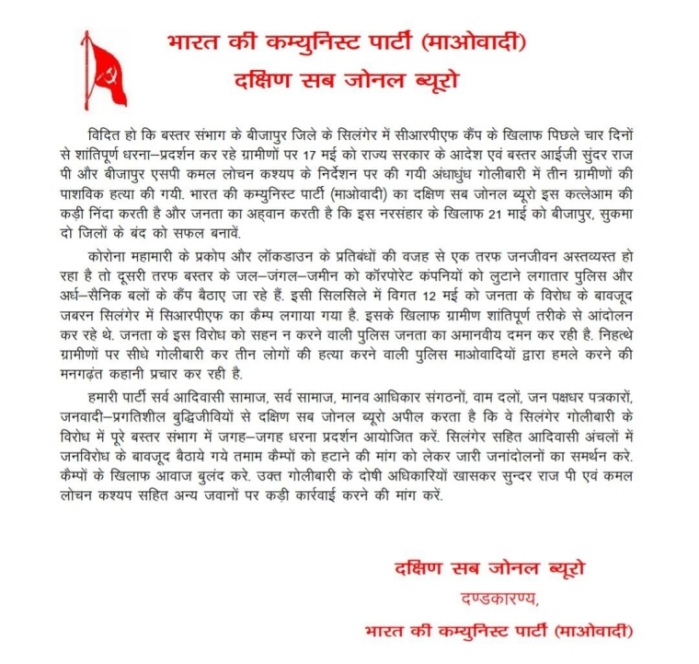
After Chhattisgarh police issued its statement, Maoists South Zonal Committee issued a press release in which it claimed that the police story related to firing from Maoists is fake. Police indiscriminately fired upon the villagers under the instructions of SP Bijapur and IG Bastar, Maoists alleged.

To protest the alleged police brutality, the Maoists South Zonal Committee said that a shutdown of Bijapur and Sukma districts has been called on May 21.

This particular incident in question had occurred on Monday evening near a newly set up police camp at Silger. A big crowd of villagers had gathered in the area since Sunday night to oppose the camp.  

Videos of the firing incident, including the one in which local villagers can be heard saying that nine civilians had been killed in the firing by the security forces and that no Maoists were present at the spot and no exchange of fire had taken place, are doing the rounds on social media.

The villagers alleged that nine had been killed and almost one and a half dozen civilians had been injured in the incident.

As WHO finally admits that Covid-19 virus can be ‘airborne’, read how it had refused the possibility for a year, rejected evidence given by scientists

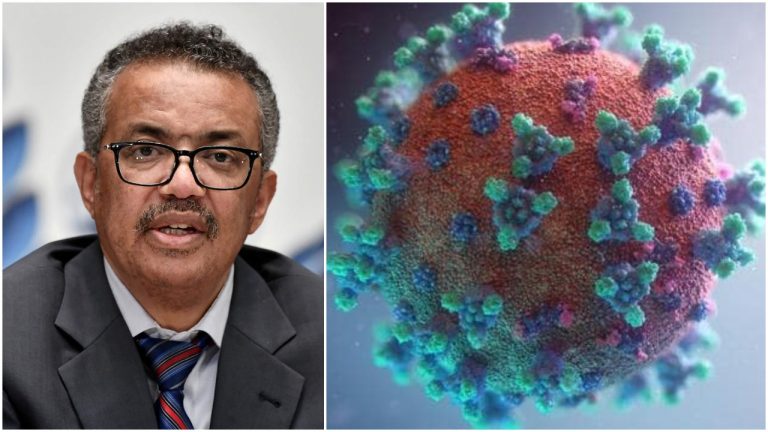
Earlier this month, the World Health Organisation (WHO) acknowledged that the Coronavirus can also be airborne. After denying for more than a year, the WHO finally updated the mode of Covid-19 transmission and said that the disease can be an airborne threat. It said, “the virus can also spread in poorly ventilated and/or crowded indoor settings, where people tend to spend longer periods of time. This is because aerosols remain suspended in the air or travel farther than 1 metre (long-range)”. For almost a year now, scientists all over the world have known that the SARS-CoV-2 can be airborne for a short distance for some time, but the WHO had refused to acknowledge that.

It may be noted that Centers for Disease Control and Prevention (CDC) of the USA had also admitted earlier this month that the Covid-19 virus can be airborne, after denying the same for a year.

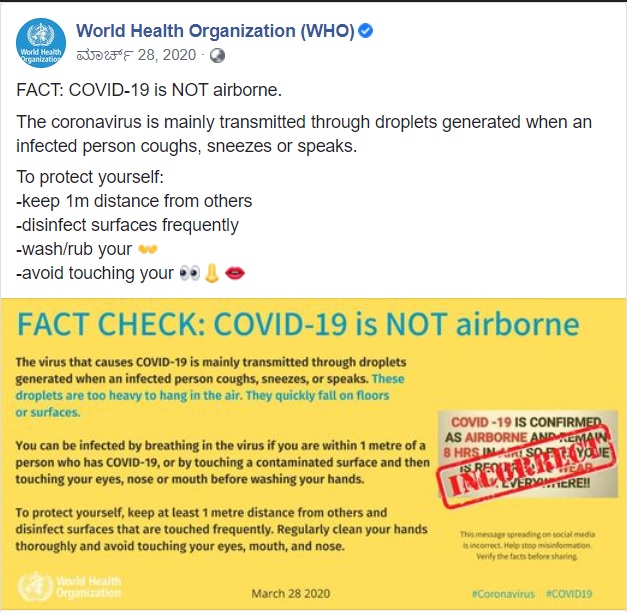
On March 28 2020, the WHO, the global health watchdog, took to social media to put out a post, “FACT: #COVID19 is NOT airborne”. In its post, the WHO claimed that the coronavirus is mainly transmitted through droplets generated when an infected person coughs, sneezes, or speaks. For the scientists of WHO, Covid-19 was not airborne, and one could not contract the disease if they followed necessary protocols.

Linsey Marr, an aerosol scientist at Virginia Tech and an infectious disease expert, had her doubts regarding WHO’s so-called fact-check. For Marr, who had analyzed the initial results of the Covid-19 outbreak in China, it looked like the virus may stay in the air for longer, infecting anyone who breathed in enough of it. For people indoors, that posed a considerable risk. Soon, Marr joined with 35 other aerosol scientists to try and warn the WHO it was making a big mistake.

According to a detailed report by website – The Wired, for the next few days, the scientists analyzed the list of superspreading events in restaurants, call centres, cruise ships, and a choir rehearsal, instances where people got infected to Covid-19 even when they were far away from a contagious person. The incidents contradicted the WHO’s main safety guidelines, i.e., keeping 3 to 6 feet of distance between people and frequent handwashing.

If SARS-CoV-2 travelled only in large droplets that immediately fell to the ground, as claimed by the WHO, then how would people far away from each other caught the infection, the scientists pondered. They argued that the infectious air was the reason for the infection. However, the WHO’s experts were in no mood to listen to these scientists. To declare Covid-19 could well be airborne, the scientists wanted more direct evidence, which could take months to gather. Meanwhile, thousands of people were falling ill every day as the virus was abundant in the air.

Lidia Morawska, a revered atmospheric physicist, also tried to explain how far infectious particles of different sizes can travel. Shockingly, WHO experts abruptly cut her off, arguing that she was wrong.

As per Marr, Morawska has been advising WHO on the impacts of air pollution for over two decades. Interestingly, the organization has accepted her research on air pollution to understand similar particles of many sizes can hang aloft, travel far, and be inhaled. For the WHO’s advisers, the same laws of Physics strangely did not apply to virus-laced respiratory particles. To them, the word ‘airborne‘ only meant that particles smaller than 5 microns.

For Marr, the beginning of a global pandemic was not a good time to pick a fight with WHO. But, the reluctance of WHO to listen to experts and banking on outdated science that concerns public health policy had angered Marr. She had to get through to them, but first, she had to understand why they were failing to convince the WHO on Covid-19 being airborne.

According to scientists, almost all respiratory infections transmit through coughs or sneezes as bacteria and viruses quickly spread by falling and sticking to any surface within a distance of 3 to 6 feet. If these droplets come in contact with the nose or mouth, they can cause an infection. Only Measles and tuberculosis transmit a different way, an exception to the above rule. They are described as “airborne” as those pathogens travel inside aerosols, microscopic particles that can be alive for hours and travel longer distances. They can spread when contagious people breathe.

WHO relied on ‘5 micron’ classification to decide whether Covid-19 was airborne or not

As per Marr, the distinction between the droplet and airborne transmission has enormous consequences. To prevent droplets, one has to wash hands frequently with soap and water regularly. However, to fight infectious aerosols, the air itself is the enemy, which means setting up expensive isolation wards and providing N95 masks for all medical staff. The distinction between droplets and airborne is based on their length, i.e., at 5 microns. A micron is a unit of measurement equal to one-millionth of a meter.

By this definition, any infectious particle smaller than 5 microns in diameter is an aerosol, anything bigger than the size is a droplet. To her shock, the WHO and the US Centers for Disease Control and Prevention also keep the ‘5 microns’ as the basis to define whether a particle is a droplet or aerosol dichotomy toggled.

According to Marr, this is a problem. “The physics of it is all wrong,” Marr says as she explains how things move through the air. “Reality is far messier, with particles much larger than 5 microns staying afloat and behaving like aerosols, depending on heat, humidity, and airspeed. I’d see the wrong number over and over again, and I just found that disturbing,” Marr expresses her anguish.

The error meant that the medical community had a distorted picture of how people might get sick, the aerosol scientist contends. Marr decided to collect some data of her own. Marr found that droplets were small often stay aloft for hours, and it was enough of it to make people sick.

Despite all her efforts, Marr could not convince the WHO officials that certain infections could be airborne. In December 2019, similar research carried out by Yuguo Li reached her desk. An indoor-air researcher at the University of Hong Kong, Li was among the firsts to discover the SARS outbreak in 2003. His investigation of an outbreak at the Amoy Gardens apartment complex provided the strongest evidence that a coronavirus could be airborne. Like Marr, he too struggled to convince the public health community that their risk calculus was off. Eventually, he decided to work out the math.

The simulations worked out by Li showed that when a person coughed or sneezed, the heavy droplets were too few, and the targets. i.e., an open mouth, nostrils, eyes were too small to account for many infections. Therefore, Li’s team concluded that the public health establishment had got it backward and that most colds, flu, and other respiratory illnesses must spread through aerosols instead. The latest findings had exposed the fallacy of the 5-micron boundary. 

He went a step further, tracing the number back to a decades-old document the CDC had published for hospitals. The new findings brought excitement to Marr. Co-incidentally, a journal asked her to review Li’s paper, and she did not have any hesitation about that. On January 22, 2020, she wrote, “This work is hugely important in challenging the existing dogma about how infectious disease is transmitted in droplets and aerosols.”

A day later, the Chinese government officially stopped traveling in and out of the city of Wuhan in a desperate attempt to contain an as-yet-unnamed respiratory disease that had bought an 11-million-populated city into its knees. As the pandemic shut down country after country, the WHO and the CDC insisted that the infection was not a serious one and asked them to people to wash their hands, scrub surfaces, and maintain social distance. They did not utter anything about masks or the dangers of being indoors.

A 60-year-old study caused WHO to commit its greatest blunder

A few days later, Marr got an email from another aerosol scientist and an atmospheric chemist at the University of Colorado Boulder named Jose-Luis Jimenez. Jimenez, like Marr, was fixated on the WHO recommendation that people stay 3 to 6 feet apart from one another. According to Jiminez, the social distancing guideline seemed to be based on obsolete studies from the 1930s and 40s. Interestingly, the authors of these guidelines had themselves not ruled out the possibility of airborne transmission, which by definition would involve distances over 6 feet.

Strangely, nobody understood the reluctance of WHO not to consider the possibility of the Wuhan virus being airborne. Marr apprised Jimizez about her concerns with the 5-micron boundary and suggested that their two issues might be linked. If WHO based its 6-foot guideline on an incorrect definition of droplets, the 5-micron error was not just some misjudgment. For them, it seemed that WHO and CDC were deliberately sitting on flawed guidance. The scientists had a new purpose now – to find the origin of such distorted research.

With the help of Tom Ewing, a Virginia Tech scholar, and Katie Randall, Marr and the team began to dig for the citations that had become the basis of the ‘5-micron’ theory to consider infection as airborne or not. As they looked deeper, they found a research paper written in 1934 by a Harvard engineer named William Firth Wells Wells and his wife, Mildred Weeks Wells, a physician. The couple had analyzed air samples and plotted a curve showing how the opposing forces of gravity and evaporation acted on respiratory particles. The couple’s calculations made it possible to predict when it would take a particle of a given size to travel from someone’s mouth to the ground.

According to them, any particles bigger than 100 microns sank within seconds, and smaller particles stayed in the air. Randall paused at the curve the wife-husband had drawn, where she discovered the root of the idea of a droplet-aerosol dichotomy. However, the only exception in the graph was that it read around 100 microns, not 5. Years later, the scientists inside the CDC conflated the couple’s observations and plucked the size of particles out of context, based on the data of tuberculosis, to generalize the particle size to 5 microns. So, CDC kept a static guideline to classify whether an infection was airborne or not.

“Wells’ 100-micron threshold got left behind. You can see that the idea of what is respirable, what stays airborne, and what is infectious are all being flattened into this 5-micron phenomenon,” Marr and her team noted. Over time, this flawed understand became the norm to classify infections and pandemics.

Marr did not stop there. They wanted to get to the bottom of the 5-micron myth and dislodge it from decades of public health doctrine. To do this, she had a massive task at hand – to convince two of the world’s most powerful health authorities – WHO and CDC. Marr and her team had to convince these two organizations not only that they were wrong but that the error had caused irreparable damages. More than it, the error was urgent and consequential as Wuhan coronavirus had begun to wreak havoc.

Scientists publish their research, WHO owns its mistakes after a year and 3.3 million deaths

In July, Marr and Jimenez went public about their research, started a signature campaign with an open letter addressed to public health authorities, including the WHO. More than 237 other scientists and physicians warned that WHO should make stronger recommendations for masking and ventilation, failing which the airborne spread of SARS-CoV-2 would undermine even the most vigorous testing, tracing, and social distancing efforts.

The campaign went viral, inviting a strong backlash from a section of public health personalities, who rushed to defend the WHO. However, realizing its error, days later, WHO released an updated scientific brief acknowledging that aerosols may cause infection through the air, especially in poorly ventilated places. However, it stuck to its social distancing norms, advising people to wear masks indoors only if they could not keep that distance.

Even as WHO officials continued to discredit their research, Marr and Jimenez found ways to educate people about the seriousness of the Wuhan virus and its ability to be airborne. Marr spoke to Kimberly Prather, an atmospheric chemist at UC San Diego, who had the ear of prominent public health leaders within the CDC and on the White House Covid Task Force. In July, both explained the research to Anthony Fauci, director of the National Institutes of Allergy and Infectious Diseases. They showed how the 5-micron theory was flawed and explained the trajectory of a 5-micron particle went farther than 6 feet—hundreds of feet farther, making social distancing redundant.

A few weeks later, Fauci admitted that the 5-micron distinction was wrong and had been for years. “The bottom line is, there is much more aerosol than we thought,” he said. Days later, the CDC updated its guidance to acknowledge that SARS-CoV-2 can spread through long-lingering aerosols.

In December 2020, the WHO also acknowledged more about aerosols. On December 1, WHO finally recommended that everyone always wear a mask indoors wherever Covid-19 is spreading. Rather than acknowledging the massive blunder they had committed, WHO patted themselves, saying the change reflected the organization’s commitment to evolving its guidance when the scientific evidence compels a change. The WHO officials maintained that the WHO had initially paid attention to airborne transmission in hospitals, then at places such as bars and restaurants.

Last month, on Friday, April 30, the WHO quietly updated its page on its website to acknowledge that the coronavirus gets transmitted through the air. The website now states that the virus can spread via aerosols as well as larger droplets. The biggest news of the pandemic, however, passed with no news conference, no big declaration.

Alas, World Health Organisation finally woke up from its deep slumber to recognize that SARS-Covid-19 is an airborne infection, a pandemic that has killed more than 3.4 million people and infected at least 164 million people worldwide.


‘Deferring deadline does not absolve WhatsApp’: Modi govt again gives stern warning over privacy policy

The Union Government has written to social-media giant WhatsApp asking them to withdraw its new Privacy Policy in the aftermath of sweeping policy changes proposed by the messenger app. In a letter to WhatsApp, the Ministry of Electronics and Information Technology has expressed its reservations against its urgency to push for privacy policy and its implications on the users in India.

Earlier, WhatsApp had announced that its new controversial privacy policy has been deferred and it wont come into effect on May 15th. However, the govt of India said that deferring the same does not absolve WhatsApp from respecting values of informational privacy, data security and user choice for Indian users.

In a communication sent to WhatsApp yesterday (18 May 2021), the Ministry has once again told WhatsApp to withdraw its Privacy Policy 2021 as the changes to the Privacy Policy, and the manner of introducing these changes including in FAQ undermines the sacrosanct values of informational privacy, data security and user choice of Indian users and harms the rights and interests of Indian citizens.

The Ministry has also taken the same stand in the Delhi High Court, where this matter is sub-judice. Taking up the issue of discriminatory treatment to Indian users vis-a-vis users in Europe, the Ministry has further stated that, “As you are doubtlessly aware, many Indian citizens depend on WhatsApp to communicate in everyday life. It is not just problematic, but also irresponsible, for WhatsApp to leverage this position to impose unfair terms and conditions on Indian users, particularly those that discriminate against Indian users vis-à-vis users in Europe.”

In its communication, the center has drawn attention to WhatsApp about how its new Privacy Policy is a violation of several provisions of the existing Indian laws and rules. In fulfilment of its sovereign responsibility to protect the rights and interests of Indian citizens, the Government of India will consider various options available to it under laws in India. Government has given seven days time to WhatsApp to respond to his notice and if no satisfactory response is received, necessary steps in consonance with law will be taken.

Earlier, WhatsApp had said that as part of its new privacy policy it would share user data with other Facebook companies. This led its users to believe that WhatsApp would now be able to peek into the personal messages of its users and it would share the personal data of users with Facebook.

Facebook-owned Whatsapp had given February 8th as the date after which the app would stop working on devices and accounts would be suspended if the new policy was not accepted. As a result, many people started moving to other apps like Signal and Telegram looking for a substitute. Following the backlash, the social media giant had deferred its plan of implementation of Privacy Policy to May 15.