Home Blog Page 4374

Congress credits Capt Amarinder Singh for ‘helping farmers in grain procurement’ but forgets to thank Centre for its contribution

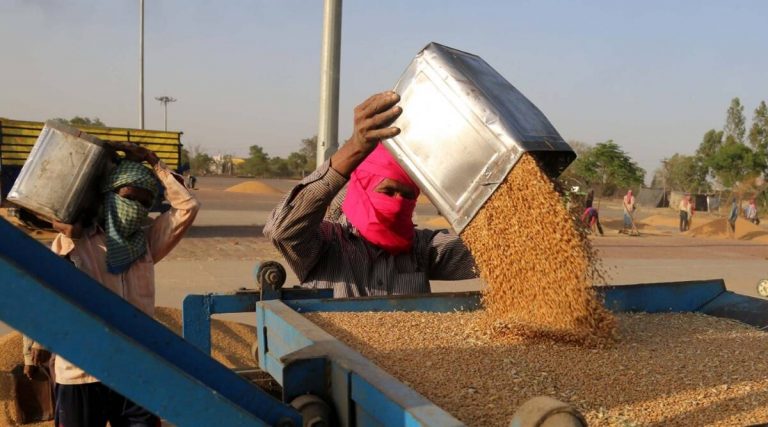
The wheat procurement in Punjab though delayed due to the second wave of Covid-19 pandemic, is set to take place till May 30. The procurement agencies and FCI have decided to purchase the crop at Rs 1,975 per quintal in the current rabi season, payment for which is being directly transferred to the bank accounts of the farmers.

Claiming full credit for the success of the ongoing procurement process, the Congress congratulated its Punjab Chief Minister for the same through a video from the official party handle.

Here’s what the video says

The video that claims to have brought back the smiles on farmers’ faces, cites quick procurement as the reason. As per the video, the Punjab government has procured 46.60LMT of wheat in just seven days at the set MSP. The video also shares that to ease the procurement process amidst the second wave, the government has added over 2000 new procurement centres in the state which are operational from 10 am to 6 pm. The video ends with talking about the safety measures and precautions being taken by the state government for the farmers who arrive at the procurement centres and the staff.

However, it is imperative to note that Captain Amarinder Singh’s government missed thanking the Centre for Direct Bank Transfers (DBT) which is the actual reason for farmers’ happiness.

Punjab farmers happy with Direct Benefit Transfers

This is the first time that the farmers from Punjab are receiving direct online payments for their produce at the determined MSP and at least 1,64,455 farmers from Punjab have been able to benefit from the DBT scheme.

This was possible after the central government refused to extend the deadline to implement the DBT process just ahead of the procurement after the state sought yet another exemption. The Centre had been pursuing the Punjab government since 2016-16 to get the state to implement direct online payment into farmers’ accounts. However, the state had been routinely approaching the Centre for granting exemption and extension of time. 

Punjab government had faced resistance from the arthiyas for the implementation of DBT before the onset of the procurement season. Not wanting to antagonize the arhtiyas close to the state elections, the state government gave in to their demands and urged the Centre was another extension. 

On being declined, the Punjab Finance Minister Manpreet Singh Badal said the government had no option, but to transfer the minimum support price (MSP) amount for the procurement directly to the bank accounts of farmers in the current rabi season.

Food Secretary Sudhanshu Pandey informed that till date Rs 13.71 crores have been transferred directly and successfully into the accounts of farmers in Punjab.

“We are now transferring in Punjab the MSP amount directly to farmers’ accounts which has been possible with the cooperation of the state government and ‘arthiyas’, who are a very important stakeholder. They will get their respective commission due under the APMC Act and rules into their accounts,” added Pandey assuring the arthiyas of the state.

Dalip Kumar of Nilpur village near Rajpura, said his happiness knew no bounds when he received two text messages from his bank announcing the credit of Rs 1.90 lakh and Rs 1.48 lakh into his account as the minimum support price (MSP) of 171 quintals of wheat that he sold in Rajpura mandi.

Dalip in an interview to the Indian Express claimed, “This is the best system. What could be better than getting payment for our crop in our account?” The news was shared by Union Minister Piyush Goyal as well.

Procurement by the Punjab government and Centre

The responsibility for the procurement of foodgrains that are eligible for MSP lies with four state agencies and the Centre’s FCI in Punjab. The Punjab government also purchases wheat and rice at MSP on behalf of the central government under the National Food Security Act (NFSA).

The Centre in the RMS 2021-22 season is hoping to procure 427 LMT of wheat this season, the highest ever in the country. This includes purchasing 130 LMT from Punjab. As per the data released by FCI, the Central government agencies have procured 18.24 LMT of wheat from Punjab. 
Pakistan govt forgets its right to expel diplomats, promises bill in National Assembly to expel French Ambassador today when house is not in session

0

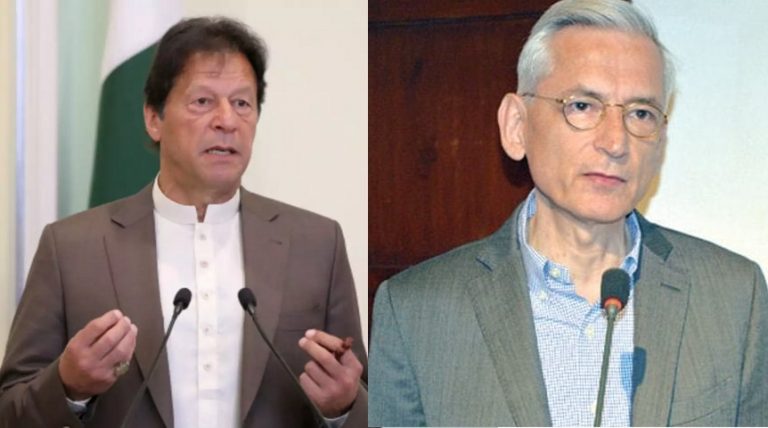
In its desperation to end the recent violence by workers and activists of Tehreek-i-Labbaik Pakistan (TLP) which enveloped Pakistan throughout last week, a minister in the Imran Khan government said that the Imran Khan government will present a resolution on the expulsion of the French ambassador in the National Assembly later today.

Pakistan’s Interior Minister Sheikh Rashid Ahmed said in a video statement that the government has had a successful round of negotiations with TLP, which has agreed to end its protest across the country.

He said that the decision was taken after another round of talks with the recently proscribed Tehreek-i-Labbaik Pakistan (TLP).

However, Pakistan government seems to have forgotten its own rights in terms of ambassadors of foreign countries. A sovereign government does not need to take the approval of the parliament to expel an ambassador. Any govt can expel an ambassador or any diplomate or official working in embassy and consul offices by declaring them persona-non-grata. A govt does not even need cabinet approval to remove an ambassador, and there is no requirement to get parliamentary approval.

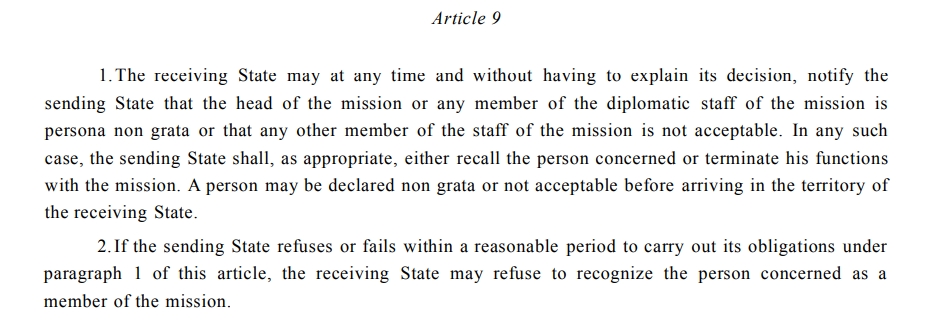
Article 9 of the Vienna Convention on Diplomatic Relations

According to article 9 of the Vienna Convention on Diplomatic Relations, the host nation at any time and for any reason can declare a particular member of the diplomatic staff to be persona non grata. After a diplomate has been declared persona non grata by the host country, they lose all diplomatic immunities. They are usually asked to leave the country within a stipulated period of time. Several nations have expels ambassadors of other countries using this provision, when the relationships between the nations had deteriorated. Therefore, Pakistan govt can easily expel Marc Baréty, the French Ambassador to Pakistan, by declaring him a persona non grata.

But for some reason, the Pakistan government has decided to raise the matter in the National Assembly and seek parliamentary approval to take action on the diplomate. It shows that the Imran Khan govt is finding it difficult to choose between offending Islamists and offending France, and wants to push the blame to the entire political establishment of the country.

Interestingly, while the minister assured that the bill will be presented in the National Assembly today, Dawn reports that there is no session scheduled for Tuesday. A day earlier, the session was adjourned to meet again on April 22 (Thursday) at 2 pm.

The minister added that the “cases registered against TLP supporters under the fourth schedule will also be dismissed and further rounds of talks will take place”.

Rashid said that he will give a detailed statement on the agreement in a press conference later in the day.

Riots erupted from protests against France in Pakistan

It may be noted that Pakistan has been witnessing violent protests as its government failed to fulfil its promise to Tehreek-e-Labbaik Pakistan (TLP) founder Khadim Hussain Rizvi. In November last year, the Imran Khan-led Pakistani government had bent its knees in front of TLP and promised Rizvi that it would bring a bill in the Parliament to legally expel the French Ambassador from the country over cartoons published by French magazine Charlie Hebdo.

It has been over a week, and more incidents of violence are being reported in the neighbouring country. Recently, videos had emerged suggesting army personnel shifting their support to TLP. Notably, Khadim Hussain Rizvi had died just a couple of days after striking a deal with the Pakistani government last year. His son Saad Hussain Rizvi took charge of TLP as its leader. Saad is leading violent protests across the country.

Supreme Court stays Allahabad HC’s order imposing lockdown in five cities of UP

0

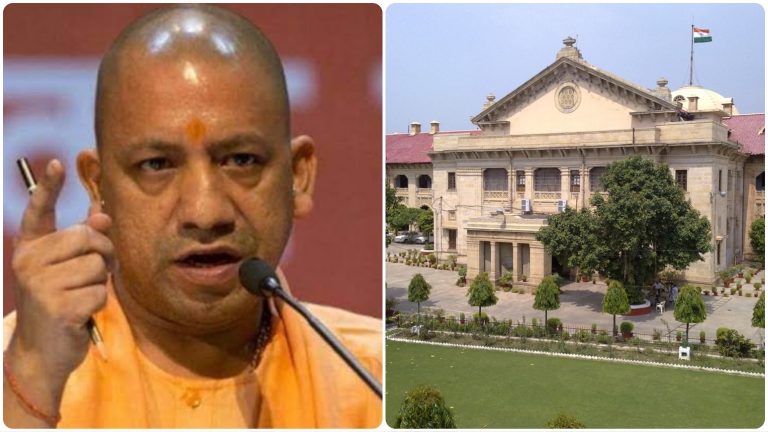
The Uttar Pradesh government had approached the top court of the country challenging the Allahabad High Court’s order on imposing strict restrictions in five cities of India’s most populous state in view of the Covid-19 pandemic, on the grounds that the High Court does not have any locus standi to issue such directions.

The matter was presented by Solicitor General Tushar Mehta before a bench headed by Chief Justice of India, SA Bobde seeking urgent listing. The court agreed to hear the matter today.

As per latest updates, the SC has stayed the order issued by the Allahabad HC that had ordered shut down in five cities of UP.

Allahabad High Court orders strict restrictions in five cities of UP in the wake of COVID-19 outbreak

On April 19, the Allahabad High Court issued a list of strict restrictions in five UP cities – Prayagraj, Lucknow, Varanasi, Kanpur Nagar, and Gorakhpur till April 26. A bench comprising of Justice Ajit Kumar and Justice Siddhartha Varma were not pleased with the surge in Covid-19 cases.

The court said that the Chief Minister of the state is in isolation and called it a difficult situation for the state. ACS Information, Navneet Sehgal said, “UP Government will not impose a complete lockdown in the cities but impose strict restrictions. The UP Government is submitting its reply before the Court on its observations.”

The court further added that the lack of development in medical infrastructure is visible as the public health system is not able to meet the challenges, and people are dying while waiting for proper medication. “Those in the helm of affairs of governance are to be blamed for the present chaotic health problems and more so when there is a democracy which means a government of the people, by the people and for the people,” the court said.

A host of other prohibitory orders were also issued by the Court.

UP government refuses to implement High Court-ordered strict restrictions

However, the UP government refused to implement the high court ordered strict restrictions in the five cities of the state, emphasising that the livelihood of the poor needs to be saved.

“Today in the order of the Hon’ble High Court, the spokesman of the UP government has conveyed that the Corona cases have increased in the state and strictness is necessary for the control of the Corona. The government has taken many steps, strict steps are being taken even further,” the UP government said in a statement as quoted by India Today.

“Along with saving lives, the livelihood of the poor has to be saved. Therefore, there will not be a complete lockdown in the cities. People are automatically shutting down many places willingly,” it added.

Medical oxygen production ramped up by four times since Feb as govt works on war footing amid second wave of COVID pandemic

0

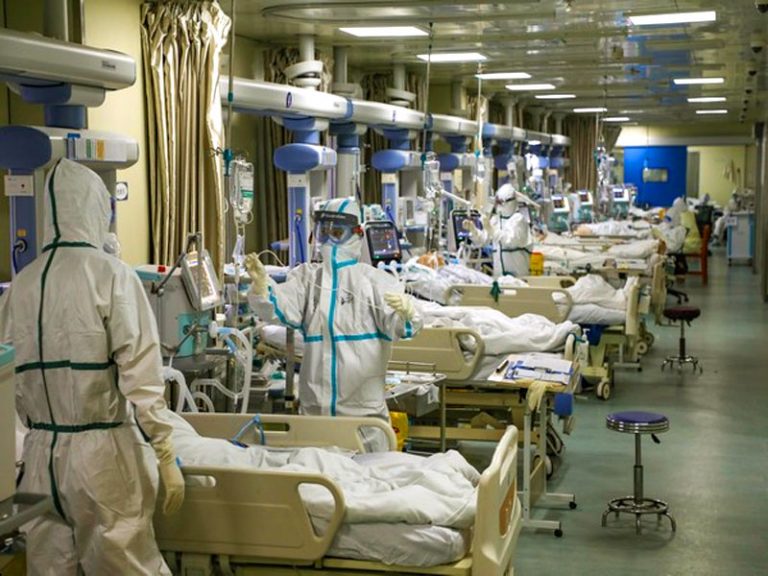
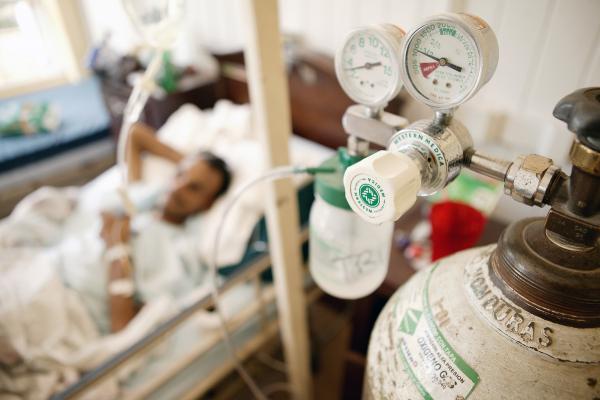
Since the surge in Covid-19 cases in India amidst the second wave of infection, the demand for medical oxygen has increased by several folds. The government of India is working extensively to increase production in the country. According to the government’s data, the production of medical oxygen has risen by 500% since February 2021.

In the first week of February, per day average production of medical oxygen was at 1308 MT across the country. On April 17, India produced 7755 MT of oxygen, out of which 4,739 MT was supplied for medical use, and the rest was supplied to the industries, which is almost four times the supply in February. According to the reports, the government is planning to allocate 6,000 MT of oxygen for medical use by the end of the week. It will be an increase of around 25% from the current supply for medical purposes, especially for the Covid-19 patients.

The government of India has restricted the supply of oxygen to industries excluding nine essential segments, including cylinder suppliers, pharma sector, steel plants and oil refineries. By restricting industrial use of oxygen, the supply to Covid centres has increased exponentially in the last few weeks.

50,000 MT oxygen production to begin soon

The government of India has already floated tenders to award a contract to import 50,000 MT of oxygen in the country. In a recent report, the Times of India quoted an unnamed source and said that the government is speeding up the process to award the contract. Simultaneously, fast-track installation of oxygen concentrators in hospitals based on the technology developed by the Indian Institute of Petroleum and Central Mechanical Engineering Research Institute is also under process. Such installations can be completed in four to five weeks.

Government officials working irrespective of health concerns

Government sources inform that many government personnel themselves have been infected with the Chinese coronavirus, but those with mild symptoms have been working remotely from home in the coordination.

The sources told OpIndia that the government officials are working day and night to chalk out plans to increase the production of medical oxygen in the country and supply it to the various states where cases are rising, including Maharashtra, Uttar Pradesh, Gujarat, Chhattisgarh, Madhya Pradesh, Delhi and more. The oxygen supply is based on a dynamic method rather than a fixed number to ensure every state gets the necessary supply of medical oxygen.

Though the demand has risen sharply in the last couple of weeks as India has reported over 2,50,000 cases in a single day, the supply for the same has increased as well. States like Uttar Pradesh are also working on installing oxygen production plants across the state. Corporates including Reliance Industries, Tata Steel, Jindal Steel, ArcelorMittal Nippon Steel, and SAIL have announced that they will provide oxygen for Covid-19 patients that have improved the situation. Under the PM Cares fund, around 100 hospitals will get their own oxygen plants soon. Currently, Maharashtra, Madhya Pradesh, Gujarat, Uttar Pradesh, Delhi, Chhattisgarh, Karnataka, Kerala, Tamil Nadu, Punjab, Haryana and Rajasthan are the top states with maximum Covid-19 cases in the country.

Migrant exodus starts as Arvind Kejriwal and Uddhav Thackeray announce lockdowns, but Rahul Gandhi asks PM Modi to clear up the mess

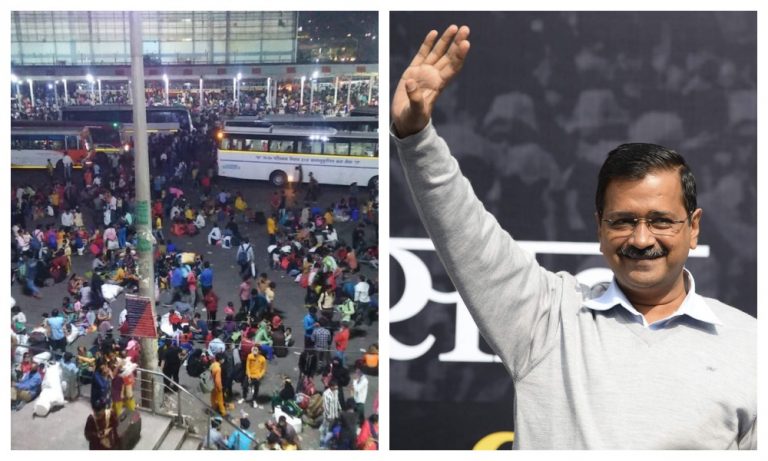
India is witnessing a sharp spike in Covid-19 cases after months of declining numbers. While many states are affected by the second wave of the coronavirus outbreak, Maharashtra and Delhi are amongst the worst hit. To tackle the exponential rise in the COVID cases, the Maha Aghadi Govt led by Uddhav Thackeray in Maharashtra and the Arvind Kejriwal Govt in Delhi have announced rigorous lockdowns in the state.

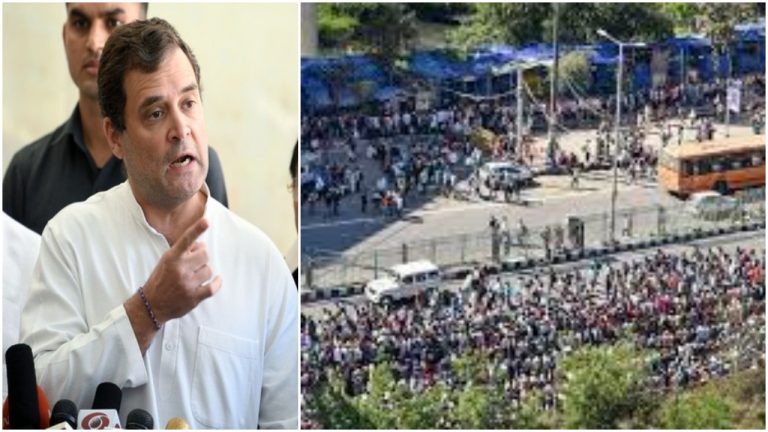
The panic created by this sudden announcement has compelled migrants workers, who endured lockdown infused difficulties during the first wave of the infection last yerar as well, to return to their native places.

As the mass exodus of migrant workers continues, Delhi’s Arvind Kejriwal-led government seems to remain nonchalant over the issue. Likewise, in the western state of Maharashtra, the migrant labourers have been left to fend for themselves by the Maha Vikas Aghadi government.

Rahul Gandhi asks Modi government to clean Kejriwal and Uddhav Thackeray’s mess

Basically, the migrant exodus in Delhi and Maharashtra began after Kejriwal and Uddhav Thackeray announced hurried lockdowns in their respective states and moreover because of the mismanagement of crisis by the state government. Interestingly, though the state-imposed lockdowns have triggered the migrant exodus, Thackeray’s partner and Congress supremo Rahul Gandhi has asked the Modi government to pay for the migrant labourers.

The Gandhi Scion has taken to Twitter to claim that it was the responsibility of the Centre to deposit money into the accounts of the migrant labourers who were leaving the states.

“Migrants are on the move again. In this situation, it is the responsibility of the Central government to deposit money in their accounts. But will a government that is blaming the people for spreading COVID-19 take such a step?”, Tweeted the Gandhi scion after the Delhi and Maharashtra govt’s shocking indifference to the plight of the migrant workers compelled them to leave the states.

Though technically it is the responsibility of the state government’s to look after the needs of the migrant workers working in the states, Rahul Gandhi has previously also cast aspersions on the central government for the plight of migrant labourers during the first wave of the pandemic in 2020. He had hit out at the PM Modi-led government for imposing an ‘unscientific lockdown’.

One wonders now why the Gandhi scion is mum about the arbitrary lockdowns imposed by the Delhi government and more importantly the Maha Vikas Aghadi government in Maharashtra, of which his party in an integral part of.

Migrant workers leave Delhi and Maharashtra in the wake of the lockdown announcements

In the light of the worsening coronavirus crisis in the national capital, Chief Minister Arvind Kejriwal today announced a strict 6-day lockdown in Delhi. The lockdown, he said, will come into effect at 10 pm on Monday, and be in force till 5 am next Monday. Moreover, the Maha Vikas Aghadi government in Maharashtra has announced a state-wide lockdown till April 30.

Just like the Delhi government’s shocking indifference to the plight of the migrant workers, the Maha Vikas Aghadi government in Maharashtra also showed little concerns for the migrant population in its state. The unfortunate exodus of migrant workers in Delhi and Maharashtra not only reflects the disastrous handling of the coronavirus outbreak by the respective state governments but also reveals that addressing the problems of the migrant population is not among their priorities.

Bombay Oxygen Investment’s stock prices soar amidst rising demand for oxygen during Covid crisis, except it doesn’t manufacture the gas

It is said that public sentiments majorly drive the investments made in the stock markets. And in the times of the COVID-19 outbreak, there are fewer things that would sway public opinion as readily as oxygen—something in high demand during the pandemic. As a result, scores of investors have parked their money in shares of the companies that they think would address the growing demand for medical oxygen in the hope to make supernormal gains till the crisis lasts.

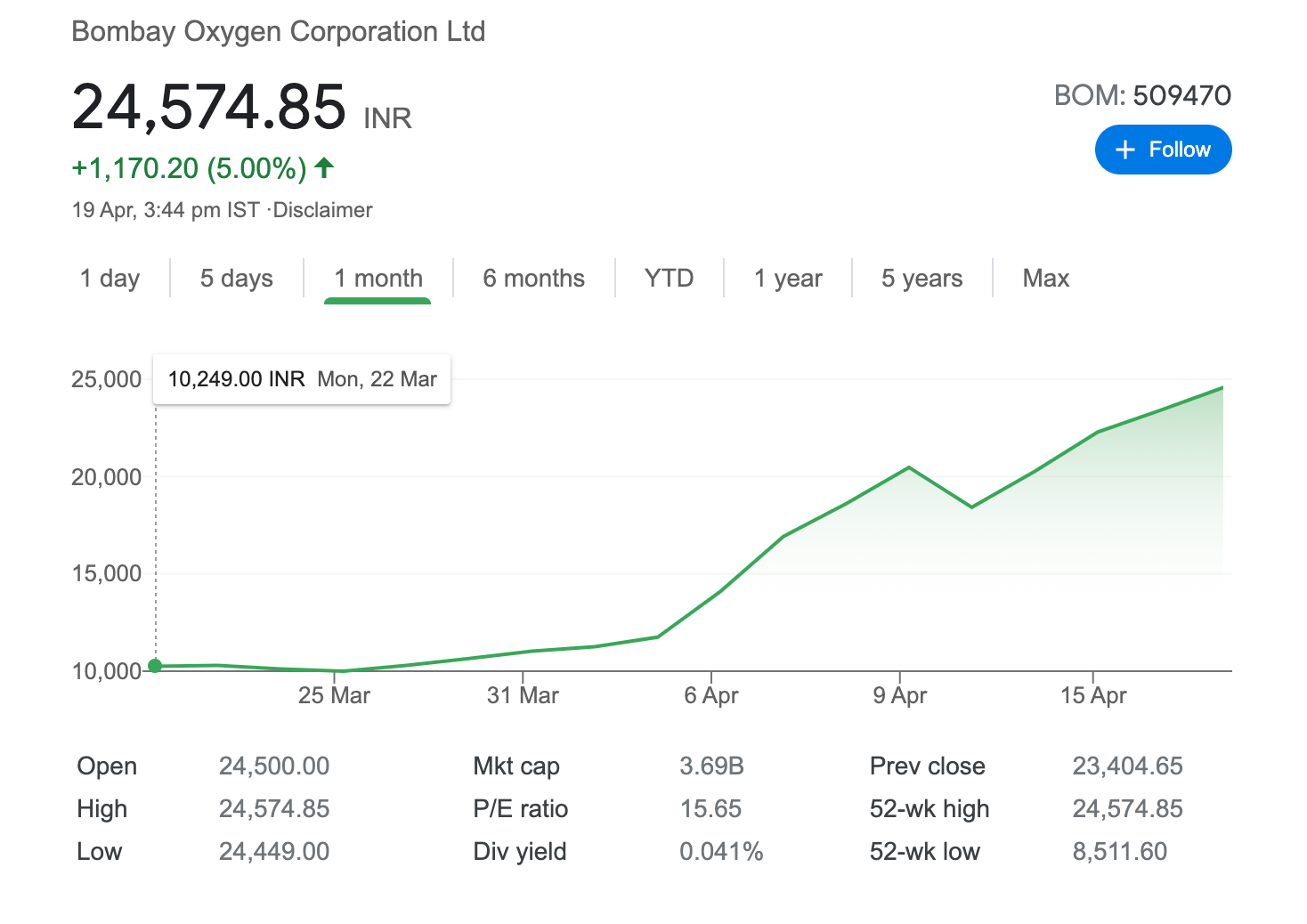
With the rising demand for medical oxygen reported from several parts of the country, a raft of investors invested their money in a relatively obscure company named Bombay Oxygen Investments Ltd, believing that the company is all set to register impressive profits as the requirement for oxygen intensifies during the pandemic. Consequently, the share price of the company reached an upper circuit limit Rs 24,574.85 apiece at the BSE on Monday, with the maximum permissible gain of 5 per cent due to the stock being under surveillance. Except, the company had little to do with the production of medical oxygen.

Ever since the resurgent wave of the coronavirus hit the country and the oxygen demand soared, the stocks of Bombay Oxygen Investments Ltd has seen a sharp uptick. From trading at Rs 10,000 levels around March 22, the stock has risen almost 150 per cent to Rs 24,574 levels in less than a month. The rise in the stock is particularly sharp following April 5, incidentally around the same time the scarcity of the medical oxygen in many hospitals across the country began to be reported.

Source: BSE

Market analysts believe the primary reason behind this stellar rally is the name of the organisation that has oxygen in it and which has led investors to believe that the organisation is into the business of manufacturing the medical oxygen. The name has enthused enough investors to invest their monies in the organisation, which has nothing to do with oxygen production.

Bombay Oxygen Corporation Ltd listed as NBFC on the Bombay Stock Exchange

The website of the company ‘Bombay Oxygen Corporation Limited’ says it was incorporated on October 3, 1960. However, it changed its name to ‘Bombay Investments Limited’ with effect from October 3, 2018. The website also mentioned that the company’s “primary business was manufacturing and supplying of industrial gases which have been discontinued from August 1, 2019”.

Instead, the company is now a Non-Banking Financial Company(NBFC) that “owns substantial financial investments in the form of shares, mutual funds and other financial securities, and income from such financial investments is the source of revenue of the company”. It has been certified by the RBI “for carrying on the business of Non-Banking Financial Company (NBFC) without accepting Public Deposits.”

Though many market analysts claim that the company no longer deals in oxygen, the website of the company still lists oxygen as one of the ‘products’ it deals in. The section says the company is ‘Manufacturer and Dealer of Industrial Gases’ and lists oxygen, nitrogen, argon, carbon dioxide as products.

Notwithstanding this contradictions, the BSE page described the company as an NBFC.

Earlier this month on April 8, BSE sought information from the company after there was a heightened activity in its stock price. The BSE sought a clarification stating it “wanted to ensure that investors have the latest information about the company and to inform the market so that the interest of the investors is protected”.

The company responded to this query saying “All the material information and announcement that may have bearing on the operations (or) performance of the company which includes all the necessary disclosures… have always been disclosed by the company within the stipulated time”.

“There is no pending information or announcement which may have a bearing on the price movement of the company. Therefore, the movement in the share price of the company is market-driven and the company is in no way connected with any such movement in price,” the company told the BSE in its response on April 9.

As per its latest quarterly financial results, the company reported a total income of Rs 33.79 crore and a profit of Rs 31.69 crore for the quarter ended December 31, 2020. The company now commands a market capitalisation of over Rs 368 crores. While the majority of the company shares are held by the promoters, who own more than 73 per cent, the bulk of the public shareholding is with small retail investors.

Share price nosedives by 5 per cent following the reports of the company not producing oxygen

Soon after it dawned upon the investors that the company Bombay Oxygen Corporation Ltd is not associated with the production of medical oxygen that is in huge demand during the pandemic, the share price of the company began to plummet.

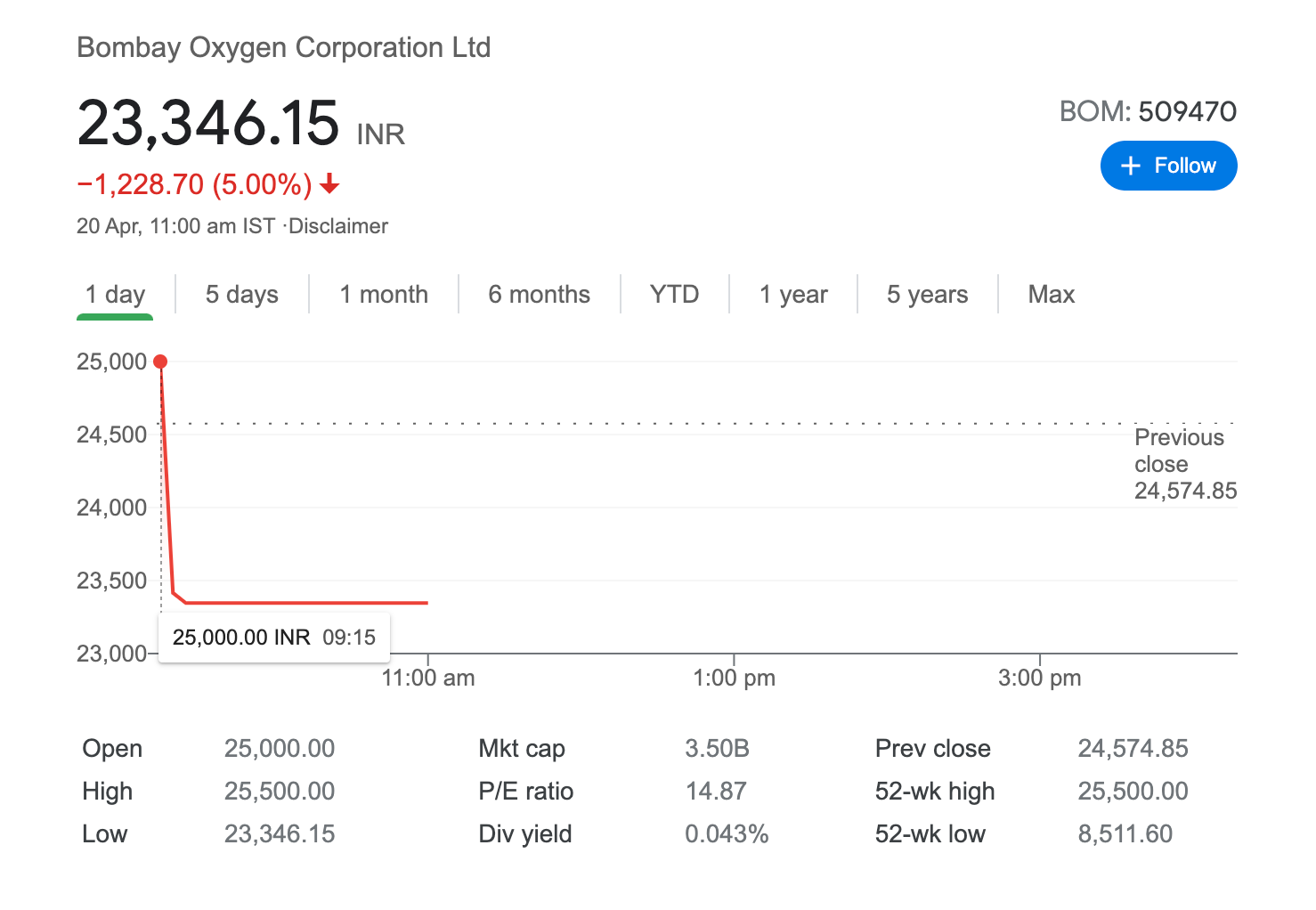
Source:BSE

On Tuesday, the shares of Bombay Oxygen Corporation Ltd opened with a lower circuit, down by 5 per cent due to stock being under surveillance. The share price of the stock is currently hovering around 23,346 levels, down from 24,574 levels a day earlier. As investors realised that the company is not into the manufacturing of oxygen, a large number of them made a beeline to sell their stocks and square their positions. This resulted in the stock price touching the lower circuit, meaning there were only sellers in the market and no buyers.

Why did 9 anti-Modi parties demand from Election Commission that rallies must be held?

If you thought that the pandemic would bring out the best instincts in people, you would be wrong. If you thought that the deadly second wave would make us all work together, you could not be more wrong. Whether people are dying or not, the apparent priority is to prove that all of this is Modi’s fault. So called liberal state governments have done a fine job of drafting letters for help addressed to the Central government. Even the states where the second wave began, which would be Maharashtra and Chhattisgarh. Their job ends there.

So let us get into the dirt and start pointing fingers, if that is what everyone wants. How did the second wave come to be? Apparently, there were two sources. One was the Kumbh Mela in Uttarakhand. The other was the huge turnout at BJP rallies in Bengal, which left every liberal unnerved. These were the sources of the second wave in Maharashtra and Chhattisgarh. Because, as we all know, time flows backwards.

But you don’t have to control time itself. You can just control the media narrative instead. Since people want to talk about election rallies, let us do that. To find out who insisted on a ground campaign in elections, let us read from The Hindu on July 17, 2020.

Bihar elections campaigning

All nine of them are ‘liberal’ parties; the Congress, the RJD, three Communist parties and some others. As The Hindu reports:

“Together, the parties came up with a joint memorandum opposing the EC’s decision to prohibit the traditional mode of campaign and allow only a ‘virtual election campaign’.”

In case anyone is confused, the BJP does not conduct elections. The Election Commission does that. And the Election Commission had decided to that coming elections should only see virtual campaigning. As the Economic Times reported on Jun 30 last year, the BJP was perfectly content with that.

“Both BJP and JDU appeared supportive of the proposal at the EC representatives’ meeting with political parties in Patna a few days ago.“

But opposition parties were sharply critical of this idea, using some really heavy words.

Opposition parties were against digital campaigns

“Discriminatory” and “violative of equality norms.” In case the opposition did not make itself clear enough, they presented a written memorandum expressing their view.

“It will be a travesty of unparalleled proportion to officially legitimise a mode of election campaign which is not only severely limiting by its reach but exclusionary by design,” the Opposition parties’ memorandum said.

When someone uses that many big words, you know they want to be taken seriously. This is in writing. And yet, the opposition comes with a straight face today and election rallies for spreading the virus. They demanded it. They got exactly what they wanted. Evidently, they don’t like it so much any more. And that is somehow Modi’s fault.

I want you to do a thought experiment. I want you to suppose that the EC had rejected the memorandum from opposition parties. Suppose that the EC had ordered that election campaigning should be restricted to digital mode only, which the BJP was perfectly happy to accept.

You know exactly how that would have gone. The opposition parties would have rushed to the Supreme Court, armed with their best PIL trolls. From New York to New Delhi, the refrain would have been the same. Modi is using Covid to throttle democracy. He is enforcing digital only campaigns to restrict voter participation to rich, upper caste, heterosexual males with smartphones. The rhetoric practically writes itself. After all, this is what the opposition parties had said at the mere suggestion of this from the EC:

“RJD, Congress, the Left parties and others have argued that the concept “is socially and economically discriminatory” and, thus, against the “principle of equality” and “violative of a level-playing field in the democratic exercise” as virtual campaigns could exclude a large section of the rural people and the poor who have no access to digital connectivity.“

Of course, the real complaint is not about digital campaigns or ground campaigns. The real complaint is that BJP is campaigning at all. And that people are coming to their rallies in large numbers. Does anyone seriously believe that if the TMC was winning in Bengal, there would be so much discontent in media against election rallies?

If I had better English, I would have said that the liberals want the elections to be “exclusionary by design.” As in they get to campaign, but BJP does not.

Despite getting their wish in the campaign, the liberal parties failed to make way with the electorate in Bihar. Does anyone remember what happened after that? The liberals decided to rally an entire army of supporters and march them to the outskirts of the capital. Missives were sent out to global media to come and see the so called largest protest in the world.

CNN boasting about crowded protests

No, it was not the largest protest in the world. Not even close. But the hyperbole shows the kind of message they wanted to give. For three months, there was saturation coverage of this event. People saw this on their TV screens. Now tell me who gave the message to the country to stop worrying about the pandemic. Remember this crafty smile?

Image
Ravish Kumar’s NDTV India gloating about a crowd at Mahapanchayat elections

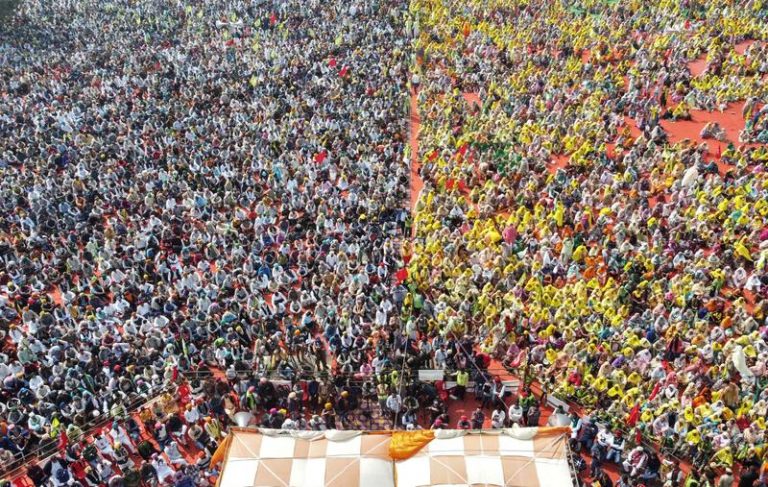
You seem happy, Ravish ji. It seems you want the viewers to know that massive crowds attended the mahapanchayat in Muzaffarnagar. It wasn’t just him of course. Most of the media wanted India and the world to know.

January 2021 crowds
More croweds for January 2021
Tikait’s rally in January 2021

And from the tone of their coverage, it does not seem they were particularly bothered by the flouting of Covid norms. See all those face masks in the picture below?

Tikait’s show of strength in January 2021

Now tell me what message people across the nation got from these three months of saturation coverage. Nobody even talking about the Covid hazard any more. Mass protests with zero protocol being followed. Did it not send the message that the pandemic was over and people could go back to living life exactly as before?

In 2013, during the initial stages of his campaign, Narendra Modi had accused the Congress of hiding behind a so called burqa of secularism. In India of 2021, as long as you wear a face mask of “liberalism” you can do anything. Because only BJP rallies and Kumbh mela spread the virus.

Suar ke bachche BJP, Suar ke bachche CISF: TMC leader Firhad Hakim asks peope to assault BJP workers, threatens CISF

On Monday (April 19), an undated video of TMC leader Firhad Hakim, comparing the central armed forces and the rival BJP to ‘pigs’, went viral on social media. Hakim is the former Mayor of Kolkata and a Cabinet Minister in the Mamata Banerjee-led-West Bengal government.

The contentious video clip was shared on Twitter by BJP spokesperson Tajinder Pal Singh Bagga. While addressing a road show, Firhad Hakim could be heard as saying, “BJP suwarer baccha bole jacchi (BJP is the progeny of pigs).” Following a time gap of indistinct chatter, he threatened, “Jab BJP aayega, toh suwar ke baccha ko pehela maaro (If the BJP, the progenies of pigs come here, then, assault them first.)” The TMC leader added, “Where will you go? Thrash them. Beat the progeny of pigs.”

Following his call for violence against BJP workers, Hakim was informed by TMC supporters that they shooed them away when the saffron party dared to come into the area. “They brought the CISF (Central Industrial Security Forces), Rail police and shooed away my mason. Let the elections get over. Then, our Central Investigation Department (CID) will take action against the ‘progeny of pigs’ CISF “, the TMC minister was seen telling his followers and the general public.

Kolkata Mayor Firhad Hakim not new to controversies

However, this is not the first time when the Mayor of Kolkata has been in the news for the wrong reasons. He had earlier called a Muslim-dominated area of Kolkata as “Mini-Pakistan.” In February this year, he was spotted delivering a political speech at a masjid in Kolkata, in blatant violation of the Model Code of Conduct. 

In order to pacify Muslim rioters, during the anti-CAA riots that had seen extensive vandalism, arson and damage to public properties, Hakim, referring to the rioters as ‘brothers’ claimed such acts by Muslims will ‘help BJP to come to power in Bengal’ and then the Muslims have to ‘keep their heads down’, like they allegedly do in UP.

Kejriwal faces flak for planning nothing for migrants while his party gave free food to ‘farmers’

Trust Aam Aadmi Party to give tough competition to Congress in lowering the bar of political discourse when the nation fights a raging pandemic.

In a surprise move on Monday, Kejriwal government in Delhi announced a week-long ‘lockdown’ in a bid to curb the Chinese coronavirus pandemic. Delhi became second state after Maharashtra to announce a lockdown in the second wave of pandemic.

After having had a bitter experience during the first wave of pandemic last year when the nation-wide lockdown was announced by Centre to curb infection and build up health infrastructure, the migrant workers in these two states decided to go back to their hometowns, lest they be left in the lurch. Amid all this, Kejriwal ‘appealed’ to the migrant workers to not go back.

It is imperative to note that last year when the pandemic hit India, it is alleged that AAP govt in Delhi ran state-govt buses and made announcements to get the migrants to bus stations. From there, Delhi Transport Corp buses brought these migrants to Delhi-UP border and left them, promising them that the UP buses will take them to their respective villages. This when all the states had stopped inter-state movement and there were no state-run buses plying on road. So, in first wave of pandemic, Kejriwal had left the migrants on their own before Yogi govt stepped in to help them.

Left with this bitter taste, it is understandable the panic the migrant workers might be having.

This was not missed by netizens who also pointed out how Kejriwal, who had gone all out to help the protesting ‘farmers’ at Delhi borders has left the migrants in a lurch, perhaps because they are not votebanks.

AAP MLA Raghav Chadha had personally gone to Delhi border to set up free WiFi for protesting ‘farmers’ just few months back even though the pandemic was still raging through the country. But have now abandoned the migrants after imposing the lockdown.

Netizens were also angry at Kejriwal having funds for arranging food for ‘protesting farmers’ but having left the migrants in a a limbo.

People were also furious that it was second time in just two years Kejriwal managed to create such fear psychosis that migrants ran away from Delhi. That they don’t have confidence in Kejriwal government that they will be taken care of.

Bhupesh Baghel, who was busy with Assam elections, blames the Centre for second wave of Covid

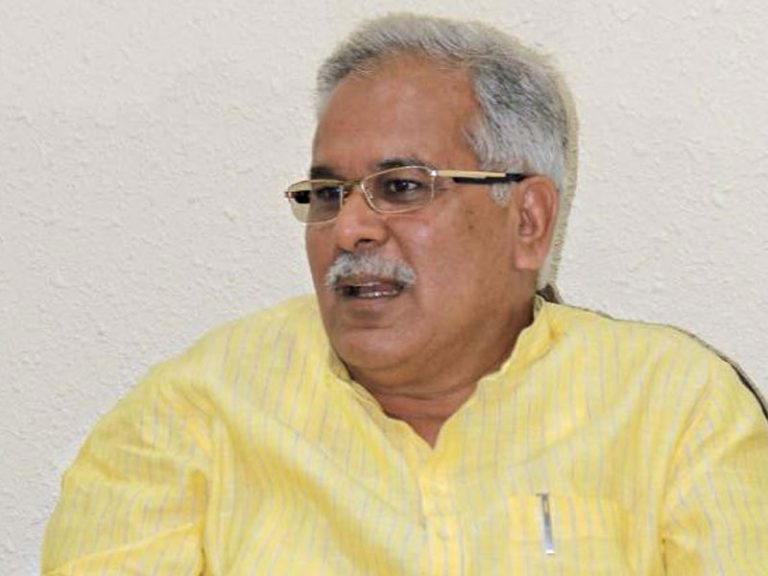
Bhupesh Baghel, Chief Minister of Chhattisgarh, has blamed the Modi Government for the second wave of infection. In an interview with Indian Express, Baghel said, “The Indian government could not even advise, provide a guideline for the second wave.” However, Baghel forgot that according to the Section 6 of the List II of the Seventh Schedule (Article 246) of the Constitution of India, public health and sanitation, hospitals and dispensaries is state subject.

Covid-19 testing and positive rate in Chhattisgarh

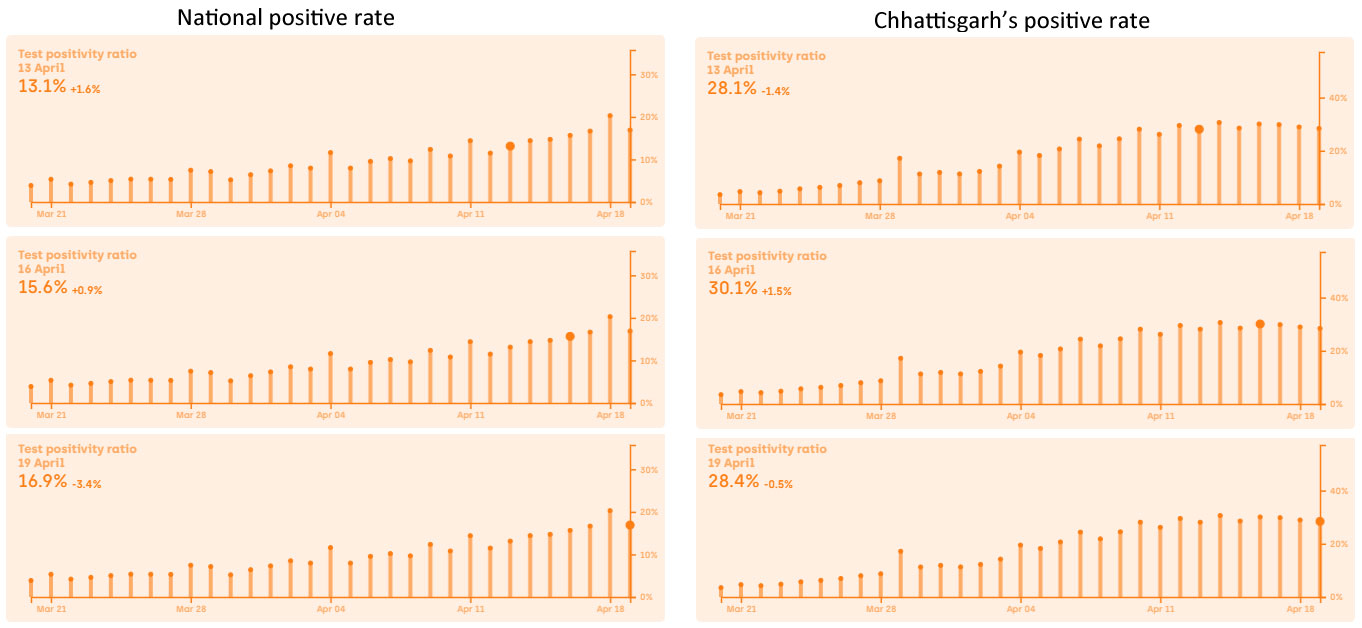
According to the Unique Identification Authority of India (UIDAI), Chhattisgarh’s estimated population stands at 2.94 crores. In his interview, Baghel claimed that they are taking 1,800 samples per 10 lakh every day that stands at 0.18% per 10 lakh. On April 19, Chhattisgarh tested 48,673 people that stands close to 0.16% per million 10 lakh. Though he is correct that the state is testing more per 10 lakh compared to some other states, the positive rate in Chhattisgarh is alarmingly high at 28%, which has been almost consistent in the last one week. The national average is around 15.5%.

National Positive Rate | Chhattisgarh Positive Rate (Source: covid19india.org)

Baghel targets Union Minister Piyush Goyal over oxygen supply

During his interview, Baghel targeted Piyush Goyal for asking state governments to keep demand for medical oxygen under control. He was talking about the interview of Goyal with news agency ANI on April 18. It has to be noted that when Goyal said that demand-side management is as important as supply-side management, he was not asking the states to use less oxygen than needed, but he was asking to stop the wastage of oxygen.

In his interview, Goyal said that his ministry was getting reports of unnecessary usage of oxygen on patients where it was not required as per the guidelines. Also, some reports suggested that medical oxygen was wasted in some hospitals. He had urged the state governments to keep a check on the wastage so that the patients in need do not have to wait for the oxygen. Notably, in the last few weeks, India has ramped up the oxygen supply across the country and took several steps to improve the supply chain.

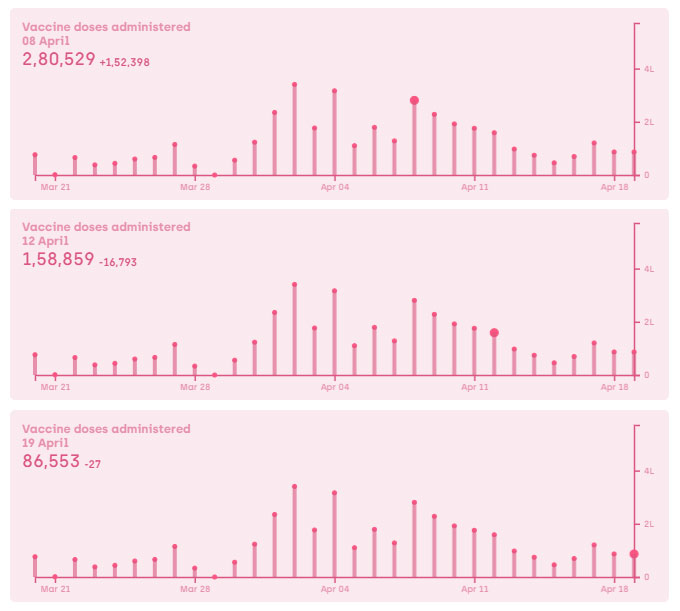
A sharp decline in vaccination

In the last few days, Chhattisgarh has seen a sharp decline in the number of vaccinations administered. Since April 13, the state has vaccinated less than one lakh people in the state. On average, the state was administering over 1.90 lakh Covid-19 vaccines in the week before April 13.

Vaccination program has seen sharp decline in the state (Source: covid19india.org)

It is notable here that Chhattisgarh is one of the worst affected states in India in terms of active cases. Reports of an overwhelmed medical infrastructure have been doing rounds in the state. Recently there were viral social media videos where dead bodies of covid patients were being taken with the help of garbage vans in the state.

Baghel and Assam election campaigning

CM Baghel was busy doing election rallies in Assam for Congress candidates while the state was experiencing a sudden surge in the number of Covid cases. Notably, he was also missing from the state when CRPF personnel were attacked by Naxals. By April 13, Chhattisgarh was reporting over 15,000 cases per day which have remained almost consistent to date. Unfortunately, the death rate is consistently around 1.2% which is nearly double the national average.