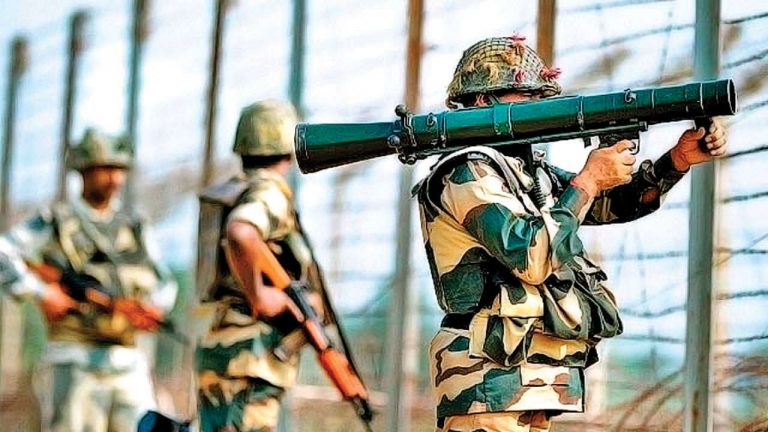
Breaking all its records since 2003, Pakistan has violated the ceasefire along the Line of Control (LoC) for the maximum times this year in nearly two decades. Pakistan has reportedly committed 5,100 violations of ceasefire in this year alone along the LoC in Jammu and Kashmir. The number is highest in around 18 years. The ceasefire violations by Pakistan has left around 36 people dead including 24 security personnel and has injured around 130 people. 15 soldiers were martyred along the LoC in Jammu region.
Pakistan resorted to heavy shelling post abrogation of Article 370
In 2019, there were reportedly 3,289 ceasefire violations by the Islamic country along the Indo-Pak border. Out of these ceasefire violations, 1,565 happened in August 2019 along following the abrogation of Article 370 that granted special status to the erstwhile state of Jammu and Kashmir. In the year before, Pakistan violated ceasefire 2,936 times with an average of 8 cases per day. These violations claimed the lives of 61 people and injured 250.
This year, ceasefire violations by Pakistan were five times that of 2017 in which 971 violations were recorded. 31 people including 12 civilians and 19 security personnel lost their lives in the ceasefire violations in 2017 while 151 were injured. Before both the countries agreed to cease fire along the LoC in 2003, 8, 376 incidents of shelling and firing by Pakistani troops occurred along the border in 2002.
However, for three continuous years- 2004, 2005 and 2006 no violation of ceasefire was recorded. Since 2009 onwards, ceasefire violations by Pakistan has only increased. These violations have severely affected the people living in the border areas including Jammu, Kathu, Kupwara and Baramulla, Samba, Rajouri and Poonch districts.
Shelling has forced border residents to migrate
According to officials, shelling and firing by Pakistan has forced people to migrate to safer places thrice which has affected education and agricultural activities. A fund of Rs 415 crore was sanctioned by the central government for the protection of border residents to construct underground bunkers along the LoC and the International Border (IB). 7,777 bunkers have been constructed in Rajouri, Poonch, Jammu, Samba and Kathua districts and tenders have reportedly been floated for building more such shelters. India shares 3,323 km border with Pakistan of which 221 km of the IB and 740 km of the LoC fall in Jammu and Kashmir.
At a time when countries around the world are bracing up for the COVID-19 vaccine rollout to put an end to the prolonged pandemic, a new and rapidly spreading mutant variant of the pathogen found in the UK and South Africa has triggered global panic. Moreover, with reports suggesting that the new variants spread 70 per cent faster than the previous strain, people have started questioning the efficacy of the current vaccines.
Putting the speculations to rest, the Scientific advisor to the Government of India Prof K. Vijay Raghavan said while addressing the media that the vaccines will work against the SARS-CoV-2 variants detected in the UK and South Africa and that there is no evidence that current vaccines will fail to protect against these COVID-19 variants.
Vaccines will work against the variants detected in UK and South Africa. There is no evidence that current vaccines will fail to protect against these #COVID19 variants: Principal Scientific Advisor (PSA) to the Government of India Prof K. Vijay Raghavan pic.twitter.com/jqiVpNB5Ng
He also confirmed that so far it has not been found that the new variant of COVID-19 increases the severity of the disease.
Stating that there are concerns as most vaccines target the Spike protein in which there are changes in the variants, he added: “Vaccines stimulate our immune system to produce a wide range of protective antibodies. The changes in the variants are not sufficient to make the vaccines ineffective.”
At present, there are six COVID-19 vaccines in different clinical trial stages in India. Besides, three vaccine candidates which are in pre-clinical trial stages, Pfizer, Serum Institute of India (SII) and Bharat Biotech have sought emergency use authorisation of their COVID-19 vaccines.
Moreover, amid the growing concerns of new coronavirus strain, the centre on Tuesday confirmed that a syndicate of various government labs all over the country for genome sequencing to the coronavirus had done roughly 5,000 genome sequences prior to the news of the UK variant came in. Giving the details, Union Health Secretary Rajesh Bhushan said that the government would be significantly increasing the number of genome sequencing and worl in a coordinated manner.
Prior to the news of the UK variant came in, we had done roughly 5,000 genome sequences across labs. Now we’ll be significantly increasing that number & would be working in a coordinated manner: Union Health Secretary Rajesh Bhushan pic.twitter.com/7CVNsl8Ysv
Earlier today, six passengers who recently returned from the United Kingdom were tested positive for the new mutant variant of coronavirus. Three of the patients have been admitted to NIMHANS, Bengaluru, two in Centre for Cellular & Molecular Biology, Hyderabad and one in National Institute of Virology, Pune. All patients have been kept in single room isolation in these designated healthcare facilities by the state governments. Their close contacts have also been put under quarantine. Comprehensive contact tracing has been started for co-travellers, their families and others, the government said in a press release.
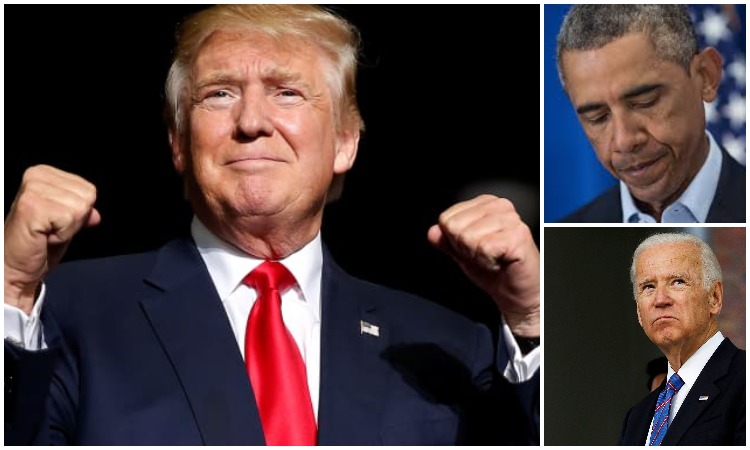
Amidst the presidential transition in the United States of America, a Gallup poll released on Tuesday reveals that Donald Trump, the outgoing President of America, has been voted as the most admired man in USA for the year 2020, unseating his predecessor Barack Obama who had held on to the title for the last 12 years. The president and his predecessor tied last year.
Donald Trump has made it to the top ten’s list 10 times
While asking respondents about their most admired man for 2020, eighteen per cent of the survey’s respondents named Trump as their most admired man, compared to 15 per cent who named Obama and 6 per cent who named President-elect Joe Biden. Three per cent named National Institute of Allergy and Infectious Diseases Director Anthony Fauci, while 2 per cent said Pope Francis.
According to report, this is the 10th time that Trump’s name has appeared among the top 10. Before entering the political sphere, he made the list in 1988, 1989, 1990 and 2011. Biden made only his second appearance in the top 10 after making to the list in 2018.
Michelle Obama becomes the most admired woman for 2020
Meanwhile, according to a Gallup poll, former first lady Michelle Obama has topped the list of the most admired woman for 2020, bagging the place for the third time in a row with Vice President-elect Kamala Harris coming in second with 6 per cent.
First lady Melania Trump came in third among most-admired women with 4 per cent, followed by media mogul Oprah Winfrey with 3 per cent, and German Chancellor Angela Merkel, former Secretary of State Hillary Clinton, Rep. Alexandria Ocasio-Cortez and Queen Elizabeth II with 2 per cent. US Supreme Court Justice Amy Coney Barrett and environmental activist Greta Thunberg both finished with 1 percent.
Pollsters surveyed 1,018 adults from December 1 to 17. The poll has a margin of error of plus or minus 4 percentage points.
A lot of liberal ‘intellectuals’ have suffered severe trauma watching the rise of Narendra Modi and Amit Shah in electoral politics which has made their sermons and their bizarre opinions utterly irrelevant in Indian politics. No one, perhaps, has suffered more of a mental breakdown than ‘Ichchhadhaari protester’ Yogendra Yadav who can be spotted trotting from one protest to the next in his effort to bring down the government at the center.
Yogendra Yadav on Tuesday addressed people through periscope where he revealed the four core demands that the ‘farmers’ will discuss on the talks proposed with the government on Wednesday. The demands are quite bizarre and have far exceeded the initial farm laws that triggered these protests. Now, it appears, the ‘intellectual’ appears to have convinced some of the protesters to make a grab for whatever they extort from the government.
‘Repeal farm laws’
Yogendra Yadav made it clear that nothing short of a complete repeal of the laws will work. He said that there will be no discussion on whether the laws should be repealed or not, “the laws must be repealed”. Only discussions related to the modalities of the repeal will occur, not whether they should be repealed.
Another intriguing feature of the latest speech by the crazy ‘intellectual’ is that he constantly refers to himself as one of the farmers protesting against the laws. But it is not clearly precisely when he became a farmer. Only recently, he was thrown out by the government of a meeting because it was insisted that there will be a discussion with only farmers, not politicians.
‘Market intervention and other prospective measures for MSP’
Yogendra Yadav said that they need a law to ensure MSP and not in written. Again, he says that there will be no debate on it and only discussion regarding the manner in which it will be implemented. In order to achieve that objective, he suggests measures that could be adopted for the same.
The proposed measures include the government paying the difference between the MSP and the price at which the farmers sold the product in the market. Another suggestion he makes is the government intervenes in the market and ensures that the cost of the product does not fall below the MSP.
‘Repeal stubble burning laws that punish farmers’
Yogendra Yadav also said that they will discuss the repeal of laws against stubble burning which is a major contributory factor towards air pollution in the NCR region and surrounding areas. There is provision for punishment against farmers engaging in the process and the ‘intellectual’ wants it repealed.
Draft Electricity Bill
Yogendra Yadav claims that in the Draft Electricity Bill, there are provisions which will ensure that farmers do not receive free electricity or electricity at subsidized rates. He wants the government to withdraw that draft as well.
In Bad Faith
Yogendra Yadav is clearly acting in bad faith here and is fully aware that the government does not have the resources to consent to at least one of the demands. One also has to ask here what do the laws against stubble burning have to do with the current spate of protests.
The intent here is clearly ‘My way or the high way’ which is evidently not the manner in which a person approaches honest negotiations. Yogendra Yadav has long been trying to undermine the NDA Government at the center and he finally appears to have found something that he believes will stick.
It also reveals that the protests have now far exceeded what the initial demands were. Now, people like the crazed intellectual is making ridiculous demands that they know the government cannot accept. He is well aware that accepting such demands will cripple the economy forever.
And yet, he is making such demands because the objective is to embarrass the government no matter what the cost is. In their hatred for Narendra Modi, it appears there is no boundary they will not cross.
The amusing part is ‘intellectuals’ and opposition party politicians have been demanding the same reforms that the new farm laws provide for. Former Prime Minister Manmohan Singh, Rahul Gandhi, Sonia Gandhi, Shashi Tharoor, Raghuram Rajan, there was widespread consensus regarding the necessity of these reforms. But now that they have been implemented, everyone is up against the government only to score political brownie points.
Senior Congress leader and former Karnataka Chief Minister Siddaramaiah admitted on Monday that he ate ‘cattle meat’. His comments came during the Congress Foundation Day event and he did not spare his own party men either who he claimed were afraid to speak out due to backlash.
Siddaramaiah said, “I had once said in the assembly that I eat cattle meat, who are you to ask?-It is my right, food habit is my right, who are you to question? If you don’t eat, leave it, I’m not going to force you. I eat because I like, who are you to ask? Do you need the courage to say this?”
“…our people stay quiet creating a feeling that what others are saying is right. You should come out of such confusions, please,” he said referring to the anti-cow slaughter bill that was passed by the Karnataka government. “Where will the farmer send aged cattle like cows, buffaloes, he said, pointing out that taking care of a cow or a buffalo costs about Rs 100 per day. Who will give that money? Farmers too worship cows,” he stated.
In 2015, Siddaramaiah had made similar comments. He had said, “I have not eaten go-maamsa (cow-meat) until today, (but) who are you to ask me whether I have or not?” Recently, Siddaramaiah, who also happens to be the leader of the Opposition in the Karnataka Assembly, had expressed regrets for his comments that Kodavas eat beef for which he received a lot of flak. He said that he has a lot of respect for Kodavas and their culture.
On December 9, Karnataka became the 20th state to completely ban cow slaughter in the state. Anyone who indulges in illegal slaughter or transportation of cows will be punished for a jail term of up to 7 years. Interestingly, the comments by the senior Congress leader came on the day that the Karnataka cabinet passed an ordinance to give effect to the bill that remains to be passed by the Legislative Council.
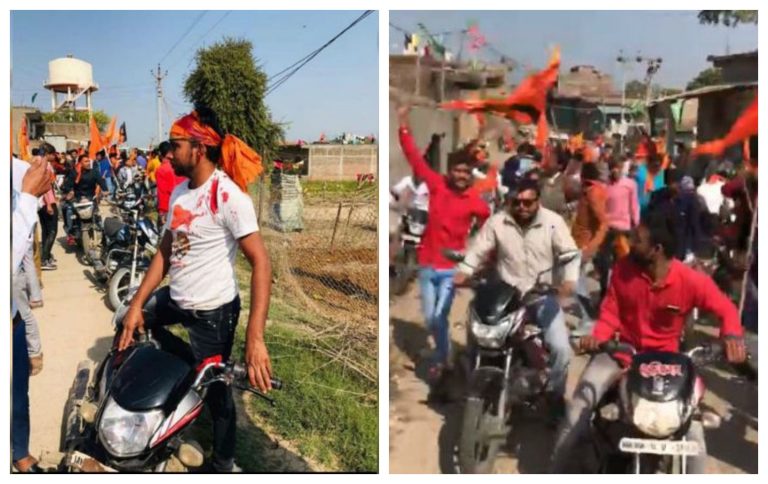
A rally taken out by a Hindu organisation in Goutampura area of Indore, Madhya Pradesh for collecting donations for the construction of Ram Mandir at Ayodhya was attacked with stones today. According to Bhaskar, the incident happened today around 1 pm at Chandankhedi village when a Hindu organisation took out a rally for collecting donations. Some people in the rally reportedly got into a dispute with some people of another community.
Around 2 pm, some members of the Hindu organisation reportedly started reading Hanuman Chalisa before a mosque. Some policemen were also present at that time. This flared up communal tensions in the area. In no time, the rally was attacked with stones and sticks. On receiving the information of the attack, several police officers along with a team of 50 policemen reached the spot. More than 12 people have reportedly been injured in the attack. Following the attack on the rally, some people from the organisation sat on protest demanding arrest of the culprits.
DIG Harinarayan Chari Mishra said that the culprits will be booked under the National Security Act (NSA).
Ujjain stone-pelting on Hindu rally
On December 25, a Hindu rally was attacked with stones in Muslim majority Begumbagh area of Ujjain. Some Hindus had taken out Ramnidhi Sangrahan rally for collecting donations for Ram Mandir at Ayodhya. The Muslim mob that included women and children, not just hurled stones at the rally but also vandalised the vehicles left behind by some people in the rally as they ran for their lives.
However, taking stringent action against the culprits who pelted stones at the rally, the police demolished a illegal house in the Bugumbagh area that was used for hurling stones at the rally. Four people named Ayaz Mohammad, Wasim Aslam, Shadab Akram and Altu Aslam have been booked by Madhya Pradesh police under the NSA.
Offering a cheap alternative to the developing nations against the more expensive and anticipated shortage of western-developed coronavirus vaccine would have been a diplomatic coup for Beijing in regaining the trust of the countries it lost following the advent of coronavirus. But China is struggling to get the world to trust its vaccines, a report published by Bloomberg said.
Even the closest of Beijing’s allies have displayed apprehensions in placing their faith in the vaccine produced by China. Pakistan, China’s all-weather ally and its eternal rental state, has long been staying afloat due to the Chinese largesse. China has invested about $70 billion in Pakistan for the development of roads, railways and other infrastructure. Even two of the Chinese clinical trials are underway in Pakistan.
However, according to the survey with the people of Karachi, the biggest city of Pakistan, China has failed to assure millions of people the efficacy of their vaccines. The respondents of the survey have not hesitated from raising their doubts and misgivings about the vaccines manufactured by the Chinese companies, underscoring the mistrust that residents of developing countries share against Beijing.
China thought that the vaccine diplomacy could be used to restore its trust with the poorer nations, propping up their ties with countries that had come under strain in the wake of the coronavirus and amidst the expected scarcity of the western-developed vaccines. However, the lack of data about the clinical trials of the Chinese vaccines and Beijing’s characteristic opacity has only added to fuel doubts surrounding the effectiveness of its produced vaccines.
The absence of global endorsement to the Chinese virus has also played a role in continuing apprehensions regarding vaccines backed by Beijing. So far only the United Arab Emirates and China itself have endorsed the vaccines for emergency use so far. Compared to this, the US and European companies have already published data on the safety and efficacy of their shots and have started to deploy them.
The raging distrust of the Chinese companies and the vaccines produced by them could act as a roadblock in Xi Jinping’s vision of restoring China to its ancient glory. For a long time now, China has sought to expand its influence over countries through its ambitious Belt and Road Initiative(BRI) and by providing financial assistance to poorer nations. China pumped millions of dollars on loans and projects to cultivate local elites and strengthen its dominance and influence.
However, the emergence of the coronavirus pandemic, with its roots being linked to the central Chinese city of Wuhan, China has lost the primacy it had once enjoyed. The fact that the tests and personal protective equipment exported by China had turned out faulty had only compounded the growing mistrust among the nations for Beijing.
China’s ‘Vaccine Diplomacy’ faltering as nations and their population show little trust in Chinese vaccines
The first case of the coronavirus case is believed to have been reported from the Chinese city of Wuhan. During that time, China came under intense criticism from the international world for bungling up the initial response to contain the infection and being non-transparent and disingenuous in not informing the world about the characteristics and nature of the contagion. As a result, the virus quickly hopscotched national boundaries and turned into a global pandemic.
This resulted in the deterioration of the relationship between China and several western countries, most notably the United States, the United Kingdom and Australia. On its part, China imposed an unprecedented lockdown to snuff out the infection from within its border. It also stopped reporting the number of daily coronavirus cases. Beijing launched a massive testing blitz to check infection among millions of its citizens but it was also aimed to underscore China’s success in handling the crisis.
Buoyed by its success in handling virus at home, China aggressively sparred with the western countries from the origins of the coronavirus to the crackdowns in Hong Kong and Xinjiang. The persistent trouble caused by the pandemic resulted in the US hardening its stance against China, including its efforts in stopping countries from from adopting the next-generation communications technology of China’s Huawei Technologies Co.
For Chinese Premier Xi Jinping, vaccine development and distribution is another frontier that would establish China as a superior country as compared to the ‘chaotic’ democracies in the west. However, many suspect that China’s push for the vaccine may be aimed at striking a bargain with the poorer countries by providing them with Chinese-made vaccine in return for the country’s commitment to using Huawei 5G telecommunication lines.
China has also launched a global effort to make the efficacy and safety of its vaccine known. It had invited representatives of 50 African countries to a Sinopharm Group Co. facility in October, in a bid to showcase its progress in developing the shots against coronavirus. Responding to Bloomberg’s question, the Chinese Foreign Ministry said Chinese companies developing vaccines strictly comply with the law and clinical trials in the first two phases showed the shots were safe and effective.
What benefits China is the fact that a large number of countries in the world do not have facilities to store western-developed vaccines. The vaccine that is manufactured by Pfizer requires to be stored at -70 degree Celsius. The poorer and developing nations lack the infrastructure that is needed to stockpile the vaccine. Besides, the limited quantity of the shots developed by the European and the American companies also benefits China’s vaccine candidates, as they are expected to be limited and in their absence, poorer nations will have no option but to turn to China for inoculating their population.
Surveys in Brazil and Kenya show people do not perceive all approved vaccines equal
However, despite repeated assurance by the Chinese authorities about the efficacy of their vaccines, nations and their population remain sceptical of the vaccines supplied by China. Even though Brazil is one of the countries where Chinese vaccine candidates are undergoing clinical trials, the Brazilian President Jair Bolsonaro has repeatedly attacked “Made in China” and said that he wouldn’t buy vaccines from China.
“We won’t buy it from China, it’s my decision,” Bolsonaro said in a radio interview in October. “It’s a matter of credibility — there are other vaccines that are more trustworthy.” However, the Brazilian government later back-pedalled on his statement. On December 21, Joao Doria, governor of Sao Paulo said that it would receive 5.5 million doses of the Sinovac vaccine within days.
Yet, a survey conducted by a polling institute Datafolha earlier in the month showed that half of Brazilians said that they would not take the Sinovac-Butantan shot, the highest refusal rate among all the vaccines. Some 36% of respondents said they’d also reject a Russian vaccine, while 23% said they wouldn’t take a U.S. shot.
A survey conducted in Kenya showed that people did not perceive all vaccines equally. Africa-focused polling company TIFA Research found that respondents were least likely to take vaccines made in China and Russia, preferring vaccines from the U.K. or the U.S.
Global leaders wary of backlash over passing substandard coronavirus vaccine
For global leaders whose countries have been battered by the coronavirus outbreak, the selection of vaccine candidate is a slippery slope. They are expectedly cautious in not inviting the public wrath over approving a second-rate coronavirus vaccine. After being racked by the menace of COVID-19, these leaders do not want their population to believe that they have compromised with their safety by allowing and approving substandard vaccines.
Yet, some international leaders have openly endorsed the inoculation process to quell doubts regarding the coronavirus vaccine. The President of Indonesia, Joko Widodo said that he will be the first one to be vaccinated in the country. Indonesia has ordered 125.5 million doses from Sinovac, as well as 30 million from Maryland-based Novavax Inc. and is developing 57.6 million of its own shots. It’s also seeking doses from Covax, AstraZeneca and Pfizer.
The Prime Minister of the United Arab Emirates, Sheikh Mohammed Bin Rashid Al Maktoum, received the Sinopharm vaccine on Nov. 3. “We wish everyone safety and great health, and we are proud of our teams who have worked relentlessly to make the vaccine available in the UAE,” he wrote on Twitter along with a photo of him receiving the vaccine.
However, the official endorsement by the leaders might not be enough to instil confidence among people for a vaccine if it receives approval. Scepticism rages unabated as people view vaccines made in China with suspicion and distrust. According to Nicholas Thomas, an associate professor in health security at the City University of Hong Kong, transparency is needed to support more general public acceptance of the Covid-19 vaccines. And the biggest inadequacy in anything concerning China is transparency.
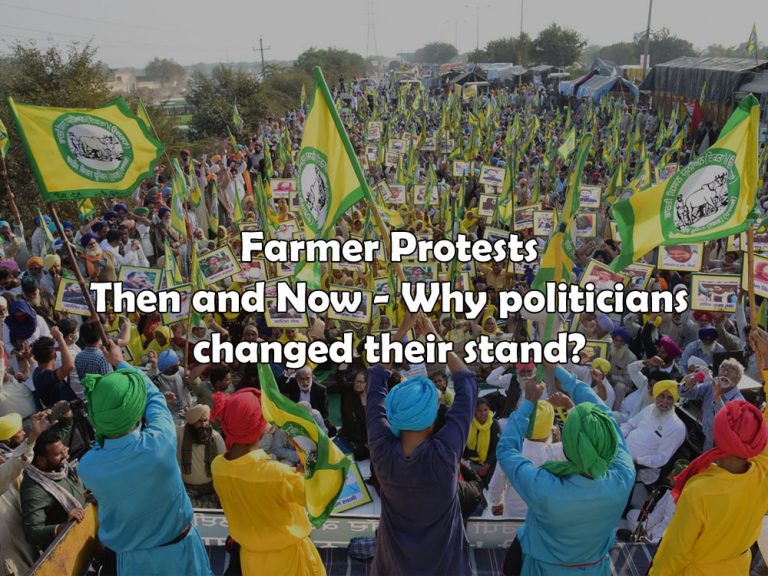
Amidst ongoing farmers’ protests in Punjab and Delhi, opposition leaders have come forward in support of the ‘farmers’. As the new farm laws have become a matter of discussion in every corner of the country, political leaders are trying to exploit them for their benefit. But at what cost? Thousands of farmers are lodged on the borders of Delhi. They are interrupting the supply chain in the National Capital, making it difficult for many factories and businesses to operate smoothly.
These businesses have already suffered a lot due to Covid-19 this year, and the agitation is only adding up to their worries. CII had warned earlier this month that the agitation is going to have an adverse effect on the Indian economy.
Congress’s leaders are telling the world that the farm laws are “black laws” or “kaale kanoon,” and the government must take them back. Rahul Gandhi, being the “rising star” who has been discovered and launchyed and relaunched so many times in the past few years, has talked extensively against these laws. But are they earnest about the farm laws? Or they just want to add fuel and enjoy the popcorns from some holiday destination? To be noted that Rahul Gandhi is currently in Italy.
Though he is not in the country, Gandhi did not forget to provoke the protesters. In a tweet on December 28, he said that the government must take back the Agriculture laws.
किसान की आत्मनिर्भरता के बिना देश कभी आत्मनिर्भर नहीं बन सकता।
To understand, how opposition leaders, intellectuals, journalists, farmers’ unions and professional protestors have shifted their argument from removing APMC to repeal reforms in Agriculture sector, it is essential to travel in the past. Let’s dig into some statements made by top Congress leaders and others in the past when they vouched for the same “Kaale Kanoon” they are trying to oppose now.
Amethi Food Park – the dream project of Rahul Gandhi
Starting with Rahul Gandhi, in 2015, when he was a Member of Parliament from his ‘beloved’ Amethi, he proposed the ‘Amethi Food Park’. As per Rahul’s speech in Lok Sabha, when he was in Amethi, a farmer asked him a question about the low prices potato farmers get for their crop. He asked him that he gets Rs.2 per KG for potato in government authorized to market, but when Lays use the same potato to make potato chips, a single chips packet containing just one potato sells at Rs 10. How is that possible?
Gandhi said that if there are no middle-men in the markets, and farmers can sell their produce directly to the factories, it will increase farmers’ income by several folds. He also advocated for farmers’ freedom to sell directly to private enterprises without middlemen.
It is a fact that Gandhi favoured trade outside the APMC market, and it has to be noted that companies like Frito Lays (Pepsi), Bingo (ITC) and others practice contract farming to get products directly from the market. It is a common practice for decades. Rahul Gandhi seemed to have no knowledge of it whatsoever. Also, it has to be noted that Gandhi had lost Amethi Smriti Irani in 2019. No reason to remind it here, but still, it has to be noted.
FDI in retail will allow farmers to sell produce to corporate – Sonia Gandhi
But is it only Rahul Gandhi who was in favour of similar changes to farm laws? Apparently no. The ‘unsung ruler’ behind the Congress-led UPA government, Sonia Gandhi, had talked extensively in favour of FDI in retail. On several occasions, she said that her party was committed to the benefit of the farmers and FDI will increase their income and reduce the cost for the consumers.
She said that when farmers sell their produce directly to the companies (that the new Agriculture Laws talk about), they will get a better price. On the other hand, as the retail chains would have to pay less than what they pay to middlemen, the end-user price of the product will come down. If she is to believe, it was a win-win situation for everyone.
If farmers sell produce to factories and retailers, it will bring the prices down – Dr. Manmohan Singh
The former Prime Minister was a great economist and an amazing reformer, at least according to the Congress Party. During his tenure as the prime minister of India, he made some difficult decisions which were supported by Sonia Gandhi and Rahul Gandhi. It is essential to point out that they supported the reforms brought by Singh as without their approval they would not have become laws anyway.
If you remember, Rahul Gandhi tends to tear ordinances and bills in the parliament. Anyway, during his speech on November 4, 2012, Dr. Manmohan Singh said that his government’s decision to allow FDI in retail would benefit farmers and consumers.
Dr. Singh said that farmers would be able to sell products directly to retailers. As there will be no middlemen in the process, the cost of the products will come down for the retailers. They will shift the benefit to the consumers by bringing down the price of the products on the shelves. It will also help strengthen the supply of food products to every corner of the country at an affordable price.
Singh said that a large portion of the produce is spoiled as there is not enough storage capacity in the country (in the recently enacted laws, a similar provision has been made to allow storage of food products up to ceiling capacity of the storage units). Allowing FDI in retail will bring investment in India concentrated on acquiring, storage and processing of the produce. The farmers will be able to bring their produce directly to the markets (new laws allow trade outside APMC), and eventually, it will bring down the cost and control inflation. Singh also emphasized the fact that it will increase job opportunities for the people.
Akalis to be blamed for loss of Agri-business worth Rs.3000 crore in Punjab – Captain Amrinder Singh
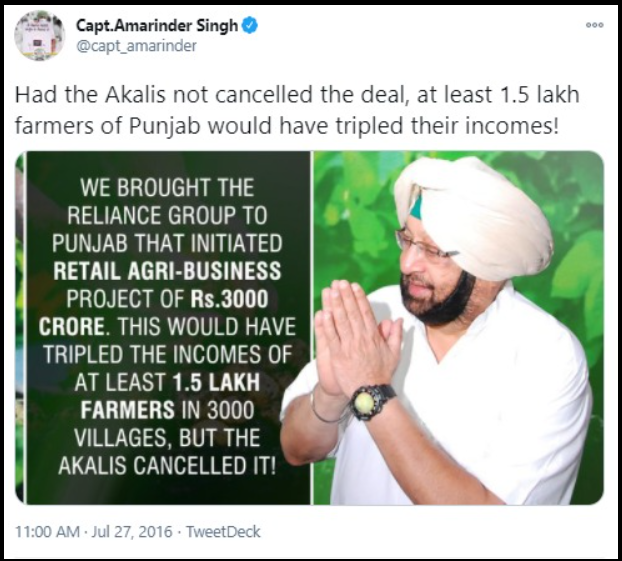
Chief Minister of Punjab Captain Amrinder Singh is a man of his words. Being from a royal family, it is his virtue that he speaks the truth. In 2016, Capt Singh had blamed the then-Akali government for not letting retail agri-business flourish in Punjab. He said that he brought major players in the state that would have benefited over 1.5 lakh farmers, but the Akali government shelved the plan.
According to Singh, it was a major loss. Interestingly, recently Congress-led Punjab Government had suggested opening private farm markets in Punjab as an attempt to counter the effect of Covid-19 in the state. Now, of course, he is singing a different tune on the farm laws.
Amrinder Singh blaming Akalis for stopping retail agri-business
Shashi Tharoor’s flip flops on farm laws
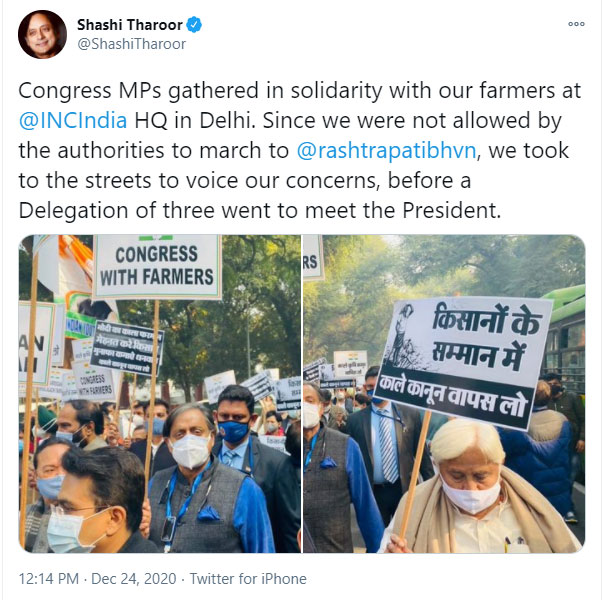
Loved by many, the gospel of English language, Congress leader Shashi Tharoor can talk in an alien-ish English. If I ever try to replicate his style, my readability score will surrender as the Pakistani Army did in the 1971 war. Anyway, he was part of the march to Rashtrapati Bhawan in support of the protesting farmers. In a picture that he had shared on his official Twitter account, Tharoor was holding a placard that read “Congress with farmers.”
Tharoor in march to support farmers protests against Agriculture Laws
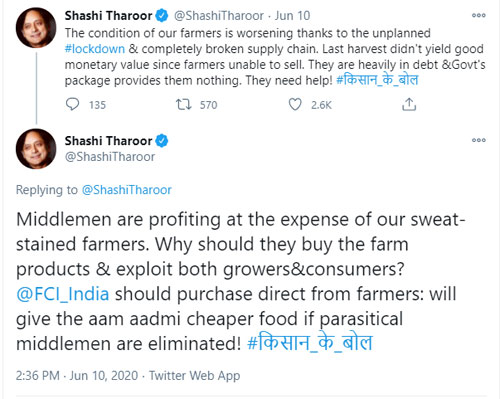
Not long ago, on June 10, Shashi Tharoor said, “Middlemen are profiting at the expense of our sweat-stained farmers.” Five months passed, and just like a goldfish, his memory goes puff, maybe?
Tharoor claiming middlemen are responsible for farmers’ and consumers’ exploitation
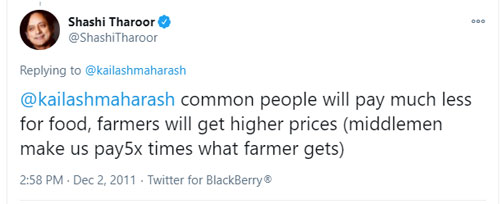
Interestingly, Tharoor was in favour of removing middlemen in 2011 as well. In 2011, he said in support of FDI that people would pay much less and farmers will get more. He had alleged that “middlemen make us pay5x times what farmer gets.”
Tharoor claiming farmers will get higher price if middlemen are removed
Congress Spokesperson Supriya Shrinate blamed middlemen for rising prices of onion
Congress leader and spokesperson Supriya Shrinate is actively criticizing the government on the farm laws. if you scroll through her Twitter account, there are countless tweets blaming union government for imposing ‘black laws’. However, in 2019, while addressing the press on the increasing price of onion, the same Supriya Shrinate had blamed the middlemen for the rise in the prices.
She said, “A recent study by Consortium of Indian farmers association has said that it’s not supply constraints but hoarding by middlemen that’s responsible for the soaring onion prices. We urge the government to find a permanent solution instead of a quick fix.” The video is available on Congress’s official Youtube channel.
It is not possible to decide which side Congress is on. On the one hand, they talk about major reforms in every sector in India. They talk about disinvestment, FDI, improving infrastructure, helping corporate to flourish and more. However, on the other hand, they talk against the same reforms when brought by the NDA government.
Now, in the words of Congress leaders like Manmohan Singh and Sonia Gandhi, there can be two reasons for such diverse thought processes within their own selves. The first reason is misinformation. The leaders themselves are misinformed about the laws. They do not have enough data and information with them to take a firm decision on which side they want to choose. The second reason, which is more likely as they are political leaders, is political vendetta.
How can they allow the reforms, they had talked about in detail to be brought, by the party that has defeated them twice in the Lok Sabha elections? How can they allow BJP to take credit that will help BJP in the next Lok Sabha elections? It is simply not possible for the grand party of India to let this happen. The party, which has already come down to 55 seats and losing states faster than Rahul Gandhi is getting grey hair, cannot allow major reforms that will help farmers and consumers in the long run.
The farm laws saga continues beyond Gandhis and Congress
If we look around, travel to the past, pull some more strings and hop on the time machine, we will find some more gems from leaders, economists, intellectuals and journalists. These people had talked on the same lines on the farm laws as Congress leaders. However, just like the goldfish that has short-lived memory, which, according to scientists, can last for up to five months, these bunch of people have forgotten what they had supported in the past. Let’s discuss these amazing people. Shall we?
Pritish Nandy was against middlemen before PM Modi came to power
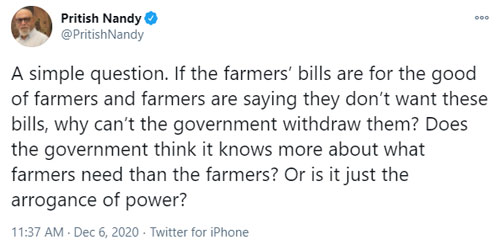
Poet and journalist Pritish Nandy, on December 6, had asked if the farmers don’t want the farm laws, why the government is so arrogant in imposing the laws?
Nandy questioning Modi government over laws
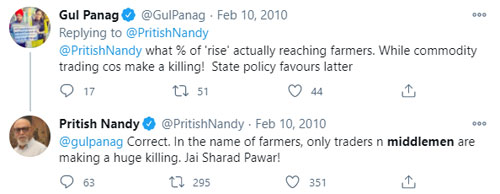
Interestingly, the same Nandy, a former parliamentarian, who joined Rajya Sabha on Shiv Sena’s ticket, had talked extensively against the middlemen in the Agriculture sector on several occasions. In 2010, while replying to actor-politician Gul Panag, he said that in the name of farmers, only traders and middlemen are making money.
Nandy blaming middlemen for low farmers’ income
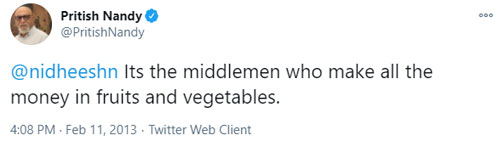
In 2013, he again said that it is the middlemen who make money on fruits and vegetables.
Nandy claiming only middlemen make money
BTW do you know Balasaheb Thackeray regretted sending ‘idiot’ Pritish Nandy to Rajya Sabha? He had said, “Actually, I am the idiot, not Pritish. He took Rajya Sabha from me and I figured only much later, too late, that he is Christian.”
Akhilesh Yadav had called for the removal of middlemen to ensure better infrastructure
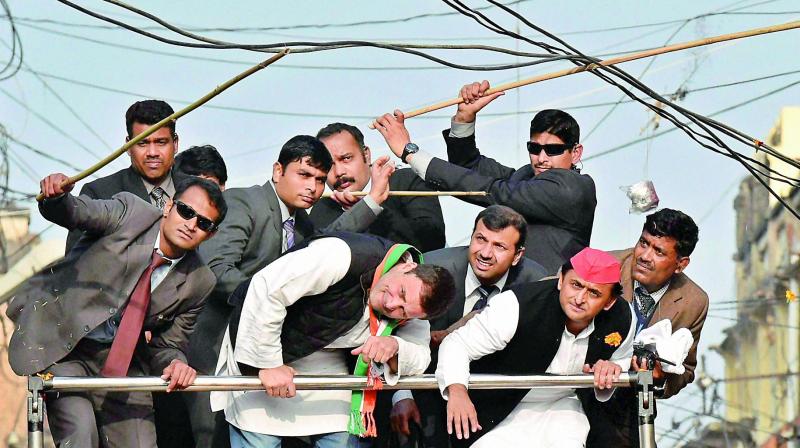
The Prince of Uttar Pradesh, the messiah of the poor and friend of Rahul Gandhi, the one who had to be saved along with Rahul from low hanging wires in UP during an election rally, Akhilesh Yadav is one of those who seem to have lost his perspective about middlemen.
During election rally in UP, the guards had to save Rahul Gandhi and Akhilesh Yadav from low hanging wires (Image: Deccan Chronicles)
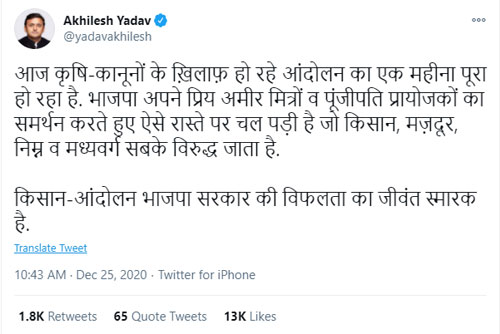
On December 25, Yadav had said that the BJP government is working for the corporate houses and not the farmers. On December 27, he said, “This is an insult to farmers, who are staging a sit-in for their rights. The BJP, while supporting its favourite capitalist friends, is walking a path which is against farmers, labourers and those from the lower-middle-income group. The government is giving Kisan Samman, but the new farm laws will cause losses worth thousands and lakhs to farmers.”
Akhilesh Yadav claiming Modi government is working for corporate interests
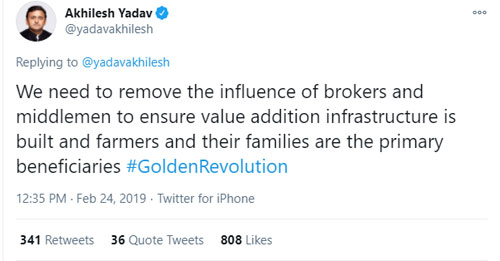
Interestingly, not long ago, Yadav had talked about the ‘problem’ named middlemen in the Agriculture sector. He said, “We need to remove the influence of brokers and middlemen to ensure value addition infrastructure is built and farmers and their families are the primary beneficiaries.” But alas, it seems like he had forgotten what he had said in 2019.
Akhilesh Yadav demanded removal of middlemen in 2019
Former RBI governor Raghuram Rajan had vouched for removing middlemen
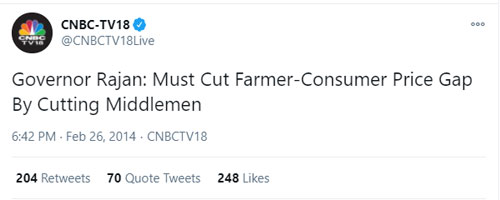
One of the most-favoured and talked-about former governor of RBI by intellectuals and opposition leaders, Raghuram Rajan, has said in an interview with the ‘very famous’ journalist Barkha Dutt that the best way out here will be to find a way to let both systems flourish and create a competitive market for the farmers so that they can get better prices. Though he is talking sense here, the issue is back in 2014, before PM Modi came to power, Raghuram Rajan wanted to eliminate the middlemen completely.
Rajan had said on APMC Act, “There is a need to reduce the wedge between what the farmer gets and what is paid by the household by reducing the role, number, and monopoly power of middlemen as well as by improving logistics.”
Raghuram Rajan had favoured removing middlemen to control price gap
The Bharatiya Kisan Union had asked for similar reforms in farm laws
The BKU had repeatedly asked for the removal of middlemen in Punjab to ensure direct payments to farmers. In its 2019 manifesto had asked for the abolition of APMCs and Essential Commodities Act. They seem to have taken a completely opposite stand now.
— Bhartiya Kisan Union (@BKU_KisanUnion) March 2, 2019
Farm Laws Reforms need patience and amendments
No reform is perfect. No lawmaker is perfect. On December 25, while addressing the nation during the disbursement of the PM-KISAN instalment, PM Modi said that we could not claim that God has given us all the knowledge. He further added that the government is open to discussion and have an open mind for a solution.
He said, “There is democracy, and we don’t claim that God has given us all the knowledge, but there should be discussion. In spite of all these things, the government is ever ready to discuss every issue of farmers because of our unwavering faith and respect in democracy and because of our dedication to the farmers. We have an open mind for a solution.”
Everyone knows that once the law is formed, it takes years of amendments and further reforms in the farm laws to ensure they benefit the people of the nation. There is no way that anyone, any government, lawmaker, or court can form a 100% perfect law in the first draft. There should be discussion and room for improvement that the government is ready to do.
However, the vested political interests of the opposition parties, left-leaning unions and Khalistanis (everyone knows they are trying to overtake the protests. Let’s not become blind on the issue.), terrorist organizations and professional protesters are not letting any path to open that may lead to a solution.
On Tuesday, BJP leader Suvendu Adhikari and other BJP party workers were attacked allegedly by TMC goons in Nandigram in East Midnapore, on their way to Janakinath Temple from Tenga.
As per reports, Adhikari had set foot in Nandigram for the first time after defecting to the BJP from the Trinamool Congress (TMC). Although he was en route an apolitical programme, several BJP supporters had flocked to welcome him in Nandigram. BJP workers had arrived in buses and cars to commemorate the event. However, at the Bhuto junction, Suvendu Adhikari and party workers came under attack allegedly from the TMC goons.
While targeting Adhikari, the miscreants threw rocks and stones at him and his supporters. During the attack, a bus carrying BJP workers was also vandalised. Several people, including a girl child, sustained head injuries. They were then taken to the Nandigram Hospital for medical treatment. According to Suvendu Adhikari, a total of 10 people were injured during the attack. BJP has also informed that they are unable to trace some of their workers, post the ambush.
Video Courtesy: News 18 Bangla
While speaking at the religious event, Shuvendu threatened to launch a protest if the goons are not arrested. He said, “We will not tolerate such attacks. The attackers must be arrested else we know how to launch a mass movement. You will be mistaken if you consider us as weak.” Demanding stringent action against the accused, the BJP workers gheraoed the Nandigram police.
TMC goons go berserk in Kolkata
On Saturday, a clash broke out between BJP and TMC workers after the latter launched an unprovocative attack against the new entrants to the saffron party outside the BJP’s main election office in Hastings in Kolkata, West Bengal.
As per reports, the situation became tense when Sunil Mondol arrived at the BJP office. Prior to his arrival, the TMC workers had set up a stage near the saffron party’s office and began their protest. Although the police personnel tried to disperse the TMC mob, they were highly outnumbered. They ambushed the vehicle of the BJP leader, preventing him from stepping into the office.
A scuffle thus broke out between the two sides but the police failed to control the situation. Soon, additional police forces were deployed and the situation was pacified. It was only after that Sunil Mondol was able to step foot into the party office. Several BJP stalwarts such as MP Arjun Singh, Locket Chatterjee, Kailash Vijayavargiya and Dilip Ghosh eventually held meeting at their main election office in Hastings. They condemned the ‘planned conspiracy’ and alleged police complicity in the incident.
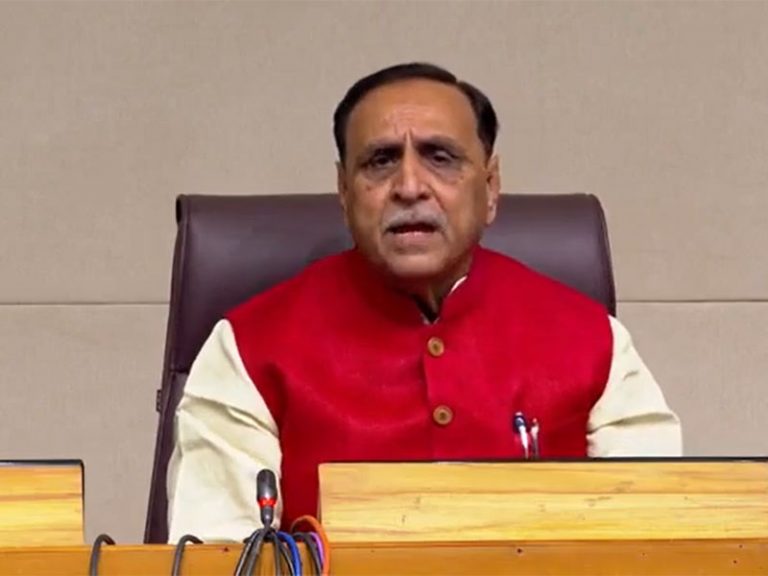
On December 29, the Gujarat State government launched a new solar policy with additional benefits to the residential, commercial and individual developers for the next five years. Dubbed as Gujarat Solar Power Policy 2021, the policy was announced by Chief Minister Vijay Rupani at Gandhinagar.
It aims to remove capacity ceiling for setting up a solar project allowing the consumers to lease their premises or roofs to a third party for power generation. That means the property owner will be able to generate and consume power on the same premises.
CM Shri @vijayrupanibjp announces Gujarat Solar Power Policy 2021 with an aim to reduce production cost and give boost to competitively priced ‘Made in Gujarat’ brands in the global market. pic.twitter.com/iBGJNMuvuO
Gujarat government has allowed group ownership of solar projects for self-consumption. It will be based on the ratio of ownership. The government has also reduced the security deposit required to be given to Discoms for the Power Purchase Agreement (PPA) by the developers to Rs.5 lakh per megawatt which was Rs.25 lakh per megawatt previously.
Rupani, during his address at the launch, said, “Currently, the industry gets power at an average cost of ₹8 per unit. The new policy will help bring it down to ₹4.5 per unit.” The policy will be operative for five years till December 31, 2025.
Under the new policy, the benefits can be availed for 25 years. As per the reports, residential units will be able to save anywhere between Rs.1.77 to Rs.3.70 per unit while the industrial units will save anywhere between Rs.2.99 to Rs.4.31 per unit. For the third party buyers, the savings will range from Rs.0.91 to Rs.2.30 per unit. Individual consumers, corporative societies, farmers, small developers and households will benefit from the new policy.
Provision to buy surplus energy
As per the Gujarat government’s statement, the state will purchase surplus energy after setting it off against the consumption. Discoms will purchase the surplus energy from residential consumers and MSME users for captive usage. It will be set-off against the consumption at Rs.2.25 per unit for the first five years. After that, it will be set off at 75 percent of the latest tariff. It will be contracted via GUVNL via bidding process for non-park based solar projects in the coming six months, and it will be valid for the remaining life of the project.
Saurabh Patel, Gujarat Energy Minister, said that the policy would enable residential consumers, commercial consumers, farmers, MSMEs, educational institutes, religional institutes etc. to generate electricity and sell off the surplus. He added that the state had received bids for “2,300 MW from residential, small industrial and institutional power producers having a capacity of up to 4 MW at an average price of ₹2.83 per unit.” Based on the grid requirements, the contracts will be awarded by January 3.
Industries will be able to compete in Global Market – CM Rupani
During his address, CM Rupani said that with Gujarat Solar Power Policy 2021, the production cost of small and large enterprises in the state will come down. It will help the industries of the state to compete in the global market.
ગુજરાત બેસ્ટ ઇન્ડસ્ટ્રીયલ ડેસ્ટિનેશન બન્યું છે. Gujarat Solar Power Policy 2021થી રાજ્યમાં નાના અને મોટા ઉદ્યોગોની પ્રોડક્શન કોસ્ટ નીચી આવશે, રાજ્યના ઊદ્યોગો વૈશ્વિક બજારમાં સ્પર્ધા કરવા માટે વધુ સક્ષમ બનશે. આ પોલિસીથી આવનારા દિવસોમાં Made In Gujarat વિશ્વભરમાં છવાઈ જશે. pic.twitter.com/DSzCG16C7u
With the current capacity of 11,000 MW of green power production, Gujarat aims to increase it to 30,000 by 2022 mainly using solar and wind.
Largest renewable energy generation park in Kutch
On December 15, Prime Minister Narendra Modi laid down the foundation stone of India’s largest renewable energy generation park in Gujarat. It will have generation capacity fo 30 gigawatts. Spread over 72,600 hectares, the Hybrid Renewable Energy Park is located near Vighakot village in Gujarat’s Kutch district. It will have dedicated zones for wind and solar energy storage and an exclusive zone for wind park activities.
India planning to bring 1.75 lakh crore investment for the renewable energy sector
India is planning to obtain up to Rs.1.75 lakh crore as an investment for the renewable energy sector. Currently, India has the capacity of 90 GW in renewable energy generation. It includes 37 GW of solar and 39 GW of wind power generation capacity.
Director-General of Solar Power Developers Association Shekhar Dutt said that India needs funds of Rs. 1.75 lakh crore to achieve the balance capacity of 35 GW to accomplish the overall ambitious target of 175 GW by 2022. This includes 100 GW from solar, 60 GW from wind, 10 GW from biogas and 5 GW from small hydropower.
While talking about the target, Union Power and New & Renewable Energy Minister RK Singh said, “We are going to come out with more innovative bids (in 2021).” He added that the past efforts had put India as the most favoured destination for investment in the clean energy sector.