Home Blog Page 5070

Supreme Court once again rejects interim bail plea of 1984 Sikh Genocide convict Sajjan Kumar

0

An interim bail-plea filed by former Congress leader and 1984 anti-Sikh massacre convict Sajjan Kumar was rejected by the Supreme Court today. Sajjan Kumar is serving a life sentence in Tihar jail since he was convicted the case by Delhi High Court. Kumar’s lawyer Vikas Singh had sought the interim on medical grounds claiming that his client had spent 20 months in jail had lost significant weight. However, his claim was countered by Senior Counsel H S Phoolka who was appearing for the victims of the riots. Phoolka cited the medical records to show that Kumar had in fact gained weight. “This is not a small case, we are not granting you bail at all”, the court said.

The court refused to grant bail on the ground that the medical reports showed that Kumar did not need hospitalisation. Singh also appealed before the Bench consisting of the CJI Bobde and Justices A S Bopanna and V Ramasubramanian to consider the bail plea on the merits. He contended that the decision of the High Court was faulty. “The witnesses disposition was completely reversed in the High Court and the Trial Court”, Singh said. Responding to Singh’s contention, the court noted that it was not inclined to hear the case on merits at this stage. The court added that the appeal against the judgment of the High Court would be heard when the court will reopen for physical hearing.

Earlier Bail Pleas

Kumar was convicted by the Delhi High Court in 2018 and was ordered to surrender within three days of the passing of judgment. This is the third time when Kumar had pleaded before the Supreme Court to grant him bail. He had filed a similar petition before the Supreme Court in February this year seeking interim bail for private medical treatment. However, his plea was dismissed by the court. Thereafter, he filed another plea before the Supreme Court in the month of May seeking the same relief. At that time, the Supreme Court refused to hear his bail plea and deferred the hearing for a later date. “We will consider your bail application in July, not now, sorry”, the court said.

Akshay Kumar announces launch of action game FAU-G in support of Atmanirbhar Bharat initiative

0

Akshay Kumar has announced the launch of an action game, FAU-G, voicing his support for the Atmanirbhar Bharat initiative launched by Prime Minister Modi. The bollywood superstar announced that through Fearless And United-Guards (FAU-G), gamers will learn more about the sacrifices of Indian soldiers. 20 per cent of the net revenue would be donated to the Bharat Ke Veer Trust, established for the welfare of Indian martyrs.

Only recently, the Indian Government had banned the popular online multiplayer game PUBG claiming that it was prejudicial to the sovereignty and integrity of the country and posed a threat to the defence, security and public order of India. Along with PUBG, 117 other Chinese apps were also banned.

FAU-G has been developed by nCore Games, a mobile games and interactive entertainment company based out of Bengaluru as per its profile on Linked.in. It further states, “We primarily develop multi-player games with immersive storylines that have a strong connect with Indian ethos. We also bring to India and publish games from top global studios for the Indian market.”

How National Education Policy 2020, approved by Modi govt, has conceptualized a new paradigm of higher education in India

The National Education Policy (NEP) 2020, approved by the Union Cabinet, has conceptualized a new paradigm of higher education in India. This paradigm shift has been propelled by the need to remove some of the existing anomalies in the Indian Education system that functioned as an impediment for quality research and innovation.

India has not been able to capitalize on the huge potential and struggled to have a global impact on the intellectual sphere in proportion to the Human Resource available to it. Only a few students go for higher studies and fewer engage in academic research. This scenario is far from satisfactory for an aspiring power like India. The quality of the research also calls for a radical change in order to keep pace with the ever-changing intellectual domain, and thereby redefining the trajectory of India’s progress. The Research infrastructure and encouragement to students for pursuing higher education have also been insufficient. The number of world-class Higher Education Institutions (HEIs) have also been very limited.

The inadequate mechanism for merit-based career management and ineffective regulatory system for higher education has proved to be inimical to the national objectives. The pedagogical and knowledge creation system of ancient India has not been sufficiently incorporated in our education system so far. The set of challenges mentioned above was provocative to the Indian mind for working out a new paradigm. As the notable pragmatic educationist, John Dewey mentioned in one of his highly influential books, How We Think, that the individual thinks only when there is good and sufficient reason for thinking.

The National Education Policy (2020) is a product of that thought process and promises to dissolve these existing anomalies by constructing an ecosystem conducive to intellectual growth and open up an altogether new dimension of higher education in India in order to make it a power to be reckoned with in the 21st Century. 

The policy has sought to overhaul the whole spectrum of Indian Education System by restructuring the contours of higher education. The main thrust of the policy is to end the fragmentation and segmentation of higher education by transforming nodal institutions of higher studies into large multidisciplinary universities, colleges and Higher Education Institution (HEI) clusters, each of which will endeavour to train and educate at least 3000 students. The idea inherent to this step is to build a vibrant community of scholars and researchers working in the conducive milieu for producing quality results to address the multifarious challenges of national import.

India has displayed in the past, unprecedented prowess of establishing institutions of intellection. For instance, the ancient Indian universities Takshashila, Nalanda, Vikramshila, Udvantpuri and Nagarjuna Vidyapeeth had thousands of students from India and the several parts of the world staying and studying in a vibrant multidisciplinary environment, amply demonstrated the success of such archetype of education and left a lasting legacy of intellectual accomplishments. India urgently needs to capitalize on the ancient tradition to create a constellation of scholars deeply devoted to further the frontiers of knowledge. 

Another remarkable aspect of the policy is the vision of widening the numerical base of scholars and researchers of eminence by expanding the institutional capacities under the most expedient educational infrastructure. One of the prominent objectives of the policy is to increase the Gross Enrollment Ratio (GER) in higher education including vocational training from 26.3% (2018) to 50% by 2035.

In order to achieve this, more HEIs are to be established and developed in various regions to ensure full access, equity and inclusion. One grand multidisciplinary HEI has been planned to be instituted in or near every district in addition to consolidating and substantially expanding and improving already existing HEIs. It is an ambitious project and holds the key to unlock the latent potential to make India excel in higher education and have a positive global impact. 

The policy has also prioritized the need to impart vocational education to a greater number of students for fostering the idea of self-reliance. Several studies show that skilling the youth and equipping them with vocational education have been indispensable factors of growth for developed nations. The 12th Five-Year Plan (2012-2017) estimated that only a very small percentage of the Indian workforce in the age group of 19-24 (less than 5%) received formal vocational education whereas in countries such as the USA the number is 52%, in Germany 75%, and in South Korea, it is as high as 96%.

These numbers only underline the urgency of the need to expedite the spread of vocational education in India.  India has woken up to this reality and intends to make it a priority to provide vocational education and necessary professional skills to students. It is proposed in the National Education Policy that at least 50% of learners shall have exposure to vocational studies by 2025. 

Despite the critical immediacy of the need, the investment in research and innovation in India is, at present, only 0.69% of GDP as compared to 2.8% in the United States of America, 3.26% in Japan, 4.2% in South Korea and 4.3% in Israel. The policy highlights the need to augment the critical mass of research in challenging areas by encouraging students to pursue higher studies and keep India abreast with the pace of educational transformation the world is going through.

The students from all social sectors have to come forward and join higher studies and therefore the policy has laid much emphasis on equitable and inclusionary higher education. If demography is the final determinant of history then it will serve us better to have an educated and efficient demographic capital.

Small nations such as South Korea, Japan and Israel have emerged as powerful nations by advancing their research and innovation despite staggering challenges in terms of human and natural resources. The policy has also kept in mind the needs of students with extraordinary capabilities and extends all possible support to nurture their innate talent so that they can apply themselves as per their calling and make seminal contributions.

The policy makes provision for a holistic and multidisciplinary approach to higher education which will introduce a paradigm characterized by a departure from the Macaulian influence. This approach will decolonize the prospective Indian intelligentsia and enable it to view the reality in its unadulterated form. It is not to eschew the learning from around the world but to blindly pursue and imitate the Western educational archetype which has proved to be inefficacious and inimical to critical and creative thinking.

The policy encourages the process of assimilating the external educational advances in Indian pedagogical structure. It has also made provisions for the internationalization of education in which the leading educational institutions from India shall open their campuses outside and foreign universities of excellence, placed in top 100, can open their campuses in India. 

Holistic and multidisciplinary education is the sine qua non for sharpening the perceptive ability of a scholar and cultivating a wholesome personality. It has become all the more essential as the structure of the global academia is increasingly becoming complex with each passing day and boundaries of disciplines are fast diminishing. The fragmented ecosystem of higher education is no longer relevant and an integrated approach seems more conducive to further the frontiers of knowledge. 

The idea of technological determinism should be in sync with the axiological aspects of education. Advocates of technological determinism claim that technological advance functions as the crucial determinant of the order of the world. The progress in science and technology has always helped humanity catapult into a new paradigm, and thereby changed the world for better.

This policy proposes to accomplish the same without neglecting the axiological aspects of education, which deals with the ethical and aesthetic faculties of human beings. The quintessence of holistic approach is well summarized by J. H. Pestalozzi, one of the greatest educationists of all times, who asserts that the education is not meant to produce an automaton but an individual with a balanced hand, heart and mind. The new Policy has envisaged a fine balance between these two apparently divergent aspects.  

The National Education Policy (2020) is not a modified form of the previous policies. It is a revolutionary vision which includes the necessary aspects of the previous policies and also attempts to remove hitherto existing anomalies in them. It has opened a new paradigm of higher education that will catalyze the intellectual impulse and transform India into a fountainhead of ground-breaking research and epistemological exploration. It envisions an exemplar of education system rooted in Indian ethos that contributes to transforming India sustainably into an equitable, inclusive and vibrant knowledge society by extending education to everyone and thereby making India into a global knowledge superpower.

It proposes to build institutions and support researchers to gain a competitive edge and transform the intellectual landscape of India by cultivating excellence in all relevant fields. It may well be said that the policy presents a comprehensive vision with robust plans of execution which has filled the heart and mind of people with renewed expectations. The ongoing decade is likely to define the locus of Indian education and its evolution in future.  

(Assistant Professor, Centre for Japanese Studies, School of Language, Literature and Culture Studies, Jawaharlal Nehru University, New Delhi)

LAC standoff: Tibetan community in Shimla cheers for Indian Army, waves flags as the convoy leaves for deployment in Ladakh frontiers

0

In a video clip shared by news agency ANI, the Tibetan community living in Himachal Pradesh’s capital Shima was seen cheering for the Indian army. The Indian soldiers who were headed to LAC were heartily welcomed by the Tibetan community members who greeted them with Indian flags, Tibetan flags and white scarves.

Similar scenes were seen in Manali earlier, soon after the mid-June clashes between the Indian Army and Chinese troops that had resulted in casualties on both sides, with China never even acknowledging their fallen soldiers.

Internationally too, members of the Tibetan community have been hailing India’s soldiers and PM Modi’s leadership for standing up to China’s bullying and expansionist designs in the region. The Tibetan government in exile, which have their headquarters in Himachal Pradesh’s Dharmashala, had also urged the Indian government to address China’s continuing occupation of their homeland Tibet.

Indian Army takes control of the northern and southern banks of the Pangong Tso Lake

Amidst the escalated tension with China in the Ladakh sector after provocative Chinese actions on the southern bank of Pangong Tso, it was reported that the Indian armed forces successfully took control of crucial strategic heights in both the northern bank and southern banks of the Pangong Tso Lake around the Chushul sector in Eastern Ladakh along the Line of Actual Control (LAC).

Indian officials have stated that the action was needed to thwart Chaina’s designs to take control of crucial locations under India’s Territory.

On August 30, the Indian Army, aided by a Special Frontier Force unit, had captured the heights lying between the southern bank of the Pangong Tso and the smaller Spanggur Lake further south.

On September 2nd it was also reported that Indian armed forces have attained control of crucial strategic heights in the northern bank of the Pangong Tso Lake. The northern banks of Pangong Tso have been one of the key areas in the ongoing border confrontation in the high-altitude snow deserts of Ladakh.

Following the manoeuvres, the security along the LAC has been enhanced. The chief of defence staff General Bipin Rawat on Thursday said Pakistan could try to take advantage of any threat developing along India’s northern borders, but also stressed that if Pakistan at all attempts any “misadventure” it would suffer “heavy losses”.

Assam: One Rafiqul Ali desecrates a 16th century Vaishnava Satra in Barpeta, burns the Holi Guru Ashan

0

On Thursday, the Assam police nabbed one Rafiqul Ali for desecrating a Satra (Vaishnav Monastery) in Ganak Kuchi village in Barpeta district of Assam. The accused is a resident of Shantipur in the Bhella area of the Barpeta town.

As per reports, Ali had set the Guru Ashan and a copy of the Hindu Holy book Bhagavad Gita placed in the Mutt of the Shri Ram Ata’s Bhithi inside the premises of the Ganak Kuchi Satra on fire. The accused had also ransacked the prayer room in the Satra. Following the incident, an atmosphere of tension has gripped the area. At the time of the incident, none was present within the Satra premises.

Ganak Kuchi Satra in Barpeta

According to reports, at around 2 PM on Thursday, when there was nobody around the Satra, Rafiqul entered the Satra premises, which was established by Shri Madhavdev in the 16th century, the main disciple of Shrimanta Sankardev. He went to the Mutt of Shri Ram Ata’s Bhithi located towards the north of the main Satra building, vandalised it, brought the Guru Ashan and other items from the Mutt out and touched them on yard in the Satra premises. He also threw away the Prashad kept in the Mutt.

On seeing flames and smoke rising from the Satra premises, locals rushed to the spot and nabbed the accused. He was then handed over to the police. The locals then tried to extinguish the fire that engulfed the sacred Ashan.

Senior police officials from Barpeta visited the Satra after the incident. The Ganak Kuchi Satra Committee has filed a formal complaint with the police regarding the matter.

Guru Ashana burnt into ashes (Photo Credits: Twitter/Abhishek)

The Guru Ashan is a seven-tiered wooden throne that represents the Ashan or seat of the Guru, and it is kept in the Manikut of a Satra, which can be compared with Sanctum Sanctorum of temples. As idolatry was denounced by Srimanta Sankardev, idols are not worshipped in Vaishnava Satras and Naamghars in Assam.

Rafiqul Ali vandalised Goddess Lakshmi temple last year

This is not the first time that the accused has been involved in acts of religious desecration. Last year, the idol of Goddess Lakshmi at the historical temple in the Keotkuchi area in Barpeta was damaged by Rafiqul Ali in the early morning on 9th October. He had also looted the temple and damaged the floor tiles and other items kept at the temple. Rafiqul also tore banners and posters, and damaged decorations, which were put up at the temple for the Lakshmi Puja.

After vandalising the temple, Ali had proceeded to torch various items of the temple, along with cloths of the Lakshmi idol. Seeing fire coming out of the temple, locals arrived at the scene and caught the perpetrator red-handed, who was hiding in a corner of the temple. The local people had handed over the man to the police, who surprisingly remained in the temple after vandalising and looting it, instead of attempting to flee.

While Indian Government maintains a strong stance against Rohingyas, ‘Rohingya Football Club’ comes up in Hyderabad and elsewhere

Rohingyas have been deemed to be a national security threat and their illegal immigration into India is cause for immense concern and yet, they appear to have formed a football team of their own and have participated in local football tournaments. It appears that football is the medium through which the illegal immigrants are being normalised in the country.

Rohingya FC the team is called and the team has participated in numerous football tournaments in the past. No attempt is made to even hide the fact that football is used to whitewash their illegal immigration into India. Ali Johar, a Rohingya ‘youth leader’ from Delhi, said, “Rohingya refugees are often seen through a particular ideological lens. There is a lot of misinformation and stereotypes about our community. Football has given us positive exposure and enabled us to tell the world that we are just like them. We are normal human beings. We have also got the chance to make many new Indian friends. Football has paved the way for constructive change, but sustaining the momentum is proving to be a challenge.”

In 2018, Rohingyas also participated in a football tournament organised by the United Nations High Commissioner for refugees (UNHCR). Among the 16 teams participating in the tournament organised at the Quli Qutub Shah Stadium in Ghansi Bazar, Hyderabad, three teams were from the Rohingya camps from Jalpally, Kishanbagh and Balapur refugee camps. “We are not playing for the sake of it. We want Rohingyas to be seen in a good light,” said Abdullah, a 24-year old player of the Rohingya Football Club (Balapur).

The three teams are called Rohingya Football Academy, Rohingya Football Club Kishanbagh and Rohingya Football Club Hyderabad. General Manager of Save the Children, one of the organisers of the event, said, “The objective is to increase visibility for refugees here. When we say refugees, we are mainly talking about Rohingya refugees, since in this region they constitute the majority of all refugees. Several of their children are unable to complete their education because of Aadhaar mandates.”

Rohingya FC came up sometime in Balapur, Hyderabad in 2016. Two years later, president of the Telangana Football Association (TFA) even said that the Rohingyas were welcome to seek their help in improving their game. “As long as they are here, they are welcome to play (with us). They can also come and practise with our players. We’ll also look into whether a coach can be appointed for them,” Mohammed Ali Zafar said.

Some of these players did not move from Myanmar to India but from Bangladesh, which makes them economic migrants, and they have no hesitation themselves in admitting that they moved from Bangladesh. “We left home in a boat and managed to reach Bangladesh after much difficulty. People known to us were living in India and we decided to come here. My parents, however, were too grief-stricken to undertake another journey. They decided to stay put in Bangladesh itself,” one of them said.

Several ‘human rights organisation’ have also come up to support the Rohingyas in India. One of them is the Rohingya Human Rights Initiative (ROHRIngya). It describes itself as “a local non-governmental, non-profit organization formed by young Rohingya activists in New Delhi, India.” It states, “We have committed to work with vision, passion, solidarity, hope, unity and perseverance. Our mission is to selflessly promote Human Rights of all human beings, especially people from Rohingya community and other disadvantaged minorities residing in India, Bangladesh and Myanmar.”

They further claim that they “are implementing all our projects, advocacy activities and interpretation services in accordance with the rules of law of India”. It does appear that the Rohingyas have been participating in football matches even earlier than 2016. There is at least one report from 2014 that speaks of a football match involving Rohingyas. Such teams have also come up in Delhi. One Indian Express report from 2017 says that Rohingyas used to gather under a tent in Shaheen Bagh for ‘football nights’.

Meanwhile, the Indian government has continued to maintain a strong stance against Rohingyas. Not too long ago, it was reported that 1300 Rohingyas had fled to Bangladesh from India fearing deportation to Myanmar. Rohingyas have also been regularly apprehended by local law enforcement. Union Ministers have also said that they pose a security threat to the country.

In October last year, Seven Rohingya Muslims who were lodged in jail since 2012 for illegally entering India were sent to Myanmar border for deportation. The government has also decided to deport 23 more Rohingyas, who have been staying at various detention camps in Assam after they were caught staying illegally in the state. Thus, at a time when the government has made its stance on Rohingyas clear, that illegal immigrants posing a serious threat to the country are being normalised through football is indeed a cause for grave concern.

Facebook’s India policy head is TMC MLA’s Bahu, party acknowledges link, says she had met Mamata with her father-in-law: Reports

While the opposition and the left-liberal jamaat have hopped on the bandwagon to claim that Ankhi Das, the Public Policy Director in Facebook for India, and South & Central Asia, is a “BJP stooge’, Mamata Banerjee’s TMC members have admitted that Das has links with the party.

On Wednesday, in the Parliamentary Standing Committee meeting, the Trinamool members accepted that Das had met West Bengal CM Mamata Banerjee along with her father-in-law.

The admission of the TMC members came on the heels of Congress MPs’ allegations that Ankhi Das favoured BJP. When the Congress MPs reportedly alleged that Das had suggested that Facebook should not act against BJP’s Telangana MLA T Raja Singh in a hate-speech issue, the BJP members countered saying: “she is the daughter-in-law of a Trinamool lawmaker from West Bengal”. This is when Trinamool members in the panel accepted that Das has met West Bengal CM Mamata Banerjee along with her father-in-law.

TMC has accused Facebook of bias too

Until now, interestingly, the Trinamool Congress was also a part of the bandwagon which accused Facebook of bias towards PM Modi and BJP. In a letter to Facebook CEO Mark Zuckerberg, West Bengal’s ruling party, the Trinamool Congress, said the company’s recent blocking of pages and accounts in the state pointed to the links it had with the BJP.

Ankhi Das’ father-in-law an erstwhile minister in the Govt of WB

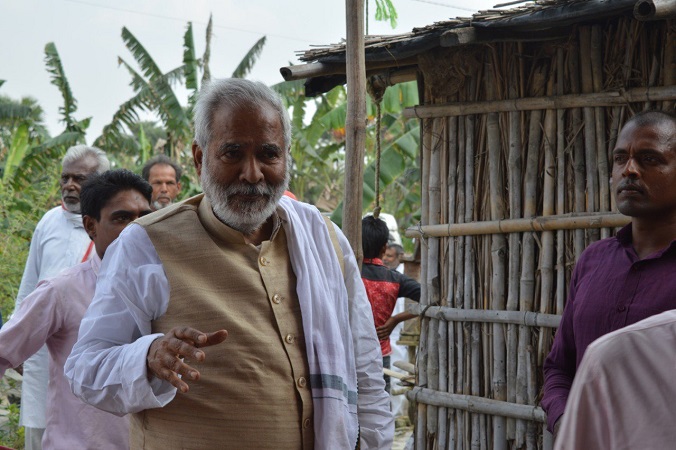
It is no secret that Ankhi Das’ father-in-law is a senior Trinamool Congress member. Rabiranjan Chattopadhyay is the erstwhile minister for the departments of Technical Education and Training, Science and Technology and Biotechnology in the Government of West Bengal. He is also an MLA, elected from the Bardhaman Dakshin constituency on a TMC ticket.

The ‘political allegiance’ of Ankhi Das with TMC

In fact, CPI(M) had also tweeted last month that Ankhi Das was in charge of handling media affairs of Mamata Banerjee led TMC during the 2011 assembly elections and was an integral part of the election war room in Bardhaman from where her father-in-law contested. CPI(M) also alleged that AnkhiDas played a significant role during 2016 assembly elections in WB in advising TMC in their social media endeavour. 

Ankhi Das’ links with TMC and AAP

Moreover, Ankhi Das’s old Facebook posts also suggest that she has been in awe of the TMC supremo Mamata Banerjee. In her post in December 2013, Ankhi Das had expressed open admiration for Mamata Banerjee’s political campaign of ‘poribortan (transformation)’.

In March Prior to the Lok Sabha elections in 2014, she had organised a ‘Facebook Talkslive’ with Trinamool Congress chief Mamata Banerjee at Kolkata Town Hall. The event was also graced by ‘journalist’ Madhu Trehan who runs the left-propaganda website, News Laundry.

Ankhi Das has also been found praising AAP for its campaigns on several occasions.

Many opposition leaders have been harping on the issue that Ankhi’s twin sister is a member of ABVP, the student wing affiliated to RSS. But Ankhi’s own political leanings and links do not seem to have garnered enough interests to allege ‘bias’ for them.

Mob raised ‘Allahu-Akbar’ and ‘Nara-e-Taqbeer’ slogans, Naveen’s home was attacked with petrol bombs: Fact finding report on Bengaluru Riots

0

A fact-finding committee on the Bengaluru Riots formed by Citizens for Democracy, consisting of retired judges, journalists, and bureaucrats, has said in its report that the riots were pre-planned and organised and specifically targeted certain Hindus in the area. It has also said that the rioting bore stark resemblance to the violence witnessed in Delhi earlier this year and in Sweden more recently. The Committee was headed by retired district judge Srikanth Babaladi.

The fact-finding committee also discovered that the local populace was actively involved in the execution of the riots and also had prior knowledge about it. The report added, “Despite attempts being made to project the same as political rivalry, it was undoubtedly communally motivated. The Committee is of the opinion that based on the kind of houses that have been attacked and people who have been targeted, the motive of the riots could also be fear mongering so as to change the demography and turn the area into a Muslim majority one.”

The Committee also said that SDPI and PFI were involved in the planning and execution of the incident. The report also mentions that the mob attacked the house of Naveen, the primary target of the mob’s wrath. It states, “Another group of rioters attacked the house of Naveen, much in the same manner as they attacked Srinivas Murthy’s house. As there was no security at Naveen’s residence, the rioters managed to break into the house and run amok while members of Naveen’s family had to quickly take shelter in their neighbour’s house. They used petrol bombs, stones, metal rods to destroy the house. Rioters used kerosene, petrol and other inflammable chemicals to set the house on fire.”

Naveen’s father, Pavan Kumar, told the Committee, “Upon personally witnessing the attack on the house me and my wife with my daughter and her children were scared for life and moved to the first floor and from there through a back door jumped into the neighboring house and got a shelter”. He stated further, “The unruly crowd gathering in front of the house threw petrol bombs on the house, poured kerosene in the house on sofa and furniture, and torched the house to burn. At the time of attack they have destroyed most of the furniture, electronic items and important documents. They have looted cash of around 5 lakhs, watches, gold chains belonging to me and around 15 lakhs of rupees of cash and jewels of my wife. One of the Muslim women from the neighboring house come to the rescue of my wife and helped her escape”.

Arun Gowda, an active member of the Karnataka Rakshana Vedike who was with his 8-month pregnant wife at the time, told the Committee that his house was attacked and vandalised by Muslim youth of the same locality. Apart from attacks on the homes of Hindus, two police stations were damaged. KG Halli PS was partially damaged while DJ Halli PS was severely damaged. The report also noted that the mob was raising ‘Allah-hu-Akbar’ and ‘Nara-e-Taqbeer’ slogans.

Based on its findings, the report said, “The pattern of the riots is common with that of Delhi and Sweden. Therefore, it is imperative for the state to investigate the incident holistically and not consider them to be isolated and local.” It also recommended, “Potential areas that might face such communal tensions must be identified by the Police in advance and short-term and long-term plans must be made to curb such tensions.”

The report recommends, “With the abolition of Section 66A of Information Technology Act, 2000, a mechanism has to be evolved to prevent and prosecute derogatory, abusive and hate content targeting any religion, race, class, organisation or sect of people.” It further recommends that investigations must be carried out to determine how the mob was able to procure weapons and petrol bombs at such a short notice.

Apart from monitoring the activities of PFI and SDPI, the Committee also said that the Karnataka Government must constitute a committee to study the source of religious extremism in the state. It was also of the opinion that demographic changes in major cities in the state should be studied and the role of illegal immigrants should be investigated in the rioting.

The Bengaluru Riots

A Muslim mob went on a rampage and unleashed extreme violence in Bengaluru on the 11th of August over a Facebook post that was allegedly derogatory to Prophet Mohammad. Subsequently, FIRs have been filed which names five individuals who are said to have led a mob of 200-300 on that particular day.

Three people were killed and more than 60 police personnel were injured in the stone-pelting and the subsequent riots unleashed by the irate Muslim mobs. At least 10 vehicles, including Innovas of two DCPs, were damaged in front of the stations. The mob also set fire to the vehicles in front of the DJ Halli police station.

Nepal: Devotees celebrating Rato Machhindranath yatra clash with police, say Communist govt wants to stop the over 1000-year-old tradition

0

Thousands of protesters in Nepal locked horns with the police after the law enforcement officials used tear gas and water cannons to break up a religious rally carried out in defiance of the coronavirus lockdown restrictions.

Nepal government had placed a ban on large gatherings to stem the inexorable spread of the Chinese coronavirus within the country. However, more than 2,000 people on Thursday took to one of the busiest thoroughfares of Kathmandu, Nepal’s capital, to haul a chariot of the rain God, Rato Machhindranath, a tradition practised for aeons.

Police officials donning riot gear were determined to stop the people from following the centuries-old ritual. Intending to disperse the congregation, the police came down brutally against the people, hurling water cannons and using tear gases against them, who in turn responded by pelting stones at the police force.

Devotees claim communist government in Nepal interfering in their religious and cultural practices

The violent confrontation between the people and the police force continued for hours, rippling through the other areas of the city, which too witnessed widespread violence and rioting after the Nepal police displayed unusual brutality against the people gathered to carry out the age-old tradition.

The adherents claimed that they should be allowed to follow the tradition that has lasted for more than 1000 years. They have objected to the government-imposed curbs, claiming that they are deliberate attempts by the communist government of Nepal to interfere in their religious practices and festivals.

The Communist government of Nepal had banned outdoor celebrations of festivals and large religious gatherings since the onset of the coronavirus outbreak, in a bid to stop the relentless march of the contagion. Nepal’s capital, Kathmandu, and surrounding districts have experienced a severe lockdown since last month that forbids people from leaving their residences.

Nepal went into the lockdown in March which was gradually lifted in July. However, the caseloads of coronavirus kept on spiking, prompting the government to impose prohibitory orders in areas witnessing the rise in the cases. Nepal has registered approximately 43,000 cases till date and 257 fatalities.

A 1,350-years-old tradition of pulling Rato Machindranth’s chariot

The tradition involving Rato Machindranath—a deity whose idol is created from clay and covered in red paint with eyes wide open—is pulled around the city for a month with the conviction that will please the gods, who in return will provide a generous rainfall, a bountiful harvest and prosperity.

‘This time, jail experience was horrible’: How Rajdeep tried to paint accused Dr Kafeel Khan as an innocent victim

0

As soon as the Gorakhpur children’s death case accused Dr Kafeel Khan came out of the Mathura jail after a bail order of the Allahabad High Court, the liberal media have already begun their favourite exercise of whitewashing and victimising him. Controversial journalist Rajdeep Sardesai seems to be on a spree of interviewing the persons accused in different cases. After conducting a farcical interview of Rhea Chakraborty, the prime accused in the Sushant Singh Rajput murder case, Sardesai has now interviewed Dr Kafeel who was arrested in Mumbai for allegedly making a provocative speech in anti-CAA protests in the AMU.

Empathising with Dr Kafeel, Sardesai asked him about how he felt after coming out of the jail. A grinning Dr Kafeel, who is apparently overwhelmed on being interviewed by Sardesai, described his period in jail as a traumatising experience. He claimed that he was denied food for days in jail, and was subjected to physical and mental trauma. “Rajdeep Sir, this time in jail they harassed my like anything”, Dr Kafeel claimed. “The STF interrogated me for three days and asked me weird questions”, he added.

Maintaining his stand on the CAA, Khan said that he did not oppose the CAA per se but he had a problem when it is clubbed with the NRP and the NRC. Flaunting his legal knowledge a bit, just like how Sardesai does often, Khan said Article 21 of the Constitution grants him freedom of speech (it expressly conferred by Article 19) and the same was recognised by the Supreme Court.

What He said in his Anti-CAA Speech

Khan had made some inflammatory remarks in his speech delivered during the anti-CAA protests in Aligarh Muslim University. He had allegedly remarked against Home Minister Amit Shah that he was a murderer whose clothes are foul with blood. He had also said that the CAA made Muslims second class citizens. He alleged that the students in the RSS run schools are taught that people with beard are terrorists and that with the CAA the government has told us that India was not our country. Khan had urged people to fight for their existence.