

Home Blog Page 5106

Pakistani network running pro-ISI, anti-India propaganda busted by Facebook and Stanford researchers, hundreds of accounts suspended

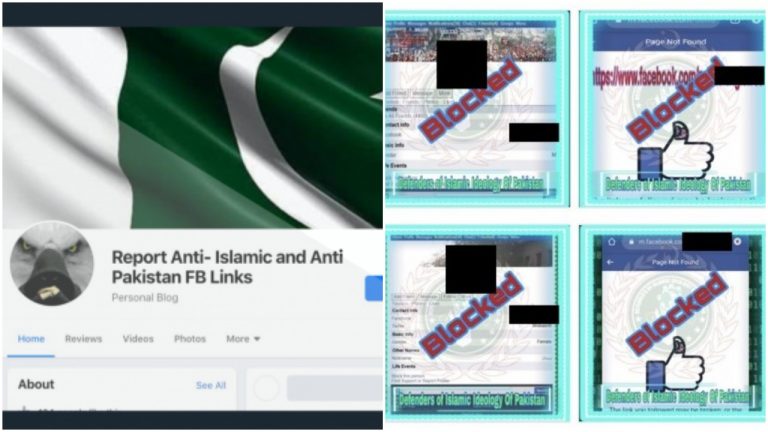
An investigation by Stanford Internet Observatory (SIO) has exposed a network of Pakistan-based Facebook and Instagram accounts that indulged in mass reporting of social media accounts and posts that were critical of Pakistani ruling establishment.

The investigation by the Stanford Internet Observatory (SIO) has revealed that as many as 103 Facebook Pages, 78 Facebook Groups, 453 Facebook accounts and 107 Instagram accounts have been taken down by Facebook on August 31, 2020, for engaging in ‘coordinated inauthentic behaviour’ in an effort to silence the critics of Pakistani ruling and military establishment.

“On August 31, 2020, Facebook suspended 103 Pages, 78 Groups, 453 Facebook accounts, and 107 Instagram accounts for engaging in coordinated inauthentic behaviour. As it notes in its takedown report, Facebook attributed this network to individuals in Pakistan,” the SIO report read.

The SIO reports said that the Facebook had shared a portion of this network with the SIO recently after which they carried out an investigation and brought out the report.

Pakistan posted anti-India propaganda, indulged in mass reporting of accounts

The report highlights how social media accounts that originated in Pakistan posted pro-Pakistan, pro-Islam propaganda on social media platforms. In addition to that, these Pakistani accounts targeted Indian government by peddling false narratives against India.

The report also stated that these social media groups also resorted to mass reporting of social media accounts. These networks operated, with Group and Page administrators who mobilized social media users to report accounts that were critical of Islam or the Pakistani military/government.

Some of these pages and groups also targeted Ahmadi religious community, one of the persecuted Muslim groups in Pakistan.

“In our investigation, we find that the network engaged in mass reporting: the coordinated reporting of accounts ostensibly for violating a platform’s terms of service. The network encouraged users to mass-report accounts that were critical of Islam and the Pakistani government, and in some cases accounts that were part of the Ahmadi religious community,” read the SIO report.

The SIO report also stated that many pages on the network focused on posting Pakistani nationalist content, praising Pakistan’s ISI, the ruling Tehreek-e-Insaf party. Their posts also focused on criticising India’s ruling BJP and PM Narendra Modi.

Report by SIO

Pakistan social media pages targeted accounts using insulting fake names

According to Shelby Grossman, a research scholar at SIO, these groups also boasted regarding their successes frequently and targeted accounts by intentionally using insulting fake names which were clearly in violation of Facebook’s policies.

“The network used a Chrome extension called Auto Reporter to report accounts in bulk, and likely to generate the direct reporting links,” said Shelby.

These pages and groups posted Pakistani nationalist content, promoting ISI, the Pakistan’s intelligence agency and the ruling Pakistan Tehreek-e-Insaf (PTI). The SIO report also noted “the repeated invoking of duty towards religion and nation for mass reporting”.

Facebook had suspended a pro-Pakistani military network in 2019 too

Reportedly, this is not the first time that Facebook has suspended social media accounts that are linked to ISPR of Pakistan Military. In April 2019, Facebook had suspended a network of accounts linked to the Pakistani military establishment.

According to Digital Forensic Research Lab, that network “represented a significant influence operation, apparently aimed at boosting support for the army inside Pakistan and boosting support for Pakistan abroad.”

It was revealed that the Pakistani politicians work directly with prominent social media trolls to get pro-Pakistan hashtags trending on Twitter.

India calls out Pakistan over false propaganda on social media

Meanwhile, India has responded to the dirty tricks played by the Pakistani establishment to indulge in a false social media propaganda. On Wednesday, India accused Pakistan of propagating fake news through social media platforms.

Calling it malicious propaganda, the Permanent Mission of India to the United Nations shared the report by the Stanford Internet Observatory(SIO) which said that Pakistan based Facebook and Instagram accounts leveraged mass reporting to silence critics.
UnAcademy educator provokes students to pick up AK47s, many online coaching centres found peddling political agenda

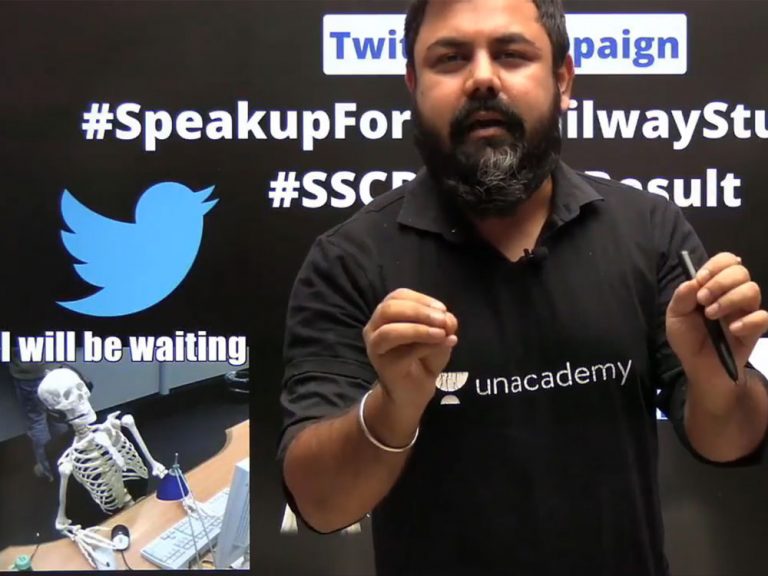
Varun Awasthi, an UnAcademy educator, has been found provoking students to pick up AK-47s in one of his videos.

A clip of his live video is making rounds on social media in which he addressed Prime Minister Narendra Modi and said, “Jis tarah Mahatma Gandhi keh ke gaye the Hindustan ki aatma gaon mein basti hai, jab tak gaon ka vikas nahi karoge Hindustan ka vikas nahi hone wala. Waise hi Modi ji itna jaan lo agar desh ko nahi jhukne dena hai na, to is yuva ko apne saath leke chalna hai. Nahi to woh din door nahi ke jis wajah se aapne Jammu Kashmir ko block kiya hai na udhar se, yahan par har yuva kalam chod ke AK-47 pakad lega. (Mahatma Gandhi said that India’s soul lives in villages, till we do not ensure the rural areas’ progress, we cannot progress as a nation. Similarly, if you do not want the nation to bend its knees, Modi Ji ensure you walk shoulder-to-shoulder with the young generation. Otherwise, just like Jammu and Kashmir, the youngsters of India will pick up AK-47s.)

After the video went viral, educator Awasthi removed the said video from his Facebook profile. However, OpIndia accessed the 20-minute video and confirmed that he tried to instigate students to pick arms. The video is about the delayed results of the SSC Railway exams. When we further dug the mentioned hashtags in the video, we found out that several educators from different coaching centers have posted similar provocative videos.

UnAcadamy initiates investigation

After the clip of Varun Awasthi went viral, Unacadamy replied to a couple of tweets saying that they do not support any such behaviour and statement made by any educator associated with the company. They added that they have initiated an investigation and will take appropriate action.

Countless ‘educators’ running a political agenda through videos

Another name that stood out from the “educators” crowd with such videos was “Bhutesh Sir,” who runs a channel by the name e1 coaching center on Youtube. He uploaded a video on 30th August in which he mocked the Ram Mandir movement. He said, “Tumhein mandir bana ke de diya aur tumhein zindagi mein kya chahiye. Ayodhya mein mandir ban gaya, uska pujan ho gaya aur is se bada mudda kya hai. (You got Ram Mandir. What else you want in your life? The Temple is being constructed in Ayodhya, Bhoomi Pujan has been done. It was the biggest issue.)”

He further added, “tumhein job dila di to yeh Hindu Muslim ke naam par ghrina kaun failayega? Jaat paat ke naam par dange kaun karwayega? Inke IT cell ki jhoothi khabrein kaun failayega agar yuva ko job dila di to? (If youth get a job, who will spread hatred between Hindu and Muslim? Who will instigate riots in the name of caste and religion? Who will spread the fake news of IT cell?).

There is one channel that goes by the name Khan GS Research Center. The teacher in that video, “Khan Sir,” uploaded a video on 31st August in which he said claimed that officials leak the papers so that they can earn money to take their families to Switzerland. The list does not end here. Videos by Rajasthani Tinger, Education Affairs, Time Coaching, and countless others are provocative, politically biased and even seem to be doing indirect political campaigning for certain opposition parties, rather than helping students with their studies. A simple search of hashtag “SpeakupforSSCRAILWAYStudents” shows how deep this nexus of coaching center goes.

It is notable here that the above-mentioned hashtag was actively promoted by Congress leaders recently, including Priyanka Gandhi Vadra.

BJP MP Arjun Singh says jihadi elements destroyed Maa Kali idol in Murshidabad temple, police claims ‘fire accident’

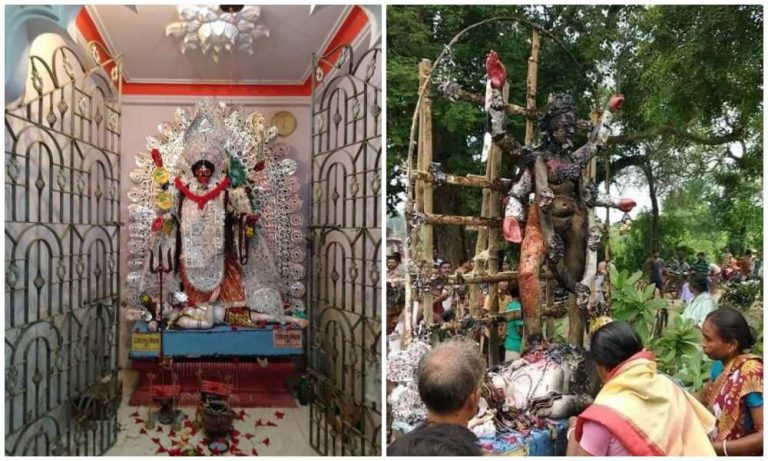
BJP MP Arjun Singh late on Tuesday night took to Twitter to share images of burnt idols of Maa Kali from a temple in Murshidabad.

He said that some people belonging to ‘one religious group’ attacked and destroyed a temple and burnt the idol of goddess Kali. However, Murshidabad Police has denied the claims.

Taking to Twitter, the police claimed that the temple committee stated that it was a fire incident that destroyed the idol.

The police has claimed that the incident took place on the intervening night of 31st August and 1st September which left only the idol destroyed. The rest of the temple is intact.

OpIndia tried to reach out to the temple authorities but the calls remained unanswered. We shall update the article when we know more.

Rajasthan HC dismisses plea of sacked IPS officer Sanjiv Bhatt requesting discontinuation of narcotics case

0

Rajasthan High Court today dismissed a plea filed by sacked IPS officer Sanjiv Bhatt requesting the closure of a case filed under the Narcotics Drugs and Psychotropic Substances Act, 1985 (NDPS Act) as reported by Live Law. The case was reportedly going on before the Special Court (NDPS) in Palanpur, Gujarat.

In his petition, Bhatt had contended that the Jodhpur Special Court had first taken cognisance in the NDPS case and later on a charge sheet was filed against him in the Gujarat Special Court. According to him, both the proceedings have the same foundation, therefore, section 186 of the Code of Criminal Procedure, 1873 (CrPC) is attracted. Under section 186 of the CrPC, a High Court can decide the place of inquiry or trial of an offence where two or more courts have taken the cognisance of the same offence and a question has arisen as to which one of them should inquire into or try the offence.

In the order dismissing the plea, Justice Manoj Kumar Garg observed that the two complaints registered in Gujarat and Rajasthan are distinct. The complaint registered in Gujarat relates to conspiracy and offence relating to the NDPS Act by placing contraband and the complaint filed in Rajasthan pertains to the false implication in NDPS case arising out of a property dispute. He clarified that section 186 applies only in a case where the complaints filed in different courts are related to the same offence. Noting that the petition lacks merit, the court observed, “Moreover, the conduct of the present petitioner is writ large from the observations made by Honourable Gujarat High Court mentioning that the applicant has scant respect for the courts”.

Bhatt was arrested by the Gujarat CID on the accusation of falsely implicating a lawyer Sumersingh Rajpurohit by planting opium in a hotel room in Palanpur. The tainted cop’s lies were also exposed by the Nanavati Commission in its report wherein it debunked his allegation on the then Chief Minister of Gujarat Narendra Modi that he had called a meeting at his residence post-Godhra riots to allow Hindus to vent out their anger against Muslims.

Bihar: Naxals kidnap and murder a pujari, dump mangled body in jungle

0

In Bihar’s Lakhisarai, Naxals kidnapped a pujari, Neeraj Jha, and killed him a week later. His body was later dumped in a jungle. This has angered the local residents. Jha was kidnapped by Naxals on 23rd August who used his phone to make ransom call demanding Rs 1 crore to his family. Even as the family members awaited his safe return, the Naxals killed him and dumped his body in the jungle.

The body was so badly mangled that the family took very long to ascertain whether it was Neeraj Jha. At first the family members failed to recognise him. Later, his brother Pankaj Jha, recognised him from the janeu he was wearing.

The incident comes a month after Maoists kidnapped three people including a teacher who was later set free. Later, a fierce encounter broke out between the security forces and the Maoists at the Lakhisarai-Munger border. Unconfirmed reports later suggested that the remaining two, the mukhiya of panchayat and the moneylender, were also released.

Even as China provokes India in Ladakh, its domestic woes reveal the country is in deep crisis

0

On the intervening night of August 29 and 30, a contingent of Chinese soldiers stealthily attempted to transgress into Indian territory on the southern bank of Pangong Tso lake in Eastern Ladakh, triggering a fresh wave of confrontation between the Armed Forces of the world’s two most populous nation.

However, Indian forces, having had the first-hand experience of Chinese treachery in Galwan Valley, were vigilant of the possibility of another clandestine attempt by China’s PLA troops to nibble away at Indian territory. This time Indian forces outfoxed the Chinese manoeuvres and pushed back about 400-500 Chinese soldiers while managing to take control of a previously unoccupied ‘strategic height’ in the area.

While the Chinese proceeded on a surreptitious plan to renew hostilities along the simmering Line of Actual Control, its penchant for inciting provocation belies the raft of domestic woes that are staring the authoritarian ruler Xi Jinping in his face.

China facing a food crisis as floods inundate large swathes of the country

China is also suffering from a looming food crisis. However, this crisis has been spun by the Chinese premier as a crusade against food wastage. China’s food shortage was also tacitly acknowledged by Xi Jinping when he launched a campaign against food waste. Jinping launched a campaign known as “Clean Plate”, urging people to order fewer plates of food while visiting restaurants and avoid wasting food.

Reports claim that farmers in China are hoarding crops. They believe that a shortage of food supply might be imminent. A senior agriculture minister has issued reassuring statements that consumers should not resort to panic buying. But, it appears that such reassurance have fallen on deaf ears.

Excessive rains and subsequent flooding have already disrupted the production of wheat, rice and other crop production in the provinces along the entire Yangtze River.

The campaign calling for judicious use of food came after southern China witnessed mass flooding, wrecking farmers and ruining tons of farm produce. Since early June, China has been severely impacted by massive downpouring that has inundated large tracts of Southern China.

The catastrophic floods, described as the worst since 1998, had reportedly affected more than 63 million people and cause a direct economic loss of more than $26 billion.

China’s agriculture is also pummeled by the scourge of African swine flu that has led to the death of more than a million hogs. Last year, the African flu killed more than 180 million swine, about 40 per cent of China’s pig population. Meanwhile, the locusts have devoured about 3 millions of acres of cropland along their way. The onset of the floods has only exacerbated the government’s efforts to control the spread of the locust damage and the raging infection among the swine.

China’s top banks reporting enormous losses

China is currently in the throes of grave economic crisis, with its banks reporting inordinate losses. Chinese banks–Industrial and Commercial Bank of China, China Construction Bank, Agricultural Bank of China, Bank of China and Bank of Communications have lost billions of dollars in profit. One of the reasons is because the Chinese government has pressed them into “national service”, wringing money out of them to support the economy that is staggering under the coronavirus crisis.

As per reports, the Chinese Communist Party has asked its banks to forgo 219 billion dollars and to reduce the lending rates and postpone the payments on loans. Besides, Chinese banks have to deal with non-performing loans of worth $ 480 billion, a statement released by China’s top banking regulator says.

Oil companies in China staring at cratering losses

In addition, China’s oil companies are also reeling under the coronavirus-induced lockdown across the world. Sinopec, one of Asia’s biggest refineries has reported a staggering loss of $3.2 billion, as the demand for oil has plummeted amidst pervasive lockdown. This is Sinopec’s world ever loss over a period of 6 months.

Another Chinese oil behemoth, Petrochina, the country’s biggest oil producer, has posted an even bigger loss of approximately $4 billion.

Beset by a host of domestic problems, China’s bold pursuit of aggressively claiming overlapping territorial disputes with more than 14 of its neighbours, including India, betrays that it might be a ploy by the embattled Chinese premier Xi Jinping to cause a distraction away from the internal woes, and rally support by leaning on nationalism.

Unearthing the hidden world of India’s dreaded secret Special Frontier Force

Every powerful nation in the world has its secret force and India is no exception to it. But, for India, it was a necessity rather than its display of might.

The ‘idea’ behind India’s elite secret force

After 5000 Indians soldiers were martyred in the Indo-Sino war of 1962, the country felt the need for a highly trained secret force that could challenge the ‘superior’ Chinese People’s Liberation Army (PLA) on difficult mountainous terrain. On the insistence of the then Intelligence Bureau chief Bhola Nath Mullik and World War 2 veteran Biju Patnaik, Prime Minister Jawarharlal Nehru commissioned the Special Frontier Forces (SFF) on his birthday on November 14, 1962.

Nehru had written two letters to the United States during the war, seeking intervention against the Chinese high-handedness. While the US suggested a ceasefire, the Central Intelligence Agency (CIA) had other plans in mind. US Defence Secretary Robert McNamara and CIA chief John McCone flew to India’s National Capital and in partnership with the Intelligence Bureau, set up the training programme.

CIA provided arms and ammunition during initial training

The newly commissioned secret force was to train Tibetan guerrilla fighters, also called Khampa warrior, who were accustomed to the tough Himalayan terrain. They were recruited with the help of Chushi Gangdruk leaders while the CIA provided initial logistical support such as arms and ammunition.

As such, in early 1963, the first batch of 12000 Tibetans was trained in Chakrata near Dehradun in Uttarakhand under the command of former army veteran and guerrilla warfare expert Sujan Singh Uban. Since Uban was a part of the 22 Mountain Regiment during the Second World War, the Special Frontier Force in India is also known as Establishment 22. The Secret Frontier Force was initially governed by the Intelligence Bureau but was later placed under the Research and Analysis Wing (RAW).

The loyalty of Special Frontier Force to Dalai Lama

Interestingly, the Tibetan guerrilla fighters who are recruited to the Special Frontier Force are believed to be loyal to Dalai Lama and are committed to the idea of a ‘free’ Tibetan kingdom. As such, the fighting spirit against the Chinese forces is emboldened, given that Tibet has fallen prey to the Chinese occupation.

They express their desire and belief in free Tibet whenever they sing their special ‘Vikasi song’ that goes as (translated), “We are the Vikasi, The Chinese snatched Tibet from us and kicked us out from our home. Even then, India kept us like their own. One day, surely one day, we will teach the Chinese a lesson. Whenever opportunities arise, we will play with our lives.” Even today, Tibetan children in schools who do not make a ‘certain grade’ are expected to join the SFF.

The toughness of the Special Frontier Force commandos

Recounting the toughness of the Special Frontier Force commandos, Captain Manmohan Singh Kohli said, “The SFF men were real tough… Once, when we were building a helipad a large rock had to be removed. It needed seven men to lift — even six wouldn’t do. Then, one of the SFF guys said, ‘Put it on my back.’ And he alone carried it about 15 feet and threw it.”

Ex-Gurkha regiment captain Dinesh Tiwari, who had trained the commandos during a 44-week course between 1969-1975, stated, “They can survive in any condition… On some winter mornings, I would watch some of them taking chilly water into their mouth, warming it, and then spitting it out to wash their face.”

Reportedly, the SFF commandos are trained in guerilla warfare, mountain warfare, mountaineering, paratrooping, intelligence gathering, and conducting tough operations.

The lid of ‘secrecy’

Due to the secrecy surrounding the force, the SFF commandos do not receive public recognition. Their tale of valour and hardship is hidden from the public eye. While the number of commandos was 20,000 in the 1970s, it shrunk to less than 10,000 over a period of time. The secrecy around India’s strongest elite personnel implies that we do not know their exact count presently.

The Operations undertaken by the Special Frontier Forces are classified so much so that the Indian army might be unaware of it. The covert force report directly to the Prime Minister of India through the Directorate-General of Security in the cabinet secretariat. Due to the mystery surrounding the elite force, it is also hailed as ‘Vikas’ by several people and the commandos are known as ‘Vikasi’.

India’s secret force ensured success in several military operations

The Sino-Indian war ended on November 21, 1962, just seven days after the secret force was originally commissioned. But, the fear of another episode of Chinese aggression ensured that the force of elite commandos was made stronger with time.

The Special Frontier Force had outlived its purpose and had since ensured the success of Operation Bluestar (the defeat of Khalistani forces and the seize of Golden Temple in Amritsar in 1984), Operation Meghdoot (India’s successful capture of Siachen Glacier from Pakistan in 1984), and Operation Vijay (the victory against Pakistani forces in the Kargil war of 1999) and checking insurgency in Kashmir.

While the Special Frontier Force lost 56 men during Operation Eagle in Chittagong in 1971, they successfully foiled the intrusion of Pakistani forces into the territory of Myanmar. This strategic victory helped in turning the fortunes in India’s favour during the Bangladesh Liberation war.

Countering Chinese Intrusion in Indian territory

The Indian Army announced on Monday that on the intervening night between the 29th and 30th of August, the Chinese PLA “carried out provocative military movements to change the status quo.” National Security Analyst Nitin Gokhale had informed that the Indian Army had noticed suspicious PLA movements in response to which they moved to occupy “unheld features along LAC to dominate” the South Bank of Pangong Tso. He said that Indian troops had not breached the LAC.

As per reports, the operation was made possible by the covert Special Frontier Force that has been serving this country since 1962 with no penchant for recognition of any kind.

Delhi Riots Accused and Pinjra Tod activist Devangana Kalita granted bail by Delhi High Court

0

North-east Delhi riots accused and JNU student Devangana Kalita has been granted bail by the Delhi High Court today on the grounds of lack of evidence. The Delhi High court said that the police could not produce any material establishing Kalita’s role in instigating the violence.

In the bail order, Justice Suresh Kumar Kait observed, “I have gone through the inner case diary produced in a sealed cover along with the pen drive and found that though her presence is seen in peaceful agitation, which is a fundamental right guaranteed under Article 19 of the Constitution of India, however, failed to produce any material that she in her speech instigated women of a particular community or gave hatred speech due to which precious life of a young man sacrificed and property damaged”.

The court granted the bail after noting that Devangana Kalita satisfied the triple test which is a prerequisite for granting bail. The test requires that there should be no chance of the person absconding, no probability of tampering with the evidence and of coercing the witnesses. Justice Kait further observed, “In my considered opinion, no prejudice will be caused to the respondent’s investigation by the grant of relief to the petitioner and she would be prevented from suffering from further unnecessary harassment, humiliation and unjustified detention”.

Devangana Kalita is one of the founders of the far-left Pinjra Tod group that claims to work for gender equality. She was booked by the police under the provisions of the Unlawful Activities Prevention Act (UAPA) for allegedly conspiring to incite the riots. She was arrested by the police in the month of May by the crime branch of the Delhi police after earlier being released on bail earlier.

Kalita is named as an accused in an FIR lodged in the Jafrabad police station under the Indian Penal Code, the Arms Act and the Prevention of Destruction of Public Property Act.

‘No one sleeps hungry in Kashi’, boatsmen debunk claims that 350 families are going hungry due to the Coronavirus lockdown

While it is true that the coronavirus pandemic has hit the Indian economy and middle and lower middle class is the worst affected, a section of people are spreading their own propaganda on the tragedy. Recently, some videos were shared on social media where claims were made that the boatsmen in Varanasi are facing financial crunch and that as many as 350 families are forced to sleep hungry.

Film actor Sonu Sood reacted to the post on Tuesday and promised aide.

Some media house had reported that the boatsmen were forced to sell off their jewellery and had appealed to Bollywood actor Sonu Sood who promised help.

Media reports on Varanasi boatsmen

However, the truth is far from what is propagated. Speaking to OpIndia, members of Nishad community clarified how they have never had to beg for food and the media reports of 350 families being hungry are all rumours. Local councillor Narsingh Das was engaged in distributing ration even when OpIndia contacted him.

“There is no denying that coronavirus has impacted us all in India. But no one can die of hunger in Varanasi. Every year the water levels in Ganga rise and the boats are either taken off the river or are run for limited time. But this does not lead to hunger for the families as reported. The community comes together to help out people in such trying times,” he said.

He said that in past six years, after PM Modi fought and won elections from Varanasi constituency, the tourism has increased and people have started earning better.

Many such people OpIndia spoke to refuted the allegations that the 350 families in Varanasi are sleeping hungry.

Adinath Sahni, a boatsman, while speaking to OpIndia also refuted these rumours that the community is facing crunch.

A video was also shared by BJP leader Naveen Kapoor where another boatman had the claim that 350 boatmen in Varanasi are unable to survive the coronavirus lockdown due to lack of financial help. Bhagat Nishad said that the claims of boatmen’s families not having food to eat are fake. He said that in the city blessed by Baba Vishwanath and Mata Annapurna, it is not possible that anyone may have to sleep hungry.

While thanking Prime Minister Narendra Modi for the help they got from the government, he said, “We received timely help during the lockdown. We appreciate what PM Modi has done for his constituency Varanasi and the country during the coronavirus pandemic.”

Further, various NGOs had also come forward to help the distressed families. Piyush, Founder of Samarpanam Foundation, replied to Sonu Sood and said they are already taking care of the boatmen in Varanasi. He added that they had supplied essential groceries to the families of boatmen, and Sonu Sood should verify the case and try to provide help using proper channels.

Gaana, Hungama, MX Player: The growing influence of Chinese companies through investments in India’s entertainment sector and elsewhere

Tensions between India and China are simmering at the Line of Actual Control in Ladakh after clashes at Galwan Valley and more recently, on the intervening night between the 29th and 30th of August. Ever since the conflict began, the Indian Government has taken stern action against Chinese businesses operating in India. Towards that end, numerous Chinese apps were banned.

However, the wings of Chinese firms run deep in India and there are numerous sectors in which such firms have made significant investment in order to increase the influence of the Chinese government. Investments have been made in sectors such as entertainment and news aggregator apps. In this report, we shall look into some of the investments that have been made by China in relevant sectors.

News aggregators

News and eBook app DailyHunt secured a $25 million funding in 2016 led by ByteDance, the same company that owns TikTok, an app that has been banned in India. With the investment, Bytedance founder & CEO Zhang Yiming joined the Board of Daily Hunt. In 2016, the news aggregator app had a user base of over 120 million app downloads and 28 million monthly active users reading approximately 4.5 billion pages.

Similarly, NewsDog, another news aggregator app, announced a $50 million Series C round in 2018 led by Chinese internet giant Tencent. It claimed to have over 50 million users. It provided its services in as many as 10 Indian languages. In addition, it established a platform ‘WeMedia’ where users could submit their own stories.

Entertainment

Xiaomi, a Chinese smartphone company, led a $25-million investment into Hungama Digital Media Entertainment. When the investment was made in 2016, Hungama boasted over 65 million monthly consumers across its music, video and movies platforms. At the time, it had partnerships with over 700 content creators and offered over 8,000 movies in Hindi, Tamil, Telugu, Malayalam, Bengali, Punjabi and other Indian languages on its platform.

Gaana, a music streaming service, the largest in India, was the beneficiary of investment to the tune of $115 million led by Tencent. “With data prices so low, having easy access to crores of songs which are editorially curated and personally recommended is a better experience than piracy, where quality is unpredictable and selection is limited, Prashan Agarwal, CEO, Gaana had said then. “We have penetrated only 5-6% of India. Over the next few years, we want to take this to 20-30%,” he said.

“As more affordable mobile data plans are driving smartphone penetration in India, we believe growth in the music streaming market will accelerate. By investing in and collaborating with Gaana, we look forward to bringing more innovation and better experiences to all Indian music lovers,” said Tencent President Martin Lau.

Tencent has made investment in another entertainment platform, MX Player, that offers playback as well as streaming services. In October 2019, it was announced that the platform had raised $110.8 million in financing led by Tencent. India is MX Player’s largest market, with 175 million monthly users until October 2019.

The case of Grindr

In March, it was reported that Chinese gaming giant Beijin Kunlun had agreed to sell its hugely popular gay dating app Grindr after the US administration deemed it to be a national security threat. Committee on Foreign Investment in the United States (CFIUS) told the Chinese company that its ownership of the site constituted a national security threat.

CFIUS expressed concern that the personal data of its close to 27 million users could be misused by the Chinese regime. It has been reported in the past that engineers in Beijing could access the personal data of Grindr users, including their private texts and HIV status. It is easy to see how such data could then be used to blackmail people.

Why should India be concerned?

It is widely recognised that Chinese companies often work as extended arms of the Chinese government. There are grave privacy issues associated with Chinese apps, which prompted the Indian government to ban numerous such apps. Even so, there are numerous apps with Chinese investments that often have users running into tens of millions. It is very possible that the data of all such users are at risk, which then has the potential to poser a grave threat to Indian national security.

The Indian Government has also taken steps to check Chinese influence in the Indian economy in recent times. However, there is still a lot that remains to be done and a concerted approach needs to be launched in order to curb the growing influence of Chinese firms in India.
