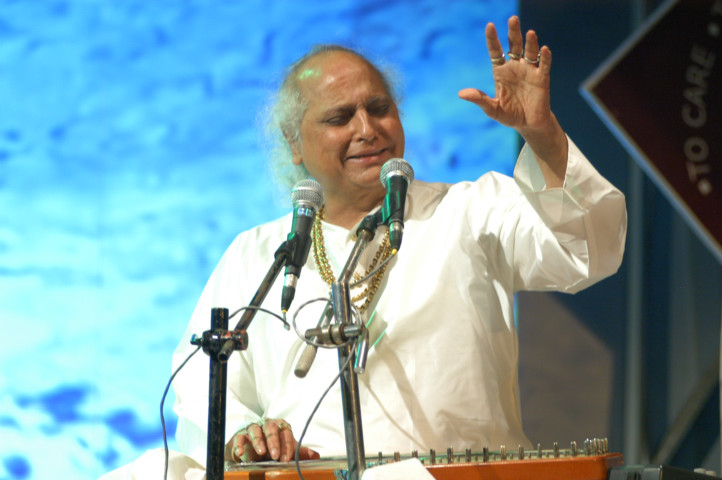
The Indian music maestro, Padma Vibhushan Pandit Jasraj has passed away at the age of 90. The Indian classical vocalist breathed his last in New Jersey, the United States.
The music maestro belonged to the Mewati Gharana, which is known for their devotion to Indian classical music. His musical career has spanned more than 80 years and led him to win numerous awards including Padma Shri, Padma Bhushan and Padma Vibhushan.
Minor planet named after Pandit Jasraj
He was the first-ever Indian musician to have a minor planet named after him. International Astronomical Union (IAU) had named a minor planet between Mars and Jupiter, VP32 (number -300128), discovered on November 11, 2006, as ‘Panditjasraj’.
Other famous musicians and composers who have astronomical bodies named after them are Mozart, Beethoven and Tenor Luciano Pavarotti.
Late Atal Bihari Vajpayee fondly called him “Rasraj”
The former Indian PM, late Atal Bihari Vajpayee, a connoisseur of poetry and music, fondly called Panditji, “Rasraj”. He disclosed this during the launch of his authorised biography, “Rasraj: Pandit Jasraj”. He had said that this is one upadhi (title) that he loves the most.
He is survived by wife Madhura, daughter Durga and son Sharang Dev.
The unfortunate demise of Pandit Jasraj Ji leaves a deep void in the Indian cultural sphere. Not only were his renditions outstanding, he also made a mark as an exceptional mentor to several other vocalists. Condolences to his family and admirers worldwide. Om Shanti. pic.twitter.com/6bIgIoTOYB
PM Modi also shared an obituary for the music legend on Twitter. “The unfortunate demise of Pandit Jasraj Ji leaves a deep void in the Indian cultural sphere,” the PM wrote.
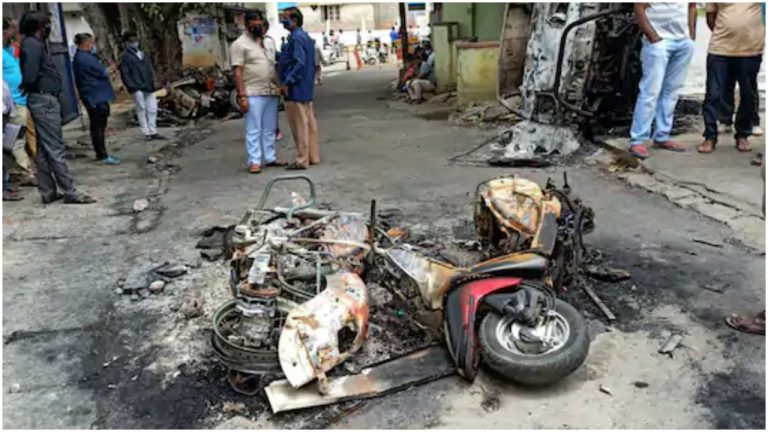
Karnataka CM BS Yediyurappa has taken to Twitter to inform that the Karnataka government has decided to recover the cost of public and private properties destroyed in the Bengaluru violence last week, from the rioters. He asserted that stringent action has been initiated against the culprits of DJ Halli and KG Halli violent incidents including invoking of the Unlawful Activities Prevention Act – UAPA Act.
The state government will request the Karnataka High Court to appoint a Claims Commissioner to assess the damage caused to properties in the riots as per the guidelines of the Supreme Court and fix the recovery cost.
A Special Investigation Team has already been formed to conduct a detailed investigation in the matter, informed the CM, adding that a team of three special prosecutors will be appointed for speedy trial of the cases. SIT will consider invoking Goonda Act if warranted, wrote the Karnataka CM in a series of Tweets.
Our Govt has decided to assess the damages caused to public & private property in the violent incidents in KG Halli & DG Halli & recover the costs from the culprits. We will approach Hon’ble High Court for appointment of Claim Commissioner as per Hon’ble Supreme Court order (1/3)
HM Basavaraj Bommai had also stated that culprits of Bengaluru violence would pay for their deeds
After the Bengaluru violence, where Muslim mobs had run riots in Bengaluru’s KG Halli and DJ Halli areas on the evening of 11 August, torching dozens of vehicles and attacking two police stations, over an allegedly “derogatory” Facebook post against Prophet Muhammad, Karnataka Home Minister Basavaraj Bommai had also stated that the people responsible for the riots and damages to property will be held accountable and the cost of damages will be recovered from them.
Earlier, BJP MP Tejasvi Surja had written to CM Yediyurappa requesting him to attach the properties of the rioters to recover damages, as the Yogi government had done in UP post the anti-CAA riots.
Hours after a video of a farmer being thrashed went viral on social media, the Lalitpur police in UP took disciplinary action against the accused cop.
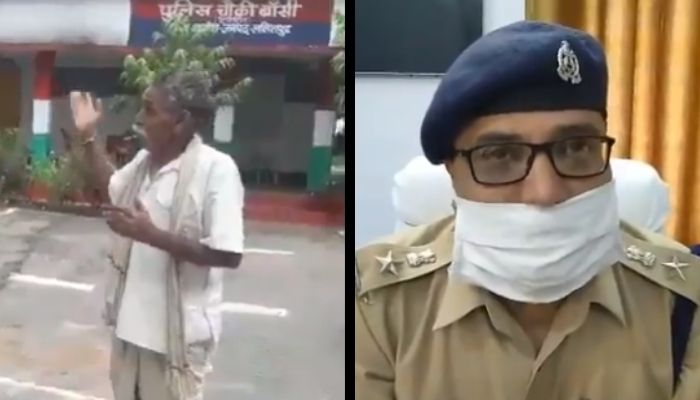
On Monday, journalist Brijesh Mishra shared a video testimony of a farmer wherein he alleged to have been beaten mercilessly by a police sepoy stationed at the Basi chowki in Lalitpur. In the said video, the old farmer can be seen crying for help and explaining it to the police officers that he was thrashed by a policeman.
“Daura daura ke maar raha tha… Dekho Sahab, kaan faat gaya… Bhukkar bhi aaya hai (He chased me and beat me up… Sir, please look that my eardrums have been damaged,” the impoverished farmer was heard as saying. The policemen who were listening to the ordeal of the farmer then said that such a harsh treatment should not have been meted out to an aged person such as him. “This is not a good thing,” one of the officers said.
उक्त प्रकरण के संबंध में शिकायतकर्ता का डॉक्टरी परीक्षण कराया जा रहा है आरोपी पुलिसकर्मी को तत्काल लाइन हाजिर कर दिया गया है,प्रकरण की जांच क्षेत्राधिकारी तालबेहट द्वारा की जा रही है,जांच उपरांत अग्रिम कार्यवाही की जायेगी। pic.twitter.com/5oDw24U09C
Commenting on the issue, Brajesh Mishra said that the painful ordeal of the farmer was bound to turn one’s eyes moist. He wrote, “The Lalitpur police thrashed the farmer so badly that his eardrums are now damaged. He doesn’t know how to lodge his complaint. He is a farmer and he is the source of our food. Atrocities against him will imply that you are bound to stay hungry.”
Lalitpur police takes action against the accused cop
Replying to the tweet of journalist Brajesh Mishra, the Lalitpur police stated, “The farmer is being medically examined. A probe has been initiated into the case.” The accused policeman has also been benched with immediate effect. The Lalitpur police further informed that the matter has now been handed over to the CO of Talbehat and appropriate action will be taken on the competition of the probe. Meanwhile, the farmer has been sent for a medical examination.
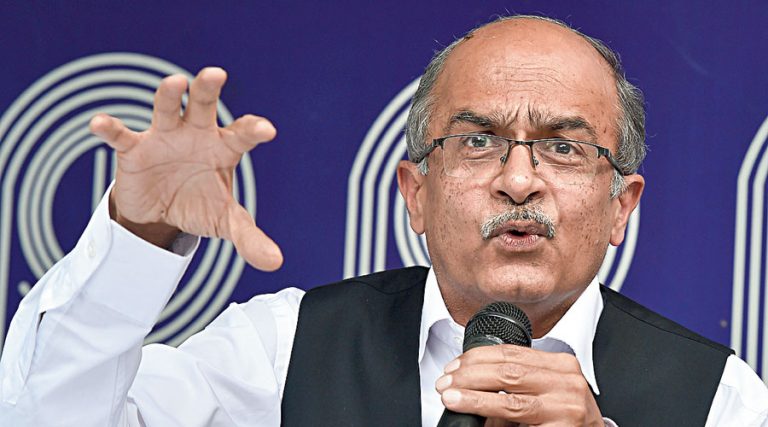
Three days after the Supreme Court found advocate Prashant Bhushan guilty of contempt, around 41 lawyers have appealed against his conviction to the apex Court on Monday. On August 14, the Supreme Court found Prashant Bhushan guilty for two tweets where he had raised aspersions on the apex court, and specifically against the Chief Justice of India.
Lawyers urge to prevent ‘miscarriage of justice’
According to journalist Utkarsh Anand, the said lawyers had expressed ‘disappointment’ over the utter disregard of the Supreme Court to the presence of the Attorney General and his opinion in the matter as mandated by law. They had urged the apex court to defer the effect of the judgment until a larger Bench decides on the issue of ‘criminal contempt.’ The lawyers also asked the apex Court to prevent the ‘miscarriage of justice’ and restore the confidence of citizens in the institution.
41 lawyers, comprising more than half of them senior advocates, have appealed to the #SupremeCourt for not effecting the conviction of adv Prashant Bhushan in the criminal contempt case. pic.twitter.com/GfD1Pqy8P3
Earlier, the apex court observed that the insinuation by Bhushan is not an attack against an individual but on the institution itself and that the CJIs who presided over the court in the last 6 years, and particularly last 4, had a particular role in destroying the Indian democracy.
The Bhoomi Pujan for the Ram Temple in Ayodhya marked the culmination of the Ram Janmabhoomi movement. A defining feature of the Bhoomi Pujan was the presence of materials from holy Hindu sites across the country – soil from Rameswaram, holy water from the confluence of the 3 seas at Kanyakumari, soil from the Sharada Peeth in PoK and many others. Water from the banks of the river Cauvery in Srirangam was also used during the event.
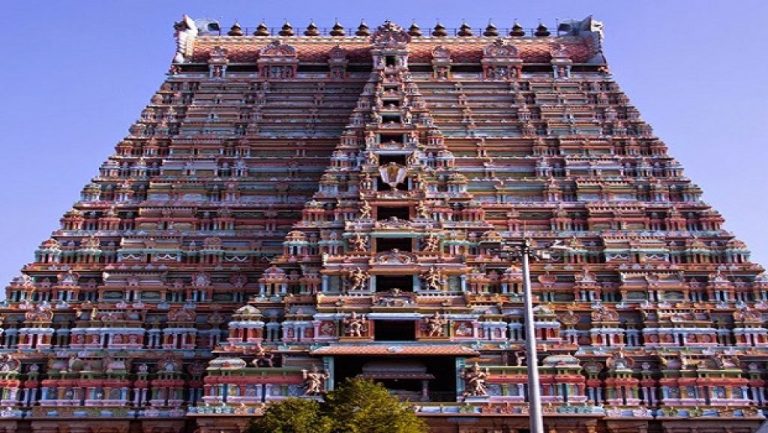
Srirangam’s contribution is particularly noteworthy because it is one of the holiest sites for Vaishnavites, the devotees of Lord Vishnu. Ram is the 7th avatar of Vishnu. The Ranganathaswamy Temple in Srirangam is considered to be the oldest amongst the 106 earthly Vaishnava Divya desams (or Vishnu temples) mentioned in the Nalayira Divya Prabhandam, a seminal work of the 12 Alvars. It is also the largest functioning Hindu temple in the world.
The “Kovil Olugu” is an exhaustive record of the temple’s social, political and cultural history. The time span covered by the Kovil Olugu is very vast, starting with the Cholas and going all the way till the temple was taken over by the East India Company in the 18th century. Written entirely in the Manipravala dialect of Tamil, this is the most authentic source of the Raganathaswamy temple’s history. Despite the availability of such a massive body of work, almost no modern historian has attempted to chronicle Srirangam’s tryst with the Delhi sultanate.
The first Islamic invasion of Srirangam
Srirangam was the fountainhead of Vaishnavism under the Cholas as well as the Pandyas. Despite multiple political upheavals and wars, the temple town was richly patronized by the power of the day. Its pre-eminent status remained undisturbed. In 1310, the death of Malaverman Kulasekara Pandya I lead to a protracted struggle for succession between his sons. Unfortunately, this civil war also happened to coincide with the march of the Delhi Sultanate towards southern India (Ref: History of Srirangam Temple, 1967, Authored by Dr V.N.Hari Rao M.A., PhD, Sri Venkateshwara University, Tirupati)
Malik Kafur was one of Alauddin Khilji’s most prominent slave-generals. By early 1311, Kafur had subdued the Kakatiyas, Yadavas and the Hoysala kingdoms, forcing them to become tributary states of the Delhi Sultanate. The Pandya country, also referred to as Ma’bar in Khusrau’s works, attracted the attention of Malik Kafur. In March 1311, Kafur’s army breached the Pandya empire via the pass at present-day Thoppur and attempted to capture Vira Pandya, Kulasekara Pandya’s son. Unable to do so, he then proceeded towards to ransack the temple in Chidambaram and then turned to Srirangam, which was then renowned for its wealth. Kafur’s army entered the Srirangam temple via its northern enclosures. The Vaishnava saints within the temple were easily overpowered, the treasury was plundered and the temple’s riches were stolen.
By April 1311, Kafur’s armies began their march back towards Delhi. The civil war within the Pandya empire continued but over the next decade the Ranganathaswamy’s wealth was eventually restored. But very few knew that what happened in 1311 was merely a precursor to the tragedy that was to follow 12 years later.
The second Islamic invasion of Srirangam
In 1320, the Khilji dynasty was overthrown by its nobles with the aid of the Governor of Punjab, Ghazi Malik. A descendant of Indian Turkic slaves, Malik renamed himself as Ghiyasuddin Tughluq and established the Tughluq dynasty. While the Khilji empire had tributary states in the Deccan, Ghiyasuddin longed for complete administrative and military control of these vassal states. In 1321, he sent a massive army to conquer the entire southern peninsula. The army was led by his eldest son Ulugh Khan, who would later ascend the throne and was more famously known as Muhammad bin Tughluq.
The 1321 expedition failed after Ulugh Khan and his army was defeated at Warangal. However, by 1323 Ulugh Khan’s forces captured Warangal in a separate expedition and now their eyes were set on Ma’bar (i.e. present-day Tamil Nadu). They first conquered Tondaimandalam and then marched towards Srirangam (Ref: The Koyil Olugu, 1954. Condensed English version authored by T.S.Parthasarathy, PRO Indian Railways and published by Tirumala Tirupati Devasthanams)
The second Islamic invasion of Srirangam is an important historical event that is recorded in all major Vaishnava works. The Guruparamparai, the Prapannamritam, the Acaryasukti Muktavali and the Kovil Olugu have detailed accounts of the sacking of Srirangam by Ulugh Khan. All these works date the invasion to have occurred in 1323.
A temple festival was being conducted while Ulugh Khan’s army advanced towards Srirangam. This festival involved a procession of the Ranganathaswamy idol (also known as the Urchavar Azhagiya Manavala Perumal) from the main temple to another shrine on the banks of the Cauvery. 12000 Sri Vaishnavas had assembled as a part of this procession. On hearing the news of the arriving Muhammadan hordes, Srirangarajanathan Vaduladesika, the chief priest of the Ranganathaswamy temple immediately dispersed the procession. He arranged for the idol and the temple’s jewels to be secretly transported further south. Eventually, Ulugh Khan’s army reached Srirangam and desecrated the temple. On learning that the deity had slipped through his hands, an enraged Khan ordered his troops to behead the 12000 Sri Vaishnavas assembled at the temple. The Kovil Olugu refers to this incident as “Pannirayiramtirumudi-tiruttina-kalabham” (the invasion which took 12000 heads).
For a couple of years, the idol wandered from shrine to shrine across South India before it reached the safe haven of Tirumala, where it was eventually deposited. Urchavar Azhagiya Manavala Perumal spent 48 years in exile, staying out of the grasp of Muhammadan invaders. It was not until 1371 that the idol was safely taken back to Srirangam and reinstalled at the temple by the Vijayanagar empire.
The second sacking of Srirangam is one of the darkest periods in Vaishnavite history. The Tughlaqs exercised direct control over Ma’bar from Delhi for over a decade. One of Ulugh Khan’s chieftains stayed back in Srirangam. He mutilated the gopurams of the temple and set up his residence right opposite the sanctum sanctorum.
He ruled the villages around Srirangam for a few years. It is said that this Muslim chief was constantly afflicted with multiple diseases during his stay inside the temple and he eventually shifted Kannanur where he desecrated Poysalesvara temple and converted it into a mosque. The Ranganathaswamy temple was eventually restored to its former glory by Bukka Raya the First, from the Sangama dynasty of the Vijayanagar empire.
The Srirangam temple is the lodestar of the Vaishnava movement in South India. It is such a tragedy that its bloody tryst with Islamic invaders does not find a single mention in either our history books or in the works of noted mainstream Indian historians. What stops our historians from shining light on persecution under Islamic rule? Any attempt to even evaluate the Mughals or any other Muslim ruler objectively is often met with accusations of selectivity.
It would not be a stretch to state that Marxist historians that dominate Indian academia are singularly responsible for the distortion of the history we teach our children. In their quest to protect the dubious ideals of Nehruvian secularism, falsehoods and imaginary tales of religious tolerance have been spun for decades. Would reconciliation have been possible in post-war German society if history textbooks had decided to whitewash the Holocaust? The first step towards healing historical wounds and reconciliation is acknowledging the crimes of the past. Sadly, the burial of dark chapters such as the sacking of Srirangam will only widen religious fissures even further.
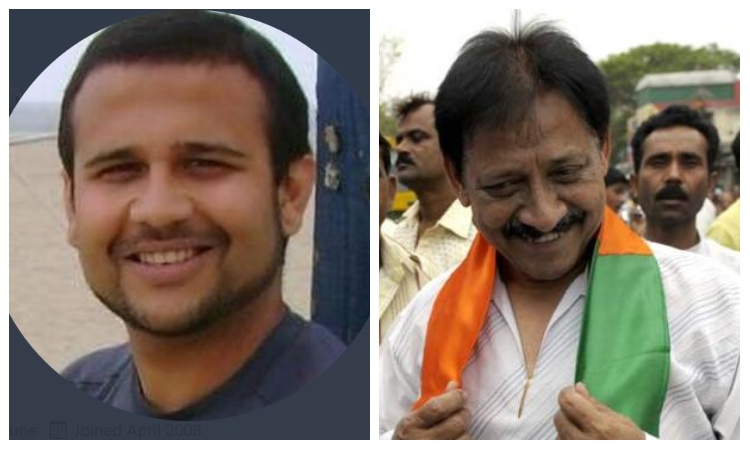
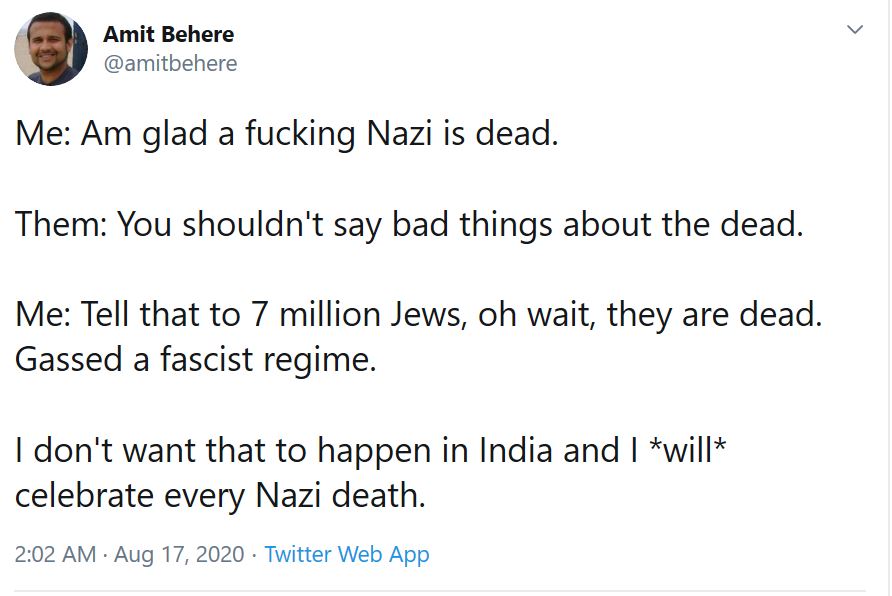
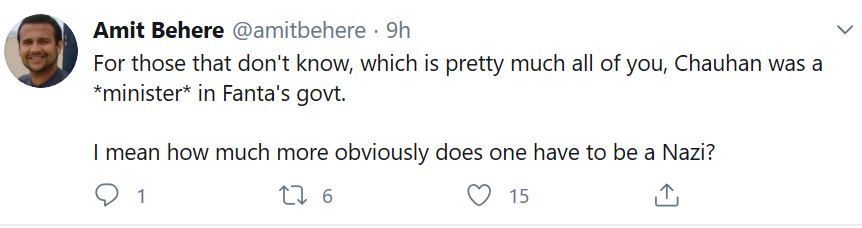
An abusive and hateful troll, Amit Behere, who has earlier displayed his utmost hate for BJP and the “Sanghis and Bhakts” (a supposedly pejorative used by the Left to demean supporters of the Prime Minister) has taken to Twitter to celebrate UP cabinet minister Chetan Chauhan’s death.
Chetan Chauhan, a former cricketer who was serving as the minister of Sainik welfare, home guards, and civil security in the Uttar Pradesh cabinet, succumbed to COVID-19 related complications at the Medanta Hospital in Gurgaon on Sunday.
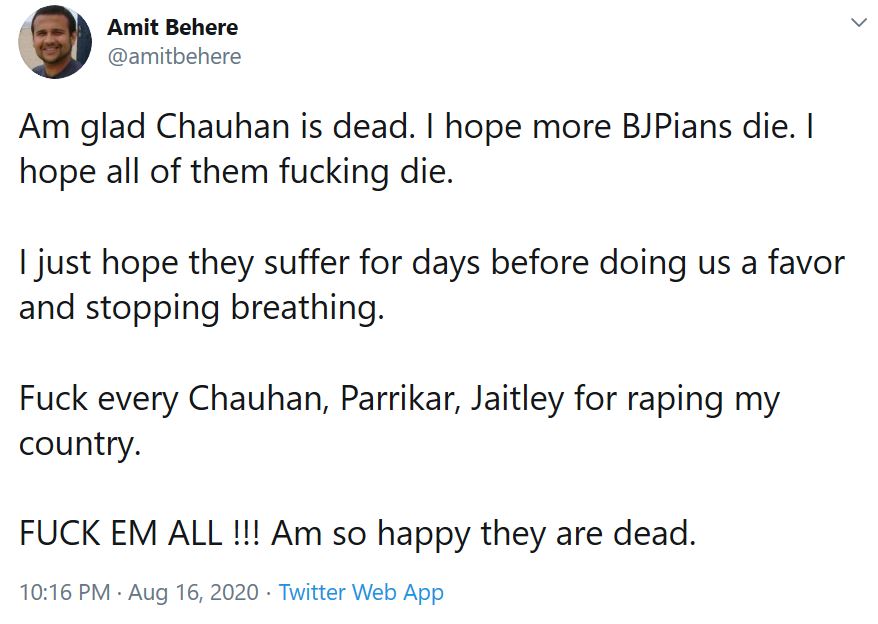
Soon after condolences for the UP minister started pouring in, Amit Behare posted a terribly hateful comment saying that he was glad that the BJP leader died. He even went a step ahead and wished death for all “BJPians”. “I just hope they suffer for days before doing us a favour and stopping breathing”, wrote Behere adding that he was happy “Chauhan, Parrikar, Jaitley” all are dead.
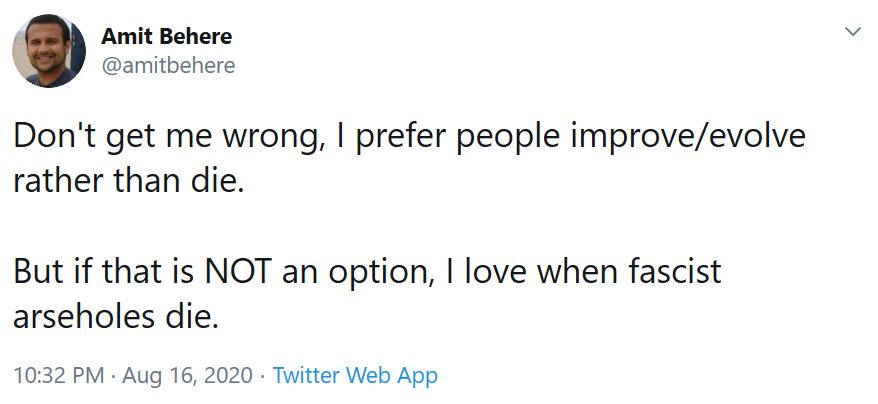
This troll, who is followed by many official functionaries of Congress like Sanjay Jha and Aam Admi Party, journalists with various publications including Barkha Dutt’s MoJo, the self-proclaimed fact-checking website Alt News’ co-founder, Harsh Mandar, and many other ‘secular-liberals’ did not stop here. In his subsequent Tweet, Behere also gave reasons as to why he is celebrating Chauhan’s death. He stated that he prefers if people evolve but he loves it when “fascist a**holes die”.
He further stated that he will celebrate every ‘Nazi’ death.
From calling him a “Nazi” to a “fascist” to rejoicing his death, Amit Behere in a series of Tweets, continues to spew venom against the BJP minister Chetan Chauhan.
Amit Behere and his despicable conduct in the past
Well, Amit Behere’s vile and despicable conduct is something which has been on display all too often. He is the same troll, who wanted the “Sanghis to be thrown in the gutter”. In January this year, Behere, who got triggered by an individual calling his 90-year-old maternal grandfather a “proud Bhakt”, took to Twitter to comment that when his 90-year-old grandfather dies, he should “throw him in the gutter” and he should tell his kids why he threw him in the gutter.
An older tweet by Defence Analyst Abhijit Iyer Mitra had also exposed this troll for the venom he harbours. In the screenshots posted by Iyer, Behara was seen hoping for a slow, painful death for leaders like Arun Jaitley. He had also spoken about how he would celebrate those deaths.
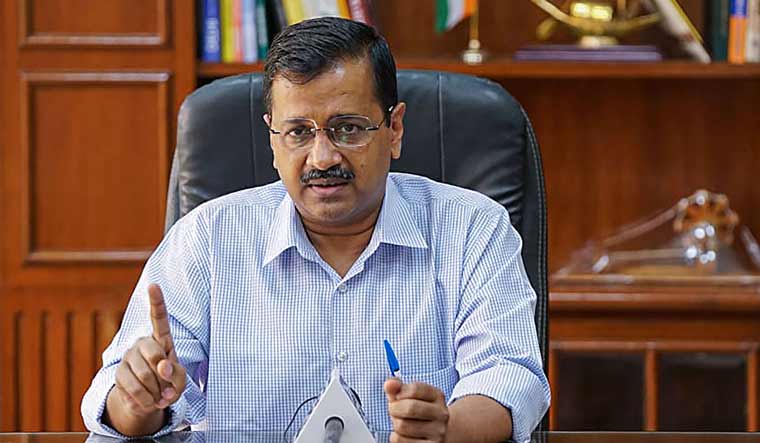
The Aam Aadmi Party has now accused the BJP of sponsoring the anti-CAA protests at Shaheen Bagh and the riots at the national capital in February after some of its activists joined the BJP on Sunday. The party accused the BJP of ‘creating’ the protests against the CAA at the site. It has also embarked upon a social media campaign to convey the same message.
Senior AAP leader Saurabh Bhardwaj said at a press conference, “The inclusion of the leaders of Shaheen Bagh protest into the party by top BJP leaders has made it clear that the BJP was the creator of the anti-CAA stir there. Those who went to Shaheen Bagh to uphold democracy must also be shocked as they were being cheated.”
Saurabh Bharadwaj stated, “The BJP won some seats from the North-East in Assembly polls because of Shaheen Bagh, creating a gap between Hindus and Muslims. In Delhi, the BJP rose from 18% to 38% due to Shaheen Bagh. As they could not win the elections they caused riots”. The social media handles of the party and its workers are also driving in the message.
Akshay Marathe, spokesperson of the Aam Aadmi Party, claimed that the Shaheen Bagh protests were “funded and backed” by the BJP to polarise the campaigns for the Delhi Assembly Election and that is why Shahzed Ali joined the BJP on Sunday.
The section of Shaheen Bagh protestors who insisted that the blocking of an arterial road was fundamental to their protest were funded and backed by the BJP to polarise
That's why Delhi Police allowed the protest to go on
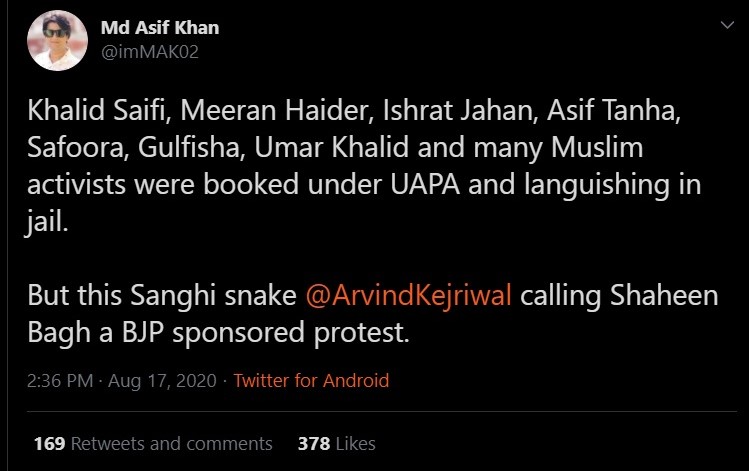
Liberals and Islamists are, however, displeased with the AAP for claiming that the protests at Shaheen Bagh were backed by the BJP. They claimed that it was utterly preposterous to suggest that the protesters were funded and backed by the BJP. Arvind Kejriwal was also called a ‘Sanghi snake’ for the allegations.
Asif Khan called Arvind Kejriiwal a ‘Sanghi snake’
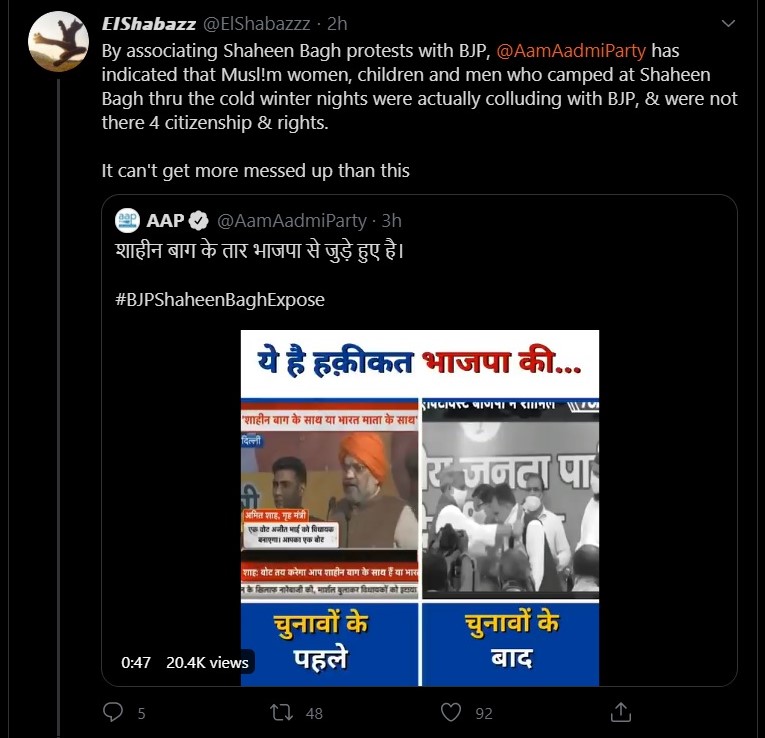
Another user claimed that by associating the Shaheen Bagh protests with the BJP, the AAP had accused the women, children and men who had protested against the CAA by sitting on the road through the harsh winter of Delhi of working for the BJP. ‘It can’t get more messed up than this,’ he remarked.
Tweet by El Shabazz
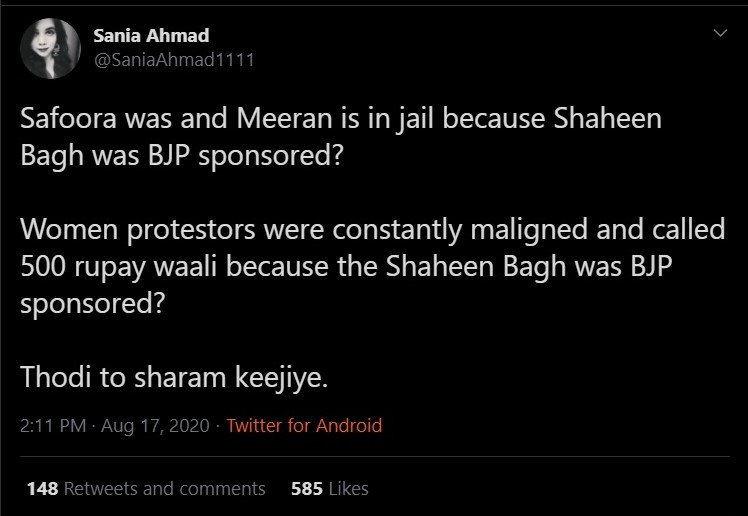
Another user, Sania Ahmad, remarked that the AAP should be embarrassed of itself for suggesting that Safoora Zargar was and Meeran Haider is in jail because the Shaheen Bagh protests were funded by the BJP. She said that the AAP should also be ashamed for claiming that the women who were maligned as ‘500 rupay wali’ were sponsored by the BJP.
Sania Ahmad says AAp should be embarrassed of itself
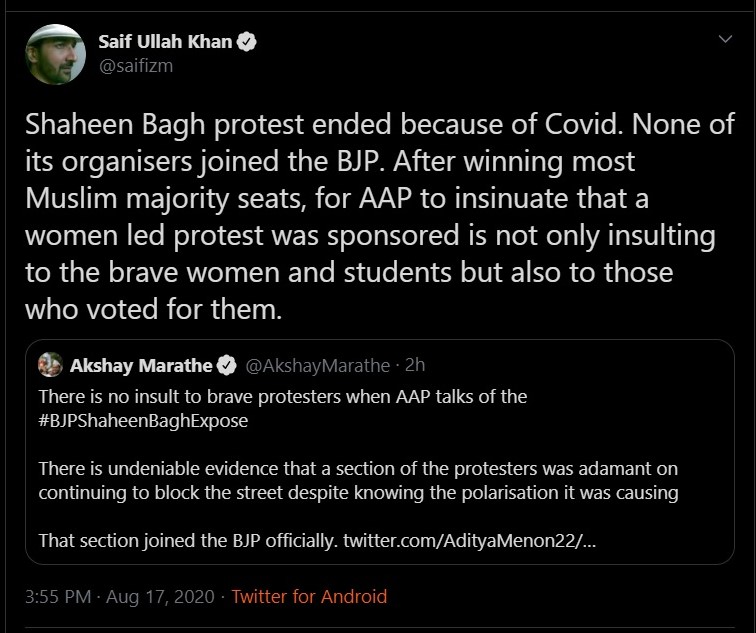
Saif Ullah Khan, who works for Shekhar Gupta’s The Print, said that the AAP’s allegations were insulting to not only the “brave women and students” but also the people who voted for them in the Delhi Assembly Elections.
Saif Ullah Khan said the allegations were insulting towards the women of Shaheen Bagh
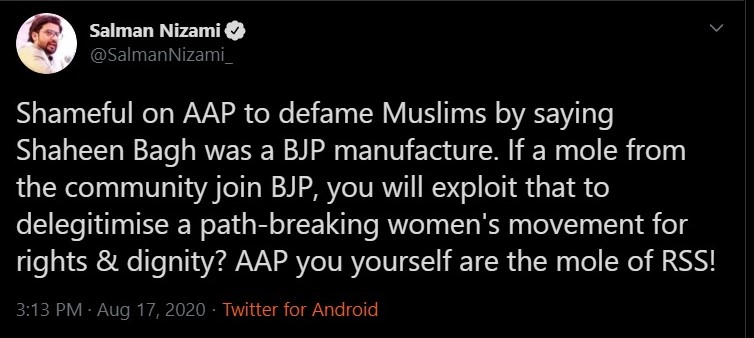
Controversial Congress politician Salman Nizami accused the AAP for ‘defaming Muslims’ by insinuating that the Shaheen Bagh protests were sponsored by the BJP and accused them of being a ‘mole’ of the RSS.
Salman Nizami slams the AAP
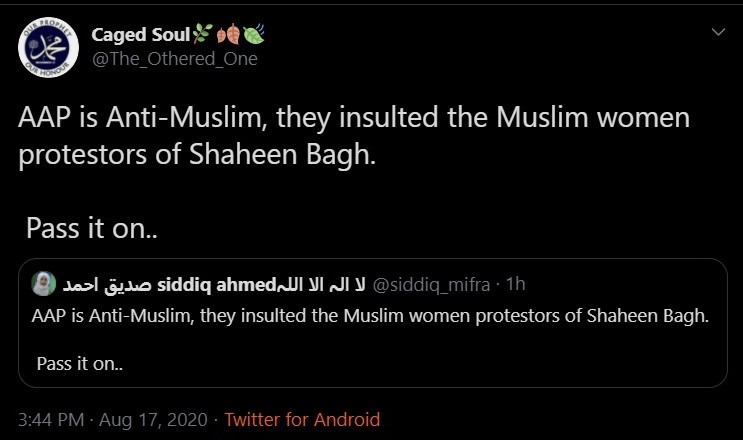
AAp was also accused of being anti-Muslim due to its allegations against Shaheen Bagh.
AAP is accused of being anti-Muslim
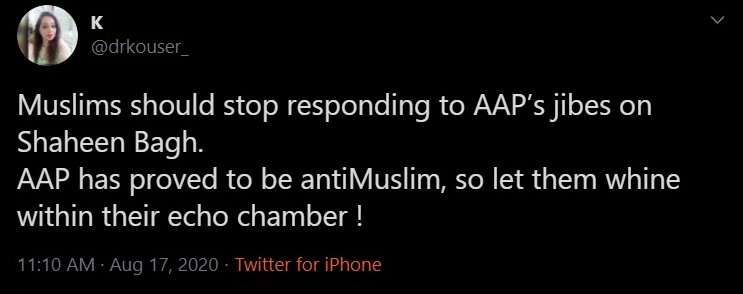
Others said that Muslims should stop responding to AAP’s allegations and let them whine.
The user wants Muslims to stop responding to AAP’s allegations
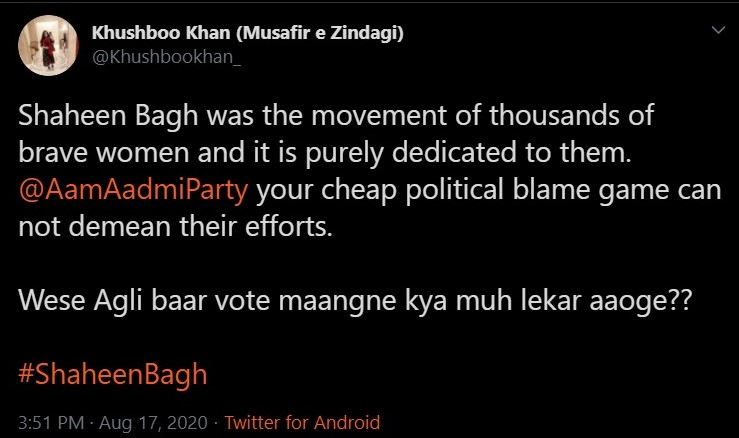
One Khushboo Khan remarked, “Shaheen Bagh was the movement of thousands of brave women and it is purely dedicated to them.” She asked the AAP, “With what face will you come to ask for votes next time?”
Khusboo Khan slams AAP
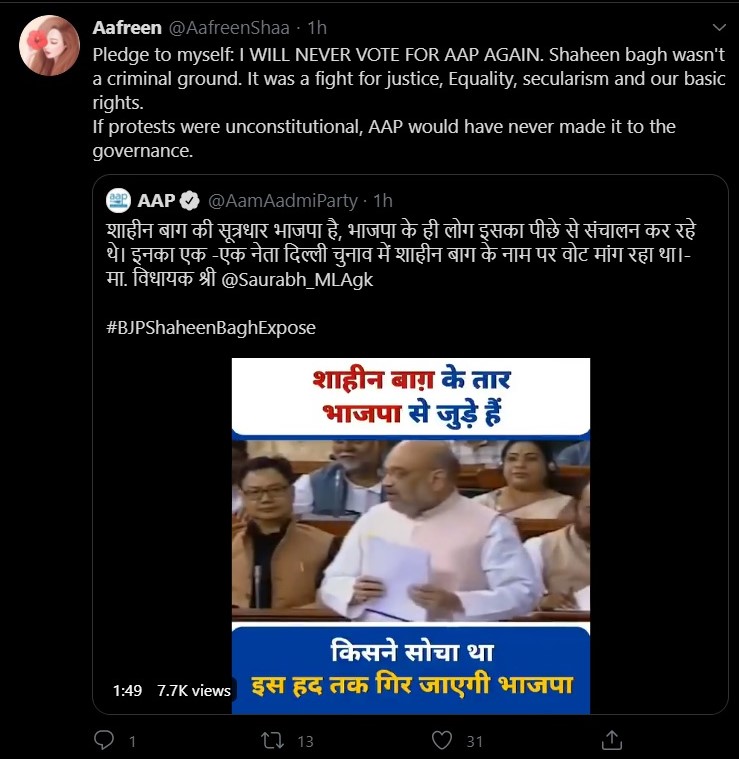
User Aafreen pledged to never vote for the AAP again. She said, “If protests were unconstitutional, AAP would have never made it to the governance.”
Aafreen pledges to never vote for AAP again
With its bizarre allegations against the BJP, the AAP has sorely angered liberals and Islamists on social media. Intriguingly, this is not the first time party or its supremo Arvind Kejriwal have attracted the wrath of liberals and Islamists. In April, the Delhi Chief Minister was attacked by Islamists for urging Muslims to celebrate Shab-e-baraat at home during the Coronavirus pandemic.
Islamists had also outraged against Arvind Kejriwal for reciting the Hanuman Chalisa on national television in his bid to win over Hindus ahead of the Delhi Elections.
A much hyped-up propaganda has been launched with the intention of portraying Facebook as ‘pro-BJP’. While the allegations appear hilarious on the face of it, liberals appear to have lost all sense of reality and proportion and embarked upon an ‘Uninstall Facebook’ drive. The latest spell of delusion began after propagandists at the Wall Street Journal published a report alleging, without any real evidence, that Facebook was unfairly favouring the BJP.
The allegations are particularly ridiculous because Facebook, like almost all other social media platforms, is known to silence ‘right-wing’ or ‘conservative’ voices on social media. The ‘Community Standards’ section on ‘Hate Speech’ offers sufficient indication of the Left-wing bias built into the platform.
Facebook clubs ‘gender identity’, a term engraved deeply in left-wing political ideology, with very real concepts such as race, ethnicity, religious identity and other such identities. Thus, if a user is vocal against the concept that a man can be a woman if he merely claims to be one, then the user can be accused of having trafficked in ‘Hate Speech’ and his account could be suspended. We are expected to believe that such an organisation has suddenly discovered fondness for a Hindutvavadi party.
Facebook Rules on Hate Speech
There is also other very real evidence that the Facebook is not favourably disposed towards the BJP. It is known that prior to the General Elections in 2019, the tech giant engaged in a campaign against popular pages supportive of the BJP and suspended them from Facebook without any clear reason at all.
For instance, in April 2019, Facebook had announced that it had taken down 687 pages linked to the Indian National Congress for suspicious activity. “When we remove one of these networks, the reason we remove them is because of their coordinated inauthentic behaviour, that they are using network of fake accounts to conceal their identity….to mislead who’s behind them. That’s the basic reason for removal,” Head of its Cybersecurity Policy Nathaniel Gleicher told the media.
What escaped notice was the fact that numerous pages supportive of the BJP were also taken down, without any good reason, and the popularity of almost every single one of these pages far exceeded that of the cumulative reach of the Congress pages put together. One of the pages that suffered the axe was The Chaupal page which currently has close to 10.8 million ‘likes’ on Facebook.
The monetisation of the page was suddenly rescinded on the 22nd of March, as per the admins of The Chaupal and they were told that it will be restored in 90 days. However, it was not restored even after 120 days had passed. Now, The Chaupal has a verified ‘blue tick’ on Facebook. It was suspected even then by the page that they suspect they were targeted because of their ‘right-wing’ political inclinations.
On the 1st of April, 2019, Facebook pages with a cumulative ‘likes’ of around 150 million were removed. “We page owners have no say after our pages are penalised. We are subjected to automated mails with no positive outcome,” they complained. They also complained that they could not add new administrators and editors to their pages.
Speaking to OpIndia, Vikas Pandey, social media influencer and administrator of various popular Facebook pages said that although numerous Congress pages were deleted and their umber was greater in absolute numbers, the cumulative ‘likes’ on them was far lesser than the BJP pages that were removed. We were told that the reason that was provided was that a Facebook administrator or editor on the page had a ‘fake profile’, he said.
“Facebook claimed that some pages were removed because one of the IDs of the admins was ‘fake’. Many people use more than one accounts and it is very normal to protect one’s identity. Such accounts were deleted arbitrarily. All this happened right before elections in April 2019.” he said.
We were told that it is a very common practice for admins of pages to create alternative profiles for their Facebook pages. Sometimes, these profiles have names that are similar to the name of the page itself or have the same names as other administrator accounts. BJP-supporting Facebook pages were removed on the basis of such silly reason.
A popular Facebook page, The Frustrated Indian, suffered similar action after they shared from a syndicated news feed. ‘Independent fact-checker’ Boom Live marked one of their articles as ‘fake’. Interestingly, it was a post that was from news agency IANS. When the administrator tried to reach out to Facebook to resolve the issue, he could not get through to him.
Similarly, another Facebook page ‘Nation Wants NaMo’ was deleted abruptly just ahead of elections. The page admin, speaking to OpIndia said that there was no ‘strike’, a warning, before Facebook deleted their page. “It was targeted to be deleted,” the former page admin said.
Another such Facebook account which is regularly targeted is ‘Political Kida’. Ankur Singh, admin of Political Kida, while speaking to OpIndia said how Facebook policies are still unclear and used arbitrarily to silence their pages. “They say that their memes and jokes are fact-checked and reported to be fake, videos that target the Congress party are removed before they go viral. The pages are selectively removed without any intimation and information and when an appeal is made, they are met with an automated response without any further response,” he said.
Numerous such Facebook pages with great reach such as ‘Doval Fan Club’, ‘I Support Ajit Doval’, ‘I Support Zee News’ with ‘likes’ of 4.1 million, 1.8 million, 2.2 million respectively were censored by Facebook as well. There are a lot of other Facebook pages supportive of the BJP that suffered the same fate.
Under such circumstances, it is utterly preposterous to claim that the social media platform is somehow unfairly favouring the BJP. If anything, it is deliberately engaging in malpractice against the party and engaging in electoral malpractice. The current ‘liberal’ rage against Facebook appears to be motivated by Facebook not bending to their will as absolutely as they so desire. Facebook, for its part, has rubbished such allegations.
A Biju Janata Dal MP from Odisha is a die-hard fan of Salman Khan, so much so that his social media pages are full of him constantly tagging and quoting Salman Khan about how he absolutely adores him, idolises him, loves him and well, etcetera etcetera.
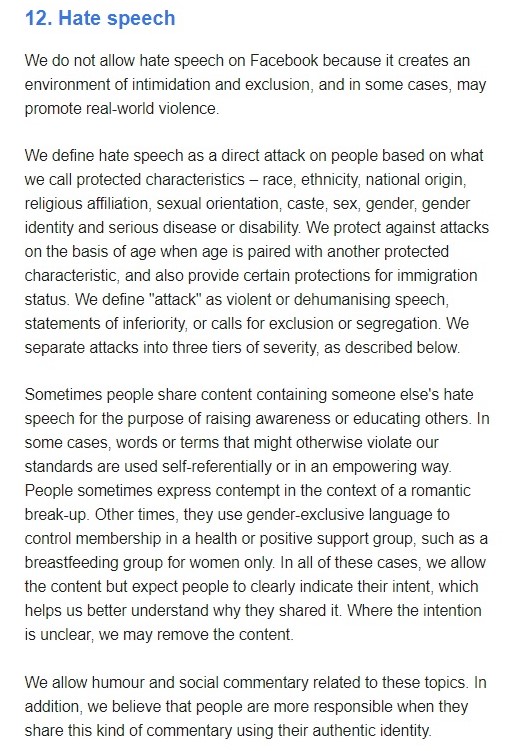
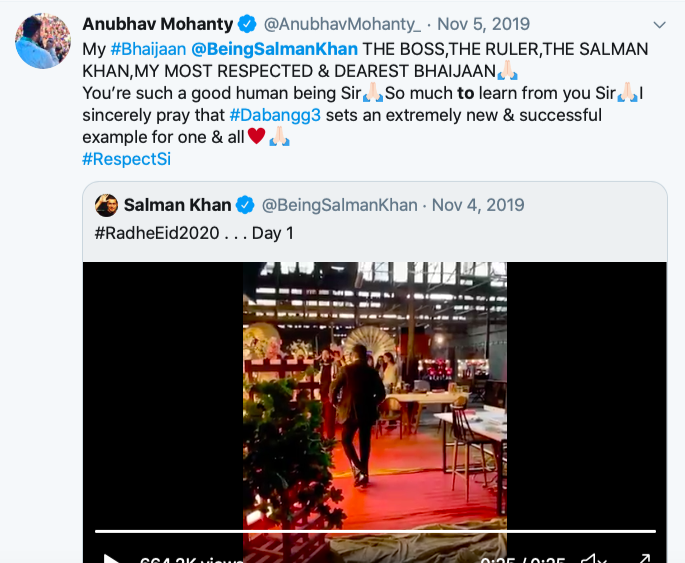
Meet Anubhav Mohanty, a successful actor in the Odia movie industry and the Lok Sabha MP from the Kendrapara constituency. Anubhav Mohanty is obsessed with Salman Khan. Actually, that will be an understatement. The Kendrapara MP’s social media is so full of Salman Khan that calling him a mere ‘fan’ itself will be an understatement. Kendrapara MP Anubhav Mohanty lives, breathes and constantly tries to be Salman Khan.
BJD MP had ‘prayed to Maa Durga’ to make him look like Salman Khan
Not joking. We are not joking. Anubhav Mohanty had himself stated that as a child, he once confined himself in the Puja room and prayed to Maa Durga to make him ‘look like Salman Khan’.
We all grow up with idols in our heart
My idol,till date is @BeingSalmanKhan As a child, once I shut myself in Pujaroom,praying to MaaDurga 2 make me looklike #SalmanKhan
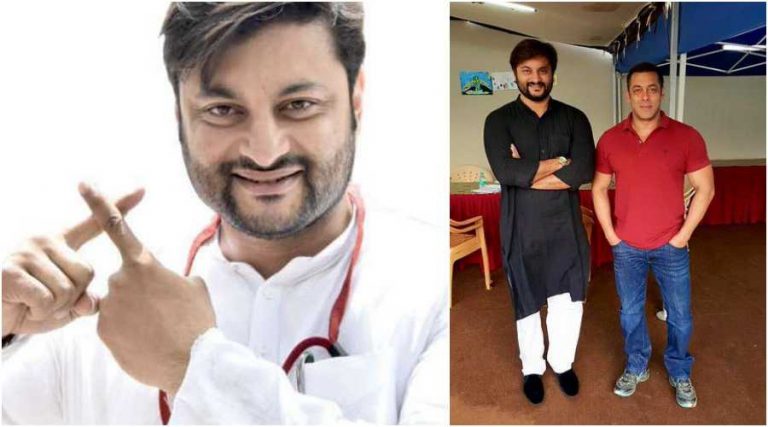
When I met him in person,itwas an amazing experience
Last year, the MP had shared some pictures of him meeting the Bollywood superstar. From the images, however, it appears like Maa Durga ignored his prayers.
Anubhav Mohanty’s twitter profile says he has 2 heroes in his life. When he is not praising his boss, that is Odisha CM Naveen Patnaik, he is found tagging, praising, and even praying to Salman Khan.
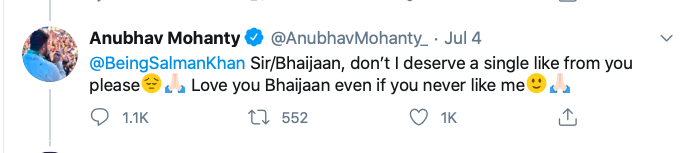
Anubhav Mohanty’s pleading with Salman Khan for ‘1 like’
The above pleading of a sitting Lok Sabha MP to a Bollywood star was for a single ‘like’ for a YouTube video of bodybuilding that he had shared on Twitter.
In sharing the said bodybuilding video, Anubhav Mohanty had also tagged Sylvester Stallone along with ‘Bhaijaan’. He had said that he has been an ardent follower of the above two and ‘needs everyone’s blessings’. What he needs blessings for, however, was not clear. It was probably for making his bodybuilding video more popular.
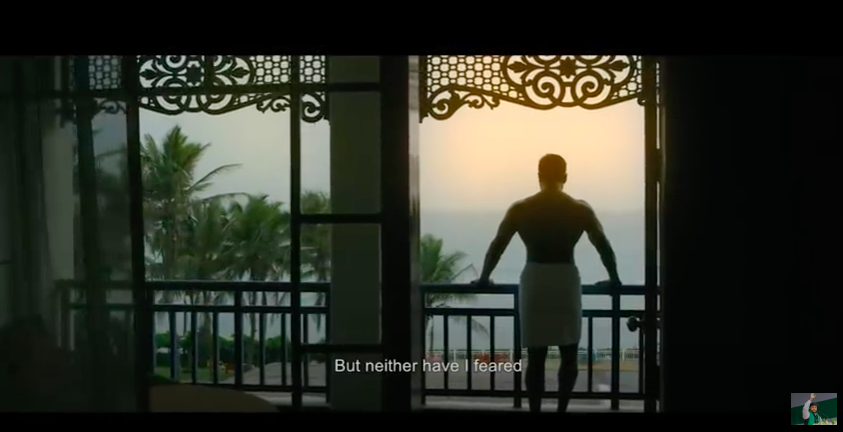
The video was slightly confusing. The narration said the Lok Sabha MP is constantly facing the challenges of life and winning all of them. But the video showed only clips of him exercising. There was one scene where he was standing in a balcony. But not looking like Salman Khan. Interestingly, that scene is an imitation of Ranbir Kapoor’s legendary “towel view” in his debut movie ‘Sawariya’. Thankfully though, the BJD leader keeps the towel on, unlike Ranbir.
Anubhav Mohanty’s video, screen grab from YouTube
Anubhav defends his love for Salman Khan before haters and critics
It is not that the actor-turned MP’s love for Salman Khan goes unnoticed. A lot of Twitter users criticise his Salman obsession and even advice him to behave in a different manner, since he is an MP. But Anubhav has no inhibitions. The BJD MP’s love for Salman Khan doesn’t bother about social media mockery or condemning.
Mohanty insists that Salman Khan is an ’emotion’ for him and political or not, every person has the right to have and pursue his emotions.
Thank you for being so polite and wanting to dictate how I live my life.
Have you heard of the term "striking a balance". Surely a political person has a right to have and pursue his emotions. No ?
There are certain tweets by Anubhav which cannot be described. There are simply no words for such pure, unadulterated love. For the Kendrapara MP, Salman Khan is more than an actor or star. He considers him the ‘ruler’, the ‘boss’ (sorry, Naveen Patnaik Ji).
BJD MP from Kendrapara showering love on Salman Khan
‘Jai Naveen’ by Anubhav Mohanty in Lok Sabha
Anubhav Mohanty is a popular Odia actor. The actor had defeated BJP’s Baijayant Panda in the 2019 Lok Sabha elections in the Kendrapara constituency. While taking his oath as an MP in the 17th Lok Sabha, the actor had grabbed headlines by adding ‘Jai Naveen’ slogan.
Anubhav Mohanty taking oath in Lok Sabha
Mohanty had chosen to take oath in the Odia language. He had ended his oath with the slogans, “Jai Jagannath, Jai Odisha, Jai Naveen, and Bande Utkala Janani”. We don’t know if political parties have ’employee of the year’ concept, but if they had, BJD would probably not even need any second thoughts.
Sadly, however, the “1 like” from Salman is probably yet to come for Anubhav Mohanty. A cursory search says Salman Khan has never responded to the actor-turned-MP on social media.
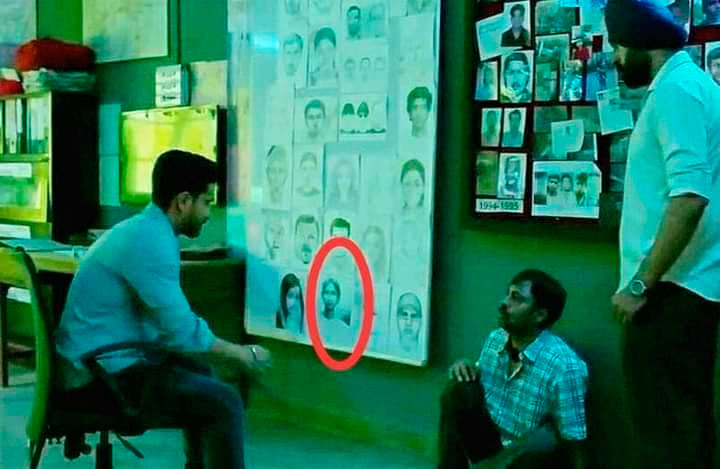
They said, “The channel said that the producers, show & the platform, have no intent whatsoever to offend any community or hurt anybody’s sentiments. Keeping in mind the feedback received and with utmost respect to our audience, we have blurred the image (inadvertently) used in one of the scenes of Abhay2.” They unconditionally apologized for the error.
Zee5 depicts Khudiram Bose as criminal in web series
On Sunday, netizens criticized the OTT Platform Zee5 and makers of Abhay 2 for disrespecting the revolutionary leader Khudiram Bose by portraying him as a criminal. The social media users alleged that in the second episode of the series, the sketch of the freedom fighter was placed with criminals in a police station.