In a dastardly act, a BJP Sarpanch was shot dead by some unidentified terrorists in Jammu and Kashmir on August 6 (Thursday). The terrorists attacked Sajjad Ahmed Khandey outside his residence at Vessu Qazigund area of Kulgam. He was rushed to Anantnag’s Government Medical College where he was declared brought dead by the doctors. This is reportedly the second such attack on a BJP leader in Jammu and Kashmir in less than 48 hours.
No terror group has claimed responsibility for the attack so far.
The BJP sarpanch was 20 metres away from his house when he was attacked
According to reports, Khandey who was staying at a secured migrant camp along with several sarpanches had left the camp on Wednesday morning to visit his home at Veesu when the terrorists fired upon him. Khandey was just 20 metres away from his house when he was attacked.
Two attacks in less than 48 hours
Prior to this, a BJP sarpanch named Arif Ahmad was critically wounded after terrorists fired upon him at Akhran, Qazigund at around 9.30 pm on August 4. Ahmad was shifted to the emergency hospital at Qazigund with firearm injury in the neck. He is still undergoing treatment at the hospital and his condition is said to be stable.
The outgoing lieutenant governor GC Murmu said that they were assessing the situation. “We have seen that some soft targets are there. A lot of terrorists have been neutralized recently so there are some desperate actions. Wherever it is required, we are providing security. It is a continuous process to assess the threat,” he said.
Other recent incidents in the valley
Recently, there have been many such incidents where terrorists have attacked democratically elected leaders in the valley. Last month, a former district president BJP Wasim Ahmad Bari was shot dead, along with his father and brother. DGP Dilbag Singh had informed that two LeT terrorists, one local man and another a Pakistani, were behind the attack.
Earlier, Kashmiri Pandit Ajay Pandita, a Congress sarpanch from the south Kashmir’s Anantnag district, was killed by Pakistan sponsored terrorists on June 8, 2020.
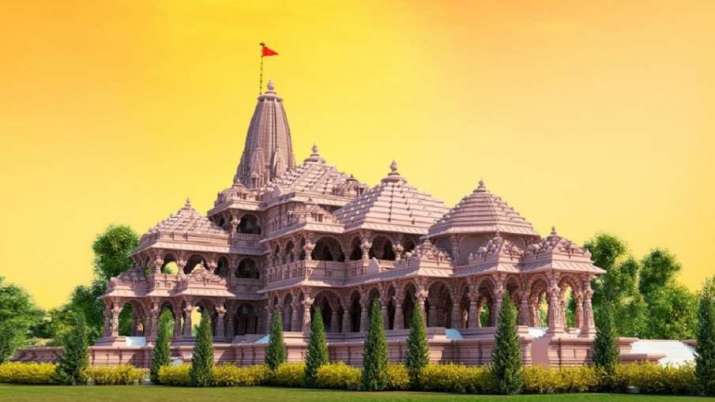
As Prime Minister Modi performed the Bhoomi Pujan for the Ram Mandir at Ayodhya, millions across the world watched and celebrated the historic event. Several Hindus, not only from India but from across the world took to social media to express their cheer over the construction of Ram Mandir at Ayodhya five centuries after it was demolished by Islamic invaders.
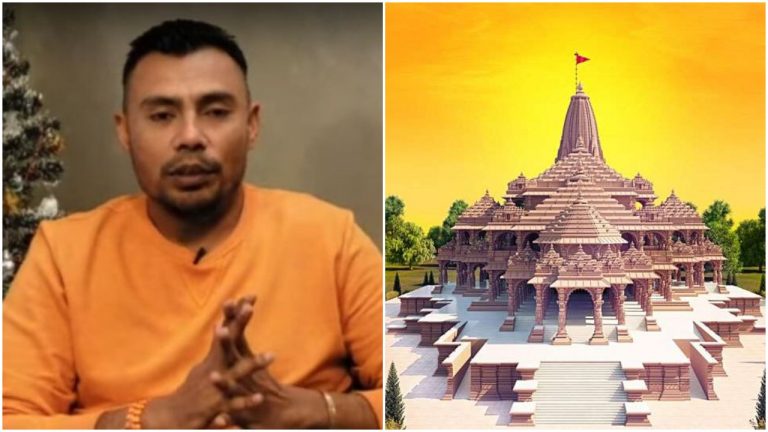
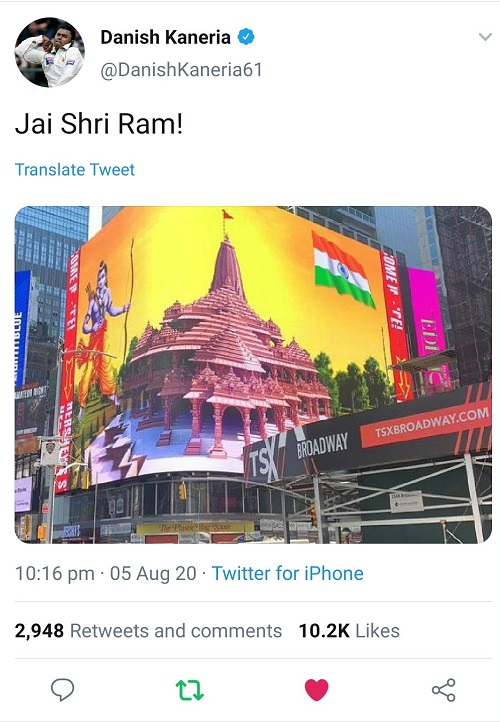
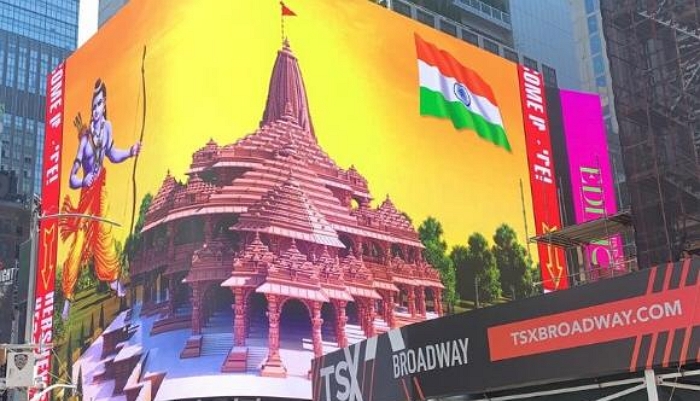
Former Pakistan cricketer Danish Kaneria, who is only the second Hindu cricketer to have represented Pakistan in international cricket, too expressed his happiness over the historic ceremony. The former Pakistani cricketer posted an image on social media platforms featuring Ram Mandir’s digital image on a giant billboard at New York’s Times Square.
Sharing the image, Danish Kaneria had also tweeted, “Today is the Historical Day for Hindus across the world. Lord Ram is our ideal.”
Kaneria’s tweet
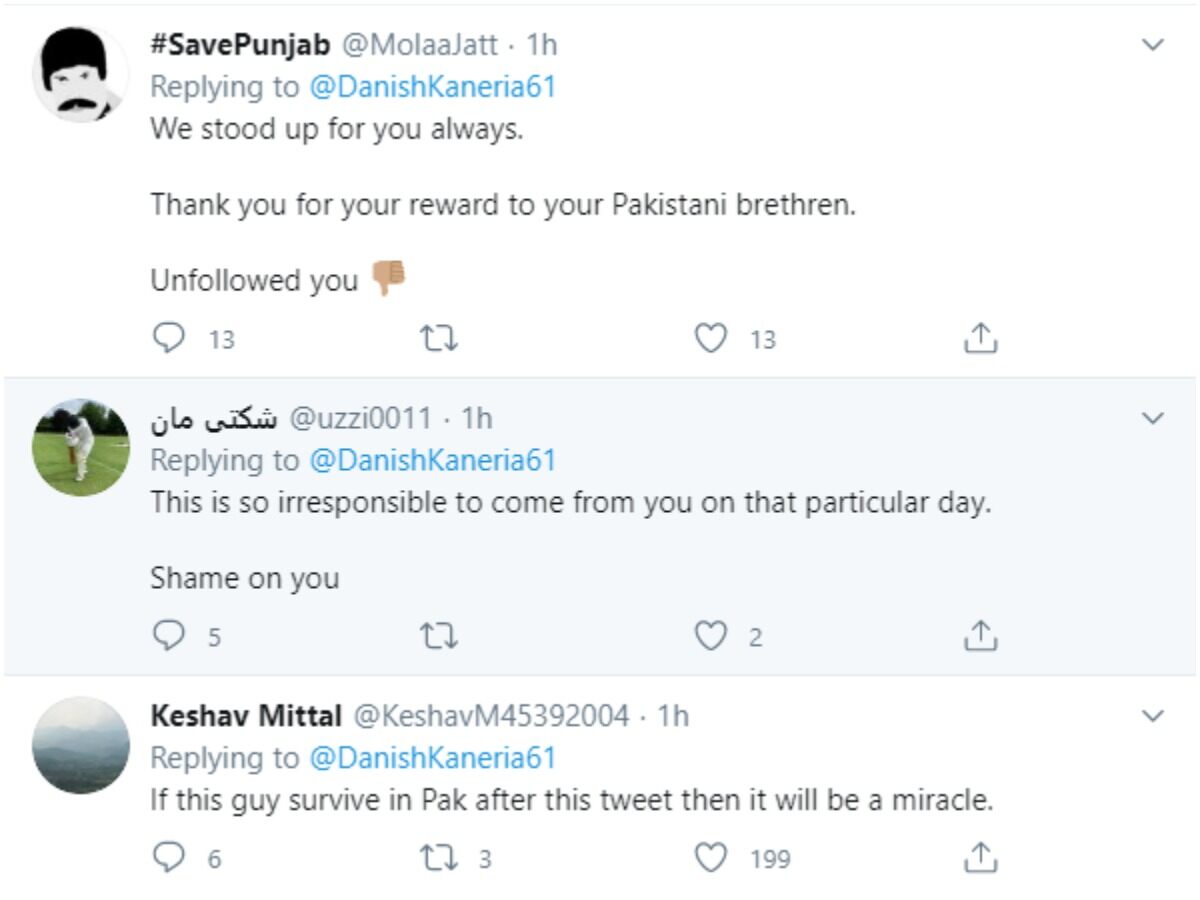
The leg-spinner, however, received backlash over the post as Islamists ganged up on him to bully and threaten him leading to the deletion of the tweet by the Pakistani cricketer.
Image Source: latestly
Danish Kaneria, perhaps also had to delete his tweet depicting the glory of Ram Mandir at Times Square in New York, fearing an attack from the Islamists within Pakistan. There was a concerted campaign from Islamists and anti-Hindu forces from across the world to stop Hindus celebrate the historic event.
Several Muslim groups including Indian Minorities Advocacy Network- ImanNet, Justice for All, Coalition of Americans for Pluralism in India CAPI, North American Indian Muslim Association NAIMA, Islamic Circle of North America -Social Justice ICNASJ and The International Society for Peace and Justice had protested against ad companies displaying Ram Mandir on the billboards at New York.
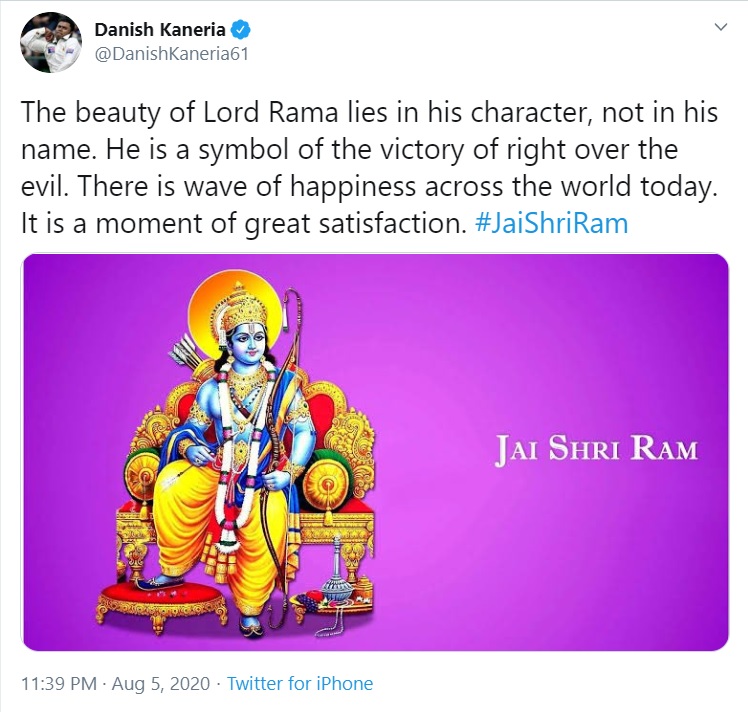
Following the bullying by Muslim groups, the ad companies that manage the NASDAQ billboards had initially refused to provide space for Hindu groups to display Bhoomi Pujan event. Danish Kaneria, probably concerned about repercussions in the Islamic country deleted his first tweet and later posted another tweet to celebrate the occasion and said that it was a ‘moment of satisfaction’.
He added that the beauty of Lord Rama lies in his character, not in his name and that he is a symbol of the victory of right over the evil. “There is a wave of happiness across the world today. It is a moment of great satisfaction,” expressed the 39-year-old former Pakistani spinner.
Image Source: Danish Kaneria
Indian Hindus express concern for Kaneria’s safety
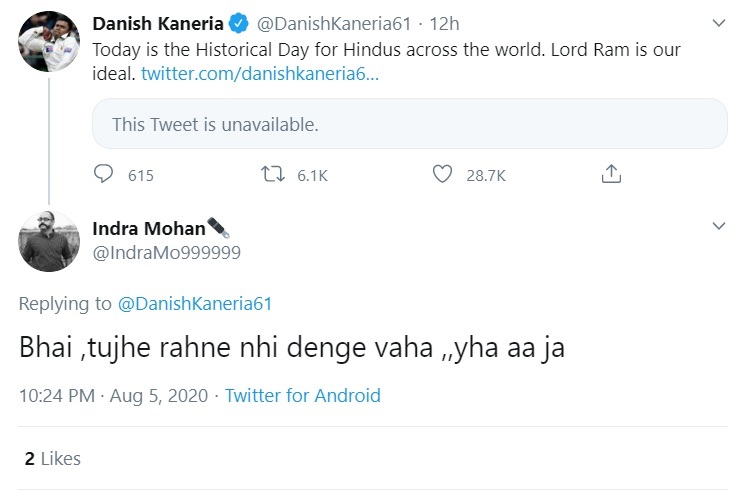
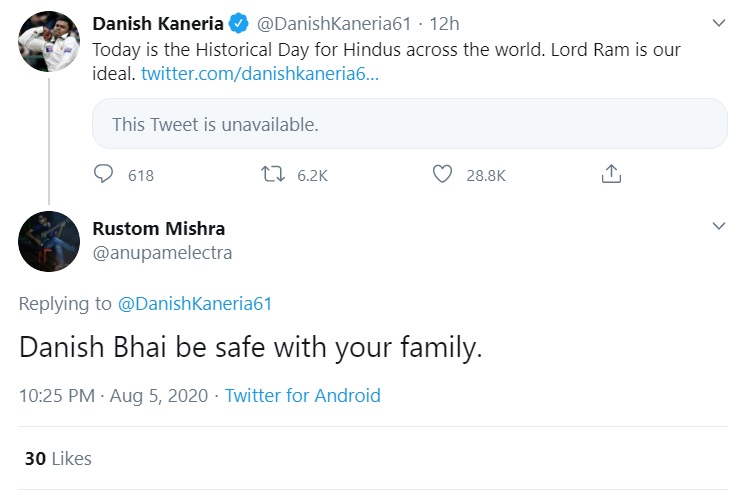
As Danish Kaneria began to openly flaunt his Hindu credentials’, other Hindus began to caution the 39-year-old cricketer that his posts would invite danger for him in his country. Hailing his fearlessness, netizens asked Kaneria to be cautious and ensure his safety in Pakistan, especially after his tweets celebrating the historic Ram Mandir Bhoomi Pujan event.
Indians’ concern about Danish Kaneria’s safety
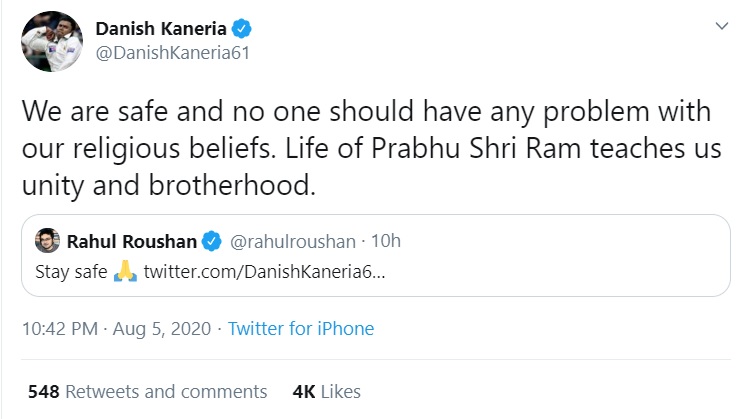
Reacting to posts of Hindus, who wished him to be safe, the 34-year-old cricketer assured that he was safe. He added that no one should have any problem with religious beliefs of Hindus. The Pakistani cricketer added that the life of Prabhu Shri Ram taught Hindus unity and brotherhood.
Image Source: Danish Kaneria
Kaneria was mistreated by former teammates for being a Hindu
In a chat show last year, former Pakistani cricketer Shoaib Akhtar had revealed how Danish Kaneria used to be humiliated and mistreated by teammates in the Pakistani team because he was a Hindu. He had stated that other players used to refuse to eat with him because of his Hindu faith. Later, Kaneria had himself confirmed it.
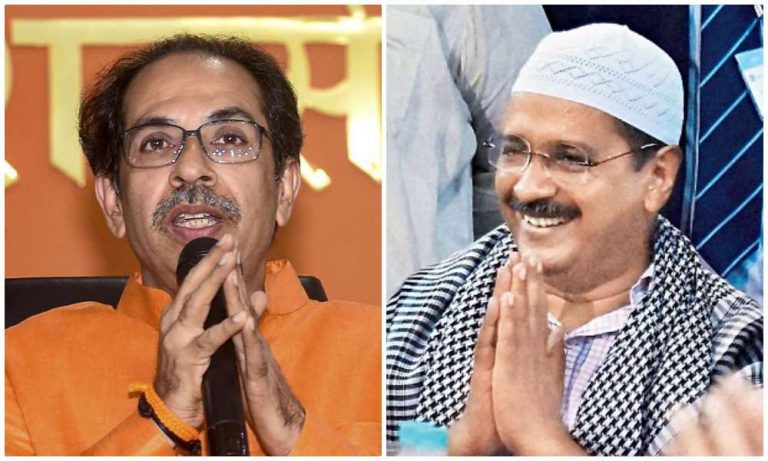
While Maharashtra Chief Minister Uddhav Thackeray and his Delhi counterpart Arvind Kejriwal may have reluctantly welcomed the Ram Mandir Bhoomi Pujan on Wednesday, the duo, along with many Islamists and Congress leaders had in the past mocked the Ram Mandir construction that was delayed due to legal hurdles.
In 2015, Shiv Sena chief Uddhav Thackeray while addressing a rally had taken a jibe at the delay in construction of Ram Mandir. At around 30 seconds into the video one can hear Thackeray say “Mandir wahin banayenge lekin tareekh nahin batayenge (We will build the temple but we will not give the date)”
Similarly, during run-up to the 2019 general elections, Delhi Chief Minister and Aam Aadmi Party supremo Arvind Kejriwal had also mocked the construction of Ram Mandir.
Congress leaders have also time and again used the same phrase to mock the construction of Ram Mandir.
Promises, promises and only promises . . NO delivery! It’s patent BJP strategy – “Mandir wahin banayenge, (Lekin) Tareekh nahi batayenge”!!! https://t.co/QH7gwDJnSE
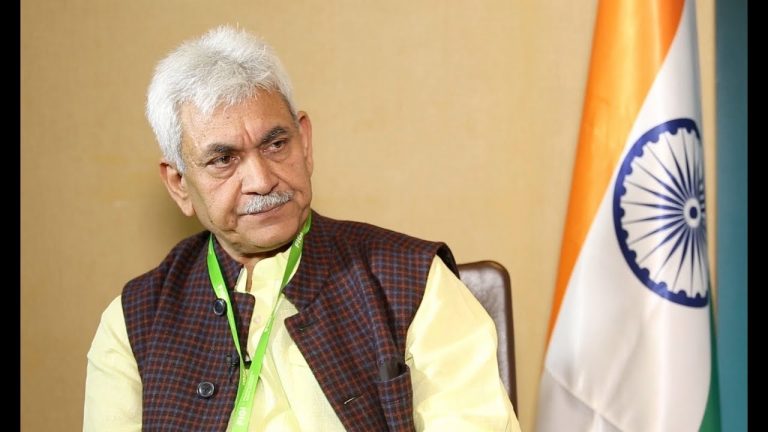
Former Union minister Manoj Sinha has been appointed as the next Lieutenant Governor of Jammu and Kashmir by President Ram Nath Kovind on Thursday. Manoj Sinha will replace Girish Chandra Murmu who resigned on Wednesday.
According to the reports, the Rashtrapati Bhavan communique on Thursday said, “The President has accepted the resignation of Girish Chandra Murmu as Lieutenant-Governor of Jammu and Kashmir.”
It also announced that “The President has been pleased to appoint Shri Manoj Sinha to be the Lieutenant-Governor of Jammu and Kashmir with effect from the date he assumes charge of his office vice Shri Girish Chandra Murmu.”
Earlier, Manoj Sinha had held the Railways portfolio as a Minister of State in the first Modi government. Manoj Sinha was also in charge of the Telecom ministry under the Modi government. The BJP leader has been a 3-time MP. He had lost the 2019 general elections from the Ghazipur constituency to BSP’s Afzal Ansari.
Lt. Governor GC Murmu appointed as the CAG
Manoj Sinha will assume charge as the Lieutenant Governor of Jammu and Kashmir after the incumbent Lt. Gov GC Murmu resigned from his post on the first anniversary of abrogation of Article 370 in Jammu and Kashmir. Lt. Gov GC Murmu sent his resignation letter to the Centre on Wednesday evening and has vacated his post immediately.
Murmu, who is a 1985-batch IAS officer of Gujarat cadre, was appointed as the first Lt.Gov of Jammu and Kashmir last October after the formation of the new Union Territory under the Jammu and Kashmir Reorganisation Act, 2019.
As per a report in Times of India, GC Murmu has been appointed as the new Comptroller and Auditor General of India. Murmu will be replacing Rajeev Mehrishi, a 1978 batch IAS officer. Mehrishi had also met the President at the Rashtrapati Bhavan on August 4, the details of his next appointment are yet to be released.
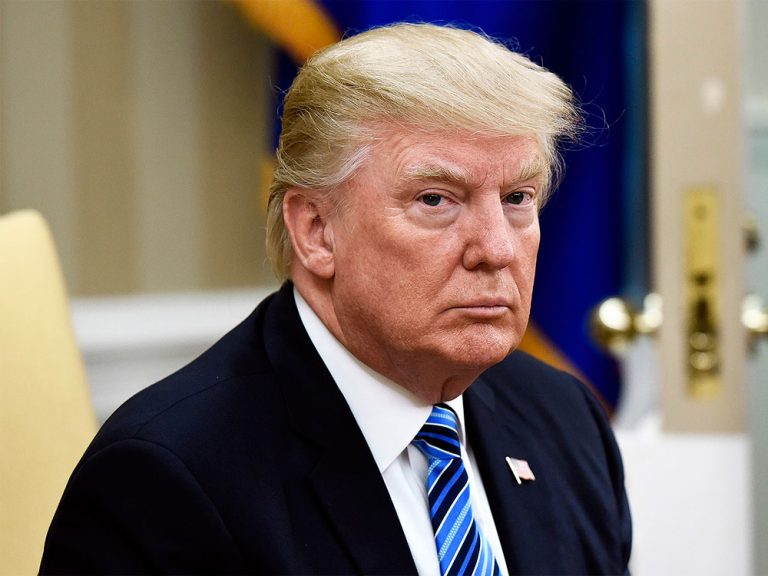
Social media giants Facebook and Twitter blocked US President Donald Trump’s Twitter account @/TeamTrump for re-election campaign briefly on Wednesday. Trump had posted a video that according to Twitter and Facebook guidelines contained misinformation about Covid-19. The policies set in place by both social media companies forbid people from sharing any information about the Covid-19 pandemic that may harm people.
Trump campaign blocked from tweeting over COVID misinformation, says AFP news agency
According to the reports, Trump posted a video of an interview he did on Wednesday with Fox News. In the video, he alleged that children were “virtually immune” from the Covid-19 infection. He said, “[Children] don’t have a problem, they just don’t have a problem.” While arguing that the schools should reopen, he added that the coronavirus does not impact them. He has seen some doctors saying that children are “totally” immune.
Nick Pacilio, the spokesperson at Twitter, said in a tweet quoting Donald Trump that the original Tweet from TeamTrump violated the Twitter Rules on Covid-19 misinformation. They have asked for its removal. The social media site did not punish the President’s account as he only retweeted it from the campaign account.
The original Tweet from @TeamTrump is in violation of the Twitter Rules on COVID-19 misinformation, and we’ve required removal. https://t.co/fDPcEa9hRe
Tim Murtaugh, Trump campaign spokesman, blamed tech companies for being biased against President in a tweet. He said that they only enforce the rules in one direction. He also mentioned in his Tweet that Pacilio was Kamala Harris’s former press secretary. Harris is junior United States Senator since 2017 from Democratic Party.
The Twitter employee who announced to the world why the @TeamTrump account was briefly suspended is also Kamala Harris’s former press secretary.
Silicon Valley is hopelessly biased against the President and only enforces the rules in one direction.
— Tim Murtaugh – Download the Trump 2020 app today! (@TimMurtaugh) August 6, 2020
Trump Vs Twitter
Twitter has been aggressive against President Donald Trump in recent months. In May, Twitter flagged two tweets by Trump about mail-in ballots. They alleged that the tweets are spreading misinformation related to voting. They also highlighted a tweet stating it violates rules against glorifying violence. In the tweet, Trump warned rioters saying, “when the looting starts, the shooting starts.”
According to WHO, “Evidence to date suggests that children and adolescents are less likely to get severe disease, but severe cases and death can still happen in these age groups.” Centres for Disease Control and Prevention (CDC) says, “based on available evidence, most children do not appear to be at higher risk for COVID-19 than adults. While some children and infants have been sick with COVID-19, adults make up most of the known cases to date.” Though most of the cases are among adults, children are not completely immune to the disease, and they should practice all the precautions and follow guidelines just like adults.
According to the CDC, the United States has reported 4,748,806 cases of Covid-19 so far, and 156,311 have lost their lives due to coronavirus.
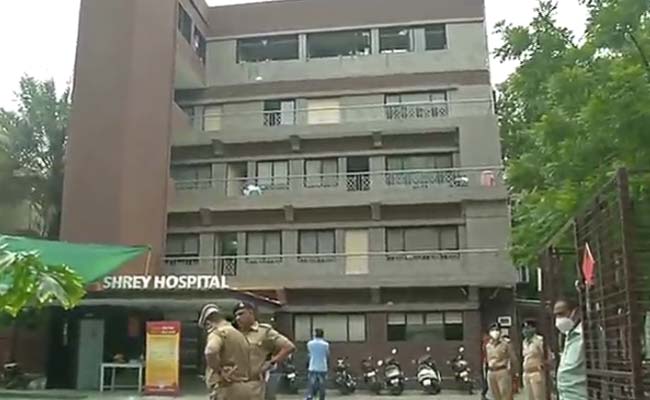
Eight people have lost their lives in a massive fire that broke out in Shrey Hospital in Navrangpura area of Ahmedabad, Gujarat. The hospital has been declared as Chinese Coronavirus hospital. The fire broke out in the ICU ward. Three women and five men have lost their lives. About 35 patients who were undergoing treatment have now been moved to SVP hospital.
As per reports, the fire broke out late last night. Two of the deceased patients have been charred beyond recognition. One of the other patients is reportedly in critical condition. Principal Health Secretary Dr Jayanti Ravi has assured unbiased probe in the incident. The mayor has reached the hospital and investigation is currently underway.
LB Zala, assistant commissioner of police, B division, Ahmedabad city while speaking to Indian Express said that the fire started at around 3:30 AM and has been controlled now. 8 people have lost their lives.
PM Modi took to Twitter to express his condolences.
Saddened by the tragic hospital fire in Ahmedabad. Condolences to the bereaved families. May the injured recover soon. Spoke to CM @vijayrupanibjp Ji and Mayor @ibijalpatel Ji regarding the situation. Administration is providing all possible assistance to the affected.
PM Modi said that he has spoken to Gujarat Chief Minister Vijay Rupani and Ahmedabad mayor Bijal Patel to take stock of the situation.
The PMO has announced ex-gratia of Rs 2 lakh each from PMNRF.
Ex-gratia of Rs. 2 lakh each from PMNRF would be given to the next of kin of those who have lost their lives due to the hospital fire in Ahmedabad. Rs. 50,000 each would be given to those injured due to the hospital fire.
On the day the Bhoomi Pujan for a grand Ram Mandir at the Ram Janmabhoomi in Ayodhya took place, devotees of Lord Ram were attacked by police in West Bengal for organising puja violating lockdown norms. The incident happened in Kharagpur town in Medinipur district in West Bengal, where police lathi-charged Hindus for organising Ram Pujas during the one-day lockdown on 5th August.
5 August was one of the days scheduled for lockdown announced by the Mamata Banerjee led TMC govt in the state, where 7 days in the month has been selected for the lockdown. Other dates for the lockdown are 8, 20, 21, 27, 28 and 31. As these are standalone single day lockdowns, state BJP had requested to shift the 5th August’s lockdown to another date, but it was not agreed by the govt. It may be noted that the lockdown dates have been changed twice after they were announced on 31st July. The dates were changed after receiving requests from different communities since the dates coincided with festivals, officials had said. All lockdowns scheduled on Sundays were also cancelled.
According to reports, a puja was organised by members of BJP and Hindu Jagaran Mancha at the Jagannath temple in Khargpur today, on the occasion of beginning of Ram Mandir construction in Ayodhya. Police had ordered the organisers to stop the puja as lockdown restrictions are in place due to the ongoing Coronavirus pandemic. But the organisers of the puja defied police order, and they continued with the program.
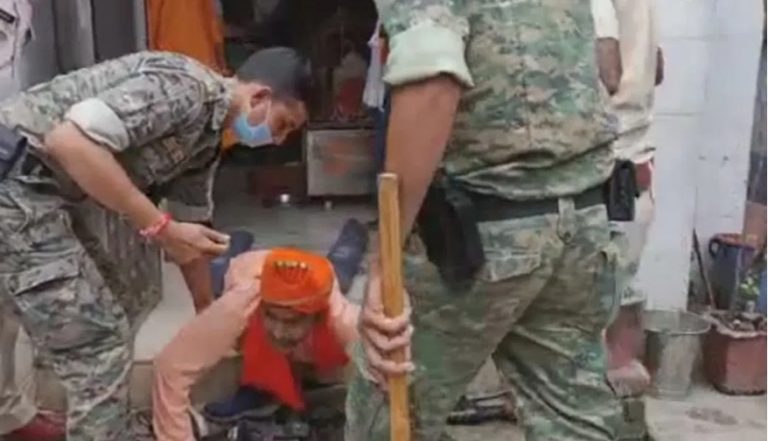
As the programs of the puja continued, a police team entered the venue and tried to stop it forcefully. This led to a clash between devotes and police, and several people from both the sides were injured as a result. After this, the police resorted to lathi charging the devotees, and they also pulled people out of the venue to stop the Puja for Ram Mandir.
A similar incident happened in Talbagicha in Kharagpur, where women workers of BJP had organised a Ram Puja. There too, a police team arrived and obstructed the proceedings. This resulted in a clash, after which the police lathi charges the women. Several persons from both sides were injured in this incident also.
Similar incidents were repeated in several other places in and around Kharagpur, where Ram Puja organised by BJP and Hindu groups were disrupted by police, and lathi charge was done on devotees. Police also removed sound systems and other facilities arranged for the Pujas.
Videos have emerged on social media showing police lathi charging Ram devotees for organising Pujas violating lockdown orders, and removing them from the venues. The video embedded with the tweet below shows police lathi charging devotees at a temple in Kharagpur.
बंगाल के खड़गपुर में श्री राम मंदिर के लिए पूजा का आयोजन किया गया था। लेकिन ममता दीदी की पुलिस ने लाठी चार्ज कर दिया, महिलाओं को भी नहीं बख़्सा। बहुत ही दुर्भाग्यपूर्ण। pic.twitter.com/NcwVmtj7sU
Another video shows police forcefully removing devotees from a Puja organised at a temple. They were later taken away from the place in a bus, while the devotees were chanting Jai Sri Ram. The video also shows that the temple was locked by police, and some devotes were beaten up by them.
After the incidents, a large number of people involved with organising the Pujas have been arrested by West Bengal police for violating the one-day lockdown order.
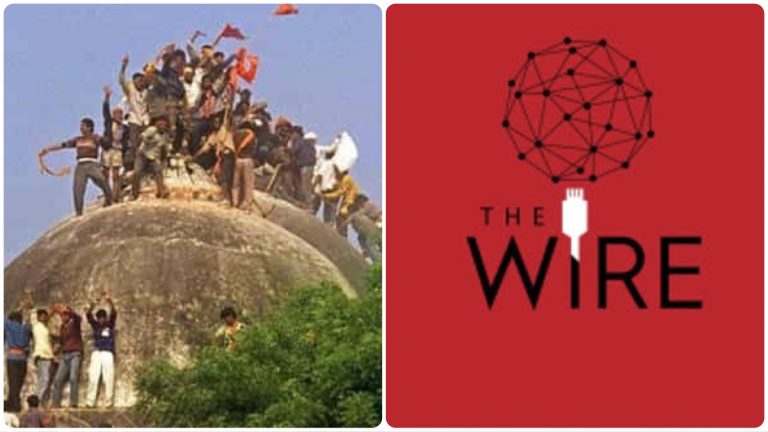
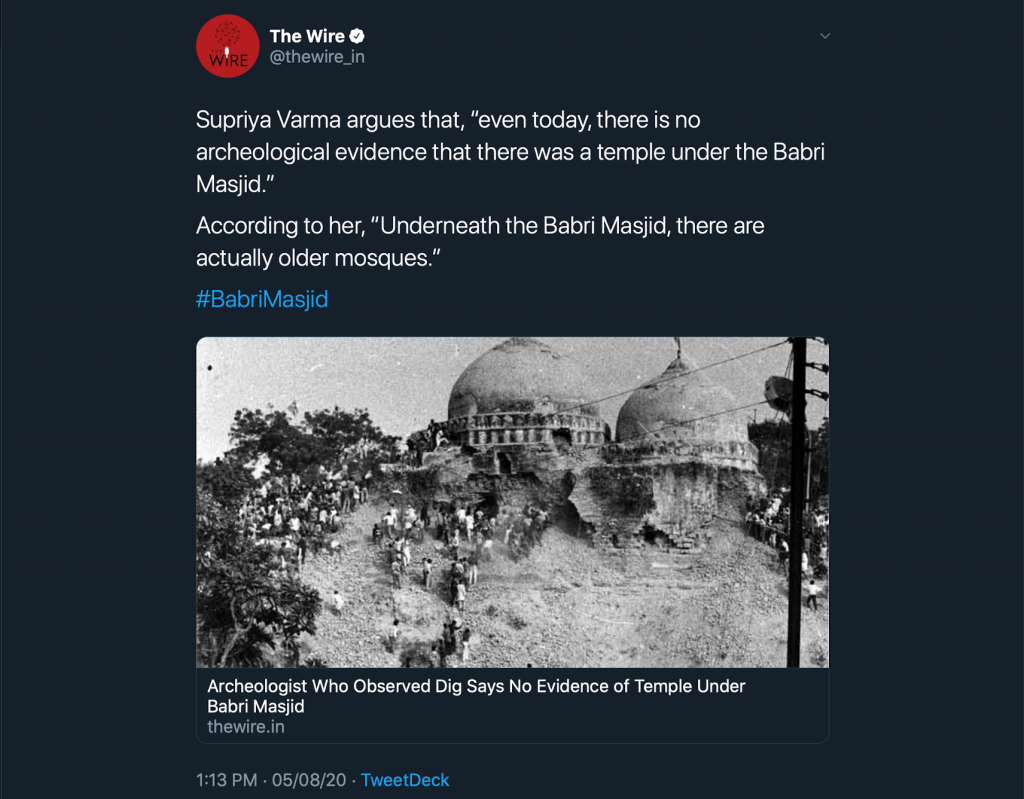
On the auspicious day of the Bhoomi Pujan ceremony, that marked the beginning of construction of the much-awaited Ram Mandir in Ayodhya, infamous left-leaning portal ‘The Wire’ replugged one of its old articles, raising questions over the legitimacy of the claims on the existence of a temple underneath the Babri structure.
The Wire shares an article alleging older mosques were found underneath Babri structure
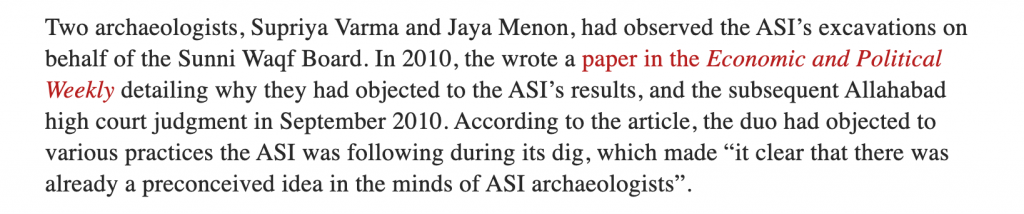
The article titled–”Archeologist Who Observed Dig Says No Evidence of Temple Under Babri Masjid” was originally published on December 6, 2018, and later on November 8, 2019, cited two archaeologists–Supriya Varma and Jaya Menon, who had reportedly observed the ASI’s excavations on behalf of the Sunni Waqf Board. It argued that the ASI finding of the existence of a temple beneath the Babri structure was patently wrong.
Relevant section from The Wire article
The article refers to a paper authored by the above-mentioned archaeologists in the Economic and Political Weekly, in which they had raised questions on the practices followed by the ASI during its dig, claiming that “there was already a preconceived idea in the minds of ASI archaeologists”.
Casting aspersions on the findings of the ASI and accusing them of observing procedural lapses, The Wire article quotes Varma as saying, “There is no archaeological evidence to prove that there was a temple underneath the Babri structure. In fact, there are older mosques under the Babri structure.”
Varma also asserted that the final ASI report on excavations at the site left much to be desired. She claimed that there was no mention of the temple in the entire report by the ASI and the details about the alleged human skeletal remains recovered from the site were missing in the report.
Allahabad High Court in 2010 unanimously rejected the allegations made by “experts” such as Supriya Varma
However, while The Wire shared an old article on the day of the foundation-laying ceremony of the Ram Mandir, in a bid to dispel the fact that a temple was found underneath the Babri structure, it conveniently did not mention the Allahabad HC’s scathing observations on the allegations levelled by the archaeologists cited by The Wire.
The Allahabad High Court in 2010, headed by three judges, unanimously rejected the objections raised by the “experts” to the presence of the temple. Regarding Supriya Varma, the archaeologist quoted by The Wire in its article, the Allahabad HC observed that Varma hadn’t read about the ground penetration radar survey report that led the court to order an excavation.
The court also observed that all the independent witnesses were all connected. Varma had done her PhD under Shireen F Ratnagar, who had written “introduction” to a book by another expert who deposed, Professor Mandal. However, she admitted she had no field experience.
Verma and Menon alleged that pillar bases at the excavated site had been planted but the High Court found that both of them were not present at the time when the actual excavation took place.
The Allahabad HC judges had stated that opinions had been offered by the experts without making proper investigation, research or study in the subject. The judge remarked that he was “puzzled and startled” by contradictory claims made by the experts.
Commenting on the experts who refused to vouch for the veracity of the claims made by them, Justice Agarwal noted, “One cannot say that though I had made a statement, I am not responsible for its authenticity since it is not based on my study or research but what I have learnt from what others have uttered.”
The Allahabad HC made withering remarks against the so-called experts Supriya Varma and Jaya Menon in 2010. Yet, The Wire, granted them legitimacy by quoting them in an article in 2018, later in 2019 and now again in 2020. The sole motive of The Wire to cite the discredited ‘experts’ in their article is to undermine the Hindu claims over Ram Janmabhoomi site and strengthen the narrative that the site originally belonged to Muslims.
The timing of replugging the article is particularly notorious, with the country gripped in the festive mood following the consecration of the Ram Mandir in Ayodhya. It was done to sow seeds of discord among the society and paint Hindus as aggressors by wrongfully appropriating what allegedly belonged to Muslims, notwithstanding the Supreme Court verdict on the issue last year, which ended the decades-long dispute by granting the Ram Janmabhoomi site to Hindus.
On the day the construction for Ram Mandir at the Ram Jamnabhoomi in Ayodhya started with the Bhoomi Pujan conducted on the presence of prime minister Narendra Modi, imagery depicting the upcoming Mandir were displayed at the Times Square in New York, USA. Video posted by ANI shows a large curved digital billboard with the images of Lord Ram and the Ram Mandir on it, located at the iconic Times Square. The Indian tricolor can also be seen in the billboard.
#WATCH USA: A digital billboard of #RamMandir comes up in New York’s Times Square.
Hindus in the USA have rented several billboards in the are to display text and images related to the Ram Mandir on the historic occasion. American India Public Affairs Committee had made arrangements to celebrate the historical moment of Ram Mandir Bhoomi Pujan in New York on 5th August, and they had leased prominent billboards for the occasion including the 17,000-square-foot wrap-around LED display screen and the giant Nasdaq screen at the Times Square. These are highest-resolution exterior LED screens at Times Square in New York.
Muslim groups in the USA and left-liberal activists in both India and USA had tried hard to stop the display of Ram Mandir’s imagery on the digital billboards at Times Square. They had launched a campaign against it after it was known that Hindu groups had hired billboards for 5th August. They had also contacted the advertising agencies that own the billboards to stop the display, but apart from one agency, others didn’t agree with them.
Several Muslim groups including Indian Minorities Advocacy Network- ImanNet, Justice for All, Coalition of Americans for Pluralism in India CAPI, North American Indian Muslim Association NAIMA, Islamic Circle of North America -Social Justice ICNASJ and The International Society for Peace and Justice filed the petition and asked the ad companies that manage the billboards not to project the images on the LED billboards managed by them. Accordingly, ‘Branded Cities’, the firm that manages the NASDAQ digital billboard had said that they have decided not to give the said billboard for the 5th August event to the Hindu groups.
After a decade long historical, political and legal dispute and with a Supreme Court intervention brought to closure in the matter of construction of Ram Mandir and, finally, Lord Rama shall get its abode to live. With Sacred soil from holy places and prominent temples from across the country and almost, all religiously significant water bodies in India are going to play a pivotal role during the construction of the Ram Mandir. The holy elements were in Ayodhya when PM Modi attends the ‘Bhoomi Poojan’ on August 5 for the construction of the temple.
Stories of ‘Maryada Purushottam’ Ram who is a reincarnation of Lord Vishnu and an epitome of righteousness was prevalent in every corner of India through tradition and culture. Therefore, the presence of sacred soil and water from every region of India naturally going to signify the age-long cultural roots existed during the pre-Colonial period across the country. This shall reflect the sentiments and emotion of people of India which is passing from generation to generation through many folk-tales and songs.
The word ‘Ram’ is not merely a word for an ancient civilization like India which is still in existence till date. The name represents identity, a value which has been in practice and alive superseding all historical ages. It lives in the hearts of people through folk stories from northern to southern region of India than from West to Eastern part of India. If there is a name in all parts of India that a child reveres early on his life, it is the name ‘Rama’. His legendary life stories have travelled beyond the shores of India to countries in South-East Asia where the Ramayana – which is artistically depicted through drama, music, dance, art and sculptor, even today.
India is a homeland to Ramayana, one of the largest epic poems in Indian Literature, a tale of spiritual heroism and the struggle for truth through an era, unapologetically true to its time period holding within its lessons for people of all times and places. However, it is distressing to note that for decades there was an ongoing and continuous distressing happened with this legendary figure in a spiritual country like India. There were less consensus and more controversies.
The saga of Ramayana was also prevalent in present North-eastern part of India. The whole idea that North-East of India was peripheral to Indian civilization and culture in the early centuries of the Christian era is based on the inadequate data and unfounded suppositions. Very little effort has been done so far to explore the North-East Indian land route through which elements of Indian civilization were exported to the South-East Asia. T
he Tra-Kieu inscription of King Prakashdhara of Champa (A.D. 653-679) mentions the erection of an image of Valmiki in the southern part of present-day Vietnam. It shows that how Indians travelling from the North-eastern land route, carried the eastern version of the epic story to the countries of Indochina is a hypothesis which cannot be dismissed together. The Rama legend, which travelled through north-eastern land route, was considerably transformed into its new home of adoption and returned to the North-East states of India by the 18thcentury with the Indochinese population trekking down along the Brahmaputra valley or the Patkai hills.
However, as I mentioned earlier it is a misfortune that there were more controversies regarding the name Lord Rama in Indian than a word of reverence in the last few decades. It is maybe because many of us now lived with a kind of mixed identity not knowing our own cultural and ancient root. The struggle of Ram Mandir becomes a matter of irrelevant for many people because of excessive induction of foreign ethos without understanding its intricacies.
Still, as it says time is everything. It is a matter of pride for each one of fellow Indians to witness a recent development related to Ram Mandir, where a century-old dispute over the site was resolved in November last year, as the Supreme Court of the Temple trust so, finally after loads of turmoil Ram Mandir foundation likely to laid on August 5th 2020 with a Bhoomi Pujan ceremony in Ayodhya. Consequently, Ram Janmabhoomi Teertha Kshetra Trust Member, said water and soil from the sacred river and holy places have been sending from across the country to Ayudhya.
Therefore, with the ‘Bhumi Pujan’ is nearing the holy soil water of Kamakhya Temple, which is one of the 51 Shaktipeeth, sent to Ayodhya. The Doloi of Maa Kamakhya Devalaya Committee, Kavindra Sharma said that collected soil and water from the temple to be used in the foundation laying ceremony for the Ram Mandir in Ayodhya.
Similarly, soil and water from Meghalaya’s Jaintia Hills were also collected to be used in building Ram Mandir. The Water collected from two rivers namely Myntdu and Myntang and soil from Syntu Ksair, Jowai and Nartiang. It is said that a 600 years old Durga Temple is located at Nartiang in the West Jaintia Hills district of Meghalaya.
This temple is also one of the 51 Shaktipeethas and is one of the holiest sites for devotees. A section of the ethnic community of Jaintia Hills of Meghalaya who are the followers of Sanatan Dharma believes that this temple is the permanent abode of Goddess Durga. Myntdu river is one of the major water bodies in West Jaintia Hills district, locally known as ‘Ka Tawiar ka Taken (Our Guardian Angle) in the Pnar dialect.
In addition waters and soils are being collected from other states of North-East India too. These are as follows:
List of Soils and Water Collected across North-Eastern States
River
Area
State
Brahmaputra
Assam
Assam
Dhansiri
Dimapur
Nagaland
Barak
Cachar
Assam
Dhaleshwari
Cachar
Assam
Surma
Cachar
Assam
Disang
Sivsagar
Assam
Kopili
Dima Hasao
Assam
Mahur
Dima Hasao
Assam
Jatinga
Dima Hasao
Assam
Langting
Dima Hasao
Assam
Gumati
Tripura
Kushiyara
Cachar/Barak
Assam
Longai
Karimganj
Assam
Tut
Mizoram
Tlawng
Sairang
Mizoram
Karnaphuli
Mizoram
Imphal
Mizoram
Jairl
Manipur
Lohit
Parashuram Kund
Arunachal Pradesh
Sipu
East Siang
Arunachal Pradesh
Siyom
West Siang
Arunachal Pradesh
Tirap
Arunachal Pradesh
Dicrong
Doimukh
Arunachal Pradesh
Myntdu
Jowai
Meghalaya
Morangang
Nartiang
Meghalaya
Moragang
Majai
Meghalaya
Umiam Lake
Bada Pani
Meghalaya
Till the present day. North-Eastern culture of India has always been treated and looked upon as a unique entity by many native historians who are already crippled by the crooked power of colonialism with no connection with the rest of India and Indian civilization per se. Unfortunately, no concrete work has been done to supersede that hegemonic power even after reaching the heights of information and knowledge society.
In fact, there is an ample of evidence in the tradition and culture of North-Eastern culture to prove that how the stories of Rama were predominant. For example, a close look at the Mizo version has disclosed that most of the Mizo folk-tale has the presence of Ramayana. The Karbis of North-Eastern India has a folk version of Ramayana which is popularly known as Sabin Alun (Chabin Alun). The tradition of song and music in Karbi Society started with Sabin Alun.
It literally means Sabin’s songs, which has been composed by Hemphu, the supreme creator, akin to Lord Vishnu. Even in Assam also 14 different forms of Kamrupi or Assamese Ramayan are so far collected and these are written in Different period by different writers. Madhav Kandali was the old and foremost one who translated this epic from the Sanskrit language to old Kamrupi Language in 14thCentury. It is one of the sources of the Old Assamese language and literature.
It is also known as Kamrupi Language which is very old in form and nature. In Tripura, if you visit the hills and deep forests and Chittagong hills Tract the old people often found reading Ramayana and Mahabharata both. Actually, the epics have been found themselves to be perennial sources of inspiration and an ocean of wisdom from which a galaxy of folktales, proverb, riddles, poems, songs, drama, dances, dialogues and visual arts have been composed by people.
Manipuri Literature which has a rich old heritage from about 10th century A.D. has a Manipuri Ramayana with all 7 cantos. King Garibniwaz entrusted one Pandit Angom Gopi or Kshema Singh Moiramba with his assistants to compose the Ramayana with a regional complexion and a large dose of the cultural soil of Manipur and it’s become a national epic of the Manipuris. The story of Ramayana is also known among the Khasis and is used to be narrated by the elderly people while sitting around the hearth. It is said that in Meghalaya the names of Rama and Lakhan are common for twin brothers and Durga and Ganga (pronounce as Konga) for twin sisters.
Conclusion
The existence of Lord Rama is not merely limited to a concrete structure. It is a wave of cultural phenomena. Indian culture is not just the domain of art and its understanding but includes literary texts that created meaning through practices, rituals, events and structures. It manifests a way of life that is based on universal values. In the context of North-Eastern India in particular and the whole country in general Ramayana has best served the purpose of cultural continuity and integration. And the construction of Ram Mandir shall further strengthen this value which has been revered since time immemorial.
It is a matter of great disappointment till now that there are lots of forces were working to disrupt this bridge. The north-Eastern part has been treated in isolation for many decades. A myth was propagated through a different medium that there was no connection between North-eastern India with the greater part of India.
Numbers of conspiracies were written to show that people living in hills and forest has nothing with Sanatani values. Whereas the fact was there has always been a cultural oneness from Iran to Indonesia (Angkor Vat). North-east was never an excluded part of India. Sanatan Dharma was extended throughout Northeast India and there was a similarity between life philosophy between hills and valley people. Hope such a great endeavour of cultural oneness that going to happen through the construction Ram Mandir shall unravel the true story of Northeastern Bharat.
(This article has been authored by Dr Phirmi Bodo who is the Assistant Professor at Centre for the Study of Social Systems, Jawaharlal Nehru University, Delhi)