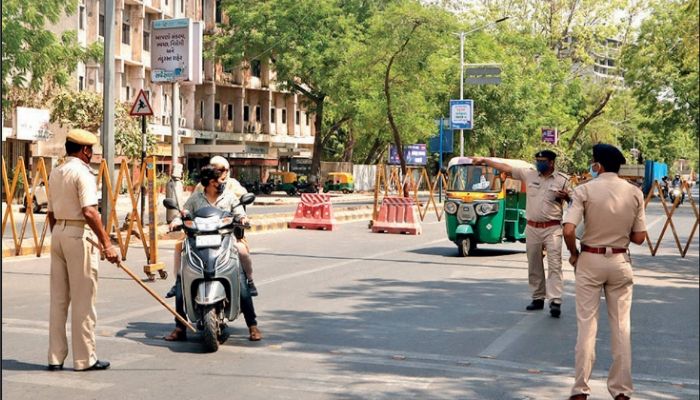
The Uttar Pradesh government today accepted Congress General Secretary Priyanka Gandhi Vadra’s offer of providing 1,000 buses for migrant workers.
Letter by UP Addnl CS (Home) to Priyanka Gandhi Vadra
In a letter to Priyanka Gandhi Vadra, UP Additional Chief Secretary (Home) Awanish Awasthi informed her that the government has accepted her proposal dated 16th May for providing buses for migrant workers. “Hence, without any delay please send list of drivers and co-drivers of these 1,000 buses so that we can make use of them in bringing back the migrant workers,” he wrote.
आज यूपी सरकार को पत्र लिखकर कांग्रेस की तरफ से 1000 बसें चलाने की अनुमति मांगी है।
रोज होती दुर्घटनाएं, असहनीय पीड़ा, अमानवीय हालात। हमारे कामगार भाई-बहन और उनके बच्चे संकट के दौर से गुजर रहे हैं।
— Priyanka Gandhi Vadra (@priyankagandhi) May 16, 2020
On 16 May 2020, Priyanka Gandhi Vadra had tweeted a letter wherein she had written to UP government seeking permission to ply 1,000 buses for migrant workers.
Congress’ offer to pay for migrants travel
Earlier this month, Congress interim President and Priyanka Gandhi Vadra’s mother Sonia Gandhi had offered to pay for passengers in Shramik Express trains which were run by government to facilitate travel of migrants stuck in other parts of the country. However, the offer to pay came after it was already clarified that migrants do not have to pay for the tickets and that the governments were bearing the cost. Soon after Congress’ offer, Rajasthan Chief Minister Ashok Gehlot, in a bid to save party fund, immediately offered that the state government will bear the cost of migrants instead. Days later, Punjab Congress MLA was caught on camera boasting to migrant workers in trains it was actually Sonia Gandhi who has paid for the tickets of the migrants.
The India Today Group has decided to sell images of migrant labourers in distress during the lockdown. Copyright images of migrants fleeing for their native places are available on indiacontent.in for prices as high as Rs. 20,000 for a single photograph excluding taxes. The sizes range from small to large with the former costing Rs. 8000 per photograph.
मजदूरों की घर लौटने की हृदयविदारक तस्वीरें website पर बिक्री के लिए देख स्तब्ध हूँ ,
इन बेचरों को पता भी न है कि वो बिक गए उनके आँसू टूटी चप्पल फटा बैग सब बिक गया! एक फ़ोटो का दाम 8000 से 20000 तक!माना कि सबको घर चलाना है लेकिन इन तस्वीरों से कमाई? pic.twitter.com/A7R4lLLCsd
While there is nothing wrong at all with selling photographs online for money, it does appear rather insensitive to profit from someone else’s misery. The circumstances appear more disconcerting considering the fact that these are the same people who harp on about ethics and morality day in and day out but here they are, trying to earn revenues from a tragedy.
The mainstream media is often at the forefront of levelling accusations at politicians of trying to gain political mileage out of tragedies, often rightly so, but here is India Today Group trying to earn revenues out of tragedies. The media appoints itself as the self-styled moral guardians of society and yet, here they are, acting in a very insensitive manner.
The mainstream media has also been busy comparing the amount of money businessman have donated during the Coronavirus crisis to help the world overcome it. India Today Group has been one of the networks who have engaged in this. Also, numerous journalists on numerous occasions in the past have suggested the appropriation of Temple Gold to help the poor or the economy. Given the manner in which the media always appears overeager to conduct charity with the money that does not belong to them, it is intriguing to note that media networks do not appear to engage in charity with the revenues they earn through their products. Quite certainly, India Today Group will not be publishing data regarding the percentage of their wealth that media networks have donated during the Coronavirus crisis.
The mainstream media also, quite ironically, demonises capitalists incessantly and often props up communist delinquents as the actual voice of the people. They are quick to amplify the allegations of ‘suit-boot ki sarkar’ made by political parties when the government makes it easier for businessmen to carry on with their work and yet, they themselves do not hesitate to engage in profiting from the misery of the poor.
A business provides its employees dignity and instils in them a sense of self-respect and yet, capitalists are continuously denigrated by the mainstream media. All the while, they side with communist leaders when they cast aspersions on the integrity of businessman without any nuance or valid justification. Simultaneously, the mainstream media is always eager for more and more socialism and in India, especially, the mainstream media has been at the forefront of cheering for socialist policies that inhibits the full potential of businessmen.
Yet, when it comes to earning revenues for themselves, the mainstream media suddenly finds virtue in capitalist practices. “Do as I say, not as I do,” appears to be the motto of media networks such as the India Today Group. It needs to be repeated here that there is nothing with selling photographs for money, however, it is indeed extremely hypocritical on the part of media networks which incessantly engages in moral sermons and yet, seeks to profit of the misery of poor migrant labourers.
During the Coronavirus crisis, we have seen journalists associated with prominent media networks urge the migrants to pose adequately so that they could capture better photographs. Such insensitivity have become a part and parcel of mainstream media networks. However, that hasn’t stopped them from preaching sermons through their platforms. It appears that they believe they are not subject to what they preach and consider themselves beyond the routine norms of decency.
At the outset, let me say this is not an attempt to disparage the government nor the people of Kerala. Despite some exaggerated claims by politicians. This is an attempt to understand.
We have been hearing a lot about the so called Kerala model of tackling the Coronavirus. Of course, one has to adjust for the fact that Kerala attracts automatic positive coverage because it has a Communist government. For example, Kerala has around 600 cases to date. Neighboring Karnataka has around 1100. Which works out to almost the same when you account for the fact that Karnataka has around twice as many people as Kerala. However, you can be certain that you wont hear of “Karnataka model” in the media any time soon. At least not until the state has a BJP Chief Minister.
Anyway, I digress. Let’s see if we can identify something special about Kerala. By now, it is clear to us that the pandemic is sustained by big cities. This is all too obvious. In the US, it is New York. In the UK, it’s London. In India, it’s Mumbai.
This makes perfect sense. A city generally has a large number of people packed densely into a small area. Also, cities tend to have highly mobile population. In times of pandemic, cities are dangerous places. This has been known for hundreds of years.
Tiny Singapore, with its population of 56 lakh people, has nearly 30,000 cases. That’s a third of the number for the whole of India! The pandemic is not in states nor in countries. The pandemic is in cities.
Consider how concentrated the pandemic is. While Mumbai takes up a tiny fraction of the land area of Maharashtra, it accounts for 56% of all cases across the state. Once you add in Thane and Pune, you are up to almost 80% already. In Gujarat, the situation is even more striking. Ahmedabad alone accounts for almost 75% of cases in the state. Once you add Surat and Vadodara, you go past 90%.
Up north, Delhi alone has twice as many cases as the whole of Uttar Pradesh.
So when we think nationwide in terms of the pandemic, we have to ask ourselves: where are the cities?
So which is the largest, most populated city in India? I’m sure you know that the answer is Mumbai. Then, there is Delhi. And they’re both suffering badly from the Coronavirus, just as you would expect. At No. 3 there is Bengaluru. But we have already agreed that we are not allowed to praise the work of BJP Chief Ministers. So we will just pretend that Bengaluru does not exist.
Who is next? There’s Hyderabad and Ahmedabad, which completes the top 5. Then there’s Chennai, Kolkata, Surat, Pune and Jaipur. In case you are wondering, Lucknow comes at 13, Bhopal at 16, Patna at 19, Ranchi at 38 and Raipur at 45. We are almost at the end of the top 50.
Wait a second. Where did Kerala go? Believe it or not, Kerala doesn’t have a single city in the top 50 in India. In fact, Kerala almost didn’t have a city in the top 75! The largest city in Kerala is Kochi, which makes it to the 75th place in the nation!
The most honest way to understand the pandemic is not by looking at state totals, but at city totals. If you have more cities, the pandemic strikes you hard. This is obvious from looking at the list of top 10 cities in India.
So here is a simpler hypothesis about ‘Kerala model.’ The pandemic did not strike Kerala hard simply because it had nowhere to go in Kerala. Because Kerala didn’t have big cities. No city in the top 50. Barely made it to the top 75.
Beware! Just because Kerala doesn’t have big cities does not mean it is not an urbanized state. In fact, the % of urban population in Kerala is above the national average. What this means is that Kerala’s “urban areas” are spread out. The state just does not have the kind of closely packed, super productive, metropolis that Mumbai, Delhi or Bengaluru would be.
So what do we have to learn? Without any disrespect to Kerala, not very much. Big cities don’t exist in Kerala because its economy does not need big cities. The usual economic engines such as financial hubs, tech hubs or factories do not exist in Kerala. Instead, the state has a remittance economy.
This works great for Kerala. But this is not a model that can be scaled up. The factories, the offices, the skyscrapers, all have to be somewhere. Wealth has to be created somewhere before it can be remitted to Kerala. In the case of Kerala, much of the economic engine has been shifted to the Gulf.
Again, this works great for Kerala. The state itself stays sheltered from the immediate drawbacks of a modern economy: big cities, polluting factories and now a pandemic. But the modern economy has to exist somewhere to generate the wealth that will support Kerala’s idyllic economy based on remittances, tourism and fishing.
So when we scratch under the surface, we find that the Kerala model has little to teach us. In times of pandemic, the most important thing is to identify the factors that lead to success or failure. In identifying these factors, the biggest mistake we can make is letting political biases get in the way.
In a viral video, Indian cricketer Virat Kohli is seen praising the efforts of RSS’s volunteers’ wing Sewa Bharati for their exemplary work in Delhi and across the country helping people in distress amid the coronavirus pandemic.
In his 0.42 sec video, Kohli congratulates Sewa Bharati organisation in Delhi for “doing such amazing work over the years and the initiative they are taking now. To get volunteers from all the best schools in Delhi. To go and do seva drives and to help other people. I just want to say that do it with all your heart, with absolute pure intent. Helping another life and helping another soul is the biggest work you can do so I wish you all the best, safety and health as well”, said Kohli in his video message.
Here’s what @imVkohli has to say about Seva Bharati’s selfless relief work during this hour of global crisis.
We are proud that hundreds of ABVP karyakartas across India are working with Seva Bharati round the clock to ensure no one sleeps helpless and hungry. pic.twitter.com/pqSHRb8pZI
The organisation Sewa Bharati is headquartered in Delhi, from where the relief work is being carried out across the country. From distributing food packets to manufacturing masks at war footing and reaching out and distributing at places facing a scarcity to distributing bed sheets and blankets to providing basic medicines, Sewa Bharati cadres have been in the forefront in extending crucial help to the needy at the time of this pandemic. Moreover, almost 2.10 lakh cadres have been reaching out to the remotest corners of the country in order to extend their assistance.
Sewa Bharati running 45 kitchens in Delhi alone
Almost 5,000 cadres have been feeding 75,000 Delhiites on a daily basis. So far the food they are providing is made out of 45 kitchens spread across Delhi. Once the food packets are ready, their zonal teams distribute among the needy in their area.
Sewa Bharati has also been distributing milk and beverages to patients and hospital staff at Coimbatore Medical College Hospital in the morning, according to Mr Ramanathan.
45 kitchens of Sewa Bharati are functioning in Delhi alone. The advice of doctors and government is also being taken care of while rendering these services. Social distancing is being followed. All the volunteers have been instructed to wear masks and gloves along with frequent usage of hand sanitizer while distributing as well as preparing the food at the kitchen.
Their cadres are also collaborating with temple trusts like the Jhandewalan Temple in the national capital where hundreds and thousands of meals are served each day.
A First Information Report (FIR) has been filed with the Uttar Pradesh police by Advocate Abhishek Rajpoot against a controversial TikTok video creator named Faizal Siddiqui for promoting acid attack as a means to avenge lost love by jilted lovers. Faisal has 13.4 million followers on the Chinese video-sharing app and is the brother of another controversial creator named Amir Siddiqui.
I filled FIR against this Faizal Siddiqui, memeber of team nawab and brother of Amir Siddiqui For promoting #Acid_attack on girls. pic.twitter.com/Zcs9D5sora
— Adv Abhishek Rajpoot (@Lawyer_AbhiSe) May 18, 2020
The NCW too took cognisance of the video and has written to DGP Maharashtra Subodh Kumar Jaiswal to take action against Siddiqui.
The NCW condemned the promotion of grievous crime of acid attack to his millions of followers on social media. The NCW has also requested action under the relevant sections of the IT Act.
The Contentious Video
A 9-second video by Faizal Siddiqui was shared on Twitter by a user named Intrepid Saffron. The video has, since then, gone viral on social media. In the contentious TikTok video, he can be heard saying, “Usna tumhe chor diya jiska liya tumna Mujhe chora tha“. The loose translation goes as “Did the man, for whom you abandoned me, leave you?” Following the dialogue, he goes on to recreate a disturbing scene of an acid attack. The face of the victim is then seen covered in scars.
Chinese smartphone brand Oppo India has suspended its factory operations in Uttar Pradesh’s Noida after six of its employees tested positive for Chinese coronavirus. The factory had resumed its operations on 8th May 2020 after nationwide lockdown was eased with social distancing guidelines in some parts of the country.
OPPO India’s statement read: “As an organization that places the safety of all our employees and citizens at the forefront, we have suspended all operations at our manufacturing facility in Greater Noida and initiated #COVID19 testing for 3000+ employees, for which results are awaited.”
“Will only allow employees with negative test results to resume office following all safety protocols. We are undertaking stringent measures to keep the employees safe and disinfecting the premises,” it read further.
As an organization that places the safety of all our employees and citizens at the forefront, we have suspended all operations at our manufacturing facility in Greater Noida and initiated #COVID19 testing for 3000+ employees, for which results are awaited: OPPO India https://t.co/6cGzM4ZDOx
Oppo had resumed operations 8th May 2020 with 30 per cent of its employees, after Home Ministry directives. The company has also started sales of mobile phones through Amazon, Flipkart and retail stores in permitted areas.
Mostly all smartphone manufactures had suspended manufacturing or assembling at their respective plants in the country almost from March 20 onwards. The MHA had then issued new guidelines to regulate different activities in this period, based on the risk profiling of the districts of the country into the red (hotspot), orange, and green zones, under which it had allowed IT manufacturing units including mobile phones resume operations from May 4.
Noida reported 8 new coronavirus cases on May 17 (Sunday), taking the total number of coronavirus cases in the district to 255.
Meanwhile, as many as 10 coronavirus patients were discharged in Noida Sunday, after getting cured of the deadly virus. With this, a total of 191 patients have been recovered and discharged from the hospital till now. The number of active coronavirus cases in Noida stands at 59, while the coronavirus death toll in the district is five.
Dhruv Rathee, ’eminent’ Youtuber and propagandist for the Aam Aadmi Party, is renowned for his habit of oversimplifying complex issues in order to suit his larger political objectives. Recently, he made a comment on Twitter which perfectly captures his intellectual bankruptcy. Responding to a tweet Dhruv Rathee opined that ‘by default, left-wing thinkers will always be more creative, imaginative and empathetic than their right-wing counterparts.
The ’eminent thinker’ also opined that the left-wing promotes ‘globalisation’, ‘open-mindedness’ and ‘out-of-box revolutionary thinking’ while the right-wing promotes ‘tradition’, ‘rules’, ‘strictness’ and ‘conservative thinking’. Thus, Dhruv Rathee is attributing causal relationship between personal traits and political opinions but he is doing so in the wrong direction. From his tweet, it is evident that he believes a person automatically becomes more creative when he endorses left-wing political opinions when, in fact, it is infinitely more likely that a creative person is more likely to have left-wing political opinions under the very specific sociopolitical conditions that exist today.
The tweet by Dhruv Rathee
As is his wont, Dhruv Rathee oversimplifies a complicated and an interesting issue in order to turn it into another opportunity to pat his back for having left-wing political opinions. His claim that left-wing promotes globalisation is extremely incorrect and is so wrong that it makes one question his very sanity. ‘Globalisation’ is very much a capitalist agenda that has no support at all from the left because it impacts domestic workers adversely. It is an agenda of the MNCs and MNCs by their very definition are not ‘left-wing’.
Does the Left-Wing promote globalisation as Dhruv Rathee claims?
The core objectives of ‘Globalisation’ are free trade, greater ease in the movement of goods and resources and more migration. In the United States of America, these are all the main agendas of the Republican Party, or at least it was until Donald Trump put his feet down. The support for illegal immigration from the Left and more globalisation from the Left is not due to ideological commitment but because it serves the interests of the Corporate Donors of the Democrat party by providing them with low wage workers. It is a simple matter of supply and demand. The more the available pool of workers, the lower is the cost of labour.
Similarly, MNCs stand to benefit the most from free trade as well. It can be seen how MNCs in the United States have outsourced manufacturing to China where the cost of labour is low so that they can increase their share of the profits. As a consequence of course, workers in the United States have suffered gravely due to it. And these policies had bipartisan consensus across party lines. And it also must be noticed that supporters of Bernie Sanders agree with those of Bernie Sanders when it comes to such economic issues. And that is why a lot of ‘Bernie Bros’ voted for Donald Trump in the 2016 US Presidential Elections instead of Hillary Clinton.
Thus, ‘Globalisation’ should not be viewed from the prism of ideology under current circumstances. But objectively speaking, it is closer to right-wing economics than the left. Care should be taken to remember here that the Indian ‘right-wing’ is not very ‘right-wing’ on matters of economics. Furthermore, it should also be borne in mind that Communist parties, with the prominent exception of India, have often been fiercely nationalist. Soviet Russia in the 20th Century was extremely nationalist in its approach, the Communist Party of China is extremely nationalist. It’s only India that communist parties have often tried to undermine the territorial integrity of our country.
Thus, considering all things, to claim that left-wing promotes ‘Globalisation’ is foolishness of the highest order. China, which literally has a Communist regime, has dedicated itself to bring an end to Globalisation as we know it. In India, the protectionist measures which are strongly espoused by all parties, and most vigorously by the ‘Left-Wing’, also indicate that Dhruv Rathee was just being an idiot.
Will Left-Wingers always be more creative, imaginative and empathetic?
Let us be clear, creativity and empathy are core human traits that have existed ever since the dawn of humanity. By contrast, left-wing politics as we know it has its origins in the French Revolution of 1789. If it were left to Rathee, he would argue that the Early Man who used to make paintings in caves was a left-winger. By his account, religious texts and traditions from thousands of years ago which emphasise the importance of acts of compassion and kindness are left-wing too. That is, quite obviously, ridiculous. Therefore, for him to declare that left-wingers will always be more creative and empathetic is simply ridiculous.
Also, creativity and empathy are more or less traits that are innate in an individual. These are traits that cannot be acquired. Either a person is creative or he is not, either a person is empathetic or he is not. Either a person scores high on the openness trait or he does not. Contrary to political opinions of an individual which changes frequently during the course of an individual over time, such characteristics of an individual do not usually change. Therefore, to insinuate that left-wingers will magically always be more creative and empathetic and left-wing promotes ‘open-mindedness’ is just bollocks.
Humans have been creative for as long as they have existed. The greatest works of Art throughout the course of history have been produced by deeply religious men and women. Such artists have always been patronised by the Kings, Nobles and the Aristocracy. Therefore, the claim that left-wingers will always be more creative than their right-wing counterparts flies in the face of all reason and logic. Were those who composed the great Bhakti music ‘left-wingers’? Were the great composers of ancient India who produced some of the greatest works of literature ‘left-wingers’? Just as not a single creative individual until the 18th Century were left-wingers, more likely than not, there will come a time in the future when left-wing ideas will lose favour among creative individuals.
As a wise man once said, men is always caught in the eternal present. And unfortunately, people believe that what is now shall always be. However, through the ages, enlightened men have always cautioned us: This too shall pass. Therefore, if Dhruv Rathee had the semblance of common sense and could cut down on his arrogance borne of unparalleled ignorance, he would have realised that there are certain conditions related to the very specific circumstances that prevail today which give people the impression that creative individuals are naturally ‘left-wing’. But this is an illusion that is generated due to a well burnished elaborate structure of incentives and inhdoctrination.
The Will of the Cathedral
There exists an elaborate network of multinational corporations, universities and civil society organisations which work together to dictate what is permissible for public consumption and what is not. The mainstream media and the entertainment industry serve as the propaganda wing of this structure. The neo-Reactionaries of the 21st century call this structure the ‘Cathedral’, an ironical jibe towards the fact that although the structure promotes a materialistic ideology that is antithetical to traditional religions, the ideology is essentially a sect of Christianity.
Over time, with significant organised effort, the ideology has managed to capture all the prominent institutions in the West. From Universities to civil society organisations to the mainstream media and the entertainment industry, the ideology dominates every aspect of Western society. The Cathedral engages in what Noam Chomsky calls the ‘manufacturing of consent’. This great beast has employed the considerable resources at its disposal to de-legitimise every other political thought. The ideology, of course, is Progressivism, the official doctrine of the left-wing today.
Unlike the West, the Cathedral has not been able to capture Indian society entirely due to a few obvious reasons. Firstly, it is an ideology that is entirely foreign to India and hence, it is not as suited for Indian society as it is for its native countries. Secondly, traditional religions are very dominant in India and the roots of Hinduism in India are still very very strong. However, it has managed to make great inroads. It has almost total control over the entertainment industry as of now and as the election manifesto of the Congress party demonstrated, it has hijacked the biggest opposition party of India as well. Simultaneously, the entire ‘civil society’ nexus in India, which is almost entirely controlled by the West, is an integral part of this cathedral as well. Also, due to the lack of educational reform, the Cathedral has hijacked Indian Universities as well.
It is due to the growing influence of the Cathedral in the entertainment industry and Indian Universities that it gives one the impression that creative individuals by their nature left-wing and will always be so. In reality, it is due to the indoctrination of our youth in Universities that the most intelligent among them endorse Progressivism as an ideology. And it is due to the financial incentives offered by the Cathedral that progressive works of art dominate the institutions of mass production. It might appear ironical but Left-Wing ideology in the 21st century is spread entirely by Big Business.
The dominance of left-wing politics in the entertainment industry works in two phases. Firstly, Universities ensure that the youth is indoctrinated en masse in progressive ideology. And secondly, it is ensured that works of art that promotes the said ideology are incentivised through financial means. For instance, while mediocre progressive-sounding movies are funded and released on Netflix and in theatres, it is inconceivable that a movie or web series that depicts Hindutva in a positive light will ever see the light of day. For instance, while movies and web series that demonises Hindus and Hindutva can be found in abundance, a venture that treats Nathuram Godse fairly and refrains from demonising him will never be funded and if somehow enough funds are generated to create a good enough product, finding a platform for it will be almost impossible.
That is how left-wingers dominate the entertainment industry. It is not because their product are inherently superior, it is because progressive works of art are capable of generating enough financial support. Furthermore, it is also essential that people in the industry air the right opinions or they are ‘cancelled’. Due to the uneven structure of the whole situation where individuals and works of art are not judged on the basis of merit alone, left-wingers tend to dominate the field. However, with the advent of Narendra Modi and the mainstreaming of Hindutva, a handful of movies have been produced which do not toe the progressive line. And with the continued dominance of Hindutva, it is almost inevitable that ‘left-wing’ ideology will lose prominence in the entertainment industry as well.
Dhruv Rathee: A servant of the Cathedral
The disproportionate influence of the Cathedral has also created a horde of idiots such as Dhruv Rathee who are convinced of their moral superiority and higher intellect merely because they are capable of mouthing the approved talking points. The ‘Champagne Socialists, or the ‘Status-Quo Revolutionaries’, do not realise that the opinions they voice are not controversial in elite circles at all and that they are essentially advocating for establishment talking points. But the illusion created by the Cathedral is so strong that such dim-witted individuals unironically believe that their opinions find greater prevalence among creative people not due to indoctrination but due to the inherent intellectual superiority of their beliefs.
The fact of the matter is, creativity and empathy are personality traits that have existed in people since the dawn of humanity. Under current circumstances, people who score high in these characteristics tend to fall in a specific political category but it does not always have to be so. The political dynamics of the 21st Century are transient and they will change in the near future and when they change, things that might appear true as of today will not hold true then. Even now, traditional art is produced almost entirely by conservatives and ‘right-wingers’. For instance, only a fool would call folk music ‘left-wing’. It’s just the Cathedral does not deem it fit for mass production.
Thus, ‘midwits’ of the Left such as Dhruv Rathee who work under the false impression that they are somehow superior intellectually to everyone by virtue of the slogans they endorse should try to gain a better understanding of circumstances instead of taking every opportunity to advertise their ignorance. The opinions on the left-wing and right-wing as aired by Dhruv Rathee are good for self-aggrandisement on social media and for lazy attempts at taking swipes at political opponents. However, they do not have any basis for truth. But when these are spouted often enough as grand facts, it further acts as self-affirmation for already indoctrinated individuals and raises a generation of highly confident ignorant deluded clowns such as the propagandist himself.
In a video that has now gone viral on social media, a Maharashtra police official can be heard lamenting over the lack of masks, health kits and sanitisers to the former Chief Minister Devendra Fadnavis.
A police officer, on patrol duty in Kinhiraja area of Washim was approached by Fadnavis. The cop confided in him about the lack of health kits, masks, and sanitisers. “Sir, this would not have happened if you were the Chief Minister”, the police officer could be heard telling the ex-CM, in the video.
The Opposition leader who was accompanied by Suresh Munde and Vinod Ghage told the officer to protect himself from infectious diseases such as the Coronavirus. “Take care of yourself. You are serving day and night”, Devendra Fadnavis said.
A Maharashtra policeman tells ex-CM Fadnavis they don’t have sanitizer, masks or anything. He also says that wouldn’t have happened if he was CM pic.twitter.com/Yvo5xi90Mv
Reportedly, the incident took place on Sunday at around 1:30 pm when Fadnavis was travelling to Mumbai from Nagpur. The former CM had stopped at the Shivaji High School in Kinhiraja and had inquired about the condition of Malegaon farmers.
However, the station in-charge of Jaulka police station has asked police officers to refrain from indulging in politics. “DSP has provided masks, sanitisers, and shield masks to the police officials. If there’s any additional requirement, please put in a request with the DSP’s office instead of politicising the issue”, the SI has stated as per a report in e-Sakal.
As per reports, 1153 policemen have been infected with the Coronavirus while 11 cops have died in the State of Maharashtra. Out of 1153 infected policemen, 128 are officers while remaining 1,026 are police constables.
Coronavirus in Maharashtra
The coronavirus outbreak in Maharashtra has reached dangerous levels, with many parts now under the threat of community spread of the virus, said a public health official. Maharashtra continues to top the list of states worst-affected by the menace of Coronavirus. It has so far reported over 33,000 active coronavirus cases with a staggering 1,198 fatalities. The capital of Maharashtra, Mumbai, alone has reported around 20,000 Coronavirus cases. Besides Mumbai, Thane and Pune are other cities in Maharashtra that are badly affected by the pandemic.
A complaint has been filed by Legal Rights Observatory (LRO) against politician Asaduddin Owaisi’s party, All India Majlis-e-Ittehad-ul-Muslimeen (AIMIM), for urging Muslims to disregard the Indian Judiciary in a viral poster.
The said complaint was filed with the Election Commission of India (ECI) and the Registrar of the Bombay High Court. In a Twitter post, LRO informed that the complaint sought for derecognition of AIMIM as a political party for ‘outrageous posters’, attempts to create a parallel judicial system and infusion of hatred against the Indian Judiciary.
— Legal Rights Observatory- LRO (@LegalLro) May 18, 2020
Contentious AIMIM poster
In the contentious poster, the party has urged Muslims to join them, besides encouraging them to ignore the Indian Judiciary and run a parallel Judiciary based on Islamic law. It encouraged Muslims to resolve their issues through Ulemas (clerics) and not courts. The poster read, “Muslims, if you stop going to the courts and instead resolve your issues through an Ulema (Islamic cleric), then, no Government will have the courage to intervene in your Shariat.”
The said poster had claimed that it is from AIMIM in Andheri (W).
In a series of announcements for the fiscal stimulus provided by the Government of India to battle the economic downturn induced by the coronavirus outbreak, Finance Minister Nirmala Sitharaman on May 18 declared the last tranche of the Rs 20 lakh crore Atmanirbhar Bharat Abhiyan economic package.
The relief package announced by the government includes a host of measures such as free food grains for distraught migrant workers, hike in foreign direct investment in defence, liquidity measures for the MSMEs, changes in Essential Commodities Act, increase in public expenditure in health, among others.
Here’s the split-up of the overall economic stimulus package:
Part 1
The first tranche of the economic relief package worth Rs 5.94 lakh crore provided liquidity measures to shore up small and medium business and support to shadow banks and electricity distribution companies. The definition of the MSME was changed and the threshold to qualify as MSMEs were raised. One of the significant announcement made by FM Sitharaman in the first tranche of economic stimulus package was Rs 3 lakh crore collateral-free automatic loans for businesses.
Sr no
Items
Rs(Crores)
1
Emergency W/C facility for Businesses, including MSMEs
3,00,000
2
Subordinate debt for stressed MSMEs
20,000
3
Fund of Funds for MSMEs
50,000
4
EPF support for Business and Workers
2,800
5
Reduction in EPF rates
6,750
6
Special liquidity scheme for NBFC/HFC/MFIs
30,000
7
Partial credit guarantee scheme 2.0 for liabilities of NBFCs/MFIs
45,000
8
Liquidity Injection for DISCOMs
90,000
9
Reduction in TDS/TCS rates
50,000
Total
5,94,550
Tranche 1 of the Economic Stimulus Package
Part 2
Totally Rs 3.1 lakh crore, the second tranche of the economic relief package included free food grains to the migrant workers across the country who have been amongst the worst-affected sections of the population from the economic tailspin caused by the coronavirus outbreak. A total of 9 announcements were made in the second tranche, which included free food grains to migrant workers for 2 months, national portability of ration cards, which permitted people to take ration from any public distribution unit in the country.
Sr no
Items
Rs(Crores)
1
Free Food grain supply to migrant workers for 2 months
3,000
2
Interest Subvention for Mudra Shishu loans
1,500
3
Special credit facility to street vendors
5,000
4
Housing CLSS-MIG
70,000
5
Additional Emergency Working Capital through NABARD
30,000
6
Additional Credit through KCC
2,00,000
Total
3,10,000
Tranche 2 of the Economic Stimulus Package
Part 3
The third tranche of the economic stimulus package saw the finance minister Nirmala Sitharaman allocating money for the Agricultural, Animal Husbandry and the ancillary sectors. A whopping Rs 1,00,000 crore was earmarked for bolstering the agricultural infrastructure in the country under Agri Infrastructure Fund. The government also declared that the Essential Commodities Act will be amended to deregulate prices of cereals, edible oils, oilseeds, pulses, onions, potatoes etc. Stock limit imposed on processors or value chain participants or any exporter subject to export demand was also removed by the government.
Sr no
Items
Rs(Crores)
1
Food Micro Enterprises
10,000
2
Pradhan Mantri Matsya Sampada Yojana
20,000
3
TOP to Total: Operation Greens
500
4
Agri Infrastructure Fund
1,00,000
5
Animal Husbandry Infranstructure Development Fund
15,000
6
Promotion of Herbal Cultivation
4,000
7
Beekeeping Initiative
500
Total
1,50,000
Tranche 3 of the Economic Stimulus Package
Part 4 and 5
The fourth and fifth tranche of the investment largely dealt with bringing about structural reforms. About Rs 40,000 crore allocation was added to the Mahatma Gandhi Rural Employment Guarantee Act(MGNREGA) and about Rs 8,100 crore for Viability. Gap Funding.
Sr no
Items
Rs(Crores)
1
Viability Gap Funding
8,100
2
Additional MGNREGS allocation
40,000
Total
48,100
Tranche 4 and 5 of the Economic Stimulus Package
Overall stimulus by Atmanirbhar Bharat Package
While the five tranches of stimulus package announced by the government totalled Rs 11,02,650 lakh crore, the relief measures declared by the government including the earlier scheme of Pradhan Mantri Garib Kalyan Package(PMGKP) worth Rs 1,92,800 crore and the measures announced by the RBI to tackle the economic downturn as the country staggers under the economic shadow of the coronavirus lockdown. The RBI package which is pegged at Rs 8,01,603 crore includes measures like moratorium on loan repayments for all borrowers and interest rate cuts etc.
Sr no
Items
Rs(Crores)
1
Part 1
5,94,550
2
Part 2
3,10,000
3
Part 3
1,50,000
4
Part 4 and 5
48,100
Sub-Total
11,02,650
5
Earlier Measures including PMGKP
1,92,800
6
RBI Measures(Actual)
8,01,603
Sub-Total
9,94,403
Grand Total
20,97,053
Overall stimulus provided by Atmanirbhar Bharat Package
The Finance Minister said that the last tranche will focus on 7 sectors- MGNREGS, Health (rural and urban) and Education related, businesses and coronavirus, decriminalisation of Companies Act, Ease of Doing Business, Public Sector Enterprises- related steps and state governments and related resources.