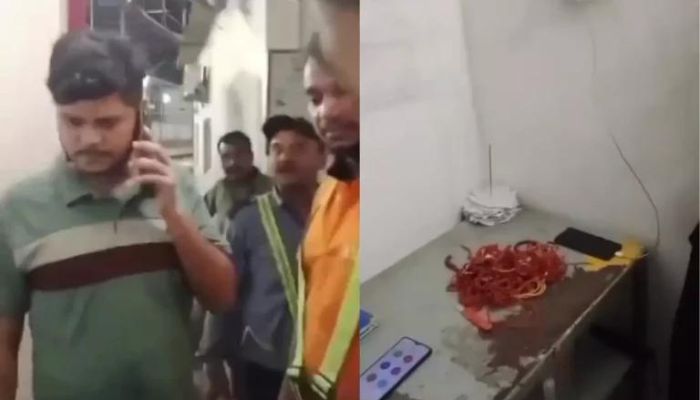
A factory of the beverage company Coca-Cola, located in Ayodhya city of Uttar Pradesh, has come under the scanner for cutting off the Kalavas (sacred thread worn by Hindus on their wrists) of its employees.
In a disturbing video that surfaced on social media on Monday (23rd September), the security guard at the factory could be seen disrespectfully removing Kalavas off the wrists of Hindu workers upon their entry into the premises.
As evident from the footage, the sacred threads of the employees were first cut permanently and then kept on a table. The incident has sparked outrage on social media for the complete disregard of Hindu sentiments by the American beverage company.
Coca-Cola refused to issue a statement initially but was later forced to give ‘clarification’ when the social media upheaval became intense.
Sachchidanand Tiwari, a security officer of Amrit Bottlers Private Limited (the bottle manufacturer of Coca-Cola), stated that he was stationed at Gate No.1 when the incident occurred on Saturday (21st September).
He claimed that the factory rules make it mandatory for workers not to wear bangles, rings, bracelets and wristwatches. “These items can contaminate the beverages in the process area,” Tiwari stated.
Company shields itself by citing contamination, later dismisses the security guard
A similar justification was provided by the factory’s public relations officer Arjun Das. “If even a single piece of thread falls into the drinking water for any reason and goes into any bottle, then the company will get defamed,” he claimed.
Das added that such a rule was applicable for workers in the procedure unit but on Saturday, the security guard imposed it on all workers. He stated that Kalava is a matter of reverence in Sanatan Dharma and that the accused security guard has been dismissed from service.
Sachchidanand Tiwari further added that Coca-Cola or its bottle manufacturer did not give any instruction to forcibly remove the sacred thread off the wrists of the Hindu workers.
He said that the company respects the religious beliefs of its employees and will not issue any such directions even in future. “If this incident has hurt anyone’s religious sentiments, then I apologise for it,” Sachchidanand Tiwari told the media.
In a shocking scandal that has rocked Malaysia recently, a nationwide police crackdown against a self-proclaimed ‘business conglomerate’ has revealed that it was, in fact an Islamic deviant cult masquerading as a business organisation. Hundreds of minor children, aged between 1 and 17 years old, have been rescued from the ‘children’s homes’ that the Global Ikhwan Services and Business Holdings (GISB) has been running in the country.
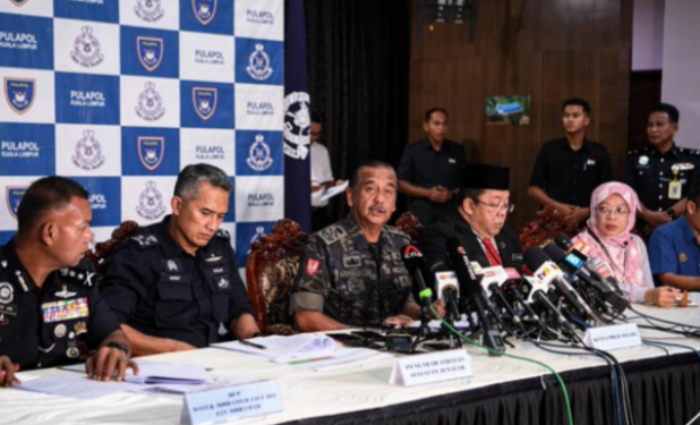
As per reports, the current scandal was first unearthed when teams of Malaysian police started raiding the children’s homes run by GISB after multiple complaints. After repeated complaints and concerns, the king of Malaysia ordered law enforcement to take swift action against the GISB. They raided 20 of these children’s homes and rescued nearly 400 children in the firs few days. In a wide-scale law enforcement operation involving multiple departments, the Royal Malaysian Police started ‘Operation Global’ on 11 September against the GISB.
Till Monday, 23 September, a total of 572 children have been rescued from the various children’s homes run by GISB. 59 of these children are under the age of 5. Among the rescued kids is a boy who was seen in a video being canned and another child who was seen being stepped on.
Malaysia’s national police chief Razaruddin Hussain has informed the media that the investigation and medical screenings have found so far that at least 172 children have suffered physical and mental abuse, and at least 13 were sodomised at the children’s homes run by GISB. Hussain further updated that so far the police have arrested over 355 individuals in the case.
Rescued children are not orphans, but children of ’employees’ used by GISB to get donations
In another shocking revelation, the Malaysian police has informed that the rescued children are not orphans, but the children of ’employees’ of the radical cult GISB. They have been separated from their parents and placed in the GISB children’s homes from a very early age. In the GISB children’s homes, the children were raised to remain loyal to the cult and were indoctrinated throughout.
‘No parents have come forward to claim the rescued children’
Authorities have revealed that even though the children are the offspring of GISB employees and followers, none of them have come forward to claim them. The children do not know their parents as they have been raised away from them from a very early age. The parents are fearing exposure and arrests, mostly due to their complicity in the scandal. GISB is said to have used the children as ‘orphans’ and claimed the children’s homes as ‘orphanages’ to solicit donations. Under Malaysian law, the crime is punishable under cheating and fraud. Many of the parents are among the arrested GISB staffers and they have denied any links to their own children.
Currently, the Malaysian government is taking care of the rescued children by placing them in government-run shelter homes. The Department of education has initiated a special teaching module to teach the children. Medical examination, treatment and counselling of the rescued children are underway.
GISB and the banned Al Arqam cult
The Al Arqam sect was started by an Islamic leader named Ashaari Mohamad. The government of Malaysia had banned the group back in 1994 calling them a heretical and deviant cult. However, the former members of the Al Arqam soon got together again and started the GISB. The GISB masquerades as a business conglomerate and runs multiple business ventures including mini-markets, bakeries, restaurants, and pharmacies across Malaysia. GISB, like its parent Al Arqam cult, promotes a certain ‘Islamic lifestyle’.
Speaking to the media, police chief Razaruddin Hussain informed that even though Al Arqam got banned, GISB flourished and at present there are over 10,000 active members, called ’employees’ or followers, practising the banned Al Arqam teachings and lifestyle in Malaysia.
The authorities have seized pamphlets and documents from GISB premises and handed them over to the Department of Islamic Development Malaysia for further action.
Over 153 bank accounts of GISB, totaling around 882,795 RM have been frozen across the country. 38 vehicles owned by the GISB, totaling around 3.9 million RMB, and 14 properties have been seized by the government too.
GISB is currently facing charges under the Security Offences (Special Measures) Act 2012 (Sosma) and the Anti-Money Laundering, Anti-Terrorism Financing, and Proceeds of Unlawful Activities Act 2001 (AMLATFPUAA).
Among the 355 persons arrested in the case are ‘teachers’ of religious studies, the leader of GISB Nasiruddin Ali and his family members, including his multiple wives, and the family members of the deceased Al Arqam leader Ashaari Mohamad.
In a shocking incident from Uttar Pradesh’s Bulandshahr district, a man has been sentenced to life imprisonment for raping his widowed mother. A widely circulated video on social media shows the man in police custody, handcuffed, and being escorted out of the Bulandshahr court following his sentencing.
The video, shared by @SachinGuptaUP on the platform X (formerly Twitter), reports that the court sentenced the man to life for the crime. According to the post, the mother alleged that her son wanted her to live with him as his wife after her husband’s death. “After my husband’s death, my son wanted me to live like his wife,” the victim’s statement said. The incident reportedly occurred on January 16, 2023.
उत्तर प्रदेश : जिला बुलंदशहर की कोर्ट ने विधवा मां से रेप करने वाले आबिद को उम्रकैद की सजा सुनाई है। ये घटना 16 जनवरी 2023 को हुई थी। पीड़िता के मुताबिक – "पति की मौत के बाद बेटा चाहता था कि मैं उसकी बीवी की तरह रहूं"@Shahnawazreportpic.twitter.com/ViVLgrN7is
The Bulandshahr fast-track court sentenced the accused, Abid, for this crime, and he has also been fined ₹50,000. Judge Varun Nigam delivered the verdict, and the decision was met with approval from the public. The incident occurred on January 16, 2023, when the mother went to the forest to gather fodder, and her son committed the heinous act. The victim later informed her younger son about the incident.
The younger son filed an FIR against his brother at the Bulandshahr Kotwali Dehat police station, after which the police arrested Abid. ADGC Crime Vijay Kumar stated that based on the medical report and the victim’s testimony, the court sentenced him to life imprisonment.
In court, the victim revealed that after her husband’s death, her son wanted her to live with him like a wife. She tried multiple times to make her son understand. Thanks to the police investigation and the support of the government legal team, it was possible to secure the conviction in just 19 months.
Akshay Shinde, a man arrested for the rape of two girls at a school in Badlapur, Maharashtra, was fatally shot by police on Monday after he seized a weapon from an officer and fired at them. The incident left two police officers injured.
The police reported that Shinde grabbed the firearm from an officer while being transported in a police vehicle around 5:30 pm. A gunfight ensued, during which several shots were exchanged, resulting in injuries to the officers.
Police returned fire on Shinde, who was being transported from Taloja jail to Badlapur for an investigation, officials said. He sustained critical injuries during the shootout and later died in the hospital.
The injured officials in the incident are Assistant Police Inspector Nilesh More and Inspector Sanjay Shinde, who shot the accused. Sanjay Shinde had previously been involved in the arrest of Dawood Ibrahim’s brother, Iqbal Kaskar while serving in the Thane Crime Branch’s Anti-Extortion Cell under encounter specialist Pradeep Sharma. He is currently part of the Special Investigation Team (SIT) investigating the Badlapur case.
The incident has sparked political controversy, with the opposition questioning the circumstances, while the government maintains it was an act of self-defence. Maharashtra Deputy Chief Minister Devendra Fadnavis stated that the rape accused attempted to seize a police firearm and opened fire, prompting the police to respond in self-defence.
In Udaipur, Rajasthan, in the year 2021, the then Congress government had allotted land for a madrasa. Now the people of the Hindu community have started opposing this allotment of land. The markets in Udaipur were kept closed in protest demanding cancellation of the allotment. On Monday (23rd September 2024), Hanuman Chalisa was recited on the road in the city after giving a memorandum to the SDM. BJP MP CP Joshi has also expressed his respect for public sentiments.
According to media reports, the matter is of Mavli town, located about 40 km from Udaipur district headquarters. In the year 2021, when there was a Congress government in Rajasthan, about 4 bigha 16 biswa land was allotted for a madrasa there. However, since then people have alleged that the land given in the name of the madrasa is in a waterlogging area. On Monday, September 23, people of all communities started gathering in Mavli with the demand to cancel this allotment. All the protesters had saffron flags with pictures of Bajrang Bali in their hands.
Seeing this gathering of thousands of people under the banner of Sarva Samaj, police force was deployed in the area. The demonstration was announced in advance by the protesters. Due to this protest, schools were also closed. The effect of the demonstration was clearly visible not only in the market but also in the surrounding villages. People from rural areas also participated in the demonstration in large numbers. The effect of this shutdown was also seen in the nearby Ghas tehsil. The people there have also announced their support to the people of Mavli.
People took out a rally from the old bus stand of Mavli, which passed through the local market, and ended at the SDM office. People sat on the road near the office and recited Hanuman Chalisa. Later a memorandum was handed over to ADM Administration Deependra Singh Rathore. In the memorandum, a demand has been made to cancel the land allotted for the madrasa.
After this demonstration, BJP MP CP Joshi spoke to the media. He supported the demands of the protesters and said that any kind of madrasa in Mavli is unnecessary. The BJP MP announced that the land allotted for the madrasa will be cancelled.
CP Joshi said that this is the Sanatani government of BJP in which no such work will be done which will cause trouble to anyone in future. Seeing the protest of the people, Mavli SDM Mansukhram Damor has sent his recommendation to the District Magistrate. In this recommendation, he has recommended to cancel the allotment of land.
The horrific onslaught against Hindus by Islamists since the 5th of August 2024 after Sheikh Hasina’s undemocratic ouster in Bangladesh from power left the world shocked. Hindus houses were marked by Jamaat-e-Islami to attack and plunder, Hindus were forced to offer money and jewellery [read Jizya] to save their lives, temples desecrated, idols of Hindu gods broken, Hindus forced to resign from their government posts, women raped, and mob lynching became a ‘normal’. All this continued unabated as the police and the Bangladeshi Army took a backseat, while Islamist mobs wreaked havoc against Hindus for simply existing.
Since the 5th of August, Hindus have been suffering unspeakable atrocities at the hands of Islamists while the Western and Indian leftist media contextualised and downplayed the anti-Hindu violence joined by Mohammad Yunus who is leading the interim government in the unrest-hit country as the Chief Advisor. Yunus has been pandering to Islamists ever since he assumed office as evident in his decision to lift the ban on Jamaat-e-Islami which has been historically involved in persecuting Hindus in Bangladesh.
While such large-scale persecution of Hindus shocked the world, this is not new in Bangladesh. The Muslim-majority country has a history of tormenting Hindu minorities in all the ways possible due to their Hindu religious identity. Attacks on Hindu houses, temples, Hindus being attacked and raped in Bangladesh is a widely known pattern of Islamists demonstrating their hatred for Hindus, however, the Bangladeshi governments over the decades have also orchestrated conspiracy to deprive Hindus of the ownership of their lands and properties. It is thus, pertinent to delve into how right from its inception, Bangladesh, has never truly been ‘secular’ even as its creation culminated from the perpetual oppression based on ethnic, religious and linguistic lines unleashed by the Pakistani Islamists at the helm of political and military power.
How the Hindus became the victims of perpetual exploitation-distress-destitution-deprivation-inequality in Bangladesh
The Bangladesh Vested Property Act, originally referred to as the Enemy Property Act, has a long history of systematic marginalisation and dispossession of the country’s Hindu communities. The chronology of previous Acts when Bangladesh was still East Pakistan can traced from the East Bengal (Emergency) Requisition of Property Act (XIII of 1948), the Enemy Property (Custody and Registration) Order of 1965, the East Pakistan Enemy Property (Lands and Buildings Administration and Disposal Order of 1966), the Enemy Property (Continuance of Emergency Provision) Ordinance No. 1 of 1969, to Bangladesh (Vesting of Property and Assets) President’s (Order No. 29 of 1972), the Enemy Property (Continuance of Emergency Provisions) (Repeal) Act (XLV of 1974), and the Vested and Non-Resident Property (Administration) Act (XLVI of 1974).
Led by President Ayub Khan, Pakistan enacted the Enemy Property Act following the 1965 war against India. The government took the properties of people who were considered “enemies” of the state, mainly Hindu minorities fleeing to India. Due to religious persecution, rioting, or the war, the majority of those impacted were Hindus who had fled East Pakistan (modern-day Bangladesh) for India. According to the law, the property of any person who had left for India could be taken over by the state as “enemy property” since India was declared an “enemy”.
Instead of scrapping the act upon Bangladesh’s independence in 1971, the newly formed government renamed it the Enemy Property (Continuance of Emergency) Provisions (Repeal) Act (Act XLV of 1974), commonly known as the Vested Property Act, repealing the Ordnance 1 of 1969. This legislation authorised the government to take control of the properties of those deemed to have left for India to escape persecution at the hands of Hindu-hating Jihadis, again targeting the Hindu minority community disproportionately.
Bangladesh's Enemy Property Act/Vested property act-one of the biggest legalised land grab projects in the world, where the entire state machinery is complicit- achieving a slow ethnic cleansing of hindus in effect- from 22% in 1951 to ~8% currently. A ?, sources at the end.
In his noted book“Deprivation of Hindu Minority: A Story of Perpetual Discrimination”, Bangladeshi economist and professor Abul Barkat writes that the implementation of theEnemy Property Act and its continuance as Vested Property Act finds roots in the religion-based statecraft of Pakistan’s feudal-military autocratic rulers. These autocratic rulers, in their pursuit of “Pakistanisation” or simply the absolute Islamisation of Pakistan wanted to get rid of both, the Bengali people and their culture.
Barkat wrote that the implementation of the Enemy Property/Vested Property Act between 1965 and 2006 directly impacted 12 lakh households and 60 lakh Hindus, resulting in the loss of their properties. The Bangladeshi Hindus lost over 26 lakh acres of land, and many families were financially destitute. The research found that this has institutionalised communalism and a “feudal mindset” in the society.
Despite Bangladesh’s attempts to portray itself as a secular state, this law adversely affected the Hindu minority as evident from the above discussion. The Hindu families already grappling with the hostile situation in the Muslim-majority country were left with no way to retrieve their land, even if they had never left Bangladesh.
Notably, most of the property of the slain Bangladeshi Hindu politician Dhirendranath Datta was seized by the Bangladesh government after the country gained independence in 1971. Since Datta’s body was never found after being arrested by the Pakistan Army during the Bangladesh Liberation War, an affidavit was filed stating that it could not be concluded that Datta had not voluntarily left the country. A detailed OpIndia report on Datta’s struggle for Bengali, the historic speech in Pakistan’s Constituent Assembly and his forgotten legacy can be read here.
The politics around the Vested Property Act
In 1996, the Bangladesh Awami League government launched steps to return properties to legal heirs and authentic claimants of minorities living in Bangladesh. Nevertheless, they were unable to complete the task even in 2001. In 2001, the Vested Property Repeal Act was passed. However, it contained significant loopholes, and the government retained authority over large tracts of previously confiscated property.
Sheikh Hasina modified the name of the ‘Vested Property Act’ to the ‘Vested Property Return Act’ in 2001, her final year in office. The Awami League government’s decision was intended to give minorities in Bangladesh the advantage of their immovable properties. The goal of this new law was to resolve issues involving minorities’ confiscated properties within 90 days and to grant the petitioners possession of the land within 180 days.
However, in the October 2001 elections for Bangladesh’s Jatiya Sansad (National Assembly), the Bangladesh Nationalist Party (BNP) regained power, and Khaleda Zia became Prime Minister. The BNP government repealed the previous government’s provisions in the ‘Vested Property Return Act’ in an obvious attempt to gain support among the Islamists.
Years later, the military-backed government under the leadership of Chief Advisor Fakhruddin Ahmed introduced the Vested Property Repeal (Amendment) Act 2011, which was gazetted on December 11, 2011, with updates in 2012 and 2013. This Act created two schedules of property and established tribunals for disposal. While lakhs of cases were filed to reclaim the seized land, barely one percent of them were resolved by 2013.
How EPA made Hindus “Zaminhara Zamindaars”
Several Hindus who were once the “Zamindaars” [landlords] have been mocked by their neighbours as “Zaminhara zamindaars” [landless landlords] since their estates and properties were gradually taken over by the Bangladeshi government. The UCA Newsreported the plight of one such Hindu family which lost most of their land due to the Enemy Property Act. Sanjay Kumar Mitra, a resident of Faridpur in Central Bangladesh staying with his wife and daughter is addressed by his neighbours as “Zaminhara zamindar”. Many years ago, Mitra approached the court to stake claim over the properties of his deceased paternal uncle who died without any children. The court, however, denied Mitra’s claim and recorded the said properties as “enemy properties”.
A Hindu resident of Bangladesh is seen as an enemy by its courts and properties over which he has a legal claim are declared as “enemy property” forcing him to fight a years-long legal battle. While Mitra managed to win in the court, he could never really claim the properties of his paternal uncle. Mitra is just one among over 1 million Hindus suffering due to EPA.
According to Rana Dasgupta, a noted Hindu lawyer and secretary of the Bangladesh Hindu Buddhist Christian Unity Council, “Introduced under Pakistan Defence Rules Ordinance 1965, the EPA was not a discriminatory law at the beginning. However, within 15 days of the proclamation, the Land Ministry published a circular that said, ‘Enemy property owners are those who belong to minority communities,’ and thus an international law was degraded into a discriminatory domestic law.”
Two years after Sheikh Mujibur Rehman was assassinated in 1975, military dictator Ziaur Rahman came to power and formed the Bangladesh Nationalist Party (BNP) which played a key role in magnifying the recent anti-quota protest into anti-Hasina violent protests. After coming to power in 1977, Ziaur Rahman revived the Vested Property Act is alienate Bangladesh from secularism and established it as an Islamic country. Alongside, bolstering Bangladesh’s position as an Islamic nation, the BNP government intended to oust Hindus from their homes and distribute their properties among BNP leaders and supporters.
On one hand, the population of Hindus was decreasing right after the creation of Bangladesh, on the other, their properties, freedom and dignity were being snatched away by the Bangladeshi governments be it the Awami League, BNP, or Jatiya Party. As per Abul Barkat, the political affiliation of direct beneficiaries of the appropriated property was estimated as Bangladesh Awami League at 44.2%, Bangladesh Nationalist Party (BNP) 31.7%, Jatiya Party 5.8% and the jihadist outfit Jamat-e-Islami held 4.8% while the rest had 13.5%. Clearly, the land and properties of Hindus were systematically and ‘legally’ usurped by the political parties in power over the years and distributed among their supporters who were Muslims.
The Vested Property Act has been nothing but a cruel mockery of the Hindus suffering atrocities from all sides. The Bengalis who had fled to India from the Pakistani Army’s massacre, which killed 3 million people in the run-up to the 1971 war, were no longer able to return and reclaim their ancestral homes in the newly established state of Bangladesh. The Vested Property Act forced the refugees to remain in India, removing millions of people, mostly Hindus, who should have been citizens of Bangladesh and usurping vast swathes of properties they owned.
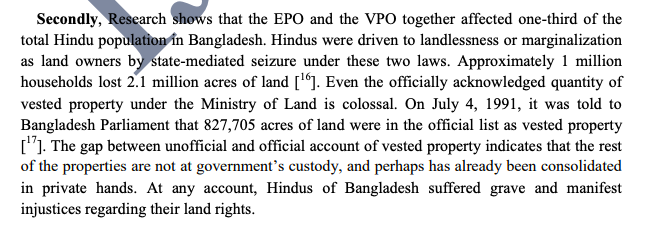
As the journal by Mohammad Ikbal Hasan Lecturer, Department of Law, University of Information, Technology & Sciences states titled LAW OF VESTED/ENEMY PROPERTY IN BANGLADESH: AN ANALYTICAL APPROACH, VPA/EPA is unconstitutional and against the fundamental right to equality. These cruel and discriminatory laws have adversely affected one-third of the total Hindu population in Bangladesh. “Hindus were driven to landlessness or marginalization as land owners by a state-mediated seizure under these two laws,” Hasan’s journal reads.
Excerpt taken from Mohammad Ikbal Hasan’s journal
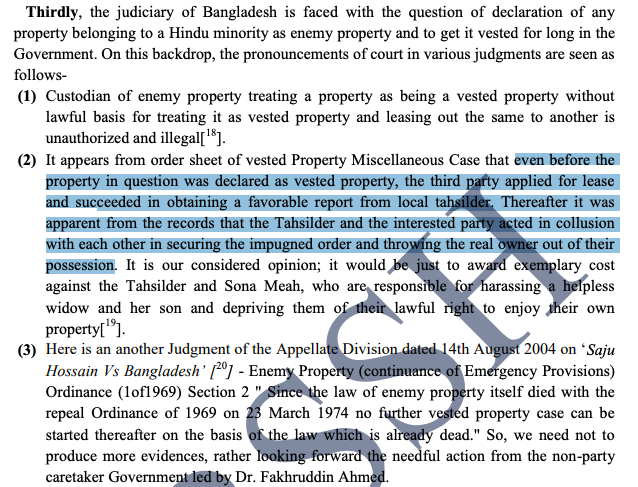
Before declaring the land as vested, the third party usually sought a lease and received a favourable report from the local tahsilder suggesting that the Tahsilder and the interested party colluded to secure the order and remove the real owner from possession. Thus, loopholes in the law and fake documents were used by Muslims to usurp the properties of Hindus. Even during Khaleda Zia’s reign from 1991 onwards, the government tried to sell vested properties to occupants willing to pay a certain premium. This triggered bureaucratic interests in such properties and the land-grabbing mafias thrived.
Excerpt taken from Mohammad Ikbal Hasan’s journal, Source: International Journal of Research in Social Sciences and Humanities
A research paper by Shelley Feldman titled: “Legal” Land Appropriation as Sanctioned by the Vested Property Act(s) states that the government had conducted a survey of vested properties in 1993 and local officials also listed many properties whose owners were alive and living in Bangladesh. However, violence, desecration of temples, theft of idols, rape of Hindu and other non-Muslim women often accompanied land grabs.
Excerpt from Shelley Feldman’s research paper “Legal” Land Appropriation as Sanctioned by the Vested Property Act(s) (Source: JSTOR)
After the Awami League returned to power in 2009, the Vested Property Return (amendment) Bill 2011 was approved, and a district-by-district list of returnable properties was to be published within 150 days, but the act omitted assets vested in 1969 or purchased for ‘public purpose’, thus the land grabbing persisted. The act was repeatedly amended, the deputy commissioners sought extensions to compile the list, and vested land increased dramatically, by 14% in schedule ka (government-controlled) and 58% in schedule kha (not under government control) over three years (2011-14).
Excerpt from Shelley Feldman’s research paper (Source: JSTOR)
Other than Hindus, the EPA/VPA also impacted the Bangladeshi Buddhists. Both the population and ownership of properties among Hindu and other non-Muslim minority groups dwindled over the last five decades. In June 2023, it was reported that the High Court dismissed a petition challenging the legality of sections 9, 13, and 14 of the Vested Property Act saying that it does not contradict fundamental rights and formed a special tribunal to hear cases pertaining to this act. In August this year, the Bangladesh Hindu Buddhist Christian Unity Council demanded that the Yunus administration scrap the Vested Property Act. However, given that the Yunus government is backed by Islamist outfits like the BNP and Jamat-e-Islami, it is highly unlikely that this Act will be repealed. While this draconian act should have been escorted to the dustbin decades back, however, instead of effectively addressing the grievances of the Hindu and other non-Muslim minorities, the political parties perpetuated an environment where such discriminatory laws were allowed to exist for so long.
Conclusion
The Vested Property Act, an ignominious legacy of pre-partition politics of Islamist lunatics, continues to threaten Bangladesh’s Hindu minority. Though some attempts have been made to address the issue, decades of land seizures and state control over minority property have caused significant hurt to the perennially persecuted Bangladeshi Hindus. The Vested Property Act is an example of how the Islamists when at the helm of power used laws to target a vulnerable religious group, contributing to the demographic fall of Hindus in Bangladesh over time. Bangladesh was carved out in 1971 to escape the horrors committed by Pakistan’s military and Islamists during the Liberation War, however, Bangladesh’s history of continued persecution of Hindus and other non-Muslim communities suggests that since its very birth, Bangladesh inherited Pakistan’s Islamist fanaticism reflecting in the country’s anti-Hindu laws and is trapped under the shackles of Islamist terrorism, communal hatred and discrimination.
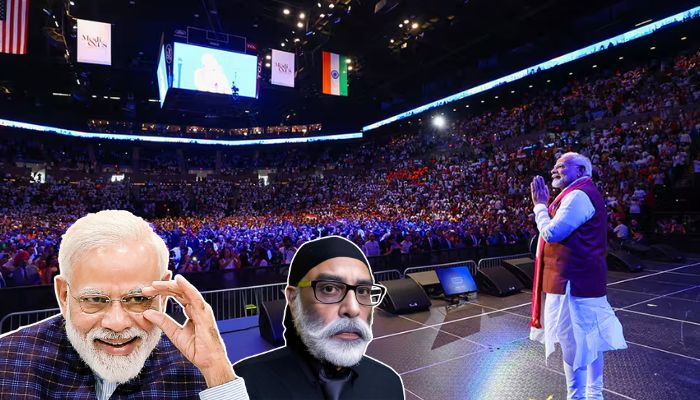
On 22nd September (local time), Khalistani terrorist Gurpatwant Singh Pannun released a video against Indo-Americans who attended Prime Minister Narendra Modi’s event in New York during his US visit. Irked by the grand success of PM Modi’s event, Pannun, who is the founder of the Khalistani terrorist organisation Sikhs For Justice, asked PM Modi to “Please take your Indo-Americans back to India.” Venting out his frustration on the organisers and attendees of the event, the terrorist Pannun added, “All those who planned and funded the event are followers of Modi’s Hindutva ideology.”
Source: X
In the video, visibly angry with the success of the event, Pannun said, “Narendra Modi, take your Indo-American Hindus, followers of your violent Hindutva ideology back to India.” He further threatened PM Modi and said that no legal action was being taken against PM Modi as he has immunity as PM.
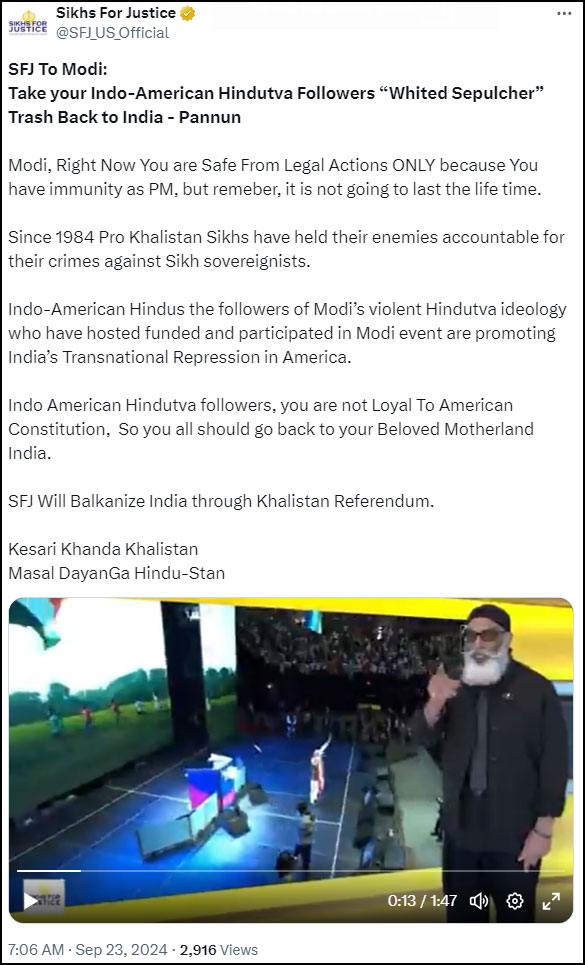
In a post on social media, Sikhs For Justice (withheld in India) shared the video and wrote, “Take your Indo-American Hindutva Followers “Whited Sepulcher” Trash Back to India – Pannun.“
The video said, “Modi, Right Now You are Safe From Legal Actions ONLY because You have immunity as PM, but remember, it is not going to last a lifetime.Since 1984 Pro Khalistan Sikhs have held their enemies accountable for their crimes against Sikh sovereignists.Indo-American Hindus the followers of Modi’s violent Hindutva ideology who have hosted funded and participated in Modi events are promoting India’s Transnational Repression in America.Indo-American Hindutva followers, you are not Loyal To American Constitution, So you all should go back to your Beloved Motherland India.SFJ Will Balkanize India through Khalistan Referendum.Kesari Khanda Khalistan. Masal DayanGa Hindu-Stan“
The sources close to the intelligence agencies said that his video was on the expected lines. Speaking to News18, the sources said, “Pannun is a rogue element who has no identity. He is doing this at the direction of foreign agencies who have funded him. His lawsuit was planned deliberately at a time when the PM was going and these agencies never expected huge success. The event was as successful as any event in India.”
Notably, anti-Modi protests were planned during the visit of Prime Minister Narendra Modi to the US but they failed to make any significant impact on the event.
Interestingly, a lawsuit had been filed by Khalistani terrorist Gurpatwant Singh Pannun, founder of the Khalistani organisation Sikhs For Justice, in connection with the alleged attempt to assassinate him. The US court has summoned the Government of India and its top security officials, including NSA Ajit Doval. The Indian agencies have called the lawsuit ‘baseless’.
SFJ is a designated terror organisation
Sikhs For Justice was formed in 2007 to create ‘Khalistan’, a separate homeland for Sikhs. In 2019, the Ministry of Home Affairs banned the organisation under the provisions of the Unlawful Activities (Prevention) Act. Later, its chief Gurpatwant Singh Pannun was also designated as a terrorist.
The Legend of Maula Jatt, a Pakistani controversial film, is slated to be released in India two years after its worldwide debut. It stars Fawad Khan and Mahira Khan in the key roles and is the first Pakistani film to be released in India in over a decade. However, Karachi-based film producer Nadeem Mandviwalla, who is also the distributor of the film in Pakistan, confirmed to India Today that the film will only be released in Punjab and not across the country.
Mandviwalla expressed hope that the film could still perform well at the box office, saying, “The film can still do some exceptional business in India as till today it is not available on any OTT platform. Thus, it has a great chance to become a huge hit. It might take a little time as the film is releasing after two years and the excitement is no longer there as it was in 2022, during its original release. However, the word of mouth of the film is bound to create that excitement again.”
The Legend of Maula Jatt is a replica of Pakistan’s 1979 film Maula Jatt. After it premiered two years ago, it became Pakistan’s largest box-office blockbuster. Given that the plot is based on Punjabi culture, the creators hope that the Punjabi audience will give it a chance in theatres.
Earlier, the film’s director, Bilal Lashari, disclosed details regarding its Punjab release in India. He shared a poster for the film on social media, writing, “Releasing in India, Punjab on Wednesday 2nd Oct! Two years in, and still house full on weekends in Pakistan! Now, I can’t wait for our Punjabi audience in India to experience the magic of this labour of love (sic)!”
The film is based on a 1979 Pakistani cult classic titled, ‘Maula Jatt.’ The remake features actor Fawad Khan as the hero ‘Maula Jatt’ who fights his nemesis and finest warrior in Punjab by the name of Noori Natt (played by Hamza Ali Abbassi).
Zee Studios had bought the Indian rights for this all-time high-grosser Pakistani film. In December 2022, the makers had planned to release the film in Punjab and Delhi to target Punjabi speakers. However, the announcement of the film’s release triggered a massive outrage in the country. Netizens registered their outrage stating that Pakistani films should not be released in India especially when the Islamic Republic continues to sponsor terrorism in India. Netizens had also demanded a ban on the film’s release in India.
Moreover, the movie had also courted controversy for starting actor Hamza Ali Abbassi, known for his admiration of 26/11 terror mastermind Hafiz Saeed. OpIndia had reported in December 2022 that Pakistani actor Hamza Ali Abbasi, who plays a crucial role in the movie, has been unabashed in his vocal support for the 2008 Mumbai attack mastermind, Hafiz Saeed.
The movie features actor Fawad Khan as the hero ‘Maula Jatt’ who fights his nemesis and finest warrior in Punjab by the name of Noori Natt. This character of Noori Natt is played by Hamza Ali Abbasi, a terror sympathiser and an active proponent of the divisive ‘Two Nation theory.’
Zee Studios is handling the release of The Legend of Maula Jatt in India. It is part of Zee Entertainment Enterprises, which also owns the Zindagi channel, India’s only platform for syndication of Pakistani programming, particularly TV dramas. The film was scheduled to be released in India in 2022, along with its worldwide release. However, other political parties protested the release, and it was never made public.
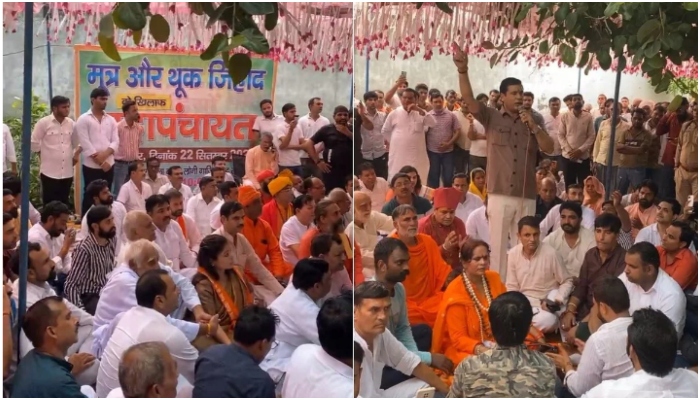
On Sunday (22nd September), Hindu outfits organised a panchayat comprising all communities at the Shiv Mandir in Tila village, Ghaziabad’s Loni area. This panchayat issued an appeal to economically and socially boycott individuals who mix spit and pee into meals and beverages.
Apart from Hindu saints and sages, thousands of people from hundreds of villages participated in the panchayat.
Swami Dipankar Maharaj told the Panchayat that Hindu society must abandon casteism and unite. “The time has arrived for the entire society to unite,” he said.
Meanwhile, Sadhvi Prachi stated that the 36 sects of Hindu society must unite. She stated that people from other communities use Hindu names to fool Hindu sisters and daughters.
“If they enjoy Hindu names so much, they should change their faith and become Hindus; we will accept them,” she said. During this time, Nand Kishore Gurjar, a BJP MLA from Loni also addressed the Panchayat members.
The Panchayat handed over a memorandum addressed to the Chief Minister of the state, the local MLA and ACP. It also called for the arrest of the culprits and the passage of legislation aimed at population control.
In addition, a call was made to take action against persons engaged in such activities under the National Security Act.
It is worth noting that on September 13th, the Loni Border police station arrested a 29-year-old juice salesman on charges of putting urine in juice, and his minor companion (15) was also detained.
According to ACP Bhaskar Verma, the arrest was conducted in response to a public complaint. People had complained that Aamir, the juice salesman, was offering customers fruit juice mixed with human pee.
Verma stated that when police arrived at the scene and inspected his juice cart, they discovered a plastic can full of urine. According to him, the police interrogated Aamir about this, but he couldn’t provide a satisfactory answer.
According to the police, during interrogation, the accused juice vendor Aamir stated that there was nowhere nearby to urinate, so he gathered it in a plastic bottle. The cops utterly rejected his argument.
Bajrang Dal activists caught Aamir red-handed on the evening of September 13th as he was reportedly adding pee into the juice.
According to Bhaskar Verma, after hearing about this act, people gathered and beat up the accused Aamir. Following the event, BJP MLA from Loni Nand Kishore issued a video in which he urged people not to buy food from sellers with a sick mentality.
On Monday, 23rd September, the Chief Minister of Odisha, Mohan Charan Majhi, ordered a judicial inquiry into allegations of custodial violence against an Army Captain and his fiancée at Bharatpur police station in the state. A commission has been set up by the Government of Odisha to investigate the details of the case, which will be led by Justice (Retired) Chittranjan Das. The commission is expected to submit a report on the matter within 60 days.
Odisha Chief Minister Mohan Charan Majhi has ordered a judicial probe into the alleged custody violence against an Army officer and his fiancée at Bharatpur Police Station in Bhubaneswar. https://t.co/7lNPIHaxP4pic.twitter.com/Ql6nwbNIZi
Meanwhile, the concerned police officials have been suspended by the Odisha government, as confirmed by CM Majhi. He added that a case has been registered against the said police officials. CM Majhi stated, “The state government is fully concerned about the dignity, safety, and rights of women. The police officers concerned have been suspended, and a case has also been registered against them. Action has been taken against the youth involved in the incident.”
The Odisha government also issued an official notification expressing deep concern over the incident. As per reports, the Army officer and his fiancée were assaulted and mistreated by the police officials. The notification emphasised the public importance of the matter, which warranted an inquiry under the Commissions of Inquiry Act, 1952.
The notification read, “It has come to the notice of the State Government that cases and counter-cases have been lodged alleging misbehaviour/assault on a woman and a serving army officer inside Bharatpur Police Station; and whereas the State Government is deeply concerned about the issue and is of the opinion that, this being a matter of serious public importance, it should be inquired into by a Commission of Inquiry under the Commissions of Inquiry Act, 1952.”
The commission, led by Justice (Retired) Das, will investigate the sequence of events that led to the reported incidents, the roles and accountability of individuals involved, and will suggest measures to prevent future occurrences of similar nature and ensure the security of women.
The notification read, “The Headquarters of the Commission shall be at Bhubaneswar. However, the Commission may hold the inquiry at any other place as may be considered necessary for the purpose.”
Background of the incident of the assault in Odisha on the Army Captain and his fiancée
On 15th September, the Army Major and the woman went to Bharatpur police station to complain about some miscreants who had harassed them while returning from a hotel late at night. Reportedly, the police officials did not address their concerns and allegedly tortured the Captain and the woman instead. The woman was sent to jail without any justification by the police.
Reportedly, the woman was forcefully locked in the police station and assaulted at Bhubaneswar’s Bharatpur police station by a few female officers and later she was also allegedly sexually molested by the inspector-in-charge (IIC) of the Police Station in police custody. At the same time, the army officer was also locked up and assaulted by cops. The incident came to light after the Odisha HC granted the woman bail and ordered an investigation into the case.
“As I was screaming for help, the inspector in charge of the police station came around 6 am,” the woman claimed, saying that he lowered her pants, exposed his private parts, and abused her in filthy language.
“Around 1 am on September 15, when I was heading home after closing down my restaurant, a group of youths stopped our car and tried to scuffle with us. After we managed to get into the car, we went to the Bharatpur police station to lodge an FIR, where a lady constable was sitting at the reception wearing a nighty,” the woman alleged while speaking to reporters at AIIMS Bhubaneswar.
On 22nd September, the District Court granted bail to all seven accused officials in the case, who have been identified as Rakesh Naik, Abhilash Sawant, Aman Kumar, Aditya Ranjan Behra, Akash Padhiyari, Harish Manta, and Ashish Kumar. Speaking to the media, Additional DCP Bhubaneswar, Krushna Prasad Dash, said that a case against the accused police officials has been registered under several sections of the BNS.
Speaking about the matter, state Law Minister Prithviraj Harichandan said, “This is a crucial situation…Whatever incident has happened was not called for. She has asked for help and she has not been given a proper response from the Police station…When it came to the notice of the Government, CM formed a ministerial committee to listen to the grievance, to discuss it with the victim, her parents and other Army veterans…We sat with the team, we listened to them very patiently…In the evening, we apprised the CM regarding all this. After that, there was a high-level committee meeting, it was decided that a judicial inquiry would be instituted…Since it’s a crime against women, for which we have zero tolerance, CM has decided to let the Crime Branch inquiry continue and High Court will monitor the investigation process…”
#WATCH | Alleged assault against an Army officer & a woman accompanying him | Odisha CM Mohan Charan Majhi & Law Minister Prithviraj Harichandan met the woman & her father, along with Army officers at Lok Seva Bhavan in Bhubaneswar.
The victim and her father also met CM Majhi and Law Minister Prithviraj Harichandan. Her father said, “State Government has ordered a juridical inquiry. So, we thank Odisha Government & CM that he heard us. Two days back, we saw a Police personnel demonstration. That had put doubt in our minds about whether the Police investigation would be fair. To clear that doubt, the State Government has ordered a judicial inquiry. I think this is happening for the first time in history that judicial inquiry will be completed within 60 days in a time-bound manner…CM has assured us that security would be provided so that if a woman steps out even at 2 am in the night, she feels safe. There can be issues at our restaurant due to this case, so he has assured us that there won’t be any such problem. He has assured us that it will be kept secure and that the restaurant can be operated without any issue…”
#WATCH | Alleged assault against an Army officer & a woman accompanying him | Odisha CM Mohan Charan Majhi & Law Minister Prithviraj Harichandan met the woman and her father, along with Army officers at Lok Seva Bhavan in Bhubaneswar today.
After meeting the CM, the victim woman said, “Today, after meeting the CM where he gave me a patient audience and hearing, he has heard all my grievances and till date my complaint remains those 7 Bhatapur Police officials who wronged me & molested me. He has assured me with a judicial inquiry that I will be given justice…I told him that I could face possible threats because already the Police officials have come twice and intimidated my staff. So, I also told him about the same episode. He has assured and ensured that in the future, women are going to be absolutely safe in this state and zero tolerance towards any wrongdoings towards women will be taken…With all these words that he had promised me, I do feel relaxed. I will be happy when the justice will be provided to me through this judicial inquiry. I am happy that he gave me a patient hearing.”
| Alleged assault against an Army officer & a woman accompanying him | Odisha CM Mohan Charan Majhi & Law Minister Prithviraj Harichandan met the woman and her father, along with Army officers at Lok Seva Bhavan in Bhubaneswar.
Opposition party leaders also issued statement in the matter. Notably, BJD had called for six-hour bandh to protest against the alleged assault which has been recalled after orders for judicial inquiry in the matter. BJD Vice-President Debi Prasad Mishra said, “The Odisha government has issued a notification. Yesterday, a press note was released from the Chief Minister’s office that the demands of BJD chief & former Odisha CM Naveen Patnaik have been considered and to ensure the quick redressal of justice, an enquiry monitored by the high court will probe into the incident.”
#WATCH | Bhubaneswar, Odisha: | Alleged assault against an Army officer & a woman accompanying him | BJD Vice-President Debi Prasad Mishra says, "The Odisha government has issued a notification. Yesterday, a press note was released from the Chief Minister's office that the… pic.twitter.com/dKuHPURlEQ
“We are hopeful that justice will be served and exemplary punishment will be given to those involved in the incident…BJD withdraws a six-hour bandh in Bhubaneswar that the party had proposed on September 24”. the BJD leader added.