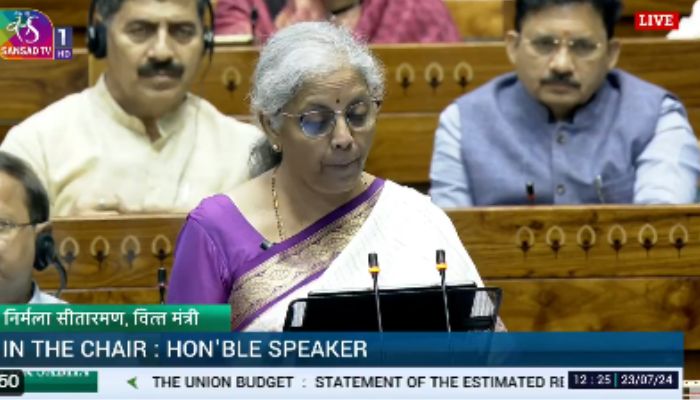
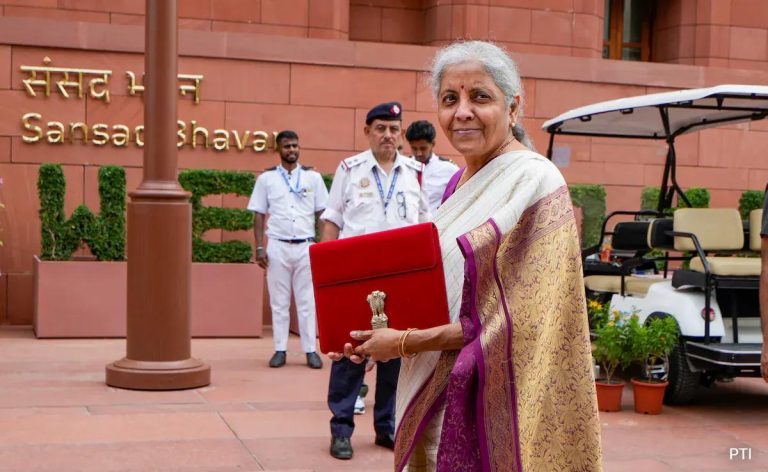
On Tuesday (23rd July), Finance Minister Nirmala Sitharaman presented the Annual Financial Statement (Budget 2024-25) before the Lok Sabha. The Finance Minister has given relief to taxpayers who choose to opt for the New Tax regime as the tax slabs have been revised and the Standard deduction limit has been increased from Rs 50,000 to Rs 75,000.
Personal Income Tax: The Union Finance Minister made 2 announcements for those who adopt the new Tax regime.
As per the Budgetary announcement, the Standard Deduction for salaried employees is proposed to be increased from Rs 50,000 to Rs 75,000. Deduction on family pension, for pensioners, is proposed to be enhanced from Rs 15,000 to Rs 25,000. This will provide relief to 4 crore salaried individuals and pensioners. In the New Tax regime: The revised tax structure is –
Rs 0-3 lakh – nil
Rs 3 – 7 lakh – 5%
Rs 7-10 lakh- 10%
Rs10-12 lakh – 15%
Rs 12-15 lakh – 20%
Above Rs 15 lakh – 30%
Under the Nex Tax regime, a salaried employee is expected to save up to Rs 17,500 in Income tax.
#WATCH | On personal income tax rates in new tax regime, FM Sitharaman says, "Under new tax regime, tax rate structure to be revised as follows – Rs 0-Rs 3 lakh -Nil; Rs 3-7 lakh -5% ; Rs 7-10 lakh-10% ; Rs 10-12 lakh-15%; 12-15 lakh- 20% and above Rs 15 lakh-30%." pic.twitter.com/zQd7A4OsnT
Revenue of Rs 37,000 crores – Rs 29,000 crores in direct taxes and Rs 8,000 crores in indirect taxes will be foregone. While revenue of Rs 30,000 crore will be additionally mobilized, thus the total revenue foregone is about Rs 7,000 crores annually.
Additionally, the Union Finance Minister also announced that the government will undertake a comprehensive review of the Income Tax Act to make it easy to read.
During her 7th Budget speech, Finance Minister Nirmala Sitharaman also said the government will come out with SoP (standard operating procedure) for TDS defaults and simplify and rationalise the compounding of such offenses.
FM Sitharaman added that two tax exemption regimes for charitable trusts will be merged into one.
As per the Budgetary announcement, in the Financial Year 2023, around 58% of corporate tax has come from a simplified tax regime.
She informed the Lok Sabha that more than two-thirds of individuals availed of the new income tax regime.
Furthermore, the FM announced that DPI (Digital Public infrastructure) apps will be developed for credit, e-commerce, education, health, law, MSME service delivery, and urban governance.
Union Finance Minister Nirmala Sitharaman in her Budget speech proposed the creation of employment of about 4.1 crore youth over the next five years.
Towards it, the finance minister has allocated Rs 2 lakh crore.
Similarly, she proposed Rs 1.48 crore to skilling the citizens to generate job opportunities. 20 lakh youth will be skilled over five years.
A total of 1,000 industrial training institutes will be upgraded, she announced.
She proposed in her speech that a one-time wage would be provided to all first-time employees in all sectors. The incentive for first-timers would be provided through Direct Benefit Transfer (DBT)
The Finance Minister said that the government will launch internship opportunities in 500 companies for one crore youth in five years.
She said interns will get exposure to real-life environments and an allowance of Rs 5000 per month.
The companies will bear training and 10 per cent of training costs from CSR funds.
Sitharaman said employment, skilling, MSME, and middle class are key focus areas of this Budget.
(This news report is published from a syndicated feed. Except for the headline, the content has not been written or edited by OpIndia staff)
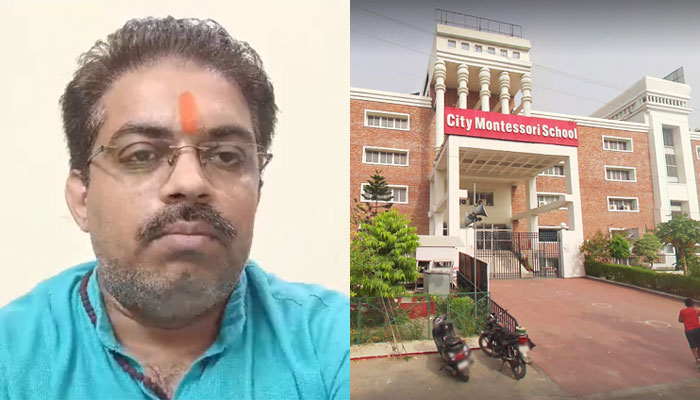
On 4th July, a seasoned mathematics teacher at City Montessori School (CMS) Lucknow, Kuldeep Tiwari, wrote a complaint to the District Magistrate alleging his services were terminated from the school after he refused to withdraw cases related to the Bhojshala, Gyanvapi, and the demolition of illegal religious structures. In his complaint, he alleged that he was subjected to persistent harassment over his religious practices including maintaining Shikha and wearing Tilak along with his involvement in several PILs.
In the detailed complaint, Tiwari accused the Principal Ms Jaishreekrishnan and Vice Principal Ms Rita Fleming, of repeatedly asking him to remove Tilak and cut Shikha. Tiwari pointed out that both are significant parts of his life as he is a practising devout Hindu. Tiwari asserted that these demands were made repeatedly over several years often accompanied by insults and threats.
⚡️STARTLING HINDUPHOBIA IN LUCKNOW!⚡️
?Anti-Hindu stance by the largest school of the world – 'City Montessori School' (CMS) of Lakshmanpuri (Lucknow)!
Tiwari is involved in several high-profile PILs. His organisation held a major spiritual and cultural event in Lucknow in October 2023. During the event, a model exhibition of the Gyanvapi Temple was shown. The event was attended by several prominent scholars and spiritual leaders. The event aimed to raise awareness about important religious sites including Kashi, Mathura and Bhojshala.
He said that soon after the event, the Principal and Vice Principal called him in their office and demanded that he withdraw all his pending PILs. He said, “I was told to either withdraw my cases or resign from my job immediately”. He expressed his inability to withdraw the cases stating that the legal battles he is fighting are within the bounds of the law and public interest.
Tiwari said the situation worsened after he participated in Puja before the ASI survey of the Bhojshala case in April 2024. When he came back, he was again pressured to resign or face termination.
As per Tiwari, he was told, “You were asked to withdraw all the cases, but you did not, so you will no longer work at CMS. It would be better if you resign voluntarily, otherwise, we will dismiss you. You will be left destitute, then sit on the street and feed on Hindutva.”
He said, “They threatened to leave me destitute and even made derogatory comments about my religious beliefs.” He alleged that a conspiracy was hatched to terminate him from his job.
Finally, on 1st July 2024, he received a termination letter from CMS that cited various reasons. He said, “My dismissal is an insult to my religious sentiments and a violation of my rights”. In his complaint, Tiwari called for a high-level investigation into the matter stating he believed there might be influence of external, anti-India forces. He said, “It is crucial to ascertain whether the pressure was due to personal malice or other anarchic forces.”
He also added that CMS, which is inspired by the Bahá’í Faith, is a powerful institution with notable links to foreign entities. He further alleged that CMS receives foreign funding. He raised concerns about potential influences on the investigation as well. He requested for full security detail for himself fearing his safety amidst the conflict.
List of cases Kuldeep is involved in:
Bhojshala Case, WPIL 10484/2022, Indore High Court
Gyanvapi Case, Case Numbers 350/2021 and 1415/2023, Honorable District Court, Varanasi
Against Illegal Religious Constructions, WPIL 1930/2022, Honorable Allahabad High Court
Against the Provisions of Section 494 IPC, WP (C) 001382/2020, Honorable Supreme Court
Against Bollywood Film ‘Adipurush,’ Case Number 0728/2022, Honorable Allahabad High Court (Lucknow Bench)
Shri Krishna Janmabhoomi Case, WPIL 0293/2024, Honorable District Court, Mathura
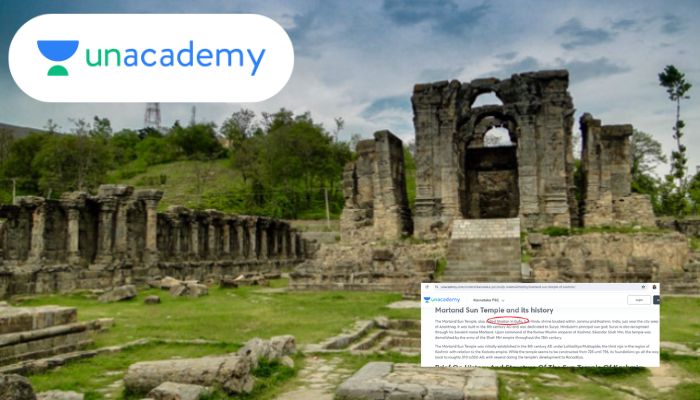
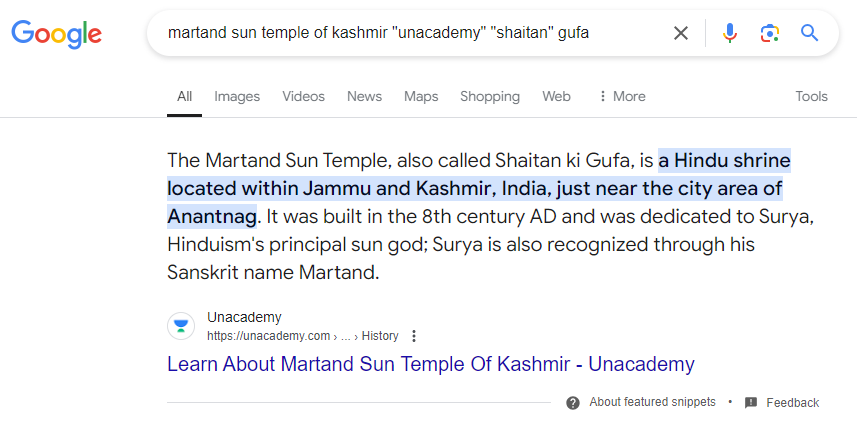
A significant outrage has erupted on social media after Unacademy, a popular online education platform, referred to the historic Martand Sun Temple as “Shaitan ki Gufa” (Devil’s Cave) in one of its lessons.
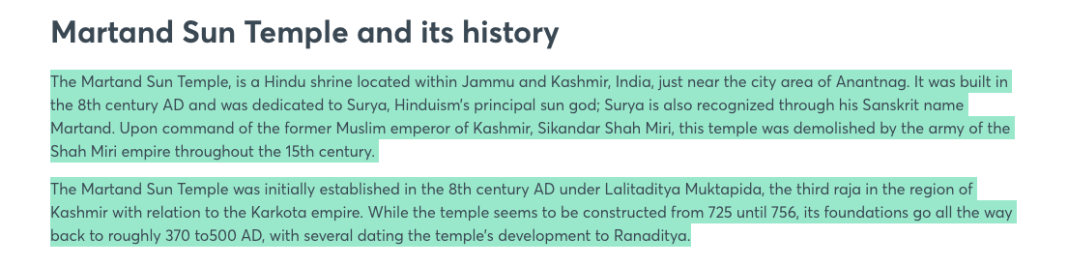
“The Martand Sun Temple, also called Shaitan ki Gufa, is a Hindu shrine located within Jammu and Kashmir, India, just near the city area of Anantnag. It was built in the 8th century AD and was dedicated to Surya, Hinduism’s principal sun god; Surya is also recognized through his Sanskrit name Martand. Upon command of the former Muslim emperor of Kashmir, Sikandar Shah Miri, this temple was demolished by the army of the Shah Miri empire throughout the 15th century,” Unacademy’s lesson on the history of Martand Sun Temple read.
On 22nd July, several social media users shared the screengrab of this contentious Unacademy lesson and questioned who is writing content for their study material. Several X users asked if Unacademy is taking script lessons from Bollywood.
An X user Anuradha Goyal asked, “Seriously @unacademy, Is Martand Sun Temple called Shaitan Ki Gufa or are you taking lessons from Bollywood fiction?
Seriously @unacademy , Is Martand Sun Temple called Shaitan Ki Gufa or are you taking lessons from Bollywood fiction? pic.twitter.com/BzlG5OD6xT
Renowned author and historian Vikram Sampath deemed Unacademy’s distortion of history as “shameful” and asked if Bollywood script writers are creating content for the ed-tech platform.
“This is terrible @unacademy that you term the Martand Sun Temple as “shaitan ki gufa” ! Who’s creating your educational content — Bollywood script writers ?? Shameful,” Sampat asked.
This is terrible @unacademy that you term the Martand Sun Temple as "shaitan ki gufa" ! Who's creating your educational content — Bollywood script writers ?? Shameful. https://t.co/1VJi7wMXVu
— Dr. Vikram Sampath, FRHistS (@vikramsampath) July 22, 2024
“Jan ki Baat” founder and journalist Pradip Bhandari asked Unacademy to remove the “offensive” content from its website. “Martand Sun Temple is not “Shaitan Ki Gufa” @unacademy! Change it. This is offensive to the Hindu community,” Bhandari posted.
Martand Sun Temple is not "Shaitan Ki Gufa" @unacademy!
— Pradeep Bhandari(प्रदीप भंडारी)?? (@pradip103) July 22, 2024
Amidst a heavy backlash from social media users, the ed-tech platform edited its lesson on the Hindu temple and removed “Shaitan ki Gufa” from it. However, Unacademy has not issued an apology for distorting history and normalising the demonisation of a historic Hindu temple destroyed by Islamic fanatics.
Source: Unacademy
Martand Sun Temple in Kashmir and Sikandar ‘Butshikan’
The Martand Sun Temple, located in Anantnag, Kashmir, is a monumental representation of Hindu architecture and spirituality. Constructed in the 8th century by Lalitaditya Muktapida, the Martand Surya Mandir stands as a testament to ancient India’s architectural and cultural prowess. However, during the 14th century, Sikandar Shah Miri also known as Sikandar Butshikan [idol-breaker], notorious for his campaigns against Hindus demolished the temples belonging to Kafirs [infidels]. It is claimed that the Islamic fanatic called the ruins of the Martand Temple as ‘Shaitan ki Gufa’ (Devil’s cave), however, specific references to him using the term “Shaitan ki Gufa” are not well-documented in credible historical sources. It is said that Kashmiri Muslims refer to the Hindu temple as devil’s cave, and Bollywood, media and Islamists have over the years been making attempts to justify and normalise this blatant demeaning of Hindu temples.
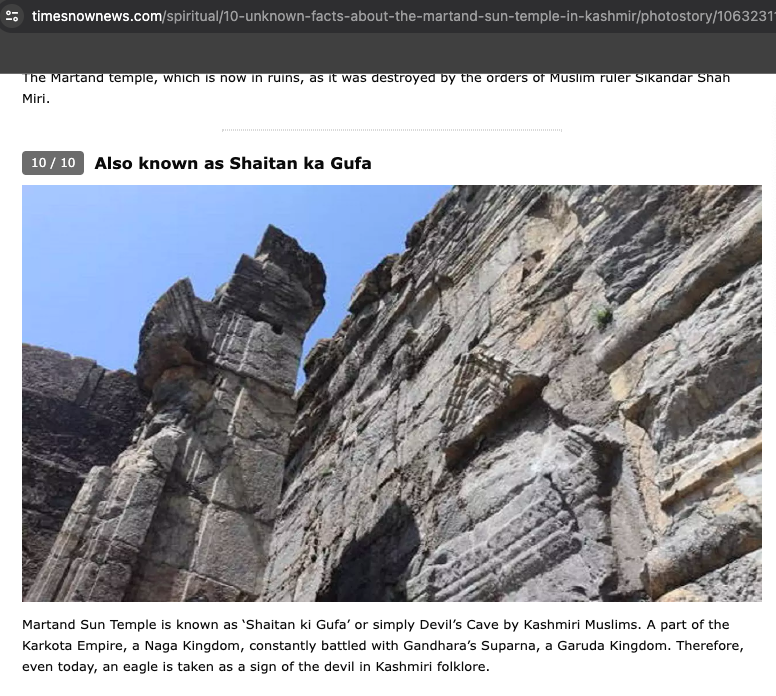
In this vein, TimesNow had published a photo story last year wherein it claimed that Kashmiri Muslims refer to this Hindu temple as ‘Shaitan ki Gufa’.
Source: TimesNow
Bollywood film ‘Haider’ referred to Martand Surya Mandir Martand as ‘Shaitan Ki Gufa’
Back in 2014, filmmaker Vishal Bharadwaj drew widespread criticism for slandering Hindu traditions in his film ‘Haider’. In this Shahid Kapoor starrer, the Surya Mandir was called Shaitan Ki Gufa in one of its songs ‘Bismil’ with Shahid dancing inside the Martand Sun Temple. This song earned huge praises for the director and actor, with people celebrating the mockery of Hindu sentiments in garb of ‘creative freedom’.
In April last year, OpIndia reported that Muslims had set off firecrackers inside the temple on Eid-ul-Fitr.
Unacademy and its past controversies
This is not the first time that Unacademy has offended Hindu sentiments, back in 2021, the ed-tech portal was found peddling a dangerously anti-Hindu narrative through its online test module. The test module insinuated that somehow Hindus are anti-Muslim bigots.
“In a city named X, a group of Muslim people were carrying out their rally on the occasion of Eid. They were chanting their slogans and were celebrating their festivals. When they were passing through the streets of a Hindu-dominated colony, the Hindus of the area started pelting stones at them and claimed that they outraged the religious feelings of Hindus. Is the claim correct?”, one of the questions in the test module read. This came despite it being widely known that Hindus have on numerous occasions been attacked with stones and other things by Islamists for celebrating their festivals and chanting their religious slogans in the so-called ‘Muslim areas’. However, in its attempt to push leftist propaganda, the ed-tech platform reversed religious identity to paint the aggressors as the victims.
After outrage, Unacademy issued an apology and blamed a third party for the ‘misrepresentation’.
In September 2020, Unacademy educator Varun Awasthi provoked students to pick up AK-47s in his online classes. Unacademy, had to distance itself from the contentious remarks made by Awasthi. Other than this, in the same year, an Unacademy tutor had gone on a rant against Brahmins. His video saying that “Brahmins are the most idle [Kaamchor] community”, went viral on social media triggering an outrage.
In August 2023, Unacademy educator Karan Sangwan courted controversy by asking students to vote for ‘educated politicians’. He also lauded the British colonizers for doing an excellent job by crafting the perfect statute and criticized the recently announced three new laws replacing IPC, CrPC, and the Evidence Act. Netizens had strongly criticised Sangwan for using an education platform to peddle political propaganda. Eventually, he was sacked by Unacademy.
Coming back to the ‘Shaitan ki Gufa’ row, Unacademy’s usage of this derogatory term is not just a factual error but an egregious attack on the Hindu community. It perpetuates a narrative that demonises Hindus and their heritage, echoing historical bigotry. Such outrageous misrepresentations in educational content are dangerous as they shape young minds and perpetuate false narratives against an already targeted Hindu community. While Unacademy has removed the offensive term from its content, this incident should serve as a wake-up call to address and rectify the bias and misinformation that pervades educational content.
The Martand Sun Temple is a revered site for Hindus, built in honour of the Sun God and labelling it with a derogatory term used by Islamists is profoundly disrespectful to the Hindu temple’s religious significance. Equating a sacred Hindu site with a “Devil’s Cave” implies a blasphemous comparison that demeans Hindu beliefs and discredits Hindu heritage. The term ‘Shaitan ki Gufa’ reflects the bigotry of Islamic invaders who sought to destroy Kafir Hindu’s culture and religion. Repeating it in contemporary contexts that too by ‘education’ platforms continues to propagate historical injustice and prejudice against Hindus.
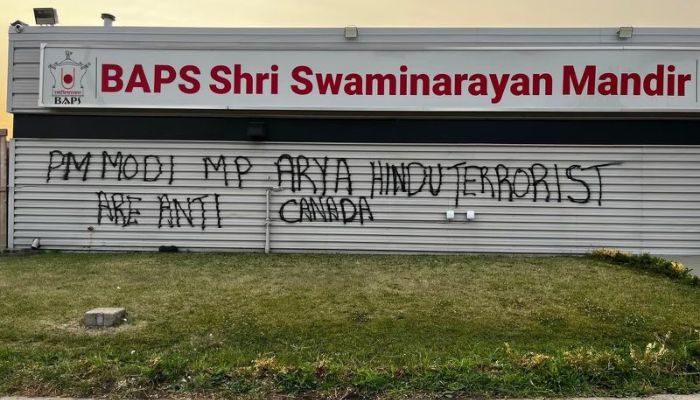
On Monday (22nd July, local time), extremists defaced the Bochasanwasi Shri Akshar Purushottam Swaminarayan Sanstha (BAPS) Swaminarayan Mandir in Edmonton city in Alberta province of Canada.
The development was confirmed on social media by Canadian MP Chandra Arya. In visuals shared by him on X (formerly Twitter), it could be seen that the wall of the Hindu temple vandalised with Hinduphobic, anti-Modi graffiti.
‘PM Modi MP Arya Hindu terrorist are Anti Canada,’ read the graffiti. In a tweet, MP Chandra Arya pointed out, “The Hindu temple BAPS Swaminarayan Mandir in Edmonton is vandalized again. During the last few years, Hindu temples in Greater Toronto Area, British Columbia and other places in Canada are being vandalized with hateful graffiti.”
The Hindu temple BAPS Swaminarayan Mandir in Edmonton is vandalized again. During the last few years, Hindu temples in Greater Toronto Area, British Columbia and other places in Canada are being vandalized with hateful graffiti. Gurpatwant Singh Pannun of Sikhs for Justice last… pic.twitter.com/G0a8ozrrHX
“Gurpatwant Singh Pannun of Sikhs for Justice last year publicly called for Hindus to go back to India. Khalistan supporters publicly celebrated in Brampton and Vancouver the assassination of Prime Minister Indira Gandhi and brandishing images of deadly weapons,” he emphasised.
The Canadian MP accused Khalistanis of orchestrating the attack on the BAPS Swaminarayan Mandir in Edmonton. “As I have always been saying, Khalistani extremists seems to get away with ease with their public rhetoric of hate and violence…Hindu-Canadians are legitimately concerned,” he stated.
Chandra Arya reiterated, “Like a broken record, I again call on Canadian law enforcement agencies to take this issue seriously before these rhetorics get translated into physical action against Hindu-Canadians.”
Attacks on Hindu temples in Canada
This is not the first time that a Hindu temple had come under attack in Canada.
In September 2023, the Shree Mata Bhameshwari Durga Devi Society in Surrey British Columbia was sprayed with ‘Punjab is not India’ grafitti
In February 2023, a Ram temple in Mississauga was defaced with anti-India graffiti by unknown miscreants.
In January 2023, the Gauri Shankar Mandir was desecrated by Khalistani extremists in Brampton City in Ontario province of Canada. The walls of the temple were defaced with anti-India graffiti by Khalistanis associated allegedly with the banned outfit Sikhs For Justice (SFJ). The vicious slogan of ‘Khalistan Zindabad, Hindustan Murdabad’ was found spray-painted on the outer wall of Gauri Shankar Mandir.
In September 2022, some Khalistani terrorists defaced BAPS Swaminarayan Temple in Toronto with anti-India slogans. Several videos circulating on social media showed slogans of ‘Khalistan Zindabad, Hindustan Murdabad’ painted on the walls of the temple.
In February 2022 alone, six Hindu temples were attacked in Toronto.
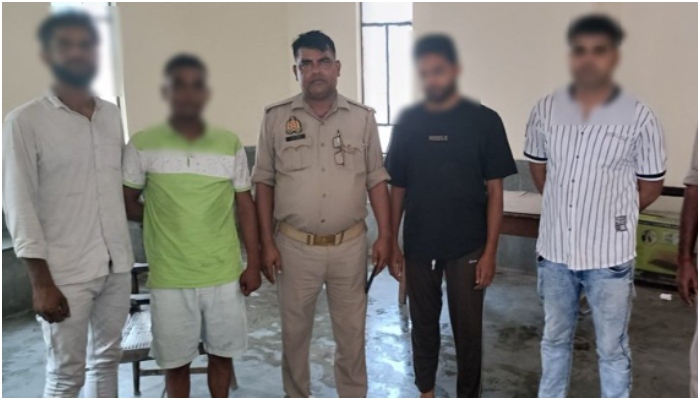
On Sunday, July 21st, the Uttar Pradesh Police arrested 4 individuals identified as Akram, Shahrukh, Arshad, and Azam after they attacked a Hindu temple in the Izatnagar area of UP’s Bareilly district. The accused have been charged with causing a disturbance and damaging idols at the Gopeshwar Nath temple.
As per the local reports, the primary accused identified in the case, Akram belongs to the state of Uttarakhand. The incident is said to have happened on Sunday when the accused persons reached the temple and damaged the idols of the Gods and Goddesses. They damaged the idols of Lord Shiva and Goddess Parvati ahead of the beginning of the Shravan month. Accused Akram also attacked the temple priest with a knife, as per reports.
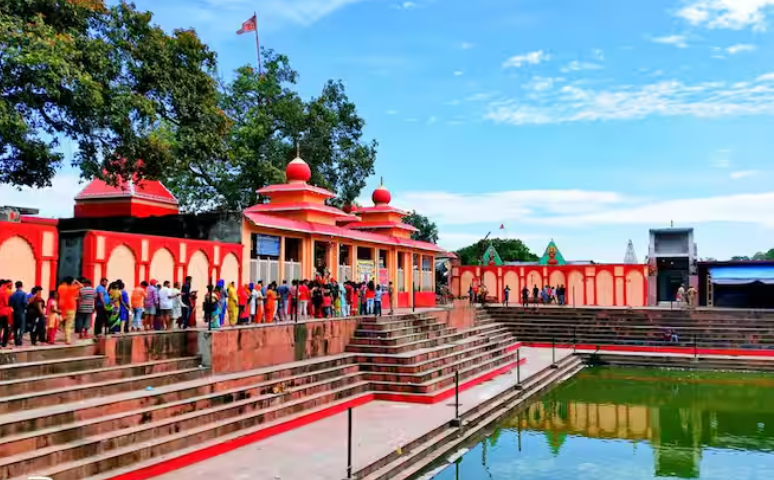
Gopeshwarnath Temple (ABP News)
The Hindu residents and activists learned about the incident and demanded strict punishment against the accused persons. They informed the police after which Assistant Superintendent of Police (ASP) Rahul Bhati and CO Anita Chauhan reached the spot. On seeing the police, the accused persons attempted to flee from the spot however, the primary accused Akram was caught. The police also recovered foreign currency from the arrested Akram.
The police immediately began an investigation into the case after the Hindu organizations protested against the incident and demanded strict action against the accused. The other accused were then eventually arrested.
The police have charged four under relevant sections of the Bharatiya Nyaya Sanhita, including section 298 (injuring or defiling a place of worship with intent to insult the religion of any class).
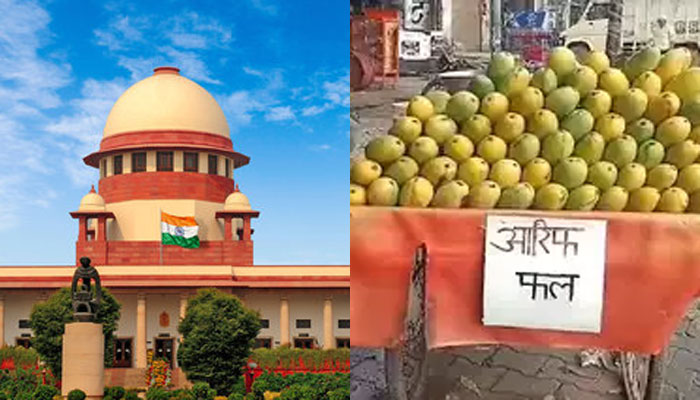
On 22nd July, the Supreme Court of India gave interim relief to the petitioners against the Uttar Pradesh, Madhya Pradesh and Uttarakhand governments’ directives to prominently display the names of the owners of the shop and carts. While Uttar Pradesh and Uttarakhand governments issued directives for the Kanwar Yatra Path, Madhya Pradesh’s Ujjain administration gave directives for the shops and carts outside the Mahakal Temple.
During the argument, an interesting trivia came to light. The matter was heard by Justice Hrishikesh Roy and Justice SVN Bhatti. It was mentioned by Justice Bhatti that he used to go to a vegetarian hotel operated by a Muslim over the one operated by a Hindu citing ‘hygiene standards’.
He said, “Without disclosing the city’s name I will share it with you. In Kerala, there were two vegetarian hotels, one by Hindu and one by Muslim. I went to the latter because he was maintaining international standards. He was a Dubai returnee. But he displayed everything on the board.” [The quote is a mix of X posts made by Live Law and Bar & Bench]
Singhvi: Hundreds are losing their jobs. We have to wake up and smell the coffee. Idea is to exclude not just one minority but Dalits as well.
Justice Roy: What is the expectation of the Kanwariyas? They worship Shiva, yes? Do they expect the food to be cooked and served and…
In short, Justice Bhatti made a firm choice based on the information displayed on a board to choose a Muslim hotelier over a Hindu hotelier because the former was maintaining “International Standards” of hygiene. Justice Bhatti had the choice of selecting the hotelier with a complete set of information including his religion.
J Bhatti: There is one veg hotel run by a Hindu, and one run by a Muslim…in Kerala…As the judge of that state, I used to go the one run by the Muslim. He was maintaining international standards#SupremeCourt#KanwarYatra
Now the question arises, if Justice Bhatti can have the choice and clarity while choosing the restaurant, why did the two-judge bench, which he was part of, deny the same right to Hindu pilgrims performing Kanwar Yatra? For those who are unaware, devotees performing Kanwar Yatra are supposed to eat only Satvik food. They must follow certain rules which they may break in case enough information is not available.
The interim stay imposed by the Supreme Court was based on the contention that the directives were “discriminatory” and would cause untouchability. Interestingly, on social media, it has been argued that Kanwariyas would also avoid eating at restaurants run by Scheduled Castes, Scheduled Tribes OBCs etc. One may ask what proof or evidence they provided. The answer is none.
Anyway, Abhishek Manu Singhvi, representing the petitioners further contended that the display of the name itself cannot be seen as a measure to ensure vegetarian food. Furthermore, any such directive coming without any support from the Constitutional or legal provisions would infringe the secular character and Articles 14, 15(1) and 17 of the Constitution. While these contentions were accepted by the apex court, there was no thought of mind implying the fact that Hindus too have the right to choose where they want to eat or buy anything.
Furthermore, while discussing the above aspects, Justice Bhatti also mentioned that “some non-vegetarians” prefer Halal-certified meat. Halal is a religious term used for meat produced as per Sharia law or Islamic laws. Only a Muslim can ensure the meat is Halal. Judges were aware that food choices are prominently dependent on religion. Without taking the name of the Muslims, Justice Bhatti pointed out that Muslims make an informed choice to choose Halal meat over Jhatka or unlabelled. How do they know that the meat is Halal? Meat shop owners mention it in bold letters.
Justice Bhatti: We understand the distinction between good and bad here. Some non-vegetarians prefer halal certified meat. What I see is that you previously mentioned you couldn’t answer my brother’s question with a simple yes or no.
Halal meat is so widely available and has become the first choice of famous food chains that it is extremely difficult for Hindus and Sikhs to find Jhatka meat. They have to make extra effort to ask if the meat is Jhatka or not. As Halal meat is butchered only by a Muslim, it leads to a loss of jobs for Hindu and Sikh butchers. Only a few Butchers of Hindu or Sikh community are left but it has never been questioned. Hindus are in majority in India. The population of meat-eating Hindus surpass Muslims. Still, Hindus are forced intentionally or unintentionally to eat Halal meat. In this case, what about the rights of Hindus? Are they not valid?
One needs two hands to clap. Certain rules about dietary habits and choices cannot be imposed continuously in a biased manner favouring only one community. Hindus must get the right to choose where they want to eat and from whom they want to buy fruits or any other item. It has to be based on the information publically available, preferably prominently written on boards outside shops and carts.
There is another aspect of the order. The Supreme Court pointed out that a competent food authority should have passed the order in the matter. The court said, “It is permissible for the authorities to ensure that the Kanwariyas are served vegetarian food conforming to the preferences and also ensure hygienic standards. In furtherance to this, the competent authority may perhaps issue orders under the Food Safety and Standards Act, 2006 and the Street Vendors Act, 2014. However, the legal powers vested on the competent authority cannot be usurped by the Police, without legal foundation.” In short, if FSSAI issues directive to prominently display names of the owners and workers at the restaurant or carts, the apex court will not have a problem with it.
Sadly, there was no one from any of the three governments, Uttar Pradesh, Madhya Pradesh and Uttarakhand, to represent the matter in the Supreme Court even though all three governments have counsels on payroll in the apex court. The next date of hearing in the matter is 26th July.
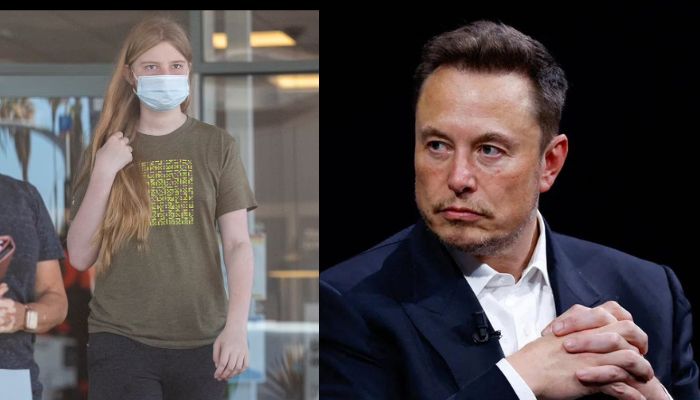
On Monday (22nd July, US local time), American billionaire Elon Musk narrated how he ‘lost’ his son Xavier and vowed to destroy the woke mind virus.
During an interview with renowned psychologist Jordan Peterson, Musk recounted, “I was essentially tricked into signing documents for one of my older boys, Xavier.” The Tesla CEO pointed out that he was misled into opting for puberty blockers for his son.
“This was before I had really any understanding of what was going on, and we had COVID going on, and so there was a lot of confusion. And, you know, I was told Xavier might commit suicide if he didn’t. That was a lie right from the outset?” he emphasised.
JUST IN: Elon Musk says his son is "dead" thanks to the woke mind virus after he was put on puberty blockers, says he vowed to "destroy the woke mind virus after that."
??
"I was essentially tricked into signing documents for one of my older boys… This was before I had… pic.twitter.com/wfWztIziTs
Musk added, “Incredibly evil, and I agree with you that people that have been promoting this should go to prison. So I was tricked into doing this, and it wasn’t explained to me that puberty blockers are actually just sterilization drugs.”
“So I lost my son, essentially. They call it deadnaming for a reason. So the reason it’s called deadnaming is because your son is dead. So my son Xavier is dead, killed by the woke mind virus,” he lamented.
“Yeah, and there (are) lots of people in that situation now. It’s not pretty, and (there are) lots of demolished kids. Well, that’s a good reason to be the final straw. So I vowed to destroy the woke mind virus after that, and we’re making some progress,” the Tesla CEO concluded.
The Background of the Controversy
In June 2022, Elon Musk’s son Xavier Alexander Musk announced that he identified as a ‘woman.’ The 18-year-old re-christened himself as ‘Vivian Jenna Wilson’ and decided to cut ties with his father.
While Xavier is not physically ‘dead’, Musk lost his son to what he described as the ‘woke mind virus’. He had blamed the elite school, where Xavier studied, for brainwashing him.
“(Xavier) became a fervent Marxist and broke off all relations with me…He went beyond socialism to being a full communist and thinking that anyone rich is evil…I have made many overtures, but he doesn’t want to spend time with me,” Musk stated.
Indian Naval Ship (INS) Brahmaputra is resting on one side after a major fire broke out on the ship, resulting in the loss of a junior sailor for whom the search is in progress, the Indian Navy said.
The fire broke out in the INS Brahmaputra, a multi-role frigate, on the evening of July 21, while she was undergoing refit.
“In the fire incident onboard the frigate INS Brahmaputra, the warship experienced severe listing to one side (port side). Despite all efforts, the ship could not be brought to an upright position. The ship continued to list further alongside her berth and is presently resting on one side. All personnel have been accounted for except one junior sailor, for whom the search is in progress,” the Indian Navy said.
“An inquiry has been ordered by the Indian Navy to investigate the accident. A fire had broken out onboard the Indian Naval Ship Brahmaputra, a multi-role Frigate, on the evening of July 21 while she was undergoing refit. The fire was brought under control by the ship’s crew with the assistance of firefighters from Naval Dockyard, Mumbai {ND (Mbi)} and other ships in the harbour, by the morning of July 22. Further, follow-on actions, including sanitization checks for assessment of residual risk of fire, were carried out,” they added.
Union Defence Minister Rajnath Singh has also directed Navy Chief Dinesh K. Tripathi to take appropriate action in the incident.
“Chief of the Naval Staff, Admiral Dinesh K Tripathi, has apprised RM Shri @rajnathsingh
of the fire breakout onboard Indian Naval Ship Brahmaputra and the damages caused by the incident. RM Shri @rajnathsingh has directed the Navy Chief to take appropriate action,” the Office of the Raksha Mantri posted on X.
(This news report is published from a syndicated feed. Except for the headline, the content has not been written or edited by OpIndia staff)
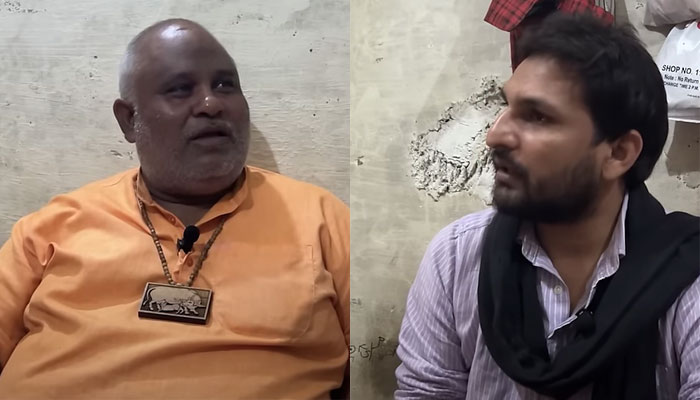
On Saturday, 20th July, propaganda portal Newslaundry published a video interview with Gaurakshak Bajrang Force chief Bittu Bajrangi. While speaking to Bittu, Newslaundry’s reporter Avdesh Kumar spoke to him politely but the agenda with which he approached the interview was sinister.
Violence broke out in Nuh during a jalabhishek yatra in July last year, killing six people. Key accused Bittu Bajrangi is set to lead the same yatra today.
The title of the video interview reads, “The main accused of Nuh riots and out on bail Bittu Bajrangi to organize Jalabhishek Yatra again”. The description of the video, which was in Hindi, read, “Bittu Bajrangi, the main accused in the violence that occurred on July 31 last year, is personally inviting people to participate in this procession. We spoke to Bittu Bajrangi in detail about this matter. It should be noted that the violence in Nuh, Haryana, last year created a climate of concern across the state and the country. This violence occurred during a religious procession when a minor dispute between two communities suddenly escalated. Six people lost their lives, and many were injured in the violence.”
The description further read, “Bittu Bajrangi, known as a Gau Rakshak, was prominently implicated in this incident. He also runs an organization called Gau Raksha Bajrang Force. Last year, he was arrested on charges of inciting violence and playing an active role in it. The police and administration considered him one of the main accused. Bittu Bajrangi participated in the religious procession during which the violence started. He is accused of inciting his supporters and encouraging them to engage in violent activities. Immediately after the violence, Bittu Bajrangi was taken into police custody, and multiple charges were filed against him. He is currently out on bail.”
OpIndia talked to Bittu Bajrangi to get his views on the title and description. He said, “I am heartbroken. I will be vigilant next time before agreeing to an interview”. From his statement, it is evident that he was unaware of how he was going to be presented in the video.
No one is denying that there are several cases filed against Bittu Bajrangi, especially linked to his Gau Raksha work. However, in this case, Newslaundry has presented him as if he was the one solely responsible for the Nuh violence that took place on 31st July 2023. OpIndia accessed court documents, including his bail orders by the Sessions Court. There was no mention that he was the main accused. As the order read, Usha [Kundu], HPS Additional Superintendent of Police, Nuh, was posted on the day of the incident. She noticed Bittu and his accomplices coming towards the temple to join the procession.
She pointed out in her complaint that Bittu and his accomplices were carrying swords and Trishul-like weapons which were confiscated by the police. After the police confiscated the swords and Trishul, Bittu and his accomplices got into an altercation with the police and staged a protest by sitting on the road in front of the police vehicle. It was then alleged that they forcefully took the weapons away. Defense counsel appearing for Bittu argued that the alleged weapons were just symbols that were carried for display.
While granting bail to Bittu, the court noted, “It has nowhere been pointed out that as to whether these weapons were being used to cause violence on the spot or to inflict any injury either to the policemen or to any people of a particular community. No such allegations are there. Snatching of such articles/weapons from the policemen is also highly improbable.” Bittu Bajrangi was accused under sections 148, 149, 332, 353, 186, 395, 397, 506, 25, 54, and 59 of the IPC in connection with the Nuh violence incident.
It was nowhere mentioned in the FIR that Bittu Bajrangi used the weapons or inflicted any injuries on police personnel or people of a particular community.
Notably, a trial in the matter has started in the Sessions court and a non-bailable warrant was issued against Bittu as he failed to appear in court via video conferencing. His counsel argued there was some miscommunication but NBW was issued by the court. However, that still does not prove that he played any role in the violence.
Newslaundry’s description lacks facts. They mentioned that six people were killed but did not mention what was the reason behind it. Newslaundry failed to mention that a Hindu boy named Abhishek was shot dead and then beheaded by an Islamist mob. Abhishek’s head was then crushed with a stone. Newslaundry did not make a video explaining how an Islamist mob attacked a cybercrime police station or how a female judge was attacked during the violence by the Islamist mob when she was traveling with her daughter. Shops of Hindus were burnt to the ground, Hindu pilgrims were made hostages in a temple, and police personnel and home guards were killed by the riotous Islamist mob. This is how propaganda works and Newslaundry is an expert in it.
As mentioned earlier, no one is denying the cases against Bittu. He mentioned that there are around eight cases currently pending against him and he has been in and out of jail over such cases. But that does not nullify the fact that he has tirelessly worked for the welfare of the Hindu community including Gau Raksha. While propaganda portals do not skip a breath before mentioning terrorists like Afzal Guru as a professor or riot-accused Umar Khalid as a “student activist”, when it comes to Hindu activists like Bittu, they present them as no less than terrorists, while hiding the crimes of the Islamists against which those like Bittu Bajrangi act in defense.
Hundreds and thousands of Hindu activists are misrepresented by the left-leaning media which often distorts their intentions and work. Take the example of this interview. The NL reporter kept pressing Bittu to “reveal” his political affiliation. Bittu pointed out that he works independently without any political affiliation or “sar par haath” per se.
Kumar kept asking if he was associated with RSS, BJP, or VHP. Bittu clearly said that he is inspired by these organizations and attached to them in one way or another. When the reporter said VHP has “disowned” him, Bittu said, “When a family member does something wrong, the elders of the family say in anger ‘he is not part of our family’. That does not necessarily mean that the person who did wrong has been disowned”. The argument visibly rattled the reporter, and he changed his course of questions.
From the use of foul language to alleged derogatory social media posts, Kumar did not leave any stone unturned to agitate Bittu during the interview. Bittu at one point said, “I am a very calm person who does not use foul language. However if someone acts against the Hindu community, I may get angry”. He admitted he gets angry but that does not mean he uses foul language every time he speaks, something which Newslaundry’s reporter wanted to present.
What could be the aim of such an interview that too just a couple of days before the scheduled Brijmandal Yatra? The aim was simple. Newslaundry wanted to set a narrative that Bittu Bajrangi was the key accused and reason for Nuh’s violence last year. In case anything happens during the 2024 Yatra, the blame would have again gone to Hindu activists. Unfortunately for Newslaundry and fortunately for Bittu, he was not granted permission to attend Yatra. It was one of his bail conditions that he would not visit Nuh until the trial was over, which could have led to the denial of the permission, this, despite there being no proof of his involvement in any violence during the Nuh Yatra, and there being plenty of evidence of the violence unleashed by the Muslim mob.
One can only hope nothing happens during the ongoing Brijmandal Yatra as 5,000 police personnel have been deployed by the Haryana government to avoid any sort of agitation or violence. In a country where Hindus are supposedly a majority, they need protection from the police (in the case of Brijmandal Yatra) and the Army (in the case of Amarnath Yatra) to participate in a pilgrimage which speaks volumes about the reality of the situation.