Home Blog Page 998

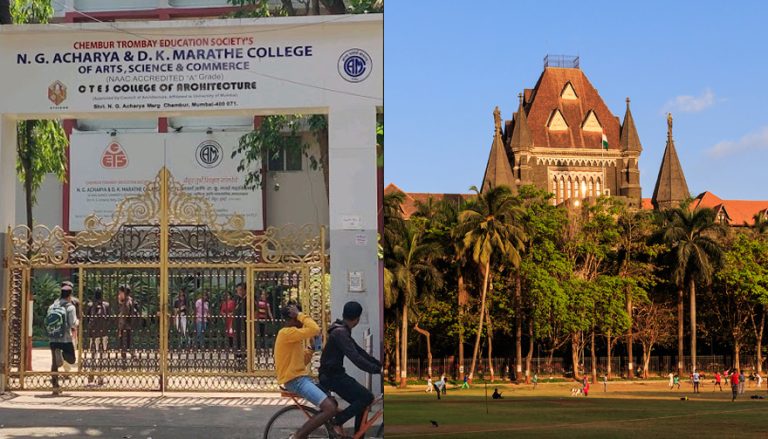
We are not inclined to interfere: Bombay High Court dismisses plea challenging hijab ban imposed by a Mumbai college

On 26th June, the Bombay High Court rejected an appeal from nine female students contesting a Mumbai college’s dress code, which forbade students from wearing Islamic headgear, stoles, burqas, hijabs and other items on campus. The students who are enrolled in second and third-year B.Sc. and B.Sc. (Computer Science) courses of NG Acharya and DK Marathe College filed a petition against the institution, but it was dismissed by a division bench of Justices A S Chandurkar and Rajesh Patil, who stated that they were not inclined to interfere with the decision taken by the educational institution.

They submitted a petition to the High Court earlier this month, contesting a decision made by the NG Acharya and DK Marathe College of Art, Science and Commerce of the Chembur Trombay Education Society that enforced a dress code that barred students from entering the building with burqas, stoles, caps, badges or hijabs. The petitioners claimed that such a directive violated their fundamental rights of choice, privacy and practice of their religion. The plea termed the college’s action “arbitrary, unreasonable, bad-in-law and perverse” and charged that it was a “colourable exercise of power.” 

The college during the hearing last week asserted that the goal of the restriction is to prevent the display of religious symbols, with the exception of those that are considered to be an integral component of the basic right to practice one’s faith such as the turban worn by Sikhs. Senior counsel Anil Anturkar, on behalf of the college, clarified that the prohibition is for all religious symbols and does not specifically target Muslims. He underlined that, except in cases when they are required under the fundamental right to religion, the college’s policy bans the open display of religious symbols.

Altaf Khan, the petitioner’s attorney, presented specific Quranic verses to the High Court to bolster their argument that the hijab is a mandatory component of Islam. In addition to their right to freedom of religion, he alleged the petitioners were challenging the college’s decision by invoking their rights to privacy and choice. He alleged that this issue deals with older college students who have a dress code but not a uniform, setting it apart from the Karnataka High Court’s ruling on the hijab ban at junior institutions.

He contended that the dress code was implemented through WhatsApp without any legal foundation, drawing a comparison to the Karnataka case where a uniform policy that was already in place was enforced. He emphasized that the petitioners’ rights to autonomy, bodily integrity and choice have been breached by the dress code. Anil Anturkar pointed out that the rule did not apply only to Muslims but to all students as well and he urged the petitioners to provide evidence that the wearing of the hijab is a mandatory Islamic religious practice. He maintained that rather than wearing religious insignia, pupils need to concentrate on their studies.

He further stressed that when the petitioners applied for admission, they were aware of the dress code. He added that the college would also object if someone was to put on additional religious symbols in the future, for instance, a gada (mace) or bhagwa (saffron) outfit. The university’s legal representative questioned whether the writ petition could be upheld, noting that this case does not include a state instrumentality, in contrast to Karnataka, where a government decree outlawing the hijab was challenged.

Altaf Khan refuted the accusation of discord, stating that the petitioners had been donning hijabs for two years without causing any strife. He alleged that the ban is against Justice KS Puttaswamy’s verdict on the right to privacy as well as Articles 19 and 21. He declared that the case solely addresses the petitioners’ complaints and does not pertain to the general public interest. He remarked that there is no justification for the dress regulation and the hijab is also Indian. He mentioned that the dress code prevents students from Muslim, Scheduled Castes, Scheduled Tribes and Other Backward Class communities from having greater access to education by listing a number of rules and regulations.

The submission claimed that the petitioners have been using the hijab and niqab for a number of years, both inside and outside of the college. The institution recently published an updated notice titled “Instruction for Student” over a WhatsApp message and its website. The letter implemented a dress code that specifically prohibits the wearing of stoles, caps, badges, niqabs, burkhas and hijabs. The petitioners alleged that the directives undermine their rights provided by Articles 14, 19, 21, 25, 26, and 29 of the Indian Constitution and are unlawful, arbitrary and unreasonable. They also asserted that these instructions are not supported by any statutory authority.

The petitioners made their request to the college administration and principal on 13th May, asking them to lift the ban on the headscarf, burka, and hijab and permit them “as a matter of right of choice, dignity, and privacy in the classroom.” They also brought their grievance to the attention of the United Grant Commission, the University’s chancellor, and the vice-chancellor for support and urged them to step in and uphold an inclusive learning environment. They filed the case in the High Court after not getting a response to their complaints.

Madhya Pradesh: Mohd Salman threatens, molests minor Hindu girl in Dhar village, faces arrest and bulldozer action

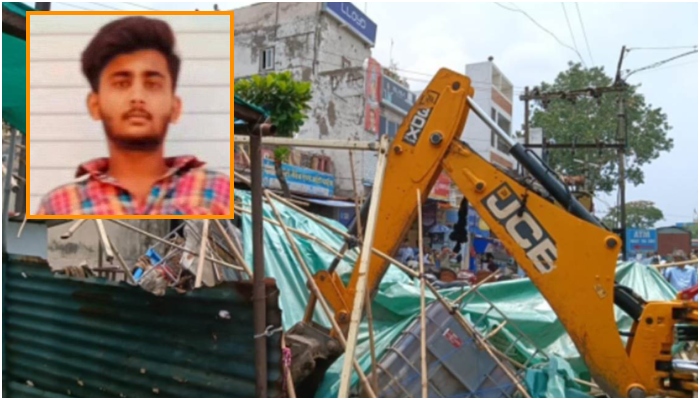
On Wednesday, 26th June, the Madhya Pradesh Police arrested an individual identified as Mohammed Salman for molesting a Hindu minor girl from Dhar. The incident is said to have happened when the victim was going home after school. The accused reportedly blocked her on her way home and molested her. The Hindu activists have taken cognizance of the event and demanded strict action against the accused person.

As per the reports, the incident came to the fore only after the girl reached home and informed her parents. The parents then filed a police complaint demanding strict action against the accused person.

The Police arrested the individual and launched an investigation into the case. Meanwhile, the administration decided to raze down the illegal shop belonging to the accused. Accused Salman operates a vegetable shop in a village in Dhar. He is said to have molested a Hindu girl who studied in 8th standard at a local school.

As per the Police, the accused stopped the girl under the guise of asking address at around noon on 25th June. He then clicked derogatory photos of her and molested her. He also threatened the girl to circulate her image and cooperate with her in his derogatory activities. The girl somehow managed to escape from the spot and reach home.

The accused has been charged under relevant sections of the Indian Penal Code, 1860, POCSO, 2012, and also SC/ST Act. The Hindus meanwhile asked the local administration to take action against the accused after which the latter’s illegal property was razed to ground.

Further investigations are underway.

Punjab: Lovely Professional University student from Odisha gang raped by men dressed as Nihangs, Aman, Ranveer Singh and Manjit Singh arrested

An alarming gang rape incident has come to light from Jalandhar, Punjab. On 24th June, a 24-year-old female student who hails from Odisha was brutally gang-raped by three men disguised as Nihangs. The victim is enrolled in the Bachelor of Business Administration (BBA) program at Lovely Professional University (LPU). The gang rape incident took place on the night of 24th June when the victim went out to eat at a food court near Dhilwan Gate along with her friends.

According to police, the victim was with her two male friends at the time of the incident, all students of the same class. At around 1 AM, three men arrived at the food stall on bikes. Two of them were in traditional Nihang attire and armed with daggers. They approached the students and questioned the victim’s friends about their intentions in an intimidating manner, asking what were they doing at that time with a lone girl. They then forced her friends to leave the place claiming they would safely drop the girl back.

They forcibly made her sit on their two-wheeler, saying they would drop her at her campus. But Instead of taking the girl back to the campus, they took her to a secluded place and gang-raped her. After committing the crime, they left the traumatised student and fled the scene.

After that, the victim called her friends and requested them to rescue her. Her friends rushed to the spot for her aid and took her to the hospital. Patara police were informed about the incident, after which the police swung into action.

By Tuesday morning, the three suspects identified as Aman, Ranveer Singh and Manjit Singh were arrested by the police. SHO Baljeet Singh said in a statement that one of the accused is employed at a government water treatment plant, another is a student and the third one runs an electric goods shop. The police confirmed that though the accused were dressed as Nihangs they did not belong to the community. They were taken to Civil Hospital for medical examination before being remanded in police custody for further questioning.

According to the police, the victim said in her complaint that she and her friends were enjoying a meal at the food court when three men arrived on a bike who were dressed in Nihang attire. They questioned her friends about why they were with the victim so late at night. They intimidated the friends and managed to scare them away while assuring them that they would drop her back safely. However, they took her to a secluded place to gang rape her.

An FIR has been registered based on the victim’s complaint and the accused were granted police remand by the court. SHO assured that the perpetrators will be brought to justice.

OpIndia tried contacting local police but could not connect.

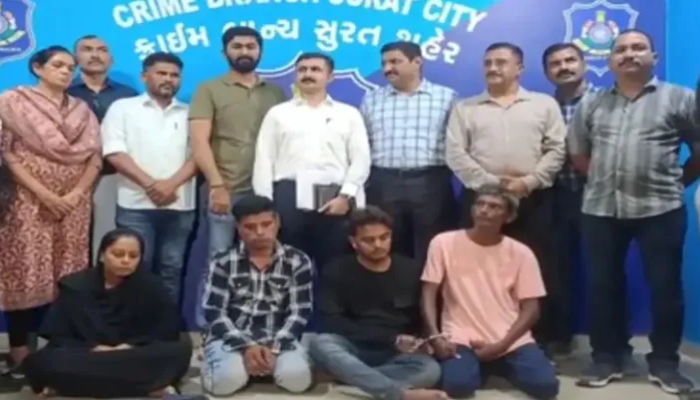
Drug smuggling gang busted in Surat: Rabia, Safiq and Ashfaq among 7 arrested, narcotics worth lakhs recovered

Drug seizures have been reported in numerous locations around Gujarat for a while. Now, Surat Police captured seven persons, including a woman, who were peddling drugs. Narcotics valued at lakhs have been found on them by authorities.

Home Minister Harsh Sanghvi has shared the information on his official social media handle. He declared that there is no place for drugs in the state. He highlighted, “Taking a step further to make the state drug-free, the Gujarat Police has carried out successful operations. Taking a step further to make the state drug-free, the Gujarat Police has carried out successful operations.”

He mentioned that the arrested individuals are Rabia Abdul Razak Shaikh (40) and Safiq Khan Babukhan Pathan (43), both from Mumbai. The minister revealed that the Surat police arrested these people at the railway station before they could deliver drugs in Surat and after further investigation, five more drug dealers connected to the group were taken into custody. He added, “The Gujarat Police has worked vigilantly to keep drugs out of the state, protecting the lives of many youths. Congratulations to the Surat Police for the success of this operation.”

According to the information, the Surat Crime Branch team conducted surveillance and apprehended Rabia along with her accomplice Safiq on 23rd June. They reached Surat from Mumbai via the Suryanagari Superfast Express (Bandra Terminus to Jodhpur Junction). In response to a confidential tip, the Surat Crime Branch maintained vigilance outside the railway station and arrested Rabia, a resident of Govandi, Maharashtra, and Safiq, a resident of Jaunpur, Uttar Pradesh, together with 252.34 grams of suspected drugs whose market price is Rs 25,23,400.

A slew of arrests began after questioning the duo. The police learned that they sold drugs to Mohsin Sheikh, Sarfaraz Gadhiyali alias Salman and Faizal, living in Surat and carried out searches in five areas. While looking for the three culprits, the cops reached room number 404 of Cassa Marina Hotel in the Rander area and found Sarfaraz there. 28.790 grams of drugs worth Rs 28,900 was confiscated from him. He is originally from Jambusar in Bharuch and currently stays in Ramnagar, Rander. The police have registered a case against him under the NDPS (Narcotic Drugs and Psychotropic Substances) Act at Rander Police Station.

Afterwards, the cops caught Faisal Allahrakha Kachra and Yasin Babul Mulla with 31.55 grams of drugs or 3,15,500 MD (Methylenedioxymethamphetamine) from the road near Rama Residency in the Rander neighbourhood. A case was registered against the pair under the NDPS Act at the Rander police station. Meanwhile, the police raided Ashfaq Mohammad Yunus Sheikh’s residence after learning that his friend Mohsin Sheikh was hiding there. The cops then stormed Rudrapur Kumbharwad where Ashfaq was apprehended.

Ashfaq attempted to jump from one building’s roof to another in an attempt to flee, but he was injured in the process after which he was brought to the hospital immediately. 14 grams of drugs were discovered on him during the inspection. Syed Asif, also known as Babu was caught by authorities in front of Shruti Ent Hospital & Cochlear Implant Centre in Nanpura and they discovered 27 grams of drugs on him. Surat Crime Branch searched 5 places in total and recovered 354.650 grams of drugs and 1.930 grams of marijuana valued at Rs 37.37 lakhs.

A total of 7 offenders Rabia Bibi Sheikh, Safiq Khan Pathan, Sarfaraz alias Salman, Faisal Kachhara, Yasin Mulla, Ashfaq Sheikh and Syed Asif alias Babu have been arrested by the police. Rabia was the brains behind the operation and she brought the drugs in a school bag. The cops also took away cash and mobile phones from her.

During her prior visits to Surat, she had delivered narcotics to five different individuals. Now, one case has been submitted at DCB police station, one case at Pal Police Station, one at Rander police station and two at Athwalines police station against the accused. Seven crime cases have already been registered against Sarfaraz alias Salman at Rander police station.

Surat police had been working on this case for more than a month and had collected all the details on these criminals. Rabia used to travel to Surat by means of multiple trains, buses and rickshaws. From the start, two constables had been deployed behind Rabia by the police to keep an eye on her every move. Furthermore, her delivery agents were not even aware that they were on the radar of the crime branch. The effort by the Gujarat police has resulted in the confiscation of drugs worth over Rs 2200 crores in the last three months, with Surat police recording the highest number of cases. Drugs worth approximately Rs 9300 crores were seized in the last three years.

Surat Police is holding several drives as part of their “No Drugs in Surat City” campaign. Drone surveillance is being used in addition to strict checking in every other region of the city, including the waterfront. The police are also conducting awareness campaigns and checking at food stands and food corners near educational institutions to prevent young people from becoming addicted to drugs.

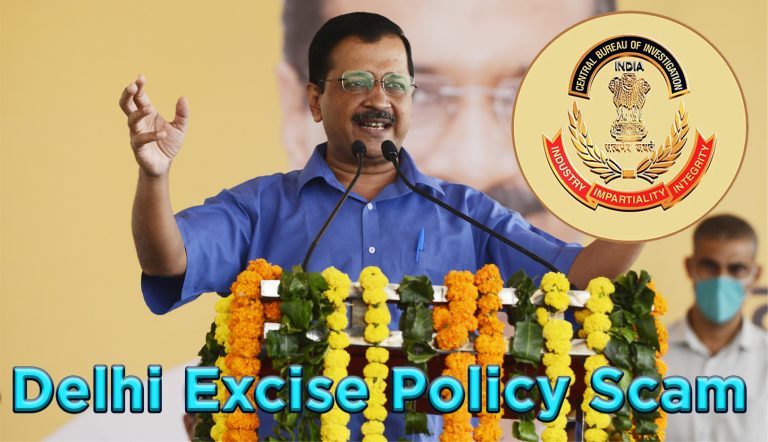
Delhi Excise Policy Scam: CBI formally arrests CM Arvind Kejriwal from court after questioning him in jail

0

The Central Bureau of Investigation (CBI) on Wednesday arrested Delhi Chief Minister Arvind Kejriwal from the courtroom, in connection with the Excise policy case.

CBI arrested the Aam Aadmi Party (AAP) national convenor Kejriwal after the Vacation Judge of Delhi Court allowed CBI to examine/interrogate him in the courtroom so that the agency could proceed with his formal arrest.

The court also asked CBI to place on record the material that they have for his arrest.

Kejriwal was today produced before the court of vacation judge Amitabh Rawat in compliance of the production warrant issued by the court yesterday.

During the hearing, Kejriwal’s wife Sunita Kejriwal, AAP’s Rajya Sabha MP Sanjay Singh and AAP leader Dilip Pandey remained present in the courtroom.

CBI’s Special Public Prosecutor DP Singh extensively argued and opposed submissions by Kejriwal’s lawyer.

The advocate also moved an application seeking a supply of applications for interrogation by CBI and the order passed related to that.

Yesterday, Kejriwal in Tihar Jail and recorded his statement related to the Excise Policy case. He was arrested by the Enforcement Directorate in the Excise Policy money laundering case on March 21 this year and presently in Judicial Custody in the case.

One of the lawyers for the Aam Aadmi Party also posted on X, and said that, “The dirty tricks of the Modi government fears the release of Arvind Kejriwal by SC has asked to CBI to make arrest in the same matter almost a year after he joined the investigation. What it shows nothing changed the vindictive mindset of BJP. Shame.

The Delhi High Court on Tuesday stayed Chief Minister Arvind Kejriwal’s bail order passed by the trial court, saying that the trial court should have at least recorded its satisfaction with the fulfilment of twin conditions of section 45 of Prevention of the Money Laundering Act (PMLA) before passing the impugned order.

The vacation bench of Justice Sudhir Kumar Jain, while passing the order, said that documents and arguments were not appreciated properly by the trial court.

On June 20, the trial judge granted bail to Kejriwal in the money laundering case. The next day, the ED moved an urgent petition before the High Court challenging the bail order. The High Court heard both sides extensively reserve orders on the ED’s application to stay the bail order and halted the release of Kejriwal until the pronouncement of its order.


(This news report is published from a syndicated feed. Except for the headline, the content has not been written or edited by OpIndia staff)

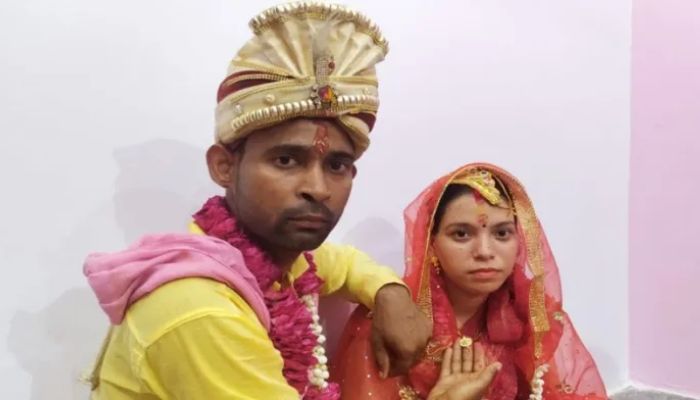
‘Was afraid of Halala’: Samreen becomes Suman Yadav after Ghar Wapsi in Bareilly, marries Mitrapal amidst chants of Gayatri Mantra and Havan

In Uttar Pradesh’s Bareilly district, a Muslim girl named Samreen (22) did Ghar Wapsi and embraced Hindu Dharma. After reverting to Hindu Dharma, she changed her name to Suman Yadav. Suman also tied the marital knot with a Hindu youth named Mitrapal. The couple took seven vows in front of the fire at the Agastya Muni Ashram in Bareilly, promising to always support each other. Samreen performed the Vedic ritual with a havan amidst chants of the Gayatri Mantra. On Tuesday (25th June 2024), after doing Ghar Wapsi, Samreen expressed her dislike for the burqa, stating that she was afraid of triple talaq and Halala.

Samreen’s father, Jameel Ahmed, works in the clothing business. She is originally from the Senthal area of Bareilly. Samreen’s father only educated her up to the 5th grade. About two years ago, she went to a relative’s house in the Izzatnagar area to attend a function. Mitrapal’s house was in the neighbourhood of her relative’s place. During this time, they met for the first time. Mitrapal has completed his intermediate education and works in a private job with a monthly salary of Rs 12,000.

After conversing for a few days, they became friends, and their friendship eventually turned into love. They also decided to get married. However, when Samreen’s family learned about their relationship, they imposed numerous restrictions on her. They started monitoring her outings and took away her phone. They also started searching for a prospective Muslim bride for Samreen. Meanwhile, Samreen and her lover Mitrapal were also trying to get married as soon as possible.

Through his friends, Mitrapal found out about the Agastya Muni Ashram and the priest K.K. Shankhdhar, who had facilitated several Ghar Wapsi ceremonies. On Tuesday (25th June), Samreen managed to leave her house and reach Mitrapal. From there, they went to the Agastya Muni Ashram where priest K.K. Shankhdhar checked their documents. Samreen stated that she wanted to perform Ghar Wapsi and marry Mitrapal of her own free will, without any coercion. She also submitted written proof of this.

The couple finally tied the marital knot. After doing Ghar Wapsi, Samreen chanted the Gayatri Mantra and performed a havan as per Vedic rituals. Besides priest K.K. Shankhdhar, members of the Hindu organization present in the temple blessed Samreen. Mitrapal’s family happily welcomed Samreen, now Suman Yadav, as their daughter-in-law. Samreen mentioned that she was not very familiar with Islamic practices and the teachings written in religious books.

Speaking to the media, Samreen also mentioned that she started liking Hindu Dharma after observing the customs and ways of her lover’s family. Samreen added that she does not like the burqa. She was also afraid of triple talaq and Halala. After marriage, Samreen went to her in-laws’ house with her husband.

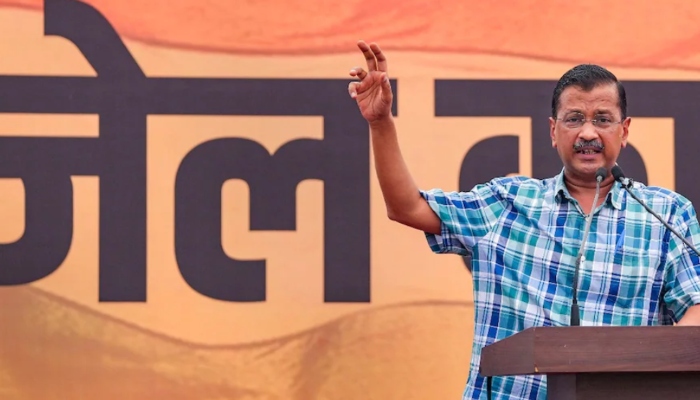
CBI moves to arrest Arvind Kejriwal from Tihar, questions him in excise policy case before presenting before trial court

The Central Bureau of Investigation on Tuesday (25th June) moved to arrest Arvind Kejriwal from Tihar Jail in the Delhi liquor policy case. This happened on the eve of the Supreme Court hearing his petition appealing the Delhi High Court ruling delaying the trial court’s order to give him bail.

As per the reports, the CBI also questioned Kejriwal in this case and granted permission to bring the Delhi Chief Minister before the relevant trial court on Wednesday (June 26), where he is expected to request his custody.

Notably, Kejriwal will appear before the CBI court on Wednesday morning, where he will be detained for further custodial interrogation.

The ED arrested Kejriwal on March 21, stating that the Delhi chief minister diverted money from liquor vendors to support party activities. The Aam Aadmi Party and other opposition parties have said that this case is part of the Narendra Modi regime’s habit of employing central agencies to target opposition figures.

Sanjay Singh, the AAP’s leader, dubbed the CBI’s move a “big conspiracy”. “At a time when there is a cent percent possibility that Arvind Kejriwal will get bail from the Supreme Court, sources have informed me that the Centre is conspiring to register a fake CBI case against the Delhi CM and get him arrested by the CBI. The entire nation can see this and is standing in solidarity with Arvind Kejriwal,” Singh said.

Earlier in the day, the Delhi High Court stayed the trial court’s decision to grant Kejriwal regular bail. According to Justice Sudhir Kumar Jain, the trial court did not fully understand the evidence presented by the Enforcement Directorate (ED). The judge also agreed with Additional Solicitor-General S.V. Raju’s allegation that the Central agency was not given adequate time to argue its stay application.

Advocate Hari Shankar Jain files complaint against Asaduddin Owaisi for saying ‘Jai Palestine’: Here is what articles 102 and 103 say, and how Owaisi could have broken it

Amidst the controversy over the “Jai Palestine” slogan raised by AIMIM MP Asaduddin Owaisi in the Lok Sabha after taking the oath, senior advocate Hari Shankar Jain has filed a complaint against Owaisi seeking his disqualification as an MP.

Taking to X on 25th June, Hari Shankar Jain’s son and lawyer Vishnu Shankar Jain informed that a complaint has been lodged against Owaisi in terms of articles 102 and 103 of the constitution.

“A complaint has been filed before the President of India against Mr. Asaduddin Owaisi in terms of article 102 and 103 of the constitution of india by Mr. Hari Shankar Jain seeking his disqualification as member of parliament,” Jain posted.

What articles 102 and 103 of the Indian Constitution say

Owaisi’s remarks have triggered an outrage over an Indian MP raising slogans hailing another nation in the Indian parliament. This has raised questions about potential disciplinary actions, including disqualification from Parliament.

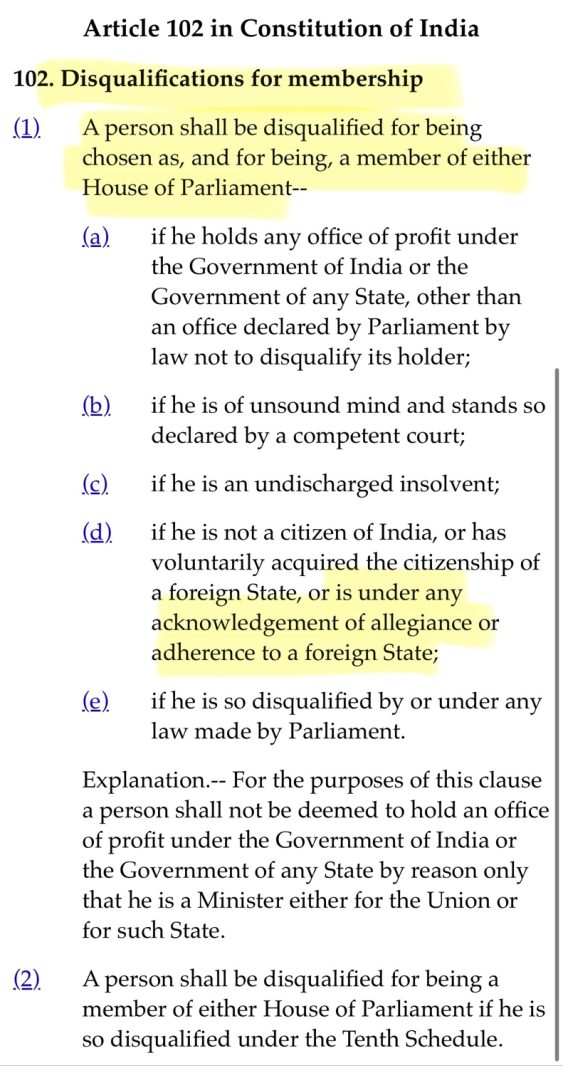
Notably, Article 102 of the Indian constitution states rules pertaining to the disqualification of a Member of Parliament.

Clause 1: This article deals with the disqualifications for membership of either house of Parliament. It states that a person shall be disqualified for being chosen as, and for being, a member of either House of Parliament if:

  • He holds any office of profit under the Government of India or the Government of any State, other than an office declared by Parliament by law not to disqualify its holder.
  • He is of unsound mind and stands so declared by a competent court.

(c) He is an undischarged insolvent.

(d) He is not a citizen of India, or has voluntarily acquired the citizenship of a foreign State, or is under any acknowledgment of allegiance or adherence to a foreign State.

(e) He is so disqualified by or under any law made by Parliament.

Clause 2: A person shall be disqualified for being a member of either House of Parliament if he is so disqualified under the Tenth Schedule.

Notably, the Tenth Schedule of the Constitution also known as the “Anti-Defection Law,” was added by the 52nd Amendment Act in 1985. Its primary purpose is to combat political defections by legislators, which can undermine the stability of governments. It contains Provisions as to disqualification on grounds of defection, exemptions and powers of the Chairman/Speaker of the House in this regard.

Asaduddin Owaisi’s pro-Palestine remarks can be taken into consideration under Article 102 (4) for demonstrating his allegiance or adherence to a foreign State “Palestine”.

“For the purposes of this clause, a person shall not be deemed to hold an office of profit under the Government of India or the Government of any State by reason only that he is a Minister either for the Union or for such State. A person shall be disqualified for being a member of either House of Parliament if he is so disqualified under the Tenth Schedule,” the constitution states.

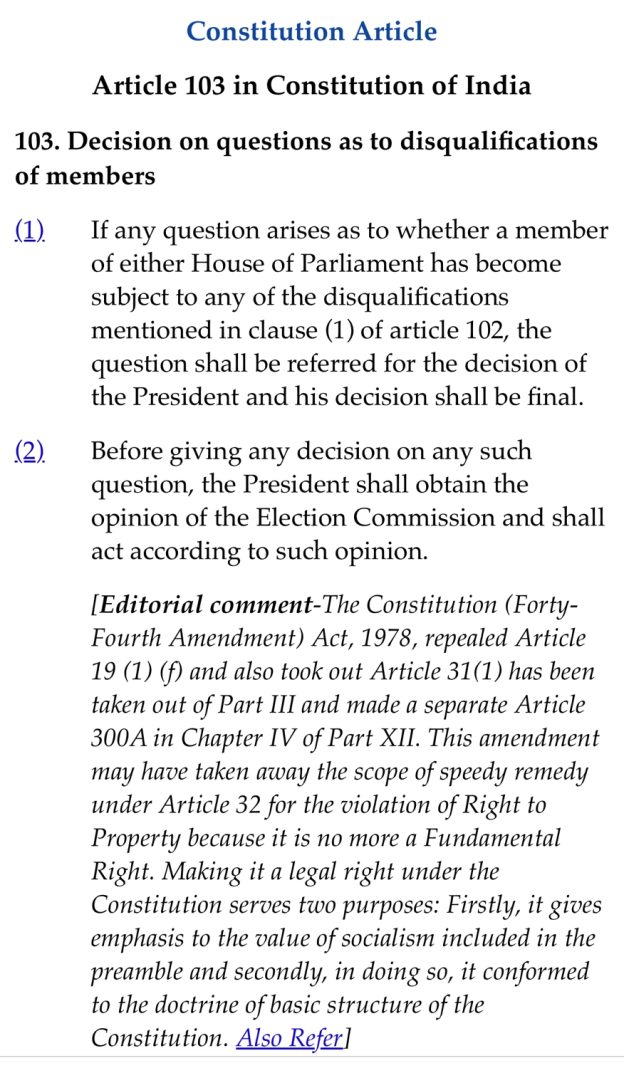
The rules regarding decisions on questions pertaining to the disqualification of an MP are stated in Article 103 of the Constitution. Here is what clauses 1 and 2 of this Article state:

  • Clause 1: This article states that if any question arises as to whether a member of either House of Parliament has become subject to any of the disqualifications mentioned in Article 102, the question shall be referred to the President of India, whose decision shall be final.
  • Clause 2: Before giving any decision on such a question, the President shall obtain the opinion of the Election Commission of India and act according to such opinion.

The controversy erupted on Tuesday when AIMIM MP from Hyderabad, Asaduddin Owaisi took the oath as a Member of Parliament and raised the ‘Jai Palestine’ [hail Palestine] slogan inside the Lok Sabha. After taking the oath, Owaisi said, “Jai Bhim, Jai Meem, Jai Telangana, Jai Palestine”. Asaduddin Owaisi expressed solidarity with Palestine at a time when the territory is engaged in a violent conflict with Israel after the Palestinian terrorist group Hamas launched a brutal attack on Israeli civilians in October last year.

While defending his action, Owaisi asserted that there is no clause in the Constitution prohibiting him from chanting “Jai Palestine”. However, now advocate Hari Shankar Jain has lodged a complaint against Owaisi under the above-discussed sections of the constitution.

Asaduddin Owaisi’s act of raising the “Jai Palestine” slogan after taking his oath is seen as a violation of parliamentary rules. It exemplifies a form of political grandstanding that detracts from the dignity of the parliamentary process. It must be recalled that the same Owaisi had raised strong objections to raising Vande Mataram and Bharat Mata ki Jai slogans. If Owaisi’s action is considered a serious breach of conduct, it could trigger proceedings under Articles 102 and 103. The Speaker of the Lok Sabha could refer the matter to the President, who, after consulting the Election Commission, could decide on the disqualification.

‘He is doing Namaz several times’: Orissa High Court commutes death sentence of Sheikh Asif Ali, who was convicted for rape and murder of a 6 year old girl

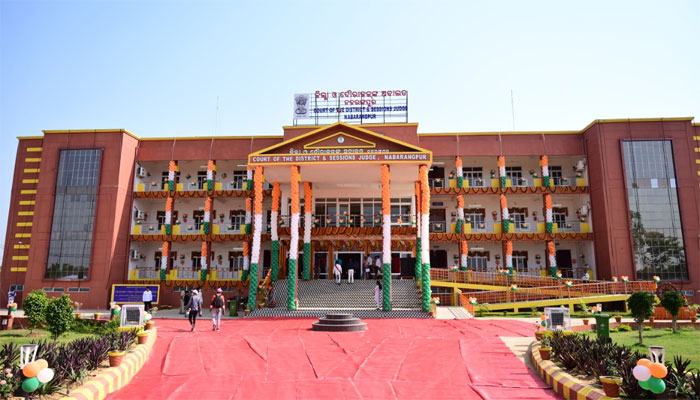
On 20th June, the Orissa High Court commuted the death sentence of Sheikh Asif Ali to life imprisonment from death sentence. Asif is convicted of rape and murder of a six-year-old girl. The court noted in the judgment that Asif was consistently offering Namaz several times a day and he was ready to accept the punishment as “he has surrendered before God”. The court took his readiness to accept his punishment as a sign of remorse and potential to reform.

The Bench comprising of Justice SK Sahoo and Justice RK Pattnaik stated, “The punishment should not be disproportionately great is a corollary and it is dictated by the same principle that does not allow punishment of the innocent, for any punishment over what is deserved for the criminal conduct is punishment without guilt. There is no cogent evidence that the appellant is beyond reform and rehabilitation,” while commuting the death sentence to life imprisonment.

The incident

On 21st August 2014, the young victim and her minor cousin went to buy chocolates at around 2 PM. By 3 PM the girl did not return which worried her family. They called the villagers and initiated a search for her. The 6-year-old was found naked and unconscious in a narrow part of Sheikh Khairuddin’s house. She was rushed to a primary health care centre from where she was referred to SCB Medical College and Hospital in Cuttack. While she was being taken to the hospital, the victim succumbed to her injuries.

The victim’s cousin disclosed later that Sheikh Asif Ali and Sheikh Akil Ali had forcibly taken her away. A complaint in the matter was filed by the victim’s family leading to a case being registered against the accused under Sections 302, 376-D, and 376-A of the Indian Penal Code (IPC) and Section 6 of the Protection of Children from Sexual Offences (POCSO) Act.

During the investigation and based on the postmortem report of the deceased, it was found that the accused in the case gagged the mouth of the deceased and lifted her in arms to take her away. They raped the 6-year-old child and then strangulated her to death.

Trial and Orissa High Court observations

Though the trial court convicted the accused under the said Sections of IPC and POCSO, the Orissa High Court, upon re-examination of evidence and testimonies acquitted Sheikh Akil Ali of all charges due to lack of evidence. In the case of Sheikh Asif Ali, the court said, “The prosecution failed to establish the charge under section 376-D of the IPC against the appellant Sheikh Asif Ali. He is acquitted of such charge but found guilty under sections 302, 376-A of the IPC, and Section 6 of the POCSO Act.”

Rationale for commutation

While commuting the sentence, the Orissa High Court noted that there was a lack of cogent evidence that indicated Asif was beyond reform and rehabilitation. The court emphasised that capital punishment should be reserved for the “rarest of rare” cases where life imprisonment is insufficient.

Despite acknowledging the heinous nature of the minor girl rape, the Court highlighted the circumstantial basis of the case and the absence of premeditation. The court remarked, “Keeping in view the ratio laid down in the decisions discussed above, it is borne out of the record that the offence was committed against a girl child aged about six years in a most horrendous, devilish and barbaric manner, but the case is based on circumstantial evidence and there is no material on record that the crime was committed in a pre-planned manner.”

The court noted, “It seems that both the appellants noticed the deceased in the company of cousin brother while they were returning after purchasing chocolates and then the deceased was lifted away and she was subjected to rape during the course of which she sustained injuries on different parts of her body and her death was due to shock and haemorrhage as a result of injuries to genital track which were fatal in the ordinary course of nature. No harm has been caused to the minor cousin while lifting away the deceased even though the appellants must have been aware that is likely to disclose their misdeeds before the family members and others.”

Punjab: NIA announces rewards of Rs 10 lakh each for information on 2 accused wanted in VHP leader Vikas Prabhakar’s murder case

0

 The National Investigation Agency (NIA) on Tuesday declared a cash reward of Rs 10 lakh each against two wanted accused in connection with the murder of Vishwa Hindu Parishad (VHP) leader Vikas Prabhakar in Punjab.

Harjit Singh alias Laddi, son of Kuldip Singh, a resident of Garpadhana village in Punjab’s Nawanshahr, and Kulbeer Singh alias Sidhu, son of Sukhvinder Singh, a resident of Yamuna Nagar, Police Station Sadar Jagadhari, Haryana, are absconders in the murder case registered on May 9 this year, the NIA said in a statement.

Vikas Prabhakar was shot dead by two unidentified motorcycle-borne men at his shop in Nangal town in Punjab’s Rupnagar district on April 13, 2024. The two assailants entered Bagga’s confectionery shop located near the Rupnagar railway station and opened fire at him and then fled from the scene.

The NIA said that the identities of the informants will be kept a secret in their interest. The agency also shared photos of the duo.

Earlier, on April 16, the Rupnagar Police, in a joint operation with the state special operating cell (SSOC) in Mohali, arrested two Pakistani-backed operatives in connection with this high-profile murder case.

With this, the Punjab police claimed to have solved the murder case within three days. “In a major breakthrough, Rupnagar Police, in a joint operation with SSOC #Mohali, has solved the Vikas Prabhakar Murder Case in less than three days with the arrest of 2 operatives of a terror module backed by #Pakistan-based terrorist masterminds,” the Punjab Police posted on social media platform X.

The two were arrested on April 16 with two weapons- 32 bore pistols, 16 live cartridges, one empty used cartridge, and a TVS Jupiter scooty used in the crime.

From the preliminary investigations, it has been revealed that this is a terror module, operated and funded by Foreign-based handlers operating from Portugal and other places, the police added.

(This news report is published from a syndicated feed. Except for the headline, the content has not been written or edited by OpIndia staff)