

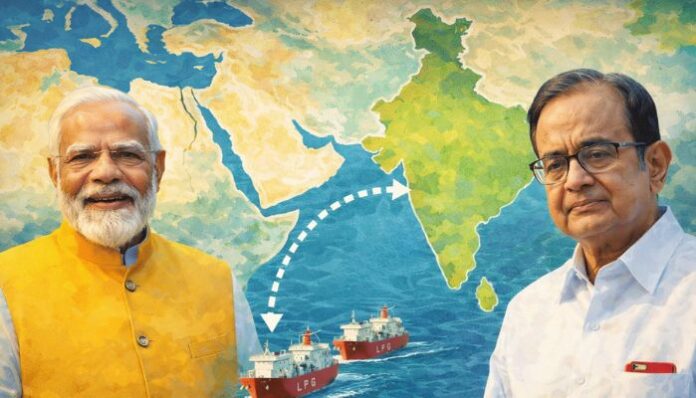
On 18th March, senior Congress leader P Chidambaram cited a “Google generated” estimate to claim that LPG shipments carried by two Indian-flagged vessels were equivalent to merely 1.25 to 1.6 days of India’s cooking gas demand. In a post on social media platform X, he tried to project that the supply was not significant.
GOOGLE generated the following information:
— P. Chidambaram (@PChidambaram_IN) March 18, 2026
Based on reports from March 14-17, 2026, two Indian-flagged LPG carriers, Shivalik and Nanda Devi, successfully crossed the Strait of Hormuz, carrying a cumulative total of 92,700 metric tonnes of LPG.
•Total LPG Carried: 92,700…
In his post, Chidambaram wrote, “GOOGLE generated the following information: Based on reports from March 14-17, 2026, two Indian-flagged LPG carriers, Shivalik and Nanda Devi, successfully crossed the Strait of Hormuz, carrying a cumulative total of 92,700 metric tonnes of LPG. Total LPG carried: 92,700 metric tonnes (each carrying over 46,000 MT). Duration met: this amount is equivalent to approximately 1.25 to 1.6 days of India’s total cooking gas demand.”
However, a closer examination of the numbers and the current supply situation shows that this claim lacks critical context. While the estimate in terms of days of demand is broadly arithmetical, it does not reflect how LPG distribution and buffering operate in practice. To begin with, the two vessels together carried around 92,700 metric tonnes of LPG. When the LPG shortage was projected by the Government of India a few days back, it directed companies to restrict or prioritise supply to essential sectors, excluding supply to hospitals and other critical services.
Later, the Union Government allowed 20% supply to the commercial sector, which is now expected to increase to 30% as per recent reports. Even if one assumes that only 70% of this cargo is meant for domestic consumption, that still amounts to approximately 64,890 metric tonnes, or 64.89 million kilograms of LPG. This translates into roughly 4.57 million standard domestic cylinders of 14.2 kg each.
In practical terms, this is not an insignificant quantity. A standard LPG cylinder of 14.2 kg typically lasts around 25 to 30 days for many households, depending on usage. This means that the domestic share of this shipment alone can support over 4.5 million households for around a month, which can help ease pressure on refill demand and distribution cycles.
Additionally, as reported by Reuters, India currently has adequate crude oil supplies and refined fuel stocks to meet domestic demand. Officials have reiterated that exports will only be allowed if surplus volumes are available, which clearly shows that the government is prioritising internal consumption.
The government is also pushing for a transition towards piped natural gas, which is not facing any supply constraints. Reuters reported that around 120,000 new piped gas connections have already been added in the past two weeks. This shift is going to help reduce dependence on LPG, particularly in urban areas, and ease pressure on cylinder-based supply, which is also widely used in the commercial sector.
This framing reduces the significance of LPG shipments to a simple “days of demand” metric, which can be misleading. Such supplies are not intended to meet the country’s entire requirement in isolation, but to sustain continuity and stabilise supply chains during a period of geopolitical disruption.
