

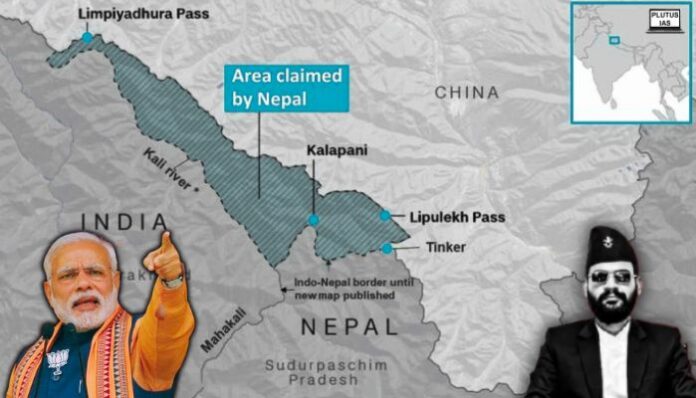
After six years, the Kailash Mansarovar Yatra through the Lipulekh Pass between India and China is set to resume. However, Nepal has raised ‘objections’ and claimed Lipulekh as its own territory. On 3rd May, Nepal’s new PM Balen Shah-led government claimed that the Lipulekh, Kalapani, and Limpiyadhura areas are an integral part of its territory, and therefore, travelling through them is against Nepalese law.
Nepal’s Ministry of Foreign Affairs issued a statement on Sunday, and said that the Government of Nepal firmly maintains its position that Lipulekh, Limpiyadhura, and Kalapani, located east of the Mahakali River, are its inalienable territories based on the 1816 Treaty of Sugauli.
“The Ministry of Foreign Affairs has drawn attention to the questions and concerns raised by various media outlets regarding the Kailash Mansarovar Yatra, which is said to be conducted between India and China via Nepali territory, Lipulekh. The Government of Nepal is completely clear and steadfast in the fact that Limpiyadhura, Lipulekh, and Kalapani east of the Mahakali River are integral parts of Nepal since the Sugauli Treaty of 1816,” it said.
“The Government of Nepal has reiterated its clear stance and concerns to both India and China through diplomatic channels regarding the Kailash Mansarovar Yatra, which is said to be organised via Nepali territory, Lipulekh. Even before this, the Government of Nepal has been continuously urging the Government of India not to carry out any activities such as road construction or expansion, border trade, and pilgrimage in the area,” the Nepali Foreign Ministry continued.
नेपाली भूमि लिपुलेक हुँदै कैलाश मानसरोवर यात्राका विषयमा मिडियाबाट सोधिएका प्रश्नका सम्बन्धमा परराष्ट्र प्रवक्ताको जवाफ
— MOFA of Nepal 🇳🇵 (@MofaNepal) May 3, 2026
🔗:https://t.co/Ho5PWyqYCc pic.twitter.com/uNfN25H2N9
“In addition, it is clarified that even the friendly country of China has been officially informed about the fact that the Lipulekh region is Nepalese territory. The Government of Nepal is always committed to resolving the border issue through diplomatic means, in line with the spirit of the close and friendly relations between Nepal and India, based on historical treaties and agreements, facts, maps, and evidence,” it added.
India, however, promptly responded to Nepal’s baseless claims over Lipulekh, which falls within India’s Uttarakhand.
In a statement, the Ministry of External Affairs said, “In response to media queries regarding claims related to border issues made by the Foreign Ministry of Nepal in the context of the annual Kailash Manasarovar Yatra, the Official Spokesperson said that India’s position in this regard had been consistent and clear. Lipulekh Pass has been a long-standing route for the Kailash Manasarovar Yatra since 1954, and the Yatra through this route has been going on for decades. This is not a new development.”
Our response to media queries regarding comments made by Foreign Ministry of Nepal on border issue in the context of the Kailash Mansarovar Yatra ⬇️
— Randhir Jaiswal (@MEAIndia) May 3, 2026
🔗 https://t.co/ouqMCjhwlb pic.twitter.com/hM7lJgh5Uc
It added, “As regards territorial claims, India has consistently maintained that such claims are neither justified nor based on historical facts and evidence. Such unilateral artificial enlargement of territorial claims is untenable. India remains open to a constructive interaction with Nepal on all issues in the bilateral relationship, including on resolving the agreed outstanding boundary issues through dialogue and diplomacy.
Notably, this is not the first time that Nepal has laid claim to Lipulekh. The neighbouring country has, over the years, been asserting territorial claims. Nepal had raised the issue in August 2025 as well when India declared the restart of commerce through Lipulekh with China.
Lipulekh Pass is located in a tri-junction region claimed by Nepal and India. Nepal incorporates Lipulekh, as well as the nearby Kalapani and Limpiyadhura territories, into its official maps and constitution, claiming them in accordance with the Treaty of Sugauli’s designation of the Kali River as the frontier.
India disputes this claim, claiming that the river originates downstream and hence this land belongs to Uttarakhand.
