

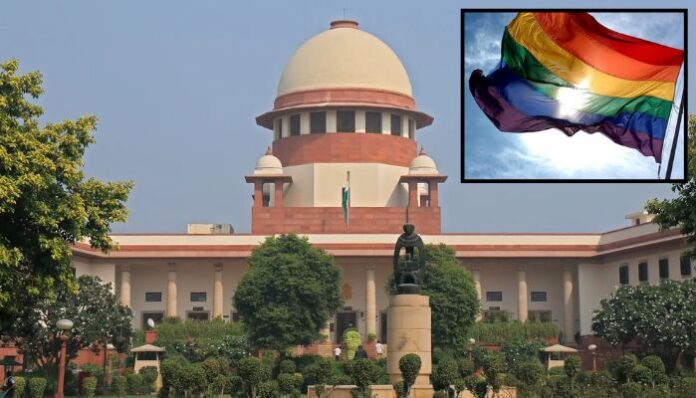
The Supreme Court on Monday, 4th May, took up petitions challenging the newly amended transgender law, and made it clear that it will not put the law on hold for now. A Bench led by Chief Justice of India Surya Kant and Justice Joymalya Bagchi issued notices to all States and said the matter will be heard by a three-judge Bench next.
During the hearing, the Court clearly stated that it is not inclined to grant any interim stay on the law at this stage. “Issue notice. Let notice be issued to all States through their Advocate Generals. The matter shall be initially placed before a 3-judge bench… No question of grant of any interim order… no question of interim stay,” the Bench said.
The Supreme Court has issued notice to the central government and all states on petitions challenging the Transgender Amendment Act 2026. However, the Court refused to grant an interim stay on the law. The CJI stated that the matter will be listed for hearing before a three-judge… pic.twitter.com/lRrx8Mr1Eg
— IANS (@ians_india) May 4, 2026
The law in question received presidential assent on 31st March and brings major changes to the Transgender Persons (Protection of Rights) Act, 2019. It redefines who can be recognised as a transgender person and also introduces stricter punishments for offences like forced gender identity and bodily harm.
Concerns over self-identification
One of the biggest concerns raised by petitioners is that the new law removes the concept of self-identification of gender. Instead, it introduces a requirement for medical certification, which many argue goes against the landmark 2014 NALSA judgment of the Supreme Court.
Senior Advocate AM Singhvi, appearing for some petitioners, told the Court that the amendment restricts a person’s right to identify their own gender. “This Act prohibits this category of self-recognition… if I go to a hospital and say I recognise myself as a particular gender… the hospital could say no, this Act prohibits it,” he argued.
He also said the law effectively goes against the NALSA ruling. “You cannot nullify the judgment… NALSA judgment is nullified, and basis removal is not attempted,” Singhvi added. He urged the Court to stay the law, saying it is affecting people who are already undergoing gender-affirming treatments.
Court raises questions, Centre defends law
However, the Bench questioned whether self-identification could be misused. “In this country of 140 crore people, some can masquerade this facility for the grant of reservations also, isn’t it?” the Chief Justice asked.
Justice Bagchi also pointed out that the amendment changes the basic framework under which the NALSA judgment was delivered. “Self-identification is replaced with medical evaluation,” he noted.
Defending the law, Solicitor General Tushar Mehta said the amendment aims to prevent misuse and curb harmful practices like forced gender changes or illegal procedures.
Widespread criticism and petitions
The new law has already triggered strong reactions from opposition parties and LGBTQIA+ groups. Many activists have said they were not consulted before the Bill was introduced in Parliament.
In fact, two members of the National Council for Transgender Persons, Kalki Subramanium and Rituparna Neog, resigned in protest after the Bill was passed in the Rajya Sabha. Even a Supreme Court-appointed committee had earlier suggested that the government withdraw the Bill.
Several petitions have now been filed against the law, including by activists and organisations working on transgender rights. The Supreme Court will hear the matter in detail before a larger Bench in the coming days.
