

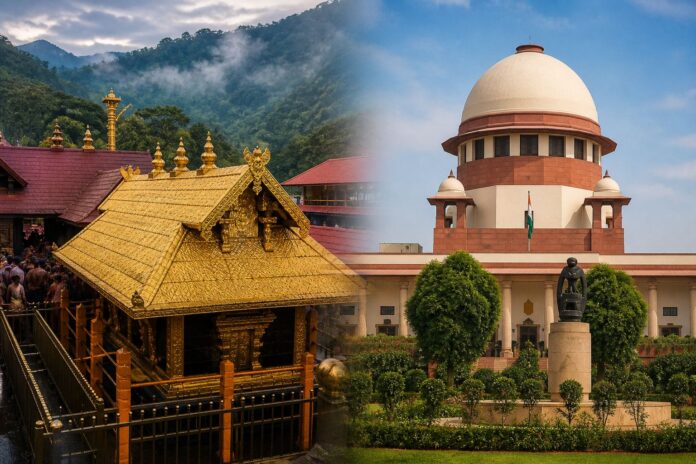
The Supreme Court of India on Tuesday came down sharply on the Indian Young Lawyers Association over its 2006 Public Interest Litigation (PIL) that challenged the long-standing restriction on the entry of women aged 10 to 50 into the Sabarimala Temple. A nine-judge Constitution Bench led by Chief Justice of India Surya Kant questioned both the maintainability of the plea and the association’s locus standi, describing the petition as an “abuse of process of law.”
The bench, which also comprises Justices B.V. Nagarathna, M.M. Sundresh, Ahsanuddin Amanullah, Aravind Kumar, Augustine George Masih, Prasanna B. Varale, R. Mahadevan and Joymalya Bagchi, is currently hearing a batch of matters dealing with the interplay between religious freedom and claims of gender-based exclusion at places of worship.
Proceedings took a pointed turn when Advocate Ravi Prakash Gupta, appearing for the association, submitted that the original PIL had been triggered by four newspaper reports. He maintained that the petition was intended to protect the faith of devotees of Lord Ayyappa rather than undermine it. The bench, however, appeared unconvinced.
Justice B.V. Nagarathna questioned how a juristic entity could claim to represent matters of personal belief, observing that faith is inherently individual and not something an organisation can assert on its own behalf. Justice Aravind Kumar pressed further on procedural legitimacy, asking whether the association had formally authorised the filing of the PIL through a resolution and whether it had been duly signed by its office-bearers.
CJI Surya Kant also raised direct questions about the association’s standing, asking why it had chosen to intervene in a matter rooted in religious practice and whether it could claim any representative authority in such issues.
The bench went on to suggest that the association’s energies would be better directed toward professional causes within the legal community. Justice Nagarathna underscored the need for organisations of young lawyers to focus on strengthening the bar, particularly by supporting practitioners from rural areas who face structural disadvantages in accessing higher courts.
The ongoing proceedings form part of a broader constitutional review of the limits of judicial intervention in religious customs. The issue traces back to the landmark 2018 verdict, when a five-judge Constitution Bench, by a 4:1 majority, struck down the restriction on the entry of women of menstruating age into Sabarimala, holding the practice to be unconstitutional.
During the latest hearing, counsel for the association also referred to the views of the temple’s tantri regarding the deity’s traditions and raised objections to certain judicial observations about the constitution of the nine-judge bench.
The matter remains under consideration, with the court continuing to examine how constitutional guarantees of equality intersect with the autonomy of religious denominations.
