

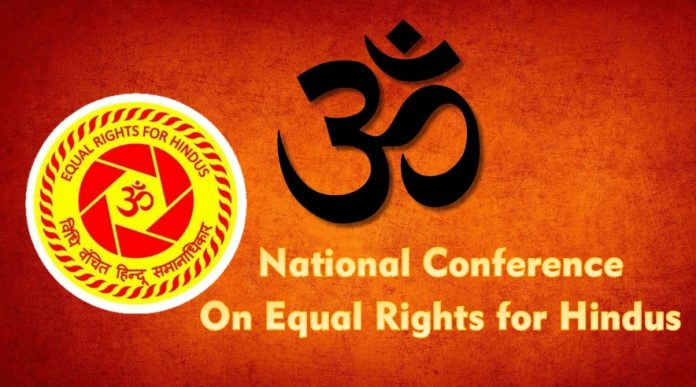
A National Conference on Equal Rights for Hindus will be organized by the Hindu Charter on the 21st of September in Delhi with the objective of preparing a draft Resolution and Constitution (Amendment) Bill for the amendment of articles 12, 15, 19, 25 to 30.
The National Conference for #EqualRightsForHindus is just the pehla padaw of a long Yatra, which we have to undertake together to ensure that India, that is Bharat, truly remains Bharat. We look forward to your presence, participation, engagement and encouragement. ? pic.twitter.com/XPFlwQewZF
— #EqualRightsForHindus??? (@DimpleAtra) September 19, 2019
The discussion will focus on six topics pertaining to the discourse. These are, Rights of citizenship of persecuted adherents of indigenous religions of India, Organized Conversions Subverting the Religious Character of the Indian Society and Civilisation, Selective Undue Interference by the State & Judiciary in Customs and Practices of Hindus, Control and management of Hindu Temples & Religious Institutions and misappropriation of their properties for secular purposes by the Indian State, Indian State Facilitating Conversion of Hindus by Sectarian Public Funding, Indian State Hindering Inter-Generational Transmission of Ancient Civilizational Knowledge, and Fragmentation of Hindu society by denying Hindus the Right to administer Educational Institutions without Undue State Interference.
As is apparent, the Conference will focus on the ‘core issues’ related to the sustenance and the continued existence of the Hindu Civilization. The delegates involved in the discussions will emphasize the institutional discrimination faced by Hindus in our country. Most of these issues pertain to laws passed during the Congress era which effectively denied Hindus equal rights with respect to minority religious communities in India.
The organizers state explicitly that it is an Advocacy and Activist Conference. Hence, “the panelists have a higher responsibility to unequivocally articulate the issues for formulation of actionable policy and legislative suggestions.” As for the format of the discussions, it “will be akin to the time tested avadhana prakriya, with the panelists acting as avadhanis and the delegates performing the role of pruschakas (questioners).”
One of the objectives of the Conference is to “raise awareness about these civilizational issues, so that more and more people are informed of the deep discrimination of existential concern for our indigenous religions (such as Hinduism, Buddhism, Jainism, Sikhism), culture and our ancient civilization which are primarily informed by Sanatana Dharma.”
The Hindu Charter requests the government to “treat us Hindus equally by giving equal rights and freedoms on par with those of religious minorities by upgrading our constitutional status by amendment of articles 12, 15, 19, 25-30.” It states that “India being the only State with Hindu majority and the only homeland for adherents of indigenous religions of India,” it has a “civilizational responsibility towards the indigenous religions and its adherents. However, India, in all these years has shown an inexplicable reticence in discharging its civilisational responsibility of helping millions of Hindus, Buddhists, Jains and Sikhs from genocidal religious persecution in other countries.”
The Hindu Charter also expressed their gratitude towards the Prime Minister Modi, Home Minister Amit Shah, the RSS and the BJP for the abrogation of Article 370, one of the core demands of the Hindu Charter.
The discussions will be live-streamed on the youtube channel of Hindu Charter. It can be watched on Saturday here.


