

While several Pakistani Hindu migrants across the country have been celebrating and lauding the passing of the historic Citizenship Amendment bill, which has brought their lost hope back, many members belonging to various Muslim organisations, who have been protesting against the Bill, have taken to the streets across India in a post-Friday namaz protest today.
Organisations like the Jamaat-e-Islami Telangana and Odisha units and the Jamiat-e-Ulama Telangana and Andhra Pradesh units criticised the Citizenship Amendment Bill, 2019, which became law post Presidential assent after getting a clear passage in the Rajya Sabha and Lok Sabha on Wednesday and Monday respectively, as discriminatory and unconstitutional.
Protests against the CAB were planned soon after Friday prayers across mosques in the State and other various parts of the country.
Hamed Mohammed Khan, president, Jamaat-e-Islami Telangana and Odisha units, on Thursday, said Friday khutbas (sermons) on CAB were prepared and would be delivered in mosques under its control. Soon after Friday prayers, members of the organisation, its supporters and those against the CAB would take to the streets and demonstrate peacefully.
“Protesters will wear black bands, carry black flags and signs, will stand outside, and protest silently and peacefully. On Sunday, we propose to organise a dharna and public meeting at Dharna Chowk, where we will inform the people of the CAB and its nature,” Khan said.
Following the direction, protests were launched in Uttar Pradesh’s Saharanpur district, where various people from the Muslim community opposing the bill took to the streets after the Friday prayers. Internet services were shut down in Aligarh and Saharanpur following the large-scale protests.
Students of the Aligarh Muslim University and members of the Jamait-e-Ulama Hind had also staged protests against the new law.
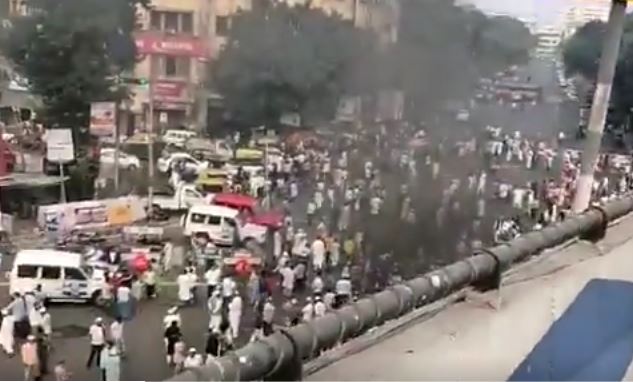
West Bengal’s Kolkata was also not left behind. Many protestors gheraoed Kolkata’s Park Circus area, which is predominantly a Muslim area, after their Friday Namaz to stage protest against the contentious bill.
A tweeter user shared a video taken from Kolkata’s Maa Flyover overlooking Park Circus, where people collected in large numbers protesting against the Citizenship Amendment Bill (CAB).
@pokershash pic.twitter.com/hzEmyjZQGQ
— kavitasharma?? (@krs1178) December 13, 2019
A similar protest in West Bengal’s Murshidabad area turned violent after protestors pelted stones on an ambulance and vandalised the Beldanga station, situated beside National Highway 34 at Beldanga in Murshidabad district in West Bengal.
Anti-CAB protest turns violent in #Bengal. In Murshidabad stones pelted on an ambulance. Beldanga station vandalised by protesters. Muslim organisations had given protest call across the state after Friday prayers today pic.twitter.com/bdDyAIwEAc
— Indrojit | ইন্দ্রজিৎ (@iindrojit) December 13, 2019
Though this time these post-Friday prayer protests have been tucked away behind the pretext of CAB, violence after Friday Muslim prayers are not uncommon. History has it, how the Friday namaz has been, often seen turning into mass violence.
On April 25, last year, we had reported how a large mob speculated to be numbering into a thousand, went on a rampage following the Friday Namaz Prayers in Madhya Pradesh’s Burhanpur town. In order to restore peace, the police proceeded to lathi charge the violent youths.
Similarly, in August last year, the police had to fire at a mob in Aligarh which was resorting to incessant stone-pelting after Friday prayers. Post-Eid prayers too had seen intense violence in July 2017 when a large mob decided to attack a police station in Meerut, Uttar Pradesh.
In 2012, Lucknow had witnessed one of the biggest mayhem when a mob, numbering about 500, went berserk and indulged in large-scale violence, targeting media persons in particular and even beating up several bystanders who were caught unawares after the Alvida namaz (on the last Friday of Ramzan). The mob also had vandalised a statue of Lord Mahavira.
A lot more such incidents have been rampant in the valley of Jammu and Kashmir too.


