

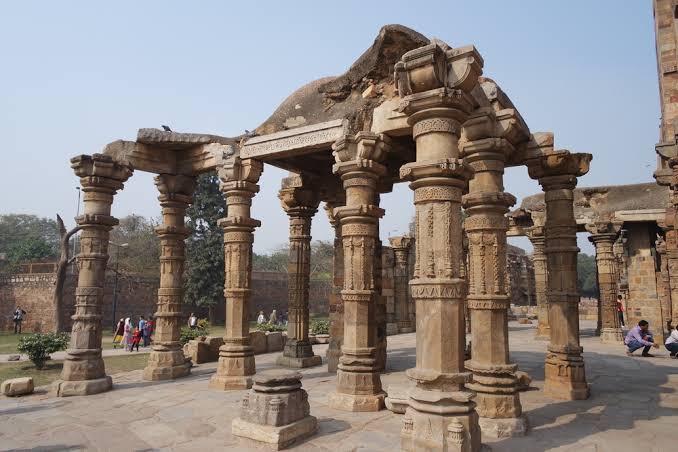
After the landmark judgment in the Ayodhya Dispute which handed over the right to Hindus to build a Ram Mandir in Ayodhya, and with a legal battle ensuing in Kashi-Mathura, a lawsuit has been filed in national capital Delhi, seeking ‘right to worship’ at Delhi’s iconic Qutub Minar.
Plea seeks declaration that principal deity Tirthankar Lord Rishabh Dev and principal deity Lord Vishnu, along with Lord Ganesh, Lord Shiva, Goddess Gauri, God Sun, Lord Hanuman including presiding deities of 27 temples, pic.twitter.com/BiSJ1U7Att
— Live Law (@LiveLawIndia) December 9, 2020
The case filed at Delhi’s Saket Court seeks restoration of Hindu and Jain deities and the right to worship them within the temple complex situated inside the Qutub Minar at Mehrauli.
Petition seeks the right to worship of Hindu and Jain deities inside Qutub Minar complex
The petition prayed for the declaration of principal deity Tirthankar Lord Rishabh Dev and principal deity Lord Vishnu, along with Lord Ganesha, Lord Shiva, Goddess Gauri, God Surya, Lord Hanuman, including presiding deities of 27 temples who have the right to be restored and worshipped with proper rites and rituals, performance of regular pooja within the temple complex situated in the area of Qutub Minar complex.
According to news agency PTI, the matter came up for hearing before Civil Judge Neha Sharma, who fixed the next date of hearing on December 24.
Qutubudin Aibak destroyed Hindu and Jain temples, along with their deities: petition
“Qutubdin Aibak, a commander of Mohammed Gauri dismantled/ destroyed Shree Vishnu Hari temple and 27 Jain and Hindu temples along with constellations of respective deities and raised some inner constructions within the temple complex,” the plea said.
The petition further stated that Qutubdin Aibak did not completely demolish the existing temples and build Quwwatul Islam Masjid by using materials from the temples, adding that there are still pictures of Hindu gods and deities like Ganesh, Vishnu, Yaksha and symbols like Kalash, temple wells and sacred lotus in the mosque.
“Only the faces of gods and deities are defaced, the rest of the sculptures are identifiable. The corridor is completely of Vedic style having rectangular galleries with holy symbol engraved pillars,” the petitioner said.
Petitioner demands the court to create a trust to hand over the management and administration
The petitioner has sought a mandatory injunction directing the Central government to create a trust, according to the Trust Act, 1882, and hand over the management and administration of the temple complex situated within the area of Qutub complex.
“Decree be passed in the nature of mandatory injunction, directing the Trust, to be created by Central government, to manage the affairs of 27 Hindu and Jain temples with iron pillar, in accordance with the scheme of administration framed by the Central government,” the petition said.
The litigant also sought a decree to be passed in the nature of permanent injunction, restraining the defendants permanently from interfering in making necessary repair works, raising construction and making arrangement for pooja, darshan and worship of deities.


