

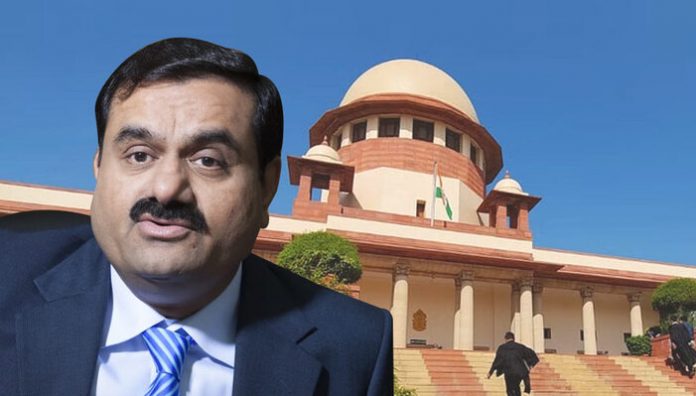
On Friday, February 17, the Supreme Court turned down the Centre’s suggestion in a ‘sealed cover’ regarding a proposed panel of experts recommending steps to tighten regulatory measures in order to minimise any loss to Indian investors due to market volatility, as witnessed during the Adani-Hindenburg row.
A bench comprising of the Chief Justice of India (CJI), DY Chandrachud, and Justices PS Narasimha and JB Pardiwala decided against accepting the government’s sealed cover proposal stating that since the issue demands ‘full transparency’, doing so may give the impression that the committee was appointed by the government and the matter was kept away from the other side.
CJI Chandrachud remarked, “We will not accept the sealed cover suggestion by you because we want to maintain full transparency. Also, if we take recommendations in a sealed cover, it will appear as though we have kept them secret because the people will assume that it is a government-appointed committee.” The SC bench stated that if the suggestions made by the Centre are accepted they must be disclosed to the other side in order to maintain transparency.
“We will appoint the committee and its members on our own,” the bench said. Additionally, the Court made it clear that it would not name a sitting judge to the committee to look into the matter. The Central Government’s argument that the report’s impact on the market was negligible was also dismissed by the Court.
Four petitions regarding a report written by short-seller Hindenburg Research, alleging conglomerate fraud that cost the Adani Group losses of over $100 billion in market value, were being heard by the court.
Nathan Anderson, the founder of Hindenburg Research, and his associates in India were the subject of a FIR filed by advocate Manohar Lal Sharma with the SEBI and the Union Home Ministry. Sharma also submitted an application for a gag order to restrict media coverage about publicly traded firms unless they are first submitted to and approved by the SEBI.
Advocate Vishal Tiwari requested that a commission led by a former judge of the highest court conduct an investigation of the Hindenburg report. Moreover, Tiwari has sought the formation of a special committee to monitor a procedure for approving loans worth more than 500 crores.
Congress leader Jaya Thakur in her petition questioned the decisions of the State Bank of India (SBI) and the Life Insurance Corporation (LIC) to purchase Adani shares at allegedly inflated rates and called for the prosecution of the Adani group of companies under relevant laws.
Thakur further requested that a judge on the Supreme Court conduct the investigation. A plea filed by one Anamika Jaiswal was also heard today.
Notably, on Monday, the Centre had agreed to the top court’s recommendation to form a panel of experts to look into strengthening the regulatory procedures for the stock market in the wake of the share price drop in the Adani Group stocks, which was precipitated by a report by Hindenburg Group over claims of “stock manipulation”. Nonetheless, the Adani group has vehemently denied any wrongdoing.
Tushar Mehta, presenting on behalf of the Centre and SEBI, stated that the market regulator and other statutory authorities are prepared to address the current situation caused by the Hindenburg report.
“The government has no objection to forming a committee. Yet we can make suggestions on the committee’s mandate. Mehta The law enforcement officer stated, “We can provide names in a sealed cover.”
Mehta added that any “unintentional” message during the panel’s setup could have a detrimental impact on the flow of money.


