

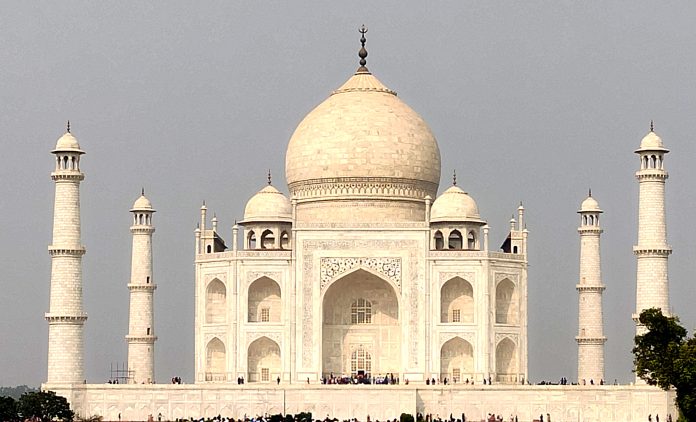
The Delhi Court on Friday ordered the Archaeological Survey of India (ASI) to review a representation filed by the Hindu Sena organisation which sought instructions to publish the “correct history” of the Taj Mahal. The petition filed by Hindu Sena claims that the Taj Mahal was not built by Mughal ruler Shah Jahan, and therefore the correct history of the monument should be published.
The Public Interest Litigation (PIL) arguing that Raja Man Singh and not Mughal Emperor Shah Jahan was the one who constructed the Taj Mahal was heard by a bench consisting of Chief Justice Satish Chandra Sharma and Justice Tushar Rao Gedela. The court disposed of the plea by referring the matter to ASI.
The petitioner has already submitted an appeal with similar prayers to the Supreme Court, the Bench observed. Subsequently, the outfit was asked by the highest court to submit a representation before the ASI. The High Court was notified that the ASI has not yet made a determination regarding the same and asked the government agency to investigate the claim.
The Taj Mahal was refurbished by Shah Jahan after it was originally the palace of Raja Man Singh, according to the petition filed by Hindu Sena President Surjit Singh Yadav. He consequently requested that “historically incorrect facts” about the building of the Taj Mahal be taken out of historical accounts by the ASI, the Central government, the National Archives of India and the government of Uttar Pradesh.
The PIL further demanded that the ASI should be given instructions to conduct an inquiry into the existence of Raja Man Singh’s residence and the age of the ivory-white marble mausoleum. The petitioner stated that he conducted “deep study and research” on the Taj Mahal and that it is crucial to remove historical errors and provide the public with accurate information about the structure.
He cited ZA Desai’s book “Taj Museum” which describes how a “lofty and beautiful” location was chosen for Mumtaz Mahal’s interment. He maintains that at the time of the burial, Raja Jai Singh, the grandson of Raja Man Singh, was in possession of this mansion or manzil. The petitioner stressed that this home was never dismantled. According to him, the Taj Mahal’s current design is nothing more than “a modification, renovation and refurbishment of the mansion of Raja Man Singh which already existed.”
The plea emphasised, “Further, the book titled Taj Museum mentions that the dead body of Mumtaz Mahal was interred under a temporary domed structure within the land premises of Raja Jai Singh. It is pertinent to mention that there is no account which states that the mansion of Raja Man Singh was demolished to construct Taj Mahal.”
The petitioner was represented by attorneys Mahesh Kumar and Shashi Ranjan Kumar Singh.


