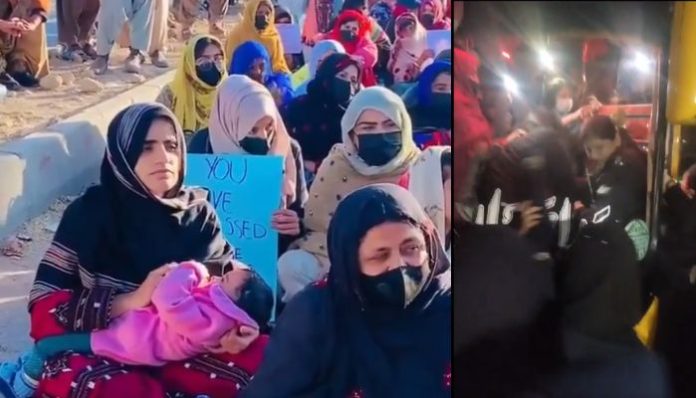
The Islamabad Police have released the detained women protesters after enduring 26 hours of alleged humiliation, harassment, and torture on the 28th day of the movement against the Baloch Genocide.
The Baloch Yakjahti Committee took to social media to share the distressing experience faced by the detained women while urging the Baloch nation to persist in their protests against the treatment of protesters in Islamabad.
Despite the release of the female activists, concerns linger as more than 200 male associates remain in custody. Reportedly, 162 of them have been shifted to Adiala Jail, while over 50 others are detained in various police stations across Islamabad.
The Baloch Yakjahti Committee expressed its determination to continue the movement against Baloch Genocide and extra-judicial abductions. “We shall continue our movement against Baloch Genocide and the extra-judicial abductions. The next step would be announced tomorrow through social media, stay tuned,” the Baloch Yakjahti Committee declared in a social media post.
The Long March, organised by the Baloch Yakjahti Committee, initially began as a protest against the Baloch genocide, triggered by the extrajudicial murder of four young Baloch individuals in district Kech. The march traversed various districts of Balochistan and Punjab, encountering severe brutality upon reaching Islamabad.
The Baloch Human Rights Council expressed deep concern over the “inhuman and brutal response” of the Islamabad police and the interim government. The council condemned the actions of the police, accusing them of beating and arresting Baloch activists, as well as targeting elderly men, women, and children participating in the march.
“These individuals seek justice for their loved ones who have been forcibly disappeared from different parts of Pakistan,” the Baloch Human Rights Council stated in a social media post. The council called for a condemnation of the use of brute force and urged the Pakistani authorities to uphold their pledge to respect human rights instruments.
“Instead of resorting to the use of brute force, the authorities in Pakistan should uphold their pledge to respect the human rights instruments they are signatories to, thereby ensuring justice for the victims and holding accountable those responsible for crimes against the Baloch,” the council added on X.
(This news report is published from a syndicated feed. Except for the headline, the content has not been written or edited by OpIndia staff)